Well, it's been awhile since I've used this intro so let's dust it off. I watch way more movies than I probably should to the point I feel like I've kinda run out of older, good movies. I can find plenty of bad ones! But use that old sticktuitiveness (that's a word, right?) and keep looking. You will find some gems out there, some forgotten classics, or at least something mildly entertaining. That was 1970's The Mind of Mr. Soames for me, a movie I'd never even remotely heard of but ending up enjoying a lot.
At an isolated English manor, an extremely risky medical procedure is about to be performed, something that has never seemingly been done before safely. During its birth some 30 years earlier, damage was done to an infant boy's brain, putting him into a coma he never awoke from. Now, that man, John Soames (Terence Stamp), is just turning 30 and two doctors, Bergen (Robert Vaughn) and Maitland (Nigel Davenport), intend to wake him up. The risky procedure works, but that's only the start of things. Soames never had a chance to grow up even though he has the body of a full-grown adult. What to do? Well, Soames exhibits all the characteristics of an infant so Doctors Bergen and Maitland have to teach him literally how to be a person. Their methods differ though and threaten to cause a riff. How do you teach a 30-year old man about...well, everything? Their work is cut out for them, and nothing will come easily.
What a cool, interesting movie. And yes, to reiterate, I'd never heard of it in the least. Aired recently on Turner Classic Movies a few weeks ago as part of a Robert Vaughn-themed night, I gave it a shot. I'm glad I did although I will say I was heading into a different movie than I got. Just looking at the cast and watching the first few minutes of the flick, I thought I'd stumbled into a horror thriller from Hammer Films. I was wrong. From director Alan Cooke, 'Soames' is far more of a low-key thriller early on that morphs into a darker, more sinister psychological thriller in its second half. Definitely worth seeking out though.
For starters, the trio at the top pulled me in here, Vaughn, Stamp and Davenport. By 1970, Vaughn was the most established star by far in both film and television, Davenport was a recognizable face and a very reliable character actor and Stamp the up and coming star. These are three incredibly interesting performances, all for different reasons. Vaughn and Davenport get to play off each other and do it incredibly well. We've got two incredibly gifted, talented doctors who are also convinced of their own methods. Vaughn's Bergen is more sympathetic, wanting the infant 30-year old to grow up and learn in a nurturing, more natural environment. Davenport's Maitland is more rigid, wanting Soames to learn, learn and LEARN and then maybe have some fun. The script pretty obviously shows which one they think is right (cough Vaughn cough Davenport is always evil cough), but the two actors do a good job bringing that friction to life.
And then there's that third guy, Terence Stamp. Still a relative newcomer to feature films, Stamp had starred in a handful of movies since making his screen debut in 1962's Billy Budd and Term of Trial. Here, it's just a quality, intriguing and interesting performance. As is usually the case with roles similar to this (disabilities of any sort, mental or physical), there's always the potential to be over the top, ridiculous, forced, even hammy. Stamp manages to avoid all of those potential disasters. He's believable, sympathetic and is always interesting. The range of the character goes from an infant who can't speak and has absolutely no concept of the world to a young boy, maybe four or five who can speak and is slowly beginning to grasp things. Still, how do you explain the entire world to an individual who's 30 years behind? An emotionally effective performance, one that balances the drama and some laughs mixed in as Soames "grows up" in some sorts.
Also look for Christian Roberts as the TV personality who with a crew is taping the first few months of Soames' life for a TV special and Donal Donnelly as Allan, another doctor at the manor in the English countryside working with Soames and maybe the one who's closest to the childlike 30-year old.
As I watched 'Soames,' all I could think of was how similar at times it is to 1968's Charly, starring Cliff Robertson in an Academy Award-winning role. Both films take similar outlooks on life, stories about people deemed "different" because they aren't cookie-cutter in appearance or personality or behavior. It was cool to read then that the same studio that made 'Soames' had previously tried to buy the rights for Flowers for Algernon, the novel that became Charly. As for our movie here, I liked it a lot, intriguing to the end. I thought I had the ending pegged but I was off in the finale-predicting department. What could have been an absolute whopper of an ending is still pretty good but it taps the brakes a bit rather than going for a knockout blow. Still, an excellent, little-known flick that is definitely worth tracking down.
The Mind of Mr. Soames (1970): ***/****
The Sons of Katie Elder
"First, we reunite, then find Ma and Pa's killer...then read some reviews."
Showing posts with label Robert Vaughn. Show all posts
Sunday, July 12, 2015
Thursday, May 22, 2014
The Delta Force
Here's a universal truth for you that just about everyone can agree about. Chuck Norris is in fact, an amazingly bad ass movie star. His movies aren't always that great -- sometimes they're not even good, sometimes they're truly bad -- but through it all, Chuck Norris and all his awesome facts, is one cool dude. I haven't seen many of his movies, but I do my best to catch up with them, like 1986's The Delta Force, loosely based on the true story of real-life 1985 hijacking of TWA Flight 847.
Flying out of Cairo with scheduled stops at Athens, Rome and New York City, ATW Flight 282 takes off with 100-plus passengers on-board. Not too long after takeoff, terrorists from the New World Revolutionary Organization led by a man named Abdul (Robert Forster) hijack the plane, starting a chain of events as the plane tries to find a landing site to deal with the terrorists and all their hostages. While the terrorists' demands are up in the air, an elite American special forces out, the Delta Force, led by Colonel Nick Alexander (Lee Marvin) and his second-in-command, Major Scott McCoy (Norris), is scrambled to help rescue the hostages. Can the Delta Force get their in time and rescue the hostages in time against nearly insurmountable odds as the terrorists prep to go out in a blaze of glory?
What an odd, weird movie. From director Menahem Golan (who co-wrote the script with James Bruner), 'Delta' was filmed on-location at a new studio in Jerusalem, the GG Israel Studios. The Israeli locations are pretty cool, adding an authentic look and feel to the story. Now with that said, it's a big old mess of a flick with some -- if not enough -- entertaining qualities. It mixes touches of disaster movies, action heavy shoot 'em ups and plenty of patriotic flag-waving, bouncing back and forth among the different angles. It's almost schizophrenic, never finding a rhythm. We go from on-board hostages to diplomatic and government situations, airport to Delta Force, hostages to terrorists. I felt like key parts of the story that explain what went on are completely missing. Title cards try and explain how and when and where, but there seems to be chunks completely cut away. Different segments with no real unifying link.
Instead of that focus on story and character and plot development, 'Delta' rides on one thing; Chuck Norris' awesomeness. That's it. That's all. Unfortunately, he's kept in the background for most of the first hour of the movie.When his McCoy is on-screen, Norris makes the most of it, his experienced Delta Force leader worn down by the horrors of fighting. That said, he sure embraces that whole fighting thing. The last 45 minutes (more on it later) are one scene after another where Norris' McCoy goes all America on some terrorist ass. He jumps off buildings, shoots, punches, and stabs countless terrorists while riding a motorcycle rigged with seemingly infinite rockets and missiles. In another way of showing how cool he is, McCoy typically likes to enter or leave a room by jumping through a window, opening the door for all sorts of badass entrances. Great drama it is not, but in the badass department, 'Delta' succeeds thanks to Norris.
In his last movie before his death a year later in 1987, Marvin is as cool as ever as Col. Alexander, the no-nonsense, smart-ass Delta Force leader, always ready with a quick shot from the hip or a snappy one-liner. Their scenes aren't too long, but Marvin and Norris are an excellent team together. Who else to look for? How about Robert Vaughn as the Delta Force commander back in Washington D.C. Oh, and some of the hostages? George Kennedy, Martin Balsam, Shelley Winters, Joey Bishop, Lainie Kazan, and a young Kim Delaney as a nun with Bo Svenson as the pilot of the hijacked jet airliner. Not a bad cast by any means, just the opposite, but the disjointed story doesn't give most of them a chance to do anything. George Kennedy manages to rise above the story, as do Balsam and Svenson.
If you can make it to the last 45 minutes, you'll be rewarded. It's almost non-stop from there until the final scene, making up for the slowish first 80 minutes and its schizophrenic nature that's all over the freaking place. In general, it's a pretty cheesy 1980s action movie with all sorts of good cliches and stereotypes. The Delta Force theme is unintentionally funny -- nice work from composer Alan Silvestri -- with an almost pleasant, light-hearted feel to it. Listen HERE if curious. You almost expect to be played over a sports movie montage.
Not a bad movie, not necessarily a good movie either, but entertaining enough. Cool cast that isn't used to its potential, but Marvin and Norris make it worthwhile.
The Delta Force (1986): ** 1/2 /****
Flying out of Cairo with scheduled stops at Athens, Rome and New York City, ATW Flight 282 takes off with 100-plus passengers on-board. Not too long after takeoff, terrorists from the New World Revolutionary Organization led by a man named Abdul (Robert Forster) hijack the plane, starting a chain of events as the plane tries to find a landing site to deal with the terrorists and all their hostages. While the terrorists' demands are up in the air, an elite American special forces out, the Delta Force, led by Colonel Nick Alexander (Lee Marvin) and his second-in-command, Major Scott McCoy (Norris), is scrambled to help rescue the hostages. Can the Delta Force get their in time and rescue the hostages in time against nearly insurmountable odds as the terrorists prep to go out in a blaze of glory?
What an odd, weird movie. From director Menahem Golan (who co-wrote the script with James Bruner), 'Delta' was filmed on-location at a new studio in Jerusalem, the GG Israel Studios. The Israeli locations are pretty cool, adding an authentic look and feel to the story. Now with that said, it's a big old mess of a flick with some -- if not enough -- entertaining qualities. It mixes touches of disaster movies, action heavy shoot 'em ups and plenty of patriotic flag-waving, bouncing back and forth among the different angles. It's almost schizophrenic, never finding a rhythm. We go from on-board hostages to diplomatic and government situations, airport to Delta Force, hostages to terrorists. I felt like key parts of the story that explain what went on are completely missing. Title cards try and explain how and when and where, but there seems to be chunks completely cut away. Different segments with no real unifying link.
Instead of that focus on story and character and plot development, 'Delta' rides on one thing; Chuck Norris' awesomeness. That's it. That's all. Unfortunately, he's kept in the background for most of the first hour of the movie.When his McCoy is on-screen, Norris makes the most of it, his experienced Delta Force leader worn down by the horrors of fighting. That said, he sure embraces that whole fighting thing. The last 45 minutes (more on it later) are one scene after another where Norris' McCoy goes all America on some terrorist ass. He jumps off buildings, shoots, punches, and stabs countless terrorists while riding a motorcycle rigged with seemingly infinite rockets and missiles. In another way of showing how cool he is, McCoy typically likes to enter or leave a room by jumping through a window, opening the door for all sorts of badass entrances. Great drama it is not, but in the badass department, 'Delta' succeeds thanks to Norris.
In his last movie before his death a year later in 1987, Marvin is as cool as ever as Col. Alexander, the no-nonsense, smart-ass Delta Force leader, always ready with a quick shot from the hip or a snappy one-liner. Their scenes aren't too long, but Marvin and Norris are an excellent team together. Who else to look for? How about Robert Vaughn as the Delta Force commander back in Washington D.C. Oh, and some of the hostages? George Kennedy, Martin Balsam, Shelley Winters, Joey Bishop, Lainie Kazan, and a young Kim Delaney as a nun with Bo Svenson as the pilot of the hijacked jet airliner. Not a bad cast by any means, just the opposite, but the disjointed story doesn't give most of them a chance to do anything. George Kennedy manages to rise above the story, as do Balsam and Svenson.
If you can make it to the last 45 minutes, you'll be rewarded. It's almost non-stop from there until the final scene, making up for the slowish first 80 minutes and its schizophrenic nature that's all over the freaking place. In general, it's a pretty cheesy 1980s action movie with all sorts of good cliches and stereotypes. The Delta Force theme is unintentionally funny -- nice work from composer Alan Silvestri -- with an almost pleasant, light-hearted feel to it. Listen HERE if curious. You almost expect to be played over a sports movie montage.
Not a bad movie, not necessarily a good movie either, but entertaining enough. Cool cast that isn't used to its potential, but Marvin and Norris make it worthwhile.
The Delta Force (1986): ** 1/2 /****
Tuesday, May 6, 2014
The Magnificent Seven
Why
do some movies stick with you more than others? I grew up watching
westerns and war movies from the 1950s and 1960s, movies that still
dominate my all-time Top 10, movies like The Alamo, The Great Escape,
The Dirty Dozen, The Good, the Bad and the Ugly, The Professionals and
several others. They still resonate now more than a few years later. Oh,
and of course, 1960's The Magnificent Seven.
Several years back I reviewed all four movies (the original and the 3
sequels), and it's been too long. Time for an updated review. The
original and still best, one of the best westerns ever and a personal
favorite.
South of the border in a small farming village, a bandit named Calvera (Eli Wallach) rides in and steals almost everything he and his gang of 40 bandits can carry, leaving just enough for the village to survive and start all over again. The villagers decide they've had about enough, riding north into Texas to buy guns so they can fight back against Calvera's gang. Instead, they meet Chris (Yul Brynner), a mysterious gunfighter clad in black who recommends they hire men rather than buy guns. Chris agrees to help, recruiting six other gunfighters from varying backgrounds, including an amiable drifter and gunfighter, Vin (Steve McQueen), to help out. The money is poor, the mission is more than difficult and the odds are stacked against them. Chris and the six gunslingers ride south, ready to help the village and fight off Calvera, odds be damned.
What a good movie. From director John Sturges (a master of 'Movies for Men'), 'Seven' came along at an interesting time for the western genre. Things, they were a'changing. Westerns were becoming more cynical, darker, more introspective, eventually transforming into the spaghetti western and the folksy, revisionist westerns of the 1970s. As fondly remembered as 'Seven' is now, it struggled in theaters in the U.S. upon its initial release, finding huge success in Europe and Asia before being re-issued in the U.S. several years later. It is an Americanized version of Akira Kurosawa's classic film, Seven Samurai, transplanting samurais for wild west gunfighters. It's interesting for any number of reasons, from the music to the budding star power on display, the dark tone to the exciting action scenes. A favorite of mine, a four-star review, and I won't really debate it. So there!
How about that casting?!? Much of the cast would go on to become huge stars, but here in 1960, they were relative unknowns. Brynner was the established star, The King and I, The Ten Commandments already to his name, and he's the pulse of the movie. His Chris is the unflappable leader of the group, a capable gunfighter who's also got all the qualities a leader should have. Loyal, strong, and tough. McQueen steps up to the plate in his first starring role. His Vin is easy-going, a drifter looking for work, quite good with his gun but maybe looking for something else in his life. Brynner and McQueen had a tumultuous relationship on the set -- McQueen trying to upstage the established star -- but the result is more than solid. Their chemistry crackles, their scenes together that perfect dynamic between the commander and his right-hand man. As the bandit Calvera, Wallach is an effortless scene-stealer, disappearing for huge stretches only to return with a vengeance.
And then there's the rest of the seven, because Brynner and McQueen weren't enough, right? Right?!? First, there's Charles Bronson as Bernardo O'Reilly, a half-Mexican, half-Irish gunman who has quite the reputation for cleaning up nasty jobs and his price is high...usually. He bonds with three boys from the village who "got him," promising to watch over him and care for his grave should he die in battle. Then, there's James Coburn as Britt, the laconic, knife-throwing specialist who has few equals with knife or gun. Coburn says about 30 words the entire movie and steals every scene he's in. Next, Robert Vaughn as Lee, a hired gun who's lost his edge, convinced he is facing his death. Next up, Brad Dexter as Harry Luck, a friendly gunslinger convinced there's more to the job than Chris is saying. Finally, there's Horst Buchholz as Chico, the young, unproven kid looking to make a name for himself with his more established cohorts.
As if that star power wasn't enough to carry a movie, I liked the characterization of these gunslingers more than anything. That's something I've picked up on repeated viewings as I got older. The portrayal of these hired guns is honest, not looking to glamorize these men. They're tied down by nothing, drift along from job to job, all the while risking their lives knowing that any job could be their last. What do they have? Their guns, their horse and maybe most importantly, their word. 'Seven' boasts one of my all-time favorite scenes, in westerns and films in general. Given a chance to run from a battle against seemingly insurmountable odds, they opt to stay. Coburn's Britt famously says "No one throws me my own guns and says run....Nobody." When offered the chance to run, Vaughn's Lee is told "Go ahead, Lee, you don't owe anything to anybody." His answer? "Except to myself." That's the essence and spirit of the movie. Men in a nasty situation doing what's right because it's what they should do, what is right. Profoundly simple, it always sticks with me, these men living by their code and what they believe in.
As for the villagers, look for Vladimir Sokoloff as the Old Man, the village patriarch who has little use for the whiny farmers, Jorge Martinez de Hoyos as Hilario, the fiery farmer ready to side with the gunmen, Pepe Hern and John Alonzo his close friends, Rico Alaniz as Sotero, the quasi-mayor of the village trying to weigh all his options and lastly, Rosenda Monteros as Petra, the young woman in the village who takes a liking to Buchholz's Chico. Also look for familiar western faces Robert J. Wilke and Whit Bissell in quick scenes.
More than anything else though, I think what's lasted the longest in the social conscience is composer Elmer Bernstein's musical score. The soundtrack is one of the all-time greats, the main theme a whistle-worthy track that will be running through your head for days. This is what big movie soundtracks can be. They add something to the movie itself, like a new but essential character. If you're not familiar with it (and even if you are), listen HERE. Just a great score, moving, adrenaline-pumping and emotional as needed. An all-time great score from an all-time great composer.
The story covers a lot of ground over its 128-minute running time. The story is fairly episodic, starting with the essential and entertaining recruiting of the team, Brynner's Chris seeking the gunmen out for the job. Each snippet gives each actor his chance to stand out on their own before becoming part of the group. Coburn's classic introduction especially stands out. From there, it's one great scene after another, both as entertainment value but also for delving into all the characters from the Seven to the villagers to Calvera. There isn't a ton of action, but the gunplay stands out, two featured sequences as the Seven tangle with Calvera's gang. It's the final battle that packs the emotional punch, the odds finally taking their toll on this group of gunfighters we've come to like and root for. It's a downbeat ending when you really consider it, but it's the right ending for this story and the characters.
Just a great movie. It was a favorite growing up and always will be. One of the best westerns ever, and an easy one to recommend for fans of the western genre or for someone just being introduced to the genre as a whole. A classic, plain and simple.
The Magnificent Seven (1960): ****/****
Rewrite of September 2009 review
South of the border in a small farming village, a bandit named Calvera (Eli Wallach) rides in and steals almost everything he and his gang of 40 bandits can carry, leaving just enough for the village to survive and start all over again. The villagers decide they've had about enough, riding north into Texas to buy guns so they can fight back against Calvera's gang. Instead, they meet Chris (Yul Brynner), a mysterious gunfighter clad in black who recommends they hire men rather than buy guns. Chris agrees to help, recruiting six other gunfighters from varying backgrounds, including an amiable drifter and gunfighter, Vin (Steve McQueen), to help out. The money is poor, the mission is more than difficult and the odds are stacked against them. Chris and the six gunslingers ride south, ready to help the village and fight off Calvera, odds be damned.
What a good movie. From director John Sturges (a master of 'Movies for Men'), 'Seven' came along at an interesting time for the western genre. Things, they were a'changing. Westerns were becoming more cynical, darker, more introspective, eventually transforming into the spaghetti western and the folksy, revisionist westerns of the 1970s. As fondly remembered as 'Seven' is now, it struggled in theaters in the U.S. upon its initial release, finding huge success in Europe and Asia before being re-issued in the U.S. several years later. It is an Americanized version of Akira Kurosawa's classic film, Seven Samurai, transplanting samurais for wild west gunfighters. It's interesting for any number of reasons, from the music to the budding star power on display, the dark tone to the exciting action scenes. A favorite of mine, a four-star review, and I won't really debate it. So there!
How about that casting?!? Much of the cast would go on to become huge stars, but here in 1960, they were relative unknowns. Brynner was the established star, The King and I, The Ten Commandments already to his name, and he's the pulse of the movie. His Chris is the unflappable leader of the group, a capable gunfighter who's also got all the qualities a leader should have. Loyal, strong, and tough. McQueen steps up to the plate in his first starring role. His Vin is easy-going, a drifter looking for work, quite good with his gun but maybe looking for something else in his life. Brynner and McQueen had a tumultuous relationship on the set -- McQueen trying to upstage the established star -- but the result is more than solid. Their chemistry crackles, their scenes together that perfect dynamic between the commander and his right-hand man. As the bandit Calvera, Wallach is an effortless scene-stealer, disappearing for huge stretches only to return with a vengeance.
And then there's the rest of the seven, because Brynner and McQueen weren't enough, right? Right?!? First, there's Charles Bronson as Bernardo O'Reilly, a half-Mexican, half-Irish gunman who has quite the reputation for cleaning up nasty jobs and his price is high...usually. He bonds with three boys from the village who "got him," promising to watch over him and care for his grave should he die in battle. Then, there's James Coburn as Britt, the laconic, knife-throwing specialist who has few equals with knife or gun. Coburn says about 30 words the entire movie and steals every scene he's in. Next, Robert Vaughn as Lee, a hired gun who's lost his edge, convinced he is facing his death. Next up, Brad Dexter as Harry Luck, a friendly gunslinger convinced there's more to the job than Chris is saying. Finally, there's Horst Buchholz as Chico, the young, unproven kid looking to make a name for himself with his more established cohorts.
As if that star power wasn't enough to carry a movie, I liked the characterization of these gunslingers more than anything. That's something I've picked up on repeated viewings as I got older. The portrayal of these hired guns is honest, not looking to glamorize these men. They're tied down by nothing, drift along from job to job, all the while risking their lives knowing that any job could be their last. What do they have? Their guns, their horse and maybe most importantly, their word. 'Seven' boasts one of my all-time favorite scenes, in westerns and films in general. Given a chance to run from a battle against seemingly insurmountable odds, they opt to stay. Coburn's Britt famously says "No one throws me my own guns and says run....Nobody." When offered the chance to run, Vaughn's Lee is told "Go ahead, Lee, you don't owe anything to anybody." His answer? "Except to myself." That's the essence and spirit of the movie. Men in a nasty situation doing what's right because it's what they should do, what is right. Profoundly simple, it always sticks with me, these men living by their code and what they believe in.
As for the villagers, look for Vladimir Sokoloff as the Old Man, the village patriarch who has little use for the whiny farmers, Jorge Martinez de Hoyos as Hilario, the fiery farmer ready to side with the gunmen, Pepe Hern and John Alonzo his close friends, Rico Alaniz as Sotero, the quasi-mayor of the village trying to weigh all his options and lastly, Rosenda Monteros as Petra, the young woman in the village who takes a liking to Buchholz's Chico. Also look for familiar western faces Robert J. Wilke and Whit Bissell in quick scenes.
More than anything else though, I think what's lasted the longest in the social conscience is composer Elmer Bernstein's musical score. The soundtrack is one of the all-time greats, the main theme a whistle-worthy track that will be running through your head for days. This is what big movie soundtracks can be. They add something to the movie itself, like a new but essential character. If you're not familiar with it (and even if you are), listen HERE. Just a great score, moving, adrenaline-pumping and emotional as needed. An all-time great score from an all-time great composer.
The story covers a lot of ground over its 128-minute running time. The story is fairly episodic, starting with the essential and entertaining recruiting of the team, Brynner's Chris seeking the gunmen out for the job. Each snippet gives each actor his chance to stand out on their own before becoming part of the group. Coburn's classic introduction especially stands out. From there, it's one great scene after another, both as entertainment value but also for delving into all the characters from the Seven to the villagers to Calvera. There isn't a ton of action, but the gunplay stands out, two featured sequences as the Seven tangle with Calvera's gang. It's the final battle that packs the emotional punch, the odds finally taking their toll on this group of gunfighters we've come to like and root for. It's a downbeat ending when you really consider it, but it's the right ending for this story and the characters.
Just a great movie. It was a favorite growing up and always will be. One of the best westerns ever, and an easy one to recommend for fans of the western genre or for someone just being introduced to the genre as a whole. A classic, plain and simple.
The Magnificent Seven (1960): ****/****
Rewrite of September 2009 review
Wednesday, May 15, 2013
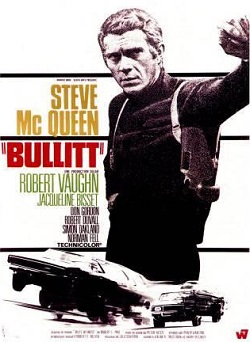
Bullitt
Let's cut away all the fluffiness and cut right to the bone. Steve McQueen is maybe the coolest actor to ever work in Hollywood. An underrated actor who had an incredible on-screen presence, he had his biggest success and popularity in the late 1960s. The Cincinnati Kid, Nevada Smith, Thomas Crown Affair, The Sand Pebbles, all excellent parts in good to great films. Nowhere was McQueen more at his coolest than 1968's Bullitt.
A respected and hard-edged San Francisco detective, Frank Bullitt (McQueen) has been tasked with a somewhat dull but essential task from ambitious politician Walter Chalmers (Robert Vaughn). Prepping for a Senate hearing about a Mafia takedown, Chalmers has enlisted a key witness (Felice Orlandi), and Bullitt and two other detectives must babysit him over a weekend until the hearing. Instead, the witness is killed by two assassins, forcing Bullitt to find out what's going on. Something doesn't fit together as he examines the clues and evidence, but the pressure is on. Chalmers needs a scapegoat, and Bullitt seems like the perfect target to take the fall. Knowing he's been backed into a corner, Bullitt has an extremely limited window to find out exactly what's going on.
The late 1960s were one of the most influential periods in Hollywood history, changing the way films were made and more importantly, the stories that were told. From director Peter Yates, 'Bullitt' is a police/cop movie like none before it. It is a smart, stylish cop drama/thriller that for me, gets better with each viewing. For starters, it was filmed in San Francisco, setting the stage for Dirty Harry, McQ and a whole cop genre to move into the city. It is an ideal backdrop for the story; a polished, good-looking city that is nonetheless hiding secrets. The score from Lalo Schifrin is a good mix of quiet, soothing jazz and faster-paced, more traditional yet still exciting musical cues (listen HERE). The style in an almost documentary-like fashion reflects some of the French crime thrillers that I've really come to appreciate, giving 'Bullitt' a different edge more than just the same old, same old cops and robbers story.
That starts with Steve McQueen as Detective Frank Bullitt, a veteran cop who always gets the job done but usually how he wants to do it, not how he should do it. That basic write-up is as cliched as the countless cop movie stereotypes that have been done to death in the years since, but McQueen gives the lead performance a different edge. Never one for huge dialogue scenes, McQueen's Bullitt is a huge presence whenever he's on-screen. He does more with a look here or there than many actors could do with an entire monologue with the camera trained on them. There's a self-assured confidence in the part, a quietness about it too. Bullitt is an expert at what he does, but he's not interested in fame or accolades. He does it because he's really good, so good that he's become almost desensitized to the violence he sees on a daily basis. McQueen is cool, acts cool and looks cool (I have a way with words, don't I?).
Okay, so we've talked about the plot, Steve McQueen's badass-ness (is that a word?), and hhhmmm, what else? Oh, right, the cars. Some 45 years since its release, 'Bullitt' is still remembered fondly for an infamous car chase that opened the door for countless knockoffs, remakes and retries. Driving his 1968 Ford Mustang, McQueen pursues two assassins (driver Bill Hickman, killer Paul Genge) in, around and through San Fran, two muscle cars going at it for everything they're worth. Schifrin's soundtrack is left by the wayside, just the sounds of the two engines doing battle providing all the soundtrack that's needed. Looking back on it now, it isn't a flashy sequence, but it is clear how much it has influenced just about every movie car chase since. It is an extended sequence that runs about 10 minutes total (near the film's halfway point), one that will definitely get the adrenaline pumping.
Now sometimes at the expense of the film's style is the film's story. It took me three or four viewings to really get everything down just right. Not to throw this out there as a cop-out, but an understanding of the story isn't a must here. You watch for the style. Some reviewers/critics have an issue with the pacing, some point-blank stating that it's a boring movie. It isn't an action-packed movie, that's for sure. 'Bullitt' takes its time but always knows where it wants to go. A chase through a hospital is subtle and underplayed but incredibly full of tension, as is the finale at the San Francisco airport as Bullitt chases a suspect across runways in use. We see little departures into San Fran with Bullitt's girlfriend, Cathy (Jacqueline Bisset), on dates and at work, to Bullitt's apartment, to follow up with witnesses. It's rarely flashy, but there's something charming just the same about that assured style.
Backing McQueen up, Vaughn does what he does best; gentlemanly slimy to perfection. His Chalmers is smooth and suave, but he's really a snake waiting in the grass to strike. Don Gordon (a longtime, close friend of McQueen) is nicely cast as Delgetti, Bullitt's longtime partner with Simon Oakland and Norman Fell as their superiors. Also look for Robert Duvall in a small but key (and effective) part as a cab driver whose help Bullitt enlists as he tries to figure everything out.
One of my favorites, an iconic flick from the 1960s, and one of Steve McQueen's all-time bests. Haven't seen it? What's wrong with you?!? Highly recommended.
Bullitt (1968): ****/****
Rewrite of November 2009 review
Tuesday, August 17, 2010
The Bridge at Remagen
One Memorial Day I don't know how many years back, I stumbled across a WWII movie on Turner Classic Movies that I'd never seen before, much less heard of. 1969's The Bridge at Remagen is based on a WWII battle, but because of a general lack of big names -- whether it be the director or the cast -- is not mentioned in discussions of other 1960s MGM war movies. It is a product of the times as America was fully involved by 1969 in Vietnam, but it is a very effective look at the closing days of the war.
Too often war movies pick a side and go from there, disregarding the other side completely. Some of the better ones at least attempt to show both sides of the war. It is said of war that 'the victors write the history books' but in many ways, the soldiers on either side are very similar. They're fighting because that is what they're told to do, their superiors deciding what should or shouldn't be done. Director John Guillermin splits time evenly between the Americans and Germans, giving an excellent look at one of the key battles late in WWII with an underrated cast and some great action.
It's March 1945 and the German armies are in full retreat. The Allied forces are nipping at their heels, chasing them back into Germany. The German High Command has ordered all bridges over the Rhine River destroyed to help slow down the Allied charge, but one bridge at Remagen remains. General Von Brock (Peter van Eyck) sees that 75,000 German troops will be cut off if the bridge is destroyed and instead sends a close friend and fellow officer, Major Paul Krueger (Robert Vaughn), to hold the bridge as long as possible. Just miles away, the Allies charge forward hoping to catch the German defenses napping, at their front an armored infantry unit commanded by Lt. Hartman (George Segal), who after weeks at the point is leading an exhausted unit. But pressure from HQ and the battalion commander (Bradford Dillman) keeps the men going, hoping to end the war as quickly as possible.
Where this reflects the times is the portrayal of a war near its end, the soldiers deteriorating with pure exhaustion. The end of the war is near, and the Germans are turning on each other. Vaughn's Krueger is promised a defense that doesn't exist and reinforcements that can't be moved. The SS and Gestapo run rampant, ruling with an iron fist. The ranks are thinned by deserters, and refilled with old men and young boys. The Americans are always on the move, pushing themselves and the Germans to their absolute limits. They're bone tired but they have no option but to follow orders. The rules of war are gone to a certain point, and survival has taken priority over everything else. It is a cynical story at times, the effects of war wearing men down on both sides. Frightening at times to see the portrayal of the closing days of the war presented in a realistic fashion.
The portrayal of the opposing forces is seen through the eyes of two junior officers, both with different missions but driven to the same point. Segal is perfect as Lt. Hartman, a company commander at his wit's ends when it comes to commanding. He's trying to protect his men as best as possible, but HQ has their objectives. Guest star E.G. Marshall as an American general callously states "100 may die, but 10,000 will be saved." An honest statement in the big picture, but when you're part of the 100, does it matter? Across the river is Vaughn's Krueger, a career German officer -- not a Nazi -- disobeying orders but still trying to save as many men as possible. The two actors don't share any scenes together, but there is a bond between them nonetheless. They may be on opposite sides of the war, wearing different uniforms, but in many ways they're the same.
In the honest portrayal of a war in its closing days, both sides aren't shown as particularly heroic. Ben Gazzara is a scene-stealer as Sgt. Angelo, one of Hartman's men who is a good soldier under fire but rubs the Lt. the wrong way by picking clean the bodies of dead German soldiers. Gazzara is so good in the part that you forget at times how despicable his actions are. He balances the good with the bad, the power of his actions wearing on him. Forced to kill a Hitler Youth teenager, he almost snaps when confronted. All of the Americans aren't shown in a positive light, including Hartman's unit which includes Bo Hopkins, Matt Clark, Robert Logan, Steve Sandor, and Tom Heaton. Dillman's Barnes is a good officer but he has no idea how to interact or treat his men. The Germans too are at each other's throats. Look for Hans Christian Blech in a solid supporting part as one of Krueger's officers.
Bouncing back and forth between the American and German perspective could have caused a disjointed story, but that's never really a problem. Instead, it drives the pace at a lightning speed as the Germans fall back, the Americans pushing forward. The action scenes are well-handled and nicely choreographed starting with the filming locations in Czechoslovakia where a bridge similar in appearance to the actual Remagen bridge was used. There is an epic scale to the battles with the end result possibly being an earlier end to the war, but on a personal level we see Hartman's men ordered across a bridge fully expecting it to blow at any moment. Full of tension from the beginning, the battle sequences are aided by Guillermin's camerawork, right there on the ground with the foot soldiers.
A highly underrated WWII story. Elmer Bernstein's score (Main Theme listen HERE) borrows from some of his more notable musical scores, and at times sounds more like a western theme, but for the most part it's good. You can watch the whole movie in a widescreen version via Youtube, starting with Part 1 of 11. Don't let the lack of big names scare you away from this one. An all-around solid look at the closing days of WWII and one of its key engagements.
The Bridge at Remagen <---trailer (1969): **** /****
Too often war movies pick a side and go from there, disregarding the other side completely. Some of the better ones at least attempt to show both sides of the war. It is said of war that 'the victors write the history books' but in many ways, the soldiers on either side are very similar. They're fighting because that is what they're told to do, their superiors deciding what should or shouldn't be done. Director John Guillermin splits time evenly between the Americans and Germans, giving an excellent look at one of the key battles late in WWII with an underrated cast and some great action.
It's March 1945 and the German armies are in full retreat. The Allied forces are nipping at their heels, chasing them back into Germany. The German High Command has ordered all bridges over the Rhine River destroyed to help slow down the Allied charge, but one bridge at Remagen remains. General Von Brock (Peter van Eyck) sees that 75,000 German troops will be cut off if the bridge is destroyed and instead sends a close friend and fellow officer, Major Paul Krueger (Robert Vaughn), to hold the bridge as long as possible. Just miles away, the Allies charge forward hoping to catch the German defenses napping, at their front an armored infantry unit commanded by Lt. Hartman (George Segal), who after weeks at the point is leading an exhausted unit. But pressure from HQ and the battalion commander (Bradford Dillman) keeps the men going, hoping to end the war as quickly as possible.
Where this reflects the times is the portrayal of a war near its end, the soldiers deteriorating with pure exhaustion. The end of the war is near, and the Germans are turning on each other. Vaughn's Krueger is promised a defense that doesn't exist and reinforcements that can't be moved. The SS and Gestapo run rampant, ruling with an iron fist. The ranks are thinned by deserters, and refilled with old men and young boys. The Americans are always on the move, pushing themselves and the Germans to their absolute limits. They're bone tired but they have no option but to follow orders. The rules of war are gone to a certain point, and survival has taken priority over everything else. It is a cynical story at times, the effects of war wearing men down on both sides. Frightening at times to see the portrayal of the closing days of the war presented in a realistic fashion.
The portrayal of the opposing forces is seen through the eyes of two junior officers, both with different missions but driven to the same point. Segal is perfect as Lt. Hartman, a company commander at his wit's ends when it comes to commanding. He's trying to protect his men as best as possible, but HQ has their objectives. Guest star E.G. Marshall as an American general callously states "100 may die, but 10,000 will be saved." An honest statement in the big picture, but when you're part of the 100, does it matter? Across the river is Vaughn's Krueger, a career German officer -- not a Nazi -- disobeying orders but still trying to save as many men as possible. The two actors don't share any scenes together, but there is a bond between them nonetheless. They may be on opposite sides of the war, wearing different uniforms, but in many ways they're the same.
In the honest portrayal of a war in its closing days, both sides aren't shown as particularly heroic. Ben Gazzara is a scene-stealer as Sgt. Angelo, one of Hartman's men who is a good soldier under fire but rubs the Lt. the wrong way by picking clean the bodies of dead German soldiers. Gazzara is so good in the part that you forget at times how despicable his actions are. He balances the good with the bad, the power of his actions wearing on him. Forced to kill a Hitler Youth teenager, he almost snaps when confronted. All of the Americans aren't shown in a positive light, including Hartman's unit which includes Bo Hopkins, Matt Clark, Robert Logan, Steve Sandor, and Tom Heaton. Dillman's Barnes is a good officer but he has no idea how to interact or treat his men. The Germans too are at each other's throats. Look for Hans Christian Blech in a solid supporting part as one of Krueger's officers.
Bouncing back and forth between the American and German perspective could have caused a disjointed story, but that's never really a problem. Instead, it drives the pace at a lightning speed as the Germans fall back, the Americans pushing forward. The action scenes are well-handled and nicely choreographed starting with the filming locations in Czechoslovakia where a bridge similar in appearance to the actual Remagen bridge was used. There is an epic scale to the battles with the end result possibly being an earlier end to the war, but on a personal level we see Hartman's men ordered across a bridge fully expecting it to blow at any moment. Full of tension from the beginning, the battle sequences are aided by Guillermin's camerawork, right there on the ground with the foot soldiers.
A highly underrated WWII story. Elmer Bernstein's score (Main Theme listen HERE) borrows from some of his more notable musical scores, and at times sounds more like a western theme, but for the most part it's good. You can watch the whole movie in a widescreen version via Youtube, starting with Part 1 of 11. Don't let the lack of big names scare you away from this one. An all-around solid look at the closing days of WWII and one of its key engagements.
The Bridge at Remagen <---trailer (1969): **** /****
Subscribe to:
Posts (Atom)
.jpg)