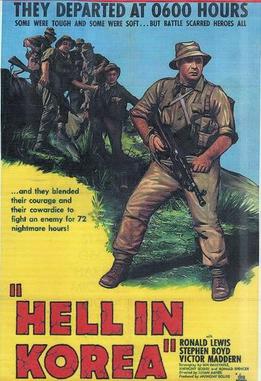
When I think of anti-war films, I tend to zoom right in on the 1960's, right as the Vietnam War jumped into full gear and moviegoing audiences amped up their cynicism. Well, sorta. The theme of today's review intro? The Brits, ahead of the game in the dark, gloomy, cynical anti-war film. I'll obviously mention some others later, but for now, here's 1956's Hell in Korea.
Commanded by inexperienced Lieutenant Butler (George Baker), a 15-man patrol leaves its base and heads out on a reconnaissance patrol. The patrol is split up down the middle, half professional soldiers and the other half National Service men called up when the fighting in Korea started. Their objective is simple; march out to a seemingly isolated village and find out if it is garrisoned or being used at all by North Korean and Chinese forces. Short answer? It ain't, but on the way back to base, the patrol is cut off by a much larger Chinese force. Butler tries to pull off a delaying action, but more Chinese troops quickly arrive on the scene. Butler's patrol has only one alternative...cut back through the abandoned village and fort up above it in a mountainside temple cut perched next to a cliff before they're cut to pieces. If they can make it...
There's something to be said for movies like this. By the late 1950's, studios in Hollywood and London alike were starting to focus more on BIG movies, EPIC movies with a huge scale and a bigger cast. Then there's movies like this. Filmed in black and white, 'Korea' focuses on one patrol, its mission, and its fallout when things go wrong. There is no bigger picture of the war. The focus is on one patrol. It was filmed in a barren location (I can't find where) and feels removed from any civilized part of the world. Cut-off from their own forces, the patrol is on their own. It can be stories like this that work so well because for all the huge battles and large-scale clashes, there were far more stories like this when it comes to a realistic war.
Two movies came to mind while watching this 1956 war drama, both like-minded stories and outlooks, as I thought about what to write. Wouldn't you know it? Both are British, 1961's The Long and the Short and the Tall (liked it) and 1959's Yesterday's Enemy (loved it). These aren't movies interested in glorifying war or showing it for all its heroism and bravery. It was about survival, plain and simple. That's where director Julian Amyes' film works best. The men on the patrol come from a variety of backgrounds, some don't like each other to the point it borders on hate, and they aren't looking for medals or notoriety. They want to survive and get home, war be damned. There's honesty in that sentiment. There's nothing heroic about getting your head blown off on a desolate Korean hillside. The stark black and white photography certainly adds something to that bleak, no-hope filled anti-war sentiment.
What originally caught my eye though wasn't the message or anti-war feelings. It was the cast! Featuring a Lost Patrol/Sahara/Bataan-like ensemble, the cast here is the patrol. We don't meet anyone back at HQ, no one on the enemy, NO ONE else. The cast is the patrol. That's it, and that's all. Though none get key, lead parts, it's cool to see Michael Caine (in his screen debut), Robert Shaw and Stephen Boyd in early roles. As the inexperienced but intelligent Lt. Butler, Baker is very solid in the best performance, getting help from Harry Andrews and Stanley Baker as the embattled veterans on the patrol, Andrews the tough as hell sergeant, Baker the Chinese-hating corporal. Also look for familiar faces in Michael Medwin, Ronald Lewis, Victor Maddern, Percy Herbert, Harry Landis and Robert Brown as members of the patrol.
As simple, straightforward and effective as 'Korea' can be at times, there are moments that feel like misfires. There's some key moments in firefights where the camera moves away from where the action should be. Characters being killed off is almost an afterthought, brushed away as quick as the camera can move. Things feel a bit rushed at just 80 minutes, much of the downtime between battles spent with the patrol bitching and moaning about the state they find themselves in. Some of it builds the tension, helps us get to know the men at least a little bit, but it also gets repetitive when it should be getting interesting as the bullets are supposed to start flying.
It is is a good, interesting movie, but not a great one. I loved the temple set, up on a hilltop seemingly in another world. I liked Malcom Arnold's score, somewhat reminiscent of his most famous score, The Bridge on the River Kwai. So while it isn't a great movie with some big flaws, this is still a little-known, mostly forgotten war film that is definitely worth catching up with. Track it down if you can. I happened to stumble across it on Turner Classic Movies recently.
Hell in Korea (1956): ** 1/2 /****
The Sons of Katie Elder
"First, we reunite, then find Ma and Pa's killer...then read some reviews."
Showing posts with label Harry Andrews. Show all posts
Tuesday, August 18, 2015
Friday, November 28, 2014
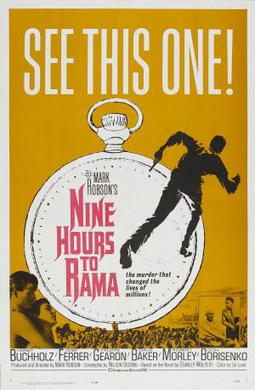
Nine Hours to Rama
So you know what isn't the most uplifting source for stories? Assassins and their assassination attempts. You don't hear a lot of movies about John Wilkes Booth, Lee Harvey Oswald, James Earl Ray and Sirhan Sirhan. How come? Well, it's odd because there's a fascination with killers and those they killed. And then there's the movies that are made, almost completely forgotten like 1963's Nine Hours to Rama, the story of the killer of Mahatma Gandhi.
It's January 30, 1948 in New Delhi, India. Just a few months into the country's independence after 200-plus years under Great Britain's rule, India is still finding its voice as an independent nation, and peace-preaching Mahatma Gandhi is that voice. The police and the army have been mobilized. Evidence and rumors suggest an assassination attempt is going to be made on Gandhi before the day is out. The killer? An extremist hell bent on ending Gandhi's life, his name Naturam Godse (Horst Buchholz). He's been chosen by his movement as the man supposed to kill Gandhi and he is ready to do whatever it takes to accomplish his mission. His work is cut out for him though, as the police, including police superintendent Gopal Das (Jose Ferrer), are closing in on him.
What I don't know about Gandhi's life could fill volumes. The same for Indian history, even more recent history like earning its independence from England. This 1963 story from director Mark Robson has been basically completely forgotten over the last 50-plus years. I caught a couple minutes of 'Rama' a few years back on AMC and finally was able to catch up with the feature film thanks to a recent airing on TV. What an interesting if flawed movie. Robson filmed on location in India, an incredibly nice touch that gives his film quite the authentic feel. He films the crowded streets, the country roads, the people, and there's almost a documentary feel as the story develops. Composer Malcolm Arnold turns in an excellent score, slightly reminiscent of his Bridge on the River Kwai score, to aid the assassination story that's based on the truth but mostly fictionalized.
One of my favorite movies is The Magnificent Seven, a western featuring a cast full of stars and recognizable character actors...and Horst Buchholz, a German actor playing a Mexican gunfighter. It's a very good part, but one of two movies I actually have seen Buchholz in. Well, make that three now with Buchholz doing a solid job here as Naturam. I think the script makes a wise choice in not demonizing him. He's a flawed character, obsessive in his beliefs and convinced he's in the right through his actions. If you know the history, it takes some of the mystery out of where this will end up but that doesn't take away from the strength of the story.
And how about the weakness of the story? That's from a storytelling device that can make or break a movie...the dreaded flashback. This is a story with two paths. One, Naturam in the hours building up to his assassination attempt. Two, his life, how he ended up on this path. His motivations and reasons are one thing, but that doesn't make the flashbacks interesting. Maybe in a separate movie, the flashback device works, but I felt that it fell short here mostly because the other half of the movie is so straightforward and effective. The main focus is on Naturam's troubled relationship with Rani (Valerie Gearon), a woman from vastly different backgrounds and beliefs who's still drawn to Naturam. A fiery, up and down relationship, it just doesn't work well in context. Minimizing the story of Gandhi's assassin to a tortured love story just doesn't work.
With the rest of the cast, Ferrer is the best supporting part. His Das is a dedicated, driven police officer who wants India to succeed as an independent nation. He knows that future needs its leader, Gandhi (J.S. Casshyap, a dead ringer for Gandhi), and has to convince the great man to listen to advice when his life is in danger. Don Borisenko plays Naturam's worrying accomplice, Diane Baker plays a prostitute who Naturam comes across in his efforts to hide while the police search for him and Harry Andrews and Robert Morley don some face-darkening makeup to play an Indian general and an Indian politician.
'Rama' is at its absolute best in the assassination plotline. Ten years before The Day of the Jackal was released, Robson's film does a great job laying things out, a race against time with life and death on the line through a crowded city. Naturam knows he's being pursued with the police close behind every step of the way. The tension keeps building and building as the sun begins to set, especially knowing where the story will end up. Knowledge of the history isn't a hindrance to any enjoyment of the story. It all builds to an incredibly moving ending, a flawed movie that manages to rise above its flaws in its strongest moments. A not so well known historical story but an interesting one to watch develop to its inevitable end.
Nine Days to Rama (1963): ** 1/2 /****
It's January 30, 1948 in New Delhi, India. Just a few months into the country's independence after 200-plus years under Great Britain's rule, India is still finding its voice as an independent nation, and peace-preaching Mahatma Gandhi is that voice. The police and the army have been mobilized. Evidence and rumors suggest an assassination attempt is going to be made on Gandhi before the day is out. The killer? An extremist hell bent on ending Gandhi's life, his name Naturam Godse (Horst Buchholz). He's been chosen by his movement as the man supposed to kill Gandhi and he is ready to do whatever it takes to accomplish his mission. His work is cut out for him though, as the police, including police superintendent Gopal Das (Jose Ferrer), are closing in on him.
What I don't know about Gandhi's life could fill volumes. The same for Indian history, even more recent history like earning its independence from England. This 1963 story from director Mark Robson has been basically completely forgotten over the last 50-plus years. I caught a couple minutes of 'Rama' a few years back on AMC and finally was able to catch up with the feature film thanks to a recent airing on TV. What an interesting if flawed movie. Robson filmed on location in India, an incredibly nice touch that gives his film quite the authentic feel. He films the crowded streets, the country roads, the people, and there's almost a documentary feel as the story develops. Composer Malcolm Arnold turns in an excellent score, slightly reminiscent of his Bridge on the River Kwai score, to aid the assassination story that's based on the truth but mostly fictionalized.
One of my favorite movies is The Magnificent Seven, a western featuring a cast full of stars and recognizable character actors...and Horst Buchholz, a German actor playing a Mexican gunfighter. It's a very good part, but one of two movies I actually have seen Buchholz in. Well, make that three now with Buchholz doing a solid job here as Naturam. I think the script makes a wise choice in not demonizing him. He's a flawed character, obsessive in his beliefs and convinced he's in the right through his actions. If you know the history, it takes some of the mystery out of where this will end up but that doesn't take away from the strength of the story.
And how about the weakness of the story? That's from a storytelling device that can make or break a movie...the dreaded flashback. This is a story with two paths. One, Naturam in the hours building up to his assassination attempt. Two, his life, how he ended up on this path. His motivations and reasons are one thing, but that doesn't make the flashbacks interesting. Maybe in a separate movie, the flashback device works, but I felt that it fell short here mostly because the other half of the movie is so straightforward and effective. The main focus is on Naturam's troubled relationship with Rani (Valerie Gearon), a woman from vastly different backgrounds and beliefs who's still drawn to Naturam. A fiery, up and down relationship, it just doesn't work well in context. Minimizing the story of Gandhi's assassin to a tortured love story just doesn't work.
With the rest of the cast, Ferrer is the best supporting part. His Das is a dedicated, driven police officer who wants India to succeed as an independent nation. He knows that future needs its leader, Gandhi (J.S. Casshyap, a dead ringer for Gandhi), and has to convince the great man to listen to advice when his life is in danger. Don Borisenko plays Naturam's worrying accomplice, Diane Baker plays a prostitute who Naturam comes across in his efforts to hide while the police search for him and Harry Andrews and Robert Morley don some face-darkening makeup to play an Indian general and an Indian politician.
'Rama' is at its absolute best in the assassination plotline. Ten years before The Day of the Jackal was released, Robson's film does a great job laying things out, a race against time with life and death on the line through a crowded city. Naturam knows he's being pursued with the police close behind every step of the way. The tension keeps building and building as the sun begins to set, especially knowing where the story will end up. Knowledge of the history isn't a hindrance to any enjoyment of the story. It all builds to an incredibly moving ending, a flawed movie that manages to rise above its flaws in its strongest moments. A not so well known historical story but an interesting one to watch develop to its inevitable end.
Nine Days to Rama (1963): ** 1/2 /****
Labels:
1960s,
Harry Andrews,
Horst Buchholz,
Jose Ferrer,
Mark Robson,
Robert Morley
Friday, May 30, 2014
Sands of the Kalahari
Ah, the survival film, the type of movie that makes you think how you would react in a life and death, do or die situation. Me? I'd probably wet myself and die of fright in most situations. Adrift at sea, stranded anywhere from a snow-covered mountain to a barren, savage desert wasteland, it all sounds pretty hellish to me. A straightforward story of survival with a hugely dark message, enter 1965's Sands of the Kalahari.
Traveling across Africa, Grace Munkton (Susannah York) is at the airport waiting for her flight when over the loudspeaker she hears her flight has been indefinitely postponed. She heads to a nearby hotel and is woken up hours later by a knock at the door. Several passengers have agreed to pay a pilot, Sturdevan (Nigel Davenport) with his own plane to fly them to their destination. With five passengers, Sturdevan takes off but hours out from the airfield they fly directly into an immense swarm of locusts. The engines give out, the plane crash-landing in the middle of the African desert. Now with limited supplies, Grace, Sturdevan and four other individuals must survive. They're trapped in the middle of the desert with no indication of where they are, where they should head. Making it worse? Sturdevan was unable to report his position before crashing. Can the group survive? Can they survive each other?
'Kalahari' comes from director Cy Endfield (who also wrote the screenplay) and star Stanley Baker who had worked together a year earlier on the very successful Zulu. It keeps the African location, but from there the similarities end. This flick was filmed on-location in South-West Africa and Spain, an expansive, sun-drenched look to the desert survival story. The music is kept to a minimum, the focus almost entirely on the survival aspect. It is based off a novel by author William Mulvihill and gets points for some wise choices. It's unglamorous, gritty, cynical and dark. It explores the possibilities when a situation is quite literally life and death. How would you respond? Would you freak out? Would you do your best to remain calm, hold out for hope and rescue? It's hard not to at least think of this story on a personal level in that sense.
The survivors certainly cover the gamut in terms of variety. We get a female character, an old man, strapping young man, the educated, the physical, the bullying. A little society pops up among the survivors who find a relative life when they stumble across a cave carved into an immense black rock mountain, a water hole nearby with a limited food supply. Baker plays Bain, an alcoholic engineer who's injured in the crash. Davenport has a character that's odd across the board in terms of personal choices, the pilot Sturdevan an interesting, flawed character. York adds the interesting element as the woman, drawn to Stuart Whitman's O'Brien, a big-game hunter who's traveling with two high-powered rifles in tow. Whitman is the star here, his O'Brien realizing how tenuous their grasp on survival is, and he's willing to make some harsh decisions. There's also Harry Andrews as Grimmelman, an aging German man with desert experience, and Theodore Bikel as Dr. Bondrachai, a professor with tons of knowledge but not necessarily life experience.
I liked this movie enough to seek out the novel from Mulvihill. I read it over a couple days, an entertaining, interesting read that I enjoyed. Endfield's adaptation is odd in a sense, trying to add some more profound outlooks on life. He doesn't just show the desperation for survival. He has to tell us about it. Everything is spelled out for us. Campfire scenes try to explain what's happening, about their situation, about how they're changing. I think they're trying to be profound in their analysis of humans, survival and that desperation that sets in with death on the line. Just show it though. These long, expository scenes of dialogue become tedious and worse than that, condescending.
If there's a weakness, it's that the story isn't as interested in spelling things out. 'Kalahari' leaves a couple loose ends in the finale about what happens to certain characters. The ending itself is perfect in its execution. There's some good twists along the way, some good performances, but it's also a tad slow-moving and drifts along at parts. I wanted to really like this one, but I came away with mixed feelings. I'll recommend it, but this is a decent movie that could have been significantly better.
Sands of the Kalahari (1965): ** 1/2 /****
Traveling across Africa, Grace Munkton (Susannah York) is at the airport waiting for her flight when over the loudspeaker she hears her flight has been indefinitely postponed. She heads to a nearby hotel and is woken up hours later by a knock at the door. Several passengers have agreed to pay a pilot, Sturdevan (Nigel Davenport) with his own plane to fly them to their destination. With five passengers, Sturdevan takes off but hours out from the airfield they fly directly into an immense swarm of locusts. The engines give out, the plane crash-landing in the middle of the African desert. Now with limited supplies, Grace, Sturdevan and four other individuals must survive. They're trapped in the middle of the desert with no indication of where they are, where they should head. Making it worse? Sturdevan was unable to report his position before crashing. Can the group survive? Can they survive each other?
'Kalahari' comes from director Cy Endfield (who also wrote the screenplay) and star Stanley Baker who had worked together a year earlier on the very successful Zulu. It keeps the African location, but from there the similarities end. This flick was filmed on-location in South-West Africa and Spain, an expansive, sun-drenched look to the desert survival story. The music is kept to a minimum, the focus almost entirely on the survival aspect. It is based off a novel by author William Mulvihill and gets points for some wise choices. It's unglamorous, gritty, cynical and dark. It explores the possibilities when a situation is quite literally life and death. How would you respond? Would you freak out? Would you do your best to remain calm, hold out for hope and rescue? It's hard not to at least think of this story on a personal level in that sense.
The survivors certainly cover the gamut in terms of variety. We get a female character, an old man, strapping young man, the educated, the physical, the bullying. A little society pops up among the survivors who find a relative life when they stumble across a cave carved into an immense black rock mountain, a water hole nearby with a limited food supply. Baker plays Bain, an alcoholic engineer who's injured in the crash. Davenport has a character that's odd across the board in terms of personal choices, the pilot Sturdevan an interesting, flawed character. York adds the interesting element as the woman, drawn to Stuart Whitman's O'Brien, a big-game hunter who's traveling with two high-powered rifles in tow. Whitman is the star here, his O'Brien realizing how tenuous their grasp on survival is, and he's willing to make some harsh decisions. There's also Harry Andrews as Grimmelman, an aging German man with desert experience, and Theodore Bikel as Dr. Bondrachai, a professor with tons of knowledge but not necessarily life experience.
I liked this movie enough to seek out the novel from Mulvihill. I read it over a couple days, an entertaining, interesting read that I enjoyed. Endfield's adaptation is odd in a sense, trying to add some more profound outlooks on life. He doesn't just show the desperation for survival. He has to tell us about it. Everything is spelled out for us. Campfire scenes try to explain what's happening, about their situation, about how they're changing. I think they're trying to be profound in their analysis of humans, survival and that desperation that sets in with death on the line. Just show it though. These long, expository scenes of dialogue become tedious and worse than that, condescending.
If there's a weakness, it's that the story isn't as interested in spelling things out. 'Kalahari' leaves a couple loose ends in the finale about what happens to certain characters. The ending itself is perfect in its execution. There's some good twists along the way, some good performances, but it's also a tad slow-moving and drifts along at parts. I wanted to really like this one, but I came away with mixed feelings. I'll recommend it, but this is a decent movie that could have been significantly better.
Sands of the Kalahari (1965): ** 1/2 /****
Sunday, October 30, 2011
633 Squadron
More than any other war, World War II has produced hundreds and probably thousands of movies telling the countless stories of the war from all angles. I've done my fair share of WWII reviews -- over 100 as I write this one -- and I'm quite sure I won't run out anytime soon. Among the thousands of movies are selections from most of the countries involved, especially England. Over the 1950s and 1960s, some of the best WWII movie were British, seeing similar production value, stories, and actors returning for multiple roles. An underrated one not often remembered so fondly (unfortunately so) is 1964's 633 Squadron.
The commander of 633 Squadron, Wing Commander Roy Grant (Cliff Robertson) has been given his most difficult mission. His squadron of international pilots flying for the British have their work cut out for them on this specific mission. It's spring 1944, and the coming D-Day invasion looms. Deep in the Norwegian fjords lies a factory producing rocket fuel that will be used to repel the landings while also assaulting England from across the Channel. Grant and his pilots must fly through a gauntlet of fire in the fjords, hoping to knock out the factory. The Norwegian resistance (headed by George Chakiris) will work to knock out some of the antiaircraft positions along the fjord. No matter what happens though, the mission seems like suicide. With thousands of lives at stake, can 633 Squadron pull off the job?
I've always enjoyed these British war movies, on the big scale like Battle of Britain to the smaller-scaled The Dam Busters. They don't glorify war or glamorize death, knowing that an effort to make war heroic would be foolhardy. War isn't heroic. It's a dirty, brutal business. The men fighting on the other hand are incredibly heroic, and that's what these movies go for. To save the lives of thousands, sometimes the life of the smaller group down to the individual had to be sacrificed. Given a chance to abort the mission, Robertson's Grant refuses the offer, continuing the mission knowing that the casualties will almost certainly be extreme. As for the familiar faces, look for Harry Andrews as Air Vice Marshal Davis with Michael Goodliffe and Donald Houston as two of his higher-ranking staff.
Showing the heroic actions of the men and not necessarily the heroism of war itself, the movie separates itself from the pack in its portrayal of the final assault through the fjords. Without giving anything away, basically nothing in the hours leading up to the mission goes right. Andrews' Air Vice Marshal gives the squadron the option to abort the mission, but Robertson's Grant pushes on, weighing the sacrifices they must give with those who have already died and the thousands more who might die as a result in the future. Don't be confused. The ending mission may be successful, but at a heavy cost. The movie ends on a high, positive note, touting the heroism of the fighter crews as it should, especially considering the price paid for the mission's success.
In a recent line of Robertson reviews, add '633' to the list. One of my favorite actors, Robertson is a strong lead here as Wing Commander Grant, an American pilot leading this international squadron. It's a stock character; an officer weary of war, sick of seeing his men killed in a futile effort, just wanting it all to be over. Nothing fancy, nothing showy, just a good performance. George Chakiris is badly miscast as Erik, a Norwegian resistance fighter who's sister, Hilde (Maria Perschy), is attracted to Robertson's character. Mostly, Chakiris just doesn't look the part, but he isn't given much to do in a smaller part. As for the squadron, some of the names include John Meillon, John Bonney, Angus Lennie, Scott Finch, and Julian Sherrier, the collective group being more important than the individual.
One of the best reasons to see this movie is not surprisingly for the aerial sequences. Aviator buffs will no doubt eat this movie up, especially the impressive amounts of footage of the Mosquito aircraft. Some footage is re-used over and over again, but the shots of these aircraft zipping through narrow fjords and valleys is impressive. It puts it all into perspective how dangerous these missions were, and the little kid in all of us who's fascinated by flight and aviation can't help but be entertained. Ron Goodwin's majestic score doesn't hurt either (listen HERE) playing over the aviation sequences, a similar sounding score to his Battle of Britain and Force 10 from Navarone scores.
On a purely entertaining level, the final assault on the fjord is noteworthy for another thing; it's major impact on George Lucas and Star Wars. The ending basically lays out the blue print for Luke Skywalker's Death Star trench run at the end of Star Wars, a group of pilots flying through hellacious amounts of fire in hopes of reaching their objective at the end of the gauntlet. Watch THIS very clever mash-up of the sequences from 633 with the dialogue from Star Wars, obvious SPOILERS of course. Imitation is the best form of flattery, huh?
This is an underrated WWII movie that deserves better. It isn't anything groundbreaking or Earth-shattering. Instead it is a story about the heroic pilots who put it all on the line when called upon to do their duties. Highly recommend seeking this one out.
633 Squadron <---trailer (1964): ***/****
The commander of 633 Squadron, Wing Commander Roy Grant (Cliff Robertson) has been given his most difficult mission. His squadron of international pilots flying for the British have their work cut out for them on this specific mission. It's spring 1944, and the coming D-Day invasion looms. Deep in the Norwegian fjords lies a factory producing rocket fuel that will be used to repel the landings while also assaulting England from across the Channel. Grant and his pilots must fly through a gauntlet of fire in the fjords, hoping to knock out the factory. The Norwegian resistance (headed by George Chakiris) will work to knock out some of the antiaircraft positions along the fjord. No matter what happens though, the mission seems like suicide. With thousands of lives at stake, can 633 Squadron pull off the job?
I've always enjoyed these British war movies, on the big scale like Battle of Britain to the smaller-scaled The Dam Busters. They don't glorify war or glamorize death, knowing that an effort to make war heroic would be foolhardy. War isn't heroic. It's a dirty, brutal business. The men fighting on the other hand are incredibly heroic, and that's what these movies go for. To save the lives of thousands, sometimes the life of the smaller group down to the individual had to be sacrificed. Given a chance to abort the mission, Robertson's Grant refuses the offer, continuing the mission knowing that the casualties will almost certainly be extreme. As for the familiar faces, look for Harry Andrews as Air Vice Marshal Davis with Michael Goodliffe and Donald Houston as two of his higher-ranking staff.
Showing the heroic actions of the men and not necessarily the heroism of war itself, the movie separates itself from the pack in its portrayal of the final assault through the fjords. Without giving anything away, basically nothing in the hours leading up to the mission goes right. Andrews' Air Vice Marshal gives the squadron the option to abort the mission, but Robertson's Grant pushes on, weighing the sacrifices they must give with those who have already died and the thousands more who might die as a result in the future. Don't be confused. The ending mission may be successful, but at a heavy cost. The movie ends on a high, positive note, touting the heroism of the fighter crews as it should, especially considering the price paid for the mission's success.
In a recent line of Robertson reviews, add '633' to the list. One of my favorite actors, Robertson is a strong lead here as Wing Commander Grant, an American pilot leading this international squadron. It's a stock character; an officer weary of war, sick of seeing his men killed in a futile effort, just wanting it all to be over. Nothing fancy, nothing showy, just a good performance. George Chakiris is badly miscast as Erik, a Norwegian resistance fighter who's sister, Hilde (Maria Perschy), is attracted to Robertson's character. Mostly, Chakiris just doesn't look the part, but he isn't given much to do in a smaller part. As for the squadron, some of the names include John Meillon, John Bonney, Angus Lennie, Scott Finch, and Julian Sherrier, the collective group being more important than the individual.
One of the best reasons to see this movie is not surprisingly for the aerial sequences. Aviator buffs will no doubt eat this movie up, especially the impressive amounts of footage of the Mosquito aircraft. Some footage is re-used over and over again, but the shots of these aircraft zipping through narrow fjords and valleys is impressive. It puts it all into perspective how dangerous these missions were, and the little kid in all of us who's fascinated by flight and aviation can't help but be entertained. Ron Goodwin's majestic score doesn't hurt either (listen HERE) playing over the aviation sequences, a similar sounding score to his Battle of Britain and Force 10 from Navarone scores.
On a purely entertaining level, the final assault on the fjord is noteworthy for another thing; it's major impact on George Lucas and Star Wars. The ending basically lays out the blue print for Luke Skywalker's Death Star trench run at the end of Star Wars, a group of pilots flying through hellacious amounts of fire in hopes of reaching their objective at the end of the gauntlet. Watch THIS very clever mash-up of the sequences from 633 with the dialogue from Star Wars, obvious SPOILERS of course. Imitation is the best form of flattery, huh?
This is an underrated WWII movie that deserves better. It isn't anything groundbreaking or Earth-shattering. Instead it is a story about the heroic pilots who put it all on the line when called upon to do their duties. Highly recommend seeking this one out.
633 Squadron <---trailer (1964): ***/****
Labels:
1960s,
Cliff Robertson,
George Chakiris,
Harry Andrews,
WWII
Sunday, October 23, 2011
Danger Route
I stumbled across a channel in the last few weeks I didn't realize was on the dial -- This TV -- and taking any chance I can to see some hard-to-find movies, I've been reviewing their website fairly regularly. They're not showing classics, focusing more on some lesser known, more mainstream movies, including some I've never heard of, including 1967's Danger Route.
Part James Bond knock-off with a darker outlook on the life of a secret agent/spy, it struggles at times to decide what's really going on. The cast was what drew me in, and for the most part no one disappoints. Certain moments ring so true you feel they just have to be accurate, dead-on in their portrayal of the espionage underworld. The other moments though? Well, they fall short. The first 45 minutes were mind-numbingly slow, the middle portions a major improvement, and the end too tidy although perfectly cynical.
A secret agent with a license to kill, Jonas Wylde (Richard Johnson) has had enough of the business and wants out. He decides to take on one more job, a contract hit on an order he receives from his superiors. A Czechoslovakian scientist has defected to the Americans with all his secrets, and he's ready to spill them all. Wylde must now figure a way to get to the heavily guarded defector, briefly staying in Britain as he travels to America. As his plan comes together though, the very capable and highly professional Jonas begins to suspect something else is up. His mission is one thing, but is there something more? Is he part of a mole hunt? Who exactly is gunning for him?
I'm going to get this one rant out of the way and then won't come back to it again. As I say/type it, I know I sound like an ignorant American, but here goes anyways. This movie is very British. Usually in my mind, that's a positive. Here? Mostly because there was no closed captioning on the broadcast, it's a bad thing. Johnson talks in what can only be described as a quiet mumble. I'm pretty decent deciphering accents, but this movie threw me for a loop. Therefore, I felt more than a few times like I was behind or had missed something, jumps in logic and story going over my head. Apparently not though, 'Danger' just relying on a twisting and turning story that doesn't always make sense.
Taking into consideration his choice to talk in a growling whisper for most of his lines, Johnson is still an interesting choice to play this well-worn, experienced secret agent. Usually playing a key secondary role -- he specialized in the right hand man part -- he gets a chance at a starring role. I like the edge he brings to his character, an ability to handle himself in every situation, a distrust in basically everyone around him, and a knack for figuring things out quicker than humanly possible. In the cool but odd department, he also dispatches quite a few people via a nicely placed judo chop that Austin Powers would be proud of. Johnson's Wylde snaps necks like nobody's business.
About 45 minutes into the movie after the painfully slow opening, I was very much drawn in. Wylde finds out his mission is more than he was told, and things get interesting. Director/actor Sam Wanamaker has a scene-stealing part that in two or three brutally effective scenes almost save the movie on their own. Playing CIA agent 'Lucinda,' Wanamaker shows the potential here after capturing Wylde, telling him exactly how he caught him. It's well-written, well thought out and executed as perfectly as possible. Simple and straightforward, and the best scene in the movie going away.
The supporting parts on the whole -- including Wanamaker -- are key without being time-consuming in actual screentime. Harry Andrews plays Canning, Wylde's long-time supervisor trying to look out for one of his most-trusted agents. Gordon Jackson is Brian, Wylde's partner who helps him in and out of different missions, leaving the authorities in the dust. Call me chauvinistic, but I had trouble keeping track of the female characters in this movie, four of them if I counted right, all attractive, blonde women. There's Carol Lynley as Jocelyn, Wylde's mistress, Barbara Bouchet as Marita, a possible double agent playing both sides, Sylvia Sims as Barbara, Canning's wife, and Diana Dors as a somewhat clueless maid Wylde plays.
I wanted to like this one, and really tried to get into it, but it never amounts to much. Decent cast wasted in a disappointing espionage story.
Danger Route <---trailer (1967): * 1/2 /****
Part James Bond knock-off with a darker outlook on the life of a secret agent/spy, it struggles at times to decide what's really going on. The cast was what drew me in, and for the most part no one disappoints. Certain moments ring so true you feel they just have to be accurate, dead-on in their portrayal of the espionage underworld. The other moments though? Well, they fall short. The first 45 minutes were mind-numbingly slow, the middle portions a major improvement, and the end too tidy although perfectly cynical.
A secret agent with a license to kill, Jonas Wylde (Richard Johnson) has had enough of the business and wants out. He decides to take on one more job, a contract hit on an order he receives from his superiors. A Czechoslovakian scientist has defected to the Americans with all his secrets, and he's ready to spill them all. Wylde must now figure a way to get to the heavily guarded defector, briefly staying in Britain as he travels to America. As his plan comes together though, the very capable and highly professional Jonas begins to suspect something else is up. His mission is one thing, but is there something more? Is he part of a mole hunt? Who exactly is gunning for him?
I'm going to get this one rant out of the way and then won't come back to it again. As I say/type it, I know I sound like an ignorant American, but here goes anyways. This movie is very British. Usually in my mind, that's a positive. Here? Mostly because there was no closed captioning on the broadcast, it's a bad thing. Johnson talks in what can only be described as a quiet mumble. I'm pretty decent deciphering accents, but this movie threw me for a loop. Therefore, I felt more than a few times like I was behind or had missed something, jumps in logic and story going over my head. Apparently not though, 'Danger' just relying on a twisting and turning story that doesn't always make sense.
Taking into consideration his choice to talk in a growling whisper for most of his lines, Johnson is still an interesting choice to play this well-worn, experienced secret agent. Usually playing a key secondary role -- he specialized in the right hand man part -- he gets a chance at a starring role. I like the edge he brings to his character, an ability to handle himself in every situation, a distrust in basically everyone around him, and a knack for figuring things out quicker than humanly possible. In the cool but odd department, he also dispatches quite a few people via a nicely placed judo chop that Austin Powers would be proud of. Johnson's Wylde snaps necks like nobody's business.
About 45 minutes into the movie after the painfully slow opening, I was very much drawn in. Wylde finds out his mission is more than he was told, and things get interesting. Director/actor Sam Wanamaker has a scene-stealing part that in two or three brutally effective scenes almost save the movie on their own. Playing CIA agent 'Lucinda,' Wanamaker shows the potential here after capturing Wylde, telling him exactly how he caught him. It's well-written, well thought out and executed as perfectly as possible. Simple and straightforward, and the best scene in the movie going away.
The supporting parts on the whole -- including Wanamaker -- are key without being time-consuming in actual screentime. Harry Andrews plays Canning, Wylde's long-time supervisor trying to look out for one of his most-trusted agents. Gordon Jackson is Brian, Wylde's partner who helps him in and out of different missions, leaving the authorities in the dust. Call me chauvinistic, but I had trouble keeping track of the female characters in this movie, four of them if I counted right, all attractive, blonde women. There's Carol Lynley as Jocelyn, Wylde's mistress, Barbara Bouchet as Marita, a possible double agent playing both sides, Sylvia Sims as Barbara, Canning's wife, and Diana Dors as a somewhat clueless maid Wylde plays.
I wanted to like this one, and really tried to get into it, but it never amounts to much. Decent cast wasted in a disappointing espionage story.
Danger Route <---trailer (1967): * 1/2 /****
Labels:
1960s,
Espionage,
Gordon Jackson,
Harry Andrews,
Richard Johnson
Tuesday, August 16, 2011
Too Late the Hero
By 1970, the United States had been involved in the Vietnam War for going on five years. The American public had grown tired of a war that was producing no results and eating up American soldiers' lives by the thousands. As a country, we grew sick of authority and power figures, losing faith in the people we were supposed to trust. This distrust and frustration with the system came out in countless outlets, especially in films and even more so in war films, like 1970's Too Late the Hero.
From director Robert Aldrich comes this war movie that has been generally forgotten over the last 40-plus years. Is there a chance it is too cynical, too dark, too anti-war? It certainly could be any of those reasons, and while it is not a great anti-war movie, it certainly is a good one. Just three years earlier, Aldrich had directed the classic anti-war movie The Dirty Dozen, a mix of incredibly dark humor, anti-establishment sentiment and in general a disdain for anything related to the powers that be. With 'Hero,' he takes it up a notch. Think Dirty Dozen mixed with The Guns of Navarone and Play Dirty, and you've got this war flick.
A day away from a month's leave, American Navy officer Lt. Sam Lawson (Cliff Robertson) is instead assigned a dangerous mission in the southwest Pacific in 1942. He's sent to a small, seemingly inconsequential island in the New Hebrides to join a British outfit fighting Japanese forces on an island. Lawson's services as a translator -- he speaks Japanese working for intelligence -- are needed as he joins a small patrol trekking across the island to a Japanese base. Their mission? Knock out the radio so an American naval convoy can pass by the island safely and have Lawson transmit a message to Japanese headquarters so as to no alert the enemy of the coming attack. The men on the patrol are a mixed bunch including troublemaker and medic Pvt. Tosh Hearne (Michael Caine) and is commanded by a courageous if inept officer, Lt. Hornsby (Denholm Elliott). As they approach their objective though, a wild card emerges, news of a Japanese counterattack that intelligence is unaware of.
Is there a such thing as a war movie that is too opposed to war, too anti-war in its general sentiment? That's always my issue with movies like this. Think Platoon, All Quiet on the Western Front, Born on the 4th of July, Full Metal Jacket. All high quality, solid movies, but because they're not necessarily entertaining it can be hard to go back and revisit the films with multiple viewings. That's my problem at least. I bought Too Late the Hero seven years ago, watched it once and even though I enjoyed it, did not watch it again until this summer. It can be a tad on the slow side -- meandering along at 134 minutes -- and stretches go by where not much happens. It is an incredibly dark film overall, making it hard to go along for the ride. None of this is intended to steer you away from the movie, but instead serve as fair warning heading in.
Where Aldrich's The Dirty Dozen had some redeeming characters, 'Hero' has none of them. There are few positive qualities in any of them. Robertson's Lawson is basically trying to sit out the war in a rear echelon radio post and goes along only when there are no other options. He blatantly refuses to go along with an order on the mission, using a discrepancy to hide his cowardice. Caine's Tosh is a little better, but he is truly only looking out for himself. Screw the lives of others if his life is the necessary sacrifice. It is hinted that Elliott's Hornsby is gay, but it's not important overall. He's both brutally cold and stupidly inept in his command. Harry Andrews is the British commander ready to sacrifice his men as needed, and in a cameo Henry Fonda basically blackmails Lawson into going on the mission. The patrol includes Ian Bannen, Percy Herbert, Ronald Fraser, and Lance Percival among other interchangeable characters there to be fodder for the Japanese.
Setting the movie apart from so many other anti-war films that are content in delivering their 'War is hell!' message is a script from Aldrich that revels in being unique, in going where many war films don't want to go. It is genuinely unique. As the survivors of the patrol race back through the jungle to the relative safety of their own base, the Japanese are in hot pursuit with some psychological warfare prepared. A Japanese major, Yamaguchi (Ken Takakura), uses loud speakers and an amplification system to address the men he's pursuing, offering them terms of surrender with an ever-shrinking deadline. The Japanese aren't the bloodthirsty savages here for the most part, and as is the case with Takakura's Yamaguchi, he's just a soldier trying to do his duty. The booming voice through the jungle is a nice touch though, an enemy that cannot be seen and only be heard.
The best though by far is the finale so OBVIOUS SPOILERS from here on in. SPOILERS STOP READING SPOILERS Needing to deliver the news of the coming Japanese attack, only two survivors make it back -- Tosh and Lawson. The only problem? The only way back to the base is an open stretch of land, a veritable no man's land. The Japanese have it covered, and any attempt to cross the vast openness is basically a suicide mission. Tosh and Lawson attempt it, running like madmen in a zig-zag pattern in an attempt to make it hard to pick them off. Aldrich shoots this adrenaline-pumping sequence from a distance, making sure we can't see which man is which. I won't spoil the ending as to who makes it -- or do both make it? Hhhmmm, interesting -- but it is a whopper of an ending and another unique touch, something I'd never seen before in a war movie. Watch it HERE with more OBVIOUS SPOILERS.
This certainly isn't a perfect war movie, but as far as anti-war movies go it's hard to beat. Maybe some of the reasoning I've come up with is because it hasn't been fondly remembered since its 1970 release. It is a bit of a hidden gem. An appropriate if not so subtle message tries too hard at times, but the idea is there. Throw in some great performances from a deep cast -- especially Robertson and Caine -- and it is definitely worth a watch.
Too Late the Hero <---trailer (1970): ***/****
From director Robert Aldrich comes this war movie that has been generally forgotten over the last 40-plus years. Is there a chance it is too cynical, too dark, too anti-war? It certainly could be any of those reasons, and while it is not a great anti-war movie, it certainly is a good one. Just three years earlier, Aldrich had directed the classic anti-war movie The Dirty Dozen, a mix of incredibly dark humor, anti-establishment sentiment and in general a disdain for anything related to the powers that be. With 'Hero,' he takes it up a notch. Think Dirty Dozen mixed with The Guns of Navarone and Play Dirty, and you've got this war flick.
A day away from a month's leave, American Navy officer Lt. Sam Lawson (Cliff Robertson) is instead assigned a dangerous mission in the southwest Pacific in 1942. He's sent to a small, seemingly inconsequential island in the New Hebrides to join a British outfit fighting Japanese forces on an island. Lawson's services as a translator -- he speaks Japanese working for intelligence -- are needed as he joins a small patrol trekking across the island to a Japanese base. Their mission? Knock out the radio so an American naval convoy can pass by the island safely and have Lawson transmit a message to Japanese headquarters so as to no alert the enemy of the coming attack. The men on the patrol are a mixed bunch including troublemaker and medic Pvt. Tosh Hearne (Michael Caine) and is commanded by a courageous if inept officer, Lt. Hornsby (Denholm Elliott). As they approach their objective though, a wild card emerges, news of a Japanese counterattack that intelligence is unaware of.
Is there a such thing as a war movie that is too opposed to war, too anti-war in its general sentiment? That's always my issue with movies like this. Think Platoon, All Quiet on the Western Front, Born on the 4th of July, Full Metal Jacket. All high quality, solid movies, but because they're not necessarily entertaining it can be hard to go back and revisit the films with multiple viewings. That's my problem at least. I bought Too Late the Hero seven years ago, watched it once and even though I enjoyed it, did not watch it again until this summer. It can be a tad on the slow side -- meandering along at 134 minutes -- and stretches go by where not much happens. It is an incredibly dark film overall, making it hard to go along for the ride. None of this is intended to steer you away from the movie, but instead serve as fair warning heading in.
Where Aldrich's The Dirty Dozen had some redeeming characters, 'Hero' has none of them. There are few positive qualities in any of them. Robertson's Lawson is basically trying to sit out the war in a rear echelon radio post and goes along only when there are no other options. He blatantly refuses to go along with an order on the mission, using a discrepancy to hide his cowardice. Caine's Tosh is a little better, but he is truly only looking out for himself. Screw the lives of others if his life is the necessary sacrifice. It is hinted that Elliott's Hornsby is gay, but it's not important overall. He's both brutally cold and stupidly inept in his command. Harry Andrews is the British commander ready to sacrifice his men as needed, and in a cameo Henry Fonda basically blackmails Lawson into going on the mission. The patrol includes Ian Bannen, Percy Herbert, Ronald Fraser, and Lance Percival among other interchangeable characters there to be fodder for the Japanese.
Setting the movie apart from so many other anti-war films that are content in delivering their 'War is hell!' message is a script from Aldrich that revels in being unique, in going where many war films don't want to go. It is genuinely unique. As the survivors of the patrol race back through the jungle to the relative safety of their own base, the Japanese are in hot pursuit with some psychological warfare prepared. A Japanese major, Yamaguchi (Ken Takakura), uses loud speakers and an amplification system to address the men he's pursuing, offering them terms of surrender with an ever-shrinking deadline. The Japanese aren't the bloodthirsty savages here for the most part, and as is the case with Takakura's Yamaguchi, he's just a soldier trying to do his duty. The booming voice through the jungle is a nice touch though, an enemy that cannot be seen and only be heard.
The best though by far is the finale so OBVIOUS SPOILERS from here on in. SPOILERS STOP READING SPOILERS Needing to deliver the news of the coming Japanese attack, only two survivors make it back -- Tosh and Lawson. The only problem? The only way back to the base is an open stretch of land, a veritable no man's land. The Japanese have it covered, and any attempt to cross the vast openness is basically a suicide mission. Tosh and Lawson attempt it, running like madmen in a zig-zag pattern in an attempt to make it hard to pick them off. Aldrich shoots this adrenaline-pumping sequence from a distance, making sure we can't see which man is which. I won't spoil the ending as to who makes it -- or do both make it? Hhhmmm, interesting -- but it is a whopper of an ending and another unique touch, something I'd never seen before in a war movie. Watch it HERE with more OBVIOUS SPOILERS.
This certainly isn't a perfect war movie, but as far as anti-war movies go it's hard to beat. Maybe some of the reasoning I've come up with is because it hasn't been fondly remembered since its 1970 release. It is a bit of a hidden gem. An appropriate if not so subtle message tries too hard at times, but the idea is there. Throw in some great performances from a deep cast -- especially Robertson and Caine -- and it is definitely worth a watch.
Too Late the Hero <---trailer (1970): ***/****
Monday, June 20, 2011
Paratrooper
Is there anything more ridiculous that a person can do than jump out of a plane with a parachute? I say this as someone who would like to sky-dive at some point in my life, knowing the inherent and fairly obvious consequences that could result from said experience. Now let's add something to the equation. What about jumping out of a plane and landing somewhere where thousands of men with guns would like nothing more than to kill you? Okay, so maybe not my best lead ever, but I thought it was good enough for a movie appropriately titled Paratrooper, released in 1953.
This British war flick was aired recently as part of TCM's Memorial Day programming (like many of my recent reviews), and was one I'd never heard of before stumbling across it on their website. The story sounded a lot like a book I was given as a little kid by my Dad, a book he had read as a kid about a commando raid in France trying to knock out a German radar station. As is the case with this movie, it was appropriately named 'Radar Commandos.' The story sounded interesting enough, the talent behind the camera impressive, and the cast had a couple names I'll always check out.
It's 1940 in England, and American volunteer via Canada, McKendrick (Alan Ladd) volunteers to be part of a newly formed unit of paratroopers. He doesn't tell anyone, but he has an aviation background, and more than that, experience with parachuting out of a plane. Joining the completely volunteer unit, McKendrick just wants to blend in and do his job like all the other volunteers. His superiors quickly see his talent and his ability to lead, but he wants nothing to do with a promotion. The training revs up as the paratroopers practice jumping out of planes. Their orders are coming though as the fighting intensifies against the Germans. First up on their list is a German radar station in France, but that's just the start. A heavily guarded German airfield also awaits them.
This is a lot like so many movies I've seen over the years. It's not bad mostly because the talent involved on both sides of the camera just wouldn't allow a truly bad movie. On the other hand, it's not very good either. It is dull at times -- surprising considering the subject matter -- and so cliche-ridden in other segments that the story struggles to get off the ground. Director Terence Young would go on to direct three of the best James Bond films (Dr. No, From Russia With Love, and Thunderball), but this WWII venture doesn't have the same urgency or even a fraction of the entertainment value. Cliches are one thing though -- I love cliches, just about all of them -- but Paratrooper is undone by some just bizarre moments that seem out of place, some things I may be reading too much into and others that are just bad.
In an effort to save some money (I'm assuming), some green screen shots are used so painfully obvious and out of place that they're laughable. Ladd and fellow cast members stand close to the camera while footage of paratroopers training or tanks driving by is shown behind them. Ladd's McKendrick is also given a love interest...sort of... who really wants nothing to do with him but ends up falling for him because gosh darnit, he's just a good guy. Ladd has little chemistry with 22-year old Susan Stephen who was 18 years younger than him so that's always nice. Then there's Stanley Baker, typically a sure thing, playing a jump instructor. His acting isn't in question here...just his voice. He is dubbed so bizarrely that every time he speaks it just sounds odd. Just weird little things that pepper throughout the movie.
A saving grace in even a bad movie can be the casting, and above all else that's what drew me into Paratrooper. I was disappointed then because the script doesn't allow for much in the way of actualy character development. The more I see of Alan Ladd I lean toward thinking of him as a one-note actor. He's so calm, so even-keeled that his characters could be accused of being asleep. Ladd rarely shows emotion, and here his character's internal struggles and demons come across as a minor problem as opposed to something that's tearing him up. Leo Genn is your prototypical cold British officer, calculating and good at what he does but not particulary interesting. Harry Andrews gets to yell and scream as the unit's platoon sergeant, and Baker makes a quick appearance as the jump instructor. I recognize a bunch of other faces, English actors who always dotted these movies as background players, but like the leads, they don't make much of an impression.
Through all the tedium in the story, there are some solid moments. The attack on the radar station is well-handled if a little chaotic. I can't decide if that was the intention or just a by-product of some lazy filmmaking, but it's a cool sequence. The same goes for the raid at the German airfield in North Africa. The violence isn't gratuitious, but it is pretty graphic for a movie released in 1953 including a couple uses of blood squibs. Unfortunately by the time these action sequences come around, I was bored with the movie, its story and its characters. Average in every way, but there are worse options to kill 90 minutes.
Paratrooper (1953): **/****
This British war flick was aired recently as part of TCM's Memorial Day programming (like many of my recent reviews), and was one I'd never heard of before stumbling across it on their website. The story sounded a lot like a book I was given as a little kid by my Dad, a book he had read as a kid about a commando raid in France trying to knock out a German radar station. As is the case with this movie, it was appropriately named 'Radar Commandos.' The story sounded interesting enough, the talent behind the camera impressive, and the cast had a couple names I'll always check out.
It's 1940 in England, and American volunteer via Canada, McKendrick (Alan Ladd) volunteers to be part of a newly formed unit of paratroopers. He doesn't tell anyone, but he has an aviation background, and more than that, experience with parachuting out of a plane. Joining the completely volunteer unit, McKendrick just wants to blend in and do his job like all the other volunteers. His superiors quickly see his talent and his ability to lead, but he wants nothing to do with a promotion. The training revs up as the paratroopers practice jumping out of planes. Their orders are coming though as the fighting intensifies against the Germans. First up on their list is a German radar station in France, but that's just the start. A heavily guarded German airfield also awaits them.
This is a lot like so many movies I've seen over the years. It's not bad mostly because the talent involved on both sides of the camera just wouldn't allow a truly bad movie. On the other hand, it's not very good either. It is dull at times -- surprising considering the subject matter -- and so cliche-ridden in other segments that the story struggles to get off the ground. Director Terence Young would go on to direct three of the best James Bond films (Dr. No, From Russia With Love, and Thunderball), but this WWII venture doesn't have the same urgency or even a fraction of the entertainment value. Cliches are one thing though -- I love cliches, just about all of them -- but Paratrooper is undone by some just bizarre moments that seem out of place, some things I may be reading too much into and others that are just bad.
In an effort to save some money (I'm assuming), some green screen shots are used so painfully obvious and out of place that they're laughable. Ladd and fellow cast members stand close to the camera while footage of paratroopers training or tanks driving by is shown behind them. Ladd's McKendrick is also given a love interest...sort of... who really wants nothing to do with him but ends up falling for him because gosh darnit, he's just a good guy. Ladd has little chemistry with 22-year old Susan Stephen who was 18 years younger than him so that's always nice. Then there's Stanley Baker, typically a sure thing, playing a jump instructor. His acting isn't in question here...just his voice. He is dubbed so bizarrely that every time he speaks it just sounds odd. Just weird little things that pepper throughout the movie.
A saving grace in even a bad movie can be the casting, and above all else that's what drew me into Paratrooper. I was disappointed then because the script doesn't allow for much in the way of actualy character development. The more I see of Alan Ladd I lean toward thinking of him as a one-note actor. He's so calm, so even-keeled that his characters could be accused of being asleep. Ladd rarely shows emotion, and here his character's internal struggles and demons come across as a minor problem as opposed to something that's tearing him up. Leo Genn is your prototypical cold British officer, calculating and good at what he does but not particulary interesting. Harry Andrews gets to yell and scream as the unit's platoon sergeant, and Baker makes a quick appearance as the jump instructor. I recognize a bunch of other faces, English actors who always dotted these movies as background players, but like the leads, they don't make much of an impression.
Through all the tedium in the story, there are some solid moments. The attack on the radar station is well-handled if a little chaotic. I can't decide if that was the intention or just a by-product of some lazy filmmaking, but it's a cool sequence. The same goes for the raid at the German airfield in North Africa. The violence isn't gratuitious, but it is pretty graphic for a movie released in 1953 including a couple uses of blood squibs. Unfortunately by the time these action sequences come around, I was bored with the movie, its story and its characters. Average in every way, but there are worse options to kill 90 minutes.
Paratrooper (1953): **/****
Labels:
1950s,
Alan Ladd,
Harry Andrews,
Leo Genn,
Stanley Baker,
Terence Young,
WWII
Thursday, May 12, 2011
Helen of Troy (1956)
There are stories, and then there are STORIES. Written by Homer, The Iliad is one of the latter, an epic in every sense of the word about honor, love, war, betrayal, loyalty, and a lot of other great stuff that wouldn't seem out of place in a daytime soap opera. In the early 2000s, a rash of feature films and TV movies came out telling the story, most notably 2004's epic Troy. It is a story that lends itself well to the epic format that Hollywood used as its bread and butter in the 1950s and early 1960s, including 1956's Helen of Troy.
If you're known as the person in history with "the face that launched a thousand ships," you're clearly not going to be forgotten anytime soon. With all the different versions and takes on the Iliad, it was cool to see this epic from Helen's perspective as opposed to the more major players. Yes, she was the cause of the decade-long confrontation between the Trojans and the Spartans, but once the war did start, she's almost an afterthought as the major players step to the front. It is cool to see the story from her perspective, but there's only one problem. Director Robert Wise forgot to make her or her lover Paris interesting in even the slightest way.
With war brewing on the horizon, Trojan prince Paris (Jacques Sernas) travels to Sparta to see if he can negotiate a treaty for peace after all other efforts have failed. On the trip there he is washed overboard in rough seas only to float to shore where he is saved by Helen (Rossana Podesta), Queen of Troy, who is instantly drawn to the prince, but knows nothing can come of it and instead poses as a slave girl. Paris heads to the city to meet Menelaus (Niall MacGinnis), King of Sparta, and is more than a little surprised to see Helen there too at his side. Sparta is far from willing to negotiate any deal with Troy so Paris prepares to leave, but as he goes he takes Helen with him. Menelaus and his brother Agamemnon (Robert Douglas) prepare for war, bringing their army together from all corners of their empire, ready to bring back Helen and destroy Troy in the process.
The characters here are some of the best you will ever come across in literature, and here in the movie version. These are larger than life individuals, battling on a huge stage with thousands of lives hanging in the balance over a love triangle (this is one of the few exceptions where the love triangle plot device actually works). How then does a movie make these people boring, uninteresting and un-engaging? No idea, but this movie accomplishes that not so pleasant feat. Even at just over two hours, this is an epic shooting for the heights of Ben-Hur or Fall of the Roman Empire. It is all about the spectacle and what the eye can behold more than plot or character development. That's somewhat fair with this story because most people are somewhat familiar with the Iliad. But effort -- even a small one -- would have been appreciated.
Using 2004's Troy as a jumping off point, I mentioned that seeing Helen and Paris' perspective was interesting...at first. My biggest issue is that both characters are nearly impossible to like. They love each other so much that they're willing to basically allow two warring countries to wipe each other out. Oh no, we're so drawn to each other we can't be apart. Bah, they're two of the whiniest characters ever. Troy wisely pushes them aside once the story is presented. Not helping the cause is that Podesta as Helen and Sernas as Paris are two of the most lackluster, wooden performers I've ever seen. They have passionate embraces (oh, scandalous) and exchange some knowing glances, but I couldn't have cared less about either of them.
Piling on to the casting department, let's rip the rest of the cast. Granted this is not your prototypical epic that goes for three hours with an all-star cast and sets the world on fire. It tries to be though. I can't think of a cast from an epic that left as little of an impression on me as this 1956 epic did. The cast is backed into a corner right away with a dud of a script so it's not entirely their fault, but just about every one on-screen is just angrily reciting lines. Stanley Baker is a relative bright spot, hamming it up as a near-lunatic Achilles, Harry Andrews is miscast as Hector, the good prince and son of Troy, and Cedric Hardwicke plays Priam, King of Troy, among a long listing of actors and actresses who I've seen in little else. These are great characters who end up being cardboard cutouts of something better. If nothing else, look for a 22-year old Brigitte Bardot in a supporting role as Helen's attendant/slave, Andraste.
Helen of Troy is not a complete waste, mostly because of the scale and the spectacle. Wise films his movie in Italy so the locations are gorgeous, and the sets and costuming were clearly spared no expense. The scale of the movie is impressive. The Spartans' first attack on Troy and its high city walls is something to behold. Literally thousands of extras were used to fill out the ranks of either army. That is the one part of the movie that truly feels like an epic. It is too bad then that the story and character and any sort of plot tension is completely missing.
Helen of Troy <---trailer (1956): **/****
If you're known as the person in history with "the face that launched a thousand ships," you're clearly not going to be forgotten anytime soon. With all the different versions and takes on the Iliad, it was cool to see this epic from Helen's perspective as opposed to the more major players. Yes, she was the cause of the decade-long confrontation between the Trojans and the Spartans, but once the war did start, she's almost an afterthought as the major players step to the front. It is cool to see the story from her perspective, but there's only one problem. Director Robert Wise forgot to make her or her lover Paris interesting in even the slightest way.
With war brewing on the horizon, Trojan prince Paris (Jacques Sernas) travels to Sparta to see if he can negotiate a treaty for peace after all other efforts have failed. On the trip there he is washed overboard in rough seas only to float to shore where he is saved by Helen (Rossana Podesta), Queen of Troy, who is instantly drawn to the prince, but knows nothing can come of it and instead poses as a slave girl. Paris heads to the city to meet Menelaus (Niall MacGinnis), King of Sparta, and is more than a little surprised to see Helen there too at his side. Sparta is far from willing to negotiate any deal with Troy so Paris prepares to leave, but as he goes he takes Helen with him. Menelaus and his brother Agamemnon (Robert Douglas) prepare for war, bringing their army together from all corners of their empire, ready to bring back Helen and destroy Troy in the process.
The characters here are some of the best you will ever come across in literature, and here in the movie version. These are larger than life individuals, battling on a huge stage with thousands of lives hanging in the balance over a love triangle (this is one of the few exceptions where the love triangle plot device actually works). How then does a movie make these people boring, uninteresting and un-engaging? No idea, but this movie accomplishes that not so pleasant feat. Even at just over two hours, this is an epic shooting for the heights of Ben-Hur or Fall of the Roman Empire. It is all about the spectacle and what the eye can behold more than plot or character development. That's somewhat fair with this story because most people are somewhat familiar with the Iliad. But effort -- even a small one -- would have been appreciated.
Using 2004's Troy as a jumping off point, I mentioned that seeing Helen and Paris' perspective was interesting...at first. My biggest issue is that both characters are nearly impossible to like. They love each other so much that they're willing to basically allow two warring countries to wipe each other out. Oh no, we're so drawn to each other we can't be apart. Bah, they're two of the whiniest characters ever. Troy wisely pushes them aside once the story is presented. Not helping the cause is that Podesta as Helen and Sernas as Paris are two of the most lackluster, wooden performers I've ever seen. They have passionate embraces (oh, scandalous) and exchange some knowing glances, but I couldn't have cared less about either of them.
Piling on to the casting department, let's rip the rest of the cast. Granted this is not your prototypical epic that goes for three hours with an all-star cast and sets the world on fire. It tries to be though. I can't think of a cast from an epic that left as little of an impression on me as this 1956 epic did. The cast is backed into a corner right away with a dud of a script so it's not entirely their fault, but just about every one on-screen is just angrily reciting lines. Stanley Baker is a relative bright spot, hamming it up as a near-lunatic Achilles, Harry Andrews is miscast as Hector, the good prince and son of Troy, and Cedric Hardwicke plays Priam, King of Troy, among a long listing of actors and actresses who I've seen in little else. These are great characters who end up being cardboard cutouts of something better. If nothing else, look for a 22-year old Brigitte Bardot in a supporting role as Helen's attendant/slave, Andraste.
Helen of Troy is not a complete waste, mostly because of the scale and the spectacle. Wise films his movie in Italy so the locations are gorgeous, and the sets and costuming were clearly spared no expense. The scale of the movie is impressive. The Spartans' first attack on Troy and its high city walls is something to behold. Literally thousands of extras were used to fill out the ranks of either army. That is the one part of the movie that truly feels like an epic. It is too bad then that the story and character and any sort of plot tension is completely missing.
Helen of Troy <---trailer (1956): **/****
Saturday, April 2, 2011
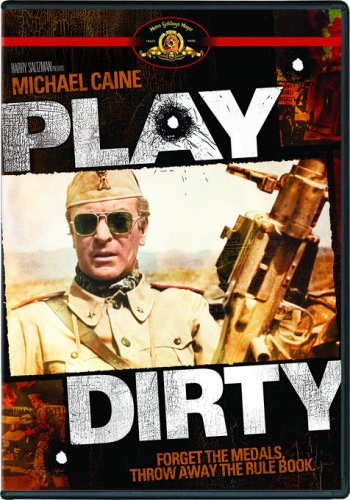
Play Dirty
An actor in the lead almost always worth watching. Michael Caine, check. A setting that rarely disappoints. Check, North Africa in WWII as the Germans battle the Allies for control. An ending that delivers one of the best sucker punch surprises ever. You bet. So why has no one heard of 1968's Play Dirty? It's one of those hidden gems I was very pleased I stumbled upon. Now if only more fans could find it, it might get some of the credit it deserves.
After a year of failed missions that produced no results, British commando leader Colonel Masters (Nigel Green) has been given one last chance to do something positive. He has reports of a German fuel dump that is key to Rommel's success. The high command's only demand is that Masters send a British officer along with to lead the mission. In steps Capt. Douglas (Caine), a British petroleum official, who instantly clashes with his second-in-command and Masters' officer, Capt. Leech (Nigel Davenport). That might be the least of his problems. Trekking across 400 miles of desert, Douglas leads a small team of convict commandos, battling German patrols, murdering Arab tribesmen, and everything the desert can throw at them. Something else might be waiting for them too, something none of them could plan for.
Director Andre De Toth has a hidden gem here in this WWII story. It borrows liberally from other North Africa WWII movies like Tobruk or TV shows like The Rat Patrol. But something just clicks here that's hard to explain. It is a minimalist war movie if there ever was one. It is cynical beyond all belief, the headquarters officers (including Harry Andrews in a small part) clueless but brimming with pride and ego. The commandos are murderers, rapists, drug dealers and arms smugglers, only joining Masters' force because it got them out of prison. The effect is a winner. It's an honest, downright filthy look at WWII. As the tagline said, 'Throw out the medals, forget the rule book, if you want to survive...play dirty.'
Playing a cat and mouse game on the mission is Caine as Douglas and Davenport as Leech. Michael Caine plays the stiff upper-lip officer perfectly, prim and proper trying to do things by the book. He doesn't realize he's basically a sacrificial lamb, trying to pull off this suicidal mission. He receives little help from Capt. Leech, a man interested only in which side will pay more for his services. The problem is, he's damn good at his job and is working with a pay-off in mind. Seeing these two men go toe to toe is fun, like a heavyweight bout where both sides land punch after punch. It's not great performances on their own, but together they carry the movie. Douglas just wants to accomplish the mission placed in front of him, even with the men behind him possibly gunning for him. Leech is going to do what it takes to ensure his own survival, and hopefully Douglas' life too.
Like Tobruk, the basic mission is simple. In the desert, gasoline and water are key if you want to keep your vehicles moving. The men on a mission angle isn't played up much after an early introduction scene of the convict commandos. More focus is placed on Douglas and Leech, but the commandos include Sadok (Aly Ben Ayed), explosives expert, Kostas Manou (Takis Emmanuel), black market arms dealer, Kafkarides (Enrique Avila), the drug dealer and driver, Boudesh (Scott Miller), a brawler, and Hassan (Mohsen Ben Abdallah) and Assine (Mohamed Kouka), the two gay Arab trail guides. Among the group, there's maybe 15 or 20 lines combined. It's more what they are that's important. They're the lowest of the low and no one much cares what happens to them. None of these actors were anything more than background players, and for some, they were only in three or four movies at all. They still do a solid job giving Douglas' team an eclectic mix of sordid individuals though.
The minimalist aspect helps make this movie better than other similar WWII stories. The mission is painfully simple. Travel across the desert and blow up the fuel dump. Done, no detours. A long sequence has them navigating a steep cliff face trying to get their vehicles to the top. They change countless tires. They run into patrols, Arab tribesmen, avoiding mine fields and booby traps. Michel Legrand's musical score never provides any clues as to what's about to happen, the story surprising you instead. The pacing may seem a little slow, but this is what faces them. Survival at its most base in the desert. You do what you need to do to keep moving. For these men, it's always moving forward because what awaits them is better than what they're leaving behind.
Above all else though, the final 30-45 minutes makes Play Dirty a near classic. I'm going to give away the ending so stop reading if you don't want to know. SPOILERS STOP READING SPOILERS Making it all the way to the dump, Douglas' team doesn't realize their mission has become compromised. The fuel dump is in reach of Allied forces and can be saved, not destroyed. British headquarters contacts double agents and tells them a team of commandos is gunning for the fuel. All but Douglas and Leech are killed in the attempt, the two officers making it out. Not bad, right? Late 1960s cynicism at its best. There's more. The next morning, the duo (in German uniforms) attempts to surrender to advancing Allied forces. Hands up, white flag in sight, they're accidentally gunned down by British troops. A soldier apologizes to his officer, claiming he didn't see the flag, credits roll. END OF SPOILERS
Just in terms of sheer guts to actually use that ending, Play Dirty gets a ridiculous amount of credit from me. I can think of maybe three or four other movies that surprised me, just completely caught me off-guard in a shocking way. First, that many main characters getting killed off is an oddity. But that's what works. People get killed during war, often in situations where mistakes are made and soldiers have to be sacrificed. One of the best shocker endings I've ever seen in one of the most underrated WWII movies around.
Play Dirty <--- opening credits (1968): *** 1/2 /****
After a year of failed missions that produced no results, British commando leader Colonel Masters (Nigel Green) has been given one last chance to do something positive. He has reports of a German fuel dump that is key to Rommel's success. The high command's only demand is that Masters send a British officer along with to lead the mission. In steps Capt. Douglas (Caine), a British petroleum official, who instantly clashes with his second-in-command and Masters' officer, Capt. Leech (Nigel Davenport). That might be the least of his problems. Trekking across 400 miles of desert, Douglas leads a small team of convict commandos, battling German patrols, murdering Arab tribesmen, and everything the desert can throw at them. Something else might be waiting for them too, something none of them could plan for.
Director Andre De Toth has a hidden gem here in this WWII story. It borrows liberally from other North Africa WWII movies like Tobruk or TV shows like The Rat Patrol. But something just clicks here that's hard to explain. It is a minimalist war movie if there ever was one. It is cynical beyond all belief, the headquarters officers (including Harry Andrews in a small part) clueless but brimming with pride and ego. The commandos are murderers, rapists, drug dealers and arms smugglers, only joining Masters' force because it got them out of prison. The effect is a winner. It's an honest, downright filthy look at WWII. As the tagline said, 'Throw out the medals, forget the rule book, if you want to survive...play dirty.'
Playing a cat and mouse game on the mission is Caine as Douglas and Davenport as Leech. Michael Caine plays the stiff upper-lip officer perfectly, prim and proper trying to do things by the book. He doesn't realize he's basically a sacrificial lamb, trying to pull off this suicidal mission. He receives little help from Capt. Leech, a man interested only in which side will pay more for his services. The problem is, he's damn good at his job and is working with a pay-off in mind. Seeing these two men go toe to toe is fun, like a heavyweight bout where both sides land punch after punch. It's not great performances on their own, but together they carry the movie. Douglas just wants to accomplish the mission placed in front of him, even with the men behind him possibly gunning for him. Leech is going to do what it takes to ensure his own survival, and hopefully Douglas' life too.
Like Tobruk, the basic mission is simple. In the desert, gasoline and water are key if you want to keep your vehicles moving. The men on a mission angle isn't played up much after an early introduction scene of the convict commandos. More focus is placed on Douglas and Leech, but the commandos include Sadok (Aly Ben Ayed), explosives expert, Kostas Manou (Takis Emmanuel), black market arms dealer, Kafkarides (Enrique Avila), the drug dealer and driver, Boudesh (Scott Miller), a brawler, and Hassan (Mohsen Ben Abdallah) and Assine (Mohamed Kouka), the two gay Arab trail guides. Among the group, there's maybe 15 or 20 lines combined. It's more what they are that's important. They're the lowest of the low and no one much cares what happens to them. None of these actors were anything more than background players, and for some, they were only in three or four movies at all. They still do a solid job giving Douglas' team an eclectic mix of sordid individuals though.
The minimalist aspect helps make this movie better than other similar WWII stories. The mission is painfully simple. Travel across the desert and blow up the fuel dump. Done, no detours. A long sequence has them navigating a steep cliff face trying to get their vehicles to the top. They change countless tires. They run into patrols, Arab tribesmen, avoiding mine fields and booby traps. Michel Legrand's musical score never provides any clues as to what's about to happen, the story surprising you instead. The pacing may seem a little slow, but this is what faces them. Survival at its most base in the desert. You do what you need to do to keep moving. For these men, it's always moving forward because what awaits them is better than what they're leaving behind.
Above all else though, the final 30-45 minutes makes Play Dirty a near classic. I'm going to give away the ending so stop reading if you don't want to know. SPOILERS STOP READING SPOILERS Making it all the way to the dump, Douglas' team doesn't realize their mission has become compromised. The fuel dump is in reach of Allied forces and can be saved, not destroyed. British headquarters contacts double agents and tells them a team of commandos is gunning for the fuel. All but Douglas and Leech are killed in the attempt, the two officers making it out. Not bad, right? Late 1960s cynicism at its best. There's more. The next morning, the duo (in German uniforms) attempts to surrender to advancing Allied forces. Hands up, white flag in sight, they're accidentally gunned down by British troops. A soldier apologizes to his officer, claiming he didn't see the flag, credits roll. END OF SPOILERS
Just in terms of sheer guts to actually use that ending, Play Dirty gets a ridiculous amount of credit from me. I can think of maybe three or four other movies that surprised me, just completely caught me off-guard in a shocking way. First, that many main characters getting killed off is an oddity. But that's what works. People get killed during war, often in situations where mistakes are made and soldiers have to be sacrificed. One of the best shocker endings I've ever seen in one of the most underrated WWII movies around.
Play Dirty <--- opening credits (1968): *** 1/2 /****
Labels:
1960s,
Andre De Toth,
Harry Andrews,
Michael Caine,
Nigel Davenport,
Nigel Green,
WWII
Tuesday, July 20, 2010
Moby Dick
Just the name of certain books have the ability to send chills down the spines of high school and college students. War and Peace, The Grapes of Wrath, Moby Dick, and any number of books from authors like Hemingway, Joyce, Hawthorne, Shakespeare, and many, many more. They're classics and are recommended for a reason, but that doesn't always mean they are good. Honors English in high school and advanced English/Literature/Composition sure proved that to me. Want the easy way out? I avoided it during my high school and college career, but how about watch the movie? I've never read Herman Melville's source novel, but I'm "halfway" caught up having seen 1956's Moby Dick.
Melville's novel is a pretty good example of a book students are afraid to even go near. For starters, it's a long book no matter what edition you pick up. That's not necessarily a breaking point because long books can still be good books. More importantly though, what style is it written in? Is it period appropriate? Is it heavy on words and vocabulary readers won't understand without looking up? I had that problem with director John Huston's movie version of Melville's novel. A movie with some issues, but a fair share of positives too. Bear in mind I'm reviewing the movie, not the novel as I jump in.
It's 1841 and a young sailor Ishmael (Richard Basehart) signs up on a whaler named the Pequod with hopes of experiencing and exploring the high seas and making some good money in the process. Even having sailed before on previous non-whaling voyages, Ishmael isn't quite sure what to expect of the journey that awaits him, but the crew seems a likable enough group. There's second-in-command Starbuck (Leo Genn), officer Stubb (Harry Andrews) and a multi-international crew with men from all over the world. For days though, no one sees the captain on deck, a man known only as Ahab (Gregory Peck), a veteran of the sea. When he does reveal himself, he delivers a speech about the success the Pequod's crew is about to have, but he has other plans. Above all else, he wants to kill a white sperm whale named Moby Dick, and nothing is going to stop him.
Reading the critical reviews of this 1956 version, one aspect of the movie seems to polarize critics more than anything else; the casting of Gregory Peck as Captain Ahab. I was surprised to read these complaints because I thought Peck's performance was one of the better things about the movie. The criticisms state that he was too young an actor to play one of literature's most notorious characters. Ahab was an old, grizzled veteran of the sea, his leg bitten off by Moby Dick, and now he wants revenge. His descent into madness, his obsession in killing Moby Dick worked in terms of character and story. Peck admitted later in his career it wasn't his best performance, stating there was too much prose from the novel in the film. For me, that was a problem throughout the film. Peck's performance? Not so much.
My biggest complaint of Huston's film was the feeling of being talked at, of being preached to. Many scenes drag on as characters talk in a very proper Victorian sounding conversation. These are whalers, not exactly upper class, high end sailors so they should talk naturally. Instead, much of the conversation feels stilted and generally a little off, and there is a lot of it. Early on, Orson Welles makes a cameo as a priest giving a sermon about Jonah and the whale (ooooohhh, foreboding!) that moves at a pace paint drying would be jealous of. These long-winded conversations take away from the movie's pacing which is otherwise able to move along at a good rate. Authentic to the book in terms of being true to the source, but maybe not so much commitment would have been better.
I'll be the first to say that I know little to nothing about whaling and its history. Seeing the movie's depiction of whaling certainly gives you an appreciation of how dangerous the job actually was. Men in small boats leave their bigger ships and chase after whales near the ocean's surface, then hurl harpoons and spears at the beast until they're dead. These are the scenes I enjoyed most as Huston gives us a feel of what sea life had to be like. Because for every hunt on the waters, there's time where the crew is bored to tears waiting for some action on-deck. I don't know if it was the quality of TCM's print or how Huston filmed the movie, but a washed-out almost sepia coloring certainly adds to the doom and gloom of this horrific hunt.
For a movie that clocks in at just under 2 hours, one thing I realize looking back is how little actually happens until the end. I don't know about the novel, but the pacing is all over the place. Ahab is introduced by face until 30 minutes into the film, Moby Dick doesn't make an appearance until the last 30 minutes, and in the end it all feels rushed, especially the sea battle with this giant white sperm whale. Behind Peck, the cast is all right, Basehart wasted as Ishmael because he's given little to do while Genn solid as Starbuck. I liked the movie, but the more I thought about it, the more problems I had. Still, it's worth a watch, if for nothing else than for you to decide what you think of Peck's performance.
Moby Dick <----trailer (1956): ** 1/2 /****
Melville's novel is a pretty good example of a book students are afraid to even go near. For starters, it's a long book no matter what edition you pick up. That's not necessarily a breaking point because long books can still be good books. More importantly though, what style is it written in? Is it period appropriate? Is it heavy on words and vocabulary readers won't understand without looking up? I had that problem with director John Huston's movie version of Melville's novel. A movie with some issues, but a fair share of positives too. Bear in mind I'm reviewing the movie, not the novel as I jump in.
It's 1841 and a young sailor Ishmael (Richard Basehart) signs up on a whaler named the Pequod with hopes of experiencing and exploring the high seas and making some good money in the process. Even having sailed before on previous non-whaling voyages, Ishmael isn't quite sure what to expect of the journey that awaits him, but the crew seems a likable enough group. There's second-in-command Starbuck (Leo Genn), officer Stubb (Harry Andrews) and a multi-international crew with men from all over the world. For days though, no one sees the captain on deck, a man known only as Ahab (Gregory Peck), a veteran of the sea. When he does reveal himself, he delivers a speech about the success the Pequod's crew is about to have, but he has other plans. Above all else, he wants to kill a white sperm whale named Moby Dick, and nothing is going to stop him.
Reading the critical reviews of this 1956 version, one aspect of the movie seems to polarize critics more than anything else; the casting of Gregory Peck as Captain Ahab. I was surprised to read these complaints because I thought Peck's performance was one of the better things about the movie. The criticisms state that he was too young an actor to play one of literature's most notorious characters. Ahab was an old, grizzled veteran of the sea, his leg bitten off by Moby Dick, and now he wants revenge. His descent into madness, his obsession in killing Moby Dick worked in terms of character and story. Peck admitted later in his career it wasn't his best performance, stating there was too much prose from the novel in the film. For me, that was a problem throughout the film. Peck's performance? Not so much.
My biggest complaint of Huston's film was the feeling of being talked at, of being preached to. Many scenes drag on as characters talk in a very proper Victorian sounding conversation. These are whalers, not exactly upper class, high end sailors so they should talk naturally. Instead, much of the conversation feels stilted and generally a little off, and there is a lot of it. Early on, Orson Welles makes a cameo as a priest giving a sermon about Jonah and the whale (ooooohhh, foreboding!) that moves at a pace paint drying would be jealous of. These long-winded conversations take away from the movie's pacing which is otherwise able to move along at a good rate. Authentic to the book in terms of being true to the source, but maybe not so much commitment would have been better.
I'll be the first to say that I know little to nothing about whaling and its history. Seeing the movie's depiction of whaling certainly gives you an appreciation of how dangerous the job actually was. Men in small boats leave their bigger ships and chase after whales near the ocean's surface, then hurl harpoons and spears at the beast until they're dead. These are the scenes I enjoyed most as Huston gives us a feel of what sea life had to be like. Because for every hunt on the waters, there's time where the crew is bored to tears waiting for some action on-deck. I don't know if it was the quality of TCM's print or how Huston filmed the movie, but a washed-out almost sepia coloring certainly adds to the doom and gloom of this horrific hunt.
For a movie that clocks in at just under 2 hours, one thing I realize looking back is how little actually happens until the end. I don't know about the novel, but the pacing is all over the place. Ahab is introduced by face until 30 minutes into the film, Moby Dick doesn't make an appearance until the last 30 minutes, and in the end it all feels rushed, especially the sea battle with this giant white sperm whale. Behind Peck, the cast is all right, Basehart wasted as Ishmael because he's given little to do while Genn solid as Starbuck. I liked the movie, but the more I thought about it, the more problems I had. Still, it's worth a watch, if for nothing else than for you to decide what you think of Peck's performance.
Moby Dick <----trailer (1956): ** 1/2 /****
Labels:
1950s,
Gregory Peck,
Harry Andrews,
John Huston,
Leo Genn,
Orson Welles,
Richard Basehart
Wednesday, June 30, 2010
The Deadly Affair
Whenever possible I do my best to avoid sounding like an arrogant American moviegoer. No nudity and no explosions? Count me out. I do my best to at least give movies a try regardless of the country they're from. If it sounds halfway decent, that's all I need. Movies from England are usually a safe bet starting with the lack of a language barrier or subtitles, although in some cases, those subtitles wouldn't hurt. That's where I'll start with 1966's The Deadly Affair.
A British production through and through, 'Affair' is the anti-Bond movie with its lack of action, sex and any sense of humor. Typically, I can keep up with thick/heavy British accents (a talent derived from years of watching Michael Caine movies), but subtitles or closed captioning always helps in a pinch. Directed by Sidney Lumet -- typically one of my favorite directors -- this semi-spy flick has so many actors mumbling and whispering through their parts that I was more than a little confused just 10 or 15 minutes in. Even trying to keep up, the story was difficult to follow...to a point. A "twist" late seemed incredibly obvious to me, but maybe I had time to think about, being confused and all.
After meeting with a possible Communist working for the British government, agent Charles Dobbs (James Mason) is shocked to find out the man killed himself -- even after a positive ruling from Dobbs to their superiors. An old friend and former agent, Dieter Fry (Maximilian Schell), is visting but Dobbs must put his friendship to the side as he investigates. With some help from a retired detective (Harry Andrews), he begins to piece things together with much of the mystery surrounding the death coming back to the man's wife (Simone Signoret). Through it all though something isn't adding up, and Dobbs realizes he's stepped into something much bigger than he anticipated.
First off, the casting is impeccable. Not so impeccable? Mason mumbles his way through his part, Signoret's thick French accent is tough to decipher at times, and Andrews talks in an ultra-fast fashion that combined with his own accent makes most of his lines nearly impossible to understand. Combine all three of those elements, and I was confused almost from the start. The story features a fair share of twists -- which obviously didn't help -- but even then the it is so slow-moving that often enough these twists don't register as a surprise. It's clear this English man didn't kill himself. It's only a matter of who was involved and most importantly, why.
On to a theory I have that I've dubbed 'the Law and Order guest star rule.' Watch an episode of Law and Order. If there's a guest star in the cast, put all your money on them being the bad guy/killer/rapist/thief/kidnapper. Figure that NBC didn't pay them just to hang around. Their services are going to be put to use. The theory applies to movies too involving any sort of mystery. In 'Affair,' it is the question of who is the murderer. SPOILERS STOP READING SPOILERS Not surprisingly, it's Schell. He makes an appearance early and then reappears in the last 15 minutes. It is obvious from his entrance he's the bad guy. One, he is Maximilian Schell, and two, he's still Maximilian Schell. END OF SPOILERS
Beyond the murder mystery and the government intrigue, the pacing lacks any sort of energy. Mason is having marital problems with wife Ann (Harriet Andersson) because she basically sleeps with anyone who says 'howdy' to her. Mason's Dobbs is unbelievably forgiving in a storyline that goes nowhere. One semi-twist involves who Ann is sleeping with, but you should really see it coming from miles off. There are other little oddities that include long scenes of watching Shakespearean plays while Dobbs and Andrews' Mendel try to piece things together. Out of place and with the ability to grind the story to a complete halt, I'm sure I missed something important, but by that point I just didn't care.
Not much else to say here. Disappointing of course because Lumet is typically such a reliable director, and the cast he's working with is certainly impressive. I'll recommend this one for fans of any of the actors or Lumet completists, but for not much else. I'm sure some subtitles couldn't hurt a second viewing, but that first one was painful enough.
The Deadly Affair <----TCM trailer (1966): * 1/2 /****
A British production through and through, 'Affair' is the anti-Bond movie with its lack of action, sex and any sense of humor. Typically, I can keep up with thick/heavy British accents (a talent derived from years of watching Michael Caine movies), but subtitles or closed captioning always helps in a pinch. Directed by Sidney Lumet -- typically one of my favorite directors -- this semi-spy flick has so many actors mumbling and whispering through their parts that I was more than a little confused just 10 or 15 minutes in. Even trying to keep up, the story was difficult to follow...to a point. A "twist" late seemed incredibly obvious to me, but maybe I had time to think about, being confused and all.
After meeting with a possible Communist working for the British government, agent Charles Dobbs (James Mason) is shocked to find out the man killed himself -- even after a positive ruling from Dobbs to their superiors. An old friend and former agent, Dieter Fry (Maximilian Schell), is visting but Dobbs must put his friendship to the side as he investigates. With some help from a retired detective (Harry Andrews), he begins to piece things together with much of the mystery surrounding the death coming back to the man's wife (Simone Signoret). Through it all though something isn't adding up, and Dobbs realizes he's stepped into something much bigger than he anticipated.
First off, the casting is impeccable. Not so impeccable? Mason mumbles his way through his part, Signoret's thick French accent is tough to decipher at times, and Andrews talks in an ultra-fast fashion that combined with his own accent makes most of his lines nearly impossible to understand. Combine all three of those elements, and I was confused almost from the start. The story features a fair share of twists -- which obviously didn't help -- but even then the it is so slow-moving that often enough these twists don't register as a surprise. It's clear this English man didn't kill himself. It's only a matter of who was involved and most importantly, why.
On to a theory I have that I've dubbed 'the Law and Order guest star rule.' Watch an episode of Law and Order. If there's a guest star in the cast, put all your money on them being the bad guy/killer/rapist/thief/kidnapper. Figure that NBC didn't pay them just to hang around. Their services are going to be put to use. The theory applies to movies too involving any sort of mystery. In 'Affair,' it is the question of who is the murderer. SPOILERS STOP READING SPOILERS Not surprisingly, it's Schell. He makes an appearance early and then reappears in the last 15 minutes. It is obvious from his entrance he's the bad guy. One, he is Maximilian Schell, and two, he's still Maximilian Schell. END OF SPOILERS
Beyond the murder mystery and the government intrigue, the pacing lacks any sort of energy. Mason is having marital problems with wife Ann (Harriet Andersson) because she basically sleeps with anyone who says 'howdy' to her. Mason's Dobbs is unbelievably forgiving in a storyline that goes nowhere. One semi-twist involves who Ann is sleeping with, but you should really see it coming from miles off. There are other little oddities that include long scenes of watching Shakespearean plays while Dobbs and Andrews' Mendel try to piece things together. Out of place and with the ability to grind the story to a complete halt, I'm sure I missed something important, but by that point I just didn't care.
Not much else to say here. Disappointing of course because Lumet is typically such a reliable director, and the cast he's working with is certainly impressive. I'll recommend this one for fans of any of the actors or Lumet completists, but for not much else. I'm sure some subtitles couldn't hurt a second viewing, but that first one was painful enough.
The Deadly Affair <----TCM trailer (1966): * 1/2 /****
Wednesday, June 23, 2010
The Internecine Project
If a movie has a gimmick, is that a bad thing? 3-D filming comes to mind, an actor/actress playing against type in a major way, a twist that no one sees coming, and many more I'm probably missing. Sometimes that gimmick can hold an otherwise dull or average movie together and make it worth watching. These gimmicks tend to gravitate toward thrillers, horror and action movies, but that's a general blanket statement. They can be in any type of movie. Generally forgotten since its release, 1974's The Internecine Project has a gimmick, and a good one at that.
This British production is interesting in that it presents a unique idea and executes it in one of the most ridiculously boring sounding sequences. I won't spoil what it is yet, but does a man sitting in his office waiting for a phone to ring at a preordained time over the course of several hours sound interesting at all? You wouldn't think so, but that's part of why 'Project' works so surprisingly well. It's not groundbreaking or anything that new, but the murder mystery thriller keeps you guessing until the end when an appropriate twist ending is delivered.
About to receive a government advisor position after years of working in economic theory as a Harvard professor, Dr. Robert Elliott (James Coburn) is approached by a highly powerful and high ranking government official who also seems to have some ties in big business, E.J. Farnsworth (Keenan Wynn). Elliott has a bit of a shadowy past during his years as an operative for the government, and these people would stand to take him down if he gains this position of power. The only solution? Kill them. But how can he do it without arising suspicion that he did it? Elliott comes up with an ingenious plan that has these four people unknowingly killing each other. The deadline is approaching though, and Elliott has little time to accomplish his task when an ex-girlfriend, a respected journalist (Lee Grant) shows up on his doorstep.
This is the type of story that keeps you guessing as to where exactly it is going through the first 30 minutes. You know something's coming down the highway right at you, but what exactly? When it is revealed, the simplicity of it is what makes it work. Elliott needs these four dead and in a great handful of scenes goes to each of them (including Harry Andrews, Ian Hendry, Michael Jayston, and Christiane Kruger) explaining what they have to do to remain safe. All of the murders will take place in one night in a 3-4 hour window with Elliott telling each of his dupes/victims to call him at a certain time and let the phone ring a specified amount of times.
And that's where the gimmicky scene of Coburn sitting in his office waiting for his private line to ring begins. It's a scene that goes on almost 30 minutes as the four go about their business, sneaking into an apartment or office while another person is doing the same in their apartment. All the while, Coburn's Elliott sits in his office with a checklist, crossing them off as the quartet calls him with updates. The plan is simple but depends almost completely on timing so when the phone rings more or less than expected, Coburn of course gets nervous. The scene is incredibly high on tension in a way I would have never thought possible.
This is the type of thriller though where you're fulling expecting a twist. Sometimes the best twist can be not seeing it coming at all, but others just beg to reveal something or surprise the audience at the end. 'Project' from the get-go feels like a movie that is going to pull the carpet out from under you at the last possible second, and in the last five minutes it certainly does not disappoint. I debated even making this comparison, but it reminded me a lot of 1972's The Mechanic. Both endings caught me by surprise in their execution, but that last twist, that last surprise works beautifully here.
With a twisty story like this, the cast can tend to be replaceable whether it be the star or one of the supporting players. I like the choice of Coburn in the lead because he always showed an ability to play the charming hero or the villainous bad guy. As Elliott, he's a bit of an evil mastermind, but he's so smooth doing it you find yourself rooting for him -- or I did at least. You need someone leading the way in a story similar to this, and Coburn does it well. The movie is available on a good transfer on a recently released DVD if curious.
The Internecine Project <----trailer (1974): ** 1/2 /****
This British production is interesting in that it presents a unique idea and executes it in one of the most ridiculously boring sounding sequences. I won't spoil what it is yet, but does a man sitting in his office waiting for a phone to ring at a preordained time over the course of several hours sound interesting at all? You wouldn't think so, but that's part of why 'Project' works so surprisingly well. It's not groundbreaking or anything that new, but the murder mystery thriller keeps you guessing until the end when an appropriate twist ending is delivered.
About to receive a government advisor position after years of working in economic theory as a Harvard professor, Dr. Robert Elliott (James Coburn) is approached by a highly powerful and high ranking government official who also seems to have some ties in big business, E.J. Farnsworth (Keenan Wynn). Elliott has a bit of a shadowy past during his years as an operative for the government, and these people would stand to take him down if he gains this position of power. The only solution? Kill them. But how can he do it without arising suspicion that he did it? Elliott comes up with an ingenious plan that has these four people unknowingly killing each other. The deadline is approaching though, and Elliott has little time to accomplish his task when an ex-girlfriend, a respected journalist (Lee Grant) shows up on his doorstep.
This is the type of story that keeps you guessing as to where exactly it is going through the first 30 minutes. You know something's coming down the highway right at you, but what exactly? When it is revealed, the simplicity of it is what makes it work. Elliott needs these four dead and in a great handful of scenes goes to each of them (including Harry Andrews, Ian Hendry, Michael Jayston, and Christiane Kruger) explaining what they have to do to remain safe. All of the murders will take place in one night in a 3-4 hour window with Elliott telling each of his dupes/victims to call him at a certain time and let the phone ring a specified amount of times.
And that's where the gimmicky scene of Coburn sitting in his office waiting for his private line to ring begins. It's a scene that goes on almost 30 minutes as the four go about their business, sneaking into an apartment or office while another person is doing the same in their apartment. All the while, Coburn's Elliott sits in his office with a checklist, crossing them off as the quartet calls him with updates. The plan is simple but depends almost completely on timing so when the phone rings more or less than expected, Coburn of course gets nervous. The scene is incredibly high on tension in a way I would have never thought possible.
This is the type of thriller though where you're fulling expecting a twist. Sometimes the best twist can be not seeing it coming at all, but others just beg to reveal something or surprise the audience at the end. 'Project' from the get-go feels like a movie that is going to pull the carpet out from under you at the last possible second, and in the last five minutes it certainly does not disappoint. I debated even making this comparison, but it reminded me a lot of 1972's The Mechanic. Both endings caught me by surprise in their execution, but that last twist, that last surprise works beautifully here.
With a twisty story like this, the cast can tend to be replaceable whether it be the star or one of the supporting players. I like the choice of Coburn in the lead because he always showed an ability to play the charming hero or the villainous bad guy. As Elliott, he's a bit of an evil mastermind, but he's so smooth doing it you find yourself rooting for him -- or I did at least. You need someone leading the way in a story similar to this, and Coburn does it well. The movie is available on a good transfer on a recently released DVD if curious.
The Internecine Project <----trailer (1974): ** 1/2 /****
Labels:
1970s,
Harry Andrews,
Ian Hendry,
James Coburn,
Keenan Wynn
Friday, February 5, 2010
55 Days at Peking
I'll be the first to admit that while U.S. history is one of my favorite subjects, I know very little about Asian history whether it be China, Japan or anything in between. The subject covered in 'Peking' is the Boxer Rebellion, which I've always been aware of but couldn't have told you one thing about it. Reading some reviews and critiques of the movie, it seems history was handled fairly and mostly honestly. Looking at it that way, it serves then as both a history lesson and an entertaining epic.
Arriving in 1900 Peking with a company of U.S. Marines, Major Matt Lewis (Heston) finds a city in turmoil and on the brink of war. The Boxers, a large group of anti-imperialism/anti-catholic citizens, are ready to revolt. The world powers all have an ambassador and embassy in Peking with a token force of their military -- around 400 total men -- there for protection. British ambassador Sir Arthur Robertson (David Niven) somehow convinces the other ambassadors to stay even when a revolution seems imminent that could take all their lives. The armed forces along with all family, women and children move into the Legation Quarter, a walled city that can serve as a fortress. But with limited supplies, including food and ammunition, can the multi-national group survive until reinforcements arrive?
Based on the actual Boxer Rebellion history, 'Peking' holds many similarities with 1960's The Alamo both in history and in movies with composer Dimitri Tiomkin doing the score for both. After some background, both historical and character driven, most of the movie settles in for the extended siege of the Legation Quarter. Director Nicholas Ray -- who usually worked on smaller, more manageable movies -- has his work cut out for him. Making a siege interesting to watch is a challenge, but Ray succeeds. The almost two-month long battle is never dull with plenty of tension and action, but more on that later.
Once past the big name stars, 'Peking' doesn't have a cast of thousands of A-list stars, but the leads more than handle their own. Heston is an ideal choice for the tough U.S. Marine trying to do what's right, and Niven hits all the right notes as a former soldier turned ambassador trying to prove he belongs. Rising above just an unnecessary eye candy role, Ava Gardner nails her part as Baroness Natalie Ivanoff, a woman being kicked out of the city forced to re-enter upon the attack. She has an instant connection with Heston's Lewis, but thankfully the script calls for her to dig deeper as Natalie sees the horror of the fighting. Also starring are Flora Robson as Empress Tzu-Hsi, John Ireland as Sgt. Harry, one of Heston's Marines, and Harry Andrews as Father de Bearn, a priest with some military background. There's also a worthwhile subplot with a Chinese girl (Lynne Sue Moon) who's father is a Marine.
A good test if whether the movie you're watching is an epic has an overture, intermission, and exit music. If you answered 'yes' to the question, enjoy YOUR EPIC! 'Peking' has spectacle written all over it from the cast to the sets to the thousands of extras. Huge sets were constructed in Spain, and they're a site to behold, giving the story a real authenticity that would have been lost with models or green screens. Hundreds and thousands of extras fill the screen for the battle scenes which are some of the bigger ones ever committed to the screen. With the list of differing armed forces nationalities, there's even some humor, like Ireland's Sgt. waking up soldiers in a litany of languages.
Now for whatever reason -- probably because it's a good movie and what'd be the point of it -- this movie has not been released on DVD, not a good one at least. It's one of those epics where you can honestly say 'they don't make them like that anymore.' 'Peking' is everything that was big and grand about a roadshow version of a movie with great casting, a bigger than life historical story, memorable score, huge action, and surprisingly enough, an effective message. After all, the Boxers just want their country back...even if they go about it in an extreme fashion.
I was unable to find a trailer -- an English one anyways, if you understand German I can help you out -- but TCM has posted 4 clips you can watch through their website. The print shown on TCM was pretty near flawless if you ask me so how about those studio execs get off their butts and get this one on DVD.
55 Days at Peking (1963): *** 1/2 /****
Sunday, May 24, 2009
Battle of Britain
Battle of Britain (1969), directed by Guy Hamilton of James Bond fame, is everything that was good and bad about the epic war movies to come out of the 60s, and really epic movies in general. Growing up in the good old USA, the early parts of WWII were never taught as much as the post-Pearl Harbor years once America got involved in the war so this movie serves as a good introduction to the earlier years of the war. Immediately following the Dunkirk disaster, it appears that Hitler and the Third Reich are one good push away from winning the war. All that's needed for that final push is the invasion of England.
But before a cross-channel invasion can take place, Herman Goring and his illustrious Luftwaffe must knock out the Royal Air Force so an invasion force can go across the channel relatively unmolested. For the RAF though, they're heading into a battle with the odds heavily stacked against them with just 600 pilots to Germany's 2,500. As Laurence Olivier's Air Chief Marshal Dowding so eloquently but effectively states, "Our boys are going to have shoot down their boys at a rate of 4 to 1." So begins the battle of Britain, here's the film's opening, a good sum-up of what's happened and what's to come.
With a movie that focuses exclusively on a key moment in Britain's history, the benefits are obvious. Director Hamilton collects a who's who of British actors to fill out his cast. Olivier and Trevor Howard star as Dowding and Air Vice Marshal Park, the higher-ups in the RAF who oversee the desperate fight in the air. As the pilots, Micheal Caine, Robert Shaw and Christopher Plummer lead the fight with Ian McShane and Edward Fox as two pilots in Shaw's squadron. And then making short appearances are Curd Jurgens, Harry Andrews, Patrick Wymark, Michael Redgrave, Kenneth More, and Ralph Richardson. If that cast doesn't impress you at least a little bit, this might not be your movie.
As I've covered before though, the flaw with such a huge cast is the characterization which suffers. These characters are more outlines of historical figures than flesh and blood people. Plummer stands out mostly because he's given a love interest, the beautiful Susannah York, so we find out something about his squadron leader. You're not hoping Caine's Squadron Leader Canfield makes it, you're hoping Michael Caine makes it. The same with Shaw and Plummer. But that's a minor flaw for me, not something that should stop you from seeing the movie.
And surprise, surprise, what's the actual reason for seeing a movie built around WWII in the air? If you answered 'dogfights' and lots of aerial footage, pat yourself on the back. It's a pre-CGI movie that relies on actual footage being shot of these pilots in action, the British Spitfires tangling with the German Stukas, here's one great scene with Goring asking his officers what they need to win. The film will sink or swim for most viewers on the dogfights, which do eat up most of the movie's 132-minute running time. The best is saved for last appropriately enough as the British throw all their reserves into the battle in one last, desperate ploy to stop the Luftwaffe. It's a 4-minute scene with no dialogue, no sound at all other than Ron Goodwin's score, sampled here, a very British score indeed.
Hamilton's movie then is not so much about the characters as the battle itself. Obviously, without the pilots, WAFs and coast watchers, the battle for Britain could not have happened. But Hamilton goes for the spirit of these people. Maybe we don't know much about them, their personal backgrounds, but they're fighting for what they believe in to stop a power-hungry Adolf Hitler as he swept across Europe. If these pilots hadn't held off the Luftwaffe and ultimately won the battle, who knows how different the world would be right now? It's a frightening thought. And that's why Battle for Britain works, even with its flaws.
Still wavering? Here's a trailer, a long one at that, and a longer preview of the movie as a whole. A WWII movie not as well known as many war movies of the time, but one definitely worth checking out if you've missed it up to now.
Subscribe to:
Posts (Atom)