The Sons of Katie Elder

The Sons of Katie Elder
"First, we reunite, then find Ma and Pa's killer...then read some reviews."
Showing posts with label Leo Gordon. Show all posts

Friday, October 9, 2015

The Conqueror (1956)

I love John Wayne so let's get that out of the way. I've seen just about every single one of his feature-length films, and more than a few of his ventures are on the Just Hit Play All-Time Favorite List. I can be honest though when necessary, and the 1950's were far from the Duke's strongest decade. Though there were some gems -- Rio Bravo, The Searchers, Hondo among others -- there were some duds, real tankers. Blood Alley, The Barbarian and the Geisha, Legend of the Lost, all not remembered so fondly but one rises (or sinks?) above the rest. Definitely Wayne's worst film and one remembered as one of the worst of all-time, 1956's The Conqueror.

"Why is it so bad, Tim?" you might ask. Why? Well, John Wayne, the all-American movie star takes a crack at playing the infamous Mongol warrior and leader Genghis Khan. Yeah, you read that right. John Wayne plays Genghis Khan. And away we go!

Ruling his tribe/clan of Mongols on the Asian Steppe, fiery, brutal warrior Temujin (Wayne) has caused himself some issues. Namely, a violent conflict he's started with a rival tribe because he kidnapped said tribe leader's wife-to-be, Bortai (Susan Hayward). The equally fiery woman wants nothing to do with Temujin and making it worse, her father killed Temujin's father years before. Uh-oh, family drama! Even as war looms and his people threaten to leave him entirely, Temujin refuses to give up his kidnapped bride who wants nothing to do with him (or does she?!?). Instead, the Mongol leader looks to form an uneasy alliance with a past enemy to hold his power and hopefully gain much, much more. Can it all hold together long enough for Temujin to do what he needs to do to reach out and grab everything he wants? The answer lies on a trail of bodies and a river of blood across the Steppe.

Well, that was a fun plot synopsis to write! It's not too often I get to write a trail of bodies and a river of blood in a review. It's an easy plot to spell out because it is just so criminally bad. We will address John Wayne as Genghis Khan in a bit -- that's too easy -- but there's so much badness here in all-around fashion. The script offers one stilted scene of dialogue after another and then one betrayal and backstabbing after another. Imagine the Indians in 1950's westerns -- Me Indian. How! -- but transitioned to a war on the Asian steppe. Yeah, it's just as bad and cliched and just plain dumb as you'd expect. Actor-turned-director Dick Powell is at the helm of a real stinker here, basically from beginning to end. It doesn't build to bad. It just IS bad.

Okay, John Wayne as Genghis Khan. Let's process this. Let's rationalize. It can't be as bad as it sounds, right? No, it's exactly how it sounds. In the late 1940's and into the 1950's, Wayne really developed as an actor, piling up some of his best roles -- She Wore a Yellow Ribbon, Red River, Sands of Iwo Jima, The Searchers -- but this is just uncomfortable to watch. As Ben Manckiewicz said during the recent airing of 'Conqueror' on TCM, Wayne has said in interviews he played Khan as an American cowboy, a tough gunfighter and wouldn't you know it? That formula doesn't work. He's trying so give him credit because it would have been easy to phone this one in (real easy). Wayne just has too much working against him from the aforementioned dialogue that sounds especially stiff coming from the Duke down to the ridiculous mustache wardrobe set him up with. Bad. Really bad so be forewarned.

No one in the cast escapes the wrath of the script to be honest. Hayward was one tough actress, but she doesn't have much chemistry with Wayne and that's a problem when the driving force of the movie is their passion-filled, love-hate relationship. Hayward does get a bizarre, forced striptease/sexy dance of sorts so....there's that, I guess? Pedro Armendariz plays Temujin's half-brother, Jamuga, his conscious, a wise sidekick who recommends what to do next. Also look for Agnes Moorehead, Thomas Gomez, William Conrad, John Hoyt and Ted de Corsia in supporting parts. Familiar faces Lee Van Cleef and Leo Gordon get supporting background parts. A whole bunch of very non-Asian actors playing Asian parts and the end results are just as bad as you figured they would be. Not a winner in the bunch!

If there's a positive, it comes as a bit of a loaded statement. The scope and scale of the movie is impressive. The battle scenes of colliding, thundering armies crashing into each other are something to behold. The stuntwork is impressive throughout as hundreds of riders fill the screen in lavish uniforms set against the stunning backdrop of the Utah desert. Then there's the issue...the filming locations were 100-miles south of nuclear testing sites and judging by the amount of cast members that would die from cancer over the coming years, it seems the U.S. government's promise that the nuclear fallout wouldn't head their direction...well, that's garbage. Much of the cast and crew would die over the next 5, 10 and 20-plus years from varying cancers, quite possibly from the arduous filming schedule in the Utah desert. If that's not tragic, I don't know what is.

So here we are. The fact that 'Conqueror' has a 3.3 rating on IMDB is a testament to John Wayne fans who are fighting a heck of a battle to bring that number up at least a little. This movie is just as bad and worse as you've heard. I lost interest pretty quickly but stuck it out, hoping things might improve at some point. That's the worst kind of a bad movie, one that's almost impossible to even enjoy in guilty pleasure fashion. Give this one a wide, big-old berth, and that's coming from one of the biggest John Wayne fans around.

The Conqueror (1956): */****

Thursday, November 27, 2014

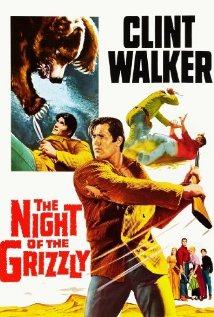
The Night of the Grizzly

So that 1975 movie about a great white shark terrorizing a summer vacation locale? What's it called? Jaws I think? Yeah, it's halfway decent. It spawned far too many ripoffs, knockoffs and lousy sequels, many of which I've reviewed here. Here's a twist for you....what about a movie that inspired Jaws? It comes from a genre you might not have thought of, the western. Here's 1966's The Night of the Grizzly.

Having worked for years as a marshal, Big Jim Cole (Clint Walker) has decided to turn in his badge. He has acquired a ranch in Wyoming from a family member and with his wife, Angie (Martha Hyer), three kids, and his former deputy, Sam Potts (Don Haggerty), is uprooting and moving for a new life. The nearby town is welcoming -- for the most part -- and the land is good farming land. Cole even has plans to raise some cattle, but he's got two problems to deal with. One, the rich landowner and fellow rancher in town, Jed Curry (Keenan Wynn), desperately wants his land and is going to stop at nothing to get that land. Two, a grizzly lives in the mountains that has terrorized the area for years. Dubbed Satan by the townspeople, the bear kills randomly, killing man and livestock alike and not just for food. If he wants his family to stay on their new land, Cole has his work cut out for him.

So did you notice how I didn't mention that whole man-killing grizzly until late in the plot description? Yeah, that wasn't an accident or oversight on my part. For a movie named 'Night of the Grizzly,' director Joseph Pevney sure doesn't seem too interested in doing much with the whole grizzly bear plot. It's just an odd movie in the end, one that can't pick a rhythm and stick with it. It is equal parts family drama that would seem more comfortable on The Waltons, odd, out of place humor, some typical western land/rancher drama, and oh yeah, that killer bear who everyone is terrified of. Dun-dun-duh!!! If you just commit to the bear story and go with it, maybe we've got something, but it plays out like there wasn't much of a script so things got fleshed out with all those other odds and ends.

The most disappointing thing about 'Grizzly' is that the cast alone has plenty of potential. Whether it was on TV or in feature films, Walker was an underrated western star. For starters, he looks like a wild west sort of guy you wouldn't want to tangle with in a fight. The former marshal turned rancher is weighed down by the family drama, Walker left to deal with his worrying wife and a gaggle of troublesome kids. Not given much to do but be the cliched bad guy, Keenan Wynn is slimy and sinister as Jed Curry, ready to do whatever it takes. Jack Elam similarly isn't given much to do other than hang out with Cole's precocious daughter, Gypsy (Victoria Paige Meyerink), in a rare change of pace good guy part. Showing up at the hour-mark in full-on intimidation mode, Leo Gordon is a convict and crook from Cole's past brought in to cause some trouble.

But seriously...it's an unstoppable killer grizzly bear!!! Focus on the bear!!! An attempt here and there at a mood-lightening laugh is one thing. But repeatedly? And at the expense of the story? Talk about a potential killer. One extended bit has little Gypsy chasing after a skunk she thinks is a cat. Oh, no! A smelly little kid who has to eat outside! Oh, and there's Nancy Kulp (of The Beverly Hillbillies) as a general store owner who's got a crush on the drunken Potts. There's also a mountain family that moonshines where we even get to see a drunken rooster stagger around the barnyard. And also, Curry's kids are stupid and awkward. They trick Potts into giving them money for whiskey...but it's a dry county. The acting is anywhere from rough to awkward to watch, and it's hard to tell whether it was because of the actors or the script. Maybe both.

The biggest comparison to Jaws comes in the finale. Much of the movie has the bear shown via a stomping paw or his fuzzy head as he stands up. When we do see the bear, it doesn't look particularly big. In the end, Cole and Gordon's baddie end up chasing the bear around a mountain. Again, lots of potential but it never adds up to anything too interesting. Steer clear of this stinker.

The Night of the Grizzly (1966): */****

Thursday, November 6, 2014

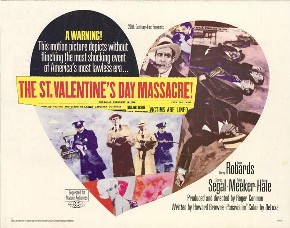
The St. Valentine's Day Massacre

I grew up in Chicago so I love just about everything in the Windy City, all the sports teams, the downtown area, all that great food from Chicago style hot dogs to Chicago style pizza. But that Chicago history? My goodness, there are some dark moments from the Black Sox scandal to the Chicago Fire, the riots at the 1968 Democratic convention and generally all sorts of political corruption and deception. One of the most violent incidents in the city's history? That's told in a 1967 B-movie, The St. Valentine's Day Massacre.

It's early 1929 and the streets of Chicago are filled with warring gangsters from two rival gangs. On one side is Al Capone (Jason Robards), a brutal, possibly maniacal Italian gangster with Mafia ties, who rules Chicago's South Side with an iron fist. Running the city's North side is George 'Bugs' Moran (Ralph Meeker), his Irish gang trying to hold onto their territory.  Things across the city are building to an unavoidable confrontation as both sides fight for control of thousands of speakeasies, Prohibition still raging. Capone has grown tired of Moran's gang trying to build up their power and has put into work a plan to execute his rival gang leader. Can one gang win out over the other? Can anyone win with the city's streets riddled with bullets and blood?

Everyone's heard of producer/director extraordinaire Roger Corman? He's one of Hollywood's all-time greats at getting movies made on the cheap so basically the King of B-Movies. That's not a bad thing, and I say it as a compliment. This generally forgotten 1967 gangster flick is one of his best, telling the true story of one of Chicago's darkest moments. It was filmed on studio streets -- cheaper than Chicago's downtown area -- but it works, giving the city a closed in, wintery and claustrophobic effect. This is a flick that works almost like a quasi-documentary, like something you'd see on The History Channel...but darker, much darker. With narrator Paul Frees and his perfectly gravelly voice laying things out, introducing dates, people and times, it all fits together like puzzle pieces.

Where 'Massacre' separates itself from the quasi-documentary feel is that darkness, that gangster world we're thrust into. Low budget though it may be, the movie looks great with countless gangsters wearing impeccably cool suits with fedoras, rocking vicious tommy guns and 1920s boats of cars that look as cool as ever now in 2014 as they would have in 1929. As for the real life gangsters, this isn't The Godfather where you kinda sorta maybe sympathize with the Corleones, however vicious and murdery they are. There ain't a single sympathetic character anywhere in sight. These are nasty, brutal, violent folks interested in making money and killing some rival gangsters in the process. You're not rooting for anybody. You're not hoping these guys come out unscathed. You just wanna see how it all shakes out and who's gonna make it. Let me tell you...not many do.

One of the coolest aspects of 'Massacre' is its ridiculously deep cast. We're not talking a disaster flick type of cast full of aging A-list stars. We're talking a couple very solid movie stars/actors at the top and a cast backing them up absolutely packed to the guts with familiar, recognizable character actors. As for the leads, Robards is terrifyingly hammy as everyone's favorite Chicago gangster, Al Capone. He's got that look in his eye, you just never know what he's going to do next. Meeker is excellent too in a more understated but just as sinister part, Bugs Moran, an Irish gangster and Capone's main rival for power. Also look for a young George Segal in one of his best early roles, playing Peter Gusenberg, one of Moran's enforcers/lieutenants working closely with his brother, another enforcer, Frank (David Canary) while constantly fighting with live-in girlfriend (Jean Hale).

Okay, brace yourself because you're about to get hit with a whole lot of links to actor's IMDB pages. These are all the real-life people involved in the 1920s world of Chicago gang wars, an extremely interesting historical time if you're interested in the subject matter. On the Capone side keep an eye out for Clint Ritchie as the massacre's mastermind, Frank Silvera, Harold J. Stone, Paul Richards, Joe Turkel, Alex Rocco, Leo Gordon, John Agar, and Richard Bakalyan and Jack Nicholson (Yes, that Jack Nicholson) as two hired mafia killers. On the Moran side of things, watch for Bruce Dern, Kurt Kreuger, Tom Reese. Some appearances are quicker than others, but it's cool to see so many people in one movie, even if it is only for a scene or two.

Just an entertaining dark and dirty movie. If you're a fan of history whether it be Chicago or gangsters or anything in between, this gritty, cynical, particularly vicious flick is for you. I loved it.

The St. Valentine's Day Massacre (1967): *** 1/2 /****

Friday, November 15, 2013

Hostile Guns

The name A.C. Lyles doesn't exactly ring a bell with famous western directors/producers. He's no John Ford, no Budd Boetticher, no Sergio Leone. Why no notoriety? Short answer? He didn't produce any classics, maybe not even any just old fashioned, good flicks. I caught 1967's Hostile Guns on a recent airing on a movie channel -- a Lyles production -- and let's just say it's.....well....not so good.

Readying to transport prisoners to the Huntsville Prison, Marshall Gid McCool (George Montgomery) is struggling to find a deputy willing to travel with him. No one is willing to take on the dangerous job -- even if it pays well -- until McCool meets Mike Reno (Tab Hunter), a young, fiery cowboy thrown into a jail cell for starting a fight in the town's saloon. With the promise of $50 for his services, Reno agrees, signing on as a deputy and immediately slugs it out with the prisoner they're transporting, a convicted murderer, Hank Pleasant (Leo Gordon), who intends to make the trip just as difficult as possible. With a specially outfitted wagon, McCool and Reno head out on the trail, picking up prisoners as they go at different stops on the way to Huntsville, including a female prisoner, Laura Mannon (Yvonne De Carlo), another convicted murderer. The new arrival may be the least of their concerns though, both McCool and Reno quickly realizing they're being followed. Who's trailing them?

I guess it should have clicked for me early on. I've been watching westerns since I was a little kid, and when this one popped up on the TV schedule, I should have put it together. At no point in my tries to watch as many westerns as I can had I ever come across this western from director R.G. Springsteen. No mention, N-O-N-E, for good or bad. Nonetheless, I plodded on. After all, it sounded promising with a more than respectable cast. Yeah, that's about all it's good. This is a western that at 91 minutes reeks of cheapness. I'm thinking total budget here couldn't have been more than a couple bucks here and there, and that money went to assembling the cast, the best thing going here by far. Where to start, where to start?

Made on a small budget doesn't/shouldn't be a deal breaker. On the contrary, it can be nothing but a positive. For 'Hostile' though, huge stretches of the already dull 91-minute flick is simply shots of McCool, Reno and the wagon riding through the rocky, desert mountains. Then, we get a follow-up shot of their pursuers. I swear the angles of the shot were tweaked because it felt like I saw the same rock formation one time after another. Same for the follow-up shot of those evil bad guys!!! My personal favorite in the Badness Department is the fight scenes. Usually a halfway decent movie does its best to delicately transition the shots of the stunt doubles fighting with those of the actors "fighting." This was almost amateurish in that department. Not only don't the stunt doubles resemble who they're posing as, the fight scenes are so poorly edited you clearly see the face of the doubles. Get a sample in the link below.

If there is anything to remotely recommend here, it's not surprisingly the cast. They're almost all stock characters you've seen before in any number of westerns, but they have their moments. A familiar face if not a star, Montgomery is solid as the stoic, very capable marshal who's working with a real bad hand. Hunter is actually pretty respectable for the most part, only going high up on the Annoying Meter late. Their veteran law officer, young punk cowboy dynamic is good. Gordon does what he does best, growls and looks menacing as the brutal killer while De Carlo makes the most of her part as the society woman who's guilt or innocence is debatable. Brian Donlevy makes what amounts to a cameo as another marshal, while Pedro Gonzalez Gonzalez (as a goat thief) and Robert Emhardt (as a corrupt railroad official) play two other prisoners being transported. John Russell plays Pleasant's pursuing brother, Aaron, James Craig playing his cousin, both looking to spring Pleasant. 

Familiar situations, bad stunt work, recognizable characters, none of them are deal-breakers for me with a western. Just plain boredom and laziness? Now we're talking. A B-western that uses the same stock footage over and over is just bad. How many times can we see Russell and Craig ride down the same hill? How much was actually filmed outdoors? Not much, most of the trail scenes relegated to indoor studio work. Mostly, it's just boring. There's lot of talking, intense staring, all of it building up to some sort of showdown that never comes to fruition. The finale is disappointing, and then it ends. Not very good.

Hostile Guns (1967): */****

Tuesday, October 22, 2013

The Jayhawkers!

Sometimes sports rivalries can be pretty legit. As my friend pointed out, Missouri vs. Kansas isn't just two schools who hate each other. This is two states that brutally went back and forth against each other prior to the Civil War in hopes of bringing Kansas into the U.S. as a free, Northern state. So when you hear "border warfare" between the two schools, remember, it's not so bad. The conflict was even dubbed Bleeding Kansas. It's naturally a touchy subject, especially one for a feature film, but that doesn't seem to stop 1959's The Jayhawkers!

It's shortly before the Civil War in 1860, and Cam Bleeker (Fess Parker) has escaped from the territorial prison in Kansas. Wounded with a bullet in his shoulder, he returns home to find a very pretty French widow, Jeanne (Nicole Maurey), living in his home and on his land with her two kids. He finds out the truth, his wife died months earlier from unknown reasons. It's not long then before he's caught by the army and offered a choice. Bleeker will earn himself a full pardon for his past actions if he can somehow bring Luke Darcy (Jeff Chandler) to justice. With a small army of fighters and gunmen, Darcy intends to turn Kansas into his own country, seemingly without a preference to free or slave state. The only problem is that Darcy has forted up somewhere in the foothills, and no one knows where his hideout is. Making Bleeker's decision easier, he finds out Darcy may have somehow been involved with his wife's death. He takes the offer having to first find Darcy and his gang of Jayhawkers, but he doesn't know the full truth.

From director Melvin Frank, I remembered this one vaguely from watching it as a kid. A huge Davy Crockett fan then (and now to be fair), I watched it for Fess Parker, the mountain fortress sticking with me all these years. It popped up recently on a movie channel I didn't realize I had so I thought it was as good a time as any to catch up with it. Let's start with the positives. A quasi-western about Bleeding Kansas gets points just for having some balls. That is one particularly nasty period in American history so quite a challenge for a modestly budgeted western. So there, No. 1, an attempt at originality. On top of that, it's a very pretty western, shot with some impressive vistas and horizon shots that John Ford would have been proud of. Also, composer Jerome Moross turns in a score that's all around solid, big and booming (a little too "epic-y" at times) to keep up with the action and developing story. 

Never quite the huge film stars they could have been -- Parker more of a television star thanks to Davy Crockett and Daniel Boone, Chandler with a career tragically cut short by his sudden death in 1962 at the young age of 42 --both Chandler (getting top billing) and Parker are well cast. I liked the darkness of either character. Chanlder's Jeff Darcy is an egomaniacal maniac....but a really smooth, charming one. He wants Kansas, ALL of it for himself. His methods are brutally harsh, innocent people caught up in his wake, but for many, there's a method to his madness as his followers increase. Parker too gets a good shot at a significantly darker role than he'd previously had and doesn't disappoint. His Cam Bleeker (also a nomination for Coolest Name Ever) is hell bent on revenge and his target is Darcy. The relationship between the two men is maybe the most surprising thing about the movie, mostly good, some questionable.

Because every western needs a female character -- read = Sarcasm -- we get Maurey as Jeanne, a French widow who ends up with Bleeker through an odd set of circumstances, one after another. Her children are very badly dubbed it seems to the point it can be distracting listening to them talk. It's not that this is a bad or uninteresting character, it's just that she seems out of place and forced into the story. Henry Silva is a slimy scene-stealer as Lordan, Darcy's right hand man and brutal enforcer while Don Megowan and Leo Gordon play two of his Jayhawkers. Herbert Rudley plays the Governor of Kansas, cutting a deal with Bleeker. Also look quickly for uncredited Jack Kruschen and Harry Dean Stanton as a sheriff and deputy in pursuit of a fleeing Bleeker.

Unfortunately, it ain't all positive. A potentially really dark story with a revenge-seeking convict cutting a deal to capture a maniacal, power hungry man just should have been better. It just should have. Parker's Bleeker seems to fall awfully easy for Chandler's Darcy and all his motivations. Even when something goes horribly wrong late in the movie, Bleeker is pissed.........but really only to a point. For the sake of the movie he keeps on going to get his revenge, but even then, the brakes get tapped. All I ask is commit to the darkness or don't go there at all. There's even a bizarre scene in tone early as Bleeker "teaches" Jeanne's two French-speaking children English, or at least a Parker-like English. Bleeker instructs them "I'm a-going, she's a-going, he's a-going" and keeps on going. It's a painful scene in execution and completely out of place.

That's the biggest deal breaker. It's a lot of potential here that is never tapped. For a movie that runs 100 minutes, just not enough happens. Lots and lots of talking with no real payoff, including an ending that I felt cheated a bit. A decent watch thanks to some interesting casting, but mostly this was just a disappointment.

The Jayhawkers! (1959): **/****

Thursday, May 30, 2013

My Name is Nobody

The truth of the wild west was that it was a particularly nasty place. Of all the sheriffs, marshals, cowboys, bandits, gunfighters and hired guns that gained infamy -- good or bad -- in the years following the Civil War, I feel safe saying very few got to choose their ending. Many died bloody in horrifically violent fashion. It's a simple theme of countless westerns; choosing how you go out, how you die when your time is up. Among other things, it's a theme that makes up the best parts of 1973's My Name is Nobody.

A famous gunfighter who's gained notoriety wherever he goes, Jack Beauregard (Henry Fonda) has decided to leave his infamous reputation behind him. It's 1899, and the west that he knew is becoming a thing of the past. His plan is simple; buy a ticket on a ship in New Orleans and sail away to Europe where no one knows him or his own past. That's his plan at least. On the trail, he keeps meeting a younger gunfighter known simply as Nobody (Terence Hill) who has his own plans for Beauregard. He's followed Beauregard's busy and checkered past and finding out that he intends to retire, wants him to do otherwise in glorious, bloody fashion. Nobody wants Jack to face off against the infamous Wild Bunch, a gang of 150 killers and gunmen, stamping his name in the history books.

From director Tonino Valerii, 'Nobody' is one weird revisionist-comedy-spaghetti western. It is based on a story idea from spaghetti western directing legend Sergio Leone, and there are rumors/reports that he even directed some scenes here. It is both equal parts goofy, slapstick comedy and some really poignant scenes about the closing days of the wild west. Often times, it plays almost like a tribute to the western genre, both American and spaghetti westerns. On the other hand, it creates its own identity while still paying tribute. Composer Ennio Morricone's score borrows liberally from his previous scores -- most notably Fonda's Frank Theme in Once Upon a Time in the West -- and even uses samples of Wagner's Valkyrie score (listen HERE) for the Wild Bunch theme. Give the main theme a try HERE, a little lighter in theme and tone. The locations, the music, the obvious love of the genre, it's all there.

Using a familiar western pairing of the experienced, veteran gunfighter and the young up-start looking to make a name for himself, 'Nobody' again takes something familiar and makes it different while still working. Fonda is the veteran gunfighter, his Jack Beauregard having simply outlived the era that made him a known name. He just wants to retire, leave the name behind, and more importantly the target painted squarely on his back. Hill's mysterious Nobody isn't going to allow it, wanting his hero to go out in a blaze of glory. He may not want to allow it, but he never forces Jack to do anything, just keeps on talking and talking, trying to convince him to follow the path he should take. They have a great dynamic; Fonda amused at first by Nobody, Hill with an ever-present smile on his face. Nothing is ever spelled out, but there's almost a protecting angel aura hanging over him. However it's interpreted, it's two good parts.

Either Fonda or Hill is in almost every scene, but 'Nobody' has an interesting, even surprising supporting cast. Jean Martin plays Sullivan, a mine owner in business with the Wild Bunch to distribute his stolen gold (an odd, unnecessary storyline). Familiar American faces R.G. Armstrong, Geoffrey Lewis, Steve Kanaly and Leo Gordon make quick appearances as various gunfighters gunning with and gunning for Jack. Among several familiar spaghetti western faces look for Mario Brega and Benito Stefanelli among others.

The biggest thing preventing this tribute western is a self-indulgent streak right up its back. I like Hill a lot as an actor, but I've never been a huge fan of his overly comedic parts. His Trinity westerns are infamous for a slapstick comedy that typically divides fans into the love/hate department. The first 80 minutes here give Hill plenty of chances -- far too many -- to show off that physical ability. One scene has Nobody in a bar seeing if he can chug booze/beer, throw the glass over his shoulder and shoot it before it hits the ground. Watch it HERE. While interesting in itself, it just goes on too long. Then there's the sped-up fight scenes, Hill slapping opponents over and over again before they can draw a gun on him. These are all things that could be funny/worthwhile in small doses, but it just goes on too long here.

The saving grace here is the final 30 minutes, a pretty perfect finale that helps the movie end on quite the high note. Nobody finally gets Jack to believe in his Wild Bunch shootout, an artsy, well-done sequence that pits Jack against the small army of gunmen on an open prairie. The follow-up is even better and offers a solid twist as Jack and Nobody end up in New Orleans. No spoilers here, but it works well. The highlight though is Jack's letter to Nobody about the changing times, what to look out for, and how the world and wild west has changed. It's a simple, eloquent ending that manages to wrap up on quite the freeze frame. The movie in its entirety is a mixed bag, but I loved it when it works.

My Name is Nobody (1973): ***/****  

Monday, May 6, 2013

Escort West

Think 'wild west,' and a lot of people will think of the 30-plus years after the Civil War right on through the end of the 19th Century. But there is a crossover as the two historical eras overlapped. Yes, the Civil War western like Major Dundee, Escape from Fort Bravo, Two Flags West, and now, a new entry, 1958's Escort West.

It's been just a few months since the end of the Civil War, and ex-Confederate soldier Ben Lassiter (Victor Mature) is riding west with his 10-year old daughter, Abby (Reba Walters). They're heading to Oregon -- via Nevada? -- but now they've caught up with a Union patrol guarding a payroll shipment. Ben and Abby head their separate ways, but down the trail they ride across the massacred remains of the patrol with two female survivors, sisters Beth (Elaine Stewart) and Martha (Faith Domergue) Drury. A Modoc war party is on the warpath killing everything in its path. The Drury sisters tell Ben they were supposed to meet up with another Union patrol somewhere ahead of them, but they're not sure exactly where. While trying to avoid the Modoc warriors, can Ben and Co. manage to find the patrol and safety?

This western from director Francis D. Lyon is interesting for its writing staff; actor/writer Leo Gordon and Fred Hartsook (cool name). Gordon made a career out of playing tough guy roles in films like Tobruk (also wrote), Hondo and many others, including this one. He also wrote more than a few films and TV episodes and did it well. Gordon had a knack for writing meat and potato stories that audiences ate up. They're pretty straight forward, but they feature plenty of action and tough guys beating the hell out of each other. This one is pretty straightforward too, even a little short at 75 minutes, but western fans should enjoy it.

The Civil War western angle plays well here. A few months since the end of the war, Mature's Ben is looking for a fresh start. He's put the war behind him and wants to move on with his daughter. Meeting up with Union cavalry troopers though that aren't so forgiving, the hatred and rivalry from the war still very much alive. It's made worse when Ben meets the Drury sisters. Beth likes the Confederate and his daughter, but Martha isn't so forgiving, holding a hard-edged hatred for the Confederacy having lost her husband in the war (but there's more going on there too). The Union vs. Confederacy angle works well, giving a familiar western a fresh perspective. Then, the two former enemies must band together to survive Indian attacks. Good stuff all around.

The casting is good from top to bottom here, starting with Mature. He's a very capable soldier, but we also see a softer side of him as he looks out for his daughter. Stewart is solid and Domergue is appropriately shrill and hateful as the Drury sisters. Rex Ingram is a scene-stealer as Nelson, a black Union quartermaster wounded in the attack who bonds with Ben. The Union troopers include William Ching and Noah Beery Jr. as the officers in charge with Slim Pickens, Harry Carey Jr., Ken Curtis and Gordon. With a movie that's just 75 minutes, none of these familiar western faces are given much to do, but it's cool to see so many in one film. Would the movie be better with some more development in story and characters? Sure, what movie wouldn't? What's here is solid though.

Filmed in black and white, 'Escort' has the California hills/mountains posing as the Nevada mountains. It's got an interesting visual look to the story, the black and white adding a nice touch. The cavalry vs. Modoc story develops nicely with a claustrophobic touch as the canyons full of rocks and plants seem to be closing in on the troopers. Indians are hiding all around, just waiting to attack. An actor named X Brands play Tago, the Modoc leader. The biggest flaw may be that at 75 minutes, it feels rushed. The ending comes together too quickly, wrapping up in a flash because....well, because it does. It's a solid, entertaining B-western that could have been significantly better, but it's not bad for what it is.

Escort West (1958): ** 1/2 /**** 

Saturday, January 5, 2013

Apache Territory

Playing the lead role in 1954's Four Guns to the Border, actor Rory Calhoun had already starred in one western based off a novel by famed western author Louis L'Amour. Working with his own production company four years later, Calhoun returned to the well again, this time with 1958's Apache Territory.

Riding through the desert on the way to Fort Yuma, drifting gunfighter Logan Cates (Calhoun) stumbles across several dead bodies and a young woman, Junie (Carolyn Craig), who was the lone survivor of an Apache attack. It seems that Apache chief Churupati is leading his warriors on a rampage, killing everyone in their path. Logan heads to the nearest water hole, hoping to stock up on as much water as he can, but he's not the only one thinking like that. Other desert travelers have found their way to the water -- including a soon to be married couple, the remnants of a cavalry troop, a young man who survived an Apache attack -- and find themselves trapped by Churupati's Apache warriors. Can they hold the Apaches off until help arrives?

From L'Amour's novel Last Stand at Papago Wells, 'Territory' translates well to the big screen. L'Amour's writing style as an author generally translated well in that sense. His stories were straightforward with plenty of action and excitement featuring tough, loner heroes, beautiful women waiting to be wooed and villains who almost always meet a nasty end in the finale. These are far from flashy westerns, but they get the job done. This one isn't around long enough to leave too much of an impression -- positive or negative -- at just 72 minutes long. There's nothing wrong with that though. Just sit back and enjoy it.

So with a small, desperate group of survivors trapped at an isolated water hole, we follow the action as the mostly off-screen Apaches lay siege. And other than the opening as we see how Logan ends up at the water hole, the entire story is set around this water hole. It ends up being a cool addition to the story. Lying in the shade of a cliff face, the water hole is ringed by rocks and boulders that are perfect for defense. The water hole becomes a mini-fort of sorts as the survivors try not to lose their minds, stay sane as arrows rain down and ultimately survive. It's a pretty simple formula, but it works well. Kudos to director Ray Nazarro for keeping that action and drama contained in this one specific spot.

Never a huge star, Calhoun just the same was able to carve out a niche for himself as an actor. Much of that niche came in 1950s B-westerns like this one. His Logan Cates is a pretty typical L'Amour hero; strong, silent, tough and not one to let anyone else control what he does. He also gets the scorned love interest in Barbara Bates' Jennifer, a former love who is now engaged to John Dehner's Grant Kimbrough, a gambler. Who else ends up at this water hole? Why, lots o' people! Along with Craig's Junie, there's Lonnie (Tom Pittman), an 18-year old on his way to California, Lugo (Frank DeKova), a peaceful Pima warrior, and the remnants of a cavalry patrol (Leo Gordon, Myron Healey, Regis Parton) commanded by desk sergeant, Sheehan (Francis De Sales).

It's odd that with a movie that doesn't even break the 80-minute mark the pacing can be a little off. The negative part of a story surrounding a siege is that a whole lot doesn't happen. There's a lot of talking, a lot of worrying, and then an occasional arrow picking off one of our survivors. A few ventures away from the water hole provide some excitement, and the finale doesn't disappoint either as Calhoun's Logan comes up with a unique way to dispatch the waiting Apaches. Enjoyable, solid western, but nothing more.

Apache Territory (1958): ** 1/2 /****

Saturday, November 3, 2012

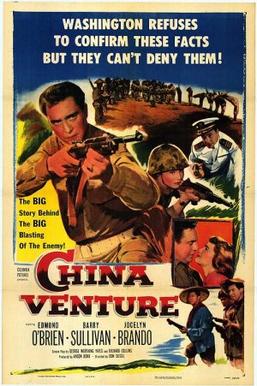
China Venture

Blah. That's all I'm coming up with for 1953's China Venture, a WWII story from director Don Siegel. Blah. Pretty weak, isn't it? It's not even good enough to mildly praise nor horrible enough to rip to pieces. It's just there, wasting away in its 83-minute running time. And away we go!

Leading a small patrol of Marines into China late in 1944, Capt. Matt Reardon (Edmond O'Brien) receives a message from Chinese guerrillas high up in the mountains. A high-ranking Japanese general (Philip Ahn) has crashed in the jungle, and for a price -- $10,000 -- the guerrillas will sell him to the Americans. Radioing for help, Reardon's patrol is "reinforced" by a Navy intelligence officer, Thompson (Barry Sullivan), a doctor (Dayton Lummis) and a nurse (Joceln Brando) to interrogate and care for the general. Heading into the thick jungle, Reardon's patrol is in a race against the clock as Japanese forces close in on the downed general too.

From director Don Siegel, 'Venture' is not meant to be some groundbreaking, innovative WWII story. Made in 1953 and not even breaking the 90-minue mark, it is a no-frills story that blends the men on a mission story with a handful of other familiar genre conventions. None of it really amounts to much, the different conventions working against each other in such a short time. The angle of the fighting in China is always interesting -- Americans, Japanese and Chinese warlords all fighting -- but the story never gets to push the limits. Even 1959's Never So Few (in all its amazing badness) went a little further. The "love story" between O'Brien and Brando is a flop too, slowing things down needlessly.

Where some positives come out is Siegel's tough guy talent behind the camera. At different points, 'Venture' reminded me some of Siegel's underrated WWII gem, 1962's Hell is For Heroes. Shot in black and white, it has the gritty, dirty look of an episode of Combat. The jungle is a gnarly, nasty place, and jungle fighting is full of ambushes, booby traps and all sorts of unpleasantness. While there isn't enough action, what's there is appropriately unpleasant. I just wish there was more of it, but instead we get long, uncut tracking shots of Reardon's patrol walking through the jungle, walking up and down hills. Not exactly adrenaline-pumping action.

Leading the cast, O'Brien has some good and some bad going for him. As the smart-mouth but capable Reardon, he's believable; a tough officer looking out for his men. The romance angle with Brando's Lt. Wilkins is painful to watch at times. Sullivan is solid as Cmdr. Thompson, the Navy Intelligence officer with no jungle-fighting experience. Reardon's squad includes Leo Gordon as the tough Sgt. Janowicz (O'Brien's scenes with him are highlights), Dabbs Greer, Alvy Moore, Wong Atarne and several other completely unlisted actors in the cast listing. The whole 'men on a mission' angle is wasted. Instead the focus is on the bickering between Reardon and Thompson, and the lovey-dovey stuff with Brando's caring nurse.

In the last third of the movie, the chance for some betrayals and actual excitement is there, but even that is mishandled. Leon Askin (later General Burkhalter on Hogan's Heroes) is badly cast as Wu King, the Chinese warlord auctioning off the Japanese general. Stereotypical doesn't begin to describe the part. As the rescuing Japanese forces close in, Reardon and Thompson are forced to make an extremely difficult decision, and the result proves to be the movie's strongest scene. But in the moments after, the finale is rushed. The movie isn't bad or good in the end. There are worse ways to spend 83 minutes, but I can think of a lot of better ways.

China Venture (1953): **/****

Thursday, August 23, 2012

The Bamboo Prison

Here we are again, the propaganda movie. I feel bad. I do, but I've got little else to go on here. Subtle, underplayed propaganda = anywhere from good to tolerable. Heavy-handed, aggressively in your face propaganda = not good to not tolerable. Unfortunately, 1954's The Bamboo Prison goes down the heavy-handed route.

Having marched for over 40 days, Corporal Brady (Brian Keith) and the remnants of a column of prisoners of war finally reach their destination; a brutal, under-supplied camp run by the North Korean army and several Russian/Communist advisers. Getting the scoop from his fellow prisoners, Brady discovers that one American P.O.W., Sgt. John Rand (Robert Francis), is a collaborator working with their captors for better treatment and billeting. Brady quickly finds out there's more than meets the eye when it comes to this believed collaborator. Rand is really an intelligence officer planted in the camp hoping to find proof/documentation of Communist atrocities committed against the POW's. Can he get the proof before a Russian counterpart figures him out?

Released just a year after the conclusion of the Korean War, 'Prison' was no doubt an incredibly timely story for audiences. Beyond it's issues with the propaganda angle -- more to come in that department -- the movie is undone by a general stupidity I had trouble getting past. At just 79 minutes, it doesn't really know where it wants to get other than delivering the "Communists are epically bad" message. Director Lewis Seiler was a talented director, even handling other propaganda-ish movies like Guadalcanal Diary, but the story here is too convoluted for its own good. Rambling, oddly and aggressively trying to be funny, it's a mess.

Propaganda in film can be good. I've said that before, and I'll most likely say it again. The story in 'Prison' has Francis' Rand searching for proof of Communist atrocities, anything from brainwashing to brutal physical beatings to lack of supplies and clothing. Brief sidenote; can't he just see these atrocities? What exactly is he looking for? Does pretending to be a collaborator actually help that much? Here's the thing. All those things were done by Communist/North Korean forces. There's evidence of it, but that doesn't make it any more pleasant to watch. We are subjected to long monologues about the Communist ideal, and then shown how evil it is. Movies like The Manchurian Candidate showed that this subject could be handled in a subtle but still scary and effective fashion. That isn't the case here.

Star of just four movies before his death at age 25 in 1955 in an airplane crash, Francis isn't the best choice to play this character. As was the case with his other roles, he just is not a very expressive actor. His line deliveries come across as beyond static. Monotone, wooden, one-note, all adjectives would apply here. His Rand is also given a love interest, Tanya (Dianne Foster), a Russian ballerina married to a Communist adviser/brainwasher. Those scenes -- lacking any real chemistry -- can be painful to watch. In the sidekick role, Keith is wasted as the tough, no-nonsense Cpl. Brady. He's introduced, and you think he's going to be a main character but unfortunately not. His character disappears for long stretches, only to pop up when Rand needs some help.

Then there's the portrayal of the American and international prisoners of war. For a camp that's supposed to be one step above Hell, the prisoners don't seem to mind too much. They're always laughing it up, hamming it up, and all at their Communist captors' expense. Haha communism! You're so stupid! The prisoners include Jerome Courtland as Arkansas, a shrill Southerner with that stereotypical drawl, E.G. Marshall as Father Dolan, Earle Hyman as Doc, the black medic (another redeeming part), Jack Kelly as Slade, the fast-talking car salesman, King Donovan as Pop, the family man trying to get home (bet that ends well for you, buddy), Pepe Hern as Ramirez, the Mexican soldier, Leo Gordon as Pike, the hot-headed prisoner, and Dickie Jones as Jackie, the youngster. At different points, they sing together, do impressions of Bogie, and all sorts of prisoner of war hijinks. Yeah for being a prisoner of war!

There just isn't much going on here in that whole positive vein. The ending is ridiculously stupid, making us question what the hell Sgt. Rand was even thinking all along. Has he started to believe all the things he was pretending to believe? Eh, not worth analyzing. Just not a good movie.

The Bamboo Prison <--- TCM trailer/clips (1954): * 1/2 /****

Thursday, October 6, 2011

All the Brothers Were Valiant

I got off to a rocky start with 1953's All the Brothers Were Valiant. The story of two brothers on the high seas in the South Pacific in the 1850s seemed like so many other generic high seas adventures that flooded the market in the 1940s and 1950s. It seemed like all the samples from other movies were taken for this one down to the stock characters and idiotic decision-making. Thankfully somewhere along the way, director Richard Thorpe pulls his head out of his butt and decides to make a halfway-decent movie.

After a three year voyage, Joel Thorpe (Robert Taylor) returns to 1848 New Bedford to find out that his brother, Mark, has disappeared from his own voyage somewhere in the South Pacific. Joel is given command of his missing brother's ship -- a whaler -- and prepares for another long voyage, but not before marrying Priscilla Holt (Ann Blyth), the former sweetheart of Mark's who Joel always had a crush on. Priscilla joins Joel as they head for the South Pacific where they manage to find Mark (Stewart Granger), ready with an explanation for his missing status. Mark instantly causes problems, both with Priscilla who he wants back and almost inciting a mutiny on Joel's ship, enticing the crew with promises of pearls.

Okay, every so often I feel the need to say this. I realize it is the rare movie that is perfect and/or flawless. At least 99.99 percent of movies have something wrong with them. It's just hoping that the positives -- however many there are -- outweigh the negatives. That's why I'll be able to give 'Valiant' a positive review, a recommendation for any viewers who are curious. As bad as some parts are, as cliched as the characters and story can be, the end result is positive. I enjoyed the positives more than I hated the negatives, and that's all I'm looking for in a new movie on a first viewing.

Don't get me wrong. That first 30 minutes is particularly brutal. All the high seas cliches are there; the happy crew singing as they go about their work, the long shots of the majestic ship and its towering sails moving across the ocean, the firm but fair captain pushing his crew. It's bad, real bad. Making it worse is that Taylor and Blyth have no chemistry together. I've come around around Taylor who I wasn't always a fan of. This is not a strong part for him, a vanilla "hero" with little charisma or personality. Blythy's Priscilla is around because the story requires some tension. What woman in her right mind would board a ship with her husband with a three-year voyage ahead of them in the 1840s? Somehow, some way, she keeps her hair immaculate and her dresses pristine. Good for her.

The saving grace is Granger's arrival at about the 35-minute mark. He's the necessary bad boy hero, the good guy who has some questionable morals and/or motives. His backstory -- a flashback that runs around 10-15 minutes -- is the high point of the story, probably worthy of an entire movie on its own. Ravaged with fever in the South Pacific, he is cared for by a beautiful native girl (Betta St. John). Once healthy again, Mark joins with a marauding group of adventurers (including James Whitmore and Kurt Kasznar) searching for pearls on an isolated island with a warring tribe as its inhabitants. There is some tension, some excitement, some betrayals and backstabbing and greed in this too-short segment, starting the movie back on its more interesting path.

Thanks to Granger's introduction, the movie does get more interesting as things near the halfway point. There are still some weird coincidences and stupid decisions made, but the possible mutiny livens things up. Mutinies have a way of doing that I suppose. The drama that comes out of this second half illustrates what's wrong with the movie. It boils down to this. Granger is interesting. Taylor isn't. Granger's Mark plays everyone against each other for his own benefit, realizing his mistake in the closing minutes. It is a 1950s movie so his fate is never really in question. Taylor and his monotone voice and delivery keep us on Granger's side unfortunately so we're basically rooting for the "bad guy" of the two brothers.

Sappy love triangle and boring performances from Taylor and Blyth, this was a good movie. Granted, those are big strikes against any movie, but what are you going to do? Blyth bounces back and forth between Joel and Mark every other scene, and the resolution is too perfect to believe. I still liked the movie though in spite of basically everything in my head telling me not to like it. Among the mutinous crew, look for Keenan Wynn in Spanish-mode as Silva, the treacherous leader of the lowly crew, Michael Pate, Leo Gordon, Peter Whitney, and John Lupton. So overall, this movie barely (and it was close) gets a slightly positive recommendation. A classic it is not with some epic flaws, but I did enjoy it.

All the Brothers Were Valiant <---trailer (1953): ** 1/2 /****

Thursday, June 2, 2011

Seven Angry Men

One of the most controversial people in American history was a driven, even obsessed abolitionist who made a name for himself in the years before the Civil War, John Brown. I have always been fascinated by Brown mostly because his belief that all men should be free. The only problem was his extreme execution of these beliefs. His actions were those of an extremist, an individual who was going to get what he wanted no matter the cost. His reasoning was sound, but his actions bordered on the insane.

Complete hogwash in terms of historical accuracy, 1940's Santa Fe Trail is the only movie I can even think of that has Brown playing a major role. He played a huge role in starting the Civil War -- the bloodiest conflict in American history -- but has generally been forgotten in the pages of history books over the last 150-plus years. At the height of his popularity, actor Raymond Massey played the infamous abolitionist in a movie that while entertaining, is about as accurate as saying that the sun is green and the moon is made of cheese. It is a performance that is downright terrifying at times. Some 14 years later, once again bearing a striking resemblance to the real-life Brown, Massey reprised the role of John Brown in 1955's Seven Angry Men.

It's 1856 and brothers Owen (Jeffrey Hunter) and Oliver (Larry Pennell) are traveling to Kansas to work with their father, John Brown (Massey), in his efforts to help the territory enter the United States as a free state. Four other Brown brothers are already waiting as the family is reunited, all in hopes of making Kansas a place where slaves are illegal.  Their father, John, though is willing to do anything necessary to ensure that with the coming vote.  Sticking with his father through thick and thin -- even going against his wife, Elizabeth (Debra Paget), and her intentions -- Owen quickly realizes how obsessed the man really is. John has bigger, grander plans than just Kansas though. He has his sites set on Harpers Ferry, Virginia, and the U.S. Military arsenal there where he hopes to arm an army of freed and escaped slaves.

The Civil War is one of the most interesting times in American history, but the build-up to the bloodiest war ever fought on American soil is just as interesting.  In the five years before the war, Kansas was dubbed 'Bleeding Kansas' as abolitionists fought pro-slavers over the future of the state, whether it would enter the United States as a free or slave state. Brown's raid on Harpers Ferry (read about it HERE) is similarly one of the most fascinating chapters in American history (to me at least). However miserably the raid failed, Brown's intentions are amazing when you think about it. The topic can be a touchy one (Kansas and Harpers Ferry) so it's easy to understand why movies have generally steered clear of it, but the history is incredibly interesting.

The tone of the two movies -- Santa Fe Trail and Seven Angry Men -- are basically polar opposites, but the positive you can take from both movies is Raymond Massey's acting performances as John Brown. As I mentioned earlier, he bears a striking resemblance to the real-life Brown. His acting though is so much more, bringing this obsessed, completely and blindly driven man to life. His intentions were genuine -- all men should be free regardless of color -- but his actions were deplorable, believing in an Old Testament form of justice. Making him more interesting/believable/frightening is that Brown (an ultra religious man) believes God is using him as his vessel on Earth to do what he needs to get accomplished. Scary much?

So director Charles Marquis Warren has those two great things working for him -- interesting history, more interesting historical person -- and what does he focus his story on? The budding relationship of Brown's son, Owen, his right hand man, and a fellow abolitionist, Elizabeth, who believes John's actions are despicable. Do you think there's a chance they might put their differences aside and get hitched? They talk about these problems a lot, and then share some very passionate 1950s movie kisses and some scandalous embraces. Because of that, Massey's John Brown gets pushed to the background far too often.  In the rest of the cast is Dennis Weaver, James Best, John Smith and Pennell as the brothers who actually make an impression. Also look for James Edwards as Green, a freed black man fighting with the Browns, and Leo Gordon in heavy mode as pro-slaver leader gunning for Brown.

I wanted to like this movie more than I did, but it just has so many things working against it. A B-movie or even an A-level movie on a smallish budget can overcome a lot with some basic things; avoid overacting, don't get too exaggerated, keep the music in a non-blaring mode. 'Angry' misses on all counts. Carl Brandt's score is painfully obvious, almost willing you to feel certain emotions. The love story is equally bad, and I can't decide if that's on the actors, the script or the director. Maybe worst of all is that the movie just doesn't know what it wants to say. Is John Brown a hero or a traitor? The ending has the Battle Hymn of the Republic playing over Brown's execution just minutes after vilifying the man. Which one is it? Massey is great, and the relatively forgotten history is interesting, but otherwise this one is worth passing on.

Seven Angry Men <--- TCM clips (1955): **/****        

Thursday, September 9, 2010

A Robert Stack double feature

As part of their annual Summer Under the Stars festival in August, Turner Classic Movies has again done a great job of going beyond the typically popular stars and devoting a day to them.  Sure, some of the bigger stars get their days, but for the most part lesser stars are getting their shots.  One included TV star Robert Stack who before he became Elliott Ness was in a fair number of movies in the 1950s. But I'm going to pull a bit of a cop-out here.  I taped two westerns Stack starred in, and really, neither was anything special.  So you all know what that means....a two-fer review!

The two westerns, 1956's Great Day in the Morning and 1953's Conquest of Cochise, are pretty typical of most 1950s westerns. They're hamstrung by a smallish budget and a small scale, and are basically filled out with enough good guy vs. bad guy action and romantic triangles to fill 90 minutes and give the audience what they paid for.  'Morning' has some unused potential to be a really good B-western while 'Conquest' is more content to just sit back with some odd casting and let the story do its own work.  Neither are available on DVD, probably for a reason, but I can think of worse westerns, and I've seen some doozies.

With war on the horizon in 1861, Owen Pentecost (Stack) rides west into Colorado.  A Southerner, he's used to putting up with some anti-South sentiments, even more so when he wins a saloon in a poker game from a northern businessman, Jumbo Means (Raymond Burr). With some help with a saloon girl (Ruth Roman), Owen goes about building a business as the Civil War looms and animosity grows between the North and South. A pretty new shopowner (Virginia Mayo) has arrived in town to stir up some more problems, and a rumor that a Southern-owned mine is transporting gold back to the east hovers over the town.

Watching movies, I struggle more and more with main characters who just aren't likable.  I don't need a lovey-dovey sweetheart, but give me some reason to like a character.  Stack's Pentecost (what kind of name is that?) is that condescending a-hole who comes across as too standoffish, and therefore, I don't like him.  Burr is an immense villain -- the guy looks huge -- and Roman delivers a good performance as the saloon girl with a heart of gold...sort of. The story deals with a topic most westerns steer clear of -- pre Civil War in the west -- but it's pretty run of the mill overall.  There was a chance to be something better, but I can't put my finger on exactly what's missing that director Jacques Tourneur didn't accomplish.  Look for Leo Gordon as a heavy with a grudge against Stack.

In 'Conquest,' Stack plays Major Tom Burke, a cavalry officer assigned with four companies to Tucson to help keep the hostile situation in control.  Apache chief Cochise (John Hodiak) could go either way, start a war with the ever-growing number of American settlers settling on Apache land, or arrange a peace treaty so the two sides may live in peace. That's just one problem though as a tribe of Comanches is nearby and threatening to attack everyone in sight, whites, Mexicans and Apaches alike. Major Burke and his cavalry and Cochise and his warriors may be forced to fight alongside each other if they have any chance of surviving the coming war.

What surprised me about this 70-minute western was the almost complete disregard for the cavalry perspective for a change, instead focusing on the Apache's perspective.  Once you get past the ridiculous casting of Hodiak as an Apache chief, it's a good ride.  When he's not talking in stunted, stilted "Indian talk," Hodiak is more than solid at introducing the Apache way of life.  For a B-western average in any other way, it's a refreshing look at the Indians' way of life in the 19th Century.  How authentic? I'm not sure, but effort gets points here.  Stack's portrayal of a woman-chasing cavalry officer is downright dull, and he ends up disappearing for about 20, maybe 25 minutes late in the movie only to reappear at a strategically necessary time.

Not being a huge Robert Stack fan to begin with -- he always come across as bland and wooden to me -- these two movies did nothing to change my mind either way.  The supporting casts were actually better than the star in both cases, and if nothing else the stories tried something new, a little different, where many westerns play it safe.  Average but not bad either.

Great Day in the Morning <---TCM trailer (1956): ** 1/2 /**** 
Conquest of Cochise <--- TCM trailer (1953): **/****

Tuesday, July 14, 2009

Kings of the Sun

When movies in the 50s and 60s were trying to figure out how to deal with the growing popularity of TV, studios tried to tell stories that TV just couldn't duplicate. Translation, big, sprawling historical epics in widescreen with big casts and big stars. Like any grouping of movies, some were better than others with classics like Ben-Hur, The Ten Commandments, and Spartacus. But there's something appealing about all of them, good or bad, because they're at least trying to shoot for the stars.

Directed by J. Lee Thompson, 1963's Kings of the Sun is a prime example of an average epic that has enough going for it overall to recommend. Historical setting? Mayans running from fellow tribesmen who've joined with the Spaniards. Check. Big names in the cast? Yul Brynner and George Chakiris, double check. Unnecessary love triangle because the story on its own isn't enough? Of course, what would an epic be without it?

As his father dies and he's appointed king, Mayan king Balam (Chakiris) must deal with a new threat. A large group of fellow tribesmen led by tyrannical Hunac Cel (Leo Gordon) have teamed with European invaders and are rampaging across the land, destroying everyone who doesn't join them. With a small group of survivors, Balam heads to the coast with Hunac Cel close behind. It's there they find a village of fishermen and farmers, and before they too are wiped out, they join Balam in sailing across the Gulf of Mexico to safety and hopefully freedom.

After days of sailing with no end apparently anywhere in sight, the new tribe finally sees land. They reach the beach and start to build a new life, sacrificial temple and all with a stockade to prevent any natives from attacking. It's not long before those natives show up, including Black Eagle (Yul Brynner), a chief of a tribe of hunters and wanderers. Black Eagle is taken prisoner with plans to sacrifice him to the gods in hopes of having a good harvest. Will Balam go against his beliefs to let him go or is the inevitable showdown coming?

This is another time in history that's too often ignored when it comes to movies. I'm no expert when it comes to Mayan culture and history, but KotS seems to get the basics right. One of the main issues with new king Balam is how he keeps up their religion, their beliefs. The high priest, Ah Min (Richard Baseheart), looks out for Balam and tries to guide him, but the main dispute is over sacrificing their own tribesmen. Does it work or are they just too superstitious and believe it has some effect?

Thompson went to Chicen Itza and Mazatlan to film extensively for KotS which gives the story an authenticity, a realism that would be missing if it had just been filmed in the hills around Hollywood. Shot with a Panavision camera, the cinematography is one of the best things about the movie. The main set once the tribe has set up camp is in a beautiful, sunny Mexican bay that fits perfectly.

The main set then provides a cool location for a final battle with Balam's Mayans, Black Eagle's tribe and Hunac Kel's barbarian tribesmen in the village and up the scaffolding of the temple slowly being built. It's the set piece the whole movie builds up to, and it doesn't disappoint. Hundreds of extras, Elmer Bernstein's booming and appropriately epic score, good action with fighters going toe to toe.

The casting is somewhat hit or miss, but Brynner is at his best. At the ripe "old" age of 43 when the movie was released, Brynner looks like he could handle someone half his age, the dude's ripped. Instantly recognizable with his shaved head, he presents an imposing figure as his tribe's most respected warrior. But more than that, his character has a depth missing from other parts in the movie. About to be sacrificed, Black Eagle bonds with Ixchel (Shirley Anne Fields), a young woman promised to Balam as a wife. While the action is good in other scenes, these quiet scenes work just as well and keep the movie somewhat grounded. As his rival, Chakiris doesn't leave much of an impression. Fresh off the success of West Side Story, he just doesn't have the presence needed to keep up with Brynner. Here's their first meeting.

Also worth mentioning, Kings of the Sun has more than a few connections with 1960's The Magnificent Seven. Both films were made by the Mirisch Company so that'll have something to do with it, both star Brynner and Brad Dexter, as Balam's right hand man, Bernstein did the score for both films, and even laconic gunfighter Britt, um, I mean James Coburn provides the opening narration. Just some cool trivia, or at least cool to me.

All things considered, Kings of the Sun is a worthwhile epic. It doesn't have the scope or size of some of the true classics, but it gives a good effort and if nothing else is a fun watch.