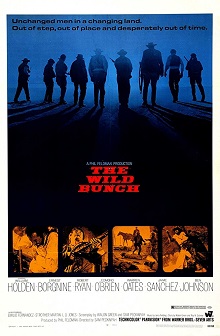
By 1969, director Sam Peckinpah had worked on several TV series and several film productions, including The Deadly Companions, Ride the High Country and Major Dundee. He was an incredibly talented director but one whose fiery personality and personal demons could potentially derail any film he worked on. But in 1969, it all came together, Peckinpah making his classic, his all-time great film, one of the best westerns ever and best films ever in general, 1969's The Wild Bunch.
It's 1913 in a small border town near the Rio Grande, and a gang of outlaws, led by the infamous Pike Bishop (William Holden), disguised as soldiers ride in to rob the bank of a rumored silver shipment. The robbery is an epic disaster as a posse of bounty hunters, led by Deke Thornton (Robert Ryan), a paroled outlaw who used to ride with Pike, is waiting in ambush. Many of Pike's gang is killed in the robbery that nets them NO money. The remaining members of the gang, including Dutch Engstrom (Ernest Borgnine), retreat into Mexico. They need a new job, a new robbery, a new chance to earn some money. Pike especially knows that time is running out, that times are changing, and their chances at surviving as outlaws is becoming ever more unlikely. It doesn't help that Deke and his bounty hunters have followed them into Mexico, looking to collect the bounties on these infamous outlaws. With time running out, what do they do?
What a movie. Every so often, each and EVERY thing involved in the making of a film comes together and forms that perfect symmetry. 'Bunch' is an all-timer, not just a movie I love but a great movie in terms of storytelling and in technical terms. Appropriate for the time it was released (the late 1960's), it is cynical, horrifically violent, brutally honest and generally downbeat. This is a western and film ahead of its time, helping set the tone where films would go in the coming years. This is Peckinpah at the top of his game. He would have other good to great to classic films, but this is his Great film. Just a gem.
There is little to nothing to criticize here. While the filming process sounds incredibly interesting (a film in itself), the choice to film in Mexico pays off huge dividends. Cinematographer Lucien Ballard shoots a beautiful movie with the Mexican countryside and desert as a backdrop. The locations are phenomenal. You feel like you're watching the actual settings of the Mexican Revolution to our story. Composer Jerry Fielding turns in quite the memorable score as well, appropriately epic at times and equally quiet and emotional as necessary in other scenes. Listen to a sample HERE. As for the story itself, Peckinpah and writer Walon Green turn in a screenplay that's just a gem. It isn't a movie in a rush, letting things breathe and allow the viewer to get to know the characters -- for good or bad -- over its 145-minute running time. Sit back and take it in. You shan't be disappointed!
Many westerns have dealt with the death of the old west, the end of an era, but none better than The Wild Bunch. It's 1913 and there's no place for these outlaws, killers and gunfighters anymore. The world is changing, and civilization (of sorts) is moving in to replace them. We follow a gang of those outlaws, robbers, killers/murderers as they try to pull off their one last job and step away, and it's a testament to the acting on display and screenplay that we feel any sympathy at all to these men. Like few movies I've ever seen, there is a doomed quality to these men who are working with limited time on their hands. They know the door is closing on them, more than likely a bloody death awaiting them if they don't figure out something soon.
Where Peckinpah's screenplay is so strong is in its characterization and its depth. There's a whole lot of acting talent on display in 'Bunch,' and for much of the cast, this is their all-time best performance or certainly one of their best. Holden's Pike Bishop is one of the most fascinating characters ever in my book, an aging outlaw who's outlived his time but doesn't know what else to do. Borgnine too is excellent as Dutch, his right-hand man who can also see the writing on the wall. Their scene together after the early botched robbery is essential, two men who potentially know what awaits them but go into things willingly because maybe that ending is what's supposed to happen. On the counter, Ryan's Deke Thornton is equally tragic. He's riding after his old partner, Bishop, and would much rather be riding with them than chasing them. But as the script relies on, your word is your word, and these men live by that coda.
One of the many things Peckinpah loved to touch on in his films was that bond of men under fire who come through while others don't. Holden's Pike is the mouthpiece for that concept, of giving your word and sticking by it even when it'd be far easier to tuck your tail and run. We see that again and again with the bunch, including Pike, Dutch, old, grizzled Sykes (Edmond O'Brien), the crass, unsavory Gorch brothers, Lyle (Warren Oates) and Tector (Ben Johnson), and Angel (Jaime Sanchez), the youngest of the group, a fiery Mexican. What's interesting is that though Pike and the bunch claim to live by this coda, they continue to fall short of actually living up to it. It's when they realize their faults in that department that the story takes a far more tragic turn toward the inevitable ending that you just knew was coming.
Because the already-mentioned star power wasn't enough, here's some more! Along with Ryan, look for scene-chewing Strother Martin and L.Q. Jones as two scummy bounty hunters with Albert Dekker as the railroad magnate "employing" them. Emilio Fernandez is perfectly slimy as Mapache, the Mexican general claiming to be some sort of freedom fighter but it seems it is all for show, for more power, with Jorge Russek and Alfonso Arau (El Guapo in Three Amigos) as his subordinate officers. Also look for Bo Hopkins, Dub Taylor and Chano Urueta in key (if small) supporting parts.
What 'Bunch' has become synonymous with over the years is its groundbreaking, sometimes horrifying portrayal of on-screen violence. It's not that Peckinpah lingers on the violence for the sake of shock value. Far from it, but instead he makes it into an art form. The idea of a 'dance of death' comes to mind in any portrayal of violence with three main set pieces (1. The opening robbery turned into a bloody shootout 2. A prolonged train robbery and 3. The final, bullet-riddled and blood-splattered gun battle). The editing is ridiculously fast and cut in with perfect uses of slow motion. Simply put, there is an art to Peckinpah's use of violence, both in the editing, in the overwhelming use of slow-motion blood squibs, and the impact of that violence we're seeing. If Bonnie and Clyde opened the door some for its own use of on-screen violence, Peckinpah's The Wild Bunch kicked that door wide open. Almost 50 years later, it still resonates, and it's clear the impact it had on hundreds and thousands of movies released since.
It all builds to maybe the most memorable action sequence of all-time. If it's not No. 1, it certainly belongs in the conversation. In a sequence that's been dubbed "The Battle of Bloody Porch," it all comes together in an extended sequence that has lost none of its edge since its release in 1969. This is a transfixing scene that is equal parts horrifying and startling but you just can't look away. There are too many great moments just in this scene alone to mention, including an improvised walk the Bunch takes on their way to a final showdown (maybe the movie's second-strongest sequence). It is followed by a quick, shocking death, and then an eerie moment of silence that hangs in the air. With one gunshot, it is on, bullets flying thick in the air. Obvious SPOILERS but you can watch it HERE. If you haven't seen the movie, I don't recommend watching the sequence out of context. Watch the movie and soak it all in as part of the whole product. Just a remarkable extended sequence with virtually no music. The focus is the characters, violence and death. Nothing more. Nothing less.
A classic in every sense of the word. I pick something new up with every viewing, and it never loses any of its impact. A film without a weakness.
The Wild Bunch (1969): ****/****
The Sons of Katie Elder
"First, we reunite, then find Ma and Pa's killer...then read some reviews."
Showing posts with label Sam Peckinpah. Show all posts
Monday, December 28, 2015
Tuesday, March 4, 2014
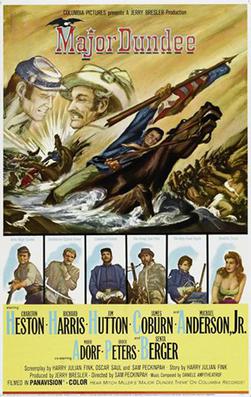
Major Dundee
It's late in 1864, the Civil War raging back east, but in the New Mexico territory, an Apache war party led by Sierra Charriba (Michael Pate), massacres a troop of U.S. cavalry, kidnapping three boys from a local ranch at the same time. The commander of a nearby Confederate prison camp, Major Amos Dundee (Charlton Heston) decides to go after the Apaches, rescuing the kids and bringing Charriba to justice. Without abandoning the camp though, he must assemble a ragtag group of Confederate prisoners, black infantry, inexperienced officers, cowboys, drunks, bandits and thieves to capture the Apaches. At his right hand is a Confederate officer and friend from the past but now a sworn enemy, Capt. Benjamin Tyreen (Richard Harris). Dundee's company of irregular cavalry hits the trail, following the Apache war party into Mexico, tangling with occupying French forces as well. The Apaches and the French are just two enemies though, the Union and Confederate loyalties among the company threatening to tear Dundee's command apart from the inside.
The production history of this Peckinpah western has quite the checkered past. The production in Mexico went way over budget and way over schedule. Depending on what you read, Peckinpah's original cut for 'Dundee' was anywhere between three and four hours long. When the studio took it away from him, it was cut down to just over two hours. A DVD released in 2005 had a new, never before seen version with almost 15 additional minutes added to the running time. Some additional footage was found that was unable to be reinserted back into the film, but as is, we'll probably never know/see Peckinpah's intended version. So what's the end result with the 136-minute version? A far better western than the 123-minute version that features some good performances, a ridiculously deep cast, some ahead of its time vicious action, and a story that drifts needlessly at times.
What was Peckinpah's goal? He wanted to make an epic western, a new western in the vein of the John Ford cavalry movies. It was supposed to be big and violent full of scope and vision. 'Dundee' doesn't quite live up to that, but in terms of pure entertainment, it's hard to beat. It starts with Charlton Heston in the titular role. Like Peckinpah's best movies, Dundee is the flawed anti-hero like nobody's business. The story almost becomes Moby Dick in the Civil War west. Dundee has been posted to this isolated prison camp because of a command decision he made at Gettysburg (hinted at, never spelled out), and he intends to right that wrong. His plan? Get the kids back, take out Sierra Charriba, become a hero again. The problem? Dundee may not be cut out for command. He's equal parts brilliant strategist with overreaching egoist. His pride and ego get in the way of things, the mission into Mexico becoming an obsession. Quite the performance, one that doesn't always get the notoriety it deserves in Heston's already impressive filmography.
One of Peckinpah's favorite storytelling devices was the anti-hero and his right hand man, sometimes a former friend turned unwilling ally, a device used to its best ability four years later in The Wild Bunch. Here, that relationship is between Heston's Dundee and Richard Harris' Capt. Ben Tyreen. Again, their checkered history (friendship turned bitter rivalry, even hatred) all leads up to this, two men forced to work together. Harris is one of my favorite actors, and this is my favorite performance of many, one of my all-time favorite characters in any film. Harris' Tyreen is everything Dundee wants to be; intelligent, charming, a good leader, and well liked and respected by his men. Tyreen has one great line after another, Harris bringing this character to life, a Irish immigrant turned cashiered American officer to Confederate renegade. The dynamic between Dundee and Tyreen provides some of the movie's best dialogue scenes, the confrontations crackling with energy. Kudos to both actors for developing that chemistry to its fullest.
Brace yourself though. This movie has one sick cast of tough guy actors, many from the Peckinpah stock character Hall of Fame. Jim Hutton provides some laughs as Lt. Graham, a bumbling artillery officer assigned to the cavalry. James Coburn is a scene-stealer as Samuel Potts, Dundee's one-armed, bearded, quick-witted scout, as is Mario Adorf as the feisty, loyal Sgt. Gomez, Dundee's most capable Union soldier. Michael Anderson Jr. does a fine job too as Trooper Ryan, Dundee's young bugler, providing the narration from his in-mission journal. There's also Brock Peters as Aesop, the leader of the small contingent of black infantry, Slim Pickens as Wiley, the drunken mule-packer, R.G. Armstrong as Reverend Dahlstrom, the shotgun-wielding preacher, and Dub Taylor as Priam, the disheveled horse thief. As for Tyreen's Confederates, there's Ben Johnson as the tough Sgt. Chillum, L.Q. Jones and Warren Oates as Arthur and O.W. Hadley, and John Davis Chandler as Jimmy Lee, the troublemaker. Also look for Karl Swenson as Dundee's second-in-command at the prison camp. Just a ridiculously deep cast full of great characters.
Where the movie struggles some -- but is also damn entertaining in those struggles -- is the final 40 minutes. The story does drift too much from the Apaches to the French to Dundee's lost weekend in Durango and a brief love affair with Senta Berger's Teresa. Trooper Ryan's narration gets choppy, weeks slipping by in a flash. The saving grace is back-to-back action sequences, one a showdown with the Apaches in a box canyon, the other a bloody, violent battle with French lancers in the Rio Grande. This is Peckinpah at his action best, clearly an indicator of where his movies would go, especially with The Wild Bunch. Watch the scene with the French and see how brutal it is, how graphic it could have been if censors allowed it. Characters are unceremoniously killed off (blink and you'll miss it), including one surprising death, but it's just a great action scene leading to a quick ending.
Most Peckinpah fans don't list this as their favorite, maybe not even one of their favorites. I just really like this movie, always have, and the longer version with the additional 15 minutes or so really does help make it better. The musical score from composer Daniele Amfitheatrof takes some heat, especially the Major Dundee theme (listen HERE), but I like it, almost as a guilty pleasure. Filming on location in Mexico, including stops in Durango, a gorgeous waterfall location at El Saltito, and many more, all add to that authentic flavor. You really feel like you're on an odyssey across Mexico, seeing a variety of spots, locations and cities. One of my favorite westerns, a heavily flawed but just a damn entertaining movie in the end. Hard to beat, even if we'll never see that epic 4-hour version Peckinpah intended.
Major Dundee (1965): ****/****
Rewrite of August 2009 review
Saturday, July 20, 2013
Invasion of the Body Snatchers (1956)
As different eras and time periods pass, highly successful genres in Hollywood find ways to stay fresh, changing with the new times. Almost always though, there's a common tie, some link to what originally made the genre successful with audiences. Take science fiction. It is a genre that has been aided by the invention of all sorts of new technology, especially CGI. But what's the best time period for the genre? I'll watch a sci-fi flick from any decade, any time period, but for me, the genre was at its absolute strongest in the 1950s. I caught up with one classic I'd never seen before, 1956's Invasion of the Body Snatchers.
Returning to his home in Santa Mira, California, after attending a two-week convention, Dr. Miles Bennell (Kevin McCarthy) is alarmed by the amount of requests he receives from patients upon his return. Several people are complaining that their loved ones seem a little off, that the people they've known all their lives simply aren't themselves. Bennell looks into it a bit but doesn't think much of it....at first. A friend and neighbor (King Donovan) has found what he believes to be a dead body that somewhat resembles him but without any distinctive features or fingerprints to identify him. With a longtime crush and recent divorcee Becky (Dana Wynter) at his side, Bennell starts to investigate and is stunned by what he finds. Some sort of extraterrestrial race is in fact replacing human beings with almost duplicate versions of themselves, but eliminating emotion in the process. Can Bennell figure out how to stop the rapidly reproducing duplicates in time?
The 1950s were packed to the gills with everything from Forbidden Planet to The Day the Earth Stood Still, It Came From Outer Space to The Thing. As far as comparisons go, 'Invasion' is interesting because of some similarities with 1951's The Thing, but also how it impacted John Carpenter's The Thing remake. From Don Siegel, this 1956 sci-fi creeper is a gem. Based on a serial that ran in Collier's Magazine, it is smart, well-written and scary without having to resort to obvious GOTCHA! scares and thrills. Filmed in black and white, it is subtle and unsettling, Siegel using his camera in a variety of different angles, POV, and tracking shots. The shadowy black and white works well, almost like a sci-fi film noir, building that sensation of impending doom expertly. We know something isn't quite right, but what is it exactly?
An obvious influence on Siegel's film is rather timely for a 1950s audience, but now in 2013, it's easier to keep it in perspective. With McCarthyism and a Red Scare permeating the United States, Americans were worried about an ever-constant threat of Commies and Reds affecting an American way of life. What better way to translate that than in a story of a mysterious alien race that secretly and covertly tries to change who you are? The end result? An eerily similar version of what you used to be, but not quite spot-on. Now, we can look back on that secondary layer to the story and see it for what it is. I wonder if 1950s audiences picked up on it. Regardless, Siegel and the script don't overdo that angle. It is underplayed, just another subtle layer to the scares.
A really solid character actor who never quite became a huge star, McCarthy is a great lead here as Dr. Miles Bennell, a likable, smart and smooth doctor who questions things as much as anyone. But something that's hard to explain like this? How could people literally be replaced without anyone else noticing? McCarthy does a good job showing that slow burn as he figures out exactly what's going on, from a doctor who thinks things out to a man who appears unhinged when he learns the truth. Avoiding just being the pretty face along for the ride, Wynter more than holds her own as the female lead. The rest of the cast is lesser known actors, the ensemble as a whole doing a pretty cool job. Larry Gates plays a similarly questioning psychiatrist who Miles seeks out for help, Donovan and future Morticia Adams Carolyn Jones as Jack and Teddy, a couple who finds a suspicious body, Jean Willes as Miles' nurse Sally, and even future director Sam Peckinpah as Charlie, one of the townspeople affected by the quasi-alien invasion.
There really isn't a weak moment in the film, but with an 80-minute running time, things really pick up about the 35 or 40-minute mark. We start to learn what's really going on, and unlike most sci-fi movies that feature a twist, this one works. Sometimes films try so hard to really throw you for a loop that the twist comes across as laughable. Not the case here thankfully. Besides, even if you don't buy the twist/explanation, the final 30 minutes are so fast-paced you won't even notice. Siegel's camera work (including some cool tracking shots from a distance) and a race for survival provide some ridiculously tense moments. The ending is a little weak, Siegel being forced to film a prologue and epilogue (featuring uncredited Whit Bissell and Richard Deacon) that starts off well enough but ends up weakening the possible darkness of his original ending. Still a classic, still well worth tracking down.
Invasion of the Body Snatchers (1956): ****/****
Returning to his home in Santa Mira, California, after attending a two-week convention, Dr. Miles Bennell (Kevin McCarthy) is alarmed by the amount of requests he receives from patients upon his return. Several people are complaining that their loved ones seem a little off, that the people they've known all their lives simply aren't themselves. Bennell looks into it a bit but doesn't think much of it....at first. A friend and neighbor (King Donovan) has found what he believes to be a dead body that somewhat resembles him but without any distinctive features or fingerprints to identify him. With a longtime crush and recent divorcee Becky (Dana Wynter) at his side, Bennell starts to investigate and is stunned by what he finds. Some sort of extraterrestrial race is in fact replacing human beings with almost duplicate versions of themselves, but eliminating emotion in the process. Can Bennell figure out how to stop the rapidly reproducing duplicates in time?
The 1950s were packed to the gills with everything from Forbidden Planet to The Day the Earth Stood Still, It Came From Outer Space to The Thing. As far as comparisons go, 'Invasion' is interesting because of some similarities with 1951's The Thing, but also how it impacted John Carpenter's The Thing remake. From Don Siegel, this 1956 sci-fi creeper is a gem. Based on a serial that ran in Collier's Magazine, it is smart, well-written and scary without having to resort to obvious GOTCHA! scares and thrills. Filmed in black and white, it is subtle and unsettling, Siegel using his camera in a variety of different angles, POV, and tracking shots. The shadowy black and white works well, almost like a sci-fi film noir, building that sensation of impending doom expertly. We know something isn't quite right, but what is it exactly?
An obvious influence on Siegel's film is rather timely for a 1950s audience, but now in 2013, it's easier to keep it in perspective. With McCarthyism and a Red Scare permeating the United States, Americans were worried about an ever-constant threat of Commies and Reds affecting an American way of life. What better way to translate that than in a story of a mysterious alien race that secretly and covertly tries to change who you are? The end result? An eerily similar version of what you used to be, but not quite spot-on. Now, we can look back on that secondary layer to the story and see it for what it is. I wonder if 1950s audiences picked up on it. Regardless, Siegel and the script don't overdo that angle. It is underplayed, just another subtle layer to the scares.
A really solid character actor who never quite became a huge star, McCarthy is a great lead here as Dr. Miles Bennell, a likable, smart and smooth doctor who questions things as much as anyone. But something that's hard to explain like this? How could people literally be replaced without anyone else noticing? McCarthy does a good job showing that slow burn as he figures out exactly what's going on, from a doctor who thinks things out to a man who appears unhinged when he learns the truth. Avoiding just being the pretty face along for the ride, Wynter more than holds her own as the female lead. The rest of the cast is lesser known actors, the ensemble as a whole doing a pretty cool job. Larry Gates plays a similarly questioning psychiatrist who Miles seeks out for help, Donovan and future Morticia Adams Carolyn Jones as Jack and Teddy, a couple who finds a suspicious body, Jean Willes as Miles' nurse Sally, and even future director Sam Peckinpah as Charlie, one of the townspeople affected by the quasi-alien invasion.
There really isn't a weak moment in the film, but with an 80-minute running time, things really pick up about the 35 or 40-minute mark. We start to learn what's really going on, and unlike most sci-fi movies that feature a twist, this one works. Sometimes films try so hard to really throw you for a loop that the twist comes across as laughable. Not the case here thankfully. Besides, even if you don't buy the twist/explanation, the final 30 minutes are so fast-paced you won't even notice. Siegel's camera work (including some cool tracking shots from a distance) and a race for survival provide some ridiculously tense moments. The ending is a little weak, Siegel being forced to film a prologue and epilogue (featuring uncredited Whit Bissell and Richard Deacon) that starts off well enough but ends up weakening the possible darkness of his original ending. Still a classic, still well worth tracking down.
Invasion of the Body Snatchers (1956): ****/****
Labels:
1950s,
Don Siegel,
Horror,
Kevin McCarthy,
Sam Peckinpah,
Sci-Fi,
Whit Bissell
Thursday, February 7, 2013
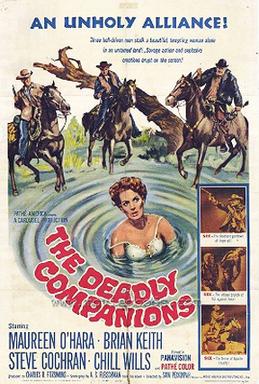
The Deadly Companions
By 1961, Sam Peckinpah had made a name for himself on the TV screen, writing, creating and even directing two different series, the classic The Rifleman and the lesser known The Westerner. The man that would go on to direct classics like The Wild Bunch, Straw Dogs, and Ride the High Country had to start somewhere though in films, and that's 1961's The Deadly Companions.
Drifting along from town to town, a man named Yellowleg (Brian Keith) teams up with two fellow drifters, Turk (Chill Wills) and Billy (Steve Cochran), agreeing to knock off a bank in a tiny, isolated desert town. As they ready to pull the job, the trio instead gets caught up in someone else's robbery, and a young boy is actually killed by Yellowleg in the process. The boy's mother, Kit (Maureen O'Hara), insists the boy be buried with her deceased husband, buried in the far-off and possibly abandoned town of Siringo. Feeling the extreme guilt over the accidental shooting, Yellowleg insists on guiding Kit through Apache territory to Siringo, but the dangerous journey holds secrets and trials that none of them were expecting.
Everyone has to start somewhere, and for Peckinpah in films, this was it. It is an interesting debut -- both good and bad -- that certainly is a forerunner of his later movies. While limited by a smallish budget, Peckinpah shows a knack that viewers would come to expect with movies like The Wild Bunch and Ride the High Country. According to O'Hara's biography, the filming was a less than pleasant process as first-time feature film director Peckinpah adjusted to shooting on a bigger scale than TV allowed. It's interesting though because with the exception of maybe Junior Bonner or Ballad of Cable Hogue, this is probably his least violent film. There are flaws, but I also think there's a hidden gem among all those flaws.
Let's start with Brian Keith as Yellowleg, a former Union officer traveling the west looking for vengeance on the man who tried to scalp him during the Civil War. That man? Chill Wills' Turk, a former Confederate soldier on the brink of lunacy trying to revive the Confederacy. Keith's Yellowleg (we never learn his real name) wears his hat low on his hat, never taking it off, because of the scar across his forehead from the failed scalping. He's also carrying a bullet in his shoulder and struggles to fire his gun accurately because of the wound. Peckinpah favored wounded, scarred anti-heroes dealing with extreme internal demons struggling to come to terms with those demons. I like Keith more and more with each passing part, and this is a very good one, if not one that's easily remembered as one of his best.
That's what I like about this first Peckinpah feature film. It isn't a classic by any means. But considering it was released in 1961, it's hard not to be impressed. This is far from a typical western released in that year, starting to reflecting the changing times, and that's what surprised me (although I guess it shouldn't have. Peckinpah wasn't exactly a touchy-feely kind of guy). This is one epically dark western. Each and every character is a tortured individual, all struggling to cope with something. Even the bad guys -- perfectly cast Cochran and Wills -- are trying to rape O'Hara's Kit, rob banks, shoot Yellowleg in the back and so on. Not nice guys. The background gives it all more depth; a former Union soldier obsessed with revenge on the Confederate who tried to scalp him? Oh, and a little boy gets gunned down in the first 20 minutes? It's hard to imagine a 1961 getting any more dark.
As I mentioned, this is far from an action-packed western. At the same time, it isn't exactly story-heavy either. It leans more toward episodic as Yellowleg, Kit, the two gunslingers and the dead boy make their way to Siringo. The focus is on Yellowleg's demons, Kit's mistrust and hatred of the man who killed her boy, and a vengeful Apache trying to kill them. I liked the dynamic between Keith and O'Hara especially. An IMDB reviewer compares it to an artsy Euro-western, and I'm hard pressed to disagree. The music from Marlin Skiles -- heavy on Spanish guitar, accordion and harmonica -- is oddly effective and appropriate. The look (including on-location shooting in Arizona, especially Old Tucson) is dreary and washed-out, reflecting the generally dark demeanor and tone of the story. Oh, and it is a Peckinpah film, watch for Strother Martin as a fire-breathing parson.
Things aren't perfect of course. At 93 minutes, 'Companions' can be a tad disjointed. Scenes transition from one to another without any real transition, scenes ending on odd notes as the screen fades to black. The ending especially is a little crazy as the studio took the finished film away from Peckinpah (a recurring trend later in his career) and reedited it into an indecipherable, completely out of place happy ending. It's still a good movie that doesn't deserve all the flak it takes, and one Peckinpah fans should definitely see. You can watch the entire movie HERE at Youtube, but it is a public domain print and therefore, not a good one. Hold out for another airing on TCM.
The Deadly Companions (1961): ***/****
Drifting along from town to town, a man named Yellowleg (Brian Keith) teams up with two fellow drifters, Turk (Chill Wills) and Billy (Steve Cochran), agreeing to knock off a bank in a tiny, isolated desert town. As they ready to pull the job, the trio instead gets caught up in someone else's robbery, and a young boy is actually killed by Yellowleg in the process. The boy's mother, Kit (Maureen O'Hara), insists the boy be buried with her deceased husband, buried in the far-off and possibly abandoned town of Siringo. Feeling the extreme guilt over the accidental shooting, Yellowleg insists on guiding Kit through Apache territory to Siringo, but the dangerous journey holds secrets and trials that none of them were expecting.
Everyone has to start somewhere, and for Peckinpah in films, this was it. It is an interesting debut -- both good and bad -- that certainly is a forerunner of his later movies. While limited by a smallish budget, Peckinpah shows a knack that viewers would come to expect with movies like The Wild Bunch and Ride the High Country. According to O'Hara's biography, the filming was a less than pleasant process as first-time feature film director Peckinpah adjusted to shooting on a bigger scale than TV allowed. It's interesting though because with the exception of maybe Junior Bonner or Ballad of Cable Hogue, this is probably his least violent film. There are flaws, but I also think there's a hidden gem among all those flaws.
Let's start with Brian Keith as Yellowleg, a former Union officer traveling the west looking for vengeance on the man who tried to scalp him during the Civil War. That man? Chill Wills' Turk, a former Confederate soldier on the brink of lunacy trying to revive the Confederacy. Keith's Yellowleg (we never learn his real name) wears his hat low on his hat, never taking it off, because of the scar across his forehead from the failed scalping. He's also carrying a bullet in his shoulder and struggles to fire his gun accurately because of the wound. Peckinpah favored wounded, scarred anti-heroes dealing with extreme internal demons struggling to come to terms with those demons. I like Keith more and more with each passing part, and this is a very good one, if not one that's easily remembered as one of his best.
That's what I like about this first Peckinpah feature film. It isn't a classic by any means. But considering it was released in 1961, it's hard not to be impressed. This is far from a typical western released in that year, starting to reflecting the changing times, and that's what surprised me (although I guess it shouldn't have. Peckinpah wasn't exactly a touchy-feely kind of guy). This is one epically dark western. Each and every character is a tortured individual, all struggling to cope with something. Even the bad guys -- perfectly cast Cochran and Wills -- are trying to rape O'Hara's Kit, rob banks, shoot Yellowleg in the back and so on. Not nice guys. The background gives it all more depth; a former Union soldier obsessed with revenge on the Confederate who tried to scalp him? Oh, and a little boy gets gunned down in the first 20 minutes? It's hard to imagine a 1961 getting any more dark.
As I mentioned, this is far from an action-packed western. At the same time, it isn't exactly story-heavy either. It leans more toward episodic as Yellowleg, Kit, the two gunslingers and the dead boy make their way to Siringo. The focus is on Yellowleg's demons, Kit's mistrust and hatred of the man who killed her boy, and a vengeful Apache trying to kill them. I liked the dynamic between Keith and O'Hara especially. An IMDB reviewer compares it to an artsy Euro-western, and I'm hard pressed to disagree. The music from Marlin Skiles -- heavy on Spanish guitar, accordion and harmonica -- is oddly effective and appropriate. The look (including on-location shooting in Arizona, especially Old Tucson) is dreary and washed-out, reflecting the generally dark demeanor and tone of the story. Oh, and it is a Peckinpah film, watch for Strother Martin as a fire-breathing parson.
Things aren't perfect of course. At 93 minutes, 'Companions' can be a tad disjointed. Scenes transition from one to another without any real transition, scenes ending on odd notes as the screen fades to black. The ending especially is a little crazy as the studio took the finished film away from Peckinpah (a recurring trend later in his career) and reedited it into an indecipherable, completely out of place happy ending. It's still a good movie that doesn't deserve all the flak it takes, and one Peckinpah fans should definitely see. You can watch the entire movie HERE at Youtube, but it is a public domain print and therefore, not a good one. Hold out for another airing on TCM.
The Deadly Companions (1961): ***/****
Labels:
1960s,
Brian Keith,
Chill Wills,
Maureen O'Hara,
Sam Peckinpah,
Strother Martin,
westerns
Saturday, October 29, 2011
The Getaway
In a too short career, director Sam Peckinpah is both rightly and wrongly remembered for one thing; on-screen violence. It's true of course, The Wild Bunch opening the door for more graphic, brutal portrayals of violence. On the other hand, Peckinpah is so much more, an extremely talented director who used violence as a way of telling his stories. 'Wild' and Straw Dogs were shockers, Bring Me the Head of Alfredo Garcia a drug-induced trip, Ride the High Country a western classic. His most mainstream movie though, just a straight action thriller with no real message, is 1972's The Getaway.
Serving a 10-year sentence for armed robbery, Carter 'Doc McCoy (Steve McQueen) is paroled when his wife, Carol (Ali MacGraw), cuts a deal with a crooked/corrupt businessman, Jack Beynon (Ben Johnson). The parole comes at a price though, Doc having to take part in a bank robbery with two other crooks, Butler (Al Lettieri) and Jackson (Bo Hopkins). The robbery nets $500,000, but in the aftermath Jackson is killed, Butler tries to turn on Doc, and Beynon is looking to double cross them all. Now with Carol in tow, Doc is on the run, searching for a way out. With hired killers all around smelling the money, Doc and Carol -- dealing with some additional marriage issues -- must run the gauntlet to freedom, but where do they go?
Say what you want about Peckinpah as a director -- and he has his fair share of detractors -- but the man had style. By 1972, he was an established director and ended up with one of his career's biggest successes with 'Getaway.' His movies had style, but it was a gritty, realistic, no frills style. His trademark slow-motion violence is there (if somewhat subdued compared to other movies), and the characters are as tough as they come, everyone doing whatever it takes to survive on their own. It's a nasty little world Peckinpah presents as Doc makes his getaway across southern Texas along the Rio Grande. From his typically unique opening credit sequence through the final shootout, Peckinpah always keeps it interesting.
I love seeing teams of superstar directors and actors, especially when they're two of my favorites like here with Peckinpah and McQueen. The duo worked twice together in 1972, also making rodeo flick Junior Bonner. Their personal and individual styles just work together. McQueen's icy, business-like Doc McCoy is one of his darker characters. He's an incredible anti-hero, an ex-con who doesn't trust anybody, even his wife when he finds out what she's been up to. Where some actors made impressions with long stretches of dialogue, McQueen does a lot here -- as he often did -- with very little, using his face, a simple look, his physicality to get a message across. A man of few words to say the least. And because I mention it with every McQueen review....he's very cool. Black suit, shades and a 12-gauge shotgun blasting away at a police car? How isn't that cool?
Because of McQueen as the leading man and Peckinpah in the director's chair, I've always been able to look past some of the movie's more glaring problems. For one? There are surreal moments that just don't fit. Lettieri can and usually was an intimidating villain, but his Rudy Butler is bizarre, almost child-like. He ends up kidnapping a veterinarian, Harold (Jack Dodson), and his wife, Fran (Sally Struthers), to patch up his wounds. The scenes are so off-the-wall they're painful to watch, Rudy having sex with Fran in front of Harold. There's also a food fight, and Fran's utter dependence on Rudy with Struthers at her shrill best. I'm not for domestic abuse, but when McQueen punches a screaming, frantic, whining Struthers near the end it was like a release. Lettieri wasted, and Struthers at her annoying best.
Putting together a finished product, McQueen used his clout to get a new score for the movie, replacing Peckinpah collaborator Jerry Fielding with Quincy Jones. All in all, a bad choice. The score is awful and completely out of place. Not that kind of awful you can ignore either. Harmonica solos? Really, that's the best you've got? And God bless her, but MacGraw just was not a good actress. The future Mrs. Steve McQueen brings little personality to the part with McQueen salvaging what he can of their on-screen time together. Whatever chemistry they had in real-life rolled over to the movie at least a little bit, but that can't save 'Getaway' from her lack of acting ability.
Thankfully there's a ton of other small but well-done supporting parts. Johnson is underused, but his scene with McQueen on the Riverwalk in San Antonio is a great exchange. Hopkins too -- a Peckinpah favorite -- isn't around long, but it's always good seeing his brewing yet cool and laid back persona. Also look for Richard Bright as a conman, Dub Taylor as Laughlin, a hotel owner with connections everywhere, and Roy Jenson and John Bryson as two of Beynon's henchmen. The best part though is for Slim Pickens as an aging Cowboy who Doc and Carol meet in their getaway attempt. It's a small part -- maybe 5 minutes -- that I think should have earned Pickens a Best Supporting Actor nomination, it's that good. His dialogue is honest and refreshing, and his extended scene with McQueen and MacGraw is one of the most natural exchanges I've ever seen. Great part for one of the all-time great character actors.
For a Peckinpah movie, the action is pretty slim. If anything, 'Getaway' focuses more on the chase and the tension that gets built up. McQueen going to town on pursuing police with a shotgun is like a release for him as much as it is the viewer. The same goes for the showdown in Laughlin's hotel, an orgy of shotguns and machine guns. Peckinpah doesn't go overboard, tapping the brakes as necessary. He knows what works and what doesn't, what audiences want to see. It's a flawed movie in the end, but a good one. Since it has inspired a remake while also being sampled by countless other movies, especially impacting No Country for Old Men. Check this one out for Peckinpah behind the camera, and McQueen in front of it.
The Getaway <---trailer (1972): ***/****
Serving a 10-year sentence for armed robbery, Carter 'Doc McCoy (Steve McQueen) is paroled when his wife, Carol (Ali MacGraw), cuts a deal with a crooked/corrupt businessman, Jack Beynon (Ben Johnson). The parole comes at a price though, Doc having to take part in a bank robbery with two other crooks, Butler (Al Lettieri) and Jackson (Bo Hopkins). The robbery nets $500,000, but in the aftermath Jackson is killed, Butler tries to turn on Doc, and Beynon is looking to double cross them all. Now with Carol in tow, Doc is on the run, searching for a way out. With hired killers all around smelling the money, Doc and Carol -- dealing with some additional marriage issues -- must run the gauntlet to freedom, but where do they go?
Say what you want about Peckinpah as a director -- and he has his fair share of detractors -- but the man had style. By 1972, he was an established director and ended up with one of his career's biggest successes with 'Getaway.' His movies had style, but it was a gritty, realistic, no frills style. His trademark slow-motion violence is there (if somewhat subdued compared to other movies), and the characters are as tough as they come, everyone doing whatever it takes to survive on their own. It's a nasty little world Peckinpah presents as Doc makes his getaway across southern Texas along the Rio Grande. From his typically unique opening credit sequence through the final shootout, Peckinpah always keeps it interesting.
I love seeing teams of superstar directors and actors, especially when they're two of my favorites like here with Peckinpah and McQueen. The duo worked twice together in 1972, also making rodeo flick Junior Bonner. Their personal and individual styles just work together. McQueen's icy, business-like Doc McCoy is one of his darker characters. He's an incredible anti-hero, an ex-con who doesn't trust anybody, even his wife when he finds out what she's been up to. Where some actors made impressions with long stretches of dialogue, McQueen does a lot here -- as he often did -- with very little, using his face, a simple look, his physicality to get a message across. A man of few words to say the least. And because I mention it with every McQueen review....he's very cool. Black suit, shades and a 12-gauge shotgun blasting away at a police car? How isn't that cool?
Because of McQueen as the leading man and Peckinpah in the director's chair, I've always been able to look past some of the movie's more glaring problems. For one? There are surreal moments that just don't fit. Lettieri can and usually was an intimidating villain, but his Rudy Butler is bizarre, almost child-like. He ends up kidnapping a veterinarian, Harold (Jack Dodson), and his wife, Fran (Sally Struthers), to patch up his wounds. The scenes are so off-the-wall they're painful to watch, Rudy having sex with Fran in front of Harold. There's also a food fight, and Fran's utter dependence on Rudy with Struthers at her shrill best. I'm not for domestic abuse, but when McQueen punches a screaming, frantic, whining Struthers near the end it was like a release. Lettieri wasted, and Struthers at her annoying best.
Putting together a finished product, McQueen used his clout to get a new score for the movie, replacing Peckinpah collaborator Jerry Fielding with Quincy Jones. All in all, a bad choice. The score is awful and completely out of place. Not that kind of awful you can ignore either. Harmonica solos? Really, that's the best you've got? And God bless her, but MacGraw just was not a good actress. The future Mrs. Steve McQueen brings little personality to the part with McQueen salvaging what he can of their on-screen time together. Whatever chemistry they had in real-life rolled over to the movie at least a little bit, but that can't save 'Getaway' from her lack of acting ability.
Thankfully there's a ton of other small but well-done supporting parts. Johnson is underused, but his scene with McQueen on the Riverwalk in San Antonio is a great exchange. Hopkins too -- a Peckinpah favorite -- isn't around long, but it's always good seeing his brewing yet cool and laid back persona. Also look for Richard Bright as a conman, Dub Taylor as Laughlin, a hotel owner with connections everywhere, and Roy Jenson and John Bryson as two of Beynon's henchmen. The best part though is for Slim Pickens as an aging Cowboy who Doc and Carol meet in their getaway attempt. It's a small part -- maybe 5 minutes -- that I think should have earned Pickens a Best Supporting Actor nomination, it's that good. His dialogue is honest and refreshing, and his extended scene with McQueen and MacGraw is one of the most natural exchanges I've ever seen. Great part for one of the all-time great character actors.
For a Peckinpah movie, the action is pretty slim. If anything, 'Getaway' focuses more on the chase and the tension that gets built up. McQueen going to town on pursuing police with a shotgun is like a release for him as much as it is the viewer. The same goes for the showdown in Laughlin's hotel, an orgy of shotguns and machine guns. Peckinpah doesn't go overboard, tapping the brakes as necessary. He knows what works and what doesn't, what audiences want to see. It's a flawed movie in the end, but a good one. Since it has inspired a remake while also being sampled by countless other movies, especially impacting No Country for Old Men. Check this one out for Peckinpah behind the camera, and McQueen in front of it.
The Getaway <---trailer (1972): ***/****
Labels:
1970s,
Al Lettieri,
Ben Johnson,
Bo Hopkins,
Dub Taylor,
Sam Peckinpah,
Slim Pickens,
Steve McQueen
Saturday, October 30, 2010
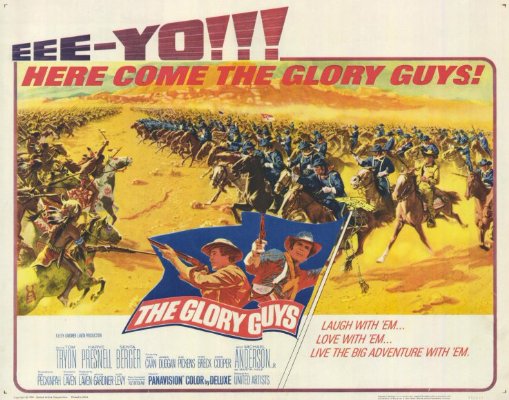
The Glory Guys
For over two years, I've been a Netflix member and have caught up with a lot of movies that were either impossible to find or I just wasn't willing to buy to actually see them. Over the two years, Netflix has added many features but maybe none better than the ability to watch a long list of movies instantly through your computer or even by downloading through your TV. There are some hidden gems among these many movies, but you've just got to find them. I stumbled across a western today I've long wanted to see, 1965's The Glory Guys.
I don't know how many years back, but I caught the last 10 or 15 minutes of this on TCM when I got home from school. Because it looked good and I was interested in seeing it again, it obviously hasn't been on TCM and of course is not available in any format. Thank you, Netflix, for making it available. With a screenplay by infamous director Sam Peckinpah, this western is a thinly veiled version of the massacre at the Little Big Horn when George Armstrong Custer and the 7th Cavalry were wiped out by a huge grouping of plains Indians. TV director Arnold Laven is listed as the movie's director, but rumors persist that Peckinpah handled some of the directing duties. For a western that is long forgotten, it has too many positives to be left behind as it is.
After fighting the Apaches in the southwest, Captain Demas Harrod (Tom Tryon) is transferred to Fort Doniphan by the orders of famed Indian fighter General Frederick McCabe (Andrew Duggan). He is assigned a company in the renowned 3rd Cavalry, but the men are a motley group of misfits with little experience with horses or firearms. With the help of his company sergeant, Gregory (Slim Pickens), Harrod goes about whipping the men into shape for the coming campaign. Harrod also finds himself in a fight for the hand of widowed gunslinger Lisa Woodard (the always lovely Senta Berger) against Army scout Sol Rogers (Harve Presnell). All their problems aside though, the 3rd Cavalry is part of a huge campaign meant to control the plains Indians for good, and Gen. McCabe is looking for glory in the process, no matter the cost in men.
Part of the reason this western has been forgotten over the last 45 years is the casting of the leads, Tryon and Presnell. Neither actor was a big star coming into 'Glory Guys' and neither would be afterward. They're the type of roles you can see much bigger names taking over, but for me I thought the two did solid jobs. Tryon can be a tad wooden at times, and Presnell's character is underwritten and underused, but they have a good chemistry together as they fight for Berger (and who'd blame them?). The unnecessary love triangle isn't as awful as it could have been thankfully, and besides a few scenes that kill momentum in the middle is left by the wayside.
More than a few things here reminded me of Peckinpah's other 1965 western, Major Dundee. The big ones are obvious, a cavalry story fighting Indians serving as the basis for both movies' story. But then there's the location filming in Durango, Mexico for both, and the casting of Berger, Pickens, and Michael Anderson Jr. in an eerily similar role to the one he played in Major Dundee. Whoever ended up directing more of 'Glory Guys,' there is the distinct feel of a Peckinpah movie whether it's seeing the same locations or just the dynamic among male characters. Peckinpah had a knack for tough, hard-edged male characters who fight and fight only to side with each other when the chips are down. There is a code among men like these, and they tend to live by it no matter the end result. So yes, it may be an average western, but it's elements like this that help lift it up a notch or two.
What works best when the story isn't focusing on the love triangle is the training and development of Harrod's D Company as they arrive at the fort only to turn into highly competent cavalry soldiers. Pickens is perfectly cast as tough Sgt. Gregory with Anderson Jr., a very young James Caan as brawling Irishman Anthony Duggan (the accent is must-hear), Adam Williams, and Erik Holland rounding out the recognizable faces in the company. Peckinpah's screenplay is at its best when dealing with the training and the camaraderie that develops among these men. The characters lean to outlines more than red-blooded characters, but Cann especially stands out, as does Anderson Jr. Tryon's Harrod pushes his men because he's seen Gen. McCabe's dangerous battlefield tactics and knows the better prepared his men are, the more likely they'll make it through alive. I wish more time could have been spent with D Company, but what's here is quality.
Now onto one of my self-named elements of movies I love, the sense of doom. With a story about an eventual massacre, you know where everything's going to end up. The last 45 minutes are dripping with tension as the 3rd Cavalry unknowingly rides to their doom. The actual battle is a spectacle to behold, hundreds of cavalry and Indians on horseback going toe to toe. Clearly some serious money was spent on the finale, an epic, well choreographed and constructed battle that would preview similar scenes in Major Dundee and The Wild Bunch. If you're a Netflix member, I recommend checking this one out, and if not, keep an eye out for it. How hard is it to find? I couldn't even find a trailer or a video clip.
The Glory Guys (1965): ***/****
I don't know how many years back, but I caught the last 10 or 15 minutes of this on TCM when I got home from school. Because it looked good and I was interested in seeing it again, it obviously hasn't been on TCM and of course is not available in any format. Thank you, Netflix, for making it available. With a screenplay by infamous director Sam Peckinpah, this western is a thinly veiled version of the massacre at the Little Big Horn when George Armstrong Custer and the 7th Cavalry were wiped out by a huge grouping of plains Indians. TV director Arnold Laven is listed as the movie's director, but rumors persist that Peckinpah handled some of the directing duties. For a western that is long forgotten, it has too many positives to be left behind as it is.
After fighting the Apaches in the southwest, Captain Demas Harrod (Tom Tryon) is transferred to Fort Doniphan by the orders of famed Indian fighter General Frederick McCabe (Andrew Duggan). He is assigned a company in the renowned 3rd Cavalry, but the men are a motley group of misfits with little experience with horses or firearms. With the help of his company sergeant, Gregory (Slim Pickens), Harrod goes about whipping the men into shape for the coming campaign. Harrod also finds himself in a fight for the hand of widowed gunslinger Lisa Woodard (the always lovely Senta Berger) against Army scout Sol Rogers (Harve Presnell). All their problems aside though, the 3rd Cavalry is part of a huge campaign meant to control the plains Indians for good, and Gen. McCabe is looking for glory in the process, no matter the cost in men.
Part of the reason this western has been forgotten over the last 45 years is the casting of the leads, Tryon and Presnell. Neither actor was a big star coming into 'Glory Guys' and neither would be afterward. They're the type of roles you can see much bigger names taking over, but for me I thought the two did solid jobs. Tryon can be a tad wooden at times, and Presnell's character is underwritten and underused, but they have a good chemistry together as they fight for Berger (and who'd blame them?). The unnecessary love triangle isn't as awful as it could have been thankfully, and besides a few scenes that kill momentum in the middle is left by the wayside.
More than a few things here reminded me of Peckinpah's other 1965 western, Major Dundee. The big ones are obvious, a cavalry story fighting Indians serving as the basis for both movies' story. But then there's the location filming in Durango, Mexico for both, and the casting of Berger, Pickens, and Michael Anderson Jr. in an eerily similar role to the one he played in Major Dundee. Whoever ended up directing more of 'Glory Guys,' there is the distinct feel of a Peckinpah movie whether it's seeing the same locations or just the dynamic among male characters. Peckinpah had a knack for tough, hard-edged male characters who fight and fight only to side with each other when the chips are down. There is a code among men like these, and they tend to live by it no matter the end result. So yes, it may be an average western, but it's elements like this that help lift it up a notch or two.
What works best when the story isn't focusing on the love triangle is the training and development of Harrod's D Company as they arrive at the fort only to turn into highly competent cavalry soldiers. Pickens is perfectly cast as tough Sgt. Gregory with Anderson Jr., a very young James Caan as brawling Irishman Anthony Duggan (the accent is must-hear), Adam Williams, and Erik Holland rounding out the recognizable faces in the company. Peckinpah's screenplay is at its best when dealing with the training and the camaraderie that develops among these men. The characters lean to outlines more than red-blooded characters, but Cann especially stands out, as does Anderson Jr. Tryon's Harrod pushes his men because he's seen Gen. McCabe's dangerous battlefield tactics and knows the better prepared his men are, the more likely they'll make it through alive. I wish more time could have been spent with D Company, but what's here is quality.
Now onto one of my self-named elements of movies I love, the sense of doom. With a story about an eventual massacre, you know where everything's going to end up. The last 45 minutes are dripping with tension as the 3rd Cavalry unknowingly rides to their doom. The actual battle is a spectacle to behold, hundreds of cavalry and Indians on horseback going toe to toe. Clearly some serious money was spent on the finale, an epic, well choreographed and constructed battle that would preview similar scenes in Major Dundee and The Wild Bunch. If you're a Netflix member, I recommend checking this one out, and if not, keep an eye out for it. How hard is it to find? I couldn't even find a trailer or a video clip.
The Glory Guys (1965): ***/****
Saturday, August 7, 2010
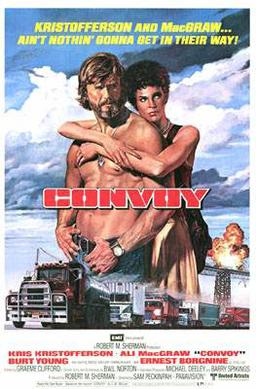
Convoy
The transition from popular song to feature length movie seems like quite a stretch to me, but maybe that's just my crazy opinion. But as long as a studio is making a ridiculous jump from a 4-minute song to a 110-minute movie, they might as well push the pedal to the floor and hire an equally crazy/ridiculous director, Sam Peckinpah. And big picture, it isn't as much a movie as it is a series of scenes with 18-wheeler semi-trucks driving around, a folksy soundtrack, and a lot of the cast spending most of their time reciting dialogue through CB radios. If that's not a recipe for a successful movie, I just don't know what is.
Driving into Arizona, 18-wheeler semi drivers Rubber Duck (Kris Kristofferson), Pig Pen (Burt Young) and Spider Mike (Franklyn Ajaye) are pulled over by a local sheriff, Dirty Lyle Wallace (Ernest Borgnine), with a bone to pick. They bribe the crooked cop to get away but end up meeting him down the road in an off-road diner where a knock-down, drag 'em out brawl ensues, Lyle handcuffed to a stool at the bar. Duck and Co. head out on the road hoping to reach the state lines before the law can get their hands on them. With a friendly-looking hitchhiking photographer (Ali MacGraw) along for the ride, Duck takes the lead, but that crooked sheriff isn't going to let them go so easily. But as the chase wears on, news spreads and Duck's little convoy continues to grow and grow.
Wikipedia (an always reliable source for info) points out that Convoy was part of a string of movies released in the late 1970s at the height of the CB radio/truck driver popularity. Who knew? That's what the movie is too, an excuse for a long line of 18-wheelers to drive in formation down the road, a lot of CB talk with far too many 'Breaker...breaker...10-4 good buddies' and Borgnine at his over the top, obnoxious best. What I did enjoy was the stunt work done while driving the huge semi-trucks. Doing dangerous stunts in sports cars and race cars is one thing, but these trucks are huge and the drivers handle them as if they were much smaller cars. High speeds and sharp turns never looked so impressive.
As much as anything though, this is a very 70s movie about refusal to go along with the system and not trusting anyone in any power through the government, police or any sort of establishment. Peckinpah's portrayal of this is less than subtle too, not helping matters. As Duck's convoy grows bigger by the hour, government officials conclude that this is some sort of mass protest, and even when told the truth, they ignore the otherwise obvious truth in front of them. Seymour Cassel plays the governor of a southwest state, I think Texas, who sees an opportunity to appeal to a wide range of voters by supporting Duck's "protest." But with Cassel's clueless governor and Borgnine's insane sheriff, it just gets to be a little much.
No matter the quality of the finished product -- and more often than not it was high quality -- Peckinpah always worked with some impressive casts. Convoy's isn't the best assembly of talent, but it's a solid if not spectacular cast. Working with Peckinpah for a third time, Kristofferson is as always very likable in his lead part as Rubber Duck. You could say he's not acting in most of his movies, typically playing a laid back, easy going, drawling good old boy, and I'm not going to dispute that, but he's cool, I like him as a star, and that's that. So there. This is Borgnine that I don't like. So ridiculously over the top, screaming his lines, those huge bug eyes glaring at you. He's the bad guy you love to hate, but it's too much to take seriously. MacGraw, never a great actress to begin with, is here for eye candy with one of the oddest looking hairstyles I've seen. Other than these three, none of the cast really jumps out for good or bad.
The story dawdles along for most of an hour, hour and a half and then the message comes out. The establishment isn't going to just let Duck drive off into the sunset. The solution is a little much though as he makes a break for 'ole Mexico, but if nothing else, for a split second it works. If the movie ended there, it could have been a solid send-off. But then there's another five minutes or so with a twist that negates everything the last scene just accomplished. I don't really know what to make of the movie overall, but it's certainly a doozy. If nothing else, HERE is the song the movie's based on.
Convoy <---trailer (1978): **/****
Labels:
1970s,
Burt Young,
Ernest Borgnine,
Kris Kristofferson,
Sam Peckinpah
Wednesday, October 28, 2009
The Ballad of Cable Hogue
Abandoned in the desert by his partners Taggart (L.Q. Jones) and Bowen (Strother Martin), desert drifter Cable Hogue (Jason Robards) endures five days without water as he attempts to walk to the next far-off town. As he lies down ready to give up and die, he sees a drop of water on his boot and discovers a hidden water hole deep in the sand. A stagecoach passes by (Slim Pickens riding shotgun) and tells him there's no water for 40 miles between towns for the stagecoach route. Seeing a chance for some serious cash, Cable files a claim and sets up shop out in the desert, charging 10 cents for a person to drink and 25 cents for animals.
As the money starts to roll in, so do the people. First, there's Reverend Joshua Sloane (David Warner), a minister who travels across the west preaching and generally getting in trouble with married women. Second, there's Hildy (Stella Stevens), a prostitute in a nearby town who falls for Cable but must decide whether to stay with him or continue on to San Francisco where she'll marry a rich man. Holding everything up is Cable who is content to wait at his water hole, Cable Springs, until Taggart and Bowen eventually show up and give him a chance at revenge.
With maybe two guns fired the whole movie, the attention is clearly on the story. It's the early 20th Century so like The Wild Bunch or Ride the High Country, Peckinpah's movie deals with the changing times in the wild west. While a key twist revolves around the times and the advancing technology, the story otherwise could be set anywhere in any time period. Cable's little operation out in the desert is a quaint little American dream, coming full circle when Pickens brings him an American flag to fly. It's a story that is in no rush to get its message across, letting things out here and there.
The high point of 'Cable' is star Jason Robards. Two years removed from one of his best parts -- Cheyenne in Once Upon a Time in the West -- Robards gives Cable a hard edge. Warner's Joshua deems Cable not a good man or a bad man, just a man. He's a likable character, a fella who doesn't care much for people or their cities in towns. He's content to live his life out in the desert (Arizona and New Mexico were the filming locations) and let his money pile up. In her on-screen nudity phase, Stevens plays the hooker with a heart of gold who falls in love with Cable. There's a natural chemistry between the actors although it's hard not to notice that Stevens is naked, half-naked, or undressing just about every time she's in view.
As strong as the leads are, the movie in general suffers from what I like to call the makings of a folksy western. Westerns in the 70s went away from gunfights and action, focusing more on lyrical storytelling, lots of folk songs, and some truly unnecessary comedy, and 'Cable' is no exception. A song over the credits, Tomorrow is the Song I Sing, and Butterfly Mornin's (sung by Stevens) grind the already slow-moving pace to a complete halt. With some low-brow humor, Peckinpah also speeds up the film like a bad Benny Hill episode which looks out of place and amateurish when comparing it to the director's other movies. Adding to the comedy, Warner's horny reverend feels out of place and generally comes across as painfully unfunny.
The revenge storyline is left by the wayside for much of the movie, and that's fine. Robards is appealing on-screen, and it's as enjoyable to see his watering hole station grow and his interactions with Warner, Pickens, and R.G. Armstrong as a stagecoach supervisor, and Peter Whitney as a bank officer who bankrolls Cable. But when the revenge aspect steps back to the forefront, it does not ring true. The whole ending seems a little forced. The premise is an ideal one, similar to The Wild Bunch without the epic gunbattle, but in execution it doesn't work. SPOILER Cable gets run over by a car and basically is fine, laughs at his own death, has Warner eulogize him, and then dies off-screen. He's such a strong character it is a shame he is dispatched like he is. END OF SPOILER
'Cable' is an uneven effort from Peckinpah that ranges from great -- the first hour and Robards' performance -- to below average (folk songs, comedy, forced ending). If you are a fan of Bloody Sam, I'd definitely say 'watch this one.' The volatile director only made 16 movies, and it'd be hard to recommend completely passing over one of them.
The Ballad of Cable Hogue <---trailer (1970): ** 1/2 /****
Subscribe to:
Posts (Atom)