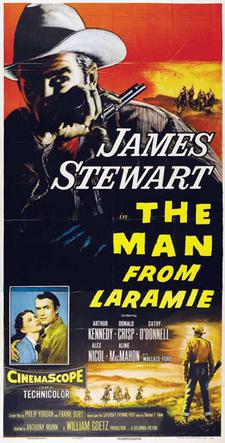
By 1950, James Stewart had been working in Hollywood for 15-plus years, most of those years as a go-to star who audiences and critics alike liked and appreciated. In 1950 though, he starred in a western called Winchester '73, teaming with director Anthony Mann. It ended up playing a key -- if unappreciated -- role and movie as Stewart headed into the next portion of his career. From there on in, Stewart was a regular in the western genre, by my count starring in 17 westerns. Today's entry? That would be 1955's The Man from Laramie.
Having endured a long trip on the trail, Will Lockhart (Stewart) and his packed-to-the-gills freight wagons have finally arrived in the small, isolated desert town of Coronado. Lockhart sells his goods and is in no rush to get back to Laramie. Actually...he'd like to stick around. He's got some questions he would like answered about a cavalry patrol being massacred several months before by an Apache war party using repeating rifles. Where did those rifles come from? Who sold them to the Apaches? Now, Will isn't letting on to his real goal of being Coronado, but he quickly draws the ire of the local rancher, Alec Waggoman (Donald Crisp), who with his weak son, Dave (Alex Nicol), and loyal foreman, Vic (Arthur Kennedy), rule over the surrounding area. The clock is ticking on Lockhart if he wants to get his answers before he ends up six feet under with a bullet or knife in his back.
Early in his career, Stewart did star in one pretty excellent western, 1939's Destry Rides Again. Some more years under his belt, his service in World War II behind him, Stewart was a little more weathered, a little more grown up when he really dove into the western genre in the 1950's. He just looks like he belongs in the western, from the beat-up hat he wore in so many to the tall, lean look that screamed authentic cowboy. He's likable -- as always -- but as necessary, Stewart is able to call up this rage and fury as needed. That's especially important as we discover exactly what his Will Lockhart is up to in Coronado. It's an excellent performance from Jimmy Stewart all around, an actor and a man who appears quite comfortable in a genre that is and was happy to have him.
John Wayne had John Ford. Randolph Scott had Budd Boetticher. Jimmy Stewart....he had Anthony Mann. This is actually the fifth and final pairing of the actor/director combo, and it's a good one. They also paired in Winchester '73, Bend of the River, The Naked Spur, The Far Country, and this film. So many 1950's westerns were clean and polished, but there's a meanness, a darkness to these pairings. With touches of Shakespearean storylines, even some mythological storylines (greed, betrayal, lust, murder), Mann added a much-needed darkness and depth to the western. It wasn't always a cut and dry good and bad. It was tortured anti-heroes (a sign of things to come in the genre). It was realistic -- if not graphic -- violence. There are a fair share of pretty weak westerns from this decade, but when they were good? They were pretty good overall, like here, and so many Stewart/Mann, Scott/Boetticher pairings.
'Laramie' doesn't feature a huge cast or a ton of recognizable names, but the casting in general is solid because of the script with all that Shakespearean, mythology-based storylines. Crisp is excellent as the aging rancher who's desperately clinging to what he carved out of the wilderness. He's trying to keep it all together, balancing things between his whiny, weak-minded son, Dave (a sniveling Nicols), and the tougher, ruthless Vic Hansbro. Kennedy is excellent, as he usually was, without resorting too much to chewing the scenery. Cathy O'Donnell plays Barbara, Waggoman's niece and Vic's fiance, caught up in the middle of all the family drama, Aline MacMahon is a weathered, ranching rival to the Waggomans with a history with her rivals, Wallace Ford is Charley, Lockhart's quasi-partner and a tried and true wagon driver with experience to burn, and an underused Jack Elam doing what he did best as shifty, two-faced supporting villain.
This is a western with a ton to offer. It has elements of film noir storytelling, the mystery of the massacre playing out against a western backdrop. Lockhart's secret doesn't come as a huge surprise, but it works because the tension and mood is built up more with each passing scene. The final reveal in the closing scene is dealt with in almost matter of fact fashion, but getting there is a ton of fun. The score is nothing to write home about, but my goodness, the visuals from the on-location shooting in New Mexico are Stunning. What a beautiful picture, the rocky mountains and sand-swept plains and vistas filling the background with each passing scene. It is a sun-drenched western with seemingly no clouds anywhere near or around the location shooting. Story, twists and characters aside, you can just sit back and appreciate the natural beauty.
If there's a weakness, it's in the last 45 minutes or so of a 104-minute movie. As certain things are revealed, the story loses some momentum. The ending itself features some twists and betrayals and backstabbing along the way that do make it fun, but there isn't the same energy as was there in the first half. Still, it's a solid, well-made adult western from the 1950's and Jimmy Stewart is always fun to watch. Definitely worth seeking out.
The Man From Laramie (1955): ***/****
The Sons of Katie Elder
"First, we reunite, then find Ma and Pa's killer...then read some reviews."
Showing posts with label Anthony Mann. Show all posts
Friday, August 7, 2015
Thursday, December 6, 2012
The Furies
Having helped make a name for himself in the late 1940s with film noirs like Border Incident, Side Street, Raw Deal, director Anthony Mann spun that success into a string of his best films over a span of about four years, including an interesting, adult-themed western from 1950, The Furies.
Running his cattle ranch, the Furies, with an iron fist, T.C. Jeffords (Walter Huston) has created an empire unto himself. He doesn't tolerate weakness in those around him and is always looking out for his own well-being no matter the cost/expense to others. At his side and helping him run the ranch is his fiery daughter, Vance (Barbara Stanwyck), who looks up to her father in every way and adopted his brutality as her own. As Vance decides she wants a husband who can keep up with her, the Furies falls on tough times with T.C. looking for any sort of income. Making matters worse is that T.C. proposes to Flo Burnett (Judith Anderson), a rich Easterner, a decision that does not sit well with Vance.
As I've written about before, the late 1940s and early 1950s were a key period in the transitioning of the wild west on film. Gone were the singing cowboys, straight-laced good guys and so obviously evil bad guys. The westerns became more adult-oriented. There weren't good guys and bad guys, just not-so-nice good guys and less evil bad guys. In other words? More realistic. These significantly darker stories have allusions from everything to Greek mythology to Shakespeare and everything in between. Hints of incest are there (incredibly subtle, but there) with countless more betrayals, back-stabbings and murders lurking in the corners.
Blending his film noir roots with the western makes for an easy transition for Mann in the director's chair. Picked up by the Criterion Collection, it's easy to see why. The film lives in both the film noir world and the western world, making for a great combination. All the film noir elements are there -- shadowy, smoky settings, the femme fatale, the conniving shady businessman and so many more -- and 'Furies' is certainly benefited from the black and white photography. Westerns can look beautiful in color, especially late 1940s ventures like She Wore a Yellow Ribbon, but there is an effective simplicity to the black and white. It was filmed on-location in the Arizona desert, the starkness and isolated feeling hanging over the ever-darkening developing story. Franz Waxman's score is worthwhile too.
One of my issues reading Greek mythology in high school and college was simple; too many characters. 'Furies' has a lot of characters, all of them looking out for themselves. A film noir star herself, Stanwyck seems at ease in the western. A tough female star is always a welcome addition to the genre, throwing away the notion of the damsel in distress. Huston gets to ham it up a bit as T.C., but he does a great job. Wendell Corey is the conniving Rip Darrow, a banker and saloon owner looking for revenge who also takes a shine to Stanwyck's Vance. Gilbert Roland makes the most of a supporting part as Juan Herrera who with his family is about to be kicked off the Jeffords' land, including his mother (Blanche Yurka), who's believed to be an old witch. Thomas Gomez as some fun as El Tigre, Jeffords' cattle boss, leading a supporting cast that includes Beulah Bondi, Albert Dekker, John Bromfield, and Wallace Ford.
With a 109-minute running time, I wasn't always sure where 'Furies' was heading. Well, check that. You know it won't be a happy ending, but it takes an interesting route getting there. All the back-stabbing and betrayals are present as anyone and everyone starts to turn on each other. Always pay attention though, it is the 1940s and karma, she is a....well, you know. Past transgressions must be paid for. The final scene is a little too hunky-dory, a little too sweet for my liking, but the build-up is solid enough to not be ruined by the cop-out finale at the Jeffords' ranch. Credit to Mann for combining film noir and an adult western so smoothly. It's missing that special something that keeps it from classic status, but it's an above average western.
The Furies (1950): ***/****
Running his cattle ranch, the Furies, with an iron fist, T.C. Jeffords (Walter Huston) has created an empire unto himself. He doesn't tolerate weakness in those around him and is always looking out for his own well-being no matter the cost/expense to others. At his side and helping him run the ranch is his fiery daughter, Vance (Barbara Stanwyck), who looks up to her father in every way and adopted his brutality as her own. As Vance decides she wants a husband who can keep up with her, the Furies falls on tough times with T.C. looking for any sort of income. Making matters worse is that T.C. proposes to Flo Burnett (Judith Anderson), a rich Easterner, a decision that does not sit well with Vance.
As I've written about before, the late 1940s and early 1950s were a key period in the transitioning of the wild west on film. Gone were the singing cowboys, straight-laced good guys and so obviously evil bad guys. The westerns became more adult-oriented. There weren't good guys and bad guys, just not-so-nice good guys and less evil bad guys. In other words? More realistic. These significantly darker stories have allusions from everything to Greek mythology to Shakespeare and everything in between. Hints of incest are there (incredibly subtle, but there) with countless more betrayals, back-stabbings and murders lurking in the corners.
Blending his film noir roots with the western makes for an easy transition for Mann in the director's chair. Picked up by the Criterion Collection, it's easy to see why. The film lives in both the film noir world and the western world, making for a great combination. All the film noir elements are there -- shadowy, smoky settings, the femme fatale, the conniving shady businessman and so many more -- and 'Furies' is certainly benefited from the black and white photography. Westerns can look beautiful in color, especially late 1940s ventures like She Wore a Yellow Ribbon, but there is an effective simplicity to the black and white. It was filmed on-location in the Arizona desert, the starkness and isolated feeling hanging over the ever-darkening developing story. Franz Waxman's score is worthwhile too.
One of my issues reading Greek mythology in high school and college was simple; too many characters. 'Furies' has a lot of characters, all of them looking out for themselves. A film noir star herself, Stanwyck seems at ease in the western. A tough female star is always a welcome addition to the genre, throwing away the notion of the damsel in distress. Huston gets to ham it up a bit as T.C., but he does a great job. Wendell Corey is the conniving Rip Darrow, a banker and saloon owner looking for revenge who also takes a shine to Stanwyck's Vance. Gilbert Roland makes the most of a supporting part as Juan Herrera who with his family is about to be kicked off the Jeffords' land, including his mother (Blanche Yurka), who's believed to be an old witch. Thomas Gomez as some fun as El Tigre, Jeffords' cattle boss, leading a supporting cast that includes Beulah Bondi, Albert Dekker, John Bromfield, and Wallace Ford.
With a 109-minute running time, I wasn't always sure where 'Furies' was heading. Well, check that. You know it won't be a happy ending, but it takes an interesting route getting there. All the back-stabbing and betrayals are present as anyone and everyone starts to turn on each other. Always pay attention though, it is the 1940s and karma, she is a....well, you know. Past transgressions must be paid for. The final scene is a little too hunky-dory, a little too sweet for my liking, but the build-up is solid enough to not be ruined by the cop-out finale at the Jeffords' ranch. Credit to Mann for combining film noir and an adult western so smoothly. It's missing that special something that keeps it from classic status, but it's an above average western.
The Furies (1950): ***/****
Saturday, November 10, 2012
Men in War
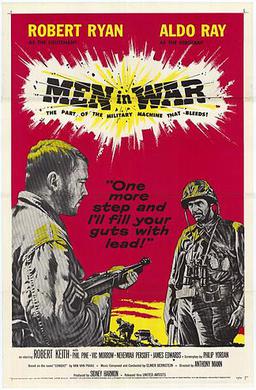
The Korean War was unlike any war Americans had ever been involved in. The movies made about it certainly reflected that. There was nothing simple about it, no easy answer, but I suppose that applies to all wars. One of the best movies about Korea is also one that has gone criminally unrecognized over the years, 1957's Men in War.
Following a horrifically costly engagement late in 1950 in Korea, Lt. Benson (Robert Ryan) finds himself in command of the ragged remains of his rifle platoon. With just 17 men and no idea where the rest of the battalion is, Benson leads his men to a prearranged objective that he's not even sure still exists. Along the way, they run into Sgt. Montana (Aldo Ray), a stubborn and very capable soldier who's transporting by jeep his shell-shocked commanding officer, the Colonel (Robert Keith). When Benson commandeers the jeep, Montana goes along more than a little unwillingly. Together, the motley group continues to their objective, an otherwise ordinary location, simply titled Hill 465. What awaits there? None of them know.
Never even mentioned among the best war movies around, this Korean War has been criminally neglected since its 1957. From director Anthony Mann, it is a cynical, extremely dark, very realistic, and even a tad existential at times. While it is based in Korea, it really could be any war. The infantry soldiers trudge on, fighting a mostly unseen enemy, just trying to survive. We learn nothing about anyone, and there's no bigger picture of the war. These men are separated from their possibly annihilated unit and walking in heavily occupied enemy territory. The North Koreans appear as needed; in the aftermath of a firefight, two survivors talk quietly -- not really hiding either -- where seconds before bullets and grenades were raining down on them. This is war and the effect it has on the individual.
Beyond that simple story is a realistic story. I try not to use this description too much, but it was truly ahead of its time. We're introduced to Benson's platoon in the aftermath of the attack that separated his platoon from the battalion. The men look exhausted to the point of fainting. One man has been killed -- stabbed in the back with a bayonet -- by a North Korean scout, and so it starts. The cynicism is palpable. Benson mumbles 'Son of a...' before veering off. Ray's Montana shoots a surrendering North Korean, albeit one reaching for a hidden pistol. Later, a second prisoner is used for bait to see if the platoon has been spotted. Filmed in a close-up black and white, I felt like a fly on the wall as a viewer. We feel like we're right there with the foot soldiers. By no means a flashy filming style, but the story doesn't call for it. Also worth mentioning is Elmer Bernstein's eerie but spot-on musical score.
Playing on the basic notion of the unit picture, 'War' has an impressive tough guy cast. It's great to see Ryan get a good guy role. Very capable of playing a hellishly bad villain, Ryan is a perfect choice to play the beaten down officer who must buck up to get his men to safety. Ray as his counter is just as spot-on, a similarly experienced soldier but one with a simpler mission. That angle (protecting your commanding officer) would be used 20 years later in A Bridge Too Far. Benson's platoon includes Riordan (Phillip Pine), the radioman, Lewis (Nehemiah Persoff), the unhinged sergeant, Zwickley (Vic Morrow), the scared to death private, Killian (James Edwards), the mechanic, and Davis (L.Q. Jones), the medic and BAR man. Seven other soldiers are listed in the cast but under the dirt, grime and three-day stubble, it's hard to distinguish them.
For the most part here, the story is fairly familiar. Nothing crazy or out of the blue. The platoon deals with North Korean scouts trying to pick them off, bickering amongst the men, even stumbling into a minefield. Where it distinguishes itself is in the finale as Benson's men reach Hill 465. There is nothing special about the hill, just a big chunk of jagged rock....that's occupied by North Koreans. The small-scale battle has elements of the surreal. The enemy fires only occasionally, only appearing for brief close-ups. In its small scale, it is a very personal, aggressive, and uncomfortable depiction of battle. Soldiers are killed, but we barely see their faces to know who it is. The film ends on a dour note, but an effective one just the same.
A war film that deserves better. Effective message that is never overbearing, great casting, almost documentary-like feel from Mann, all amount to a film well worth watching.
Men in War <---Youtube clip (1957): *** 1/2 /****
Following a horrifically costly engagement late in 1950 in Korea, Lt. Benson (Robert Ryan) finds himself in command of the ragged remains of his rifle platoon. With just 17 men and no idea where the rest of the battalion is, Benson leads his men to a prearranged objective that he's not even sure still exists. Along the way, they run into Sgt. Montana (Aldo Ray), a stubborn and very capable soldier who's transporting by jeep his shell-shocked commanding officer, the Colonel (Robert Keith). When Benson commandeers the jeep, Montana goes along more than a little unwillingly. Together, the motley group continues to their objective, an otherwise ordinary location, simply titled Hill 465. What awaits there? None of them know.
Never even mentioned among the best war movies around, this Korean War has been criminally neglected since its 1957. From director Anthony Mann, it is a cynical, extremely dark, very realistic, and even a tad existential at times. While it is based in Korea, it really could be any war. The infantry soldiers trudge on, fighting a mostly unseen enemy, just trying to survive. We learn nothing about anyone, and there's no bigger picture of the war. These men are separated from their possibly annihilated unit and walking in heavily occupied enemy territory. The North Koreans appear as needed; in the aftermath of a firefight, two survivors talk quietly -- not really hiding either -- where seconds before bullets and grenades were raining down on them. This is war and the effect it has on the individual.
Beyond that simple story is a realistic story. I try not to use this description too much, but it was truly ahead of its time. We're introduced to Benson's platoon in the aftermath of the attack that separated his platoon from the battalion. The men look exhausted to the point of fainting. One man has been killed -- stabbed in the back with a bayonet -- by a North Korean scout, and so it starts. The cynicism is palpable. Benson mumbles 'Son of a...' before veering off. Ray's Montana shoots a surrendering North Korean, albeit one reaching for a hidden pistol. Later, a second prisoner is used for bait to see if the platoon has been spotted. Filmed in a close-up black and white, I felt like a fly on the wall as a viewer. We feel like we're right there with the foot soldiers. By no means a flashy filming style, but the story doesn't call for it. Also worth mentioning is Elmer Bernstein's eerie but spot-on musical score.
Playing on the basic notion of the unit picture, 'War' has an impressive tough guy cast. It's great to see Ryan get a good guy role. Very capable of playing a hellishly bad villain, Ryan is a perfect choice to play the beaten down officer who must buck up to get his men to safety. Ray as his counter is just as spot-on, a similarly experienced soldier but one with a simpler mission. That angle (protecting your commanding officer) would be used 20 years later in A Bridge Too Far. Benson's platoon includes Riordan (Phillip Pine), the radioman, Lewis (Nehemiah Persoff), the unhinged sergeant, Zwickley (Vic Morrow), the scared to death private, Killian (James Edwards), the mechanic, and Davis (L.Q. Jones), the medic and BAR man. Seven other soldiers are listed in the cast but under the dirt, grime and three-day stubble, it's hard to distinguish them.
For the most part here, the story is fairly familiar. Nothing crazy or out of the blue. The platoon deals with North Korean scouts trying to pick them off, bickering amongst the men, even stumbling into a minefield. Where it distinguishes itself is in the finale as Benson's men reach Hill 465. There is nothing special about the hill, just a big chunk of jagged rock....that's occupied by North Koreans. The small-scale battle has elements of the surreal. The enemy fires only occasionally, only appearing for brief close-ups. In its small scale, it is a very personal, aggressive, and uncomfortable depiction of battle. Soldiers are killed, but we barely see their faces to know who it is. The film ends on a dour note, but an effective one just the same.
A war film that deserves better. Effective message that is never overbearing, great casting, almost documentary-like feel from Mann, all amount to a film well worth watching.
Men in War <---Youtube clip (1957): *** 1/2 /****
Labels:
1950s,
Aldo Ray,
Anthony Mann,
Korean War,
L.Q. Jones,
Nehemiah Persoff,
Robert Ryan,
Vic Morrow
Monday, July 16, 2012
Cimarron (1960)
My typical stance on an epic film is 'Bring it on.' You can't have too many of them, especially from the age of the epics, the 1950s through the 1960s. These are big, big movies. Then, I think of my favorite genre; the western. I can't name many quality epic, classic westerns. One exception is How the West Was Won, but I'm drawing a blank as to others. One that aspires to be an epic but ultimately fails is 1960's Cimarron.
Having put his wild cowboy drifting days behind him, Yancy 'Cimarron' Cravat (Glenn Ford) hopes to settle down with his newlywed bride, Sabra (Maria Schell). Yancy's plan starts with an impossible offer from the government, one that seems too good to be true. The Oklahoma territory and its millions of acres will be open to anyone who can stake a claim (the 1889 Land Run, read HERE), and Yancy has a spot all picked out to start a family with Sabra. Things don't go quite as planned though, forcing the couple to improvise and adjust. Setting up a small newspaper in Osage, Oklahoma, Yancy and Sabra are to become part of an era in American history full of drastic and modern change.
From director Anthony Mann, this is an appropriately big epic. The scale is impressive with scenes of hundreds of extras filling the screen behind the biggest names in the cast. None is more impressive than the depiction of the Oklahoma land rush. Literally hundreds of riders and wagons fill the screen from edge to edge as all these hopeful land owners race to stake a claim to their own land. Scenes like this make you appreciate what an epic is in all of its glory on such a large scale. The look of the movie is a beauty from the open prairies of the 1880s to the settled cityscapes of the 1910s. But that is where the positives end unfortunately.
Even with a movie clocking in at 149 minutes, it feels like Cimarron tackles too much. The story covers 25-plus years, but doesn't cover any of those years adequately. The script has jumps in times that come fast and furious, jumping a few months one time and then ten years the next. An episodic, somewhat drifting story can be a necessity dealing with a film of this scale, but at some point it has to be interesting even just a little bit. The tinier episodes here lack any of that interest with an exception here and there. Mann was at his best with smaller scale stories -- The Naked Spur, The Man from Laramie -- but struggles with stories of this magnitude. There's little heart, little emotion, and little interest to see a budding America growing from the wild west to the modern world.
That lack of emotion can be chalked up to any number of things, but the most glaring mistake was the casting. From top to bottom, 'Cimarron' lacks the huge star power of other epics, but that's not a deal breaker. It is though when almost to a man the characters are miscast. Ford and Schell don't have a great chemistry; a problem when these two characters are magnetically drawn together by their unexplained love. Ford's Yancy is trying to put a somewhat checkered past behind him, but that past is never even remotely dealt with, only hinted at. His character ends up being this icon of a growing America, and I'm thinking 'Really?' He bails on his wife for five years at one point, ten years at another. Schell too is trying here, but a character that could -- and probably should -- have been sympathetic comes across as shrill and whiny. When the two leads aren't especially likable, we could be in for a long ride.
The rest of the cast is hit or miss, and as is the case with epics gone bad, it's not always their fault. The ones given more screentime include Arthur O'Connell and Mercedes McCambridge as Tom and Sarah Wyatt, parents of a brood of eight trying to start a new life, a family that befriends Yancy and Sabra. Russ Tamblyn is a scene-stealer as the Cherokee Kid, a troubled youth Yancy tries to help with Vic Morrow as part of his gang. Anne Baxter is wasted as Dixie, a former love of Yancy's who now holds a grudge against him, a businesswoman who opens a whorehouse (a classy one at least). Potential for a cool character, but she's gone halfway through the movie. Also throw in Robert Keith, Charles McGraw, Harry Morgan, Edgar Buchanan, L.Q. Jones and David Opatoshu in supporting parts, some gone in a flash so don't blink. The problem is not the actors, but the lack of any character development. They drift in as needed and disappear as quickly as they appeared. Lots of potential for some very interesting characters, but nothing comes of it as Yancy and Sabra's story develops.
Once again, this won't sound like it makes a whole lot of sense, but there's both too much and not enough going on in a 149-minute movie. It's dull. The story moves along far too fast, glazing over significant portions of the story. I can't think of an epic with characters as unsympathetic as the ones here. I didn't care for most of the characters or how things ended up, and in the end, nothing comes of it. The resolution (using that term loosely) is disappointing and seemingly hypocritical for what we've seen up to this point. An epic attempt, but ultimately a disappointing failure.
Cimarron <---TCM trailer (1960): **/****
Having put his wild cowboy drifting days behind him, Yancy 'Cimarron' Cravat (Glenn Ford) hopes to settle down with his newlywed bride, Sabra (Maria Schell). Yancy's plan starts with an impossible offer from the government, one that seems too good to be true. The Oklahoma territory and its millions of acres will be open to anyone who can stake a claim (the 1889 Land Run, read HERE), and Yancy has a spot all picked out to start a family with Sabra. Things don't go quite as planned though, forcing the couple to improvise and adjust. Setting up a small newspaper in Osage, Oklahoma, Yancy and Sabra are to become part of an era in American history full of drastic and modern change.
From director Anthony Mann, this is an appropriately big epic. The scale is impressive with scenes of hundreds of extras filling the screen behind the biggest names in the cast. None is more impressive than the depiction of the Oklahoma land rush. Literally hundreds of riders and wagons fill the screen from edge to edge as all these hopeful land owners race to stake a claim to their own land. Scenes like this make you appreciate what an epic is in all of its glory on such a large scale. The look of the movie is a beauty from the open prairies of the 1880s to the settled cityscapes of the 1910s. But that is where the positives end unfortunately.
Even with a movie clocking in at 149 minutes, it feels like Cimarron tackles too much. The story covers 25-plus years, but doesn't cover any of those years adequately. The script has jumps in times that come fast and furious, jumping a few months one time and then ten years the next. An episodic, somewhat drifting story can be a necessity dealing with a film of this scale, but at some point it has to be interesting even just a little bit. The tinier episodes here lack any of that interest with an exception here and there. Mann was at his best with smaller scale stories -- The Naked Spur, The Man from Laramie -- but struggles with stories of this magnitude. There's little heart, little emotion, and little interest to see a budding America growing from the wild west to the modern world.
That lack of emotion can be chalked up to any number of things, but the most glaring mistake was the casting. From top to bottom, 'Cimarron' lacks the huge star power of other epics, but that's not a deal breaker. It is though when almost to a man the characters are miscast. Ford and Schell don't have a great chemistry; a problem when these two characters are magnetically drawn together by their unexplained love. Ford's Yancy is trying to put a somewhat checkered past behind him, but that past is never even remotely dealt with, only hinted at. His character ends up being this icon of a growing America, and I'm thinking 'Really?' He bails on his wife for five years at one point, ten years at another. Schell too is trying here, but a character that could -- and probably should -- have been sympathetic comes across as shrill and whiny. When the two leads aren't especially likable, we could be in for a long ride.
The rest of the cast is hit or miss, and as is the case with epics gone bad, it's not always their fault. The ones given more screentime include Arthur O'Connell and Mercedes McCambridge as Tom and Sarah Wyatt, parents of a brood of eight trying to start a new life, a family that befriends Yancy and Sabra. Russ Tamblyn is a scene-stealer as the Cherokee Kid, a troubled youth Yancy tries to help with Vic Morrow as part of his gang. Anne Baxter is wasted as Dixie, a former love of Yancy's who now holds a grudge against him, a businesswoman who opens a whorehouse (a classy one at least). Potential for a cool character, but she's gone halfway through the movie. Also throw in Robert Keith, Charles McGraw, Harry Morgan, Edgar Buchanan, L.Q. Jones and David Opatoshu in supporting parts, some gone in a flash so don't blink. The problem is not the actors, but the lack of any character development. They drift in as needed and disappear as quickly as they appeared. Lots of potential for some very interesting characters, but nothing comes of it as Yancy and Sabra's story develops.
Once again, this won't sound like it makes a whole lot of sense, but there's both too much and not enough going on in a 149-minute movie. It's dull. The story moves along far too fast, glazing over significant portions of the story. I can't think of an epic with characters as unsympathetic as the ones here. I didn't care for most of the characters or how things ended up, and in the end, nothing comes of it. The resolution (using that term loosely) is disappointing and seemingly hypocritical for what we've seen up to this point. An epic attempt, but ultimately a disappointing failure.
Cimarron <---TCM trailer (1960): **/****
Thursday, September 15, 2011
The Heroes of Telemark
While troops from both the Allied and Axis powers all over Europe and the South Pacific in WWII, another battle raged in laboratories with scientists and doctors working toward another goal; the creation of the first atomic bomb. Whichever country made the first bomb would almost assuredly win the war as just the threat of using such a weapon would force other countries to surrender. In 1942 some three years into the war, Germany seemed to be in the lead as Adolf Hitler sought the perfect weapons.
Based on a true story, 1965's The Heroes of Telemark tells the story of the Norwegian resistance's effort to stop the atomic development. By the mid 1960s, WWII espionage and commando stories were at the absolute height of their success as a wave of movies flooded theaters (sorry for the bad pun). 'Telemark' is one that isn't a classic, and despite some interesting casting in the two leads has been generally forgotten. It hasn't been available to watch on DVD in the U.S. until recently so that might have something to do with it, but even though I enjoy the movie I can appreciate those who don't. More on that later.
Working at a university in Oslo in Nazi-occupied Norway in 1942, Professor Rolf Pedersen (Kirk Douglas) is trying to stay as far away from the war effort -- on either side -- as possible. One day he is approached by Knut Straud (Richard Harris), a resistance fighter from the town of Rjukan, who has information about the Germans' development and increased production of heavy water in a factory in his hometown. Rolf sees the potential for disaster and agrees to go with Knut to England -- sneaking into the country -- to consult with British Intelligence on what they want done. The thought of Hitler having atomic weapons at his disposal is all the motivation he needs. The objective then is simple; send a commando team (including Knut and Rolf) to the Rjukan factory to sabotage the effort and slow down the developments. The means to do it? A little harder as the Germans have an intimidating security force all around the factory.
While the names have been changed and some of the events dramatized a bit, the basic story is based off a true story of the Norwegian resistance and their efforts to slow down the Germans' advances in atomic weaponry. That plot description is a general one too, only taking the story up to the hour mark or so in a 131-minute movie. Director Anthony Mann certainly adds a wrinkle to the commando story with the potential of this new city-destroying weapon. Most commando/espionage movies have an objective like taking out a key bridge or an important gun emplacement. Using the history and very timely matter of atomic weapons is an interesting and fact-based twist.
My biggest surprise when I first saw this was the casting of Kirk Douglas and Richard Harris as the two leads. I was in a Richard Harris phase -- still am I guess, he's a badass -- and thought 'Why the hell was I not aware of this movie?!?' Seeing two big stars like these two is part of the fun of stumbling across movies like this. Douglas was the more established one here, Harris the rising star, and apparently they didn't get along too well on-set. That is very much a good thing because their on-screen rivalry is very much real. They don't like each other at all. They work together because they need each others help and are forced to do so, not because they enjoy being commandos together. Douglas gets the shinier part -- including a rekindling relationship with ex-wife Anna, played by Ulla Jacobsson -- while Harris gets pushed to the side too much. Still, it's Kirk Douglas and Richard Harris. They're cool so deal with it.
Two key sequences always stand out for me, both of them coming straight out of the history books. The first is the raid on the Rjukan factory as Rolf and Knut lead eight Norwegian resistance fighters into the factory, avoiding security at every turn. The real-life raid went just as smoothly as this one, but Mann shoots it so well that the scene's are packed with tension and adrenaline. All it takes is one goof, and these guys are going to be outnumbered in a big way. The same goes for the finale as the Dynamic Duo attempts to sink a ferry carrying thousands of gallons of heavy water going across the Norwegian fjords. In both sequences, there is little to no gunfire, the natural tension of the situation doing the heavy lifting.
So what's the problem with this movie? I can't put my finger on it, and I like the movie. It is just missing something. At 131 minutes it is a tad on the slow side. Mann shot the movie on location in Norway, and it is stunning to watch. Composer Malcolm Arnold's score is highly memorable, even if it borrows liberally from his Bridge on the River Kwai soundtrack. Michael Redgrave is underused as Anna's uncle also working with the resistance. I guess the best description I can give is that it isn't the most personal movie. It never sucks you in the way The Guns of Navarone or Where Eagles Dare do. Still a good WWII commando movie, but not the best.
The Heroes of Telemark <---TCM trailer (1965): ***/****
Based on a true story, 1965's The Heroes of Telemark tells the story of the Norwegian resistance's effort to stop the atomic development. By the mid 1960s, WWII espionage and commando stories were at the absolute height of their success as a wave of movies flooded theaters (sorry for the bad pun). 'Telemark' is one that isn't a classic, and despite some interesting casting in the two leads has been generally forgotten. It hasn't been available to watch on DVD in the U.S. until recently so that might have something to do with it, but even though I enjoy the movie I can appreciate those who don't. More on that later.
Working at a university in Oslo in Nazi-occupied Norway in 1942, Professor Rolf Pedersen (Kirk Douglas) is trying to stay as far away from the war effort -- on either side -- as possible. One day he is approached by Knut Straud (Richard Harris), a resistance fighter from the town of Rjukan, who has information about the Germans' development and increased production of heavy water in a factory in his hometown. Rolf sees the potential for disaster and agrees to go with Knut to England -- sneaking into the country -- to consult with British Intelligence on what they want done. The thought of Hitler having atomic weapons at his disposal is all the motivation he needs. The objective then is simple; send a commando team (including Knut and Rolf) to the Rjukan factory to sabotage the effort and slow down the developments. The means to do it? A little harder as the Germans have an intimidating security force all around the factory.
While the names have been changed and some of the events dramatized a bit, the basic story is based off a true story of the Norwegian resistance and their efforts to slow down the Germans' advances in atomic weaponry. That plot description is a general one too, only taking the story up to the hour mark or so in a 131-minute movie. Director Anthony Mann certainly adds a wrinkle to the commando story with the potential of this new city-destroying weapon. Most commando/espionage movies have an objective like taking out a key bridge or an important gun emplacement. Using the history and very timely matter of atomic weapons is an interesting and fact-based twist.
My biggest surprise when I first saw this was the casting of Kirk Douglas and Richard Harris as the two leads. I was in a Richard Harris phase -- still am I guess, he's a badass -- and thought 'Why the hell was I not aware of this movie?!?' Seeing two big stars like these two is part of the fun of stumbling across movies like this. Douglas was the more established one here, Harris the rising star, and apparently they didn't get along too well on-set. That is very much a good thing because their on-screen rivalry is very much real. They don't like each other at all. They work together because they need each others help and are forced to do so, not because they enjoy being commandos together. Douglas gets the shinier part -- including a rekindling relationship with ex-wife Anna, played by Ulla Jacobsson -- while Harris gets pushed to the side too much. Still, it's Kirk Douglas and Richard Harris. They're cool so deal with it.
Two key sequences always stand out for me, both of them coming straight out of the history books. The first is the raid on the Rjukan factory as Rolf and Knut lead eight Norwegian resistance fighters into the factory, avoiding security at every turn. The real-life raid went just as smoothly as this one, but Mann shoots it so well that the scene's are packed with tension and adrenaline. All it takes is one goof, and these guys are going to be outnumbered in a big way. The same goes for the finale as the Dynamic Duo attempts to sink a ferry carrying thousands of gallons of heavy water going across the Norwegian fjords. In both sequences, there is little to no gunfire, the natural tension of the situation doing the heavy lifting.
So what's the problem with this movie? I can't put my finger on it, and I like the movie. It is just missing something. At 131 minutes it is a tad on the slow side. Mann shot the movie on location in Norway, and it is stunning to watch. Composer Malcolm Arnold's score is highly memorable, even if it borrows liberally from his Bridge on the River Kwai soundtrack. Michael Redgrave is underused as Anna's uncle also working with the resistance. I guess the best description I can give is that it isn't the most personal movie. It never sucks you in the way The Guns of Navarone or Where Eagles Dare do. Still a good WWII commando movie, but not the best.
The Heroes of Telemark <---TCM trailer (1965): ***/****
Labels:
1960s,
Anthony Mann,
Kirk Douglas,
Michael Redgrave,
Richard Harris,
WWII
Sunday, July 31, 2011
The Tall Target
Like so many episodes of The Twilight Zone rose above its trippy sci-fi roots to tell some stories that are still around in the pop culture psyche. One episodes -- "Back There" -- has future Professor from Gilligan's Island time traveling to April 14, 1865, realizing he can try and change history, saving President Abraham Lincoln's life but ultimately failing to do so. It's a great example of 'What if?," a question that can be applied to any and all parts of history -- some better than others. What if Lincoln had lived? What if assassin John Wilkes Booth had missed?
The tragedy of the situation of course is that Booth didn't miss, killing Lincoln with a shot to the head as he watched a play at Ford's Theater just days after the conclusion of the Civil War, the defining moment of his Presidency. Remembered as fondly as he was for helping save the United States from its most bloody conflict, it is easy to forget that Lincoln was not an extremely popular president, even among the Union states, much less the Confederate states who seceded. Were there other attempts on his life that failed? So goes the premise of 1951's The Tall Target.
A sergeant on the New York City Police Department, John Kennedy (Dick Powell) turns in a report explaining his investigation of a coming assassination attempt on the soon to be inaugurated president, Abraham Lincoln. It's 1861, and the country is tearing itself apart, both Northern and Southern opposition wanting nothing of this new Republican president. No one believes him though so he boards a train heading south to Baltimore, finding his partner -- a fellow detective -- murdered on the train. Someone has caught wind of what he is up to and intending to stop. The train is packed as the passengers head to the inauguration in Baltimore, but can Kennedy find out who's targeting him before the assassination attempt can be made?
As a history buff, I'll watch anything associated with the Civil War, especially a little known story like this one about a failed assassination attempt on Lincoln. A title card says the story is accurate to history, and attempts like these showed how chaotic and violent the months leading up to the Civil War actually work. The historical backdrop is just gravy because setting the story on a fast-moving train is always a good jumping off point, especially when we're fully aware the killer is on-board somewhere. Think Murder on the Orient Express mixed with a little Strangers on a Train and a little historical what-if thrown in for good measure.
The guessing game comes from the passengers as Powell's Sgt. John Kennedy (interesting choice of name looking back on the 1951 movie now) goes about his investigation. There are a handful of characters, some obvious choices, others coming as a twist, and others serving as a red herring to the real identity of the plotters. A mix of Northern and Southern passengers keep you guessing. Paula Raymond and Marshall Thompson play Ginny and Lance Beaufort, Southern brother and sister heading home, Lance a recent graduate of West Point. Ruby Dee is memorable as Rachel, Ginny's slave/maid, who may know something that will help Kennedy out. Adolphe Menjou plays Col. Jeffers, a Union militia officer heading to the inauguration, Florence Bates is Mrs. Alston, a well-known abolitionist writer, and Will Geer is the train conductor who finds his train caught up in a twisting, confusing murder investigation.
Having heard his name several times but never having seen in him anything, I've now seen Dick Powell in two different movies in as many weeks. For a guy who made a name for himself on musicals and on stage, this is another part for the actor where he seems like a less than ideal choice to play a tough lead character. In Station West, he was a government agent investigating two murders, and here again he plays an officer who no one believes, albeit involved in something much, much bigger. I don't know much more about Powell than what I've been able to take away from these two roles, but I like him. He's got kind of a snobby side to him, but he's still personable and a likable lead (if that makes sense). Song and dance man, maybe, but he's good here.
The 1950s were the high point of director Anthony Mann's career, but because he had so many successes over a 10-plus year span, some get lost in the shuffle. This is one of them unfortunately which hasn't gotten the credit it deserves. It is a movie that qualifies in my 'different so it's good' category of rating a movie. Mann brings his typical strong hand directing, keeping the mystery going with a hard edge to Kennedy's investigation. Anyone and everyone is a suspect as the bodies start to mount up. A cool, little historical murder mystery....oh, and Lincoln makes it.
The Tall Target <---TCM clips (1951): ***/****
The tragedy of the situation of course is that Booth didn't miss, killing Lincoln with a shot to the head as he watched a play at Ford's Theater just days after the conclusion of the Civil War, the defining moment of his Presidency. Remembered as fondly as he was for helping save the United States from its most bloody conflict, it is easy to forget that Lincoln was not an extremely popular president, even among the Union states, much less the Confederate states who seceded. Were there other attempts on his life that failed? So goes the premise of 1951's The Tall Target.
A sergeant on the New York City Police Department, John Kennedy (Dick Powell) turns in a report explaining his investigation of a coming assassination attempt on the soon to be inaugurated president, Abraham Lincoln. It's 1861, and the country is tearing itself apart, both Northern and Southern opposition wanting nothing of this new Republican president. No one believes him though so he boards a train heading south to Baltimore, finding his partner -- a fellow detective -- murdered on the train. Someone has caught wind of what he is up to and intending to stop. The train is packed as the passengers head to the inauguration in Baltimore, but can Kennedy find out who's targeting him before the assassination attempt can be made?
As a history buff, I'll watch anything associated with the Civil War, especially a little known story like this one about a failed assassination attempt on Lincoln. A title card says the story is accurate to history, and attempts like these showed how chaotic and violent the months leading up to the Civil War actually work. The historical backdrop is just gravy because setting the story on a fast-moving train is always a good jumping off point, especially when we're fully aware the killer is on-board somewhere. Think Murder on the Orient Express mixed with a little Strangers on a Train and a little historical what-if thrown in for good measure.
The guessing game comes from the passengers as Powell's Sgt. John Kennedy (interesting choice of name looking back on the 1951 movie now) goes about his investigation. There are a handful of characters, some obvious choices, others coming as a twist, and others serving as a red herring to the real identity of the plotters. A mix of Northern and Southern passengers keep you guessing. Paula Raymond and Marshall Thompson play Ginny and Lance Beaufort, Southern brother and sister heading home, Lance a recent graduate of West Point. Ruby Dee is memorable as Rachel, Ginny's slave/maid, who may know something that will help Kennedy out. Adolphe Menjou plays Col. Jeffers, a Union militia officer heading to the inauguration, Florence Bates is Mrs. Alston, a well-known abolitionist writer, and Will Geer is the train conductor who finds his train caught up in a twisting, confusing murder investigation.
Having heard his name several times but never having seen in him anything, I've now seen Dick Powell in two different movies in as many weeks. For a guy who made a name for himself on musicals and on stage, this is another part for the actor where he seems like a less than ideal choice to play a tough lead character. In Station West, he was a government agent investigating two murders, and here again he plays an officer who no one believes, albeit involved in something much, much bigger. I don't know much more about Powell than what I've been able to take away from these two roles, but I like him. He's got kind of a snobby side to him, but he's still personable and a likable lead (if that makes sense). Song and dance man, maybe, but he's good here.
The 1950s were the high point of director Anthony Mann's career, but because he had so many successes over a 10-plus year span, some get lost in the shuffle. This is one of them unfortunately which hasn't gotten the credit it deserves. It is a movie that qualifies in my 'different so it's good' category of rating a movie. Mann brings his typical strong hand directing, keeping the mystery going with a hard edge to Kennedy's investigation. Anyone and everyone is a suspect as the bodies start to mount up. A cool, little historical murder mystery....oh, and Lincoln makes it.
The Tall Target <---TCM clips (1951): ***/****
Labels:
1950s,
Anthony Mann,
Dick Powell,
Marshall Thompson,
The Civil War,
Will Geer
Friday, April 30, 2010
Devil's Doorway
Starting in 1950 with Winchester '73, director Anthony Mann made five movies with star Jimmy Stewart, all of them westerns, and all of them different from the typical shoot 'em up. These weren't just good guys and bad guys shooting it out, these were adult westerns where characters lived in all sorts of gray moral ground. It was a sign of what was to come in the westerns with a more cynical look at how our country expanded into the west through the 19th century. The Mann/Stewart westerns are classics, but Mann showed a knack for tough, hard-edged movies throughout his career that didn't shy away from showing a real, authentic wild west.
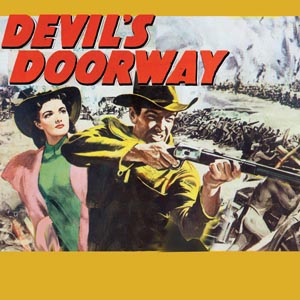
Take 1950's Devil's Doorway which tackles one of the biggest wild west issues that is so often brushed under the rug. Say it however you want it, but the extermination of the American Indian as Americans flooded across the country with the idea of Manifest Destiny. It's a topic that has produced movies with the premise of "white man's guilt," making the Indians look like noble warriors and Americans as drooling, savage murderers. Devil's Doorway is somewhere in between, a Shoshone tribe who have taken parts of the white culture into their own are forced to defend their land while ranchers, sheepherders and homesteaders prepare for a fight for this prime cut of land.
It's several years since the end of the Civil War and hero and Congressional Medal of Honor winner Lance Poole (Robert Taylor) returns home to the town he grew up in in Wyoming. Lance made it through the war unscathed and has hopes of building up his family's land into something great. The only problem; Lance is a Shoshone Indian, and homesteaders have moved into the area and are looking for grazing land. As an Indian, Poole isn't granted the right to own land so the 50,000 acres his family and tribe have owned for years is now up for grabs. One sheepherder (Marshall Thompson) tries to make a deal that would benefit both, but a corrupt, Indian hating lawyer (Louis Calhern) leads the opposition. Lance has been backed into a corner and knows he'll have to defend his land.
In 1950, I'd say a majority of westerns still portrayed Indians as murdering savages so it is refreshing to see an Indian as a major character and a sympathetic one at that. Taylor is an odd choice for an Indian with his transformation consisting of skin darkener and some grown out, slicked back hair. Thankfully, he doesn't attempt any stunted English. Everyone in town knows Lance and respects him, even more so now because he's returned as a war hero. But because he's an Indian -- and for that reason alone -- he is looked down upon. All he wants is to defend his family's land without interference, but no one's going to let him do just that.
This is an honest look at the expansion of the west and Devil's Doorway is way ahead of the genre in that sense. The west was not an easy place to live with people looking to advance themselves with little regard for those who got in their way. Mann takes that style on with his no-frills, often surprisingly brutal story. He films in black and white with Colorado proving the locations -- beautiful ones at that -- that adds even more to the authentic feel of the story. Mann is on point here with no unnecessary detours or subplots. A female lawyer (Paula Raymond) fights for Lance's cause, but there's no overly sentimental love story that develops. It's pretty typical of a Mann western, don't waste time getting to where you want to go.
Watching as many westerns as I have -- especially pre-1960 or so -- I feel like I've been trained to expect a happy ending no matter how ridiculous it is in terms of the story and character arcs. That was my concern here because there is NO WAY this story ends pleasantly, but Mann sticks to his guns. The last 30 minutes goes down as one of the best, realistic endings to a western I've seen, especially the last 2 shots which are heartbreaking and emotional in a way that completely caught me off guard. Add that emotion to the exciting action on-screen, and you've got a real winner here. Anthony Mann and Robert Taylor at the top of their game.
Devil's Doorway <----trailer (1950): *** 1/2 /****
Take 1950's Devil's Doorway which tackles one of the biggest wild west issues that is so often brushed under the rug. Say it however you want it, but the extermination of the American Indian as Americans flooded across the country with the idea of Manifest Destiny. It's a topic that has produced movies with the premise of "white man's guilt," making the Indians look like noble warriors and Americans as drooling, savage murderers. Devil's Doorway is somewhere in between, a Shoshone tribe who have taken parts of the white culture into their own are forced to defend their land while ranchers, sheepherders and homesteaders prepare for a fight for this prime cut of land.
It's several years since the end of the Civil War and hero and Congressional Medal of Honor winner Lance Poole (Robert Taylor) returns home to the town he grew up in in Wyoming. Lance made it through the war unscathed and has hopes of building up his family's land into something great. The only problem; Lance is a Shoshone Indian, and homesteaders have moved into the area and are looking for grazing land. As an Indian, Poole isn't granted the right to own land so the 50,000 acres his family and tribe have owned for years is now up for grabs. One sheepherder (Marshall Thompson) tries to make a deal that would benefit both, but a corrupt, Indian hating lawyer (Louis Calhern) leads the opposition. Lance has been backed into a corner and knows he'll have to defend his land.
In 1950, I'd say a majority of westerns still portrayed Indians as murdering savages so it is refreshing to see an Indian as a major character and a sympathetic one at that. Taylor is an odd choice for an Indian with his transformation consisting of skin darkener and some grown out, slicked back hair. Thankfully, he doesn't attempt any stunted English. Everyone in town knows Lance and respects him, even more so now because he's returned as a war hero. But because he's an Indian -- and for that reason alone -- he is looked down upon. All he wants is to defend his family's land without interference, but no one's going to let him do just that.
This is an honest look at the expansion of the west and Devil's Doorway is way ahead of the genre in that sense. The west was not an easy place to live with people looking to advance themselves with little regard for those who got in their way. Mann takes that style on with his no-frills, often surprisingly brutal story. He films in black and white with Colorado proving the locations -- beautiful ones at that -- that adds even more to the authentic feel of the story. Mann is on point here with no unnecessary detours or subplots. A female lawyer (Paula Raymond) fights for Lance's cause, but there's no overly sentimental love story that develops. It's pretty typical of a Mann western, don't waste time getting to where you want to go.
Watching as many westerns as I have -- especially pre-1960 or so -- I feel like I've been trained to expect a happy ending no matter how ridiculous it is in terms of the story and character arcs. That was my concern here because there is NO WAY this story ends pleasantly, but Mann sticks to his guns. The last 30 minutes goes down as one of the best, realistic endings to a western I've seen, especially the last 2 shots which are heartbreaking and emotional in a way that completely caught me off guard. Add that emotion to the exciting action on-screen, and you've got a real winner here. Anthony Mann and Robert Taylor at the top of their game.
Devil's Doorway <----trailer (1950): *** 1/2 /****
Labels:
1950s,
Anthony Mann,
Louis Calhern,
Marshall Thompson,
Robert Taylor,
westerns
Subscribe to:
Posts (Atom)