When it comes to the all-time best tough guy actors, Jack Palance doesn't always get his due. With movies like Shane, Companeros, The Professionals, A Professional Gun and even City Slickers (among many more), Palance put together quite a career. Were they all winners? Not by a long shot with some real stinkers included in the list, but this is a name I'm always happy to see pop up in a movie's credits. It could be great, good, tolerable and sometimes, downright painful, but that's the fun! Where does 1967's Kill a Dragon fall? Read on...
A tiny fishing village near Hong Kong is in trouble. The poor, isolated village has stumbled into a potentially huge payday when some of the villagers discover a shipwrecked boat on their shores packed to the seams with an immense, highly temperamental load of nitroglycerin. The trouble? Though the village claims the nitro by salvage laws, the real owner, a ruthless smuggler and businessman, Patrai (Fernando Lamas), will stop at nothing to get his nitro back. He gives them just three days to turn the nitro over or else he'll wipe out the village. The village's only hope comes in the form of a soldier of fortune, Rick Masters (Palance), who offers to help for a sum of the profits. Masters assembles a small team to help him out, but they are going to need quite a plan. Patrai and his small army are waiting to unleash themselves on the village and time is running out.
I'm a pretty cheap date when it comes to most movies. If I'm entertained, I can look past a whole lot of faults or slip-ups. And every once in awhile, you just need a good B-movie to clear your head. This one? It's a B-movie, it isn't very good, it is pretty dumb, and it is entertaining. Don't expect anything too crazy -- or even particularly good -- but it is a mindless adventure flick made on the cheap that nonetheless kept me interested throughout its meandering but still brisk 91-minute running time. An obvious comparison is a tweaked version of the classic 1960 western The Magnificent Seven (one of my all-time favorites) with 1960s Hong Kong replacing 1870s Mexico. It isn't so noble or righteous in its story. It's mercenaries and smugglers and soldiers of fortune looking for a payday. Is that so bad?
There is definitely a so bad it's good feel to director Michael Moore's film. While I was entertained, not much goes on for much of the movie. Lots of talking, lots of intense stand-offs, with a chase here and there mixed in. Much of the action is saved for the finale in a tense showdown at the fishing village. As for the B-movie angle, it was clearly made on the cheap. My biggest suspicion? The cast looks to have brought their own wardrobe. Case in point...it is too much to watch Palance and co-star Aldo Ray run around Hong Kong in polo shirts, khakis, sweaters and very white sneakers. It is quite the visual look, not your typical tough guy attire but that's part of the goofy charm of this oh so bad but oh so entertaining B-flick.
Besides his business casual attire, Palance has some fun as soldier of fortune Rick Masters. We learn a little about his smuggling past and his heated rivalry with Lamas' Patrai, but mostly, he's that cool anti-hero who meets each sticky situation head-on, danger be damned. His scenes with Lamas are the high points, two hated enemies talking with smiles on their faces but ready to shoot the other in a flash should the situation arise. Lamas gets to ham it up a bit as the mustachioed villain, always impeccably dressed to boot. Masters' small crew includes Ray as Vigo, a former partner who's fallen on hard times and is a tour guide in Hong Kong and Don Knight and Hans William Lee as Ian and Jimmie, con men partners always looking for a chance at a sizable payday. There's also Kam Tong as Win Lim, the fishing village's leader.
Here's a movie that really has nothing hugely positive going for it, but just the same I enjoyed it. The action is kept under wraps until the finale, but I liked the payoff between Masters and Patrai. It's dumb throughout but entertaining dumb. How many movies can you watch where Jack Palance has this unexplained pull on Asian women wherever he goes? Look for Aliza Gur as hustler, possible hooker and mostly nude (strategically covered) Tisa and Judy Dan as the faithful, loyal young woman from the fishing village, , drawn to Masters...well, because the movie has to have something to do. Stupid, mindless fun, and you've got to stick around for the laughable final scene. So bad but so entertaining. If nothing else, it was filmed on location in and around Hong Kong and Macau so there's that!
Kill a Dragon (1967): ** 1/2 /****
The Sons of Katie Elder
"First, we reunite, then find Ma and Pa's killer...then read some reviews."
Showing posts with label Aldo Ray. Show all posts
Friday, March 13, 2015
Thursday, January 3, 2013
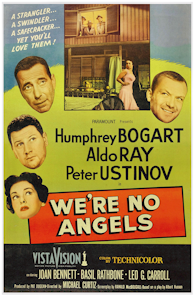
We're No Angels
By 1955, Humphrey Bogart had done everything possible to be a true Hollywood legend. What do you think of when you hear his name though? I typically think of heavy roles, dramatic, intimidating tough guys. Sure, they're not all like that, The African Queen comes to mind, but a majority were. Well, we can add another film to that small list, 1955's We're No Angels.
It's Christmas Eve on Devil's Island in 1895, and three convicts, Joseph (Bogart), Albert (Aldo Ray) and Jules (Peter Ustinov), have managed to escape. The only problem? They've got no money, no papers, and no way of getting off the island. Instead, they meet Felix Ducotel (Leo G. Carroll), a quiet, worrisome and soft-spoken shopkeeper who offers them a job fixing his roof. The trio sees a chance for some easy money, pretending to work on the roof and waiting for nightfall for a chance to rob the shopkeeper blind, giving them everything they need to pull off the successful escape. Pretty simple, right? From their rooftop perch, the convicts start to listen to the goings on in Felix's worrisome life. Uh-oh, now the convicts are interested and even going to help. That escape plan is on hold....for now.
This was a movie on my Netflix queue as a 'Save' option for months after I accidentally read about it at IMDB. I couldn't find it anywhere, and it didn't seem to be on TV...ever. So when TCM aired it in early December, I jumped at the chance. It was well worth the wait. That plot description doesn't exactly scream out buddy comedy, does it? That's what it is though at its most basic. It just happens to be a buddy comedy on steroids that blends a great script, perfect casting and a unique setting that takes advantage of the early stages of widescreen format in films. Long story short, I liked this movie from director Michael Curtiz a whole lot.
The casting works so well because it plays against convention and typecasting. My first thought at hearing Bogie, Aldo Ray and Peter Ustinov in a movie about convicts escaping Devil's Island? Not going to be a comedy. While all three actually are criminals, their crimes are played for laughs (Bogie is a forger, Ray and Ustinov murderers) and end up producing some of the biggest laughs in the movie. I probably use this too much, but the chemistry among these three actors -- all very talented in their own right -- is spot-on. It's effortless. They do it with ease. And because it's a comedy, it's that much better. Dramatic actors doing comedy can be hit or miss, but when handled correctly as it is here, it can carry a movie.
So as is usually the case, this movie goes both ways. Is it the cast lifting up a script or a solid script giving the cast something to do for a change? Oh, no, the Chicken or Egg: Movie Edition! It's both here. Bogie, Ray and Ustinov doing comedy is a welcome change. As good as they are dramatically, they're even better doing comedy. Read some of the more memorable quotes from 'Angels' over at IMDB HERE. It's never obvious humor, most of it underplayed to the point some lines are probably too subtle to even register. That is the beauty though of smart humor though. And throw into the shenanigans, Adolph, a very little, very poisonous snake as the fourth member of the troop with a knack for "solving problems," and we've got some laughs.
Playing the straight man to the convicts' subtle shenanigans, Carroll does a fine job as constantly worried Felix whether it be his family or his business. Joan Bennett and Gloria Talbott round out Felix's family, his loving wife, Amelie, and his daughter, Isabel, madly in love. Basil Rathbone and John Baer play visiting family members, both with their own secrets and looking to take advantage of Felix, his family and his general store. Rathbone is particularly nasty, rounding out a supporting cast that does a solid job without taking away the spotlight from the three main stars.
On top of the acting though the little things come through in 'Angels.' It was one of the first films to use Vistavision, a unique, very colorful widescreen format. The main setting -- Felix's shop, house and roof -- plays like an on-stage play, but the screen is constantly full of bright colors and vivid backgrounds. It hits the ground running in an opening scene that shows the trio of angels escaping from quite a distance. The story itself is pretty interesting and never dull, but it never hurts when a movie is fun to watch in a visual-sense alone. As I seem to do so often, I feel like I'm not explaining why I liked this movie real well (damn comedies!), but I did. A lot, I liked this movie a ton. If you can find a copy or stumble across it on TV, sit down, plant it somewhere comfy and enjoy it.
We're No Angels (1955): *** 1/2 /****
It's Christmas Eve on Devil's Island in 1895, and three convicts, Joseph (Bogart), Albert (Aldo Ray) and Jules (Peter Ustinov), have managed to escape. The only problem? They've got no money, no papers, and no way of getting off the island. Instead, they meet Felix Ducotel (Leo G. Carroll), a quiet, worrisome and soft-spoken shopkeeper who offers them a job fixing his roof. The trio sees a chance for some easy money, pretending to work on the roof and waiting for nightfall for a chance to rob the shopkeeper blind, giving them everything they need to pull off the successful escape. Pretty simple, right? From their rooftop perch, the convicts start to listen to the goings on in Felix's worrisome life. Uh-oh, now the convicts are interested and even going to help. That escape plan is on hold....for now.
This was a movie on my Netflix queue as a 'Save' option for months after I accidentally read about it at IMDB. I couldn't find it anywhere, and it didn't seem to be on TV...ever. So when TCM aired it in early December, I jumped at the chance. It was well worth the wait. That plot description doesn't exactly scream out buddy comedy, does it? That's what it is though at its most basic. It just happens to be a buddy comedy on steroids that blends a great script, perfect casting and a unique setting that takes advantage of the early stages of widescreen format in films. Long story short, I liked this movie from director Michael Curtiz a whole lot.
The casting works so well because it plays against convention and typecasting. My first thought at hearing Bogie, Aldo Ray and Peter Ustinov in a movie about convicts escaping Devil's Island? Not going to be a comedy. While all three actually are criminals, their crimes are played for laughs (Bogie is a forger, Ray and Ustinov murderers) and end up producing some of the biggest laughs in the movie. I probably use this too much, but the chemistry among these three actors -- all very talented in their own right -- is spot-on. It's effortless. They do it with ease. And because it's a comedy, it's that much better. Dramatic actors doing comedy can be hit or miss, but when handled correctly as it is here, it can carry a movie.
So as is usually the case, this movie goes both ways. Is it the cast lifting up a script or a solid script giving the cast something to do for a change? Oh, no, the Chicken or Egg: Movie Edition! It's both here. Bogie, Ray and Ustinov doing comedy is a welcome change. As good as they are dramatically, they're even better doing comedy. Read some of the more memorable quotes from 'Angels' over at IMDB HERE. It's never obvious humor, most of it underplayed to the point some lines are probably too subtle to even register. That is the beauty though of smart humor though. And throw into the shenanigans, Adolph, a very little, very poisonous snake as the fourth member of the troop with a knack for "solving problems," and we've got some laughs.
Playing the straight man to the convicts' subtle shenanigans, Carroll does a fine job as constantly worried Felix whether it be his family or his business. Joan Bennett and Gloria Talbott round out Felix's family, his loving wife, Amelie, and his daughter, Isabel, madly in love. Basil Rathbone and John Baer play visiting family members, both with their own secrets and looking to take advantage of Felix, his family and his general store. Rathbone is particularly nasty, rounding out a supporting cast that does a solid job without taking away the spotlight from the three main stars.
On top of the acting though the little things come through in 'Angels.' It was one of the first films to use Vistavision, a unique, very colorful widescreen format. The main setting -- Felix's shop, house and roof -- plays like an on-stage play, but the screen is constantly full of bright colors and vivid backgrounds. It hits the ground running in an opening scene that shows the trio of angels escaping from quite a distance. The story itself is pretty interesting and never dull, but it never hurts when a movie is fun to watch in a visual-sense alone. As I seem to do so often, I feel like I'm not explaining why I liked this movie real well (damn comedies!), but I did. A lot, I liked this movie a ton. If you can find a copy or stumble across it on TV, sit down, plant it somewhere comfy and enjoy it.
We're No Angels (1955): *** 1/2 /****
Labels:
1950s,
Aldo Ray,
Christmas,
Comedy,
Humphrey Bogart,
Michael Curtiz,
Peter Ustinov
Saturday, November 10, 2012
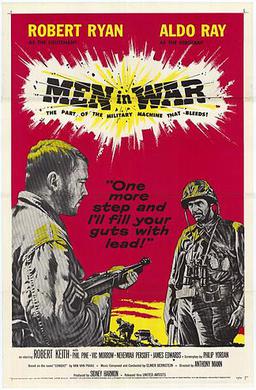
Men in War
The Korean War was unlike any war Americans had ever been involved in. The movies made about it certainly reflected that. There was nothing simple about it, no easy answer, but I suppose that applies to all wars. One of the best movies about Korea is also one that has gone criminally unrecognized over the years, 1957's Men in War.
Following a horrifically costly engagement late in 1950 in Korea, Lt. Benson (Robert Ryan) finds himself in command of the ragged remains of his rifle platoon. With just 17 men and no idea where the rest of the battalion is, Benson leads his men to a prearranged objective that he's not even sure still exists. Along the way, they run into Sgt. Montana (Aldo Ray), a stubborn and very capable soldier who's transporting by jeep his shell-shocked commanding officer, the Colonel (Robert Keith). When Benson commandeers the jeep, Montana goes along more than a little unwillingly. Together, the motley group continues to their objective, an otherwise ordinary location, simply titled Hill 465. What awaits there? None of them know.
Never even mentioned among the best war movies around, this Korean War has been criminally neglected since its 1957. From director Anthony Mann, it is a cynical, extremely dark, very realistic, and even a tad existential at times. While it is based in Korea, it really could be any war. The infantry soldiers trudge on, fighting a mostly unseen enemy, just trying to survive. We learn nothing about anyone, and there's no bigger picture of the war. These men are separated from their possibly annihilated unit and walking in heavily occupied enemy territory. The North Koreans appear as needed; in the aftermath of a firefight, two survivors talk quietly -- not really hiding either -- where seconds before bullets and grenades were raining down on them. This is war and the effect it has on the individual.
Beyond that simple story is a realistic story. I try not to use this description too much, but it was truly ahead of its time. We're introduced to Benson's platoon in the aftermath of the attack that separated his platoon from the battalion. The men look exhausted to the point of fainting. One man has been killed -- stabbed in the back with a bayonet -- by a North Korean scout, and so it starts. The cynicism is palpable. Benson mumbles 'Son of a...' before veering off. Ray's Montana shoots a surrendering North Korean, albeit one reaching for a hidden pistol. Later, a second prisoner is used for bait to see if the platoon has been spotted. Filmed in a close-up black and white, I felt like a fly on the wall as a viewer. We feel like we're right there with the foot soldiers. By no means a flashy filming style, but the story doesn't call for it. Also worth mentioning is Elmer Bernstein's eerie but spot-on musical score.
Playing on the basic notion of the unit picture, 'War' has an impressive tough guy cast. It's great to see Ryan get a good guy role. Very capable of playing a hellishly bad villain, Ryan is a perfect choice to play the beaten down officer who must buck up to get his men to safety. Ray as his counter is just as spot-on, a similarly experienced soldier but one with a simpler mission. That angle (protecting your commanding officer) would be used 20 years later in A Bridge Too Far. Benson's platoon includes Riordan (Phillip Pine), the radioman, Lewis (Nehemiah Persoff), the unhinged sergeant, Zwickley (Vic Morrow), the scared to death private, Killian (James Edwards), the mechanic, and Davis (L.Q. Jones), the medic and BAR man. Seven other soldiers are listed in the cast but under the dirt, grime and three-day stubble, it's hard to distinguish them.
For the most part here, the story is fairly familiar. Nothing crazy or out of the blue. The platoon deals with North Korean scouts trying to pick them off, bickering amongst the men, even stumbling into a minefield. Where it distinguishes itself is in the finale as Benson's men reach Hill 465. There is nothing special about the hill, just a big chunk of jagged rock....that's occupied by North Koreans. The small-scale battle has elements of the surreal. The enemy fires only occasionally, only appearing for brief close-ups. In its small scale, it is a very personal, aggressive, and uncomfortable depiction of battle. Soldiers are killed, but we barely see their faces to know who it is. The film ends on a dour note, but an effective one just the same.
A war film that deserves better. Effective message that is never overbearing, great casting, almost documentary-like feel from Mann, all amount to a film well worth watching.
Men in War <---Youtube clip (1957): *** 1/2 /****
Following a horrifically costly engagement late in 1950 in Korea, Lt. Benson (Robert Ryan) finds himself in command of the ragged remains of his rifle platoon. With just 17 men and no idea where the rest of the battalion is, Benson leads his men to a prearranged objective that he's not even sure still exists. Along the way, they run into Sgt. Montana (Aldo Ray), a stubborn and very capable soldier who's transporting by jeep his shell-shocked commanding officer, the Colonel (Robert Keith). When Benson commandeers the jeep, Montana goes along more than a little unwillingly. Together, the motley group continues to their objective, an otherwise ordinary location, simply titled Hill 465. What awaits there? None of them know.
Never even mentioned among the best war movies around, this Korean War has been criminally neglected since its 1957. From director Anthony Mann, it is a cynical, extremely dark, very realistic, and even a tad existential at times. While it is based in Korea, it really could be any war. The infantry soldiers trudge on, fighting a mostly unseen enemy, just trying to survive. We learn nothing about anyone, and there's no bigger picture of the war. These men are separated from their possibly annihilated unit and walking in heavily occupied enemy territory. The North Koreans appear as needed; in the aftermath of a firefight, two survivors talk quietly -- not really hiding either -- where seconds before bullets and grenades were raining down on them. This is war and the effect it has on the individual.
Beyond that simple story is a realistic story. I try not to use this description too much, but it was truly ahead of its time. We're introduced to Benson's platoon in the aftermath of the attack that separated his platoon from the battalion. The men look exhausted to the point of fainting. One man has been killed -- stabbed in the back with a bayonet -- by a North Korean scout, and so it starts. The cynicism is palpable. Benson mumbles 'Son of a...' before veering off. Ray's Montana shoots a surrendering North Korean, albeit one reaching for a hidden pistol. Later, a second prisoner is used for bait to see if the platoon has been spotted. Filmed in a close-up black and white, I felt like a fly on the wall as a viewer. We feel like we're right there with the foot soldiers. By no means a flashy filming style, but the story doesn't call for it. Also worth mentioning is Elmer Bernstein's eerie but spot-on musical score.
Playing on the basic notion of the unit picture, 'War' has an impressive tough guy cast. It's great to see Ryan get a good guy role. Very capable of playing a hellishly bad villain, Ryan is a perfect choice to play the beaten down officer who must buck up to get his men to safety. Ray as his counter is just as spot-on, a similarly experienced soldier but one with a simpler mission. That angle (protecting your commanding officer) would be used 20 years later in A Bridge Too Far. Benson's platoon includes Riordan (Phillip Pine), the radioman, Lewis (Nehemiah Persoff), the unhinged sergeant, Zwickley (Vic Morrow), the scared to death private, Killian (James Edwards), the mechanic, and Davis (L.Q. Jones), the medic and BAR man. Seven other soldiers are listed in the cast but under the dirt, grime and three-day stubble, it's hard to distinguish them.
For the most part here, the story is fairly familiar. Nothing crazy or out of the blue. The platoon deals with North Korean scouts trying to pick them off, bickering amongst the men, even stumbling into a minefield. Where it distinguishes itself is in the finale as Benson's men reach Hill 465. There is nothing special about the hill, just a big chunk of jagged rock....that's occupied by North Koreans. The small-scale battle has elements of the surreal. The enemy fires only occasionally, only appearing for brief close-ups. In its small scale, it is a very personal, aggressive, and uncomfortable depiction of battle. Soldiers are killed, but we barely see their faces to know who it is. The film ends on a dour note, but an effective one just the same.
A war film that deserves better. Effective message that is never overbearing, great casting, almost documentary-like feel from Mann, all amount to a film well worth watching.
Men in War <---Youtube clip (1957): *** 1/2 /****
Labels:
1950s,
Aldo Ray,
Anthony Mann,
Korean War,
L.Q. Jones,
Nehemiah Persoff,
Robert Ryan,
Vic Morrow
Thursday, May 31, 2012
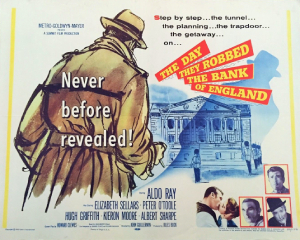
The Day They Robbed the Bank of England
Never a huge star, instead one finding a niche as a character actor and tough guy on-screen, Aldo Ray is one of many gems to come out of the 1950s and 1960s. Most of his roles were supporting parts -- often as part of impressive ensemble casts -- but he did get the occasional leading role, like 1960's The Day They Robbed the Bank of England. Can you figure out what it's about? Yes, puppies.
It's the turn of the century in 1900s London, and the IRA needs money, needs a lot of it and needs it quick to support the movement. In London, O'Shea (Hugh Griffith) and Mrs. Muldoon (Elizabeth Sellars), a widow of a dead IRA gunman, have assembled a small group of thieves and IRA fighters to pull off an impossible job, one that's never been done before. They have hired an American with Irish blood, Norgate (Ray), to lead the job, but where to even start in taking down the seemingly impregnable, heavily guarded bank? Norgate starts by trying to get in from the inside, befriending Capt. Fitch (Peter O'Toole), a young officer working as part of the bank guard. Can Norgate and his team find a way in?
Yes, another heist movie. Sue me, I love these movies. As far as this popular sub-genre goes though, 'Day' is an interesting one that certainly tries to distance itself from the genre conventions. From director John Guillermin, this heist movie starts off on a positive note with a story set in 1910s London, not the present. It sounds simple, but it's deceptively simple in tweaking the story. There are no huge, high-tech security features, just a securely built, heavily guarded vault with no easy way in or out. This is not Ocean's 11. It keeps you guessing though, and Guillermin has some fun with some crazy, exaggerated zooms with the camera, composer Edwin Astley likewise keeping things moving with his score. It is filmed in black and white, keeping things focused on the story and characters, and never tries to be a groundbreaking classic, just a good, old-fashioned impossible robbery.
This is a solid example of a strong part for Aldo Ray in the lead. He doesn't have to do any heavy lifting, instead focusing on being that tough guy -- even a little anti-hero -- who wants to get the job done no matter what obstacles get thrown at him. Norgate's backstory is unfortunately kept under wraps, but some past demons and struggles with the law are hinted at. It's not a flashy part, but Ray is a meat and potatoes kind of guy, and he gets the job done here. This was also just O'Toole's second film role, and even with a poorly written character, the talent is evident. Norgate's team includes Griffin's O'Shea as the bankroll and IRA big-wig, Kieron Moore as fiery Walsh, Joseph Tomelty, Wolf Frees and Albert Sharpe as scene-stealing Tosher, an old drunk who knows a secret that could make the robbery a huge success, affectionately calling Norgate 'Your worship.'
Preventing 'Day' from becoming a classic are a couple flaws that shoot the story in the foot. The early portions of the movie drag a bit as we find that Norgate has a past with Sellars' Mrs. Muldoon who now has a suitor of sorts in Moore's Walsh too. No, it's not a painfully drawn out love triangle -- thankfully -- but the scenes with Norgate trying to win her back are tedious to say the least. Again, there's no real background explained so what should we care? Oh, they used to be together?!? Eh, pass. The other is the utter stupidity in the Fitch character, a disgruntled, bored officer who is so mind-blowingly stupid he doesn't see that Norgate is pilfering him for detailed information about the bank layout. It's a necessary part of the story (how else do they find the dimensions of the vault?), but there wasn't anything better that could have been used?
It is a heist movie, and reflecting the workmanlike nature of its star, the actual robbery is a meat and potatoes kind of job. No big twists or tricks, just a devious plan that has Norgate and his team tunneling into the vault via a shut-down sewer. Meanwhile, O'Toole's Fitch begins to smell a rat in the whole situation. Can he figure it out in time, putting all the pieces together? The last 45 minutes as the heist develops and unravels are not surprisingly the best part, including a memorable ending, Ray doing a ton in his final two scenes without speaking a word. Solid, entertaining heist movie. Definitely worth checking out.
The Day They Robbed the Bank of England <---TCM clips (1960): ***/****
It's the turn of the century in 1900s London, and the IRA needs money, needs a lot of it and needs it quick to support the movement. In London, O'Shea (Hugh Griffith) and Mrs. Muldoon (Elizabeth Sellars), a widow of a dead IRA gunman, have assembled a small group of thieves and IRA fighters to pull off an impossible job, one that's never been done before. They have hired an American with Irish blood, Norgate (Ray), to lead the job, but where to even start in taking down the seemingly impregnable, heavily guarded bank? Norgate starts by trying to get in from the inside, befriending Capt. Fitch (Peter O'Toole), a young officer working as part of the bank guard. Can Norgate and his team find a way in?
Yes, another heist movie. Sue me, I love these movies. As far as this popular sub-genre goes though, 'Day' is an interesting one that certainly tries to distance itself from the genre conventions. From director John Guillermin, this heist movie starts off on a positive note with a story set in 1910s London, not the present. It sounds simple, but it's deceptively simple in tweaking the story. There are no huge, high-tech security features, just a securely built, heavily guarded vault with no easy way in or out. This is not Ocean's 11. It keeps you guessing though, and Guillermin has some fun with some crazy, exaggerated zooms with the camera, composer Edwin Astley likewise keeping things moving with his score. It is filmed in black and white, keeping things focused on the story and characters, and never tries to be a groundbreaking classic, just a good, old-fashioned impossible robbery.
This is a solid example of a strong part for Aldo Ray in the lead. He doesn't have to do any heavy lifting, instead focusing on being that tough guy -- even a little anti-hero -- who wants to get the job done no matter what obstacles get thrown at him. Norgate's backstory is unfortunately kept under wraps, but some past demons and struggles with the law are hinted at. It's not a flashy part, but Ray is a meat and potatoes kind of guy, and he gets the job done here. This was also just O'Toole's second film role, and even with a poorly written character, the talent is evident. Norgate's team includes Griffin's O'Shea as the bankroll and IRA big-wig, Kieron Moore as fiery Walsh, Joseph Tomelty, Wolf Frees and Albert Sharpe as scene-stealing Tosher, an old drunk who knows a secret that could make the robbery a huge success, affectionately calling Norgate 'Your worship.'
Preventing 'Day' from becoming a classic are a couple flaws that shoot the story in the foot. The early portions of the movie drag a bit as we find that Norgate has a past with Sellars' Mrs. Muldoon who now has a suitor of sorts in Moore's Walsh too. No, it's not a painfully drawn out love triangle -- thankfully -- but the scenes with Norgate trying to win her back are tedious to say the least. Again, there's no real background explained so what should we care? Oh, they used to be together?!? Eh, pass. The other is the utter stupidity in the Fitch character, a disgruntled, bored officer who is so mind-blowingly stupid he doesn't see that Norgate is pilfering him for detailed information about the bank layout. It's a necessary part of the story (how else do they find the dimensions of the vault?), but there wasn't anything better that could have been used?
It is a heist movie, and reflecting the workmanlike nature of its star, the actual robbery is a meat and potatoes kind of job. No big twists or tricks, just a devious plan that has Norgate and his team tunneling into the vault via a shut-down sewer. Meanwhile, O'Toole's Fitch begins to smell a rat in the whole situation. Can he figure it out in time, putting all the pieces together? The last 45 minutes as the heist develops and unravels are not surprisingly the best part, including a memorable ending, Ray doing a ton in his final two scenes without speaking a word. Solid, entertaining heist movie. Definitely worth checking out.
The Day They Robbed the Bank of England <---TCM clips (1960): ***/****
Labels:
1960s,
Aldo Ray,
Heist movies,
Kieron Moore,
Peter O'Toole
Sunday, September 13, 2009
The Naked and the Dead
Now looking at a reissue of Mailer's novel, the Amazon listing has it as over 700 pages so any movie version is going to have to cut things out. The 1958 movie clocks in at 131 minutes so I tried to keep that in mind while watching it. TCM's Robert Osborne said the novel upon its initial release was a huge success because of its 'salty language' with plenty of four-letter words and its frank way of dealing with some touchy subject matters. Of course, a movie from 1958 had to strip much of that away with censors. So right off the bat, the movie already has two strikes against it, but I'll move on.
The story centers around an American infantry battalion on an unnamed Pacific island midway through the war. Three main characters step to the front, giving the viewer a good sense of all the different ranks in the battalion. First, there's Sgt. Sam Croft (Aldo Ray in a part he was born to play), the leader of an intelligence and recon platoon that is understrength after several campaigns on the front lines. His men hate him almost to a man, and he gives them good reason. Croft is sadistic, killing unarmed prisoners callously and then prying the gold teeth out of their mouths. Second, there's Lt. Robert Hearn (Cliff Robertson), a young officer with connections back home. Translation = Earns a job far from the front lines. And third, there's General Cummings (Raymond Massey), the battalion commander obsessed with casualty estimates and striking fear into his men's hearts, often for pointless power trips.
I liked the idea of seeing the war from different perspectives, from the high-ranking general to the men on the front line. With war movies, it's typically one or the other. But in the execution, something doesn't translate. The first 70 minutes are extremely reliant on dialogue scenes meant to flesh out the main characters. Maybe this was the purpose, but none of the three are particularly likable. Croft is pure evil, Hearn is a cocky, arrogant spoiled son of a you know what, and Cummings borders on the crazy. These early scenes drag on too much.
The pace picks up when a twist to the storyline is thrown in. On this Japanese-held island, Cummings' advance has slowed to a halt. He puts into action a plan that should break the stalemate, but he needs behind the lines info. Croft and his platoon are selected to go behind the Japanese lines and set up an observation post for their advancing battalion mates. After pissing off Cummings, Hearn is given command of the platoon. So now, they're not only tangling with Japanese patrols, but a fight for power between Hearn and Croft.
The patrol segment is by far the better part of the movie. There's a natural tension as Croft and his men walk through the jungle (Panama substitituing for the actual Pacific) trying to get to their objective while avoiding the Japanese. What I enjoyed most in the movie was Croft's platoon which includes Richard Jaeckel, William Campbell, James Best as the bible-thumping, drawling medic, Jerry Paris and Rat Packer Joey Bishop as two Jewish soldiers, Robert Gist, and L.Q. Jones at his overacting best. Jaeckel and Jones are really the only ones given any development, and reading the book reviews it seems the platoon's back story was sacrificed from the 700-page plus behemoth.
For a WWII movie, the action is pretty sparse and when it comes along, it's pretty disappointing. The gunfire sounds like prop guns and the explosions look as staged as a movie explosion can be. As mentioned before with the censors, the violence is often off-screen, like a Japanese patrol burning in a lit-up field, and comes off as too tame. It's hard to judge a movie for the time it was made in, but if this movie was released in the 90s we're talking a Pacific version of Saving Private Ryan.
So compared to other WWII movies in the 50s and 60s, this one is pretty average but a lot of my complaints come from the censors. Director Raoul Walsh tried to make the definitive, honest look at a platoon of soldiers in the Pacific in WWII, but it is hamstringed by any number of forces working against it. Worth a watch for Aldo Ray's performance and the list of character actors who make up his platoon, but otherwise this one's only worth it for diehard war movie fans.
The Naked and The Dead (1958): **/****
Subscribe to:
Posts (Atom)