I'd like to think I'm not a movie snob. I try to be open with all movies, but as I've discovered the thousands and thousands of films out there, some are just more challenging than others. We're not supposed to like or enjoy them, or even hate them for that matter. You're just supposed to watch the film and experience it. You challenge yourself sometimes with movies like these, like 1976's The Desert of the Tartars.
Completing his three years at the military academy, young Lt. Drogo (Jacques Perrin) has received his orders, riding to his post with dreams and hopes of adventure and heroism. He has been assigned to Fort Bastiano, a lonely, isolated posting along the country's border. He finds that nothing is as he thought it would. The fort looks out over the desert and a horizon that hasn't seen the enemy -- the Tartars -- in years. Are they even out there somewhere across the desert? Days turns to weeks, weeks to months and months to years here at the fort. The officers and garrison watch time move past them at a glacial pace, questioning what they're doing at this post. Will the Tartars ever come back? Will they attack?
How do you describe a movie like this? It is based off a controversial novel by Dino Buzzati that for years defied a novel-to-film adaptation. At different points, 'Tartars' is surreal, symbolic, other-worldly, philosophical, existential and so much more. It is a movie about waiting and what if? What is coming? What do you do with yourself as you wait? It is an incredibly striking film -- both good and bad -- that I have little to no idea how to interpret. I found myself wondering if the setting was a variation on Purgatory, not Heaven and not quite Hell but clearly not normal life either. I can't say I liked the movie, but it has to be seen to be believed in its weirdness, eccentricity and existentialism.
My thoughts on the Purgatory-like setting come from the visual look of the movie. Italian director Valerio Zurlini turns out one of the most visually imposing movies I've ever seen, an almost apocalyptic setting that looks like it could be the edge of the known world. Zurlini and cinematographer Luciano Tovoli create a world, this isolated fortress completely removed from the real world, miles away from civilization and all it offers. 'Tartars' was filmed in Bam, Iran, the immensely spacious but sparsely occupied fortress becoming another character in the story. Spacious is a good way to describe the movie. It is an immense movie. The desert all around is bigger than it seems because of what it represents, fear, intimidation, and in a weird way...hope. What's out there? These men are driven to the point they welcome an enemy sighting. One of the most beautifully simple visual movies I've ever seen, aided by Ennio Morricone's haunting, almost classical score.
In a story where basically nothing happens for the 146-minute running time, your enjoyment -- or hatred -- of this movie will no doubt come from the characters and their development, their own personal handling of this bizarre posting. Zurlini and star Perrin worked hand in hand to get this movie done, Perrin even contributing much of his own money to help complete the movie while serving as one of the film's producers. He does an incredible job as the young idealistic Lt. Drogo, the inexperienced but very capable soldier who both resents and welcomes his posting to Fort Bastiano. Where this performance works, where all the performances work really, is that the actors bring these individuals to life without much in the way of dialogue. They say a lot with their faces, looks saying more than words ever could. Perrin is great at it especially, and the physical transformation Drogo goes through is remarkable. A very strong lead, one that trickles down to the rest of the cast.
Assembling an international who's who cast, Zurlini has a truly impressive cast here. Max von Sydow plays Captain Hortiz, posted at Bastiano the last 19 years and supposedly the last man at the post to see a Tartar on the horizon. Giuliano Gemma is Major Mattis, the obsessed, career-driven officer with little in the way of personal interaction. Jean-Louis Trintignant has a small part but a good one as Rivone, the post's doctor who sees the men disintegrating around him. Fernando Rey's Nathanson is the one officer who's seen combat but is a shell of himself after suffering a horrific combat wound. Vittorio Gassman plays Fillmore, the beleaguered commandant in a no-win situation. Helmut Griem is Simeon, Drogo's fellow officer and best friend at the post, the two men almost willing a Tartar enemy to show up. These are not showy performances, none of them calling attention to themselves, but that doesn't mean they don't make an impression.
Now this far into the review, you're probably thinking 'Hey, this is pretty positive.' And it is. I intended it that way. What works well here is a home run. What doesn't work is awful. I'm not exaggerating when I say that in 146 minutes almost nothing happens. Visual and beautiful to look at is one thing, impressive performances another, but NOTHING happens. Zurlini wants to put you to sleep, just like the characters on-screen. He wants to lull you into this uncomfortable silence, this possibly impending doom. Even a surprise in the final moments is so underplayed that it doesn't make the impact it could have. The final 30 minutes do pick up the pace -- thankfully and mercifully -- to the point where the ending is effective in that sense of doom.
So where does it fall in the end? The deliberately slow pacing no matter how much I try to push aside as a minor complaint just isn't. This was a difficult movie for me to get through especially considering the two-plus hour run-time. I'd like to believe the performances from the very deep cast and the incredible look of the movie are enough to recommend the movie, but even there I'm struggling. It is a movie that defies ratings in a way, but the positives are that good. Barely....just barely, I'll go positive here.
The Desert of the Tartars <---trailer (1976): ** 1/2 /****
The Sons of Katie Elder
"First, we reunite, then find Ma and Pa's killer...then read some reviews."
Showing posts with label Max von Sydow. Show all posts
Thursday, November 10, 2011
Friday, January 14, 2011
The Quiller Memorandum
By 1966, the James Bond phenomenon had taken over the world with the huge successes of Dr. No, From Russia With Love, Goldfinger and Thunderball. Audiences wanted more spy movies, and studios obliged them whenever they could. A wall of international intrigue movies hit theaters ranging from Bond knockoffs to spoofs like the Matt Helm and Derek Flint series to attempts that took a more serious approach to the spy genre, including 1966's The Quiller Memorandum.
This is the anti James Bond movie, a spy story focusing on the more subtle but still very dangerous life of a espionage agent. There is no globe-trotting heroics, no ridiculously over the top shootouts and chases, no bedding down of countless women, just a good old-fashioned story of a spy with a dangerous mission that could easily cost him his life. You know what though? All those things about the Bond series that viewers typically either hate or love...they were fun to watch. That's missing here. It's a dull transition to the screen from a novel by Trevor Dudley Smith that lacks anything in the way of excitement or thrills. I'm all for more realistic spy movies, but at least make them enjoyable to sit through.
Two British agents in post-WWII Berlin have been murdered so a new American agent, Quiller (George Segal), is brought in to pick up the investigation where his predecessors left off. His superior, Pol (Alec Guinness), tells him something else about the mission that could put him in even more danger. Both murdered agents were investigating the possible reemergence of an extremist Nazi group that wants to again claim power in Germany. If possible, Quiller must infiltrate this Nazi group (headed by Max von Sydow) and find their hideout before any of their plan can take effect. One of the few clues Quiller has though to get close to the group is a schoolteacher, Inge (Senta Berger), who may or may not know more than she's letting on.
There was a lot about this movie that appealed to me. The setting of post-World War II Berlin is a really unique to tell this hard-boiled story that remains rooted in a believable plot, not a plan to take over the world. Director Michael Anderson is a visual director, using some great on-location shoots as Segal's Quiller explores Berlin looking for clues. I've never thought of Berlin as a particularly pretty city, but the locations here are a great scene-setter and background. It's refreshing also to see a spy movie so heavy on dialogue -- and good, snappy dialogue at that -- instead of relying so heavily on babes and action. Visually, a great movie to watch and listen to when it's 'on' but not always an exciting movie to watch.
That last part surprised me because with the cast involved and the basic premise, it sounded like a real winner. A second Nazi party looking to regain power? Now that's a prime villain if there ever was one. Maybe the movie's best scene are these Nazis including von Sydow interrogating Segal in a great, very unique scene unlike any other interrogation I've seen in a movie. Watch it HERE. That's the whole movie though, great moments broken up by long periods of nothing. There is no real plot to begin with, and Segal's Quiller makes some unbelievably stupid decisions for someone who is considered such a top spy. His character drifts along and stumbles into clues rather than deducing anything for himself. Add in an oddly out of place and overbearing John Barry score, and the plotline is cartoonish with this blaring music being played over it.
I don't fault Segal for bad acting here because it's the writing, not his acting. His Quiller is just not a very strong main character. A very capable spy by reputation, he makes decision after decision that should have ended with him getting a bullet in the head yet somehow he survives time and time again. I have always liked Segal as an actor, but this wasn't his best part. His romance with the lovely Senta Berger never goes anywhere and has a forced feeling to it. They've got a decent chemistry together, but the story gets bogged down in their romantic interludes. Worst of all, a somewhat coherent twist late in the movie between the two characters is so poorly handled that it misses having any impact. The movie just ends with no resolution, or not one I was satisfied with.
Now I can't say I was surprised by the positives in this movie, both of them..Guinness and von Sydow. Guinness' part as Pol is nothing more than three or four scenes that probably total 10-15 minutes on-screen, and he steals every scene he is in, especially an explanation of the trials Quiller will face from both sides. Underused, sure, but what's there is choice. Playing a steely-eyed, blonde and blue eye Nazi villain, who is better than von Sydow? His character is pretty one-note with no surprises, but he brings such a feeling of menace and intensity to it you can't help but remember his smallish part. Also watch for George Sanders in a humorous cameo as a higher-up agent in London.
The Quiller Memorandum <---trailer (1966): **/****
This is the anti James Bond movie, a spy story focusing on the more subtle but still very dangerous life of a espionage agent. There is no globe-trotting heroics, no ridiculously over the top shootouts and chases, no bedding down of countless women, just a good old-fashioned story of a spy with a dangerous mission that could easily cost him his life. You know what though? All those things about the Bond series that viewers typically either hate or love...they were fun to watch. That's missing here. It's a dull transition to the screen from a novel by Trevor Dudley Smith that lacks anything in the way of excitement or thrills. I'm all for more realistic spy movies, but at least make them enjoyable to sit through.
Two British agents in post-WWII Berlin have been murdered so a new American agent, Quiller (George Segal), is brought in to pick up the investigation where his predecessors left off. His superior, Pol (Alec Guinness), tells him something else about the mission that could put him in even more danger. Both murdered agents were investigating the possible reemergence of an extremist Nazi group that wants to again claim power in Germany. If possible, Quiller must infiltrate this Nazi group (headed by Max von Sydow) and find their hideout before any of their plan can take effect. One of the few clues Quiller has though to get close to the group is a schoolteacher, Inge (Senta Berger), who may or may not know more than she's letting on.
There was a lot about this movie that appealed to me. The setting of post-World War II Berlin is a really unique to tell this hard-boiled story that remains rooted in a believable plot, not a plan to take over the world. Director Michael Anderson is a visual director, using some great on-location shoots as Segal's Quiller explores Berlin looking for clues. I've never thought of Berlin as a particularly pretty city, but the locations here are a great scene-setter and background. It's refreshing also to see a spy movie so heavy on dialogue -- and good, snappy dialogue at that -- instead of relying so heavily on babes and action. Visually, a great movie to watch and listen to when it's 'on' but not always an exciting movie to watch.
That last part surprised me because with the cast involved and the basic premise, it sounded like a real winner. A second Nazi party looking to regain power? Now that's a prime villain if there ever was one. Maybe the movie's best scene are these Nazis including von Sydow interrogating Segal in a great, very unique scene unlike any other interrogation I've seen in a movie. Watch it HERE. That's the whole movie though, great moments broken up by long periods of nothing. There is no real plot to begin with, and Segal's Quiller makes some unbelievably stupid decisions for someone who is considered such a top spy. His character drifts along and stumbles into clues rather than deducing anything for himself. Add in an oddly out of place and overbearing John Barry score, and the plotline is cartoonish with this blaring music being played over it.
I don't fault Segal for bad acting here because it's the writing, not his acting. His Quiller is just not a very strong main character. A very capable spy by reputation, he makes decision after decision that should have ended with him getting a bullet in the head yet somehow he survives time and time again. I have always liked Segal as an actor, but this wasn't his best part. His romance with the lovely Senta Berger never goes anywhere and has a forced feeling to it. They've got a decent chemistry together, but the story gets bogged down in their romantic interludes. Worst of all, a somewhat coherent twist late in the movie between the two characters is so poorly handled that it misses having any impact. The movie just ends with no resolution, or not one I was satisfied with.
Now I can't say I was surprised by the positives in this movie, both of them..Guinness and von Sydow. Guinness' part as Pol is nothing more than three or four scenes that probably total 10-15 minutes on-screen, and he steals every scene he is in, especially an explanation of the trials Quiller will face from both sides. Underused, sure, but what's there is choice. Playing a steely-eyed, blonde and blue eye Nazi villain, who is better than von Sydow? His character is pretty one-note with no surprises, but he brings such a feeling of menace and intensity to it you can't help but remember his smallish part. Also watch for George Sanders in a humorous cameo as a higher-up agent in London.
Friday, October 8, 2010
Robin Hood
Some characters from historical literature have just had more of an impact than others, characters like Hawkeye in Last of the Mohicans, Captain Ahab in Moby Dick, King Arthur, Tom Sawyer and Huckleberry Finn just to name a few. One that I started reading about when I was younger who still remains a favorite is Robin Hood. Countless books have been written about the legendary outlaw and even more film versions that include stars Errol Flynn, Sean Connery, Kevin Costner, and even a Disney animated version that I love. Well, they can't all be winners, like 2010's Robin Hood.
A pairing of director Ridley Scott and star Russell Crowe with a great character like Robin Hood seemed like a no-brainer to me (Gladiator for anyone confused) even though I never got to see it in theaters. Going into this, I should say I'm a fan of the legend, the myth of Robin Hood. Like so many movies dealing with stories already known by audiences (Bond, Batman, Hulk), Scott goes with a reboot, telling the story of how everything we know about a character -- in this case Robin Hood -- came to be. So basically, it's an unofficial prequel. Bigger than that though, the title character is almost a throwaway addition. This movie could have been any 12th Century archer fighting royalty. I wanted to like this movie, and it just didn't happen.
After fighting for King Richard the Lionheart (Danny Huston) in the Crusades for 10 years, archer Robin Longstride (Crowe) returns home to England with three of his closest friends and allies he's fought these many years with. Completing a mission he told someone he would honor, Robin rides to the town of Nottingham where he meets Sir Walter Loxley (Max von Sydow) and his daughter-in-law, Marion (Cate Blanchett). He agrees to say on with them, posing as Marion's dead husband so they can hold on to their land. Bigger things are at work though as a treacherous Englishman, Godfrey (Mark Strong), is pitting new king John (Oscar Isaac) against his people while also arranging a surprise invasion from the French. Standing in their way is Robin himself, ready to defend England to the last.
I made the unfortunate decision of watching Scott's Director's Cut, clocking in at 156 minutes instead of the theatrical 141 minute-version. Bad choice. I'm all for historical epics in just about any form, any historical time period, but there's both too much going on here and not enough at the same time. Maybe the best thing going for the movie is the cast, but there's too many worthy actors here so they're in and out of the story too much. After the introduction of all the players and settings, basically an hour goes by before any conflict is even introduced. Then when it is presented, it's another 30 minutes before SOMETHING ACTUALLY HAPPENS. Maybe I was expecting a different movie, but I was bored to tears and only stuck with it because I kept waiting for it to get better. Insider tip? It doesn't.
With Scott directing and Crowe starring, Gladiator is one of my all-time favorites. Reviews even identified this one as Gladiator with a bow and arrow. Playing the title character (although he's only identified as Robin Hood once), Crowe makes this otherwise dull flick somewhat interesting. The man is cut out to star in historical epics, and he makes Robin a believable leader, a man capable of convincing others to do something they never would have on their own. Crowe also looks to do most of his own stunts -- fighting and horse riding -- so he gets points just for being cool. As Marion, Blanchett is like a female equivalent of Crowe, an actress cut out for period pieces. The two of them have some definite chemistry, but it gets lost in an endless series of scenes that go nowhere.
The name recognition alone for the supporting cast is great, but that's about all they get. Over 80 now, von Sydow is still the man and just by being in the movie makes it better. William Hurt looks like he stumbled into the wrong movie playing William of Marshal, a royal caught in the middle of a possible English civil war. Strong is a great villain, a man with NOT ONE redeeming quality, making it that much easier to hate him. Matthew Macfayden is the sheriff of Nottingham, relegated to background duty here. Huston makes the most of a quick appearance as the Lionheart. Robin's not so merry men include Friar Tuck (Mark Addy), Little John (Kevin Durand), Will Scarlet (Scott Grimes) and Alan A'Dale (singer Alan Doyle). I would have loved to see a movie more about Robin and his men in Sherwood Forest, but I guess I can add that to my list of complaints.
One thing that still surprised me about this movie was the PG-13 rating because without the R-rating, the action and violence seem pretty tame, almost boring. I don't need decapitated heads or gushing blood, but it felt very whitewashed here. Not that the action is top-drawer by any means, but it was certainly more watchable than just about anything else here. Like the rest of the movie, it just didn't impress. On scale alone, this movie gets some points but other than Crowe, Blanchett and an underused supporting cast, I've got to pass on this one. A disappointing result, and a surprising one too.
Robin Hood <---trailer (2010): **/****
A pairing of director Ridley Scott and star Russell Crowe with a great character like Robin Hood seemed like a no-brainer to me (Gladiator for anyone confused) even though I never got to see it in theaters. Going into this, I should say I'm a fan of the legend, the myth of Robin Hood. Like so many movies dealing with stories already known by audiences (Bond, Batman, Hulk), Scott goes with a reboot, telling the story of how everything we know about a character -- in this case Robin Hood -- came to be. So basically, it's an unofficial prequel. Bigger than that though, the title character is almost a throwaway addition. This movie could have been any 12th Century archer fighting royalty. I wanted to like this movie, and it just didn't happen.
After fighting for King Richard the Lionheart (Danny Huston) in the Crusades for 10 years, archer Robin Longstride (Crowe) returns home to England with three of his closest friends and allies he's fought these many years with. Completing a mission he told someone he would honor, Robin rides to the town of Nottingham where he meets Sir Walter Loxley (Max von Sydow) and his daughter-in-law, Marion (Cate Blanchett). He agrees to say on with them, posing as Marion's dead husband so they can hold on to their land. Bigger things are at work though as a treacherous Englishman, Godfrey (Mark Strong), is pitting new king John (Oscar Isaac) against his people while also arranging a surprise invasion from the French. Standing in their way is Robin himself, ready to defend England to the last.
I made the unfortunate decision of watching Scott's Director's Cut, clocking in at 156 minutes instead of the theatrical 141 minute-version. Bad choice. I'm all for historical epics in just about any form, any historical time period, but there's both too much going on here and not enough at the same time. Maybe the best thing going for the movie is the cast, but there's too many worthy actors here so they're in and out of the story too much. After the introduction of all the players and settings, basically an hour goes by before any conflict is even introduced. Then when it is presented, it's another 30 minutes before SOMETHING ACTUALLY HAPPENS. Maybe I was expecting a different movie, but I was bored to tears and only stuck with it because I kept waiting for it to get better. Insider tip? It doesn't.
With Scott directing and Crowe starring, Gladiator is one of my all-time favorites. Reviews even identified this one as Gladiator with a bow and arrow. Playing the title character (although he's only identified as Robin Hood once), Crowe makes this otherwise dull flick somewhat interesting. The man is cut out to star in historical epics, and he makes Robin a believable leader, a man capable of convincing others to do something they never would have on their own. Crowe also looks to do most of his own stunts -- fighting and horse riding -- so he gets points just for being cool. As Marion, Blanchett is like a female equivalent of Crowe, an actress cut out for period pieces. The two of them have some definite chemistry, but it gets lost in an endless series of scenes that go nowhere.
The name recognition alone for the supporting cast is great, but that's about all they get. Over 80 now, von Sydow is still the man and just by being in the movie makes it better. William Hurt looks like he stumbled into the wrong movie playing William of Marshal, a royal caught in the middle of a possible English civil war. Strong is a great villain, a man with NOT ONE redeeming quality, making it that much easier to hate him. Matthew Macfayden is the sheriff of Nottingham, relegated to background duty here. Huston makes the most of a quick appearance as the Lionheart. Robin's not so merry men include Friar Tuck (Mark Addy), Little John (Kevin Durand), Will Scarlet (Scott Grimes) and Alan A'Dale (singer Alan Doyle). I would have loved to see a movie more about Robin and his men in Sherwood Forest, but I guess I can add that to my list of complaints.
One thing that still surprised me about this movie was the PG-13 rating because without the R-rating, the action and violence seem pretty tame, almost boring. I don't need decapitated heads or gushing blood, but it felt very whitewashed here. Not that the action is top-drawer by any means, but it was certainly more watchable than just about anything else here. Like the rest of the movie, it just didn't impress. On scale alone, this movie gets some points but other than Crowe, Blanchett and an underused supporting cast, I've got to pass on this one. A disappointing result, and a surprising one too.
Robin Hood <---trailer (2010): **/****
Tuesday, June 29, 2010
Victory
In line with all the World Cup coverage on ESPN the last few weeks, I thought it only fitting that I throw in a soccer review in a timely fashion. Here in the U.S., soccer seems fated to always be the 5th or 6th most popular sport around -- if even that high. It just can't pick up enough momentum into becoming as popular in the U.S. as it is around the world. Too bad because watching good soccer being played can be as exciting as any sport out there. As for the movies, there's been a handful (mostly based out of England), and one that I catch every so often on ESPN Classic and finally decided to watch from beginning to end, 1981's Victory.
If a soccer movie doesn't appeal to you, how about a soccer movie set during World War II Paris? That still doesn't do it for you? Add one of the most eclectic casts ever assembled for a sports movie that includes Americans, Brits, Germans and famous soccer players from all over the world. Director John Huston turns in a movie that is definitely not your typical sports flick, but for all its weirdness the movie lives on if somewhat under the radar. It is by no means a classic, but it is entertaining and certainly rather unique. Soccer critics complain about slow-pacing, faking injuries, low scoring games, but none of that is a worry in movie form. For all the weirdness in fictitious story and interesting casting, 'Victory' almost demands at least one watch.
Early in 1942 in a large prisoner of war camp, German officer Major Steiner (Max von Sydow) approaches British P.O.W. Captain John Colby (Michael Caine) with a proposition. Steiner asks Colby -- a professional soccer player before the war -- if the prisoners would be interested in a friendly match between the Germans. Colby accepts and goes about assembling a team that includes talent from all over Europe as former soccer stars languish in prison camps. But not so fast, the little game thought up develops into something much bigger when the German High Command catches wind of the game. The stakes get bigger and bigger for everyone involved, while one American POW/player, Capt. Robert Hatch (Sylvester Stallone), tries to get in contact with the French resistance. The plan? To help the Allied team escape at halftime of the game that is to be played in front of 50,000 fans in a packed stadium in the middle of Paris.
Prisoner of war movies have been handled in any number of different ways, but nothing quite like this before. Along with all the known elements of the POW movie, there's the added storyline of this international, mid-war soccer game. The story does suffer some bouncing back and forth between the resistance effort and the prisoners' attempts to escape with the training and preparation for the game, but you're having so much fun you barely notice some of the lagging moments in the middle of the movie. At just two hours, it does feel like the movie bit off more than it could chew, but in the end, the final result is worth it.
The thing that caught my eye when looking at this movie was the cast. Stallone, Caine, von Sydow, and Brazilian soccer superstar Pele all in the same movie? That sounds just weird enough to work. Fresh off the success of the first two Rocky movies, Stallone lost 40 lbs. to make himself look like an actual POW instead of a ripped, rather healthy prisoner of war. I'll never say Stallone was a great actor, but the guy's got presence. For his character, basically imagine tough-talking Rocky Balboa in a German POW camp not taking crap from anybody. He even looks somewhat credible as the Allied team goalie in the big game. Caine is solid as always as Capt. Colby, the team leader just trying to keep his squad together while putting up with all sorts of outside distractions. He's easily the most likable of all the characters. Playing the German major, von Sydow is given little to do, but still manages to give his character some depth. He's a German officer first and foremost, but he's also a soccer fan at heart.
Of all the sports to turn into a visually pleasing movie, soccer has to be one of the most difficult. Whole games can go on without a single goal, much less an actual attack. Thankfully that's not the case here. Soccer legend Pele choreographed all the soccer in the movie -- training sequences and game scenes alike -- and right off the bat gives these scenes some credibility. The Germany vs. Allies game is about 35 minutes long and is the high point of the movie in terms of excitement and quality. Pele saves the coolest goal for himself, the bicycle kick (maybe the coolest thing in sports, period). The whole game is a treat to watch at the thuggish Germans and the bribed officials do everything in their power to hand the win to Germany and show they are the superior race to the world. The movie ends on a positive note as the 50,000 screaming fans get behind the upstart Allies playing the German national team. On a sidenote, I love the Allied jerseys (white with red and blue stripes down the left side). Can the U.S. National team adapt these and get rid of the pageant jerseys they wear now?
Amidst all this soccer craziness is the fact that the Allies players are prisoners of war. Caine's Colby balances orders from above basically telling him he's a traitor if he plays to the senior ranking prisoner telling him his duty is to escape and help the team do the same. These provide the main drama and some surprisingly emotional moments. Requesting the best players he can for his team, Colby asks for 6 players from Eastern European countries who have been captured. Pulled out of horrific conditions in labor camps, they're basically walking skeletons. Undeterred, he keeps them on and buy them at least a few weeks more of living. Come game time, the team must balance escaping thanks to the French resistance with delivering a blow to German morale by even staying in the game.
It is the balance among all these elements that made me like this flick so much. There's a nice balance of humor and drama, all in a setting that would seem the unlikeliest place for a World War II soccer game. Whether you're a soccer fan, sports fan or even just a history buff looking for a different sort of movie, give 'Victory' a try. Good soccer movies can be few and far between so embrace them when you find them.
Victory <----trailer (1981): ***/****
If a soccer movie doesn't appeal to you, how about a soccer movie set during World War II Paris? That still doesn't do it for you? Add one of the most eclectic casts ever assembled for a sports movie that includes Americans, Brits, Germans and famous soccer players from all over the world. Director John Huston turns in a movie that is definitely not your typical sports flick, but for all its weirdness the movie lives on if somewhat under the radar. It is by no means a classic, but it is entertaining and certainly rather unique. Soccer critics complain about slow-pacing, faking injuries, low scoring games, but none of that is a worry in movie form. For all the weirdness in fictitious story and interesting casting, 'Victory' almost demands at least one watch.
Early in 1942 in a large prisoner of war camp, German officer Major Steiner (Max von Sydow) approaches British P.O.W. Captain John Colby (Michael Caine) with a proposition. Steiner asks Colby -- a professional soccer player before the war -- if the prisoners would be interested in a friendly match between the Germans. Colby accepts and goes about assembling a team that includes talent from all over Europe as former soccer stars languish in prison camps. But not so fast, the little game thought up develops into something much bigger when the German High Command catches wind of the game. The stakes get bigger and bigger for everyone involved, while one American POW/player, Capt. Robert Hatch (Sylvester Stallone), tries to get in contact with the French resistance. The plan? To help the Allied team escape at halftime of the game that is to be played in front of 50,000 fans in a packed stadium in the middle of Paris.
Prisoner of war movies have been handled in any number of different ways, but nothing quite like this before. Along with all the known elements of the POW movie, there's the added storyline of this international, mid-war soccer game. The story does suffer some bouncing back and forth between the resistance effort and the prisoners' attempts to escape with the training and preparation for the game, but you're having so much fun you barely notice some of the lagging moments in the middle of the movie. At just two hours, it does feel like the movie bit off more than it could chew, but in the end, the final result is worth it.
The thing that caught my eye when looking at this movie was the cast. Stallone, Caine, von Sydow, and Brazilian soccer superstar Pele all in the same movie? That sounds just weird enough to work. Fresh off the success of the first two Rocky movies, Stallone lost 40 lbs. to make himself look like an actual POW instead of a ripped, rather healthy prisoner of war. I'll never say Stallone was a great actor, but the guy's got presence. For his character, basically imagine tough-talking Rocky Balboa in a German POW camp not taking crap from anybody. He even looks somewhat credible as the Allied team goalie in the big game. Caine is solid as always as Capt. Colby, the team leader just trying to keep his squad together while putting up with all sorts of outside distractions. He's easily the most likable of all the characters. Playing the German major, von Sydow is given little to do, but still manages to give his character some depth. He's a German officer first and foremost, but he's also a soccer fan at heart.
Of all the sports to turn into a visually pleasing movie, soccer has to be one of the most difficult. Whole games can go on without a single goal, much less an actual attack. Thankfully that's not the case here. Soccer legend Pele choreographed all the soccer in the movie -- training sequences and game scenes alike -- and right off the bat gives these scenes some credibility. The Germany vs. Allies game is about 35 minutes long and is the high point of the movie in terms of excitement and quality. Pele saves the coolest goal for himself, the bicycle kick (maybe the coolest thing in sports, period). The whole game is a treat to watch at the thuggish Germans and the bribed officials do everything in their power to hand the win to Germany and show they are the superior race to the world. The movie ends on a positive note as the 50,000 screaming fans get behind the upstart Allies playing the German national team. On a sidenote, I love the Allied jerseys (white with red and blue stripes down the left side). Can the U.S. National team adapt these and get rid of the pageant jerseys they wear now?
Amidst all this soccer craziness is the fact that the Allies players are prisoners of war. Caine's Colby balances orders from above basically telling him he's a traitor if he plays to the senior ranking prisoner telling him his duty is to escape and help the team do the same. These provide the main drama and some surprisingly emotional moments. Requesting the best players he can for his team, Colby asks for 6 players from Eastern European countries who have been captured. Pulled out of horrific conditions in labor camps, they're basically walking skeletons. Undeterred, he keeps them on and buy them at least a few weeks more of living. Come game time, the team must balance escaping thanks to the French resistance with delivering a blow to German morale by even staying in the game.
It is the balance among all these elements that made me like this flick so much. There's a nice balance of humor and drama, all in a setting that would seem the unlikeliest place for a World War II soccer game. Whether you're a soccer fan, sports fan or even just a history buff looking for a different sort of movie, give 'Victory' a try. Good soccer movies can be few and far between so embrace them when you find them.
Victory <----trailer (1981): ***/****
Labels:
1980s,
John Huston,
Max von Sydow,
Michael Caine,
Prisoners of War,
Sports,
Sylvester Stallone,
WWII
Sunday, April 4, 2010
Shutter Island
When a big budget movie comes out and I find out it's based on a book, I typically try to read the book first before seeing the movie. It isn't a hard and fast rule, but it always helps when I've heard of the author or know the book is held in high regard. For that reason, it took me a month and a half to see Shutter Island in theaters. When I saw previews for a thriller from director Martin Scorsese, I was hooked, but I paused when I heard it is based on a novel by Dennis Lehane and features quite a twist. My thinking has always been with books/movies, if I'm going to be surprised, I'd rather be surprised by a book.
After reading the book, I can say the twist worked very effectively and I never saw it coming. In a way, seeing the movie after finishing Lehane's novel almost made the theater viewing feel like a second time around. Scorsese sticks extremely closely to the storyline with a few small exceptions and one MAJOR exception, but on the whole, the highly respected director more than treats the subject matter with respect. As for the twist, knowing it going into the movie certainly influences the viewing. No two ways about it, this is a good twist. Hints are dropped left and right, but they are incidental moments that mean nothing without the knowledge. It's not a twist for the sake of having a twist, instead providing a moving and surprising ending.
It's 1954 and U.S. Marshal Teddy Daniels (Scorsese favorite Leonardo DiCaprio) has been teamed up with a new partner, Chuck Aule (Mark Ruffalo), on a strange investigation. In Boston Harbor on a small island called Shutter Island, a violent criminal escapes from her cell at Ashecliffe Mental Hospital. Daniels and Aule are called in to investigate the escape which as the evidence is revealed seems more and more like a disappearance. Nothing adds up concerning the escape, and the head physician, Dr. Cawley (Ben Kingsley) seems to be hiding something. Nothing on the island is what it's supposed to be, and Daniels and Aule begin to wonder what they've gotten themselves into.
Several reviews I've read said Scorsese's newest movie has some Hitchcockian cues, and I'd be hard pressed to argue that, especially making some comparisons to Vertigo. I think the closest thing you can compare Shutter Island to is Scorsese's remake of Cape Fear, but even then, it's a loose comparison. The director has created a visually stunning movie here, full of doom and gloom on this island out in Boston Harbor. The cinematography is beautiful in a dark, terrifying sort of way, a foreboding that everything is not quite right. Lots of play with dark and light, shadows and smoke make the story uncomfortable to watch at times like a good thriller should.
However, after watching the trailer, reading the book, and now having seen the movie, I think it was marketed wrong. It's advertised as a scary movie, but it really isn't. Sure, there's some 'Gotcha!' moments, but as a whole, it's a moody, dialogue-driven movie. The creepiest parts of the movie by far are the flashbacks and dream sequences as Teddy deals with some demons from his past as he investigates this peculiar case. The island setting contributes to this because as the marshals begin to uncover things there's no place to go, they're trapped and at the mercy of the hospital's staff. That feeling of claustrophobia just adds and builds on this sense of doom that starts from the opening shot and never really lets up. Kudos to the soundtrack (can't find a composer) that at times is loud and ominous at times, and quiet and soothing at others.
Early in his career, Scorsese's favorite actor was Robert De Niro, but now DiCaprio has stepped into the spotlight as the favorite. I loved him in The Departed, and here he even continues on with that Boston accent. Other than that, it's a great performance. His Teddy Daniels is a man who's good at what he does, but sometimes at a cost. His mental stability is questioned because of his past when his wife died in a fire started by an arsonist. The character is basically the viewer, trying to piece things together as they're presented. DiCaprio hasn't made a ton of movies for being such a huge star, but this quickly climbs to the top of the list in my opinion.
With a Scorsese movie though, one star wouldn't be enough, and here his supporting cast is pitch perfect. Ruffalo gets the workmanlike role as the new partner trying to keep up with Teddy's investigation. It's a thankless part, but he's rewarded in the end. Kingsley matches DiCaprio step for step as Dr. Cawley, the head physician at Ashecliffe in a role that keeps you guessing. What's he really up to? He is steering the marshals away from something or steering them where he wants them to be? A consummate pro like Kingsley handles it with ease in a part that I hope gets him some Oscar buzz for best supporting actor. Michelle Williams plays Dolores, Teddy's dead wife who he still sees in his dreams in a very moving part. If that trio wasn't enough, add Max von Sydow, Patricia Clarkson, Jackie Earle Haley, Elias Koteas, Ted Levine, Emily Mortimer and John Carroll Lynch. Other than von Sydow, none of those mentioned are in more than a scene or two, but they all bring their A-game with their brief appearances. Audiences may have issue with the movie, but it's not because of the cast.
I go back and forth with movies with a twist, but when handled well I have no issue with them. This is clearly one handled well. It's the type of story that leaves you confused and questioning everything you saw and will almost certainly make a second viewing almost mandatory to see all the clues and hints. Even knowing it's coming in the movie, it still surprised me because it is handled so well. The reveal is by far the best scene in the movie and the most powerful/emotional too. Scorsese did make one addition -- the movie's final line -- which I thought was unnecessary, but other than that, I have no issue with a twist that seems to divide audiences right down the middle.
A little different for Martin Scorsese, sure, but with one of the best directors ever, it's fun just to see him work. This is a movie that works in term of story and also on its own as a strong movie with casting, cinematography, and atmosphere. It doesn't really matter the order, but read the book and see the movie!
Shutter Island <----trailer (2010): ****/****
After reading the book, I can say the twist worked very effectively and I never saw it coming. In a way, seeing the movie after finishing Lehane's novel almost made the theater viewing feel like a second time around. Scorsese sticks extremely closely to the storyline with a few small exceptions and one MAJOR exception, but on the whole, the highly respected director more than treats the subject matter with respect. As for the twist, knowing it going into the movie certainly influences the viewing. No two ways about it, this is a good twist. Hints are dropped left and right, but they are incidental moments that mean nothing without the knowledge. It's not a twist for the sake of having a twist, instead providing a moving and surprising ending.
It's 1954 and U.S. Marshal Teddy Daniels (Scorsese favorite Leonardo DiCaprio) has been teamed up with a new partner, Chuck Aule (Mark Ruffalo), on a strange investigation. In Boston Harbor on a small island called Shutter Island, a violent criminal escapes from her cell at Ashecliffe Mental Hospital. Daniels and Aule are called in to investigate the escape which as the evidence is revealed seems more and more like a disappearance. Nothing adds up concerning the escape, and the head physician, Dr. Cawley (Ben Kingsley) seems to be hiding something. Nothing on the island is what it's supposed to be, and Daniels and Aule begin to wonder what they've gotten themselves into.
Several reviews I've read said Scorsese's newest movie has some Hitchcockian cues, and I'd be hard pressed to argue that, especially making some comparisons to Vertigo. I think the closest thing you can compare Shutter Island to is Scorsese's remake of Cape Fear, but even then, it's a loose comparison. The director has created a visually stunning movie here, full of doom and gloom on this island out in Boston Harbor. The cinematography is beautiful in a dark, terrifying sort of way, a foreboding that everything is not quite right. Lots of play with dark and light, shadows and smoke make the story uncomfortable to watch at times like a good thriller should.
However, after watching the trailer, reading the book, and now having seen the movie, I think it was marketed wrong. It's advertised as a scary movie, but it really isn't. Sure, there's some 'Gotcha!' moments, but as a whole, it's a moody, dialogue-driven movie. The creepiest parts of the movie by far are the flashbacks and dream sequences as Teddy deals with some demons from his past as he investigates this peculiar case. The island setting contributes to this because as the marshals begin to uncover things there's no place to go, they're trapped and at the mercy of the hospital's staff. That feeling of claustrophobia just adds and builds on this sense of doom that starts from the opening shot and never really lets up. Kudos to the soundtrack (can't find a composer) that at times is loud and ominous at times, and quiet and soothing at others.
Early in his career, Scorsese's favorite actor was Robert De Niro, but now DiCaprio has stepped into the spotlight as the favorite. I loved him in The Departed, and here he even continues on with that Boston accent. Other than that, it's a great performance. His Teddy Daniels is a man who's good at what he does, but sometimes at a cost. His mental stability is questioned because of his past when his wife died in a fire started by an arsonist. The character is basically the viewer, trying to piece things together as they're presented. DiCaprio hasn't made a ton of movies for being such a huge star, but this quickly climbs to the top of the list in my opinion.
With a Scorsese movie though, one star wouldn't be enough, and here his supporting cast is pitch perfect. Ruffalo gets the workmanlike role as the new partner trying to keep up with Teddy's investigation. It's a thankless part, but he's rewarded in the end. Kingsley matches DiCaprio step for step as Dr. Cawley, the head physician at Ashecliffe in a role that keeps you guessing. What's he really up to? He is steering the marshals away from something or steering them where he wants them to be? A consummate pro like Kingsley handles it with ease in a part that I hope gets him some Oscar buzz for best supporting actor. Michelle Williams plays Dolores, Teddy's dead wife who he still sees in his dreams in a very moving part. If that trio wasn't enough, add Max von Sydow, Patricia Clarkson, Jackie Earle Haley, Elias Koteas, Ted Levine, Emily Mortimer and John Carroll Lynch. Other than von Sydow, none of those mentioned are in more than a scene or two, but they all bring their A-game with their brief appearances. Audiences may have issue with the movie, but it's not because of the cast.
I go back and forth with movies with a twist, but when handled well I have no issue with them. This is clearly one handled well. It's the type of story that leaves you confused and questioning everything you saw and will almost certainly make a second viewing almost mandatory to see all the clues and hints. Even knowing it's coming in the movie, it still surprised me because it is handled so well. The reveal is by far the best scene in the movie and the most powerful/emotional too. Scorsese did make one addition -- the movie's final line -- which I thought was unnecessary, but other than that, I have no issue with a twist that seems to divide audiences right down the middle.
A little different for Martin Scorsese, sure, but with one of the best directors ever, it's fun just to see him work. This is a movie that works in term of story and also on its own as a strong movie with casting, cinematography, and atmosphere. It doesn't really matter the order, but read the book and see the movie!
Shutter Island <----trailer (2010): ****/****
Saturday, January 23, 2010
The Kremlin Letter
Sometimes I get fed up with movies spoon-feeding their stories, their twists and turns with supposedly shocking revelations. They are the type of movies where you don't even have to be fully conscious to follow the story. Call it attention deficit disorder in younger viewers -- I'm 24 and resent people saying 'younger audiences' can't sit still for more than 10 minutes -- but for whatever reason movies more and more go down the road where original stories are dummied down so the average chimp can keep up.
So when I stumble across a movie that requires your attention for every second of screen time I jump at the chance. Movies with lots of information thrown your way in a short period of time can be frustrating and enjoyable at the same time. And where would this all work better because the genre framework is already established? Spy movies where betrayals, deceptions and double crosses are part of the landscape. Virtually forgotten 40 years since its release -- thanks to no DVD or VHS release -- 1970's The Kremlin Letter, directed by John Huston, is a nice little twist on the spy movie.
Released in the midst of the James Bond craze, The Kremlin Letter is basically the anti-007 in terms of action and storytelling. Huston's take is heavy on dialogue with almost no action from start to finish. Instead of action, there's tension to spare as a team of American and British agents go undercover in Moscow to accomplish a perilous mission. Countless bits of information and explanations about the setting and the characters are thrown your way without warning, forcing you to file away little bits of information in your head so a scene or a line makes sense later in the movie. With all that said, the "twist" revealed late isn't that much of a surprise -- if you're paying attention or have seen even a couple spy movie or two you'll spot it early -- but it does work because of how the twist affects the story.
In the midst of the Cold War, a single letter could tear apart the world if it falls into the wrong hands. A high-ranking American official has written a letter saying the U.S. would help the USSR in taking out China's nuclear weapons program, and the agent holding the letter turns up dead...without the letter. A new agent, Charles Rone (Patrick O'Neal), is assigned to assemble a team with the help of agents who have experience dating back to WWII. This group of American and British agents will be headed by Ward (Richard Boone) who will lead a group of specialists (Nigel Green, Dean Jagger, George Sanders, and Barbara Parkins) in hopes of getting the letter back before all-out war breaks out. Getting that letter won't be so easy though with two Russian agents, Kosnov (Max von Sydow) and Bresnavitch (Orson Welles) also involved.
Reading through that cast listing when I saw this movie on TCM's schedule, I'm not going to lie; I was a little disappointed in myself I'd never even heard of this movie...not even in passing, even a little bit. It's not a classic spy movie, but it is an above average entry. Most of that credit goes to Huston's directing and the performances he gets from this very impressive grouping of actors and actresses. With very little action, the spotlight is squarely on the cast to carry the movie. Some are in it more than others -- Jagger, Green and Sanders are criminally underused with some great eccentric characters -- but even the smaller performances leave an impression.
Never a huge star but always a reliable lead, O'Neal is the anti-007 in his portrayal of a spy. His Rone doesn't carry a gun, is a last-minute replacement for his position, and with his photographic memory and ability to remember everything told to him is a valuable member of the team. Instead of fighting his way out of a situation, Rone thinks things out before putting his life on the line, especially in a key subplot that sees him develop a relationship with von Sydow's Kosnov's wife, Erika (Bibi Andersson). As the veteran agent working with Rone, Richard Boone makes the biggest impression, and that's saying something considering the cast. His Ward is a scene-stealer, always addressing Rone as 'Nephew' with his Texan drawl, and demanding your attention every minute he's on-screen.
Their counterparts, von Sydow and Welles, have less time and development but don't waste a second. And really can you think of two better actors to play imposing, always intimidating Russian agents? Much like his role in 3 Days of the Condor, von Sydow is frightening with his steely glare, and when wasn't Welles an intimidating presence? The whole cast seems to be enjoying themselves with Green as a pimp/drug dealer, Sanders as a transvestite, and Parkins as a wet behind the ears safecracker. Raf Vallone even makes a quick appearance as an espionage teacher. They play the type of characters that could probably carry a movie on their own, but instead play supporting roles here. If I can find a copy of Noel Behn's source novel, I'll be sure to pick it up just to see if how much had to be cut for a feature film.
An interesting movie for any number of reasons, especially considering the year and time it was released in. It's hard to figure out why this little gem has been forgotten over the years (maybe it was too different from what audiences were seeing with the Bond series), but it is worth tracking down just to watch this great cast go to town with an interesting spy story. Convoluted at times but everything clears up in the end, including one last twist in the final scene.
The Kremlin Letter <----TCM clips (1970): ***/****
So when I stumble across a movie that requires your attention for every second of screen time I jump at the chance. Movies with lots of information thrown your way in a short period of time can be frustrating and enjoyable at the same time. And where would this all work better because the genre framework is already established? Spy movies where betrayals, deceptions and double crosses are part of the landscape. Virtually forgotten 40 years since its release -- thanks to no DVD or VHS release -- 1970's The Kremlin Letter, directed by John Huston, is a nice little twist on the spy movie.
Released in the midst of the James Bond craze, The Kremlin Letter is basically the anti-007 in terms of action and storytelling. Huston's take is heavy on dialogue with almost no action from start to finish. Instead of action, there's tension to spare as a team of American and British agents go undercover in Moscow to accomplish a perilous mission. Countless bits of information and explanations about the setting and the characters are thrown your way without warning, forcing you to file away little bits of information in your head so a scene or a line makes sense later in the movie. With all that said, the "twist" revealed late isn't that much of a surprise -- if you're paying attention or have seen even a couple spy movie or two you'll spot it early -- but it does work because of how the twist affects the story.
In the midst of the Cold War, a single letter could tear apart the world if it falls into the wrong hands. A high-ranking American official has written a letter saying the U.S. would help the USSR in taking out China's nuclear weapons program, and the agent holding the letter turns up dead...without the letter. A new agent, Charles Rone (Patrick O'Neal), is assigned to assemble a team with the help of agents who have experience dating back to WWII. This group of American and British agents will be headed by Ward (Richard Boone) who will lead a group of specialists (Nigel Green, Dean Jagger, George Sanders, and Barbara Parkins) in hopes of getting the letter back before all-out war breaks out. Getting that letter won't be so easy though with two Russian agents, Kosnov (Max von Sydow) and Bresnavitch (Orson Welles) also involved.
Reading through that cast listing when I saw this movie on TCM's schedule, I'm not going to lie; I was a little disappointed in myself I'd never even heard of this movie...not even in passing, even a little bit. It's not a classic spy movie, but it is an above average entry. Most of that credit goes to Huston's directing and the performances he gets from this very impressive grouping of actors and actresses. With very little action, the spotlight is squarely on the cast to carry the movie. Some are in it more than others -- Jagger, Green and Sanders are criminally underused with some great eccentric characters -- but even the smaller performances leave an impression.
Never a huge star but always a reliable lead, O'Neal is the anti-007 in his portrayal of a spy. His Rone doesn't carry a gun, is a last-minute replacement for his position, and with his photographic memory and ability to remember everything told to him is a valuable member of the team. Instead of fighting his way out of a situation, Rone thinks things out before putting his life on the line, especially in a key subplot that sees him develop a relationship with von Sydow's Kosnov's wife, Erika (Bibi Andersson). As the veteran agent working with Rone, Richard Boone makes the biggest impression, and that's saying something considering the cast. His Ward is a scene-stealer, always addressing Rone as 'Nephew' with his Texan drawl, and demanding your attention every minute he's on-screen.
Their counterparts, von Sydow and Welles, have less time and development but don't waste a second. And really can you think of two better actors to play imposing, always intimidating Russian agents? Much like his role in 3 Days of the Condor, von Sydow is frightening with his steely glare, and when wasn't Welles an intimidating presence? The whole cast seems to be enjoying themselves with Green as a pimp/drug dealer, Sanders as a transvestite, and Parkins as a wet behind the ears safecracker. Raf Vallone even makes a quick appearance as an espionage teacher. They play the type of characters that could probably carry a movie on their own, but instead play supporting roles here. If I can find a copy of Noel Behn's source novel, I'll be sure to pick it up just to see if how much had to be cut for a feature film.
An interesting movie for any number of reasons, especially considering the year and time it was released in. It's hard to figure out why this little gem has been forgotten over the years (maybe it was too different from what audiences were seeing with the Bond series), but it is worth tracking down just to watch this great cast go to town with an interesting spy story. Convoluted at times but everything clears up in the end, including one last twist in the final scene.
The Kremlin Letter <----TCM clips (1970): ***/****
Sunday, May 10, 2009
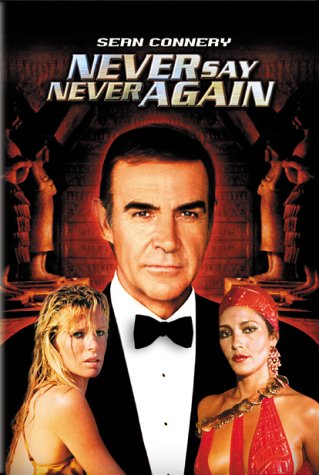
Netflix review #19: Never Say Never Again
It's the red-headed stepchild of the Bond series that no one's quite sure what to make of. But it's got Sean Connery back in the role that he made famous so it's got to be worth mentioning, right? That movie is 1983's Never Say Never Again, an unofficial entry into the James Bond series released the same year as Octopussy.
Making his 7th appearance as OO7, Connery is back after a 12-year absence since Diamonds Are Forever. Roger Moore had capably filled in his shoes for six movies already, but for whatever reason, Connery returned to the role. If you're thinking you've let some new, original Bond story slip by you, don't get excited. 'Never' follows the same storyline as Thunderball, one of my personal top 5 Bond movies. There's differences from the original, it's not a scene-for-scene remake, but I wouldn't recommend watching them back to back.
That was one of my issues with the remake. If Connery's coming back as James Bond, why would you remake one of his movies? And one that didn't need to be remade at that. Maybe the creators and producers were going for the comfort food factor, audiences liked the original and they'll like this one because we tell them to. If it was a stand alone movie with no original to compare it to, it would get higher marks, but unfortunately it isn't nearly as good as Thunderball.
The movie starts with a good opening sequence (with Bond theme inserted) as Bond tries to rescue a kidnapped princess from a heavily-guarded South American compound. The OO's have been deactivated, but now M (Edward Fox) is forced to bring them back into action. Two nuclear warheads have been stolen by SPECTRE, and NATO is given one week to pay up or have two key locations wiped off the face of the Earth. Clues lead Bond to a man named Largo (Klaus Maria Brandauer) where he begins his globe-trotting adventures that take him to the Bahamas, the French Riviera, and North Africa.
Connery slides back into the part nicely although he does look a little too old for the part, much like Moore did in his later efforts. But even then, I'm nitpicking, it's always fun to see the best Bond around back in action. As good as the others are, Moore, Daniel Craig, Pierce Brosnan, Timothy Dalton and George Lazenby, Connery will always be the best. In the rivals department, Barbara Carrera plays Latima Flush, a SPECTRE killer who revels in her job. Maybe a little crazy, she loves nothing more than finishing off her kill.
Brandauer as Largo is more back to the villains of the Connery movies. No supervillains here, just some royally bad dudes working for SPECTRE looking to cause mayhem and chaos around the world. Max von Sydow even has a small part as Ernest Blofeld, but it's only a scene or two. Depending on whether you count 'Never' as an official Bond movie, Kim Basinger is right at the top as one of the hottest Bond girls. Made in 1983, this movie gets away with more in the way of nudity than the 60s movies did. We're not talking gratuitous nude shots every scene, but Basinger spends most of the movie in short/sheer/see-through outfits. No complaints of course, just pointing it out.
I could stop there with the cast, but there's some other parts worth mentioning. Q is played by Alec McCowen and puts a different spin on Bond's gadget master, and Fox breathes some life into M. For a trivia question, it's Bernie Casey and not Geofrey Wright that played the first black Felix Leiter. And in one odd choice of casting, Rowan Atkinson, later Mr. Bean, plays an embassy officer working with Bond.
Where Thunderball is remembered for some great action scenes, especially the underwater finale with spear guns, the remake falls short. One no-holds barred fistfight is a good one, seen here, as a recuperating Bond takes on a much bigger, stronger SPECTRE killer. A chase late in the movie as Bond runs from Latima and her henchmen has some cool stunts s well including a fiery end. But overall, something's missing. Parts are too tongue in cheek while others just fall flat. And it does hurt when the James Bond theme can't be used. It's easily one of the most recognizable things about the series.
The DVD is somewhat overpriced at almost $15, but it's a good package. Widescreen presentation looks clean all the way through, but the only special feature is a short trailer. An average and unofficial Bond movie worth seeing for Connery's return and Kim Basinger, I'd say rent Never Say Never Again before buying it.
Never Say Never Again (1983): ** 1/2 /****
Subscribe to:
Posts (Atom)