The Sons of Katie Elder

The Sons of Katie Elder
"First, we reunite, then find Ma and Pa's killer...then read some reviews."
Showing posts with label Ralph Nelson. Show all posts

Tuesday, July 31, 2012

Soldier in the Rain

Making the jump from television to movie star, Steve McQueen had an interesting run through the first half of the 1960s, including his star-making role in The Great Escape with other strong parts in The Magnificent Seven, Hell is For Heroes, and two or three other parts. There were more positives than negatives, but the ones that missed have been generally forgotten. Unfortunately, 1963's Soldier in the Rain is on that short list of misses.

A few weeks away from getting his discharge papers, Sgt. Eustis Clay (McQueen) is dreaming of all that civilian life can offer him, all the freedoms the army has kept him from. A wheeler-dealer who trades for anything and everything he needs, Eustis has big plans to make a fortune once he's free of the army, but it all starts with one key caveat; he wants the help of friend and fellow supply officer, Master Sgt. Maxwell Slaughter (Jackie Gleason), who is similarly up for reenlistment but hasn't made his decision yet. As normal, everyday life goes by on the army base, Eustis does his best to convince Maxwell to join him in all his post-army plans, but can he do it?

With less than 30 feature length films to his name, McQueen's star burned fast and bright through the late 1950s, then into the 60s and 70s before his death in 1980 from cancer. He's one of my all-time favorite actors -- trapped in a dead heat with John Wayne and Clint Eastwood -- and this is one of the few films of his I had not seen. With so few remaining unseen, I'm sorry to report how disappointed I was with the effort. From usually reliable director Ralph Nelson comes a mess of a story, not sure if its a light buddy comedy or a significantly darker fare, slapstick goofiness or hardcore emotional. The most damning issue? If it's trying to be funny, it produces few to no laughs. If it's going for the drama, it's completely void of it up until the last 20 minutes.

As a huge McQueen fan, this is a bizarre film to watch because of the 33-year old actor's role. With later parts in Bullitt, The Sand Pebbles, and The Thomas Crown Affair (among others), McQueen perfected the part of the quiet anti-hero, the loner who works in society but only because he has to. Biographies point to him removing whole scenes of dialogue from scripts, insisting he could do something more efficiently with a glance or a quick sentence. Wouldn't you know it? It almost always worked. And then there's his part here....basically the polar opposite. Two years prior in The Honeymoon Machine, McQueen showed he could pull off a somewhat obvious comedic part. He had impeccable delivery and was able to do any physical scenes flawlessly. It's the type of part that made you wish he did more comedy in his career. Something doesn't quite make the transition to this flick then. 

It's hard to describe why this performance doesn't work. As I mentioned in the previous paragraph, part of McQueen's appeal was this effortless cool. It never looked like he was trying too hard to impress you. His part in 'Soldier' is for lack of a better description.....obvious. It feels forced, like he's playing a stereotyped, cliched character so McQueen decided to ratchet it up a notch. His accent is supposed to be southern (I think?), but it sounds like he's got marbles in his mouth. Eustis is naive, innocent and a dreamer, but one key character ingredient is missing. It's hard to like him. Maybe I've just come to expect that much more of McQueen, but this is one of his lesser efforts although God bless him, he's certainly trying. Also in the shrill, annoying and overacting department are Tuesday Weld and Tony Bill in supporting parts. Ed Nelson and Lew Gallo have some fun with some adversarial parts, always tangling with Eustis and Maxwell.

The saving grace for 'Soldier' is Jackie Gleason. I grew up watching Gleason in some episodes of The Honeymooners where he was loud, exaggerated and all over the place. As I've found though in his best roles, Gleason was a great actor usually when he could underplay a part, like he does as Master Sgt. Slaughter. A nobody as a civilian, Slaughter enjoys all the perks of his job, but never really lets it go to his head. In Eustis, he has a friend and an adoring fan who looks at him like a hero in whatever he does. Rather than brush it aside though, Slaughter looks at country bumpkin Eustis and embraces him like a brother he's got to look out for. There is a friendly charm to Gleason here, just a good man who makes the right decisions to help others out. Don't mess with someone that's close to him, or he'll come after you.

So while I can't truly recommend this film, I can say that parts of it work extraordinarily well. Even when McQueen's performance can be a little grating, his scenes with Gleason have an easy-going natural charm (more impressive when you read about their on-set differences). A buddy film/relationship minimizes it to a point, but that's what it is. Two different people who end up being close friends. Still, the movie on the whole doesn't amount to a whole lot, especially in the final 30 minutes as it takes a turn to the extreme dark. Probably for McQueen completists and Gleason fans alike.

Soldier in the Rain <---Youtube clip (1963): **/****

Monday, June 11, 2012

The Wrath of God

Why do some movies just reach out and grab you? You know the movie. The one most of your friends have never heard of and give you that 'What the hell are you talking about?' look. It's that hidden gem of a movie that you stumbled across at Netflix, the one you started watching at 2 in the morning when you couldn't sleep. Because you found it, and it seems to have been forgotten among a sea of movies, it's almost your movie. I've got a handful of them, one of my favorites being 1972's The Wrath of God.  

It's the 1920s in an unidentified Central American country, and three men have been brought together to pull off a suicidal, basically impossible mission. First is Emmet Keogh (Ken Hutchison), an IRA gunman on the run. Second, there's Jennings (Victor Buono), a portly, double-dealing and conniving businessman who can never turn away at a chance at some easy cash. And third, there's Father Van Horne (Robert Mitchum), a defrocked priest now working as a con man with some tricks up his sleeve. They have a simple choice in front of them; stand in front of a firing squad or work together to kill Tomas de la Plata (Frank Langella), a maniacal revolutionary who rules his region with a tyrannical fist. Can the unlikely, unholy trio pull the job off and get out alive?

A little known western from 1972 with a solid cast, a somewhat goofy tone that has some fans thinking it's a spoof (I for one, do not), and action, drama and humor. What to take away from it? According to anything written about the movie from director Ralph Nelson, it was beset with problems from the start. Co-star Hutchison severely cut his hand, almost died and was forced to miss several weeks of filming. That's kind of a problem when Hutchison is in almost every scene. Starring in her last movie, Rita Hayworth was struggling with Alzheimer's and couldn't remember her lines. Now this may just be me, but you know what? Somehow and some way, it all works for the better. Yes, it's an odd, weird, even goofy mess of a movie, but it's damn entertaining.

'Wrath' has lots of little things going for it, the things that help make a good movie great. From composer Lalo Schifrin comes a crazy, off the wall, jazzy and Mexican themed score that sounds like an offbeat spaghetti western score (listen to samples HERE). Nelson filmed on location in Mexico using some familiar, memorable spots that you'll have seen in Vera Cruz, Big Jake, The Wild Bunch, and The War Wagon. The finale at the de la Plata hacienda is especially cool, using the same location as the finale to 1954's Vera Cruz. The best thing going though is the script. The movie is based off a Jack Higgins novel (written as James Graham), and while I like the novel, it doesn't have the dark humor the movie does. The whole movie is basically one great one-liner after another, but it never feels forced. Read IMDB's Memorable Quotes HERE for a sample. Credit to Mitchum, Buono and Hutchison especially for committing to the lines because it could have felt cheesy from the get-go in lesser hands.  

Mitchum was the only big, recognizable star in the cast, but that ends up working as a positive for the film. He was often criticized for being too calm, too lackadaisical, for being downright bored in his parts. This is a showy, scene-stealing part, and Mitchum runs away with it. Having some fun with previous "religious" parts like Night of the Hunter and Five Card Stud, he plays Father Oliver Van Horne, a somewhat disheveled, former priest (backstory explained late) now working as a conman and hired gun. He carries a large case loaded with an automatic machine gun and hiding over $50,000. Mitchum clearly looks like he's having some fun here. Hutchison and Buono too stand out, Hutchison as the fiery IRA gunman who gets a love interest, Chela (model Paula Prentiss in one of her 3 career roles), a mute Indian girl, and Buono as the portly, boozing dealer who always looks out for himself first and foremost. The trio has this really easy-going, likable chemistry that carries the movie, a nice positive when they're in almost every scene together.

The other three main parts are basically extended cameos. Playing the maniacal laughing, insane Tomas de la Plata, Langella hams it up like nobody's business. He hates priests after seeing sketchy, immoral priests in his village growing up so when Mitchum's Van Horne shows up, he basically loses his mind. Langella has some great exchanges with Mitchum too, overplaying vs. underplaying. In her last film, Hayworth is clearly struggling with her part, but it's still cool to see her working with the cast. Also hamming it up is John Colicos as Colonel Santilla, the conniving officer trying to get his rival de la Plata knocked off in any way possible. His spelling out the suicide mission to his self-named 'Unholy Trinity' is a priceless scene. Gregory Sierra is solid too as Jurado, de la Plata's one-eyed henchman. Fans of The Wild Bunch should check out the cast too, where you'll see Jorge Russek, Chano Urueta, Aurora Clavel, and Enrique Lucero, all of them playing supporting parts much like in Peckinpah's film.

A quasi-revolutionary western that isn't interested in breaking any ground sure ain't a bad thing. In many of his movies, Nelson was just interested in making entertaining, well-made and exciting movies. 'Wrath' is 3-for-3 there. It's fun from beginning to end, the last 30 minutes especially standing out as Van Horne, Keogh and Jennings make their move in taking out de la Plata. A bloody shootout in a village square leads into a bloodier shootout at the de la Plata hacienda, Van Horne wrapping it up nicely with a great closing line. Is the movie great? By no means, but I love it just the same. It's different, it's funny, and whether it's laughs or action, it should keep you entertained. Now about finding a DVD copy of it.....yeah, that's another story.

The Wrath of God (1972): *** 1/2 /****

Sunday, September 18, 2011

Charly

Through all the enhancements and developments in acting through Hollywood's history, the Academy Awards have done their fair share of changing too.  Is there a go-to thing an actor or actress can do to ensure themselves a nomination for Best Actor or Best Supporting Actress? It obviously takes a ton of talent and some luck at that, but it's easy enough to figure out. For years, it was big, verbose, stagey performances. Through the 1960s as method acting came into play, it was moodier, darker performances. In the early 2000s, it was actors dulling themselves down to play characters you'd never expect.

A tricky ground for an actor/actress to play is that of a mentally handicapped individual.  As Robert Downey Jr. so famously said in Tropic Thunder (and while I laugh, there's an uncomfortable truth about it), "You never go full retard."  For a person to play the part of a handicapped individual, you're treading that fine line.  Are you embracing the part, truly discovering and showing what it is like to be that person? Or are you just pandering to an audience for sympathy, mimicking someone who doesn't deserve that treatment? One of the best examples came in 1968's Charly with actor Cliff Robertson -- a favorite of Just Hit Play -- winning the 1969 Best Actor's Academy Award for his performance of a man with the IQ of 59.

Living on his own in a small, poorly furnished one-room apartment and working as a janitor as a bakery, Charly Gordon (Robertson) is trying to make himself smarter. He is mentally challenge and with an IQ of just 59 struggles to adjust at times in a modern and often times unforgiving world.  Charly has spent two years attending night school, learning from his teacher, Alice (Claire Bloom) how to read and write even if the process is slow-going. Alice approaches Charly one day with an offer. A team of doctors have developed a somewhat controversial medical surgery/procedure on the brain that makes the patient exponentially more intelligent. A genuinely good person who wants to improve himself, Charly is an ideal case study, and that's exactly what he is. He undergoes the surgery and slowly but surely starts to see improvement. There's so much in fact that he develops the intelligence of a genius. Something else awaits him though as he changes, something even a superior intellect could figure out or stop.

When I first watched this movie, I was curious mostly to see Robertson's Academy Award winning performance. He's one of my favorite actors, and I thought he never quite got his due. Revisiting the movie how many years later, I had forgotten how dark the movie is, how cynical its look at the real world really is. With the naivete and innocence of a child, Charly goes through life just trying. That's all. He tries. His co-workers rip him mercilessly for kicks, but he thinks they mean well. After his surgery, Charly sees a mentally challenged man working as a waiter laughed at by the crowd in a restaurant when he drops a tray of glasses. For any number of reasons, it is a difficult movie to watch, to see man's apparently inherent ability to be cruel for no apparent reason. Post-surgery, Charly asks 'Why would the people who would never dream of laughing at a blind or crippled man laugh at a moron?' It's a valid question and one without an easy answer.

Watching other Robertson movies, I think of The Devil's Brigade, PT 109, Too Late the Hero, Three Days of the Condor, action, war and thrillers. He's a really good actor and cool in all those movies (I have a way with words, don't I?), but this is his best performance by far. He walks that fine line between cliched and stereotype of playing a retarded man. His Charly is a believable person, not a caricature of what people think a mentally challenged individual would be. Above all else, you like this character.  You're rooting for him to succeed, to better himself. He is as innocent as they come without a mean bone in his body. He brings Charly Gordon to life, and then when Charly does change as an individual, becoming "normal" (for lack of a better word, society's normal I guess), you believe that transformation too.

Where the movie succeeds most for me is the first hour where we get to know Charly before he undergoes his surgery.  We see his tiny even depressing apartment with a small fridge, two chairs, a bed and a chalkboard where he writes his next day's activities. He goes to work where he thinks the people making fun of him are his best friends because he doesn't know any better. Charly goes to night school, learning to read and write, and ultimately goes through testing with Bloom's Alice and a team of doctors. One particularly effective bit has Charly "racing" a mouse named Algernon who's undergone the surgery, seeing who can complete a maze quicker. In a weird way, they become friends, but it works and makes sense. Above all else, Charly and his interactions with those around him feel genuine, and it keeps the movie grounded throughout.

The movie has its issues though, issues that keep it from being a classic. Director Ralph Nelson is undone at times by 1960s syndrome, or whatever you'd like to call the psychedelic elements of his story. The split screen effect feels dated now and serves no real purpose. A weird acid trip toward the end of the movie is truly bizarre as Charly lashes out, trying to discover the world in a way he's never seen.  It's like the similar scene in Easy Rider where Peter Fonda and Dennis Hopper trip out on acid.  A nightmare sequence near the finale is unsettling in a similar fashion, but in a positive sense that shows the struggles Charly is going through. And better or worse, the story drags some once Charly has undergone the surgery. It's not boring, but it's just not as interesting seeing the change in the character.

Rewatching the movie though, my issues are ultimately left behind because Robertson's lead performance as Charly Gordon is that good.  It is an incredibly moving story that does do its fair share of pulling at your heart strings.  You think you know where it's going, and then Nelson pulls the rug out from under you.  He saves the biggest shock for last, one of the most powerful endings I can think of. Moving doesn't do enough to describe the effectiveness of the final shot, a freeze frame that stayed with me long after watching the movie. Great performance, almost great movie. You can watch the movie at Youtube, starting HERE with Part 1 of 11.

Robertson died recently, passing away on September 10, 2011.  He was an underrated actor who didn't always get his due, and he will be missed.

Charly (1968): *** 1/2 /****

Wednesday, January 19, 2011

Fate is the Hunter

When I think of disaster movies, I think The Poseidon Adventure and other 1970s epically bad but still enjoyable movies with huge casts of stars and dated special effects.  Through the 1950s and 1960s, disaster movies were made, just not on the same scale.  Only part of 1964's Fate is the Hunter really matches up with any of the criteria for a disaster flick, but it foreshadows what was to come in the coming decades as audiences watched planes crash, earthquakes tear apart the world, towering buildings go up in flames and much, much more.

Director Ralph Nelson takes control of the helms here in this quasi-disaster flick which is both ahead of its time in storytelling but also very dated at times.  Nelson is one of those hidden gems of a director you stumble across every so often.  He was never pigeon-holed into one specific type of movie and ended up directing films across countless genres.  Action, western, drama, comedy, message movies, he tried them all and did them all well.  Never flashy but always getting the job done in above average fashion, Nelson doesn't have a true classic to his name, but his filmography is nonetheless littered with worthwhile movies.

On a flight from Los Angeles to Seattle, veteran pilot Capt. Jack Savage (Rod Taylor) and his crew run into mechanical problems and are forced to crash land on a beach, the jet airliner exploding on contact with a pier running across the beach. Everyone on board other than one stewardess (Suzanne Pleshette) is killed, and the public, the corporation, and the media want answers.  What happened that caused Savage to attempt such a difficult maneuver? All evidence points to pilot error being the cause, but airline executive, former pilot and friend of Savage's, Sam McBane (Glenn Ford), thinks something else happened. Time is running out though, and McBane must prove Savage's innocence before a board of inquiry pins the blame on the deceased pilot.

Wasting little time surprising the viewer, Nelson kills off star Rod Taylor before the credits even roll.  Just when you think Taylor's Savage has successfully landed his jet airliner carrying 49 passengers...BOOM! The plane explodes, and 'Fate is the Hunter' pops up on the screen.  Talk about a tone-setter. No worries though for Taylor fans, this is not the last we'll see of him.  His involvement in the movie from there on in besides his character being constantly talked about is through flashbacks that flesh him out as an individual.  It's those little bits of character that should help us decide if this experienced, always calm and capable pilot was really incapable of dealing with what seemed like a minor mechanical issue.  Long story short, don't miss the first 10 minutes, or you'll be lost.

The problem any movie faces when it has such a strong start is sustaining that energy over the length of the movie.  That's where 'Hunter' struggles.  The investigation is interesting enough because it's hard not to be curious about what actually caused the plane to malfunction in such a surprising way.  But Ford's questioning gets tedious quickly.  The flashbacks are beyond tedious and serve only to make Savage more of a 3-D character.  After the first flashback, it becomes too much.  We get it.  He's a good pilot who is cocky, arrogant, not always likable and quite the ladies man.  But is a movie really going to peg Taylor as a boozehound who caused the deaths of over 50 people? I think not.  It's not a matter of if, it's a matter of how Taylor didn't crash the plane because he was drunk. 

Worse than that though (as a Lost fan I can appreciate even the slowest of flashbacks) is the direction Ford's character and the story takes overall in the final half hour.  Now granted, the word 'Fate' is in the movie's title.  As the evidence comes together and Ford's McBane talks to all these possible witnesses, he begins to question if maybe, just maybe, fate played a role in that plane crashing.  An out of season bird may have flown into the engine, three other planes were all off-schedule by a few minutes, the pier was supposed to have been removed a week earlier, it just doesn't add up.  Was something else at play here? Ford's testimony is even worse when he admits all this.  I can't tell if it is just all too sappy or handled poorly, but if Nelson was trying to deliver a message with this change in direction it didn't work.  I haven't read the source novel to know one way or another, but the ending disappoints on a lot of levels.

The redeeming factor through all the negatives is the impressive cast assembled here.  Ford is never flashy but is as reliable as always with Taylor making the most of his posthumous part...in character at least. Pleshette has a small but integral part (and looks great by the way). Also look for Nancy Kwan, Constance Towers, Jane Russell in a cameo as herself in 1945, Nehemiah Persoff, an uncredited Dorothy Malone, Max Showalter, Wally Cox and many more recognizable faces even if you don't know their name. Other than the cast and some nice-looking black and white camerawork, I struggled to get through this movie.  Potentially good but never amounts to anything much.

Fate is the Hunter <---trailer (1964): **/****

Thursday, October 21, 2010

Tick...Tick...Tick

At the height of his NFL career, star running back Jim Brown decided to walk away from the sport he loved so he could get into movies.  There are few athletes who have the guts to do that, and to make it more impressive, Brown is still remembered as one of -- if not THE -- the best NFL players of all-time.  Being born some 20 years after he played his last game, I can't speak to that, but I can say I've always liked Brown as an actor.  I've seen most of his more well-known roles but came across one on TCM I'd never heard of before, 1970's tick...tick...tick  Unique title, huh?

Released in 1970 while the civil rights movement was still raging, this Ralph Nelson-directed flick reminded me in a lot of ways of 1967's In the Heat of the Night.  Of course some three years later, a somewhat similar storyline isn't going to have the same impact, and it would be nearly impossible to match the acting talents of Sidney Poitier and Rod Steiger.  You've got to try though, right?  And Nelson has a go at it, handing us a story that is at times predictable in its direction but never in a bad way.  It's not as aggressive or as in your face as 'Night,' but in its own way 'tick' serves as a nice companion piece to its classic predecessor.

In Colusa county in the deep south, Sheriff John Little (George Kennedy) heads in for his last day of work after losing a recent election.  The opponent who beat him has created quite a stir as a black man, Jim Price (Brown), is prepared to take office in a county severely divided by racial ties. Little holds no grudge against his replacement, only being upsetting that he's lost a job he's held for so many years.  New on the job, Price has his work cut out for him as rumors persist that the Klan might try something.  He knows he's in a corner though and can't do much to provoke an incident as told to him by the elderly town mayor (Fredric March).  Looking for help though with a crime that could tear the town and county apart, Price turns to an unlikely ally in Little.

It feels funny writing this, but the pairing of a white and black actor seems laughable in 2010...even if racism continues to exist in some extremely odd, almost always out of place situations.  In the Heat of the Night certainly kicked the door down on the premise, and 'tick' plows right through the open door frame.  Nelson doesn't hit you over the head with anything, but it is quickly apparent that if you throw out skin color, Brown's Price and Kennedy's Little are basically the same person.  They're family men who would do anything for their wife and children.  They do what's right no matter how difficult the choice is or the repercussions that will follow.  When someone or something is in trouble, they come to help because they know it is the right thing to do.

After working together briefly in their few scenes in 1967's The Dirty Dozen, Brown and Kennedy reunite here with some very positive results.  I've read criticisms of Brown that he was a stiff actor without much range, and I'll agree to a point.  He could be stiff at times, but he always rose to the occasion.  The former NFL star was an incredible physical presence, looming over all his co-stars whether he intended it or not.  He was at his best in roles like this, and his somewhat stiff style works for the character, a stubborn but fair man who knows he's in the right.  Kennedy is just as strong as the scorned sheriff who doesn't dwell too much on this change in his life.  Both actors have a very easy-going way about them, and they play well off each other.  And besides, just as a movie fan, it's fun to see two actors like Brown and Kennedy work together.

As I mentioned earlier, the story can be at times a tad predictable.  Nelson never shoves anything down your throat, but some of the so-called twists shouldn't really surprise anyone.  As a viewer, you know where the story is going before the characters even do.  Was there ever any doubt that Brown and Kennedy would end up side by side to combat racism and prejudice?  The same goes for the supporting characters, none of whom are developed much.  March gets some laughs as the old, crotchety mayor while Lynn Carlin is very good as Julia, John's wife trying to help her husband figure out what to do with himself. Some other notable names include Don Stroud as a gun-toting, pissed off former deputy, Clifton James, Bernie Casey, Dub Taylor, Karl Swenson, and Richard Elkins as Brad Wilkes, Price's only deputy.

The one thing that worried me going in was something in the credits, a credit to the singers and writers of a handful of songs that I was disappointed to hear would be the movie's soundtrack.  I won't go through all the songs -- read the list HERE -- but I can say they are all cookie-cutter folk songs from the late 1960s that sound alike.  I'm not a fan to begin with, but the soundtrack is misused with a story dealing with racism and prejudice in the deep south.  Annoying and out of place? You bet, but I liked the movie nonetheless.

...tick...tick...tick... <---TCM trailer (1970): ***/****

Sunday, December 20, 2009

The Wilby Conspiracy

Certain topics just seem odd when dealt with in movie form regardless of the result; i.e. was the movie good or not? By making a movie about genocide, racism, slavery, the Holocaust, you're fully stepping into the arena to be judged on a different level because people around the world feel so strongly about that topic one way or another. Years ago I saw part of 1975's The Wilby Conspiracy and revisited it this weekend and watched it all the way through. It's definitely a movie that qualifies as dealing with a difficult topic -- South African apartheid -- but it is handled in an incredibly unique way.

Right off the bat, we're talking issues about race that will bring up deep-seeded feelings and emotions in audiences. And while never completely avoiding the topic, director Ralph Nelson puts his own spin in dealing with a story based in South Africa in the 1970s. For those that didn't read the above link, here's the gist, apartheid is segregation on a massive scale and done legally that in South Africa's case existed for almost 50 years between 1948 and 1994. Instead of making a hard-hitting 'topic' movie, Nelson delivers a message rolled together with an action/adventure movie. Really who would have thought of 1970s South Africa as a ripe location for a buddy action movie?

After ten years in jail in Cape Town, Shack Twala (Sidney Poitier) is released when the charges against him are dropped. Going to get his identification papers with his lawyer, Rina (Prunella Gee), and her boyfriend and English engineer Jim Keogh (Michael Caine), Shack is stopped by the police and threatened with imprisonment. Keogh steps in to help and a fight ensues, forcing Shack and Keogh to flee for their safety. From his days in the anti-apartheid movement, Shack knows who can help them out of the country, a man in Johannesburg almost 900 miles away. But as they run, Keogh begins to suspect there's more going on, and he's right. Shack is after a bag of hidden diamonds that can help fund the resistance and the revolution and needs Keogh's help. Chasing after them are two members of the secret police, Major Horn (Nicol Williamson) and Van Heerden (Rijk de Gooyer).

I won't go as far as saying 'Wilby' is a buddy movie, but it's damn close. Saying that almost seems to minimalize the context of the story which does deal with the situation in South Africa where 3 million whites rule over the 18 million or so blacks. Because the apartheid is legal and supported/approved by the government, there's a delicate balance. What helps this is the very different main characters, Poitier's Shack who grew up and lives within this system and Caine's Keogh who is an outsider and goes along with it because he's expected to, not because he believes it.

Surprisingly enough, this dynamic provides some funny moments as Shack and Keogh are forced to pretend Keogh is the master so as not to arouse suspicion. Both men embrace these situations because they have to, but in the moments afterward they have it out, Shack even admitting 'I read Lenin, Marx, and Winnie the Pooh.' These lighter moments help balance out the story, especially the parts with the secret police who in many ways resemble the Gestapo or the KGB for the fear they can instill in the population. Williamson is a very capable villain as he tracks Shack down on this cross country chase.

All the cast handles this odd dynamic well as they balance social issues like apartheid and racism in general with the lighter additions like the humor and action. Caine and Poitier play off each other well as this forced partnership leaves them no other option than to work together. Poitier gets the meatier role as the anti-apartheid activist with vengeance on his mind, but Caine's performance equals it as the English engineer gets more and more involved within the movement. Gee's Rina is both a love interest and the moral compass in a small but effective performance. Saeed Jaffrey and Persis Khambatta have key roles as two Indians living in Johannesburg who worked with Shack in the past, and then Rutger Hauer is nicely evil as Rina's two-timing husband.

Now all social issues and messages aside, The Wilby Conspiracy has some really solid action sequences -- especially the end with what looks to be an incredibly dangerous helicopter stunt -- and has a quick pace throughout. The backstory of apartheid aside, the movie plays like any number of action movies centering on a chase or a fugitive manhunt. But it's handled so well and with such a unique spin on the story, you'll hardly notice. It's entertaining from start to finish with strong performances from Poitier and Caine. Available on DVD but look out for it on TV.

The Wilby Conspiracy <----trailer (1975): ***/****

Monday, April 27, 2009

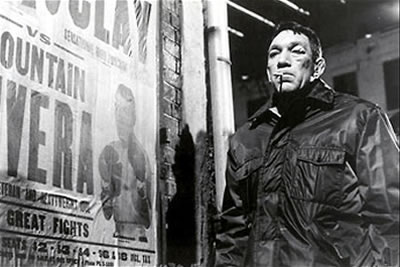
Requiem for a Heavyweight

Sports movies have covered a wide variety of topics over the years. The genre's got so many stories that anything from comedy to serious drama to thriller can be handled within a sports story. A forerunner of sorts for Martin Scorcese's Raging Bull, 1962's Requiem for a Heavyweight is a sports movie that may seem like something you've seen before, but that's because it was an original, a movie that set the stage for other similar movies to come along.

In a fight with Cassius Clay, veteran boxer Luis 'Mountain' Rivera (Anthony Quinn) takes quite a beating before being knocked out late in the 7th round. It's after the fight a doctor tells Mountain that he's done. A couple more punches to the head and he may lose his eyesight completely. So what to do now? Boxing is all Rivera's known, and after 17 years in the ring he's now forced to look for something new, a completely different career. He might have found an answer in Grace Miller (a great supporting part for Julie Harris), a social worker who sees the potential Mountain has.

Released in 1962, director Ralph Nelson's movie could have been straight out of the late 40s when film noir was at the top of its game. If I hadn't seen the release date, I would have said it was film noir, maybe running in a double feature with 1949's The Set-Up with Robert Ryan. Filmed in black and white, almost every scene is full of shadows and characters sitting in the darkness.

Not a 'name' director, Nelson had a string of moderate successes in the 1960s and 1970s but never became a huge star. Too bad because of the movies I've seen, he was a talented man behind the camera. He had an eye for the visual and wasn't just content to point the camera at the actors and shoot. Nelson thinks outside the box with Requiem, making shots that could have been ordinary something memorable. The movie opens through the eyes of Mountain as he's pummeled by Clay. The scene goes on for several minutes as he wakes up and groggily walks from the ring with his manager and cut-man. The technique is repeated in the finale and is used equally as effective.

But what most movies come down to isn't how the director shoots scenes or even the storyline, it can be all about the actors. The three main leads make this movie, especially Quinn as Mountain Rivera. How he wasn't nominated for his performance here by the Academy escapes me. In a career of making countless characters come to life, this is one of his best. Rivera is a kid in a man's body that's taken years of abuse in the ring. He's still got an innocence to him, and he trusts those around him, even when everything points to doing just the opposite. Truly one of Quinn's finest performances.

Right behind him are Jackie Gleason and Mickey Rooney as Maish Remmick, Mountain's manager, and Army, his cut-man who's taken his own share of abuse in the ring. Maish at one time probably had Mountain's best interest at heart but now with his fighter's ability declining, he makes a decision that could tear them apart. Gleason makes the character both sympathetic and despicable depending on which scene you look at. After coming into the public eye as Judy Garland's boyfriend, Rooney shows how good an actor he was. Like a big brother, Army looks out for Mountain's well-being when no one else does. This trio has a history together that goes back many years, and it's a credit to the three actors for making it believable.

At under 90 minutes, this isn't a long movie, but in a short time the audience feels like you've gotten to know the characters and their history and relationships. It all builds to a heartbreaking ending for Mountain, one that shows the true colors of the character. He's a boxer who's best days have passed him by, but that doesn't mean he still can't help those around him. One of the best and underappreciated movies to come out of the sports genre with a great performance from Quinn. With a screenplay from The Twilight Zone's Rod Serling, it's about as can't miss as a movie can be.

Requiem for a Heavyweight <---trailer (1962): *** 1/2 /****