The Sons of Katie Elder

The Sons of Katie Elder
"First, we reunite, then find Ma and Pa's killer...then read some reviews."
Showing posts with label Jackie Gleason. Show all posts

Tuesday, July 31, 2012

Soldier in the Rain

Making the jump from television to movie star, Steve McQueen had an interesting run through the first half of the 1960s, including his star-making role in The Great Escape with other strong parts in The Magnificent Seven, Hell is For Heroes, and two or three other parts. There were more positives than negatives, but the ones that missed have been generally forgotten. Unfortunately, 1963's Soldier in the Rain is on that short list of misses.

A few weeks away from getting his discharge papers, Sgt. Eustis Clay (McQueen) is dreaming of all that civilian life can offer him, all the freedoms the army has kept him from. A wheeler-dealer who trades for anything and everything he needs, Eustis has big plans to make a fortune once he's free of the army, but it all starts with one key caveat; he wants the help of friend and fellow supply officer, Master Sgt. Maxwell Slaughter (Jackie Gleason), who is similarly up for reenlistment but hasn't made his decision yet. As normal, everyday life goes by on the army base, Eustis does his best to convince Maxwell to join him in all his post-army plans, but can he do it?

With less than 30 feature length films to his name, McQueen's star burned fast and bright through the late 1950s, then into the 60s and 70s before his death in 1980 from cancer. He's one of my all-time favorite actors -- trapped in a dead heat with John Wayne and Clint Eastwood -- and this is one of the few films of his I had not seen. With so few remaining unseen, I'm sorry to report how disappointed I was with the effort. From usually reliable director Ralph Nelson comes a mess of a story, not sure if its a light buddy comedy or a significantly darker fare, slapstick goofiness or hardcore emotional. The most damning issue? If it's trying to be funny, it produces few to no laughs. If it's going for the drama, it's completely void of it up until the last 20 minutes.

As a huge McQueen fan, this is a bizarre film to watch because of the 33-year old actor's role. With later parts in Bullitt, The Sand Pebbles, and The Thomas Crown Affair (among others), McQueen perfected the part of the quiet anti-hero, the loner who works in society but only because he has to. Biographies point to him removing whole scenes of dialogue from scripts, insisting he could do something more efficiently with a glance or a quick sentence. Wouldn't you know it? It almost always worked. And then there's his part here....basically the polar opposite. Two years prior in The Honeymoon Machine, McQueen showed he could pull off a somewhat obvious comedic part. He had impeccable delivery and was able to do any physical scenes flawlessly. It's the type of part that made you wish he did more comedy in his career. Something doesn't quite make the transition to this flick then. 

It's hard to describe why this performance doesn't work. As I mentioned in the previous paragraph, part of McQueen's appeal was this effortless cool. It never looked like he was trying too hard to impress you. His part in 'Soldier' is for lack of a better description.....obvious. It feels forced, like he's playing a stereotyped, cliched character so McQueen decided to ratchet it up a notch. His accent is supposed to be southern (I think?), but it sounds like he's got marbles in his mouth. Eustis is naive, innocent and a dreamer, but one key character ingredient is missing. It's hard to like him. Maybe I've just come to expect that much more of McQueen, but this is one of his lesser efforts although God bless him, he's certainly trying. Also in the shrill, annoying and overacting department are Tuesday Weld and Tony Bill in supporting parts. Ed Nelson and Lew Gallo have some fun with some adversarial parts, always tangling with Eustis and Maxwell.

The saving grace for 'Soldier' is Jackie Gleason. I grew up watching Gleason in some episodes of The Honeymooners where he was loud, exaggerated and all over the place. As I've found though in his best roles, Gleason was a great actor usually when he could underplay a part, like he does as Master Sgt. Slaughter. A nobody as a civilian, Slaughter enjoys all the perks of his job, but never really lets it go to his head. In Eustis, he has a friend and an adoring fan who looks at him like a hero in whatever he does. Rather than brush it aside though, Slaughter looks at country bumpkin Eustis and embraces him like a brother he's got to look out for. There is a friendly charm to Gleason here, just a good man who makes the right decisions to help others out. Don't mess with someone that's close to him, or he'll come after you.

So while I can't truly recommend this film, I can say that parts of it work extraordinarily well. Even when McQueen's performance can be a little grating, his scenes with Gleason have an easy-going natural charm (more impressive when you read about their on-set differences). A buddy film/relationship minimizes it to a point, but that's what it is. Two different people who end up being close friends. Still, the movie on the whole doesn't amount to a whole lot, especially in the final 30 minutes as it takes a turn to the extreme dark. Probably for McQueen completists and Gleason fans alike.

Soldier in the Rain <---Youtube clip (1963): **/****

Sunday, September 11, 2011

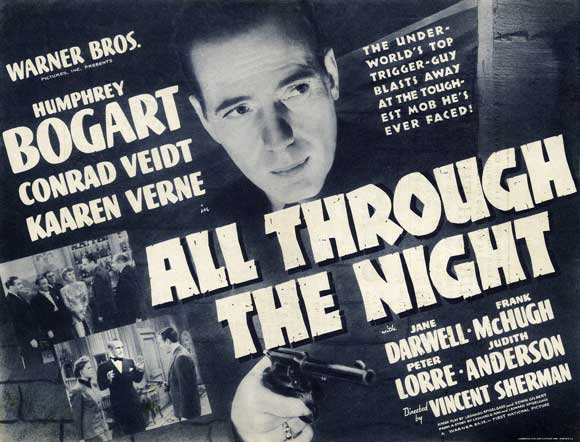
All Through the Night

You know what's not funny? Nazis. Care to differ? I'm a fan of Hogan's Heroes and can appreciate the cartoonish portrayal of Nazis like in The Producers or Charlie Chaplin in The Dictator or even the Three Stooges poking fun at Adolf Hitler.  But at their most basis, is there anything actually, legitimately funny about them? I've never thought so.

Imagine my surprise then when I read the plot description of 1941's All Through the Night which read 'A criminal gang turns patriotic to track down a Nazi gang.' Released in 1941 even before the Japanese sneak attack on Pearl Harbor on December 7, I figured this would be an interesting, potentially very dark propaganda attempt to show an American audience how evil Germany, Hitler, and the Nazis were.  I really figured on that much when I saw Humphrey Bogart was the star. Propaganda? Yes, but so much more and so much weirder. It's got a propaganda message mixed with a mystery thriller but plenty of action and laughs thrown in too. Confused much? I was.

While the rest of the world is wrapped up in WWII, a gang in New York City run by Gloves Donahue (Bogart) goes about their daily business without too much concern of what's happening in Europe. The dapper gangsters have their hands in everything, the suave Gloves at their head. One day, Gloves' mother (Jane Darwell) calls her son in to investigate a disappearance which is quickly revealed as a murder. Gloves and his boys look into it, following the only clue they have, a beautiful woman, Leda (Kaaren Verne), who showed up in the wrong place at the wrong time. What have they stumbled into exactly? The victim was a seemingly innocent baker, but they quickly find out there's much more to it. Gloves and his crew are quickly tangling with a cutthroat crew of German agents doing their best to sabotage America and its interests.

Call this pretty eerie, but according to the IMDB 'All Through the Night' was released in theaters for the first time on December 2, 1941, exactly five days before the attack on Pearl Harbor.  That certainly adds a darker dimension to a story that is oddly enough attempts to be funny and scare the audience into thinking one way.  I get it. I really do.  Many Americans wanted nothing to do with WWII in any way, staying isolated by an ocean on either side from fighting in Europe or the Pacific.  Others obviously wanted our country to get involved, and as a byproduct, we see efforts like this that are certainly trying to influence your feelings on the subject.  The idea is there, but there is something just plain odd, just unexplainable about this movie.

The pacing, the tone, the comedy, the action. It's just all too much here in director Vincent Sherman's movie. We've got Bogie and his gang running around NYC in the middle of the night stumbling across a German spy ring, a Fifth column group, while also tangling with cops who think Gloves is a murderer, and a bar owner and his goons who want to fight it out with Bogie and Co.  Just too much time is spent going for laughs with a story that 1. Doesn't need laughs and 2. Suffers because the humor is slapstick and physical humor.  Maybe this all would have worked with a tweak here and there. Portray the Nazis as cartoonishly stupid idiots and possibly it clicks. As presented here, they're cold-blooded, conniving murderers who will kill anyone who gets in their way. The combination of Gloves and his fast-talking "tough" guys and these brutally cold German agents never gels.

What makes this worse is that there is a lot of talent involved in this can't make up it's mind story.  Bogie is great, playing his usual tough guy but given a chance to show off his comedic chops. He's funny because he plays it straight, throwing one-liners with split second timing.  His gang includes William Demarest, a very young-looking Jackie Gleason, and Frank McHugh, along with Phil Silvers as a bespectacled waiter with a mouth. A year later Bogart would work again with co-star Conrad Veidt in a little film called Casablanca -- maybe you've heard of it -- who here plays the evil German leader who's agents include Peter Lorre and Judith Anderson. The gang gets to ham it up in that fast-talking style of the 1940s where everyone yells and screams wearing their very high-waisted pants and classy hats and suits.  The Germans get to be over the top evil, Veidt's main baddie even willing to blow himself and his little dog up to help the war effort.

While the comedy fell short for me on just about every front, one scene came through and delivered, one where I genuinely thought it was funny.  Posing as German agents to see what these crooks are up to, Gloves and Demarest's Sunshine are forced to "report" on their activities.  With absolutely nothing to report, they pull off this gimmick with gibberish and yelling, ending each statement with 'Heil!' which causes all the other agents in the room to stand with a rousing 'Heil Hitler!'  In the process, they buy themselves some time to escape. Smart humor? No, not in the least, but it was funny...at times.  Overall though, the movie can't figure out what it is and takes too long not deciding. A worthwhile flick for Bogart fans, but not much else.

All Through the Night <---TCM trailer (1941): **/****   

Sunday, June 26, 2011

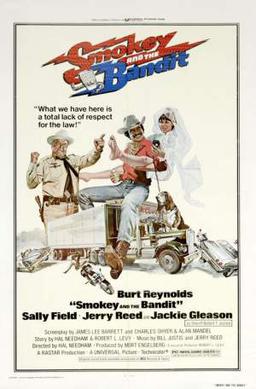
Smokey and the Bandit

Some movies just sound good. With a movie based off Shakespeare or Tolstoy or a Jane Eyre novel, you're going to get a supremely well-written and most likely well-acted movie. Then there's the polar opposite. You know you're going to have fun watching this movie. Burt Reynolds driving a badass car through the South with every sheriff and police officer around chasing him? Count...me...in.  That's 1977's Smokey and the Bandit.

This is a movie I'd never even seen a minute of before. Heard of it, knew what it was about, yes. Seen it? Not even a little bit.  I've always been a fan of Burt Reynolds, and this is probably his most well-known movie right up there with the original The Longest Yard. The 1970s were Reynolds' decade as he was one of if not the most popular movie stars around. Think of George Clooney and Brad Pitt rolled into one. This is him at its best, a little slice of Americana that is the definition of a popcorn movie.

A reputation for being able to pull off the impossible, a trucker named Bandit (Reynolds) has taken on an impossible dare that no one has ever pulled off. Leaving from Georgia, he has to drive to Texarkana, Texas, pick up 400 cases of Coors beer and race back to Georgia, all in 28 hours. The only problem? Transporting Coors beer east of the Mississippi is bootlegging. Driving as a blocker in a Pontiac TransAm to clear the way, Bandit recruits old buddy and fellow trucker, Snowman (country singer Jerry Reed), to drive an 18-wheeler full of the beer. Picking up the beer proves to be the easy part, but on the return trip, Bandit picks up Carrie (Sally Field), a woman on the side of the road in a wedding gown. He thinks nothing of it, but almost immediatey, a Texas sheriff, Buford T. Justice (Jackie Gleason) is on his tail. With time running out, can Bandit and Snowman make it back to Georgia?

On the Making Of documentary on the DVD, Reynolds says he told stuntman-turned-director Hal Needham that the script (which Needham had helped write) was the worst thing he'd ever read...and that he'd do the movie. Reynolds later states that they improvised a lot of the banter along the way. And you know what? It doesn't matter that the script is lousy because the story is nonexistent. The driving mission across the South is laid out early, and from there on in it's one big chase full of fast cars, idiotic police, and some memorable country ballads. Unpretentious and fun, this movie never aspires to be anything other than a movie that is a hell of a lot of fun to watch. Reynolds says it's the perfect rainy weekend afternoon movie, and I can't really disagree.

The best part of the movie is Reynolds. I can't say it is a performance because you get the feel that Reynolds is just playing a bootlegging version of himself. Bandit is funny, smooth, a great driver, a living legend, a ladies man, cocky in his abilities, and through it all, you like him. Reynolds just has a knack for being incredibly likable in almost every role he plays. He has some great one-liners throughout the movie, has a great banter down with Reed's Snowman over the C.B. radio, and looks to be having a ton of fun actually making the movie. Escaping from a pursuing patrol car, Bandit hides behind a building and as he crawls away, turns to the camera and smiles. It's that Burt Reynolds smile. It's completely ridiculous and out of place, but it's perfect. Breaking the fourth wall? You're having too much fun to care.

While this is obviously Reynolds' movie, the three supporting parts are just as important, and none of them disappoint. A Family Guy joke has some fun with Sally Field's casting as the "hot girl," but Fields has a good on-screen chemistry with Reynolds. That's a good thing considering most of their time together is spent in a cramped TransAm. You'd never know that Reed was a singer first and an actor second, but he's just a ball of energy as Cledus -- CB tag 'Snowman' -- Bandit's long-time partner in crime.  And then there's Hollywood legend Jackie Gleason, hamming it up like there's no tomorrow and enjoying every minute of it. He has too many quality one-liners to even repeat here and is so over the top and ridiculous that is character is the perfect fit for this flick.

But basically above all the fun the cast has and the great one-liners are the cars, the chasing and the racing. A long-time stuntman before he turned to directing, Needham has an eye for action, and the chase sequences are a definite high point of the movie featuring some truly impressive (and not always intentional) stunts. There are plenty of driving adventures, and then throw in Reed's soundtrack to make a truly enjoyable movie. They're country ballads -- with a little quicker tempo -- that should be really bad but end up working. There is Eastbound and Down (<----listen there), The Bandit, and The Legend. It's all the little things that add up to make this movie as much fun as it is. It could be judged as a guilty pleasure, but I think it is just a genuinely good, exciting, action-packed and funny movie.

Smokey and the Bandit <---trailer (1977): ***/****

Tuesday, June 14, 2011

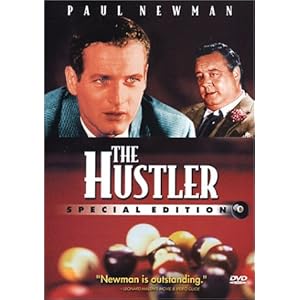
The Hustler

Airing for five seasons between 1959 and 1964, The Twilight Zone produced countless classic episodes, shows that have lived on over the last 50-plus years.  I can think of a dozen or so that I could rattle off, one better than the next. One that always stuck with me though starred Jonathan Winters and Jack Klugman as an established pool shark, a legend, and the up and coming shark looking to make a name for himself. Somewhere, sometime in my head, I convinced myself that it was the basis for 1961's The Hustler. Not quite, but the basic premise and set-up is similar.

Even more than three years since his death in 2008, it's hard to believe that Hollywood acting legend Paul Newman passed on.  He was and is one of the greats, a movie star and an actor. What is odd though -- for me -- is that I was always a fan of his without actually seeing many of his movies.  As I seek more of them out, I've come to a realization. Newman's performances are rarely if ever in question. His acting is almost always top-notch. It's the movie as a whole though that doesn't always quite live up to expectations. I'm not quite sure where 'The Hustler' falls.

A pool hustler who travels the backroads and little towns looking for a game, Eddie Felson (Newman) has his sights set on a living legend in pool halls, Minnesota Fats (Jackie Gleason). He gets his wish, playing Fats in a marathon game of straight pool, even going up as much as $18,000 at one point. Eddie pushes too far though and keeps playing, losing it all and putting him right back where he started. Eddie meets Sarah (Piper Laurie), a similarly jaded individual with her fair share of problems, the two bonding through their problems and finding someone else exactly like the other. Eddie starts to scrape together money, hoping to get a rematch with Fats, even signing on with shady gambler/bookie/businessman, Bert Gordon (George C. Scott), to bankroll him. All Eddie wants is a shot at Fats, the money doesn't mean much. He wants the fame, the reputation, the recognition, but for him, it may be too late.

Cool Hand Luke is my favorite Newman movie, and probably my favorite role of the actor's, but I think this may be his best acting performance overall.  I've always liked Newman as an actor because he's very natural onscreen, but he is also actually acting. He's capable of humor and high drama and everything in between.  This is a part that certainly leads to the high drama.  Eddie -- dubbed Fast Eddie for his hustling ability -- is at first just a young rising star who wants his shot at the legend. It's quickly apparent that his ego and pride is going to get the best of him.  He is obsessed, hitting rock bottom immediately. His character is so blinded by his drive that he doesn't realize he's destroying himself in the process of trying to better himself.  Newman dives into this character head first, committing from the get-go, and he brings this tragic character to life vividly.

There is a style to so many 1960s movies that is just hard to explain. They're cool because they're cool, and they know it. They don't have to try to be stylish or edgy. They just are. Director Robert Rossen here turns in one of the most effortlessly stylish and cool movies I can think of. The movie is shot in black and white which I'm always a fan of. It's easy to say now because I've already seen the movie in B&W, but it's hard to imagine it in color. As is, the movie is stripped down and bare-bones. It just works that way, reflecting what's going on in Eddie's head. Anything extra or not essential gets thrown by the wayside. The best parts of the movie are shot in smokey, dingy pool halls, but there is an unexplained coolness to them. Maybe just because its the 1960s, maybe it is the jazzy score from Kenyon Hopkins, the movie is fun to watch.

With a movie that runs 134 minutes, there are moments of perfection followed by stretches of dullness and boredom. The introduction is classic in the pre-credits sequence, and the epic duel between Eddie and Fats is a landmark sequence that goes on for most of a half hour (Newman and Gleason doing a lot of their own trick shots too, impressive). I would have never thought watching pool would be fascinating, but 'Hustler' proves otherwise. Gleason is a scene-stealer, and he basically has about 14 lines of dialogue. He's impeccably cool and calm, understated and confident in his ability. Just when Eddie thinks he has him, Fats cleans up, puts his jacket back on and is ready for a new round. You feel intimidated just watching him, much less playing him. Gleason disappears then until the end, but he makes every second onscreen count.

This early pool marathon session does two things, it sets the story off at a brisk, exciting pace (the good), and then lets the story sink some (that's the bad for those slow readers out there) in terms of pacing.  After the game, the story just lags, boring me as Eddie meets equally troubled Sarah (Laurie does a fine job with the part). The character study is interesting, seeing what makes this man tick, but I got bored seeing it develop. Scott's reappearance late as Gordon is a movie-saver, adding a dark, seedy element to the story. The ending is quite a downer, but in an appropriate way, a fitting end for Eddie. I loved Newman's performance, liked other parts of the movie, and was bored in still others. A mixed bag, but still a good movie.

The Hustler <---trailer (1961): ** 1/2 /**** 

Monday, April 27, 2009

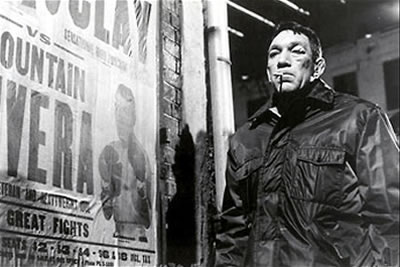
Requiem for a Heavyweight

Sports movies have covered a wide variety of topics over the years. The genre's got so many stories that anything from comedy to serious drama to thriller can be handled within a sports story. A forerunner of sorts for Martin Scorcese's Raging Bull, 1962's Requiem for a Heavyweight is a sports movie that may seem like something you've seen before, but that's because it was an original, a movie that set the stage for other similar movies to come along.

In a fight with Cassius Clay, veteran boxer Luis 'Mountain' Rivera (Anthony Quinn) takes quite a beating before being knocked out late in the 7th round. It's after the fight a doctor tells Mountain that he's done. A couple more punches to the head and he may lose his eyesight completely. So what to do now? Boxing is all Rivera's known, and after 17 years in the ring he's now forced to look for something new, a completely different career. He might have found an answer in Grace Miller (a great supporting part for Julie Harris), a social worker who sees the potential Mountain has.

Released in 1962, director Ralph Nelson's movie could have been straight out of the late 40s when film noir was at the top of its game. If I hadn't seen the release date, I would have said it was film noir, maybe running in a double feature with 1949's The Set-Up with Robert Ryan. Filmed in black and white, almost every scene is full of shadows and characters sitting in the darkness.

Not a 'name' director, Nelson had a string of moderate successes in the 1960s and 1970s but never became a huge star. Too bad because of the movies I've seen, he was a talented man behind the camera. He had an eye for the visual and wasn't just content to point the camera at the actors and shoot. Nelson thinks outside the box with Requiem, making shots that could have been ordinary something memorable. The movie opens through the eyes of Mountain as he's pummeled by Clay. The scene goes on for several minutes as he wakes up and groggily walks from the ring with his manager and cut-man. The technique is repeated in the finale and is used equally as effective.

But what most movies come down to isn't how the director shoots scenes or even the storyline, it can be all about the actors. The three main leads make this movie, especially Quinn as Mountain Rivera. How he wasn't nominated for his performance here by the Academy escapes me. In a career of making countless characters come to life, this is one of his best. Rivera is a kid in a man's body that's taken years of abuse in the ring. He's still got an innocence to him, and he trusts those around him, even when everything points to doing just the opposite. Truly one of Quinn's finest performances.

Right behind him are Jackie Gleason and Mickey Rooney as Maish Remmick, Mountain's manager, and Army, his cut-man who's taken his own share of abuse in the ring. Maish at one time probably had Mountain's best interest at heart but now with his fighter's ability declining, he makes a decision that could tear them apart. Gleason makes the character both sympathetic and despicable depending on which scene you look at. After coming into the public eye as Judy Garland's boyfriend, Rooney shows how good an actor he was. Like a big brother, Army looks out for Mountain's well-being when no one else does. This trio has a history together that goes back many years, and it's a credit to the three actors for making it believable.

At under 90 minutes, this isn't a long movie, but in a short time the audience feels like you've gotten to know the characters and their history and relationships. It all builds to a heartbreaking ending for Mountain, one that shows the true colors of the character. He's a boxer who's best days have passed him by, but that doesn't mean he still can't help those around him. One of the best and underappreciated movies to come out of the sports genre with a great performance from Quinn. With a screenplay from The Twilight Zone's Rod Serling, it's about as can't miss as a movie can be.

Requiem for a Heavyweight <---trailer (1962): *** 1/2 /****