The Sons of Katie Elder

The Sons of Katie Elder
"First, we reunite, then find Ma and Pa's killer...then read some reviews."
Showing posts with label Lee J. Cobb. Show all posts

Wednesday, December 30, 2015

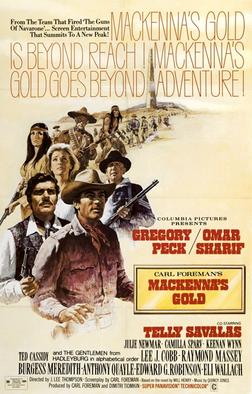
Mackenna's Gold

Oh, cable, how I love you. I basically have two channels on if I'm watching TV, either MLB Network or Encore Westerns. A whole channel devoted to western TV shows and movies?!? Aaahhh my head just exploded! It gives me a chance to revisit a whole bunch of movies I haven't seen in years, like 1969's Mackenna's Gold, a big-budget, all-star extravaganza that I remember liking (I think) on my first viewing. Does it hold up?

A marshal for the western town of Hadleyburg, Mackenna (Gregory Peck) is out on the trail when he's ambushed by an old Apache man who dies after a quick shootout. Before he dies, the Apache gives Mackenna a map to a famous, supposedly lost, canyon of gold ('Canon del Oro') that treasure hunters have long sought. Mackenna throws the map in the fire but not before noticing a couple landmarks on it. He's soon cornered by a Mexican bandit, Colorado (Omar Sharif), and his gang who similarly are looking for the canyon of gold. They're not alone. The desert seems full of treasure hunters and gold-hopefuls desperately searching for the gold. Discovering that Mackenna may hold the key to finding the canyon, he's taken along as Colorado's unwilling prisoner. The supposed location is days away across the vast desert with Mackenna, Colorado and his men forced to deal with a do-good posse out of Hadleyburg, an intervening cavalry troop and an Apache war party. How far will the prospect of gold drive all these folks?

I'm a sucker for westerns -- good and bad -- but this one is bad and just not that enjoyable. Talk about a movie where the ingredients don't come together (at all), and you've got this movie. The talent on-hand is unquestionable from director J. Lee Thompson, stars Gregory Peck and Omar Sharif leading a ridiculously deep cast, a cool, potential-filled story and a drop-dead look to it all...it should have been so much better. Or I guess I'd settle for just 'good' too. The formula seems to go after a western Guns of Navarone meets Treasure of the Sierra Madre combination, but it never jells into anything remotely coherent or especially enjoyable. That's tough to say because a cast this good should make a movie pretty decent on its own but alas, it wasn't meant to be this time! If you're looking for a Peck-Thompson-Carl Foreman pairing, stick with 'Navarone.'

Kudos to Encore Westerns. Watching the movie for the second time but first time since 2009, I watched it in widescreen, as it was meant to be. Thompson filmed in Super Panavision 70, a filming technique that fills the screen to epic proportions, almost like a panoramic picture. Shooting on-location in Monument Valley, Glen Canyon and Canyon de Chelly in Arizona adds a great visual appeal to the movie. Shots of riders galloping across these expanses are excellent to watch, a sight to behold, and unfortunately, one of the few genuine positives to take away from a western that's too long at 128 minutes. When a movie's looks are the best thing going...that's never a good thing.

Poor Gregory Peck, he looks like he's as bored as all get-out and doesn't quite know what to do. One of my all-time favorite actors, he's undone by all the shenanigans going on around him. Getting to play straight man to a murdering bandit, a gold-for-eyes posse, a bloodthirsty Apache war party, a murdering cavalry sergeant (an underused Telly Savalas), and all sorts of ancient legends coming to life is never a good thing. As reliable as anyone who's ever graced the screen, Peck is given little more to do than look out for Camilla Sparv's damsel in distress while navigating a love triangle with Julie Newmar's Apache warrior and Sparv. Yeah, you read that right. Catwoman plays an Apache warrior and looks great doing it! She even gets an odd nude swimming scene where she tries to kill both Peck and Sparv. So there's that!

So much of the rest of the cast is simply miscast. I like Sharif in just about any film he's ever done, but he's an odd choice to play our Mexican bandit, Colorado. His gang includes Keenan Wynn as a Mexican bandit named Sanchez, with Ted Cassidy (Lurch from The Addams Family), Rudy Diaz and Robert Phillips as Apache warriors. All spot-on casting! Brace for this list of appearances that amount to little more than cameos, members of a "posse" out of Hadleyburg that's looking for gold. The group includes Eli Wallach, Anthony Quayle, Lee J. Cobb, Burgess Meredith, Raymond Massey and Edward G. Robinson!!! Look at that Hollywood royalty! Unfortunately, they're introduced, given nothing to do and there basically because of their name recognition. So....yeah....there's that! Quite the cast, huh? I just wish they were given more to do. Maybe that character development was cut from the rumored 3-hour version of the film. Yeah, that's it I'm sure.
  
Just too many moving pieces that never get going in the same direction. There's virtually no story, just some character introductions and then they're off into the desert. The only detour are various ways to kill off characters in waves. Then, there's the beautiful location shooting, with a slight problem. Countless times, one after another, we see the location shots and then a quick cut to our actors in front of a rear projection shot. Nothing takes you out of the story's momentum like Peck, Sharif and Co. riding a "horse" as they tear across the desert. Throw in some odd, out of place narration (it's not Victor Jory's fault!), some painful theme ballads, and generally odd cutting and editing that is more and more jarring with each passing scene.

There's a meanness to the story that's hard to account for. Characters are introduced for the sake of dispatching them in unceremonious fashion, but the general tone of the movie itself isn't that dark. It feels like they're going for that "Greed will make you do horrible things" tone, but it's too light, fluffy and goofy to pull it off. There's some potential obviously with the all-star cast, some equally impressive camera angles and shots, and the location shooting, but there's just too much negative going on to ignore it. A stinker.

Mackenna's Gold (1969): **/****

Tuesday, July 29, 2014

The Man Who Loved Cat Dancing

If I know a movie is based off a book, I typically try to find that book before jumping into a viewing. Some are easier than others -- in terms of film and literature -- to track down so you take them when you can. I stumbled across The Man Who Loved Cat Dancing several years ago at a local library knowing it was also a feature length film. I didn't especially care for the book, but there was some potential. Now as for the movie....that proved difficult tracking it down. That is until TCM aired it recently. Here we are with the film adaptation, 1973's The Man Who Loved Cat Dancing.

Having pulled off a successful train robbery at an isolated part of the desert, outlaw Jay Grobart (Burt Reynolds) and his gang ready themselves to ride off with thousands of dollars in their saddlebags. The gang is in for a surprise though. A woman, Catherine Crocker (Sarah Miles), has accidentally ridden up and witnessed the entire robbery. With no alternative, the gang brings her along as a hostage of sorts, knowing a posse will be along soon enough. Jay and Co. put some miles between them, but they're right. A posse is following their trail, a Wells Fargo agent, Lapchance (Lee J. Cobb), and Catherine's worrying husband (George Hamilton), leading the way. With Catherine in tow, Jay continues on the getaway as planned. That route takes them right into Indian territory where Jay has a to this point unspoken plan he intends to bring about.

I can't say I went into this flick with high expectations with a pretty decent memory of the novel from author Marilyn Durham. Still, I'm having more and more trouble tracking down westerns from major studios I haven't seen before so I wanted to give it a fair shot. The cast was impressive enough. The story had potential, even if I felt like the novel wasted much of that potential. So clean slate going in, 'Man' still didn't do it for me. It isn't quite the ultra-dark vision of so many other revisionist westerns of the 1970s, but it does try for some sort of reality. The west as presented is violent, unpleasant, gritty and dirty where survival is as much about luck as anything else. What is this western from director Richard C. Sarafian missing then? While there are performances that are worth mentioning, the movie itself simply isn't interesting.

One of my pet peeves in westerns is unnecessarily jamming a love story into an otherwise good story that doesn't NEED a love story. Well, sticking to the Durham novel, 'Man' rides along with the love story that develops between Jay and Catherine. The odd thing isn't that the love story there. It's how it develops. Catherine is actually running away from her husband, and we find out she is a lady at basically all times. How's that? Yeah, she doesn't like sex to the point she's embarrassed by it. Does her husband abuse her? Could be although it's never spelled out. Naturally, Catherine gets some Stockholm Syndrome for Jay who is rough with her and doesn't baby her. She falls madly in love with him even when we find out about Jay's rather checkered past, especially with his dead wife, an Indian woman named Cat Dancing. It plays out in odd fashion and seems like an odd fantasy to have, like something you'd see in a schmaltzy romance novel.

So beyond that, the performances are pretty decent. It's cool to see Reynolds sink his teeth into a meatier performance, a heavy dramatic part. He's always good in lighter comedy roles, but give the guy credit. Reynolds was a solid dramatic actor when he wanted to be, and the anti-hero good guy turned bad guy in a western with a checkered past is a familiar western archetype. Miles does her best with what I found to be a poorly written character. Her chemistry is good with Reynolds, and she has a memorable moment here and there, but the character's intentions and motivations float all over the place. Lee J. Cobb is underused as the Wells Fargo agent while Hamilton is kept in the dark with another poorly defined character. He's shown as a bit of a dandy, a gentleman more interested in what people think of him than actually getting his wife back, but like so many characters we don't find out enough about him. As for Jay's gang look for Bo Hopkins and Jack Warden as despicably bad outlaws with Jay Varela playing Charlie, the one decent member of the crew. Also look for Robert Donner and Jay Silverheels in supporting parts.

A disappointing end result. At 123 minutes, it is far too long, possibly in an effort to be dreamlike and.....nah, just slow-moving. The soundtrack isn't memorable in the least, and while there is some beautiful on-location shooting, the movie just dreary-looking from beginning to end. The finale could have saved the movie some, but even there the brakes are tapped in a big way to make things a happy Hollywood ending. A meh movie in the end.

The Man Who Loved Cat Dancing (1973): **/****

Monday, April 21, 2014

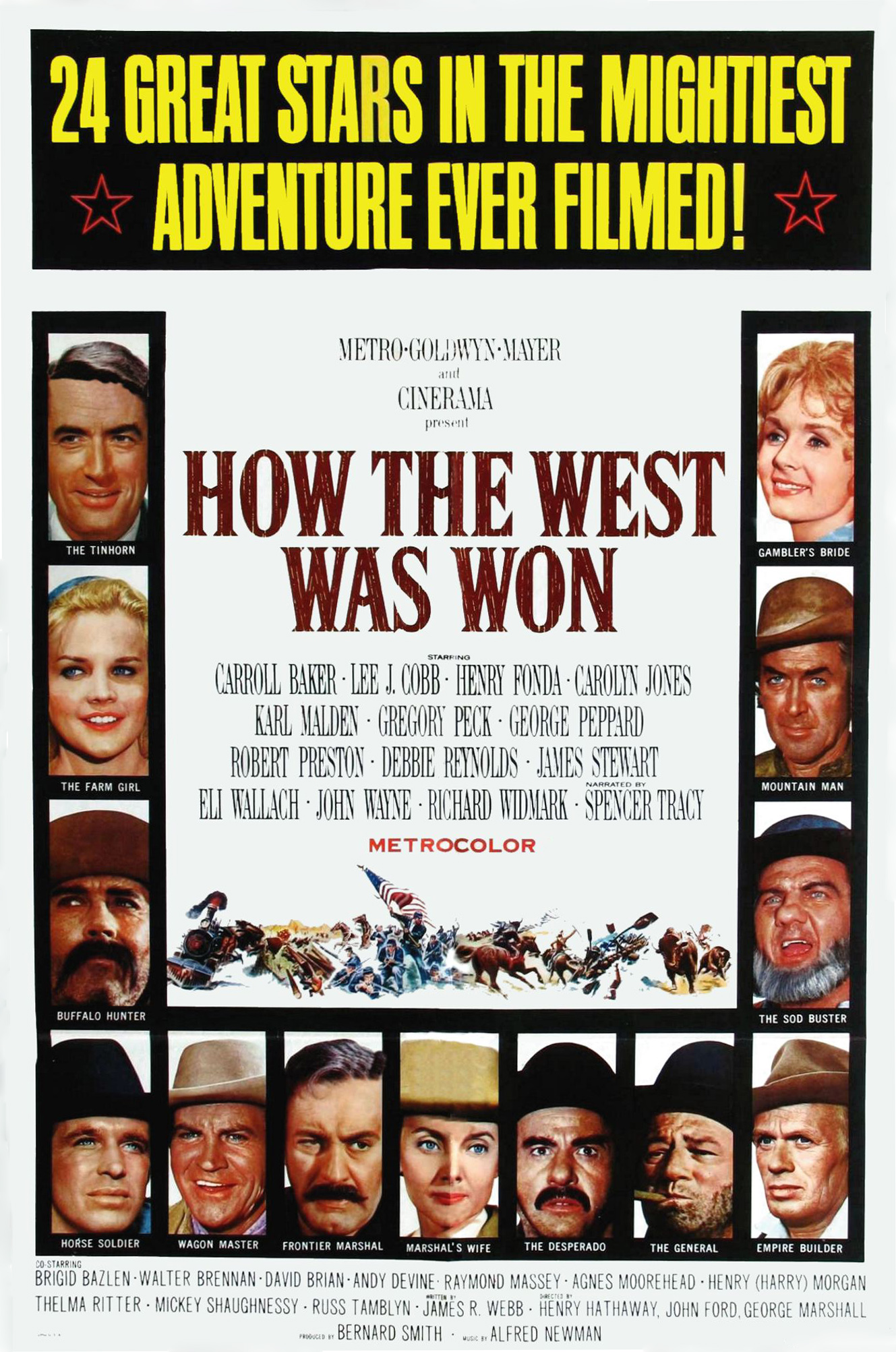
How the West Was Won

In the age of the epics -- the 1950s and 1960s -- some just stand above the rest. It's the stories, the cast, the scope. I don't love 1962's How the West Was Won but as far as epics go, there are very few in its neighborhood. There are obvious flaws, but when it works, it works in a big way. An impressive all-star cast, a story about the development of the American west and a shooting technique that is must-see. That's a winning formula.

A 162-minute film is broken up into five separate segments, the story following the Prescott-Rawlings family as it moves west and settles between the 1840s and the 1880s. It was directed by three different directors and covers a ton of ground. And away we go!

1. The Rivers (directed by Henry Hathaway): It's the 1840s, and the Prescott family, led by patriarch Zebulon (Karl Malden), is moving west and looking for a new life. In Zebulon's family is two daughters, Eve (Carroll Baker), looking for a new life in the west, and Lillith (Debbie Reynolds), wanting to stay in the far-more civilized East. In their dangerous travels on the rivers, they also meet Linus Rawlings (James Stewart), a mountain man with a canoe full of pelts.
Also starring: Lee Van Cleef, Walter Brennan, Agnes Moorehead, Brigid Bazlen.

2. The Plains (directed by Hathaway): Having worked for years on her own as a singer and dancer, Lillith Prescott (Reynolds) has just inherited a gold mine in the wake of the California gold rush. She heads west on a wagon train led by trail driver Richard Morgan (Robert Preston) with a gold-seeking gambler, Cleve Van Valen (Gregory Peck), also along too. 
Also starring: Thelma Ritter.

3. The Civil War (directed by John Ford): The war between the states in its early months, young Zeb Rawlings (George Peppard) leaves home with the blessing of his mother, Eve, to join the Ohio volunteers in the fighting. Like so many others, he thinks the war will be full of glory and be over quickly. Zeb finds out how very wrong he is at the bloody battle of Shiloh.
Also starring: John Wayne (as General Sherman), Russ Tamblyn (as a Confederate deserter), Harry Morgan (as General Grant), Andy Devine, Ken Curtis, Raymond Massey (as Abraham Lincoln).

4. The Railroad (directed by George Marshall): In the years following the Civil War, railroad companies race across the U.S. to link the two coasts. Now in the cavalry, Zeb Rawlings (Peppard) finds himself balancing out what his duty requires of him with what he knows is right, the railroad, including brutal supervisor Mike King (Richard Widmark), pushing the Arapahoes to their limit.
Also starring: Henry Fonda as Jethro Stuart, a former mountain man.

5. The Outlaws (directed by Hathaway): Having left the cavalry behind, Zeb Rawlings is now a family man with two kids, now trying to leave his profession as a lawman behind. He receives a letter from his aunt, Lillith (Reynolds), and readies the family to move. As they travel though, Zeb runs into Charlie Gant (Eli Wallach), a notorious outlaw gunning for Zeb.
Also starring: Lee J. Cobb, Carolyn Jones.

This is a movie that's simply put, BIG. It was filmed in Cinerama, three cameras filming each scene and then splicing the action together. The result? An immense look at the expansion of the west. Shots look like panoramic paintings, putting a whole new scope on the growth and development of the American west. It is a beautiful movie. Certain sequences especially stand out -- the camera on a raft trying to survive river rapids, an Indian attack on a wagon train, a stampeding buffalo herd trampling a railroad camp, a runaway train during an attempted robbery -- over the course of the movie, but visually there just isn't a weak spot. I love composer Alfred Newman's score -- listen to an extended sample HERE -- as it gives a moving background to the story. Countless gorgeous filming locations, providing a great backdrop while also transitioning from segment to segment.

It had been years since I watched this movie straight through in one sitting before my recent revisit of this 1962 epic. As you compare the five separate segments, I don't think it's really in question which one is the strongest. It's John Ford's Civil War segment, doing in 20 minutes what entire movies couldn't do in bringing the Civil War to life. Quick, dark, visually striking and unsettling, it is a gem of a sequence, especially Peppard meeting Tamblyn's Confederate deserter after the battle. The second strongest segment for me is the opening 'Rivers' with Stewart, Baker, Reynolds and Malden all leaving a positive impression. All five segments could be stretched out to a feature length film on their own, but these two especially stand out. They get their message across in a quick window and in both cases left me wanting more. Kudos to Ford and Hathaway for their work here.

What struck me more on the rewatch was the other three segments. They are by no means bad segments, but they're just not as good as the other two. I've always thought the weakest was the Plains segment, things feeling too rushed in general. The same qualifies for the Railroad and Outlaws portions. By the time you take away the Entr'Acte, intermission, and Finale music, we're looking at a movie with five segments covered in about 150 minutes (give or take). None of these three are given a chance to breathe to the point they feel downright rushed. As for some other positives? I loved the transitional scenes -- narrated by Spencer Tracy, directed in uncredited fashion by Richard Thorpe --  that set things up, explaining how America has changed, how its people change. These quick montages provide the heart of the movie, almost like a documentary in some ways. Like any movie that tries to accomplish so much, there's good and bad. The positives -- especially the Civil War middle -- is enough to outweigh the negatives thankfully.

One of my biggest worries in reviewing this 1962 epic was that the cast is too big. There's no way I was gonna be able to get all those names tagged with a 200-character limit. Who stands out? Stewart i excellent as Linus Rawlings, Fonda is good in a quick part as Jethro Stuart, and Baker is very strong too. The best parts though are Debbie Reynolds as Lillith and George Peppard as Zeb, the two hearts of the family. One or both is in every segment, the audience seeing them age, learn and adapt as America grows with them. Their scenes together in the Outlaws portion ring especially true. However you cut it though, just an impressive cast from top to bottom, one of the best ever assembled for a Hollywood film.

A doozy of a movie for what it's trying to accomplish. It falls short at times, but this is a movie worth watching for what it represents alone. This is a throwback film, a true epic that strives to be something great. If it doesn't live up those high hopes, so be it. The effort is admirable, a fascinating story of America growing up over an extremely turbulent portion of its history. Oh, and Debbie Reynolds singing A Home in the Meadow (listen HERE) is a truly beautiful song, a fitting one for the movie.

How the West Was Won (1962): ***/****

Tuesday, February 4, 2014

Macho Callahan

I take pride in the fact I've seen a lot of westerns. It's my favorite genre, and I do my best to see as many as I can from lousy B-westerns to more polished, big budget ventures. The beauty of having that genre you like though is that if you keep on looking and exploring, you're going to find those little-known gems that don't have a big reputation. I can add 1970's Macho Callahan to that list.

It's late in the Civil War, a man named Macho Callahan (David Janssen) just released from solitary treatment at a brutal Confederate prison camp deep in Texas. He's been waiting to put into operation his plan for a mass escape, and in execution, it works. In a bloody breakout, Callahan escapes the hellish prison camp, managing to meet up with his former partner, Juan (Pedro Armendariz Jr.), with some revenge on his mind. How exactly did Callahan -- not a soldier -- end up in the prison camp? Well, now he's searching for the man, Duffy (Lee J. Cobb) that ended up putting him there. Callahan and Juan must first track Duffy down though, but it's not going to be easy. There is a reward on Callahan's head, a rather lucrative one, and every bounty hunter, gunman and two-bit killer in the state is looking for him.

Wow. This was one nasty, dark, brutal western. The spaghetti westerns had helped tweak the western genre in a big way already in the late 1960s (and continuing into the 1970s), giving it that cynicism, that darkness that just hadn't been there in most American westerns. Well, this entry from director Bernard L. Kowalski is one of the darkest, dirtiest, meanest westerns I've ever seen, and that's a good thing. Part of it is the look of the film, all the characters dirty, sweaty and sporting all sorts of unkempt hair and beards. It sounds simple, but that goes a long way. 'Callahan' looks and feels like we're there with the characters, a visceral, authentic peek into the not so glamorous wild, wild west. I liked composer Patrick Williams' score too, not used a ton but doing a good job of building that tension and doom.

It's more than just the look though. It's something else. This is a movie with a vicious mentality. This is brutality at its worst. This is a meanness that permeates the movie. That starts in the opening, quite-startling sequence set in the Confederate prison camp. The place looks filthy, disease and grime hanging in the air. We see a cook gutting a cow, its entrails falling from the body. The prisoners waste away, waiting for their chance to escape. This sequence was disturbing in its tension, in its reality, but it sets the tone immediately, especially with the bloody, gruesome escape. That incredibly dark mood sticks around throughout the movie. The violence is bloody and graphic and uncomfortable. No one...NO ONE, is safe. Characters are killed off with the snap of a finger. At one point, Janssen's Callahan even shoots a buffalo. There's just something hanging in the air here. No romance, no beauty, no charm of the old west. This is life, where survival reigns above all else.

A TV star from The Fugitive, Janssen doesn't scream western star, but his brooding, intense Callahan is a pretty interesting lead character. Early on, he's almost completely blinded by his desire for revenge. There's more to the character of course, and without giving away much in the way of spoilers, it comes courtesy of Jean Seberg's Alexandra, a widow who wants nothing to do with Callahan but is forced to travel with him and Juan on the trail. It's not quite a love story, but feelings do develop, two lonely people finding a friend of sorts in a nasty world. Janssen also has a solid chemistry with Armendariz Jr., a familiar western dynamic between two partners, two bandits who seem to be constantly on the run. I really liked the duo, neither stars but both very capable actors.

The rest of the cast is just as solid. Along with Lee J. Cobb, look for James Booth, Bo Hopkins, Diane Ladd, David Carradine, Richard Anderson and Matt Clark. Some of the parts are bigger than others, some just a scene or two. As I mentioned earlier though, 'Callahan' isn't interested in reputation or star power. Characters are killed without warning from beginning to end here, keeping you guessing from scene-to-scene what's going to happen. This isn't glorious, romantic death either, but an unceremonious, lightning-quick fate. One second you're there. The next second you're not.

I don't know if saying I liked this movie is an apt description. It's a tough movie to like, but to watch and experience it a little bit? Yeah, that's more appropriate. Things drag some in the second half of the 99-minute movie, but as the ending approaches, momentum picks up to the inevitable, appropriately unceremonious ending. No big shootout, no big gunfight, just an ending. There's touches of the surreal too, Callahan, Alexandra, Juan and a baby bear on the trail. Don't question. Just go with it. The whole movie is a trip.

Macho Callahan (1970): ***/****

Wednesday, July 24, 2013

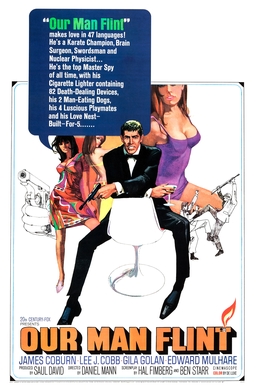
Our Man Flint

By 1966, the James Bond series was up and running, international hit one after another with Dr. No, From Russia With Love, Goldfinger and Thunderball already hits with audiences. Where there's success, comes knockoffs though, and the spoofs weren't far behind. One of the first to follow in Bond's footsteps was 1966's Our Man Flint.

All around the world, horrific weather catastrophes are wreaking havoc. What's the cause? Three scientists working for international criminal organization Galaxy have created a weather machine that can cause thunderstorms, hurricanes, tornadoes, volcanic eruptions. Galaxy demands that all the world's nations capitulate to them, but a N.A.T.O.-like organization, Z.O.W.I.E. (Zonal Organization for World Intelligence and Espionage) has one last solution; get super-spy Derek Flint (James Coburn) out of retirement and let him try to take out Galaxy and its weather weapon. Flint is a hard sell, but he takes the job eventually. There is little in the way of clues and no idea where Galaxy's base is. Flint pursues the one piece of evidence he does have, but Galaxy and its henchmen are waiting for him.

As a huge fan of the 007 series, I'll give any spoof a shot. I'd seen In Like Flint (the sequel to this 1966 original) and liked it if I didn't love it, the same for Dean Martin in the Matt Helm series. From director Daniel Mann, 'Our' is a solid if unspectacular entry into the spy spoof genre. It pokes fun at James Bond, even mentioning a rival and fellow agent of 007, his code name Triple-O 8. At one point, Flint even brings up Spectre, Bond's main rival, and calls 007's Walther PPK, booby-trapped briefcase 'crude.' It knows where it's coming from and has some fun with it while still paying tribute, not like the goofier but still funny Austin Powers series.

The biggest thing going for both movies is the casting of James Coburn as Flint. Already a star thanks to his parts in The Magnificent Seven, The Great Escape and Charade (among others), Coburn wouldn't seem like an obvious choice to play Flint, but he makes it is own. Up until this point, he was more of a stoic anti-hero and man of few words. It's a showier part here but never an obvious one. Coburn's Flint is an epically successful ladies man, knowledgeable about anything and everything, and a specialist in karate and hand-to-hand combat, disliking the brutality of guns. His lankiness, that charming smile, that ever-calm demeanor, it all adds up to make a great character. At one point, he pursues a lead because he knows the ingredients to bouillabaisse, visiting every restaurant in Paris until he can find it, just knowing how it would taste. There's some pressure playing the American James Bond, but Coburn kills the part.

What's lacking though beyond Coburn is any more memorable characters behind him. Lee J. Cobb is a scene-stealer as Cramden, the Z.O.W.I.E. commander and Flint's former commanding officer, always trying to keep tabs on his agent but usually just going along for the ride. Gila Golan is the gorgeous Flint girl, playing Gila (original name, huh?), a Galaxy member tasked with bringing in Flint, preferably alive and before he can complete his mission. The main villain is Malcolm Rodney, played by Edward Mulhare, but he lacks any real charisma, any punch in terms of an intimidating Bond villain. He never really poses a threat to Flint, too bad because his henchman, Gruber (Michael St. Clair) is dispatched far too quickly. The three quasi-evil doctors are played by Benson Fong, Rhys Williams and Peter Brocco. As for Flint's harem of beautiful, scantily clad women, look for Shelby Grant, Sigrid Valdis, Gianna Serra and Helen Funai, around as eye candy without more than 10 words said among the four.

The rebellious, roguish super spy, the sexy women around every corner, the impregnable island fortress, the power-hungry villain, the impossible situation that screams suicide. This spoof has all the touches of a good Bond film, but just in the laugh department it is missing that special something that could bring it up a notch or two. It only runs 107 minutes, but it drags, especially in the second half. One episodic set piece to another, they don't always add up to a really good final product. Through it all, Coburn's laconic, smart-assed Flint makes it worthwhile, but it's not a classic. Just an enjoyable movie that's good for a couple laughs.

Our Man Flint (1966): ** 1/2 /****

Monday, February 25, 2013

The Left Hand of God

The lives, missions, and beliefs of priests lends well to film adaptations. Think of movies like Keys of the Kingdom, I Confess, The Mission, The Scarlet and the Black, Going My Way, Boys Town and many others. How about a priest sub-genre? Priests who aren't what they seem, films like 1972's The Wrath of God and 1955's The Left Hand of God.

It's 1947 in a remote province of China, and Father O'Shea (Humphrey Bogart) is on his way to an isolated Catholic miss deep in the hills. His predecessor was killed, and the mission is has been missing a priest for months. Three other Americans await, Dr. David Sigman (E.G. Marshall), his wife, Beryl (Agnes Moorehead), and Anne (Gene Tierney), a widow working at the mission. O'Shea's work is cut out for him, the local villagers happy he's there but also worrisome about his arrival. The biggest problem though isn't from the villagers though, but instead the new priest. O'Shea has a secret that threatens to tear the village apart. One of the few men who knows the secret? A warlord, Mieh Yang (Lee J. Cobb), who with his small army of killers poses a huge threat to the poor farming villages.

Based on a novel by William Barrett, this priestly-based story went through its fair share of incarnations and stars before it finally ended up in the hands of director Edward Dmytryk who eventually decided Bogart would be an ideal choice for the part (Kirk Douglas and Gregory Peck were attached to star in earlier incarnations). The film itself is nothing classic, nothing particularly different or unique, but it is nonetheless an enjoyable, well done movie that I was interested in from beginning to end. I'll say it again, familiarity can be a good thing when handled right (read: not boring). Substituting Malibu Canyon, California for China doesn't seem like an obvious choice, but it works in the same way MASH did replacing California for Korea. Composer Victor Young's score is a step above the rest, not your standard epic score.

After reviewing We're No Angels in late 2012, here's another Bogart film from late in the Hollywood icon's career. With Angels, The Harder They Fall, The Desperate Hours and this film (his last four films before his death in 1957), Bogie takes somewhat atypical roles. They're different, not just typical tough guy parts. Semi-spoiler alert......Bogie isn't a priest, taking the disguise and cover story to escape a troublesome situation. I won't spoil the details here, but an effective flashback lays it all out. It's not a showy or scene-stealing part by any means, but there's something charming about it. Bogie's Jim Carmody -- formerly Father O'Shea -- is quite capable of handling himself but there's a certain element of his lifestyle and past that makes him vulnerable.

Without ever becoming sappy, 'Hand' does a fine job of developing the character. We see his interactions with the cynical Dr. Sigman, a physician trying to consider the bottom line and frustrated with Chinese ways, with the widowed Scotty who sees him for the good he does, and most importantly, the Chinese villagers. Converts to Catholicism, they're seeking answers while also looking for a priest to lead the community. Several scenes show Bogie's Father O'Shea interacting with the village children, a good running bit that could have been pushed too far but knows when to tap the brakes. Bogie does a great job with these scenes, especially with his village assistant/quasi-altar boy, John (Victor Sen Yung), and also talking things out with a father (Benson Fong) who loses his wife and newborn baby minutes apart.

Clocking in at just 87 minutes, 'Hand' lacks the epic scale that the story could have required. It's pretty straightforward and to the point but never in a bad way. Marshall, Moorehead, and Tierney all provide solid support for Bogart, three differing performances that show a variety of responses to his arrival and impact. Cobb as the Chinese warlord is an odd choice to play....well, a Chinese warlord, but he avoids being stereotypical or cliched. Bad eye makeup? Yes. Bad performance? No, it could have been awful. Also look for Philip Ahn in a small part as Yang's assistant. Nothing flashy, but I liked this one a lot, especially for a late role for Bogie, and a goodie at that.

The Left Hand of God (1955): ***/****

Thursday, October 25, 2012

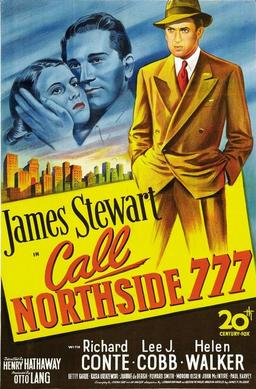
Call Northside 777

This is going to sound simple, but certain movies make me think of the message. Watching old films from basically any Hollywood film is one of my favorite things to do. It can give a window into times long since past. We see towns and cities as they were, not as they are. An all-around solid quasi-documentary, film noir-ish mystery, 1948's Call Northside 777 is a gem.

A reporter for the Chicago Times newspaper, reporter P.J. McNeal (James Stewart) is given a new assignment. An 11-year old murder case from 1932 is in the news, both Frank Wiciek (Richard Conte) and Tomek Zaleska (an uncredited George Tyne) serving 99-year prison sentences for the murder of a Chicago police officer. Wiciek's mother, Tillie (Kasia Orzazewski), a blue collar worker if there ever was, has offered a $5,000 reward for finding the real murder, exonerating her son. McNeal writes the mother's story, but it grabs attention of readers who want more of this story leaving McNeal to explore the long-retired murder case. Ever the suspicious reporter, McNeal goes along but questions the case. Could Frank actually be guilty?

Based on a true story involving the murder of a Chicago police officer (read about it HERE, SPOILERS obviously), 'Call' is an interesting movie for all the right reasons. From director Henry Hathaway, it is part documentary, part investigative procedural, part film noir. The good thing? It moves among those three different genres effortlessly. Clocking in at 112 minutes, it isn't always the quickest-paced flick, but it moves around a lot so that's excusable. A story in the shadows, taking advantage of the black and white photography, it's a great movie to watch.

For me though, this movie is worthwhile for two reasons. One, Hathaway filmed on location in Chicago. This is a great window into late 1940s Chicago. Trivia question and answer for you, but this was the first Hollywood feature film to film on location in Chicago. Where so many films from the 1940s would limit themselves to Hollywood sets, 'Call' gets a whole lot of points for filming in downtown Chicago, but the suburbs as well. Curious what the Windy City looked like 60-plus years ago? This is your movie. The other reason; as a writer who's written for the Chicago Sun-Times, it's a great precursor for All the President's Men. We see how journalists and investigators worked in a pre-Internet age, doing their investigating the old-fashioned way. It's the little things, ain't it?

Already an established star by 1947, Stewart does a solid, workmanlike job as reporter P.J. McNeal. Cynical to a point because the job requires it, McNeal is skeptical of the whole case but takes it on because it's a decent story that readers are curious about it. As the real story comes out though, he starts to question even more, giving Stewart a good chance to flex a little dramatically. Go crusading journalist! Conte is solid in a supporting role as the possibly falsely-convicted Frank while Orzazewski is a scene-stealer as his mother, Tillie. Usually a tough guy actor, Lee J. Cobb plays Kelly, McNeal's editor at the Chicago Times. Joanne De Bergh has a small but essential part as Helen, Frank's wife who supports his innocence. Also look for John McIntire as a former state's attorney trying to cover his butt and an uncredited E.G. Marshall in a small part.

There are some oddities here I feel I have to point out. For a story that's built on the small details, the little pieces of evidence, the movie itself.....isn't. Several rather key questions go unanswered in the end. We find out what happens to Conte's Frank, but what about his supposed partner, Tyne's Tomek? Why is Cobb's editor so dead-set on following this story up? A backstory is hinted at, but never dealt with. The ending is effective, but with a 112-minute movie, it comes together a little quickly, almost like Hathaway ran out of time or money. Still, these are problems but not ones that can ruin a movie. Highly recommend checking this one out.

Call Northside 777 <---trailer (1948): ***/****

Friday, August 31, 2012

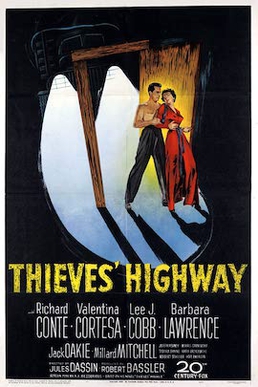
Thieves' Highway

I hate it when that happens. You know what I mean. A movie comes highly recommended in one way or another -- a friend, a movie review, an IMDB rating, a Netflix recommendation -- and you assume you're really going to enjoy it a lot...only to, well, come away somewhat empty. That was my biggest reaction from 1949's Thieves' Highway, a highly recommended if not hugely well-known film noir.

A war veteran returning home to his family and girlfriend, Polly (Barbara Lawrence) in Fresno, Nico Garcos (Richard Conte) is stunned by what he finds. His father has been crippled in a driving accident, but it's more than that. The circumstances were shady at best as conniving businessman Mike Figlia (Lee J. Cobb) also robbed him of $1,900 that he owed him in the process. Nico is enraged, wanting to exact revenge, and he concocts a plan with a down-on-his-luck truck driver, Kinney (Millard Mitchell), to buy and ship a truck-full of apples that Figlia would be interested in purchasing. Nico has his plan, but even he can't be too sure of what is in store for all involved.

From director Jules Dassin, 'Thieves' has a lot going for it. As a film noir, it is highly effective in its amoral portrayal of that seedy underbelly of the criminal black market. Conte is the anti-hero, revenge on his mind and little else. Cobb is the conniving, slimy Figlia, a villain without anything even remotely close to being a redeeming quality. The look of the movie -- much of it shot on location in Fresno and its markets -- is perfect; that blend of shadowy, smoky doom that film noirs specialized in. You just know nothing good is going to come out of that shadowy alleyway, don't you? It is a particularly nasty world, one of manipulation, greed, bribery, and a me-first and screw the rest sort of attitude.

So as a fan of incredibly dark stories, why then didn't I like this one? I can't quite put my finger on it. Maybe I've seen the darkness of such stories and it doesn't hit me as much as it might have audiences in 1949. Mostly though, I never felt a connection to any of the proceedings, whether it be the characters or the developing story. There was a little part of me that was incredibly amused by the portrayal of the seedy underworld of.....produce???? Yeah, I suppose the apple business is pretty cutthroat. I don't mean to minimize the movie like that, but it never felt quite as sinister as it could have. Yes, everyone is in it for themselves, and Conte's Nico wants to right a wrong and exact revenge on the man who crippled his father, but it's never truly an interesting story, for me at least.

The reviews I've read are almost uniformly positive about the casting, and I agree to a point. Many though tout Conte as delivering a career-best performance. I'm not seeing it. I'm a fan -- if not a huge one -- but I always think of Conte at his best in a key supporting role. When he has to carry a movie on his own, I've never thought too highly of those movies. Mostly, he doesn't look too interested in the revenge angle. His easy-going delivery is broken up by these quick outbursts of rage/anger, but they never felt even close to being realistic. On the other hand, Lee J. Cobb is at his best, a villain you love to hate. He has eyes for making as much of a profit as he can with no regard for anything else. If lives are destroyed in the process, so be it. He doesn't care as long as he's making some money.

The rest of the cast are familiar members from the Film Noir Stock Characters list. Valentina Cortese plays Rica, the subtly played hooker with a heart of gold. She takes some money from Cobb's Figlia to keep Nico busy, but quickly realizes the error of her ways (good timing, huh?). I didn't really see much in the way of chemistry between Cobb and Cortese either. Mitchell is solid if unspectacular as the equally ambitious truck driver, Kinney, while Joseph Pevney and Jack Oakie are underused as Pete and Slob, two rival truck drivers trying to move in on Nico's plan. Their bumbling partner act is played for laughs early, but thankfully, the duo takes a turn for the serious as things escalate.

Who knows? Maybe I'm missing something here. I've been guilty of that before. As a fan of dark, realistic stories, I thought this one sounded like a sure thing. The dog eat dog world portrayed in 'Thieves' is interesting on a small level, but it never amounted to much for me. Making it worse, the happy ending comes completely out of left field. At least stick to your guns. If you're going for dark, stay dark.

Thieves' Highway <---trailer (1949): **/****

Tuesday, July 3, 2012

They Came to Rob Las Vegas

In the late 1960s over a span of about three years, Gary Lockwood seemed to be a rising star in Hollywood. So what happened then? By the 1970s, he worked mostly as a guest star on television and B-movies. He's still kicking at 75 years old, but he hasn't been in a feature film since 1998. Whatever the reason, I'm still a fan, and I was glad to see a recent TCM airing of one of those late 1960s movie, 1968's They Came to Rob Las Vegas.

Planning the perfect robbery of an armored car headed for Las Vegas, aging crook Gino (Jean Servais) sees his plan fall apart in execution, and he's killed in the robbery. His nephew, Tony Ferris (Lockwood), is hurt hard by the news because he chose not to take part in the robbery, leaving family out to dry. Knowing what the plan was though, Tony picks up where the previous effort failed, working with a small team of friends and fellow crooks to take down the supposedly impregnable armored trucks of Alex Skorsky (Lee J. Cobb), a businessman trying to get a government contract. What Tony doesn't know though is a dogged insurance investigator, Douglas (Jack Palance), is also on Skorsky's trail, and the three men are on a collision course.

I stumbled across this flick several years back poking around at the IMDB but was never able to track down a copy until this recent airing on Turner Classic Movies. I was intrigued by this heist movie with an above average cast that I'd never even heard of. So why has it been brushed aside all these years? For starters, it is a tad leisurely paced at 124 minutes, countless scenes of the armored truck driving around to the amazingly bad jazz-themed soundtrack. It's hard to describe how bad the soundtrack is, but what's funny is that at other times it is spot-on perfect. Listen to part of it HERE. Even at two-plus hours, the story drifts too much, key background going unexplained, new situations and developments seemingly coming out of left field. And you know what's most surprising? I really liked it.

All bad to lousy things considered, this heist movie with U.S.-Spanish-French-Italian backing is a hell of a lot of fun. Yes, it is fun in that guilty pleasure, so bad it's good department, but the end result is the same. It's fun and entertaining, reeking of that suave, groovy late 1960s style. With backing from so many countries, we've got the feel of a modern spaghetti western -- bad dubbing galore -- with an international cast and Spanish filming locations and then we've got on-location shooting in Las Vegas, a city dripping with sleazy style. Seeing it in 1968? That's just an awesome city. Like the Bond movies or the B-movie Euro crime thrillers, there's just an unexplainable charm and style to 'Las Vegas.' Either you go along with it or you don't, and your take on the movie will probably hinge on that reaction.

What originally drew me in was the heist angle coupled with the casting. Lockwood is a worthwhile anti-hero, quiet and confident as he puts his plan into motion. He also gets the love interest, the very beautiful Elke Sommer as Ann, his girlfriend and inside source at Skorsky's headquarters. Not a great actress, but I don't think she was cast for her acting chops. Cobb and Palance aren't given a ton to do, but they get some points for just being there. Cobb's Skorsky is into the mob for money laundering and generally looks worried/nervous, building up for some large outbursts. Palance is Palance, a high-strung ball of energy just waiting to explode.

As a fan of heist movies and men-on-a-mission movies, I came away disappointed with one aspect of 'Las Vegas' and that's Tony's team of crooks. They include Leroy (Georges Geret), the smooth talking, suave veteran thief, Cooper (Fabrizio Capucci), the young hothead, Sal (Gustavo Re), the machinist with the acetylene torch, Merino (Daniel Martin), the lookout, Clark (Maurizio Arena), the chopper pilot, and Baxter (Enrique Avila), the quiet, assured thief. One quick scene with Tony laying out the plan shows this group has worked together before, but we never hear about it...at all. The team is cool because the story requires it, but when they inevitably turn on each other, it lacks any real punch. Interesting enough, but never developed enough either. A whole movie could have been devoted to Tony's crew.

That said, the heist and the aftermath -- no spoilers here -- are the highlights of the movie. The first 45 minutes are a tad on the slow side, but things pick up with the desert heist; Tony's crew attacking the heavily armored car in the middle of nowhere. The ending doesn't quite pay off like I'd hoped, leaving too much unanswered, but for some reason, I fell for this one. Not a classic and maybe not even that good overall, but worth a watch.

They Came to Rob Las Vegas <---Youtube montage (1968): ***/**** 

Thursday, March 26, 2009

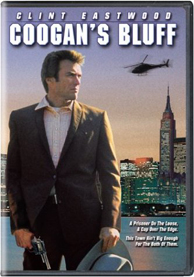
Coogan's Bluff

With work picking up some of late, I haven't been watching as many movies, but in my effort to see all of Clint Eastwood's movies I watched Coogan's Bluff today. For a very basic review, think of Dirty Harry in New York and you've got this movie. Don Siegel, the same director as 1971's Dirty Harry, directs here too so this is almost like a dry-run for the rogue cop movie that took the country by storm.
Piute county Deputy Sheriff Walt Coogan out of Arizona is good at what he does, but in doing his job he tends to piss people off, including the sheriff. So after one such incident, he's sent on a mission to New York City to extradite a prisoner. But arriving in NY, Coogan gets fed up with all the procedures and rules he'll have to follow to get custody of the prisoner, a hop-head named Jim Ringerman. Coogan bluffs his way into the hospital Ringerman is at after he took some LSD. But on the way to the airport, he escapes with some help from his girlfriend. Now Coogan's on his own in a city he can't stand, and nothing's going to stop him from bringing his man back.

Director Siegel had a specialty for tough, gritty movies where guys were guys and that's how it was. Coogan's Bluff definitely falls into that category. The movie has a rough feel to it and seems to have been shot on a lower budget. At times, it tries too hard including one long sequence at a rave. The scene almost calls out 'hey, look, this is how the late 60s were!' Toward the end of the movie, it's almost like Siegel and Co. realized they didn't know how to finish the movie and the story/plot becomes disjointed. A cool action sequence at the end makes up for it though.

Two action scenes stand out here, helped in great part by Eastwood doing many of his own stunts. One has Coogan taking on a group of six or seven thugs in a pool hall. It's a pretty vicious fight as pool cues and balls are flying, as are some of the thugs. The finale action is an exciting motorcycle chase near the Cloisters Museum in Manhattan, another case where you can clearly see Eastwood on the bike.

Joining the cast is Lee J. Cobb, a great character actor who made a career out of playing crotchety old guys who complain about everything. Cobb plays Lt. McElroy, the NY police officer who must work with Coogan even if he does disagree with his methods. Susan Clark plays Julie Roth, a probation officer who Coogan meets and takes a keen interest in in more ways than one. Don Stroud, who would play a rival of Eastwood's again in Joe Kidd, is good in a smaller part as Ringerman, the drug-addicted prisoner trying to avoid extradition back to Arizona where he committed an unidentified crime. Tisha Sterling has a memorable part as Linny Raven, Ringerman's girl who you're never quite sure what her motives are.

The DVD is a good deal but a bit of a disappointment. The widescreen presentation is there and looks good, but no special features at all. Still, it's worth it for the movie alone, even just to see a dry-run of Dirty Harry.

Coogan's Bluff (1968): ***/*****