The Sons of Katie Elder

The Sons of Katie Elder
"First, we reunite, then find Ma and Pa's killer...then read some reviews."
Showing posts with label Robert Preston. Show all posts

Monday, April 21, 2014

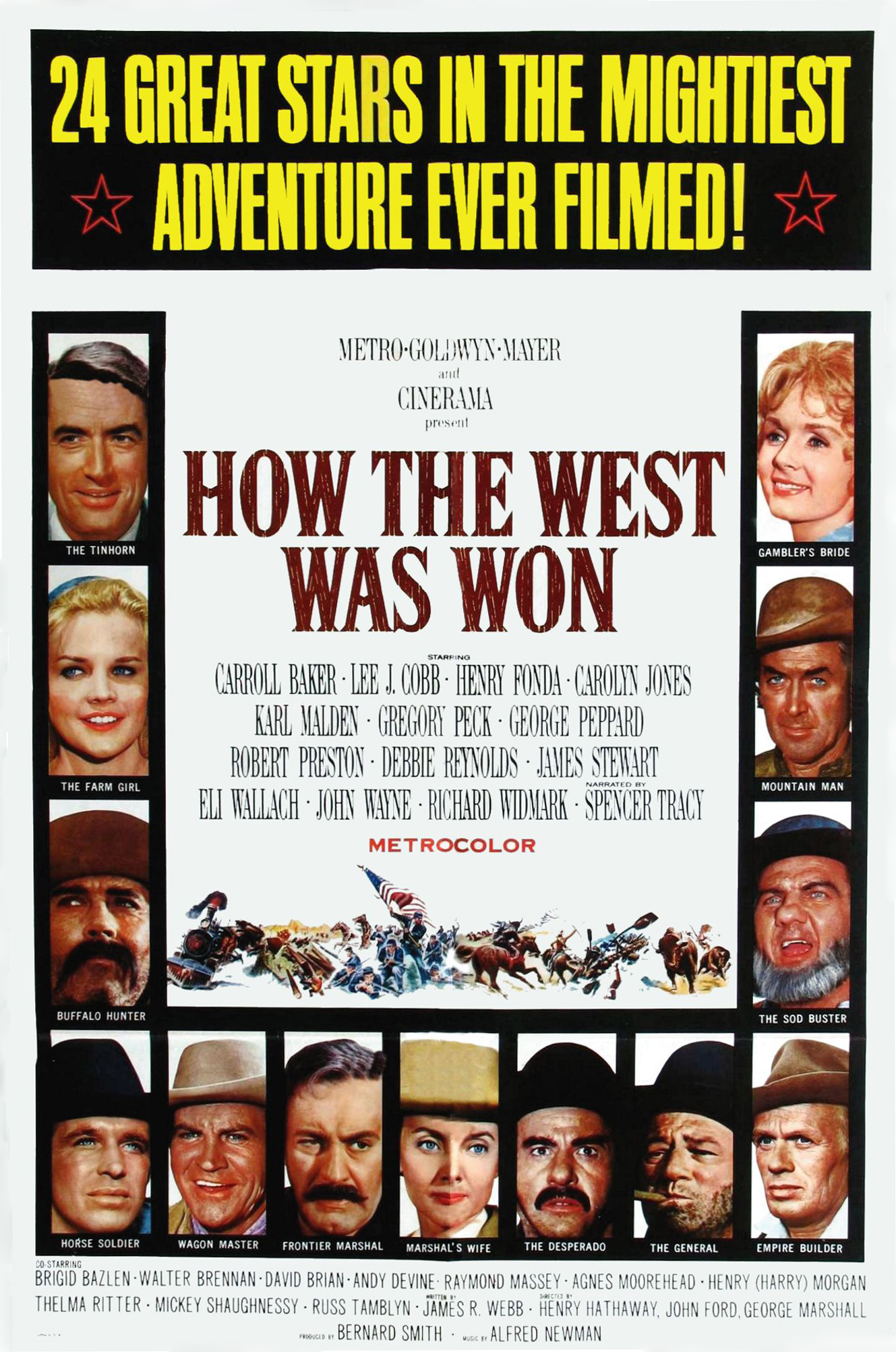
How the West Was Won

In the age of the epics -- the 1950s and 1960s -- some just stand above the rest. It's the stories, the cast, the scope. I don't love 1962's How the West Was Won but as far as epics go, there are very few in its neighborhood. There are obvious flaws, but when it works, it works in a big way. An impressive all-star cast, a story about the development of the American west and a shooting technique that is must-see. That's a winning formula.

A 162-minute film is broken up into five separate segments, the story following the Prescott-Rawlings family as it moves west and settles between the 1840s and the 1880s. It was directed by three different directors and covers a ton of ground. And away we go!

1. The Rivers (directed by Henry Hathaway): It's the 1840s, and the Prescott family, led by patriarch Zebulon (Karl Malden), is moving west and looking for a new life. In Zebulon's family is two daughters, Eve (Carroll Baker), looking for a new life in the west, and Lillith (Debbie Reynolds), wanting to stay in the far-more civilized East. In their dangerous travels on the rivers, they also meet Linus Rawlings (James Stewart), a mountain man with a canoe full of pelts.
Also starring: Lee Van Cleef, Walter Brennan, Agnes Moorehead, Brigid Bazlen.

2. The Plains (directed by Hathaway): Having worked for years on her own as a singer and dancer, Lillith Prescott (Reynolds) has just inherited a gold mine in the wake of the California gold rush. She heads west on a wagon train led by trail driver Richard Morgan (Robert Preston) with a gold-seeking gambler, Cleve Van Valen (Gregory Peck), also along too. 
Also starring: Thelma Ritter.

3. The Civil War (directed by John Ford): The war between the states in its early months, young Zeb Rawlings (George Peppard) leaves home with the blessing of his mother, Eve, to join the Ohio volunteers in the fighting. Like so many others, he thinks the war will be full of glory and be over quickly. Zeb finds out how very wrong he is at the bloody battle of Shiloh.
Also starring: John Wayne (as General Sherman), Russ Tamblyn (as a Confederate deserter), Harry Morgan (as General Grant), Andy Devine, Ken Curtis, Raymond Massey (as Abraham Lincoln).

4. The Railroad (directed by George Marshall): In the years following the Civil War, railroad companies race across the U.S. to link the two coasts. Now in the cavalry, Zeb Rawlings (Peppard) finds himself balancing out what his duty requires of him with what he knows is right, the railroad, including brutal supervisor Mike King (Richard Widmark), pushing the Arapahoes to their limit.
Also starring: Henry Fonda as Jethro Stuart, a former mountain man.

5. The Outlaws (directed by Hathaway): Having left the cavalry behind, Zeb Rawlings is now a family man with two kids, now trying to leave his profession as a lawman behind. He receives a letter from his aunt, Lillith (Reynolds), and readies the family to move. As they travel though, Zeb runs into Charlie Gant (Eli Wallach), a notorious outlaw gunning for Zeb.
Also starring: Lee J. Cobb, Carolyn Jones.

This is a movie that's simply put, BIG. It was filmed in Cinerama, three cameras filming each scene and then splicing the action together. The result? An immense look at the expansion of the west. Shots look like panoramic paintings, putting a whole new scope on the growth and development of the American west. It is a beautiful movie. Certain sequences especially stand out -- the camera on a raft trying to survive river rapids, an Indian attack on a wagon train, a stampeding buffalo herd trampling a railroad camp, a runaway train during an attempted robbery -- over the course of the movie, but visually there just isn't a weak spot. I love composer Alfred Newman's score -- listen to an extended sample HERE -- as it gives a moving background to the story. Countless gorgeous filming locations, providing a great backdrop while also transitioning from segment to segment.

It had been years since I watched this movie straight through in one sitting before my recent revisit of this 1962 epic. As you compare the five separate segments, I don't think it's really in question which one is the strongest. It's John Ford's Civil War segment, doing in 20 minutes what entire movies couldn't do in bringing the Civil War to life. Quick, dark, visually striking and unsettling, it is a gem of a sequence, especially Peppard meeting Tamblyn's Confederate deserter after the battle. The second strongest segment for me is the opening 'Rivers' with Stewart, Baker, Reynolds and Malden all leaving a positive impression. All five segments could be stretched out to a feature length film on their own, but these two especially stand out. They get their message across in a quick window and in both cases left me wanting more. Kudos to Ford and Hathaway for their work here.

What struck me more on the rewatch was the other three segments. They are by no means bad segments, but they're just not as good as the other two. I've always thought the weakest was the Plains segment, things feeling too rushed in general. The same qualifies for the Railroad and Outlaws portions. By the time you take away the Entr'Acte, intermission, and Finale music, we're looking at a movie with five segments covered in about 150 minutes (give or take). None of these three are given a chance to breathe to the point they feel downright rushed. As for some other positives? I loved the transitional scenes -- narrated by Spencer Tracy, directed in uncredited fashion by Richard Thorpe --  that set things up, explaining how America has changed, how its people change. These quick montages provide the heart of the movie, almost like a documentary in some ways. Like any movie that tries to accomplish so much, there's good and bad. The positives -- especially the Civil War middle -- is enough to outweigh the negatives thankfully.

One of my biggest worries in reviewing this 1962 epic was that the cast is too big. There's no way I was gonna be able to get all those names tagged with a 200-character limit. Who stands out? Stewart i excellent as Linus Rawlings, Fonda is good in a quick part as Jethro Stuart, and Baker is very strong too. The best parts though are Debbie Reynolds as Lillith and George Peppard as Zeb, the two hearts of the family. One or both is in every segment, the audience seeing them age, learn and adapt as America grows with them. Their scenes together in the Outlaws portion ring especially true. However you cut it though, just an impressive cast from top to bottom, one of the best ever assembled for a Hollywood film.

A doozy of a movie for what it's trying to accomplish. It falls short at times, but this is a movie worth watching for what it represents alone. This is a throwback film, a true epic that strives to be something great. If it doesn't live up those high hopes, so be it. The effort is admirable, a fascinating story of America growing up over an extremely turbulent portion of its history. Oh, and Debbie Reynolds singing A Home in the Meadow (listen HERE) is a truly beautiful song, a fitting one for the movie.

How the West Was Won (1962): ***/****

Friday, April 29, 2011

Reap the Wild Wind

As a fan of John Wayne and just about every one of his movies in one way or another, I can appreciate that by a certain point in his career (say 1960 or so) he was basically playing variations on the same character.  Some would say he was playing himself, but I won't go quite that far.  Early in his career even after the success of 1939's Stagecoach, Wayne had not yet been pigeon-holed into one type of role so in the early 1940s, he played some roles that are different from the norm in generally forgotten movies, like 1942's Reap the Wild Wind.

Still finding his niche as an actor, Wayne gets lost in the shuffle here some with an impressive cast.  It's an impressive movie on a lot of different levels, but that doesn't mean it's a particularly good movie though. Directed by the legendary epic moviemaker Cecil B. DeMille, 'Wild Wind' feels like his answer to the classic movie released three years before, 1939's Gone With the Wind. It's lavish and extravagant with a sweeping story full of action, intrigue and romance. It plays too much like a soap opera though ripped right off a stage somewhere. Rarely bored but never truly invested in this movie, it falls short in the end.

After his ship is wrecked on the reefs near Key West, Captain Jack Stuart (Wayne) is nursed back to health by lovely Southern belle, Loxi Claiborne (Paulette Goddard), who instantly falls for him. Stuart has come under fire though, the blame being placed on his shoulders for the wreck. He is set to go on a cruise that will eventually end up in Charleston where he'll face a ruling from the company's board of directors. Looking to help the man she loves, Loxi heads to Charleston by land, looking to woo the lawyer who will look to crucify Jack, Stephen Tolliver (Ray Milland). Stephen falls for her too, and she can't help but have feelings back toward him. The situation will come to a halt though when a salvaging pirate, King Cutler (Raymond Massey), puts them all on a course to meet on the high seas on the company's new steam ship, the Southern Cross, as it heads toward the dangerous Key West reefs.

The story ends up playing out like an average, even at times bad, soap opera. Overacting is around every corner, the love triangle is always tumultuous with all sides swearing they're right, and no one is going to give in easily. It's a big movie, living up to an epic status, with gigantic sets adorned with detail, costuming period accurate, and extras filling the screen. DeMille's film had the biggest budget of any film made since Gone with the Wind, and he spends it well.  Visually (even with some bad green screen shots), it is a great movie to watch. The story doesn't keep up though, and you're left waiting for everything to resolve itself.  I was willing the movie to move along a little quicker as the 123-minute run time dragged on endlessly.

So even if the story is too ridiculously over the top to take seriously, the cast is nothing to shake your head at.  Ray Milland is the real star here, dominating the movie with Goddard. He's painted as the upper class businessman, but that's quickly thrown out the window.  It's built up as this great rivalry with Wayne's Capt. Jack, but nothing develops there. Wayne's character is window dressing which is disappointing for me as a fan.  Massey is perfectly cast as Massey, I mean King Cutler, the villain who sneers and glares his way through line deliveries.  As if those three names weren't enough, Robert Preston is along for the ride (and given little to do) as Dan Cutler, King's little brother and business partner. Lynne Overman gets to ham it up too as Capt. Phil Pillpott, a veteran of the seas always ready with a dig or a barb. 

While the male characters aren't developed much and are probably the better for it, the female characters are not so lucky.  It's interesting that the two main female roles -- Goddard and Susan Hayward -- were both passed over for the role of Scarlett O'Hara for GwtW. I've never seen Goddard in another role (that I remember at least), but based on this part, I won't be seeking her out too much more. God bless her, she's a pretty girl, but she's an awful actress. She chews the scenery in each and every scene, pulling off both her acting faces, the sly, sweet Southern belle and the screaming terrified woman gone batty.  There's little middle ground either, it's one or the other. I felt bad for Hayward who's character has nothing to do but fall for Preston's Dan in a wasted subplot and then serve a purpose late. It's a wasted part for a talented actress.

Trying to save the best for last, 'Wild Wind' surely gets points for effort in the finale. A sizable portion of the budget was used to construct a giant squid that attacks Wayne and Milland as they go diving for the wreck of a ship. The underwater sequences -- giant squid attack included -- are impressive for 1942 considering all those things actually had to be filmed.  It is an ending that obviously left an impression as it was almost exactly reused several years later in another John Wayne flick, Wake of the Red Witch. Reap the Wild Wind also belongs to a rare club of John Wayne movies, but I can't give too much away here. I didn't like this movie much, but it does try and almost lives up to its own high expectations.

Reap the Wild Wind (1942): ** 1/2 /****

Wednesday, January 12, 2011

My Outlaw Brother

From a young age, Mickey Rooney was almost always on stage in front of people. As a child actor, he starred in 78 comedies between 1927 and 1936 as Mickey McGuire before becoming more universally known as Judy Garland's on-screen partner in countless movies.  The early parts of his career are probably what he's most remembered for, but by the time he was 30 in 1950, Rooney started doing more dramatic roles, some obviously better than others.  Rarely the star, mostly a key supporting character, that's how I think of Rooney, an underrated character actor who always kept his parts interesting regardless of the quality of the movie.

One movie that wasn't particularly bad but wasn't particularly good either was 1951's My Outlaw Brother, a low budget western that has since lapsed into public domain.  It's typical of so many westerns made in the 1930s, 1940s and 1950s that studios churned out as quick as they could make them.  They usually offer a chance to see some well-known stars before they were stars in quirky but still entertaining stories that clearly didn't have very large budgets.  This isn't Rooney's best part as he was trying to establish himself as a more serious actor, but it's an interesting watch for western fans.

Assigned a dangerous mission, Texas Ranger Joe Walter (Robert Preston) must ride across the Rio Grande into Mexico to the small mountain town of San Clemente. There an American, Patrick O'Moore (Robert Stack), is working with an Indian bandit, El Tigre, terrorizing the country.  Walter must bring him out alive and back across the border so he can face justice. It looks and sounds like suicide, but with his trusty horse Sunny under him, Walter accepts and rides south.  Along the trail, he meets another ride heading to San Clemente and is more than a little surprised to find out the man is Patrick's younger brother from New York City, Denny (Rooney), who's going to visit his brother after many years apart.  Could this chance meeting help his odds?

The problem with most of these public domain movies is that the prints available on TV or the ones you can buy on DVD are pretty low quality after decades of mishandling and poor care.  That's the case here with a poor print that is at different times fuzzy or scratchy with the audio volumes dipping in and out.  With a decent print, the black and white filming would be halfway decent with some authentic looking locations. The movie was filmed at Estudios Tepeyac and when the story does venture outside, we get some cool locations, especially an abandoned mission where Patrick's hideout is.  The music is not memorable, and the story nothing new in the least either, but I was rarely bored.

You can attribute most if not all of that sentiment to the cast.  I don't know if he was a great actor (I've only seen him in four or five movies), but Preston is one of the most watchable movie stars I can think of.  Playing the Texas Ranger, he's an ideal for that laconic, capable, and tough character, guiding Rooney's inexperienced cowboy Denny along the trail.  Rooney got top billing, but Preston was really the star.  Stack doesn't fare as well as the possibly villainous Patrick.  He looks ridiculous duded up as a Mexican vaquero and ends up delivering a stiff performance that doesn't make you care one way or the other what happens to him.  There's a twist late about Patrick, but it comes out of left field and feels like a rushed ending wrapped up nicely with a bow.  Also look for Wanda Hendrix as Carmela Alvarado, a possible love interest, and Jose Torvay as a hot-tempered, vengeful blacksmith.

Some of Rooney's better parts would come in the years following My Outlaw Brother, but this feels like one where he's still trying to figure things out.  Is it a drama or a comedy? Is his character a brawler or a klutz?  And how in the hell does he manage to seduce Hendrix's Alvarado?  Rooney goes for a broader playing of Denny O'Moore, a city boy traveling into the wilderness for the first time and always getting into scrapes where he needs to be rescued.  A solid drinking game while watching this movie would be to take a shot for every time Rooney says 'Ow!'  You'd be wasted pretty quickly.  Still, he's got a good chemistry with Preston, and that helps carry the movie through its rougher patches.

Watch the full movie HERE starting with Part 1 of 9.

My Outlaw Brother (1951): **/****       

Tuesday, April 20, 2010

Blood on the Moon


In a biography I read and reviewed last spring about Robert Mitchum, the Hollywood star and one of the first bad-boy movie stars said he never really thought he was much of an actor.  He said it came easy to him, and typically, he never watched his movies once he was done making them.  Maybe it was easy for him, but there is a constant through almost all of Mitchum's movies.  He is smooth on-screen like few others, and as the title of the biography said 'Baby, I don't care.'  If you didn't like him or his movies, Mitchum just didn't care.

Early in his career, Mitchum was signed with RKO Studios and was usually stuck making low-budget westerns and film noirs that over 60 years later have generally withstood the test of time.  1948's Blood on the Moon is typical of the movies he made during his RKO days, but it has a trump card on most of those other movies.  The cast here is ridiculously good starting with Mitchum in the lead and trickling down through all the supporting parts.  It is a late 40s western that blends the western and film noir genres, falling somewhere in between.  Different for sure, and worth a watch.

Drifter Jim Garry (Mitchum) rides into a peaceful-looking valley and quickly finds out everything is not so peaceful as it appears.  There are two factions in the valley, both fighting for control of the land.  On one side is John Lufton (Tom Tully), a rancher trying to sell his cattle to the nearest Indian reservation.  On the opposition is a group of small homesteaders led by a gunfighter, Tate Riding (Robert Preston), and an old, wily homesteader, Kris Barden (Walter Brennan), who is just looking out for the land he's lived on for years.  Throwing a wrench into the situation is Lufton's daugther (Phyllis Thaxter) who has fallen in love with Riding.  Lufton's other daughter, Amy (Barbara Del Geddes) isn't quite sure what to make of Garry who himself doesn't know exactly what's he gotten himself into.

Blood on the Moon is based on a novel by western author Luke Short who over a 30-year span wrote more than 50 western novels.  It does use some well worn western cliches, but it's handled so smoothly it's not even worth complaining about.  The mysterious drifter is as old as westerns themselves, and the ranchers vs. the homesteaders is certainly nothing new in terms of storytelling.  But thanks to his strong cast and some great camera work in black and white, director Robert Wise turns in a solid effort all around.

As the mysterious drifter who only one person really knows, Mitchum does what he does best; the strong, silent type ready with a crack when needed or an equally effective and well-placed punch.  Opposed to a lot of stars in westerns, Mitchum looks comfortable in the saddle, and more than that he looks the part of a cowboy who's spent too long on the trail.  His Garry is a decent enough fellow looking to make some cash, but even he has his limits as to what he'll do to get it.  The subplot with Bel Geddes isn't that great mostly because the two don't have a ton of chemistry together.  Well, maybe they do, but it's hard to see after his pairings with Jane Greer and Jane Russell.

What works so well for the supporting cast is that for much of the movie there isn't good and bad, just varying shades of gray.  Everyone has their reasons, their motives, and even Preston -- who does end up being the villain -- isn't just a cold-blooded killer.  He's a poor homesteader turned gunfighter trying to carve a life out for himself and fiance.  Preston's Riling is that character though you know isn't quite right because it's Preston playing him, and he made a career out of parts like this.  Brennan is solid as a homesteader wavering on what's right and wrong.  Then, also look out for gravelly-voiced Charles McGraw as a hired gun and Frank Faylen as an Indian agent looking to make a buck, both good supporting parts.

While the story does use some wild west cliches -- they are tried and true for a reason -- Wise's movie sets itself apart from the rest because of its one.  Gunfighters, hired killers are looked upon as a scourge of society so Mitchum's Garry isn't exactly well liked upon his arrival.  Westerns often dealt with this issue, but in 1948, this dark tone is more than a little surprising.  The same goes for the violence which isn't graphic but is always realistic, especially a knock-down, drag 'em out saloon brawl between Mitchum and Preston.  With some great shadowy outdoor filming in California and Arizona, this 1948 western has all the elements.

Blood on the Moon <---trailer (1948): ***/****

Sunday, July 19, 2009

Beau Geste

How gutsy does a director have to be to start a movie by showing the ending? I give any director with the cajones to do that points right off the bat. Opening the movie by showing how the story will end up can drive viewers away in some cases, but if handled well can make viewers even more involved with the story. After all, we now know how everything will end up, but getting there can be half the fun.

Director William Wellman pulls this off with his 1939 classic Beau Geste, a story of three brothers who enlist in the French Foreign Legion. The story opens with a relief column nearing Fort Zinderneuf, a far-off post near an oasis that came under siege by Arab tribesmen. But as the relief draws closer, they find the whole garrison massacred to a man, and the commanding officer dead on the parapets with a French bayonet through his heart. With no enemy dead anywhere in sight and no legionnaires to tell the story, the question arises; what happened to these 50 legionnaires?

After the cool opening sequence at the scene of the massacre, the story flashes back to 15 years prior where three brothers, Beau, Digby and John, have been adopted by a rich English woman, Lady Patricia (Heather Thatcher) The three orphans live the life of luxury, playing war games and playing pranks on each other and their 'cousin' Gussie, the heir to quite a family fortune. But the years pass and Lady Patricia receives a note from her long lost husband saying he'll soon return for the Blue Water diamond, the last thing of any value they own. Before he can retrieve it though, the diamond is stolen by someone living in the house. But who was it?

In hopes of removing suspicions from his younger brothers, Beau (Gary Cooper) takes the blame and enlists in the French Foreign Legion to avoid embarrassment for his family. But it's not too soon before brothers Digby (Robert Preston) and John (Ray Milland) join up too with their big brother. It's in the legion they come under the command of sadistic Sergeant Markoff (Brian Donlevy), who was humiliated at his last post and now seeks to redeem himself, no matter the cost even if it is his own men's lives. It is when Markoff finds out the Geste brothers may be diamond thieves that the real conflict arises, the sergeant splitting the trio up, Beau and John to Zinderneuf as replacements and Digby to another fort for mounted infantry training.

The French Foreign Legion is often presented as this glamorous, honorable fighting unit, but in just about every movie I can think of some unlucky company is getting massacred or abandoned at some far out post with no hope of outside help or survival. In Beau Geste, it's no different. The soldiers at Zinderneuf hope to lead a mutiny against Markoff, but that plan gets put on hold when the Arab tribesmen arrive en masse. The battle scenes are exciting from the start even if we know the end result. The desert outside Yuma, Arizona fills in nicely for the Sahara desert, oasis and all, with the set of the fort a perfect setting for the drama to unfold.

As for the cast, it would be hard to ask for a better one. As the title character, Cooper does what he does best, the sort of everyman role who is noble, honorable, and always looking out for those around him, especially his younger brothers. Preston and Milland round out the trio of brothers, Milland getting slightly more screen time and the love interest, and with Cooper provide the heart, the backbone of the movie. Their scenes together ring true whether it be with the comedic introductions or later in the movie when they've enlisted in the Legion. The three actors bring the characters to life, much like the three leads in another 1939 classic with a somewhat similar story, Gunga Din.

In a role he received a Best Supporting Actor nomination for, Donlevy has a great part as Markoff, the sadistic, half crazy sergeant who will drive his men to the breaking point and then keep on pushing. He wants his good name back and all the medals and privileges that come with a promotion, and as he sees it, it's all in grasp if he wins a significant battle, casualties be damned. Unfortunately for Donlevy, 1939 was the year of Gone With the Wind, Stagecoach, Mr. Smith Goes to Washington, so he didn't get the win, but it's still one of his best parts. Also in the cast is a very young Susan Hayward as Isobel, the love interest who grew up with the Gestes but starts to fall for the youngest brother, John. Just some of the other legionnaires include J. Carrol Naish, Albert Dekker, Broderick Crawford, and Charles Barton.

Labeled as Hollywood's strongest overall year just for the sheer number of classics that were released, 1939 was quite a year for the movies. The old reliable 'they don't make 'em like that anymore' applies to any number of movies from that year, especially Beau Geste. It is good old-fashioned entertainment with an exciting story, strong and likable characters and some creativity in telling the story. With a DVD released just weeks ago, don't skip this one by. A true classic from start to finish.