The Sons of Katie Elder

The Sons of Katie Elder
"First, we reunite, then find Ma and Pa's killer...then read some reviews."
Showing posts with label Sterling Hayden. Show all posts

Sunday, May 12, 2013

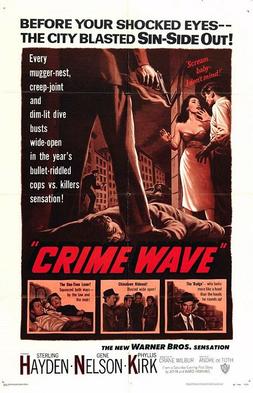
Crime Wave

I've been thinking about this for three days now since I watched 1954's Crime Wave, and I've got nothing. I really do try to come up with interesting intros to the reviews, even taking some pride in it. I'm stumped here though so let's cut to the chase. A film noir with a solid cast and director, I liked this movie a lot. Good enough? Yeah, let's get going.

In the dead of night in Los Angeles, three escaped convicts led by Doc Penny (Ted de Corsia) rob a gas station, grabbing $130, but as they make their getaway, an investigating police officer on patrol gets in their way and is callously gunned down. The news spreads through police departments/offices throughout the city, and in minutes, a huge manhunt led by Lt. Sims (Sterling Hayden) is under way. The city is all but shut down in hopes of capturing the trio, but they seem to have disappeared. Sims and the police start to investigate where they could be hiding with Sims thinking they've holed up somewhere with an ex-con. Suspect No. 1? An ex-con named Steve Lacey (Gene Lacey) who Sims put away years ago and has supposedly gone clean. Time is running out though, and there's a chance that maybe the crooks slipped away, the murder going unresolved.

I come away more and more impressed with the entire genre of film noir flicks the more I'm introduced to them. I was always aware of the more well-known, well respected noirs, but as I try to review more and more reviews, I'm finding more and more worthwhile entries to the genre. This one from director Andre de Toth is one that doesn't get much in the way of recognition, but it's everything that's right about the genre. It was filmed on location in Los Angeles, Burbank and Glendale, its shadowy streets, alleys and neighborhoods providing a backdrop to the story. It looks great, and it doesn't waste any time with its 75-minute running time. Cops, crooks, and those caught in the middle. Hard to mess up that formula, but de Toth does a great, workmanlike job here.

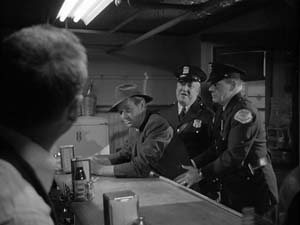
Early on in 'Crime,' I thought I was watching a quasi-remake of Jules Dassin's 1948 noir The Naked City. That film plays almost like a documentary of how the cops handle the investigation following a crime. Seeing both the police perspective and that of the crooks on the run, 'Crime' is similar in its portrayal. We see suspects brought in for questioning, the police searching for clues, following any leads that might lead to bringing the cop killers to justice. The story takes an interesting, even surprising turn in the second half, focusing more on Nelson's Steve and his troubles. He's moved on from his criminal past, marrying Ellen (Phyllis Kirk), a woman who accepts what he was but loves him for what he is now. This goes down the more traditional route in its noir roots, Steve, Sims and the police, and Doc and the crooks all converging on a collision course.

As far as casting goes, 'Crime' lacks the star power of more well-known film noirs, but I liked the cast. Hayden especially stands out as Lt. Sims, a veteran police officer who's seen just about everything the streets have to offer. Early on, he's so driven -- even obsessed -- I thought the story might have him develop into the bad guy. As the villain, de Corsia is appropriately greasy/slimy with a young Charles Bronson (listed as Buchinsky) and Nedrick Young as his convict cohorts. Jay Novello plays a doctor and ex-con who accidentally killed a patient, now working as a vet who gets caught up in the manhunt while the uncredited duo of Timothy Carey and Jim Hayward as two other ex-cons brought into Doc's plan. Dub Taylor makes a quick appearance as the gas station attendant while Hank Worden plays Steve's trusting boss.  

Not too much analysis required here. It's a good film noir with a solid story, good casting and quick-moving pacing. Not a hugely well known film noir, but one I enjoyed a lot. Oh, and 1950s Los Angeles looks pretty cool. It almost feels like Joe Friday should come in to assist on the investigation.

Crime Wave (1954): ***/****

Wednesday, March 6, 2013

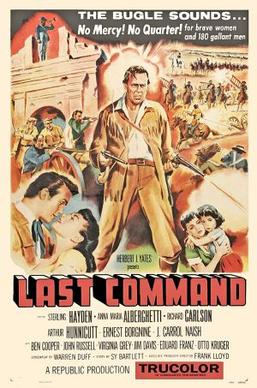
The Last Command (1955)

Of the three most well-known heroes of the battle of the Alamo, David Crockett, James Bowie and William Travis, there's no doubt who is the most well-known of the three. Oh, that'd be Crockett for those unfamiliar with history. In second place, the infamous knife fighter Jim Bowie who's had several films based on his exploits including 1952's The Iron Mistress (meh) and for today's review, 1955's The Last Command.

It's 1834, and knife fighter, adventurer and land owner Jim Bowie (Sterling Hayden) is riding south through Texas to Mexico to see his home and his family. As he rides through the territory though, he finds that many Texan colonists have had enough with Mexican president, Santa Anna (J. Carrol Naish), who's become more of a dictator with each passing day. Old friends with the president, Bowie isn't sure who to side with at first, but when his wife and children die, he's forced to come up with answers about what he believes and what he should ultimately do with the coming revolution. He joins the fighting, leading a group of volunteers. Santa Anna has started to march an army north from Mexico City to deal with the revolutionaries, and all roads lead to the town of San Antonio and a ruined old mission, the Alamo.

Anyone familiar with John Wayne's The Alamo from 1960 will no doubt notice some similarities between that film and this 1955 flick from Republic Studios. The reason? This was originally made with Wayne -- still working at Republic -- attached as an actor. He wanted to make an Alamo film, but disagreements with the studio drove the two sides apart. The end result was simple; Wayne left Republic, Republic made the film without Wayne, apparently out of spite. There are some similarities, from Davy Crockett's death to the Alamo defenders raiding the surrounding Mexican army for artillery and many others. The biggest difference though is obvious, a focus on Jim Bowie.

It's funny that in the casting of the infamous knife fighter, one of America's truly unique historical personalities, two of Hollywood's most wooden, vanilla actors were chosen. In 'Iron,' Alan Ladd starred, and here, Hayden takes the reins as Bowie. I'll say this. I don't think Hayden has a "showy" side, but he at least commits here and shows some energy in the lead. Just like Wayne's film would do, there is an unnecessary -- even painful -- love story as Bowie falls for Consuelo (Anna Maria Alberghetti), a young Mexican woman from a rich family (Eduard Franz plays her well-to-do uncle). Above all else, it's cool to see Bowie get a movie devoted to him and his involvement in the months leading up to and in the Texas Revolution. He was a fiery, passionate fighter who fought for what he believed in. His friendship with Santa Anna is a little much (the Mexican dictator affectionately calls him 'Jimmy'), but seeing a familiar story from an unfamiliar angle is refreshing.

Overall, the story focuses on a two-year period starting in 1834 and running through March 1836 and the battle and fall of the Alamo. The movie runs just 110-minutes and is a little slow-moving at times -- rather talky -- so non-history fans may lose some interest. Alamo buffs will get a kick out of the story though that focuses on Texas history that most Alamo movies simply ignore. We do meet some familiar faces, including Colonel Travis (Richard Carlson), Davy Crockett (Arthur Hunnicutt) and Lt. Dickinson (John Russell). Carlson is solid as the similarly fiery Travis, and Hunnicutt is a scene-stealer as the backwoods, storytelling Crockett that's based more in myth than the real-life Crockett. The story doesn't just jump right to the Alamo, but lays some ground work and background leading up to the famous battle. Also look for Ernest Borgnine as Mike Radin a rival-turned-friend of Bowie's and Ben Cooper as Jeb Lacey, a young Texan who looks up to Bowie. Other Alamo defenders include Slim Pickens, Jim Davis, Roy Roberts and Russell Simpson as the Parson.

The actual battle for the Alamo takes up about the last 40 minutes of 'Command.' The set is somewhat limited -- we basically see one corner of the mission along with the wooden palisade -- but there's something oddly cool about the set built near Bracketville, Texas (where Wayne's film was made). For a movie released in 1955, the final assault on the Alamo is surprisingly vicious and violent. Nothing graphic, but still pretty hardcore stuff for a 1950s audience. Each character gets their moment, their on-screen death with Bowie saved for last.

There's nothing hugely memorable about this 1955 Republic picture, but I like it just the same. Composer Max Steiner's score is a highlight -- give it a sample HERE -- and the Jim Bowie theme song (listen HERE) is pretty awful, but in an amazingly bad and memorable way. Lots of good actors, familiar faces and an enjoyable if unspectacular story in director Frank Lloyd's historical bio-pic. One IMDB reviewer points it out accurately. It's neither a big budget A-movie or a low-budget B-movie, but it's somewhere in between. TCM has three clips available so give them a watch at the link below.

The Last Command (1955): ***/****

Monday, January 21, 2013

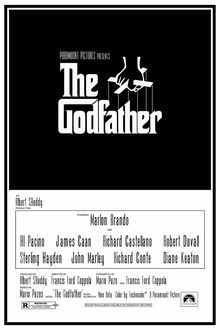
The Godfather

Some movies are just better than others, plain and simple. They're the ones that even the most casual movie fans among us are aware of, films like Gone With the Wind, Casablanca, Lawrence of Arabia, and one of my favorite movies, and maybe the greatest movie ever made, 1972's The Godfather.

It's just a few months since the end of WWII, and Vito Corleone (Marlon Brando), the head of the Corleone crime family in New York City and dubbed the Godfather, is at the height of his power. He has an epically successful business, running the unions and all the gambling in the city, and he's able to do it because he has countless politicians and judges in his back pocket. Things are changing though all around him, especially the underworld and the business he helped create.  Vito is approached about a deal he could bankroll, but it involves drugs, and he chooses to ignore it. The decision is one that drastically affects the family, one that will incorporate all his family members, especially fiery firstborn Santino (James Caan), adopted Irish son, Tom Hagen (Robert Duvall), and his youngest and smartest son, Michael (Al Pacino). What does the future hold? Who will rise up to help their father?

Based off a novel of the same name by author Mario Puzo, 'Godfather' is one of those rarest films; it's perfect. In that sense, director Francis Ford Coppola improves on Puzo's novel, the rare film that is better than its source novel. None of that is a dig at Puzo -- the novel is one of my favorites, a well-written gem -- but the film takes the idea, premise and characters and runs with it. Clocking in at 175 minutes, it never slows down, never feels dull. The dialogue and script provide countless engrossing talking scenes. The look of the movie with its authentic wardrobe, cars and sets is incredible, Coppola filming in an earthy fashion where things always look dark and burned-out to a point. Oh, and composer Nino Rota's score is halfway decent (that's sarcasm by the way), one of the great, classic scores in Hollywood history. You know it already, but listen to the theme HERE.  

What sets Coppola's film apart from countless other films about the Mafia, mobsters and organized crime is the impeccably written story. Puzo's novel introduces countless characters, relationships, history at the reader with all sorts of backstory, and the film assembles it into an expertly told, very coherent (sounds simple, but you'd be surprised) story that develops nicely. It covers over 10 years of time, but at no point does it feel even slightly rushed. Puzo's novel (he also worked with Coppola on the script) introduces characters and within minutes we feel like we've got a good idea of who they are as an individual. Imagine that with over 10 characters that get a fair share of screentime. There is a comfort level with the characters -- the good guys and the bad guys -- that makes the movie more enjoyable the second it begins. Does it all fall into place right away? No, it takes some time, but getting there is half the fun.

As far as true acting movies go, this 1972 classic is hard to beat. There isn't a performance that falls short or feels fake, but two rise above the rest; Brando as Vito Corleone and Pacino as his son, Michael. Playing one of the most iconic characters in film history, Brando's performance has opened the doors for all sorts of impressions, caricatures and stereotypes, but it is a career-best performance (and that's saying something considering Brando's career). It is a layered, nuanced performance, a man in the second half of his life who is highly intelligent, kind and ruthless at the same time, and a man who will stop at nothing to care for his family. Pacino's Michael goes through the film's biggest transition, a young man and WWII hero who wants nothing to do with his family's shady background but finds himself thrust into the family business when outside forces descend on the Corleones. Brando won an Oscar -- fully deserved -- and Pacino was nominated, but whatever the award nominations out there, it's two amazing performances.

Coppola's film earned plenty of acting nominations, three alone for Best Supporting Actor with Pacino, Duvall and Caan all earning a nod. The coolest part? All three deserved it for one reason or another. Caan and Duvall get less screentime, but they make the most of it. Caan is a scene-stealer as the fiery, hot-tempered Santino, known to friends and family as Sonny, the oldest Corleone son. The same for Duvall as Tom Hagen, but in a different way. Where Caan is more aggressive, Duvall underplays his part as Tom, the unofficial Irish Corleone brother, a childhood friend of Sonny's who Vito welcomed into the house. Other members of the Corleone family and operation? Richard Castellano and Abe Vigoda as Clemenza and Tessio, the Corleone caporegimes (think right-hand men, enforcers), John Cazale as Fredo, the Corleone brother and screw-up, Talia Shire as Connie, the lone Corleone sister and her similarly fiery husband, Carlo (Gianni Russo), and Diane Keaton as Kay, young Michael's love who must decide how much she's willing to put up with.

And then there's the opposition, the all-around nice individuals who are trying to take down the Corleones. For starters there's Richard Conte as Barzini, a head of another NYC crime family, Sterling Hayden as Capt. McCluskey, an NYC cop on a rival's payroll, John Marley as a film studio head who incurs the wrath of the Corleones, Al Lettieri as Sollozzo, a drug supplier looking for funding and backing, and Alex Rocco as a casino owner dealing with a buy-out of his casino.

On repeated viewings, I've noticed different features about the film, different layers that can affect how I view it. The biggest is simple; family. Yes, it's a pretty hardcore, violent story about a crime family with its hand in illegal happenings, but it's still family. If you can look past that whole criminal aspect, the biggest focus is the family and the dynamics and relationships among family members. Through the rather vicious, violent ups and downs, love and hate, they're there for each other (for this movie at least). I love how Vito dotes on his kids and grandchildren but can balance that out with a brutal mindset -- it's business, not personal -- at the same time. The relationship between Vito and Michael is the most heartfelt, including one of my all-time favorite scenes as father and son discuss what could have been, maybe what should have been. A worrying Vito wanted more for his son, but a firmly entrenched Michael (very much looking out for the family) calmly states "We'll get there, Pop." It's an endearing, heartfelt moment, one of many.

There are far too many memorable, iconic, and all-time great scenes to discuss one by one.  Big picture, that's probably what viewers will remember the most on initial viewing. The infamous horse head scene, the introduction of Vito, his loyal enforcer, Luca Brasi (Lenny Montana), and his "offer he can't refuse," the perfect simplicity and natural quality of the opening wedding, a slight detour to Sicily and its beautiful hills, a meeting among Michael, Sollozzo, and McCluskey in a traditional Italian restaurant, and maybe the most memorable, the baptism scene, almost entirely silent other than Rota's score playing over the developing scenes. Each of the above scenes could be analyzed in a review unto itself, but this review is already getting long-winded. Long story short? It's maybe the greatest movie in Hollywood history without a flaw in sight. Shame on you if you haven't seen it by the way. What are you waiting for?

The Godfather (1972): ****/****

Saturday, May 12, 2012

Zero Hour!

As a stand-alone film, 1957's Zero Hour! has no real business being remembered as anything but a pretty bad B-movie full of wooden acting and poorly-made effects. Now, it's not exactly a well-known, fan favorite some 50-plus years later, but it does have a certain claim to fame. It is the source for one of the all-time great spoofs, 1980's classic Airplane! On that tidbit of trivia alone, this is a movie worth a watch....once.

It's been ten years since the end of WWII, but former fighter pilot Ted Stryker (Dana Andrews) still struggles with a command decision that cost the lives of several members of his squadron. He's been bouncing from job to job, and his wife, Ellen (Linda Darnell), is threatening to leave him. Returning from a job interview, Ted finds that Ellen has taken their son, Joey, and has left him. He tracks them down, buys a ticket on their plane with hopes of winning her back. The odds are against him though. Something happens to both the pilot and co-pilot, forcing the air crew to ask if anyone on-board can fly a plane. With some 40-odd lives at stake, can Ted pull it together and land the plane?

It's been years since I've seen Airplane! but it's hard to watch the 1957 movie without cracking up at the very premise. Maybe back in the 1950s this was looked at as a solid, entertaining thrill-ride, but now? It plays like a spoof of itself. It's high drama on steroids! The acting is atrocious -- Darnell yelling and screaming 'MOUNTAINS!' is priceless -- and you can't help but wonder why it took 23 years to make a spoof of this flick. It was ripe for the picking, and when given the chance, the 1980 spoof classic did not disappoint in the least. Robert Hays' character is even named Ted Striker, "I" instead of "Y' in this case.

What amused me is that the situation -- a passenger forced to fly the plane -- is dripping with natural tension. Anyone who's ever gotten on a plane has at least briefly thought about the possibility. If not flying the plane, at least something out of the ordinary happening. So right off the bat, there is that tension watching the movie. You're thousands of feet up in the air, and your life depends on some schlub taken from his seat to fly an airliner? So yes, there is some excitement in the movie. But there is too much working against it. Besides the main cast, it appears they picked people off the street to read lines. At different points, you can see cast members apparently looking off screen to read cue cards. The music is blaring at you in the most obvious of fashion -- DUN DUN DUH!!!!! -- that something bad is going to happen, and we see the same effects repeatedly of the plane flying through fog, clouds and rain.

So here's the situation. You've got a former fighter pilot in a life and death situation being talked down by a airliner pilot who used to fly with him and still holds a grudge. How about we pick two of the most wooden, nondescript actors to play those parts? It's a story that literally revolves around life and death. It sounds like logical thinking, don't you think? God bless them both, but Andrews and Sterling Hayden were not good choices for these parts. Andrews was a likable enough actor on screen, but he's not one to carry a movie. Hayden as Captain Martin Treleaven, the on-the-ground link to the possibly doomed plane, is an equally poor choice. Basically no matter the part, Hayden had one pitch to his voice; deep and stilted, no real emotion. So when he's yelling at Stryker to "PULL UP! YOU'RE TOO LOW!" it isn't dramatic, it's funny. For me at least, that ruins any of the tension or drama the story naturally builds up.

It's not just the fault of the two stars in Andrews and Hayden. The whole story and execution comes across as ridiculous. The pilot (pro football player Elroy Hirsch) and co-pilot, along with many of the passengers, become deathly ill because they eat contaminated fish as opposed to the regular "meat" option for dinner. Could it happen? Sure, but it sounds nuts. Oh, no, contaminated fish! There's also the screaming hysterical woman who needs to be slapped at the slightest bit of turbulence, the passenger (Jerry Paris) who uses a hand puppet to calm down the Stryker boy, the doctor (Geoffrey Toone) who is freakishly calm and knows everything, and the stalwart stewardess (Peggy King) who is the main culprit reading her cue cards.

Everything almost from the start comes across as half-baked. And a broken marriage being saved because the husband finally faced his fears? Oh, that's sweet. I was very surprised to see the high rating (6.8 as I write this) at IMDB, mostly because I thought it was unintentionally hilarious. It could and probably should have worked as high drama, but instead it produces laughs....lots of them. Good to watch once, mostly to see all the inspirations for the much better and intentionally funny Airplane! It is worth sticking around for Hayden's final line, a classic delivery in the lack of emotion department considering what's just happened.

Zero Hour! <---TCM clips (1957): **/****

Monday, February 27, 2012

Arrow in the Dust

When I recorded four westerns off of Turner Classic Movies in January, I figured I'd lucked into something. I'd seen none of them, much less heard much about any of them, so I went in with measured expectations, hoping for at least one or two winners among the bunch. I was surprised as any when I really liked the first three (Gold of the Seven Saints, Fort Dobbs, Drum Beat), and then there was the fourth, 1954's Arrow in the Dust. No perfect 4-for-4 day at the plate this time.

Having deserted his post, U.S. cavalry trooper Bart Laish (Sterling Hayden) is on the run with a patrol not far behind. As he runs, he comes across the wreckage of an ambushed wagon train, his dying friend, Major Andy Pepperes (Carleton Young), among the bodies. Andy implores his friend to complete the mission he couldn't, take command of a wagon train that must get through to Fort Laramie. The Pawnee tribe is on the warpath, and the wagon train is guarded by a small, undermanned company waiting for a commander. Knowing that taking the job could be certain death, Bart poses as the Major and joins up with the train, hoping to bring it in safely while possibly also clearing his name.

 As a fan of the western genre, I can give a movie a pass if it still manages to entertain me in all its badness. This 1954 oater is testing even my limits. It is bad, truly bad. A B-movie that runs just 79 minutes but feels like an eternity has little to nothing going for it. From Allied Artists Pictures, 'Arrow' is one of the weakest westerns I've ever come across.  At least 30 minutes of the already glacial-like story is long shots of the train and the cavalry troop riding around to a generic western score. The script is predictable (if there was a script), the characters taken from the Western Stock Characters 101 list, the action laughable, and in general, a feeling of laziness. Bad, just bad.

I go back and forth with Sterling Hayden as an actor. In movies like The Asphalt Jungle, he's very good, but I think it's because he's working with an ensemble and not asked to carry the picture. In Dr. Strangelove, his wooden delivery works through the ridiculous nature of the story. In a bad B-movie like 'Arrow,' he stands out like a sore thumb. He looks physically uncomfortable in the part, and his stilted, awkward deliveries are as monotone as ever. His "command" comes to respect him, and I'm thinking "What did I miss?" When a movie depends on Hayden to carry an already sub-par story, you're in for a long movies. He also could be the most unrealistic cowboy/trooper I've ever seen. Watch him riding his horse. He always pulls back on the reins, his horse rearing its head with every stride like it's in pain.

Playing the deserter-turned-savoir with no real explanation provided for his desertion, Hayden's Bart makes decision after decision that gets stupider with each one. More and more of his men are killed, but because the story requires it, they love him and respect him. The "action" has a shot of cavalry firing at charging Indians, said Indians falling from their horses, cavalry shooting again. Any hand-to-hand combat is ridiculous, some of the worst choreographed fights ever, including one clumsy fight toward the end with two past their prime old men duking it out. The Pawnees also team up with the Apaches to become the dumbest tribe of warriors ever, charging into a wall of gunfire rather than shooting back. In the end, the cavalry makes it, apparently because the Indians got bored and went home. Who knows for sure.

While Hayden's bad performance is the most prominent, it is just one of many in this flick. Coleen Gray plays Christella (cool name), a single woman driving her own wagon as part of the train. She just hates Bart for how hard he drives the men, but gosh darnit! Wouldn't you know she kinda falls for him too? Hayden certainly gives her a lot to fall in love with. Keith Larsen is Lt. King, Bart's second-in-command, with Tom Tully playing the chubby scout, Crowshaw, who quickly finds out Bart's secret but doesn't say anything. The only other name even worth mentioning is Lee Van Cleef in a supporting role as a trouble-making gunslinger. Watch quick though before he makes a gruesome exit.

If you've made it this far, I appreciate it. I can't recommend this even to western fans, but if you can come up with a good drinking game to go with it, lots of alcohol/booze could make it more enjoyable.  Well, maybe, it's a shot in the dark. Feeling like torturing yourself? Watch the entire movie below.

Arrow in the Dust <---entire movie (1954): */****

Sunday, June 27, 2010

The Asphalt Jungle

Whether he was behind the camera directing or in front of the camera acting, there were few directors or actors as tough/cool/badass as John Huston.  As an actor, he always played characters with an edge and with his gravelly voice and not so classic looks, he always sold the part.  As a director, he excelled with movies that were as tough as the stories they told.  They were 'guy's guys movies' that rarely disappointed and one of his best was 1950's The Asphalt Jungle.

This 1950 heist movie is worth talking about for two reasons.  One, released at the height of film noir popularity, 'Jungle' finds a way to put its own spin on the story and it ends up being a classic in the genre.  Two, you can judge it by the impact it had on later underworld heist movies.  Watch a heist movie released since 1950, and it's almost impossible not to make some connection or influence Huston's flick had.  At just under two hours, there is not a wasted minute in the build-up, heist, and fall out of a jewelry robbery.

Just out of jail after seven years inside, Doc Reidenschneider (Sam Jaffe) wastes no time setting up a job that could net him and his partners almost a million dollars.  With some help and financial backing from a crooked lawyer, Alonzo Emmerich (Louis Calhern), Doc reveals his plan to knock off a diamond exchange.  He'll need some help though and recruits three men, Dix Handley (Sterling Hayden), the muscle, Gus Minnisi (James Whitmore), the getaway driver, and Louis Ciavelli (Anthony Caruso), the safe-cracker to help him pull off the job.  The Doc has everything figured out down to the second, but all the planning in the world can't account for the unexpected.  And then there's Emmerich, who may have ulterior motives for the heist.

The 'jungle' of the title is the underworld, the crime figures who threaten to take over cities and ruin the lives of good people all across the country, or at least that's how Police Commissioner Hardy (John McIntire) explains it.  Like most noir movies, Huston shoots in black and white in this unnamed midwest city.  The characters live and die in smokey rooms and dark, shadowy alleys as they go about their heist.  Like few other movies, Huston creates a real feeling of the underworld, the seedier parts of town that you don't want to be caught in after a certain hour.  With composer Miklos Rozsa's score, you've got the right start to a winner.

Working with an ensemble cast, Huston gets the best out of this talented crew.  Often stiff and a little wooden in starring roles, Hayden delivers a career-best performance as Dix Handley (other than the pornstar-sounding name).  Handley is a two-bit thug -- dubbed a 'hooligan' -- who dreams (watch HERE) of raising enough money to buy his childhood farm and leaving this dirty city life.  I don't think he was ever better than he was here.  Jaffe too is beyond perfect casting as the small in stature but brilliant planner of crimes and heists, earning an Oscar nomination for his part.  His Doc is incredibly intelligent and a gentleman to boot, seemingly involved in crime because he's good at it.  These two characters end up forming an unlikely friendship based on truth and hard knocks, a surprising friendship to come out of a heist movie.

The rest of the cast isn't anything to sneeze at as well.  Calhern as Emmerich is the prototypical slimy villain.  From the moment the heist is brought up, you know he's looking to double-cross Doc and his crew (with some help from equally slimy Brad Dexter). Where Handley might beat you with his fists, Emmerich would do the same with words and intellect, never ruffling a hair on his head or putting a crease in his suit.  Jean Hagen is solid as Doll, a wandering young woman attracted to Handley in who she sees something good where no one else does.  Whitmore too is great in his quick appearance as Gus, the hunchback getaway driver who will be loyal to the end.  Also look for an actress you might have heard of, Marilyn Monroe in just her 3rd credited role, as Emmerich's mistress.  You look at her and understand what Emmerich was thinking.

The beauty of 'Jungle' is in the execution because it never slows down.  The actual heist -- an exciting if not groundbreaking sequence -- is over less than an hour into the movie.  The fallout from the heist is where the movie revels because even Doc can't plan for everything, in this case unforeseen accidents popping up when least expected.  It's an idea and a premise used in so many types of movies, but it is has never been used so well as it is in the heist movie.  Without giving too much a way, it's safe to say 'Jungle' doesn't exactly have a happy ending -- it is 1950 -- but overall it works better because there wasn't a happy ending.

Because so many heist movies have been made since, The Asphalt Jungle may play like a movie that you've seen many times before...been there, done that.  But watch it thinking that when it was released in 1950, there hadn't been a movie quite like this before.  Director Huston puts together a doozy of a cast with Hayden delivering a career-best part leading the way, and there isn't an aspect of the movie that fails.  A winner in every sense of the word.

The Asphalt Jungle <----trailer (1950): ****/****

Wednesday, April 21, 2010

Jack Sparrow's long-lost relatives

In 2003, Johnny Depp as Captain Jack Sparrow helped revitalize the pirate movie with the hugely popular and trilogy spawning Pirates of the Caribbean: Curse of the Black Pearl.  Basically, he made pirates cool again mostly because Depp is one of the coolest actors around.  For years though, the pirate movie had been a thing of the past -- other than the box-office bomb Cutthroat Island -- after being extremely popular in the Hollywood studio era.  The star most often associated with these swashbuckling roles was Errol Flynn, but many actors took to the high seas as a pirate.

Where Flynn was an ideal choice to play a pirate -- roguish but not a killer, smooth but particularly vicious at times -- those other actors had their work cut out for them...usually because they were compared to Flynn.  Some were better than others, but I watched two recently that certainly qualify in the odd casting department, Paul Henreid in 1945's The Spanish Main and Sterling Hayden in 1952's The Golden Hawk.  I typically think of Henreid as a second banana, and I questioned whether Hayden has the on-screen presence to overact as pirates normally do in any number of extravagant ways.  Safe to say, neither is Johnny Depp, but here goes.

Given away as a bride to the viceroy of Cartagena, Spanish contessa Francesca (Maureen O'Hara) is en route when her ship is attacked by the Barracuda, an infamous pirate ship in the Caribbean captained by Laurent Van Horn (Henreid).  She is taken prisoner, and Van Horn demands that she marry him.  Bargaining to save the life of the crew, Francesca agrees.  But the viceroy (Walter Slezak) hears of this and is none too pleased because he's long hunted Van Horn.  The pirate thinks he is in the free and clear with his new wife, but his crew and the pirate code say he has broken their rules.  Nothing comes easy as a pirate.

First off, the casting.  Henreid is not the right choice to play a swashbuckling pirate.  He's too much of a dandy and to say the least, is not intimidating.  He does little of his own stunts with an obvious double stepping in for him.  You want to root for him as he takes on the evil viceroy, but it's hard to get behind him.  O'Hara is quite the looker here with her strikingly red hair, but she's an Irish actress playing a Spanish contessa.  Something doesn't add up, especially when she tries a Spanish accent.  Slezak isn't much of a bad guy either as the somewhat vicious but mostly stupid viceroy.  It's all wrapped up nicely with a bow in the end.

Read any of my previous reviews of a Sterling Hayden movie, and you'll get the same idea with each one.  He's at his best when he's playing the steely-eyed hero.  Ask him to show too much emotion or fire, and it gets awkward real quick.  Transferring that thought, a pirate might not be the ideal choice for a part.  Honestly, Hayden is the least of the problems in The Golden Hawk.  It's a B-movie and not a good one.  The script is awful having characters who hate each other fall madly in love with each other because the story requires it and little else.  'Hawk' has a cheap look to it, lots of studio work, and miniatures serving for any shots of cities or ships sailing the ocean blue.

If you're looking for a plot description, read the one from 'Spanish Main' but replace the actors names.  Hayden is a French (really? French? That's a good one) pirate looking to avenge his mother's death years before.  Hayden's Kit 'the Hawk' Gerardo sails the seas taking down any ship he can.  On board one of theses ships he captures a beautiful woman (Rhonda Fleming) who ends up being a rival pirate.  Throw in a kidnapped Spanish wife who's married to the evil captain, and you've got this stinker.  Look for Michael Ansara in a good supporting part as Bernardo, one of Kit's men.  Other than that, pass on this one in a big way.

The moral of the story after seeing these two pirate movies is this; stick with Errol Flynn and his swashbuckling pirate movies where money was spent on casting, costuming and getting a decent story to work with.  Henreid and Hayden just aren't cut out for parts as pirates, but it's not like the rest of these movies helps out.  O'Hara and Fleming both look great and its refreshing to see some take no crap badass chicks in older movies, but they're lost in a sea of bad movie.

The Spanish Main <---trailer (1945): **/****  
The Golden Hawk (1952): */****

Monday, April 5, 2010

Suddenly

The timing of the release of the original The Manchurian Candidate could not have been planned any worse as the movie was in theaters a year prior to Lee Harvey Oswald assassinating John F. Kennedy Jr.  Star Frank Sinatra demanded the movie be pulled from theaters and for years it wasn't shown in theaters.  Could Oswald have been influenced by the movie?  Who knows?  However in a biography of Sinatra, it is claimed that Oswald was influenced by an earlier movie the actor starred in, 1954's Suddenly.

Similar to Manchurian Candidate, Suddenly involves a plot to kill the president and both movies feature Sinatra in a starring role.  That's where the similarities end.  Suddenly is a B-movie that comes in at just 76 minutes and was probably an ideal drive-in movie.  Set almost entirely in one house -- even more specifically, in one room -- it has the feel and look of a TV show inspired by a play with a longer running time.  At times, it even reminded me of a Twilight Zone episode, not that it involves science fiction or strange happenings, but in its personal relationships and interactions of how individuals react in extreme instances.

In the sleepy California town of Suddenly, sheriff Todd Shaw (Sterling Hayden) receives a telegram telling him that the President is coming through his town later that day by train, and that he should help arrange security.  The Secret Service and the State Police will help, but Shaw will be the one at the forefront.  In a house on a hilltop overlooking the train station, three gunmen, led by John Baron (Sinatra) kidnap the three members of the house, including Pop (James Gleason), a retired Secret Service agent, his daughter-in-law and widower, Ellen (Nancy Gates), and son Pidge (Kim Charney).  Their plan is simple, pick off the president when he steps off the train. Searching the area for the rumored assassins, Shaw ends up a prisoner too.  With only a few hours to spare, can Shaw intervene and stop the assassination attempt?

One big thing I couldn't help but notice with this flick was the acting, which ranges from great -- like Sinatra -- to pretty awful (Gates, Charney, and one more named to be mentioned).  Sinatra was just a year removed from his Oscar-winning performance in From Here to Eternity and gets another meaty role here.  His Baron is a WWII veteran who was awarded for bravery with a Silver Star, but something else happened during his tour that we never find out about, but it's something dark.  Baron is a gun for hire, pure and simple, who holds money in higher regard than patriotism.  He does the job not because he hates his country, but because the money offered was the right price.  Sinatra dominates the screen with his part, even looking right into the camera several times like he directly addressing the audience.  His performance is the big reason to check this movie out.

In previous reviews, I've pointed out Hayden typically has the on-screen charisma of a cardboard box.  Angry or in love, that deep voice sounds the same.  This is a little better part for him although I couldn't help but wonder if he was auditioning for a 1950s version of The Andy Griffith Show.  His part is smaller once Sinatra is introduced, but of course, he's the hero.  And remember, this is the 1950s.  Do you really think the attempt is going to be successful?  Gates and young Charney are comical in their parts (unintentionally I hope) as their "anger" takes over.  My personal favorite was Charney screaming 'Darn you!" several times at Sinatra, with Sinatra appropriately laughing.  Also, look out for the extremely unlucky TV repairman who is so genuinely confused as to what is going on it makes you wonder if he even saw a script.

The tension builds throughout, but a ham-fisted ending doesn't really work with everyone involved guilty of some very stagy over-acting.  If you don't see the ending coming, well, shame on you because Gleason's wise old grandpa foreshadows what is to come about 15 minutes into the movie.  It's a chaotic finale with the types of deaths where a person is shot, groans and clutches at their stomach.  There is a bit of a twist during the attempt, but looking back, I should have known it was coming.

Not a bad movie by any means, and it is an entertaining way to spend an hour and a half.  Don't expect too much, and you'll probably like it too.  Seeing Sinatra -- an underrated actor if there ever was one -- do his thing is enjoyable, and even Sterling Hayden isn't that bad.  Just try to think of this one as a really long Twilight Zone episode, and not a feature length film.  I couldn't find a trailer so the link below is four clips from TCM.

Suddenly <----clips (1954): ** 1/2 /****

Thursday, August 27, 2009

The Killing

So after watching two Sterling Hayden movies last week on his TCM day and a third thanks to Netflix, The Killling, I've decided I need to go in a different direction with my movies for a little while. To be fair, the two on TCM were B-movies, Ten Days to Tulara and Battle Taxi, but they weren't even good B-movies. I figured The Killing sounded pretty good, but something just didn't click for me in actually watching it.

The story is gritty and realistic especially when considering it was released in 1956. With director Stanley Kubrick at the helm, the movie takes on an almost documentary like feel to it. Fresh out of prison after serving a five-year sentence, Johnny Clay (Hayden) is putting his master plan into effect. With a small crew, Clay intends to knock off a racetrack cash room (not unlike The Split would do 10 years later) on a day when hundreds and thousands of bets will go to the tickettakers. Clay figures the take will be just over $2 million dollars.

Clay has developed a complicated plan that requires split-second timing with help from a handful of people, some who know what they're doing and others who will remain in the dark, as Clay himself will actually pull off the actual robbery in the chaos they cause. But when you bring so many different people together, personality conflicts come up that you can't plan for in advance. Even the most detailed, well thought out plan can go awry with something that comes out of left field. The aftermath of the robbery and the ending provides a nice, little twist with that thought in mind.

I can't throw Hayden under the bus here for his performance because he's an ideal choice for the quiet, hardened ex-con looking to get his life back on track with his wife (Coleen Gray). The whole cast is good in roles that don't require any background or backstory. This is who they are, and Kubrick presents them as that without any unnecessary clutter. Clay's team includes Jay C. Flippen as the bankroller, Ted de Corsia as a cop who'll play an important role in the getaway, Elisha Cook Jr as an attendant with some problems at home with his wife (Marie Windsor), and Joe Sawyer as a bartender at the racetrack.

Watching The Killing some 50 years after its release, my first thought was 'I've seen this before' because it's style and story have been reused and taken into the lexicon of heist and robbery movies. It's not fair to hold that against The Killing because they couldn't account for the impact it would have on the sub-genre, but it is hard not to notice it. Kubrick tells the story in non-linear fashion, showing one character's involvement and then bouncing back 3 hours to another character. The negative to come from this is a very cheesy sounding narrative that sounds like something plunked from a Dragnet episode.

With that type of storyline, the heist is well-handled because we see things before they always know what they mean in the context of the robbery. Two parts especially stand out as Clay hires two men, Timothy Carey as a marksman, Carey's scenes with MASSIVE SPOILERS, and Kola Kwariani as a strongman, Kola's introduction, to cause diversions during the robbery. I liked both subplots and would have liked to know more about them, but maybe that's not what Kubrick was going for. Also, the subplot which becomes a major turning point in the movie, whipped Cook Jr and wife Windsor, are difficult to watch because Windsor is such a nasty character. Her plan with boyfriend Vince Edwards ends up making quite an impact on the aftermath.

I'd like to give The Killing a higher ranking, but I just couldn't get into it. Like I said though, I can't blame the movie itself for that. It set the groundwork for future heist/robbery movies with its style and frankness in dealing with thieves turning on each other and the double and triple cross. Maybe I'll give this one a try down the road because I can appreciate that it is a good movie, just not one I necessarily liked.

The Killing <----trailer (1956): ** 1/2 /****

Friday, March 13, 2009

Johnny Guitar

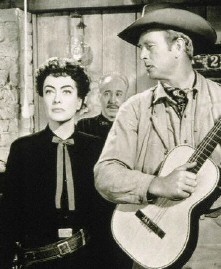
Certain westerns try to switch things up when it comes to the old reliables of the genre. One of those is the male hero. Nicholas Ray's offbeat 1954 western Johnny Guitar turned that aspect of westerns away immediately with Joan Crawford as the lead and a woman as her main rival. A definite inspiration for Sergio Leone with Once Upon a Time in the West, the basic plot is similar, this was an interesting movie that certainly deserves its cult status.

A guitar-playing cowboy (it's not as bad as it sounds) rides into a lonely saloon one day looking for a job as a musician. His name: Johnny Guitar (Sterling Hayden in one of his better parts). He has a past with the saloon owner, Vienna (Joan Crawford), who is sitting on a fortune and everyone knows it. She owns much of the land where the railroad will have to drive through. When the rails reach her acreage, she'll be rich. But not so fast, Guitar finds out there's two factions in town, the ranchers and the outlaws.

Tough-talking Emma Small (Mercedes McCambridge) and ranch owner John McIvers (Ward Bond) want Vienna out of the town so they can swoop in and grab her land and saloon. On Vienna's side is a gang led by an outlaw called the Dancin' Kid (Scott Brady). The Kid and his gang, Turkey Ralston (Ben Cooper), Bart Lonergan (Ernest Borgnine), and Corey (Royal Dano) are as equally hated as Vienna. Johnny Guitar rode into town thinking he had an easy job playing his guitar but finds out quickly nothing comes easy. Throw in John Carradine and Paul Fix as two of Vienna's employees and you've got quite a cast.

Lots going on here in this western. It's a talkative western with some gunplay sprinkled in but not too much. There's elements of other genres, straight romance stories, bits of film noir, and even a little McCarthy-ism just for good measure. And as mentioned, there's a lot of influence on later westerns, especially OUATITW. A posse all dressed in black hunts down the Kid and his gang look like something out of a spaghetti western like Django Kill! And where most westerns don't know what to do with female characters, this one puts them front and center. Both characters are interesting and developed with the fanatical rivalry kinda frightening.

The cast works well for the most part. Crawford doesn't look comfortable, but she gives a good performance. Always a little wooden in the acting department, Hayden pulls off the part of a guitar-playing cowboy with a past well. McCambridge is a good counter to Crawford as two women who hate each other and would love to see the other one dead. The finale, a shootout between the two, is the only woman vs. woman gunfight I can even think of in a western. About as different from the norm as you could get with a western, especially in the straight-laced 50s, Johnny Guitar should be a must-see for western fans!