The Sons of Katie Elder
"First, we reunite, then find Ma and Pa's killer...then read some reviews."
Showing posts with label Edward Dmytryk. Show all posts
Sunday, January 31, 2016
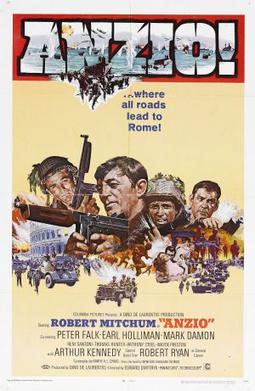
Anzio
Over the 1950's and 1960's, World War II movies were a dime a dozen hitting theaters. Even with the abundance of movies though, some theaters of war were often ignored, or at least covered less. Case in point? The Italian Campaign as Allied forces took Sicily and then Italy in horrific fighting that claimed thousands and thousands of lives in what some said/say was a waste of manpower. So while 1968's Anzio may not be a good movie, I can't help it. I'm a fan so sue me.
It's early 1944 and the fighting has dragged to a stalemate between Allied and Axis forces along the Monte Cassino line. The Allied forces are planning an invasion in Italy above the fighting as Cassino, intending to land some 70,000 troops north of the fighting at the port of Anzio. Among those landing is a war correspondent, Dick Ennis (Robert Mitchum), who will tag along with an American Ranger battalion (specially-trained infantry) as they hit the beaches. An expected hot landing is anything but...the troops hit the beaches with little to no resistance. There's no German forces for miles. On a patrol into the Italian countryside, Ennis and a corporal from the First Special Service Force, Jack Rabinoff (Peter Falk), discover just how open the countryside is. Back at the Allied beachhead though, no one on the general staff believes them. While the Allies dig in and establish a strong beachhead, the Germans take advantage, assembling a line as deadly as anything the war has seen.
If you're looking for a more detailed description of the Battle of Anzio, check out the Wikipedia page. I'm currently reading Alex Kershaw's The Liberator, an excellent read that explores the fighting in Italy in some detail. What's here in this 1968 war film is a condensed version with some embellishments and names changed. The actual battle of Anzio was a horrific miscalculation on the parts of the Allied commanders who made cautious decisions that ended up costing thousands of lives needlessly in fighting that could have been easily avoided. See? We learned something today!
'Anzio' itself is an interesting mess of a movie. It's from the 1960's, the age of the big, epic war films like The Great Escape, Battle of the Bulge, The Guns of Navarone, a trend that would continue into the 1970's. From director Edward Dmytryk (and Duilio Coletti in whatever the "Italian version" is), 'Anzio' is part of a trend of flicks dubbed Macaroni war movies (instead of spaghetti, get it?!?), films made with mostly Italian backing albeit with smaller budgets. Dino De Laurentiis produced the war film, bringing a respectable budget that's seen in landing shots where landing crafts empty of hundreds of soldiers hitting the beaches. There is a big budget feel (some of the time) as this story develops about one of the most costly battles of WWII. More detail later, but there's also truly odd moments sprinkled throughout, giving Dmytryk's film an off-balanced feel to the proceedings. More later!
Two performances here have always appealed to me, Robert Mitchum as war correspondent Dick Ennis, a character very loosely based on famed writer Ernie Pyle. Interesting tidbit? Mitchum earned an Oscar nomination for his performance in 1945's The Story of G.I. Joe, the story of Ernie Pyle in Italy! Ennis is a frontline guy, always sticking with the troops at the front even when he doesn't have to be. Mitchum treads that fine line between looking worn out and being interested, but that laconic, tired look favors Ennis well. He's sick of war, sick of stupid orders and commands that costs unnecessary lives. A good performance for Mitchum. As for Falk, it is an...interesting performance. His Jack Rabinoff is a SOLDIER. He loves fighting. He's good at it (maybe too good), and his backstory of how he ended up in the First Special Service Force is quite revealing. Again, there's some odd moments, but Falk brings a ton of energy, some humor to the part that's hard not to like.
This quasi-epic war film resorts to more familiar territory in the second half. Following a horrific German ambush, a small group of Rangers, including Ennis and Rabinoff, must get back to their own lines to report what the Allies are about to march into. If it's familiar, so be it. It's more at home. It's more comfortable. Among the survivors, look for Earl Holliman as the capable Sergeant Abe Stimmler, Reni Santoni as Pvt. Movie (always ready with an impression), an underused Mark Damon, Thomas Hunter, Giancarlo Giannini, and Joseph Walsh. In the epic vein, we also get unnecessary cameos from Robert Ryan and Arthur Kennedy with Kennedy at least getting something to do. Ryan is in two scenes, and he only speaks in one! Also look for ever the German, Wolfgang Preiss as Field Marshal Kesselring, the Allies' opposition across the line.
Where 'Anzio' falls in parts is its odd tone and general lack of epic qualities, even though it thinks it is an epic. It is NOT. It's a good, old-fashioned war flick. Simply put, it tries to cover too much ground in 117 minutes. The song that plays over the opening credits, This World is Yours (listen HERE), is awful. Truly out of place. The score itself is hit-and-miss, but when it works, I liked it a lot. As for the tone, this is a story that just refuses to pick one tone and go with it. Is it dark? Is it a light war film? While things are somewhat ironed out (not really), we get a painful scene of Falk's Rabinoff sitting in an ambulance with three prostitutes as he sings "Bye, Bye Blackbird" with them. There's another scene later where he does the same thing. What the hell is going on?!? Don't even get me started about the general combat tactics here either, highly-trained American troops charging into machine gun fire without even raising their weapons or trying to throw a grenade at the nest. Meh, run!!!
Now all that said, I've always liked this movie and held it up on my most recent reviewing. I love the Italian filming locations, especially the shots of Rome. I've always been a big fan of Mitchum and Falk, and even considering some script idiosyncrasies, they're both pretty good here, as is the whole supporting cast. Through all the general craziness and oddness, there's some...oddly charming. The action is harsh, including a late battle between our survivors and four German snipers, and from beginning to end, it is entertaining. It ain't a classic. So be it. It's very entertaining.
Anzio (1968): ***/****
Rewrite of May 2009 review
Tuesday, October 7, 2014
The Carpetbaggers
One of my favorite movies growing up -- and still is -- is the 1966 western Nevada Smith starring Steve McQueen. Wouldn't you know it? It's a prequel to a novel by Harold Robbins called The Carpetbaggers. How's that work? Well, it does and it doesn't. I'm still looking for the book, but I can check the film adaptation off the list. That's 1964's The Carpetbaggers.
It's the early 1920s and Jonas Cord Jr. (George Peppard) is a young man without a care in the world. Any problems he has, his rich father will solve or give him money or turn a blind eye to his antics. When Jonas' father suddenly dies from an aneurysm, a whole business empire is thrust upon Jonas. Will it crumble with the irresponsible Jonas at its helm? Far from it if he has anything to do with it. Young Cord wants to expand and grow and dominate the world. He starts the steady climb up, parlaying one factory into another and there's no market anywhere that Jonas doesn't want his hand in. He wants the power, the money, the prestige and nothing is going to stop him. But in the 1920s and 1930s, can anything actually slow Jonas down? Maybe only himself.
This was a movie I've long been aware of, one that I was vaguely familiar with because of 1966's Nevada Smith. For quite awhile it lingered on my Netflix Saved queue and lingered and lingered. Seriously....do people just hold onto the movies for months at a time?!? 'Carpetbaggers' finally popped up on the Retro Movie Channel, and I had to jump. I'm glad I did. From director Edward Dmytryk, it is a well-told story about business, ego, power, corruption and all that good, dark, sexy stuff that audiences can't turn away from. It clocks in at 150 minutes which might seem long, but the story moves at a lightning pace throughout. The timeline covers around 20 years but never feels rushed. We see the important moments from the good to the mostly bad to the really bad and often painful.
There's something simple and appealing about rise to power stories. How do they climb up? How do they stay there? What, if anything, will ultimately prove to be their downfall? This is a dark movie. There aren't good guys, just less bad guys. Everyone is out for themselves and willing to screw anyone over to get what they want with Peppard's Jonas leading the way. 'Carpetbaggers' takes place in posh hotel suites, busy movie sets, on new-model airplanes, in factories and follows Jonas with every decision he makes. It's nothing crazy original -- sure seems like a Howard Hughes-esque main character -- but there's something enjoyable, entertaining and appealing about this flick. I especially liked composer Elmer Bernstein's musical score with some familiar touches from other scores but forming its own identity. Listen HERE to the main theme.
Look at George Peppard's 1960s filmography, and you only see a couple classic movies, Breakfast at Tiffany's and How the West Was Won. But there's more there to appreciate, but he's got a handful or two of really solid movies worth seeking out. This film definitely counts. Peppard specialized in playing the anti-hero, that a-hole lead you just hate but can't look away from.This is a character who's icy, calculating, brutally efficient and with some deep-seeded personal issues. Obviously this isn't a character you're rooting for, but he's perfectly fascinating. We want to see what makes him tick. We want to see his next brutal takeover, whether it's on a personal basis or putting together a corporate buyout. An excellent performance from one of my favorites, Mr. Peppard. Nice work all around.
Peppard's Cord is the lightning rod for the story, but we meet a whole lot of other folks, most of them just as egotistical, greedy and downright lousy. Some good performances in a deep cast, starting with Alan Ladd in one of his all-time best parts as aging cowboy Nevada Smith. A checkered past to his name, Nevada tries to help Jonas knowing it can never really work. There's also Carroll Baker as Rina, Jonas' stepmother who's the same age as him and looking to make a name for herself. Slinking it up and quite sexy, Baker delivers an excellent part. There's also key supporting parts for Elizabeth Ashley (Jonas' wife), Robert Cummings (an agent turned producer), Martha Hyer (another femme fatale), Lew Ayres (Jonas' much-maligned yet capable accountant), Martin Balsam (a rival movie studio owner), Ralph Taeger (a pilot and business part of Jonas'), Archie Moore (the house servant who knows all) and Leif Erickson (Jonas' tough-love father).
If there's a weak point, it comes in the ending. I was looking for something better, something more appropriate and something DARKER. This is a tidy ending. An easy ending. The build-up makes up for it though to the point the last five minutes can't and won't ruin things. As for the connection to 1966's prequel, Nevada Smith, I think it is best to consider it two unrelated movies. Things don't jive just right, especially Brian Keith's Jonas turning into manipulative, evil Leif Erickson. One produced the other so that's cool, but that's about it. Both excellent movies, and let's leave it at that.
The Carpetbaggers (1964): ***/****
It's the early 1920s and Jonas Cord Jr. (George Peppard) is a young man without a care in the world. Any problems he has, his rich father will solve or give him money or turn a blind eye to his antics. When Jonas' father suddenly dies from an aneurysm, a whole business empire is thrust upon Jonas. Will it crumble with the irresponsible Jonas at its helm? Far from it if he has anything to do with it. Young Cord wants to expand and grow and dominate the world. He starts the steady climb up, parlaying one factory into another and there's no market anywhere that Jonas doesn't want his hand in. He wants the power, the money, the prestige and nothing is going to stop him. But in the 1920s and 1930s, can anything actually slow Jonas down? Maybe only himself.
This was a movie I've long been aware of, one that I was vaguely familiar with because of 1966's Nevada Smith. For quite awhile it lingered on my Netflix Saved queue and lingered and lingered. Seriously....do people just hold onto the movies for months at a time?!? 'Carpetbaggers' finally popped up on the Retro Movie Channel, and I had to jump. I'm glad I did. From director Edward Dmytryk, it is a well-told story about business, ego, power, corruption and all that good, dark, sexy stuff that audiences can't turn away from. It clocks in at 150 minutes which might seem long, but the story moves at a lightning pace throughout. The timeline covers around 20 years but never feels rushed. We see the important moments from the good to the mostly bad to the really bad and often painful.
There's something simple and appealing about rise to power stories. How do they climb up? How do they stay there? What, if anything, will ultimately prove to be their downfall? This is a dark movie. There aren't good guys, just less bad guys. Everyone is out for themselves and willing to screw anyone over to get what they want with Peppard's Jonas leading the way. 'Carpetbaggers' takes place in posh hotel suites, busy movie sets, on new-model airplanes, in factories and follows Jonas with every decision he makes. It's nothing crazy original -- sure seems like a Howard Hughes-esque main character -- but there's something enjoyable, entertaining and appealing about this flick. I especially liked composer Elmer Bernstein's musical score with some familiar touches from other scores but forming its own identity. Listen HERE to the main theme.
Look at George Peppard's 1960s filmography, and you only see a couple classic movies, Breakfast at Tiffany's and How the West Was Won. But there's more there to appreciate, but he's got a handful or two of really solid movies worth seeking out. This film definitely counts. Peppard specialized in playing the anti-hero, that a-hole lead you just hate but can't look away from.This is a character who's icy, calculating, brutally efficient and with some deep-seeded personal issues. Obviously this isn't a character you're rooting for, but he's perfectly fascinating. We want to see what makes him tick. We want to see his next brutal takeover, whether it's on a personal basis or putting together a corporate buyout. An excellent performance from one of my favorites, Mr. Peppard. Nice work all around.
Peppard's Cord is the lightning rod for the story, but we meet a whole lot of other folks, most of them just as egotistical, greedy and downright lousy. Some good performances in a deep cast, starting with Alan Ladd in one of his all-time best parts as aging cowboy Nevada Smith. A checkered past to his name, Nevada tries to help Jonas knowing it can never really work. There's also Carroll Baker as Rina, Jonas' stepmother who's the same age as him and looking to make a name for herself. Slinking it up and quite sexy, Baker delivers an excellent part. There's also key supporting parts for Elizabeth Ashley (Jonas' wife), Robert Cummings (an agent turned producer), Martha Hyer (another femme fatale), Lew Ayres (Jonas' much-maligned yet capable accountant), Martin Balsam (a rival movie studio owner), Ralph Taeger (a pilot and business part of Jonas'), Archie Moore (the house servant who knows all) and Leif Erickson (Jonas' tough-love father).
If there's a weak point, it comes in the ending. I was looking for something better, something more appropriate and something DARKER. This is a tidy ending. An easy ending. The build-up makes up for it though to the point the last five minutes can't and won't ruin things. As for the connection to 1966's prequel, Nevada Smith, I think it is best to consider it two unrelated movies. Things don't jive just right, especially Brian Keith's Jonas turning into manipulative, evil Leif Erickson. One produced the other so that's cool, but that's about it. Both excellent movies, and let's leave it at that.
The Carpetbaggers (1964): ***/****
Labels:
1960s,
Alan Ladd,
Carroll Baker,
Edward Dmytryk,
George Peppard,
Lew Ayres,
Martha Hyer,
Martin Balsam
Monday, February 25, 2013
The Left Hand of God
The lives, missions, and beliefs of priests lends well to film adaptations. Think of movies like Keys of the Kingdom, I Confess, The Mission, The Scarlet and the Black, Going My Way, Boys Town and many others. How about a priest sub-genre? Priests who aren't what they seem, films like 1972's The Wrath of God and 1955's The Left Hand of God.
It's 1947 in a remote province of China, and Father O'Shea (Humphrey Bogart) is on his way to an isolated Catholic miss deep in the hills. His predecessor was killed, and the mission is has been missing a priest for months. Three other Americans await, Dr. David Sigman (E.G. Marshall), his wife, Beryl (Agnes Moorehead), and Anne (Gene Tierney), a widow working at the mission. O'Shea's work is cut out for him, the local villagers happy he's there but also worrisome about his arrival. The biggest problem though isn't from the villagers though, but instead the new priest. O'Shea has a secret that threatens to tear the village apart. One of the few men who knows the secret? A warlord, Mieh Yang (Lee J. Cobb), who with his small army of killers poses a huge threat to the poor farming villages.
Based on a novel by William Barrett, this priestly-based story went through its fair share of incarnations and stars before it finally ended up in the hands of director Edward Dmytryk who eventually decided Bogart would be an ideal choice for the part (Kirk Douglas and Gregory Peck were attached to star in earlier incarnations). The film itself is nothing classic, nothing particularly different or unique, but it is nonetheless an enjoyable, well done movie that I was interested in from beginning to end. I'll say it again, familiarity can be a good thing when handled right (read: not boring). Substituting Malibu Canyon, California for China doesn't seem like an obvious choice, but it works in the same way MASH did replacing California for Korea. Composer Victor Young's score is a step above the rest, not your standard epic score.
After reviewing We're No Angels in late 2012, here's another Bogart film from late in the Hollywood icon's career. With Angels, The Harder They Fall, The Desperate Hours and this film (his last four films before his death in 1957), Bogie takes somewhat atypical roles. They're different, not just typical tough guy parts. Semi-spoiler alert......Bogie isn't a priest, taking the disguise and cover story to escape a troublesome situation. I won't spoil the details here, but an effective flashback lays it all out. It's not a showy or scene-stealing part by any means, but there's something charming about it. Bogie's Jim Carmody -- formerly Father O'Shea -- is quite capable of handling himself but there's a certain element of his lifestyle and past that makes him vulnerable.
Without ever becoming sappy, 'Hand' does a fine job of developing the character. We see his interactions with the cynical Dr. Sigman, a physician trying to consider the bottom line and frustrated with Chinese ways, with the widowed Scotty who sees him for the good he does, and most importantly, the Chinese villagers. Converts to Catholicism, they're seeking answers while also looking for a priest to lead the community. Several scenes show Bogie's Father O'Shea interacting with the village children, a good running bit that could have been pushed too far but knows when to tap the brakes. Bogie does a great job with these scenes, especially with his village assistant/quasi-altar boy, John (Victor Sen Yung), and also talking things out with a father (Benson Fong) who loses his wife and newborn baby minutes apart.
Clocking in at just 87 minutes, 'Hand' lacks the epic scale that the story could have required. It's pretty straightforward and to the point but never in a bad way. Marshall, Moorehead, and Tierney all provide solid support for Bogart, three differing performances that show a variety of responses to his arrival and impact. Cobb as the Chinese warlord is an odd choice to play....well, a Chinese warlord, but he avoids being stereotypical or cliched. Bad eye makeup? Yes. Bad performance? No, it could have been awful. Also look for Philip Ahn in a small part as Yang's assistant. Nothing flashy, but I liked this one a lot, especially for a late role for Bogie, and a goodie at that.
The Left Hand of God (1955): ***/****
It's 1947 in a remote province of China, and Father O'Shea (Humphrey Bogart) is on his way to an isolated Catholic miss deep in the hills. His predecessor was killed, and the mission is has been missing a priest for months. Three other Americans await, Dr. David Sigman (E.G. Marshall), his wife, Beryl (Agnes Moorehead), and Anne (Gene Tierney), a widow working at the mission. O'Shea's work is cut out for him, the local villagers happy he's there but also worrisome about his arrival. The biggest problem though isn't from the villagers though, but instead the new priest. O'Shea has a secret that threatens to tear the village apart. One of the few men who knows the secret? A warlord, Mieh Yang (Lee J. Cobb), who with his small army of killers poses a huge threat to the poor farming villages.
Based on a novel by William Barrett, this priestly-based story went through its fair share of incarnations and stars before it finally ended up in the hands of director Edward Dmytryk who eventually decided Bogart would be an ideal choice for the part (Kirk Douglas and Gregory Peck were attached to star in earlier incarnations). The film itself is nothing classic, nothing particularly different or unique, but it is nonetheless an enjoyable, well done movie that I was interested in from beginning to end. I'll say it again, familiarity can be a good thing when handled right (read: not boring). Substituting Malibu Canyon, California for China doesn't seem like an obvious choice, but it works in the same way MASH did replacing California for Korea. Composer Victor Young's score is a step above the rest, not your standard epic score.
After reviewing We're No Angels in late 2012, here's another Bogart film from late in the Hollywood icon's career. With Angels, The Harder They Fall, The Desperate Hours and this film (his last four films before his death in 1957), Bogie takes somewhat atypical roles. They're different, not just typical tough guy parts. Semi-spoiler alert......Bogie isn't a priest, taking the disguise and cover story to escape a troublesome situation. I won't spoil the details here, but an effective flashback lays it all out. It's not a showy or scene-stealing part by any means, but there's something charming about it. Bogie's Jim Carmody -- formerly Father O'Shea -- is quite capable of handling himself but there's a certain element of his lifestyle and past that makes him vulnerable.
Without ever becoming sappy, 'Hand' does a fine job of developing the character. We see his interactions with the cynical Dr. Sigman, a physician trying to consider the bottom line and frustrated with Chinese ways, with the widowed Scotty who sees him for the good he does, and most importantly, the Chinese villagers. Converts to Catholicism, they're seeking answers while also looking for a priest to lead the community. Several scenes show Bogie's Father O'Shea interacting with the village children, a good running bit that could have been pushed too far but knows when to tap the brakes. Bogie does a great job with these scenes, especially with his village assistant/quasi-altar boy, John (Victor Sen Yung), and also talking things out with a father (Benson Fong) who loses his wife and newborn baby minutes apart.
Clocking in at just 87 minutes, 'Hand' lacks the epic scale that the story could have required. It's pretty straightforward and to the point but never in a bad way. Marshall, Moorehead, and Tierney all provide solid support for Bogart, three differing performances that show a variety of responses to his arrival and impact. Cobb as the Chinese warlord is an odd choice to play....well, a Chinese warlord, but he avoids being stereotypical or cliched. Bad eye makeup? Yes. Bad performance? No, it could have been awful. Also look for Philip Ahn in a small part as Yang's assistant. Nothing flashy, but I liked this one a lot, especially for a late role for Bogie, and a goodie at that.
The Left Hand of God (1955): ***/****
Labels:
1950s,
E.G. Marshall,
Edward Dmytryk,
Gene Tierney,
Humphrey Bogart,
Lee J. Cobb
Tuesday, October 30, 2012
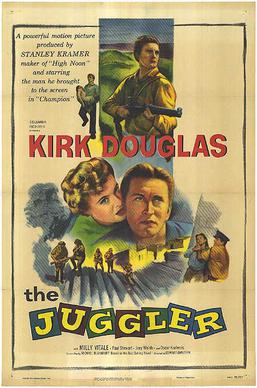
The Juggler
Born Issur Danielovitch, this actor would go on to a huge career in Hollywood as an actor under a different name; Kirk Douglas. The son of Jewish immigrants from Belarus, Douglas spent much of his life and early parts of his career fighting anti-Semitism, an interesting part of his autobiography The Ragman's Son. With his Jewish heritage, I can only imagine that 1953's The Juggler was an emotional venture for the actor.
It's 1949 and among hundreds of other Jewish refugees, Hans Mueller (Douglas) disembarks from a ship in Haifa in Israel at a refugee camp. A survivor of a WWII concentration camp, Hans was an international star before the war, gaining fame as a performer and juggler, but he was the lone survivor from his family; his wife and kids both dying in the camps. Now, Hans is struggling to adjust to a post-war life. He leaves the refugee camp, but when he is stopped by a police officer, Hans freaks out, runs and when cornered beats the officer senseless. Hans is now on the run, trekking across the Israeli countryside.
The Holocaust is one of those historical tragedies that is hard to fathom actually happened. Six million Jews killed in around six years? Millions more of Russians, minorities and various ethnicities and cultures? It boggles the mind. Many films have handled the touchy, emotional subject matter extremely well, but I can't think of another one that deals with how the survivors of the concentration camps assimilated themselves back to a "normal" life following their horrific ordeal. More impressive, 'Juggler' was made just four years after the story is set, and eight years since the end of WWII. That subject matter is still very much a fresh wound, and if for absolutely nothing else, this film gets bonus points for trying to tell a timely, emotional story.
Basically regardless of the role or the movie, if I see the name 'Kirk Douglas' in the cast listing, I'll give the film a shot. This is not a role that is mentioned with his best, but it is a hidden gem. He does an admirable job bringing Hans to life. As Hans treks across Israel, we learn more about his concentration camp past. Upon first meeting him, he mistakes another refugee family for his wife and kids. He's convinced it's them. But as we see more of his deep-seeded issues, it's easy to see that everything is not all right. Hans is claustrophobic, fears any sort of uniformed authority and is almost schizophrenic in his personal interactions. Douglas always had the ability to turn into an emotional livewire on-screen, and that's no different than here. A very effective performance, both understated and exaggerated at the same time, but just the right amount of both.
What struck me years back when I first stumbled across this movie was the photography. Made in 1953 before widescreen filming techniques were used, 'Juggler' nonetheless takes advantage of filling the fullscreen. Director Edward Dmytryk shoots the entire film in black and white on location in Israel, a choice that brings the entire movie up a notch. The California hills, the southwest desert, none of it would have sufficed here. As Hans walks across Israel, we get a sense of distance traveled, seeing Haifa, Jerusalem, Nazareth and the Hill of Galilee as a backdrop. The camera moves close in behind Douglas' Hans, but in the background we see the expansive countryside going on for seemingly endless miles. Not only is the movie timely, but because it was filmed in Israel, it feels that much more authentic.
As far as star power goes, the movie hitches its wagons to Douglas' name recognition. The rest of the cast isn't going to have much recognition at all with most viewers. Milly Vitale plays Ya'El, a Jewish woman working with refugees to relocate within Israel who begins to worry about Hans' mental mindset. Paul Stewart plays Detective Karni, the officer pursuing Hans after his attack on the police officer. Joseph Walsh plays Joshua, a Jewish teenager who joins Hans in his "travels" of sorts, the two bonding over similar backgrounds. Also look for future Sgt. Schultz John Banner as a witness to the attack who takes part in the investigation and Beverly Washburn as Susy, a young girl who becomes Hans' friend when they meet upon arriving at the camp.
This one was a pleasant surprise. At times, it borders on being a little overdone -- looking at you, George Antheil's musical score especially -- but mostly it hits all the right notes. Douglas is the biggest reason to see this ahead of its time story. Well worth seeking it out.
The Juggler <---trailer p="p">---trailer>
It's 1949 and among hundreds of other Jewish refugees, Hans Mueller (Douglas) disembarks from a ship in Haifa in Israel at a refugee camp. A survivor of a WWII concentration camp, Hans was an international star before the war, gaining fame as a performer and juggler, but he was the lone survivor from his family; his wife and kids both dying in the camps. Now, Hans is struggling to adjust to a post-war life. He leaves the refugee camp, but when he is stopped by a police officer, Hans freaks out, runs and when cornered beats the officer senseless. Hans is now on the run, trekking across the Israeli countryside.
The Holocaust is one of those historical tragedies that is hard to fathom actually happened. Six million Jews killed in around six years? Millions more of Russians, minorities and various ethnicities and cultures? It boggles the mind. Many films have handled the touchy, emotional subject matter extremely well, but I can't think of another one that deals with how the survivors of the concentration camps assimilated themselves back to a "normal" life following their horrific ordeal. More impressive, 'Juggler' was made just four years after the story is set, and eight years since the end of WWII. That subject matter is still very much a fresh wound, and if for absolutely nothing else, this film gets bonus points for trying to tell a timely, emotional story.
Basically regardless of the role or the movie, if I see the name 'Kirk Douglas' in the cast listing, I'll give the film a shot. This is not a role that is mentioned with his best, but it is a hidden gem. He does an admirable job bringing Hans to life. As Hans treks across Israel, we learn more about his concentration camp past. Upon first meeting him, he mistakes another refugee family for his wife and kids. He's convinced it's them. But as we see more of his deep-seeded issues, it's easy to see that everything is not all right. Hans is claustrophobic, fears any sort of uniformed authority and is almost schizophrenic in his personal interactions. Douglas always had the ability to turn into an emotional livewire on-screen, and that's no different than here. A very effective performance, both understated and exaggerated at the same time, but just the right amount of both.
What struck me years back when I first stumbled across this movie was the photography. Made in 1953 before widescreen filming techniques were used, 'Juggler' nonetheless takes advantage of filling the fullscreen. Director Edward Dmytryk shoots the entire film in black and white on location in Israel, a choice that brings the entire movie up a notch. The California hills, the southwest desert, none of it would have sufficed here. As Hans walks across Israel, we get a sense of distance traveled, seeing Haifa, Jerusalem, Nazareth and the Hill of Galilee as a backdrop. The camera moves close in behind Douglas' Hans, but in the background we see the expansive countryside going on for seemingly endless miles. Not only is the movie timely, but because it was filmed in Israel, it feels that much more authentic.
As far as star power goes, the movie hitches its wagons to Douglas' name recognition. The rest of the cast isn't going to have much recognition at all with most viewers. Milly Vitale plays Ya'El, a Jewish woman working with refugees to relocate within Israel who begins to worry about Hans' mental mindset. Paul Stewart plays Detective Karni, the officer pursuing Hans after his attack on the police officer. Joseph Walsh plays Joshua, a Jewish teenager who joins Hans in his "travels" of sorts, the two bonding over similar backgrounds. Also look for future Sgt. Schultz John Banner as a witness to the attack who takes part in the investigation and Beverly Washburn as Susy, a young girl who becomes Hans' friend when they meet upon arriving at the camp.
This one was a pleasant surprise. At times, it borders on being a little overdone -- looking at you, George Antheil's musical score especially -- but mostly it hits all the right notes. Douglas is the biggest reason to see this ahead of its time story. Well worth seeking it out.
The Juggler <---trailer p="p">---trailer>
Wednesday, May 30, 2012
Back to Bataan
One of the more horrific events in American military history, the Bataan Death March
is hard to comprehend some 60-plus years later. As an event in time, it
marks a low point for the U.S. military, but it often hides the rest of
the Philippines involvement in WWII. While the fighting continued as
the Allies island-hopped across the Pacific, guerrilla fighting raged on
in the Philippines, small groups of left behind American soldiers
fighting alongside Filipino natives, like 1945's propaganda-heavy but
highly entertaining Back to Bataan.
Commanding a company of Filipino scouts late in the Bataan defense in spring 1942, Colonel Joe Madden (John Wayne) is called back to HQ with special orders. In an effort to ease the pressure on the front line troops, Madden will be sent behind the lines to organize guerrilla units. As he arrives though, the Allies surrender, and the Japanese are now in charge of some 70,000 prisoners. With a small ragtag group of American soldiers, Filipino natives and Filipino scouts, Madden goes to work nipping at the Japanese war effort in the face of impossible odds. With Japanese reprisals instantaneous and brutal, Madden seeks help, one of his men, Capt. Andres Bonifacio (Anthony Quinn), the grandson of a Filipino hero, now a prisoner. Together they fight on, hoping the Allies will return to the Philippines in time.
What is most appealing and interesting about this Edward Dmytryk-directed WWII story is the timing. It was released in theaters in the United States in late May 1945. The war was still very much going on, the bombings of Hiroshima and Nagasaki still two-plus months away. I'll go into the propaganda angle later, but there's just something appealing about the story. It is straightforward, honest and even in its force-fed attitude, entertaining. The action is kept to small doses, but when it's there, it's loud, chaotic and doesn't have that whitewashed feel of a 1940s war movie, including several impressive stunts for the Duke. The military-themed score isn't real subtle, but it works in its obvious ways. Japanese...DUN DUN DUH! Americans....Cue the hero music!
Not one of his best roles, this is nonetheless one of my favorite John Wayne performances. The 38-year old Wayne was just heading into his prime as an actor, and it ends up being an interesting middle ground. He doesn't look like a kid anymore, but he doesn't look like the heavier Duke of the 1960s. As the main star here, Wayne's Col. Madden ends up being the face of the American involvement in the guerrilla movement. Who better to lead a warring nation against invaders? A similarly very young looking Quinn gets the showier part, the disillusioned Filipino trying to decide if the fighting and cost in lives is worth it. Knowing that both Wayne and Quinn would go on to become huge stars, it's fun seeing them in early parts as rising stars. Quinn also gets a love interest, Fely Franquelli as Dalisay Delgado, an American agent working undercover for the Japanese (think Tokyo Rose).
And then there is the propaganda. By spring 1945, the Allied forces would win the war in the Pacific, it was just a matter of time. 'Bataan' nonetheless lays it on pretty thick in the propaganda department. The Japanese officers (including Richard Loo, Philip Ahn, and Leonard Strong) are maniacally evil, sneering, conniving and diabolical whenever possible. Loo's Major Hasko actually pets a Filipino girl's hair at one point, seemingly practicing to be a Bond villain. Granted, the Japanese war effort in general was despicable, inhuman and horrifically awful, but 'Bataan' makes it cartoonish in its portrayal. There's also the opposite. A Filipino teacher (Vladimir Sokoloff) is hanged rather than pull down an American flag. Instead of ripping the Japanese, it builds up the glory of America, especially young Filipino fighter, Maximo (Ducky Louie), and his American teacher, Ms. Barnes (Beulah Bondi), arguing. Late, a mortally wounded Maximo wishes he could have learned to spell 'liberty' correctly. The weird thing? Even in its cheeseball corniness, it works somehow.
While it isn't a classic WWII film, 'Bataan' is a highly entertaining movie to watch, especially in a double-bill with 1942's Bataan. The history is interesting, the prologue showing the freeing of Allied prisoners at Cabanatuan Prison Camp (read more HERE), the real-life incident depicted in 2005's The Great Raid. An excellent story in 2005, but in 1945 it was just four months removed from the actual incident! Timely much? The real-life P.O.W. survivors even make an appearance (watch HERE). How cool is that? Talk about a time capsule. There's some humor as well, Paul Fix's displaced American hobo, Bindle, talking with Alex Havier's loyal and capable Filipino scout, Sgt. Bernessa, about the beauty of being a hobo. Also look for Lawrence Tierney as Lt. Waite, an American officer debriefing the guerrillas before the action-packed finale. Just a good, old-fashioned war movie, one that could have gotten bogged down in its propaganda message but manages to rise above it.
Back to Bataan <---trailer (1945): *** 1/2 /****
Commanding a company of Filipino scouts late in the Bataan defense in spring 1942, Colonel Joe Madden (John Wayne) is called back to HQ with special orders. In an effort to ease the pressure on the front line troops, Madden will be sent behind the lines to organize guerrilla units. As he arrives though, the Allies surrender, and the Japanese are now in charge of some 70,000 prisoners. With a small ragtag group of American soldiers, Filipino natives and Filipino scouts, Madden goes to work nipping at the Japanese war effort in the face of impossible odds. With Japanese reprisals instantaneous and brutal, Madden seeks help, one of his men, Capt. Andres Bonifacio (Anthony Quinn), the grandson of a Filipino hero, now a prisoner. Together they fight on, hoping the Allies will return to the Philippines in time.
What is most appealing and interesting about this Edward Dmytryk-directed WWII story is the timing. It was released in theaters in the United States in late May 1945. The war was still very much going on, the bombings of Hiroshima and Nagasaki still two-plus months away. I'll go into the propaganda angle later, but there's just something appealing about the story. It is straightforward, honest and even in its force-fed attitude, entertaining. The action is kept to small doses, but when it's there, it's loud, chaotic and doesn't have that whitewashed feel of a 1940s war movie, including several impressive stunts for the Duke. The military-themed score isn't real subtle, but it works in its obvious ways. Japanese...DUN DUN DUH! Americans....Cue the hero music!
Not one of his best roles, this is nonetheless one of my favorite John Wayne performances. The 38-year old Wayne was just heading into his prime as an actor, and it ends up being an interesting middle ground. He doesn't look like a kid anymore, but he doesn't look like the heavier Duke of the 1960s. As the main star here, Wayne's Col. Madden ends up being the face of the American involvement in the guerrilla movement. Who better to lead a warring nation against invaders? A similarly very young looking Quinn gets the showier part, the disillusioned Filipino trying to decide if the fighting and cost in lives is worth it. Knowing that both Wayne and Quinn would go on to become huge stars, it's fun seeing them in early parts as rising stars. Quinn also gets a love interest, Fely Franquelli as Dalisay Delgado, an American agent working undercover for the Japanese (think Tokyo Rose).
And then there is the propaganda. By spring 1945, the Allied forces would win the war in the Pacific, it was just a matter of time. 'Bataan' nonetheless lays it on pretty thick in the propaganda department. The Japanese officers (including Richard Loo, Philip Ahn, and Leonard Strong) are maniacally evil, sneering, conniving and diabolical whenever possible. Loo's Major Hasko actually pets a Filipino girl's hair at one point, seemingly practicing to be a Bond villain. Granted, the Japanese war effort in general was despicable, inhuman and horrifically awful, but 'Bataan' makes it cartoonish in its portrayal. There's also the opposite. A Filipino teacher (Vladimir Sokoloff) is hanged rather than pull down an American flag. Instead of ripping the Japanese, it builds up the glory of America, especially young Filipino fighter, Maximo (Ducky Louie), and his American teacher, Ms. Barnes (Beulah Bondi), arguing. Late, a mortally wounded Maximo wishes he could have learned to spell 'liberty' correctly. The weird thing? Even in its cheeseball corniness, it works somehow.
While it isn't a classic WWII film, 'Bataan' is a highly entertaining movie to watch, especially in a double-bill with 1942's Bataan. The history is interesting, the prologue showing the freeing of Allied prisoners at Cabanatuan Prison Camp (read more HERE), the real-life incident depicted in 2005's The Great Raid. An excellent story in 2005, but in 1945 it was just four months removed from the actual incident! Timely much? The real-life P.O.W. survivors even make an appearance (watch HERE). How cool is that? Talk about a time capsule. There's some humor as well, Paul Fix's displaced American hobo, Bindle, talking with Alex Havier's loyal and capable Filipino scout, Sgt. Bernessa, about the beauty of being a hobo. Also look for Lawrence Tierney as Lt. Waite, an American officer debriefing the guerrillas before the action-packed finale. Just a good, old-fashioned war movie, one that could have gotten bogged down in its propaganda message but manages to rise above it.
Back to Bataan <---trailer (1945): *** 1/2 /****
Labels:
1940s,
Anthony Quinn,
Beulah Bondi,
Edward Dmytryk,
John Wayne,
Paul Fix,
WWII
Friday, July 8, 2011
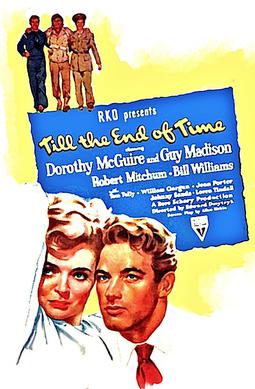
Till the End of Time
I have this notion that following the end of World War II in both the European and Pacific theaters that everything was hunky-dory, everything was just fine as soldiers returned home to their friends and families without missing a beat. That of course was not the truth. Thousands of young men had just taken part in a world-shattering and world-changing event that altered the course of history, and then after years of fighting, the war was over. As much as they may have wanted to go home, it just wasn't that easy. From director Edward Dmytryk, 'End of Time' is an honest, moving look at this transition through the eyes of three Marine veterans.
After three-plus years fighting in the Pacific, highly decorated Marine Cliff Harper (Guy Madison) is being mustered out just a few months after the end of WWII. He parts ways with his best friend, William Tabeshaw (Robert Mitchum), and heads home to California where he sees his parents (Tom Tully and Ruth Nelson) for the first time in years. Cliff is glad to be home, but he doesn't know quite what to do with himself. He finds himself lashing out at everyone around him. He wants nothing to do with any sort of job or responsibility. Nothing comes easy for him as he tries to readjust even when he meets Pat Ruscomb (Dorothy McGuire), a young widow who lost her pilot husband in Europe within the last year. Instantly drawn to a similarly struggling Pat, Cliff can't seem to do anything right though, and his struggles to keep his emotions in check might drive her away.
I had little to no expectations going into this one. The plot description sounded interesting, and I liked the two leads in McGuire and Madison, not even realizing one of my favorites in Robert Mitchum played a key supporting role. The premise was even more interesting considering the film was released within a year of the end of WWII. My picture of a post-WWII America is one where audiences did not want to see movies about their heroic veterans struggling to readjust to civilian life. This is a great movie, authentic, honest and moving. It doesn't try to whitewash these struggles so many veterans went through after surviving the hell of combat. I liked it so much more than 'Best Years' and wish it could receive some recognition alongside that much more well-known movie. Still, it doesn't take away from its value as a film that can stand alone on its own.
Certain moments take this movie to another level. In terms of a no-frills opening, the long, uninterrupted shot of Madison's Cliff walking through his childhood home upon returning is great. He slowly walks through the rooms, seeing things so much differently than he did only a few years before. Later, a veteran, Perry (Bill Williams), refuses to wear his prosthetic legs but finally swallows his pride and pushes his stubborness by the wayside. In a great reveal, he opens the door to his room dressed in his dress uniform, proudly walking to his beaming mother. The best though comes when Cliff and Pat are on a date at an ice rink where they see an Army soldier (Richard Benedict) struggling with a bout of the shakes. Both having dealt with similar circumstances in their own way, they help the young soldier who wants to go home but doesn't want to worry his parents. A scene that is incredibly moving in its execution, it is years ahead of its time in honesty.
Just 24 years old at the time, Guy Madison does not disappoint in his first starring role and second movie overall. What sets his Cliff Harper character apart is that at several different times, he's a complete asshole. Granted, it isn't so much him as his internal battle to adjust and be normal again, but he's aggressive and even violent, both physically and lashing out with words. Mostly though, he realizes what he's doing and does his best to stop it. His relationship with a scene-stealing McGuire feels real and never forced. These are two individuals who are dealing with similar problems but end up using the other for some sort of legitimacy or rationale. I have this picture of McGuire as the motherly character from Friendly Persuasion and Swiss Family Robinson so seeing her as a somewhat promiscuous young lady is quite a departure. You buy it though. Like Madison's Cliff, she doesn't know how to move on with her life.
Imagine my surprise when I sat through the credits and after McGuire and Madison I saw Robert Mitchum's name pop up. Consider me very pleased, even if his part is only a supporting one, if a key one at that. This is a pre-stardom Mitchum, but it's clear he's destined for bigger and better things. His character is also an ex-Marine who has a metal plate in his head after he was wounded. He refuses to deal with the ever-increasing headaches he has, living life as it presents itself. From what I've read about Mitchum, the character isn't too far removed from his real-life personality. In other words? He's always up to something, and it's always going to be entertaining.
There is little not to like about this movie. From the lead parts down to the supporting roles like Williams' ex-boxer Perry and Tully and Nelson as Cliff's parents, everyone hits that right note. It's that rare movie that hits almost all the right notes. It never gets too melodramatic or hammy, but also doesn't underplay the situation of these returning veterans. 'Best Years' is much more well-known, and it also features some great performances, but for me, I'll stick with this one.
Till the End of Time <---TCM clips (1946): *** 1/2 /****
Labels:
1940s,
Edward Dmytryk,
Guy Madison,
Robert Mitchum,
WWII
Thursday, April 21, 2011
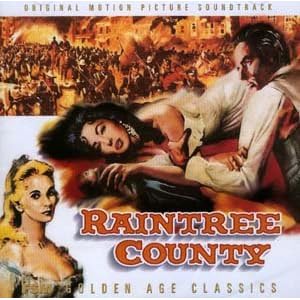
Raintree County
The conversation about the best Civil War epic will typically always begin and end with one movie, 1939's Gone With the Wind, a classic film and one of the best movies ever made in Hollywood history. In general though, Hollywood hasn't gone to the Civil War well too often, and I've never been able to figure out why. Movies like Gettysburg and Gods and Generals were made because Ted Turner has lots of money and is a Civil War buff. Glory is a classic true story that I think is the best depiction of the war around. Well, there's another epic, 1957's Raintree County.
The main problem with this MGM epic is that it tries to be Gone With the Wind 2 too much instead of blazing its own trail. I was surprised though to read the hate this movie gets whether it be the cast being miscast, the story being too simple, or just overall, it's a boring movie. I think two of those three are legitimate issues to have with the movie, but there's something appealing about Raintree County that will take more than that to ruin the movie. The 1950s and early 1960s were the time of the epic in Hollywood, 3-hour movies where no expense was spared. Gigantic budgets, big-time directors, all-star casts, they just don't make them like this anymore. It's a time capsule of a different era in Hollywood, and an interesting one at that.
It's 1859 in Freehaven, Indiana in Raintree County and young John Shawnessy (Montgomery Clift) is about to graduate from the local college. He's ready for the future with his longtime sweetheart, Nell (Eva Marie Saint), when he meets Susanna (Elizabeth Taylor), a Southern belle visiting Freehaven from Louisiana. John falls for her immediately as does she for him. It doesn't take long before Susanna tells him that she's pregnant with his child so they marry and move to the South. With a conflict brewing about states' rights and the ability to own slaves though, John insists they move back to Raintree County. As the Civil War breaks out though with the attack on Fort Sumter, he finds out that his young wife has a secret that could tear them apart. His life thrown on its side, John must now make a huge decision, all the while the North fighting the South around them.
The biggest surprise I found reading reviews here was about the casting and acting of Clift and Taylor. Montgomery Clift was involved in a horrific car accident during filming that caused production to shut down for two months while waiting for him to heal so there is already a stigma attached to the part and the movie as unlucky, and in some circles, just plain bad. I don't know if Clift was the right choice for the lead role, but it's the rare movie he's not very watchable in that lead role. It's not his best performance, but it's still good. More surprising is that Elizabeth Taylor earned a nomination for her performance. No disrespect to the recently passed Miss Taylor, but this was just too hammy of a performance. She's Scarlet O'Hara on steroids, chewing the scenery left and right, a fragile woman screaming and crying at every turn because of her past. She treads that fine line between highly dramatic and soap opera, but too often it leans toward the soap opera acting, loud, confrontational and overbearing.
Say what you will about the two leads, but one thing that's untouchable is the rest of the cast. That's always one of the best things to come out of these Hollywood epics, casts that feature a who's who list of stars playing supporting roles. For this particular epic we've got Marie Saint as the innocent, incredibly sweet Nell, Nigel Patrick as Professor Stiles, a fast-talking, intelligent, philanderer of a man, Lee Marvin as Orville 'Flash' Perkins, John's drinking buddy and a brawler of a man, Rod Taylor as Garwood Jones, a Northern politician who leans toward Southern rights, Agnes Morehead and Walter Abel as John's parents, and DeForest Kelley as a Confederate officer John comes across in Georgia. Of all the performances, Patrick and Marvin especially shine. Patrick's Professor is that good sort of scenery chewing, verbose and expressive, a man who loves life and everything about it. Marvin's Flash is a similar character if from a little lower class. He loves to fight and compete, loves women, and loves to drink.
Director Edward Dmytryk was given a $5,000,000 budget to make this movie, a huge sum at the times. While the film struggled with audiences, it wasn't for lack of effort. It was nominated for best costumes and best art direction and deservedly so. Raintree County is a stunningly beautiful movie with beautiful locations (Kentucky and Mississippi mostly), huge sets filled with hundreds of extras, and a screen so full of action, details, and vivid colors that you can overlook the somewhat stilted dialogue or slow-moving story (it clocks in at just under 3 hours). This is an EPIC, a type of movie they just don't make anymore. The story -- based off a novel -- tries to tackle a lot of topics because honestly, the Civil War had a lot of topics worth covering. It's too much at different points and not enough, focusing on the same thing over and over instead of focusing on the more interesting aspects, Abolitionism, slavery, the actual fighting. Like any movie, it is good and bad. You just hope the good outweighs the bad, and for me it did.
One reason I've assumed the Civil War has never been made into many feature films is the expense of creating huge battle scenes. The actual combat of the war is the second half of the movie after a brief intermission. The sequences are large-scale but don't linger, and were even re-used five years later in How the West Was Won. Clift's John ends up with General Sherman's army in Georgia, and for me this was the movie at its best. Battle sequences are handled with an effective, well-done montage, and Dmytryk paints a picture of what 1864-5 Georgia must have been like, war-torn, terrifying, and a host for all sorts of evil. Working off a novel and trying to stay true to the source, I understand you have to go with what is in front of you. Dmytryk's epic is solid and I enjoyed it from beginning to end. It could have been better, but it's the rare movie that couldn't be better. There are only so many Hollywood epics like this so enjoy them for what they are.
Raintree County <---trailer (1957): ***/****
The main problem with this MGM epic is that it tries to be Gone With the Wind 2 too much instead of blazing its own trail. I was surprised though to read the hate this movie gets whether it be the cast being miscast, the story being too simple, or just overall, it's a boring movie. I think two of those three are legitimate issues to have with the movie, but there's something appealing about Raintree County that will take more than that to ruin the movie. The 1950s and early 1960s were the time of the epic in Hollywood, 3-hour movies where no expense was spared. Gigantic budgets, big-time directors, all-star casts, they just don't make them like this anymore. It's a time capsule of a different era in Hollywood, and an interesting one at that.
It's 1859 in Freehaven, Indiana in Raintree County and young John Shawnessy (Montgomery Clift) is about to graduate from the local college. He's ready for the future with his longtime sweetheart, Nell (Eva Marie Saint), when he meets Susanna (Elizabeth Taylor), a Southern belle visiting Freehaven from Louisiana. John falls for her immediately as does she for him. It doesn't take long before Susanna tells him that she's pregnant with his child so they marry and move to the South. With a conflict brewing about states' rights and the ability to own slaves though, John insists they move back to Raintree County. As the Civil War breaks out though with the attack on Fort Sumter, he finds out that his young wife has a secret that could tear them apart. His life thrown on its side, John must now make a huge decision, all the while the North fighting the South around them.
The biggest surprise I found reading reviews here was about the casting and acting of Clift and Taylor. Montgomery Clift was involved in a horrific car accident during filming that caused production to shut down for two months while waiting for him to heal so there is already a stigma attached to the part and the movie as unlucky, and in some circles, just plain bad. I don't know if Clift was the right choice for the lead role, but it's the rare movie he's not very watchable in that lead role. It's not his best performance, but it's still good. More surprising is that Elizabeth Taylor earned a nomination for her performance. No disrespect to the recently passed Miss Taylor, but this was just too hammy of a performance. She's Scarlet O'Hara on steroids, chewing the scenery left and right, a fragile woman screaming and crying at every turn because of her past. She treads that fine line between highly dramatic and soap opera, but too often it leans toward the soap opera acting, loud, confrontational and overbearing.
Say what you will about the two leads, but one thing that's untouchable is the rest of the cast. That's always one of the best things to come out of these Hollywood epics, casts that feature a who's who list of stars playing supporting roles. For this particular epic we've got Marie Saint as the innocent, incredibly sweet Nell, Nigel Patrick as Professor Stiles, a fast-talking, intelligent, philanderer of a man, Lee Marvin as Orville 'Flash' Perkins, John's drinking buddy and a brawler of a man, Rod Taylor as Garwood Jones, a Northern politician who leans toward Southern rights, Agnes Morehead and Walter Abel as John's parents, and DeForest Kelley as a Confederate officer John comes across in Georgia. Of all the performances, Patrick and Marvin especially shine. Patrick's Professor is that good sort of scenery chewing, verbose and expressive, a man who loves life and everything about it. Marvin's Flash is a similar character if from a little lower class. He loves to fight and compete, loves women, and loves to drink.
Director Edward Dmytryk was given a $5,000,000 budget to make this movie, a huge sum at the times. While the film struggled with audiences, it wasn't for lack of effort. It was nominated for best costumes and best art direction and deservedly so. Raintree County is a stunningly beautiful movie with beautiful locations (Kentucky and Mississippi mostly), huge sets filled with hundreds of extras, and a screen so full of action, details, and vivid colors that you can overlook the somewhat stilted dialogue or slow-moving story (it clocks in at just under 3 hours). This is an EPIC, a type of movie they just don't make anymore. The story -- based off a novel -- tries to tackle a lot of topics because honestly, the Civil War had a lot of topics worth covering. It's too much at different points and not enough, focusing on the same thing over and over instead of focusing on the more interesting aspects, Abolitionism, slavery, the actual fighting. Like any movie, it is good and bad. You just hope the good outweighs the bad, and for me it did.
One reason I've assumed the Civil War has never been made into many feature films is the expense of creating huge battle scenes. The actual combat of the war is the second half of the movie after a brief intermission. The sequences are large-scale but don't linger, and were even re-used five years later in How the West Was Won. Clift's John ends up with General Sherman's army in Georgia, and for me this was the movie at its best. Battle sequences are handled with an effective, well-done montage, and Dmytryk paints a picture of what 1864-5 Georgia must have been like, war-torn, terrifying, and a host for all sorts of evil. Working off a novel and trying to stay true to the source, I understand you have to go with what is in front of you. Dmytryk's epic is solid and I enjoyed it from beginning to end. It could have been better, but it's the rare movie that couldn't be better. There are only so many Hollywood epics like this so enjoy them for what they are.
Raintree County <---trailer (1957): ***/****
Friday, August 20, 2010
Shalako
By 1968, James Bond himself, Sean Connery, was riding high off the success of the first five 007 movies he made, most recently with You Only Live Twice. When he wasn't playing Bond, Connery did his damnedest to avoid being typecast, generally succeeding with a wide-ranging list of roles that continued into the 1970s and 1980s. But in all those movies, he only did one western, and it's a good one, 1968's Shalako.
Based on a Louis L'Amour novel, this Euro-western has a lot going for it with a lot of different elements thrown together in the final product. Start with the uniquely international cast that includes American, English, French, Scottish, German and Spanish actors and actresses, all of them with speaking roles. While the story ends up being somewhat familiar late in the movie, the build-up to that point is different from about 99.9% of other westerns. At times it can be a little too much with so many different elements working together and sometimes against each other, but the positives outweigh the negatives...for me at least.
Frontiersman and former U.S. cavalry officer Shalako Carlin (Connery) stumbles across an Apache ambush, saving a beautiful French woman, Countess Irina Lazaar (Brigitte Bardot), from certain death. Irina is part of a European hunting party headed by Baron Von Halstatt (Peter Van Eyck), Sir Charles Daggett (Jack Hawkins), and U.S. senator Henry Clark (Alexander Knox) who are touring the American west, killing any animals they see, their wives along for the adventure. Knowing what awaits them, Shalako tries to convince them to leave the territory as the Apaches don't take kindly to anyone riding onto their land. The party ignores him, but when their guide, Bosky Fulton (Stephen Boyd) and his men double-cross them, they have no one to turn to other than Shalako.
Above all else, I'd say watch this movie for the cast, starting with Connery and on down the line through all the supporting parts, some much bigger than others. If anything, there may be too many names involved because characters aren't given the attention they deserve at times. Connery's Shalako -- an all around badass like most L'Amour heroes -- doesn't even dominate the screen, and the movie's named after him! Those I could get into the plot review are just some of the names, there's also Honor Blackman as Hawkins' wife, Woody Strode as an Apache chief (not as bad as a Mongol bandit I guess), Valerie French as the senator's wife, and Julian Mateos and Don Barry as two gunmen along for the ride.
Seeing Connery in a western setting might seem odd -- Scottish actor dudes up in bucksins and six-shooter -- but it works. He is typical of most L'Amour heroes in his ability to handle himself in even the hairiest situation, loyal and honest, and does the right thing over the thing that makes the most sense. In the end, you know he'll win and get the girl. Oops, did I just give away the ending? My bad. Director Edward Dmytryk had a bit of a predicament with leading lady Bardot, the definition of a 1960s sex kitten. Basically do you make her look like a woman on the frontier or like, well, Brigitte Bardot. He goes with option B. Hair always look perfect as does the makeup. I'll disagree with a lot of reviews, I thought Connery and Bardot had good chemistry, and her sexy French accent goes a long way. It just does, no other explanation needed.
Keeping it all together is the movie's biggest problem as Dmytryk juggles all these characters and subplots. The story is at its strongest when sticking with Shalako and the motley crew of survivors he's leading. Boyd is always a solid villain but his character could basically be erased from the storyline and it wouldn't skip a beat. Van Eyck and Hawkins do what they can with stiff upper lip aristocratic characters. If nothing else, there is more eye candy than usual in a typical western. Along with Bardot -- who is given a topless scene with strategically placed hands -- there's Blackman and French, neither of whom are too bad to look at.
I wish there was more I could say about this Euro-western, but I'm drawing a blank. The cast is solid if under utilized, the action is exciting, and the Spanish desert fills in nicely for the American southwest. Be forewarned, there's a truly awful theme song -- give it a listen HERE -- that plays over the credits on either end of the movie. I'll apologize in advance for the song being stuck in your head for the next few days. It is a western that does nothing spectacularly, but instead does everything in a solid, workmanlike manner.
Shalako <---TCM clip (1968): ***/****
Based on a Louis L'Amour novel, this Euro-western has a lot going for it with a lot of different elements thrown together in the final product. Start with the uniquely international cast that includes American, English, French, Scottish, German and Spanish actors and actresses, all of them with speaking roles. While the story ends up being somewhat familiar late in the movie, the build-up to that point is different from about 99.9% of other westerns. At times it can be a little too much with so many different elements working together and sometimes against each other, but the positives outweigh the negatives...for me at least.
Frontiersman and former U.S. cavalry officer Shalako Carlin (Connery) stumbles across an Apache ambush, saving a beautiful French woman, Countess Irina Lazaar (Brigitte Bardot), from certain death. Irina is part of a European hunting party headed by Baron Von Halstatt (Peter Van Eyck), Sir Charles Daggett (Jack Hawkins), and U.S. senator Henry Clark (Alexander Knox) who are touring the American west, killing any animals they see, their wives along for the adventure. Knowing what awaits them, Shalako tries to convince them to leave the territory as the Apaches don't take kindly to anyone riding onto their land. The party ignores him, but when their guide, Bosky Fulton (Stephen Boyd) and his men double-cross them, they have no one to turn to other than Shalako.
Above all else, I'd say watch this movie for the cast, starting with Connery and on down the line through all the supporting parts, some much bigger than others. If anything, there may be too many names involved because characters aren't given the attention they deserve at times. Connery's Shalako -- an all around badass like most L'Amour heroes -- doesn't even dominate the screen, and the movie's named after him! Those I could get into the plot review are just some of the names, there's also Honor Blackman as Hawkins' wife, Woody Strode as an Apache chief (not as bad as a Mongol bandit I guess), Valerie French as the senator's wife, and Julian Mateos and Don Barry as two gunmen along for the ride.
Seeing Connery in a western setting might seem odd -- Scottish actor dudes up in bucksins and six-shooter -- but it works. He is typical of most L'Amour heroes in his ability to handle himself in even the hairiest situation, loyal and honest, and does the right thing over the thing that makes the most sense. In the end, you know he'll win and get the girl. Oops, did I just give away the ending? My bad. Director Edward Dmytryk had a bit of a predicament with leading lady Bardot, the definition of a 1960s sex kitten. Basically do you make her look like a woman on the frontier or like, well, Brigitte Bardot. He goes with option B. Hair always look perfect as does the makeup. I'll disagree with a lot of reviews, I thought Connery and Bardot had good chemistry, and her sexy French accent goes a long way. It just does, no other explanation needed.
Keeping it all together is the movie's biggest problem as Dmytryk juggles all these characters and subplots. The story is at its strongest when sticking with Shalako and the motley crew of survivors he's leading. Boyd is always a solid villain but his character could basically be erased from the storyline and it wouldn't skip a beat. Van Eyck and Hawkins do what they can with stiff upper lip aristocratic characters. If nothing else, there is more eye candy than usual in a typical western. Along with Bardot -- who is given a topless scene with strategically placed hands -- there's Blackman and French, neither of whom are too bad to look at.
I wish there was more I could say about this Euro-western, but I'm drawing a blank. The cast is solid if under utilized, the action is exciting, and the Spanish desert fills in nicely for the American southwest. Be forewarned, there's a truly awful theme song -- give it a listen HERE -- that plays over the credits on either end of the movie. I'll apologize in advance for the song being stuck in your head for the next few days. It is a western that does nothing spectacularly, but instead does everything in a solid, workmanlike manner.
Shalako <---TCM clip (1968): ***/****
Friday, November 13, 2009
The Human Factor
In an interview he did for the special features The Human Factor DVD, George Kennedy says that growing up watching movies his favorite stars were not even stars. As a youngster, Kennedy chose the character actors as his favorites. It's only fitting then that the long-time actor -- still chugging along at 84 -- is a prime example of how good a character actor can be. Rarely given starring roles, the character actor was always given 4th or 5th billing but often enough stole the show. Actors like Ben Johnson, Victor McLaglen, and Warren Oates made careers out of those supporting roles.
So with a supporting actor Oscar to his name for his role as Dragline in Cool Hand Luke, Kennedy became one of the most dependable Hollywood character actors in the late 1960s and throughout the 1970s including a close association with a long list of disaster movies. But having seen enough of those supporting parts, it's always nice to see those actors get a shot with a starring role. In one of his few lead parts, Kennedy steps into vigilante mode in 1975's The Human Factor.
Working for NATO in Italy, electronics expert John Kinsdale (Kennedy) returns home one night to find police ringing his house. His wife and three children have been brutally murdered execution-style and there's very little in the way of evidence or clues to point to the murderers. With some help from the somewhat dimwitted Italian police chief (Raf Vallone), Kinsdale goes about using what little evidence the police do have to track down the killers. His co-worker, Mike McAllister (John Mills), agrees to help out so the duo uses their state of the art computer technology to get readouts on the killers.
As Kinsdale and McAllister continue to use all the facilities at their disposal, quite illegally as well, the evidence points to an extremist group (led by Thomas Hunter and producer Frank Avianca) demanding prisoners be released from prisons all over Western Europe. If the prisoners aren't released, more and more American families living in Europe will be brutally murdered. McAllister thinks they should go to the police with all the information they've obtained, but Kinsdale has other plans. He's not going to settle for a lifetime jail sentence for the terrorists, he's going to go after them himself.
In the vein of Death Wish or the Dirty Harry movies, 'Human' relies heavily on the idea of your average citizen being pushed far enough where his only option is vigilantism. At 6'5 and 250 lbs., Kennedy is quite a presence in the Paul Kersey/Harry Callahan role. His Kinsdale has one motive in life; kill the group who killed his family. If he gets killed in the process, so be it. Kennedy pulls off the scenes that require a ton of intensity nicely, but also nails the quiet scenes, like when he finds one of his daughter's dolls in the terrorists' hideout. Mills is more than solid in his own right as Kinsdale's sidekick, and Vallone is all right as the clueless Italian cop.
Critiques around the movie deal with its use of technology which at the times must have seemed pretty innovative. We're talking computer-to-computer hookup, probability software, programs that analyze evidence quicker than ever before. So watching this now in 2009, we're basically talking your average, run of the mill CSI episode -- feel free to pick which city. I'm betting this wasn't the intent when director Edward Dmytryk made the movie, but 'Human' is quite a time capsule for an early representation of technology.
While those technological segments can drag some, the movie really picks up speed once Kennedy goes vigilante. An otherwise mild-mannered guy, Kinsdale does anything and everything if it will help him get his family's murderers. One interesting scene that Dmytryk apparently winged on-location was a car chase through Naples with Kennedy manning a boat of a station wagon. In its ridiculousness it becomes an exciting chase scene. By far though, the best is saved for last in a hostage situation that is visually reminiscent of the Munich hostage situation. Fed up with formalities and negotiating, Kinsdale takes matters into his own hands in a bloody shootout with an ending that allows the viewer to make up his/her own mind on what happens.
A pretty mindless Italian crime movie that benefits from a strong performance from George Kennedy in the lead and John Mills in an underused supporting part. Slow moving at times, but the final 30 minutes make up for it, especially the finale. Here's a short TV spot if the trailer below doesn't convince you.
The Human Factor <---- (1975): ***/****
Labels:
1970s,
Edward Dmytryk,
George Kennedy,
John Mills,
Raf Vallone
Friday, May 1, 2009
Warlock
By the 1950s when westerns were no longer just drive-in entertainment or B-movies, money and big stars took to the screen for all sorts of different stories. The result was good and bad. Audiences got lots of epics shot in the actual west and not a soundstage with some impressive casts. On the other hand, westerns became almost white-washed. Towns were always clean, the hookers always had a heart of gold, and everyone from the mayor to the town bum were always dressed like they'd just come from the dry cleaner.
A prime example of the good and bad that came out of 50s westerns was 1959's Warlock, a story with many plotlines crossing and recrossing. Riding with Abe McQuown and his gang, Johnny Gannon (Richard Widmark) has grown tired of Abe's tactics and decides to leave the bunch. After being terrorized by McQuown's gang, the cowardly town of Warlock hires a town-tamer who's good with a gun, Clay Blaisedell (Henry Fonda) and his partner, Tom Morgan (Anthony Quinn), to clean out the gang. But Clay is hired above the law, he's not an official peace officer and his ways start to piss off the townspeople.
Sick of no one standing up for the town, Gannon takes the job as the official deputy sheriff of Warlock. Now there's a triangle of people gunning for power and none of them are going to give it up quietly. That's the story at the most basic, but there's a lot going on behind it. There's the love interests, Dorothy Malone as Lily Dollar, a woman from Clay's past who likes Johnny, and Dolores Michaels as Jessie Marlow, a young woman who sees the good in Clay when no one else can. Then throw in a complicated partner relationship between Clay and Morgan, and McQuown's gang is almost a throwaway storyline.
Because of the long list of storylines and relationships, the movie suffers some. At 122 minutes, it never feels long, but I'm sure some of it could have been condensed. As everything comes out in the wash in the last 30-45 minutes, it's almost an overload of revelations and confrontations. But because of the cast, it's easy to overlook the flaws. Widmark is a good lead as Gannon, the gunfighter torn about what he should do. Fonda as Clay is a less-evil version of his Frank from Leone's Once Upon a Time in the West. Even as he's hired, Clay knows how this is going to end but the town doesn't believe him. It's hard to peg Quinn as Tom Morgan, Clay's sidekick and business partner who has always looked out for his friend. Quinn makes quite the impression here, but too much is revealed too late.
As for the bad 50s aspect of the movie, it's mostly in the staging. Town-based westerns can be hard to do because the movie is limited to mostly indoor sets. There's only a couple instances in Warlock so it's noticeable but not distracting. My main issue is with the costumes. Every character's shirt is clean and looks like someone just ironed it. There's shiny vests and boots as far as the eye can see. It all looks too Hollywood for my liking. The west was a dirty place which the spaghetti westerns showed clearly. The west was hot so men and women sweated, their clothes got dusty and dirty, you couldn't shave every other hour as it appears the men in Warlock do.
The positives of the 50s western to counter is simple. There's no classic good guys vs. bad guys here. The leads are not perfect people and because of it the feel of the movie, especially the last half hour is dark. It's easy to see how Warlock influenced later westerns as the genre shifted tones in the 1960s, even just a year later with The Magnificent Seven.
I've never seen the DVD in stores, part of the reason it took me this long to see the movie, but it's a good buy. The movie's presented in widescreen that looks great with special features of sorts to boot. Six other western trailers, a MovieTone news reel that shows Fonda at a party (I guess that counts as a connection), and a Warlock trailer. An in-between western, not quite as light as some 1950s westerns but not as dark or realistic as the 60s, Warlock should still be on your 'watch' list.
Warlock (1959): ***/****
A prime example of the good and bad that came out of 50s westerns was 1959's Warlock, a story with many plotlines crossing and recrossing. Riding with Abe McQuown and his gang, Johnny Gannon (Richard Widmark) has grown tired of Abe's tactics and decides to leave the bunch. After being terrorized by McQuown's gang, the cowardly town of Warlock hires a town-tamer who's good with a gun, Clay Blaisedell (Henry Fonda) and his partner, Tom Morgan (Anthony Quinn), to clean out the gang. But Clay is hired above the law, he's not an official peace officer and his ways start to piss off the townspeople.
Sick of no one standing up for the town, Gannon takes the job as the official deputy sheriff of Warlock. Now there's a triangle of people gunning for power and none of them are going to give it up quietly. That's the story at the most basic, but there's a lot going on behind it. There's the love interests, Dorothy Malone as Lily Dollar, a woman from Clay's past who likes Johnny, and Dolores Michaels as Jessie Marlow, a young woman who sees the good in Clay when no one else can. Then throw in a complicated partner relationship between Clay and Morgan, and McQuown's gang is almost a throwaway storyline.
Because of the long list of storylines and relationships, the movie suffers some. At 122 minutes, it never feels long, but I'm sure some of it could have been condensed. As everything comes out in the wash in the last 30-45 minutes, it's almost an overload of revelations and confrontations. But because of the cast, it's easy to overlook the flaws. Widmark is a good lead as Gannon, the gunfighter torn about what he should do. Fonda as Clay is a less-evil version of his Frank from Leone's Once Upon a Time in the West. Even as he's hired, Clay knows how this is going to end but the town doesn't believe him. It's hard to peg Quinn as Tom Morgan, Clay's sidekick and business partner who has always looked out for his friend. Quinn makes quite the impression here, but too much is revealed too late.
As for the bad 50s aspect of the movie, it's mostly in the staging. Town-based westerns can be hard to do because the movie is limited to mostly indoor sets. There's only a couple instances in Warlock so it's noticeable but not distracting. My main issue is with the costumes. Every character's shirt is clean and looks like someone just ironed it. There's shiny vests and boots as far as the eye can see. It all looks too Hollywood for my liking. The west was a dirty place which the spaghetti westerns showed clearly. The west was hot so men and women sweated, their clothes got dusty and dirty, you couldn't shave every other hour as it appears the men in Warlock do.
The positives of the 50s western to counter is simple. There's no classic good guys vs. bad guys here. The leads are not perfect people and because of it the feel of the movie, especially the last half hour is dark. It's easy to see how Warlock influenced later westerns as the genre shifted tones in the 1960s, even just a year later with The Magnificent Seven.
I've never seen the DVD in stores, part of the reason it took me this long to see the movie, but it's a good buy. The movie's presented in widescreen that looks great with special features of sorts to boot. Six other western trailers, a MovieTone news reel that shows Fonda at a party (I guess that counts as a connection), and a Warlock trailer. An in-between western, not quite as light as some 1950s westerns but not as dark or realistic as the 60s, Warlock should still be on your 'watch' list.
Warlock (1959): ***/****
Labels:
1950s,
Anthony Quinn,
Dorothy Malone,
Edward Dmytryk,
Henry Fonda,
Richard Widmark,
westerns
Subscribe to:
Posts (Atom)