The Sons of Katie Elder

The Sons of Katie Elder
"First, we reunite, then find Ma and Pa's killer...then read some reviews."
Showing posts with label Eva Marie Saint. Show all posts

Monday, May 4, 2015

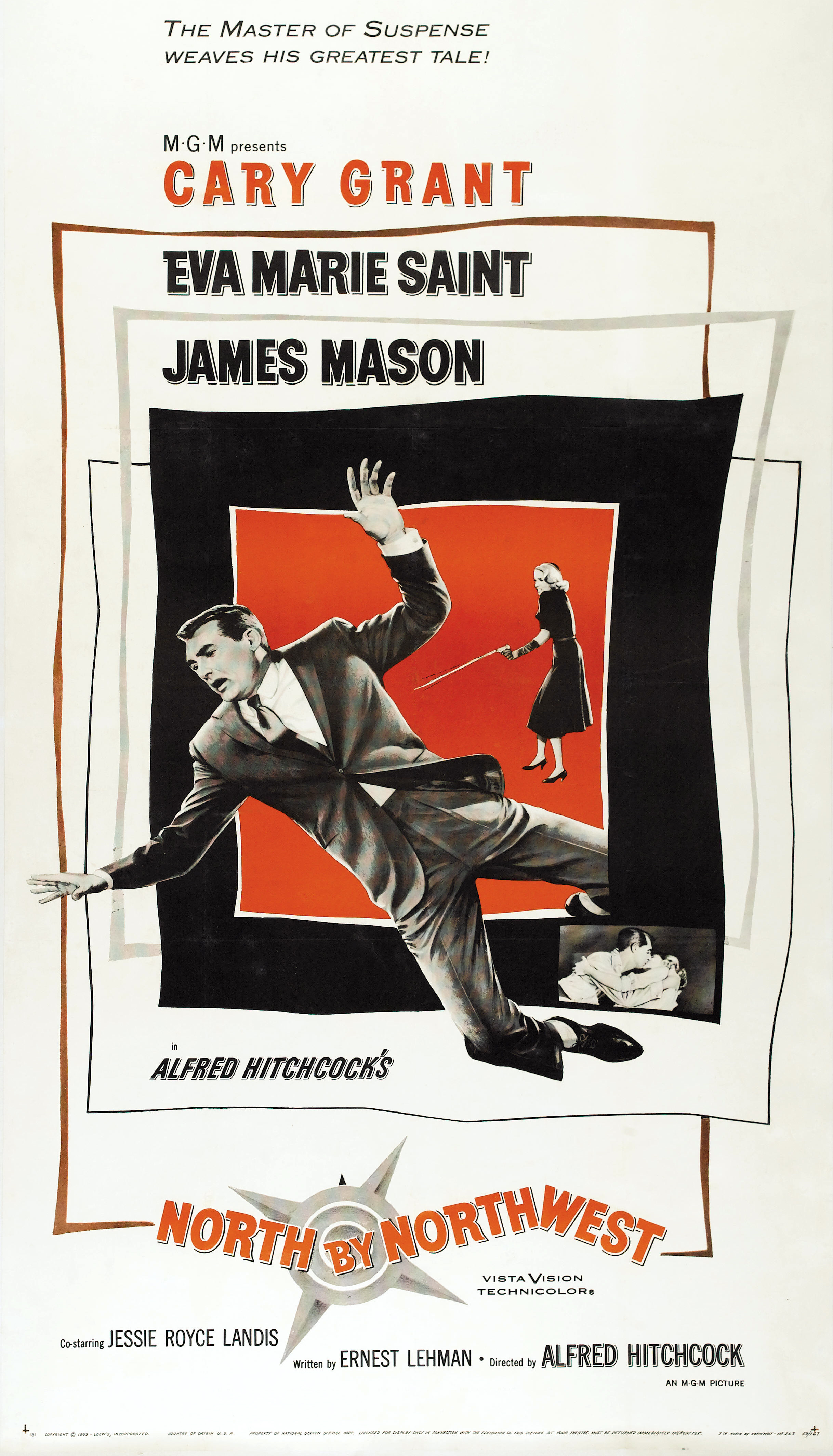
North by Northwest

Name a great director. A truly great one. Someone like Stanley Kubrick, John Ford, Billy Wilder, Orson Welles, and for today's review, Alfred Hitchcock. Ask any fan what their favorite movie is from their favorite actor, and you'll no doubt get some great answers; some agreed upon on and others surprising. For Mr. Hitchcock though, the Master of Suspense himself, that favorite movie is not worth arguing about, and I don't think it's that close either. Here's 1959's North by Northwest, my favorite Hitchcock movie by far and one of the best movies ever.

Working as an ad executive in New York City, Roger Thornhill (Cary Grant) leads quite the bachelor life in Manhattan. Well, he did lead quite the bachelor life. Visiting clients at lunch, Thornhill is taken by gunpoint out of the restaurant and driven to an isolated countryside mansion far from the city. There he meets a mysterious but eerily calm man, Vandamm (James Mason), who begins to ask him questions, questions that Thornhill has absolutely no idea how to answer. What do the questions lead Thornhill to believe? These men believe he's some sort of secret agent, a government official who's trying to stop them from doing...well, something. Vandamm and Co. have had enough though and decide to kill Thornhill, but he manages to escape. Now what? No one believes his improbable story. NO ONE. These men won't leave him alone though, and now, Thornhill is being framed for murder. He goes on the run, and the key to his safety may be a similarly mysterious but very beautiful young woman (Eva Marie Saint). Can Thornhill figure it out before his time runs out?

Sometimes, you just tip your cap to someone at the top of their game. That's Alfred Hitchcock here directing this 1959 mystery thriller. With more than a few genuine classics to his name already, Hitchcock hits this one out of the stadium. It's perfect. Smart, funny, frightening, impressive, so many adjectives come to mind. It's that Hitchcock does it all so seamlessly too. One scene, the tension is dripping off the screen. The next Grant and Saint engage some of the more scandalous dialogue to come out of the dialogue. Next up, a ridiculously charged chase scene. The movie clocks in at 136 minutes and covers a ton of ground, impressive when you consider the story basically has no plot, no huge reveals. So as I said, tip your cap. Some movies are untouchable, and this is planted firmly on that list. A master director at his absolute best.

A true test of a director's legacy is that all-important impact he/she makes with their films. One of Hitchcock's many, even countless impressions he's made is a little ditty called the 'macguffin.' It is a plot device that is SO FREAKING IMPORTANT, but never gets explained in the least. Like AT ALL. That's this entire movie. It's a movie about secret agents and the hidden government offices who run them. It's about bad guys who hold diabolical government secrets and must be stopped at all costs. So in that sense, there's literally no plot here. Yeah, Grant's Thornhill must stop Mason's Vandamm but...whatever. This is an epic case of mistaken identity that snowballs into something far more sinister, dangerous and potentially deadly. It takes a brave, talented and gutsy director to pull something like that off. I've always thought the 1950s were Hitchcock's strongest decade, and this is leading the way out front.

I got the sense watching 'Northwest' recently for this review that the Thornhill character was probably written for a younger actor. You know what though? It doesn't matter. Yeah, maybe Cary Grant was a little older than intended for the character, but his charming, likable on-screen persona and his smooth, deadpan delivery is beyond perfect for the part. As this case of mistaken identity unravels, Grant's charming, gentlemanly indignation fits effortlessly into the story. His chemistry with the lovely Eva Marie Saint is one of the best in film history, simple as that. Their dialogue is scandalous even a little bit now, ahead of its time for sure. You watch their scenes together and marvel. Just sit back and enjoy it. Hitchcock reveled in thumbing his nose at Hollywood's so-called rules, and my goodness, he pushes the envelope any time he can. I have to wonder, did the censors and studio just allow it? It's just too good to pass up.

The cast is so disgustingly good everywhere you look. Mason is the perfect foil to Grant, similarly charming, calculating and with a touch of diabolical intent. His henchmen are terrifying without saying more than a few words, Martin Landau and the creepiest eyes ever and Adam Williams as his knife-wielding enforcer. Just eight years older than Cary Grant, Jessie Royce Landis has a ball as Thornhill's worrying mother, the comic straight woman to all these antics, including her classic encounter with Landau and Williams in a packed elevator. There's also a great little part as Leo G. Carroll as the Professor, a mysterious, distinguished man interested in seeing how the proceedings develop. There's too many other familiar faces with small parts that pop up here and there to mention, but I noticed a cool, quick and you'll blink moment with a young Jeremy Slate as an alert policeman in Grant Central Station. A cool, very early part for a Just Hit Play favorite!

I hadn't watched this movie in years straight through, and man, it was fun catching up with this classic film. From Saul Bass' incredible credit sequence -- watch it HERE -- to composer Bernard Herrmann's phenomenal musical score -- give it a listen HERE -- this movie is technically perfect. Hitchcock uses some great visual tricks from matte paintings and green-screen techniques that trick your eye into seeing something you're not and doing it without calling attention to those techniques. Again, Hitchcock puts it all together. Sit back and take it all in.  

Talk to fans of the movie, and there's countless scenes that they'll mention as their favorites. There's the climactic chase ON Mount Rushmore (WHAT?!?), the painfully tension-riddled scene at an isolated crossroads with quite a twist in maybe the movie's most iconic scenes, and that's just two I'm willing to mention. If you haven't seen this movie, you are in for a treat. If you have seen it, go back and revisit 'Northwest.' There are few movies that click on all cylinders like Hitchcock's classic film does. From New York City to Chicago to Rapid City, a thrill a minute ride. A true, TRUE classic.

North by Northwest (1959): ****/****
Tuesday, February 18, 2014

Winter's Tale

If there's ever a weekend meant for sappy, sugary sweet, lovey-dovey movies, it has to be Valentine Day weekend. Audiences had two options this past weekend when it comes to the romantically pleasant love story, Endless Love and 2014's Winter's Tale. Reviews were almost uniformly negative -- some scathingly so -- but I thought there was too much positive going on to make it that bad. Was I correct? Well, there are positives, but when it's bad.....it's bad.

In New York City in 1916, Peter Lake (Colin Farrell) is an accomplished thief who's run into a bit of trouble. In the city, he has no rivals, but a former boss and mentor of sorts, Pearly Soames (Russell Crowe), wants him dead, and he's willing to pay a hefty price to get it done. Every job Peter pulls off, he's being hunted by Pearly's criminal underworld thugs. Picking a safe at one luxurious NYC house, Peter is surprised to find the supposedly empty house not empty at all, a pretty 21-year old woman, Beverly (Jessica Brown Findlay), dying of tuberculosis and already having outlived the diagnosis from her doctors. Beverly doesn't scream or freak out, Peter undone some by her response. Instead, she invites him to sit down for tea, and they talk. Their connection is instantaneous, their attraction evident from the first words they share though. It almost feels like the universe has brought these two young people together for a reason. Could something be going on with far bigger implications? Are they meant to do something special?

I saw the trailers for this romantically-charged period piece this past fall and was intrigued. It looked sappy and overdone -- like Valentine's Day bait at most -- but I was intrigued. It was a love story that didn't look too cheesy. 'Tale' is based off a 1983 novel from author Mark Helprin, and it's rocking 4 out of 5 stars currently at Amazon (buy it HERE, because Amazon needs my help). As the release date drew closer, I was actually looking forward to seeing it. The premise -- and there's far more than my simple plot description above -- of 1910s New York City, a criminal underworld connection, true love, lost love, and quasi-time travel seemed like literature at its best, or at least something that appeals to me. It sure sounded like the Pete Hamill novel 'Forever' in some ways, a favorite of mine. And the end result? Wow. I don't know exactly where to start.

There is potential here. There is, but there is also a reason critics are tearing it to pieces. My favorite review goes to Richard Roeper -- read HERE -- who certainly enjoyed bringing up all the most cringe-worthy moments. This is a story about true love, the universe, good and evil, miracles, destiny, finding a purpose in life, accomplishing what you're supposed to accomplish. All well and good, right? Sure, it's a lot to deal with but it certainly could have worked. It doesn't. 'Tale' is too dreamy, too loving, too sugary sweet with voiceover narrations about stars, people dying and becoming stars, about angels ascending and descending from Earth and Heaven and Hell. The basic premise is that true love brings out a true miracle in everyone. Everyone has that one miracle, that one thing in life that is pure and good and perfect. In many cases, it's love. Crowe as Pearly is a demon who's job is to prevent those miracles. Working against him are creatures and beings trying to help individuals complete their mission.

Yeah, and there it goes. Things start to disintegrate quickly, and yes, there's just too much going on. The creature helping Peter accomplish his miracle -- is it to save Beverly? Hhhmmm, I don't know.... -- is an immaculate white horse that Peter calls 'Horse,' but it sounds dreamy with an accent. Oh, and the horse flies, sprouting wings as necessary to escape dangerous situations. Pearly especially wants to kill the horse. Oh, and Pearly says the horse is "actually a dog" which...we...never...actually...see. And it's never explained. Crowe overacts like his life depends on it, similarly rocking an Irish(?) accent, his demon turning into a maniacal-looking animal when it gets angry. Pearly also visits a special guest two times, Lucifer himself played by Will Smith. Yes, you read that right. Will Smith. His Lucifer has a touch of gray, wears big, gold earrings, a stylish black blazer and in 1916 NYC wears a Jimi Hendrix t-shirt. The scene where he blows up on Pearly, reprimanding him for an idea, is laughably bad. I'm assuming it was meant to be a big, frightening dramatic moment, and I laughed. Out loud.

What did work for me was the crux of the story, the relationship between Peter and Beverly. I'm a Colin Farrell fan so that helps, but the character is interesting. His backstory is glossed over too much (including an 1895 "flashback" and one scene with wise Indian Graham Greene) and his hair is just odd, but it is interesting, the doomed anti-hero (relative, he's a nice thief) trying to save his love. A twist about 3/4 of the way through the movie has him doomed to walk the Earth not knowing who he is, not able to remember who he is or why he's been forced to do this, but the high points for the character are his scenes with Beverly, Brown Findlay having a solid chemistry with Farrell throughout. Again, I liked the premise, the doomed lovers trying to reverse that doomed quality, to make things right. In execution, it doesn't always work well. There's simply too much going on, the story trying to be an end-all declaration on everlasting love. Helprin's novel is pretty massive so I'm assuming lots of exposition, explanation, development, maybe whole plotlines were excised. What's left is a shell of what could have been a good movie.

But the star power! The Star Power! The supporting parts are in name only, the script not doing anyone any favors, but the acting is surprisingly bad. William Hurt is awkwardly odd as Isaac, Beverly's worrying father who sleepwalks through his part, including one painfully forced scene with Peter where they discuss grammar and pronunciation. Jennifer Connelly is really over the top as Virginia, a single mom with a daughter (Ripley Sobo, a good little actress) dying of cancer in 2014 NYC who meets Peter, not questioning too much what's going on. And in the Hollywood legend department, Eva Marie Saint plays an old woman in 2014 who Peter meets and may have known before. Also look for Kevin Corrigan and Kevin Durand as two of Pearly's henchmen.

Bad is one thing, forced bad is another. The script in first-time director Akiva Goldsman's film makes some odd choices. Eva Marie Saint plays an editor-in-chief of an NYC newspaper who if my math is correct, is 104 years old!!! In the newspaper business!!! The universe "providing" is one thing, but come on. I'm really wavering here. I genuinely liked parts of this movie, but when it flops, it does so in a big way. I'm not going to recommend it, not as a genuinely good movie, but I also won't rip it as the all-time bomb it's being made out to be. Just don't go in expecting the skies to open up. You'll get some laughs out of it for sure. Intentional laughs? I doubt it. A two-star review teetering on less.

Winter's Tale (2014): **/****

Monday, December 17, 2012

The Russians Are Coming The Russians Are Coming

From a screenplay by William Rose, 1963's It's a Mad Mad Mad Mad World is one of my all-time favorite comedies with its ridiculous cast, madcap comedy and general zaniness. Three years later, Rose tried to duplicate the success with the similar formula. Unfortunately, 1966's The Russians Are Coming The Russians Are Coming doesn't match up.

Off the East Coast and near Gloucester, a Russian sub is run aground by a captain (Theodore Bikel) who wants to get a good look at America. The Russians send a landing party to shore commanded by Lt. Rozanov (Alan Arkin) to find some sort of help....secretly of course. The little island is quiet though, everyone basically minding their own business. Rozanov and his eight-man patrol first go to the house of a vacationing writer, Walt Whittaker (Carl Reiner), and his family. As they ever so secretly and quietly seek help -- a powerboat to help pull the sub off a sandbar -- rumor spreads through the island like wildfire. Anyone and everyone who can carry a weapon takes to the streets to find the Russians.

Now, I'm no dummy. I knew going into this movie it was a comedy. Having watched it, I know it is a comedy. But reading that description, nothing at all screams comedy about it, and I think that may be the biggest thing working against this Norman Jewison-directed comedy. A madcap, screwball comedy about a bunch of strangers traveling a couple hundred miles to unearth some buried money? That's funny. A madcap, screwball comedy about a tiny New England island trying to hunt down some marauding Russians? Yeah, not so much. My first reaction was for the film to do a complete 180. An action movie, a drama, a politically-charged thriller with this basis premise would be a gem, full of tension and anxiety.

That's me in my own head though. The basic premise of the story just isn't funny then. I may have chuckled here and there, but I don't remember actually laughing out loud once. The comedy and laughs weren't there for me. As posses sprout up all over the island and everyone starts to freak out, the story bounces among five or six different developing situations (for the lack of any better description). Reiner's Walt tied up to a rather large woman (Tessie O'Shea) by the Russians and trying to escape? The town drunk chasing a horse (the entire movie) so he can warn the island Paul Revere-style what's going on? Screwball is one thing. Just stupid another.

If there is any saving grace here -- however slim -- it will be the cast. Now granted, none of the performances are that good or that funny, but come on.....star power! Reiner's Walt is married to Eva Marie Saint with some decent back and forths between the veteran actors. Young Sheldon Collins plays their shrill son, Pete. Arkin is a bright spot as Rozanov, but I think it's mostly because he gets to play a straight man to all the hijinks and shenanigans. His Russian accent is pretty funny too. Brian Keith and Jonathan Winters get to ham it up as the Sheriff and his deputy, but the biggest ham is Paul Ford as the island veteran leading the hunt with his ancient sword. Also look for John Phillip Law as one of Rozanov's sailors who instantly falls in love with the Whittaker's babysitter (Andrea Dromm).

Sorry to say, but I came away vastly disappointed with this comedy. At 126 minutes, it's just too long and even tedious. Making it worse, any scene with Russian being spoken doesn't feature subtitles. I don't care if it's made-up, jokey subtitles, but put something on the screen for long dialogue scenes! The romance between Law's sailor and the babysitter is painful to watch at times too. Apologize for the somewhat shorter review than usual, but I was completely unimpressed with this comedy.

The Russians Are Coming (1966): **/****

Friday, November 18, 2011

36 Hours

Though I've written about this before, it's hard to avoid repeating it. Imagine a secret the whole world wants to know in this modern ultra-connected world and keeping that secret for months...successfully. In 1944, Allied forces kept a secret of the coming European invasion, keeping Normandy under wraps as the spot of the attack. How far would the Germans go to discovering that location? In steps 1965's 36 Hours.

It is May 31, 1944 and U.S. Army intelligence officer Major Jefferson Pike (James Garner) is sent to Lisbon to meet with a source who may have info on the German's knowledge of the coming invasion. He is one of the select few among the Allied forces who knows not only the location of the coming invasion but all its intricate details....and the Germans know it. He's drugged and kidnapped. How far will the Germans go to get that knowledge? Using a radical procedure developed by Dr. Walter Gruber (Rod Taylor) for a different result, the Germans intend to trick Pike into thinking it is 1950, and that World War II is long since over. With the invasion looming and working in a small window, can Gruber get the info out of Pike in time?

Intensely unique and original. That's the best description I can think of for director George Seaton's film, but somehow it is not enough, not appropriate enough. It is the execution of the first 75 minutes that make this movie special. In 2011, imagine a secret as big as the Normandy invasion.....exactly, you can't. This is a secret that kept the world captive for months and wasn't revealed. The D-Day invasion of June 6, 1944 was a world changer, an event that altered the course of history. Is the story true? Who knows for sure? It stands to reason though that with a coming event that could change the future of the world, one side would pull out each and every stop to see if they could influence that event.

So how does Dr. Gruber do it? Pike is kidnapped and drugged. His hair is dyed, a chemical is placed on his skin to age it, a solution dropped in his eyes to blur his vision, and he wakes up in a U.S. Army hospital in......1950?!? This is a vast conspiracy to get the information out of the Intelligence officer, Gruber telling him he has retrograde amnesia that cancels the last six years of his life. I won't go into a ton of details or reveals, but the movie and the story -- even resorting to an amnesia ploy -- works. It just works. Could Pike fall for it? Could he reveal Normandy as the location of the coming invasion? Would the German High Command even believe him if he told them? One of the most unique, well-told "gimmicks" (for lack of a better word) I've ever seen in a movie.

Three stars do the heavy lifting here in support of said-unique story. Garner is the unknowing dupe, the target. His performance isn't great because the movie doesn't require him to be great. His Pike doesn't have much to do other than look confused. Garner is still himself though, and his laid back, ultra-cool persona works....until he doesn't have to be laid back or ultra-cool anymore. Then watch out there, Germans, because you're in for it. Eva Marie Saint plays Anna, one of Gruber's "assistants," a nurse posing as Pike's future wife. Anna has been lifted from a concentration camp to help, her life used as a bargaining chip. Her character and its relevance certainly adds some gravity to the film, giving a heart to a WWII thriller.

The best part though is saved for Rod Taylor as Doctor/Major Walter Gruber. The brilliant mind behind the plan, Gruber is an American-born German, returning to Germany with his family when he was 16. His original intention with the plan of future-amnesia hypnosis (best description I can think of) was to "save" German troops returning from the Russian front, and it worked, helping them relax only to find out it's a few days later, not years. He has faith in his plan if not its intentions, and Taylor does a great job there. He balances the deception with a genuine concern for Pike, Anna and Germany as a whole as he feels pressure from the S.S. (including interrogator Werner Peters). He seems to know it but plods on anyways. Gruber is fighting a losing battle because he gets the information, he gets the Normandy location, but no one believes it. A great performance from Taylor with a tragic-tint to it.

With a story that unique and entertaining, it would be nearly impossible to keep up the momentum, and the last 30 minutes just isn't as good as the first 80 or so. It loses some of the perspective as the smart, well thought out angle heads back to the more traditional chase sequences. Still, the movie is a gem. It is beautifully shot in black and white and composer Dimitri Tiomkin's score won't disappoint. Even look for Hogan's Heroes' Sgt. Schultz, John Banner, in a small but key role late. Looking for something different in a WWII movie? Start here.

36 Hours <---TCM trailer (1965): ***/****

Thursday, April 21, 2011

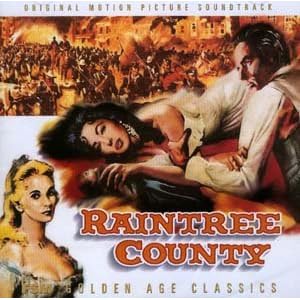
Raintree County

The conversation about the best Civil War epic will typically always begin and end with one movie, 1939's Gone With the Wind, a classic film and one of the best movies ever made in Hollywood history.  In general though, Hollywood hasn't gone to the Civil War well too often, and I've never been able to figure out why.  Movies like Gettysburg and Gods and Generals were made because Ted Turner has lots of money and is a Civil War buff. Glory is a classic true story that I think is the best depiction of the war around. Well, there's another epic, 1957's Raintree County.

The main problem with this MGM epic is that it tries to be Gone With the Wind 2 too much instead of blazing its own trail.  I was surprised though to read the hate this movie gets whether it be the cast being miscast, the story being too simple, or just overall, it's a boring movie. I think two of those three are legitimate issues to have with the movie, but there's something appealing about Raintree County that will take more than that to ruin the movie. The 1950s and early 1960s were the time of the epic in Hollywood, 3-hour movies where no expense was spared. Gigantic budgets, big-time directors, all-star casts, they just don't make them like this anymore.  It's a time capsule of a different era in Hollywood, and an interesting one at that.

It's 1859 in Freehaven, Indiana in Raintree County and young John Shawnessy (Montgomery Clift) is about to graduate from the local college. He's ready for the future with his longtime sweetheart, Nell (Eva Marie Saint), when he meets Susanna (Elizabeth Taylor), a Southern belle visiting Freehaven from Louisiana. John falls for her immediately as does she for him. It doesn't take long before Susanna tells him that she's pregnant with his child so they marry and move to the South. With a conflict brewing about states' rights and the ability to own slaves though, John insists they move back to Raintree County. As the Civil War breaks out though with the attack on Fort Sumter, he finds out that his young wife has a secret that could tear them apart. His life thrown on its side, John must now make a huge decision, all the while the North fighting the South around them.

The biggest surprise I found reading reviews here was about the casting and acting of Clift and Taylor.  Montgomery Clift was involved in a horrific car accident during filming that caused production to shut down for two months while waiting for him to heal so there is already a stigma attached to the part and the movie as unlucky, and in some circles, just plain bad.  I don't know if Clift was the right choice for the lead role, but it's the rare movie he's not very watchable in that lead role. It's not his best performance, but it's still good.  More surprising is that Elizabeth Taylor earned a nomination for her performance.  No disrespect to the recently passed Miss Taylor, but this was just too hammy of a performance. She's Scarlet O'Hara on steroids, chewing the scenery left and right, a fragile woman screaming and crying at every turn because of her past. She treads that fine line between highly dramatic and soap opera, but too often it leans toward the soap opera acting, loud, confrontational and overbearing.

Say what you will about the two leads, but one thing that's untouchable is the rest of the cast.  That's always one of the best things to come out of these Hollywood epics, casts that feature a who's who list of stars playing supporting roles.  For this particular epic we've got Marie Saint as the innocent, incredibly sweet Nell, Nigel Patrick as Professor Stiles, a fast-talking, intelligent, philanderer of a man, Lee Marvin as Orville 'Flash' Perkins, John's drinking buddy and a brawler of a man, Rod Taylor as Garwood Jones, a Northern politician who leans toward Southern rights, Agnes Morehead and Walter Abel as John's parents, and DeForest Kelley as a Confederate officer John comes across in Georgia. Of all the performances, Patrick and Marvin especially shine.  Patrick's Professor is that good sort of scenery chewing, verbose and expressive, a man who loves life and everything about it. Marvin's Flash is a similar character if from a little lower class.  He loves to fight and compete, loves women, and loves to drink.

Director Edward Dmytryk was given a $5,000,000 budget to make this movie, a huge sum at the times. While the film struggled with audiences, it wasn't for lack of effort.  It was nominated for best costumes and best art direction and deservedly so.  Raintree County is a stunningly beautiful movie with beautiful locations (Kentucky and Mississippi mostly), huge sets filled with hundreds of extras, and a screen so full of action, details, and vivid colors that you can overlook the somewhat stilted dialogue or slow-moving story (it clocks in at just under 3 hours). This is an EPIC, a type of movie they just don't make anymore. The story -- based off a novel -- tries to tackle a lot of topics because honestly, the Civil War had a lot of topics worth covering.  It's too much at different points and not enough, focusing on the same thing over and over instead of focusing on the more interesting aspects, Abolitionism, slavery, the actual fighting. Like any movie, it is good and bad. You just hope the good outweighs the bad, and for me it did.

One reason I've assumed the Civil War has never been made into many feature films is the expense of creating huge battle scenes. The actual combat of the war is the second half of the movie after a brief intermission.  The sequences are large-scale but don't linger, and were even re-used five years later in How the West Was Won.  Clift's John ends up with General Sherman's army in Georgia, and for me this was the movie at its best. Battle sequences are handled with an effective, well-done montage, and Dmytryk paints a picture of what 1864-5 Georgia must have been like, war-torn, terrifying, and a host for all sorts of evil.  Working off a novel and trying to stay true to the source, I understand you have to go with what is in front of you.  Dmytryk's epic is solid and I enjoyed it from beginning to end. It could have been better, but it's the rare movie that couldn't be better. There are only so many Hollywood epics like this so enjoy them for what they are.

Raintree County <---trailer (1957): ***/****   

Monday, March 15, 2010

The Stalking Moon

Watching my latest Netflix movie, 1969’s The Stalking Moon, I tried to come up with something to write about.  Besides the fact I’m pretty neutral on the movie overall, I couldn’t come up with anything.  One somewhat odd casting choice jumped out, but not enough to write a whole review and nothing really unique to add to the western genre.  All I came up with is this is a movie with a story but no script.

A scout for the U.S. cavalry for 15 years, Sam Vanner (Gregory Peck) is retiring to a little ranch he purchased up in the mountains years ago.  But before he can retire, he steps forward to help a mother and her 9-year old son get to a train station.  The woman’s name is Sarah Carver (Eva Marie Saint), and she’s lived the last nine years as a captive of the Apaches.  Her son is a half-breed, and his father, a warrior named Salvaje, wants his boy back.  Sam quickly figures out what’s going on as bodies start to mount all along the trail.  Instead of putting Sarah and her son on a train, Sam offers for them to move in with him at his ranch.  They accept, but the deadly Salvaje is still out there waiting.

Let’s start with the positives, led by the villainous Apache warrior, Salvaje (translated as ‘savage’ or ‘wild’).  For one, the character isn’t even seen until well over an hour into the story.  He’s a presence, a fear hanging in the air even when he’s not around.  People hear his name and quake with fear.  When he does show up, he is still never seen clearly.  Instead, there are lightning quick shots of a man poking his head over a rock with a rifle or an arm or leg disappearing into the woods.  It’s not until the end we even get a good look at him, and even then we never get a good look at his face.

Unfortunately, it takes almost 75 minutes to get to the point where Salvaje makes his move for his family.  The first hour-plus is a road movie and a rather boring one at that.  Instead of story development or character background, we get shots of Peck and Saint riding across the desert.  The locations are gorgeous, but if I wanted to see gorgeous western locations I’d go visit the Rockies or Yellowstone.  Great on-location shooting can be the cherry on top of a good movie, making it a great one.  But using the locations instead of story or character, a movie is going to suffer.

It’s hard to criticize Peck or Saint for their performances -- or director Robert Mulligan for that matter -- because the script provides no background about either one other than a line in passing here or there. Peck’s experienced cavalry scout is a fixture in westerns, but what else is there for the character?  He wants to get home to his ranch and seems like a decent guy, offering to help a mom and her son when he doesn’t have to.  But how’d he get to this point?  Even a quick monologue from one of the cavalry officers who seem to know him pretty well would have sufficed.  Instead, there are long sequences with little dialogue that seem awkward without that talking.

As for the odd casting choice, Eve Marie Saint seems out of place.  She is a fine actress, but her part requires her to stutter – she hasn’t spoken English in years – and look worried.  Instead of just spilling her guts and telling Vanner that her homicidal husband is after them, Sarah just tells him they need to leave.  Also, for a white woman forced to live with Apaches for nine years, she looks pretty good.  The only other cast member given more than a line or two of dialogue is Robert Forster’s Nick, a half-breed scout Sam taught everything he knows.  SPOILERS Of course, following the rule that the coolest character typically dies, Nick is fated to meet his maker before the credits roll.  SPOILERS

Not a bad movie but not a good one either.  A bad movie can be entertaining, but ‘Stalking Moon’ is pretty dull and even a worthwhile final 30 minutes can’t save the story.  It had some potential to be a pretty decent western, but it never lives up to it.  Disappointed I can’t recommend this one, but there just isn’t enough positive to bring up.  For die-hard western fans only.  Sorry, I couldn't find a trailer, but that might be for the better.

The Stalking Moon: (1969): * ½ /****

Friday, April 17, 2009

Grand Prix

One of my favorite things about movies is that if someone wants badly enough to make a movie on a specific topic, it's going to happen. And sometimes, more than one person likes that topic so moviegoers are hit with a wave of similar movies. Think of all the quasi-Lord of the Ring movies to come out in recent years, or the sci-fi avalanche that resulted from the original Star Wars trilogy. In the late 60s, it was racing movies as stars and directors turned their attention to fast cars. I've always liked Steve McQueen's 1971 semi-documentary Le Mans and I'd like to see Paul Newman's 1969 racing movie Winning. But the first of these late 60s and early 70s racing movies was 1966's Grand Prix.

I'd read many positive reviews of director John Frankenheimer's race epic that clocks in at just under three hours so I went into the movie really hoping to enjoy it. It tells the story of a whole season of Formula One racing in Europe and the U.S. through the eyes of four drivers. There's Pete Aron (James Garner), an American racer who's been in a two-year long slump but has a chance to climb back to the top with a Japanese racing team owned by Izo Yamura (Toshiro Mifune). Jean-Pierre Sarti (Yves Montand) is a veteran driver tiring of racing but still at the top of his game. He's married but is separated from his wife and during the season falls for an American photojournalist, Louise Frederickson (Eva Marie Saint). A new driver, up and coming Nino Barlini (Antonio Sabato) makes a splash on the circuit after becoming a champion motorcycle driver. And last, there's Scott Stoddard (Brian Bedford), a British driver trying to live up to the expectations set by his racing father.

The movie starts with a bang on the opening race of the season at Monte Carlo with a great credit sequence, and here's an extended clip just so you can get an idea of the racing footage. Teammates Aron and Stoddard have a miscommunication mid-race and Aron's car is destroyed and he's shaken up while Stoddard is badly broken up and so starts the tension. Director Frankenheimer clearly pulled out all the stops when it came to the racing footage. Cameras are placed on the cars, facing forward so you get a sense of how fast these cars are going and backward where we see the drivers. Then there's the big wide shots of the racers zipping by.

Not being a Nascar fan, I thought this would get repetitive over the course of the movie. I couldn't have been more wrong. The races never get old, and I recommend watching the movie for those alone. Here's a few more samples, the F1 Spa-Francorchamps and then the finale with SPOILERS at the Italian Monza course with its high banking turns. The footage is so good the race sequences feel like a documentary. It's by far the best racing footage I've come across in movies, right up there with Le Mans.

It's a shame then that Frankenheimer couldn't just have made a racing movie that ran about 2 hours and stopped there. The movie as is drags incredibly slowly once the racers leave their cars on the tracks. It took me a handful of sittings to get through the movie because of that slow pace. Each of the drivers has their personal issues to deal with, but the only one that comes across as sympathetic is Montand's Sarti.

Of course that doesn't mean the huge international cast isn't good. Garner was and still is a cool actor, making seem like he's not even trying. As Aron, the down but not out racer, he may not be the most sympathetic character but as a sort of underdog I was rooting for him. Sabato is having a lot of fun as the rags to riches Italian driver, and Bedford is good but doesn't leave a huge impression. Mifune rises above what could be a cliched role, and Marie Saint is a good counter to Montand. Jack Watson has a small but strong part as Jeff Jordan, Stoddard's fiery race manager. Adolfo Celi makes a quick appearance too as a race team owner.

Rewatching these racing clips as I post, I can't help but feel the adrenaline rush just watching them. And that's the reason to watch Grand Prix, here's a trailer. With so many directors relying on CGI these days, it's hard to imagine better quality race movies coming out. So even though the non-race sequences can be painfully slow, I'm highly recommending this one because I loved the races more than I hated the love stories.