I like crime thrillers. Could you tell? If movies have taught us anything about the criminal underworld in all its glory, it's that it is easy to get into crime but not so easy to get out. You could do a whole sub-genre of films where an aging, veteran crook (a safecracker, a killer, a gun runner) is trying to walk away but someone or something ain't letting him. I stumbled across 1971's The Last Run years ago, and it definitely applies. Kudos to Turner Classic Movies for airing this hard-to-find flick!
Living in a small, quiet fishing village in southern Portugal, Harry Garmes (George C. Scott) leads a day-to-day life that's almost monk-like. He used to be one of the best drivers around, getting the job done no matter what but through some personal and family drama, he ended up in Portugal alone. It's been nine years since he's taken a job...until now. Garmes cuts a deal to be at a certain place at a certain time and drive someone out of harm's way and into France. The plan goes off without a hitch as Garmes picks up young, cocky Rickard (Tony Musante) after a highway prison bus escape, Rickard making him stop in a nearby town for his girlfriend, Claudie (Trish Van Devere). Even though Rickard rubs him the wrong way, Garmes has taken a contract and he intends to keep it, but what exactly is going on? What was Rickard put away for and is someone else on their trail? The border and relative safety can't come quick enough.
I first heard of this 1971 crime story a few years back courtesy of Warner's DVD-on-Demand offer where a disc was burned and sent to you instead of mass-producing it. The price was a little steep so patient movie review guy kicked in, and finally TCM obliged! Reviews were encouraging, a low-key, almost artsy crime drama that seemed to have touches of so many solid French new wave crime movies. Oh, and George C. Scott. That's almost never a bad thing. Well, the movie is okay but nothing special. Filming and production was beset by one thing after another from director John Huston bailing because he fought with Scott non-stop, and also Scott falling in love with Van Devere during filming....and his then-wife was in the movie at the time.
Good formula for success, huh? I don't know how much the production issues came into play, but 'Run' is a tad uneven. Director Richard Fleischer replaced Scott and took the helm, directing a crime drama that is straight forward, underplayed, no-nonsense and boasting all sorts of potential. It does have that Euro-feel of being almost minimalist in its development. The music is kept to a minimum, the focus is kept on the actors, and...well, I don't know. There just isn't much to it. Yeah, there is a sense of impending doom gathering on the horizon, but you've got a pretty good idea of where this is going pretty quick. I was curious to see the twists you know are coming, what exactly Scott's Garmes has gotten himself into, but the twists and payoffs weren't anything special unfortunately. Lots of potential -- but I say it too much -- but you've got to do something with that potential and not stand pat.
Scott was always a huge personality, and as I've learned reading about this production, that wasn't only on-screen but off. He fell in love with Van Devere during filming (and was eventually married) but his then-wife Colleen Dewhurst was actually in the film (playing a prostitute) as well. Fun, huh? Oh, and he chased Huston off apparently. His performance is an interesting one. His Harry Garmes is the definition of a doomed anti-hero. His life has retreated in on itself and thrust back into his past life -- being a hell of a getaway driver -- he sees that what he'd been doing wasn't really living at all. It is a quiet, imposing part with some typical Scott bursts of fire and rage and intimidation. What I'm looking for (usually) in my doomed anti-hero is some sort of sentiment and that wasn't necessarily on display here. I wasn't rooting for him to pull the job off, to get out alive, to get the girl, whatever the case may be. Scott or the script? Your call, but I guess it's both.
Musante and Van Devere are the only other cast members given much screentime. Musante does what he does best as a smooth (probably too smooth) crook who you can never get a read on. Is he telling you the truth or getting ready to stab you in the back? The future Mrs. Scott, Van Devere is okay in a similarly odd part just because it's never quite clear what she's up to. The whole subplot with Garmes and Claudie is forced and doesn't have much chemistry. Along with Dewhurt, look for spaghetti western regular Aldo Sambrell in a quick part.
I wanted to like this one a lot more, but I keep thinking they were trying to be something, trying to do this, trying too hard. When the twist comes as Musante reveals what's up, I had no idea what he was talking about. Then when the chases start and the bullets start to fly....yeah, still no idea. That can be a problem if you like following the story. 'Run' instead seems content to have you know that those guys are bad guys, and that's all. Any back story is unnecessary unfortunately. There are positives, the Spanish/Portuguese/French locations providing a beautiful visual backdrop and a couple car chases dotting the 99-minute running time. A disappointment unfortunately, but man, am I glad I didn't buy it!
The Last Run (1971): **/****
The Sons of Katie Elder

"First, we reunite, then find Ma and Pa's killer...then read some reviews."
Showing posts with label George C Scott. Show all posts
Showing posts with label George C Scott. Show all posts
Monday, September 14, 2015

Friday, September 11, 2015
Rage (1972)

Dan Logan (Scott) is a small-time rancher who lives in Wyoming with his 12-year old son, Chris (Nicolas Beauvy). Dan's wife died years before, leaving him to raise his son alone, something he takes to heart and very seriously. They've got a good life on the Logan spread, just father and son making a living. One night they're out camping on a hillside when Dan wakes up to find Chris unresponsive and bleeding profusely from the nose. He races into town to the hospital and Chris is immediately taken away from him. Doctors aren't sure exactly what happened, but one doctor especially, Holliford (Martin Sheen), assures him that everything will be taken care of. Dan too is asked to stay for observation, just to see if anything has happened to him too. What's going on? What Dan doesn't know is that a local army base is covering up an accident with a nerve gas accidentally being released...
Here's a trivia question for you. With what film did actor George C. Scott make his directorial debut? You're looking at it. That would be 1972's Rage. It's an interesting debut for the longtime actor. It's timely. It's hard-hitting, cynical, violent (horrifically at times), intensely uncomfortable so yeah, basically made for an early 1970's audience fed up with any sort of establishment. While it doesn't get too heavy in getting it across, it's safe to say 'Rage' is a "message" film. It wants to get a message across and make the audience get down to basics and think about what the story is really saying. The nerve gas reveal in the above plot line is a relative spoiler. You find out pretty quickly actually what's going on. The point is, it's the start of something. It's what the nerve gas represents.
That being...anyone trying to keep things under wraps from you because as a people, we're too stupid to handle something dangerous. Whether you agree with that is up to you. 'Rage' is a movie for those folks fed up with information being withheld from them, of someone in power dancing around the truth, of that person treading the fine line between the truth and a flat-out lie "for your benefit." Your establishment a-holes? Sheen plays an army doctor working undercover of sorts who really knows what's going on. Richard Basehart is Logan's longtime doctor and friend, quickly realizing the truth as he puts the clues together. Also look for Kenneth Tobey, Paul Stevens, Barnard Hughes, Ed Lauter and others trying to keep things under wraps.
Whether it be from behind the director's chair or in front of the camera, this is Scott's movie. His single father and small-time rancher character is about as archetypal American as you can get. He's created a life and carved it out of the landscape for himself and his son. He'll do anything to protect it. While there are some familiar Scott outbursts, I liked the Logan character most in the quiet moments. Dan is looking out for his son, pleased he sees his boy picking things up quickly as he grows up. We see a lot of this in an extended montage through the movie's first 15 minutes as Dan and Chris interact all over the ranch, ultimately ending up playing checkers while camping next to a small fire.
Also look for Dabbs Greer and John Dierkes in small supporting parts.
I was both intrigued and struggled with the slow pacing here in Scott's feature film directorial debut. The first hour is intensely slow as we begin to realize how bad the situation is, how dangerous the nerve gas really is, and the depths the army/establishment will go to keep that news under wraps. It is about the hour-mark when Logan puts it all together and FREAKING LASHES OUT. We're talking Death Wish meets Falling Down with any other vigilante movie you want to mention thrown in for good measure. He becomes a man possessed to right a wrong done against him. I kinda figured where the story was going, but not to these depths. It is dark. It is uncomfortable, and that's no doubt what Scott set out to do. Life ain't easy, especially when the powers that be have rooted interests in something not getting out.
The ending itself is tough to watch. It's supposed to be. As far as it goes, I wish it would have gone a little further. From the word 'go' we know this won't be a happy ending, but some more revenge and vengeance being dished out would have been so much better. So many more needed to be punished for their actions. Man, I'm getting all sorts of Old Testament here, but it's true. The actual finale is heartbreaking because it doesn't feel forced. There aren't any easy answers so my complaints of wanting more revenge being doled out go unanswered. That's life. It's tough. A depressing movie, flawed at times but interesting throughout.
Rage (1972): ***/****
Monday, September 8, 2014
Oklahoma Crude
.jpg)
It's the 1910s and feisty Lena Doyle (Faye Dunaway) owns a chunk of land smack dab in the middle of the Oklahoma oil fields. She has put the time into the land, building a shack and a derrick and intends to tap the crude oil she believes is in the ground below her. There's a problem of course. A powerful oil magnate is scooping up land left and right, purchasing all the small-time owners. Well, most of them. Lena refuses to sell, claiming (rightfully so) that the land is hers. In hopes of protecting her investment, Lena gets some help from some unlikely places, including her estranged father, Cleon (John Mills) and a hired gun he hired, Mason (George C. Scott). Mason isn't quite sure what to make of the job, looking to make some quick and easy cash, but the little group is in for more than they planned on when the oil company sends out an enforcer, Hellman (Jack Palance), to make sure Lena sells.
Well, this was certainly an interesting movie if a heavily flawed one. I struggled through it at times and was rewarded with a far stronger second half of a 108-minute movie. Getting there can be a trial at times though, and even the last hour isn't as good as it could have been. Still, Kramer chooses an interesting story to tell and picks the right time to release it, the 1970s when audiences would have been all sorts of stirred up about a huge company strong-arming small businesses (I guess that'd land pretty well now in 2014 too). The development of the oil fields in Oklahoma in the early 1900s is an interesting enough historical period -- one that hasn't gotten its due in films, TV and books -- with plenty of dark, nasty material to dive into, but...
Kramer doesn't seem to be able to pick a tone, a voice and stick with it. Is it supposed to be truly dramatic and dark and unsettling? Or is it supposed to be goofy and fun and the kinda oddball romance story I typically hate? And that's where the problem is. It's both. The song that plays over the opening credits, Send a Little Love My Way, had me worried I was jumping into a folksy, disgustingly pleasant western that I do love so much. It wasn't, but it's a good forebearer of what's to come. The score from Henry Mancini is simply put, very obvious, big and loud and not appropriate for what the dark and depths of the story could have been. Instead, we get the Dunaway/Scott rivalry, the Dunaway/Mills fighting, Palance vs. the world, and all mixed in with some "I hate you until I love you" story and some all too painful comic relief. Oh, look, that naked guy got shot in the butt with buckshot!!! Yeah, it's too schizophrenic for its own good.
There is a saving grace, one that quickly popped up as the pleasant song mentioned above plays over the credits. Yeah, it's that cast thing. Dunaway, Scott, Mills and Palance?!? Yes, I will invest some time to see how this develops. The script doesn't always do this quartet a ton of favors, but there is a ton of talent here that manages to bring these characters to life. Dunaway's Lena is tough as nails, never been handed anything in her life, ready to fight for what's hers and screw anyone who gets in her way. Scott's Mason -- or Mase, his full name revealed late -- is harder to read, a worker and quasi-hired gun looking for a payday but just as interesting to see develop. I loved the energy Mills as Cleon brought to his part, a father who wasn't there for his daughter as she grew up. Now that he can help? He's going to do everything he can, even when that daughter tells him to screw off. And then there's Palance, doing what he does best, playing that near lunatic but very obsessed bad guy that you're never quite sure what he's capable of.
The human moments are not surprisingly, those that work best in Kramer's film. I especially liked the dynamic between Dunaway's Lena and Scott's Mase. It develops nicely -- but takes quite awhile getting there -- and for the most part manages to avoid all the pratfalls of a sappy story of two opposites who aren't so opposite. Mills is a scene-stealer and Palance is solid. The darkness of the second half is what the entire movie should have been. Filming out on the desolate, stark prairies, you get a sense of what these small-time drillers went through. Isolated and alone with no help in sight should it be needed. I simply wish Kramer would have committed, not trying to mix the light-hearted with the dark. At least if he kept it light, so be it. It's there. That's it. That's all. Enjoyable enough to recommend but far from a classic.
Oklahoma Crude (1973): ** 1/2 /****
Thursday, December 19, 2013
Bank Shot
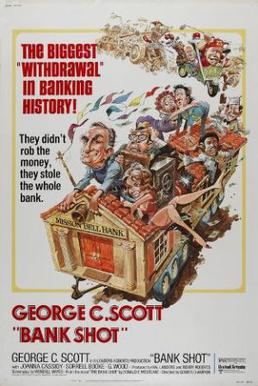
Wasting away a prison/rehab center run by Bulldog Streiger (Clifton James), accomplished crook and master planner Walter Ballentine (George C. Scott) is slowly losing his mind. He's allowed a visitor one day, his "lawyer" who's really his former partner in crime, Al G. Karp (Sorrell Brooke), and he's got a new plan for a very lucrative caper. Streiger is on the lookout, but even he can't keep Ballentine from escaping, his prisoner getting away in ridiculous fashion. What job awaits him with Karp? Not one he would have thought of. A new bank in Los Angeles is being built, a temporary bank in a trailer being used until the new one opens. Ballentine laughs at the plan given him and comes up with his own instead. Instead of robbing the bank in convoluted fashion, why not just steal the entire bank? With Karp's oddball crew of crooks, Ballentine goes about putting his own plan into operation.
Wow, this movie was just not good. Like at all. We're talking really bad. Eastlake's novel is pretty goofy, a little silly, but there's an underplayed sense of humor that works well. I could be wrong too, maybe that's just my interpretation. This comedy from director Gower Champion has no subtlety, no sense of underplaying anything, no real laughs at all. It is the broadest definition of broad humor. Oh, no! Ballentine is driving a huge Caterpillar into a barn! Oh, no! A trailer is driving out of control down a vacant road! Physical comedy is one thing, but this is so bad it never amounts to anything. John Morris' musical score is painfully obvious, almost begging, willing the audience to laugh. The opening prison break, Ballentine getting away on an excavator, Streiger on a souped-up golf cart, sets the tone for the painfully unfunny attempts at laughs to come.
What the hell is George C. Scott doing here? Scott had some odd acting choices in the 1970s, but this one is pretty bad. I say that having watched a movie with Scott where had to stop an assassination attempt on the President by....dolphins. Yeah, The Day of the Dolphin, check it out. It really exists. From the get-go here, Scott seems bored and uninterested in actually being a part of the ever-stupid story. As for the character that Eastlake wrote -- John Dortmunder in the books -- Scott isn't the best casting choice either, whether it be his physical appearance (rocking some amazingly LARGE eyebrows, we're talking REAL big) or his demeanor at basically all times. Was he blackmailed? Was he doing a favor for a friend? I don't know what was going on, what prompted him into doing this flick? I'm listening if there's a good theory out there.
So heist flick with a lousy premise that falls short on basically every level, surely the oddball crew of crooks can save this poop-fest, right?!? Yeah, that's what I was counting on, only to be disappointed there too. Beyond Brooke as Al G. Karp as Ballentine's goofy partner, there's also Eleonora (Joanna Cassidy), the sexy backer of the plan with all her cash (and an unexplained attraction to Ballentine, helping him "ease back" into society after so long away from women), Victor Karp (Bob Balaban), Al's nephew, the other planner and a former FBI agent, Muns Gornik (Bibi Osterwald) and her son, Stosh (Don Calfa), and Hermann X (Frank McRae), a pistol-wielding, demolition expert hoping to become a politician. There isn't an interesting character in the bunch, making it a tad difficult to actually support the crew. We learn little to nothing about them, just an introduction and right into the heist. The rest of the story in an 83-minute story is spent on hamming it up James and his L.A. cop partner (G. Wood) trying to track Ballentine down.
The premise of the heist is actually pretty original, and some of their plans are actually unique. But at any point is it interesting to watch? No. Everything just seems obvious from beginning to end. The heist and its fallout could have been decent if it wasn't handled in such spoof-like fashion, but the efforts to make it all hysterically, gut-busting funny fall short. Steer clear of this one, go read the Westlake novel instead.
Bank Shot (1974): */****
Monday, July 1, 2013
The New Centurions

Fresh out of the police academy, Roy Fehler (Stacy Keach) and a new batch or rookies are assigned to precincts and departments across Los Angeles. A hopeful law student with a wife and daughter, Roy has become a cop in hopes of making some money and learning the business while studying for his law degree. He is paired with veteran beat cop Andy Silvinski (George C. Scott), a police officer who's seen everything good and bad the streets have to offer. They bond immediately and become fast friends, the veteran introducing the rookie to the ins and outs of the job, teaching how to handle anything that might present itself. As he gets used to the job though, Roy starts to realize he likes doing it, and that it's not just a job. His wife, Dorothy (Jane Alexander), wants him to leave the force, but he may be in too deep at this point. What to decide on? Your career or your family?
My above comment about police movies being a dime a dozen is not intended as a dig or insult. I very much like all those movies. Naturally, I was more than a little surprised then when I found this film from director Richard Fleischer at Netflix having heard absolutely nothing about it....ever. In an era when everyone and their mother was making police movies -- Bullitt, Dirty Harry, Branningan among many others -- it's refreshing to see one that isn't interested in the high profile cases, the so-called 'glamour' of the position. 'Centurions' focuses almost solely on the beat cops, their day-to-day jobs around the department, on patrol and in the streets, and most importantly in Roy's case, how the job affects all the other aspects of life. It's better because it is a more personal story, nothing big picture about the scandal/corruption in the force or a major case that leads the news every night.
On that personal level, the story leans toward the episodic and for the better. A movie that runs about 103 minutes covers a lot of ground, following Roy from his rookie days to his reassignment on the force to his return to the department where he started. It never feels rushed, but the story does keep moving and jumping from incident to incident. These scenes know when to cut things off, laying things out, showing us what's happening and then moves on, never overstaying their welcome. The best moments are Roy, Andy and the other departmental officers on night patrol, dealing with thieves and hookers to domestic disturbances and drunks. At times, things get a little too sunshine happy (an incident with six or seven hookers comes to mind), and composer Quincy Jones' score is a tad too 1970s funky at times, but for the most part, the positives are there.
In the late 1970s and into the 1980s, buddy cop movies were everywhere, usually pairing a goofball newbie with a chiseled, no-nonsense veteran. Obviously, that's not the case here. I love the easy-going dynamic between Keach and Scott in every one of their scenes. Their dialogue never feels forced, their friendship anything but fake. It's natural throughout. On the force, we also meet veteran officers Clifton James and Ed Lauter to pair with a couple of newbies, Scott Wilson and a pre-CHIPs Erik Estrada. James Sikking plays a glory-hunting Vice squad officer as well.
I had an inkling where the story was going here, but I wasn't quite sure. As good as Scott is as the veteran cop, the focus is on Keach, and he doesn't disappoint. We see his struggles at home with his wife and later how he meets another woman, Lorrie (Rosalind Cash), a nurse who once patched him up following a shooting. Realistic throughout, the story takes a dark turn -- not surprisingly -- in the final act. The ending is quick, brutal and highly effective. It's a hidden gem among the cop genre, one that has that early 70s charm with a good cast and a not so typical story in a familiar genre. Well worth seeking out.
The New Centurions (1972): ***/****
Wednesday, February 29, 2012
Taps
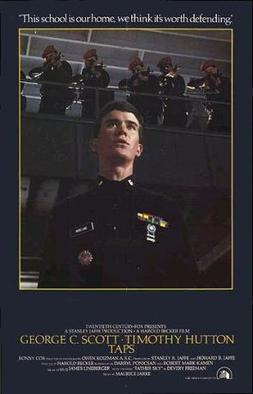
As commander of the Bunker Hill Military Academy, General Harlan Bache (George C. Scott) does his best to instill a feeling of pride, honor and duty among his cadets. One of the cadets, Brian Moreland (Timothy Hutton), has just been promoted to Major -- the highest ranking cadet -- for his senior year only to have some shocking news revealed. The Academy will be shut down in exactly one year, the grounds cleared for high-rise condos. An incident between some cadets and boys from the local town prompts an outcry though, and the date is moved up so the Academy will close immediately. Seeing his world and second home torn away from him, Moreland concocts a plan. With all the remaining cadets, Major Moreland takes over the Academy with armed force, but even he couldn't have predicted what his actions will produce.
From director Harold Becker, Taps has a feel of authenticity. Hutton and the rest of the young actors lined up with actual members of the Academy, doing the drills and living the life with them. The most important thing to come from this is that they're believable. To a man, they look comfortable in the part. The portrayal of the military is fair; an honor-bound society that lives by a specific code of morals and principles. You do what's right because it is right, not for any other reason. Filmed at Valley Forge Military Academy in Pennsylvania, Taps shows the life of the cadets from the various uniforms to the drilling to the dorms. An impressive scene has Hutton's Brian leading the commencement ceremony, the entire Academy parading around a field, and you believe it. All these little things, all these details add up because you see the life of these cadets -- good or bad on a personal level -- and what pushes them to do what they do.
Uniformly (pun intended) solid, three performances from the cadets stand out. This was Hutton's second feature film (he'd won an Oscar for his 1st part in Ordinary People) with co-stars Sean Penn making his screen debut and Tom Cruise making his first appearance in a non-background role. The talent on the screen even at a young age for all three is unquestioned. Hutton is the born leader, but he's quite sane and very intelligent. He loves the military life and resents the change. Him more than anyone else has fallen hook, line and sinker for General Bache's teachings about honor. Penn plays his best friend, Alex, a somewhat unwilling member of the revolt who sticks with it because he's going to stick it out next to his friend, not because he truly believes. On the other hand, there's Cruise's Shawn, a capable leader but a hot-head and possible fanatic. It's almost like good and evil, Alex on one shoulder as Brian's conscience, Shawn on the other as the Devil. Other keys part for the cadets include Giancarlo Esposito and Evan Handler as the two other cadet officers, Pierce and West, with Brendan Ward and John P. Navin Jr. as Charlie and Derek, two of the youngest cadets involved in the takeover.
In telling the story, Becker makes a wise choice. We see the story only from the cadets' perspectives and other than one quick detour, the whole story takes place within the walls of the Academy. We really only get to know two adult characters, Scott's General Bache and Ronny Cox as Colonel Kerby, commander of the National Guard called in to handle the situation which goes on for days. In a more subtle, understated part, Scott's performance is reminiscent of his most iconic role, George S. Patton, making it clear why these boys and young men believe so strongly in him. It's not a huge role, but it's a memorable one. Cox too brings humanity to a part that needs it. He wants to get the situation resolved as quickly as possible with as little bloodshed as possible. His one-on-one with Hutton's Moreland late at the Academy fence is an especially memorable confrontation. But other than these two parts, this movie belongs to the cadets. We see the quickly-escalating situation through their eyes and through what they see.
Making that choice works because we feel like we're right there with them. From the start, you know there will be no Hollywood happy ending. You can start to question their real motives, and that's where this movie rises above. Hutton and Cruise are the clear believers, truly believing in what they're doing. What about everyone else? Do they go along with it because the majority does or because they believe too? As the days wear on and an armed response from the National Guard looms, the courage begins to wither away for many. It's only late that Hutton's motives can be questioned. Has he been brainwashed? Has he gone too far because of a personal problem? Providing all the answers, the ending is especially emotional. Several scenes will no doubt leave a lasting impression, one in the predawn hours before the attack, the other coming in the movie's final minutes. It is an incredible ending, an appropriate, moving one if not a happy conclusion.
An underrated movie, I really enjoyed it. The message board at IMDB makes claims of dull, unrealistic, stupid, but I think they miss the point. The armed takeover and the ensuing situation isn't supposed to be an incredibly realistic development. It is a means to an end. It is intended to show these young men in a situation that becomes bigger than them and their intentions or beliefs. Their code of honor and pride is put to the test. Could something like this happen? Sure, of course it could, but it's the message that is important more than the situation.
Taps <---trailer (1981): *** 1/2 /****
Friday, November 11, 2011
The Hanging Tree

In the Montana hills during a gold strike in 1873, Dr. Joseph Frail (Cooper) rides into a gold boom-town and sets up shop. He quickly helps a young gunshot victim, Rune (Ben Piazza), who was shot but managed to escape while robbing the sluice of a miner, Frenchy Plante (Karl Malden). No one saw Rune to identify him, leaving only Frail that knows what he was caught attempting. Frail holds it over his head, insisting he work off his "bill" while not telling him that he threw away the bullet he dug out of his shoulder. Rune agrees, but news hits the town of a woman struggling to survive in the wilderness his problems are pushed aside. The woman, Elizabeth Mahler (Maria Schell), a Swedish immigrant, is found near death. Frail treats her, but questions arise about his intentions. Can the doctor's path come back to haunt him again?
It's odd to see a leading man in a role like this as Cooper plays. He is the star, but with an ensemble cast that features four key parts, Cooper is often pushed to the side in the second act. Of his time in front of the camera through, the screen veteran makes the most of it, again showing his darker, flawed side. His Dr. Frail means well in almost all of his intentions, but the execution of those intentions leave something to be desired. He wants to help those around him, but his manner of doing so is odd. Because he doesn't care what others think of him, Frail obviously rubs some people the wrong way. In the dark, tragic character department, he's also trying to right a wrong, redeem himself for a past action that hovers around him wherever he goes. Somewhat underused, but a great part for Cooper.
Because I feel the need to categorize every movie, I guess you can say this is a western...sort of. The TCM description/review said a movie that's 'Not for all tastes.' It isn't a shoot 'em up, guns blazing western. From director Delmer Daves, this qualifies more as a psychological western, focused more on the individual personalities and dynamics than the wild west action. All the characters are scarred in some way, flawed in another and thrust into this difficult time and place to survive in. Because of that, the pacing can be a little slow at times as the story struggles to pick up any momentum. It took me three different sit-downs to get through the 106-minute movie. When it works, it really works though.
It's also different from most westerns in the setting, the mountains and hills of Montana in the 1870s. There aren't gunfighters or cowboys and Indians. Instead, it's gold prospectors, shop owners, doctors, fanatical preachers, and even families with children around. The look of the movie is great, Daves filming the story in Washington. There is also a very entertaining and completely wrong toned theme song, sung by Marty Robbins. Give it a listen HERE. It's catchy. I'll give him that, even if it sounds like it should have been in a lighter western.
What works through some of the slower portions of the movie is the characters around Dr. Frail, especially Schell's Elizabeth. I probably complain too much about this, but if a western is going to feature a female lead, this is a good example. Elizabeth was traveling with her father when their stagecoach was held up, her father killed in the robbery. In the wilderness, she starts walking and barely survives, brought back to good health by Frail once she's found. She wants to start out on her own, creating a life for herself. Schell's Elizabeth is a good-natured but strong-willed woman, liking to think the best of people but knowing that isn't always the case. Granted, she's put into an unnecessary love triangle between Frail and Rune, but Daves handles it in the right way. Very solid performance and a strong female performance.
My only experience with Piazza was his small part in The Blues Brothers -- trust me, you'll recognize him -- but in his second feature film, he manages to keep up with Gary Cooper. Malden does what he does best, shows off his versatility. He could play good and bad, sometimes within the same role, like here. You know from his introduction he's up to no good, and a confrontation is coming. Karl Swenson is good as Fraunce, the general store owner and friend of Frail's, while George C. Scott has a small part as a Bible-beating "healer" who sees competition in Frail.
The movie picks up steam toward the last 30 minutes, a mob mentality taking over as the psychological effects start to kick in, the very powerful affect gold has on people. Startling in its brutality, the ending works although the final shot leaves the conclusion to your own interpretation. Slow moving at times, but a worthwhile, underrated psychological western.
The Hanging Tree <---TCM trailer (1959): ***/****
Tuesday, August 23, 2011
The Formula

From director John G. Avildsen comes a story that you think will go one way and instead goes down another path. It does involved Nazis -- including a very cool opening sequence -- but ends up being more about big business and billions of dollars on the line from international corporations that end up all but ruling the world. Think Syriana meets Who Killed the Electric Car?, and you've got this movie. I don't know what to think of it, liking it at times and groaning as the "twists" are revealed. Like any movie I guess, take the good and the bad.
A former government agent turned Los Angeles police officer, Lt. Barney Caine (George C. Scott) is called in to lead a murder investigation. Caine is startled to find it is the murder of an old friend and a fellow police officer. But as he examines the evidence at the scene, something doesn't add up. Something seems forced, but he follows what is presented to him and ends up traveling to Germany as the clues and evidence present themselves. His friend was apparently involved in some high-end things -- drugs, big business (including oil chairman Marlon Brando) and billions of dollars -- that few were aware of. Was Caine's friend involved in something bigger than all of that though? Something worth killing more people over? As the bodies start to pile up, Caine wonders what exactly is going on, and if he could be next.
Complicated, twisting storylines typically go two ways. One, it is a well-written, well thought out complicated plot that works if you pay attention and keep up with it. Two, it is complicated for the sake of being hard to follow. That's The Formula. I resent when reviewers say a viewer who doesn't "get it" wasn't paying attention. Here, I paid attention, but the twists are too ridiculous, too convenient to even come close to making sense. It isn't so much a Nazi splinter group of survivors pulling the strings as big business with monetary concerns doing the work. Just too many things happen that are explained in one quick conversation. If it is going to work, some sort of clue has to be given. If not, that isn't a twist. It's just lazy on the part of the script.
In its twists and turns, 'Formula' probably tries to do to much. It was billed as the movie that "the oil companies don't want you to see." The subject matter is probably dead-on accurate as to how the oil companies actually work, but it is handled in such a heavy-handed fashion that the message gets murky and even darkly comical and over the top. The formula is a German solution and equation to create a synthetic fuel that will replace the world's need for oil. Naturally the oil companies want to cover up its existence and are willing to do just about everything possible to keep it under wraps. The story does keep you guessing as to everyone's motives, and it ends on a pessimistic note, but the story is so far all over the place that it never gels as a finished product.
On to the positives, few that they are. In well-written movies or schlock like this, George C. Scott is almost always a watchable movie star. He is intense, believable, and feels like he's never acting (to me at least). His Barney Caine character keeps the movie grounded in its police procedural roots -- albeit one that has him globe-trotting and involved in multi-billion dollar deals. He's more than a little fed up with the system, the higher-ups, and the limitations placed on him. Caine is an old school cop/investigator who is just going to get the job done, and Scott is a bright spot among the bigger mess. Another positive, the opening in spring 1945 as German stares the end of the war dead in the face. The closing days of WWII (really, any war) are Dramatic Situations 101, and the tension and mood are great in this quick but effective opener.
Okay, now back to the negatives! Yeah, more fun! Brando got a paycheck for this one, and I think that's all he was worried about. His extended cameo as the chairman of an oil corporation as the actor -- maybe Hollywood's all-time best actor -- hamming it up in such an over the top fashion that it is either unintentionally bad or a brilliant choice by a brilliant actor. I lean toward unintentionally bad, but who knows? The rest of the cast is okay, including Marthe Keller as Lisa, a source for Caine in Germany, John Gielgud as a German scientist who escaped from the Russians, G.D. Spradlin as Clements, a higher-up official with his hand in everything, and a long cast listing following them, none really making much of an impression positive or negative. It was cool to see WWII movie vet Wolfgang Preiss in a small part if nothing else.
Needlessly confusing at times, boring at others, and even a memorable lead performance from George C. Scott can't save this one.
The Formula <---TCM clip (1980): **/****
Tuesday, June 14, 2011
The Hustler
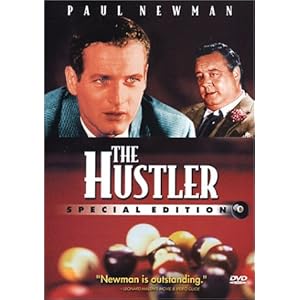
Even more than three years since his death in 2008, it's hard to believe that Hollywood acting legend Paul Newman passed on. He was and is one of the greats, a movie star and an actor. What is odd though -- for me -- is that I was always a fan of his without actually seeing many of his movies. As I seek more of them out, I've come to a realization. Newman's performances are rarely if ever in question. His acting is almost always top-notch. It's the movie as a whole though that doesn't always quite live up to expectations. I'm not quite sure where 'The Hustler' falls.
A pool hustler who travels the backroads and little towns looking for a game, Eddie Felson (Newman) has his sights set on a living legend in pool halls, Minnesota Fats (Jackie Gleason). He gets his wish, playing Fats in a marathon game of straight pool, even going up as much as $18,000 at one point. Eddie pushes too far though and keeps playing, losing it all and putting him right back where he started. Eddie meets Sarah (Piper Laurie), a similarly jaded individual with her fair share of problems, the two bonding through their problems and finding someone else exactly like the other. Eddie starts to scrape together money, hoping to get a rematch with Fats, even signing on with shady gambler/bookie/businessman, Bert Gordon (George C. Scott), to bankroll him. All Eddie wants is a shot at Fats, the money doesn't mean much. He wants the fame, the reputation, the recognition, but for him, it may be too late.
Cool Hand Luke is my favorite Newman movie, and probably my favorite role of the actor's, but I think this may be his best acting performance overall. I've always liked Newman as an actor because he's very natural onscreen, but he is also actually acting. He's capable of humor and high drama and everything in between. This is a part that certainly leads to the high drama. Eddie -- dubbed Fast Eddie for his hustling ability -- is at first just a young rising star who wants his shot at the legend. It's quickly apparent that his ego and pride is going to get the best of him. He is obsessed, hitting rock bottom immediately. His character is so blinded by his drive that he doesn't realize he's destroying himself in the process of trying to better himself. Newman dives into this character head first, committing from the get-go, and he brings this tragic character to life vividly.
There is a style to so many 1960s movies that is just hard to explain. They're cool because they're cool, and they know it. They don't have to try to be stylish or edgy. They just are. Director Robert Rossen here turns in one of the most effortlessly stylish and cool movies I can think of. The movie is shot in black and white which I'm always a fan of. It's easy to say now because I've already seen the movie in B&W, but it's hard to imagine it in color. As is, the movie is stripped down and bare-bones. It just works that way, reflecting what's going on in Eddie's head. Anything extra or not essential gets thrown by the wayside. The best parts of the movie are shot in smokey, dingy pool halls, but there is an unexplained coolness to them. Maybe just because its the 1960s, maybe it is the jazzy score from Kenyon Hopkins, the movie is fun to watch.
With a movie that runs 134 minutes, there are moments of perfection followed by stretches of dullness and boredom. The introduction is classic in the pre-credits sequence, and the epic duel between Eddie and Fats is a landmark sequence that goes on for most of a half hour (Newman and Gleason doing a lot of their own trick shots too, impressive). I would have never thought watching pool would be fascinating, but 'Hustler' proves otherwise. Gleason is a scene-stealer, and he basically has about 14 lines of dialogue. He's impeccably cool and calm, understated and confident in his ability. Just when Eddie thinks he has him, Fats cleans up, puts his jacket back on and is ready for a new round. You feel intimidated just watching him, much less playing him. Gleason disappears then until the end, but he makes every second onscreen count.
This early pool marathon session does two things, it sets the story off at a brisk, exciting pace (the good), and then lets the story sink some (that's the bad for those slow readers out there) in terms of pacing. After the game, the story just lags, boring me as Eddie meets equally troubled Sarah (Laurie does a fine job with the part). The character study is interesting, seeing what makes this man tick, but I got bored seeing it develop. Scott's reappearance late as Gordon is a movie-saver, adding a dark, seedy element to the story. The ending is quite a downer, but in an appropriate way, a fitting end for Eddie. I loved Newman's performance, liked other parts of the movie, and was bored in still others. A mixed bag, but still a good movie.
The Hustler <---trailer (1961): ** 1/2 /****
Wednesday, January 20, 2010
Anatomy of a Murder
 In the 1950s, actors like James Dean, Montgomery Clift and Marlon Brando started a trend in acting that continues even to this day; method acting. Actors tried to really get into the role, often times driving everyone around them nuts in the process. What about method directing then? I couldn't help but think of that idea while watching 1959's Anatomy of a Murder from director Otto Preminger.
A producer, director and actor at different points during his career, Preminger never shied away from telling stories without that glossy finish. His movies feel real, almost like a documentary, because they don't call attention to themselves in a highly visual way. These movies are nonetheless great to look at -- the German-born director favored black and white filming -- but as a viewer you feel like you are there with the actors in the scene. Where some directors overfilm (if that's a word/concept), Preminger puts the camera in place and lets his actors go to work. This style pays off with his depiction of a genre that's been used to death in film, the courtroom drama.
Having lost his position as the county district attorney, lawyer Paul Biegler (James Stewart) has settled into an easier, slower-paced lifestyle. He spends much of his time fishing, playing his piano, listening to music and reading law with his friend Parnell McCarthy (Arthur O'Connell), and then takes an occassional case here and there. But then Paul is offered a high-profile case to defend a soldier, Lt. Frederick Manion (Ben Gazzara), who shot a man five times for raping his wife, Laura (Lee Remick). Paul isn't sure if he should take the case but after looking into it and interviewing those involved decides to defend Manion. What's waiting for him in court is Michigan's best prosecutor, a ringer brought in from Lansing, Claude Dancer (George C. Scott).
Having grown up watching countless repeats of Law & Order, Boston Legal, and any number of courtroom movies like 12 Angry Men, I won't say I'm jaded when it comes to that type of story, but I feel like I've seen just about everything the genre has. That doesn't mean I don't seek these movies out, it just takes a little more to impress me. Preminger succeeds on that level with his sometimes leisurely -- slow-paced isn't the right choice of description -- courtroom story that runs 160 minutes. Even at over two and a half hours, it doesn't feel long. The first hour is Biegler's personal investigation as he figures out exactly what happened in the murder. The last 90-100 minutes is the actual trial, and it's one of the best presentations of a courtroom trial I've ever seen, thanks to Stewart and Scott bantering back and forth.
What's interesting in the execution of the trial is the feel of a twist coming, the expectation that we're about to be wowed with some huge revelation. It never comes. There is no twist. Preminger doles out the story, the situation and the characters and lets the story peel like an onion. The jury's verdict is read, and that's it. So in a way, it is a twist. The story is as linear as a story like this could be. Biegler is the viewer because he knows what we know. Was Laura Manion raped, or was she having an affair that went to far? Did Lt. Manion go temporarily insane when he shot the accused rapist? Preminger doesn't give you an easy out, no nice and tidy explanation. And that's why Anatomy of a Murder works.
Working with many of Hollywood's biggest stars, Preminger had a reputation as a stickler for details, but he was always able to get an impressive performance out of his actors. I can't decide about Jimmy Stewart because I say this with every movie I see with him in it, but this is one of his finest performances. With the Manion case, he's up against the wall and must use every trick in the book to get his client acquitted. It's one of those performances where you can't take your eyes off the star, it's that captivating to watch him work. Stewart worked with all the greats in his career, Preminger, Ford, Hitchcock, Capra, and it's easy to see why. He never mails it in, always making his performances special.
To work with Stewart, Preminger assembles an impressive listing for his supporting cast. Gazzara is his typical sneering, intimidating self as Manion, and Remick sexes it up as his possibly trampy wife Laura. Neither character is particularly likable, and we're never sure who's telling the truth so Stewart's Biegler has his work laid out for him if he wants to win the case and get Manion off. This isn't Scott's best part, mostly because it is a one-note part, but he makes the most of it. O'Connell is the stereotypical country drunk who never really lived up to his own expectations but gets a 2nd chance at success with Biegler. Eve Arden has a funny part as Paul's long suffering secretary looking for a paycheck, and Kathryn Grant plays Mary Pilant, the estranged daughter of the murder victim.
Certainly a unique look at a genre that's been overdone at times. Somewhat risque for the time in its depiction of a rape and the rape victim, Preminger has a winner with this courtroom drama. Not a perfect movie, but pretty close to being one. Enjoy the very cheesey, very enjoyable overdone trailer.
Anatomy of a Murder <----trailer (1959): *** 1/2 /****

Sunday, February 15, 2009
The Day of the Dolphin

When it comes to what people like about movies, answers are across the board. Maybe it's the actors and actresses involved, or a favorite director, or maybe just a genre that appeals to viewers. But sometimes, you read a movie description that's so odd, so crazy, that you can't help but watch the movie. Read below and tell me you're not intrigued.
"After teaching dolphins to speak, a scientist tries to keep them from being used in an assassination plot."
The movie? The Day of the Dolphin starring George C. Scott. Mike Nichols directs and Buck Henry wrote the screenplay so I thought maybe this was a comedy, or at least a dark comedy. Nichols directed The Graduate and Catch-22 while Henry was the creator of Get Smart and was a writer on The Graduate. It's safe to say then that I was caught off guard when I discovered the movie's played straight, no comedy here.
To be fair, the assassination plot from the description isn't even dealt with until the last half hour or so. Much of the rest of the movie's plot is pretty thin. Scott is Dr. Jake Terrell, a man who works with dolphins and has taught his two subjects, Alpha and Beta, to speak English with a limited vocabulary. That's most of the first 75 minutes of the movie, Terrell and his team working with the dolphins. To the film's credit, that storyline works, mostly because the dolphins are so entertaining and cute, like sea otters, you just can't go wrong.
But then comes the assassination plot. There's a turn of events where the watchers of the watchers want to kill the president of the U.S. using Terrell's dolphins. I won't explain how exactly because the plan is creative, but it seems thrown together with villains and quasi-villains all trying to out-do each other. The twist and final line of the assassination plotters was funny though, laugh out loud funny, but whether it was intentional or not I don't know.
An interesting movie to say the least with a combination of nature film and conspiracy theories. I can honestly say I've never written anything like that before. Check it out for the scenes with the dolphins and an oh so crazy 70s conspiracy plot. It'll get a laugh or two out of you.
Subscribe to:
Posts (Atom)