The Sons of Katie Elder

The Sons of Katie Elder
"First, we reunite, then find Ma and Pa's killer...then read some reviews."
Showing posts with label John Gielgud. Show all posts

Friday, March 22, 2013

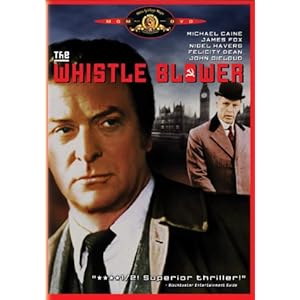
The Whistle Blower

Espionage flicks typically go one of two ways. One, the James Bond route; lots of action, explosions, beautiful women, gunfights, that sort of thing. Two, the more realistic way, films like Tinker, Tailor, Soldier, Spy and Argo. They both have their positives to take away, and sometimes it just depends what you're in the mood for. Where does 1987's The Whistle Blower fall? Oh so serious.

A veteran of the British Navy who served as a pilot during the Korean War, Frank Jones (Michael Caine) has moved on with his life and now has a mildly successful sales company. More and more, Frank finds himself talking his idealistic young son, Bob (Nigel Havers), down off the ledge about the nature of his job. Bob is a Russian linguist working for British intelligence, but he's become disillusioned about how the nature of the espionage is handled. Frank tries to convince him that with a struggling economy, any job is a good job, especially for a language specialist in Russian. Frank is stunned then when he receives the news that his son died in an accident, falling off the roof of his apartment building. Everyone from the police to the coroner believes it was an accident, but having talked to his son, Frank knows his son was investigating some deep, dark things. Was it an accident or part of a cover-up of something far more sinister?

Thank you, Netflix, for this one. I found it while looking through Caine's filmography/listing, and after months of procrastinating and avoiding it, I gave it a shot this week. There's no question what type of espionage flick this one is. It is the most serious of serious. No deadpan humor, no sexy secret agents, no guns a' blazing with explosions and fireballs. This is a gentlemanly espionage....well, mostly. From director Simon Langton, 'Whistle' manages to be both highly unsettling and low key in its delivery. You don't hear that often, do you? It can be a tad on the slow side, a little dull at times, but for the most part, I liked this one.

No surprises here, but Michael Caine will be my first, second and third reasons for watching this movie. Even when a movie is lousy, Caine is eternally watchable. When a movie is halfway decent, like 'Whistle' is, his performance can help bring it up a notch or two. Reflecting the solemn and serious tone of the story, it is a mostly understated, underplayed part for the screen veteran. He loves his son while also being frustrated by him. When Bob dies under suspicious circumstances, Frank is the only one who believes there could be more to the story. The portions of the story that follow are the movie at its best; an angry, confused and curious father searching for answers about his offspring. He even gets a few chances at some rabid outbursts, and let me tell you, I wouldn't want to be on the receiving end of a Caine outburst.

On top of Caine's performance, I liked the subtle nature of the story. At 104 minutes, it is never in a rush to get anywhere. Early on, it's not even in a rush to lay everything out. It's like as an audience we're dropped into a story that already had a prologue. Names, situations, backgrounds, reputations, they're all thrown at us, and we're forced to figure it out on the fly as it comes at us. Much of it surrounds British intelligence's effort to monitor Russian messages electronically. One agent Dodgson (Bill Wallis) has been pitting the Brits/Americans vs. the Russians, and those crafty Brits intend on figuring out what's going on. Their investigation leads to a traitor (John Gielgud) who's lived in England for over 20 years. As he continues to look for answers concerning his son, Frank finds out what his son was involved with, but also how far those intelligence agencies will go to produce effective results.

Like 2011's Tinker, Tailor, Soldier, Spy, 'Whistle' delves into the inner workings of the intelligence agencies. It isn't just them looking out for the country's well-being, but seeing how far they can push it to test the limits of their power.  It's a pretty frightening thought. Is one life expendable if it could lead to a huge payoff intelligence-wise? James Fox has an unsettling part as Lord, a British higher-up who calmly lays out a brutally sadistic plan, Barry Foster plays Charlie Greig, an old Army buddy of Frank's now working in Intelligence, and Gordon Jackson plays Bruce, the agent in the field putting plans into effect. Also watch for Felicity Dean as Cynthia, Bob's new girlfriend, a soon-to-be divorced woman with a kid, and Kenneth Colley as Pickett, a leftist crusading journalist desperately searching for a deeply hidden story.

I wish I had liked this movie more. For all the positives, it is slow, and it lacks a certain energy. Understated is one thing, but the story is so underplayed that I never really felt any sense of worry. The ending is disappointing although the final scene is moving, featuring some very cool on-location shooting at the Cenotaph in Whitehall, London.

The Whistle Blower (1987): ** 1/2 /****

Sunday, May 27, 2012

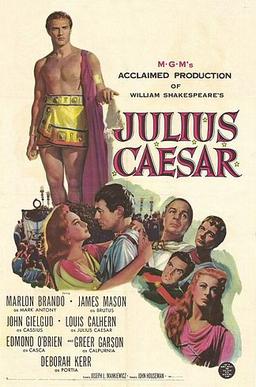
Julius Caesar (1953)

So this William Shakespeare guy....pretty talented, huh? A poet and playwright, he is basically the benchmark for everything in literature. And thanks to my upbringing in English classes through high school and college, I basically hate Shakespeare. I was forced to read his writings and resented basically every minute of it. That only partially explains my hate for 1953's Julius Caesar, but it is certainly part of it.

In ancient Rome, senator Julius Caesar (Louis Calhern) returns to an adoring public, many touting him as the future ruler of the Roman empire. Caesar's ambition is feared throughout the Senate, even leading many of his fellow Senators to plot against him, including the idealistic Brutus (James Mason) and cynical, scorned Cassius (John Gielgud). They worry that his ambition, along with close friend and fellow Senator, Mark Antony (Marlon Brando), will spell Rome's doom. They begin to form a plan, one that could change the country's future for years to come.

Now I'm going to say something early and just be done with it. I don't intend this review to sound like a whiny high school student although no doubt it will to a certain point. I can appreciate Shakespeare as an immense talent, but that doesn't mean I like anything about reading his work. I can appreciate that his talents have influenced basically every form of literature written since. But actually reading it? Some of the most difficult experiences I've ever had with the written word. Long, uninterrupted scenes of dialogue/monologues have a knack for putting me to sleep quickly. But....but.....even knowing this, I sought out this 1953 film, mostly because of the extraordinary talent assembled here. Unfortunately, I disliked it as much as I've always disliked Shakespeare's works whether it be in books and plays or film and television.

Where my objection comes from is Shakespeare's style. In writing, it is extremely difficult for me to get through the dialogue, and seeing it in a film didn't help. Well written it most certainly is, but it is stilted, awkward, forced and for me, difficult to follow. It doesn't seem to make a difference who's reciting the lines because the talent in this cast is truly impressive. And yes, I know these are stage-based stories, but seeing actors -- no matter the talent -- stand and wave and yell and recite several minutes of expressive yet still stilted dialogue doesn't scream out 'ENTERTAINING!' to me. Acting is one thing, and method acting a whole other beast, but I've never understood the appeal of loud, verbose, exaggerated stage acting, and that's what this movie is. It's 120 minutes of very talented actors talking and talking and...well, you get the idea.

With so much talent assembled for this film in the cast and director Joseph Mankiewicz behind the camera, I just assumed my issues would go by the wayside. With three movies to his name (Streetcar, The Men, Viva Zapata), Brando is a bright spot as Mark Anthony. His famous address of the Roman people following Caesar's assassination especially stands out. Then throw in Mason, Calhern, Gielgud, Edmond O'Brien, Greer Garson and Deborah Kerr? How could that not be worthwhile? I chalk it up more to Shakespeare's style than anything, but I just didn't care. I know the story, know where it will end up, and who makes it and who doesn't. Also look for Michael Ansara, Michael Pate, John Doucette, Lawrence Dobkin and Rhys Williams in smaller supporting parts.

I'm ready to take all sorts of heat for my dislike of this movie, but I hated it almost from the start. Besides the stilted, overdone stage acting, it is an incredibly dull story to watch. It was filmed in black and white on a soundstage, the camera and focus on the actors, not the huge scale or lavish sets. Bored to tears. There's just only so many ways to hear a classically trained actor speaking in the most prim and proper English ever written. So go ahead, let me have it if you so choose. I'm admitting I don't like Shakespeare. Karma is going to kick me square in the butt at some point.

Julius Caesar <---TCM trailer/clips (1953): */****

Tuesday, August 23, 2011

The Formula

Following the conclusion of World War II, American movies had an easy enemy and opponent for the next 40-plus years.  Through the length of the Cold War, the Russians/Soviets/Reds were the perfect bad guy, a shadowy, dark, sinister and even evil villain to do battle with.  But let's not forget about that other villain to come out of the late 40s...the escaped Nazis in movies like The Boys from Brazil and Marathon Man, and to an extent 1980's The Formula.

From director John G. Avildsen comes a story that you think will go one way and instead goes down another path. It does involved Nazis -- including a very cool opening sequence -- but ends up being more about big business and billions of dollars on the line from international corporations that end up all but ruling the world.  Think Syriana meets Who Killed the Electric Car?, and you've got this movie.  I don't know what to think of it, liking it at times and groaning as the "twists" are revealed. Like any movie I guess, take the good and the bad.

A former government agent turned Los Angeles police officer, Lt. Barney Caine (George C. Scott) is called in to lead a murder investigation. Caine is startled to find it is the murder of an old friend and a fellow police officer. But as he examines the evidence at the scene, something doesn't add up. Something seems forced, but he follows what is presented to him and ends up traveling to Germany as the clues and evidence present themselves. His friend was apparently involved in some high-end things -- drugs, big business (including oil chairman Marlon Brando) and billions of dollars -- that few were aware of. Was Caine's friend involved in something bigger than all of that though? Something worth killing more people over? As the bodies start to pile up, Caine wonders what exactly is going on, and if he could be next.

Complicated, twisting storylines typically go two ways. One, it is a well-written, well thought out complicated plot that works if you pay attention and keep up with it. Two, it is complicated for the sake of being hard to follow. That's The Formula. I resent when reviewers say a viewer who doesn't "get it" wasn't paying attention. Here, I paid attention, but the twists are too ridiculous, too convenient to even come close to making sense.  It isn't so much a Nazi splinter group of survivors pulling the strings as big business with monetary concerns doing the work. Just too many things happen that are explained in one quick conversation. If it is going to work, some sort of clue has to be given. If not, that isn't a twist. It's just lazy on the part of the script.

In its twists and turns, 'Formula' probably tries to do to much. It was billed as the movie that "the oil companies don't want you to see." The subject matter is probably dead-on accurate as to how the oil companies actually work, but it is handled in such a heavy-handed fashion that the message gets murky and even darkly comical and over the top. The formula is a German solution and equation to create a synthetic fuel that will replace the world's need for oil. Naturally the oil companies want to cover up its existence and are willing to do just about everything possible to keep it under wraps.  The story does keep you guessing as to everyone's motives, and it ends on a pessimistic note, but the story is so far all over the place that it never gels as a finished product.

On to the positives, few that they are.  In well-written movies or schlock like this, George C. Scott is almost always a watchable movie star.  He is intense, believable, and feels like he's never acting (to me at least). His Barney Caine character keeps the movie grounded in its police procedural roots -- albeit one that has him globe-trotting and involved in multi-billion dollar deals.  He's more than a little fed up with the system, the higher-ups, and the limitations placed on him. Caine is an old school cop/investigator who is just going to get the job done, and Scott is a bright spot among the bigger mess. Another positive, the opening in spring 1945 as German stares the end of the war dead in the face. The closing days of WWII (really, any war) are Dramatic Situations 101, and the tension and mood are great in this quick but effective opener.

Okay, now back to the negatives!  Yeah, more fun!  Brando got a paycheck for this one, and I think that's all he was worried about. His extended cameo as the chairman of an oil corporation as the actor -- maybe Hollywood's all-time best actor -- hamming it up in such an over the top fashion that it is either unintentionally bad or a brilliant choice by a brilliant actor.  I lean toward unintentionally bad, but who knows? The rest of the cast is okay, including Marthe Keller as Lisa, a source for Caine in Germany, John Gielgud as a German scientist who escaped from the Russians, G.D. Spradlin as Clements, a higher-up official with his hand in everything, and a long cast listing following them, none really making much of an impression positive or negative. It was cool to see WWII movie vet Wolfgang Preiss in a small part if nothing else.

Needlessly confusing at times, boring at others, and even a memorable lead performance from George C. Scott can't save this one.

The Formula <---TCM clip (1980): **/****   

Thursday, February 18, 2010

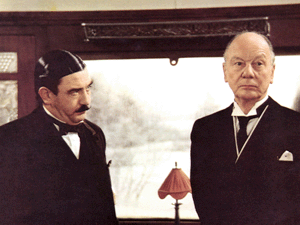
Murder on the Orient Express

Different directors have different personalities, different ways audiences look at them.  Michael Bay?  Loud, explosive movies. James Cameron? Huge blockbusters. Still chugging along at 86 years old, director Sidney Lumet has had a knack for working with some of Hollywood’s biggest stars in movies with a long list of those biggest stars.  Working off an Agatha Christie source novel, 1974’s Murder on the Orient Express assembles one of the most impressive casts ever assembled.

Playing Belgian detective Hercule Poirot, Albert Finney leads this cast in an enjoyable, ridiculous murder mystery set in the 1935.  Finney is in just about every scene and dominates the movie.  I’ve never read a Christie novel or anything at all related with Poirot, but this character reminded me of Peter Falk’s TV detective Columbo.  A quirky, eccentric detective solves convoluted crimes that no person in their right mind should be able to comprehend. 

Boarding the Orient Express after receiving orders to return to London, famed detective Hercule Poirot (Finney) is given a berth on the crowded train thanks to a railroad official (Martin Balsam) and long-time friend. But on the second night out, a mysterious American passenger, Ratchett (Richard Widmark), is murdered, stabbed through the midsection 12 times.  The railroad official turns to Poirot to solve the murder before the train reaches the next station.  A snow-covered pass blocks the train’s way, giving Poirot free range to go about solving the mystery.  The detective quickly figures out that Ratchett was involved in a well-known kidnapping case.  So was it a hired killer, or was one of the many passengers onboard the murderer?

The murder mystery itself is an interesting one that unfolds quickly in the first 30 minutes or so.  The whole next hour is devoted to a series of interrogations/interviews as Finney’s Poirot and Balsam’s Bianchi assemble the evidence concerning Ratchett’s murder.  With a dialogue-heavy movie, the story sinks or swims on these scenes. In that sense, it swims long and hard.  Finney earned an Oscar nomination for his performance, and it’s a treat to watch him interact with his supporting cast.

The cast is a who’s who of Hollywood stars from the Golden Age and then a newer wave of younger stars making a name for themselves and then a few in between.  Describing all these characters would require a whole other review in itself so I’ll try and keep it shorter.  Along with Finney, Balsam, and Widmark, there’s a list of names that include Anthony Perkins, Ingrid Bergman (Oscar-nominated supporting part), Lauren Bacall, Sean Connery, Michael York, Jacqueline Bisset, Vanessa Redgrave, Jean-Pierre Cassel, and John Gielgud. Most of them are given a brief intro and then their interrogations with Poirot.  Basically that amounts to a cameo-like role for all of them, but it’s great just to see all those big-names working together.

SPOILERS Don’t read anymore if you want to know who the murderer is SPOILERS.  Poirot does his detective work and then confronts all the train’s passengers.  His conclusion? They all murdered Ratchett, each stabbing him once with the same knife.  Each passenger has a connection to an infamous kidnapping case that Widmark’s Ratchett masterminded, resulting in the death of five people.  So working together, the murdering dozen or so have planned this murder to a fault…they just didn’t plan on Poirot being onboard.  This twist is stupid, ridiculous, over the top, and somehow…it works.  The ending itself is a bit of a letdown, but that’s a minor complaint. 

The reveal itself is well-handled in an almost 30-minute scene where all the clues and evidence comes together.  Lumet handles it perfectly with quick flashbacks to Poirot’s questioning as Finney seemingly lose his mind only to figure everything out.  And that’s why this is a movie worth watching, the performances from Finney to the long list of A-list actors making the most of their supporting roles.  More than a little beyond the limits of believability, but still fun from beginning to end.

Murder on the Orient Express <----trailer (1974): ***/****