The Sons of Katie Elder

The Sons of Katie Elder
"First, we reunite, then find Ma and Pa's killer...then read some reviews."
Showing posts with label Joseph Mankiewicz. Show all posts

Thursday, March 3, 2016

The Quiet American

For the United States, the Vietnam War officially began in 1965 as American forces officially became involved in the fighting in Vietnam. Of course, American advisors had been on the ground in Vietnam for a decade-plus trying to help swing things toward the American way and away from the Communist way. A particularly nasty period leading to a far nastier period, it's shady and dark and very hush-hush, very Cold War. Not too many films address the pre-Vietnam War time. An exception? From 1958, The Quiet American.

It's 1952 in Saigon and the political situation in Vietnam is on the verge of exploding as Vietnamese insurgents have begun to fight back against their French colonist rulers. Everything is seemingly in the balance just waiting for someone to strike the match that sets it all off. Living in the city is Thomas Fowler (Michael Redgrave), a middle-aged British journalist working as a war correspondent on the almost-daily updates of the fighting. He lives with a young Vietnamese woman, Phuong (Giorgia Moll), and is quite comfortable in his living situation in spite of the fighting and death around him. His peaceful arrangement changes though when a young American (Audie Murphy) shows up in Saigon. Working with a friends of Asia organization, the American takes an immediate liking to Phuong, putting the young woman in quite a spot. Now, Fowler -- with a wife back home -- must decide what is most important to him.

This 1958 historical drama from director Joseph Mankiewicz is based on a novel by author Graham Greene. As for the finished product, Greene was less than pleased with some rather major changes made from his source novel. Mankiewicz too was displeased with what the studio had done to the version he had written and then directed. I haven't read the novel, but I have seen the 2002 version of the film (starring Michael Caine and Brendan Fraser) that's supposedly a lot more in line with Greene's original. Moral of the story? Issues those involved may have had, 'Quiet' is worth a watch for any number of reasons, flaws considered and flaws aside.

My feeble mind can only grasp so much Politic. That's right...the upper-cased Politic. That was my worry about this 1958 drama. Though it is a personal story among three people in Saigon, the political situation in the city (and the world on a bigger level) is the basis. I wasn't always sure what they're talking about, but it's fascinating to watch it develop. Basically, everyone has their motives, the French, Communists, Americans and those that would benefit from a third force taking an active role in Vietnam, in this case those dastardly Americans. Mankiewicz filmed in Vietnam in 1958 -- so not the most peaceful filming location -- which gives 'Quiet' an authentic air of actually being a part of what we're seeing on-screen. Filming was less than smooth sounds like as demonstrations and violence rocked the city. How about that for adding that layer of reality?

The basis of the story is one of my least favorite storytelling devices....well, ever. It's the love triangle among Redgrave's middle-aged journalist, Murphy's noble, naive, idealistic American, and Moll's innocent Phuong who simply wants to be happy. The historical backdrop certainly helps alleviate the pain, but mostly, it's the acting talent involved. Mankiewicz's script lets these potential cardboard cutouts be red-blooded individuals (mostly). Redgrave is excellent as Fowler, the journalist going through a mid-life crisis of sorts at the worst possible moment. It's a challenging character because he isn't sympathetic, is a bit too whiny but all under the umbrella of being a stodgy British gentleman. He's passive aggressive and with a touch of condescending for good measure. By far, that's the best performance.

Murphy wasn't the first choice to play the titular, unnamed character, just part of a checkered production that saw some huge names drop in and out of filming. Murphy takes a rap sometimes for his wooden acting, but I thought he was excellent here. The biggest change made from Greene's novel is in the character, Murphy's American presented as a heroic, naive, honest, genuinely good individual while his backstory and motive for being in Vietnam are never truly explained. The 2002 version did not have that problem. Redgrave and Murphy play well off each other, Moll keeping up throughout with a thankless part. Also look for Claude Dauphin as a scene-stealing police investigator, Bruce Cabot, Fred Sadoff, Kerima and Richard Loo in key supporting parts.

There are issues with the story's pacing and as I mentioned, I get lost at times in the politically-heavy scenes. But as a movie? It's very good. I liked the movie-watching experience a lot. Filmed in black and white, 'Quiet' looks great, humid and sweaty and sun-drenched, a perfect backdrop for that politically and love-charged Saigon. The storytelling techniques work well -- giving away the ending in the opening scene, the rest told in flashback -- and the acting is solid all-around. A lot to recommend for an oft-forgotten drama.

The Quiet American (1958): ***/****

Tuesday, October 15, 2013

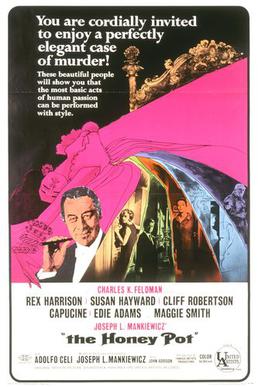
The Honey Pot

I like to think I know at least some background on anything from movies to television, sports to music. And then there's....plays!!! I've never been a huge fan of theater so I can honestly say I know little to nothing about a whole lot of plays, theaters, and writers, like Volpone, a play from the 1600s from playwright Ben Jonson. How about an introduction with 1967's The Honey Pot?

Even with all his millions, his whiskey, his cigars and his huge Venetian mansion, quirky millionaire Cecil Fox (Rex Harrison) is bored to tears. He's always taken pride in living life to the fullest, but in his middle years he's looking for some entertainment. Fox comes up with an idea while watching Jonson's Volpone, bringing the play to life, his life. He hires an on-and-off actor, William McFly (Cliff Robertson), as his assistant in his own personal play, the millionaire putting his diabolically "fun" plan into effect. Fox is going to pretend he's dying following a heart attack and he intends to settle up his vast fortunes, assembling three former loves in his Venetian mansion and letting the hijinks begin. McFly takes the job somewhat suspiciously but he goes along with it. What exactly is Cecil Fox up to? What is his ultimate goal in pulling off this ultra-involved prank?

I had never heard of this 1967 quasi-comedy from director Joseph Mankiewicz until it recently popped up on Turner Classic Movie's schedule. The plot sounded interesting enough, but mostly it was the cast that caught my attention. On top of Harrison and Robertson, we get Susan Hayward as Lone Star Crockett, a quirky American businesswoman with her hand in the oil business, Maggie Smith as Lone Star's nurse, Sarah, Capucine as Princess Dominique, and Edie Adams as a sex kitten American movie star. Oh, and there's also Adolfo Celi as a Venetian police officer who gets pulled into Fox's elaborate practical joke. Not too bad in the casting department, huh? That's what I thought, and I was right. Above all else, if you're going to give this one a try, go in because of the casting.

I especially liked the dynamic between Harrison and Robertson. Neither man knows exactly what the other one is up to, but they both know the other is up to something at least mildly sinister. Who will figure it out first? They have an appealing, easy-going chemistry that gives an energy to each of their scenes together, whether it be putting all the details of their plan together or just sitting across from each other at a poker game. Harrison's Cecil gets a chance to go one-on-one with Hayward's bajillionaire, Capucine's royalty and Adams' actress, each bringing a different dynamic to their scenes and background. I especially liked Hayward as Lone Star with all her quirks and idiosyncrasies. Robertson too gets a possible romance with Smith's Sarah, Lone Star's nurse who begins to smell a rat somewhere in this Venetian mansion.

So where exactly does this one hit a rough spot? Well, to be fair, it's not just one specific scene. It's an entire script from Mankiewicz, based off Thomas Serling's novel which is based off the original Volpone. The movie is a rather leisurely 132 minutes, and that's just the version released in the United States. In the United Kingdom, a 150-minute long version was released in theaters. I'm all for well-written dialogue. I don't know if this is as well-written as it thinks it is. It's smart and clever, witty and quick, but it's not the end all, be all dialogue that it believes it is. 'Pot' is too smarmy for its own good. The dialogue goes on and on seemingly without end. There are no memorably choreographed set pieces, nothing at all really to break up the monotony. It runs over two hours, but this is a story that goes on and on. It feels long. It is long.

'Pot' is listed as a comedy crime thriller which is fine and dandy. When one of the above characters is murdered nearing the hour-mark, things are definitely thrown for a loop. It's dark, but it ceases to be funny from there on in. One character begins to piece things together, but can the mystery be unraveled in time? It's not especially funny, especially the ending with all its forced attempts at humor, and the drama isn't dramatic enough. Pick a tone and stick with it! Funny or drama! It can work in the right situation, but this wasn't it. A very disappointing negative review.

The Honey Pot (1967): **/****     

Sunday, May 27, 2012

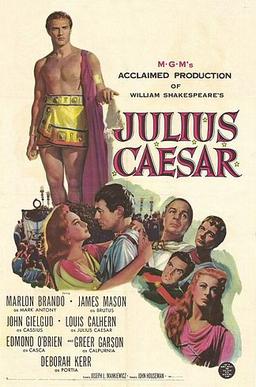
Julius Caesar (1953)

So this William Shakespeare guy....pretty talented, huh? A poet and playwright, he is basically the benchmark for everything in literature. And thanks to my upbringing in English classes through high school and college, I basically hate Shakespeare. I was forced to read his writings and resented basically every minute of it. That only partially explains my hate for 1953's Julius Caesar, but it is certainly part of it.

In ancient Rome, senator Julius Caesar (Louis Calhern) returns to an adoring public, many touting him as the future ruler of the Roman empire. Caesar's ambition is feared throughout the Senate, even leading many of his fellow Senators to plot against him, including the idealistic Brutus (James Mason) and cynical, scorned Cassius (John Gielgud). They worry that his ambition, along with close friend and fellow Senator, Mark Antony (Marlon Brando), will spell Rome's doom. They begin to form a plan, one that could change the country's future for years to come.

Now I'm going to say something early and just be done with it. I don't intend this review to sound like a whiny high school student although no doubt it will to a certain point. I can appreciate Shakespeare as an immense talent, but that doesn't mean I like anything about reading his work. I can appreciate that his talents have influenced basically every form of literature written since. But actually reading it? Some of the most difficult experiences I've ever had with the written word. Long, uninterrupted scenes of dialogue/monologues have a knack for putting me to sleep quickly. But....but.....even knowing this, I sought out this 1953 film, mostly because of the extraordinary talent assembled here. Unfortunately, I disliked it as much as I've always disliked Shakespeare's works whether it be in books and plays or film and television.

Where my objection comes from is Shakespeare's style. In writing, it is extremely difficult for me to get through the dialogue, and seeing it in a film didn't help. Well written it most certainly is, but it is stilted, awkward, forced and for me, difficult to follow. It doesn't seem to make a difference who's reciting the lines because the talent in this cast is truly impressive. And yes, I know these are stage-based stories, but seeing actors -- no matter the talent -- stand and wave and yell and recite several minutes of expressive yet still stilted dialogue doesn't scream out 'ENTERTAINING!' to me. Acting is one thing, and method acting a whole other beast, but I've never understood the appeal of loud, verbose, exaggerated stage acting, and that's what this movie is. It's 120 minutes of very talented actors talking and talking and...well, you get the idea.

With so much talent assembled for this film in the cast and director Joseph Mankiewicz behind the camera, I just assumed my issues would go by the wayside. With three movies to his name (Streetcar, The Men, Viva Zapata), Brando is a bright spot as Mark Anthony. His famous address of the Roman people following Caesar's assassination especially stands out. Then throw in Mason, Calhern, Gielgud, Edmond O'Brien, Greer Garson and Deborah Kerr? How could that not be worthwhile? I chalk it up more to Shakespeare's style than anything, but I just didn't care. I know the story, know where it will end up, and who makes it and who doesn't. Also look for Michael Ansara, Michael Pate, John Doucette, Lawrence Dobkin and Rhys Williams in smaller supporting parts.

I'm ready to take all sorts of heat for my dislike of this movie, but I hated it almost from the start. Besides the stilted, overdone stage acting, it is an incredibly dull story to watch. It was filmed in black and white on a soundstage, the camera and focus on the actors, not the huge scale or lavish sets. Bored to tears. There's just only so many ways to hear a classically trained actor speaking in the most prim and proper English ever written. So go ahead, let me have it if you so choose. I'm admitting I don't like Shakespeare. Karma is going to kick me square in the butt at some point.

Julius Caesar <---TCM trailer/clips (1953): */****