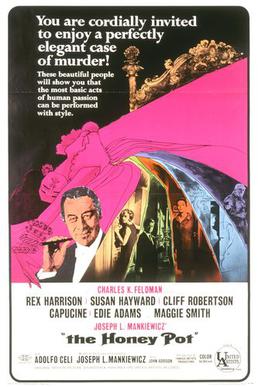
I like to think I know at least some background on anything from movies to television, sports to music. And then there's....plays!!! I've never been a huge fan of theater so I can honestly say I know little to nothing about a whole lot of plays, theaters, and writers, like Volpone, a play from the 1600s from playwright Ben Jonson. How about an introduction with 1967's The Honey Pot?
Even with all his millions, his whiskey, his cigars and his huge Venetian mansion, quirky millionaire Cecil Fox (Rex Harrison) is bored to tears. He's always taken pride in living life to the fullest, but in his middle years he's looking for some entertainment. Fox comes up with an idea while watching Jonson's Volpone, bringing the play to life, his life. He hires an on-and-off actor, William McFly (Cliff Robertson), as his assistant in his own personal play, the millionaire putting his diabolically "fun" plan into effect. Fox is going to pretend he's dying following a heart attack and he intends to settle up his vast fortunes, assembling three former loves in his Venetian mansion and letting the hijinks begin. McFly takes the job somewhat suspiciously but he goes along with it. What exactly is Cecil Fox up to? What is his ultimate goal in pulling off this ultra-involved prank?
I had never heard of this 1967 quasi-comedy from director Joseph Mankiewicz until it recently popped up on Turner Classic Movie's schedule. The plot sounded interesting enough, but mostly it was the cast that caught my attention. On top of Harrison and Robertson, we get Susan Hayward as Lone Star Crockett, a quirky American businesswoman with her hand in the oil business, Maggie Smith as Lone Star's nurse, Sarah, Capucine as Princess Dominique, and Edie Adams as a sex kitten American movie star. Oh, and there's also Adolfo Celi as a Venetian police officer who gets pulled into Fox's elaborate practical joke. Not too bad in the casting department, huh? That's what I thought, and I was right. Above all else, if you're going to give this one a try, go in because of the casting.
I especially liked the dynamic between Harrison and Robertson. Neither man knows exactly what the other one is up to, but they both know the other is up to something at least mildly sinister. Who will figure it out first? They have an appealing, easy-going chemistry that gives an energy to each of their scenes together, whether it be putting all the details of their plan together or just sitting across from each other at a poker game. Harrison's Cecil gets a chance to go one-on-one with Hayward's bajillionaire, Capucine's royalty and Adams' actress, each bringing a different dynamic to their scenes and background. I especially liked Hayward as Lone Star with all her quirks and idiosyncrasies. Robertson too gets a possible romance with Smith's Sarah, Lone Star's nurse who begins to smell a rat somewhere in this Venetian mansion.
So where exactly does this one hit a rough spot? Well, to be fair, it's not just one specific scene. It's an entire script from Mankiewicz, based off Thomas Serling's novel which is based off the original Volpone. The movie is a rather leisurely 132 minutes, and that's just the version released in the United States. In the United Kingdom, a 150-minute long version was released in theaters. I'm all for well-written dialogue. I don't know if this is as well-written as it thinks it is. It's smart and clever, witty and quick, but it's not the end all, be all dialogue that it believes it is. 'Pot' is too smarmy for its own good. The dialogue goes on and on seemingly without end. There are no memorably choreographed set pieces, nothing at all really to break up the monotony. It runs over two hours, but this is a story that goes on and on. It feels long. It is long.
'Pot' is listed as a comedy crime thriller which is fine and dandy. When one of the above characters is murdered nearing the hour-mark, things are definitely thrown for a loop. It's dark, but it ceases to be funny from there on in. One character begins to piece things together, but can the mystery be unraveled in time? It's not especially funny, especially the ending with all its forced attempts at humor, and the drama isn't dramatic enough. Pick a tone and stick with it! Funny or drama! It can work in the right situation, but this wasn't it. A very disappointing negative review.
The Honey Pot (1967): **/****
The Sons of Katie Elder
"First, we reunite, then find Ma and Pa's killer...then read some reviews."
Showing posts with label Maggie Smith. Show all posts
Tuesday, October 15, 2013
Wednesday, September 25, 2013
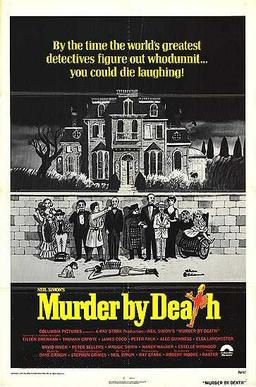
Murder by Death
What's more fun than a murder mystery in film and on TV? The people who solve the murder mysteries!!! And no, I'm not talking about police procedurals where police officers follow the clues and catch the crooks. We're talking the out of this world observant and intelligent sleuths and detectives who follow all the minute, excruciating little details and pull theories out of thin air. They certainly get their due in a great spoof from 1976, Murder by Death.
Coming from all around the world, five world-class detectives have been brought together at an isolated country mansion by eccentric recluse Lionel Twain (writer Truman Capote). His goal? Present a murder with little evidence and let his five detectives piece things together. Whoever figures things out and fingers the murderer by dawn will receive a $1 million reward. Who are his contestants of sorts? They include Milo Perrier (James Coco), the whiny Belgian, Sam Diamond (Peter Falk), the tough guy detective, Jessica Marbles (Elsa Lanchester), the very English middle-aged woman, Dick Charleston (David Niven), the gentlemanly, smooth aging detective, and Sidney Wang (Peter Sellers), the pronunciation challenged Chinese detective. Each detective has brought a partner/sidekick/spouse but can any of the manage to solve a seemingly impossible murder mystery?
From director Robert Moore and screenwriter Neil Simon, 'Murder' is a gem in the Whodunnit genre. Throw a bunch of characters together, add in a mystery/murder or something that needs to be solved, and let the fun begin. This is a spoof of the Whodunnit genre, but it's not a stupid spoof, far from it. While the humor is far from high brow laughs, it's snappy, smart and quick. This is a very talented cast assembled here, the actors and actresses playing off each with remarkable ease. It's a quick movie at just 94 minutes, but there are laughs throughout. It was filmed on a mansion set in Burbank Studios, a closed-in, claustrophobic feel to the ever twisting and turning story. Self-contained and the better for it.
You really just can't go wrong with the sick amount of talent brought together here in the cast. Each detective is based off a classic literature character (Perrior = Hercules Poirot, Diamond = Sam Spade, Marbles = Miss Marple, Charleston = Nick Charles/The Thin Man, and Wang = Charlie Chan), each given their quirky personality traits that bring it all together nicely. Coco's Perrier is dying of starvation -- or so he believes -- as the mystery develops, Diamond does his best Humphrey Bogart impression throughout, Marbles quirky, mousy and excited, Charleston the upper class, smooth-talking Englishman, and Wang the master of logic and observation (with a touch of political incorrectness thrown in for good measure). It would be easy to see any/all of these characters getting their own movie, but when assembled together, we're talking impeccable chemistry with some sublimely perfect laughs.
Improving on the talent brought together is that each character is given a sidekick of some sort, a spouse, child, whatever. More cast listing!!! The recently departed Eileen Brennan plays Tess Skeffington, Sam's secretary and mistress, Maggie Smith plays Nora Charleston, Dick's longtime and loving wife, Estelle Windood as Miss Marple's wheelchair bound and ancient nurse, James Cromwell as Marcel, Perrier's very French chauffeur and Richard Narita as Willy, Wang's adopted Japanese son.
Oh, there's more. One of the movie's most perfectly executed running bits has Alec Guinness as Bensonmum, Twain's personal assistant and butler.....who's blind. It's almost inappropriate, a little politically incorrect when you hear about it, but like so much else going on in Simon's script, it just works. He answers the door, never realizing if anyone entered but speaking as if they're standing in front of him. He serves dinner with poor results, guides the guests to their rooms, and has a great running gag with the new cook, Yetta (Nancy Walker), a Hungarian woman who's deaf, can't talk and doesn't understand English in any way, but Guinness' Bensonmum can't see that she's holding up notes explaining herself. It's stupid almost as an idea, almost infantile in its humor, but oh goodness, it works so well. Here's a montage of so many of those great lines, watch it HERE.
Director Moore's film runs just 94 minutes, flying by at a breakneck speed. The first 60 minutes are about as perfect as a comedy can be, smart and stupid but balanced out between the two. It's beyond funny on all levels. The last 30 minutes or so come up a little short, the goofiness becoming a little too much. Capote -- an obvious scene-stealer -- delivers a great monologue ripping all these great detectives apart. He criticizes their storytelling techniques, their introduction of characters out of nowhere, ridiculous twists that come out of nowhere, and basically making it impossible to solve the mystery, whatever it should be. The ending is flat out stupid, but it's supposed to be. If you can decipher it in any way, you let me know. The struggles of the last 30 minutes prevent it from being an all-time great comedy, but flaws and all, it is still a gem.
Murder by Death (1976): *** 1/2 /****
Coming from all around the world, five world-class detectives have been brought together at an isolated country mansion by eccentric recluse Lionel Twain (writer Truman Capote). His goal? Present a murder with little evidence and let his five detectives piece things together. Whoever figures things out and fingers the murderer by dawn will receive a $1 million reward. Who are his contestants of sorts? They include Milo Perrier (James Coco), the whiny Belgian, Sam Diamond (Peter Falk), the tough guy detective, Jessica Marbles (Elsa Lanchester), the very English middle-aged woman, Dick Charleston (David Niven), the gentlemanly, smooth aging detective, and Sidney Wang (Peter Sellers), the pronunciation challenged Chinese detective. Each detective has brought a partner/sidekick/spouse but can any of the manage to solve a seemingly impossible murder mystery?
From director Robert Moore and screenwriter Neil Simon, 'Murder' is a gem in the Whodunnit genre. Throw a bunch of characters together, add in a mystery/murder or something that needs to be solved, and let the fun begin. This is a spoof of the Whodunnit genre, but it's not a stupid spoof, far from it. While the humor is far from high brow laughs, it's snappy, smart and quick. This is a very talented cast assembled here, the actors and actresses playing off each with remarkable ease. It's a quick movie at just 94 minutes, but there are laughs throughout. It was filmed on a mansion set in Burbank Studios, a closed-in, claustrophobic feel to the ever twisting and turning story. Self-contained and the better for it.
You really just can't go wrong with the sick amount of talent brought together here in the cast. Each detective is based off a classic literature character (Perrior = Hercules Poirot, Diamond = Sam Spade, Marbles = Miss Marple, Charleston = Nick Charles/The Thin Man, and Wang = Charlie Chan), each given their quirky personality traits that bring it all together nicely. Coco's Perrier is dying of starvation -- or so he believes -- as the mystery develops, Diamond does his best Humphrey Bogart impression throughout, Marbles quirky, mousy and excited, Charleston the upper class, smooth-talking Englishman, and Wang the master of logic and observation (with a touch of political incorrectness thrown in for good measure). It would be easy to see any/all of these characters getting their own movie, but when assembled together, we're talking impeccable chemistry with some sublimely perfect laughs.
Improving on the talent brought together is that each character is given a sidekick of some sort, a spouse, child, whatever. More cast listing!!! The recently departed Eileen Brennan plays Tess Skeffington, Sam's secretary and mistress, Maggie Smith plays Nora Charleston, Dick's longtime and loving wife, Estelle Windood as Miss Marple's wheelchair bound and ancient nurse, James Cromwell as Marcel, Perrier's very French chauffeur and Richard Narita as Willy, Wang's adopted Japanese son.
Oh, there's more. One of the movie's most perfectly executed running bits has Alec Guinness as Bensonmum, Twain's personal assistant and butler.....who's blind. It's almost inappropriate, a little politically incorrect when you hear about it, but like so much else going on in Simon's script, it just works. He answers the door, never realizing if anyone entered but speaking as if they're standing in front of him. He serves dinner with poor results, guides the guests to their rooms, and has a great running gag with the new cook, Yetta (Nancy Walker), a Hungarian woman who's deaf, can't talk and doesn't understand English in any way, but Guinness' Bensonmum can't see that she's holding up notes explaining herself. It's stupid almost as an idea, almost infantile in its humor, but oh goodness, it works so well. Here's a montage of so many of those great lines, watch it HERE.
Director Moore's film runs just 94 minutes, flying by at a breakneck speed. The first 60 minutes are about as perfect as a comedy can be, smart and stupid but balanced out between the two. It's beyond funny on all levels. The last 30 minutes or so come up a little short, the goofiness becoming a little too much. Capote -- an obvious scene-stealer -- delivers a great monologue ripping all these great detectives apart. He criticizes their storytelling techniques, their introduction of characters out of nowhere, ridiculous twists that come out of nowhere, and basically making it impossible to solve the mystery, whatever it should be. The ending is flat out stupid, but it's supposed to be. If you can decipher it in any way, you let me know. The struggles of the last 30 minutes prevent it from being an all-time great comedy, but flaws and all, it is still a gem.
Murder by Death (1976): *** 1/2 /****
Labels:
1970s,
Alec Guinness,
Comedy,
David Niven,
James Cromwell,
Maggie Smith,
Peter Falk,
Peter Sellers
Tuesday, August 21, 2012
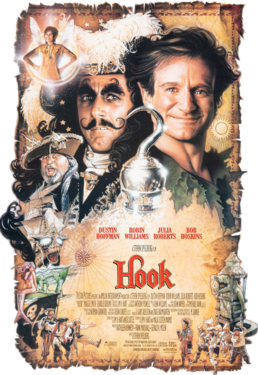
Hook
Let's face it. Who among us actually wanted to grow up? It's just more fun being a kid. Less responsibilities, no obligations, and basically? Do what you want. That's part of the long-lasting charm of the Peter Pan character, a mischievous boy who never grows up, causing mischief and enjoying himself wherever he goes. What if Peter did grow up though, forgetting about what he used to be? So goes 1991's Hook.
A ruthless businessman who can scoop up struggling businesses effortlessly, Peter Banning (Robin Williams) takes his wife and kids, Jack (Charlie Korsmo) and Maggie (Amber Scott), to visit his grandmother, Wendy (Maggie Smith), in London. Obsessed with a merger, Peter has lost touch with his family, and one night, they're mysteriously taken from Wendy's home, an ominous note from a JAS Hook left on their bedroom door. It defies a 'Peter Pan' to come back to Neverland and rescue his children. Peter has no idea what to make of it until Maggie reveals a secret; Peter is in fact Peter Pan all grown up, his "childhood" lost since forgotten when he chose to grow up. How can he get his kids back? By embracing who he used to be, visiting Neverland and tangling with the nasty Captain Hook (Dustin Hoffman).
As a literary character, Peter Pan first appeared in author J.M. Barrie's 1902 book The Little White Bird. Peter would appear in several other Barrie books and since then has become an instantly recognizable literary character from books and plays to stage plays and feature films, even the iconic Disney classic from 1953. It is a character most kids are aware of at least a little, and there is a charm to the boy who refuses to grow up. A story delving into a 'what if?' about said character is an interesting, unique idea. Peter decided to grow up when he fell in love with his future wife, Moira (Caroline Goodall). And what if a full-grown Peter doesn't remember his past life as the infamous Peter Pan? Well, away we go.
I watched the movie and enjoyed it only to get a rather large surprise as the credits rolled. Directed by.....Steven Spielberg?!? I couldn't and didn't believe it. Not one of Spielberg's best films, Hook is nonetheless a good film. What struck me most was the distinct look of the film, giving an appearance of almost being based on a stage. The sets are all clearly indoors -- especially the outdoor ones on Neverland and on Hook's ship -- but they're busy, cluttered and claustrophobic. There's always lots of action and movement around, filling the screen to the point it looks like it may burst. John Williams' score is okay if not particularly memorable, never rising above the action on-screen.
What I liked most though was the casting, almost from top to bottom. Who better than to play wild man-child Peter Pan than ultra-goofy Robin Williams? He brings the character to life; a business suit executive who can't be bothered with anything fun. Then, he starts to remember what he used to be and watch out! Let the fireworks ensue. Hoffman is a scene-stealer as Capt. Hook, the infamous pirate leader with a hook for a hand after a crocodile bit his hand off. Julia Roberts plays Tinkerbell, the tiniest of fairies who guides Peter on his rediscovery of who he is. Bob Hoskins too is very good as Smee, Hook's right hand man. Of Peter's Lost Boys, the ones that stand out the most are Dante Brasco as Rufio, the new leader of the Boys, and Raushan Hammond as Thud Butt, the rather....round, jovial Lost Boy. Even look for singer Phil Collins in a small part and Gwyneth Paltrow as a young Wendy in a flashback.
Far from perfect, the movie does have its flaws. At 144 minutes, it's far too long. Here's my issue. The movie never really slows down from its London intro to the majority of the time being spent on Neverland. It isn't really the pacing's fault, but the movie feels incredibly long at times. Some scenes go on for too long without knowing where to cut it off. As well, the use of some computer generated images looks dated now some 20-plus years later. Hard to criticize it too much, but it's certainly noticeable. Still, it's an entertaining story with an iconic character, an interesting visual look, and a deep cast.
Hook <---trailer (1991): ** 1/2 /****
A ruthless businessman who can scoop up struggling businesses effortlessly, Peter Banning (Robin Williams) takes his wife and kids, Jack (Charlie Korsmo) and Maggie (Amber Scott), to visit his grandmother, Wendy (Maggie Smith), in London. Obsessed with a merger, Peter has lost touch with his family, and one night, they're mysteriously taken from Wendy's home, an ominous note from a JAS Hook left on their bedroom door. It defies a 'Peter Pan' to come back to Neverland and rescue his children. Peter has no idea what to make of it until Maggie reveals a secret; Peter is in fact Peter Pan all grown up, his "childhood" lost since forgotten when he chose to grow up. How can he get his kids back? By embracing who he used to be, visiting Neverland and tangling with the nasty Captain Hook (Dustin Hoffman).
As a literary character, Peter Pan first appeared in author J.M. Barrie's 1902 book The Little White Bird. Peter would appear in several other Barrie books and since then has become an instantly recognizable literary character from books and plays to stage plays and feature films, even the iconic Disney classic from 1953. It is a character most kids are aware of at least a little, and there is a charm to the boy who refuses to grow up. A story delving into a 'what if?' about said character is an interesting, unique idea. Peter decided to grow up when he fell in love with his future wife, Moira (Caroline Goodall). And what if a full-grown Peter doesn't remember his past life as the infamous Peter Pan? Well, away we go.
I watched the movie and enjoyed it only to get a rather large surprise as the credits rolled. Directed by.....Steven Spielberg?!? I couldn't and didn't believe it. Not one of Spielberg's best films, Hook is nonetheless a good film. What struck me most was the distinct look of the film, giving an appearance of almost being based on a stage. The sets are all clearly indoors -- especially the outdoor ones on Neverland and on Hook's ship -- but they're busy, cluttered and claustrophobic. There's always lots of action and movement around, filling the screen to the point it looks like it may burst. John Williams' score is okay if not particularly memorable, never rising above the action on-screen.
What I liked most though was the casting, almost from top to bottom. Who better than to play wild man-child Peter Pan than ultra-goofy Robin Williams? He brings the character to life; a business suit executive who can't be bothered with anything fun. Then, he starts to remember what he used to be and watch out! Let the fireworks ensue. Hoffman is a scene-stealer as Capt. Hook, the infamous pirate leader with a hook for a hand after a crocodile bit his hand off. Julia Roberts plays Tinkerbell, the tiniest of fairies who guides Peter on his rediscovery of who he is. Bob Hoskins too is very good as Smee, Hook's right hand man. Of Peter's Lost Boys, the ones that stand out the most are Dante Brasco as Rufio, the new leader of the Boys, and Raushan Hammond as Thud Butt, the rather....round, jovial Lost Boy. Even look for singer Phil Collins in a small part and Gwyneth Paltrow as a young Wendy in a flashback.
Far from perfect, the movie does have its flaws. At 144 minutes, it's far too long. Here's my issue. The movie never really slows down from its London intro to the majority of the time being spent on Neverland. It isn't really the pacing's fault, but the movie feels incredibly long at times. Some scenes go on for too long without knowing where to cut it off. As well, the use of some computer generated images looks dated now some 20-plus years later. Hard to criticize it too much, but it's certainly noticeable. Still, it's an entertaining story with an iconic character, an interesting visual look, and a deep cast.
Hook <---trailer (1991): ** 1/2 /****
Wednesday, August 3, 2011
Harry Potter and the Sorcerer's Stone
First released in 1997 from author J.K. Rowling, the Harry Potter franchise in both literature and film has taken the world by storm. The seven Potter books have sold 450 million copies -- actually think about how many books that is -- and the films to date (I'm writing this before the final film is released) have grossed six billion dollars worldwide. Now partially because I don't like being told to read/watch something, my only experience with the Potter books comes from reading the first story during a college English class.
While there was nothing about the series that turned me off, I just wasn't pulled in like so many of the devoted fans that love everything about the character(s), the series and this whole new world. I enjoyed the first book -- Harry Potter and the Sorcerer's Stone -- but got through it more because I needed to for the class as opposed to wanting to read it. So now 14 years later as the final movie is about to hit theaters tomorrow, I finally looked into the first movie, watching 2001's Harry Potter and the Sorcerer's Stone. Better late than never, right?
Growing up with his aunt, uncle and cousin after his parents died when he was a baby, 11-year old Harry Potter (Daniel Radcliffe) has always been a little different, but he has no idea why. As weird things start happening around him, he gets a strange visitor, an immense man with a gigantic beard, Hagrid (Robbie Coltrane), who tells him he should get ready to travel to Hogwarts, a school for young wizards. Not sure what to make of everything, Harry goes along, thrust into a world of oddities, magic, and spells where everyone seems to know him, but he has no idea why. He meets Ron Weasley (Rupert Grint) and Hermione Granger (Emma Watson), fellow first year wizardry students, and starts to learn the ways of being a wizard. As he learns all he can though, Harry begins to see that there's more to his past than he knows, and he may be destined for bigger and better things.
A whole new crazy wizard world aside, I think a big selling point of these movies/books is actually the simplicity of the Harry character. He's a young kid trying to find out who he is and what he should do to grow up. Granted, he's going to a wizard school and not just grammar school, but what person in the audience can't appreciate that feeling of butterflies as you step into something new? Over the last 10 years and all the movies that followed, Radcliffe has grown up in front of our eyes, and as a 12-year old here in the opener, he shows what a great actor he can be. Child actors are incredibly hit or miss, but he shows off his impressive talents. The same goes for Grint as Ron, Harry's best friend and partner in crime, and Watson as Hermione, the know-it-all who wants to be the best wizard ever. It's this friendship among the three youngsters that keeps the movie grounded in the coming movies because through all the craziness, they're still just three good friends.
On to bigger and better things though, a whole world devoted to being a wizard. Director Chris Columbus has the unenviable task of turning a hugely popular book into a movie that fans will approve of, and more than that, live up to expectations. Visually, the movie is a stunner, a beautiful story to watch all the way through. Hogwarts looks like an English castle from the Middle Ages as the wizard students are separated by house. It's a clean slate though to create this world because Rowling creates everything from the ground up. We're introduced to the game of Quidditch, a cross-breed of hockey and soccer on brooms, school houses with names like Griffindor and Slyterhin, a school that literally moves around in its architectural form as needed, teachers and professors with all sorts of specialties, creatures and objects that are unique and interesting in their weirdness. It's fun to watch and easy to keep up with, the movie almost serving as a guide for what is to come in the series.
Credit goes to the child (and now adult) actors in Radcliffe, Grint and Watson for making the series what it is over the last 10 years. But one of the things that helped legitimize the series in its film form was the ridiculous talents involved in filling out all these great supporting roles. Ready to get some serious acting chops dropped on you? Start with Richard Harris as Professor Albus Dumbledore, the head master of Hogwarts and wisest of all the professors. Some of the other professors include Maggie Smith as Minerva McGonagall, Ian Hart as the squirrelly Prof. Quirrell, John Cleese as Nearly Headless Nick, and Alan Rickman as Severus Snape, head of the Slytherin House. Coltrane is a scene-stealer as the gigantic, somewhat dim Hagrid who is almost Harry's guardian angel, and John Hurt even makes a one-scene appearance as Olllivander, a wand maker. What works though is that these don't feel like unnecessary cameos, instead being little parts brought to life by immensely talented actors and actresses. They're characters, not movie stars.
Having not seen the rest of the movies -- yet -- I've still kept up with the series over the years. It was hard not to keep up even by accident with the wave of media attention devoted to Harry Potter. The series has changed quite a bit in the years since its debut, and mostly for the better. I read a surprising amount of critiques that ripped this movie pretty good because it was aimed so much at kids while the later movies went to a darker, more cynical place. This is the movie that had to be made to introduce the series though, a fun, exciting adventure that introduces all the players and puts everything where it needs to be. I've tried to keep the review tight and know I missed a fair amount of stuff that I could have mentioned.
What's worth knowing? It's a good movie, and a great introduction to an extremely popular series that has gotten bigger and better since. A very good start.
Harry Potter and the Sorcerer's Stone <---trailer (2001): ***/****
While there was nothing about the series that turned me off, I just wasn't pulled in like so many of the devoted fans that love everything about the character(s), the series and this whole new world. I enjoyed the first book -- Harry Potter and the Sorcerer's Stone -- but got through it more because I needed to for the class as opposed to wanting to read it. So now 14 years later as the final movie is about to hit theaters tomorrow, I finally looked into the first movie, watching 2001's Harry Potter and the Sorcerer's Stone. Better late than never, right?
Growing up with his aunt, uncle and cousin after his parents died when he was a baby, 11-year old Harry Potter (Daniel Radcliffe) has always been a little different, but he has no idea why. As weird things start happening around him, he gets a strange visitor, an immense man with a gigantic beard, Hagrid (Robbie Coltrane), who tells him he should get ready to travel to Hogwarts, a school for young wizards. Not sure what to make of everything, Harry goes along, thrust into a world of oddities, magic, and spells where everyone seems to know him, but he has no idea why. He meets Ron Weasley (Rupert Grint) and Hermione Granger (Emma Watson), fellow first year wizardry students, and starts to learn the ways of being a wizard. As he learns all he can though, Harry begins to see that there's more to his past than he knows, and he may be destined for bigger and better things.
A whole new crazy wizard world aside, I think a big selling point of these movies/books is actually the simplicity of the Harry character. He's a young kid trying to find out who he is and what he should do to grow up. Granted, he's going to a wizard school and not just grammar school, but what person in the audience can't appreciate that feeling of butterflies as you step into something new? Over the last 10 years and all the movies that followed, Radcliffe has grown up in front of our eyes, and as a 12-year old here in the opener, he shows what a great actor he can be. Child actors are incredibly hit or miss, but he shows off his impressive talents. The same goes for Grint as Ron, Harry's best friend and partner in crime, and Watson as Hermione, the know-it-all who wants to be the best wizard ever. It's this friendship among the three youngsters that keeps the movie grounded in the coming movies because through all the craziness, they're still just three good friends.
On to bigger and better things though, a whole world devoted to being a wizard. Director Chris Columbus has the unenviable task of turning a hugely popular book into a movie that fans will approve of, and more than that, live up to expectations. Visually, the movie is a stunner, a beautiful story to watch all the way through. Hogwarts looks like an English castle from the Middle Ages as the wizard students are separated by house. It's a clean slate though to create this world because Rowling creates everything from the ground up. We're introduced to the game of Quidditch, a cross-breed of hockey and soccer on brooms, school houses with names like Griffindor and Slyterhin, a school that literally moves around in its architectural form as needed, teachers and professors with all sorts of specialties, creatures and objects that are unique and interesting in their weirdness. It's fun to watch and easy to keep up with, the movie almost serving as a guide for what is to come in the series.
Credit goes to the child (and now adult) actors in Radcliffe, Grint and Watson for making the series what it is over the last 10 years. But one of the things that helped legitimize the series in its film form was the ridiculous talents involved in filling out all these great supporting roles. Ready to get some serious acting chops dropped on you? Start with Richard Harris as Professor Albus Dumbledore, the head master of Hogwarts and wisest of all the professors. Some of the other professors include Maggie Smith as Minerva McGonagall, Ian Hart as the squirrelly Prof. Quirrell, John Cleese as Nearly Headless Nick, and Alan Rickman as Severus Snape, head of the Slytherin House. Coltrane is a scene-stealer as the gigantic, somewhat dim Hagrid who is almost Harry's guardian angel, and John Hurt even makes a one-scene appearance as Olllivander, a wand maker. What works though is that these don't feel like unnecessary cameos, instead being little parts brought to life by immensely talented actors and actresses. They're characters, not movie stars.
Having not seen the rest of the movies -- yet -- I've still kept up with the series over the years. It was hard not to keep up even by accident with the wave of media attention devoted to Harry Potter. The series has changed quite a bit in the years since its debut, and mostly for the better. I read a surprising amount of critiques that ripped this movie pretty good because it was aimed so much at kids while the later movies went to a darker, more cynical place. This is the movie that had to be made to introduce the series though, a fun, exciting adventure that introduces all the players and puts everything where it needs to be. I've tried to keep the review tight and know I missed a fair amount of stuff that I could have mentioned.
What's worth knowing? It's a good movie, and a great introduction to an extremely popular series that has gotten bigger and better since. A very good start.
Harry Potter and the Sorcerer's Stone <---trailer (2001): ***/****
Labels:
2000s,
Alan Rickman,
Fantasy,
John Hurt,
Maggie Smith,
Richard Harris
Wednesday, March 30, 2011
Young Cassidy
Born in 1880 in Dublin, Ireland, Irish playwright/dramatist/memoirist Sean O'Casey would go on to become one of Ireland's most famous writers. So I've read at least, I've never heard of him. Apparently, O'Casey thought fairly highly of himself too, publishing a 6-volume autobiography while also completing over 20 other works during his career. Not having heard of him, I stumbled across the movie of his life, 1965's Young Cassidy, and tuned in mostly because of the star.
In his personal life, O'Casey was a noted socialist, but that's not going to work in an America-made movie about his life now, is it? An Irish writer in the first 20 years of the 20th Century is ripe pickings for a story fraught with conflict and issues as Ireland went through violent conflict after violent conflict in the 1910s. I was somewhat worried to read that John Ford shot part of the movie before being forced to leave the production after falling ill. I love Ford and all of his quirks, but I didn't want to watch The Quiet Man 2. Instead, director Jack Cardiff replaced him and probably for the better.
It's 1910 in the slums in Dublin and John Cassidy (Rod Taylor) is searching for work to care for his extended family and his aging mother (Flora Robson). Ireland is struggling with poverty and violence as the people fight back, upset with the lives they've almost been forced to live. Cassidy among them doesn't know what to make of the situation but ends up joining the Irish revolutionary forces. A treaty is signed with England for peace, and a young Johhny doesn't know what to do with his life. With help from a young, pretty bookstore owner, Nora (Maggie Smith), he turns to writing, something he's always enjoyed and been good at but never saw any future in it. He begins to write about the things he knows, the life he's led, and he once again is good at it. But in the process, he begins to drive everyone close to him further away.
So often stereotyped or pigeon-holed as a tough guy actor, Rod Taylor didn't always get a ton of chances to show off his acting ability. While I like other Taylor movies better than 'Young,' I can't think of a better performance delivered by the Australian actor. John Cassidy (changed from Sean O'Casey for some reason) has been toned down some from the real O'Casey, but there's still some chinks in the armor that help make him a full-fledged character. He's a family man but a fiery individual too, his temper often getting the better of him. He gets around town a fair share, typically getting involved where he shouldn't be. Seeing the strife and struggle around him, Cassidy just wants something better for himself and the Irish people. He loves everything about his roots, his background, and he uses it as a source in his writings.
The darker, tragic Irish history apparently creates many dark, tragic writers (James Joyce also comes to mind). What makes a great writer great? If you read enough and believe what classical critics say, it's that the most successful writers write about what they know. It's the people they meet, the streets and businesses in the cities and towns they grew up in, their relationships with friends, families, enemies and strangers. Irish poverty then comes easy to Cassidy in his writing. It is all he knows. The story reminded me in a lot of ways of Angela's Ashes, painting Ireland and its culture in a positive and negative light. Through all the struggles though, Ireland still manages to get across the impression of a classically romantic country, partially due to all its struggles. Cardiff takes advantage, filming his story in Ireland to give it that authentic feel without going down that cutesy, too sweet way that Ford did in The Quiet Man.
The supporting characters cover the gamut, all given a chance to play off of Taylor's Johnny. The story covers years so some characters stick around longer than others, and for the most part they make the most of it. Late in her career, Robson is a quiet scene-stealer as Johnny's mother, doting on her son who seems to always have been her favorite, the one child who has a chance to amount to something. Philip O'Flynn plays Mick Mullen, a close friend and co-worker of Johnny's who sticks with him through the ups and downs. In one of her first film roles, Julie Christie plays Daisy Battles, a possible love interest for Johnny. Edith Evans and Michael Redgrave are also scene-stealers as Lady Gregory and W.B. Yeats, owners of the Abbey Playhouse who see the potential Johnny has in his writings.
For a movie that clocks in at 110 minutes, I'm struggling to remember a lot of what happened. The story has an episodic feel to it as the years pass, Johnny growing and developing into a writer. It certainly picks up the pace when the story focuses on his writing after all the struggles he's been through. What I liked was the ending. Irish history isn't going to have a lot of happy endings -- especially when it comes to movies -- and Cardiff picks the perfect place to end the story. It's by no means a downer ending because that's not a fair description. It's a real ending, one that makes sense regardless of it is qualifies as a Hollywood happy ending. I'm not sure if I did enjoy the movie or just moderately enjoy it, but as I right this now, I'll say give it a try.
Young Cassidy <---TCM trailer (1965): ***/****
In his personal life, O'Casey was a noted socialist, but that's not going to work in an America-made movie about his life now, is it? An Irish writer in the first 20 years of the 20th Century is ripe pickings for a story fraught with conflict and issues as Ireland went through violent conflict after violent conflict in the 1910s. I was somewhat worried to read that John Ford shot part of the movie before being forced to leave the production after falling ill. I love Ford and all of his quirks, but I didn't want to watch The Quiet Man 2. Instead, director Jack Cardiff replaced him and probably for the better.
It's 1910 in the slums in Dublin and John Cassidy (Rod Taylor) is searching for work to care for his extended family and his aging mother (Flora Robson). Ireland is struggling with poverty and violence as the people fight back, upset with the lives they've almost been forced to live. Cassidy among them doesn't know what to make of the situation but ends up joining the Irish revolutionary forces. A treaty is signed with England for peace, and a young Johhny doesn't know what to do with his life. With help from a young, pretty bookstore owner, Nora (Maggie Smith), he turns to writing, something he's always enjoyed and been good at but never saw any future in it. He begins to write about the things he knows, the life he's led, and he once again is good at it. But in the process, he begins to drive everyone close to him further away.
So often stereotyped or pigeon-holed as a tough guy actor, Rod Taylor didn't always get a ton of chances to show off his acting ability. While I like other Taylor movies better than 'Young,' I can't think of a better performance delivered by the Australian actor. John Cassidy (changed from Sean O'Casey for some reason) has been toned down some from the real O'Casey, but there's still some chinks in the armor that help make him a full-fledged character. He's a family man but a fiery individual too, his temper often getting the better of him. He gets around town a fair share, typically getting involved where he shouldn't be. Seeing the strife and struggle around him, Cassidy just wants something better for himself and the Irish people. He loves everything about his roots, his background, and he uses it as a source in his writings.
The darker, tragic Irish history apparently creates many dark, tragic writers (James Joyce also comes to mind). What makes a great writer great? If you read enough and believe what classical critics say, it's that the most successful writers write about what they know. It's the people they meet, the streets and businesses in the cities and towns they grew up in, their relationships with friends, families, enemies and strangers. Irish poverty then comes easy to Cassidy in his writing. It is all he knows. The story reminded me in a lot of ways of Angela's Ashes, painting Ireland and its culture in a positive and negative light. Through all the struggles though, Ireland still manages to get across the impression of a classically romantic country, partially due to all its struggles. Cardiff takes advantage, filming his story in Ireland to give it that authentic feel without going down that cutesy, too sweet way that Ford did in The Quiet Man.
The supporting characters cover the gamut, all given a chance to play off of Taylor's Johnny. The story covers years so some characters stick around longer than others, and for the most part they make the most of it. Late in her career, Robson is a quiet scene-stealer as Johnny's mother, doting on her son who seems to always have been her favorite, the one child who has a chance to amount to something. Philip O'Flynn plays Mick Mullen, a close friend and co-worker of Johnny's who sticks with him through the ups and downs. In one of her first film roles, Julie Christie plays Daisy Battles, a possible love interest for Johnny. Edith Evans and Michael Redgrave are also scene-stealers as Lady Gregory and W.B. Yeats, owners of the Abbey Playhouse who see the potential Johnny has in his writings.
For a movie that clocks in at 110 minutes, I'm struggling to remember a lot of what happened. The story has an episodic feel to it as the years pass, Johnny growing and developing into a writer. It certainly picks up the pace when the story focuses on his writing after all the struggles he's been through. What I liked was the ending. Irish history isn't going to have a lot of happy endings -- especially when it comes to movies -- and Cardiff picks the perfect place to end the story. It's by no means a downer ending because that's not a fair description. It's a real ending, one that makes sense regardless of it is qualifies as a Hollywood happy ending. I'm not sure if I did enjoy the movie or just moderately enjoy it, but as I right this now, I'll say give it a try.
Young Cassidy <---TCM trailer (1965): ***/****
Labels:
1960s,
Julie Christie,
Maggie Smith,
Michael Redgrave,
Rod Taylor
Subscribe to:
Posts (Atom)