The Sons of Katie Elder

The Sons of Katie Elder
"First, we reunite, then find Ma and Pa's killer...then read some reviews."
Showing posts with label Peter Sellers. Show all posts

Wednesday, September 25, 2013

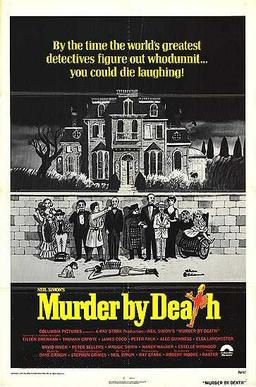
Murder by Death

What's more fun than a murder mystery in film and on TV? The people who solve the murder mysteries!!! And no, I'm not talking about police procedurals where police officers follow the clues and catch the crooks. We're talking the out of this world observant and intelligent sleuths and detectives who follow all the minute, excruciating little details and pull theories out of thin air. They certainly get their due in a great spoof from 1976, Murder by Death.

Coming from all around the world, five world-class detectives have been brought together at an isolated country mansion by eccentric recluse Lionel Twain (writer Truman Capote). His goal? Present a murder with little evidence and let his five detectives piece things together. Whoever figures things out and fingers the murderer by dawn will receive a $1 million reward. Who are his contestants of sorts? They include Milo Perrier (James Coco), the whiny Belgian, Sam Diamond (Peter Falk), the tough guy detective, Jessica Marbles (Elsa Lanchester), the very English middle-aged woman, Dick Charleston (David Niven), the gentlemanly, smooth aging detective, and Sidney Wang (Peter Sellers), the pronunciation challenged Chinese detective. Each detective has brought a partner/sidekick/spouse but can any of the manage to solve a seemingly impossible murder mystery?

From director Robert Moore and screenwriter Neil Simon, 'Murder' is a gem in the Whodunnit genre. Throw a bunch of characters together, add in a mystery/murder or something that needs to be solved, and let the fun begin. This is a spoof of the Whodunnit genre, but it's not a stupid spoof, far from it. While the humor is far from high brow laughs, it's snappy, smart and quick. This is a very talented cast assembled here, the actors and actresses playing off each with remarkable ease. It's a quick movie at just 94 minutes, but there are laughs throughout. It was filmed on a mansion set in Burbank Studios, a closed-in, claustrophobic feel to the ever twisting and turning story. Self-contained and the better for it.

You really just can't go wrong with the sick amount of talent brought together here in the cast. Each detective is based off a classic literature character (Perrior = Hercules Poirot, Diamond = Sam Spade, Marbles = Miss Marple, Charleston = Nick Charles/The Thin Man, and Wang = Charlie Chan), each given their quirky personality traits that bring it all together nicely. Coco's Perrier is dying of starvation -- or so he believes -- as the mystery develops, Diamond does his best Humphrey Bogart impression throughout, Marbles quirky, mousy and excited, Charleston the upper class, smooth-talking Englishman, and Wang the master of logic and observation (with a touch of political incorrectness thrown in for good measure). It would be easy to see any/all of these characters getting their own movie, but when assembled together, we're talking impeccable chemistry with some sublimely perfect laughs.

Improving on the talent brought together is that each character is given a sidekick of some sort, a spouse, child, whatever. More cast listing!!! The recently departed Eileen Brennan plays Tess Skeffington, Sam's secretary and mistress, Maggie Smith plays Nora Charleston, Dick's longtime and loving wife, Estelle Windood as Miss Marple's wheelchair bound and ancient nurse, James Cromwell as Marcel, Perrier's very French chauffeur and Richard Narita as Willy, Wang's adopted Japanese son.

Oh, there's more. One of the movie's most perfectly executed running bits has Alec Guinness as Bensonmum, Twain's personal assistant and butler.....who's blind. It's almost inappropriate, a little politically incorrect when you hear about it, but like so much else going on in Simon's script, it just works. He answers the door, never realizing if anyone entered but speaking as if they're standing in front of him. He serves dinner with poor results, guides the guests to their rooms, and has a great running gag with the new cook, Yetta (Nancy Walker), a Hungarian woman who's deaf, can't talk and doesn't understand English in any way, but Guinness' Bensonmum can't see that she's holding up notes explaining herself. It's stupid almost as an idea, almost infantile in its humor, but oh goodness, it works so well. Here's a montage of so many of those great lines, watch it HERE.

Director Moore's film runs just 94 minutes, flying by at a breakneck speed. The first 60 minutes are about as perfect as a comedy can be, smart and stupid but balanced out between the two. It's beyond funny on all levels. The last 30 minutes or so come up a little short, the goofiness becoming a little too much. Capote -- an obvious scene-stealer -- delivers a great monologue ripping all these great detectives apart. He criticizes their storytelling techniques, their introduction of characters out of nowhere, ridiculous twists that come out of nowhere, and basically making it impossible to solve the mystery, whatever it should be. The ending is flat out stupid, but it's supposed to be. If you can decipher it in any way, you let me know. The struggles of the last 30 minutes prevent it from being an all-time great comedy, but flaws and all, it is still a gem.

Murder by Death (1976): *** 1/2 /****

Saturday, May 26, 2012

The Blockhouse

Peter Sellers was an actor first and foremost. Many say doing comedy is much more difficult than drama, and Sellers was certainly known more as a comedic actor than anything. Could he do dramatic roles? There aren't a whole lot of options to test the theory, but we can start with 1973's The Blockhouse.

It's June 6, 1944 and somewhere along the French coast a camp of forced laborers comes under fire from a naval bombardment. In the chaos that follows, seven such laborers (including Sellers as Frenchman Roquet) escape into a heavily fortified bunker. They retreat inside and down possibly hundreds of feet, a blast sealing off their only exit. The good news? The bunker deep underground was stocked to feed an army with tons of food, wine and supplies at their disposal. The bad news? They're well-supplied, but there's no way out and no real hope of rescue. The seven prepare for what could be a long stay.

This is a difficult movie to review for a couple different reasons. For one, it's based on a supposed true story and isn't exactly intended as a film you enjoy. You appreciate it more than anything...if that makes sense. From director Clive Rees, 'Blockhouse' uses WWII as a jumping off point, but it's not essential the setting. The need, fight and struggle to survive is the key. The D-Day intro grounds the story with a nice touch, but it's not a necessary one. It is a dark movie -- visually and in storytelling -- with a dread of claustrophobia and impending death hanging in the air. Everything from the drab colors to the mumbled dialogue sets things in motion. The film opens with an intro 'This is the true story of 7 men....details....only 2 would survive.' Not talking happy-go-lucky now, are we?

And now back to the intro, Sellers as a dramatic actor. Yes, the Pink Panther star can most definitely act in a dramatic roles. I'll go into more details later because all the parts are uniformly above average, but Sellers and co-star Jeremy Kemp are the unquestioned stars here. None of the parts are loud, showy roles with a minimum on theatrics and exaggerated moments. These are men slowly wasting away in this almost apocalyptic situation. Sellers is a surprise choice -- only his 2nd purely dramatic role -- but he doesn't disappoint. His Roquet is soft-spoken but highly intelligent, becoming an unofficial leader among the group and someone the others look up to. He tries his best to maintain his own sanity while preserving that of the others at the same time. His last scene is an especially moving one.

Rounding out the other six are some recognizable faces if not quite the huge names. I especially liked Kemp as Grabinski, the other intellectual in the group who finds an equal in Roquet. The others include Kramer (Nicholas Jones) and Visconti (Charles Aznavour), both reveling in stories of past conquests, Lund (Per Oscarsson), a quiet man who's the only one trying to aid their cause by breaking out some how and some way, Aufret (Peter Vaughan), the laborer who worked with the Germans as a prisoner overseer, and Khozek (Leon Lissek), the somewhat slow but genuinely good Eastern European. Because it's a very personal, even unsettling movie, it's nearly impossible not to root for these guys at least a little bit. Still, even a little personal background would have been nice. Does it detract from the very pointed survival message? Maybe, but I think it would have ultimately helped.

This is a story though not interested in the bigger picture of WWII or even keeping us as viewers up to the minute on every little detail of the ordeal. By the second or third scene, we've lost all track of time. Have these men been there for days, weeks, months? They don't know. In all its darkness though, 'Blockhouse' has some great, memorable moments. A teacher, Sellers' Roquet covers the walls with poems and quotes from literature. Roquet and Grabinski play chess in a one-sided affair, later arguing over switching to dominoes. A bike is found in the storerooms, the trapped residents reveling in having some fun. A "Christmas party" takes a turn for the worse after the saddest version of Silent Night you've ever heard. These little moments help humanize the story in ways I wouldn't have thought of, but the movie's the better for it.

So how to review this in the end? I'm not sure. Because the ordeal isn't the most exciting thing, the story itself is a tad sluggish at times. Necessary, even realistic to the real-life story? I'd assume so, but visually it isn't the most interesting movie to watch. The characters are literature archetypes more than flesh and blood human beings. Striving for survival is mankind at his most simplest though, and while it is an incredibly difficult movie to watch at times, it is worthwhile for at least one viewing.

The Blockhouse <---Opening credits/sequence (1973): ** 1/2 /****

Friday, February 4, 2011

Casino Royale (1966)

After a four-year gap since Pierce Brosnan's final James Bond movie, MI6 agent 007 returned in a big way in 2006 with Daniel Craig taking over the part of the secret agent.  It was a huge success and served as an excellent reboot for the franchise, quickly climbing into my top 5 all-time Bond flicks.  Why did it work? Like most of the best movies from the franchise, it stuck close to the Ian Fleming source novel that had not been made previously...in a serious fashion at least.  That's where 1966's awful Casino Royale jumps in.

By 1966, star Sean Connery had already completed four 007 movies and had turned James Bond into one of the world's biggest stars.  It was so popular that spoofs started popping up like James Coburn as Derek Flint and Dean Martin as Matt Helm among others.  I get it, strike when the iron is hot, but in a saturated market of spy and espionage movies -- serious and spoof -- don't you want to at least turn out a quality product?  With six different directors shooting different portions of the movie, this was like How the West Was Won: 007 Style.  Besides an occasional laugh here and there, the only redeeming quality is an out-of-this world (if wasted) cast, but more on that later.

All over the world, American, British, Russian, and French agents are turning up dead and their agencies don't have the slightest clue or evidence as to who's pulling off the jobs.  The agency heads turn to retired MI6 agent, Sir James Bond (David Niven), to root out the problem. Bond is a legend in the espionage business, but his best days are behind him, and he questions what has happened to the field he worked so well in, carving out a name and reputation for himself.  He concocts a crazy plan to smoke out whoever is behind the murders; using his name, agents all over the world (Peter Sellers, Ursula Andress, Daliah Lavi, Joanna Pettet, Woody Allen, Terence Cooper) will see if working as bait draws the mastermind out of his lair. The plan might be too good though because SMERSH and mastermind Le Chiffre (Orson Welles) send agents to kill the original and still best James Bond around.

Now anyone familiar with Casino Royale -- Fleming's novel or the Craig movie -- knows that the plot described there is nothing like the book or the movie.  Bond's effort to detain Le Chiffre at the baccarat table is handled in a scene that takes about 10 minutes, not an entire movie.  Using other spy spoofs as an example, there is clearly potential here.  A character as ripe for the picking as James Bond is hard to mess up in the humor department, but this movie is a mess.  For all the subtle, perfectly delivered lines that pepper the script, there's huge scenes of excess of physical and slapstick humor that even Mel Brooks must have shaken his head at.  The finale is the worst of all with one of the 14 directors obviously not knowing where to cut things off.

Let's start with the crazy amount of talent involved here behind the camera, including John Huston (also playing M in one scene) and Robert Parrish among four other less notable names.  The writing too includes Sellers, Billy Wilder, and Joseph Heller.  How did this much talent put together such an awful movie? On top of the cast listed above, there's also parts for Deborah Kerr, William Holden, Jean-Paul Belmondo, Peter O'Toole (on-screen for about 6 seconds), Charles Boyer, George Raft, Jacqueline Bisset, and Barbara Bouchet. What's worse is that the cast appears to be having a blast making the picture.  It's just that much worse that what they're working with is beneath all of their talent.  Bit parts and extended cameos for almost all of these names limit actual on-screen time, but just in terms of name power, this movie is impressive.

The only star that I thought was legitimately good was David Niven as retired 007, Sir James Bond, enjoying his retirement in an isolated English country villa only to be thrust back into the world of espionage.  Because it is an older Bond, Niven has some fun with the part, poking fun at Connery's portrayal especially.  He gets some good laughs from his constant curiosity of how all secret agents have become sex fiends, leaving lonely, beautiful women in every city all over the Earth.  He shakes his head at all the changes he sees in the life of a spy only to embrace them once he's back into it.  A professional plain and simple, Niven makes the most of the material, rising above it to deliver a worthwhile performance.

So this movie was bad, downright awful at times, okay? I am scraping the bottom of the barrel here looking for something to write about.  Most of the movie was just so stupid and dumb I can't even complain.  It's so bad it is surreal at times.  So what can I recommend? If nothing else with this overabundance of characters, the script calls for a long list of beautiful actresses who are required to wear slinky outfits and do little else.  Kerr, Lavi, Pettet, Andress, and Bouchet are all half-naked for about 90% of the movie, and that's all I've got.  So stupidly bad, this movie has to be seen to be believed.

Casino Royale <---trailer (1966): */****

Tuesday, January 25, 2011

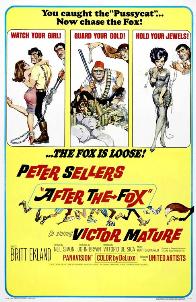
After the Fox

The years following World War II changed the way many countries made movies, and nowhere was that more evident than in war-torn Italy.  A whole genre of films devoted to dealing and discussing how a country moves on following such a world-shattering event emerged called Italian neorealism. If you want a cliff note's version of the genre, they're usually artsy movies that border on the existential with images, stories and characters that force the viewer to make up their own minds and interpret something. There's the part of me that avoids these movies because they sound pretentious and overbearing, all the while knowing there has to be something to these well-received films.

So what does that intro to a review have to do with anything? Well, I didn't actually watch an Italian neorealist film (not yet at least). Instead I watched an Italian comedy that spoofed the genre with star Peter Sellers impersonating a director that sounds suspiciously a lot like famous Italian director Federico Fellini, 1966's After the Fox. This isn't an obvious spoof like Airplane! or The Naked Gun series, but it certainly pokes fun at these art-house movies that are held in such high regard.  Not a hilarious movie, but still a funny one with Sellers dominating the movie like so few can.

Serving a sentence in an Italian mountaintop prison, infamous master thief Aldo Vanucci (Sellers) hears his younger sister, Gina (Britt Ekland), is in trouble and promptly breaks out of prison as easy as snapping his fingers.  When he quickly realizes there's nothing he can do to help his aspiring actress of a sister, Aldo decides to take part in a dangerous job of helping transport 300 gold bars from Egypt into Italy. Every police and detective agency in Europe knows the gold is coming so how can Aldo and his "gang" help get the gold into the country? He develops a plan where he'll pose as an Italian filmmaker filming a movie in a small coastal village about what else? A ship carrying bars of gold landing in Italy after a successful heist of course. The plan seems ludicrous, but could it somehow work?

Growing up watching movies, I was never a huge fan of Peter Sellers.  Aware of him, yes, but I never sought out his movies.  The original Pink Panther didn't hit me right, but I'd like to give it another try at some point.  One criticism I've had of Sellers is that he seems to play the same niche role.  Like Eddie Murphy has done over the last 15 or 20 years, Sellers would play two or three roles in a single movie, and something that I can't explain always bugged me about that.  We get it, you're talented. Now back off.  As I see more of him though, it's easy to see why he's got such a strong fan following.  Regardless of the role, the man is extremely funny.  His deliveries are impeccable, that perfect mix of subtle laughs and more obvious physical, slapstick humor.

Nowhere is that more evident than the second half of After the Fox when Sellers' Aldo unleashes his plan to get the gold into Italy.  He dupes an entire town, a police chief, and even an American actor (Victor Mature poking fun at himself) to star in this "film." The only problem is the timing doesn't work out quite to plan so Aldo -- renaming himself Federico Fabrizi -- has to actually stage scenes to buy himself some time.  So with no script and no real movie at all (with an entire village watching all the time), Aldo improvises and comes up with a neorealistic film about two lost loves (Mature and Ekland) finding each other in this other-worldly depiction of love.  This is Sellers at his best, big and loud, screaming and directing like a nut.  These are the inspired scenes that produce the biggest laughs.

With Sellers posing like a madman as he "directs" his movie all in hopes of actually pulling off this heist, it's Victor Mature as past his prime American actor Tony Powell who steals the movie.  Looking to legitimize his fake film, Sellers somehow convinces Mature's Powell to take part in this innovative new project.  Martin Balsam as Mature's questioning, worrying agent is priceless as well.  So hard up for work and desperately looking to get back into the limelight, Powell goes for it hook, line and sinker. Every request, every command Aldo makes, Powell goes for it, enthusiastically replying 'Beautiful!' before immediately complying.  Mature is playing a variation on himself by this point in his career and nails the part.  It's a bit of a dig without being mean or cruel, but because he commits so forcefully to this wacky movie you can't help but laugh.

All told, I liked this movie but didn't love it.  Director Vittorio De Sica takes his time getting the story where it needs to be so that first hour takes a little while to develop. Sellers helps things along and keeps them moving thankfully.  For the rest of the cast, Ekland doesn't look Italian even with brown hair instead of her usual blonde, but she makes the most of a smaller part.  Akim Tamiroff is the stupidly evil plotter of the gold heist always ready with a double-cross with the beautiful Maria Grazia Buccella as his eye candy. Paolo Stoppa, Tino Buazzelli, and Mac Ronay are very funny as Aldo's inept gang too. A funny movie in the vein of a light-hearted spoof, worthwhile for Sellers and Mature.

After the Fox <---trailer (1966): ***/****   

Sunday, January 23, 2011

The Millionairess

Each and every movie genre has its fair share of predictability, but depending on the viewer it might not be as big a deal.  For me, westerns can be easy to predict where they're going, but part of the fun is how it gets to the end result.  Yeah, the good guy usually wins, but how does he get to that point? What challenges does he face?  The journey getting there can overcome any predictability in the overall story.  How about romantic comedies though? The guy always gets the girl, but it's hard to get wrapped up in a story like that -- for me at least.

Something else has to work for a romantic comedy to be anything but average.  That's why typically I avoid rom-coms unless something secondary jumps out at me.  Interesting leads in the cast always help, and that's why I watched 1960's The Millionairess with Sophia Loren and Peter Sellers in the leads. Loren for all her beauty was an underrated comedic actress, and Sellers is one of the most accomplished comedic actors in movie history.  But the pairing just felt odd to me taking all considerations of talent aside.  Well, my worries were legitimate because even as talented as both actors are, they lack any real chemistry.  It's not entirely their fault because the script is rather lacking, but no chemistry is a deal-killer here in this romantic comedy.

After her extraordinarily rich father dies, Epifania Parerga (Loren) inherits so much money that she becomes the richest woman in the world.  But for all the money, the clothes, the glitz and glamor, Epifania just isn't happy with her life, especially when her choice for a husband ends up cheating on her.  She sets out to find a new husband -- because as comedies tell us, an unmarried woman is a failure at life -- who lives up to her recently passed father's expectations.  She can't find anyone until she meets an Indian doctor, Ahmed el Kabir (Sellers), who she quickly falls for.  The only problem?  Dr. Kabir has no interest in her whatsoever, and no matter what advances she makes, he wants nothing to do with her.

Depending on the quality of the movie and the timeliness, a movie can age well or not at all, and this one feels like a very 1960s comedy.  It's still funny that so many of these comedies were right at home with the premise that a woman might as well roll over and die if she wasn't married by a certain age.  That's Loren's character who has all the money in the world, runs a variety of successful businesses, and basically has the world at her disposal, but because she can't, and I quote "Make a man happy" she thinks her life is being wasted.  Any story that needs that kind of gimmick already has a strike against it before anything else happens.

It never helps then that an actress as beautiful as Loren plays a character so shrill, so downright annoying that you don't care how she ends up.  Her ploy to seducing Sellers is to continuously attempt to kill herself only to have the good doctor rescue her at the last second.  If that's not love, I don't know what is.  Her tactics border on stalkerish, and it's understandable why Seller's Dr. Kabir has no interest in this intensely shallow woman.  What's worse is that because the movie requires it, he eventually gets worn down and falls in love with her too.  Now it is Loren at her most drop-dead gorgeous so instead of a well-written character, we get to see her in various stages of undress that include lingerie, a *gasp* naked back, and all sorts of tight-fitting, very stylish outfits.  So the character's annoying, but she's nice to look at.

A concern I had reading the description was that Sellers -- a very British actor -- was going to play an Indian doctor.  It takes a very talented actor to play a different race, and that's just for starters.  There's nothing like a bad makeup job to make a pasty Sellers look like a middle-aged Indian man.  Well, my concerns were unfounded although at times it did sound like Sellers was doing Apu from The Simpsons.  He underplays his role so well that his Dr. Kabir is one of the more redeeming things about the movie.  His character is likable, and that's key when you hate his counterpart.  I've always liked Sellers as an actor, but he's much better when he isn't hamming it up like the Pink Panther movies. His humor is more subtle here, and the movie is better for it.

Still, as good as Sellers is, that doesn't overcome a lack of chemistry with Loren.  I assumed with two actors as immensely talented as them that an on-screen chemistry would just happen naturally, but it never develops.  I don't think it's their fault so chalk it up to the awful script or the directing or both. The script just doesn't give a lot of chances for anyone to be funny or a chance for the characters to interact in a humorous way. Alastair Sim has a funny part as Loren's lawyer Julius, and Vittorio De Sica is good as a sweatshop owner who meets Loren, but that's about it for the cast. A romantic comedy doesn't have to be hilarious to be good, but it can't be downright dull.  All other things aside, this movie was dull no matter the talent involved.

The Millionairess <---TCM clips (1960): **/****

Friday, September 11, 2009

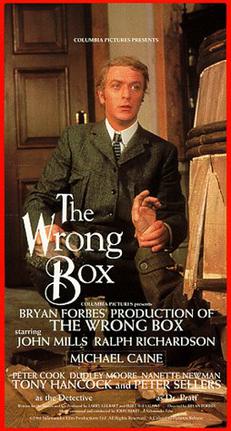
The Wrong Box

Like any sense of humor, British humor can be an odd thing. There's the very dry laughs where the proper Englishman chuckles softly to himself, but then's there is also the Monty Python, Benny Hill slapstick that's played for the out loud laugh. A movie virtually unknown to American audiences, 1966's The Wrong Box, provides a perfect pairing of both senses of humor with a great cast and a tale of confusion and trickery.

The story begins simply enough with the signing of a 'tontine' where 20 young men are entered into a lottery. Their fathers pay $1,000 pounds for their sons which will be put into a bank account and allowed to grow. The last surviving son will be rewarded with all of the money. So it begins and the years pass, 63 to be exact, with the boys growing up and some meeting their maker in an inspired scene that had me rolling. Then, it comes down to 2 brothers, the Finburys, Masterman (John Mills) and Joseph (Ralph Richardson), who live next to each other but haven't spoken in 40 years.

Joseph is away on vacation with his two nephews, Morris (Peter Cook) and John (Dudley Moore), so when Masterman finds out they're the only two remaining men, he sends for him with a very made-up deathbed message. Masterman intends to kill his brother and give all the money to his grandson, Michael (Michael Caine), to help pay off the family debt and also put him through medical school. Morris and John catch wind of the news and are thrust into an awkward situation when the train they're riding on crashes, and they believe Joseph was killed. The money is so close, and they believe all they need is Joseph to outlast Uncle Masterman for a few days. Not so fast though, Joseph is very much alive.

So starts a story that bounces around and all over the place with far too many cases of misunderstanding and scheming to even mention here. If it all sounds ridiculous, it is but don't be scared away. The humor comes out of these ridiculous situations and the crazy reactions these individuals have to 'solve' their problems. Having the two brothers live next to each other provides for an easy use of general confusion as boxes intended for the other house goes to the wrong one. Some unnecessary but still funny title cards help move things along.

What makes this work from start to finish is the casting. Mills and Richardson as the two longlost brothers are dead-on. Mills is made up to look like he is on death's doorstep but he's really anything but as the scheming, murdering brother, and Richardson nails the part of the clueless brother who collects facts and bores people to death with everything he's learned. Caine is even funny in an early part as the straight man, including a possibly forbidden love with his cousin Julia (Nanette Newman) who lives with Uncle Joseph. The best part of Caine's role is his scenes with Peacock the butler (Wilfrid Lawson), the weary, tired, slow-moving house attendant who hasn't been paid in 7 long years.

In the more slapstick scenes, Cook and Moore as the bumbling but still devious brothers provide their fair share of laughs, especially Moore who can't curb his interest in working class women. And in a small but still funny cameo, Peter Sellers plays Dr. Pratt, a clueless drunk of a doctor who provides Morris with a death certificate for his dead grandfather which you can check out here and here. I've never been a huge fan of Sellers, I just don't get some of his humor, but he's too much here, making the most of his two-scene appearance.

The movie isn't available in DVD format, and VHS tapes can be a little expensive to track down but good news from Youtube! A user has kindly made The Wrong Box available broken up into 10-minute segments. The link earlier is Part 1, and you can go from there if you wish to watch the rest of the movie. It's not well known at all here in the States, but I'm glad I stumbled across it. Dry and slapstick humor, it's laugh out loud however you look at it.

The Wrong Box (1966): ***/****