The Sons of Katie Elder

The Sons of Katie Elder
"First, we reunite, then find Ma and Pa's killer...then read some reviews."
Showing posts with label Robert Parrish. Show all posts

Friday, December 18, 2015

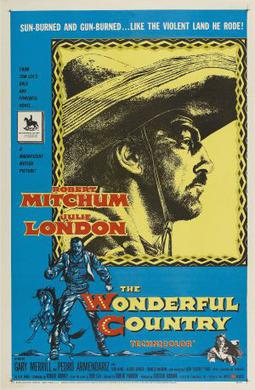
The Wonderful Country

Compared to the 1960's, the 1950's just doesn't stand up for me when it comes to the western genre. Movies were too much soap opera, not enough wild west. Sure, there were plenty of good to great to classic entries, but the following decade was a stretch of a genre at its best. Closing out the decade strong though was a 1957 western that's been generally forgotten over the years, The Wonderful Country.

Working for the powerful Castro family in Mexico, gunfighter and hired gun Martin Brady (Robert Mitchum) is crossing the Rio Grande and entering the United States. An incident from his past drastically changed his life, forcing him to retreat into Mexico where he developed a name for himself as quite the dangerous pistolero. Now, he's on a mission from the Castros to pick up an illegal shipment of repeating rifles and ammunition. It isn't soon after crossing the border that his horse throws him, breaking Martin's leg. He can't ride so he's forced to wait and heal in the border town, shipping the guns and ammunition back to Mexico without him. So with nothing to do but wait, Martin sits back and heals but doesn't quite know what awaits him. People from his past, new acquaintances, and those who want to see him dead, they all await in the coming weeks, especially when news reaches town that the gun shipment has been stolen. But by who?

What an interesting, genuinely odd, even offbeat movie. I watched this western from director Robert Parrish years ago and revisited it recently when it popped up on MGM-HD. I liked it a lot then, and a second viewing produced the same result...albeit with the same response. This is an odd movie, no doubt about it. There are touches of an almost art-house film sprinkled throughout. The story is disjointed to say the least, covering months (and maybe more) from beginning to end but with no real sense of the passage of time. But coursing through it all, an odd energy hangs in the air that I found appealing. A bit of a mess but a good mess to watch.

Robert Mitchum was the best. He had no rivals, a rogue in Hollywood before it was cool to be a rogue. He was one of the first anti-heroes too, the tortured hero who transitioned into bigger and better. One of his specialties? As I've mentioned before, Mitchum was drawn to Mexico including this film but also The Wrath of God, Villa Rides, 5 Card Stud, Bandido and probably several more I'm forgetting. Who better then to play an expatriate American who embraced the Mexican lifestyle almost entirely? I can't think of anyone.

Mitchum's Martin Brady is the one constant through all the craziness and winding story. Yeah, his accent is a little rough at times, but when he speaks Spanish, this isn't an actor remembering his lines. He speaks it fluently. But the character as a whole is interesting because it feels so ahead of its time. This is the somber, even doomed gunfighter running from his past but not really knowing what the future holds for him. All he's known is his pistol, but his ability with the gun has him tied down so he can't escape. From the look of the character -- the immense sombrero, the stubble, the vaquero attire -- to the potentially doomed development, it's a more than worthwhile lead performance.

The rest of the cast is more of an ensemble with a few bright spots. Julie London plays Helen Colton, the wife of the local army outpost commander, Major Stark Colton (Gary Merrill), a generally ineffective officer. Helen has a past and is drawn to Mitchum's Brady but she may have other ideas. But then things get weird in almost variety show ensemble territory, including Albert Dekker (a Texas Ranger captain), Jack Oakie (a well-meaning railroad man), scene-stealing Charles McGraw (an amiable doctor), former Negro League/MLB pitcher Satchel Paige (a cavalryman, a Buffalo Soldier), Anthony Caruso (a Mexican farmer), Mike Kellin (a Mexican pistolero), Victor Manuel Mendoza (the army officer) and his brother, the Governor (Pedro Armendariz), John Banner (the German store owner), Jay Novello (a Mexican soldier and Brady's friend) and Max Slaten (his naive visiting nephew). Enough for you? McGraw is especially good, as is Armendariz in a smaller part.

Definitely worth mentioning is the visual appeal of the movie. 'Country' filmed on-location in Mexico, making the movie look almost like a country's tour guide. Some locations are familiar from other like-minded westerns, but for the most part, you're seeing a country as it is, not done up for the sake of a movie. With a Mexican-themed score combined with that beautiful countryside serving as a backdrop, we've got a winner in the technical department. Sure, the story drifts along too much, bouncing from one character and situation to the next almost without warning, but this is a movie that's very enjoyable if you drift along with it. Not a classic, but a pretty darn good western.

The Wonderful Country (1959): ***/****

Friday, February 4, 2011

Casino Royale (1966)

After a four-year gap since Pierce Brosnan's final James Bond movie, MI6 agent 007 returned in a big way in 2006 with Daniel Craig taking over the part of the secret agent.  It was a huge success and served as an excellent reboot for the franchise, quickly climbing into my top 5 all-time Bond flicks.  Why did it work? Like most of the best movies from the franchise, it stuck close to the Ian Fleming source novel that had not been made previously...in a serious fashion at least.  That's where 1966's awful Casino Royale jumps in.

By 1966, star Sean Connery had already completed four 007 movies and had turned James Bond into one of the world's biggest stars.  It was so popular that spoofs started popping up like James Coburn as Derek Flint and Dean Martin as Matt Helm among others.  I get it, strike when the iron is hot, but in a saturated market of spy and espionage movies -- serious and spoof -- don't you want to at least turn out a quality product?  With six different directors shooting different portions of the movie, this was like How the West Was Won: 007 Style.  Besides an occasional laugh here and there, the only redeeming quality is an out-of-this world (if wasted) cast, but more on that later.

All over the world, American, British, Russian, and French agents are turning up dead and their agencies don't have the slightest clue or evidence as to who's pulling off the jobs.  The agency heads turn to retired MI6 agent, Sir James Bond (David Niven), to root out the problem. Bond is a legend in the espionage business, but his best days are behind him, and he questions what has happened to the field he worked so well in, carving out a name and reputation for himself.  He concocts a crazy plan to smoke out whoever is behind the murders; using his name, agents all over the world (Peter Sellers, Ursula Andress, Daliah Lavi, Joanna Pettet, Woody Allen, Terence Cooper) will see if working as bait draws the mastermind out of his lair. The plan might be too good though because SMERSH and mastermind Le Chiffre (Orson Welles) send agents to kill the original and still best James Bond around.

Now anyone familiar with Casino Royale -- Fleming's novel or the Craig movie -- knows that the plot described there is nothing like the book or the movie.  Bond's effort to detain Le Chiffre at the baccarat table is handled in a scene that takes about 10 minutes, not an entire movie.  Using other spy spoofs as an example, there is clearly potential here.  A character as ripe for the picking as James Bond is hard to mess up in the humor department, but this movie is a mess.  For all the subtle, perfectly delivered lines that pepper the script, there's huge scenes of excess of physical and slapstick humor that even Mel Brooks must have shaken his head at.  The finale is the worst of all with one of the 14 directors obviously not knowing where to cut things off.

Let's start with the crazy amount of talent involved here behind the camera, including John Huston (also playing M in one scene) and Robert Parrish among four other less notable names.  The writing too includes Sellers, Billy Wilder, and Joseph Heller.  How did this much talent put together such an awful movie? On top of the cast listed above, there's also parts for Deborah Kerr, William Holden, Jean-Paul Belmondo, Peter O'Toole (on-screen for about 6 seconds), Charles Boyer, George Raft, Jacqueline Bisset, and Barbara Bouchet. What's worse is that the cast appears to be having a blast making the picture.  It's just that much worse that what they're working with is beneath all of their talent.  Bit parts and extended cameos for almost all of these names limit actual on-screen time, but just in terms of name power, this movie is impressive.

The only star that I thought was legitimately good was David Niven as retired 007, Sir James Bond, enjoying his retirement in an isolated English country villa only to be thrust back into the world of espionage.  Because it is an older Bond, Niven has some fun with the part, poking fun at Connery's portrayal especially.  He gets some good laughs from his constant curiosity of how all secret agents have become sex fiends, leaving lonely, beautiful women in every city all over the Earth.  He shakes his head at all the changes he sees in the life of a spy only to embrace them once he's back into it.  A professional plain and simple, Niven makes the most of the material, rising above it to deliver a worthwhile performance.

So this movie was bad, downright awful at times, okay? I am scraping the bottom of the barrel here looking for something to write about.  Most of the movie was just so stupid and dumb I can't even complain.  It's so bad it is surreal at times.  So what can I recommend? If nothing else with this overabundance of characters, the script calls for a long list of beautiful actresses who are required to wear slinky outfits and do little else.  Kerr, Lavi, Pettet, Andress, and Bouchet are all half-naked for about 90% of the movie, and that's all I've got.  So stupidly bad, this movie has to be seen to be believed.

Casino Royale <---trailer (1966): */****

Sunday, August 8, 2010

The Purple Plains

As movies go, if you're a pilot and you fly enough, eventually you're going to crash in the wilderness somewhere and A. march back to safety B. fight a giant bear or C. survive Lord of the Flies style when your fellow survivors turn on you.  Most of these downed pilot movies I've seen qualify in the A department, a majority of them set in the military in one way or another, like Behind Enemy Lines with Owen Wilson and Gene Hackman.  But before that action extravaganza, that plot device has been used many times, like 1954's The Purple Plain.

In 1945 Burma in the closing months of WWII, Canadian fighter pilot Bill Forrester (Gregory Peck) is battling with some inner demons on a daily basis.  Early in the war his newlywed bride was killed in a bombing raid in London and ever since he's been looking and trying to die in combat with no luck, instead earning medals and citations. Forrester meets a young Burmese woman, Anna (Win Min Than in her only movie) working with the missionaries and falls in love with her, giving him a reason to live. But just when things are looking up him, a routine flight goes awry, and Bill is forced to crash land in the Burmese jungle with a passenger and a navigator.  They land safely, but they're 30 miles into Japanese territory with little supplies.  Do they attempt to march out or wait and hope help is coming?

'Plain' is divided fairly evenly between the two different stories, one is Forrester and his background and his personal struggles as he meets and gets to know Anna, and two his efforts to survive with an obnoxious whiny doctor (Maurice Denham) and an inexperienced navigator (Lyndon Brook) in the jungle. Director Robert Parrish doesn't go overboard with a sappy love story -- thankfully -- and also doesn't overhype the second half survival story. He finds a good mix in between because that first half is necessary if the second half is supposed to do anything to the viewer emotionally.  We've seen where Forrester is coming from, and now we get a chance to see what he's like when his mind is all there.

I've always been a Gregory Peck fan, but the more I see of him the bigger a fan I become.  I've yet to see a performance of his that isn't a solid one.  Some obviously work better than others, but he's almost always trying something new.  His Bill Forrester is a tortured individual, a man who wants nothing more than to die so he can be reunited with his dead wife.  While still fighting the war, he is clearly going through some post-traumatic stress disorder as he deals with his past.  The performance is a strong one for Peck, especially the second half as the character arc comes full circle.  Forced to improvise and become a leader or lay back and die, Peck's Forrester steps up to the plate and does what he has to to survive.

The survival aspect of the story is clearly the one that appealed to me more.  The on-location shooting was done in Sri Lanka where The Bridge on the River Kwai would be filmed three years later.  It's a funny thing, but the jungles look like real jungles.  Who would have thought that?  By the time Forrester and Co. crash, there's a real feeling of claustrophobia as if the jungle is closing in on you.  In a wise choice, Parrish never has the trio run into a Japanese patrol, much less see any trace of a single Japanese soldier.  The threat is enough, their ever lurking presence.  Besides, the real threat is among the group as Forrester and Blore try to decide what to do, make their own luck or wait for a rescue?

This isn't going to be a particularly long review.  I liked the movie, and that's about it.  It's not a great movie, but it is a different story and I'm always up for that.  Also in the cast look for a pre-James Bond Bernard Lee as Dr. Harris, a physician interested in helping Forrester out, and Brenda De Banzie as Mrs. McNabb, a missionary working in Burma who is like a mother to young Anna. The movie is available to watch via Youtube starting with Part 1.

The Purple Plain <---TCM clips (1954): ***/****    

Friday, April 16, 2010

A Town Called Hell

When watching a spaghetti western, there's a certain amount of weirdness to be expected.  After all, these were typically European directors/producers/screenwriters interpreting the American west so weirdness just comes with the territory.  But beyond anti-heroes and crazy villains, the spaghettis were often heavy on graphic violence, religious imagery and symbolism, and no penchant for having to have a happy ending.  Basically, everything I like in a western.

For years, the craziest spaghetti I saw was 1967's Django Kill! which features some truly disgusting violence, a gang of gay cowboys, and...wait, that's enough, violence and gay cowboys is a good explanation.  Last night on Netflix Instant viewing, I checked out 1971's A Town Called Hell for a couple reasons, I've never been able to actually track a copy down, and two, the cast looks ridiculously good.  It's not a straight Italian spaghetti western with British and Spanish backing, but it's got all the right elements.  If anything, it's got too many elements.  This one is all over the place and ranks right up there with Django Kill! for new weirdest spaghetti.

It's 1905 in Mexico (right in the middle of the Mexican revolution for you history buffs).  A widower, Alvira (Stella Stevens) rides into the dusty, rundown town of Bastardo -- not 'Hell' as the title implies.  She is offering $20,000 for the man who murdered her husband, but she doesn't know who he is, only that he's in the town.  Alvira's only clue is a name...'Aguila.'  But other than that, she's got nothing to go on.  Three key people in Bastardo seem to have information.  There's the Priest (Robert Shaw), the Colonel (Martin Landau) with his army detachment, and Don Carlos (Telly Savalas), the town's corrupt mayor/bandit. But nothing comes easy, and the betrayals start flying and the bodies start to add up.

Where to start?  Spaghetti westerns generally had an extremely dark tone full of cynicism and violence, lots of anti-establishment feelings.  'Hell' certainly qualifies because no character is safe.  The violence isn't graphic but it is brutal in its honesty.  There are hangings, stabbings, shootings, and so much more.  The setting for this is a really desert town that has fortress walls on all sides, and even though the movie was made/filmed in Spain, it looks like Mexico in all its dusty, dirty glory.  I'm positive I'm reading too much into this, but the town could be some sort of purgatory, some bizarre version of hell.  Or it could just be a whacked out western, you make the decision. 

The story itself is too interesting with director Robert Parrish mixing and matching left and right.  An IMDB user stated there's at least 15 plots, they just last 2 or 3 minutes before moving on, and really, that's a pretty accurate description of this gothic, dark western.  Stevens sleeps in a coffin at night and has a pale deaf-mute protector, Spectre (Dudley Sutton), with her at all times.  Savalas is a violent dictator with an iron fist on this town...until he doesn't anymore when his men turn on him, crucifying him.  Shaw has a vivid dream where Stevens' Alvira kills him in his sleep.  Landau as a Mexican officer?  That does seem pretty logical.  A flashback with a sped-up version of the Battle of New Orleans and a bizarre, confusing backstory just caps it all off.  That's the movie in a nutshell, always moving and never slowing up enough to know how ridiculous it all sounds.

Through all of the craziness, there's a really cool if sometimes odd cast.  Robert Shaw is one of my favorite actors, and he's the star here.  Simply named 'the Priest,' he has a past that still gnaws at him, and he seems to be the only person who knows who 'Aguila' is.  On a non-consequential level, Shaw is also sporting a badass handlebar mustache and mutton chop-like sideburns.  Savalas is the shirtless bandit mayor (honestly, in his 30 minutes he never has a shirt on) who gets to ham it up.  His departure about 30 minutes does come as a surprise, mostly because we never see how he gets whacked.  Landau is the only one who doesn't work because well, he's not Mexican.  He's loud and obnoxious but still isn't a good villain.  Stevens is wasted -- but looks good doing it -- and appears like she wandered into the set and just started reciting lines.

There's also supporting parts for Fernando Rey as an old blind man who may hold the key to Aguila's identity, spaghetti western regular Aldo Sambrell as Calebra, one of Don Carlos' thugs, TV star Michael Craig in flashback as Paco, one of the Priest's partners, and Al Lettieri as La Bomba, Carlos' not so smart treacherous right hand man.  What I liked about this western -- and I did like it -- was the general weirdness of it all.  There's this great cast and no story (not a coherent one at least), but all the little things add up.  Recommending this almost in spite of itself.

A Town Called Hell <----trailer (1971): ** 1/2 /****

Saturday, September 19, 2009

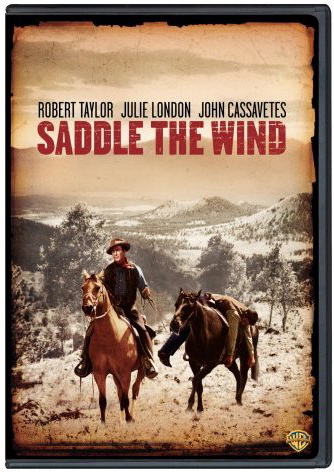
Saddle the Wind

With my review a couple weeks back of Duel in the Sun, I pointed out how much certain westerns seem related to many Greek tragedies. When you think about it, it's pretty easy to turn one into the other. As families spread across the U.S. in the 1800s, just about everybody had problems/conflicts that could only be resolved amongst the members of the family. Before westerns got too cynical in the 1960s, many American westerns used the Greek tragedy formula, including 1958's Saddle the Wind.

The key to pulling off that transformation from Greek tragedy to the wild west is in the relationships. 'Saddle' has this in a quasi-love triangle between two brothers who own a ranch in a mountain valley and the saloon girl one of the brothers brings home to be his wife. It's the type of story that if you can't predict how it ends, you definitely have not seen enough movies or read enough books. Director Robert Parrish and writer Rod Serling of The Twilight Zone do just enough with the story though to make it different, including a twist on the ending you can see coming a mile off.

In a lush, green mountain valley, two ranch owners live peacefully, Dennis Deneen (Donald Crisp), a grizzled old rancher who has come to despise violence and everything it brings, and Steve Sinclair (Robert Taylor), a reformed gunfighter trying to move on from his checkered, bloody past. Coming back from selling part of their herd, Steve's younger brother Tony (John Cassavetes) returns home with a fiance in tow, a saloon girl, Joan Blake (Julie London) who supposedly sees a better life than she's used to. Tony has also purchased a new pistol with a hair-trigger to boot.

Everything seems fine at the Sinclair's Double S ranch but in the span of a few days, two people arrive in town, both causing trouble in their own way. There's Larry Venables (Charles McGraw), a gunslinger as fast as Steve's ever seen gunning for the older Sinclair, and Clay Ellison (Royal Dano), a former Union soldier who says part of the valley rightfully belongs to him. Steve is forced to deal not only with these two problems, but also from Deneen and then his hot-tempered younger brother.

The family conflict comes across as authentic with a nice dynamic between Taylor and Cassavetes. Steve grew up caring for his younger brother, who in the process started to idolize his gunfighting older brother and now that he's full grown, he intends to be just as fast with a six-gun as Steve. Tony's intentions are good, he just wants to protect his brother (who doesn't wear a gun now), but caught up in the moment, a new side of him is revealed. Thrown into the mix is London's saloon girl who quickly sees maybe she didn't make a wise decision siding with fiery Tony.

Except for his lead role in Bataan, I've never been a huge fan of Taylor. He comes across as too wooden sometimes, but his role as Steve is the best I've seen yet. The reformed gunslinger is nothing new in a western, but Taylor brings humanity to the part as a man who genuinely regrets his past actions. As for Tony, who better to play hot-tempered, quick on the trigger brother than Cassavetes? Bordering on the obsessed with his drive, Cassavetes is the anger to Taylor's calm. London plays a strong woman, too often left behind in westerns, and even gets to serenade Cassavetes in an awkward, out of place scene.

There aren't any true villains here, but McGraw and Dano at least provide the lighter fluid for this fire. Gravelly voiced McGraw is intimidating and gruff as the new gunslinger in town and Dano as the beaten-down farmer looking to make something for his family provide strong support. Crisp makes the most of his part as the stodgy old ranch owner while recognizable character actors Richard Erdman, Ray Teal, and Douglas Spencer round out the supporting cast.

As is the case with the more story-oriented westerns, the action/gunplay is left by the wayside for most of the movie. Two gunfights are high on tension, but they're over in the blink of an eye, and the final shootout isn't much of a shootout at all. This isn't a complaint, I just felt the need to point it out so anyone watching the movie isn't expecting 100 minutes of western shootouts. It's a well-told story though with believable characters and good performances from Taylor, Cassavetes, and London. I couldn't find a trailer, but here's two scenes from later in the movie with semi-SPOILERS, one and two.

Saddle the Wind (1958): ***/****