The Sons of Katie Elder

The Sons of Katie Elder
"First, we reunite, then find Ma and Pa's killer...then read some reviews."
Showing posts with label Vincent Price. Show all posts

Wednesday, July 29, 2015

More Dead Than Alive

The name Aubrey Schenck might not immediately ring a bell. A longtime producer in Hollywood, Schenck was at the helm of some very good B-movies and some very bad B-movies. The common denominator? Good or bad, they were usually pretty entertaining. Here's one of his western ventures, 1969's More Dead Than Alive, a familiar story with a twist and a good cast.

Having served 18 years in a territorial prison in Arizona, a man named Cain (Clint Walker) has put his past behind him and has earned parole. Not bad considering his past life as a gunfighter piled up 12 kills to his name. Earning that early release though, Cain wants nothing more than to put that violent, blood-riddled life behind him. Can he though? He can't find a steady job, has no money to his name, and as he quickly finds out, his name still means something to a whole lot of people. Some are just curious to meet him while others are more interested in testing his long since lost prowess with a pistol. Taking somewhat desperate measures, Cain takes a job with a wild west shooting show run by an opportunistic businessman and carnival barker, Dan Ruffalo (Vincent Price). His reputation precedes him, even if his shooting ability isn't what it used to be. There may be a bigger issue with the show's previous main attraction, a young gunfighter named Billy (Paul Hampton) who doesn't like his attention stolen away from him.

From producer Schenck and director Robert Sparr, 'Dead' is definitely a somewhat budget-constricted B-movie, clearly filmed on some back lots in California. The cast is small(ish) with a few big names and some unfamiliar faces filling out the rest of the roles. Nothing that qualifies as a deal-breaker yet, right? Correct! I like cheap, easily digestible westerns like that...most of the time. So while this one has potential, it derails slowly but surely, really coming off the tracks in the last act. In the end, I felt like I was getting one movie and instead got one that couldn't quite make up its mind about what it was trying to accomplish.

This is a western that has some fun with the myth of the gunfighter. From 1950's The Gunfighter to 1976's The Shootist, a whole sub-genre of westerns is devoted to demythologizing of the wild west gunfighter. Often romanticized, the profession of sorts was far from it. You were the fastest gun around...until you weren't. There was a price for fame, for gaining that reputation, and often it was a bullet in your back. That's Clint Walker's Cain (no first name), a reformed hired gun and killer with 12 dead bodies to his name. Those years in jail did him good, cleaned him up and got his mind right to the point all he wants to do is settle down and start up a ranch of his own, if he can get some money to do so. Familiar territory? Yep, seen over and over again in westerns as a safe, fallback option for a story. So....

Yeah, not new ground, but when 'Dead' works, it is because of star Clint Walker. A western standby after his TV run as Cheyenne ended in 1962, Walker is always a welcome sight when I see him in a cast listing. His heroes -- even relative anti-heroes like here -- are stout and resolute, ready to stand by their guns no matter what gets thrown at them. In just about every role I've seen him, Walker is natural, likable and obviously quite the imposing physical presence at 6-foot-6 with a stature that looks like he could take on a grizzly bear...and win. He injects some energy into Cain, a gunfighter who wants to move on. You're rooting for him, a man who's made his mistakes and wants to leave them in the past.

So Walker is good, and Vincent Price steals the show as only Vincent Price can, but...that's about it with worthwhile characters. Hampton overacts so laughably bad that his Billy character develops like a spoof. Billy Valence is extremely talented with a gun but has never faced anyone down, just inanimate targets. When he begins to crumble, the emotional scenes are cringe-worthy. Anne Francis is okay as Monica Ralston, but her character seems out of place. She's a free-spirit, a painter and artist who travels and paints...in the wild west. Seems more appropriate for a hippie movie of the late 1960s, not a hard-hitting western, and their slowly developing love interest never worked with a general lack of chemistry. Mike Henry has a small but fun part as a notorious bandit with a grudge against Cain, and also look for Craig Littler, Clarke Gordon, Beverly Powers and William Woodson in other small supporting parts.

Taking it all in though, there's something missing. The bloody, harsh opening jailbreak scene is a gem, getting my hopes up in a big way. The music is pretty horrendous, horrifyingly out of place in dramatic scenes to the point it plays like a spoof. Oh, and of course there's a moody, overdone ballad of a theme song. Mostly though, it can't pick a path and stick with it. The story and characters bounce all over, seemingly getting somewhere but never in a direct fashion. Hampton is really, really rough with a character with potential but is completely hammed up and trying too hard. As good as Walker and Price are, 'Dead' is undone by those flaws. The ending should come as more of a surprise, but it doesn't and because the tone has been all over from left field to the end zone (yes, I understand), the end falls flat. Just too bad.

More Dead Than Alive (1969): **/****

Thursday, April 23, 2015

His Kind of Woman

Occasionally I have some genuine freak-out moments. Case in point? I’ve been writing movie reviews here with Just Hit Play since January 2009. I must be getting old! I’ve mentioned before though the timing of starting some of these reviews. I watched some good, even great, movies in the months right before I started this site but never reviewed them, not feeling confident enough to review months later from memory. That’s today’s review, a film noir from 1951, His Kind of Woman, that’s one of my favorites.

A down on his luck gambler living in Los Angeles, Dan Milner (Robert Mitchum) is drifting along with the clothes on his back and very little money in his pocket. Then, his luck turns on a dime, but it seems so easy. A mysterious man with underworld connections offers him a huge payday if he’ll simply leave the country and visit Mexico. There’s a catch though. He can’t know why, only get to a remote hotel on the Baja California peninsula and wait. From there, he won’t be able to return to the United States for at least a year. Suspicious but in need of the money, Milner takes the deal and heads to Mexico. There at the hotel, he meets a beautiful singer, Lenore (Jane Russell), in pursuit of a popular Hollywood actor, Mark Cardigan (Vincent Price), and an odd assortment of guests and locals. Milner sits back and waits for what’s heading his way. What has he gotten himself into exactly?

I saw this 1951 film noir in November 2008, two months before I started writing these reviews. Talk about bad timing, huh? I loved it, something pulling me in and keeping me interested throughout its two-hour running time. It comes from bazillionaire Howard Hughes and had a whole bunch of production problems that become evident in the final act. Now that said, there’s something charming and fun about it from beginning to end. It hasn’t been distributed much, if at all, since its release and ‘Kind’ doesn’t have a huge following. The moral of the story is simple. It should. I highly recommend it.

To say this is a film noir is limiting. It is to be sure, but it tries to do a lot more and generally, succeeds on most of those fronts. Director John Farrow (and an uncredited Richard Fleischer when Hughes didn’t like Farrow’s work) is at the helm of an equal parts film noir, love story, comedy with some action and shootouts thrown in. It isn’t always perfect, but the script makes a mostly successful go at it. Six different people are listed at the IMDB page for this movie as having written part of ‘Kind’ (again reflecting the behind the scenes drama). It’s smart. The dialogue crackles. The story is sorta kinda there, relying on the actors to bring the at-times slow story to life. I think the biggest compliment I can say is that it almost plays like a spoof of the film noir genre itself…but never truly becomes a spoof. Now that takes some doing. Not too light, not too heavy-handed, but more importantly and more successfully, somewhere in between.

Just a few weeks ago, I reviewed 1952’s Macao, another pairing of stars Robert Mitchum and Jane Russell. I watched ‘Kind’ back in 2008 in my Jane Russell phase. I’d never seen her films but fell hard for her right away, and this was only my second Russell film I believe. Again, talk about an on-screen match made in heaven. It’s easy to say Mitchum does the same thing movie in and movie out – that laconic, loner anti-hero – but he brings a different edge and energy with each passing film. I loved his Milner character, a man who knows he’s in trouble but keeps going along to figure out what’s up. The same for Russell’s Lenore, a young woman looking for love but with a fair share of failed attempts behind her. The duo just WORKS so well together. Their scenes are pretty pitch perfect throughout. They’re believable, you like them, and they seem to like each other. How can you go wrong?

What surprised me about the movie’s general unknown quality is the cast. With the cast assembled, how does it not have more of a reputation even by accident? Mitchum and Russell are excellent, but it’s Vincent Price who steals the show. His Mark Cardigan is an Errol Flynn-like movie star, a swashbuckler who’s looking for his movie star life to become his real life. A little too much at times, but very funny. Still not enough? There’s also Tim Holt as an investigating cop, Charles McGraw as a thug and enforcer, Raymond Burr as a mobster trying to get back into the U.S., Jim Backus as a talkative investment banker, Philip Van Zandt as the hotel owner, and an uncredited Anthony Caruso a brooding sidekick to Burr. Not bad at all.

An additional character worth mentioning is the hotel set on the Baja California peninsula. It’s so 1940s/1950s stylish with its bungalows and pool and just some really cool architecture. The sets date the movie a bit, but it truly becomes an additional character. The ending? Yeah, things fall apart a bit as the last 40 minutes get a little too kooky. Even when it goes off the tracks though, ‘Kind’ is still a really fun movie. Definitely worth seeking out, the 1951 film noir popping up occasionally on Turner Classic Movie’s schedule.

His Kind of Woman (1951): *** 1/2 /****

Friday, December 12, 2014

The Fall of the House of Usher

How about some unlikely pairings for today's review? Director/producer extraordinaire Roger Corman is the master of the B-movie across countless genres. What author/writer do you think he used as sources for eight of his movies? It's a name I would have never thought of if you gave me a week to think about it. That writer? A mildly well-known 19th century writer by the name of Edgar Allan Poe. His short story was the inspiration for 1960's The Fall of the House of Usher.

Riding out to a worn-down mansion on desolate land in New England, Philip Winthrop (Mark Damon) is trying to find his fiance. When he arrives at the mansion, Winthrop is met by his fiance's menacing older brother, Roderick Usher (Vincent Price), who insists that Philip should just ride away and forget anything and everything about his fiance. He is dumbfounded at the thought and especially confused at Roderick's continuing insistence that he leave and have nothing to do with his younger sister, Madeline (Myrna Fahey), who similarly hasn't told Philip anything about her background or what Roderick is trying to hide. After almost non-stop badgering to find out exactly what's going on, Philip finally gets the truth. The house of Usher is cursed, and it's only a matter of time before Madeline finally cracks.

I read my fair share of Edgar Allan Poe in high school in English classes, but this short story -- originally published in 1939 -- was not one of them. 'Usher' comes from American International Pictures which had previously been known for cheap, black and white flicks made for double-bills and drive-in theaters. Not anymore with some money pumped into things courtesy of change of pace movies like this. I watched it on the MGM HD channel, and my goodness, it was a good-looking movie. Filmed completely on an indoor set with a small cast, 'Usher' is a small-scale, impending doom type of story. It's all about mood and that building sense of the twist to come. So...

Yeah, it never really clicks, not for me at least. I was expecting more from a Corman film working off a screenplay from Richard Matheson with Vincent Price in the lead. It's a short movie at just 79 minutes long (some versions are slightly longer), but it feels much, much longer. Not having read Poe's short story, I can't criticize what did or didn't make the jump but for all the mood and tension building, 'Usher' is surprisingly dull. How many times can Damon's Philip ask the same questions without getting any real answers about the supposedly cursed Usher family? Maybe I was expecting a bigger, better twist when it is revealed, but nearing the hour-mark I had pretty much checked out. Winthrop arrives at the house, talks to Roderick, hangs out, has some mysterious conversations about the Usher family and its background and just persistently sticks around. Meh, I'll pass as it never really comes together.

So there is some recognizable names here with a cast that totals just four speaking parts. Vincent Price is one of the masters of the horror genre and is always a welcome addition to a cast. Here, his Roderick Usher -- rocking a platinum blonde haircut -- is far from his best work. He chews the scenery like his paycheck depended on it as his different ailments wear him down from his sensitive hearing and sense of smell to his intense dislike of being touched. It's an oddball part for sure, one I didn't quite know what to make of. A rising star who never quite became a star, Damon is more on edge here in an uncomfortable, awkward part. Maybe because we're dropped into the story with no real background, but his love for Madeline seems a little much, especially when Roderick starts spouting off about the Usher curse and all that fun stuff. You know, if curses on your wife bother you.

As the seemingly cursed Madeline, Fahey is all right but underused as a key character who just isn't on-screen enough to leave much of an impression. And because every possibly haunted mansion in the country needs a doorman and butler, Harry Ellerbe plays Bristol, the oft-maligned houseman for the Usher home, always looking worried and always trying Philip to bail.

It isn't the big twist or revelation that works in the final act here in 'Usher.' It's more of a surprise that Price's Roderick has for Philip. The reveal of that surprise does work, but it gets lost late as some supernatural family hijinks take over. A disappointment overall. I'm not a huge horror fan, but this one sure sounded like it had some potential only to fall short in the end.

The Fall of the House of Usher (1960): * 1/2 /****

Thursday, April 25, 2013

Dangerous Mission

Having produced movies since the 1930s, RKO Pictures had to try different things to keep up with movies from other studios with more money to burn. They had to try something to keep up, giving audiences a reason to come out and see their films. Take 1954's Dangerous Mission, a generally pretty normal noir-ish film that capitalizes on some cool location shooting.

Witness to a mob killing in a night club, Louise Graham (Piper Laurie) is on the run with both mobsters and the police looking for her. She's hidden out in Glacier National Park, starting a job at a souvenir stand at one of several hotels offered to tourists. As the search intensifies -- the mob wanting to kill her, the police wanting to bring her in as a witness -- several newcomers have arrived in the park, including smooth-talking New Yorker Matt Hallett (Victor Mature), an ex-Marine. What are his intentions? Is he "visiting" to protect Louise or to kill her? Looking out for Louise's safety, Park Ranger Joe Parker (William Bendix) starts to investigate the newcomer, but keeps his eye on some others, including amiable photographer Paul Adams (Vincent Price).  Just what is everyone up to?

It doesn't take a nuclear physicist to figure what the appeal for me was in the 1954 RKO movie. The best thing going for director Louis King's film is the location shooting at Glacier National Park. Yes, I know it's not the same park, but I visited Yellowstone National Park with my family, and visually stunning doesn't begin to describe the place. The same goes for Glacier, especially a time capsule-esque look we get here to 1954 Glacier. Yes, indoor sets are clearly back in Hollywood, but we get enough of Mature, Laurie and Co. actually walking around in the park, including in and around Saint Mary Lake (I think, I could be way off). So while the budget was obviously limited and the scale kept on a smaller level, this B-movie makes the attempt to lure audiences in. It's a gimmick, but one that pays off in the end.

As long as we're throwing compliments out here, we might as well continue on. Clocking in at just 75 minutes, 'Dangerous' isn't too interested in deep back stories, any history at all. Here's the story, here's the characters, now deal with it. Of course, there's more to it than that. The opening 40 minutes is a gem because of a couple of key omissions. For one, that would be that no one is properly introduced. We never actually even see Laurie's Louise, just hear her scream upon stumbling into the murder scene. The same for Mature and Price. In a mobster scene, we see a man's arm draped in a chair -- but nothing else -- with orders to find and kill the witness as quickly as possible. Cue Mature driving into the park (packing a gun) and then the hotel where Louise works. Anyone with two working brain cells can no doubt deduce who's who, but it's another cool gimmick that went a long way. It's Clue: The RKO Film Noir Version.

And even in a small scale flick that doesn't hit the 90-minute mark, there's still some solid casting. I've always been a fan of Mature, and he looks to be enjoying himself here. Throw in Price, Laurie, and Bendix, and you've got a good mix. Also look for Betta St. John as Mary, an Indian girl and friend of Louise, Harry Cheshire as Elster, the guffawing, boozing Texan who may know more than he's letting on, and Steve Darrell as Katoonai Tiller, Mary's father who's wanted for murder. Also keep an eye out for Dennis Weaver in a bit part as a Ranger clerk.

While 'Dangerous' does have some surprising positives, there's some familiar negatives to boot. It is only 75 minutes long, but my estimation, there's probably about 45 minutes of actual story (and that might be generous). To flesh things out, we see an avalanche take out a house party, Mature's Matt getting a loose livewire under control. We get lots of goofing around and drinking and smoking, even a sighting of the dreaded love triangle as Matt and Paul battle -- in the goofy sense -- for Louise. Mature, Price and Bendix later have to put out an immense, fast-moving forest fire. It's ridiculous. They laugh and laugh, but at no point does Louise really question what's going on. She's running for her life but decides to keep a very high profile position in Glacier. Maybe......just maybe......one of these guys wants to kill her? I don't know, I could be way off base here.

And to counter balance the actual shooting on location in Glacier, we also some awfully cheap cutaways to indoor sets posing as Glacier. To say they stand out like a sore thumb is an understatement. It's pretty straightforward stuff, but I still liked it. The purpose seems to be entertainment -- however they get it done -- including a reliance on always dressing Piper Laurie in outfits that look like she's one sneeze away from popping out of her dress/shirt/skirt. Subtle it is not, but B-movies weren't meant to be. Not bad if you find a copy.

Dangerous Mission (1954): ** 1/2 /****  

Tuesday, February 12, 2013

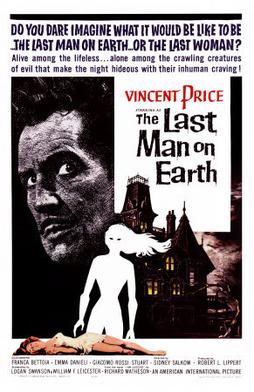
The Last Man on Earth

One of my all-time favorite books, Richard Matheson's I Am Legend, has been a frequent source of material for film adaptations. The book -- truly scary and unsettling -- has transitioned well to the screen, including Charlton Heston in 1971's The Omega Man and Will Smith in 2007's I Am Legend. As good as those two films are, the first film version may be the best, 1964's The Last Man on Earth.

It is 1968, and it has been three years since an unknown plague-like disease turned seemingly everyone on Earth into a variation of zombie and vampire. Among the wreckage, one man, Robert Morgan (Vincent Price), somehow survived the pandemic and has lived completely on his own for three straight years. He has created a routine, finding supplies, roaming the city and most importantly, protecting himself. Every single night, the zombie vampires descend on his house and is led by his best friend and co-worker, Ben (Giacomo Rossi-Stuart). Feeling a variation of survivor guilt while missing his wife and daughter, Robert edges ever closer to insanity. Can he find some way to keep on surviving before the armies of mutants finally get to him?

While I liked both 'Omega' and 'Legend,' neither film really stuck close to the source material Matheson presented in his 1954 novel. Wouldn't you know it? It sticks pretty close to the novel, and it is significantly better for it. Sure, certain things have been tweaked and changed. Matheson's undead were highly intelligent, fast-moving vampires who played mind games with the last man on Earth, trying to drive him mad each night to the point he hands himself over to them. In 'Man,' they are much more zombie-like, slow-moving and not intelligent at all. Morgan hangs garlic and mirrors and lightly bars his windows and doors so not exactly a fortified house. Famous zombie director George Romero even admitted that Matheson's novel and this film were a major inspiration for his classic Night of the Living Dead. So yes, there were changes made, but they allow the true nature of the story and movie to work so well.

Without the huge star power of Heston and Smith, Vincent Price is nonetheless a great choice to play Morgan, the last surviving human being on Earth. An actor predominantly known for his niche in horror and sci-fi films (typically playing some variation of bad guy), Price rises to the occasion, doing a great job portraying Morgan. As was the case with the later movies, it is a part that most actors would dream of. The spotlight is on you and you alone. The nature of the part is perfect because it allows for some interpretation. Price tries to keep his routine and stay calm about it, but it's easy to see he's quickly losing his grip on his isolated reality. In an extended flashback, we see why he's been drive to this point, meeting his wife (Emma Danieli) and young daughter (Christi Courtland) while also seeing a pre-vampire Ben in some eerie, unsettling scenes.

Beyond the acting of the isolated man, these movies transition well because of the premise, one man exploring an empty world. Yep, don't forget, the vampires can't go out in the day, allowing Morgan a chance to drive around safely. We see his routine in a great extended sequence over the first 20 minutes. He visits a grocery store for fresh garlic, investigates buildings for the vampires sleeping/hiding away the day, burns their bodies in an ever-growing fire with a billowing smoke cloud, and occasionally visits his daughter's "grave." This is a film made mostly with Italian backing and was filmed on-location in Rome, giving these scenes a different but oddly appropriate Euro-look to the story. This isn't NYC, Chicago, or L.A., it's an isolated, unnamed metropolitan city that serves as the backdrop for Morgan's life. Nicely done to directors Sidney Salkow and Ubaldo Ragona (the Italian part of the equation).

Like 'Omega' and 'Legend,' this 1964 version suffers some in the third act when we find out that maybe Morgan isn't alone. He meets Ruth (Franca Bettoia), a young woman who managed to survive the spreading disease but is now showing the early signs of the zombie-like transition. It's not that these segments are bad or uninteresting. They're just not as interesting as the build-up. Thankfully, the twist in the final scenes sticks closely to Matheson's novel ending, righting the ship with the best ending possible. Happy ending? Oh, no, not at all, but this isn't a story that calls for a happy ending. Yes, there are issues here. The Italian-to-English dubbing leaves something to be desired, the budget places certain limitations on the scale, but for me those were minor issues. I rank it with I Am Legend as the best version, and I feel safe recommending it to Matheson fans, or just someone looking for a smart, well-written sci-fi/horror classic. I included a trailer link below, but if you want to watch the full version, check it out HERE at Youtube. Fair warning; it's far from a good print.

The Last Man on Earth (1964): *** 1/2 /****

Friday, February 17, 2012

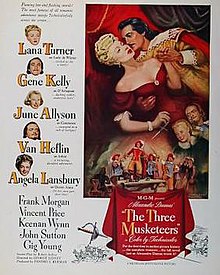
The Three Musketeers (1948)

First appearing as a serial in 1844 from French author Alexandre Dumas, The Three Musketeers have become some of literature's most popular, most famous and most well-liked characters in the history of the written word. That popularity has transitioned to film in countless efforts (ok, you can count them, but there's a lot, HERE), including 1948's The Three Musketeers.

Leaving his home and family behind, a young Frenchman named D'Artagnan (Gene Kelly) heads for Paris with hopes and dreams of joining the Musketeers of the Guard, the men who protect the King. He almost immediately meets three musketeers, Athos (Van Heflin), Porthos (Gig Young), and Aramis (Robert Coote), getting on their bad side and agreeing to duel to the death with each. Their problems are thrown by the wayside though as they see they must work together to save France from the treacherous prime minister, Richelieu (Vincent Price), who wants to start a war with rival England. With spies and traitors all around, the Musketeers -- plus D'Artagnan -- must fight for each other, for France, and for love.

Above all else, the cast here is truly impressive, a long list of recognizable names. That doesn't mean they're necessarily great performances, but well, the names are there! Not a great start, but Kelly is miscast as young D'Artagnan. He's just not believable other than his physical ability. Heflin is the only one of the three Musketeers to make any lasting impression, Young and Coote wasting away in the background. Price sneers and connives as Richelieu as only he can, but the best villain is the stunningly beautiful Lana Turner as Lady de Winter, Richelieu's most trusted agent. There's also parts for Angela Lansbury as the French queen, Anne, June Allyson as Constance, the Queen's maid and D'Artagnan's true love, Keenan Wynn as Planchet, D'Artagnan's servant, John Sutton as the Duke of Buckingham and Frank Morgan as King Louis.

What plagues this movie is something that affected so many movies in the 1940s and 1950s. It is interested in the spectacle of what's going on on the screen, and the truly impressive scale. It is intended to 'WOW!' the audience, and it does. The Technicolor technique has the action jumping off the screen, and visually it is an amazing movie to watch. The sets, the costumes, the detail. It's all there, but it's a shallow movie. Even knowing who the Musketeers were and the outline of the story, I was bored to tears. It took multiple viewings and a week-long break to even finish this one. There's no heart, no real interest in the characters. Rather than developing those bonds and the characters, we get countless fight scenes, lots of Musketeer carousing that goes nowhere.

Like anything, something good is best in small doses. The fight scenes here are a prime example. An early introduction has D'Artagnan fighting at first against and then with his new Musketeer buddies. The sword-fighting is a sight to behold, and then it keeps going....and going....and going. Kelly was a dancer first and foremost, and a talent with an incredible physical ability, but enough is enough. He jumps, he twirls, he flips, oh, and then he kills some guys. We get it, Mr. Kelly, you're extremely talented. Almost to a fault, the action -- whether it be hand-to-hand or with swords and pistols -- starts off well but doesn't know when to stop. It gets tedious, and with impressive sequences like this, that's never a good thing. Director George Sidney had to know when to pull the plug. Instead, he tries to wow the audience and ends up overdoing it. 

Now even with the thinly drawn characters and tedious action, this movie certainly has its pluses. When the story does get serious toward the end, dropping all the comedic carousing and shenanigans, wouldn't you know? The story significantly improves. As Lady de Winter, Turner especially shines, a snake waiting in the shadows to strike. There is a darkness to it as characters are killed, betrayals are unleashed, and allegiances tested. With a movie that runs at over two hours at 125 minutes, it just takes too long to get there. A darker, more straightforward Musketeers movie with this cast could have been a classic, but this 1948 version struggles to find a consistent tone. The last half hour is that good, but the build-up unfortunately is not. Still, there is too much positive going on here to not give it an at least partially positive review. Just know it's a mixed bag.

The Three Musketeers <---TCM trailer/clips (1948): ** 1/2 /****

Sunday, December 26, 2010

The Keys of the Kingdom

Some actors toil away for years trying to make it big in Hollywood.  All they’re looking for is that one big shot to step into the limelight. Others don’t spend much time at all on the climb up the ladder. In 1944, Gregory Peck made his debut in two movies featuring two great roles. In just his second movie overall, 1944’s The Keys of the Kingdom, he made such a positive impression that he earned an Oscar nomination for Best Actor. He didn’t win the award, but he surely deserved it.

The background of the movie is a sign of the times in the 1940s and early 1950s as studios made big budget stories about historical figures involved with religion, faith, and personal beliefs. Name a prominent historical figure with some involvement in religion over the years and chances are you can find a film from a major studio made about them.  As a person who doesn't have much use for organized religion, I usually try to steer clear of these movies as they shove some sort of rhetoric down your throat.  Thankfully, this one didn't do that, instead just focusing on the story of one man and his struggles and triumphs through his faith and personal beliefs.

After graduating from the Catholic college he's attending, Francis Chisolm (Peck) has no intention of continuing on to becoming a priest, but when something from his personal life changes his outlook on things, he opts for the priesthood.  From the start though, he questions if he's right for it and struggles in his first two years.  A bishop (Edmund Gwenn) who knows him well recommends him for a position in China where a Catholic priest is needed to start up a mission that has failed in the past.  Francis agrees to take the position and uproots himself to China where his work is cut out for him.  Upon arriving, he receives help from one of the few remaining converts, Joseph (Benson Fong), the young priest starts the work of building the mission and gaining converts who genuinely believe, not just because they're looking for food or shelter.

The story here is rare in that it covers over 40 years in Francis' life, but it never seems or feels rushed.  The important moments in his life and his struggles as a Catholic priest working as a missionary in China are all covered and given due course.  We see him in his ups and downs, his good and bad, the people he meets and who affect his life as much as he does theirs.  It is filmed in black and white -- I don't know how color would have worked here -- and the producers clearly spared no expense.  The mission set is ridiculously cool, and in general all the main sets are extravagant and textured.  They don't just look like wooden planks painted and propped up behind the actors.  Story and sets together, quite a combination here.  It seems obvious, but I'm always surprised how many movies take that for granted.

In just his second movie, Peck shows off an acting ability that would help catapult him to stardom.  Later in his career, he would gain a reputation as being somewhat stiff on-screen, playing the same character repeatedly with his strong, deep voice and commanding presence. I like Peck in just about everything he's done and can usually see past those criticisms, but I thought I should point them out.  Here, none of that's a problem.  His Francis is a lively, passionate man trying to do what he believes is right in an extremely difficult situation.  He's driven to do that at all costs no matter how difficult, willing to sacrifice for his converts who have come to trust him because of his actions and beliefs.  The character reminded me of a younger Atticus Finch, and that's never a bad thing.

This was Peck's movie from the start, but he is supported very capably by a cast full of studio players.  Thomas Mitchell plays Willie Tulloch, Francis' best friend back home, a doctor who is proud of his atheist beliefs. You can see why Willie and Francis are friends, they bond through their differences, neither man trying to convince the other of their convictions.  Vincent Price is Angus Mealey, Francis' childhood friend and fellow priest who is on a different road, a route where he climbs the ladder quickly in the church.  It's a good comparison to see the vast differences in the two men. Rose Stradner is a scene-stealer as Reverend Mother Maria-Veronica, a sister who struggles with her faith at times and how easily it comes to Francis.  She has a very moving, touching scene at the end of the movie that's worth watching on its own.  Also look for Roddy McDowall playing a young Francis, Cedric Hardwicke as a bishop in bookends of the movie questioning if Francis should be forcibly retired, and Leonard Strong as Mr. Chia, an opposing force of Francis' who ends up becoming fast friends with him. 

I was surprised by how much I liked this movie.  It doesn't try too hard delivering its message, a credit to the strengths of the cast who play the movie straight.  There's no hamming it up for the camera or speechifying at awkward moments.  The Chinese are not stereotyped like so many other movies do.  They're not shifty Asians capable of horrible things, and they're not ignorant peasants who must be taught how to do everything.  They're just people looking for something different in life.  Above all else though, watch this for Gregory Peck. You won't be disappointed in the 28-year old actor's secondary debut.

The Keys of the Kingdom <---trailer (1944): *** 1/2 /****

Monday, March 29, 2010

The Las Vegas Story

Cities like New York, L.A., and Chicago may have inspired more stories and probably more movies, but running a close fourth is Las Vegas, the City of Lights.  Movies like the original Ocean's 11, the remake, Vegas Vacation, The Hangover, and many others are set in Sin City.  Gambling, women, entertainment and debauchery left and right just translates well I guess.  Made right in the boom as the city became the city we know today, 1952's The Las Vegas Story presents a desert town full of love triangles, robberies, fraud, embezzlement, and of course, murder.

What caught my eye with this film noirish story was the cast, but I ended up liking it as a whole and not just because of the talent involved.  Certain outdoor scenes were obviously filmed in Las Vegas for any shots of the Strip or the hotels, but other than those, it's pretty clear most scenes were shot indoors at the Hollywood studios.  It's not a big deal really, but don't expect lots of live shots of the city.  The story starts off as one thing and ends up going down a very different route.  Lots of different elements must have been thrown into the blender, and when it came out, there was The Las Vegas Story.


Taking a cross country trip, husband and wife Lloyd Rollins (Vincent Price) and Linda Rollins (Jane Russell) make a stop in Las Vegas.  Lloyd is acting suspiciously, but that is overshadowed by Linda, who worked for years in the city as a lounge singer and left under less than ideal conditions.  She left behind her fiance who is now a detective on the LVPD, Dave Andrews (Victor Mature).  They awkwardly meet up with some baggage from their past, but that's just the beginning. Lloyd has a money issue (or lack of) and is quickly in the hole.  He pawns off one of Linda's necklaces, but the casino/club owner (Robert J. Wilke) he sold it to ends up dead and the necklace goes missing.  An insurance investigator (Brad Dexter) is on the case as well, where it seems anyone could be the murderer.

The plot detour works, making this love triangle more of a driving force to the story than the focus point.  Of course because of that, the story is all over the place, and not always in a good way.  It's still well-made and entertaining as these twists and detours lead to a great ending.  SPOILERS  The actual killer is Dexter's insurance investigator.  Dexter almost always played a heavy so it's no real surprise when it is revealed he is the killer.  Mature's Det. Andrews figures it out though and goes after Linda -- the kidnapped love of his life -- who Dexter took prisoner.  Watch the showdown HERE.   The finale features some great stuntwork involving a helicopter chasing a car in and around an abandoned airfield.  Even after the chase, there's a great cat and mouse game between Dexter and Mature in the wide open, dusty and windy expanses of this airfield.  END OF SPOILERS

Looking at the casting, RKO Studios didn't always have the biggest names in their movies, but that makes these type of movies appeal to me more.  Jane Russell is drop dead gorgeous, but too often that's all her roles required of her -- and to be fair, her character is neglected in the last 20 minutes.  When given the chance, she showed a knack for playing tough femme fatale who can pull off some humor and be sexy at the same time.  As for the looks department, 'Vegas Story' does display her proudly, including one silhouette shower scene that seems tame now.  A beauty on screen, she's often stereotyped as a body with no acting ability, but she is a strong actress with the right part.

Mature and Price provide some fireworks as the love interests.  As an actor, Mature is underrated in my book the same way Russell is.  He's got quite the presence when the camera focuses on him, and maybe he doesn't have the greatest range.  But if you do what you're good at and find those appropriate roles, who cares?  As a police detective scorned by his fiance, Mature gets to do the romantic scenes and the action too so it's the best of both worlds.  Price was a versatile actor and shows it here as a character who's motivations are left in the shadows until the end.  Horror, comedy, or thriller, Price could do them all.  Dexter is Dexter, and Jay C. Flippen has a funny part as a veteran cop who thinks he knows everything.

My only other complaint about this movie is Hoagy Carmichael being cast in a supporting role.  A bandleader, singer and composer, Carmichael plays Happy, a piano player who used to work with Russell's Linda.  Russell was a singer as well as an actress, and she had a decent voice but this also means she sings in her movies.  In some situations -- like Gentlemen Prefer Blondes -- a quick song is fine because it fits with the tone of the movie.  But a murder mystery noir full of deceit and infidelity?  Not so much.  Still, we get songs with Russell and Carmichael singing, like HERE, instead of focusing on the more interesting, more entertaining storyline.  Still, with all that said, the movie is worth a watch.  It's a mess of a movie, but an entertaining one at that.

The Las Vegas Story <---trailer (1952): ** 1/2 /****