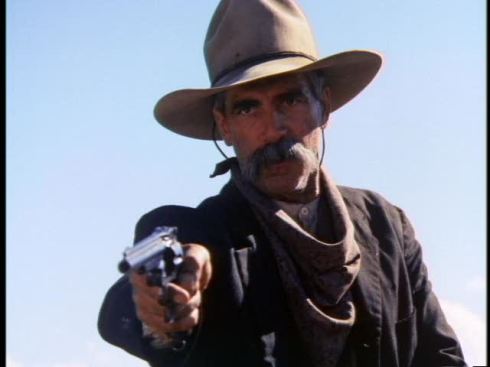
When authors are writing a story, a short story, a novel, do you think they write thinking of a movie star or actor that could portray their characters? I know I've written like that. When western author Louis L'Amour was writing one of his many memorable western novels, I can't help but think if he specifically thought of Tom Selleck as a potential star. Talk about a match made in heaven from book to film. One of several worthwhile examples is a 2001 TV movie, Crossfire Trail.
It's 1880 in the Pacific Ocean and a ship is making its way to San Francisco. On board, a man named Rafe Covington (Selleck) has made a promise to a dying man who owns an expansive cattle ranch in the Wyoming Territory. He's long been away from the ranch and his wife, Anne (Virginia Madsen), and doesn't know what's come of them. With two friends along to help out, Rafe heads for the ranch not sure what he's stepped into. Anne is under the assumption that her husband died well over a year ago and for better or worse has moved on, and is even engaged (sort of) to the local businessman and head honcho, Bruce Barkow (Mark Harmon). No matter the extreme difficulties thrown his way, Rafe intends to keep his word to a dying friend, even when Barkow resorts to violent measures to get what he wants.
Want some proof that the western genre isn't dead? Debuting on TNT in January 2001, 'Crossfire' racked up over 12 million viewers. It was the most watched TV movie until....2007's High School Musical 2 (Yeah, there's a proud moment for you). Why did this 2001 made-for-TV western resonate so well with audiences? There's something to be said for Louis L'Amour westerns whether they're in film form or good, old-fashioned novels. We're talking good guys and bad guys, keeping your word versus betrayal and backstabbing. Don't get me wrong, I love the more adult-themed 1950s westerns, the ultra-violent spaghetti westerns and the cynical 1970s westerns, but it's nice on occasion to go back and revisit the heart of the western; good vs. bad. Kudos to director Simon Wincer (Quigley Down Under). Oh, and Alberta, Canada fills in nicely for the American west with some gorgeous-looking film locations.
No stranger to Louis L'Amour adaptations, Selleck picks up where he left off with The Sacketts and The Shadow Riders. He's also put his western stamp on films like Quigley Down Under (with Wincer), Last Stand at Saber River and Monte Walsh. Selleck just seems at home in the western and especially so in bringing L'Amour's laconic, steadfast heroes. He does a great job as Rafe Covington, a cowboy, a drifter, a sharpshooter, and a man who sees a chance to settle down and create something for himself. A man of few words, he's comfortable in his own skin and lives by his set of morals, judgements and beliefs. Selleck makes it look easy and has some excellent chemistry with his co-star, Virginia Madsen. Maybe more than that, he looks like a cowboy in the saddle, throwing down with a bad guy who's just asking for it, and lining up a shot with his new-model Winchester rifle.
As with several other western/L'Amour novels, our hero needs a team. Familiar, archetypal characters, but good characters. Here, Rafe isn't alone as he's got Joe Gill (Wilford Brimley), the grizzled ranch-hand, Rock Mullaney (David O'Hara), the fun-loving, hard-drinking Irishman, and J.T. Langston (Christian Kane), the youngster of the group proving he belongs with the rest, proving he's a good cowboy. There's some great moments among the group of four, cowboys from different backgrounds riding the trail or sitting around a campfire, those perfect little moments that stand out in the western genre.
For a TV western, there's a pretty decent cast overall. Before his NCIS days, Mark Harmon gets to villain it up as Barkow, the smooth businessman with a sinister streak right up his back. As his enforcer, Brad Johnson appears about halfway through the movie as Bo Dorn, the hired killer with absolutely no scruples. His scenes with Selleck's Rafe especially crackle with intensity. Also look for Barry Corbin as a sheriff with no backbone, Rex Linn, Marshall Teague, and Patrick Kilpatrick as assorted cowboy fodder for Rafe, and William Sanderson as Dewey, the saloon bartender. Not huge names but some very solid actors and performances sprinkled throughout.
Look, Crossfire Trail is a good western. It's not a classic, and it makes no effort to rewrite the genre. You could easily see John Wayne playing Rafe Covington with a cast full of familiar faces around him in a 1950s western directed by Henry Hathaway. There's not a ton of gunplay, most of that saved for the finale as all our different good guys and bad guys have it out in a vacant western street. You know the ending before it's even there, and you know what? It doesn' matter in the least. A good story, a perfect star, an excellent supporting cast. You don't need much more when it comes to the western. Enjoy this one. I certainly did.
Crossfire Trail (2001): ***/****
The Sons of Katie Elder
"First, we reunite, then find Ma and Pa's killer...then read some reviews."
Showing posts with label Louis L'Amour. Show all posts
Wednesday, October 1, 2014
Friday, October 25, 2013
Guns of the Timberland
I guess I only have myself to blame. I should have learned with 1952's The Big Trees that logging and cutting down trees just isn't exciting as it sounds. Just the same, when 1960's Guns of the Timberland popped up on Turner Classic Movie's schedule, I wanted to give it a shot. It comes from a novel by an author I like a lot, and the cast sounded pretty capable. Yeah, I was wrong. It's now 0-for-2 when it comes to logging movies.
Traveling by train, Jim Hadley (Alan Ladd) and Monty Walker (Gilbert Roland) are heading into the mountains to finish out a contract they've signed. It's 1895 somewhere in the Pacific Northwest, and Jim, Monty and their crew of lumberjacks have been contracted to provide limber for a new railroad line. They've invested much of their own money to help get the job and desperately need it to come through for them. They think the job will be easy...until they get there. The area they're supposed to clear is dominated by ranches that need the trees to provide a watershed for the land. No trees, no ability to hold water in the land. One ranchowner, Laura Rileyy (Jeanne Crain), is at the forefront of the effort to stop them, and the whole town is behind her. Both sides stand to lose everything should the other side succeed. Who will cave and buckle first?
When I see based on a story/novel from western writer Louis L'Amour, I'm always psyched. I grew up reading his stories and still read them today. I haven't read this source story, but it sounds like the movie script switched up the focus of the novel. In the movie, we follow Jim and Monty in their efforts to clear the land. In the book, it sure sounds like it's the other way around as we see from the rancher's perspective. Ultimately, I felt like that went a long way toward dooming the picture. It's hard to support and/or hate either side here. Both sides are doing what they need to do to survive. Yes, it's at the expense of the other side. So really....are there good guys and bad guys? It's hard to judge either side too harshly. Too bad because with that said, all the natural conflict goes out the window. We don't really want either side to win if that makes sense.
I did like the cast even if they are given little to do. I like Ladd depending on the role, and he's decent here because he's paired with the fiery, always fun Roland. Thankfully, Roland avoids the stereotypical 'Ay, chihuahua!' moments he so often resorted to. Ladd seems a little off, some of his lines stepping on other actor's lines, maybe off a second or two as to when he should have said something. I don't know what was going on, but Ladd even looks a little uncomfortable in most of his scenes. Also joining the crew of boisterous, roughneck, fun-loving lumberjacks is Noah Beery Jr., Henry Kulky, and Johnny Seven, some there for comic relief, others for intimidation factors.
On the other side of the line is a really dull crew of quasi-bad guys who aren't so bad. Crain is okay as tough female rancher Riley, but even she falls for Ladd's Jim at the drop of a hat. The most villainous is Lyle Bettger as Clay Bell, Riley's foreman who isn't below some rather nasty methods to get the lumberjacks out of town. Frankie Avalon plays Bert, a young man working on the Riley ranch who finds himself caught between the ranch and the appealing freedom of the lumberjacks. It's actually a pretty good part for Avalon, even if the script finds two opportunities to let him sing. The rest of the townspeople don't make much of an impression, just a sea of passive-aggressive, cackling maroons who revel in all the stunts pulled against the lumberjacks. Mostly, you just want to see them get punched in the face a couple times.
If there is a positive to take away here, it's the on-location shooting. Director Robert D. Webb filmed his movie in Blairsden and Graeagle, California up in the mountains. It may be one big old dull story, but it's nice to look at while you're being bored. That's the biggest issue. The tension is there, but it's just never that interesting. You don't care how things end up, and the finale is a big old cop-out. I didn't have high expectations to begin with, but even those weren't worth it.
Guns of the Timberland (1960): * 1/2 /****
Traveling by train, Jim Hadley (Alan Ladd) and Monty Walker (Gilbert Roland) are heading into the mountains to finish out a contract they've signed. It's 1895 somewhere in the Pacific Northwest, and Jim, Monty and their crew of lumberjacks have been contracted to provide limber for a new railroad line. They've invested much of their own money to help get the job and desperately need it to come through for them. They think the job will be easy...until they get there. The area they're supposed to clear is dominated by ranches that need the trees to provide a watershed for the land. No trees, no ability to hold water in the land. One ranchowner, Laura Rileyy (Jeanne Crain), is at the forefront of the effort to stop them, and the whole town is behind her. Both sides stand to lose everything should the other side succeed. Who will cave and buckle first?
When I see based on a story/novel from western writer Louis L'Amour, I'm always psyched. I grew up reading his stories and still read them today. I haven't read this source story, but it sounds like the movie script switched up the focus of the novel. In the movie, we follow Jim and Monty in their efforts to clear the land. In the book, it sure sounds like it's the other way around as we see from the rancher's perspective. Ultimately, I felt like that went a long way toward dooming the picture. It's hard to support and/or hate either side here. Both sides are doing what they need to do to survive. Yes, it's at the expense of the other side. So really....are there good guys and bad guys? It's hard to judge either side too harshly. Too bad because with that said, all the natural conflict goes out the window. We don't really want either side to win if that makes sense.
I did like the cast even if they are given little to do. I like Ladd depending on the role, and he's decent here because he's paired with the fiery, always fun Roland. Thankfully, Roland avoids the stereotypical 'Ay, chihuahua!' moments he so often resorted to. Ladd seems a little off, some of his lines stepping on other actor's lines, maybe off a second or two as to when he should have said something. I don't know what was going on, but Ladd even looks a little uncomfortable in most of his scenes. Also joining the crew of boisterous, roughneck, fun-loving lumberjacks is Noah Beery Jr., Henry Kulky, and Johnny Seven, some there for comic relief, others for intimidation factors.
On the other side of the line is a really dull crew of quasi-bad guys who aren't so bad. Crain is okay as tough female rancher Riley, but even she falls for Ladd's Jim at the drop of a hat. The most villainous is Lyle Bettger as Clay Bell, Riley's foreman who isn't below some rather nasty methods to get the lumberjacks out of town. Frankie Avalon plays Bert, a young man working on the Riley ranch who finds himself caught between the ranch and the appealing freedom of the lumberjacks. It's actually a pretty good part for Avalon, even if the script finds two opportunities to let him sing. The rest of the townspeople don't make much of an impression, just a sea of passive-aggressive, cackling maroons who revel in all the stunts pulled against the lumberjacks. Mostly, you just want to see them get punched in the face a couple times.
If there is a positive to take away here, it's the on-location shooting. Director Robert D. Webb filmed his movie in Blairsden and Graeagle, California up in the mountains. It may be one big old dull story, but it's nice to look at while you're being bored. That's the biggest issue. The tension is there, but it's just never that interesting. You don't care how things end up, and the finale is a big old cop-out. I didn't have high expectations to begin with, but even those weren't worth it.
Guns of the Timberland (1960): * 1/2 /****
Labels:
1960s,
Alan Ladd,
Gilbert Roland,
Louis L'Amour,
Lyle Bettger,
Noah Beery Jr,
westerns
Saturday, January 5, 2013
Apache Territory
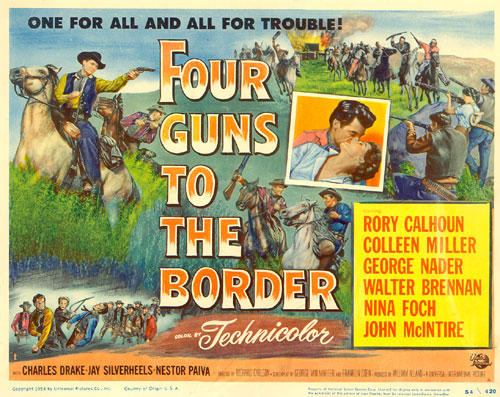
Playing the lead role in 1954's Four Guns to the Border, actor Rory Calhoun had already starred in one western based off a novel by famed western author Louis L'Amour. Working with his own production company four years later, Calhoun returned to the well again, this time with 1958's Apache Territory.
Riding through the desert on the way to Fort Yuma, drifting gunfighter Logan Cates (Calhoun) stumbles across several dead bodies and a young woman, Junie (Carolyn Craig), who was the lone survivor of an Apache attack. It seems that Apache chief Churupati is leading his warriors on a rampage, killing everyone in their path. Logan heads to the nearest water hole, hoping to stock up on as much water as he can, but he's not the only one thinking like that. Other desert travelers have found their way to the water -- including a soon to be married couple, the remnants of a cavalry troop, a young man who survived an Apache attack -- and find themselves trapped by Churupati's Apache warriors. Can they hold the Apaches off until help arrives?
From L'Amour's novel Last Stand at Papago Wells, 'Territory' translates well to the big screen. L'Amour's writing style as an author generally translated well in that sense. His stories were straightforward with plenty of action and excitement featuring tough, loner heroes, beautiful women waiting to be wooed and villains who almost always meet a nasty end in the finale. These are far from flashy westerns, but they get the job done. This one isn't around long enough to leave too much of an impression -- positive or negative -- at just 72 minutes long. There's nothing wrong with that though. Just sit back and enjoy it.
So with a small, desperate group of survivors trapped at an isolated water hole, we follow the action as the mostly off-screen Apaches lay siege. And other than the opening as we see how Logan ends up at the water hole, the entire story is set around this water hole. It ends up being a cool addition to the story. Lying in the shade of a cliff face, the water hole is ringed by rocks and boulders that are perfect for defense. The water hole becomes a mini-fort of sorts as the survivors try not to lose their minds, stay sane as arrows rain down and ultimately survive. It's a pretty simple formula, but it works well. Kudos to director Ray Nazarro for keeping that action and drama contained in this one specific spot.
Never a huge star, Calhoun just the same was able to carve out a niche for himself as an actor. Much of that niche came in 1950s B-westerns like this one. His Logan Cates is a pretty typical L'Amour hero; strong, silent, tough and not one to let anyone else control what he does. He also gets the scorned love interest in Barbara Bates' Jennifer, a former love who is now engaged to John Dehner's Grant Kimbrough, a gambler. Who else ends up at this water hole? Why, lots o' people! Along with Craig's Junie, there's Lonnie (Tom Pittman), an 18-year old on his way to California, Lugo (Frank DeKova), a peaceful Pima warrior, and the remnants of a cavalry patrol (Leo Gordon, Myron Healey, Regis Parton) commanded by desk sergeant, Sheehan (Francis De Sales).
It's odd that with a movie that doesn't even break the 80-minute mark the pacing can be a little off. The negative part of a story surrounding a siege is that a whole lot doesn't happen. There's a lot of talking, a lot of worrying, and then an occasional arrow picking off one of our survivors. A few ventures away from the water hole provide some excitement, and the finale doesn't disappoint either as Calhoun's Logan comes up with a unique way to dispatch the waiting Apaches. Enjoyable, solid western, but nothing more.
Apache Territory (1958): ** 1/2 /****
Riding through the desert on the way to Fort Yuma, drifting gunfighter Logan Cates (Calhoun) stumbles across several dead bodies and a young woman, Junie (Carolyn Craig), who was the lone survivor of an Apache attack. It seems that Apache chief Churupati is leading his warriors on a rampage, killing everyone in their path. Logan heads to the nearest water hole, hoping to stock up on as much water as he can, but he's not the only one thinking like that. Other desert travelers have found their way to the water -- including a soon to be married couple, the remnants of a cavalry troop, a young man who survived an Apache attack -- and find themselves trapped by Churupati's Apache warriors. Can they hold the Apaches off until help arrives?
From L'Amour's novel Last Stand at Papago Wells, 'Territory' translates well to the big screen. L'Amour's writing style as an author generally translated well in that sense. His stories were straightforward with plenty of action and excitement featuring tough, loner heroes, beautiful women waiting to be wooed and villains who almost always meet a nasty end in the finale. These are far from flashy westerns, but they get the job done. This one isn't around long enough to leave too much of an impression -- positive or negative -- at just 72 minutes long. There's nothing wrong with that though. Just sit back and enjoy it.
So with a small, desperate group of survivors trapped at an isolated water hole, we follow the action as the mostly off-screen Apaches lay siege. And other than the opening as we see how Logan ends up at the water hole, the entire story is set around this water hole. It ends up being a cool addition to the story. Lying in the shade of a cliff face, the water hole is ringed by rocks and boulders that are perfect for defense. The water hole becomes a mini-fort of sorts as the survivors try not to lose their minds, stay sane as arrows rain down and ultimately survive. It's a pretty simple formula, but it works well. Kudos to director Ray Nazarro for keeping that action and drama contained in this one specific spot.
Never a huge star, Calhoun just the same was able to carve out a niche for himself as an actor. Much of that niche came in 1950s B-westerns like this one. His Logan Cates is a pretty typical L'Amour hero; strong, silent, tough and not one to let anyone else control what he does. He also gets the scorned love interest in Barbara Bates' Jennifer, a former love who is now engaged to John Dehner's Grant Kimbrough, a gambler. Who else ends up at this water hole? Why, lots o' people! Along with Craig's Junie, there's Lonnie (Tom Pittman), an 18-year old on his way to California, Lugo (Frank DeKova), a peaceful Pima warrior, and the remnants of a cavalry patrol (Leo Gordon, Myron Healey, Regis Parton) commanded by desk sergeant, Sheehan (Francis De Sales).
It's odd that with a movie that doesn't even break the 80-minute mark the pacing can be a little off. The negative part of a story surrounding a siege is that a whole lot doesn't happen. There's a lot of talking, a lot of worrying, and then an occasional arrow picking off one of our survivors. A few ventures away from the water hole provide some excitement, and the finale doesn't disappoint either as Calhoun's Logan comes up with a unique way to dispatch the waiting Apaches. Enjoyable, solid western, but nothing more.
Apache Territory (1958): ** 1/2 /****
Labels:
1950s,
John Dehner,
Leo Gordon,
Louis L'Amour,
Rory Calhoun,
westerns
Friday, March 25, 2011
Four Guns to the Border
If I hadn't seen the credits at the opening of the movie, I'm pretty sure I would have been able to figure out that 1954's Four Guns to the Border was based on a Louis L'Amour story. Now it must have been a short story because eight years after this movie the fleshed-out version was released in its novel form, called High Lonesome. But short story or novel, the main characters come right out of L'Amour's rotation of stock characters. None of this is meant as a criticism -- I love his western novels -- but instead as a positive, another western that's the movie equivalent of comfort food.
All the old reliable characters I've come to expect were there, and it doesn't take long to establish who everyone is. 'Border' reminded me in a lot of ways of Catlow, another L'Amour western that was later turned into a feature film. Let's start with the lead, a sullen gunfighter at the head of a gang that isn't so bad all things considered. He's just looking for something else in life. Two, the older, grizzled right hand man. Three, the younger gunfighter who is the wild card, and four, the minority, a gunfighter with Indian/Mexican backgrounds. For good measure, throw in a father and daughter traveling across the desert who need help and maybe....just maybe...the daughter will fall for our sullen, glum leader. Ooops, I think I gave away the whole movie.
After robbing a saloon that nets his gang nothing when the safe is empty, outlaw gunslinger Cully (Rory Calhoun) decides to pull a bank job that has long been on his mind. The bank in nearby Cholla holds a monthly deposit from local cattle ranchers, but the bank is well-guarded and the townspeople very protective of their holdings. Cully's gang is up to the task, especially considering their past with Cholla sheriff, Dan Flaherty (Charles Drake). But a big payday seems a long way off as they plan for the job. On the trail, the gang comes across small ranch owner, Simon Bhumer (Walter Brennan) and his young daughter, Lolly (Colleen Miller). Even more trouble is the rumors that an Apache war party has jumped the reservation and is terrorizing the territory, all the while Cully's gang preparing for the dangerous job in front of them.
A B-western released at the height of western popularity in the mid 1950s, 'Border' doesn't do much to distinguish itself from so many other westerns of the time, but I found myself very much enjoying it still. Some of that can be attributed to L'Amour's comfort and ease writing about the American west, but it's more than that. Even when the story starts bouncing off the walls in a hundred different directions, it's still entertaining. That's my one complaint, just too much going on. Almost 30 minutes is spent setting everything up before Sheriff Flaherty and his wife (Nina Foch) and their past with Cully are brought up. In the meantime, Simon and Lolly fade into the background right when their story was getting interesting. All the different stories of course end up together, but the route getting there could have been smoother.
Most of my enjoyment from 'Border' comes from the casting. Calhoun was never a huge star, but he was always a reliable lead with the right part. Cully is a prototypical L'Amour hero, a bad guy who isn't that bad. He just needs a reason to turn to the light, in this case Miller's Lolly character. His gang includes Dutch (John McIntire), the grizzled gunslinger, Bronco (George Nader), the cocky but likable gunfighter, and Yaqui (Jay Silverheels, the Lone Ranger's Tonto), a knife-throwing, affable Indian. Like Cully, they're not so bad compared to most wild west outlaws. Given the chance, they redeem themselves in the eyes of the audience. Brennan is Brennan, playing the crotchety old rancher looking out for his daughter's best interests.
Discovered by a movie scout that saw a picture of her on vacation, Colleen Miller plays Lolly in one of her few film roles, and the only one I've seen of hers. The slim brunette is gorgeous, America's girl next door, and the studio apparently wanted to make her a sexpot with this part. Their efforts though are so incredibly not subtle that it comes across as a 1950s version of softcore porn. Upon being introduced, here are just some of the things thrown at Lolly. She's knocked out so Brennan pours a canteen over her, strategically wetting her shirt, continuing to pour even after she's awake. Later in a storm at night, Lolly heads outdoors in a white nightie to care for the horses. White nightie and water? Oh, I get it. She also undresses several times, needlessly but entertainingly hikes up her dress, and even enjoys some candy. Cully's gang stands around while she licks a candy cane. Are they kidding? It's so ridiculous it is actually funny at times.
B-movie actor himself turned director, Richard Carlson does a solid, workmanlike job with this B-western. Balancing all these different plates at one time, he manages to get all the characters and storylines where they need to be in the end. The finale had a chance to go for a whopper of an ending, spaghetti western-eque in terms of who makes it and who doesn't, but unfortunately this is 1954 Hollywood, not 1966 Italy. Still, I liked this movie. Nothing special, but always entertaining.
Four Guns to the Border (1954): ***/****
All the old reliable characters I've come to expect were there, and it doesn't take long to establish who everyone is. 'Border' reminded me in a lot of ways of Catlow, another L'Amour western that was later turned into a feature film. Let's start with the lead, a sullen gunfighter at the head of a gang that isn't so bad all things considered. He's just looking for something else in life. Two, the older, grizzled right hand man. Three, the younger gunfighter who is the wild card, and four, the minority, a gunfighter with Indian/Mexican backgrounds. For good measure, throw in a father and daughter traveling across the desert who need help and maybe....just maybe...the daughter will fall for our sullen, glum leader. Ooops, I think I gave away the whole movie.
After robbing a saloon that nets his gang nothing when the safe is empty, outlaw gunslinger Cully (Rory Calhoun) decides to pull a bank job that has long been on his mind. The bank in nearby Cholla holds a monthly deposit from local cattle ranchers, but the bank is well-guarded and the townspeople very protective of their holdings. Cully's gang is up to the task, especially considering their past with Cholla sheriff, Dan Flaherty (Charles Drake). But a big payday seems a long way off as they plan for the job. On the trail, the gang comes across small ranch owner, Simon Bhumer (Walter Brennan) and his young daughter, Lolly (Colleen Miller). Even more trouble is the rumors that an Apache war party has jumped the reservation and is terrorizing the territory, all the while Cully's gang preparing for the dangerous job in front of them.
A B-western released at the height of western popularity in the mid 1950s, 'Border' doesn't do much to distinguish itself from so many other westerns of the time, but I found myself very much enjoying it still. Some of that can be attributed to L'Amour's comfort and ease writing about the American west, but it's more than that. Even when the story starts bouncing off the walls in a hundred different directions, it's still entertaining. That's my one complaint, just too much going on. Almost 30 minutes is spent setting everything up before Sheriff Flaherty and his wife (Nina Foch) and their past with Cully are brought up. In the meantime, Simon and Lolly fade into the background right when their story was getting interesting. All the different stories of course end up together, but the route getting there could have been smoother.
Most of my enjoyment from 'Border' comes from the casting. Calhoun was never a huge star, but he was always a reliable lead with the right part. Cully is a prototypical L'Amour hero, a bad guy who isn't that bad. He just needs a reason to turn to the light, in this case Miller's Lolly character. His gang includes Dutch (John McIntire), the grizzled gunslinger, Bronco (George Nader), the cocky but likable gunfighter, and Yaqui (Jay Silverheels, the Lone Ranger's Tonto), a knife-throwing, affable Indian. Like Cully, they're not so bad compared to most wild west outlaws. Given the chance, they redeem themselves in the eyes of the audience. Brennan is Brennan, playing the crotchety old rancher looking out for his daughter's best interests.
Discovered by a movie scout that saw a picture of her on vacation, Colleen Miller plays Lolly in one of her few film roles, and the only one I've seen of hers. The slim brunette is gorgeous, America's girl next door, and the studio apparently wanted to make her a sexpot with this part. Their efforts though are so incredibly not subtle that it comes across as a 1950s version of softcore porn. Upon being introduced, here are just some of the things thrown at Lolly. She's knocked out so Brennan pours a canteen over her, strategically wetting her shirt, continuing to pour even after she's awake. Later in a storm at night, Lolly heads outdoors in a white nightie to care for the horses. White nightie and water? Oh, I get it. She also undresses several times, needlessly but entertainingly hikes up her dress, and even enjoys some candy. Cully's gang stands around while she licks a candy cane. Are they kidding? It's so ridiculous it is actually funny at times.
B-movie actor himself turned director, Richard Carlson does a solid, workmanlike job with this B-western. Balancing all these different plates at one time, he manages to get all the characters and storylines where they need to be in the end. The finale had a chance to go for a whopper of an ending, spaghetti western-eque in terms of who makes it and who doesn't, but unfortunately this is 1954 Hollywood, not 1966 Italy. Still, I liked this movie. Nothing special, but always entertaining.
Four Guns to the Border (1954): ***/****
Labels:
1950s,
Louis L'Amour,
Richard Carlson,
Rory Calhoun,
Walter Brennan,
westerns
Wednesday, September 8, 2010
Conagher
Growing up, I became a reader at a young age, and I'd read just about anything having to do with the old west. Fiction and non-fiction, novels, short stories or encyclopedias, they were all the same to me. The master of the western story, Louis L'Amour, obviously appealed a lot to me, and I still remember the first book of his I read, The First Fast Draw. I still read his books from time to time because above all else, they're the literary equivalent of comfort food. You know what you're getting each time you open one of his books.
In the last few months, I've reviewed several L'Amour ventures into movies, made for TV movies and even TV shows. Unlike bigger scale westerns where the scale was important, L'Amour's novels never had that problem. They usually focused on a handful of main characters instead of hundreds of speaking parts and were about the problems of those individuals rather than a bigger western where a whole town or territory might be in danger. So with that thought, maybe Louis L'Amour and his novels were cut out for made-for-TV movies where the smaller scale was a benefit, not a hindrance. Not one of the best examples but a decent enough western, 1991's Conagher.
Traveling west with her recently married husband and his two kids from his previous marriage, Evie Teale (Katharine Ross) finds herself running the homestead by herself in unforgiving territory. Her husband went to buy cattle and has been missing for months, leaving her to believe he died somehow because he wouldn't just abandon his family. But Evie trudges on, living the toughest of frontier lives from day to day. A drifting cowboy, Conn Conagher (Sam Elliott), stops by one day on the trail and helps out briefly before moving on. There is a connection immediately between Evie and Conn, but they seem almost fated not to be together. But trying to carve out a living on their own, the two similar minded people can't help but be drawn to each other.
Some actors are cut out for certain genres, and Sam Elliott belongs in westerns, plain and simple. He has the look and the acting style that fits in perfectly with the genre. More than that, he's cut out to play a L'Amour hero, hard-working, tough, always willing to help, and honest/loyal to a fault. Basically, he's a man of principle. This was Elliott's fourth appearance in a movie based off a L'Amour novel, and he's got the part down to an art by now. His performance is the best part of the movie, and the story tends to drag when he's not around. It drags some even when he is around, but that's not entirely his fault.
Now I haven't read Conagher so I may be criticizing the movie more than I am the book here. At 117 minutes, this feels too disjointed without any unifying connection through the story. There are these little episodic sidebars that reveal more about the character but never anything surprising. Conagher signs on with an old rancher (Ken Curtis in a solid supporting turn) who is being run out by a rival ranch. These scenes show Conn's willingness to do what's right when it'd be easier to bail, but that's nothing we didn't know already. Then to add insult to injury, this drifter cowboy must tangle with two rustlers (James Gammon and Paul Koslo). Streamline the story some and these segments are gone for an overall more well organized story.
It isn't often I'm about to say this, but this is a western that could have used more of the romantic subplot that it introduces but doesn't do anything with until the end. Married in real life, Elliott and Ross have an obvious chemistry together without much in the way of words spoken. After a brief scene early where they meet, they spend most of the rest of the movie apart. Maybe I was just expecting something different from the story where they meet early, fall for each other and go from there, but I was disappointed in how the relationship developed. Basically they spend too much time apart in the slow-moving middle sections that don't do much anyways.
The rest of the cast is solid for a TV western. Barry Corbin is the best part as McCloud, the stagecoach driver who frequents the Teale's place. Billy Green Bush appears very briefly as Jacob, Evie's husband, with Gavan O'Herlihy making a reliably evil bad guy. Also look for recognizable western faces Buck Taylor as a rival cowboy and Dub Taylor as a stagecoach station agent. It's a decent enough western, but other than Elliott and Ross I'm remembering little to recommend. Average in every way and probably only for western completists.
Conagher <---trailer (1991): **/****
In the last few months, I've reviewed several L'Amour ventures into movies, made for TV movies and even TV shows. Unlike bigger scale westerns where the scale was important, L'Amour's novels never had that problem. They usually focused on a handful of main characters instead of hundreds of speaking parts and were about the problems of those individuals rather than a bigger western where a whole town or territory might be in danger. So with that thought, maybe Louis L'Amour and his novels were cut out for made-for-TV movies where the smaller scale was a benefit, not a hindrance. Not one of the best examples but a decent enough western, 1991's Conagher.
Traveling west with her recently married husband and his two kids from his previous marriage, Evie Teale (Katharine Ross) finds herself running the homestead by herself in unforgiving territory. Her husband went to buy cattle and has been missing for months, leaving her to believe he died somehow because he wouldn't just abandon his family. But Evie trudges on, living the toughest of frontier lives from day to day. A drifting cowboy, Conn Conagher (Sam Elliott), stops by one day on the trail and helps out briefly before moving on. There is a connection immediately between Evie and Conn, but they seem almost fated not to be together. But trying to carve out a living on their own, the two similar minded people can't help but be drawn to each other.
Some actors are cut out for certain genres, and Sam Elliott belongs in westerns, plain and simple. He has the look and the acting style that fits in perfectly with the genre. More than that, he's cut out to play a L'Amour hero, hard-working, tough, always willing to help, and honest/loyal to a fault. Basically, he's a man of principle. This was Elliott's fourth appearance in a movie based off a L'Amour novel, and he's got the part down to an art by now. His performance is the best part of the movie, and the story tends to drag when he's not around. It drags some even when he is around, but that's not entirely his fault.
Now I haven't read Conagher so I may be criticizing the movie more than I am the book here. At 117 minutes, this feels too disjointed without any unifying connection through the story. There are these little episodic sidebars that reveal more about the character but never anything surprising. Conagher signs on with an old rancher (Ken Curtis in a solid supporting turn) who is being run out by a rival ranch. These scenes show Conn's willingness to do what's right when it'd be easier to bail, but that's nothing we didn't know already. Then to add insult to injury, this drifter cowboy must tangle with two rustlers (James Gammon and Paul Koslo). Streamline the story some and these segments are gone for an overall more well organized story.
It isn't often I'm about to say this, but this is a western that could have used more of the romantic subplot that it introduces but doesn't do anything with until the end. Married in real life, Elliott and Ross have an obvious chemistry together without much in the way of words spoken. After a brief scene early where they meet, they spend most of the rest of the movie apart. Maybe I was just expecting something different from the story where they meet early, fall for each other and go from there, but I was disappointed in how the relationship developed. Basically they spend too much time apart in the slow-moving middle sections that don't do much anyways.
The rest of the cast is solid for a TV western. Barry Corbin is the best part as McCloud, the stagecoach driver who frequents the Teale's place. Billy Green Bush appears very briefly as Jacob, Evie's husband, with Gavan O'Herlihy making a reliably evil bad guy. Also look for recognizable western faces Buck Taylor as a rival cowboy and Dub Taylor as a stagecoach station agent. It's a decent enough western, but other than Elliott and Ross I'm remembering little to recommend. Average in every way and probably only for western completists.
Conagher <---trailer (1991): **/****
Labels:
1990s,
Katharine Ross,
Ken Curtis,
Louis L'Amour,
Paul Koslo,
Sam Elliott,
westerns
Friday, August 20, 2010
Shalako
By 1968, James Bond himself, Sean Connery, was riding high off the success of the first five 007 movies he made, most recently with You Only Live Twice. When he wasn't playing Bond, Connery did his damnedest to avoid being typecast, generally succeeding with a wide-ranging list of roles that continued into the 1970s and 1980s. But in all those movies, he only did one western, and it's a good one, 1968's Shalako.
Based on a Louis L'Amour novel, this Euro-western has a lot going for it with a lot of different elements thrown together in the final product. Start with the uniquely international cast that includes American, English, French, Scottish, German and Spanish actors and actresses, all of them with speaking roles. While the story ends up being somewhat familiar late in the movie, the build-up to that point is different from about 99.9% of other westerns. At times it can be a little too much with so many different elements working together and sometimes against each other, but the positives outweigh the negatives...for me at least.
Frontiersman and former U.S. cavalry officer Shalako Carlin (Connery) stumbles across an Apache ambush, saving a beautiful French woman, Countess Irina Lazaar (Brigitte Bardot), from certain death. Irina is part of a European hunting party headed by Baron Von Halstatt (Peter Van Eyck), Sir Charles Daggett (Jack Hawkins), and U.S. senator Henry Clark (Alexander Knox) who are touring the American west, killing any animals they see, their wives along for the adventure. Knowing what awaits them, Shalako tries to convince them to leave the territory as the Apaches don't take kindly to anyone riding onto their land. The party ignores him, but when their guide, Bosky Fulton (Stephen Boyd) and his men double-cross them, they have no one to turn to other than Shalako.
Above all else, I'd say watch this movie for the cast, starting with Connery and on down the line through all the supporting parts, some much bigger than others. If anything, there may be too many names involved because characters aren't given the attention they deserve at times. Connery's Shalako -- an all around badass like most L'Amour heroes -- doesn't even dominate the screen, and the movie's named after him! Those I could get into the plot review are just some of the names, there's also Honor Blackman as Hawkins' wife, Woody Strode as an Apache chief (not as bad as a Mongol bandit I guess), Valerie French as the senator's wife, and Julian Mateos and Don Barry as two gunmen along for the ride.
Seeing Connery in a western setting might seem odd -- Scottish actor dudes up in bucksins and six-shooter -- but it works. He is typical of most L'Amour heroes in his ability to handle himself in even the hairiest situation, loyal and honest, and does the right thing over the thing that makes the most sense. In the end, you know he'll win and get the girl. Oops, did I just give away the ending? My bad. Director Edward Dmytryk had a bit of a predicament with leading lady Bardot, the definition of a 1960s sex kitten. Basically do you make her look like a woman on the frontier or like, well, Brigitte Bardot. He goes with option B. Hair always look perfect as does the makeup. I'll disagree with a lot of reviews, I thought Connery and Bardot had good chemistry, and her sexy French accent goes a long way. It just does, no other explanation needed.
Keeping it all together is the movie's biggest problem as Dmytryk juggles all these characters and subplots. The story is at its strongest when sticking with Shalako and the motley crew of survivors he's leading. Boyd is always a solid villain but his character could basically be erased from the storyline and it wouldn't skip a beat. Van Eyck and Hawkins do what they can with stiff upper lip aristocratic characters. If nothing else, there is more eye candy than usual in a typical western. Along with Bardot -- who is given a topless scene with strategically placed hands -- there's Blackman and French, neither of whom are too bad to look at.
I wish there was more I could say about this Euro-western, but I'm drawing a blank. The cast is solid if under utilized, the action is exciting, and the Spanish desert fills in nicely for the American southwest. Be forewarned, there's a truly awful theme song -- give it a listen HERE -- that plays over the credits on either end of the movie. I'll apologize in advance for the song being stuck in your head for the next few days. It is a western that does nothing spectacularly, but instead does everything in a solid, workmanlike manner.
Shalako <---TCM clip (1968): ***/****
Based on a Louis L'Amour novel, this Euro-western has a lot going for it with a lot of different elements thrown together in the final product. Start with the uniquely international cast that includes American, English, French, Scottish, German and Spanish actors and actresses, all of them with speaking roles. While the story ends up being somewhat familiar late in the movie, the build-up to that point is different from about 99.9% of other westerns. At times it can be a little too much with so many different elements working together and sometimes against each other, but the positives outweigh the negatives...for me at least.
Frontiersman and former U.S. cavalry officer Shalako Carlin (Connery) stumbles across an Apache ambush, saving a beautiful French woman, Countess Irina Lazaar (Brigitte Bardot), from certain death. Irina is part of a European hunting party headed by Baron Von Halstatt (Peter Van Eyck), Sir Charles Daggett (Jack Hawkins), and U.S. senator Henry Clark (Alexander Knox) who are touring the American west, killing any animals they see, their wives along for the adventure. Knowing what awaits them, Shalako tries to convince them to leave the territory as the Apaches don't take kindly to anyone riding onto their land. The party ignores him, but when their guide, Bosky Fulton (Stephen Boyd) and his men double-cross them, they have no one to turn to other than Shalako.
Above all else, I'd say watch this movie for the cast, starting with Connery and on down the line through all the supporting parts, some much bigger than others. If anything, there may be too many names involved because characters aren't given the attention they deserve at times. Connery's Shalako -- an all around badass like most L'Amour heroes -- doesn't even dominate the screen, and the movie's named after him! Those I could get into the plot review are just some of the names, there's also Honor Blackman as Hawkins' wife, Woody Strode as an Apache chief (not as bad as a Mongol bandit I guess), Valerie French as the senator's wife, and Julian Mateos and Don Barry as two gunmen along for the ride.
Seeing Connery in a western setting might seem odd -- Scottish actor dudes up in bucksins and six-shooter -- but it works. He is typical of most L'Amour heroes in his ability to handle himself in even the hairiest situation, loyal and honest, and does the right thing over the thing that makes the most sense. In the end, you know he'll win and get the girl. Oops, did I just give away the ending? My bad. Director Edward Dmytryk had a bit of a predicament with leading lady Bardot, the definition of a 1960s sex kitten. Basically do you make her look like a woman on the frontier or like, well, Brigitte Bardot. He goes with option B. Hair always look perfect as does the makeup. I'll disagree with a lot of reviews, I thought Connery and Bardot had good chemistry, and her sexy French accent goes a long way. It just does, no other explanation needed.
Keeping it all together is the movie's biggest problem as Dmytryk juggles all these characters and subplots. The story is at its strongest when sticking with Shalako and the motley crew of survivors he's leading. Boyd is always a solid villain but his character could basically be erased from the storyline and it wouldn't skip a beat. Van Eyck and Hawkins do what they can with stiff upper lip aristocratic characters. If nothing else, there is more eye candy than usual in a typical western. Along with Bardot -- who is given a topless scene with strategically placed hands -- there's Blackman and French, neither of whom are too bad to look at.
I wish there was more I could say about this Euro-western, but I'm drawing a blank. The cast is solid if under utilized, the action is exciting, and the Spanish desert fills in nicely for the American southwest. Be forewarned, there's a truly awful theme song -- give it a listen HERE -- that plays over the credits on either end of the movie. I'll apologize in advance for the song being stuck in your head for the next few days. It is a western that does nothing spectacularly, but instead does everything in a solid, workmanlike manner.
Shalako <---TCM clip (1968): ***/****
Monday, July 5, 2010
The Burning Hills
Author Louis L'Amour's novels and short stories have been a frequent source for movies and television shows over the years. His westerns are typically old-fashioned stories where the line is clearly drawn between good and bad, the good guy always wins and usually gets the girl in the process. It's basically a giant cookie cutter for a movie that can be duplicated time and time again with a few cast changes here and there. There's one basic element that can ruin it -- check that, there's probably hundreds but I'll be talking about one -- and that's casting.
By the mid 1950s, you'd think Hollywood would have learned and stopped casting white people in roles that they just couldn't pull off; minorities. Thankfully no instances of blackface come to mind, but Hispanics, Indians, Mexicans and any number of European nationalities were all ripe for the picking. Some people can pull off playing a minority, but they seem few and far between. Make-up and a phony accent do not alone make a part believable. One of L'Amour's early novels of the same name was turned into 1956's The Burning Hills, a western that is undone by some awful choices in casting, several minority related.
In 1965's Major Dundee, Richard Harris laughs at a struggling Charlton Heston, stating 'You make an unlikely looking Mexican." I love the line for its delivery, but also a trend that still lasts in movies. Thankfully in this western from director Stuart Heisler only one part qualifies exactly with the Harris line. That role is 18-year old Natalie Wood playing a Mexican girl, face-darkening makeup and awful accent included. It's not Wood's fault because she would show in many other movies that she was an above average actress, but it does make a movie hard to take seriously whenever she's on-screen. All things considered though with this oater, Woods as a Mexican girl is the least of the problems.
After finding his brother murdered on their land with a bullet in his back, Trace Jordan (Tab Hunter) tries to track down the three men responsible for the killing. The trail leads to the ranch house of Joe Sutton (Ray Teal), a rich land owner and cattle rancher, but when Trace confronts him, he is forced to shoot Sutton. Trying to escape, he too is wounded and is forced to hide at the home of a poor Mexican family, including teenage Maria (Wood). But time is short for Trace who as he tries to recuperate finds out a posse is gunning for him led by Sutton's son Jack (Skip Homeier) and ranch foreman Ben Hinderman (Claude Akins), and the group won't settle for anything less than Trace's dead body.
Working off L'Amour's novel, the story is everything that can be right about a western. Simple but effective, exciting and rarely boring. For all the flaws here, there is potential, much of it in how the chase and hunt are handled. Characters are ruthless, and their actions often show a complete disregard for anything but the moment at hand. A fight between Hunter's Trace and a cowboy/gunman played by Earl Holliman is particularly brutal in a knock-down, drag 'em out fight that leaves the viewer feeling like they were part of the fight. The same for the finale between Trace and Jack as the two basically fist-fight their way down a mountain. The ending is a little weird though because Homeier's Jack seems to just float away down a river without explanation.
One part casted badly is one thing, but a second and third all but doom a movie. As mentioned, I can't completely fault Wood for someone else choosing her and casting her as a teenage Mexican girl. But that said, the part is pretty awful. Then there's her relationship with Hunter, that perfect kind of movie falling in love relationship where two people fall in love minutes after meeting because of the extremes of the situation they meet. As for Hunter, he's too vanilla for the part he's playing. He's not really bad or really good in the lead, he's just there, and that's it. The western hero needs some sort of edge, and it just isn't here with the part as played by Hunter.
Where the lead is pretty plain, the villain is laughably evil. Homeier was in a string of successful westerns in the 1950s, usually in a supporting role. As the villainous Jack Sutton, he's laughable and looks to be auditioning for the part of the original gay caballero. Decked out in an all black outfit -- leather vest included -- he isn't intimidating at all and any attempts at being that feared bad guy produce laughs, not goosebumps. It'd be like a meek librarian, glasses perched on his nose, yelling at you. Some other parts include an underused Akins as the foreman, and Eduard Franz as Jacob Lantz, a Ute tracker leading the posse. A German actor playing an American Indian, just one more odd choice in a long list from this western.
An overall pretty bad attempt at a star vehicle for rising stars Hunter and Wood, this one bored me to tears. A few supporting parts make it at least bearable to watch with some exciting, well-choreographed fight scenes, but not much else to go on here. Watch it at Youtube, starting with Part 1 of 9.
The Burning Hills (1956): * 1/2 /****
By the mid 1950s, you'd think Hollywood would have learned and stopped casting white people in roles that they just couldn't pull off; minorities. Thankfully no instances of blackface come to mind, but Hispanics, Indians, Mexicans and any number of European nationalities were all ripe for the picking. Some people can pull off playing a minority, but they seem few and far between. Make-up and a phony accent do not alone make a part believable. One of L'Amour's early novels of the same name was turned into 1956's The Burning Hills, a western that is undone by some awful choices in casting, several minority related.
In 1965's Major Dundee, Richard Harris laughs at a struggling Charlton Heston, stating 'You make an unlikely looking Mexican." I love the line for its delivery, but also a trend that still lasts in movies. Thankfully in this western from director Stuart Heisler only one part qualifies exactly with the Harris line. That role is 18-year old Natalie Wood playing a Mexican girl, face-darkening makeup and awful accent included. It's not Wood's fault because she would show in many other movies that she was an above average actress, but it does make a movie hard to take seriously whenever she's on-screen. All things considered though with this oater, Woods as a Mexican girl is the least of the problems.
After finding his brother murdered on their land with a bullet in his back, Trace Jordan (Tab Hunter) tries to track down the three men responsible for the killing. The trail leads to the ranch house of Joe Sutton (Ray Teal), a rich land owner and cattle rancher, but when Trace confronts him, he is forced to shoot Sutton. Trying to escape, he too is wounded and is forced to hide at the home of a poor Mexican family, including teenage Maria (Wood). But time is short for Trace who as he tries to recuperate finds out a posse is gunning for him led by Sutton's son Jack (Skip Homeier) and ranch foreman Ben Hinderman (Claude Akins), and the group won't settle for anything less than Trace's dead body.
Working off L'Amour's novel, the story is everything that can be right about a western. Simple but effective, exciting and rarely boring. For all the flaws here, there is potential, much of it in how the chase and hunt are handled. Characters are ruthless, and their actions often show a complete disregard for anything but the moment at hand. A fight between Hunter's Trace and a cowboy/gunman played by Earl Holliman is particularly brutal in a knock-down, drag 'em out fight that leaves the viewer feeling like they were part of the fight. The same for the finale between Trace and Jack as the two basically fist-fight their way down a mountain. The ending is a little weird though because Homeier's Jack seems to just float away down a river without explanation.
One part casted badly is one thing, but a second and third all but doom a movie. As mentioned, I can't completely fault Wood for someone else choosing her and casting her as a teenage Mexican girl. But that said, the part is pretty awful. Then there's her relationship with Hunter, that perfect kind of movie falling in love relationship where two people fall in love minutes after meeting because of the extremes of the situation they meet. As for Hunter, he's too vanilla for the part he's playing. He's not really bad or really good in the lead, he's just there, and that's it. The western hero needs some sort of edge, and it just isn't here with the part as played by Hunter.
Where the lead is pretty plain, the villain is laughably evil. Homeier was in a string of successful westerns in the 1950s, usually in a supporting role. As the villainous Jack Sutton, he's laughable and looks to be auditioning for the part of the original gay caballero. Decked out in an all black outfit -- leather vest included -- he isn't intimidating at all and any attempts at being that feared bad guy produce laughs, not goosebumps. It'd be like a meek librarian, glasses perched on his nose, yelling at you. Some other parts include an underused Akins as the foreman, and Eduard Franz as Jacob Lantz, a Ute tracker leading the posse. A German actor playing an American Indian, just one more odd choice in a long list from this western.
An overall pretty bad attempt at a star vehicle for rising stars Hunter and Wood, this one bored me to tears. A few supporting parts make it at least bearable to watch with some exciting, well-choreographed fight scenes, but not much else to go on here. Watch it at Youtube, starting with Part 1 of 9.
The Burning Hills (1956): * 1/2 /****
Labels:
1950s,
Claude Akins,
Earl Holliman,
Louis L'Amour,
Natalie Wood,
Tab Hunter,
westerns
Tuesday, June 1, 2010
The Sacketts
In a career that spanned a handful of decades, author Louis L'Amour published over 100 works that included novels, short stories, and even some non-fiction, many of which were turned into TV shows and feature length film adaptations. Most of these works were westerns, and I started reading them at a young age, starting with The First Fast Draw. I've enjoyed some more than others, but the ones I've gone back to come from a series of books about the Sackett family.
In the time when miniseries were extremely popular -- better known as the 1970s and 1980s -- two of L'Amour's Sackett novels were turned into a two-part miniseries in 1979 appropriately titled The Sacketts. My first concern was that the two source novels are two separate works about three brothers -- two in one book, and the third in a separate book -- with a very quick crossover. So how is a miniseries with two vastly different stories expected to work? Like any adaptation, things were dropped and left by the wayside, but big picture, this miniseries works because of the talent involved.
Based on the novels The Daybreakers and Sackett, the miniseries focuses on three brothers from a Tennessee family heading west in the years following the Civil War. Tell (Sam Elliott) is the oldest and despite growing up in the South, joined up with a Union infantry regiment during the war. Once Lee surrenders, Tell heads west, ending up as a drifter/saddle tramp looking for work wherever he can get it. Too young to join the fight, Orrin (Tom Selleck) is engaged to be married to a local girl, but a long-standing feud interrupts with young brother Tyrel (Jeff Osterhage) killing a man in his brother's defense. With the local law looking for answers, Orrin and Ty head west to set up a new life.
Riding into Texas, Orrin and Ty sign on with a cattle drive heading north to Abilene. Along the way, they become more than capable cowpunchers and in the process meet ramrod and trail driver Tom Sunday (Glenn Ford) and veteran cowboy Cap Rountree (Ben Johnson). Delivering the cattle to a buyer, the quartet sticks together and heads west to Santa Fe only to find a range war brewing between the Mexicans (led by Gilbert Roland) and the Americans (the always evil John Vernon in charge). Further north in the mountains, Tell stumbles upon a gold vein, but that's just the start. The Bigelow brothers are on his trail looking for vengeance. And wouldn't you bet, at some point the brothers' trails cross?
Cramming two full books into a 4-hour miniseries had to have been a daunting task for writer Jim Byrnes, and he does a solid job adapting the novels. Both books delved into romantic subplots with the brothers meeting women along the way, but in putting together a story about three brothers -- and not the ladies -- these subplots are just that, subplots in the background. Byrnes also had to invent basically a new storyline (the brothers meeting up on the trail) and an ending because Daybreakers and Sackett just didn't cross paths. All in all, props to Byrnes for pulling it off.
Starting with the casting of the Sackett brothers, the actors involved from top to bottom are downright impressive, more so for fans of westerns. Elliott, Selleck, and Osterhage were not stars when they were chosen to play these brothers. It's funny that the best character, Tyrel, was played by the actor who for some reason, never became a bigger star. As L'Amour writes them, Ty was my favorite. Like Tell, he's quiet and unassuming, but when pushed he pushes back. Elliott is basically a rougher, older Ty and growls his way through the part, and Selleck gets to be Selleck, a charming, likable personality. Among the three, there's a definite chemistry which pays off in a big way.
L'Amour's main characters were the prototypical western hero; tough, honorable, and able to shoot their way out of any sticky situation. These were men of few words who did what was right because they didn't know any other way. These three actors were all so good there's even an unofficial sequel -- 1982's The Shadow Riders -- where they play a trio of brothers, the Travens this time. Through all its other flaws in the miniseries, the casting is about as perfect as casting can be.
By 1979, the western had played out its line in terms of moviegoing popularity thanks to the spaghetti westerns and ultra-violent spins the genre took. So in a way, this is a last hurrah for the western, and the casting represents that. Tom Sunday is younger in the book, but Ford playing him is just right. He's a former lawyer, a cowboy, and a gunfighter and serves as a replacement father for the boys. Johnson as the saddle-sore cowboy who seen it all? Born to play the part. Roland makes a quick appearance, and Vernon is typically evil. Ruth Roman is good as Emma, a saloon owner in an outlaw town who knows Cap. The Bigelow brothers include Jack Elam, Slim Pickens, and Gene Evans. For the cherry on top, throw L.Q. Jones and Paul Koslo in for good measure. It'd be hard to ask for a better cast.
This review is getting a little long so I'll start to wrap this up. It's hard to complain about a TV miniseries looking like a TV miniseries, but The Sacketts isn't exactly made on a huge scale. It feels like we see the same town over and over with the same backgrounds once the story requires the brothers to hit the trail. My biggest complaint though was the music. A soundtrack doesn't have to be great, it just can't be noticeably bad. Well, the score here is bad, and in an obvious overdone way. Overall though, just complaints for a highly entertaining, well-made miniseries that does justice to Louis L'Amour's novels.
The Sacketts (1979): ***/****
Subscribe to:
Posts (Atom)