Apparently I'd seen 1953's Ride, Vaquero! before. I don't remember it so well. And yes, I'm such a movie nerd I keep a list of all the movies I've seen, and there it was in August 2008. Pretty seductive, aren't I? So when this western popped up on TCM's schedule, man, it sure sounded familiar but I couldn't remember...well, much of anything at all. Speaks well of the movie, doesn't it? Any-hoo, here it is, a western that clearly left a huge impression on me for a second viewing.
It's soon after the end of the Civil War, but the fighting is far from over in the Texas border country along the Rio Grande. Controlling the area with his gang of gunmen and cutthroats, a bandit named Jose Esqueda (Anthony Quinn) has no plan of relinquishing that control even as landowners and hopeful ranchers move back into the area. At his side is his right-hand man, a cold, calculating gunfighter named Rio (Robert Taylor) who has few if any equals with a gun. Esqueda may have met his match when one of those hopeful ranchers, King Cameron (Howard Keel), buys up all the land he can in hopes of turning it into Texas' biggest cattle ranch. Esqueda is having none of it and intends to drive this stubborn, forceful rancher off his land with Rio's help. There's a problem though. Rio isn't so sure he wants to help anymore after meeting Cameron's beautiful young wife, Cordelia (Ava Gardner). Where does his allegiance lie? More than a few lives hang in the balance.
I'm not always a huge fan of 1950s westerns. Putting the black hat vs. white hat westerns of the 1930s/1940s behind them, the genre moved into heavier, more adult stories and themes. The efforts are a mixed batch where the failed efforts are usually undone by a heavy-handed storytelling technique. What about 'Ride'? It's not great, but it's pretty good and boosted by a fitting, moving and dark ending. Director John Farrow does a pretty decent job with a story that has some flaws, some things being too familiar but with some solid performances that have some fun with genre conventions and cliches. That's how you make an adult western.
Two of the more familiar character archetypes in the western genre are the lone gunfighter, the drifter who moves from town to town looking for work, and No. 2, the Mexican bandit. In steps Robert Taylor and Anthony Quinn to fill those shoes. I'm not always a huge fan of Taylor and his too-often wooden qualities, but I love Quinn in just about everything they do. Without giving away any spoilers, their backstory provides the crux of the story and makes them far more sympathetic...even when that's difficult because of their actions. These aren't good guys. These are bad guys, but they don't play like cliches or stereotypes. Taylor's Rio is quiet, stone-faced and generally pissed. Quinn's Jose loves life and drinking and women and raising hell, but there's more to it. Both men are part of the changing times of the west. They want to be free and live in the wild. Settlement and civilization? They've got no interest in it.
While I didn't remember the movie very clearly, as I watched it parts of it came back to me. Mostly, it was that duo. I love their brotherly dynamic that comes with all its fights and rivalries. Brothers? Yes, but they have that curiosity of who's quicker with a gun. Who would win if it came right down to it? Rio doesn't care, but Jose begins to wonder more and more. The story's focus is at its strongest in that relationship but suffers when Keel and Gardner's husband-wife combo are in the spotlight. Rio is drawn to this beautiful, feisty woman who's loyal most of all to her husband...but can't help but feel drawn to this mysterious, moody gunfighter. Keel's Cameron never seems to realize he's got a threat in Rio. It isn't quite soap opera-esque, but it sure is close and I'm no fan of a love triangle in basically any medium, especially my favorite genre, the western. It's not that Keel and Gardner don't deliver interesting performances, but they're just undone by a lackluster script at times.
Also look for Kurt Kasznar as Father Antonio, a local priest trying to keep it all peaceful in an excellent supporting part. He's not some dull, vanilla priest but ready to pitch in and get the job done. There's also supporting parts for Ted de Corsia as the town sheriff worried about Esqueda and Rio's potential and then familiar baddie Jack Elam as one of Esqueda's men, Barton.
With the better (even just tolerable) 1950s westerns, there's a quality of Greek mythology to the story and characters. 'Ride' certainly has that, especially in its final act as all the different sides come together to settle things once and for all. The ending itself is pretty inevitable. You know where it's going, but the mystery of who's gonna make it through it unscathed adds that dimension of mystery. I liked the movie overall, but the ending is especially memorable and as I mentioned earlier, particularly effective if you were even remotely sympathetic to Rio and Esqueda. It's an interesting western overall with some good performances, cool, good-looking filming locations in Utah (standing in for Texas), and a good score from composer Bronislau Kaper. A classic? No, but pretty decent.
Ride, Vaquero! (1954): ** 1/2 /****
The Sons of Katie Elder
"First, we reunite, then find Ma and Pa's killer...then read some reviews."
Showing posts with label Ava Gardner. Show all posts
Monday, April 27, 2015
Tuesday, October 16, 2012
Knights of the Round Table
King Arthur. Lancelot. Guinevere. The Round Table. One of history's most legendary stories. Everyone is aware of it in some form or another. (Right? Eh, if you haven't, I feel bad for you). This is not a story that's easy to mess up, or so you'd think. A big, flashy Cinemascope movie for MGM, 1953's Knights of the Round Table is a boring, heartless mess. Please keep reading anyways though.
As England tears itself apart with in-fighting, a knight named Lancelot (Robert Taylor) travels the land looking for the legendary knight and fighter, Arthur (Mel Ferrer). While powerful lords fight over the country, Arthur seeks to unite the regions and their people, claiming his right as King of England who pulled the sword Excalibur from the stone. Lancelot and Arthur unite, forming a one-two partnership to lead England to a reign of prosperity. Their opponents won't let anything come easy though, and true love might come between the duo as Lancelot falls in love with Guinevere (Ava Gardner), Arthur's childhood love and wife-to-be.
From director Richard Thorpe, this is a movie intended to be seen on a big, big screen. In 1953, the widescreen format was still in its infancy, but producers, studios and directors intended to blitz viewers with this new format. The screen became literally BIGGER. You could see more, appreciate more, and marvel at what took place on the screen. And looking at this movie that way, it's a success...well sort of. The screen is always full of actors, countless extras and extravagant sets and costumes. That's also the problem. The camera rarely zooms in on faces, keeping at a distance. Outdoor scenes are unnaturally transitioned to obvious, indoor sets. It's jarring sometimes, wasting some of the on-location shooting at Tintagel Castle in England.
Those problems are fixable though, or at least tolerable with the right, correctly-handled movie. Unfortunately, this ain't that movie. With such memorable, interesting characters, I can't think of a more dull story being possible. More on the casting later, but there is absolutely no personality in the story or the characters or anything for that matter. Covering many years without any sense of time passing, a 115-minute long movie feels much longer. Some scenes are meant to impress and dazzle with their scale (a battle populated by hundreds of extras, a wedding festival), and they do a little, but by 2012, I've seen better. It's a cold, heartless movie that I'm assuming was meant to impress an audience. Impress is one thing, interest is another.
With a screenplay from three writers and a story about the legendary King Arthur and the creation of his Round Table, I expected at least a little more from the cast. Maybe it's not their fault as actors, and maybe it's just the lousy script that gives them and the story nothing to do. With the right performance (Devil's Doorway, Savage Pampas), Taylor was a good actor, but he's downright dull as Lancelot. The same for Mr. Wooden, Mel Ferrer. I didn't think it was possible to make King Arthur and Lancelot this boring. Gardner is wasted, a woman torn by her two loves. Stanley Baker is the necessary conniving bad guy with his mother (apparently, I couldn't tell) played by Anne Crawford. Merlin is played by Felix Aylmer with Arthur's knights a faceless bunch that left no impression.
Not much else to rip here. It's a very clean, manicured Arthurian time with immaculately suits of armor and duded-up horses. I was bored from the start, and things don't pick up at any point along the way. Steer clear of this one.
Knights of the Round Table <---TCM trailer/clips (1953): */****
As England tears itself apart with in-fighting, a knight named Lancelot (Robert Taylor) travels the land looking for the legendary knight and fighter, Arthur (Mel Ferrer). While powerful lords fight over the country, Arthur seeks to unite the regions and their people, claiming his right as King of England who pulled the sword Excalibur from the stone. Lancelot and Arthur unite, forming a one-two partnership to lead England to a reign of prosperity. Their opponents won't let anything come easy though, and true love might come between the duo as Lancelot falls in love with Guinevere (Ava Gardner), Arthur's childhood love and wife-to-be.
From director Richard Thorpe, this is a movie intended to be seen on a big, big screen. In 1953, the widescreen format was still in its infancy, but producers, studios and directors intended to blitz viewers with this new format. The screen became literally BIGGER. You could see more, appreciate more, and marvel at what took place on the screen. And looking at this movie that way, it's a success...well sort of. The screen is always full of actors, countless extras and extravagant sets and costumes. That's also the problem. The camera rarely zooms in on faces, keeping at a distance. Outdoor scenes are unnaturally transitioned to obvious, indoor sets. It's jarring sometimes, wasting some of the on-location shooting at Tintagel Castle in England.
Those problems are fixable though, or at least tolerable with the right, correctly-handled movie. Unfortunately, this ain't that movie. With such memorable, interesting characters, I can't think of a more dull story being possible. More on the casting later, but there is absolutely no personality in the story or the characters or anything for that matter. Covering many years without any sense of time passing, a 115-minute long movie feels much longer. Some scenes are meant to impress and dazzle with their scale (a battle populated by hundreds of extras, a wedding festival), and they do a little, but by 2012, I've seen better. It's a cold, heartless movie that I'm assuming was meant to impress an audience. Impress is one thing, interest is another.
With a screenplay from three writers and a story about the legendary King Arthur and the creation of his Round Table, I expected at least a little more from the cast. Maybe it's not their fault as actors, and maybe it's just the lousy script that gives them and the story nothing to do. With the right performance (Devil's Doorway, Savage Pampas), Taylor was a good actor, but he's downright dull as Lancelot. The same for Mr. Wooden, Mel Ferrer. I didn't think it was possible to make King Arthur and Lancelot this boring. Gardner is wasted, a woman torn by her two loves. Stanley Baker is the necessary conniving bad guy with his mother (apparently, I couldn't tell) played by Anne Crawford. Merlin is played by Felix Aylmer with Arthur's knights a faceless bunch that left no impression.
Not much else to rip here. It's a very clean, manicured Arthurian time with immaculately suits of armor and duded-up horses. I was bored from the start, and things don't pick up at any point along the way. Steer clear of this one.
Knights of the Round Table <---TCM trailer/clips (1953): */****
Labels:
1950s,
Ava Gardner,
Historical epics,
Mel Ferrer,
Robert Taylor,
Stanley Baker
Thursday, May 5, 2011
Bhowani Junction
When I think of Hollywood legend and beauty Ava Gardner, I think of any number of things starting with her ridiculously good looks and her underrated ability as an actor. One thing I don't think of? Her looks being partial to her playing minority characters. But of the Gardner movies I've seen, I feel like a majority have her playing just about anything but a white, Southern girl (which is what she is). Yeah, I get it. Acting requires and demands you do things that might not seem normal. But most of those movies where Gardner is playing a Hispanic, Mexican, or in the case of 1956's Bhowani Junction, a half-Indian woman, nothing is done to help her look the part.
In the case of this movie, it doesn't end up being a huge issue because Gardner handles her part so well. A struggle I had with this 1956 epic is because of my own ignorance. With a story set in 1947 India, I made a big realization about myself. Well, sort of. Besides a basic knowledge about Gandhi, I know virtually nothing about Indian history. Seeing a story about a turbulent time in Indian history was informative to say the least, even if I did struggle to keep up at times with characters and plot lines and political issues being thrown left and right. With so little background with the subject matter, regardless of how interested I was, I had trouble keeping up, and then two, staying interested as the story resorts more to genre conventions.
After four years away from home, Victoria Jones (Gardner) returns to her home and family in Bhowani Junction in 1947 India. The country is going through rough times as Britain is going through the gradual process of withdrawing from India. The population can't wait as some peaceful groups and some violent groups go about pushing the process along. A half Indian, half English young woman, Victoria finds herself trapped in the middle, trying to work through her problems as she works as a liaison for a British colonel, Rodney Savage (Stewart Granger). Attempting to discover who she is as an individual, she finds that even the people around her won't allow her to do so. Her life is even through into chaos as violent uprisings continue, and a horrific incident threatens to take her down for good.
When it comes to an actress or actor being miscast, it can typically go two ways, one much worse than the other. The first one, just straight up wrong, the person just isn't right for the part, like John Wayne playing Genghis Khan in 1956's The Conqueror. Other times, it's a physical miscasting, and that's what Gardner as Victoria is. She's supposed to be playing a half Indian, half English young woman, but nothing is done to even remotely maker her look that way. She looks like Ava Gardner, not a half breed as she calls herself. The same goes for her accent. Making an attempt (I think?) at an English accent, it comes across as more of a East coast accent than anything else.
Now saying those things, I will counter with this. Besides the obviously odd physical choices, Gardner delivers one of her best performances. Her filmography is checkered with characters like these, strong individuals who are tested to their limits and then some. Instead of just being a sexy, smoldering seductress, Gardner shows off her dramatic acting chops. Seeing a national struggle on such a large level, her Victoria is torn between her English and Indian heritage. Which one is she? Neither side has ever really welcomed her as one of their own. As she begins to realize, she is her own person who must make up her mind on her own because no one's going to do it for her. I'm guilty of looking past her ability because of her looks, but she was an underrated actress, and this is a great chance for her to show that.
Wrapped up in this big historical epic with all its national upheaval is a surprisingly moving love story of Gardner's Victoria and, well, a lot of men. Basically every man she meets falls madly in love with her, but it's not anywhere near the romantic comedy that it sounds like. There's Bill Travers as Patrick Taylor, another half-Indian, half-English individual striving to find his place in the world, hopefully at her side. There's Francis Matthews as Ranjit, an Indian man who adores Victoria and would do anything for her. And last there's Granger as Col. Savage, the career soldier caught in an impossible situation. The relationship is never forced, especially early as they both seem ready to claw each other's eyes out. It develops naturally, and the movie is the better for it. I like Granger more and more with each movie of his.
Directed by George Cukor, this is a big, epic movie wrapped in the shell of a shorter, 2-hour story. At 110 minutes, Cukor packs a lot into his finished product. The scale is impressive, especially the extras numbering in the thousands. Pakistan fills in for India for the shooting locations, but the movie has an authentic, real feel to it. But more than the epic quality of Cukor's movie is a story about individuals trying to find out who they really are, albeit in an extremely violent, tense time in Indian history. Worthwhile for performances from Gardner and Granger, this is an underrated flick all around. It is available to watch at Youtube, starting HERE with Part 1 of 8.
Bhowani Junction <---trailer (1956): ***/****
In the case of this movie, it doesn't end up being a huge issue because Gardner handles her part so well. A struggle I had with this 1956 epic is because of my own ignorance. With a story set in 1947 India, I made a big realization about myself. Well, sort of. Besides a basic knowledge about Gandhi, I know virtually nothing about Indian history. Seeing a story about a turbulent time in Indian history was informative to say the least, even if I did struggle to keep up at times with characters and plot lines and political issues being thrown left and right. With so little background with the subject matter, regardless of how interested I was, I had trouble keeping up, and then two, staying interested as the story resorts more to genre conventions.
After four years away from home, Victoria Jones (Gardner) returns to her home and family in Bhowani Junction in 1947 India. The country is going through rough times as Britain is going through the gradual process of withdrawing from India. The population can't wait as some peaceful groups and some violent groups go about pushing the process along. A half Indian, half English young woman, Victoria finds herself trapped in the middle, trying to work through her problems as she works as a liaison for a British colonel, Rodney Savage (Stewart Granger). Attempting to discover who she is as an individual, she finds that even the people around her won't allow her to do so. Her life is even through into chaos as violent uprisings continue, and a horrific incident threatens to take her down for good.
When it comes to an actress or actor being miscast, it can typically go two ways, one much worse than the other. The first one, just straight up wrong, the person just isn't right for the part, like John Wayne playing Genghis Khan in 1956's The Conqueror. Other times, it's a physical miscasting, and that's what Gardner as Victoria is. She's supposed to be playing a half Indian, half English young woman, but nothing is done to even remotely maker her look that way. She looks like Ava Gardner, not a half breed as she calls herself. The same goes for her accent. Making an attempt (I think?) at an English accent, it comes across as more of a East coast accent than anything else.
Now saying those things, I will counter with this. Besides the obviously odd physical choices, Gardner delivers one of her best performances. Her filmography is checkered with characters like these, strong individuals who are tested to their limits and then some. Instead of just being a sexy, smoldering seductress, Gardner shows off her dramatic acting chops. Seeing a national struggle on such a large level, her Victoria is torn between her English and Indian heritage. Which one is she? Neither side has ever really welcomed her as one of their own. As she begins to realize, she is her own person who must make up her mind on her own because no one's going to do it for her. I'm guilty of looking past her ability because of her looks, but she was an underrated actress, and this is a great chance for her to show that.
Wrapped up in this big historical epic with all its national upheaval is a surprisingly moving love story of Gardner's Victoria and, well, a lot of men. Basically every man she meets falls madly in love with her, but it's not anywhere near the romantic comedy that it sounds like. There's Bill Travers as Patrick Taylor, another half-Indian, half-English individual striving to find his place in the world, hopefully at her side. There's Francis Matthews as Ranjit, an Indian man who adores Victoria and would do anything for her. And last there's Granger as Col. Savage, the career soldier caught in an impossible situation. The relationship is never forced, especially early as they both seem ready to claw each other's eyes out. It develops naturally, and the movie is the better for it. I like Granger more and more with each movie of his.
Directed by George Cukor, this is a big, epic movie wrapped in the shell of a shorter, 2-hour story. At 110 minutes, Cukor packs a lot into his finished product. The scale is impressive, especially the extras numbering in the thousands. Pakistan fills in for India for the shooting locations, but the movie has an authentic, real feel to it. But more than the epic quality of Cukor's movie is a story about individuals trying to find out who they really are, albeit in an extremely violent, tense time in Indian history. Worthwhile for performances from Gardner and Granger, this is an underrated flick all around. It is available to watch at Youtube, starting HERE with Part 1 of 8.
Bhowani Junction <---trailer (1956): ***/****
Tuesday, February 15, 2011
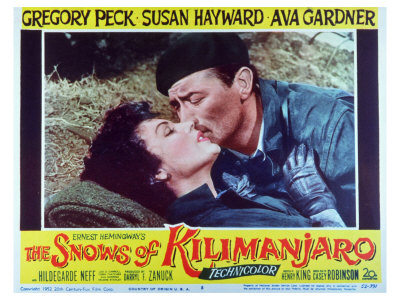
The Snows of Kilimanjaro
My lone venture into author Ernest Hemingway's repertoire is A Farewell to Arms which I had to read for an English class in high school. I don't want to under/over sell my feelings on the book, but I hated it with a passion. It wasn't so much Hemingway's style -- simplistic and understated -- because I appreciated that after reading unnecessarily wordy classics in every class I took. It was the actual story, a lost love story so sugary, so schmaltzy that I wanted both of the main characters to die horrifically. I got through the book thankfully, but it was a trial.
Since then, I've been wary of anything Hemingway-related. I don't avoid him or steer clear of him intentionally, but something he is associated with truly has to catch my eye. Released in 1952, The Snows of Kilimanjaro caught my attention mostly because of the cast while the story sounded suspiciously like A Farewell to Arms. I trudged on though, intent on giving this movie a chance. It was a mixed bag that made me realize Hemingway continued to go back to the same well over and over again. His main character is a variation on himself, a romantic, an idealist and a cynic at the same time who wants to explore and see everything the world has to offer. It sounds interesting at least.
While on safari with girlfriend/lover/fiance, Helen (Susan Hayward), writer/journalist Harry Street (Gregory Peck) scratches his knee on a thorn, the wound quickly becoming infected. Almost certainly staring death in the face if medical attention doesn't arrive soon, Harry lies on his cot in the isolated African savanna waiting for his end. Through the heat and the hallucinations, he looks back on the lost loves of his life, including Cynthia (Ava Gardner) who he meets and falls in love with in Paris following WWI, Countess Liz (Hildegard Knef), a well-to-do member of the upper class he meets on the French Riviera, and then lastly, Helen. But seeing all the mistakes he made in life, Harry tortures himself in what could be his final moments.
During his career, Hemingway went wherever the story was and ended up taking part in the World War I, Spanish Civil War, World War II, African safaris, while also visiting everywhere from Cuba to Paris and all cities in between. He was a storyteller, looking for answers of some sort, why men/women did what they did. That was the biggest appeal of this story. Peck -- apparently channeling a Hemingway-like character -- is always on the move, following the action in his globe-trotting ways. It does become tiresome because we see the toll it takes on Harry's life and those he loves before he ever puts two and two together. Still, a man who will drop anything to follow what he loves to do is an appealing main character.
In my previous Peck reviews, I know I've discussed the mental picture many moviegoers have of the famous Hollywood actor. He's Atticus Finch, the stoic, even wooden main character without much in the way of fire. He did play many roles like that, but through the first 10 years of his career, it was different. He played characters like this. Somewhat eccentric with a fire for life, nothing will stop him. These are the type of roles I typically bring up when someone notes they are not Gregory Peck fans. Even when the movie overall is a disappointment, he rarely is.
Channeling Hemingway though, it's not just the character. It's the lifestyle as well. Director Henry King works off the source novel, but not having read it I can only guess what he was forced to do. Instead of focusing more on Harry and his relationships with Cynthia, Helen and Liz, 'Snow' serves more as a travel guide for the places they visit. Yes, I realize part of the story is Harry's adventures as he explores the world. But long, unedited shots of animals on the African savanna, bullfights in Madrid, and a bizarre ending with a curious hyena do absolutely nothing for the story. Go watch a PBS episode of Nature or The Travel Channel for an idea of what you will get here.
As for the story told in flashback mode, the one with Gardner is given the most attention and for good reason. Frequent on-screen partners, Peck and Gardner had an incredibly natural chemistry that always makes the movie worthwhile to a point. The other two flashbacks are not as successful. Countess Liz is shrill and pretentious while Hayward's Helen feels tacked on to the point we're never given much information about her other than that she falls madly in love with Peck. Hit or miss overall, but that's the movie as a whole. Good and bad with the negative barely outweighing the positive. The movie is available to watch in its entirety on Youtube if you're curious.
The Snows of Kilimanjaro <---trailer (1952): **/****
Since then, I've been wary of anything Hemingway-related. I don't avoid him or steer clear of him intentionally, but something he is associated with truly has to catch my eye. Released in 1952, The Snows of Kilimanjaro caught my attention mostly because of the cast while the story sounded suspiciously like A Farewell to Arms. I trudged on though, intent on giving this movie a chance. It was a mixed bag that made me realize Hemingway continued to go back to the same well over and over again. His main character is a variation on himself, a romantic, an idealist and a cynic at the same time who wants to explore and see everything the world has to offer. It sounds interesting at least.
While on safari with girlfriend/lover/fiance, Helen (Susan Hayward), writer/journalist Harry Street (Gregory Peck) scratches his knee on a thorn, the wound quickly becoming infected. Almost certainly staring death in the face if medical attention doesn't arrive soon, Harry lies on his cot in the isolated African savanna waiting for his end. Through the heat and the hallucinations, he looks back on the lost loves of his life, including Cynthia (Ava Gardner) who he meets and falls in love with in Paris following WWI, Countess Liz (Hildegard Knef), a well-to-do member of the upper class he meets on the French Riviera, and then lastly, Helen. But seeing all the mistakes he made in life, Harry tortures himself in what could be his final moments.
During his career, Hemingway went wherever the story was and ended up taking part in the World War I, Spanish Civil War, World War II, African safaris, while also visiting everywhere from Cuba to Paris and all cities in between. He was a storyteller, looking for answers of some sort, why men/women did what they did. That was the biggest appeal of this story. Peck -- apparently channeling a Hemingway-like character -- is always on the move, following the action in his globe-trotting ways. It does become tiresome because we see the toll it takes on Harry's life and those he loves before he ever puts two and two together. Still, a man who will drop anything to follow what he loves to do is an appealing main character.
In my previous Peck reviews, I know I've discussed the mental picture many moviegoers have of the famous Hollywood actor. He's Atticus Finch, the stoic, even wooden main character without much in the way of fire. He did play many roles like that, but through the first 10 years of his career, it was different. He played characters like this. Somewhat eccentric with a fire for life, nothing will stop him. These are the type of roles I typically bring up when someone notes they are not Gregory Peck fans. Even when the movie overall is a disappointment, he rarely is.
Channeling Hemingway though, it's not just the character. It's the lifestyle as well. Director Henry King works off the source novel, but not having read it I can only guess what he was forced to do. Instead of focusing more on Harry and his relationships with Cynthia, Helen and Liz, 'Snow' serves more as a travel guide for the places they visit. Yes, I realize part of the story is Harry's adventures as he explores the world. But long, unedited shots of animals on the African savanna, bullfights in Madrid, and a bizarre ending with a curious hyena do absolutely nothing for the story. Go watch a PBS episode of Nature or The Travel Channel for an idea of what you will get here.
As for the story told in flashback mode, the one with Gardner is given the most attention and for good reason. Frequent on-screen partners, Peck and Gardner had an incredibly natural chemistry that always makes the movie worthwhile to a point. The other two flashbacks are not as successful. Countess Liz is shrill and pretentious while Hayward's Helen feels tacked on to the point we're never given much information about her other than that she falls madly in love with Peck. Hit or miss overall, but that's the movie as a whole. Good and bad with the negative barely outweighing the positive. The movie is available to watch in its entirety on Youtube if you're curious.
The Snows of Kilimanjaro <---trailer (1952): **/****
Tuesday, December 14, 2010
The Life and Times of Judge Roy Bean
When people get more cynical, so do their movies. In the 1930s, westerns portrayed good guys wearing white hats and bad guys in black duds. By the time Clint Eastwood came along in the spaghetti westerns gunning down anything that would net him a buck, things were up for grabs. Then in the late 1960s and 1970s, somebody decided to put a new spin on the old west, stories that were more cynical in nature that attempted to show what the west was really like. Goodbye romantic, hello cynicism. Say howdy to the revisionist western.
If you look at the list of westerns included in the Wikipedia entry, there are some good entries, but for the most part I don't necessarily like revisionist westerns. They try much too hard to show you that what you've been watching all these years is garbage. Take 1972's The Life and Times of Judge Roy Bean, directed by one of my favorites, John Huston. In telling the story of real-life Roy Bean, this western blends some really awkward comedic moments, overlong sub-plots that go nowhere, some hypocritical views on just about everything (can't decide if that was intended), and in general a waste of a very strong cast.
Sometime around the turn of the century, "outlaw" Roy Bean (Paul Newman) rides into west Texas past the Pecos River, an area notorious for hiding bandits and criminals. At one saloon, they turn on him and leave him for dead only to have the wounded man come back and gun them all down. Disgusted by what he's seen, Bean sets up shop as a judge, administering his unique brand of justice to anyone and everyone looking for trouble. Word spreads and soon he even has deputies who help him out, all in the name of Texas and Lilly Langtry (Ava Gardner), a stage actress from the east, a woman Bean has always been in love with. But Bean's style of justice may catch up with him as civilization follows him around every corner, and his time may be running out.
I don't know where to start with this one because to be fair, Huston doesn't know where to start either. Roy Bean was a real-life judge in west Texas who ended up becoming a legendary figure after he died. So with this revisionist western instead of telling a story that showed what the actual man was like, Huston goes for the ridiculous legend. At a run-time of 120 minutes (a very long 120 minutes), 'Life' is all over the place with no sense of where it's going. The tone ranges from slapstick comedy that produces its fair share of groans -- it did from me at least -- to an oddly serious finale. It tries to be funny while also delivering a hacked up message about the changing times and the last few years of the wild west. Pick one or the other and go with it, but don't waver between the two.
A bright spot not surprisingly is Newman in the titular role, rising above materiel that at times is just beneath him. Newman's parts in the 1970s typically covered a wide variety of movies, and this surely doesn't disappoint. What works is that he commits so fully to this part. His beliefs are ridiculously hypocritical, and he'll string anyone up at the drop of a hat if he disagrees with what's been said or done. If you're loyal to him, he'll be loyal to you, but for heaven's sake don't turn on him. This isn't a part on par with his best performances like Butch Cassidy or Lucas Jackson, but it's a quality one. Even when the movie is dull to watch, it's worthwhile to check out Newman.
So with a story that is light on story and heavy on non-related vignettes, we get a chance to see a long list of actors play small parts (some being on-screen no more than a few seconds). Gardner makes an appearance in the movie's final scene in a moving scene that comes along a little too late. Anthony Perkins is a scene-stealer as a traveling preacher who realizes Newman's Bean may be a little off his rocker but doesn't want to get shot bringing the topic up. Ned Beatty, Matt Clark, Jim Burk, Bill McKinney, and Steve Kanaly are underused but all solid as Bean's loyal deputies. Also watch for Victoria Principal, Tab Hunter, Huston as a grizzled old mountain man, Stacy Keach as an albino gunman, Roddy McDowall, Anthony Zerbe, and Jacqueline Bisset in parts that range from bad to good, your decision on where they fall.
I will give Huston credit for trying new things. Early on, we get narration from Perkins and Hunter, but instead of just hearing it, the camera is placed right in front of them as they ride into town. They're looking right at the audience, addressing us in a cool change of pace, a unique little technique. But then the narration resorts to been there, done that voiceovers. It's just an odd movie overall, one with plenty of flaws but enough positives to give it a mild recommendation.
The Life and Times of Judge Roy Bean <---trailer (1972): **/****
If you look at the list of westerns included in the Wikipedia entry, there are some good entries, but for the most part I don't necessarily like revisionist westerns. They try much too hard to show you that what you've been watching all these years is garbage. Take 1972's The Life and Times of Judge Roy Bean, directed by one of my favorites, John Huston. In telling the story of real-life Roy Bean, this western blends some really awkward comedic moments, overlong sub-plots that go nowhere, some hypocritical views on just about everything (can't decide if that was intended), and in general a waste of a very strong cast.
Sometime around the turn of the century, "outlaw" Roy Bean (Paul Newman) rides into west Texas past the Pecos River, an area notorious for hiding bandits and criminals. At one saloon, they turn on him and leave him for dead only to have the wounded man come back and gun them all down. Disgusted by what he's seen, Bean sets up shop as a judge, administering his unique brand of justice to anyone and everyone looking for trouble. Word spreads and soon he even has deputies who help him out, all in the name of Texas and Lilly Langtry (Ava Gardner), a stage actress from the east, a woman Bean has always been in love with. But Bean's style of justice may catch up with him as civilization follows him around every corner, and his time may be running out.
I don't know where to start with this one because to be fair, Huston doesn't know where to start either. Roy Bean was a real-life judge in west Texas who ended up becoming a legendary figure after he died. So with this revisionist western instead of telling a story that showed what the actual man was like, Huston goes for the ridiculous legend. At a run-time of 120 minutes (a very long 120 minutes), 'Life' is all over the place with no sense of where it's going. The tone ranges from slapstick comedy that produces its fair share of groans -- it did from me at least -- to an oddly serious finale. It tries to be funny while also delivering a hacked up message about the changing times and the last few years of the wild west. Pick one or the other and go with it, but don't waver between the two.
A bright spot not surprisingly is Newman in the titular role, rising above materiel that at times is just beneath him. Newman's parts in the 1970s typically covered a wide variety of movies, and this surely doesn't disappoint. What works is that he commits so fully to this part. His beliefs are ridiculously hypocritical, and he'll string anyone up at the drop of a hat if he disagrees with what's been said or done. If you're loyal to him, he'll be loyal to you, but for heaven's sake don't turn on him. This isn't a part on par with his best performances like Butch Cassidy or Lucas Jackson, but it's a quality one. Even when the movie is dull to watch, it's worthwhile to check out Newman.
So with a story that is light on story and heavy on non-related vignettes, we get a chance to see a long list of actors play small parts (some being on-screen no more than a few seconds). Gardner makes an appearance in the movie's final scene in a moving scene that comes along a little too late. Anthony Perkins is a scene-stealer as a traveling preacher who realizes Newman's Bean may be a little off his rocker but doesn't want to get shot bringing the topic up. Ned Beatty, Matt Clark, Jim Burk, Bill McKinney, and Steve Kanaly are underused but all solid as Bean's loyal deputies. Also watch for Victoria Principal, Tab Hunter, Huston as a grizzled old mountain man, Stacy Keach as an albino gunman, Roddy McDowall, Anthony Zerbe, and Jacqueline Bisset in parts that range from bad to good, your decision on where they fall.
I will give Huston credit for trying new things. Early on, we get narration from Perkins and Hunter, but instead of just hearing it, the camera is placed right in front of them as they ride into town. They're looking right at the audience, addressing us in a cool change of pace, a unique little technique. But then the narration resorts to been there, done that voiceovers. It's just an odd movie overall, one with plenty of flaws but enough positives to give it a mild recommendation.
The Life and Times of Judge Roy Bean <---trailer (1972): **/****
Sunday, December 5, 2010
The Angel Wore Red
I've always enjoyed reading about history, but certain times, incidents, conflicts, and even eras have passed me by. I just never read or learned much about some things more than others. High up on that list is the Spanish Civil War of which I know little more than Spain had a Civil War, and an awareness of controversial general Francisco Franco. Part of the problem with major events in history I'm curious about is where to even start? There's so much going on, and countless books to choose from. Well, it may not count as an official introduction to the Civil War, but 1960's The Angel Wore Red takes place with the conflict as its backdrop.
I was surprised reading reviews at the IMDB that this is a generally panned movie. I'd never even heard of it before it aired on TCM as part of an Ava Gardner tribute despite a pretty impressive cast. Complaints ranged from bad camera technique to awful dubbing to something as simple as the movie being too dark to be able to see anything. If that's important to you, seeing. Now, I'm not expert when it comes to movies, and I typically just try and enjoy the story. A movie has to be pretty awful for me to be critical of many things as long as I'm entertained. So is this a classic? By no means, but I liked it, and it's certainly a change of pace detailing a little told story.
Disillusioned with the direction the Catholic Church is taking and struggling with his own faith, young Spanish priest Arturo Carrera (Dirk Bogarde) leaves his position in the church. His timing is horrible though as a rebellion breaks out the day he leaves with priests an easy target of the revolutionaries. He seeks help from a prostitute, Soledad (Gardner), who isn't aware he's a priest, but Arturo eventually ends up arrested and thrown in jail to await execution. An American newsman, Hawthorne (Joseph Cotten), intervenes though, convincing the rebels that a priest's presence could smooth over objections some of the troops are having. With concerns over Soledad's safety, Arturo goes along with the plan as the violence escalates, much of it revolving around a missing religious relic that both sides want to get their hands on.
Now with little knowledge of the Spanish Civil War and its background, I will say this is a poor introduction. The revolution is obviously the backdrop to the story, but there's little explanation of what is actually going on with the exception of a few names thrown around here and there; notably the Socialist party and I think Franco once or twice. Basically, I was confused with what was actually going on throughout the story, and it never really clears up. It isn't a huge roadblock because once you get involved with the story you know the characters are in danger, and that's enough motivation. Still, when I watch a historical movie I like to have some idea what's going on, but maybe that's just me.
What did work with the otherwise confusing story was a sub-plot that dealt with faith on both an individual level and on a larger scale that faith can have an impact on large, powerful groups of people. Before a Spanish cathedral is destroyed, the cardinal saves a religious relic that's long been a part of Catholic history; a drop of blood believed to be from St. John. It's believed that whoever has possession of the blood cannot be defeated so naturally both sides want control of it. A diminutive priest (Aldo Fabrizi) who knows its location delivers a powerful, very moving monologue about the power of faith and how it can drive people to do things differently than they normally would have, putting themselves in the face of danger because they believe they will be all right. Amidst all the criticism of the movie as a movie, this sub-plot is untouched and the high point of the movie.
So two main characters are a Spanish priest and a young Spanish prostitute. Naturally, I'd assume an English actor who doesn't look Spanish, and an American actress who could maybe pass as Spanish would play those two roles. Jokes aside though, Bogarde and Gardner are the least of the movie's worries. Thankfully Bogarde doesn't attempt any hokey accent even if it does sound odd to listen to a Spanish priest speak with a very English accent. Gardner plays a role she so often did, a woman with a reputation. She plays these parts so well you can take it for granted at times what a good actress she was. The disillusioned priest and the prostitute fall for each other in a relationship that never feels forced or unnecessary. They have a definite chemistry together that does a good job of anchoring the movie.
Looking at the criticisms are they fair looking back on the movie? Yeah, I guess so. The dubbing does seem odd at times -- especially Vittorio De Sica as General Clave -- and the movie is dark visually where it can be hard at times to make things out through the shadows. But watching the movie, none of those things truly bothered me. I was aware of them, yes, but that's it. Cotten ends up being the cliched American newsman (even wearing an eye patch) who delivers a cliched narration about war and how awful it is. So as I write all this, I'm thinking this is all coming across as too negative, but I did like the movie mostly because of Bogarde and Gardner.
The Angel Wore Red <---TCM trailer (1960): ***/****
I was surprised reading reviews at the IMDB that this is a generally panned movie. I'd never even heard of it before it aired on TCM as part of an Ava Gardner tribute despite a pretty impressive cast. Complaints ranged from bad camera technique to awful dubbing to something as simple as the movie being too dark to be able to see anything. If that's important to you, seeing. Now, I'm not expert when it comes to movies, and I typically just try and enjoy the story. A movie has to be pretty awful for me to be critical of many things as long as I'm entertained. So is this a classic? By no means, but I liked it, and it's certainly a change of pace detailing a little told story.
Disillusioned with the direction the Catholic Church is taking and struggling with his own faith, young Spanish priest Arturo Carrera (Dirk Bogarde) leaves his position in the church. His timing is horrible though as a rebellion breaks out the day he leaves with priests an easy target of the revolutionaries. He seeks help from a prostitute, Soledad (Gardner), who isn't aware he's a priest, but Arturo eventually ends up arrested and thrown in jail to await execution. An American newsman, Hawthorne (Joseph Cotten), intervenes though, convincing the rebels that a priest's presence could smooth over objections some of the troops are having. With concerns over Soledad's safety, Arturo goes along with the plan as the violence escalates, much of it revolving around a missing religious relic that both sides want to get their hands on.
Now with little knowledge of the Spanish Civil War and its background, I will say this is a poor introduction. The revolution is obviously the backdrop to the story, but there's little explanation of what is actually going on with the exception of a few names thrown around here and there; notably the Socialist party and I think Franco once or twice. Basically, I was confused with what was actually going on throughout the story, and it never really clears up. It isn't a huge roadblock because once you get involved with the story you know the characters are in danger, and that's enough motivation. Still, when I watch a historical movie I like to have some idea what's going on, but maybe that's just me.
What did work with the otherwise confusing story was a sub-plot that dealt with faith on both an individual level and on a larger scale that faith can have an impact on large, powerful groups of people. Before a Spanish cathedral is destroyed, the cardinal saves a religious relic that's long been a part of Catholic history; a drop of blood believed to be from St. John. It's believed that whoever has possession of the blood cannot be defeated so naturally both sides want control of it. A diminutive priest (Aldo Fabrizi) who knows its location delivers a powerful, very moving monologue about the power of faith and how it can drive people to do things differently than they normally would have, putting themselves in the face of danger because they believe they will be all right. Amidst all the criticism of the movie as a movie, this sub-plot is untouched and the high point of the movie.
So two main characters are a Spanish priest and a young Spanish prostitute. Naturally, I'd assume an English actor who doesn't look Spanish, and an American actress who could maybe pass as Spanish would play those two roles. Jokes aside though, Bogarde and Gardner are the least of the movie's worries. Thankfully Bogarde doesn't attempt any hokey accent even if it does sound odd to listen to a Spanish priest speak with a very English accent. Gardner plays a role she so often did, a woman with a reputation. She plays these parts so well you can take it for granted at times what a good actress she was. The disillusioned priest and the prostitute fall for each other in a relationship that never feels forced or unnecessary. They have a definite chemistry together that does a good job of anchoring the movie.
Looking at the criticisms are they fair looking back on the movie? Yeah, I guess so. The dubbing does seem odd at times -- especially Vittorio De Sica as General Clave -- and the movie is dark visually where it can be hard at times to make things out through the shadows. But watching the movie, none of those things truly bothered me. I was aware of them, yes, but that's it. Cotten ends up being the cliched American newsman (even wearing an eye patch) who delivers a cliched narration about war and how awful it is. So as I write all this, I'm thinking this is all coming across as too negative, but I did like the movie mostly because of Bogarde and Gardner.
The Angel Wore Red <---TCM trailer (1960): ***/****
Labels:
1960s,
Ava Gardner,
Dirk Bogarde,
Joseph Cotten,
Vittorio De Sica
Tuesday, August 10, 2010
On the Beach
Not having lived through the Cold War, it's hard to fathom a life that always had a death cloud hanging over the world. If the U.S. and the Soviet Union did decide to go to war, it would have been over in minutes with no real winner thanks to weapons that guaranteed both sides would be wiped out. There was always that threat, that looming danger of what could be. Movies like Fail Safe, Dr. Strangelove, and The Bedford Incident are just some of the movies that have dealt with this subject, but it's the rarer film that deals with after that big what-if, like 1959's On the Beach.
An American submarine commanded by Capt. Dwight Towers (Gregory Peck) surfaces off the coast of Australia and docks. A nuclear holocaust has wiped out most of the world's population, but Australia was untouched by the apocalyptic fighting. Towers and the U.S.S. Sawfish arrive to find a country and a continent not quite sure what to do with themselves. Scientists and intellectuals predict that Australia has five or six months before radiation from the fallout reaches them, and then it will be a quick process of a week or two before all survivors are killed too. With possibly months to live, what do you do? Towers and his sub head north to see if there's any hope of survival, that the radiation may miss Australia.
First off, this has to qualify as one of the most depressing movies I've ever seen. Director Stanley Kramer creates quite a vision of what a post-apocalyptic world would be like. The whole purpose of the movie is to ask what would your reaction be if you knew you only had months to live? The vehicle of a nuclear fallout is how you to that question, but it works just as well dealing with mortality, we're all going to die. It's just a matter of when and how. The story is honest and doesn't try to whitewash anything here, these people are doomed and respond in different ways.
We see these reactions through a wide range of characters. Peck's Towers lost his wife and two kids back home but sees similarities in an Australian woman, Moira Davidson (Ava Gardner), who has nothing and no one to live for. A young navy officer (Anthony Perkins) deals with his wife (Donna Anderson) who refuses to admit that anything is wrong, and that down the road to avoid unspeakable pain she may have to take her life and that of her baby. An older scientist/doctor (Fred Astaire) copes by drinking and working on a Ferrari sports car he's purchased. No one reacts the same way, all responding individually to this horror that is presented.
Some moments provide these powerful instances of how the individual would respond. While patrolling outside San Francisco, Towers' sub has a member of the crew (John Meillon) who is a native of the city escape from the sub and swim ashore, knowing he will die in a matter of days instead of months waiting back in Australia. He tells Towers he wants to die at home, not in some strange place. The scene where the sailor talks with Peck (via loudspeaker) is an incredibly moving one. Just as moving, a scene where Astaire explains how this probably all started; one man probably looking at a computer screen swearing he saw a blip, an attack, and pushing the button or turning the key to assure the mutual destruction. Kramer's film has a lot of these powerful moments, both those two stand out from the rest.
For a movie that deals with the end of the world as we know it, in other words an epic scale, it also a very personal movie. It depends on your reaction to the end of the world, your feelings about knowing that death is coming and there's nothing you can do about it. My worry about halfway through the movie was that Kramer was waiting to pull the rug out from under the viewer, provide some sort of ridiculous solution that will allow these people to survive. My worries were unfounded, Kramer is too talented of a director to do that, force some happy ending on the viewer for a story that needs to have an unhappy one. The last 10 minutes are a perfect ending -- watch HERE -- including a final, very timely warning to 1959 viewers.
My one complaint, a minor one at that in relation to the whole movie, is that no one in Australia really tries to do anything to ensure survival. With five or six months, much could be accomplished whether it's bomb shelters or finding some protection from the radiation. Maybe it's naive to think that, probably only saving a few extra weeks or months, but all of Australia is content to go on with their lives as normal, drink a lot, go to the beach. Everyone just seems freakishly calm, no riots, no looting. They're all very mannerly about the end of the world. A minor flaw in an otherwise really effective movie, but one I felt I had to point out. Don't let it stop you from checking this one out.
On the Beach <----TCM trailer (1959): *** 1/2 /****
An American submarine commanded by Capt. Dwight Towers (Gregory Peck) surfaces off the coast of Australia and docks. A nuclear holocaust has wiped out most of the world's population, but Australia was untouched by the apocalyptic fighting. Towers and the U.S.S. Sawfish arrive to find a country and a continent not quite sure what to do with themselves. Scientists and intellectuals predict that Australia has five or six months before radiation from the fallout reaches them, and then it will be a quick process of a week or two before all survivors are killed too. With possibly months to live, what do you do? Towers and his sub head north to see if there's any hope of survival, that the radiation may miss Australia.
First off, this has to qualify as one of the most depressing movies I've ever seen. Director Stanley Kramer creates quite a vision of what a post-apocalyptic world would be like. The whole purpose of the movie is to ask what would your reaction be if you knew you only had months to live? The vehicle of a nuclear fallout is how you to that question, but it works just as well dealing with mortality, we're all going to die. It's just a matter of when and how. The story is honest and doesn't try to whitewash anything here, these people are doomed and respond in different ways.
We see these reactions through a wide range of characters. Peck's Towers lost his wife and two kids back home but sees similarities in an Australian woman, Moira Davidson (Ava Gardner), who has nothing and no one to live for. A young navy officer (Anthony Perkins) deals with his wife (Donna Anderson) who refuses to admit that anything is wrong, and that down the road to avoid unspeakable pain she may have to take her life and that of her baby. An older scientist/doctor (Fred Astaire) copes by drinking and working on a Ferrari sports car he's purchased. No one reacts the same way, all responding individually to this horror that is presented.
Some moments provide these powerful instances of how the individual would respond. While patrolling outside San Francisco, Towers' sub has a member of the crew (John Meillon) who is a native of the city escape from the sub and swim ashore, knowing he will die in a matter of days instead of months waiting back in Australia. He tells Towers he wants to die at home, not in some strange place. The scene where the sailor talks with Peck (via loudspeaker) is an incredibly moving one. Just as moving, a scene where Astaire explains how this probably all started; one man probably looking at a computer screen swearing he saw a blip, an attack, and pushing the button or turning the key to assure the mutual destruction. Kramer's film has a lot of these powerful moments, both those two stand out from the rest.
For a movie that deals with the end of the world as we know it, in other words an epic scale, it also a very personal movie. It depends on your reaction to the end of the world, your feelings about knowing that death is coming and there's nothing you can do about it. My worry about halfway through the movie was that Kramer was waiting to pull the rug out from under the viewer, provide some sort of ridiculous solution that will allow these people to survive. My worries were unfounded, Kramer is too talented of a director to do that, force some happy ending on the viewer for a story that needs to have an unhappy one. The last 10 minutes are a perfect ending -- watch HERE -- including a final, very timely warning to 1959 viewers.
My one complaint, a minor one at that in relation to the whole movie, is that no one in Australia really tries to do anything to ensure survival. With five or six months, much could be accomplished whether it's bomb shelters or finding some protection from the radiation. Maybe it's naive to think that, probably only saving a few extra weeks or months, but all of Australia is content to go on with their lives as normal, drink a lot, go to the beach. Everyone just seems freakishly calm, no riots, no looting. They're all very mannerly about the end of the world. A minor flaw in an otherwise really effective movie, but one I felt I had to point out. Don't let it stop you from checking this one out.
On the Beach <----TCM trailer (1959): *** 1/2 /****
Labels:
1950s,
Anthony Perkins,
Apocalyptic,
Ava Gardner,
Fred Astaire,
Gregory Peck,
Stanley Kramer
Friday, July 30, 2010
The Great Sinner
Where do writers get inspiration to actually write? I'd say it would depend on each individual writer, but for many it is easiest to look to those people around them, those closest to them, for a jumping off point. Or in the case of Gregory Peck in 1949's The Great Sinner, pick up a beautiful stranger in 1860s Europe, fall for her, find out she's a gambling addict, and then try to figure out gambling's appeal. And then wrap it all up in a nice succinct 110-minute movie. Easy enough, huh?
Addiction stories aren't limited to gambling of course, but there's a certain ease with them. As opposed to some other addictions, there's no drugs, drinking, sex, violence so in terms of visual it can be easier to digest and not so uncomfortable to watch. On the positive side, gambling allows you to show this obsession that is almost entirely mental as opposed to physical. Other movies have dealt with the good and bad sides of gambling (check out THIS site) so it can be hard to say something new or unique about the issue. That's where 'Great Sinner' falls. It's nothing new, but it's a good enough movie.
Traveling west to Paris from Moscow, young successful writer Fedja (Peck) shares a compartment with a beautiful young woman, Pauline Ostrovsky (Ava Gardner). Her looks have such a pull on him that he leaves the train when she does in a resort town that houses an immense casino. Fedja hits it off right away with Pauline and falls hard for her only to realize she's addicted to gambling in any and all of its forms. Her addiction fascinates him -- how could such a simple game have this profound effect on people? -- and forces him to find out the reason, possibly turning his personal investigation into a future book. But in doing so could he risk his own addiction while also losing Pauline?
A story condemning the dangers of gambling is probably as old as gambling itself. Instead of criticizing the game though, 'Sinner' chooses to go after the people so deeply affected by it. Besides Fedja and Pauline, there's Aristide Pitard (Frank Morgan), an old man given a way to leave the casino by Fedja only to return with the money given to him to buy a train ticket. There's Pauline's father, General Ostrovsky (Walter Huston), a gentleman thief if there ever was. There's Armand de Grasse (Melvyn Douglas), the casino owner pulling strings left and right to make himself richer and everyone else suffer. With this wide range of characters, we get a look at gambling's impact across the board instead of one or two characters. Also look for Ethel Barrymore as Pauline's grandmother who looks down her nose at any sort of betting, and Agnes Morehead as a pawn shop owner who capitalizes on the need to gamble for others.
The supporting cast surely doesn't disappoint, but Peck and Gardner as the two leads certainly work together. They have a definite chemistry together that carries through some of the slower scenes in the middle of the movie. Often accused of being wooden in his roles, Peck goes through quite an arc as a character, starting as a high and mighty writer and ending as an addict of epic proportions to the game he looked down upon. One of the most classically beautiful actresses ever to appear in a movie, Gardner is an underrated performer and while this isn't her best role, it certainly makes the most of a character that could have been one big stereotype. Of course, her looks don't hurt either so she's got that going for her.
Through the ups and downs of the story, my favorite was the turning point midway through when Peck's Fedja, desperate to get Pauline out of a bad situation and needing some cash, goes to the roulette table in hopes of winning enough money to basically buy her freedom. It's a longer sequence that shows his curiosity getting the best of him and some beginner's luck turning into a ridiculous winning streak. You can watch it HERE with it continuing into the next part at Youtube. Peck's voiceover is just right -- not under or overdone -- and shows how quickly gambling and a winning streak can come together and fall apart in the matter of seconds.
At a certain point though, the 'gambling is bad' idea gets to be a little preachy. Fedja's madness into his gambling addiction gets to be a little tedious, not in what's happening, but because it takes so long getting there. It's never dull, just not as well-handled as the build-up to it all. If you're looking to give this one a try, start at Youtube with Part 1 of 12.
The Great Sinner <----TCM trailer (1949): ** 1/2 /****
Addiction stories aren't limited to gambling of course, but there's a certain ease with them. As opposed to some other addictions, there's no drugs, drinking, sex, violence so in terms of visual it can be easier to digest and not so uncomfortable to watch. On the positive side, gambling allows you to show this obsession that is almost entirely mental as opposed to physical. Other movies have dealt with the good and bad sides of gambling (check out THIS site) so it can be hard to say something new or unique about the issue. That's where 'Great Sinner' falls. It's nothing new, but it's a good enough movie.
Traveling west to Paris from Moscow, young successful writer Fedja (Peck) shares a compartment with a beautiful young woman, Pauline Ostrovsky (Ava Gardner). Her looks have such a pull on him that he leaves the train when she does in a resort town that houses an immense casino. Fedja hits it off right away with Pauline and falls hard for her only to realize she's addicted to gambling in any and all of its forms. Her addiction fascinates him -- how could such a simple game have this profound effect on people? -- and forces him to find out the reason, possibly turning his personal investigation into a future book. But in doing so could he risk his own addiction while also losing Pauline?
A story condemning the dangers of gambling is probably as old as gambling itself. Instead of criticizing the game though, 'Sinner' chooses to go after the people so deeply affected by it. Besides Fedja and Pauline, there's Aristide Pitard (Frank Morgan), an old man given a way to leave the casino by Fedja only to return with the money given to him to buy a train ticket. There's Pauline's father, General Ostrovsky (Walter Huston), a gentleman thief if there ever was. There's Armand de Grasse (Melvyn Douglas), the casino owner pulling strings left and right to make himself richer and everyone else suffer. With this wide range of characters, we get a look at gambling's impact across the board instead of one or two characters. Also look for Ethel Barrymore as Pauline's grandmother who looks down her nose at any sort of betting, and Agnes Morehead as a pawn shop owner who capitalizes on the need to gamble for others.
The supporting cast surely doesn't disappoint, but Peck and Gardner as the two leads certainly work together. They have a definite chemistry together that carries through some of the slower scenes in the middle of the movie. Often accused of being wooden in his roles, Peck goes through quite an arc as a character, starting as a high and mighty writer and ending as an addict of epic proportions to the game he looked down upon. One of the most classically beautiful actresses ever to appear in a movie, Gardner is an underrated performer and while this isn't her best role, it certainly makes the most of a character that could have been one big stereotype. Of course, her looks don't hurt either so she's got that going for her.
Through the ups and downs of the story, my favorite was the turning point midway through when Peck's Fedja, desperate to get Pauline out of a bad situation and needing some cash, goes to the roulette table in hopes of winning enough money to basically buy her freedom. It's a longer sequence that shows his curiosity getting the best of him and some beginner's luck turning into a ridiculous winning streak. You can watch it HERE with it continuing into the next part at Youtube. Peck's voiceover is just right -- not under or overdone -- and shows how quickly gambling and a winning streak can come together and fall apart in the matter of seconds.
At a certain point though, the 'gambling is bad' idea gets to be a little preachy. Fedja's madness into his gambling addiction gets to be a little tedious, not in what's happening, but because it takes so long getting there. It's never dull, just not as well-handled as the build-up to it all. If you're looking to give this one a try, start at Youtube with Part 1 of 12.
The Great Sinner <----TCM trailer (1949): ** 1/2 /****
Wednesday, March 3, 2010
The Night of the Iguana
Making his directorial debut in 1941, John Huston did the equivalent of sprinting out of the box, making 1941's The Maltese Falcon for his first movie. Huston just kept on going, turning in classic after classic in a career that spanned five decades and almost 50 movies. Of course, they weren't all classics, and the Hollywood veteran did slow down by the late 1950s. His movies always had a hard, realistic edge that never pulled any punches with their storytelling.
One of his lesser known but highly regarded movies among critics, 1964's The Night of the Iguana, was ahead of its time in its ability to tackle some controversial subject matter and deal with it in an honest and forthright fashion. So a couple years before the drug culture and hippies and Woodstock came along -- and all the freeing attitudes movies dealt with in the late 60s and early 70s -- Huston's movie deals with lesbians, statutory rape, threesomes, pot, and a defrocked priest who may or may not have had an inappropriate relationship with a minor, and all of this taking place at a run-down Mexican resort.
Leading a tour bus through Mexico, a former priest, Reverend T. Lawrence Shannon (Richard Burton), doesn't seem to be able to avoid trouble. One of the women on his tour believes he's trying to seduce an underage girl (Sue Lyon) when really the girl, Charlotte, is pursuing Shannon. Pushed to his limit, Shannon freaks out and drives the bus to an old inn cut into a mountainside overlooking the sea near Puerto Vallarta. The women running the inn, Maxine (Ava Gardner), is an old friend of his and is only a few weeks removed from her husband's death. While Shannon deals with the problems among his customers, a woman shows up at the inn, Hannah Jelkes (Deborah Kerr), who with her poet grandfather is traveling around the world with what little money they have.
Watching this over the last couple days, my first reaction was that the proceedings are all very theatrical from the limited sets to the verbose, larger than life characters. Needless to say, finding out 'Iguana' is based on a play by Tennessee Williams didn't come as much of a surprise. Huston filmed the movie in Mexico -- one of his favorite locations -- and more specifically Puerto Vallarta, but limits much of the story to this seaside inn. The story is almost completely self-contained at the inn and limits the number of people/characters around. It's secluded and because of this, the story keys in exclusively on this variety of people and their issues. No distractions, no diversions, just some weird folks working things out.
The casting is phenomenal with Huston giving his leads -- Burton, Gardner, and Kerr -- a lot of leeway in how to bring their characters to life. I would have paid to listen to Burton read a phone book, his voice is perfect for movies. His Rev. T. Lawrence Shannon is a tough one to read because we don't see the incidents from his past that caused him to be kicked out of the priesthood. Did he or didn't he do it? Who really knows for sure? However you decide to interpret the character, Shannon is fascinating as Burton presents him. This is a good example of a scenery-chewing role with lots of yelling, screaming and theatrics a-plenty. Kerr is just the opposite -- as she almost always was onscreen. She's quiet, well-spoken, dignified and a lady, in the process stealing the scenes the duo have together.
One particular scene with Burton and Kerr late in the movie is the high point and really allows you to get to know these characters. But the real star of the movie is Gardner from character introduction to final scene. She's often remembered as all beauty and no ability because, let's face it, she's drop dead gorgeous. But Ava Gardner was a great actress as well and could easily carry a movie if it was required. She isn't needed to carry 'Iguana' but she does it anyway. Her Maxine lives her life as she tries to transition with her husband's death, and in the process really doesn't care what people think of her or her actions. Throw in a group of middle-aged religious women staying at her inn, and we've got ourselves a situation.
It's a good thing these three main performances are so good -- as is the small supporting cast -- because the subject matter could have easily overshadowed the characters. Of all the things mentioned before, none of them are in your face with an aggressive 'hey, look at what we're talking about style!' Huston doesn't linger on these moments, instead mentioning them and moving on. At one point, Burton's Shannon urinates on the luggage of one of the women, but unless you listen closely you'd never know what he did. He may go for the shock value, but it's over so quick it never gets old, repetitive, or exploitative. It's still more than a little odd hearing about some of these things -- like lesbians or Ava Gardner having a threesome in the ocean with two young Mexican men -- but Huston handles it in a way that is appropriate for the time and the story.
This was a weird movie all-around that got better as the story developed. The first hour was a little slow-going for my taste but picks up when Kerr shows up, seemingly out of nowhere, at Gardner's little inn. The last hour is great with the leads really getting a chance to show off their chops and dive right into the story. It's a beautiful movie filmed in black and white that if nothing else will surely bring up some interesting conversations. Very different from most movies made in 1964, and for that reason alone worth checking out. Available to watch on Youtube, starting with Part 1 of 11.
The Night of the Iguana <----trailer (1964): ***/****
One of his lesser known but highly regarded movies among critics, 1964's The Night of the Iguana, was ahead of its time in its ability to tackle some controversial subject matter and deal with it in an honest and forthright fashion. So a couple years before the drug culture and hippies and Woodstock came along -- and all the freeing attitudes movies dealt with in the late 60s and early 70s -- Huston's movie deals with lesbians, statutory rape, threesomes, pot, and a defrocked priest who may or may not have had an inappropriate relationship with a minor, and all of this taking place at a run-down Mexican resort.
Leading a tour bus through Mexico, a former priest, Reverend T. Lawrence Shannon (Richard Burton), doesn't seem to be able to avoid trouble. One of the women on his tour believes he's trying to seduce an underage girl (Sue Lyon) when really the girl, Charlotte, is pursuing Shannon. Pushed to his limit, Shannon freaks out and drives the bus to an old inn cut into a mountainside overlooking the sea near Puerto Vallarta. The women running the inn, Maxine (Ava Gardner), is an old friend of his and is only a few weeks removed from her husband's death. While Shannon deals with the problems among his customers, a woman shows up at the inn, Hannah Jelkes (Deborah Kerr), who with her poet grandfather is traveling around the world with what little money they have.
Watching this over the last couple days, my first reaction was that the proceedings are all very theatrical from the limited sets to the verbose, larger than life characters. Needless to say, finding out 'Iguana' is based on a play by Tennessee Williams didn't come as much of a surprise. Huston filmed the movie in Mexico -- one of his favorite locations -- and more specifically Puerto Vallarta, but limits much of the story to this seaside inn. The story is almost completely self-contained at the inn and limits the number of people/characters around. It's secluded and because of this, the story keys in exclusively on this variety of people and their issues. No distractions, no diversions, just some weird folks working things out.
The casting is phenomenal with Huston giving his leads -- Burton, Gardner, and Kerr -- a lot of leeway in how to bring their characters to life. I would have paid to listen to Burton read a phone book, his voice is perfect for movies. His Rev. T. Lawrence Shannon is a tough one to read because we don't see the incidents from his past that caused him to be kicked out of the priesthood. Did he or didn't he do it? Who really knows for sure? However you decide to interpret the character, Shannon is fascinating as Burton presents him. This is a good example of a scenery-chewing role with lots of yelling, screaming and theatrics a-plenty. Kerr is just the opposite -- as she almost always was onscreen. She's quiet, well-spoken, dignified and a lady, in the process stealing the scenes the duo have together.
One particular scene with Burton and Kerr late in the movie is the high point and really allows you to get to know these characters. But the real star of the movie is Gardner from character introduction to final scene. She's often remembered as all beauty and no ability because, let's face it, she's drop dead gorgeous. But Ava Gardner was a great actress as well and could easily carry a movie if it was required. She isn't needed to carry 'Iguana' but she does it anyway. Her Maxine lives her life as she tries to transition with her husband's death, and in the process really doesn't care what people think of her or her actions. Throw in a group of middle-aged religious women staying at her inn, and we've got ourselves a situation.
It's a good thing these three main performances are so good -- as is the small supporting cast -- because the subject matter could have easily overshadowed the characters. Of all the things mentioned before, none of them are in your face with an aggressive 'hey, look at what we're talking about style!' Huston doesn't linger on these moments, instead mentioning them and moving on. At one point, Burton's Shannon urinates on the luggage of one of the women, but unless you listen closely you'd never know what he did. He may go for the shock value, but it's over so quick it never gets old, repetitive, or exploitative. It's still more than a little odd hearing about some of these things -- like lesbians or Ava Gardner having a threesome in the ocean with two young Mexican men -- but Huston handles it in a way that is appropriate for the time and the story.
This was a weird movie all-around that got better as the story developed. The first hour was a little slow-going for my taste but picks up when Kerr shows up, seemingly out of nowhere, at Gardner's little inn. The last hour is great with the leads really getting a chance to show off their chops and dive right into the story. It's a beautiful movie filmed in black and white that if nothing else will surely bring up some interesting conversations. Very different from most movies made in 1964, and for that reason alone worth checking out. Available to watch on Youtube, starting with Part 1 of 11.
The Night of the Iguana <----trailer (1964): ***/****
Labels:
1960s,
Ava Gardner,
Deborah Kerr,
John Huston,
Richard Burton
Friday, February 5, 2010
55 Days at Peking
I'll be the first to admit that while U.S. history is one of my favorite subjects, I know very little about Asian history whether it be China, Japan or anything in between. The subject covered in 'Peking' is the Boxer Rebellion, which I've always been aware of but couldn't have told you one thing about it. Reading some reviews and critiques of the movie, it seems history was handled fairly and mostly honestly. Looking at it that way, it serves then as both a history lesson and an entertaining epic.
Arriving in 1900 Peking with a company of U.S. Marines, Major Matt Lewis (Heston) finds a city in turmoil and on the brink of war. The Boxers, a large group of anti-imperialism/anti-catholic citizens, are ready to revolt. The world powers all have an ambassador and embassy in Peking with a token force of their military -- around 400 total men -- there for protection. British ambassador Sir Arthur Robertson (David Niven) somehow convinces the other ambassadors to stay even when a revolution seems imminent that could take all their lives. The armed forces along with all family, women and children move into the Legation Quarter, a walled city that can serve as a fortress. But with limited supplies, including food and ammunition, can the multi-national group survive until reinforcements arrive?
Based on the actual Boxer Rebellion history, 'Peking' holds many similarities with 1960's The Alamo both in history and in movies with composer Dimitri Tiomkin doing the score for both. After some background, both historical and character driven, most of the movie settles in for the extended siege of the Legation Quarter. Director Nicholas Ray -- who usually worked on smaller, more manageable movies -- has his work cut out for him. Making a siege interesting to watch is a challenge, but Ray succeeds. The almost two-month long battle is never dull with plenty of tension and action, but more on that later.
Once past the big name stars, 'Peking' doesn't have a cast of thousands of A-list stars, but the leads more than handle their own. Heston is an ideal choice for the tough U.S. Marine trying to do what's right, and Niven hits all the right notes as a former soldier turned ambassador trying to prove he belongs. Rising above just an unnecessary eye candy role, Ava Gardner nails her part as Baroness Natalie Ivanoff, a woman being kicked out of the city forced to re-enter upon the attack. She has an instant connection with Heston's Lewis, but thankfully the script calls for her to dig deeper as Natalie sees the horror of the fighting. Also starring are Flora Robson as Empress Tzu-Hsi, John Ireland as Sgt. Harry, one of Heston's Marines, and Harry Andrews as Father de Bearn, a priest with some military background. There's also a worthwhile subplot with a Chinese girl (Lynne Sue Moon) who's father is a Marine.
A good test if whether the movie you're watching is an epic has an overture, intermission, and exit music. If you answered 'yes' to the question, enjoy YOUR EPIC! 'Peking' has spectacle written all over it from the cast to the sets to the thousands of extras. Huge sets were constructed in Spain, and they're a site to behold, giving the story a real authenticity that would have been lost with models or green screens. Hundreds and thousands of extras fill the screen for the battle scenes which are some of the bigger ones ever committed to the screen. With the list of differing armed forces nationalities, there's even some humor, like Ireland's Sgt. waking up soldiers in a litany of languages.
Now for whatever reason -- probably because it's a good movie and what'd be the point of it -- this movie has not been released on DVD, not a good one at least. It's one of those epics where you can honestly say 'they don't make them like that anymore.' 'Peking' is everything that was big and grand about a roadshow version of a movie with great casting, a bigger than life historical story, memorable score, huge action, and surprisingly enough, an effective message. After all, the Boxers just want their country back...even if they go about it in an extreme fashion.
I was unable to find a trailer -- an English one anyways, if you understand German I can help you out -- but TCM has posted 4 clips you can watch through their website. The print shown on TCM was pretty near flawless if you ask me so how about those studio execs get off their butts and get this one on DVD.
55 Days at Peking (1963): *** 1/2 /****
Subscribe to:
Posts (Atom)