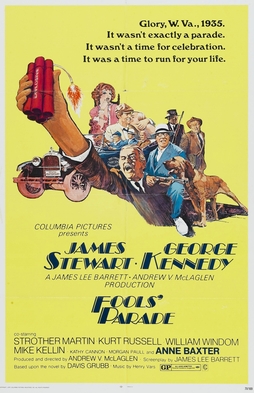
So you know what sounded pretty awful? The Great Depression. Man, I'm good at writing introductions to these reviews, aren't I? For every well-known Depression-era movie out there, it seems like there's that many more generally forgotten in a wave of flicks. Here's one I stumbled across on a cable movie channel recently and simply couldn't pass up because of an impressive cast, 1971's Fools' Parade.
It's 1935 and three convicts are being released from a West Virginia penitentiary, including Mattie Appleyard (James Stewart), Lee (Strother Martin) and Johnny (Kurt Russell), all of them having served their sentence for varying crimes. They're driven to the train station by a vicious prison guard, Doc Council (George Kennedy), who ominously states that he'll see them soon. The trio boards the train with plans of opening a general store down the train line, using Mattie's hard-earned savings as a bankroll to get things started. There's a problem though as they get further away from the town and penitentiary. Mattie's check -- earned and saved from 40 years in prison -- can only be cashed back in Glory...where they've been less than pleasantly told to never come back. If they do, Council will be waiting for them. That's not their only problem. Council may not even be waiting that long to hunt them down...
From the older classic like The Grapes of Wrath to the newer entries like O, Brother, Where Art Thou, Depression-era flicks are a cool little genre of flicks that doesn't always get a ton of attention. Maybe it's the whole soul-killing tone of these flicks. Maybe. I don't know. The 1970's especially had some cool entries, including this flick, Emperor of the North Pole, Hard Times, Paper Moon and Dillinger among others. 'Parade' belongs in that group. It's dark(ish), gritty and has the look and feel of one of America's roughest historical stretches.
So why then does this 1971 drama with some light comedy touches have virtually no reputation? Virtually no following? Well, for starters, it most definitely and assuredly is very, very odd. I can't specifically put a finger on said oddness, but it is. It's there. It...is...odd. Maybe as close as I can get is the tone, or lack of. From director Andrew McLaglen and a screenplay by James Lee Barrett, 'Parade' is just a bit of an oddball flick. It's able to build up an impressive sense of doom early on but it never quite takes off. Things slowly derail as the 98-minute running time nears its finish. Still, this is a movie that's never dull or boring. Very watchable, just odd.
Sometimes, an all over the place tone comes in second to something, anything else that's far more appealing. Here, that's easy. It's the cast. That cast. We mostly follow our three recently-freed crooks in Stewart, Martin and Russell. Stewart's Mattie served a 40-year sentence for killing two men, Martin's Lee six years for bank robbery, and Russell's Johnny a shorter sentence for an incident with a girl that's generally left unexplained. The story doesn't linger long on our trio's past criminal transgressions (wisely), instead focusing on them trying to start over again, albeit at different points in their lives. I especially liked Stewart as Mattie, sporting a bizarre-looking glass eye, the oldest of the three who most strongly wants that fresh start. He stashed away all his money during his 40-year sentence (earning a ridiculous-sounding $25,000) and now meets all sorts of roadblocks in getting that cash. Martin's Lee is seemingly a little simple-minded in his obsession with putting together a general store inventory while Russell's Johnny is stubbornly loyal to Mattie. Still, there's something charming about the trio, and there is a solid chemistry among the group.
An interesting cast all-around. When he wanted to, George Kennedy could play one interesting bad guy, and that's on display here. It's just creepy watching him. You're rooting for him to get his due and get it badly. Who else to watch for? An unrecognizable Anne Baxter as a madam who's fallen on hard times, William Windom as an unlucky traveling salesman, Mike Kellin and Morgan Paull as Doc's oddball killers, Robert Donner as a train conductor, Katherine Cannon as Baxter's lone "girl," and David Huddleston as the greedy bank owner. Quite the eclectic bunch!
I can't quite put my finger on it as to 'why' exactly, but I very much enjoyed this movie. Though the subject matter is dark, it is an easy-going, mostly pleasant movie. Yeah, it is a touch slow at times for a movie that runs just 98-minutes, but it is never dull. The West Virginia filming locations are an ideal backdrop for the story as well, giving it an authentic sense of watching where this story would have actually happened. Worth a watch. Apparently, it's somewhat difficult to find so here's my help to the situation. I watched it on Retro, a movie channel coupled with the Encore package on cable. It's a movie I recommend tracking down. Hope you enjoy it!
Fools' Parade (1971): ***/****
The Sons of Katie Elder
"First, we reunite, then find Ma and Pa's killer...then read some reviews."
Showing posts with label Andrew McLaglen. Show all posts
Thursday, January 21, 2016
Wednesday, May 13, 2015
Bandolero!
With 1960's The Alamo -- one of my two favorite movies -- producer-director-star John Wayne built an entire set in Bracketville, Texas, that included the famous Alamo mission and nearby San Antonio. It was a set that was used in many, many films in the years following, even becoming quite the tourist attraction, before closing in the last few years. One of the best and one of my favorites? A 1968 western called Bandolero!
It's 1867 in Val Verde, Texas -- a small border town not far from the Rio Grande -- where noted outlaw Dee Bishop (Dean Martin) and his gang is caught trying to rob a bank, killing two people in the process. Sentenced to hang, the entire gang is rescued on the gallows by Mace Bishop (James Stewart), who is posing as the hangman. Dee and his men escape, riding out of town hell bent for leather trying to reach Mexico ahead of a posse led by the stubborn Val Verde sheriff, July Johnson (George Kennedy). On the trail, the Bishop gang takes a hostage, Maria Stoner (Raquel Welch), a widow of one of the men killed in the robbery, and continue on to Mexico with the posse close behind. Embarrassed in his town, July Johnson has another reason to pursue the gang as far as they go. He's long been in love with Maria. All sides cross into Mexico into what Maria calls 'territorio bandolero.' Translation? Bandit country, bandits who will kill any and all gringos they come across.
This isn't a classic western, but for me, it's always been one that is a lot of fun. It's from director Andrew McLaglen, a director who specialized in pretty straightforward, almost always pretty entertaining guy's guys movies like this, The Wild Geese, McClintock, The Devil's Brigade and many others. He's one of my favorites just because of that, he made movies that were fun, that were entertaining. This is one of his better efforts, a western with a great cast, an interesting premise, and some tweaks and twists and turns in a story that tries to blaze its own trail. Again, not a classic, but damn entertaining and one of my little-known movies I consider a personal favorite.
It starts with two of my favorite actors, Jimmy Stewart and Dean Martin, in lead roles. The character premise is familiar but handled nicely. These are two brothers torn apart by the Civil War, Stewart's Mace fighting for the Union while Martin's Dee fought with the South, specifically Quantrill's Raiders. Now, years later they're brought back together by dumb luck, some coincidence and one brother desperately trying to help the others. These are two good actors, and they carry the dramatic moments. It's especially cool to see Martin in a villain role, albeit a likable villain. The middle portion of the movie is carried by their scenes as they reunite, talk things out, plan for the future, all the while trying to mend their differences. So yeah, they're on the wrong side of the law, but...meh, it's Jimmy Stewart and Dean Martin so you kinda go with it.
As for the Bishop gang, look for Will Geer as the crotchety old man, Pop Chaney, his ill-mannered, probably a little off son, Joe (Tom Heaton), Babe Jenkins (Clint Richie), a deadshot with a rifle and a bit of a ladies man, and Robbie O'Hare (Sean McClory), the hard-living, loving-life Scotsman. An interesting, nasty group to round out the gang.
The rest of the cast ranges from interesting to good to good-looking. Kennedy is underused but very solid as Sheriff Johnson, the peace officer trying to do his job but he's got some ulterior motives for his actions. I also have always liked Andrew Prine as Roscoe Bookbinder, Johnson's loyal deputy. Lonesome Dove author Larry McMurtry was apparently a big fan of this movie and used both character names and general descriptions in that novel. As for Raquel Welch, she's trying, really doing up a Mexican accent. It isn't nearly as bad as some reviews make it out to be -- the script doesn't do her any favors -- but it isn't especially good either. Shallow dude time though, she looks as beautiful as ever. Plenty more familiar faces though including Denver Pyle, Rudy Diaz (the bandit leader), Harry Carey Jr., Perry Lopez, and Dub Taylor.
Now for that Alamo Village portion of our programming. McLaglen uses the Alamo set to good use with two extended set pieces, the opening being Val Verde, the robbery and then the eventual escape. The finale is actually on the Alamo mission set, an abandoned town set among the ruins of the bombed out fort. They try to disguise the recognizable chapel face, but you can't miss it if you're paying attention. It's a great use of the locations, Utah and Arizona also serving as some locations. Also, one more thing. I love composer Jerry Goldsmith, but this is one of his favorites, a score I absolutely love. The use of a mouth harp over the opening credits is an odd choice, but does it ever work. The rest of the score is more action-packed western themes, but it's catchy, memorable and a great support to all the action. Give it a listen HERE.
If there's an issue in this McLaglen western, it's that the script has a great opening set piece and a memorable, blood and guts finale. In the middle....yeah, things drag at times. There's a couple campfire scenes, Maria getting to know Dee, Dee reacquainting himself with Mace, and all the while Johnson's posse tangles with a large gang of bandits. Never boring, but never as exciting as the beginning and end. Now that ending/finale? Yikes, it packs a wallop, packs quite a punch and does so while delivering some genuine surprises. Quite an ending to one of my favorites. A perfectly entertaining little western. Nothing more, nothing less.
Bandolero! (1968): ***/****
Rewrite of February 2010 review
It's 1867 in Val Verde, Texas -- a small border town not far from the Rio Grande -- where noted outlaw Dee Bishop (Dean Martin) and his gang is caught trying to rob a bank, killing two people in the process. Sentenced to hang, the entire gang is rescued on the gallows by Mace Bishop (James Stewart), who is posing as the hangman. Dee and his men escape, riding out of town hell bent for leather trying to reach Mexico ahead of a posse led by the stubborn Val Verde sheriff, July Johnson (George Kennedy). On the trail, the Bishop gang takes a hostage, Maria Stoner (Raquel Welch), a widow of one of the men killed in the robbery, and continue on to Mexico with the posse close behind. Embarrassed in his town, July Johnson has another reason to pursue the gang as far as they go. He's long been in love with Maria. All sides cross into Mexico into what Maria calls 'territorio bandolero.' Translation? Bandit country, bandits who will kill any and all gringos they come across.
This isn't a classic western, but for me, it's always been one that is a lot of fun. It's from director Andrew McLaglen, a director who specialized in pretty straightforward, almost always pretty entertaining guy's guys movies like this, The Wild Geese, McClintock, The Devil's Brigade and many others. He's one of my favorites just because of that, he made movies that were fun, that were entertaining. This is one of his better efforts, a western with a great cast, an interesting premise, and some tweaks and twists and turns in a story that tries to blaze its own trail. Again, not a classic, but damn entertaining and one of my little-known movies I consider a personal favorite.
It starts with two of my favorite actors, Jimmy Stewart and Dean Martin, in lead roles. The character premise is familiar but handled nicely. These are two brothers torn apart by the Civil War, Stewart's Mace fighting for the Union while Martin's Dee fought with the South, specifically Quantrill's Raiders. Now, years later they're brought back together by dumb luck, some coincidence and one brother desperately trying to help the others. These are two good actors, and they carry the dramatic moments. It's especially cool to see Martin in a villain role, albeit a likable villain. The middle portion of the movie is carried by their scenes as they reunite, talk things out, plan for the future, all the while trying to mend their differences. So yeah, they're on the wrong side of the law, but...meh, it's Jimmy Stewart and Dean Martin so you kinda go with it.
As for the Bishop gang, look for Will Geer as the crotchety old man, Pop Chaney, his ill-mannered, probably a little off son, Joe (Tom Heaton), Babe Jenkins (Clint Richie), a deadshot with a rifle and a bit of a ladies man, and Robbie O'Hare (Sean McClory), the hard-living, loving-life Scotsman. An interesting, nasty group to round out the gang.
The rest of the cast ranges from interesting to good to good-looking. Kennedy is underused but very solid as Sheriff Johnson, the peace officer trying to do his job but he's got some ulterior motives for his actions. I also have always liked Andrew Prine as Roscoe Bookbinder, Johnson's loyal deputy. Lonesome Dove author Larry McMurtry was apparently a big fan of this movie and used both character names and general descriptions in that novel. As for Raquel Welch, she's trying, really doing up a Mexican accent. It isn't nearly as bad as some reviews make it out to be -- the script doesn't do her any favors -- but it isn't especially good either. Shallow dude time though, she looks as beautiful as ever. Plenty more familiar faces though including Denver Pyle, Rudy Diaz (the bandit leader), Harry Carey Jr., Perry Lopez, and Dub Taylor.
Now for that Alamo Village portion of our programming. McLaglen uses the Alamo set to good use with two extended set pieces, the opening being Val Verde, the robbery and then the eventual escape. The finale is actually on the Alamo mission set, an abandoned town set among the ruins of the bombed out fort. They try to disguise the recognizable chapel face, but you can't miss it if you're paying attention. It's a great use of the locations, Utah and Arizona also serving as some locations. Also, one more thing. I love composer Jerry Goldsmith, but this is one of his favorites, a score I absolutely love. The use of a mouth harp over the opening credits is an odd choice, but does it ever work. The rest of the score is more action-packed western themes, but it's catchy, memorable and a great support to all the action. Give it a listen HERE.
If there's an issue in this McLaglen western, it's that the script has a great opening set piece and a memorable, blood and guts finale. In the middle....yeah, things drag at times. There's a couple campfire scenes, Maria getting to know Dee, Dee reacquainting himself with Mace, and all the while Johnson's posse tangles with a large gang of bandits. Never boring, but never as exciting as the beginning and end. Now that ending/finale? Yikes, it packs a wallop, packs quite a punch and does so while delivering some genuine surprises. Quite an ending to one of my favorites. A perfectly entertaining little western. Nothing more, nothing less.
Bandolero! (1968): ***/****
Rewrite of February 2010 review
Wednesday, May 6, 2015
Chisum
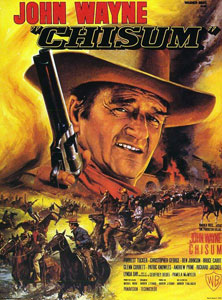
By the late 1960s and into the 1970s, John Wayne's movies became more familiar, more safe. You know what though? There's a comfort in familiarity, and there's some genuinely good movies in the bunch. Today's review is one of those efforts, telling one of the more famous stories of the wild west that ranks up there with the gunfight at the O.K. Corral or the Battle of the Little Big Horn. That story? The Lincoln County War. That movie? 1970's Chisum.
It's 1878 in the New Mexico territory, and aging rancher John Chisum (Wayne) has carved an immense cattle ranch out of the wilderness, made it all into something to behold. He's preparing for his niece, Sallie (Pamela McMyler), to come and visit the ranch, but there's some serious issues to be dealt with. An equally powerful man with some serious financial backing, Lawrence Murphy (Forrest Tucker), has moved into Lincoln County and is looking to take over. Take over EVERYTHING. First up on his list? Buying the sheriff, the bank, and scooping up all the land he can and drive Chisum out as quick as he can. Chisum is well-rooted though, and nothing is going to come easy for the despicably vicious, greedy Murphy. There's a wild card in the entire situation though, a young, fiery gunfighter with a fast-growing reputation and a fast draw with his pistol, William Bonney (Geoffrey Deuel), better known as Billy the Kid.
I've loved John Wayne and his movies since I was a little kid. Hopefully, I always will! I hadn't seen this 1970 western from director Andrew McLaglen in years until a recent showing on Turner Classic Movies gave me the opportunity to revisit it. Am I glad I did! It is different, telling the mostly true story of the Lincoln County War with some artistic license thrown in here and there. A lot of familiar faces, filming locations in Durango, Mexico where other Wayne ventures (The War Wagon, Sons of Katie Elder, The Undefeated, The Train Robbers) were filmed, a memorable score from Dominic Frontiere, and cinematographer William Clothier bringing the Mexican locations to life, yeah, it IS familiar. That's not a bad thing. I loved catching up with the movie and liked it much more than I remember. There's just enough different here to keep things interesting. And let's face it, the story and recognizable historical characters are a great backdrop for that mostly true story.
Okay, one of the most famous stories of the wild west. What do we need? How about a movie star capable of leading the way? In 1970, Wayne was still at the top of his game. He had the tough guy hero part down to an art with decades of practice. That is most definitely a compliment. Wayne was always at home in the western, and that's the case here. His Chisum -- based on the real-life John Chisum -- becomes a figurehead of the west. Years before, Chisum moved west into New Mexico and carved out a cattle ranch out of the land. Now, he's learning to slowly, begrudgingly changing with the times to survive. A testament to Wayne here is that he's not on-screen a ton. Yes, he's the star, but the Hollywood legend is content to let other members of a solid ensemble step into the limelight. When he is in the limelight? It's Duke at his tough as nails best, playing straight man to a bunch of antics while also stealing the camera, especially in a late confrontation with Tucker's Murphy. Nothing flashy, just a western professional.
Part of the fun here is the familiar names and characters popping up. The Billy the Kid story has been told in the Young Guns movies, The Left-Handed Gun, Pat Garrett and Billy the Kid, The Outlaw and many more I'm probably forgetting. I liked the spin Deuel puts on young William Bonney, a brash kid trying to put a checkered past behind him. He may be too good with a gun to let it happen though. Deuel's scenes with Glenn Corbett's Pat Garrett are a highlight, especially knowing where these two men end up. Also look for peaceful, second-chance rancher John Tunstall (Patric Knowles), Alex McSween (Andrew Prine, with his wife Lynda Day George), corrupt Sheriff Brady (Bruce Cabot), and more than a few familiar faces in the background.
The cast is one of Chisum's best features. Tucker is a slimy, nasty, slithery villain, with both Christopher George and Richard Jaeckel as his brutal enforcers. Another Just Hit Play favorite, Ben Johnson is Pepper, Wayne's right-hand man, a mumbling cowboy who'd rather solve a problem with his gun than his words, a part similar to the one he played in both The Undefeated and The Train Robbers. You ready though for some other names? Take a deep breath with me. Also look for John Agar, Robert Donner, Ray Teal, Hank Worden, Pedro Armendariz Jr., Edward Faulkner, Christopher Mitchum and plenty of faces from the John Wayne stock company. Quite the cast. QUITE a group of tough guys, a McLaglen specialty.
About as good as a traditional western can get. There's good guys, dastardly bad guys, shootouts to be had, and set against the backdrop against one of the wild west's most famous/infamous incidents ever. Something really hit me with this most recent watch, and I came away more impressed than I'd been with previous viewings. Hopefully, you'll like it just as much!
Chisum (1970): *** 1/2 /****
It's 1878 in the New Mexico territory, and aging rancher John Chisum (Wayne) has carved an immense cattle ranch out of the wilderness, made it all into something to behold. He's preparing for his niece, Sallie (Pamela McMyler), to come and visit the ranch, but there's some serious issues to be dealt with. An equally powerful man with some serious financial backing, Lawrence Murphy (Forrest Tucker), has moved into Lincoln County and is looking to take over. Take over EVERYTHING. First up on his list? Buying the sheriff, the bank, and scooping up all the land he can and drive Chisum out as quick as he can. Chisum is well-rooted though, and nothing is going to come easy for the despicably vicious, greedy Murphy. There's a wild card in the entire situation though, a young, fiery gunfighter with a fast-growing reputation and a fast draw with his pistol, William Bonney (Geoffrey Deuel), better known as Billy the Kid.
I've loved John Wayne and his movies since I was a little kid. Hopefully, I always will! I hadn't seen this 1970 western from director Andrew McLaglen in years until a recent showing on Turner Classic Movies gave me the opportunity to revisit it. Am I glad I did! It is different, telling the mostly true story of the Lincoln County War with some artistic license thrown in here and there. A lot of familiar faces, filming locations in Durango, Mexico where other Wayne ventures (The War Wagon, Sons of Katie Elder, The Undefeated, The Train Robbers) were filmed, a memorable score from Dominic Frontiere, and cinematographer William Clothier bringing the Mexican locations to life, yeah, it IS familiar. That's not a bad thing. I loved catching up with the movie and liked it much more than I remember. There's just enough different here to keep things interesting. And let's face it, the story and recognizable historical characters are a great backdrop for that mostly true story.
Okay, one of the most famous stories of the wild west. What do we need? How about a movie star capable of leading the way? In 1970, Wayne was still at the top of his game. He had the tough guy hero part down to an art with decades of practice. That is most definitely a compliment. Wayne was always at home in the western, and that's the case here. His Chisum -- based on the real-life John Chisum -- becomes a figurehead of the west. Years before, Chisum moved west into New Mexico and carved out a cattle ranch out of the land. Now, he's learning to slowly, begrudgingly changing with the times to survive. A testament to Wayne here is that he's not on-screen a ton. Yes, he's the star, but the Hollywood legend is content to let other members of a solid ensemble step into the limelight. When he is in the limelight? It's Duke at his tough as nails best, playing straight man to a bunch of antics while also stealing the camera, especially in a late confrontation with Tucker's Murphy. Nothing flashy, just a western professional.
Part of the fun here is the familiar names and characters popping up. The Billy the Kid story has been told in the Young Guns movies, The Left-Handed Gun, Pat Garrett and Billy the Kid, The Outlaw and many more I'm probably forgetting. I liked the spin Deuel puts on young William Bonney, a brash kid trying to put a checkered past behind him. He may be too good with a gun to let it happen though. Deuel's scenes with Glenn Corbett's Pat Garrett are a highlight, especially knowing where these two men end up. Also look for peaceful, second-chance rancher John Tunstall (Patric Knowles), Alex McSween (Andrew Prine, with his wife Lynda Day George), corrupt Sheriff Brady (Bruce Cabot), and more than a few familiar faces in the background.
The cast is one of Chisum's best features. Tucker is a slimy, nasty, slithery villain, with both Christopher George and Richard Jaeckel as his brutal enforcers. Another Just Hit Play favorite, Ben Johnson is Pepper, Wayne's right-hand man, a mumbling cowboy who'd rather solve a problem with his gun than his words, a part similar to the one he played in both The Undefeated and The Train Robbers. You ready though for some other names? Take a deep breath with me. Also look for John Agar, Robert Donner, Ray Teal, Hank Worden, Pedro Armendariz Jr., Edward Faulkner, Christopher Mitchum and plenty of faces from the John Wayne stock company. Quite the cast. QUITE a group of tough guys, a McLaglen specialty.
About as good as a traditional western can get. There's good guys, dastardly bad guys, shootouts to be had, and set against the backdrop against one of the wild west's most famous/infamous incidents ever. Something really hit me with this most recent watch, and I came away more impressed than I'd been with previous viewings. Hopefully, you'll like it just as much!
Chisum (1970): *** 1/2 /****
Thursday, January 29, 2015
Shenandoah
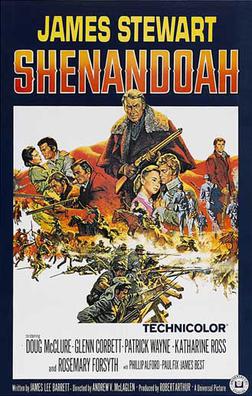
As far as directing powerhouses of the 1960s, Andrew V. McLaglen will never be remembered as one of the greats. He started off in television before making the jump to feature film, teaming several times with John Wayne while also specializing in audience friendly "guy movies." Good guys versus bad guys, lots of familiar faces and situations, you know the formula. One of his best? An underrated Civil War drama, 1965's Shenandoah.
It's 1864 in Virginia, and the tide of the Civil War has turned as the Union forces are slowly beating down the Confederate armies. Doing his best to remain free of the bloody fighting, farmer and patriarch Charlie Anderson (James Stewart) wants nothing to do with the war. Both for himself and his family -- seven kids, one daughter-in-law -- Anderson simply wants to keep working his 500-acre farm and get through the war unscathed. Fight for Virginia? Fight for slaves he doesn't have? He fights for what he believes in, his family and his farm. Well, that's what he'd like to do. While the fighting rages on, Charlie is stunned when he finds out his youngest son (Phillip Alford) has been confused as a Confederate soldier and captured by nearby Union forces. Now the war and the fighting that Anderson has done so well to steer clear of has landed square on his front porch. Can he find his son amidst the hell of war?
This was a movie I watched often growing up when my sister and I had sleepovers with my Grandma. It made an excellent Civil War double feature with Friendly Persuasion, and let me tell ya, they both hold up! I watched this McLaglen-directed Civil War drama for the first time in years, and it resonated just as much now as an adult as it did when I was a kid, if not more. McLaglen had some excellent movies to his name -- The Wild Geese is a favorite, Hondo, McLintock are also excellent -- but this is his best movie overall. The story is a series of very effective, often moving and often disturbing vignettes, all held together by the Anderson family. Filmed on-location in Oregon and California, 'Shenandoah' is an underrated visual film, and the musical score from composer Frank Skinner is a gem. So what stands out viewing this one as a 29-year old, not a 13-year old kid?
That would be James Stewart, one of my favorites in just about any movie he's in. This doesn't get the attention or notoriety as one of Stewart's best performances, but it certainly belongs in the conversation. I love what he does with the part of Charlie Anderson, a stubborn, feisty Virginia farmer and widower looking out for the best intentions of his family. He doesn't care about the war, about slavery, about Union and Confederate. He will do anything, ANYTHING, to protect his family. Stewart has some great scenes with the younger supporting cast, especially Alford's youngest son, only called 'Boy,' with his daughter, Jenny (Rosemary Forsyth), daughter-in-law, Anne (Katharine Ross), and his sons. There are too many memorable, emotional scenes to mention, but my favorites are the most simple. Minutes before the Andersons go to church each Sunday, Charlie visits his wife's grave and just talks to her. Simple perfection, Stewart absolutely nailing the underplayed but charged scenes.
Stewart is the unquestioned star of McLaglen's film, but 'Shenandoah' offers quite the ensemble of recognizable faces. Glenn Corbett and Patrick Wayne play Jacob and James, the two oldest brothers. Corbett especially stands out as Jacob who's beginning to question if their choice to stay out of the war is the right decision. Wayne is solid too, especially in his scenes with Ross. In her film debut, Forsyth is excellent, a subtle scene-stealer as innocent, tough and thoughtful Jenny who's also interested in a young Confederate soldier, Sam (Doug McClure). The other Anderson boys include Charles Robinson, Jim McMullan and Tim McIntire. Maybe the best thing you can say about the story is that the family dynamic, it just works. You believe them as one cohesive unit, one that stands together through thick and thin.
But wait, there's more! Also look for George Kennedy as a sympathetic Union officer, Gene Jackson as Gabriel, a friend of Boy's, a slave, Paul Fix as the local doctor, Denver Pyle as the pastor, James Best as Carter, a fellow prisoner who takes Boy under his wing, Harry Carey Jr. as another Confederate prisoner, Tom Simcox as Lt. Johnson, a Confederate officer, with Kevin Hagen, Dabbs Greer and Strother Martin also playing small but memorable parts.
So 29-year old me certainly picked up some new things, or at least was able to process things differently. This is one hell of an anti-war flick. The portrayal of the latter stages of the Civil War is unsettling and often times, disturbing. Death awaits around every corner, hiding behind every tree. The lines are up in the air as the war takes a turn toward its ultimate conclusion. A late battle between a small Confederate camp and a larger Union force with heavy artillery is quick and awful and uncomfortable, one of the more underrated battle sequences I can think of. The last half hour especially features one kick in the gut after another that truly hammers home the anti-war message. And that last scene? Pretty perfect, the possibility of hope lingering in the air amongst all this pain and suffering and death. One of my favorite movies.
Shenandoah (1965): ****/****
It's 1864 in Virginia, and the tide of the Civil War has turned as the Union forces are slowly beating down the Confederate armies. Doing his best to remain free of the bloody fighting, farmer and patriarch Charlie Anderson (James Stewart) wants nothing to do with the war. Both for himself and his family -- seven kids, one daughter-in-law -- Anderson simply wants to keep working his 500-acre farm and get through the war unscathed. Fight for Virginia? Fight for slaves he doesn't have? He fights for what he believes in, his family and his farm. Well, that's what he'd like to do. While the fighting rages on, Charlie is stunned when he finds out his youngest son (Phillip Alford) has been confused as a Confederate soldier and captured by nearby Union forces. Now the war and the fighting that Anderson has done so well to steer clear of has landed square on his front porch. Can he find his son amidst the hell of war?
This was a movie I watched often growing up when my sister and I had sleepovers with my Grandma. It made an excellent Civil War double feature with Friendly Persuasion, and let me tell ya, they both hold up! I watched this McLaglen-directed Civil War drama for the first time in years, and it resonated just as much now as an adult as it did when I was a kid, if not more. McLaglen had some excellent movies to his name -- The Wild Geese is a favorite, Hondo, McLintock are also excellent -- but this is his best movie overall. The story is a series of very effective, often moving and often disturbing vignettes, all held together by the Anderson family. Filmed on-location in Oregon and California, 'Shenandoah' is an underrated visual film, and the musical score from composer Frank Skinner is a gem. So what stands out viewing this one as a 29-year old, not a 13-year old kid?
That would be James Stewart, one of my favorites in just about any movie he's in. This doesn't get the attention or notoriety as one of Stewart's best performances, but it certainly belongs in the conversation. I love what he does with the part of Charlie Anderson, a stubborn, feisty Virginia farmer and widower looking out for the best intentions of his family. He doesn't care about the war, about slavery, about Union and Confederate. He will do anything, ANYTHING, to protect his family. Stewart has some great scenes with the younger supporting cast, especially Alford's youngest son, only called 'Boy,' with his daughter, Jenny (Rosemary Forsyth), daughter-in-law, Anne (Katharine Ross), and his sons. There are too many memorable, emotional scenes to mention, but my favorites are the most simple. Minutes before the Andersons go to church each Sunday, Charlie visits his wife's grave and just talks to her. Simple perfection, Stewart absolutely nailing the underplayed but charged scenes.
Stewart is the unquestioned star of McLaglen's film, but 'Shenandoah' offers quite the ensemble of recognizable faces. Glenn Corbett and Patrick Wayne play Jacob and James, the two oldest brothers. Corbett especially stands out as Jacob who's beginning to question if their choice to stay out of the war is the right decision. Wayne is solid too, especially in his scenes with Ross. In her film debut, Forsyth is excellent, a subtle scene-stealer as innocent, tough and thoughtful Jenny who's also interested in a young Confederate soldier, Sam (Doug McClure). The other Anderson boys include Charles Robinson, Jim McMullan and Tim McIntire. Maybe the best thing you can say about the story is that the family dynamic, it just works. You believe them as one cohesive unit, one that stands together through thick and thin.
But wait, there's more! Also look for George Kennedy as a sympathetic Union officer, Gene Jackson as Gabriel, a friend of Boy's, a slave, Paul Fix as the local doctor, Denver Pyle as the pastor, James Best as Carter, a fellow prisoner who takes Boy under his wing, Harry Carey Jr. as another Confederate prisoner, Tom Simcox as Lt. Johnson, a Confederate officer, with Kevin Hagen, Dabbs Greer and Strother Martin also playing small but memorable parts.
So 29-year old me certainly picked up some new things, or at least was able to process things differently. This is one hell of an anti-war flick. The portrayal of the latter stages of the Civil War is unsettling and often times, disturbing. Death awaits around every corner, hiding behind every tree. The lines are up in the air as the war takes a turn toward its ultimate conclusion. A late battle between a small Confederate camp and a larger Union force with heavy artillery is quick and awful and uncomfortable, one of the more underrated battle sequences I can think of. The last half hour especially features one kick in the gut after another that truly hammers home the anti-war message. And that last scene? Pretty perfect, the possibility of hope lingering in the air amongst all this pain and suffering and death. One of my favorite movies.
Shenandoah (1965): ****/****
Monday, January 12, 2015
Gun the Man Down
At the height of his popularity in the 1950s, John Wayne turned down an offer that ended up profiting for one person in particular. Wayne turned down the lead role for TV's Gunsmoke and instead recommended James Arness for the part. Wayne kept on being Wayne, and Gunsmoke...well, it aired for 20 seasons with over 600 episodes. Wayne and Arness became friends, Arness even starring in a flick from Wayne's production company (Batjac), a 1956 western, Gun the Man Down.
Following a botched bank robbery, Rem Anderson (Arness) is left behind by his fellow robbers, Rankin (Robert J. Wilkie) and Farley (Don Megowan), when he's wounded and can't keep up with a posse close behind. Anderson is able to hide, but it's only a matter of time before the posse picks up his trail and he's sentenced to a year in prison. Upon getting his parole, Rem has one goal in mind; revenge. He's not sure what became of Rankin and Farley, but he intends to find out. His trail leads him across the territory where finally he tracks them down in a town where they used the money from the bank robbery to open up a successful, raucous saloon. They're out in the open, but that presents a problem in itself. No one knows them as bank robbers, only saloon owners. How can Rem hope to exact his revenge with the chips stacked against him?
Starting in the early 1950s, Batjac Productions backed movies well into the 1970s, many of them starring the Duke, several others made with other stars. For the most part, they were fan friendly flicks, movies audiences would scoop up and enjoy. Not too surprisingly, the ones with Wayne were more successful than those without him, but of the ones I've seen, they've all been solid to good to really good. This 1956 western is a no frills western from director Andrew McLaglen and screenwriters Burt Kennedy and Sam Freedle. McLaglen and Kennedy were frequent collaborators with Wayne in the 50s, 60s and 70s, and you could see a younger Duke playing the Arness part. 'Gun' clocks in at just 76 minutes and features a small scale story with a small cast. It's good, but could have been better.
The odd part? There are times you feel like you're watching a small-scale film noir western. Revenge stories are nothing new to the western genre, but this one is simple and straightforward. We've got our anti-hero (Arness) trying to right a wrong, get his revenge, and get his woman (Angie Dickinson) back in the process (the femme fatale). The villains are dastardly, the cops are waiting for their chance, and we've got a fringe character or two waiting to swoop in for a profit. How can you go wrong? I wish all these pieces fit together in tighter fashion though. It is only 76 minutes long, but it drags at times with some serious pacing issues. Lots of talking, lots of dialogue, making an already short movie feel inexplicably long at times. That's never good when you're struggling to get through a movie that isn't even an hour and a half long.
Without the star power of a John Wayne, 'Gun' still has some cool parts. Arness is a solid, resolute hero who in the second half is more of a presence than an actual hero. We see other characters react to him, see others cower and worry what he's up to. Also, he was robbing a bank to provide for a new life with Dickinson's Janice so he's not all-bad, right? Right?!? Wilkie and Megowan are solid as our villains, ready to cut bait at the first sign of trouble. My favorite parts were for Emile Meyer (usually playing a heavy) as Sheriff Morton and Harry Carey Jr. as his well-meaning but little slow deputy, Lee. Morton knows the dangers of the job, has been at it forever, and is trying to look out for Lee as best as possible. Their dialogue scenes are especially worthwhile, especially Meyer as Morton. Also worth mentioning are Michael Emmet as Billy Deal, a hired killer and friend of Rem's, and Pedro Gonzalez Gonzalez as a hotel employee (he'd work with Dickinson in a similar role 3 years later in Rio Bravo). A solid cast, nothing too flashy.
I just wish I liked this one more as I'm wavering back and forth between ratings. I liked it, but man, it was slow-going at times. There's also some funny, odd moments, including Rem being told a judge will throw the book at him for the robbery...and he gets a year sentence for bank robbery where a man in town was shot during said robbery. Maybe I misread it, but there's a hilarious scene where Wilkie races to catch his horse, mounts up, rides about 4 feet and then dismounts. I'm assuming it's meant to show the horse came up lame, but it had me laughing. Now with all that considered, it's still a pretty decent little western. There are some surprising, dark twists in the last act, and things are wrapped up nicely for everyone (well, almost everyone). Western fans should at least check it out with just enough positive going for it.
Gun the Man Down (1956): ** 1/2 /****
Following a botched bank robbery, Rem Anderson (Arness) is left behind by his fellow robbers, Rankin (Robert J. Wilkie) and Farley (Don Megowan), when he's wounded and can't keep up with a posse close behind. Anderson is able to hide, but it's only a matter of time before the posse picks up his trail and he's sentenced to a year in prison. Upon getting his parole, Rem has one goal in mind; revenge. He's not sure what became of Rankin and Farley, but he intends to find out. His trail leads him across the territory where finally he tracks them down in a town where they used the money from the bank robbery to open up a successful, raucous saloon. They're out in the open, but that presents a problem in itself. No one knows them as bank robbers, only saloon owners. How can Rem hope to exact his revenge with the chips stacked against him?
Starting in the early 1950s, Batjac Productions backed movies well into the 1970s, many of them starring the Duke, several others made with other stars. For the most part, they were fan friendly flicks, movies audiences would scoop up and enjoy. Not too surprisingly, the ones with Wayne were more successful than those without him, but of the ones I've seen, they've all been solid to good to really good. This 1956 western is a no frills western from director Andrew McLaglen and screenwriters Burt Kennedy and Sam Freedle. McLaglen and Kennedy were frequent collaborators with Wayne in the 50s, 60s and 70s, and you could see a younger Duke playing the Arness part. 'Gun' clocks in at just 76 minutes and features a small scale story with a small cast. It's good, but could have been better.
The odd part? There are times you feel like you're watching a small-scale film noir western. Revenge stories are nothing new to the western genre, but this one is simple and straightforward. We've got our anti-hero (Arness) trying to right a wrong, get his revenge, and get his woman (Angie Dickinson) back in the process (the femme fatale). The villains are dastardly, the cops are waiting for their chance, and we've got a fringe character or two waiting to swoop in for a profit. How can you go wrong? I wish all these pieces fit together in tighter fashion though. It is only 76 minutes long, but it drags at times with some serious pacing issues. Lots of talking, lots of dialogue, making an already short movie feel inexplicably long at times. That's never good when you're struggling to get through a movie that isn't even an hour and a half long.
Without the star power of a John Wayne, 'Gun' still has some cool parts. Arness is a solid, resolute hero who in the second half is more of a presence than an actual hero. We see other characters react to him, see others cower and worry what he's up to. Also, he was robbing a bank to provide for a new life with Dickinson's Janice so he's not all-bad, right? Right?!? Wilkie and Megowan are solid as our villains, ready to cut bait at the first sign of trouble. My favorite parts were for Emile Meyer (usually playing a heavy) as Sheriff Morton and Harry Carey Jr. as his well-meaning but little slow deputy, Lee. Morton knows the dangers of the job, has been at it forever, and is trying to look out for Lee as best as possible. Their dialogue scenes are especially worthwhile, especially Meyer as Morton. Also worth mentioning are Michael Emmet as Billy Deal, a hired killer and friend of Rem's, and Pedro Gonzalez Gonzalez as a hotel employee (he'd work with Dickinson in a similar role 3 years later in Rio Bravo). A solid cast, nothing too flashy.
I just wish I liked this one more as I'm wavering back and forth between ratings. I liked it, but man, it was slow-going at times. There's also some funny, odd moments, including Rem being told a judge will throw the book at him for the robbery...and he gets a year sentence for bank robbery where a man in town was shot during said robbery. Maybe I misread it, but there's a hilarious scene where Wilkie races to catch his horse, mounts up, rides about 4 feet and then dismounts. I'm assuming it's meant to show the horse came up lame, but it had me laughing. Now with all that considered, it's still a pretty decent little western. There are some surprising, dark twists in the last act, and things are wrapped up nicely for everyone (well, almost everyone). Western fans should at least check it out with just enough positive going for it.
Gun the Man Down (1956): ** 1/2 /****
Tuesday, August 12, 2014
The Wild Geese
A little bit of a spin on the wild west gunslinger, today's
discussion centers around the mercenary, the hired gun who will take
just about any job as long as the money is good. And if movies have
taught us anything, mercenaries had lots of work throughout Africa in
the 1960s and since with movies like Dark of the Sun, The Dogs of War
and most recently Tears of the Sun. What about the best of the bunch?
It's a movie many American viewers may not have heard of because it
didn't get much of a release in the states. That movie? One of my
favorites, 1978's The Wild Geese.
A brutally efficient mercenary with years of experience under his belt, Allan Faulkner (Richard Burton) has agreed to take on a dangerous mission in Africa courtesy of the equally brutal, efficient and greedy merchant banker, Sir Edward Matherson (Stewart Granger). With lucrative copper mining rights on the line, Matherson needs Faulker to rescue a deposed African leader, Julius Limbani (Winston Ntshona), a leader of the people and a good man, to retake the government and settle things down. Taking a hefty payday, Faulker assembles an experienced, effective unit of 50 mercenaries, including fellow officers Lt. Shawn Fynn (Roger Moore), Capt. Rafer Janders (Richard Harris) and Lt. Pieter Coetzee (Hardy Kruger), and goes about putting together an effective plan, a smash and grab job. Faulker has the men assembled to pull off the job with a minimum of danger, but no matter how well thought out the mission is, even these mercenaries can't know what awaits them when they drop into Africa.
This review comes just a day after my Von Ryan's Express review, one of the great entertaining war movies ever made. More than that, just a great action movie. Well, surprise surprise, but I put this 1979 mercenary-centric action/drama on the same level. Is it a great movie in the vein of The Godfather or Lawrence of Arabia? Heck no, but it doesn't need to be! I watched a version that was 128 minutes long, and it is one extended thrill ride from beginning to end. Director Andrew McLaglen is far from a great director, but this is one of his best (if not THE best) movies. It is gritty, graphic, rough and tumble and the definition of a great tough guy flick. This is a movie that earns it's "Guy's Guy" type of movie, even if that theme song (listen HERE) seems a little out of place. But that's for the opening and closing credits. Enough with that. Let's get to the action!
Okay, not quite yet there with the casting. In the men-on-a-mission vein of The Guns of Navarone or Where Eagles Dare, here's one of the all-time great tough guy casts. The script calls for some older mercenaries, giving stars who weren't exactly A-list stars a chance at the spotlight again, and let me tell you, they don't disappoint. In a part of his career where the films weren't exactly great (an understatement), Richard Burton absolutely nails the part as Faulkner, a weathered, experienced mercenary who doesn't care for much other than the money he makes and the booze he can drink. Not exactly a stretch, but let's not nitpick. His officers include Harris as Janders, the master tactician and planner, Moore as Fynn, the born soldier who can fly or drive anything with a motor, and Kruger as Coetzee, the South African experienced bush fighter who has quite a few racist tendencies. They each get their moments to shine, the tough guy quartet killing it throughout with an easygoing, likable chemistry.
But wait....there's more!!! Along with Granger's quick appearance, there's Barry Foster and Patrick Allen as other shadowy characters involved in putting the mission together. Filling out the mercenary lineup are scene-stealing Jack Watson as foul-mouthed drill instructor Sandy Young, John Kani as Sgt. Jesse, the youngest of the bunch but an incredibly capable fighter, Kenneth Griffith as Witty, the flamboyantly gay medic, with Ronald Fraser, Ian Yule (an actual former mercenary), Percy Herbert, and Glyn Baker rounding out the crew. Also look for Jeff Corey and Frank Findlay in small parts. Just a cool, underrated supporting cast with plenty of memorable, recognizable faces.
Based off a novel by Daniel Carney and a Reginald Rose screenplay, one of 'Wild's' most underrated aspects is its script. Yes, it is familiar. Yes, it is politically incorrect one moment and somewhat preachy the next. But in the end, you throw it all together and all those separate ingredients work well together. It follows the men-on-a-mission formula nicely, going from assembling the team, to training the team, to unleashing the mercenaries on their dangerous mission deep in Africa, a regiment of brutal Simbas waiting to wipe them out if given the chance. There's too many good moments to mention from the Wild Geese free-falling out of a plane at 25,000 feet to Watson's hysterical rants during the training sequences to the almost non-stop smartass attitudes that produce a ton of memorable one-liners, some funny and some highly effective in the old drama department. Just a lot of positives on display here across the board.
But the biggest positive? The action of course! It's so good that the DVD actually offers a stand-alone menu where you can watch solely the explosions, shootouts and all sorts of hell that breaks loose. Without giving away any spoilers, the mission doesn't go off quite as planned, Faulkner and his men forced to improvise deep in enemy territory. Most of the last hour of the film is one extended action scene with some occasional dialogue to break things up. The highlight is the last 30 minutes, the mercenaries shooting it out with a large force of Simbas hell bent on stopping them from escaping. It's bloody, graphic and uncomfortable and features some surprising twists too as the body count rises ever higher. The action turns into a chaotic chase across the African savannah, lines and flanks shifting minute to minute. What an action movie.
This can be a difficult movie to track down. Years ago, I was lucky enough to track down a Tango DVD of this 1978 mercenary flick. It's currently available at Amazon for a very reasonable $12.99 if you're curious. As I mentioned, is it a perfect film? Nope, and again, it isn't meant to be. Instead, it is pure escapism, pure entertainment, and for me that's all I'm looking for. Familiar but highly entertaining story, action to burn and one of my all-time favorite casts. Can't recommend this one enough.
The Wild Geese (1978): ****/****
Rewrite of June 2009 review
A brutally efficient mercenary with years of experience under his belt, Allan Faulkner (Richard Burton) has agreed to take on a dangerous mission in Africa courtesy of the equally brutal, efficient and greedy merchant banker, Sir Edward Matherson (Stewart Granger). With lucrative copper mining rights on the line, Matherson needs Faulker to rescue a deposed African leader, Julius Limbani (Winston Ntshona), a leader of the people and a good man, to retake the government and settle things down. Taking a hefty payday, Faulker assembles an experienced, effective unit of 50 mercenaries, including fellow officers Lt. Shawn Fynn (Roger Moore), Capt. Rafer Janders (Richard Harris) and Lt. Pieter Coetzee (Hardy Kruger), and goes about putting together an effective plan, a smash and grab job. Faulker has the men assembled to pull off the job with a minimum of danger, but no matter how well thought out the mission is, even these mercenaries can't know what awaits them when they drop into Africa.
This review comes just a day after my Von Ryan's Express review, one of the great entertaining war movies ever made. More than that, just a great action movie. Well, surprise surprise, but I put this 1979 mercenary-centric action/drama on the same level. Is it a great movie in the vein of The Godfather or Lawrence of Arabia? Heck no, but it doesn't need to be! I watched a version that was 128 minutes long, and it is one extended thrill ride from beginning to end. Director Andrew McLaglen is far from a great director, but this is one of his best (if not THE best) movies. It is gritty, graphic, rough and tumble and the definition of a great tough guy flick. This is a movie that earns it's "Guy's Guy" type of movie, even if that theme song (listen HERE) seems a little out of place. But that's for the opening and closing credits. Enough with that. Let's get to the action!
Okay, not quite yet there with the casting. In the men-on-a-mission vein of The Guns of Navarone or Where Eagles Dare, here's one of the all-time great tough guy casts. The script calls for some older mercenaries, giving stars who weren't exactly A-list stars a chance at the spotlight again, and let me tell you, they don't disappoint. In a part of his career where the films weren't exactly great (an understatement), Richard Burton absolutely nails the part as Faulkner, a weathered, experienced mercenary who doesn't care for much other than the money he makes and the booze he can drink. Not exactly a stretch, but let's not nitpick. His officers include Harris as Janders, the master tactician and planner, Moore as Fynn, the born soldier who can fly or drive anything with a motor, and Kruger as Coetzee, the South African experienced bush fighter who has quite a few racist tendencies. They each get their moments to shine, the tough guy quartet killing it throughout with an easygoing, likable chemistry.
But wait....there's more!!! Along with Granger's quick appearance, there's Barry Foster and Patrick Allen as other shadowy characters involved in putting the mission together. Filling out the mercenary lineup are scene-stealing Jack Watson as foul-mouthed drill instructor Sandy Young, John Kani as Sgt. Jesse, the youngest of the bunch but an incredibly capable fighter, Kenneth Griffith as Witty, the flamboyantly gay medic, with Ronald Fraser, Ian Yule (an actual former mercenary), Percy Herbert, and Glyn Baker rounding out the crew. Also look for Jeff Corey and Frank Findlay in small parts. Just a cool, underrated supporting cast with plenty of memorable, recognizable faces.
Based off a novel by Daniel Carney and a Reginald Rose screenplay, one of 'Wild's' most underrated aspects is its script. Yes, it is familiar. Yes, it is politically incorrect one moment and somewhat preachy the next. But in the end, you throw it all together and all those separate ingredients work well together. It follows the men-on-a-mission formula nicely, going from assembling the team, to training the team, to unleashing the mercenaries on their dangerous mission deep in Africa, a regiment of brutal Simbas waiting to wipe them out if given the chance. There's too many good moments to mention from the Wild Geese free-falling out of a plane at 25,000 feet to Watson's hysterical rants during the training sequences to the almost non-stop smartass attitudes that produce a ton of memorable one-liners, some funny and some highly effective in the old drama department. Just a lot of positives on display here across the board.
But the biggest positive? The action of course! It's so good that the DVD actually offers a stand-alone menu where you can watch solely the explosions, shootouts and all sorts of hell that breaks loose. Without giving away any spoilers, the mission doesn't go off quite as planned, Faulkner and his men forced to improvise deep in enemy territory. Most of the last hour of the film is one extended action scene with some occasional dialogue to break things up. The highlight is the last 30 minutes, the mercenaries shooting it out with a large force of Simbas hell bent on stopping them from escaping. It's bloody, graphic and uncomfortable and features some surprising twists too as the body count rises ever higher. The action turns into a chaotic chase across the African savannah, lines and flanks shifting minute to minute. What an action movie.
This can be a difficult movie to track down. Years ago, I was lucky enough to track down a Tango DVD of this 1978 mercenary flick. It's currently available at Amazon for a very reasonable $12.99 if you're curious. As I mentioned, is it a perfect film? Nope, and again, it isn't meant to be. Instead, it is pure escapism, pure entertainment, and for me that's all I'm looking for. Familiar but highly entertaining story, action to burn and one of my all-time favorite casts. Can't recommend this one enough.
The Wild Geese (1978): ****/****
Rewrite of June 2009 review
Saturday, April 26, 2014
The Undefeated
Considering the extreme and far-reaching effects the Civil War had on American history, it's odd there haven't been more movies about the most costly war in the United States' relatively young history. The western genre has done its fair share of quasi-Civil War movies, the war becoming a jumping off point for a shoot 'em up story. What to do once the war is over? Like Major Dundee and Vera Cruz, many went south into Mexico. We can add 1969's The Undefeated to that short list.
After four years of bloody fighting, the Civil War has come to a close, leaving both the North and South to figure out where to go forward. With some of his remaining soldiers, a former Union cavalry officer, Colonel John Henry Thomas (John Wayne), rounds up a herd of 3,000 wild horses with the intention of driving them south into Mexico where they'll sell them to Emperor Maximilian's forces. A former Confederate officer, Colonel James Langdon (Rock Hudson), who had outfitted his own regiment, is leaving his plantation behind, moving south to Mexico with his surviving men, along with their wives, children and family in hoping to start a new life. In turbulent times for both the U.S. and Mexico, these two groups' paths may cross, and with wounds from the war still fresh on both sides.
This portion of history has always fascinated me, especially in movies like this, Major Dundee and Vera Cruz. I grew up watching this John Wayne western, and in spite of its flaws, I've always been a fan. From frequent Wayne collaborator and director Andrew V. McLaglen, 'Undefeated' is a fun western with a very good, deep cast, authentic locations in and around Durango, Mexico (Dundee fans will appreciate some familiar spots), a memorable score from composer Hugo Montenegro (listen HERE, disregard the odd video choice), and in general an entertaining quality that lifts it up past the flaws. It plays like a lot of Wayne's later movies; easy to sit back and watch, some action and shootouts, some drama, some romance, and some laughs here and there. When westerns were changing so dramatically in the late 1960s and heading into the 1970s, it can be fun just to watch an old-fashioned western with good guys and bad guys. No more, no less.
In a pretty cool casting choice, Wayne goes toe to toe here with Rock Hudson. It's not the most obvious pairing, but it works, simple as that. Wayne is playing a variation on his archetypal cowboy part, the leader of a small, surviving group of volunteers that rode with him throughout the Civil War. Now, he's looking for some cash to start over with, hence the immense horse drive. Hudson's Langdon too is looking for a clean start, the horrors and severe losses of the war still fresh on his mind. They're two different men, but they also have many similarities. They're fighting men who stand by what's right, loyal to those who ride with them, and ultimately try to do what they should do, not what's easiest. Their scenes together are the high points of the story, an easygoing charm with just a little Union vs. Confederacy animosity lingering. Two parts I liked a lot.
Working with a big story and a whole lot of characters, there's a lot going on in 'Undefeated,' clocking in at 119 minutes. Both halves -- Union and Confederacy -- are interesting, but I liked Wayne's half more. His trail-worn, loyal riders include Ben Johnson as Short Grub, his right hand man, Harry Carey Jr., John Agar (his part was heavily cut, including his early death scene), Don Collier (a familiar face, often a stunt man in Wayne movies), Jerry Gatlin and Dub Taylor as McCartney, the cantankerous cook who's always looking to fight, a mangy cat, High Bred, at his side. NFL quarterback Roman Gabriel joins the cast too as Blue Boy, Thomas' adopted Cherokee son. With so many western regulars, there's an ease to these scenes that are just fun to watch. Also look briefly for small parts for Paul Fix, Royal Dano and Pedro Armendariz Jr.
With the kinda-sorta episodic story that amiably drifts along, half of the focus is on those Confederates. It's never boring, but it's also not as interesting as their Union counterparts. We meet Langdon's wife (Lee Meriwether), his buxom teenage daughter, Charlotte (Melissa Newman), and his widowed sister-in-law (Marian McCargo). His men include Bruce Cabot, NFL star Merlin Olsen, Jan-Michael Vincent, Robert Donner, Edward Faulkner and whiny Big John Hamilton. We get to see young, pretty Charlotte hold off Jan-Michael Vincent's Bubba Wilkes' advances (she like Blue Boy). We get to see worrying wife Lee Meriwether....well, look worried. Olsen's Little George hangs out with the kids, then fights the Union cavalry. There's plenty of familiar faces, some good parts, but it's simply not as interesting to watch. Not bad, just not as good as it could have been.
Certain portions of the episodic story drag, but some certainly stand out. The pre-credits sequence wraps up the Civil War in a quick Union attack on a Confederate position. Later, Wayne and Hudson must team up to hold off a bandit attack on the Confederate wagon train, a good, exciting sequence. My favorite though is a late battle between the Union riders and French cavalry, the horse herd used as a weapon and negotiating ploy with a Mexican officer (Tony Aguilar). I'm wavering here. It's not a great western -- maybe not even a good one -- but I'm always entertained watching it. John Wayne fans, western fans alike should like this one.
The Undefeated (1969): ***/****
After four years of bloody fighting, the Civil War has come to a close, leaving both the North and South to figure out where to go forward. With some of his remaining soldiers, a former Union cavalry officer, Colonel John Henry Thomas (John Wayne), rounds up a herd of 3,000 wild horses with the intention of driving them south into Mexico where they'll sell them to Emperor Maximilian's forces. A former Confederate officer, Colonel James Langdon (Rock Hudson), who had outfitted his own regiment, is leaving his plantation behind, moving south to Mexico with his surviving men, along with their wives, children and family in hoping to start a new life. In turbulent times for both the U.S. and Mexico, these two groups' paths may cross, and with wounds from the war still fresh on both sides.
This portion of history has always fascinated me, especially in movies like this, Major Dundee and Vera Cruz. I grew up watching this John Wayne western, and in spite of its flaws, I've always been a fan. From frequent Wayne collaborator and director Andrew V. McLaglen, 'Undefeated' is a fun western with a very good, deep cast, authentic locations in and around Durango, Mexico (Dundee fans will appreciate some familiar spots), a memorable score from composer Hugo Montenegro (listen HERE, disregard the odd video choice), and in general an entertaining quality that lifts it up past the flaws. It plays like a lot of Wayne's later movies; easy to sit back and watch, some action and shootouts, some drama, some romance, and some laughs here and there. When westerns were changing so dramatically in the late 1960s and heading into the 1970s, it can be fun just to watch an old-fashioned western with good guys and bad guys. No more, no less.
In a pretty cool casting choice, Wayne goes toe to toe here with Rock Hudson. It's not the most obvious pairing, but it works, simple as that. Wayne is playing a variation on his archetypal cowboy part, the leader of a small, surviving group of volunteers that rode with him throughout the Civil War. Now, he's looking for some cash to start over with, hence the immense horse drive. Hudson's Langdon too is looking for a clean start, the horrors and severe losses of the war still fresh on his mind. They're two different men, but they also have many similarities. They're fighting men who stand by what's right, loyal to those who ride with them, and ultimately try to do what they should do, not what's easiest. Their scenes together are the high points of the story, an easygoing charm with just a little Union vs. Confederacy animosity lingering. Two parts I liked a lot.
Working with a big story and a whole lot of characters, there's a lot going on in 'Undefeated,' clocking in at 119 minutes. Both halves -- Union and Confederacy -- are interesting, but I liked Wayne's half more. His trail-worn, loyal riders include Ben Johnson as Short Grub, his right hand man, Harry Carey Jr., John Agar (his part was heavily cut, including his early death scene), Don Collier (a familiar face, often a stunt man in Wayne movies), Jerry Gatlin and Dub Taylor as McCartney, the cantankerous cook who's always looking to fight, a mangy cat, High Bred, at his side. NFL quarterback Roman Gabriel joins the cast too as Blue Boy, Thomas' adopted Cherokee son. With so many western regulars, there's an ease to these scenes that are just fun to watch. Also look briefly for small parts for Paul Fix, Royal Dano and Pedro Armendariz Jr.
With the kinda-sorta episodic story that amiably drifts along, half of the focus is on those Confederates. It's never boring, but it's also not as interesting as their Union counterparts. We meet Langdon's wife (Lee Meriwether), his buxom teenage daughter, Charlotte (Melissa Newman), and his widowed sister-in-law (Marian McCargo). His men include Bruce Cabot, NFL star Merlin Olsen, Jan-Michael Vincent, Robert Donner, Edward Faulkner and whiny Big John Hamilton. We get to see young, pretty Charlotte hold off Jan-Michael Vincent's Bubba Wilkes' advances (she like Blue Boy). We get to see worrying wife Lee Meriwether....well, look worried. Olsen's Little George hangs out with the kids, then fights the Union cavalry. There's plenty of familiar faces, some good parts, but it's simply not as interesting to watch. Not bad, just not as good as it could have been.
Certain portions of the episodic story drag, but some certainly stand out. The pre-credits sequence wraps up the Civil War in a quick Union attack on a Confederate position. Later, Wayne and Hudson must team up to hold off a bandit attack on the Confederate wagon train, a good, exciting sequence. My favorite though is a late battle between the Union riders and French cavalry, the horse herd used as a weapon and negotiating ploy with a Mexican officer (Tony Aguilar). I'm wavering here. It's not a great western -- maybe not even a good one -- but I'm always entertained watching it. John Wayne fans, western fans alike should like this one.
The Undefeated (1969): ***/****
Monday, June 10, 2013
Breakthrough (1979)
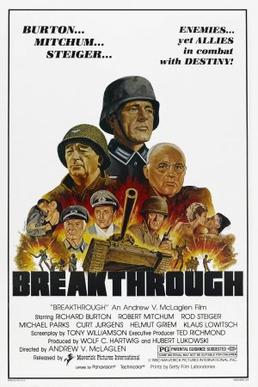
Released in 1977, Sam Peckinpah's Cross of Iron is a forgotten masterpiece, a war movie that doesn't get the credit it deserves. Not necessarily remembered as a classic, it ends on a particularly downbeat if effective ending, making the news that there's a sequel kinda hard to believe. I'm a big fan of Peckinpah's original so here goes with the unlikely follow-up, 1979's Breakthrough.
Under a withering Russian attack, German forces are retreating all along the Western Front. Among them is Sgt. Rolf Steiner (Richard Burton), a hardened veteran who's seen all the fighting can offer throughout the war. Amidst the fighting, he's granted a 14-day leave in Paris, but just as he settles in, the Allies attack at Normandy with his division transferred to the fighting. Upon catching up with his men, Steiner is given a dangerous mission that could ultimately bring the war to an end, but at minimum could save thousands of lives. In between Allied and German lines, Steiner meets an American officer, a tanker, Col. Rogers (Robert Mitchum), who isn't sure whether he can believe what Steiner is telling him. A decision must be made though quickly with an Allied offensive imminent.
In terms of original to sequel, this 1979 WWII flick from director Andrew V. McLaglen bears little resemblance to its predecessor. The ending in 'Iron' is open for interpretation as to whether certain characters survive, but this sequel answers that question (They make it by the way). And other than character names and that this too is a World War II movie, there are no real unifying links. It seems an odd movie and storyline to continue, but whatever, it happened so here we sit. It's not a particularly good movie -- most reviews rip it pretty mercilessly -- but I managed to get some enjoyment out of it. Then again, I'm a sucker for basically any western and war movie. You've been warned!!!
So now that I've established that I liked this movie, let's move ahead with ripping the movie some! While I like many of McLaglen's films (The Wild Geese, The Devil's Brigade), I can admit he was far more a workmanlike director than a master filmmaker. To say the story drifts a little bit would be a vast understatement. It starts in Russia, moves to Paris, jumps to Normandy and involves German and Allied knowledge of assassination attempts on Hitler. Oh, and Steiner's commanding officer, Major Stansky (Helmut Griem), is power hungry and doesn't care who gets caught up in the killing, civilians and innocents alike. The budget is obviously pretty limited with a fair amount of stock footage used from other war movies of the era. The score is atrocious, an oddly horrific mix of spaghetti western tones, country music, odd rock and roll notes, and hippie-psychedelic noises. It's not just bad, it's distracting, and that's significantly worse.
Here's the issue that I'm noticing in a lot of reviews. The cast here has some pretty impressive name recognition -- more than Peckinpah's original -- but it's not necessarily good performances. It's a fair criticism that most of the big names gathered are clearly phoning it in. On the other hand....oh, Richard Burton and Robert Mitchum! Replacing James Coburn, Burton does a decent job as war-weary Steiner. Mitchum is clearly not too interested in the part, but I like Mitchum so there. Also look for Rod Steiger, pissed off as usual and screaming orders as an American general, Webster. Michael Parks has a good supporting part as Sgt. Anderson, Mitchum's assistant and jeep driver. Klaus Lowitsch returns from 'Iron' as Cpl. Kruger, Steiner's fellow NCO and close friend. Curd Jurgens also plays a familiar role, an aristocratic German general frustrated with Hitler's leadership.
Schizophrenic story with far too much going on, aging stars with less than spectacular acting jobs, and a budget that's limited in basically all aspects. The action is okay, including the finale as Maj. Stansky attempts to set up an ambush for an attacking American tank battalion, but that's really the only memorable set piece. Why did I even remotely like this movie? I have no freaking idea. I was entertained throughout -- maybe because of the badness -- and that's all I'm looking for. Also worth mentioning, do a shot every time Mitchum asks about the anti-tank emplacements. You'll be drunk in minutes.
Breakthrough (1979): ** 1/2 /****
Under a withering Russian attack, German forces are retreating all along the Western Front. Among them is Sgt. Rolf Steiner (Richard Burton), a hardened veteran who's seen all the fighting can offer throughout the war. Amidst the fighting, he's granted a 14-day leave in Paris, but just as he settles in, the Allies attack at Normandy with his division transferred to the fighting. Upon catching up with his men, Steiner is given a dangerous mission that could ultimately bring the war to an end, but at minimum could save thousands of lives. In between Allied and German lines, Steiner meets an American officer, a tanker, Col. Rogers (Robert Mitchum), who isn't sure whether he can believe what Steiner is telling him. A decision must be made though quickly with an Allied offensive imminent.
In terms of original to sequel, this 1979 WWII flick from director Andrew V. McLaglen bears little resemblance to its predecessor. The ending in 'Iron' is open for interpretation as to whether certain characters survive, but this sequel answers that question (They make it by the way). And other than character names and that this too is a World War II movie, there are no real unifying links. It seems an odd movie and storyline to continue, but whatever, it happened so here we sit. It's not a particularly good movie -- most reviews rip it pretty mercilessly -- but I managed to get some enjoyment out of it. Then again, I'm a sucker for basically any western and war movie. You've been warned!!!
So now that I've established that I liked this movie, let's move ahead with ripping the movie some! While I like many of McLaglen's films (The Wild Geese, The Devil's Brigade), I can admit he was far more a workmanlike director than a master filmmaker. To say the story drifts a little bit would be a vast understatement. It starts in Russia, moves to Paris, jumps to Normandy and involves German and Allied knowledge of assassination attempts on Hitler. Oh, and Steiner's commanding officer, Major Stansky (Helmut Griem), is power hungry and doesn't care who gets caught up in the killing, civilians and innocents alike. The budget is obviously pretty limited with a fair amount of stock footage used from other war movies of the era. The score is atrocious, an oddly horrific mix of spaghetti western tones, country music, odd rock and roll notes, and hippie-psychedelic noises. It's not just bad, it's distracting, and that's significantly worse.
Here's the issue that I'm noticing in a lot of reviews. The cast here has some pretty impressive name recognition -- more than Peckinpah's original -- but it's not necessarily good performances. It's a fair criticism that most of the big names gathered are clearly phoning it in. On the other hand....oh, Richard Burton and Robert Mitchum! Replacing James Coburn, Burton does a decent job as war-weary Steiner. Mitchum is clearly not too interested in the part, but I like Mitchum so there. Also look for Rod Steiger, pissed off as usual and screaming orders as an American general, Webster. Michael Parks has a good supporting part as Sgt. Anderson, Mitchum's assistant and jeep driver. Klaus Lowitsch returns from 'Iron' as Cpl. Kruger, Steiner's fellow NCO and close friend. Curd Jurgens also plays a familiar role, an aristocratic German general frustrated with Hitler's leadership.
Schizophrenic story with far too much going on, aging stars with less than spectacular acting jobs, and a budget that's limited in basically all aspects. The action is okay, including the finale as Maj. Stansky attempts to set up an ambush for an attacking American tank battalion, but that's really the only memorable set piece. Why did I even remotely like this movie? I have no freaking idea. I was entertained throughout -- maybe because of the badness -- and that's all I'm looking for. Also worth mentioning, do a shot every time Mitchum asks about the anti-tank emplacements. You'll be drunk in minutes.
Breakthrough (1979): ** 1/2 /****
Labels:
1970s,
Andrew McLaglen,
Curd Jurgens,
Richard Burton,
Robert Mitchum,
Rod Steiger,
WWII
Monday, May 27, 2013
The Devil's Brigade
It's 1942 and with World War II very much yet to be decided, Lt. Colonel Robert Frederick (William Holden) has been summoned to a staff meeting in England. Even though he has no combat experience, Frederick is being given command of a new unit, the First Special Service Force. Their ultimate mission is still to be decided but the Colonel prepares for the training that awaits his brigade that consists of a crack unit of well-trained Canadian troops commanded by Dunkirk veteran Maj. Alan Crown (Cliff Robertson) and an unruly, misfit group of American troops headed by the similarly unruly Maj. Cliff Bricker (Vince Edwards). The two sides bristle immediately, but training continues. If Frederick can manage to keep his men together, their services are very much needed, including a dangerous mission on the Italian front.
From veteran director Andrew McLaglen, 'Brigade' is based on a real-life military unit, the First Special Service Force. Released just a year after The Dirty Dozen, it bears some striking similarities, but it more than capably carves out its own niche in war movie department. It is one of the great men-on-a-mission movies, and that's saying something considering the late 1960s were rampant with them. McLaglen filmed on location in Italy for much of the second half of the movie, giving an authentic look and feel to the proceedings as the Brigade goes into battle. Composer Alex North turns in a gem of a soundtrack, his theme for the Brigade (listen HERE) one that you'll be whistling for days. The main theme is a highlight, but North specializes in the quieter, darker and more sinister moments leading up to the battle in the finale.
More of a workmanlike director than an auteur, McLaglen specialized in movies like this with impressive casts of male stars. This 1968 WWII flick is loaded with star power. As Colonel Frederick, Holden doesn't get a flashy part, but he leads the way just the same. His officer wants to prove himself while also proving how capable his men are too. The best part in the film goes to Robertson as Maj. Crown, an intelligent, well-spoken and brutally capable officer who survived the Dunkirk disaster. It is a smart, underplayed role, and he steals every scene he's in. As his American counterpart, Edwards too is very solid. His Maj. Bricker is blunt and without a filter, a scrounger and hustler with the best of them. Also look for Dana Andrews, Michael Rennie and Carroll O'Connor as American generals, all making cameo appearances.
Ah, yes, and then there's the rest of the cast. If the star power above wasn't enough, McLaglen assembles a deep, talented cast of tough guys to fill out the ranks of the brigade. Leading the American contingent, look for Claude Akins, Andrew Prine, Richard Jaeckel, Luke Askew, Tom Troupe, Bill Fletcher and Tom Stern. For the Canadian half of the Brigade, watch out for Jack Watson, Harry Carey Jr., Jeremy Slate, Richard Dawson and Jean-Paul Vignon. It's cool just seeing all these recognizable faces here together, some leaving more of an impression than others. Jaeckel as Omar Greco, an acrobat trying to escape but finding a home instead, especially stands out as does Akins as Rocky, the American bully, Prine as Ransom, a smart misfit, Watson as Peacock, the tough but gentlemanly Canadian and Slate as O'Neill, the hand-to-hand combat instructor.
I think it's the cast that separates the movie from so many other solid WWII movies. It's a familiar formula here; introduce everyone, train them, have them put their differences aside following some male bonding and then unleash them on the enemy. The male bonding comes courtesy of a barroom brawl (watch HERE) with some rowdy lumberjacks, a great scene. The script is ideal in its ability to let these tough guys be tough guys. It's fun, natural with chemistry and features some great one-liners. Other highlights include Slate's introduction in a showdown with Akins (watch HERE), a 30-mile hike where the rivalry develops further, and many others. Moral of the story is this, we need these parts to be effective for the second half of the movie to truly work. And you bet it does.
The last hour follows the Brigade as it enters combat. Required to prove themselves and their ability, Frederick leads a patrol behind the lines to a heavily guarded Italian town crawling with Germans. It's a lighter action scene, but memorable just the same. The best part though is in the finale, the Brigade ordered to attack the apparently impenetrable Mount la Difensa (where the Service Force really made a name for themselves), a mountain garrisoned by German infantry and heavy armor. First, they must scale a sheer cliff-face to mount a surprise attack on the garrison. It is a great action sequence, McLaglen filming in the trenches and dugouts as the Brigade begins their assault. We always know where the battle is, where it's going, and the sheer scale of it. When the casualties do come (and they do, quickly and with some surprises), it makes this extended battle sequence that much more effective emotionally.
This has always been one of my favorites, and I seem to pick something new up with each passing viewing (I'm guessing I'm somewhere between 20 and 30). This time? The darkness late, Frederick greeting his men as they prepare for battle. North's score goes dark, Dawson explaining "Haven't you ever heard a man say goodbye?" It's an eerie, uncomfortable moment. Spot-on too, considering the Brigade sustained 77% casualties in the coming battle. 'Brigade' doesn't have the reputation of so many other WWII movies of the time, but it deserves some attention. A hidden gem.
The Devil's Brigade (1968): ****/****
* Rewrite of June 2010 review
Friday, August 26, 2011
One More Train to Rob
Thanks to Netflix's recent change in billing, I had to choose whether to pay an extra $8 bucks a month to keep my 'Instant Viewing' where I can watch movies and TV through their website. I didn't watch enough of either to make it worthwhile so I'm sticking with the DVD plan instead. My plan at first was to watch all the Instant Movies I could in the period before the new policy came into effect, but then 1971's One More Train to Rob came along.
I'm pretty much a sucker for any hard to find movie with a somewhat recognizable cast, especially movies from the 1960s and 1970s. Hundreds and maybe thousands of movies aren't available in any format so when you stumble across them, you've got to take advantage of the situation. Case in point here, a western available through Instant Watch with some good names -- including Just Hit Play favorite George Peppard -- and a unique, at least somewhat interesting premise. It never quite clicks into place, and a snail's pace in the first hour dooms the movie to the point where an entertaining second hour can't save it.
After a successful train robbery, well-known bank/train robber Harker Fleet (Peppard) is betrayed by several members of his gang including Timothy Xavier Nolan (John Vernon) and Jim Gant (Steve Sandor). He ends up serving a three-year jail sentence, getting out early for good behavior. Harker finds that his girlfriend, Katy (Diana Muldaur), is engaged to Nolan now as his former partner has become a rich businessman. However, Nolan is in some financial trouble, and Harker sees a way to exact his revenge. A mine in the area owned by Chinese immigrants is producing large quantities of gold, but Nolan can't get anywhere near the place. Harker on the other hand is able to dupe the Chinese into thinking he's on their side and work from the inside. Who is working against who though? Everyone has their own intentions and means of getting over $500,000 in gold that's ready for shipment.
Depending on where/what you read, director Andrew V. McLaglen takes a lot of heat for his average to below average to God-awful movies. The son of actor Victor McLaglen, he started directing western TV shows in the 1950s and parlayed that into feature films in the 1960s, many of them working with John Wayne. Was the younger McLaglen an auteur, a highly skilled, talented individual behind the camera? Nope, not really. He was a workmanlike director who got the job done usually without much in the way of personal style. I grew up watching many of his movies so I can overlook some of his deficiencies (Bandolero!, Shenandoah, The Devil's Brigade, The Wild Geese are some of my favorites). However as much as I tried here I struggled with 'Train to Rob.'
A western that came along in 1971 when most westerns were pessimistic and generally trying to bust all sort of wild west myths and lore, 'Train' is an oddity. Think John Wayne western without the Duke. It was made on a small budget -- or at least it looks like it -- and looks to have been shot mostly in the studio and on the studio backlot. The script can't make up its mind whether it is a darkly comedic western with slapstick or a hard-hitting, double crossing western where anyone and everyone is capable of a betrayal. The first hour is painfully slow at times, and I struggled to even get to the 60-minute mark. A dark western can also be funny and cynical, but McLaglen and the screenplay never makes up its mind. The second hour is a significant improvement over the first, helping the movie redeem itself at least a little bit.
Before his turn as Hannibal Smith in The A-Team in the 1980s, Peppard had a stretch of movies in the late 60s and early 70s that didn't produce a single classic, just a lot of really enjoyable, exciting action/adventure movies like Tobruk, Cannon For Cordoba, and The Executioner among others. So while I didn't love this movie by any means, I very much liked Peppard's Harker Fleet. As an actor, Peppard had a knack for playing the likable yet condescending a-hole. That is Harker Fleet in a nutshell, a lovable, conniving rogue who you can't help but like. His romantic scenes with Muldaur's Kate have a great chemistry, and his back and forth banter with Vernon's Nolan (sporting an odd but funny Irish accent) are priceless. In the midst of all the boredom and needless background, we get some great scenes of actors just looking like they're having fun.
The cast deserved more than this, and I think that's what is most disappointing. In little glimpses, this movie had some potential. One scene with Peppard and Vernon beating the hell out of each other ends in a discussion as to how they should double-cross everyone around them, both actors laughing hysterically. It doesn't feel forced or like acting, just a real laugh, a funny moment in a sea of nothing. Playing up the stereotypical Chinese miners, the miners include France Nuyen as prostitute turned savior Ah Toy, Soon-Tek Oh as Yung, the unofficial leader of the group, and Richard Loo as Mr. Chang, the wise old Asian man who knows everything. If I could recommend anything here, just skip to the one-hour mark, and you'll get the best parts of the movie.
One More Train to Rob (1971): ** 1/2 /****
I'm pretty much a sucker for any hard to find movie with a somewhat recognizable cast, especially movies from the 1960s and 1970s. Hundreds and maybe thousands of movies aren't available in any format so when you stumble across them, you've got to take advantage of the situation. Case in point here, a western available through Instant Watch with some good names -- including Just Hit Play favorite George Peppard -- and a unique, at least somewhat interesting premise. It never quite clicks into place, and a snail's pace in the first hour dooms the movie to the point where an entertaining second hour can't save it.
After a successful train robbery, well-known bank/train robber Harker Fleet (Peppard) is betrayed by several members of his gang including Timothy Xavier Nolan (John Vernon) and Jim Gant (Steve Sandor). He ends up serving a three-year jail sentence, getting out early for good behavior. Harker finds that his girlfriend, Katy (Diana Muldaur), is engaged to Nolan now as his former partner has become a rich businessman. However, Nolan is in some financial trouble, and Harker sees a way to exact his revenge. A mine in the area owned by Chinese immigrants is producing large quantities of gold, but Nolan can't get anywhere near the place. Harker on the other hand is able to dupe the Chinese into thinking he's on their side and work from the inside. Who is working against who though? Everyone has their own intentions and means of getting over $500,000 in gold that's ready for shipment.
Depending on where/what you read, director Andrew V. McLaglen takes a lot of heat for his average to below average to God-awful movies. The son of actor Victor McLaglen, he started directing western TV shows in the 1950s and parlayed that into feature films in the 1960s, many of them working with John Wayne. Was the younger McLaglen an auteur, a highly skilled, talented individual behind the camera? Nope, not really. He was a workmanlike director who got the job done usually without much in the way of personal style. I grew up watching many of his movies so I can overlook some of his deficiencies (Bandolero!, Shenandoah, The Devil's Brigade, The Wild Geese are some of my favorites). However as much as I tried here I struggled with 'Train to Rob.'
A western that came along in 1971 when most westerns were pessimistic and generally trying to bust all sort of wild west myths and lore, 'Train' is an oddity. Think John Wayne western without the Duke. It was made on a small budget -- or at least it looks like it -- and looks to have been shot mostly in the studio and on the studio backlot. The script can't make up its mind whether it is a darkly comedic western with slapstick or a hard-hitting, double crossing western where anyone and everyone is capable of a betrayal. The first hour is painfully slow at times, and I struggled to even get to the 60-minute mark. A dark western can also be funny and cynical, but McLaglen and the screenplay never makes up its mind. The second hour is a significant improvement over the first, helping the movie redeem itself at least a little bit.
Before his turn as Hannibal Smith in The A-Team in the 1980s, Peppard had a stretch of movies in the late 60s and early 70s that didn't produce a single classic, just a lot of really enjoyable, exciting action/adventure movies like Tobruk, Cannon For Cordoba, and The Executioner among others. So while I didn't love this movie by any means, I very much liked Peppard's Harker Fleet. As an actor, Peppard had a knack for playing the likable yet condescending a-hole. That is Harker Fleet in a nutshell, a lovable, conniving rogue who you can't help but like. His romantic scenes with Muldaur's Kate have a great chemistry, and his back and forth banter with Vernon's Nolan (sporting an odd but funny Irish accent) are priceless. In the midst of all the boredom and needless background, we get some great scenes of actors just looking like they're having fun.
The cast deserved more than this, and I think that's what is most disappointing. In little glimpses, this movie had some potential. One scene with Peppard and Vernon beating the hell out of each other ends in a discussion as to how they should double-cross everyone around them, both actors laughing hysterically. It doesn't feel forced or like acting, just a real laugh, a funny moment in a sea of nothing. Playing up the stereotypical Chinese miners, the miners include France Nuyen as prostitute turned savior Ah Toy, Soon-Tek Oh as Yung, the unofficial leader of the group, and Richard Loo as Mr. Chang, the wise old Asian man who knows everything. If I could recommend anything here, just skip to the one-hour mark, and you'll get the best parts of the movie.
One More Train to Rob (1971): ** 1/2 /****
Labels:
1970s,
Andrew McLaglen,
George Peppard,
John Vernon,
westerns
Monday, April 19, 2010
Hellfighters
Going through such a drastic procedure clearly didn't slow him down, but it certainly made the star appreciate what he had. Why mess with productions that would only threaten his health again? Instead, he stuck with what he knew. And of those 20 movies, I can name several which are in my top 10 Duke movies. One that isn't? That's easy, 1968's Hellfighters. I don't remember how old I was when I saw my first John Wayne movie, but I know I was young, and in the years since, I've seen just about every single one. Hellfighters was one of the few I hadn't, and to be honest, I don't know why. I never intentionally avoided it, but I never sought it out either. I'm glad I saw it to check it off the list, but it's not one of Wayne's better efforts.
John Wayne plays Chance Buckman, the owner of a company that puts out oil well fires. Buckman's exploits are based loosely on real life firefighter Red Adair, but reading up about Adair, it looks like the only thing the movie and his life have in common is that they were both actually oil well firefighters. It's about there the similarities diverge in a big way. In terms of pure visual entertainment and spectacle, I'm hard-pressed to think of too many things more exciting to watch than an epic, blazing oil well fire. These scenes are the high points of the movie. But somehow and for some reason, the story is dumbed down and filtered to the point where it could be any dangerous profession. So instead of 2 hours of fighting oil well fires, we get unnecessary family drama.
Chance Buckman (Wayne) loves what he does and he's damn good at it. With his company based out of Houston, Buckman travels the world with his team putting out, extinguishing and saving oil wells that burst into flames during drilling. It's incredibly dangerous work, but with years of practice and know-how, Chance has got it down to an art. But after one accident that hospitalizes him, his estranged daughter, Tish (Katharine Ross), comes to see him and ends up marrying Chance's right-hand man, Greg Parker (Jim Hutton). As if his job wasn't worrisome enough, Chance is now worrying about his daughter and son-in-law, not to mention his divorced wife, Madelyn (Vera Miles), who returns after years away.
It almost pains me to right that specific of a plot description for a movie about oil well firefighters. And that's the unfortunate part. With a profession like this, you would think it nearly impossible to make a dull movie about it, but director Andrew V. McLaglen succeeds in a big way. The minute the story heads away from the fire scenes, Hellfighters is downright dull. I'll admit some of the family background is needed to show the effects the job has on the firefighter and their families, but a little goes a long way here. Ross especially seems to get a kick out of showing up at these dangerous sites, seemingly oblivious to that danger. Wayne and Hutton spend much of the movie yelling at her to get down or get back. Her character is annoying and not in a cutesy way.
These romantic scenes are at times painful to watch. Wayne worked with Vera Miles in several pictures, but never with a romantic dynamic between them. As divorcees, they have little chemistry together, and it seems an odd choice to make 60-year old Wayne a heartthrob with this part. As annoying as the Hutton/Ross love plotline can be, at least it's somewhat believable. Not so with an older Wayne and a 39-year old Miles. Still, Wayne is the Duke, and he does make the most of his part, instilling some humor and 'Never say die!' spirit into it. Hutton is wasted as Chance's right hand man which is disappointing because as was the case with The Green Berets, he's got good chemistry with Wayne.
I'm not able to find clips available of the oil well scenes, but they're a sight to behold with a feeling of 'I know I shouldn't look, but I must!' throughout. Now whether McLaglen filmed actual oil well fires or created his own for the sake of the movie, I don't know, but these are some remarkable sequences. Making them that much cooler, Wayne and Hutton look to do at least some of their own stunts nearby the flaming wells. Wayne's team includes Bruce Cabot and Edward Faulkner as on-site help, with old friend and partner Jay C. Flippen left behind back at the office. It's too bad more couldn't have been done with the team because I found them much more interesting. Two solid hours of fighting oil fires probably isn't feasible, but cut the movie by 30 minutes, and maybe we're onto something.
All I can say is I wish this was a better movie. There's only so many John Wayne movies out there so when I see one that doesn't live up to its potential, I feel like I'm missing out. Hellfighters has a lot of potential but never lives up to it. Lots of great sequences are there with a solid cast, but it never clicks together. The story drifts along filling in the blanks between fires before the necessary, not at all surprising ending. Worthwhile for the oil well fire sequences, but other than that, steer clear.
Hellfighters <----fan-made trailer (1968): **/****
Labels:
1960s,
Andrew McLaglen,
Bruce Cabot,
Jim Hutton,
John Wayne,
Katharine Ross
Thursday, February 4, 2010
The Rare Breed
Comparing the two directors' filmographies, McLaglen comes out on top with a deeper selection of worthwhile movies. Of course, that doesn't necessarily mean he was a great director. More and more, I think his success in directing was a result of a nice trio to have when making a movie. One, great casting, two, lots of action, and three, a well-written script (with some obviously better than others). But looking through McLaglen's movies, they can't all be winners, like 1966's The Rare Breed.
A long-time television director who directed almost 200 combined episodes of Gunsmoke and Have Gun Will Travel, McLaglen had finally hit the jackpot on the big screen with McClintock and Shenandoah. Both stories had their similarities, tough, family men trying to live their lives amidst a strong conflict. Most of McLaglen's movies followed a tried and true formula and were the better for it. But with his next movie, The Rare Breed, he is undone by an awful script that is about as unbalanced as they come that results in an incredibly dull finished product.
After traveling from England to the U.S. with a prize hereford bull, Martha Price (Maureen O'Hara) hopes to crossbreed her Hereford bull with the famous longhorns that roam across Texas and the west. With her daughter Hilary (Juliet Mills) along, Martha finds a buyer who pays handsomely for the animal, and then a cowboy, 'Bulldog' Sam Burnett (James Stewart) to help get the Hereford where it needs to be. Seeing a chance for some quick, easy cash, Burnett makes a deal with another rancher to "lose" the animal en route. There's another cowboy on their trail, a gun-wielding psycho, Simons (Jack Elam), who has plans of his own for the bull and the money.
Netflix only slightly recommended this late 60s western, but with the talent involved I thought it was a safe bet that I'd enjoy it. I wasn't looking for an instant classic, just a good movie. The story and the characters though are so uneven and all over the place that 'Rare Breed' never gets into any rhythm. Even at just 97 minutes, it felt incredibly long, and I found myself fast-forwarding for most of the last hour. If a movie doesn't grab you early, it probably won't later on either.
The idea of the Hereford cow moving into the west is nothing new but still presents a unique setting. The cattle drive was an integral part of the west in the 1800s and has been used many times before, handled best in Lonesome Dove and in a similar way in James Michener's Centennial. All three, including 'Rare Breed,' deal with the changing times as technology and innovations in all fields push the wild west into the history books. But this McLaglen entry never takes a stand and says anything, if anything help push the good old days out the door.
A bright spot in this dud is James Stewart who brings his character to life where it just as easily could have been a cardboard cutout of a character. Unfortunately, the rest of the cast isn't so good, and it's not necessarily their fault. O'Hara was an ideal woman to ride along with the fellas in the action/adventure genre; she was tough but endearing, hardhewn but likable, and her looks never hurt. But her Martha is dead on arrival here and not a good role at all. In the weird casting department, Brian Keith plays Bowen, a mad Scotsman living on his forted-up ranch in Texas. Typically I like Keith, especially as a character actor, but here he is every stereotype imaginable of a Scottish man. Other cast members include Ben Johnson as a crippled cowboy who is gone by the 15-minute mark, Harry Carey Jr as Elam's partner (gone by the 45 minute mark), and Perry Lopez, who you'd better look fast for in the background.
If you're going to assemble a pretty solid cast like this, give them something to do at least. Elam's villain is dispatched about 45 minutes in, and with him goes any conflict or sense of danger the story had. The second Keith's son is introduced is also the exact second you can predict the ending to the movie. It's not that this is a bad movie, it just has a lazy feel to it. The music is generic, the script plodding, and some truly awful looking greenscreen effects. Some California locations look nice, but when the filming location is the best thing about the movie you know you're in trouble.
The Rare Breed <---trailer (1966): * 1/2 /****
Subscribe to:
Posts (Atom)

_poster.jpg)