The Sons of Katie Elder

The Sons of Katie Elder
"First, we reunite, then find Ma and Pa's killer...then read some reviews."
Showing posts with label Yul Brynner. Show all posts

Wednesday, September 30, 2015

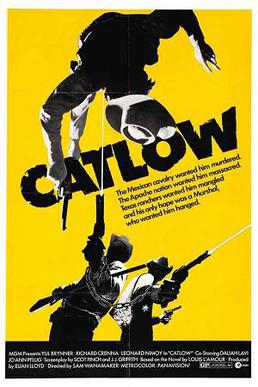
Catlow

Before his death in 1988 at the ripe, old age of 80, author Louis L'Amour had 89 novels, 14 short story collections and two non-fiction books to his name. Kinda a busy career, huh? He's always been one of my favorites, and a personal favorite (one of many) is one that doesn't always get mentioned as one of his best or most well-known. It's a 1963 western that got a feature film adaptation with the same-named 1971 flick, Catlow.

It's the years following the Civil War in the American southwest and veterans from the war have had to move on to other things, some good, some bad. Ben Cowan (Richard Crenna) is a marshal out on the trail looking for an outlaw wanted for rustling cattle and horses. Jed Catlow (Yul Brynner) is that outlaw, an amiable fella who always has a smile on his face. The problem? Cowan's warrant is for Catlow, but the two men are old friends having served together during the War, making that potential arrest a little more difficult. Well, sorta. Through a series of mistakes and misadventures, Cowan just can't seem to bring his friend in. Now, Catlow could have bitten off more than he can chew. With his gang, the outlaw is heading into Mexico after a recently discovered hidden gold treasure. He's not the only one in pursuit though, with Cowan and others on his trail.

Not quite an American western, not quite a spaghetti western, 'Catlow' lies somewhere in between. Director Sam Wannamaker's western has been basically completely forgotten, lost in a wave of one of the more tumultuous times in the genre's history. It reflects more the past than what's coming, a tongue-in-cheek tone unfortunately stepping to the forefront. That tone does feel a bit weird, a bit forced, especially against the Almerian backdrops. Spaghetti western fans will see a long list of familiar locations, all those locations providing a ton of fun along the way. The score is a mixed bag, two main themes dominating the soundtrack (listen HERE). One is more serious, the other reflecting the light mood, that tongue in cheek angle. The weird thing? Well...

L'Amour's source novel is not light or comedic or tongue in cheek at all. It's pretty standard stuff, and I mean that in a good way. A likable, resolute anti-hero of sorts, a bad guy who's not so bad, a not so trustworthy gang, conniving, greedy female characters, and a treasure that would change any man's life. Getting there is part of the fun so even the story drifts and isn't that pointed...it is fun. The cast, the winding, often goofy story, the locations, It...Is...Fun. L'Amour's novels are always entertaining, even when the film versions aren't so great. That's a case in point here. Original? No, sir. Entertaining? You bet. Don't expect too much of a coherent story, and you'll be aces.

So....hmm...fun, there's gotta be something positive to talk about, right? I'm going with Yul Brynner, one of my favorites and clearly having a lot of fun here as the affable Catlow. His most iconic parts are The Magnificent Seven and Westworld where he plays stoic, almost emotionless gunfighters so it's cool to see him branch out and show off some comedic timing. He's an underrated comedic presence. His chemistry with Richard Crenna is very solid, two old friends who are on opposite sides of the law but don't seem to let that bother them too much. They're always getting each other out of one sticky situation or another, and they're always able to laugh it off in the end. I will say Crenna's Cowan as presented here could be the dumbest sheriff/peace officer I can think of in a western. He continuously walks into one ambush after another and takes his fair share of lead in the process. Still, Brynner and Crenna are excellent together throughout.

The rest of the cast is interesting to say the least. Mr. Spock himself, Leonard Nimoy, plays Miller, a gunman hired out to bring Catlow in dead or alive (preferably dead). For you Star Trek fans, yes, you do get to see Nimoy's naked ass in all its glory. Talk about bizarre, huh? We need some sexy love interests too and get them in Daliah Lavi as fiery, murdering, betraying Rosita (Catlow's sorta girlfriend) and Jo Ann Pflug as Catherine, the beautiful daughter of a Mexican rancher who falls for Cowan (naturally). Jeff Corey plays Merridew, a grizzled trailhand and Catlow's right-hand man, while Michael DeLano plays Rio, the more treacherous, greedy member of the gang. Also look for Julian Mateos as Recalde, a Mexican officer who Cowan meets on the trail.

Look, this ain't rocket science. It's a fun, pretty mindless American/spaghetti western. It doesn't try and rewrite the genre by any means and is quite content being fun and pretty mindless. Watch it for Yul Brynner, Richard Crenna, Leonard Nimoy's naked butt, some pretty ladies, fun action and cool Spanish locations filling in for the American southwest and Mexico. If you can, watch for it on Turner Classic Movie's schedule. The print they showed was by far the best -- clean, very clean -- I've seen.

Catlow (1971): ** 1/2 /****

Monday, August 18, 2014

The Buccaneer

Ever heard the name Jean Lafitte? If you're a history buff, you should have. A French pirate and privateer, Lafitte operated out of New Orleans and the surrounding bayous through the early 1830s. His name though remains in American history for a big reason, Lafitte helping then-General and future President Andrew Jackson to victory at the Battle of New Orleans in 1815. It's a story told in a generally forgotten film from 1958, The Buccaneer.

War has broken out between the young United States of America and Great Britain, the power up for grabs after British forces capture Washington D.C., the American government barely escaping. Down in Louisiana, New Orleans is bracing for an attack, a small American army commanded by General Andy Jackson (Charlton Heston) ready to hold off a far superior British army. New Orleans will be the key as whoever holds the river will control the Mississippi River. The key to it all? A powerful, rich pirate named Jean Lafitte (Yul Brynner) who helps control the mouth of the Mississippi with his fortified pirate colony. Whichever side he sides with will have all the power and both the British and Americans are desperately trying to convince him. They're both very convincing, but what will Lafitte decide in the end?

Of all the wars America has fought in since the American Revolution in the 1770s and 1780s, the War of 1812 has to be one of those most easily forgotten. I can't even think of another film about the war. 'Buccaneer' is also noteworthy for its director, an actor making his only appearance behind the camera. Who you ask? That would be Anthony Quinn, Zorba himself taking a shot at directing. It is rumored that famed director Cecil B. DeMille did direct some of the movie while also appearing on-screen early for the prologue that sets up the history of what we're about to see in the film. What it tries to accomplish is admirable, bringing a part of American history to light that hasn't gotten the amount of attention that other wars, conflicts and incidents have. What it accomplishes in the end? That's more up in the air.

The biggest positive is Yul Brynner as infamous French pirate Jean Lafitte. As portrayed here, he's probably a little idealistic (but that's more the tone of the movie) as to the historical figure, but Brynner does a solid job. This is a man caught in the middle and trying to figure out what's his best play, whether it be with the British or the Americans. He thinks selfishly, knowing whichever way he chooses will affect his vast fleet of pirates but also thousands of other people. Dressed up as a bit of a dandy -- in one of the few roles I can think of where Brynner sports hair, even if it is a wig -- Brynner commits to the part. He has some fun with it, the best thing going in a story that tries to accomplish a lot in terms of scale and characters and history. His struggles are interesting throughout, a bit of a doomed character, and his scenes in the second half of the movie with Heston's Jackson provide the movie's strongest points.

The rest of 'Buccaneer' is more of a mixed bag. One of my biggest questions involves the sets. The entire movie is filmed on indoor sets, giving the story an odd, even cheap look. In some scenes, like the battle of New Orleans, it adds a cool claustrophobic effect to the proceedings, but for the most part it limits the potential. It's going for an epic scale, full of a long list of characters and big history, but never quite gets there. In other words, the DeMille touch...sorta. Everything is polished and colorful and too clean for an 1810s world. A pirate world at that! It's more than that though, a story that bounces around too much and simply takes too long to get where it needs to be. The last 45 minutes are 'Buccaneer' at its strongest, but the first hour and the last 15 minutes drag a bit too much. Elmer Bernstein's score is okay but not up there with his best.

So DeMille loved his epics, right? Nowhere else is that more evident in the casting. Check out the full cast and crew listing HERE. There's 200-plus names, a whole lot credited, a whole lot more uncredited. Just too much going on all over the place. There's Claire Bloom as the fiery daughter of a rival pirate captain, Charles Boyer as Lafitte's very French second-in-command, Inger Stevens as the beautiful daughter of the Louisiana governor (E.G. Marshall), Heston as Andrew Jackson, Henry Hull as his backwoods, buckskin wearing assistant, Lorne Greene as a rich resident of New Orleans, and George Matthews as Lafitte's loyal henchman of sorts. That's only part of the cast. There's too many familiar faces and recognizable names to mention. Among Lafitte's pirates we see Woody Strode to John Dierkes and many more. If you ask me, it speaks to a movie that was edited some heavily in post-production. 

If you stick around, the second half is significantly better than the first half. The battle of New Orleans isn't a long, drawn-out battle but what's there is enjoyable. Parts of the movie are really good but as a whole it wastes much of its potential. Too bad.

The Buccaneer (1958): **/****

Tuesday, May 6, 2014

The Magnificent Seven

Why do some movies stick with you more than others? I grew up watching westerns and war movies from the 1950s and 1960s, movies that still dominate my all-time Top 10, movies like The Alamo, The Great Escape, The Dirty Dozen, The Good, the Bad and the Ugly, The Professionals and several others. They still resonate now more than a few years later. Oh, and of course, 1960's The Magnificent Seven. Several years back I reviewed all four movies (the original and the 3 sequels), and it's been too long. Time for an updated review. The original and still best, one of the best westerns ever and a personal favorite.

South of the border in a small farming village, a bandit named Calvera (Eli Wallach) rides in and steals almost everything he and his gang of 40 bandits can carry, leaving just enough for the village to survive and start all over again. The villagers decide they've had about enough, riding north into Texas to buy guns so they can fight back against Calvera's gang. Instead, they meet Chris (Yul Brynner), a mysterious gunfighter clad in black who recommends they hire men rather than buy guns. Chris agrees to help, recruiting six other gunfighters from varying backgrounds, including an amiable drifter and gunfighter, Vin (Steve McQueen), to help out. The money is poor, the mission is more than difficult and the odds are stacked against them. Chris and the six gunslingers ride south, ready to help the village and fight off Calvera, odds be damned.

What a good movie. From director John Sturges (a master of 'Movies for Men'), 'Seven' came along at an interesting time for the western genre. Things, they were a'changing. Westerns were becoming more cynical, darker, more introspective, eventually transforming into the spaghetti western and the folksy, revisionist westerns of the 1970s. As fondly remembered as 'Seven' is now, it struggled in theaters in the U.S. upon its initial release, finding huge success in Europe and Asia before being re-issued in the U.S. several years later. It is an Americanized version of Akira Kurosawa's classic film, Seven Samurai, transplanting samurais for wild west gunfighters. It's interesting for any number of reasons, from the music to the budding star power on display, the dark tone to the exciting action scenes. A favorite of mine, a four-star review, and I won't really debate it. So there!

How about that casting?!? Much of the cast would go on to become huge stars, but here in 1960, they were relative unknowns. Brynner was the established star, The King and I, The Ten Commandments already to his name, and he's the pulse of the movie. His Chris is the unflappable leader of the group, a capable gunfighter who's also got all the qualities a leader should have. Loyal, strong, and tough. McQueen steps up to the plate in his first starring role. His Vin is easy-going, a drifter looking for work, quite good with his gun but maybe looking for something else in his life. Brynner and McQueen had a tumultuous relationship on the set -- McQueen trying to upstage the established star -- but the result is more than solid. Their chemistry crackles, their scenes together that perfect dynamic between the commander and his right-hand man. As the bandit Calvera, Wallach is an effortless scene-stealer, disappearing for huge stretches only to return with a vengeance.

And then there's the rest of the seven, because Brynner and McQueen weren't enough, right? Right?!? First, there's Charles Bronson as Bernardo O'Reilly, a half-Mexican, half-Irish gunman who has quite the reputation for cleaning up nasty jobs and his price is high...usually. He bonds with three boys from the village who "got him," promising to watch over him and care for his grave should he die in battle. Then, there's James Coburn as Britt, the laconic, knife-throwing specialist who has few equals with knife or gun. Coburn says about 30 words the entire movie and steals every scene he's in. Next, Robert Vaughn as Lee, a hired gun who's lost his edge, convinced he is facing his death. Next up, Brad Dexter as Harry Luck, a friendly gunslinger convinced there's more to the job than Chris is saying. Finally, there's Horst Buchholz as Chico, the young, unproven kid looking to make a name for himself with his more established cohorts.

As if that star power wasn't enough to carry a movie, I liked the characterization of these gunslingers more than anything. That's something I've picked up on repeated viewings as I got older. The portrayal of these hired guns is honest, not looking to glamorize these men. They're tied down by nothing, drift along from job to job, all the while risking their lives knowing that any job could be their last. What do they have? Their guns, their horse and maybe most importantly, their word. 'Seven' boasts one of my all-time favorite scenes, in westerns and films in general. Given a chance to run from a battle against seemingly insurmountable odds, they opt to stay. Coburn's Britt famously says "No one throws me my own guns and says run....Nobody." When offered the chance to run, Vaughn's Lee is told "Go ahead, Lee, you don't owe anything to anybody." His answer? "Except to myself." That's the essence and spirit of the movie. Men in a nasty situation doing what's right because it's what they should do, what is right. Profoundly simple, it always sticks with me, these men living by their code and what they believe in.

As for the villagers, look for Vladimir Sokoloff as the Old Man, the village patriarch who has little use for the whiny farmers, Jorge Martinez de Hoyos as Hilario, the fiery farmer ready to side with the gunmen, Pepe Hern and John Alonzo his close friends, Rico Alaniz as Sotero, the quasi-mayor of the village trying to weigh all his options and lastly, Rosenda Monteros as Petra, the young woman in the village who takes a liking to Buchholz's Chico. Also look for familiar western faces Robert J. Wilke and Whit Bissell in quick scenes.

More than anything else though, I think what's lasted the longest in the social conscience is composer Elmer Bernstein's musical score. The soundtrack is one of the all-time greats, the main theme a whistle-worthy track that will be running through your head for days. This is what big movie soundtracks can be. They add something to the movie itself, like a new but essential character. If you're not familiar with it (and even if you are), listen HERE. Just a great score, moving, adrenaline-pumping and emotional as needed. An all-time great score from an all-time great composer.

The story covers a lot of ground over its 128-minute running time. The story is fairly episodic, starting with the essential and entertaining recruiting of the team, Brynner's Chris seeking the gunmen out for the job. Each snippet gives each actor his chance to stand out on their own before becoming part of the group. Coburn's classic introduction especially stands out. From there, it's one great scene after another, both as entertainment value but also for delving into all the characters from the Seven to the villagers to Calvera. There isn't a ton of action, but the gunplay stands out, two featured sequences as the Seven tangle with Calvera's gang. It's the final battle that packs the emotional punch, the odds finally taking their toll on this group of gunfighters we've come to like and root for. It's a downbeat ending when you really consider it, but it's the right ending for this story and the characters.

Just a great movie. It was a favorite growing up and always will be. One of the best westerns ever, and an easy one to recommend for fans of the western genre or for someone just being introduced to the genre as a whole. A classic, plain and simple.

The Magnificent Seven (1960): ****/****
Rewrite of September 2009 review

Monday, June 4, 2012

The Double Man

The movie world of secret agents, espionage and government conspiracies is a tricky one. Thanks to wave after wave of movies set in that world, as a viewer, we've seen everything. With that genre more than most, a movie has to tread that ever so thin line between hard-edged, goofy and plain old spoof. That's 1967's The Double Man, an espionage movie that tries to be hard-edged but ends up falling far short.

Working as a high-up CIA analyst, Dan Slater (Yul Brynner) receives some startling news. His son has been killed in a skiing accident in the Swiss Alps. Dropping everything, Slater heads to Switzerland to investigate, not quite believing that his son -- an accomplished skier -- would die in the way described. He finds that the police have basically shrugged it off, claiming accident, but even a quick look shows Slater that something else was going on. He tries to find one of the witnesses, Gina (Britt Ekland), who saw his son moments before his death, but Slater has no idea what's in store for him.

Airing on Turner Classic Movies recently as part of a Brynner tribute night, I recorded 'Double' mostly because I'd never heard a thing about it. Some 40-plus years later, this is an almost completely forgotten 1960s spy thriller. It's easy to see why....it just isn't very good. The twist is that Russian agents (Anton Diffring, George Mikell <----both looking odd without their German uniforms, and Brandon Brady) have exact body doubles ready for Slater and several other high-up CIA agents. Intelligence security in the U.S. will be a joke after this infiltration. Could it happen? Not the point. In execution, it comes across as a big joke, bordering on the spoof aspect.

So we're off to a good start. The premise -- while at least remotely possible -- is flawed because there's never a sense of urgency. It's revealed in the opening scene about the Russians' plan to infiltrate American intelligence, but then it takes over an hour for the attempts at the switches to actually come about. In the meantime, Slater skis around Switzerland, pursuing Ekland's Gina for questions, drinking, flirting with Moira Lister, and dodging the inept agents following him. Nothing screams out 'SPOOF!' but it nonetheless has that feel. Lloyd Nolan as Edwards, Slater's supervisor, screams all his lines and then disappears at the halfway point. Also worthy of some pokes and prods is a bizarre jazzy, big band score to the spy thriller. What aids a chase across the Swiss Alps? Not a club band of horns and trombones in a score reminiscent of a bad 1970s TV cop show.

Any positives to take away from this one? Yes, and not surprisingly, it's star Yul Brynner. It's not a great performance -- maybe not even a really good one -- but Brynner always was watchable on-screen. It is a more subdued part than I would think with a secret agent father seemingly not too pissed about his son's death. Curious? Yes, but I wanted some rage...something else. Still, it's Yul Brynner, I like him, and he's playing a secret agent. Thumbs up. Just 25 years old and still somewhat new to movies, Ekland is....well....she's gorgeous. Her character is eye candy and really nothing else. It is a serviceable part, one necessary to keep the story going. On the positive, Ekland was perfectly cast as eye candy even if a possible relationship with Slater seems forced. The Russian agents are all right, Diffring and Mikell both familiar faces as Nazis/Germans in countless 1960s WWII movies. Clive Revill is good as Wheatley, the on-location agent who comes under Slater's wrath.

Spy/espionage thrillers are right in my wheelhouse. I'll give them all a try. This one is just too dull to be even remotely interesting. Long, extended shots of people skiing or chasing each other across Switzerland does in fact look good (it's a beautiful country), but in terms of entertainment it falls short. The finale over the last 30 minutes or so makes up for it to a point, but the ending tries too hard. A twist gets thrown our way in this Franklin J. Schaffner directed thriller -- which I think I kept up with -- that allows/forces us to make our own conclusions. On the whole, it falls short despite Brynner's efforts, Ekland's looks and an exciting finale.

The Double Man <---TCM clips (1967): **/****

Saturday, May 28, 2011

The Journey

One of the 1950's most popular films, 1956's The King and I was loved by audiences, award shows, and critics alike.  Maybe the biggest reason for the movie's popularity -- besides the Rodgers and Hammerstein music and the epic story -- was the pairing of its two stars, Yul Brynner and Deborah Kerr.  I haven't seen the movie in years but still remember their chemistry. It was only a matter of time before they were paired in a movie together again, that coming three years later with 1959's The Journey.

The story is based during the Hungarian Revolution of 1956. My background in said revolution is that there was in fact a revolution in Hungary in 1956.  As much as I like history, you just can't read and learn about everything.  The setting -- while specific -- is applicable to any world conflict. It is based in individuals in a bad situation trying to reach some sort of safety, some feeling of normalcy.  Through these situations, you often bond through your trials. For all its uniqueness concerning a conflict in a far-off part of the world though, 'Journey' isn't always the most exciting movie, resorting to its star power to carry it through the slower portions.

It's 1956 in Budapest, Hungary, and an English woman, Diane Ashmore (Kerr), arrives at the airport trying to get out of the country and back home to England.  She's given some tough news though; the Hungarian people are revolting against their Russian/Soviet rulers, and all traffic in and out of the country has been canceled. However, transportation has been arranged for Diane and 13 other international passengers trying to leave Hungary. They will board a bus and drive the 250 miles to safety at the Austrian border. Before they reach the border though, they're stopped and inspected by the local commander, a Russian major, Surov (Brynner), who won't let them pass until everyone is approved. Diane starts to worry because she knows a secret about a fellow passenger on board, Fleming (Jason Robards), that threatens to get them all shot.

This is an all-around kind of weird movie. It isn't like so many other movies, but not always in a good or bad way. It is just different. Director Anatole Litvak films his movie in Hungary on some of the locations where the actual revolution took place just three years before in 1956. It certainly gives the movie a feeling of realism, of authenticity that couldn't have been duplicated on a Hollywood backlot (even if it does look like a studio at times). Instead, much of the story is set in a small hotel and its surrounding buildings.  There is a washed out look to The Journey that I suppose could have been the TCM print, but I don't know for sure. I can't put my finger on it, but something about the film just didn't click with me.

With two leads like Kerr and Brynner at the forefront of the movie, it's understandable that you want them to carry the movie as much as possible.  Their performances are the least of the movie's problems.  Their chemistry together is hard to disagree with. They're just good together.  Kerr is quiet and composed, eventually pushed to the point of nerves taking over while Brynner is bigger than life, able to dominate the screen just by standing there.  But in developing these characters, the story requires them to fall for each other. The final 20-30 minutes come along, and they're fighting off urges that I just didn't see building up throughout the movie. It's dialogue and more dialogue and more dialogue. The movie is a tad long at 126 minutes, taking quite awhile to get where it's going.

As if Kerr and Brynner weren't enough to satisfy most moviegoers, Jason Robards makes his feature film debut as Fleming, the mysterious passenger on-board who has all the other passengers concerned what he's up to. SPOILERS STOP READING SPOILERS Kerr is trying to sneak him out of the country, past lovers reunited after he escaped from a Russian prison. END OF SPOILERS Robards is one of the more underrated actors from the era, and he shows off the talent we'd all get to see in the coming years. Filling out the international list of passengers is Robert Morley as the scene-stealing, stiff upper lip Englishman, Deverill, E.G. Marshall and Anne Jackson as an American couple traveling with their kids (including a 5-year old Ron Howard), and other characters from Egypt, France, Germany, and in an interesting twist, a Jewish man. There was potential here for more development among these characters, and yes, I know the focus is on the leads. The 14 passengers though screamed out for a mini-series, something that would have given them a chance to shine. Also look for Senta Berger in a bit part as a serving girl at the hotel.

Maybe the biggest problem 'Journey' has going for it is a lack of focus. Brynner's Surov is investigating these international passengers, but nothing ever seems to get done. He spends most of the time riding his prized horse, eating and drinking with the passengers who are scared to death of him, and all the while, Kerr's Diane worries he'll figure out what's going on. By the way, he does....and pretty quickly.  There is no urgency though at all, and the movie's pacing suffers.  The ending makes up for it some in terms of surprise and shock value, a moving finale that definitely caught me off guard. I just wish more of the movie could have been like that.

The Journey <---trailer (1959): ** 1/2 /****

Thursday, October 15, 2009

Adios, Sabata

Spaghetti westerns had any number of popular characters from Eastwood's Man With No Name to Franco Nero's Django and even Giani Garko's Sartana. Their popularity and success often led to a series of movies that tried to capitalize on the name only. Like 1971's Adios, Sabata which was originally titled Indio Black during filming. But following the big-time success of 1969's Sabata starring Lee Van Cleef, the title got changed, and we get the 2nd movie in the Sabata trilogy.

With Yul Brynner taking over the role of Sabata (Van Cleef was making Magnificent Seven Ride!), this is one of the more eccentric spaghetti westerns with any number of weird little oddities sprinkled throughout the story from director Gianfranco Parolini. Following in the footsteps of the first Sabata, there's lots of acrobatics, characters/stunt men jumping off of hidden trampolines into action. It looks ridiculous, but at the same time it's a lot of fun. Usually, I hate it when people bring up gay subtexts in movies, but this one had it's fair share too, more on that later.

It's 1867 and French emperor Maximilian is still ruling over Mexico. Near the border, one of his officers, Austrian colonel Skimmel (Gerard Herter) is trying to put down the revolution in his district, keeping his keen eye by shooting Mexican prisoners as they attempt to escape his walled fortress. Skimmel is sending a large gold shipment north across the border into the U.S., but the Mexican revolutionaries catch wind of the plan and send a team, led by the portly Escudo (Ignazio Spalla), to attack the convoy and take the shipment. Joining him is gun for hire and soldier of fortune, Sabata (Brynner). But everything with the gold shipment is not what it seems, and there's double-crossings and betrayals at work, not to mention the slippery Ballantine (Dean Reed), a good source of info who's joined up for a crack at the gold.

It's a shame the character was changed to Sabata because Brynner is a cool enough actor/presence to pull off a new western gunfighter. His outfit is a little flamboyant with leather bellbottom pants with fringes, tight shirt cut low with fringes, and a red serape hanging over his shoulder, but otherwise Brynner's Sabata is a worthy addition to the list of supremely cool spaghetti western anti-heroes. Using an odd sawed-off rifle that loads from the side, Sabata must pick off about 50 people alone. His reward? A cigar that's at the end of every cartridge magazine.

As for some other eccentricities, let's start with the cast. Reed's Ballantine is a bit of a foppish westerner with his ruffled shirts and generally out of place wardrode, his painting prowess, his ability to play the piano, and his desire to always write everything down in his journal. Maybe I'm overanalyzing the character, but if there was ever a gay caballero in a western, this is it. The only link to the first Sabata is Spalla, who plays a similar character and gets to ham it up, including one great last line 'Why you son of a....I mean, I never knew your mother.' Escudo's men include Septiembre (Sal Borgese) -- maybe the coolest sidekick to come out of a spaghetti --, a mute who dispatches enemies with tiny metal spheres he flings from his shoetops, and Gitano (Joseph Persaud), a revolutionary who dances the 'flamenco of death' before a showdown. Odd little touches like that with characters is what makes these spaghetti westerns so crazy and so fun to watch.

Thinking of Leone's Dollars trilogy, he took a lot of criticism for the amount and type of violence in his movies, but in reality, there isn't a ton of actual violence. It was always in the build-up and the tension. Not so here with Adios, Sabata racking up an impressive kill count as revolutionaries and henchmen and Austrian and French soldiers are mowed down by the dozen. This western is action-packed with barely five minutes going by without a gunfight of some sort, and good action too thanks to some strong stunt work. Helping things out is composer Bruno Nicolai's musical score which is about as good as any other spaghetti score you'll hear made by someone not named Morricone. Listen to the music in the opening credits in that link, and try not to whistle along.

About as mindless as a spaghetti western can get, Adios, Sabata is near the top of my list when it comes to the genre. It's stupid and ridiculous with more crazy touches than I could even cover here, but that's the fun of it all. Shut the 'ole brain off for 2 hours and watch Yul Brynner throw one-liners left and right and mow down waves of bad guys in the process.

Adios, Sabata <---trailer (1971): ***/****

Wednesday, September 16, 2009

Return of the Magnificent Seven

Made six years after the original, 1966's Return of the Magnificent Seven might as well been made 60 years after the original. Westerns were no longer the rage in the U.S. so the sequel was filmed in Spain and has much more the feel of the spaghetti western genre. The only returning actor, Yul Brynner, leads the cast with two new actors portraying characters who survived the original, and Elmer Bernstein's score comes back as well. And while it doesn't have the same depth or charm as the original, the first Mag7 movie is still a good one.

The sequel picks up 10 years after the conclusion of the first movie. Chico (Julian Mateos instead of Horst Buchholz) is still living in the village he helped save with his wife Petra (Elisa Montes) and son. But one day, a gang of bandits ride into the village and basically kidnap every male and march them out into the desert. Petra goes for help, finding Chris (Brynner) in a nearby border town. Assembling a new group of seven, with Vin (Robert Fuller instead of Steve McQueen), Chris rides south to rescue Chico and the other men from the village.

What they find is a small city being built in the middle of the desert, the workings of an eccentric rancher, Francisco Lorca (Emilio Fernandez). Lorca needs all these men to build the town and most importantly, a church, in honor of his two sons who were killed on the location during a recent uprising. Chris and the six bully Lorca out of the way, but the Mexican rancher won't go quietly, forcing the Mag7 to hole up and try to defeat Lorca and all his gunhands.

The new Magnificent Seven: With two more sequels to go, I'll get this out of the way now. You can't cast a movie with the caliber of actors that were in the first one. Brynner is back, and we do get some background information on him which is cool to find out about. McQueen was reportedly offered the part of Vin but chose not to reprise the role unfortunately. It's an average western as is, but with him, it might move up a notch. Fuller is capable enough but doesn't bring a ton of personality to the part. And in the upgrade department, Mateos makes a good Chico. For one, he's actually Hispanic, not German.

On to the new members of the seven, led by Warren Oates and Claude Akins, two great character actors ideally suited for key supporting roles here. Oates plays Colbee, a gunslinger with a wandering eye for the women, signing up with Chris when he hears about a village occupied by only women. It's a funny part, but one with some darkness to it as Colbee explains some of his background with Chris. Akins is Frank, a gunman looking to get himself shot up for the guilt he holds from something in his past. Also joining the group are Virgilio Teixeira as Luis, a Mexican bandit Chris frees from jail, and Jordan Christopher as Manuel, a young Mexican boy inexperienced with guns looking for somewhere to belong.

The Villain: Eli Wallach set the bar about as high as it could go with his part as Calvera so it would be difficult to live up to the original. Emilio Fernandez (Mapache in The Wild Bunch) just isn't as strong an opponent as Wallach's Calvera, and that's with about five times the amount of gunmen with him. His back story is interesting, but it makes him seem like a weak old man, not an intimidating, half-crazy madman. Fernando Rey has a small part as the wise village priest.

Overall, that's the problem with this first sequel. At 95 minutes, 'Return' is 33 minutes shorter than the first movie. The script seems thrown together in a rush job once the seven are assembled. Then, once the situation is laid out, it's basically 35 minutes of siege fighting as Lorca and his men attack the seven in a half-built church. The action scenes are well put together, if a little ridiculous (especially the finale), but with little build-up they're just there. The same issues are there with Chris and Vin questioning what they've done all these years, surprisingly enough producing some emotional moments.

Part of me wants to say that if this movie was just released on its own with no predecessor, it'd be a more highly regarded movie. But following in the rather large footsteps of the original, it would be almost impossible to match the enjoyment and excitement. 'Return' is worthwhile and an entertaining western in spite of some flaws, but don't expect a classic going in and you should be okay.

Return of the Magnificent Seven <-----trailer (1966): ** 1/2 /****

Friday, August 28, 2009

Triple Cross

The mid 1960s were a ripe time for historical movies with international casts, huge stories, and big budgets, from Roman times epics like Spartacus and The Fall of the Roman Empire to more modern stories like The Longest Day and Battle of Britain. The problem is that many relied too much on the stars to make something of the movie with nothing to back them up. One that comes through and doesn't just rest on its laurels is 1966's Triple Cross.

Behind the lines spy stories from WWII can be hard to mess up when translating stories to the big screen. There's typically going to be a strong villain, Germans or Japanese depending on the perspective, and a natural tension that livens up any story. Based on the true story of British criminal/spy Eddie Chapman, Triple Cross drags at times but ultimately comes through with a quality WWII spy story.

In the months leading up to WWII, British safecracker extraordinaire Eddie Chapman (Christopher Plummer) is stealing his way across the country, taking anything and everything he can from personal safes in houses and apartments. But vacationing on the Channel Islands, Chapman is captured and thrown into jail where months later he still resides when the Germans invade and take over. Fed up with his lot, Chapman offers his services to the German army as a spy. His English background and speaking abilities would clearly serve the Third Reich.

After some initial debates and tests, Chapman is sent to work a specialized German intelligence unit led by Baron Von Grunen (Yul Brynner), a career soldier and German colonel who doesn't necessarily agree with the Fuhrer and the Nazi party but nonetheless does his job. With the Baron's team are the Countess (Romy Schneider) who starts a relationship with Chapman, partially for herself but also for the job, and Colonel Steinhager (Gert Frobe), a former police officer suspicious of Chapman's intentions. The British turncoat goes through training and ends up as a trusted agent to Von Grunen, but what are his motivations?

Credit goes to Plummer for doing so well with this part because up until the 1:00-1:15 mark, you're not sure of his intentions. Is he a loyal Brit taking advantage of the situation to get back to England or does he intend to help the German war effort? Or is Chapman just looking out for himself and a chance at a big payday courtesy of the British and German intelligence outfits? Plummer plays the part so smoothly it's hard to figure out the character. He typically played a character like that, extremely smug, often overconfident that makes it hard to like him, and even when the intentions are revealed, you're not quite sure if you can believe them.

Directed by Terence Young and with Frobe as a supporting cast, the James Bond trio is completed with the casting of Claudine Auger (Domino in Thunderball). Kinda pointless trivia, but I thought worth pointing out. Trevor Howard also makes an appearance as the 'Distinguished Civilian,' no joke, a British higher-up working with Chapman on his possible collaboration with the British and Germans. It's the typical staunch, sophisticated British upper class role that Howard played so often and so well. Brynner too stands out in the cast as the intelligence colonel who sees the direction the war is going.

What I liked about Triple Cross was that the story doesn't settle for the spy adventure status-quo. One scene really jumped out for me when the Germans supposedly send Chapman out on his first mission, parachuting him into England. Thinking everything is legit, Chapman abandons his orders upon landing only to discover he's been dropped in Nazi-occupied France as a test. Scrambling to send the radio signal he was supposed to transmit an hour earlier, Eddie finds himself in a race for his life. And that's what is so nerve-wracking about spy movies. One slip up, even just a throwaway comment, can bring on your doom and when that dooms comes from the Nazis, you know you're in for it.

At times a little slow-moving and hard to follow, Triple Cross isn't the perfect spy thriller or even a very good one, but it is entertaining. Christopher Plummer and Yul Brynner provide memorable leads, and the based on a true story (loosely from what I've read) provide a nice backdrop for this WWII thriller. It seems the US version has been cut some so that might explain some flaws, but it's still worth checking out in its current form.

Triple Cross (1966): ***/****

Taras Bulba

Known for an ability to play both comedic roles, like Some Like it Hot, and dramatic roles, think The Defiant Ones, Tony Curtis can handle a wide variety of roles. In the late 1950s and early 1960s, Curtis had key parts in three movies from a different genre, the studio epic, in The Vikings, Spartacus, and Taras Bulba. If you're a movie fan like me, you recognize the first two movies and ask 'huh?' at the third one. An epic story set in 16th Century Poland and Ukraine, Taras Bulba is an underappreciated spectacle movie.

After helping their Polish neighbors defeat a common enemy, a large force of Cossacks is betrayed by their Polish allies. What is left of the force spreads to the four corners of their territory with plans of biding their time until they are once again a power to be dealt with. Flash forward 20 years later when Cossack warrior Taras Bulba (Yul Brynner) somewhat unwillingly sends his sons, Andrei (Curtis) and Ostap (Perry Lopez), to Kiev to learn the Polish culture and way of life. Met with resistance right away by the natives, Andre and Ostap settle in, Andrei especially who falls in love with a Polish princess Natalia (Christine Kaufmann). But their love sends ripples through Kiev and Natalia's brother is killed by the brothers.

Forced to run, Andre and Ostap return home with all they've learned of their treacherous enemies, the Poles. It's not long before the Polish aristocracy calls for a Cossack army to help in an invasion of the Baltic Sea, but Andrei convinces Taras that the Poles are the enemy to be dealt with. So starts a conflict between warring nations as Andrei just hopes to be reunited with his lost love.

Based on a novel by Nikolai Gogol, Taras Bulba deals with a time in history that is rarely dealt with in movies, but with the huge successes of epic movies it was only a matter of time before a movie came along. What I know about Polish/Ukrainian history in the 1500s would take as long for me to explain as a good, long blink so I'm not sure of the accuracy of the movie in relation to that history. But with a movie like this, accuracy shouldn't be your main concern, especially with Taras Bulba, because it's so damn entertaining right from the get-go.

As the father-son relationship, Brynner and Curtis (only 5 years younger than Brynner in real life) carry the movie. Brynner's Taras is fiercely patriotic and proud of his Cossack heritage. He wants what is best for his people and his family, sometimes in that order. Brynner's sheer physical presence makes this role stand out. It's easy to see why thousands of warriors would want to follow him. Curtis is not pushed to the background though, staying at the forefront of the story. His Romeo and Juliet-like love story with Natalia comes across as real and not nearly so forced as so many other epic movie love stories. The script also doesn't go for the easy ending, but it works more because it feels more real, more authentic to the characters and their makeup.

The fun of Taras Bulba though is the spectacle of it all, the sheer monstrosity of certain scenes. Director J. Lee Thompson clearly did not skimp on money here when it came to sets, costuming, and extras. Scenes of Cossack riders joining up on the road are a sight to see with literally hundreds, and maybe thousands in certain shots, of stuntmen/riders onscreen at the same time. I've made no bones hiding my distaste for overusing CGI because of scenes like that. Nothing fake about it, just hundreds of riders moving in formation.

The same goes for the battle scenes that are mostly saved for the last hour or so of the movie. Here's the first assault as the Cossack army attacks a walled Polish city. With the cannons going off in the background, extras on foot hauling ass for the safety of the castle and the large masses of riders wearing out horses behind them, it's just a fun, adrenaline-pumping scene to watch. Aided by Franz Waxman's score, these are the scenes epic movies were made for, like the chariot race in Ben-Hur or the climactic battle in Spartacus.

Just a fun movie overall that blends strong casting, especially Tony Curtis and Yul Brynner, with all that's positive about a big screen epic story including a worthwhile love story. Buy it cheap at Amazon, or look for it again on TCM in the coming months. Fans of historical period pieces won't be disappointed.

Taras Bulba (1962): ***/****

Tuesday, July 14, 2009

Kings of the Sun

When movies in the 50s and 60s were trying to figure out how to deal with the growing popularity of TV, studios tried to tell stories that TV just couldn't duplicate. Translation, big, sprawling historical epics in widescreen with big casts and big stars. Like any grouping of movies, some were better than others with classics like Ben-Hur, The Ten Commandments, and Spartacus. But there's something appealing about all of them, good or bad, because they're at least trying to shoot for the stars.

Directed by J. Lee Thompson, 1963's Kings of the Sun is a prime example of an average epic that has enough going for it overall to recommend. Historical setting? Mayans running from fellow tribesmen who've joined with the Spaniards. Check. Big names in the cast? Yul Brynner and George Chakiris, double check. Unnecessary love triangle because the story on its own isn't enough? Of course, what would an epic be without it?

As his father dies and he's appointed king, Mayan king Balam (Chakiris) must deal with a new threat. A large group of fellow tribesmen led by tyrannical Hunac Cel (Leo Gordon) have teamed with European invaders and are rampaging across the land, destroying everyone who doesn't join them. With a small group of survivors, Balam heads to the coast with Hunac Cel close behind. It's there they find a village of fishermen and farmers, and before they too are wiped out, they join Balam in sailing across the Gulf of Mexico to safety and hopefully freedom.

After days of sailing with no end apparently anywhere in sight, the new tribe finally sees land. They reach the beach and start to build a new life, sacrificial temple and all with a stockade to prevent any natives from attacking. It's not long before those natives show up, including Black Eagle (Yul Brynner), a chief of a tribe of hunters and wanderers. Black Eagle is taken prisoner with plans to sacrifice him to the gods in hopes of having a good harvest. Will Balam go against his beliefs to let him go or is the inevitable showdown coming?

This is another time in history that's too often ignored when it comes to movies. I'm no expert when it comes to Mayan culture and history, but KotS seems to get the basics right. One of the main issues with new king Balam is how he keeps up their religion, their beliefs. The high priest, Ah Min (Richard Baseheart), looks out for Balam and tries to guide him, but the main dispute is over sacrificing their own tribesmen. Does it work or are they just too superstitious and believe it has some effect?

Thompson went to Chicen Itza and Mazatlan to film extensively for KotS which gives the story an authenticity, a realism that would be missing if it had just been filmed in the hills around Hollywood. Shot with a Panavision camera, the cinematography is one of the best things about the movie. The main set once the tribe has set up camp is in a beautiful, sunny Mexican bay that fits perfectly.

The main set then provides a cool location for a final battle with Balam's Mayans, Black Eagle's tribe and Hunac Kel's barbarian tribesmen in the village and up the scaffolding of the temple slowly being built. It's the set piece the whole movie builds up to, and it doesn't disappoint. Hundreds of extras, Elmer Bernstein's booming and appropriately epic score, good action with fighters going toe to toe.

The casting is somewhat hit or miss, but Brynner is at his best. At the ripe "old" age of 43 when the movie was released, Brynner looks like he could handle someone half his age, the dude's ripped. Instantly recognizable with his shaved head, he presents an imposing figure as his tribe's most respected warrior. But more than that, his character has a depth missing from other parts in the movie. About to be sacrificed, Black Eagle bonds with Ixchel (Shirley Anne Fields), a young woman promised to Balam as a wife. While the action is good in other scenes, these quiet scenes work just as well and keep the movie somewhat grounded. As his rival, Chakiris doesn't leave much of an impression. Fresh off the success of West Side Story, he just doesn't have the presence needed to keep up with Brynner. Here's their first meeting.

Also worth mentioning, Kings of the Sun has more than a few connections with 1960's The Magnificent Seven. Both films were made by the Mirisch Company so that'll have something to do with it, both star Brynner and Brad Dexter, as Balam's right hand man, Bernstein did the score for both films, and even laconic gunfighter Britt, um, I mean James Coburn provides the opening narration. Just some cool trivia, or at least cool to me.

All things considered, Kings of the Sun is a worthwhile epic. It doesn't have the scope or size of some of the true classics, but it gives a good effort and if nothing else is a fun watch.