The Sons of Katie Elder

The Sons of Katie Elder
"First, we reunite, then find Ma and Pa's killer...then read some reviews."
Showing posts with label WWI. Show all posts

Thursday, March 24, 2016

Paths of Glory

What is the sign of an effective anti-war film? What's the mark of a successful entry? ANGER. Frustration. A struggle to believe what you're watching could have actually happened. One of the first American anti-war films is also one of the best, and in general, one of the best movies ever made. If you haven't seen it already, shame on you. Go watch it. Here's 1957's Paths of Glory.

It's 1916 and World War I has been waging for two-plus years. The fighting has bogged down to a standstill, the two sides blasting away from their trenches at each other across no man's land. A French offensive is in the works with one battalion, commanded by Colonel Dax (Kirk Douglas), assigned a key point in the German line. Under extreme machine gun fire, the attack is a failure, Dax's men returning to their own trenches. Someone must answer for the failure though, especially when the division commander (George Macready) demands retribution for the colossal failure. He wants men shot and court-martialed with the high command settling on three men. Three of Dax's men will be charged with cowardice in battle and sit before a court martial tribunal. A well-known criminal lawyer, Dax will defend them...but even the experienced lawyer can't know what awaits.

What a freaking movie. From director Stanley Kubrick (maybe you've heard of him), 'Glory' deserves its place as one of the great war films of all-time but also as one of the best films of all-time in general. Just in terms of story, it is ahead of its time. The cynical, disbelieving tone of its story seems far more in-tune with the late 1960's or the entire decade of the 70's, not the late 1950's. Technically speaking, it is damn perfect from beginning to end. If there's an obvious, glaring weakness, I'm missing it! A phenomenal movie.

The anti-war message is uncomfortable to the point the film is difficult to watch at times. While 'Glory' isn't based on any single incident, stories like this no doubt happened in World War I and countless other wars. Douglas' Dax finds himself defending three innocent soldiers -- Ralph Meeker, Timothy Carey, Joe Turkel -- who will be tried (and potentially worse) for cowardice in battle. He is met at every turn with resistance, countered by men uninterested in a real defense, battling selfish, egotistical maniacs who think solely of themselves, of glory and honor, of promotions and personal gain. If those gains are built on battlefields of men who didn't have to die...well, so be it. Kubrick's film does not pull a single punch. This is war. This is death. This is so much worse than you could have imagined it.

A star before and a star after, Douglas is at his all-time best here with a performance that definitely belongs at the top of his career. His Colonel Dax is a capable officer, a more than capable lawyer, but most of all, he's simply a good man. He's honest, an idealist and genuinely looks out for the well-being of his men. Dax is sick of war but knows the quicker it's over, the quicker he and his men can go him. Douglas does a lot with an understated part -- calm, cool and collected -- as he bides his time. It is in the final act that Douglas gets to stretch his legs with a fiery, pissed-off, beyond frustrated, beyond anger performance that resonates long after the movie's over. Dax's fire and passion shows through best in an outburst as he condemns the actions of one of the selfish, clueless commanding officer who remains oblivious to anything and everything around him. But kudos to Douglas though with a performance that allows him the chance to show off the full scope of his ability.

This is Douglas' film, no doubt, but there's strong performances all over. Adolphe Menjou and Macready are terrifying as the upper-crust commanding officers who look at war with a sort of fog covering their eyes. No one could be this selfishly inept, could they? Their scenes show the depths of their ignorance, of an old-fashioned way of looking at war. Equally despicable are Richard Anderson and Wayne Morris as two officers, both ignorant in their own ways; Anderson with his haughty arrogance, Morris his drunken cowardice. In Meeker, Turkel and Carey, we get the gamut of reactions, seeing how different individuals respond to a situation so hopeless and stupid that it baffles the mind. When nothing at all makes sense, how do you rationalize such a profoundly stupid decision made by countless people seemingly smart enough and powerful enough to know that decision simply shouldn't be made?

Released 11 years later, 2001: A Space Odyssey is usually remembered as Kubrick's best, usually followed by A Clockwork Orange. I think 'Paths' belongs with 1960's Spartacus as the director's best. Just 29 years old at the time, Kubrick already shows what an immense talent he is behind the camera. Clearly influenced by the French New Wave movement, Kubrick's camera becomes an additional character, especially in beautiful unedited, long takes navigating the claustrophobic frontline trenches. We're there with the troops in the bloody, muddy, rat-infested trenches. Going over the top into the death zone known as 'no man's land' is far worse though where men are chewed up and spit out by the hundreds and thousands. Then, we're off to gargantuan French mansions, the picture of decadence and elegance, where the high command makes all their brilliant decisions. The musical score is minimalist to say the least, all the focus on the performances.

Just too many memorable moments to mention. Basically any scene in the trench is memorable, a perfect example of how to film an uninterrupted tracking shot. The attack scenes are harrowing, and the courtroom scenes -- in those French mansions -- make you feel physically ill as you watch the court martial develop. Emile Meyer is memorable as a priest desperately trying to click with the potentially-condemned men, and Turkel is a scene-stealer in a dialogue-heavy scene talking about how soldiers want to die. Through it all, Meeker is at his career-best as the soldier who finds himself on trial for all the wrong reasons. It all leads to one of the more memorable moments I can think of in a war film, anti-war or not. Filmed at an expansive German villa, an extended military procession is an incredible sequence to watch, both aesthetically and emotionally.

An all-timer. One of the greats and a film every movie fan should see at least once.

Paths of Glory (1957): ****/****

Friday, May 8, 2015

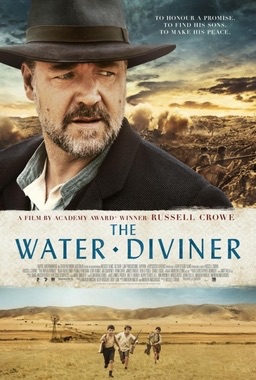
The Water Diviner

Russell Crowe has been working consistently in films since the 1990s. He's picked up three Oscar nominations for his acting, winning for 2000's Gladiator while earning nominations but not winning for 1999's The Inside and 2001's A Beautiful Mind. Like many actors though, Crowe isn't working just in front of the camera. He just happened to get behind the camera as a director. His directorial debut is getting some solid reviews while also making some decent box office. Here's 2014's The Water Diviner.

It's 1919 and the world is still moving on and recovering from the horrors and losses of World War I. At their remote ranch and home in the Australian Outback, a father and husband, Joshua Connor (Crowe) is especially dealing with those losses. He lost all three of his sons to the war, all three of his boys killed during the fighting at Gallipoli. Years later, his wife is finally undone by the loss of her boys and takes her own life, leaving Joshua alone and looking for answers. Where does he look? Both for his own sanity and for the memory of his family, Joshua decides to go find his boys, or at least their bodies buried somewhere in the hell that was no man's land. Bodies were often buried where they fell and a huge effort has been made to identity the corpses but what a daunting task. Connor figures he has no better alternative and leaves Australia, traveling to Turkey and the scarred battle sites, looking for some sort, any sort of closure.

Come on now, it's Russell Crowe! This is a throwback type of star who you could see starring in any number of big screen epics, biblical stories and large scale westerns. He's got the on-screen persona and the acting chops to carry the load so it's appropriate that Crowe cuts his directing teeth on a large-scale period piece with the aftermath of World War I as its backdrop. This is the guy behind Gladiator, Master and Commander, Robin Hood, even a western like 3:10 to Yuma. He knows what he's doing, and that's pretty clear from the get-go!

The premise is a little bit like a quixotic venture straight out of Don Quijote. It is a man searching for something, for answers, for closure, like a needle in a haystack. That father looking for answers has been explored with a whole unintentional sub-genre of films, anything from In the Valley of Elah to Shenandoah. 'Diviner' works in those heavy, emotional father son moments, most of that relationship shown through three or four quick flashbacks. We never get to learn much about Joshua's boys so all we have to rely on is that always important relationship between a father and his sons. Who will he meet along the way? What will he find? That's the beauty of the road story like this, albeit with some tweaks here and there. The post-WWI backdrop is fascinating, unsettling and uncomfortable. I know little about the history in Turkey in the late 1910s/early 1920s, but it was clearly an incredibly turbulent time. In other words, how do you find what happened to three young men in a war that took millions, four years later, and that country is still at war? Let the search begin.

Russell Crowe is the Man. He's one of my favorites, a star who's struggled over recent years to find those great roles that turned him into a star, Gladiator, A Beautiful Mind, The Insider. Like John Wayne in a western, Crowe looks and feels comfortable in these historical period pieces. It is a strong, emotional, sympathetic part for Crowe as he plays Australian rancher/father/husband trying to find some answers, any answers, to bring some closure to a hellish situation. The acting and the character provide the heart and crux of the story. It's hard not to sympathize with a father who at least partially blames himself for the deaths of his sons. The quiet moments resonate, especially as he continues to read to his boys long after their death....because that's what fathers do. The most gut-wrenching scenes have Joshua out on the still war-torn battlefields, trying to find some clue or evidence of his boys.

Who else to look for? The most familiar face is Olga Kurylenko as a Turkish woman and single mother who owns a hotel in Turkey and gives a room to Connor in his search. Yeah, the developing love story isn't the greatest, but it isn't awful either, two struggling people finding a bond and potentially more. Dylan Georgiades is solid too as her young son who clicks immediately with Connor. I thought the best supporting parts were Yilmaz Erdogan and Cem Yilmaz as two Turkish officers who get involved with Connor as he searches, all the men working through some hatred, prejudices and biases. Also look for Jai Courtney (Unbroken, Starz's Spartacus), a budding young actor who seems destined for big things. He plays a British officer tasked on the burial detail of finding, identifying and re-burying the dead soldiers from the fighting years before. The Connor boys are played by Ryan Corr, James Fraser, and Ben O'Toole.

Making his directorial debut, Crowe set out to do something daunting in directing a big, sprawling and emotional epic set against a family backdrop in a world still torn apart by war. For the most part, I think he succeeded. There are moments where maybe a bigger budget would have helped, but nothing crippling. The battle scenes are violent and uncomfortable but not graphic. It is a beautiful-looking movie with Australia and Turkey both serving as filming locations. The musical score is big and booming without being overbearing as well. 'Diviner' is at its strongest moments with Crowe's Connor out on the trail, in offices, traveling, doing anything he can to find his sons. It slows down at times when the love story develops, but things definitely pick up in the finale. A tad slow at times in general, but overall? A successful debut for Mr. Crowe. An easy movie to recommend!

The Water Diviner (2015): ***/****

Wednesday, May 21, 2014

Von Richthofen and Brown

The name Manfred von Richthofen may not ring a bell with a lot of people, but his nickname certainly will....or it should at least. That name you ask? That would be the Red Baron, a German fighter pilot from WWI who became the most famous fighter pilot of all-time. His life has been made into several films and books, but this one....well, it ain't especially good. Please read on anyways! It's 1971's Von Richthofen and Brown, an interesting title if there ever was.

As World War I rages across Europe, a young German officer, Manfred von Richthofen (John Phillip Law) transfers from the cavalry to an air squadron of fighter pilots. He picks up flying quickly and it's only a matter of time before he becomes an ace himself. His fame spreads across both sides, both German and British pilots fearing and respecting him. As his fame and notoriety rises, Richthofen's ego grows, but it's more than that as he starts to see the tide of war turn toward the Allies. Across the lines at British airfields, a new Canadian pilot has arrived, Roy Brown (Don Stroud), with some new thoughts on how the air war should be handled. Two very different pilots with very different outlooks, both Richthofen and Brown seem destined to meet on a collision course as the war wears on. 

From movies like Top Gun, Red Tails, and Behind Enemy Lines to older movies like Wings, The Dawn Patrol and Twelve O'Clock High and countless movies in between, audiences have long had a fascination with aerial combat. An untapped source of said movies is World War I, the first war to feature aerial combat of any sort. We've got entries like Flyboys, a throwback type film, entertaining if highly cliched, like The Blue Max, a bit long in the tooth with lots of potential that I should rewatch soon. Where does this 1971 entry fall? Well, it ain't good for starters. As a counter though, it doesn't have a ton of potential to begin with. We're talking a real winner here, huh? I had modest expectations heading into this flick -- there just isn't much in the way of World War I movies out there -- but I managed to come away disappointed.

It's never a good start when your two title characters have the on-screen personality of brooding, annoying and boring pieces of cardboard. I always thought John Phillip Law was a likable enough on-screen presence if not exactly a huge acting presence. The script does him no favors, but Law is downright boring as one of the most famous war heroes ever. Early on, he's an idealistic, capable soldier who revels in each of his kills. With each passing month, Richthofen becomes more and more disillusioned with the war and its cost. And then there's Stroud as Roy Brown, an actor who typically played a villain, a bad guy, a nut bag, or any and all. Wow, this performance is just bad. Stroud's Brown hates war and all its horrors. Interesting premise, huh? I don't know if he had one line that wasn't some preaching, whiny, condescending about the profoundly awful qualities of war. A dud for both potentially very interesting characters.

Made on the relative cheap from director Roger Corman, 'Richthofen' certainly tries to be a good movie. There's an abundance of aerial sequences, WWI era planes in one dogfight after another. Yeah, there's too actually too many of such sequences, and they all seem to have been filmed over one particular field. The editing just goes on and on with no real flow to the dogfights. Making it worse, the narration from Richthofen, Brown and several other pilots/officers/commanders rambling on and on about their problems, the pressure, the knowledge that death awaits them at any minute. Even composer Hugo Friedhofer's score can't save this dreck.

Lookie here, there ain't too much to say here. I didn't like this movie, and it has little to nothing to recommend. It's dull and does little in 99 minutes. There aren't any other characters/performances worth mentioning, and the only two I did mention weren't very good. My personal favorite in the most cringe-worthy department was Stroud's Brown examining a wounded, possibly dead pilot. He yells at everyone to get back, examines the body himself, and then says in almost sing-songy fashion "Well, he's dead!" and walks away. You couldn't make it up if you tried. It plays fast and loose with the historical facts, and it's just a bad, dull movie.

Von Richthofen and Brown (1971): */****

Friday, September 27, 2013

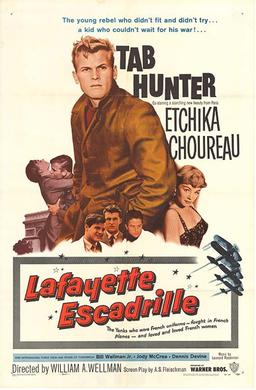
Lafayette Escadrille

Before the U.S. entered the fighting in World War I, Americans still had a chance to join the fighting themselves, especially those wanting to fly. The Lafayette Escadrille was created as a fighter squadron of American volunteers who wanted to help turn back the Axis forces. The famous squadron has been in three film adaptations of their exploits, including a silent film, recently with 2006's Flyboys, and a real dud of a flick on basically all levels, 1958's Lafayette Escadrille.

Having gotten in trouble with the law and subsequently with his father, Thad Walker (Tab Hunter) flees and sneaks onto a ship out of New York heading for Europe. His plan? Join the Lafayette Escadrille, a squadron of flyers in the French army created for American volunteers looking to join the fighting in World War I. He's worried about his trouble with the law stopping him from the squadron, but he's accepted and arrives with three other Americans. They begin training under French commanders, learning to work as a team -- mostly on the ground with very little actual training in a plane. Thad's mind is elsewhere though. He's constantly thinking about Renee (Etchika Choureau), a beautiful young French woman he met in Paris before shipping out to training camp. Can he focus enough on the training and flying to become a flyer?

How do I put those delicately? From director William A. Wellman, this movie just ain't good. It's almost painful at times to actually get a movie that runs an endless 93 minutes. For starters, it isn't really much of a story about the American flyers flying with the French. That must have been a ploy by Wellman. Point to you, Wellman! It's a bizarre mix of a forced love story, out of place physical humor, and broadly written dull characters. How many scenes do we need of a French drill sergeant (Marcel Dalio) who can't speak English trying to get his volunteers to march in formation? Oh, but one of the Americans speaks French and is just messing with the sergeant?!? That's hilarious. The actual training scenes are embarrassing, rickety wooden planes crashing into each other, even running into a bakery and a bakery thief. It doesn't have to be a consistently dark tone, but a Keystone Cops tone is exactly what shouldn't have been done.

Much like 2006's Flyboys -- which I liked a lot -- 'Lafayette' devotes far too much time to an unnecessary love story that is criminally boring to watch develop. I've never been a huge fan of Hunter as an actor, and here the 27-year old just doesn't bring the character to life. First off, it's hard to root for him. As we meet him, he's stealing a car and actually crashes at high speeds into a kid on a bike (the kid's only injured thankfully). His Thad comes from a tough house where his rich dad was very tough on him. Boo-hoo, I don't feel for you, buddy. It's not just that I didn't like the character, I was actively rooting against him. That's always a good jumping off point for any movie. His relationship with Choureau's Renee brings an already slow-moving story to a grinding halt. At the 45-minute mark, the story focuses almost exclusively on the love story away from the airfield. I felt like I'd stumbled into a different movie, a far more boring movie.

But wait, there's hope! Right? Eh, maybe not. I was intrigued by the supporting cast here so I held out hope. Thad's fellow pilots he arrives with include David Janssen as the smooth-talking, pencil mustache pilot, Duke, William Wellman Jr. playing a variation on his dad who actually flew as a WWI pilot Jody McCrea as Tom. As for the rest of the pilots, look for a pre-Rawhide Clint Eastwood, pre-Billy Jack Tom Laughlin, and Will Hutchins. The problem becomes that many more pilots are introduced, but they're a faceless bunch of characters that never amount to anything. We're actually introduced to them as they're sleeping -- so we don't actually see most of their faces -- as Wellman Sr. narrates what will happen to them. We don't actually see any of that happen, but we learn that most of them will die. It would have had at least some emotional impact if we actually got to know them. Also look for Paul Fix briefly as an American general.

It's a film that wasn't intended to be a classic but is still highly disappointing. The actual aerial footage of the WWI-era planes is pretty cool, but there's very little of it. We don't even see a dogfight until the last 10 minutes of the movie, and by then I had long since checked out. A cool cast makes it almost worth watching as a sort of guilty pleasure, a way to check off an actor like Eastwood's filmography, but it has little else to recommend. It's Rebel Without a Cause in planes, but they forgot to bring the planes. Pass.

Lafayette Escadrille (1958): */****

Monday, October 8, 2012

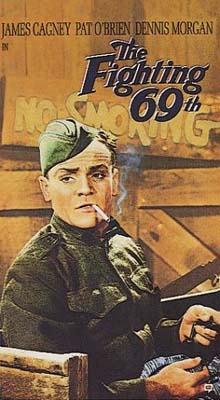
The Fighting 69th

A famous military unit -- the 69th New York --, the most decorated cleric in U.S. military history -- Father Francis Duffy -- and a movie star at the height of his game. Throw those three things together and what do you get? A sometimes overdone, mostly effective and definitely a product of its time, 1940's The Fighting 69th.

As the United States enters the fighting in 1917 in World War I, units are assembled all over the country, including the 69th New York, a regiment dating back to its fighting with the Union in the Civil War. At the head of the unit is Major Wild Bill Donovan (George Brent) who intends to shape up his regiment composed almost entirely of Irishmen from all over the state, and he does so with the help of Catholic priest Father Duffy (Pat O'Brien). Among the new recruits though is a troublemaker, Jerry Plunkett (James Cagney), a spark plug of a man with no real regard for authority who only wants to get to Europe and kill his fair share of Germans.

From director William Keighley, this 1940 war picture rises above a fair share of limitations while using the concept of a 'unit picture' as a jumping off point. It takes a group of men -- in this case the very Irish 69th New York -- and takes us through their training and/or bonding, deployment in war, and then the actual battles. Even with a 1940 release, 'Fighting' does a good job portraying the horrors of WWI. Trench warfare produced some of the nastiest fighting the world has ever seen, and it's easy to see why here. Certain shots and scenes stuck with me, including close-up shots of feet walking by the crude wooden crosses marking muddy graves, the shots of terror of artillery raining down on men in trenches, and of course the suicidal charges across no man's land into German machine guns.

Very much an established star by 1940, Cagney is both good and bad here. At times, he resorts back to stereotypical Cagney; loud and aggressive, boisterous because he can be, annoying to the point you want to rip your ears off and punch him in the face. Other times? You admire the character he's created; a blowhard of a man who really isn't all that confident but puts up a false front just the same. The antics become a little too much at times to the point it feels like the movie is just piling on. Whether or not you'll be able to enjoy this movie will no doubt revolve around being able to sift through the grating at times to get through to the real performance. In the end, it's worth it.

A solid supporting cast backs Cagney up. One thing I can say as an Irishman....don't mess with the Irish. Portraying the real-life hero Father Duffy, O'Brien delivers a saintly performance, one meant to honor the famous priest. No flaws, no mistakes, just a hero. It's an okay performance if laid on a little thick. Brent is all right as Donovan, the stiff-jawed commander of the 69th. Alan Hale is very good as Sgt. Wynn, the drill sergeant trying to toughen up his men while Jeffrey Lynn is a scene-stealer as Sgt. Joyce Kilmer, a poet/writer who should be an officer and leader, not just a little Indian. Also look for a grating comedic performance from Frank McHugh, Dennis Morgan as the selfless Lt. Ames, and Guinn Williams as Pvt. Dolan, the sort-of slow but well-meaning brute of a soldier. 

Without any real sense of subtlety, 'Fighting' tried its best to drive me nuts, and there were parts I just couldn't stand. The brawling Irishmen, the very broad humor, the antics from Plunkett, they all tried to make this a difficult movie to enjoy. But in the end, I was very moved by the finale (and that's knowing what's coming if you've got two working brain cells). Even then, the battle scenes go too far, Cagney's Plunkett sending mortars at a German position with cries of "That's for Brooklyn!" or "Take that, you Krauts!" but it still manages to be effective. There's that part of me that wants to rip this movie, but I just can't too much. I liked it almost in spite of itself. Maybe it's the Irish in me.

The Fighting 69th <---trailer (1940): ***/****

Monday, October 1, 2012

Deathwatch

It's difficult to imagine the horror that was trench warfare in World War I. Wasting away in the mud with filth, rats and disease all around, soldiers were rewarded with what amounted to suicidal charges into enemy machine guns. In other words, basically the worst environment available. Maybe because of that situation -- and its general uncomfortable quality for viewing -- WWI movies aren't as prevalent as WWII. So how do we tweak that plan? A horror WWI movie, 2002's Deathwatch.

It's 1917 along the Western Front in France, and Pvt. Charlie Shakespeare (Jamie Bell) and the rest of his infantry company take part in a nighttime charge on a heavily guarded German position. The casualties are horrific, and in the morning Shakespeare and a small group of fellow survivors are lost and separated from any other British units in the fog. They stumble upon a maze-like set of trenches held by just a trio of German soldiers so their commander, Capt. Jennings (Laurence Fox), orders them to hold the position, believing they've taken a forward German position. The group settles in, but something isn't right. Something else is in the trenches with them...some sort of evil.

Poorly reviewed/rated since its 2002 release, Deathwatch is still an interesting -- if heavily flawed -- movie. A lot of it appealed to me, and I'm not usually one for horror movies. That might be its biggest positive though, and that would be the ability to combine genres. A war movie meets a horror movie? You don't see many of those around. A WWI trench is an ideal setting for a movie for the look and feel alone. It rains basically the entire movie, turning the trench into one vast mud pit. The walkways are cluttered with debris, dead bodies and who knows what other horrors. Setting the story in an intricate set of maze-like trenches sounds simple, but it is original and gives a great backdrop to an interesting cross-genre plot.

I've made no secret of my typical dislike for horror movies. I don't like being scared watching movies. I want to enjoy them. That said, 'Deathwatch' is an incredibly uncomfortable, unsettling movie that had me on the edge of my seat. What is it that awaits these British soldiers in the trench? No spoilers here, but it is an unseen -- mostly at least -- evil that seems to pit the soldiers against one another. The trench is literally littered with corpses, German soldiers too. Serial killers, slasher movies, yeah, they're scary. But what about an enemy that is evil incarnate? How do you defeat something that is at its base...evil and in theory, can't be defeated? That sense of doom and foreboding is disgustingly effective here because until late, we don't see what these soldiers are actually up against. A twisting, turning maze can hold all sorts of horrors, and no one knows what to do to combat it.

Combining a war story with a horror movie allows director Michael J. Bassett to use the 'unit picture' idea in his casting; a small group of men from one unit working together to survive some sort of hellish war situation. In one of his first roles, 18-year old Jamie Bell is decent but nothing spectacular as Pvt. Shakespeare, the young soldier trying to overcome a fear that cripples him in battle. Fox as Jennings is the new officer who no one quite trusts. The other noteworthy performances include Hugo Speer as Sgt. Tate, the experienced non-com, Andy Serkis as Wilson, the unhinged killer, Matthew Rhys as Fairweather, the medic, Dean Lennox Kelly as McNess, the clear-thinking, worrying Scotsman, and Hugh O'Conor as Bradford, the religious radioman. The other soldiers include Ruaidhri Conroy, Kris Marshall and Hans Matheson. Torben Liebrecht has a creepy part as Friedrich, a German soldier captured in the trenches.

What splits a lot of people -- myself included -- about this movie is the ending. Spoiling it here with no doubt ruin your whole viewing of the movie, but I will say I liked it....to a point. It feels familiar, like other films I've seen with a similar twist. The last scene leaves the story open to interpretations a little, and the final shot is a startling one that sent a shiver up my back. In general, the story is good, but at times it tries to do too much. It explores religion amidst war, the brutality, goodness in a horrific situation, and a will to survive when everything around you is trying to kill you. The story/script could have been a little more pointed, but I still liked this one a lot. Well worth checking out for a creepy change of pace movie.

Deathwatch <---trailer (2002): ***/****     

Monday, July 18, 2011

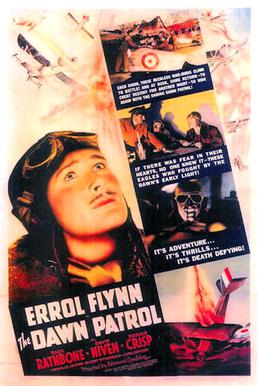
The Dawn Patrol

Just a few years after the turn of the century in 1903, the Wright Brothers were the first men to actually fly a plane -- sort of -- and over the last 100 years aviation has advanced by leaps and bounds. Think about just 10 years later though as the world was plunged into a world war. As thousands of soldiers blindly charged into enemy machine guns on the ground, planes were becoming part of war as well as pilots, fighters, and bombers all took to the skies in hopes of gaining a strategic edge on the enemy. World War I has always been vastly underrepresented in films, but there is potential for lots of good stories.

Maybe its the aviation aspect that studios assume viewers will be more interested in flying, but thankfully World War I pilots have been in several worthwhile movies. Most recently Flyboys struggled in theaters telling the story of American pilots flying with the French early in the war. George Peppard starred in The Blue Max, the story of a German infantry soldier turned national hero. One of the best though is 1938's The Dawn Patrol, an anti-war film that is both thrilling to watch and able to strike a nerve emotionally.  That's a good combination if there ever was one.

It's 1915 in France and as a leader of one of the flights in the British 59th Squadron and one of the few pilots with experience, Capt. Courtney (Errol Flynn) consistently finds himself leading rookie, inexperienced pilots on missions where they rarely return.  The war demands new pilots though and as quick as they're taught how to fly they are thrown into the fire. Courtney is constantly at odds with squadron commander Major Brand (Basil Rathbone) who realizes the idiocy of the orders he's receiving but can do nothing about it. Courtney's actions one day in destroying a rail depot actually gets Brand promoted, leaving the command post open to which Courtney is promoted. With close friend and fellow pilot, Lt. Scott (David Niven), taking over one of the flights, Courtney steps into the command position, immediately seeing that there will be no winners in this war.

I've long been aware of this movie, but just never got around to seeing it. I had a picture of gallant, heroic Errol Flynn single-handedly winning World War I from his fighter plane, dispatching hundreds of Germans at will.  Flynn does play the gallant, heroic pilot, but in terms of the rest of the movie I couldn't have been more wrong. Just a year before WWII started in a time when I think of blatant, painful propaganda movies, this is an anti-war movie screaming for someone to listen to the complete idiocy of war and armed combat. Director Edmund Goulding has a film here that doesn't pull any punches. An assembly line of pilots is sent to their deaths because the war requires it, not because it makes any sense. Someone has to fight, and these inexperienced pilots fit the bill.

The best utilization of this is when Niven's Lt. Scott sees his younger brother, Donnie (Morton Lowry), among the newest batch of replacements. Up to this point both Scott and Courtney have balked at what they're doing, but the new pilots are nameless, faceless and interchangeable individuals. Now they have a boy in front of them fresh out of flight school who with his barely 10 hours of time in a plane is expected to tangle with German aces. Niven's Scott begs, implores Courtney to ground his younger brother, giving him a few days to teach him how to survive. Courtney wants to do so, desperately wants to, but as commanding officer where can he draw the line? He can't because he would have to do this for every new pilot. It tears him up inside, sending these young men to almost certain death, but he's left no other option.

Robin Hood is Flynn's more well-known and even iconic role from 1938, but his part as Captain Courtney in The Dawn Patrol is without question the better part for him. I've always liked Flynn as an actor, but I've been critical at times because he does seem to play similar characters. It is roles like this that show he may play similar characters, but he was more than a movie star, he was an actor. Courtney is forced to go through a transformation because his duty calls for it, not because he wants to. Sending men to their death takes its toll on him, but he continues on. Flynn was just 29 years old at the time, and Niven just 28 as they filmed, both showing they were on their way to bigger and better. They have a friendship on-screen that reflects their friendship off-screen so their characters are unquestionably genuine.

With some impressive aerial footage of World War I era planes, it's impossible not to get sucked into the action.  We're watching these flimsy planes that look like a stiff wind would rip them apart as they maneuver and tear through the skies. In an age of planes that travel hundreds of miles in minutes, watching a movie like this can seem like ancient history. The best part of the movie though are the quieter moments, Scott and Courtney reminiscing before a mission that has little chance of success. It's the pilots wearily accepting their orders, hiding the disappointment and running out to their planes. It is Lt. Scott addressing his flight of the squadron, the movie beginning as it ends. There will be no victors, just survivors. These were gentleman fighting a brutish war, much of the time treating their German counterparts with respect. A great scene has Courtney drinking with a downed German pilot (Carl Esmond) just a few hours after shooting him down. There is a surreal nature to the proceedings that just couldn't be made up.

Rightfully so this is remembered as an Errol Flynn movie, and both Flynn and Niven are perfectly cast. Rathbone though is particularly memorable as Major Branch, the commander who wishes he could be up in the sky with his pilots instead of behind a desk. Donald Crisp is good in a supporting part as Phipps, the squadron adjutant while Barry Fitzgerald plays Bott, the squadron mechanic. This is a criminally underrated war movie, one that surprises in the effectiveness of its message. Well worth checking out.

The Dawn Patrol <---trailer (1938): *** 1/2 /****

Friday, March 18, 2011

All Quiet on the Western Front

In one of the most succinct, powerfully effective lines in history, Union general William Tecumseh Sherman said 'War is hell.' Nothing else really needs to be said. There is nothing glamorous about armed conflict in any setting where one man takes the life of another, no matter what movies, TV shows, and books may try and convince you otherwise.  Anti-war movies really came to the forefront during the Vietnam War as public sentiment soured on the conflict in Asia.  But one of the most moving anti-war stories came long before that, 1930's All Quiet on the Western Front.

Based on the classic novel of the same name by Erich Maria Remarque, this is a remarkable movie for any number of reasons, starting with the year it was released. I would have never pegged this movie as being released in 1930, just a few years into the sound era of movies.  There is also a sense with early Hollywood of white-washing stories, of censoring the movies of anything that is even remotely offensive. But that's the point of a war movie like this. It is supposed to offend you, to show the real horrors of war.  Considering its 1930 release, it is one of the most violent movies of the era, but it so much more than just violence.  This is war at its dirtiest, most base fighting, the effect it has on the men doing the fighting. No glory, no glamor, just survival.

With Germany preparing for war in 1914, teenager Paul Baumer (Lew Ayres) enlists with almost 20 other teenage boys from his school, dreaming of the glory that awaits them on the battlefield as Germany battles England and France. They leave with the notion that nothing would being them greater glory than to die for their country, quickly realizing how ridiculous the notion is.  After a quick training period, Paul's company is sent to the front lines as replacements for a veteran unit already worn down and torn apart from the fighting. They find a war unlike anything told to them prior, the idea of heroism and glory quickly going out the window. They settle in to the trench warfare, charging across bomb-marked fields into walls of machine gun fire. A heroic fight for one's country? Maybe, but these soldiers could care less. They just want to survive the hell that surrounds them.

Two characters rise above the story here, starting with Ayres as young, impressionable Paul. His acting can be a little too stage-oriented, but it is through his eyes we see the horror of war.  It is a remarkable performance from the 22-year old actor as we see his transformation from a naive newbie on the front lines to a tattered veteran in the matter of days. Somehow, he survives the days, weeks and months as so many of his comrades drop around him. Playing a part that would become synonymous with war movies, Louis Wolheim plays Corporal 'Kat' Katczinsky, the wily veteran who ends up being a leader based almost solely on his ability to teach and survive where so few others can. It's these two performances that anchor the movie. Other than that, most of the cast is pretty interchangeable, faces that don't leave much of an impression before being quickly dispatched.

Working on an impressively large scale for a 1930 release, director Lewis Milestone turns in an all-time classic here. He pulls no punches with his story, staying true to Remarque's source novel and its brutal honesty in portraying the horrors of war. Hundreds of extras fill the screen, and the battle scenes are immense.  Milestone shows a knack with his camera in an ahead of its time use of tracking shots that put you in the trenches with the hand-to-hand combat, following the men across acres of open ground under bombardment and heavy fire.  Exciting or entertaining? No, not really. This is war where there were no super-soldiers. Men died by the hundreds and thousands in futile efforts to gain a few feet of dirt.  The battles are surprisingly graphic, just adding to the affect of what you're actually seeing.

When I think of an above average anti-war movie, I think of the moments that stick with you long after watching the movie.  'Western Front' has too many to even mention, but here are just a few that left the deepest impression. Visiting a wounded soldier, Paul watches him die a slow, painful death, the staff and patients around him not so much as blinking at his cries. Hiding in a trench, Paul tries to save a French soldier's life moments after stabbing him to save his own. After a sustained bombardment, a German soldier finally cracks, running out of the damp, crowded dugout screaming bloody murder. Later, a wounded soldier rises from his hospital bed and trudges across the room to the window where he feels a ray of sunlight on his face, promptly dropping dead. The best though may be Paul's return home, seeing the perception that the people left behind have of this glorious war.  He tries to tell them the truth, but to no avail. After all, what does he know having served on the front lines for years?

This is a story where a happy ending just wouldn't work, wouldn't fit with the tone or style of this anti-war message.  But even being aware of that doesn't take away from the raw power of the ending, simple in its execution but speaking volumes about the idiocy of war. SPOILERS STOP READING SPOILERS Returning from leave, Paul finds Katczinsky who is wounded scrounging for food. Paul carries him back to the aid station several miles back, unaware his friend has died. He leaves quietly, not sure or not believing what just happened. Days later sitting in a trench, he reaches out for a butterfly resting just inches away and is picked off by a French sniper. The movie ends with the haunting image of Paul's outstretched hand reaching for that one beautiful thing in nature, coming up just short. I can't think of a more appropriately down ending for a movie that had to end that way.

If interested in watching the movie, it is available to watch at Youtube in an above average print thanks to a great restoration job, especially when considering the movie was made over 80 years ago.  You can watch it HERE starting with Part 1 of  13. 

All Quiet on the Western Front <---trailer (1930): *** 1/2 /****

Monday, December 6, 2010

Gallipoli

Time to get a little deep, a little thoughtful with this movie review (or at least the beginning).  I don't believe there is a smart way to fight a war dating back through history.  For hundreds of years, opposing armies stood in open fields across from each other and fired point blank into the others' ranks.  How anyone stood there staring 100 yards away at a wall of rifle and musket fire baffles me.  That was the gentlemanly way to fight though, and no one thought anything of it.  But years passed and technologies advanced so in World War I with armies using automatic weapons and machine guns, the strategies didn't advance.  Waves of soldiers jumped out of trenches and charged across open fields into a living hell of bullets and explosions.

Maybe because visually trench warfare isn't the most visually interesting thing to watch there have not been many movies made about World War I.  The ones that are out there are typically very good, including 1981's Gallipoli. It's hard to peg this one as a war movie though because it does not focus exclusively on the fighting that took place.  It is a patient movie that takes its time introducing two characters before getting them into the army.  But once director Peter Weir gets where he wants to, the movie really picks up steam as it leads to one of the more memorable finales I've come across in a war movie, especially a striking last shot that catches you off guard in its execution.

It's 1915 in western Australia and young Archy Hamilton (Mark Lee) is training as a sprinter and quickly making a name for himself as he climbs up the ranks, winning race after race. But the constant news of the war in Europe has made an impact on Archy, and after a win at a highly touted regional race, he travels to Perth with another young runner, Frank Dunne (Mel Gibson), and joins the army, the Australian and New Zealand Army Corps (ANZAC). The two friends are assigned different units, but after weeks of training their destination will be the same, the Gallipoli peninsula, where the fighting has bogged down into costly trench warfare.  The British, Australians, and New Zealanders have been cornered though against the defending Turkish forces, and both Archy and Frank know what could await them across the battlefield.

Directing less than 20 movies, Weir has nonetheless developed a reputation for making high quality, professional movies that typically deliver a message without hitting viewers over the head with that message.  That's why Gallipoli can be considered an anti-war movie, but not an obvious one.  For almost an hour, the war is mentioned and never seen, more of an idea than anything else.  Weir wants us to get to know these two main characters, and the story flows along at its best when they're together.  When separated, the movie bogs down a bit, including a long, unnecessary scene where Gibson's Dunne and his fellow soldiers explore Cairo that doesn't go anywhere.  The pacing can be frustrating at times because Weir clearly knows where he wants his story to end up, but not always how to get there.

Where Weir wants to end up is the Gallipoli campaign (a condensed version obviously) where thousands of lives were pointless wasted in suicidal charges that produced no tangible results.  Over the movie's last 20 minutes, Archy and Frank's unit is assigned one of these charges but thanks to some miscommunication end up having to go over the top of the trenches without artillery support directly into a line of waiting Turkish soldiers.  Assigned duties as a runner, Frank has orders that could halt the charge but only has seconds to do it in.  Watch the ending HERE with obvious spoilers. The race against time should have you on the edge of your seat, and that coupled with the images of soldiers preparing to die, leaving their prized possessions behind, writing a last letter is a striking contrast.  It builds to a final shot that stuck with me long after the movie was over, a tribute to Weir's ability behind the camera.

Two years removed from the first Mad Max movie, Gibson was on his way to becoming a huge star, but he wasn't quite there yet.  Besides that he looks like he's about 10 years old (he was 25 at the time), the part is a sign of things to come concerning his acting ability.  He's got a presence you just can't teach, and a charisma that has you on his side from his first introduction.  I wish I could say the same for Mark Lee, his onscreen counterpart.  It isn't a particularly good or bad performance, instead it's just there.  Lee never gives us a reason to have any interest in this character.  Translate that into any scene where he shares time with Gibson, and he's overmatched.  If they're together, you're watching Gibson and not Lee.  Other worthwhile supporting parts include Robert Grubb, Tim McKenzie and David Argue as three of Frank's friends who also enlist, and Bill Hunter as Major Barton, an Anzac officer caught in between what he owes his men and the orders he's been given from above.

One other thing particularly jumped out at me, the music.  It's an odd 1980s mix of electro synthesizers and classical opera, some of which you could hear in the ending clip provided before.  The odd combination really shouldn't work because it's just too different, but somehow it does.  It can sound out of place, but the music still somehow sets the mood and tone as needed.  Who woulda thunk it?  Not this guy, but it's another positive in an underrated WWI movie.

Gallipoli <---trailer (1981): ***/****

Sunday, November 1, 2009

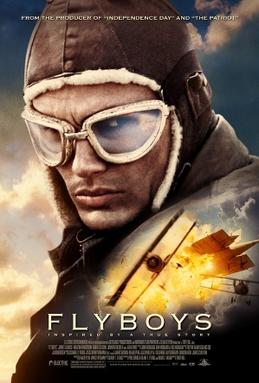
Flyboys

Before the United States officially declared war and entered WWI, many U.S. citizens joined the war effort, fighting for countries already fully involved in the war like Canada, Great Britain, and France. It's one of those lesser known stories that can get lost in the shuffle of the huge scale of the war. One group of Americans took part in the early days of aviation warfare, making up a volunteer squadron of pilots for the French, the Lafayette Escadrille. Their story was even turned into a movie, 2006's Flyboys, that is based on the facts of what actually happened.

What a surprise, but a historical epic about WWI struggled mightily at the box office, barely bringing in $13 million in theaters. I was lucky enough to catch it at a second-run theater, but it's been released on DVD in a high-quality packaging so if you missed it you have a chance to catch up. Directed by actor Tony Bill, Flyboys has an old-fashioned feel, like a war movie audiences would have seen in the 1940s as WWII raged on in Europe and the Pacific. WWI was that bridge in warfare between the Civil War and WWII as technology and strategy played a vital hand in how war was waged. Case in point; the airplane.

It's 1914 and a group of American pilots travel to France to join up with the Lafayette Escadrille, a squadron from the French Air Force (who knew?), in an effort to help throw back the German forces. It's only 10 years removed from the Wright Brothers first flight at Kitty Hawk so aerial combat is a new feature in war. Can these new pilots learn how to fly and fight before their German counterparts shoot them out of the sky, including ruthless the German ace known only as the Black Falcon (a variation of the Red Baron maybe)? With help from squadron commander Thenault (Jean Reno) and his aide Girout (Augustin Legrand) and quadruple ace Reed Cassidy (Martin Henderson), the new arrivals get to training.

Leading the pilots-to-be is Blaine Rawlings (James Franco), a young Texas rancher running away from an arrest warrant back home. Rawlings is cocky and confident, but he also becomes a reliable pilot while falling for a French girl, Lucienne (Jennifer Decker), living near the Escadrille's base as she cares for her brothers and sisters. The other pilots include Jensen (Philip Winchester), the all-American boy leaving his fiance behind so he can become a war hero, Skinner (Abdul Salis), a black boxer living in France hoping to defend the country that gave him a new life, Lowry (Tyler Labine), the Easterner with a silver spoon trying to live up to his father's name/expectations, Beagle (David Ellison), the pilot who can't seem to hit anything, and Porter (Michael Jibson), the religious pilot who goes into battle singing.

Franco leads the deep ensemble cast full of actors you might not recognize from other roles but not necessarily know their names. Rawlings' love story with Decker's Lucienne is surprisingly sweet with the French girl unable to speak English and the American pilot unable to speak French. Franco isn't a huge star, but with roles like this and in The Great Raid, I hope he sticks with some more historical movies. Other bright spots include Henderson as the requisite squadron badass. His character is based on real-life pilot, Raoul Lufbery. Reno is good in a thankless role as the squadron commander with Salis and Winchester representing themselves well.

What's so unique about a story like this is the difference almost 100 years makes in aviation. Commuter flights all over the world are second nature to us now, but in the 1910s it was an innovation, something still to be mastered and harnessed including the use of planes in war. The highlight of the movie then is of course, the aerial dogfights as the Escadrille tangles with rival German squadrons. In a time when CGI is overused much too often, Flyboys blends the computer images with actual flying sequences seamlessly. It never looks fake and because the fights look so real, they're that much more exciting and enjoyable. Here's the Escadrille's first dogfight for an idea of what's going on. Of the five or so extended battle sequences, the best by far is the attack on a German zeppelin approaching Paris, catch part of it here.

With a movie that runs well over 2 hours at 140 minutes, director Bill lets his story develop and allowing us to get to know the characters and sometimes all the difficult decisions they'll be forced to make. Aerial enthusiasts complain that the movie is not historically accurate -- I wouldn't know, I'm no expert on WWI era planes -- but that seems beyond the point. It's a well-made, exciting old-fashioned story about a little known piece of American history.

Flyboys <---trailer (2006): ***/****

Thursday, March 19, 2009

Netflix review #11: The Blue Max

While hundreds of movies have been made about WWII, the war preceeding has been covered very little by comparison. I just finished one WWI movie that I really wanted to like but never really got into it, 1966's The Blue Max starring George Peppard.

Looking for a safe spot in the middle of no-man's land, German infantryman Bruno Stachel dives into a muddy crater full of dead soldiers. High above in the skies, he sees two planes in a dogfight and smiles. Fast forward two years where Stachel has graduated from flight school and is arriving at his new squadron. Even new to the group, Stachel makes no excuses, he's there for one thing and one thing only; the Blue Max, a medal awarded to pilots with 20 kills. He doesn't care who else is killed around him, he will get the medal.

Obsessed with the pursuit, Stachel alienates the members of his squadron and its commander. On the other hand, the German Officer corps sees a hero in the making, a lower class pilot fearlessly flying against British fighters. That's not all the people who are impressed with Stachel as one German general's wife takes a keen interest in the young, cocky pilot.

By far the best thing about the movie was the aerial sequences of which there are many. No CGI here, all those planes and pilots are real. Even the scenes with the stars flying don't look too fake even if it's apparent that Peppard and Jeremy Kemp aren't actually flying. As well, these aren't modern day jet fighters or even the WWII fighters that at least looked somewhat sturdy. These planes were a little more than a decade removed from the Wright brothers taking flight at Kitty Hawk. It's too bad then that the rest of the movie drags. At 156 minutes, most scenes that don't involve the dogfights are pretty slow-moving.

One other flaw is in the characters. Peppard gives an excellent performance as Stachel, the arrogant, ruthless pilot, but he's extremely unlikable. I'm not saying all characters have to be saints, but it'd be nice to have one redeeming quality in a main character. I never was on his side and by the end hoped he would get his due. James Mason plays a German general loyal to the cause who sees a hero in the young pilot. Ursula Andress is good as Kaeti, Mason's wife who takes an interest in Stachel. Before nudity became common in movies in the 70s, Andress is always half-naked, covered up by a towel or a chair as she walks across a room. Jeremy Kemp and Karl Michael Vogerty play Willi Klugerman and Otto Heidemann, a rival pilot and the squadron commander who see Stachel as he really is.

The DVD offers the movie in a widescreen presentation that looks very clear compared to some of the scenes I've seen when the movie's aired on AMC. Special features are just a trailer, and then the same trailer in Spanish and Portuguese, along with five trailers for other Fox War classics. A movie I really wanted to like but never really got into it. Worth watching for the aerial dogfight sequences.

The Blue Max (1966): **/****