The Sons of Katie Elder

The Sons of Katie Elder
"First, we reunite, then find Ma and Pa's killer...then read some reviews."
Showing posts with label Peter Weir. Show all posts

Wednesday, April 27, 2011

The Way Back

The timing of this review wasn't intentional to go back-to-back on prisoner of war movies, but that's just my bad luck or planning I guess.  To call 2010's The Way Back a prisoner of war movie isn't quite fair though because that only serves as a jumping off point. More than the POW angle, this is a story about survival, about man testing his limits in the hopes of getting back home, trudging through hell and back to get there.  Appropriately enough, it is a good movie (if flawed) and was in theaters for about an hour and a half.  The DVD was released recently, and I was able to finally catch up with it.

As the special features on the DVD point out, the atrocities committed by the Germans in concentration camps during WWII have been well documented.  To the east though in Russia, similar atrocities were committed...we just don't know about it.  It is a little slice of history generally forgotten by the masses as hundreds of Russian gulags kept thousands of people imprisoned through the war.  'Way' is based on a non-fiction book by Slawomir Rawicz called The Long Walk documenting his story of escaping from one of these gulags with six companions and their desperate, even unbelievable, 4,000 mile walk to freedom. The book's accuracy and general honesty has been called into question ever since it was released in the 1950s, but true or not, the story is one worth telling.

Accused of spying and sabotage against Stalin, a young Polish man, Janusz (Jim Sturgess), is sent to a Russian gulag buried deep in Siberia. There he finds hellacious conditions where even the strongest struggle to survive. Seeing no hope, he escapes with six companions, including mysterious American, Smith (Ed Harris), and a Russian criminal from the streets, Valka (Colin Farrell). Short on supplies, food and water, their plan is desperate, but they figure what worse could happen to them back in the camp?  Knowing if they're caught they will be executed, Janusz and his group head south, even picking up a young Polish refugee, Irena (Saoirse Ronan), along the way. As they put hundreds and eventually thousands of miles behind them, they wonder, can they actually escape to some sort of freedom?

On a purely visual level, this is one of the most breathtaking movies you will ever see.  Janusz and his fellow escapees end up traveling over 4,000 miles from deep in Siberia to freedom in India.  Actually look at a map and see how far that is.  It's insane what he accomplished (or claims he accomplished).  We start in the snow-swept mountains of Siberia, wind whipping around at all times, and then move south into the green, rocky hills surrounding Lake Baikal.  Continue on into the wastelands of Mongolia and the Gobi Desert into the Himalayas, one of the biggest mountain ranges in the world.  'Way' is an incredibly beautiful movie to watch, shots composed with an eye to impress and leave that lasting impression. Consider the movie a big winner on that account.

Survival stories are movies and stories at their most basic.  No extra, unnecessary plotlines, no wasted departures, just putting one foot in front of the other and keep on moving. Keep on breathing even though you want to give up. Director Peter Weir has a bare-bones type of story here, men already pushed to their limits forced to go even deeper into their mind, heart and soul to keep going, to push on.  That's good for awhile, but at 133 minutes it isn't always the most interesting story.  By a certain point, you're either rooting for these characters or you're not. I assume it was Weir's intention to beat you over the head, to exhaust you with this survival trial the same way the characters are going through it.  Mission accomplished because at times this is an exhausting story.  I won't say tedious because things don't repeat themselves, but seeing a man plunge to his absolute lowest can only be done so many times.

Before the movie even starts, a title card says that in 1942 three men walked into India having survived a 4,000 mile trek to get there.  I thought it was a poor decision to give that much information away from the get-go, especially because seven people escape the gulag.  We now know four aren't going to make it. It's just a matter of which ones.  Character development is not high on the list of things going for this movie.  Sturgess as Janusz simply isn't given enough information to be a real human being.  He felt like an idea of a character to me.  Harris and Farrell are the scene-stealers, Harris' Smith the most mysterious but also most sympathetic while Farrell's criminal Valka is the most interesting.  SPOILERS When he departs a little over halfway through the movie, my interest level went down END OF SPOILERS  The other four are fairly interchangeable, including Dragos Bucur as Zoran, the funny man and complainer, Alexandru Potocean as Tomasz, the artist, Gustaf Skarsgard as Voss, the priest, and Sebastian Urzendowsky as Kazir. Mark Strong is also very good as Khabarov, but his character gets left behind at the gulag.

Where does this movie fall then?  Above average for sure, but not a classic or one I'd revisit anytime soon.  With on-location shooting in Bulgaria, Morocco and Australia, it would be worth it just to watch the movie as a visual travel guide.  I'm unfamiliar with his other work, but composer Burkhard von Dallwitz does a subtle score that is memorable in its simplicity, its ability to match up so well with the visual. My only suggestion would be to cut about 20 minutes from the movie.  There is so much positive here that I have to recommend it, including a beautiful ending, moving in its execution as everything comes full circle.

The Way Back <---trailer (2010): ***/**** 

Monday, December 6, 2010

Gallipoli

Time to get a little deep, a little thoughtful with this movie review (or at least the beginning).  I don't believe there is a smart way to fight a war dating back through history.  For hundreds of years, opposing armies stood in open fields across from each other and fired point blank into the others' ranks.  How anyone stood there staring 100 yards away at a wall of rifle and musket fire baffles me.  That was the gentlemanly way to fight though, and no one thought anything of it.  But years passed and technologies advanced so in World War I with armies using automatic weapons and machine guns, the strategies didn't advance.  Waves of soldiers jumped out of trenches and charged across open fields into a living hell of bullets and explosions.

Maybe because visually trench warfare isn't the most visually interesting thing to watch there have not been many movies made about World War I.  The ones that are out there are typically very good, including 1981's Gallipoli. It's hard to peg this one as a war movie though because it does not focus exclusively on the fighting that took place.  It is a patient movie that takes its time introducing two characters before getting them into the army.  But once director Peter Weir gets where he wants to, the movie really picks up steam as it leads to one of the more memorable finales I've come across in a war movie, especially a striking last shot that catches you off guard in its execution.

It's 1915 in western Australia and young Archy Hamilton (Mark Lee) is training as a sprinter and quickly making a name for himself as he climbs up the ranks, winning race after race. But the constant news of the war in Europe has made an impact on Archy, and after a win at a highly touted regional race, he travels to Perth with another young runner, Frank Dunne (Mel Gibson), and joins the army, the Australian and New Zealand Army Corps (ANZAC). The two friends are assigned different units, but after weeks of training their destination will be the same, the Gallipoli peninsula, where the fighting has bogged down into costly trench warfare.  The British, Australians, and New Zealanders have been cornered though against the defending Turkish forces, and both Archy and Frank know what could await them across the battlefield.

Directing less than 20 movies, Weir has nonetheless developed a reputation for making high quality, professional movies that typically deliver a message without hitting viewers over the head with that message.  That's why Gallipoli can be considered an anti-war movie, but not an obvious one.  For almost an hour, the war is mentioned and never seen, more of an idea than anything else.  Weir wants us to get to know these two main characters, and the story flows along at its best when they're together.  When separated, the movie bogs down a bit, including a long, unnecessary scene where Gibson's Dunne and his fellow soldiers explore Cairo that doesn't go anywhere.  The pacing can be frustrating at times because Weir clearly knows where he wants his story to end up, but not always how to get there.

Where Weir wants to end up is the Gallipoli campaign (a condensed version obviously) where thousands of lives were pointless wasted in suicidal charges that produced no tangible results.  Over the movie's last 20 minutes, Archy and Frank's unit is assigned one of these charges but thanks to some miscommunication end up having to go over the top of the trenches without artillery support directly into a line of waiting Turkish soldiers.  Assigned duties as a runner, Frank has orders that could halt the charge but only has seconds to do it in.  Watch the ending HERE with obvious spoilers. The race against time should have you on the edge of your seat, and that coupled with the images of soldiers preparing to die, leaving their prized possessions behind, writing a last letter is a striking contrast.  It builds to a final shot that stuck with me long after the movie was over, a tribute to Weir's ability behind the camera.

Two years removed from the first Mad Max movie, Gibson was on his way to becoming a huge star, but he wasn't quite there yet.  Besides that he looks like he's about 10 years old (he was 25 at the time), the part is a sign of things to come concerning his acting ability.  He's got a presence you just can't teach, and a charisma that has you on his side from his first introduction.  I wish I could say the same for Mark Lee, his onscreen counterpart.  It isn't a particularly good or bad performance, instead it's just there.  Lee never gives us a reason to have any interest in this character.  Translate that into any scene where he shares time with Gibson, and he's overmatched.  If they're together, you're watching Gibson and not Lee.  Other worthwhile supporting parts include Robert Grubb, Tim McKenzie and David Argue as three of Frank's friends who also enlist, and Bill Hunter as Major Barton, an Anzac officer caught in between what he owes his men and the orders he's been given from above.

One other thing particularly jumped out at me, the music.  It's an odd 1980s mix of electro synthesizers and classical opera, some of which you could hear in the ending clip provided before.  The odd combination really shouldn't work because it's just too different, but somehow it does.  It can sound out of place, but the music still somehow sets the mood and tone as needed.  Who woulda thunk it?  Not this guy, but it's another positive in an underrated WWI movie.

Gallipoli <---trailer (1981): ***/****

Sunday, November 29, 2009

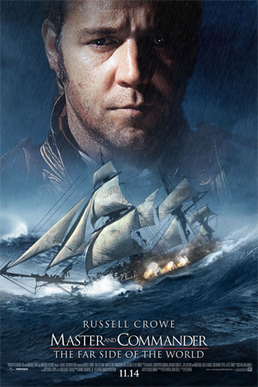
Master and Commander: The Far Side of the World

Starting in 1970, British novelist Patrick O'Brian wrote 20 books in a series that's been dubbed the 'Aubrey-Maturin' series. O'Brian's books explore a very specific time -- early 19th Century as England battled Napoleon and France -- and clearly hit a nerve with audiences. You don't put out 20 books with the same characters if somebody isn't buying them, or maybe that's just my take. I tried reading one of these books when I was 10 or 11 and struggled in the early pages and never finished it. But after watching 2003's Master and Commander: The Far Side of the World, a film adaptation of O'Brian's novels, I think I'm going to give them another shot.

Adventures on the high seas have been popular in just about every form of entertainment from movies to TV to literature to stage. Some are based in truth like Mutiny on the Bounty, others are just good stories like Herman Melville's Moby Dick. Something about traveling across the vast oceans clicks with audiences, maybe the romanticism of a time gone by? Who knows for sure, but the setting is a prime choice for a jumping off point for a story in any of its forms. Even released in 2003, 'Master and Commander' has the distinct feel of a movie from Hollywood's Golden Age.

A title card sets the stage quickly, it's 1805 and the H.M.S. Surprise is off the coast of Brazil. The Surprise's Captain, Jack Aubrey (Russell Crowe), has been given orders to track down and destroy --if possible-- a French privateer, the Acheron. Encountering the Acheron in a thick fog bank, Aubrey and the Surprise are caught off guard against the bigger, faster and more powerful French ship. After a heavily one-sided victory, the Acheron sails south thinking it has delivered a crushing blow, but Aubrey will follow his orders to a T, and he's going to get his ship. If not, the Acheron may reach the Pacific Ocean where it can wreak havoc on British trade.

While director Peter Weir's movie made almost $100 million in the U.S. alone, it has been critiqued as a bit of a flop considering the $150 million budget. But box office struggles aside, this is a hidden gem for fans of historical and period pieces which come along few and far between. From the language to the wardrobe to the sets, this makes you feel like you're on the ship with Aubrey and his crew. And other than action scenes in the beginning and the end that serve as bookends, 'Commander' is all about showing what life was like aboard an early 19th century British man of war.

And with a running time of 138 minutes, Weir gets significant time to tell that story. As a viewer, we see how the crew and officers live (the officer live a little better than crew, surprised me too) as they sail around South American and Cape Horn into the vast Pacific. The conditions are brutal, death is seemingly always right around the corner in any number of ways, the food is slop, and worst of all, a French privateer seems to have the ship's number. At times, the pacing can be a little slow but never to the point where I felt like I was bored. Some parts here and there could have been trimmed some, but that's a minor complaint.

With roles in movies like Gladiator, 3:10 to Yuma, Cinderella Man, here in 'Commander' and next year in the new Robin Hood movie, Crowe has carved himself a nice little niche in the historical genre. One of my favorite actors around, Crowe always delivers a strong performance while also making his characters sympathetic. His Jack Aubrey, 'Lucky Jack' to his men, is liked and respected by his men even when forced to make the most difficult decisions. At heart, they know Aubrey will look out for them. Reuniting after working together on A Beautiful Mind, Paul Bettany is quiet, understated and almost steals the movie from Crowe as Dr. Stephen Maturin, the Surprise's highly intelligent surgeon and naturalist.

The duo have a great dynamic together, Crowe the intelligent veteran warrior and Bettany the intellectual conscience, even playing a duet together (a very moving use of Luigi Boccherini's La Musica Notturna Delle Strade Di Madrid' No. 6, Op. 30). Aubrey and Maturin are long-time friends so that dynamic is strained at times as the captain must decide what's best for his ship while the doctor looks out for the individual and the morality of the situation. With a good but not great cast behind Crowe and Bettany, these two actors dominate the screentime. Others impressing include James D'Arcy as Lt. Pulling, a young officer on the rise, and Max Pirkis as Blakeney, a teenage midshipman forced to grow up amidst a war on the high seas.

If you're a fan of older movies that were content to just be entertaining (like that's a bad thing), this movie is for you. It's a beautiful movie to look at with some great visuals of 19th century warships chasing each other across miles of ocean, and then builds to a visceral, chaotic finale. As if that wasn't enough, the ending is a bit of a cliffhanger with the above Boccherini opera used as the sountrack. A great movie all around, especially worthwhile for Crowe and Bettany's performances, this won't disappoint.

Master and Commander: The Far Side of the World <---trailer (2003): *** 1/2 /****