Does the name Cornel Wilde ring a bell? For movie fans, it should. Working in films from the 1940s and on, Wilde starred in feature films and some television consistently into the 1970s and 1980s. The catch though is that he doesn't have that signature role or film to his name. He was an actor, not a movie star, even getting into the writing, producing and directing side of movies. If he does have a signature role, it's 1965's The Naked Prey, Wilde starring, producing and directing.
It's the late 1800s in Africa and a safari guide (Wilde) is leading a big game hunting party deep into the African veld. On the trail, the party is approached by a group of warriors who are seeking some treasures, some prizes, some trinkets for allowing the party to travel across their land and ultimately hunt. The party's leader turns them down in aggressive fashion despite their guide's insistence to the counter. Soon after, their party is attacked by the warriors and wiped almost, just a few men remaining, among them the safari and hunting guide. While the rest of the survivors are gruesomely tortured and killed, the tribe and its warriors have other plans for the guide. They're going to hunt him, giving him a short head start and then racing after him. Could he somehow, some way make it or is he doomed to meet a similarly gruesome death?
What an interesting movie. As I mentioned, Wilde stars, produces and directs this 1965 survival picture. It is a minimalist picture at its best. There's no bigger scale, no sense of character backgrounds, no picture of a larger impact. The characters don't even have names, Wilde identified in the credits simply as 'Man' while his pursuers are similarly nameless. 'Prey' was filmed on-location in Zimbabwe (formerly Rhodesia) and simply reeks -- in a good way -- of authenticity. As Wilde's Man makes it across the landscape, we get a sense of the immensity of the country, of the daunting attempt at survival looming over him. The soundtrack is limited too, African drums navigating the survival story and driving the chasing action. 'Prey' is better because it never tries to get bigger. Here's a man trying to live. Here's the pursuers trying to kill him. That's it, and that's all.
Kudos to Cornel Wilde for absolutely nailing his part as the unnamed man on the run. When 'Prey' was being made, Wilde was in his early 50s and he spends basically the entire 96-minute running time....well, running and basically nude (a stylish black loincloth). This guy was a natural athlete and freakishly in shape. Wilde was even sick during much of the production, but this is a remarkable performance. There's little to nothing in terms of spoken word or a dialogue-driven script. Not much talking to fall back on. This is a man with no clothes, no food, no water and no real concept of where he is or where safety is. All he knows is that a small group of warriors are close behind and their only goal is to kill him. To stop, to take a break (however brief), it means death and a painful death at that.
Not that I think this really needs to be said, but here goes just the same. This is a dark, vicious, uncomfortable movie to watch. From the get-go, this is an eat or be eaten story. Once the hunting party is wiped out, the African tribe tortures them in horrific fashion (poor Gert van den Bergh and Patrick Mynhardt meeting particularly bad deaths). From there, the lead warrior (Ken Gampu) and his fellow hunters are constantly on the man's trail. What starts off as a sure thing ends up turned on its side when the man is able to kill several hunters who thought they hunting a sure thing. All the while, Wilde cuts in footage of animals on the hunt, a variety of predators and hunters killing. The message? Well, it ain't subtle, but everything in the wilderness is more than capable of killing, and it's not always for necessity. There are some moments of hope, the man saving a little African girl from slavers, bonding as they travel on the trail. Mostly though, it's kill or be killed with no margin for error.
'Prey' runs 96 minutes, about 75 minutes or so spent on the kill or be killed chase. It's never dull or boring, but there are certain parts that run a little slower than others. 'Prey' is at its strongest when Wilde's man is dealing directly with his pursuers. This is a bloody, nasty, vicious story that never really taps the brakes in its portrayal of the nastiness exhibited by good, old-fashioned mankind. Well worth checking out. If you're looking for some clips, try HERE with nine total clips available.
The Naked Prey (1965): ***/****
The Sons of Katie Elder
"First, we reunite, then find Ma and Pa's killer...then read some reviews."
Showing posts with label Africa. Show all posts
Friday, November 21, 2014
Tuesday, August 12, 2014
The Wild Geese
A little bit of a spin on the wild west gunslinger, today's
discussion centers around the mercenary, the hired gun who will take
just about any job as long as the money is good. And if movies have
taught us anything, mercenaries had lots of work throughout Africa in
the 1960s and since with movies like Dark of the Sun, The Dogs of War
and most recently Tears of the Sun. What about the best of the bunch?
It's a movie many American viewers may not have heard of because it
didn't get much of a release in the states. That movie? One of my
favorites, 1978's The Wild Geese.
A brutally efficient mercenary with years of experience under his belt, Allan Faulkner (Richard Burton) has agreed to take on a dangerous mission in Africa courtesy of the equally brutal, efficient and greedy merchant banker, Sir Edward Matherson (Stewart Granger). With lucrative copper mining rights on the line, Matherson needs Faulker to rescue a deposed African leader, Julius Limbani (Winston Ntshona), a leader of the people and a good man, to retake the government and settle things down. Taking a hefty payday, Faulker assembles an experienced, effective unit of 50 mercenaries, including fellow officers Lt. Shawn Fynn (Roger Moore), Capt. Rafer Janders (Richard Harris) and Lt. Pieter Coetzee (Hardy Kruger), and goes about putting together an effective plan, a smash and grab job. Faulker has the men assembled to pull off the job with a minimum of danger, but no matter how well thought out the mission is, even these mercenaries can't know what awaits them when they drop into Africa.
This review comes just a day after my Von Ryan's Express review, one of the great entertaining war movies ever made. More than that, just a great action movie. Well, surprise surprise, but I put this 1979 mercenary-centric action/drama on the same level. Is it a great movie in the vein of The Godfather or Lawrence of Arabia? Heck no, but it doesn't need to be! I watched a version that was 128 minutes long, and it is one extended thrill ride from beginning to end. Director Andrew McLaglen is far from a great director, but this is one of his best (if not THE best) movies. It is gritty, graphic, rough and tumble and the definition of a great tough guy flick. This is a movie that earns it's "Guy's Guy" type of movie, even if that theme song (listen HERE) seems a little out of place. But that's for the opening and closing credits. Enough with that. Let's get to the action!
Okay, not quite yet there with the casting. In the men-on-a-mission vein of The Guns of Navarone or Where Eagles Dare, here's one of the all-time great tough guy casts. The script calls for some older mercenaries, giving stars who weren't exactly A-list stars a chance at the spotlight again, and let me tell you, they don't disappoint. In a part of his career where the films weren't exactly great (an understatement), Richard Burton absolutely nails the part as Faulkner, a weathered, experienced mercenary who doesn't care for much other than the money he makes and the booze he can drink. Not exactly a stretch, but let's not nitpick. His officers include Harris as Janders, the master tactician and planner, Moore as Fynn, the born soldier who can fly or drive anything with a motor, and Kruger as Coetzee, the South African experienced bush fighter who has quite a few racist tendencies. They each get their moments to shine, the tough guy quartet killing it throughout with an easygoing, likable chemistry.
But wait....there's more!!! Along with Granger's quick appearance, there's Barry Foster and Patrick Allen as other shadowy characters involved in putting the mission together. Filling out the mercenary lineup are scene-stealing Jack Watson as foul-mouthed drill instructor Sandy Young, John Kani as Sgt. Jesse, the youngest of the bunch but an incredibly capable fighter, Kenneth Griffith as Witty, the flamboyantly gay medic, with Ronald Fraser, Ian Yule (an actual former mercenary), Percy Herbert, and Glyn Baker rounding out the crew. Also look for Jeff Corey and Frank Findlay in small parts. Just a cool, underrated supporting cast with plenty of memorable, recognizable faces.
Based off a novel by Daniel Carney and a Reginald Rose screenplay, one of 'Wild's' most underrated aspects is its script. Yes, it is familiar. Yes, it is politically incorrect one moment and somewhat preachy the next. But in the end, you throw it all together and all those separate ingredients work well together. It follows the men-on-a-mission formula nicely, going from assembling the team, to training the team, to unleashing the mercenaries on their dangerous mission deep in Africa, a regiment of brutal Simbas waiting to wipe them out if given the chance. There's too many good moments to mention from the Wild Geese free-falling out of a plane at 25,000 feet to Watson's hysterical rants during the training sequences to the almost non-stop smartass attitudes that produce a ton of memorable one-liners, some funny and some highly effective in the old drama department. Just a lot of positives on display here across the board.
But the biggest positive? The action of course! It's so good that the DVD actually offers a stand-alone menu where you can watch solely the explosions, shootouts and all sorts of hell that breaks loose. Without giving away any spoilers, the mission doesn't go off quite as planned, Faulkner and his men forced to improvise deep in enemy territory. Most of the last hour of the film is one extended action scene with some occasional dialogue to break things up. The highlight is the last 30 minutes, the mercenaries shooting it out with a large force of Simbas hell bent on stopping them from escaping. It's bloody, graphic and uncomfortable and features some surprising twists too as the body count rises ever higher. The action turns into a chaotic chase across the African savannah, lines and flanks shifting minute to minute. What an action movie.
This can be a difficult movie to track down. Years ago, I was lucky enough to track down a Tango DVD of this 1978 mercenary flick. It's currently available at Amazon for a very reasonable $12.99 if you're curious. As I mentioned, is it a perfect film? Nope, and again, it isn't meant to be. Instead, it is pure escapism, pure entertainment, and for me that's all I'm looking for. Familiar but highly entertaining story, action to burn and one of my all-time favorite casts. Can't recommend this one enough.
The Wild Geese (1978): ****/****
Rewrite of June 2009 review
Friday, May 30, 2014
Sands of the Kalahari
Ah, the survival film, the type of movie that makes you think how you would react in a life and death, do or die situation. Me? I'd probably wet myself and die of fright in most situations. Adrift at sea, stranded anywhere from a snow-covered mountain to a barren, savage desert wasteland, it all sounds pretty hellish to me. A straightforward story of survival with a hugely dark message, enter 1965's Sands of the Kalahari.
Traveling across Africa, Grace Munkton (Susannah York) is at the airport waiting for her flight when over the loudspeaker she hears her flight has been indefinitely postponed. She heads to a nearby hotel and is woken up hours later by a knock at the door. Several passengers have agreed to pay a pilot, Sturdevan (Nigel Davenport) with his own plane to fly them to their destination. With five passengers, Sturdevan takes off but hours out from the airfield they fly directly into an immense swarm of locusts. The engines give out, the plane crash-landing in the middle of the African desert. Now with limited supplies, Grace, Sturdevan and four other individuals must survive. They're trapped in the middle of the desert with no indication of where they are, where they should head. Making it worse? Sturdevan was unable to report his position before crashing. Can the group survive? Can they survive each other?
'Kalahari' comes from director Cy Endfield (who also wrote the screenplay) and star Stanley Baker who had worked together a year earlier on the very successful Zulu. It keeps the African location, but from there the similarities end. This flick was filmed on-location in South-West Africa and Spain, an expansive, sun-drenched look to the desert survival story. The music is kept to a minimum, the focus almost entirely on the survival aspect. It is based off a novel by author William Mulvihill and gets points for some wise choices. It's unglamorous, gritty, cynical and dark. It explores the possibilities when a situation is quite literally life and death. How would you respond? Would you freak out? Would you do your best to remain calm, hold out for hope and rescue? It's hard not to at least think of this story on a personal level in that sense.
The survivors certainly cover the gamut in terms of variety. We get a female character, an old man, strapping young man, the educated, the physical, the bullying. A little society pops up among the survivors who find a relative life when they stumble across a cave carved into an immense black rock mountain, a water hole nearby with a limited food supply. Baker plays Bain, an alcoholic engineer who's injured in the crash. Davenport has a character that's odd across the board in terms of personal choices, the pilot Sturdevan an interesting, flawed character. York adds the interesting element as the woman, drawn to Stuart Whitman's O'Brien, a big-game hunter who's traveling with two high-powered rifles in tow. Whitman is the star here, his O'Brien realizing how tenuous their grasp on survival is, and he's willing to make some harsh decisions. There's also Harry Andrews as Grimmelman, an aging German man with desert experience, and Theodore Bikel as Dr. Bondrachai, a professor with tons of knowledge but not necessarily life experience.
I liked this movie enough to seek out the novel from Mulvihill. I read it over a couple days, an entertaining, interesting read that I enjoyed. Endfield's adaptation is odd in a sense, trying to add some more profound outlooks on life. He doesn't just show the desperation for survival. He has to tell us about it. Everything is spelled out for us. Campfire scenes try to explain what's happening, about their situation, about how they're changing. I think they're trying to be profound in their analysis of humans, survival and that desperation that sets in with death on the line. Just show it though. These long, expository scenes of dialogue become tedious and worse than that, condescending.
If there's a weakness, it's that the story isn't as interested in spelling things out. 'Kalahari' leaves a couple loose ends in the finale about what happens to certain characters. The ending itself is perfect in its execution. There's some good twists along the way, some good performances, but it's also a tad slow-moving and drifts along at parts. I wanted to really like this one, but I came away with mixed feelings. I'll recommend it, but this is a decent movie that could have been significantly better.
Sands of the Kalahari (1965): ** 1/2 /****
Tuesday, April 15, 2014
Bengazi
Some movies should just have been better. That's all. Good cast, cool story, lots of potential....and then they're not very good. That's what I thought with 1955's Bengazi. It starts off strong and then it just fizzles....quickly.
A World War II veteran who served in Africa, John Gillmore (Richard Conte) owns half of a bar in Bengazi co-owned by an aging Irishman, Robert Donovan (Victor McLaglen). Gillmore is involved in all sorts of black market deals, especially running guns, and consistently stays ahead of the local police detective, Inspector Levering (Richard Carlson). His most recent crime? He stole a jeep mounted with a machine gun from the British motor pool. He has a plan in place, working with a recently released convict, Selby (Richard Erdman), who knows the location of a hidden gold treasure at an abandoned mosque in the desert. Gillmore enlists Donovan's help with the promise of a huge payday in the end -- dangerous road aside -- but their plan has a wrench thrown in it when Donovan's daughter (Mala Powers) arrives in Bengazi to visit her father she hasn't seen in over 15 years.
A B-movie from director John Brahm, 'Bengazi' clocks in at 79 minutes, seemingly a perfect length for a relatively cheap flick. Well, that's what I figured at least. After some early potential, this movie derailed quickly and never recovers. As I've said, cheap/low budget doesn't mean bad....but, yeah, the cheap ends up impacting this one in the end. The disparate quasi-refugees and crooks working together in a crime-ridden foreign city, a suicidal mission with touches of countless westerns and war movies -- including The Lost Patrol, which McLaglen starred in -- are all archetypal stories and situations that never amount to much in the end. By the end, things are just thrown at the wall hoping some of them stick. Most don't.
If there's the remotest semblance of a positive here it comes from the cast. That doesn't mean it's good, but there's certainly some interesting casting. I like Conte, a solid character actor who never became a star so it's cool to see him in a leading role. The script does him no favors in a painfully forced subplot with Powers as Donovan's daughter, Aileen, falls madly in love with him and vice versa. They have no chemistry but are instantly in love in a dangerous situation. Gag. Late in his career, McLaglen hams it up like his life depends on it, but it's Victor McLaglen so that can be fun even when it's bad. Carlson inexplicably has a brutal Scottish accent, his Levering just an odd character in the end. Erdman is underused as the slithery Selby while Pedro Gonzalez Gonzalez, Jay Novello and Maurice Hill have small supporting parts.
I wanted to like this one. The cast is pretty cool and that premise was interesting if somewhat familiar. After traveling across the desert, Gillmore, Donovan and Selby find the abandoned mosque near a desert oasis, but they're not alone, Bedouin tribesmen hovering just beyond the horizon in an effort to protect their hidden gold. Gillmore reveals a machine gun as protection and the trio wait for help. Wouldn't you know it? Levering shows up with his assistant and Aileen...because, well, we need some love tension, not because that move makes any sense in the real world. From there, it's a matter of who will survive, if anyone. We never see the Bedouin tribesmen other than a late reveal -- budget restrictions I'm assuming -- but that sense of danger never permeates the story. Yeah, they're there in the dunes, but when there's no interest in the characters, who cares who makes it?
By the end, the bodies pile up -- Conte calling his machine gun "Baby" -- but things degenerate into painfully slow, downright dull dialogue scenes and the always unbearable love triangle. Who will Aileen pick?!? The roguish Gillmore or the reliable Levering?!? Bleck. Just steer clear of this dud, solid cast and premise aside.
Bengazi (1955): */****
Labels:
1950s,
Africa,
Richard Carlson,
Richard Conte,
Richard Erdman,
Victor McLaglen
Tuesday, April 1, 2014
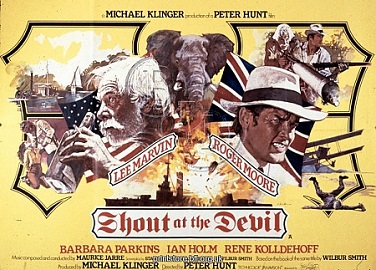
Shout at the Devil
Do you know the author Wilbur Smith? If you're an action fan, like your tough guys as tough as nails mercenaries, like Africa serving as a backdrop to action-packed stories, then he may be the author for you. One of my favorite action movies is based off a Smith novel, 1968's Dark of the Sun, and in the same vein is a mercenary story in Africa flick, 1976's Shout at the Devil.
It's 1913 in Africa and international tensions are mounting with war potentially on the horizon. In Tanganyika, a region in East Africa, an Irish-American poacher, Flynn Patrick O'Flynn (Lee Marvin) has a plan in place to poach several tons of ivory, netting a huge profit. The region is part of German-controlled territory, so Flynn would like to pose as Brits...but he needs a Brit, tricking a down-on-his-luck Englishman, Sebastian Oldsmith (Roger Moore), to accompany him, the profit providing quite the incentive. The expedition proves fruitful, but they also find themselves in some trouble with Herman Fleischer (Reinhard Kolldehoff), the German commissioner in the area tasked with keeping the region "German safe." Fleischer has been after O'Flynn for years, and he's right within his grasp now. Can O'Flynn and Sebastian get out in time? Can Fleischer finally catch up with his target?
My biggest issue over the years with this movie was....well, finding it. It has been heavily cut so depending on the version you're missing anywhere from 20 to 40 minutes. And finally on MGM-HD, I found the full version, clocking in at 150 minutes and looking good in a pristine print. Director Peter Hunt tackles a lot with this pre-World War I mercenary adventure story, 'Devil' covering about a year and a half or so in its leisurely running time. It was filmed on location in Malta and more shockingly, in South Africa, a no-no at the time considering that whole apartheid thing. To each their own I guess, right? Some on-location issues aside, there's much more to worry about here. When 'Devil' is good, it's decent. When it's not good, it can be painfully slow-going with some odd shifts in tone.
And that becomes the biggest detriment to the movie. I haven't read Smith's source novel, but Hunt's film simply tries to tackle too much. Did this movie really need to be 150 minutes long? Episodic is a fair description, but one episode aimlessly transitions to another. There's no real unifying link. Killing elephants, ambushed, running, a river chase, shipwrecked, brief interlude for love, robbing taxes from poor African villages, it goes on and on. The tone is ridiculously all over the place, an uncomfortable sequence of shooting elephants (I'm not sure if they really shot elephants but it sure looks like it) followed by a goofy knock-down fight later between Marvin and Moore. Composer Maurice Jarre's score is equally schizophrenic, hurting the effort too, goofy and dumb followed with bloody and dark and twisted. Pick one or the other and go with it, or at least find a better balance between the two. As is, the movie struggles to find that good, watchable and mindless middle ground.
What originally caught my eye was the casting, especially Lee Marvin and Roger Moore as the Odd Couple partners working together for some cash in 1913 Africa. Without any recognizable names in the rest of the cast, the success here depends on almost solely on the duo. Unfortunately, it never clicks here. Lee Marvin is one of my favorites in everything from The Dirty Dozen to The Professionals, but this isn't his best work. His O'Flynn is an archetypal character, a hard-drinking, hard-living mercenary of sorts, but it is such a broad character that it never resonated with me. It's not a particularly likable character, Marvin hamming it up too much. Moore is better, but the Sebastian character is dealt the Action Movie Killer....a love interest in the form of O'Flynn's daughter, Rosa (Barbara Parkins). The potential for the two main characters is really there, potential for the movie to take over, but like much of the rest of the movie, it falls short.
Some extended sequences do work, much of them coming in the second half as things take a darker turn for good. One quick action scene has O'Flynn, Sebastian and their men ambushing a German convoy on the delta's flatlands, brutal and quick. The finale too is pretty cool, an extended sequence that's about a half-hour long, Moore's Sebastian sneaking onto a German battleship and planting a bomb only to realize an hour later he's got to stop the explosion. An exciting, action-packed finale. It just takes too long getting there. Is it funny or really dark? Is it neither? A more pointed story would have gone a long way, but as is, 'Devil' is a big disappointment. Also look for Ian Holm in a fun part as Mohammad, O'Flynn's mute assistant, always ready with a soothing bottle of gin.
Shout at the Devil (1976): **/****
Monday, November 5, 2012
Machine Gun Preacher
The movie title certainly jumped off the page when I stumbled upon it, 2011's Machine Gun Preacher. It sounded like a schlocky action, drive-in movie from the 1970s that Quentin Tarantino would have loved. But no, it's actually a true story based on the life of Sam Childers, a drug-dealing biker turned obsessed missionary. The end result is a mixed bag, but there are certainly positives to take away.
Fresh out of jail, Sam Childers (Gerard Butler) returns to the exact things that put him in jail -- drugs, robbery, assault -- and quickly sees the error in his ways when he almost kills a man. Seeking help, some sort of redemption for all the bad he's done, Sam joins a church with his wife, Lynn (Michelle Monaghan), and tries to turn over a new leaf. He starts over, building a construction company from the ground up, starting a church for individuals like himself, but most importantly, he hears about the atrocities being committed in the Sudan and Uganda. Sam wants to do something to help the children living daily on the brink of death, but walking into a revolution, nothing will be simple.
This is an interesting mix of a movie, for good and bad reasons. Based on Childers' life, it has an authentic feel to it, and Butler does a fine job with the part (more on that later). But at the same time, it can't quite figure out what to say or do. At 127 minutes, it's both too short and too long. Focus on Sam's home life with his wife and daughter (Madeline Carroll) is necessary to show Sam's inner struggles and demons, but those scenes vary from dull to repetitive. Where the movie is at its strongest is when Sam travels to Sudan on multiple occasions to build an orphanage for children left on their own because of the revolution. It's just too bad more focus couldn't have been put there.
When the focus is on the fighting between the LRA and the freedom fighters, 'Preacher' is moving along at its best. There are moments of emotional perfection and sheer horror as Sam sees the atrocities being committed. In a startling opening sequence, we see a LRA attack on a peaceful village, a boy, William (Junior Magale), forced to kill his mother because the LRA demands a death. As Sam sees these horrors, he comes completely undone when he sees a boy killed by a land mine. Later ventures have him making choices that will end in someone's death, a decision that obviously weights heavy on his head. Butler's scenes later with Magale's William are about as perfect as you can. When the movie works, it really works.
Also a producer on the film, this was clearly an important role to Gerard Butler, and he does a great job portraying Sam Childers. At times since the success of 300, Butler seems to have trouble picking the right roles, but this is an ideally suited one for him. Early on, Sam is a despicable person -- and an easy one to hate -- but he needs that low point to help turn things around. Butler is a live wire here, emotionally charged, driven and frustrated that he can't do more. All he wants is for others to see the brutal atrocities being committed and want to help, but even that's too much sometimes. Saving the orphaned children becomes an obsession with him to the point he blocks out his family and friends. A very good performance from Butler. Monaghan is good as Lynn, Michael Shannon is underused as Sam's similarly troubled friend, Donnie, with Souleymane Sy Savane a scene-stealer as Deng, a freedom fighter who comes to be Sam's friend and partner in fighting.
Because I felt a little misled, I'm going to point this out. Hearing the title 'Machine Gun Preacher,' I was expecting a slightly different movie. This is not an action blockbuster. While the action scenes are exciting and well-made, brutally efficient in their quickness, this is a personal story about Sam and what causes the violence. A lot of time -- too much for me -- is spent on the religious aspect, Sam's missionary work at home, and at times heavy-handed messages about God and religion. It never goes too far (but it gets close at times) so be forewarned going in. A good movie that could have been better, but one that's still worth a watch.
Machine Gun Preacher <---trailer (2011): ** 1/2 /****
Labels:
2010s,
Africa,
Gerard Butler,
Michael Shannon,
Michelle Monaghan
Tuesday, August 7, 2012
Safari (1956)
If only the characters the movies we're watching were aware of the genre they were in. Out of the box, existential intro, huh? That way, these characters would realize they're making the exact same mistake that countless other characters have done. Take 1956's Safari, or any movie with an African safari to be fair. If you're an old, rich hunter, just don't bring your babely girlfriend/fiance along for the fun. She will be scooped up by the younger, more athletic and dreamier big game hunter and/or safari guide. I'm just saying...
While out leading a safari in Kenya, big game hunter and guide Ken Duffield (Victor Mature) is alerted that his family and home have been attacked. He returns to the scorched remains to find his son's dead body amongst the wreckage and swears revenge when he finds out one of his house workers, Jeroge (Earl Cameron), is among the Mau Mau rebels who led the attack. Fearing he will take vengeance, the government takes back Duffield's license and ships him out, but he finds a way back in-country. He signs on with Sir Vincent Brampton (Roland Culver) who wants to undertake a safari, bringing his fiance, Linda (Janet Leigh), along. Duffield intends to lead the safari, but he's got his sites set on revenge too.
From director Terence Young, this 1956 African safari epic is a doozy of a movie, but an entertaining if somewhat oddly-tuned final product. It's not that it's bad -- far from it, I enjoyed it a lot -- but if a movie was schizophrenic, it would be 'Safari.' One minute it's interested in dazzling the eye with its African locations. The next minute its an intensely dark and cynical look at the real-life Mau Mau Uprising. Last, it's a fun, somewhat dumb story meant to spotlight Orlando Martins (playing camp boy Jerusalem) and his goofy, light-hearted theme song, 'We're on a Safari.' I don't exactly know how, but it manages to work in the end through all its schizo tendencies. Go figure, all that stuff packed into a 91-minute movie, and it ends up being an entertaining final package.
Filming on location in Kenya, 'Safari' is obviously aided by the gorgeous, expansive Kenyan savannahs. We see shots of herds of animals running across the savannah, crocodiles diving into rivers, elephants, rhinos and lions charging at the camera. For lack of a better description, it's cool to see, and that's just one reason 'Safari' succeeds. Like the recently reviewed 'Rampage,' or any number of other safari movies from the 1950s and 1960s (Hatari, Killers of Kiliminjaro, King Solomon's Mines, The Naked Prey), this one follows a familiar formula. If you're even remotely paying attention, you know where it will end up before the movie itself might even know. Hopefully, if you're like me, you enjoy going along for the ride even if you know where you'll end up.
Right in the midst of his heyday in terms of popularity, Mature is a solid choice to play the lead role, the safari guide who's pissed at the world and looking to exact some revenge. Oh, and he might be looking for love too. Watch out Janet, he's got his eye on you! I don't think anyone will ever claim Mature was a great actor, but he's a good meat and potatoes kind of star. Nothing flashy, just gets the job done as he does here. Leigh is the eye candy as the somewhat innocent/naive Linda (or just plain stupid), given a variety of gowns, dresses and revealing outfits to wear in the African wilderness. She also bathes a lot, the water always cutting off at a strategic place. Coincidence? Yeah, "probably." Culver is the doomed older man, not aware of how stupid he is or what he's stumbled into. John Justin plays Brian, Sir Vincent's much-maligned assistant who can't do anything right.
The other parts range from odd to mildly offensive to stock characters. Martins treads that fine line between offensive minority character and goofy, hammy character. The same for Tanzinian actor Juma who plays cackling camp boy Odongo in an incredibly stereotypical part. His laugh is bizarre, making me question if we're supposed to question the boy's sanity. As the intensely evil Jeroge, Cameron is pretty one-note, saying maybe five words while sneering and enjoying his kills far too much. Lionel Ngakane leaves a positive impression as Kakora, Duffield's assistant and leader of the camp boys.
Through it all, I was entertained at basically all times, at least partially due to its schizophrenic nature. By the end once that whole safari business is resolved, the story degenerates into one big running shootout at Jeroge leads some 200 Mau Mau rebels on a bloody rampage. Mature's Ken calmly stands in front of the charging rebels, blazing away with a Sten gun, smiling all the way. Even Leigh's Linda gets in on the action, picking off bad guys left and right with her rifle. Mindlessly entertaining and a fun movie to watch if nothing particularly new, it's worth a watch as a good popcorn movie, a solid rainy day effort.
Safari (1956): ***/****
Labels:
1950s,
Africa,
Janet Leigh,
Terence Young,
Victor Mature
Saturday, May 21, 2011
The Dogs of War
With almost 20 books to his name, author Frederick Forsyth has carved out quite a little niche for himself in the world of thrillers and espionage. His characters are killers, mercenaries, hard-edged cops, all the dirty jobs that no one wants to talk about but know exist nonetheless. His realistic, detail-oriented stories translate well to film, including The Day of the Jackal, The Odessa File, and also 1980's The Dogs of War, based off a 1974 Forsyth novel.
The book is a quality example of Forsyth's style as an author. His talent isn't coming under fire here, anything but. His stories of killers, hired guns, and mercenaries are flashy or Hollywood. They're based in the darkness of those people's lives, the constant fear and battle with death. 'Dogs' as a novel is more a day-to-day description of how to mount a mercenary operation than a shoot 'em up, action-packed story. If anything, it gets somewhat tedious in its ridiculous amount of detail and description. Reading it, you can't help but wonder how a movie version would translate, all the while wondering, how would they make this work? Easier said than done, but the movie is certainly enjoyable, if flawed.
A mercenary who has fought all over the world, James Shannon (Christopher Walken) returns home to New York City after doing a job in Central America. He is approached to do a recon job in a tiny west African country, Zangaro, just a quick job where he sees what the country's military forces have to offer. Shannon agrees, taking the long trip to the poverty-stricken, desolate country ruled by a blood-thirsty dictator. During his visit, he is arrested and beaten within an inch of his life, only to be rescued by a British journalist, North (Colin Blakely). Returning home, he delivers his report and is offered another job by the mysterious Endean (Hugh Milais). For a large sum of money, Shannon must lead a mercenary outfit into Zangaro and topple the government. Looking for revenge, he agrees, starting from the ground up, recruiting a small team of mercenaries to help in the effort.
If the story sounds somewhat familiar, it should. With a few tweaks here and there, 2010's The Expendables borrowed heavily from the basic storyline. That movie was more fun overall, but The Dogs of War is the better movie. Forsyth doesn't portray his mercenary warriors as anything but what they are, hired killers, working for whoever will pay them, ideals and principles long since thrown out. This is a story interested in the details, the things many movies would brush to the side. Where do you get guns? Where do you acquire uniforms? How do you sneak into a country? It may not sound too exciting, but there's an interesting angle of the mercenary movie -- the background -- that you just don't see that often. 'Dogs' isn't as good as Dark of the Sun or The Wild Geese, but it certainly belongs in the conversation.
Intending this in the most positive sense, I think Christopher Walken is one of the weirdest, oddest, and ultimately, coolest actors to ever star in a movie. Watching him, you can't pull your eyes off of him. He's quirky, eccentric, different and rarely goes where you think he will with a character. Reading the book, Walken was nothing like what I imagined the Shannon character to be like. But the joke was on me because above all else, this movie works because of Walken. He carries this movie. Jamie Shannon is a veteran mercenary with countless battles, firefights and wars behind him. He's alone in the world (JoBeth Williams is his ex-wife) and doesn't particularly like what he does, but he's good at it, and the pay is good. A great main character, and a sympathetic one.
One of the cooler aspects of the book was Forsyth's assembling of this multi-national team of mercenaries Shannon works with in hopefully leading the coup d'etat. The movie drops the ball in that respect. Tom Berenger plays Drew, Shannon's best friend and right hand man, a mercenary who loves fighting, getting some sick enjoyment out of it. Also joining the team are Paul Freeman as Derek and Jean-Francois Stevenin as Michel. Eddie Tagoe plays Jinga, leader of the exiled African fighters working as Shannon's attack force. Other than Berenger's Drew, we're given no character development or any kind of personal background on either man. They're more cardboard cutouts of characters, ideas of what and who they should be. The team is still cool because they are the steely-eyed, cold-blooded mercenary, but so much more could have been done with the team as the book proved.
Interested in the little things, the background details, the movie (directed by John Irvin) saves up all its action for the finale, a nighttime assault on the Zangaro dictator's heavily guarded compound. Irvin spends a long scene showing Shannon's team (along with 24 exiled African fighters) moving into position, moving through the empty streets of Clarence, the capitol city. It builds the tension to a boiling point so when the action does start, it is like a release of anxiety. The attack is loud and chaotic, but still a little short. It doesn't feel rushed, but like so much more concerning the movie, I felt like more could have been done. The finale does deliver a solid twist, one that stays true to the Forsyth novel, neither a downer nor a happy ending. Just an ending.
Still, I can't help but feel disappointed after watching the movie. The book is a hefty if very readable 400 pages, and the movie does an admirable job trying to stick to the novel. Too much gets left out though, like an actual reason for why the government needs to be toppled. It is hinted at, but never explained, left to be unexplained by those who haven't read the book. The ending is a particularly dour note, a sudden ending and a moving one, but not as moving as it could have been. Other than Shannon, you don't feel much for the other characters. That's the main problem. 'Dogs' keeps you at a distance from the start.
The Dogs of War <---trailer (1980): ** 1/2 /****
Labels:
1980s,
Africa,
Christopher Walken,
Men on a Mission,
Tom Berenger
Monday, August 23, 2010
The Sins of Rachel Cade
In the Belgian Congo in 1939, American missionary and nurse Rachel Cade (Dickinson) arrives at a somewhat isolated mission only to have the doctor in charge drop dead from a heart attack. Forced to take over the not so friendly mission, Rachel does her best to offer medical treatment to the African villagers while also trying to teach them the ways of God, Jesus and the Bible from a Christian perspective. Nothing goes smoothly, but it gets more interesting when two different men, local commander Henri Derode (Peter Finch) and a suave doctor (Roger Moore) begin to show interest in the pretty young nurse, forcing her to decide if she can live by the lessons and teachings she gives to the local villagers.
After seeing Dickinson in mostly supporting roles or at least parts that usually relegated her to love interests, it was cool to see actually see her in a starring role. Her Rachel Cade is an interesting character, starting off as innocent, somewhat naive, and in some ways condescending to others' beliefs. I realize as a missionary that is her job, her mission, but she dismisses the beliefs of the villagers who have had those beliefs their whole lives. Still, even as she struggles with some inner demons and hypocritical feelings, it is a fascinating character to watch. Dickinson never gets too high or too low so Rachel is a little too laid back at times, but because we see her develop over several years, that's the character. Relatively calm even when everything around her seems to be falling apart.
Finch and Moore provide some interesting counters, and not just in who they play. Both Englishmen, Finch plays a French officer (thankfully not trying an accent) and a very young-looking Moore plays an American doctor from Boston (still sounding like a Brit). Rachel feels something for both men and ends up getting involved in a very serious way with one -- no SPOILERS today, folks -- that makes her question the morality of what's she doing. Of the two, Finch delivers the better performance, Moore playing his typically suave, ultra-charming character he perfected years later with the James Bond movies. Other good parts include Errol John as Kulu, Rachel's assistant open to embracing a Christian God, Frederick O'Neal as the local chief curious to Rachel's motivations and actions, and Rafer Johnson and Charles Wood as two of Rachel's helpers in the makeshift hospital.
Dealing with conversations about personal religious beliefs and what religion works and doesn't work, I struggled at times with how preachy the story could be. I haven't read the novel the movie was based on so I don't know what director Gordon Douglas was working with, but it is a very one-track story. Christianity good, African beliefs bad, no middle ground. Juano Hernandez plays a local medicine man/chief who may or may not believe in what he preaches, and Woody Strode plays an imposing medicine man who looks more like a witch doctor than anything else. The portrayal -- however true it is, I don't know -- seems very stereotypical to me and full of political incorrectness. Because of that portrayal, it seems obvious that of course Rachel is going to have success with converts to Christianity.
Simply in the moviemaking process, I struggled to get into this movie. It was filmed on an indoor set for this African village/mission Rachel comes to work at. Filming in Africa would have been no doubt rather expensive, but find somewhere outdoors that could have even slightly resembled the African jungle. You're very aware you're watching a movie that was filmed on a studio set and not anywhere on location. Composer Max Steiner's score is all right but doesn't leave much of a lasting impression. I had a hard time really getting into this story, and I don't know why.
The story lacks a certain amount of energy as it finds a rhythm among Rachel's mission, her personal feelings, and all the conflicts going around in the village. When issues do come up with Rachel finally caving in to some of her wants and desires, it is handled in such a PG fashion that it lacks any punch. Were we supposed to be shocked when Rachel reveals she is pregnant? Douglas probably couldn't get away with much by 1961 standards, but watching the movie some 50 years later, it is very noticeable. The whole movie is fairly dated, but some good acting brings it up a notch and at least makes the movie watchable.
The Sins of Rachel Cade <---TCM clip (1961): **/****
Thursday, June 24, 2010
Something of Value
Think of a movie star from the 1950s or 1960s. There's a long list of possibilities, but chances are you picked a white actor or actress. Now think of a black movie star from the same period. A handful come to mind, but only one was a huge star and for good reason, Sidney Poitier. For most of 20 years, black characters in movies were there for punchlines or for comic relief, but when Poitier burst onto the scene he opened the door for serious roles, including becoming the first African-American to win an Academy Award.
One reason Poitier is held in such high regard is the caliber of the movie he typically starred in. He rarely went slumming, taking a paycheck for any old role. Look up and down at his filmography and there just aren't many duds in the bunch. Some are clearly better than others, but even the ones that don't reach classic status at least tried something new and different. Movies like The Defiant Ones and In the Heat of the Night are probably his most famous roles, both dealing with racism in one form or another. One that's been generally forgotten and past by dealing with similar topics, 1957's Something of Value.
Having grown up together in Africa, Peter (Rock Hudson) and Kimani (Poitier) are somewhat oblivious to their differences in skin color. They've grown up as friends and even more than that, as brothers. But it's 1945 in Kenya, and the differences start to stare them dead in the face. Kimani's father is sentenced to prison for doing something his culture -- not the British law -- observes. Fed up with the system, Kimani joins a violent revolutionary group called 'Mau Mau' that hopes to take Africa back from the British. As the revolution grows and the body count increases daily, Peter tries to find Kimani, hoping to convince him that the way he has chosen is not the correct one, and that peace is possible. It's been years though, and it may be too late to save either man.
I'm a victim of this as much as anyone, but sometimes I look at movies from the 1950s and think of everything as whitewashed and censored to the point where everything is bland -- a la Leave it to Beaver of Happy Days. Those blanket statements can be helpful at times, but they're almost never true. 'Value' certainly pokes holes in my whitewashed theory in showing a particularly bloody, surprisingly gory depiction of an African uprising. It is filmed in black and white, but that doesn't take away the very visceral feeling you get during the battle scenes. Director Richard Brooks would have been hard-pressed to tell this story in any sense of a whitewashed fashion, but he doesn't take the easy way out telling this story, and the movie is better for that decision.
Based on a novel by Robert Ruark, Brooks' movie is clearly divided into two stories after an opening segment introducing us to Peter and Kimani. Once the story divides itself, it's either one or the other character. Long segments focus exclusively on Peter or Kimani through their lives amidst the chaos of the Mau Mau rebellion. Peter marries his longtime sweetheart (Dana Wynter) and has to deal with the massacre of some of his close family. He tries to move on with sister Elizabeth (Wendy Hiller) and father Henry (Walter Fitzgerald), but the fighting might not let them. Kimani too starts a family as he tries to convince fellow revolutionaries that there is a peaceful way to protest but quickly gets nowhere.
Their stories are obviously on a collision course when the two will meet again, vastly different men than they were in their early 20s. The white settlers (including a bloodthirsty Michael Pate) do their best to wipe out the revolution while the Mau Mau fighters plan on fighting to the last man, except for Kimani who sees how futile continuing the fight would be. The ending caught me off guard in some of the decisions made, but not in a negative 'I hated that decision' way. I haven't read the novel to compare, but Brooks goes for a realistic, depressing ending that still somehow offers a glimpse of hope, of survival in the end.
Some complaints spoke to the casting of Hudson as a British settler, and to be fair, he doesn't even attempt an accent of any sort. Is that really a bad thing though? For me, the casting was one of the strongest parts of the movie, especially Hudson and Poitier who play so well off each other in their few scenes together. Wynter and Hiller play strong female characters trying to survive this hellish life they have, and Fitzgerald is the stout father figure that can't be shaken. Pate plays the straight evil villain to perfection while Juano Hernandez plays Njogu, a sympathetic figure of the revolution who keeps his faith through it all. Also look for Ivan Dixon (Sgt. Kinch in Hogan's Heroes) as Lathela, Peter's right-hand man. Generally forgotten, but definitely worth looking for.
Something of Value <---trailer (1957): ***/****
Labels:
1950s,
Africa,
Juano Hernandez,
Michael Pate,
Richard Brooks,
Rock Hudson,
Sidney Poitier
Monday, April 26, 2010
Blood Diamond
Out of conflict comes the good and the bad. There are those who try and do something with the idea of accomplishing something good, and then there are others who try to profit from the suffering all around them. Then somewhere in between are the unwilling and unlucky caught in the middle just fighting to survive. Based in Sierra Leone in 1999, 2006's Blood Diamond has a character pertaining to each description.
This is an action movie with a message -- an undervalued and under appreciated sub genre in action movies. Basing a story in war torn Sierra Leone is not the basis for a feel-good, up story, and director Edward Zwick tries to show his story without any unnecessary upbeat feelings. A repeated line is 'TIA...this is Africa.' Here's the situation, deal with it. As government troops battle rebel forces, both sides seek to control the diamond fields where prisoners search for blood diamonds that will be used to fund the fight by buying arms and ammunitions. Amidst the chaos is the story of three people, a man looking for riches, another searching for his family, and a journalist trying to do something right.
With previous movies like Glory, The Last Samurai, and Defiance, Zwick has proven adept at handling big, sweeping pictures. Add Blood Diamond to the list because this is a big movie, especially in terms of scale. The movie was shot in Africa -- benefiting greatly from it -- and gives you a real sense of what surviving amidst a civil war must have been like. It is a chaotic trip through war-ravaged Sierra Leone with death around every corner. But for all the brutality and violence, there is a beauty to the movie as Archer and Vandy trek across the expanses of the countryside with the beauty of the nature shining through. Credit there goes to cinematographer Eduardo Serra and composer James Newton Howard for blending the visual and audio so seamlessly.
It's late in the Sierra Leone Civil War in 1999 and poor fisherman and father Solomon Vandy (Djimon Hounsou) has been torn away from his family by rebel forces and forced to work in the diamond mines. Vandy finds an enormous diamond which he manages to hide as government troops overwhelm the mine, but he's thrown in jail. There a Rhodesian smuggler and arms dealer, Danny Archer (Leonardo DiCaprio), hears of his find and arranges Vandy's release. Danny himself was thrown into jail for smuggling diamonds and now owes his boss (Arnold Vosloo) a hefty sum. Vandy suspiciously agrees to lead Archer to the diamond if he will help him find his family. With help from a do-good journalist (Jennifer Connelly), Archer agrees and they set off into the chaotic, brutal countryside, the smuggler dreaming of the riches that await him, the fisherman yearning to see his family again.
Since his star-making part in Titanic, DiCaprio has shown an ability to take on some pretty meaty roles and not just playing the romantic lead. He was nominated for best lead actor here and it's a nomination he really deserved. His Archer is a bit of a wild card in that it is almost impossible to read him. Sure, he says he's trying to help Solomon, but he has also shown that he looks out for himself and his own well-being above all else. This is a 3-D, flesh and blood character that DiCaprio brings to life. He is a deeply flawed individual with a past that still haunts him. And on a much lighter note, he gets to do another interesting accent, pulling off a South African accent nicely. This isn't an easy character to read or root for, but Danny Archer is certainly interesting to watch.
Like DiCaprio, Hounsou was also nominated -- for best supporting actor -- for his part as Solomon Vandy. I was first introduced to Hounsou with his supporting part in Gladiator and have liked him ever since. He is able to combine a quiet dignity with emotions that might explode at any minute. This man is going to do anything he can to ensure the safety of his family. The scene where he discovers his son has been taken by rebel forces is difficult to watch because we're seeing a man come apart at the seams as the anger and pure hatred coarse through his veins. It is a great performance and one that matches DiCaprio's powerhouse role. Connelly's character is nothing new -- a journalist exhausted at the ways of the world who gets a sick thrill from what she's doing -- but she pulls it off well. Her Maddy could have felt like an add-on to the story, but she ends up playing an important role in the cross country trek.
Like any movie, certain scenes stick with you longer than others. Looking to examples like Glory (the assault on Fort Wagner) and Last Samurai (the final battle), it's a safe statement to say that Zwick puts together epic action scenes as well as any director around. They're interesting to watch, but they also resonate emotionally because there's an attachment to the characters and their situation. Two sequences come to mind here. One, Archer and Solomon race through city streets as rebel forces invade, and two, an air strike is called in on a rebel camp as Archer and Solomon look for his son and the blood diamond. Both action set pieces have an enormous scale that is a pleasure to watch, all building to a final chase as they head for an airfield and a plane that will take them to safety.
My complaint here is that Blood Diamond is a long movie at 143 minutes. It's never dull, and looking back I can't think of scenes I would cut to shorten it. But it feels really long, like I was watching for much longer than 2.5 hours. It's hard to put a figure on it because the pacing is all right, and the characters certainly take you for a ride. Maybe it's just that the story takes a long time to get where it wants to be. None of this is enough to deter me from recommending it, but it is something that bothered me just the same. A very good movie all around with great performances and a sweeping story.
Blood Diamond <----trailer (2006): ***/****
Friday, January 15, 2010
Dark of the Sun
Where the wild west had its gunfighters, hired gun and bounty killers, the 20th century had its mercenaries and soldiers of fortune. Action movies have certainly played that angle, men with no allegiance to country or morals, just whoever will pay them the most money. Of course, it's not like mercenaries just popped up on the radar in the 1900s, they've been around for as long as there's been fighting and war going back to ancient Egypt all the way to the American Revolution when German soldiers fought alongside the British.But in the 20th Century conflicts all around the world allowed mercenaries to step into the limelight, and nowhere is that reflected more than in the movies. Films about soldiers of fortune that come to mind include several set in Africa where government coups, overthrows and assassinations dot the continent's history. Movies like The Wild Geese, The Dogs of War, and 1968's Dark of the Sun all follow the exploits and adventures of mercenaries working on the Dark Continent with all the political unrest giving them a chance to make heaps of cash.
Recruited by Congo president Ubi (Calvin Lockhart) and offered a large sum of money for their services, mercenary duo Capt. Curry (Rod Taylor) and Sgt. Ruffo (Jim Brown) agree to take on a dangerous mission in war-torn Congo in the early 1960s. They must travel almost 300 miles into enemy territory to a town housing a diamond mine. Their goal is to rescue some 60 refugees there and to find over $50 million dollars in uncut diamonds before Ubi's enemy General Moses and his Simba force can get them. Given just three days to accomplish the mission, Curry agrees.
The veteran mercenary begins to plan with his long-time friend and second in command, Ruffo, finding several officers to go along, Henlein (Peter Carsten), a German officer and former Nazi who's more interested in the diamonds than anything else, Surrier (Olivier Despax), a young Frenchman, and Reid (Kenneth More), a drunken doctor who's worked previously with Curry. With 40 soldiers from Henlein's Strike Force Blue along, Curry's column moves out on a heavily-armed train for the town 300 miles down the track, hoping to beat their deadline and avoid the brutal Simba forces.
This is an action movie with a message, but not one that director Jack Cardiff hits you over the head with. Curry is solely on the job for the cash payout he'll get upon delivery while Ruffo -- a native of Congo who was educated in the U.S. at USC -- takes the job because he sees it as a way to help his country out. The friendship between the two men is genuine, but there is conflict over their beliefs between them. Taylor and Brown are an excellent combo together and have some great scenes together as they discuss why they do what they do and what drives them inside. The ending brings this full circle with one character doing a 180 from where he was at in the beginning of the movie. For a change, it's nice to see some of the motivation these tough guys have instead of endless action scenes.
But all that message stuff aside, this is one of the great action movies of the 1960s that's never really gotten its due, thanks in great part to the lack of a DVD release from a major studio. It is a mercenary movie after all. The first half hour or so is used to set the story up but in an entertaining way as the characters and their dynamics among the group are established. But once the train takes off into Simba territory, it's never very long between action scenes. The tension between Curry and Henlein escalates quickly into a fight with a chainsaw, and that's even before the Simbas attack. These action scenes are highlighted by an extended segment midway through the movie as Curry must wait on a time-released vault to get the diamonds with a Simba force drawing nearer in an incredibly tense scene, and then the recovery of those diamonds later. Made in 1968, 'Dark' also takes advantage of the recent changes in on-screen violence with some very graphic scenes.
Other than Taylor and Brown, this isn't a cast of stars. Never a huge star to begin with, Taylor is excellent as Curry, the hardbitten soldier, and with the always tough, always reliable Brown form a good team. Carsten ends up being a strong villainous presence, and Yvette Mimieux has a smallish part as Claire, one of the refugees the train picks up. Filming in Jamaica instead of Africa -- understandably so considering the time -- it's a nicely-shot movie, aided in great part by Jacques Loussier's sweeping score (watch the title sequence here) which Quentin Tarantino sampled in Inglourious Basterds.
One of those movies that is not well known, but it is one of my favorites. Hopefully down the road there is a DVD release somewhere in sight, but until then I'll stick with my tape from a TCM showing. If you do stumble across it on TV, give it a try. Lots of action and excitement to get the blood and adrenaline flowing.
Dark of the Sun <----trailer (1968): *** 1/2 /****
Labels:
1960s,
Africa,
Jack Cardiff,
Jim Brown,
Men on a Mission,
Rod Taylor
Sunday, December 20, 2009
The Wilby Conspiracy
Right off the bat, we're talking issues about race that will bring up deep-seeded feelings and emotions in audiences. And while never completely avoiding the topic, director Ralph Nelson puts his own spin in dealing with a story based in South Africa in the 1970s. For those that didn't read the above link, here's the gist, apartheid is segregation on a massive scale and done legally that in South Africa's case existed for almost 50 years between 1948 and 1994. Instead of making a hard-hitting 'topic' movie, Nelson delivers a message rolled together with an action/adventure movie. Really who would have thought of 1970s South Africa as a ripe location for a buddy action movie?
After ten years in jail in Cape Town, Shack Twala (Sidney Poitier) is released when the charges against him are dropped. Going to get his identification papers with his lawyer, Rina (Prunella Gee), and her boyfriend and English engineer Jim Keogh (Michael Caine), Shack is stopped by the police and threatened with imprisonment. Keogh steps in to help and a fight ensues, forcing Shack and Keogh to flee for their safety. From his days in the anti-apartheid movement, Shack knows who can help them out of the country, a man in Johannesburg almost 900 miles away. But as they run, Keogh begins to suspect there's more going on, and he's right. Shack is after a bag of hidden diamonds that can help fund the resistance and the revolution and needs Keogh's help. Chasing after them are two members of the secret police, Major Horn (Nicol Williamson) and Van Heerden (Rijk de Gooyer).
I won't go as far as saying 'Wilby' is a buddy movie, but it's damn close. Saying that almost seems to minimalize the context of the story which does deal with the situation in South Africa where 3 million whites rule over the 18 million or so blacks. Because the apartheid is legal and supported/approved by the government, there's a delicate balance. What helps this is the very different main characters, Poitier's Shack who grew up and lives within this system and Caine's Keogh who is an outsider and goes along with it because he's expected to, not because he believes it.
Surprisingly enough, this dynamic provides some funny moments as Shack and Keogh are forced to pretend Keogh is the master so as not to arouse suspicion. Both men embrace these situations because they have to, but in the moments afterward they have it out, Shack even admitting 'I read Lenin, Marx, and Winnie the Pooh.' These lighter moments help balance out the story, especially the parts with the secret police who in many ways resemble the Gestapo or the KGB for the fear they can instill in the population. Williamson is a very capable villain as he tracks Shack down on this cross country chase.
All the cast handles this odd dynamic well as they balance social issues like apartheid and racism in general with the lighter additions like the humor and action. Caine and Poitier play off each other well as this forced partnership leaves them no other option than to work together. Poitier gets the meatier role as the anti-apartheid activist with vengeance on his mind, but Caine's performance equals it as the English engineer gets more and more involved within the movement. Gee's Rina is both a love interest and the moral compass in a small but effective performance. Saeed Jaffrey and Persis Khambatta have key roles as two Indians living in Johannesburg who worked with Shack in the past, and then Rutger Hauer is nicely evil as Rina's two-timing husband.
Now all social issues and messages aside, The Wilby Conspiracy has some really solid action sequences -- especially the end with what looks to be an incredibly dangerous helicopter stunt -- and has a quick pace throughout. The backstory of apartheid aside, the movie plays like any number of action movies centering on a chase or a fugitive manhunt. But it's handled so well and with such a unique spin on the story, you'll hardly notice. It's entertaining from start to finish with strong performances from Poitier and Caine. Available on DVD but look out for it on TV.
The Wilby Conspiracy <----trailer (1975): ***/****
Labels:
1970s,
Africa,
Michael Caine,
Ralph Nelson,
Rutger Hauer,
Sidney Poitier
Subscribe to:
Posts (Atom)
_poster.jpg)