Every so often I get embarrassed when it comes to movies. Yeah, those movies you should have seen by now. The classics for good and bad, the great performances, an award-winning something or other. We've all got them. I do my best to make sure that list is ever-shrinking, but there are gaps. So while I've reviewed all sorts of dud disaster flicks from The Swarm to When Time Ran Out, I'd never seen one of the first disaster films all the way through in one sitting until a recent viewing. Here's 1972's The Poseidon Adventure. Don't judge me. You think you're better than me?!?
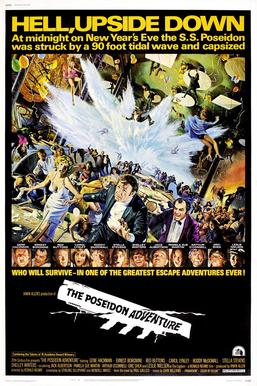
Sailing from New York City to Athens, the S.S. Poseidon is making one last voyage after years of service around the world, a ship destined for the scrap heap. That voyage is behind schedule though, and its captain (Leslie Nielsen) is under pressure to make up some serious time with so much money on the line. That speed may make up lost time but it puts the ship, crew and passengers at serious risk, but none of them know what awaits. Sailing through the Mediterranean, the Poseidon receives news of an immense earthquake off the Greek coast and its repercussions are heading right for the fully-loaded passenger ship. During a New Year's Eve celebration, an enormous wave moving at dangerous speeds is coming right for them. The ship is capsized in the wave's wake with much of the crew and many passengers killed. One small group survives though, and led by a fiery, trouble-making reverend, Scott (Gene Hackman), they try to make it through an upside down apocalyptic environment that was their ocean liner. Can they make it to the hull and possible rescue?
When it comes to disaster movies, I typically associate two movies with kick-starting the genre into its highest popularity. First, there's 1970's Airport. Second, well, here we sit. Though I've seen the entire movie here, I'd never before seen it in one viewing where I just sat down and blazed through it. Thanks, TCM! I didn't love it, but I did like it. It's difficult to watch this movie in 2015 and see it with a fresh light. This is a movie that has impacted hundreds of flicks since its release in 1972. So now on a fist-time view over 40 years later, it feels cliched, familiar and at times, overdone. None of those criticisms prove to be a deal-breaker in the end, but it will definitely impact your viewing. Still, this is a movie that helped launch an entire genre that was everywhere in theaters for almost a full decade. They weren't always classics -- or even that good -- but let's give credit where it is due.
One of the biggest impacts 'Poseidon' had on its future is the casting. This disaster movie from director Ronald Neame (and an uncredited Irwin Allen, the producer as well) assembles a pretty solid all-star cast. Future flicks would take the all-star cast concept to ridiculous levels where EVERYONE in Hollywood would make an appearance. If the script here is a little goofy, who better to keep righting the ship than Gene Hackman? I submit No One. His Reverend Scott is angry, a leader, a fighter and not interested in any excuses or garbage. When all else seems lost, he keeps his motley crew of survivors to keep moving as the water levels keep on rising. He's also rocking an impressive combover and a very stylish turtleneck. With a lot of actors, maybe the part gets a tad hammy, but because it's Gene Hackman, you go along for the ride. It's Hackman!
So what's the appeal of the ensemble all-star cast? Let's get down to business. We want to see which celebrity lives and which celebrity is due for an overdramatic death scene. So who is possible fodder for that finale? A Just Hit Play favorite, Ernest Borgnine goes for the gusto as Rogo, a police officer traveling with his new bride, a former hooker (Stella Stevens). There's also an older Jewish couple (Shelley Winters, Jack Albertson) traveling to see their grandson, two siblings (Pamela Sue Martin, Eric Shea) going to meet their parents, a lonely, middle-aged man (Red Buttons) who bonds with the ship band singer (Carol Lynley), and a member of the ship's crew, a waiter (Roddy McDowall). Winters was nominated for a Best Supporting Actress and comes across the best. The kids are pretty shrill, Borgnine and Hackman yell a lot, and Buttons is also very solid. A little hit or miss, but a strong cast overall.
How about some originality? Well, a capsized ocean liner quickly filling with water sure is a unique starting point. The survivors have to navigate their potential tomb...upside down. It's a hellish, claustrophobic, steamy, smoky environment littered with dead bodies and an ever-rising water level. You definitely feel like you're there with the survivors as they navigate this almost other-worldly situation. It's a cool premise that definitely pays dividends. The early, doom-building scenes are also incredibly effective as is the actual capsizing scene, just one epically uncomfortable extended sequence featuring some very cool special effects.
Sure, things get a touch overdone at times, especially with the pissing contest between Hackman and Borgnine for control of the group. Sure, the God/religion/faith aspects get to be a little much. Overall, it's an enjoyable movie that I've got to give a notch up simply because of its profound impact on countless movies released in its wake. Any movie that is still impacting flicks over 40 years later is okay in my book. Took quite a long time to sit down and watch it, but 'Poseidon' was worth the wait.
The Poseidon Adventure (1972): ***/****
The Sons of Katie Elder
"First, we reunite, then find Ma and Pa's killer...then read some reviews."
Showing posts with label Shelley Winters. Show all posts
Friday, April 3, 2015
Monday, July 28, 2014
Tentacles
Some movies just defy description. They're just that bad. Now, you know what movie is pretty great? 1975's Jaws, the first true summer blockbuster. You know what isn't so good about it? The seemingly countless sequels, ripoffs and countless quasi-remakes. Some of them are pretty awful but pretty entertaining if you're looking for a laugh. Then there's 1977's Tentacles. It isn't entertaining. It. Is. Just. Bad.
At Ocean Beach, a quiet seaside resort, not much in terms of danger ever goes on....until now. Several people have gone missing in the water, including one diver who went looking for the missing persons. Their bodies have been discovered, their skeletons stripped almost entirely of skin and the marrow sucked out of their bones. What could possibly doing this? A veteran newspaper reporter, Ned Turner (John Huston), is on the prowl, suspecting a huge corporation drilling in the ocean may be at fault. Keeping on the trail, Turner continues to look for an explanation, even turning to a famed animal trainer and experienced diver, Will Gleason (Bo Hopkins), for help. Looking at those who've been attacked and the mounting piles of evidence, Gleason suspects the attacks could have come from a giant octopus, a creature not known for attacking humans. Could Turner be onto something, linking the attacks to the corporation? Lives depend on them finding the answer.
Wow, what a bad, just plain awful, lousy movie. I like some of the Jaws ripoffs from Orca to Grizzly, both lousy movies, but my goodness, are they entertaining in their lousiness. This U.S./Italian co-production from director Ovidio G. Assonitis doesn't even qualify in the lousiness department. You know what the best thing going for this movie is? The music, composer Stelvio Cipriani turning in a memorable, foreboding score. Listen HERE for an extended sample. In a disaster-themed, killer animal on the loose movie, when the music is the biggest positive, you know you're in trouble. It just isn't good to the point it is painfully boring. 'Tentacles' follows the Jaws formula to a T, duplicating entire scenes, characters and story development. At no point is it ever scary or foreboding so go watch Jaws or even Jaws 2, Orca, or Grizzly for a far better time.
I'll give disaster movies credit where it's due. You get to see a lot of movie stars in one place at the same time. Now.....the performances aren't going to be very good, but it's an abundance of movie stars!!! How can you lose?!? Well, we do so there's that. No one seems particularly interested, but there is name recognition. Huston is a good choice to play a crotchety, grizzled reporter with Shelley Winters starring as his sister, a single mom who's always looking to seduce a younger man. Give him credit, Bo Hopkins commits to the material, even if his part is a pretty odd one. He's at one with animals, especially when his wife (Delia Boccardo) comes into danger. Also starring is Claude Akins as the overworked, overstressed town sheriff trying to save his townspeople. Cesare Danova plays the maligned corporation representative who must answer all the questions, knowing his company could be held responsible for the attacks. The rest of the speaking parts are badly dubbed English from Italian-speaking actors.
A master of the 1970s disaster movie cameo, Henry Fonda also makes a quick appearance as Mr. Whitehead, the President of Trojan Construction who's looking to make a buck. If some people get killed in the process....meh, whatever happens.
I don't know what to say here. It's not that the movie is bad because it is more than that. A bad movie can be entertaining, but this disaster knockoff is pure and simple boring as watching paint dry on a wall, as watching grass grow. The octopus attacks are laughable, seemingly also making an octopus a killing creature that sprints across the top of the ocean. Oh, no! It's shooting ink at me!!! The reasoning seems far-fetched even for a poorly written script, construction vibrations deep on the ocean floor infuriating the creature to the point it feels the need to kill and to kill often. A seemingly unstoppable killing machine in nature is a cool premise and a great jumping off point, but this one never does anything with it.
Then there's the end. Hopkins' animal trainer who's coming off an extreme incident with the bends unleashes his two killer whales to take out the octopus. I can't say I've seen too many movies where animals become hired killers, but this one counts. When things should be raring to go in the finale, it just doesn't. The underwater scenes go on and on without a sense of urgency. That's the entire movie, long stretches of boredom broken up by slightly less boring animal attacks. Some cool names in the cast, but even that is wasted. Steer clear or the tentacles may get you!
Tentacles (1977): */****
At Ocean Beach, a quiet seaside resort, not much in terms of danger ever goes on....until now. Several people have gone missing in the water, including one diver who went looking for the missing persons. Their bodies have been discovered, their skeletons stripped almost entirely of skin and the marrow sucked out of their bones. What could possibly doing this? A veteran newspaper reporter, Ned Turner (John Huston), is on the prowl, suspecting a huge corporation drilling in the ocean may be at fault. Keeping on the trail, Turner continues to look for an explanation, even turning to a famed animal trainer and experienced diver, Will Gleason (Bo Hopkins), for help. Looking at those who've been attacked and the mounting piles of evidence, Gleason suspects the attacks could have come from a giant octopus, a creature not known for attacking humans. Could Turner be onto something, linking the attacks to the corporation? Lives depend on them finding the answer.
Wow, what a bad, just plain awful, lousy movie. I like some of the Jaws ripoffs from Orca to Grizzly, both lousy movies, but my goodness, are they entertaining in their lousiness. This U.S./Italian co-production from director Ovidio G. Assonitis doesn't even qualify in the lousiness department. You know what the best thing going for this movie is? The music, composer Stelvio Cipriani turning in a memorable, foreboding score. Listen HERE for an extended sample. In a disaster-themed, killer animal on the loose movie, when the music is the biggest positive, you know you're in trouble. It just isn't good to the point it is painfully boring. 'Tentacles' follows the Jaws formula to a T, duplicating entire scenes, characters and story development. At no point is it ever scary or foreboding so go watch Jaws or even Jaws 2, Orca, or Grizzly for a far better time.
I'll give disaster movies credit where it's due. You get to see a lot of movie stars in one place at the same time. Now.....the performances aren't going to be very good, but it's an abundance of movie stars!!! How can you lose?!? Well, we do so there's that. No one seems particularly interested, but there is name recognition. Huston is a good choice to play a crotchety, grizzled reporter with Shelley Winters starring as his sister, a single mom who's always looking to seduce a younger man. Give him credit, Bo Hopkins commits to the material, even if his part is a pretty odd one. He's at one with animals, especially when his wife (Delia Boccardo) comes into danger. Also starring is Claude Akins as the overworked, overstressed town sheriff trying to save his townspeople. Cesare Danova plays the maligned corporation representative who must answer all the questions, knowing his company could be held responsible for the attacks. The rest of the speaking parts are badly dubbed English from Italian-speaking actors.
A master of the 1970s disaster movie cameo, Henry Fonda also makes a quick appearance as Mr. Whitehead, the President of Trojan Construction who's looking to make a buck. If some people get killed in the process....meh, whatever happens.
I don't know what to say here. It's not that the movie is bad because it is more than that. A bad movie can be entertaining, but this disaster knockoff is pure and simple boring as watching paint dry on a wall, as watching grass grow. The octopus attacks are laughable, seemingly also making an octopus a killing creature that sprints across the top of the ocean. Oh, no! It's shooting ink at me!!! The reasoning seems far-fetched even for a poorly written script, construction vibrations deep on the ocean floor infuriating the creature to the point it feels the need to kill and to kill often. A seemingly unstoppable killing machine in nature is a cool premise and a great jumping off point, but this one never does anything with it.
Then there's the end. Hopkins' animal trainer who's coming off an extreme incident with the bends unleashes his two killer whales to take out the octopus. I can't say I've seen too many movies where animals become hired killers, but this one counts. When things should be raring to go in the finale, it just doesn't. The underwater scenes go on and on without a sense of urgency. That's the entire movie, long stretches of boredom broken up by slightly less boring animal attacks. Some cool names in the cast, but even that is wasted. Steer clear or the tentacles may get you!
Tentacles (1977): */****
Labels:
1970s,
Bo Hopkins,
Claude Akins,
Disaster Movies,
Henry Fonda,
John Huston,
Shelley Winters
Thursday, May 22, 2014
The Delta Force
Here's a universal truth for you that just about everyone can agree about. Chuck Norris is in fact, an amazingly bad ass movie star. His movies aren't always that great -- sometimes they're not even good, sometimes they're truly bad -- but through it all, Chuck Norris and all his awesome facts, is one cool dude. I haven't seen many of his movies, but I do my best to catch up with them, like 1986's The Delta Force, loosely based on the true story of real-life 1985 hijacking of TWA Flight 847.
Flying out of Cairo with scheduled stops at Athens, Rome and New York City, ATW Flight 282 takes off with 100-plus passengers on-board. Not too long after takeoff, terrorists from the New World Revolutionary Organization led by a man named Abdul (Robert Forster) hijack the plane, starting a chain of events as the plane tries to find a landing site to deal with the terrorists and all their hostages. While the terrorists' demands are up in the air, an elite American special forces out, the Delta Force, led by Colonel Nick Alexander (Lee Marvin) and his second-in-command, Major Scott McCoy (Norris), is scrambled to help rescue the hostages. Can the Delta Force get their in time and rescue the hostages in time against nearly insurmountable odds as the terrorists prep to go out in a blaze of glory?
What an odd, weird movie. From director Menahem Golan (who co-wrote the script with James Bruner), 'Delta' was filmed on-location at a new studio in Jerusalem, the GG Israel Studios. The Israeli locations are pretty cool, adding an authentic look and feel to the story. Now with that said, it's a big old mess of a flick with some -- if not enough -- entertaining qualities. It mixes touches of disaster movies, action heavy shoot 'em ups and plenty of patriotic flag-waving, bouncing back and forth among the different angles. It's almost schizophrenic, never finding a rhythm. We go from on-board hostages to diplomatic and government situations, airport to Delta Force, hostages to terrorists. I felt like key parts of the story that explain what went on are completely missing. Title cards try and explain how and when and where, but there seems to be chunks completely cut away. Different segments with no real unifying link.
Instead of that focus on story and character and plot development, 'Delta' rides on one thing; Chuck Norris' awesomeness. That's it. That's all. Unfortunately, he's kept in the background for most of the first hour of the movie.When his McCoy is on-screen, Norris makes the most of it, his experienced Delta Force leader worn down by the horrors of fighting. That said, he sure embraces that whole fighting thing. The last 45 minutes (more on it later) are one scene after another where Norris' McCoy goes all America on some terrorist ass. He jumps off buildings, shoots, punches, and stabs countless terrorists while riding a motorcycle rigged with seemingly infinite rockets and missiles. In another way of showing how cool he is, McCoy typically likes to enter or leave a room by jumping through a window, opening the door for all sorts of badass entrances. Great drama it is not, but in the badass department, 'Delta' succeeds thanks to Norris.
In his last movie before his death a year later in 1987, Marvin is as cool as ever as Col. Alexander, the no-nonsense, smart-ass Delta Force leader, always ready with a quick shot from the hip or a snappy one-liner. Their scenes aren't too long, but Marvin and Norris are an excellent team together. Who else to look for? How about Robert Vaughn as the Delta Force commander back in Washington D.C. Oh, and some of the hostages? George Kennedy, Martin Balsam, Shelley Winters, Joey Bishop, Lainie Kazan, and a young Kim Delaney as a nun with Bo Svenson as the pilot of the hijacked jet airliner. Not a bad cast by any means, just the opposite, but the disjointed story doesn't give most of them a chance to do anything. George Kennedy manages to rise above the story, as do Balsam and Svenson.
If you can make it to the last 45 minutes, you'll be rewarded. It's almost non-stop from there until the final scene, making up for the slowish first 80 minutes and its schizophrenic nature that's all over the freaking place. In general, it's a pretty cheesy 1980s action movie with all sorts of good cliches and stereotypes. The Delta Force theme is unintentionally funny -- nice work from composer Alan Silvestri -- with an almost pleasant, light-hearted feel to it. Listen HERE if curious. You almost expect to be played over a sports movie montage.
Not a bad movie, not necessarily a good movie either, but entertaining enough. Cool cast that isn't used to its potential, but Marvin and Norris make it worthwhile.
The Delta Force (1986): ** 1/2 /****
Flying out of Cairo with scheduled stops at Athens, Rome and New York City, ATW Flight 282 takes off with 100-plus passengers on-board. Not too long after takeoff, terrorists from the New World Revolutionary Organization led by a man named Abdul (Robert Forster) hijack the plane, starting a chain of events as the plane tries to find a landing site to deal with the terrorists and all their hostages. While the terrorists' demands are up in the air, an elite American special forces out, the Delta Force, led by Colonel Nick Alexander (Lee Marvin) and his second-in-command, Major Scott McCoy (Norris), is scrambled to help rescue the hostages. Can the Delta Force get their in time and rescue the hostages in time against nearly insurmountable odds as the terrorists prep to go out in a blaze of glory?
What an odd, weird movie. From director Menahem Golan (who co-wrote the script with James Bruner), 'Delta' was filmed on-location at a new studio in Jerusalem, the GG Israel Studios. The Israeli locations are pretty cool, adding an authentic look and feel to the story. Now with that said, it's a big old mess of a flick with some -- if not enough -- entertaining qualities. It mixes touches of disaster movies, action heavy shoot 'em ups and plenty of patriotic flag-waving, bouncing back and forth among the different angles. It's almost schizophrenic, never finding a rhythm. We go from on-board hostages to diplomatic and government situations, airport to Delta Force, hostages to terrorists. I felt like key parts of the story that explain what went on are completely missing. Title cards try and explain how and when and where, but there seems to be chunks completely cut away. Different segments with no real unifying link.
Instead of that focus on story and character and plot development, 'Delta' rides on one thing; Chuck Norris' awesomeness. That's it. That's all. Unfortunately, he's kept in the background for most of the first hour of the movie.When his McCoy is on-screen, Norris makes the most of it, his experienced Delta Force leader worn down by the horrors of fighting. That said, he sure embraces that whole fighting thing. The last 45 minutes (more on it later) are one scene after another where Norris' McCoy goes all America on some terrorist ass. He jumps off buildings, shoots, punches, and stabs countless terrorists while riding a motorcycle rigged with seemingly infinite rockets and missiles. In another way of showing how cool he is, McCoy typically likes to enter or leave a room by jumping through a window, opening the door for all sorts of badass entrances. Great drama it is not, but in the badass department, 'Delta' succeeds thanks to Norris.
In his last movie before his death a year later in 1987, Marvin is as cool as ever as Col. Alexander, the no-nonsense, smart-ass Delta Force leader, always ready with a quick shot from the hip or a snappy one-liner. Their scenes aren't too long, but Marvin and Norris are an excellent team together. Who else to look for? How about Robert Vaughn as the Delta Force commander back in Washington D.C. Oh, and some of the hostages? George Kennedy, Martin Balsam, Shelley Winters, Joey Bishop, Lainie Kazan, and a young Kim Delaney as a nun with Bo Svenson as the pilot of the hijacked jet airliner. Not a bad cast by any means, just the opposite, but the disjointed story doesn't give most of them a chance to do anything. George Kennedy manages to rise above the story, as do Balsam and Svenson.
If you can make it to the last 45 minutes, you'll be rewarded. It's almost non-stop from there until the final scene, making up for the slowish first 80 minutes and its schizophrenic nature that's all over the freaking place. In general, it's a pretty cheesy 1980s action movie with all sorts of good cliches and stereotypes. The Delta Force theme is unintentionally funny -- nice work from composer Alan Silvestri -- with an almost pleasant, light-hearted feel to it. Listen HERE if curious. You almost expect to be played over a sports movie montage.
Not a bad movie, not necessarily a good movie either, but entertaining enough. Cool cast that isn't used to its potential, but Marvin and Norris make it worthwhile.
The Delta Force (1986): ** 1/2 /****
Tuesday, June 7, 2011
I Died a Thousand Times
Reading the movie's description at TCM's website, my first thought was 'That sounds familiar.' A simple Google search later, and it was easily figured out why. It is a straight remake of 1941's High Sierra, a film noir classic from director Raoul Walsh and starring Humphrey Bogart and Ida Lupino. Both movies were released by Warner Bros. Pictures although 'Thousand Times' does take advantage of the recent widescreen-processing in production (it looks great, more on that later). It just seems an odd choice for a remake. The 1941 version is a classic film noir, one held in high regard by reviewers and fans alike. So why remake it? Big pile of cash I'd assume.
Paroled early after serving part of a armed robbery sentence, well-known and feared gangster Roy Earle (Jack Palance) heads west, a new job already waiting for him. An old friend and partner, Big Mac (Lon Chaney Jr.), has set up a heist at a lavish resort where the end result could be almost a half million bucks. He meets his inexperienced cohorts, Babe (Earl Holliman) and Red (Lee Marvin), as they wait for the signal from their inside man (Perry Lopez) to pull the job. Roy kills time with a poor family from Ohio, including their clubfooted daughter, Velma (Lori Nelson), and also with a dance hall girl, Marie (Shelley Winters) who tags along with Red. Going stir crazy just sitting and waiting around, the call finally comes to pull off the job, but even with an experienced crook like Roy along, nothing goes as planned.
Without a specific way of explaining it or putting it into words, there is a look to 1950s films that just appeals to me. Movies were still in the early stages of taking advantage of that new widescreen process, especially here with CinemaScope. Even watching the film on TV, it looks gigantic, and I can only imagine what it looked like on a big screen in theaters. Director Stuart Heisler filmed his movie with cinematographer Ted D. McCord in Pine Hills, California, and it looks gorgeous. The Sierra mountains never looked better, and even some studio inserts for outdoor shots can't ruin it. The picture is BIG and the California desert and the tiny resort towns and stops along the highway provide a great, stark setting for this heist remake.
If there is anyone you don't want to follow in their footsteps as an actor, Humphrey Bogart has to be at the top of the list. His High Sierra performance is one of his best; a likable, sympathetic bad guy. Stepping into the role, Jack Palance is a more than solid option to take over the Roy Earle character. Palance was an always intense actor who just by giving a look can intimidate. Adding that sympathetic edge to his character, Palance's Roy is that tragic, doomed bad guy (whether you've seen the original or not, it's obvious from the start). This is supposed to be his last job, and through Winters' Marie and Nelson's Velma, he is looking for some sense of normalcy. Neither woman is the right choice for him, but he doesn't know that. Roy wants to settle down, and even though he has a mean streak a mile wide, I genuinely liked this character. An underrated Palance performance.
As for the supporting cast, it is a case of the names being more impressive than the actual performances. That's not necessarily the fault of the cast, just a script that doesn't give the actors and actresses a lot to do. Instead, there's too many characters. Holliman and Marvin are generally wasted as Babe and Red, Roy's partners in the heist. Winters is at her clingy, annoying best as Marie, a young woman who has to be around a man. She seems to play this part a lot. Pedro Gonzalez Gonzalez plays Chico, a helpful hotel attendant similar to the character he played in 1959's Rio Bravo four years later. Chaney Jr. isn't around much as Big Mac, but his quick scene with Palance is memorable. Nelson is the surprisingly dark character, Velma, with Olive Carey and Ralph Moody playing her parents. Even look for very young Nick Adams and Dennis Hopper in small parts. Dub Taylor has a quick appearance too as a gas station attendant.
Watching a remake when you're familiar with the original is tricky because you're basically watching the same movie. The 1955 version of High Sierra is virtually identical with nothing new or different really thrown in. The story lags some after the heist goes down, almost like some time needed to be killed before the finale. The ending is the same and works just as well, mostly because it is an appropriate ending. So watching the same movie, there has to be something to recommend for anyone who's seen High Sierra. The cast -- especially Jack Palance in the lead -- makes this one worth watching. Check out High Sierra too, and compare.
I Died a Thousand Times <---TCM trailer (1955): ***/****
Tuesday, November 2, 2010
He Ran All the Way
I usually try and come up with a unique intro for all my reviews, but I hit a wall every so often. It's usually in those movies that aren't particularly good or particularly bad. The classics and the awful ones are typically the easiest ones to write. It is the movies in the middle that don't leave a huge impression where I struggle to come up with something. That's all I could think of while watching 1951's He Ran All the Way, a film noir benefited by performances from its two stars.
A small-time thief with no aspirations to be anything else, Nick Roby (John Garfield) finds himself on the run after a payroll heist goes horrifically wrong. He gets his hand on over $20,000, but his partner is killed in the getaway, and Roby is forced to shoot a policeman. Believing the police have his description, Roby hides out in a community pool where he meets Peggy Dobbs (Shelley Winters), a young woman who works at a bakery and lives at home with her father (Wallace Ford), mother (Selena Royle), and younger brother (Robert Hyatt). He makes a quick impression on Peggy and gets an invite to her house. Looking for a place to hide out until the heat dies down, Roby kidnaps the Dobbs, but it feels like a matter of time until the police manhunt closes in for good. What will Roby do when he's backed into a corner?
Tortured crooks dealing with a variety of inner demons are nothing new in movies, especially film noirs where tortured individuals are almost a necessity to get in the door. Garfield's Nick Roby reminded me of a lot of those anti-heroes you'll see in any number of film noirs. He's in his 30s but has never amounted to much. His mother (Gladys George) is constantly berating him to get up and do something with his life, but Roby just doesn't seem interested in doing anything else than a life of crime. But even trapped by his own self, Roby is a worrier, a paranoid crook who somehow knows his final destination is not going to be a pleasant one. He's on his own with no one to turn to, always having had to fend for himself.
Which brings me to the good and bad parts of his kidnapping the Dobbs in their apartment. It starts off innocently enough as Roby is just looking for a place to lay low for a day or so. His paranoia and inner demons get the best of him as he convinces himself that everyone is against him and the cops are getting closer. Using my vast medical knowledge, all I can come up with is that he's some sort of schizophrenic. He goes from one end of the spectrum to the other with a snap of the finger. This really comes to fruition in the end as his paranoia finally gets the best of him, turning the one person on his side against him.
Two things drive me nuts here. One, Winters' character falls hard for Roby within about 18 minutes of meeting him. As they hole up in the apartment, the incredibly stupid duo decide to run away together because what they have is a true love. Really? That quickly? Is Winters' Peggy that frustrated with her life that a cop killer is her best option out there? From Roby's perspective, it kind of makes sense. He's always been alone and finally has met someone who likes him for what he is. Plot developments that make no real sense but are necessary for the sake of the story reek of laziness, and this was a big one.
The other thing is the actual kidnapping. Messed up and rather stupid crook that he is, Roby looks at this kidnapping as some sort of bizarre family get together. He buys them lots of food and gets pissed when the Dobbs refuse to touch the stuff. Roby threatens to SHOOT them if they don't eat. That's right, a cop killer being hunted down by the whole police force has a limit. Don't eat his food? Oh, you'd better watch out. It is a scene that I'm guessing is supposed to be tense but ends up being laughable instead. The premise that this kidnapped family is supposed to welcome their kidnapper as one of their own was just too much for me. I get it, Roby is a twisted, messed up individual, but there's a point where it isn't believable anymore.
An interesting premise here if nothing else, reminding me of movies like Suddenly and The Desperate Hours but not handled as well. Garfield's performance is worth watching even if it feels a little off at times, and Winters makes a believable character of this young woman looking for something more, something better out of life. The apartment setting is like an additional character and does add a dimension of claustrophobia to the proceedings. A mild recommendation but nothing more than that.
He Ran All the Way <---TCM clips (1951): ** 1/2 /****
A small-time thief with no aspirations to be anything else, Nick Roby (John Garfield) finds himself on the run after a payroll heist goes horrifically wrong. He gets his hand on over $20,000, but his partner is killed in the getaway, and Roby is forced to shoot a policeman. Believing the police have his description, Roby hides out in a community pool where he meets Peggy Dobbs (Shelley Winters), a young woman who works at a bakery and lives at home with her father (Wallace Ford), mother (Selena Royle), and younger brother (Robert Hyatt). He makes a quick impression on Peggy and gets an invite to her house. Looking for a place to hide out until the heat dies down, Roby kidnaps the Dobbs, but it feels like a matter of time until the police manhunt closes in for good. What will Roby do when he's backed into a corner?
Tortured crooks dealing with a variety of inner demons are nothing new in movies, especially film noirs where tortured individuals are almost a necessity to get in the door. Garfield's Nick Roby reminded me of a lot of those anti-heroes you'll see in any number of film noirs. He's in his 30s but has never amounted to much. His mother (Gladys George) is constantly berating him to get up and do something with his life, but Roby just doesn't seem interested in doing anything else than a life of crime. But even trapped by his own self, Roby is a worrier, a paranoid crook who somehow knows his final destination is not going to be a pleasant one. He's on his own with no one to turn to, always having had to fend for himself.
Which brings me to the good and bad parts of his kidnapping the Dobbs in their apartment. It starts off innocently enough as Roby is just looking for a place to lay low for a day or so. His paranoia and inner demons get the best of him as he convinces himself that everyone is against him and the cops are getting closer. Using my vast medical knowledge, all I can come up with is that he's some sort of schizophrenic. He goes from one end of the spectrum to the other with a snap of the finger. This really comes to fruition in the end as his paranoia finally gets the best of him, turning the one person on his side against him.
Two things drive me nuts here. One, Winters' character falls hard for Roby within about 18 minutes of meeting him. As they hole up in the apartment, the incredibly stupid duo decide to run away together because what they have is a true love. Really? That quickly? Is Winters' Peggy that frustrated with her life that a cop killer is her best option out there? From Roby's perspective, it kind of makes sense. He's always been alone and finally has met someone who likes him for what he is. Plot developments that make no real sense but are necessary for the sake of the story reek of laziness, and this was a big one.
The other thing is the actual kidnapping. Messed up and rather stupid crook that he is, Roby looks at this kidnapping as some sort of bizarre family get together. He buys them lots of food and gets pissed when the Dobbs refuse to touch the stuff. Roby threatens to SHOOT them if they don't eat. That's right, a cop killer being hunted down by the whole police force has a limit. Don't eat his food? Oh, you'd better watch out. It is a scene that I'm guessing is supposed to be tense but ends up being laughable instead. The premise that this kidnapped family is supposed to welcome their kidnapper as one of their own was just too much for me. I get it, Roby is a twisted, messed up individual, but there's a point where it isn't believable anymore.
An interesting premise here if nothing else, reminding me of movies like Suddenly and The Desperate Hours but not handled as well. Garfield's performance is worth watching even if it feels a little off at times, and Winters makes a believable character of this young woman looking for something more, something better out of life. The apartment setting is like an additional character and does add a dimension of claustrophobia to the proceedings. A mild recommendation but nothing more than that.
He Ran All the Way <---TCM clips (1951): ** 1/2 /****
Wednesday, October 13, 2010
The Treasure of Pancho Villa
Countless westerns set in the years following the Civil War showed gunslingers, cowboys, crooks, horse thieves, commoners and businessmen searching for riches in the American West. But if there was ever a place where making money was easiest when it comes to movies, that place would be Mexico, the country where American gunfighters and mercenaries head south to join in on any number of revolutions and Civil War. The Magnificent Seven, Vera Cruz, and The Wild Bunch stand out from the rest, but one forgotten gem is 1955's The Treasure of Pancho Villa.
Dealing with a story not so different from the previous year's Vera Cruz, 'Treasure' is one of those hidden gems that I'll always watch when I stumble across it on TV. And because there's no VHS or DVD readily available, you've got to enjoy it while you can. It's a B-western that isn't held back by flaws that brought down so many other 1950s westerns. Again a lot like Vera Cruz, Treasure was a pretty good look into the future of what westerns would turn into in the mid to late 1960s when Sergio Leone and the spaghetti westerns put their own unique spin on what the American west was like. Dark, cynical, double crosses, betrayals and plenty of action rule in this underrated western.
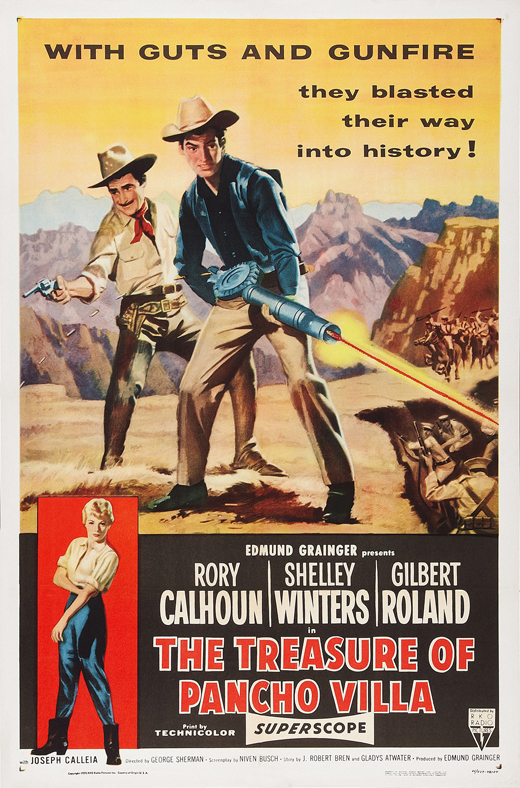
Looking to take one more big job that will allow him to retire for good, American gunman Tom Bryan (Rory Calhoun) teams up with a former alley and idealistic officer in Pancho Villa's army, Juan Castro (Gilbert Roland). With some help from Villa's revolutionaries, Tom and Juan knock off a heavily guarded and fortified train heading north with almost a million dollars in gold. Now comes the hard part as they are forced to transport the gold by mule train to a prearranged meeting point with Villa's forces. Mexican forces are following close behind hoping to get the gold back, but there's also a treacherous trail guide (Joseph Calleia) among their group who may pose a bigger problem. Time is running out though, and almost everyone starts looking out for themselves when the chips are down.
From the time I saw Clint Eastwood in Leone's spaghetti westerns, I was hooked. So going back and seeing a movie made 10 years prior when so many American westerns presented this dull, whitewashed version of the west and seeing a movie as good and as enjoyable as this is a treat. There are no real good guys, just different shades of bad, good and somewhere in between. Calhoun's Tom is a cynical mercenary who goes wherever he can get the most money, principles or ideals thrown out the window long ago. His weapon of choice is a Lewis gun, a light machine gun he uses to get out of trouble as quick as he gets into it. Just one of many influences a low-budget B-western would have on one of my favorite genres, the spaghetti western.
One of the best things to come out of 'Treasure' is the pairing of star -- but not superstars -- Calhoun and Roland. Neither actor was ever a huge star in Hollywood, but they were both solid actors who rarely disappointed on screen. Both had a knack for playing characters not quite good and not quite bad, just somewhere floating in between. They're introduced early as two similar men, a fighting man who is good at something that is extremely dangerous. They fight for different reasons -- Tom for money, Juan for beliefs and Mexican freedom -- but when the time comes they can put aside their differences and fight alongside each other. There are some great dialogue exchanges between them as each man begins to wonder if the other is trying to double cross him.
Filming in Mexico (it looks like some familiar locations in Durango), director George Sherman makes an exciting, fast-paced story that clocks in at just over 95 minutes. After the train robbery, the movie mostly settles in as a long chase movie, Tom, Juan and Co. hightailing it across the Mexican frontier chased by Mexican cavalry. It's never long in between action scenes (surprisingly graphic and callous for 1955), including one of the more original final showdowns I've seen in awhile. The opening scene actually partially reveals the ending only to flashback to how all the characters got to that spot. It's a simple technique used to death in the years since on TV and in movies, but when handled right as it is here, it works in a big way.
My only real complaint from this otherwise very solid western is the addition of Shelley Winters to the cast as an American schoolteacher along for the ride after being caught up in the revolution. Her character quickly falls for the roguish mercenary, Tom, and we're "treated" to a series of scenes as they talk about personal convictions and beliefs, what drives them and what their dreams are. The pacing slows down, and I found myself fast-forwarding through most of their scenes. Other than that, nothing to complain about. It's a hidden gem, and a western ahead of its time in terms of storytelling, realism, and cynicism. A 3-fer if there ever was.
The Treasure of Pancho Villa <---TCM trailer (1955): ***/****
Dealing with a story not so different from the previous year's Vera Cruz, 'Treasure' is one of those hidden gems that I'll always watch when I stumble across it on TV. And because there's no VHS or DVD readily available, you've got to enjoy it while you can. It's a B-western that isn't held back by flaws that brought down so many other 1950s westerns. Again a lot like Vera Cruz, Treasure was a pretty good look into the future of what westerns would turn into in the mid to late 1960s when Sergio Leone and the spaghetti westerns put their own unique spin on what the American west was like. Dark, cynical, double crosses, betrayals and plenty of action rule in this underrated western.
Looking to take one more big job that will allow him to retire for good, American gunman Tom Bryan (Rory Calhoun) teams up with a former alley and idealistic officer in Pancho Villa's army, Juan Castro (Gilbert Roland). With some help from Villa's revolutionaries, Tom and Juan knock off a heavily guarded and fortified train heading north with almost a million dollars in gold. Now comes the hard part as they are forced to transport the gold by mule train to a prearranged meeting point with Villa's forces. Mexican forces are following close behind hoping to get the gold back, but there's also a treacherous trail guide (Joseph Calleia) among their group who may pose a bigger problem. Time is running out though, and almost everyone starts looking out for themselves when the chips are down.
From the time I saw Clint Eastwood in Leone's spaghetti westerns, I was hooked. So going back and seeing a movie made 10 years prior when so many American westerns presented this dull, whitewashed version of the west and seeing a movie as good and as enjoyable as this is a treat. There are no real good guys, just different shades of bad, good and somewhere in between. Calhoun's Tom is a cynical mercenary who goes wherever he can get the most money, principles or ideals thrown out the window long ago. His weapon of choice is a Lewis gun, a light machine gun he uses to get out of trouble as quick as he gets into it. Just one of many influences a low-budget B-western would have on one of my favorite genres, the spaghetti western.
One of the best things to come out of 'Treasure' is the pairing of star -- but not superstars -- Calhoun and Roland. Neither actor was ever a huge star in Hollywood, but they were both solid actors who rarely disappointed on screen. Both had a knack for playing characters not quite good and not quite bad, just somewhere floating in between. They're introduced early as two similar men, a fighting man who is good at something that is extremely dangerous. They fight for different reasons -- Tom for money, Juan for beliefs and Mexican freedom -- but when the time comes they can put aside their differences and fight alongside each other. There are some great dialogue exchanges between them as each man begins to wonder if the other is trying to double cross him.
Filming in Mexico (it looks like some familiar locations in Durango), director George Sherman makes an exciting, fast-paced story that clocks in at just over 95 minutes. After the train robbery, the movie mostly settles in as a long chase movie, Tom, Juan and Co. hightailing it across the Mexican frontier chased by Mexican cavalry. It's never long in between action scenes (surprisingly graphic and callous for 1955), including one of the more original final showdowns I've seen in awhile. The opening scene actually partially reveals the ending only to flashback to how all the characters got to that spot. It's a simple technique used to death in the years since on TV and in movies, but when handled right as it is here, it works in a big way.
My only real complaint from this otherwise very solid western is the addition of Shelley Winters to the cast as an American schoolteacher along for the ride after being caught up in the revolution. Her character quickly falls for the roguish mercenary, Tom, and we're "treated" to a series of scenes as they talk about personal convictions and beliefs, what drives them and what their dreams are. The pacing slows down, and I found myself fast-forwarding through most of their scenes. Other than that, nothing to complain about. It's a hidden gem, and a western ahead of its time in terms of storytelling, realism, and cynicism. A 3-fer if there ever was.
The Treasure of Pancho Villa <---TCM trailer (1955): ***/****
Labels:
1950s,
Gilbert Roland,
Rory Calhoun,
Shelley Winters,
westerns
Thursday, September 30, 2010
Harper
The only other Newman flick I've reviewed here was an awful biblical epic, The Silver Chalice, so I don't want it to seem like I'm ragging on the man. Where The Silver Chalice was just all around awful, 1966's Harper is all around bad, but it's not Newman's fault. Anything but really because he's basically the only positive I took away from this convoluted mystery that not surprisingly receives good reviews from fans and has achieved a bit of cult status over the years. It's the type of thing where I finish a movie, read up on it afterward and am completely thrown off by fans' love of the movie. Did I miss something? Maybe, but I don't see myself revisiting this one anytime soon.
Tipped off by a lawyer friend (Arthur Hill) about a possible case, private investigator Lew Harper (Newman) begins to look into the background and evidence. A rich woman (Lauren Bacall) claims her husband has disappeared -- she doesn't really care, just curious -- under some mysterious circumstances and wants to know what happened to him. Harper somewhat unwillingly agrees to the job offer because after all, a payday is a payday, and the rich wife promises to pay handsomely. But with an odd, eccentric cast of characters surrounding the husband in his daily life, Harper quickly figures out that there is more going on than meets the eye. He's stumbled into something that is bigger than he ever thought.
Pretty straightforward plot review, don't you think? It's also one of the most vague reviews I've ever written because this movie just doesn't know where it's going or how to get there. Director Jack Smight has made one of the most convoluted stories I've ever seen. Countless characters are thrown at the screen, and Smight sees if they stick before dispatching them or keeping them involved. Harper follows "the clues" which I never saw and inexplicably pops up in random places, no explanation provided. At 121 minutes, the story had plenty of time to develop somewhat coherently, but that never comes to fruition. As a topper, convoluted isn't enough. It's also dull in its chaos, and still somehow easy to predict. A real doozy of a story.
The saving grace is Newman as Lew Harper, a role he would play once more in a 1970s sequel. Newman is at his best -- for me at least -- when he gets to do the anti-hero with a touch of humor and drama, that feeling of frustration with the world. He's mainstream, but he's got a bit of a rebel streak in him, like Cool Hand Luke, Hud, Butch Cassidy, or John Russel in Hombre. That's what Harper is, a man frustrated where his life has ended up. He's good at the job he does, but what does he ever really accomplish? He tracks down cheating spouses, works in seedy motels, and generally hates what he does. This possible kidnapping/disappearance case is different and maybe could give him a shot at something bigger, something better
I can't add another saving grace (can there be two?) because what I'm about to mention is only partially positive. Newman is the star, and the opening credits proceed to introduce a long alphabetical list of guest stars. Count me in, I'm all for glorified, extended cameos, and this list is impressive. Along with Bacall and Hill, there's Robert Wagner, Shelley Winters, Strother Martin, Pamela Tiffin, Julie Harris, Robert Webber, Harold Gould and Janet Leigh along for the ride. How great is that cast in support of always reliable Newman? Pretty can't miss, right? Well, for the most part this impressive cast is given nothing to do. They drift aimlessly through the story, and Newman's Harper somehow pieces all these weird events together until there's some sort of resolution that didn't really make sense to me. Great cast, sure, but a wasted one.
So what else to say? Not much. This movie is dull, confusing, a waste of the talent involved, and almost completely worth ignoring other than Newman's title role. It took me a handful of viewings to get through it because I struggled sticking with it for more than 15 or 20 minutes at a time. Thank God for the fast forward button. I'd have never made it otherwise.
Harper <---trailer (1966): */****
Friday, February 19, 2010
A Place in the Sun
Alfred Hitchcock’s influence and impact on movies is as strong as ever some 30 years since his death. Even this weekend in reviews of Martin Scorsese’s Shutter Island comparisons are being made in terms of directorial style. But in 2010, that’s all they are…comparisons. What about movies made when Hitchcock was still alive? I’m guilty of it too, but when you don’t know much about a movie or its background, you go to what you know.
So in my head, I see a thriller based in personal reactions and relationships, my mind goes right to Hitchcock who made classic very personal thrillers like Vertigo, Notorious, Rear Window, and many others. Yesterday, I watched 1951's A Place in the Sun which parts of distinctly reminded me of a Hitchcock-esque thriller. Sorry, George Stevens – the actual director of the movie – but isn’t it a compliment that I thought your movie was from the master of thrillers himself? Well, maybe not.
Quitting his job as a bellman at a Chicago hotel, George Eastman (Montgomery Clift) moves west and gets a job at his uncle’s clothing factory. George quickly hits it off with another employee, Alice Tripp (Shelley Winters), but they have to be discreet about their relationship (dating fellow employees is a no-no). Growing up in a poor family, George loves nothing more than the decadent lifestyle his uncle and his family have, including a young family friend from another rich family, Angela Vickers (Elizabeth Taylor).
George is smitten with Angela from the first time he sees her so when the beautiful young woman shows an interest in him he forgets anything and everything about his life. His mind goes blank, and all he can see is Angela. They quickly fall in love, but that’d be just too easy, wouldn’t it? Alice tells George she’s pregnant, and she wants him to marry her so they won’t cause a stir. If he doesn’t, she threatens to go to the elder Eastman’s house and blows George’s “cover” wide open. Seeing a future with Angela, his mind starts to race, even going as far as murder.
Stevens’ movie is easily broken down into segments, some stronger than the others. The first hour or so is George adjusting to his new life, especially his relationship with Alice. The two individuals are very similar in terms of background, but George wants something more of his life and aspires to reach the heights his uncle has. It’s not the most exciting segment, but Clift and Winters make it worth watching. The middle segment is the best as George meets Angela and begins to think about killing his pregnant girlfriend.
This middle part of the movie is what was reminiscent of a Hitchcock thriller, especially George’s plan being put into action. SPOILERS Alice dies, but we don’t see if George could have saved her. He takes her out on a row boat, and Alice – who can’t swim – actually capsizes the boat when she stands up. Stevens makes the choice not to show us the aftermath, only George swimming up to shore. END OF SPOILERS We don’t know what actually happens until the very last scene. This middle portion is Stevens’ movie at its best, full of tension and anxiety with a sense of coming doom. Is George capable of the thoughts racing through his head?
This builds and builds, including the aftermath as Clift tries to cover things up, and then there’s a huge letdown. He’s caught by a pre-Perry Mason Raymond Burr as a district attorney and sent to trial for first-degree murder. This last 30 minutes lacks a certain energy when it should be the most exciting part of the movie, especially after all the build-up. Instead of sprinting to the finale, ‘Place’ sort of limps to its finish in the final scenes. The reveal as to George’s intentions doesn’t really come as a surprise because let’s face it…this story is not going to have a big twist ending.
Even with the problems concerning the story, the three leads make the most of it no matter how good or bad some of the story is. Clift isn’t the slimiest of guys, but the situation he puts himself into doesn’t make it easy to root for him. I'd like to think George loves both women in one way or another, but he's out of his mind, physically, mentally in love with Taylor's Angela. As basically the ideal woman, Taylor is perfect, beautiful, smart, funny, and makes you understand what Clift sees in her. Now in her 80s, Taylor has made some news for some off-the-wall statements and relationships, but early in her career, she was a great actress and one of the most beautiful ones at that. The two have a definite chemistry that extended offscreen where they were incredibly close as friends.
Winters is the woman just looking for happiness, only to end up with a guy who would drop her at the first sign of something better coming down the road. Definitely watch this one for the acting which makes the lapses in story less obvious.
A Place in the Sun <----trailer (1951): ** 1/2 /****
So in my head, I see a thriller based in personal reactions and relationships, my mind goes right to Hitchcock who made classic very personal thrillers like Vertigo, Notorious, Rear Window, and many others. Yesterday, I watched 1951's A Place in the Sun which parts of distinctly reminded me of a Hitchcock-esque thriller. Sorry, George Stevens – the actual director of the movie – but isn’t it a compliment that I thought your movie was from the master of thrillers himself? Well, maybe not.
Quitting his job as a bellman at a Chicago hotel, George Eastman (Montgomery Clift) moves west and gets a job at his uncle’s clothing factory. George quickly hits it off with another employee, Alice Tripp (Shelley Winters), but they have to be discreet about their relationship (dating fellow employees is a no-no). Growing up in a poor family, George loves nothing more than the decadent lifestyle his uncle and his family have, including a young family friend from another rich family, Angela Vickers (Elizabeth Taylor).
George is smitten with Angela from the first time he sees her so when the beautiful young woman shows an interest in him he forgets anything and everything about his life. His mind goes blank, and all he can see is Angela. They quickly fall in love, but that’d be just too easy, wouldn’t it? Alice tells George she’s pregnant, and she wants him to marry her so they won’t cause a stir. If he doesn’t, she threatens to go to the elder Eastman’s house and blows George’s “cover” wide open. Seeing a future with Angela, his mind starts to race, even going as far as murder.
Stevens’ movie is easily broken down into segments, some stronger than the others. The first hour or so is George adjusting to his new life, especially his relationship with Alice. The two individuals are very similar in terms of background, but George wants something more of his life and aspires to reach the heights his uncle has. It’s not the most exciting segment, but Clift and Winters make it worth watching. The middle segment is the best as George meets Angela and begins to think about killing his pregnant girlfriend.
This middle part of the movie is what was reminiscent of a Hitchcock thriller, especially George’s plan being put into action. SPOILERS Alice dies, but we don’t see if George could have saved her. He takes her out on a row boat, and Alice – who can’t swim – actually capsizes the boat when she stands up. Stevens makes the choice not to show us the aftermath, only George swimming up to shore. END OF SPOILERS We don’t know what actually happens until the very last scene. This middle portion is Stevens’ movie at its best, full of tension and anxiety with a sense of coming doom. Is George capable of the thoughts racing through his head?
This builds and builds, including the aftermath as Clift tries to cover things up, and then there’s a huge letdown. He’s caught by a pre-Perry Mason Raymond Burr as a district attorney and sent to trial for first-degree murder. This last 30 minutes lacks a certain energy when it should be the most exciting part of the movie, especially after all the build-up. Instead of sprinting to the finale, ‘Place’ sort of limps to its finish in the final scenes. The reveal as to George’s intentions doesn’t really come as a surprise because let’s face it…this story is not going to have a big twist ending.
Even with the problems concerning the story, the three leads make the most of it no matter how good or bad some of the story is. Clift isn’t the slimiest of guys, but the situation he puts himself into doesn’t make it easy to root for him. I'd like to think George loves both women in one way or another, but he's out of his mind, physically, mentally in love with Taylor's Angela. As basically the ideal woman, Taylor is perfect, beautiful, smart, funny, and makes you understand what Clift sees in her. Now in her 80s, Taylor has made some news for some off-the-wall statements and relationships, but early in her career, she was a great actress and one of the most beautiful ones at that. The two have a definite chemistry that extended offscreen where they were incredibly close as friends.
Winters is the woman just looking for happiness, only to end up with a guy who would drop her at the first sign of something better coming down the road. Definitely watch this one for the acting which makes the lapses in story less obvious.
A Place in the Sun <----trailer (1951): ** 1/2 /****
Subscribe to:
Posts (Atom)
.jpg)