The Sons of Katie Elder

The Sons of Katie Elder
"First, we reunite, then find Ma and Pa's killer...then read some reviews."
Showing posts with label John Garfield. Show all posts

Saturday, January 22, 2011

The Sea Wolf

Based on the real life incident, the mutiny on the H.M.S. Bounty has been a ripe picking ground for movies over the years with a handful of flicks released over the years.  It's a solid story of how horrifically bad living on the sea was as a sailor in the 1700s.  At a certain point though, all other mutinies at sea feel like they're borrowing liberally from any of the Bounty stories.  You start seeing repeats and do-overs, the evil, despicable captain and the crew pushed to its limits.  That's why 1941's The Sea Wolf never amounts to anything better than a decent story, we've seen it before and will see it again.

Starting a movie based off a novel by famed novelist Jack London is usually about as solid a footing as a studio can pick. I grew up reading Call of the Wild and White Fang and loved them, but I'll admit I've never read London's The Sea Wolf, one of over 20-plus novels he wrote in his short career.  Not having read the book, I can't fairly compare the novel to the movie, but with a little Wikipedia investigating it didn't take long to find out how much was changed from one medium to the next.  Hollywood studios at work turning a solid, respected story into a dumbed down version that they believe audiences will love.  Nice work all around.

In 1900 in the Pacific Ocean, there is one ship -- named The Ghost -- that no sailor willingly wants to work on.  The ship's captain, Wolf Larsen (Edward G. Robinson), is a rabid tyrant, treating his men cruelly with little regard for anything but their job at hand, hunting seal. But on this trip, Larsen doesn't have a particular objective, he's running from something.  On board are three new passengers including George Leach (John Garfield), a man similarly hiding from his past, and two passengers rescued at sea following a collision, Ruth Webster (Ida Lupino), an escaped convict from a women's prison, and Humphrey Van Weyden (Alexander Knox), a writer. All three want off the ship for one reason or another, but Larsen has no intention of changing his plans for everyone else regardless of the cost.

I will say before I rip into the movie that I liked the style of the film overall with director Michael Curtiz turning in a typically polished finished product. 'Wolf' plays like a film noir on the high seas where each character is flawed from their past and are thrown together to piece everything into place.  There are no real good guys -- although Knox's Van Weyden is pretty close -- and everyone else is in shades of gray.  For a movie from Warner Bros. in the early 1940s, it has a dark, shadowy look that ends up playing well because the Ghost is clearly a stage, a set built.  No real-life adventures on the high seas here, too pricey.  Money was spent on the film though, and it's enjoyable enough to watch.

Molding London's novel though from a book to a movie, some major changes were made, and even I didn't need to look this one up.  As a writer, London doesn't seem the type to waste a lot of pages developing a hackneyed relationship between two characters who fall madly in love with each other almost at first glance.  It's just not his style if you ask me.  Well, the studios thought that would be a good route to take with the story.  Lupino and Garfield were some of the best and most recognizable stars from the 1940s with talent to spare, but they're wasted here.  Neither character was even in the book so the script adds them to apparently bring in a wider audience.  Instead, this "relationship" falls flat and drags the movie downhill quickly.

Where the movie gets it right working off of London's novel was the odd bond that develops between Robinson's Wolf Larsen -- a smaller Capt. Bligh with more of a cruel streak -- and Knox's Van Weyden.  As individual characters, you feel you actually get to know them through this high seas cruise.  Robinson plays Larsen as a ball of contradictions, one second an intelligent, rational individual and the next, a raving lunatic pitting his men against each other.  Knox makes Humphrey the most sympathetic character, a man forcefully enlisted to work with the crew even though he knows nothing of being a sailor.  His writing talents come out, and when Larsen finds out about his honest analysis of this captain, he's not angry or disappointed.  Maybe it's his pride, his ego, but he's intrigued and encourages Van Weyden to continue writing.

Too bad more of the movie couldn't have been devoted to that portion of the story.  Robinson has that intensity in his parts that so few actors can pull off and not make it feel forced.  His performance carries the movie as he drips with anger and even a little lunacy.  Knox in the quieter part doesn't get lost along the way, managing to keep up with Robinson.  Other strong supporting parts include Gene Lockhart as Dr. Louie, a drunk doctor who yearns for his glory days of the past, and Barry Fitzgerald playing against type in a particularly nasty part as Cookie, the ship's cook and an informant for Larsen about the goings on with the crew. The movie is all right overall, but it could have been better.

The Sea Wolf <---trailer (1941): ** 1/2 /****

Sunday, December 19, 2010

Air Force

As part of a themed day a few weeks ago, Turner Classic Movies aired a handful of World War II movies honoring the heroes of December 7, 1941 when the Japanese led a sneak attack on Pearl Harbor in Hawaii. Almost 70 years since one of the biggest, most violent on attacks ever on American soil, it's still hard to wrap your head around the immensity of the attack and how it drastically changed the course of human history.  Some movies like From Here to Eternity focus exclusively on the attack, but others use December 7th as a jumping off point, like 1943's Air Force.

Watching a movie released in 1943 in the U.S., you have to know what you're getting into.  Made with the backing of the U.S. Air Force (and most likely the U.S. government), this is a war story dripping with propaganda.  It was made to encourage the home front, make sure Americans knew what our armed forces were fighting for.  Overall, the movie doesn't overdo it with its message until an unnecessary gruesome finale, but the first 90 minutes is a perfect example of how good a movie can be even with an incredibly one-sided story.  Flag-waving in just about every scene and a can't beat the U.S. mentality end up working toward the positive here.

Taking off from a runway in San Francisco, a B-17 bomber named 'Mary Ann' piloted by 'Irish' Quincannon (John Ridgely) and Bill Williams (Gig Young) heads out over the Pacific bound for Hickam Field in Hawaii. With several new members of the nine-man crew, they have little experience working together but quickly find themselves needing to get on the same page.  They fly into Hawaii on the afternoon of Dec. 7, 1941 just hours after the sneak attack by the Japanese Navy that almost cripples the U.S. Pacific fleet.  They land and are are quickly given orders to continue flying to the west.  Reports of Japanese attacks throughout the Pacific have the High Command on a major alert, and every man, pilot, and plane is needed to hold back the advance if the U.S. has any chance of staying in the conflict.

Director Howard Hawks did a wise thing setting this story in and around the opening days of the U.S. involvement in World War II. Looking at the story as simplistically as possible, we get a tour of the Pacific in the days following the attack on Pearl Harbor.  We see Battleship Row still in flames, we see the heroic defenders of Wake Island as they await a Japanese attack, we see military bases in Manila falling back under waves of Japanese attackers.  It serves two purposes, one being a jumping off point for everything that's going on, and two, it shows these heroic efforts put forth by American soldiers, Marines, sailors, civilians and pilots throughout the Pacific against impossible odds.  And make no mistake, many of the people on Wake and throughout the Philippines were either killed or captured by the Japanese.

The propaganda is held in check for the most part with two major exceptions.  A machine gunner on the back of a small fighter plane is forced to bail and attempts to parachute to dry land.  Floating back to the ground, he is machine-gunned by a Japanese pilot.  Then as he lies dying on the ground, the pilot flies over again and finishes him off in brutal fashion.  First, there's documented cases of Japanese pilots doing this throughout the war.  Subtle it is not, but in terms of portraying the Japanese in as brutal a depiction as possible, this gets the job done.  Second exception, 2001's Pearl Harbor syndrome. Instead of just telling the story of Pearl Harbor, the 2001 movie adds on the telling of the Doolittle Raid on Tokyo because us Americans, we need our happy endings. Here in Air Force, Hawks depicts a fictional, very one-sided depiction of the American Air Force destroying a Japanese invasion fleet on its way to Australia.  It's overdone and just tries too hard, reveling in the defeat of the Japanese.  I understand this might have been a necessary ending in 1943, but now in 2010 it just doesn't work.

Those complaints aside, I loved the movie starting with one of Hawks' biggest strengths as a director.  He had a knack for working perfectly with predominantly male, ensemble casts, and Air Force has a good one.  Ridgely and Young play the pilots of B-17 Mary Ann with the crew including Harry Carey as veteran crew chief Robbie White, John Garfield as new machine gunner Joe Winocki, Arthur Kennedy as bombardier Tommy McMartin, Charles Drake as navigator Monk Hauser, George Tobias as mechanic Weinberg, Ward Wood as radioman Peters, Ray Montgomery as newbie Chester, and James Brown as tag-along fighter pilot Tex Raider. With such a big ensemble, we only get tidbits of info about each man, but they cover a melting pot of the Americans fighting in WWII.  They bond through their common goal and will to survive, doing whatever they can to take the war back at the Japanese.

When propaganda works, it is typically because it hits a nerve.  I've long been a fan of war movies across the board, and you can't help but root in patriotic fashion for this B-17 crew.  For a start, they're very easy to like, all of them.  When one of the crew dies following a Japanese attack, you see the others throw caution to the wind in hopes of reassembling the plane so they can rejoin the war effort.  Carey and Garfield cradling machine guns in their arms fighting off Japanese Zeroes hits you in the gut.  It's over the top and hammy, but it's perfectly portrayed. Obviously now in 2010, we know the Allies won WWII.  But in 1943 the war was still up for grabs, and Americans could always use a positive jolt.  This certainly qualifies.

Air Force <---trailer (1943): *** 1/2 /****  

Tuesday, November 2, 2010

He Ran All the Way

I usually try and come up with a unique intro for all my reviews, but I hit a wall every so often.  It's usually in those movies that aren't particularly good or particularly bad.  The classics and the awful ones are typically the easiest ones to write.  It is the movies in the middle that don't leave a huge impression where I struggle to come up with something.  That's all I could think of while watching 1951's He Ran All the Way, a film noir benefited by performances from its two stars. 

A small-time thief with no aspirations to be anything else, Nick Roby (John Garfield) finds himself on the run after a payroll heist goes horrifically wrong. He gets his hand on over $20,000, but his partner is killed in the getaway, and Roby is forced to shoot a policeman.  Believing the police have his description, Roby hides out in a community pool where he meets Peggy Dobbs (Shelley Winters), a young woman who works at a bakery and lives at home with her father (Wallace Ford), mother (Selena Royle), and younger brother (Robert Hyatt). He makes a quick impression on Peggy and gets an invite to her house.  Looking for a place to hide out until the heat dies down, Roby kidnaps the Dobbs, but it feels like a matter of time until the police manhunt closes in for good.  What will Roby do when he's backed into a corner?

Tortured crooks dealing with a variety of inner demons are nothing new in movies, especially film noirs where tortured individuals are almost a necessity to get in the door.  Garfield's Nick Roby reminded me of a lot of those anti-heroes you'll see in any number of film noirs.  He's in his 30s but has never amounted to much.  His mother (Gladys George) is constantly berating him to get up and do something with his life, but Roby just doesn't seem interested in doing anything else than a life of crime. But even trapped by his own self, Roby is a worrier, a paranoid crook who somehow knows his final destination is not going to be a pleasant one.  He's on his own with no one to turn to, always having had to fend for himself.

Which brings me to the good and bad parts of his kidnapping the Dobbs in their apartment.  It starts off innocently enough as Roby is just looking for a place to lay low for a day or so.  His paranoia and inner demons get the best of him as he convinces himself that everyone is against him and the cops are getting closer.  Using my vast medical knowledge, all I can come up with is that he's some sort of schizophrenic.  He goes from one end of the spectrum to the other with a snap of the finger.  This really comes to fruition in the end as his paranoia finally gets the best of him, turning the one person on his side against him.

Two things drive me nuts here.  One, Winters' character falls hard for Roby within about 18 minutes of meeting him.  As they hole up in the apartment, the incredibly stupid duo decide to run away together because what they have is a true love.  Really?  That quickly?  Is Winters' Peggy that frustrated with her life that a cop killer is her best option out there?  From Roby's perspective, it kind of makes sense.  He's always been alone and finally has met someone who likes him for what he is.  Plot developments that make no real sense but are necessary for the sake of the story reek of laziness, and this was a big one.

The other thing is the actual kidnapping.  Messed up and rather stupid crook that he is, Roby looks at this kidnapping as some sort of bizarre family get together.  He buys them lots of food and gets pissed when the Dobbs refuse to touch the stuff.  Roby threatens to SHOOT them if they don't eat.  That's right, a cop killer being hunted down by the whole police force has a limit.  Don't eat his food? Oh, you'd better watch out.  It is a scene that I'm guessing is supposed to be tense but ends up being laughable instead.  The premise that this kidnapped family is supposed to welcome their kidnapper as one of their own was just too much for me.  I get it, Roby is a twisted, messed up individual, but there's a point where it isn't believable anymore.

An interesting premise here if nothing else, reminding me of movies like Suddenly and The Desperate Hours but not handled as well.  Garfield's performance is worth watching even if it feels a little off at times, and Winters makes a believable character of this young woman looking for something more, something better out of life.  The apartment setting is like an additional character and does add a dimension of claustrophobia to the proceedings.  A mild recommendation but nothing more than that.

He Ran All the Way <---TCM clips (1951): ** 1/2 /****

Tuesday, October 12, 2010

Out of the Fog

For over 30 years, something called the Hays Code dominated Hollywood, basically making sure that anything shown on-screen was censored within an inch of its life.  Its effect lessened over the years, but in the 1940s especially you got a sense of that censorship.  The good guys always won, and even if those decent characters did something bad, they were going to pay for it and often enough with their lives. You more or less train yourself to pick out the ending before it happens because studios just didn't get away with those things.

I'm sure there are other examples -- Gone With the Wind comes to mind as a not-so happy ending -- but I can't think of many.  Somewhere in a murky, middle ground is an early film noirish movie that pushes the limit, but only to a certain point, 1941's Out of the Fog.  Directed by Anatole Litvak, the story hovers for awhile, not quite sure where to go but ends up righting itself nicely in the end, and even with a bit of a twist.

In a quiet, little fishing village on the East coast, a small-time racketeer, Harold Goff (John Garfield), moves in when he sees a chance to make some money.  He starts intimidating all the local business owners and residents, demanding they pay him "protection money." Two old friends and fishing buddies, Jonah (Thomas Mitchell) and Olaf (John Qualen), are two of Goff's clients, and even though they object, they don't know what else to do to stop Goff from taking everything they own. Meekly, they decide to go along with the demands, but just about everybody has a limit, and Jonah meets his when Goff starts dating his daughter, Stella (Ida Lupino). Pushed too far, how far then will Jonah and Olaf go to right the situation?

For a movie released in 1941, 'Fog' felt like it got away with a lot of things that a censor should have caught.  Directors, actors and studios found ways to be very subtle and sneak things past censors, but this is pushing the limits.  SPOILERS STOP READING SPOILERS Jonah and Olaf decide to off Goff by drowning him out at sea.  Long story short, their plan doesn't work but Goff drowns in the process.  So technically, they never committed murder even if they did put a plan into action.  At this point, I'm expecting them to get caught and sent to jail.  Joke was on me, the movie ends as happy as can be with everything wrapped up nicely.  It certainly caught me off guard because even when "good" characters commit a transgression, they typically have to pay for it.  Not so here, but the ending works.  END OF SPOILERS

In a career that was cut tragically short when he died at the age of 49, Garfield made a living for doing characters like his Harold Goff.  For being an all around son of a bitch, he's the most amiable racketeer you'll ever meet.  Garfield had this way about him that drew you in as a viewer even when his actions are pretty despicable.  His Goff is a guy you'd love to punch just once in the face, but he's so charming, so friendly in his intimidation techniques you don't even mind.  Of course he does have a mean streak right up his back which comes out in a few creepy scenes so you know things aren't going to end well for his character.  Still, it's a great villainous part, and one of many strong parts in Garfield's cut-short career.

Garfield is easily the best thing 'Fog' has going for it, but I loved the rest of the cast.  Lupino wasn't a classically pretty woman, but there's just something about her in all the movies I've seen with her.  She has this innocence about her but also a hard edge, and you end up seeing why her Stella is so caught up with this new bad boy in town.  Mitchell is one of my all-time favorite character actors even if he did always play a variation on the same character.  He's so likable in his parts that it is refreshing to see a little harder mindset as his Jonah prepares to do some bad, bad things.  Qualen usually drives me nuts in most of his parts (especially his pairings with John Ford), but he's neutral enough here not to be a problem.  Eddie Albert plays George, Stella's thrown aside boyfriend, and George Tobias has an odd very out of place part as a local businessman that doesn't justify the high billing he got.   

One other thing beside some cool, mood setting use of a constant fogginess/smokiness permeating the set (a good choice) is something else that possibly slipped by the censors.  I got a very distinct gay vibe between the Mitchell and Qualen characters.  This could be me overanalzying the situation, but they acted like more than just longtime friends.  Who knows for sure, but to prove me wrong you'll have to check it out.

Out of the Fog <---trailer (1941): ***/****

Sunday, June 13, 2010

The Fallen Sparrow


Before he died at the young age of 39, actor John Garfield sure packed a lot into a brief career.  In just over 10 years, he was in 32 movies, some parts bigger than others and not all of them starring parts.  But he carved out a niche for himself playing tough guys who remained likable despite their on-screen actions especially in The Postman Always Rings Twice where he's a wandering, murdering lover.  In 1943's The Fallen Sparrow, he gets to play a character that reminded me in a lot of ways that reminded me of Leonardo DiCaprio in Shutter Island.

Garfield plays John McKittrick, 'Kit' to his friends, a man wrestling with his past demons.  In the 1930s, McKittrick traveled to Spain and fought in the Spanish Civil War.  Toward the end of the war, his battalion was involved in a bloody battle that resulted in a majority of the men being killed or captured.  Kit has an item the enemy would love to get their hands on but refuses to give it up and is sent to a prison where he rots for two years, his captors torturing him physically and mentally.  Finally he escapes with the help of a childhood friend and returns to the U.S. where he lives on a ranch in Arizona (it's hinted this is some sort of asylum).  But even free from the prison, he's tortured by his memories of what happened in the prison, the sounds, the smells, all the little things get to him as he tries to cope.

Here's where the story kicks in because all of that background is handled in a few scenes of dialogue as information is slowly filtered out. Kit travels to New York when he receives word that a friend of his -- the one who helped him escape -- died when he accidentally fell to his death from a window on a top floor of a skyscraper.  Kit doesn't believe it for a second and starts his own investigation.  He meets all sorts of people who were at the party when his friend fell, but no one seems to be telling him the truth.  It's just the start of a story that goes left and right with twists around every corner as Kit tries to reveal the truth while also struggling to keep his sanity.

My plot description was a little shorter than usual and for good reason.  Even after finishing the movie, I wasn't quite sure what I'd just watched or what exactly happened.  Foreshadowing the huge popularity of film noir that was to come, 'Sparrow's' story isn't content just to keep you guessing as to what is to come.  This is a story that feels the need to confuse you.  Characters are introduced and then drift in and out as needed, disappearing for extended segments and then reappearing when some new twist or reveal appears.  Granted, I watched this movie in a couple different windows, but I'm usually able to keep up with most movies.  Not so much here.

SPOILERS As for the twists and turns that I did keep up with, it's all pretty ridiculous.  Garfield's Kit stumbles into a web of political intrigue with international spy rings, government agencies, blackmail, murder and Nazis hiding out in 1943 in NYC as refugees.  Then as for the big reveal of who the actual bad guy is, I thought I'd missed something.  From the get-go, their very first appearance it is obvious to a blind man who the Nazi killers really are.  Then the story spends the next hour and a half getting to that point of the reveal.  One worthwhile point mentioning, Hugh Beaumont (Ward Cleaver, the Beav's Dad on Leave it To Beaver) is one of the Nazi agents working with his 'dad' Walter Slezak.  The reveal is so obvious it threw me off to the point where when the camera zooms in and the music swells I thought I'd missed something else.  Nope, that was it, and I called it five minutes in like most moviegoers had to do when seeing this one.

But because of the good performances in this mess of a movie, I can't completely rip it to pieces.  Garfield is a strong lead as he tries to piece all this crazy evidence together with everyone around him thinking he's completely lost his mind.  Maureen O'Hara plays Toni Donne, a pawn in a much bigger picture who is forced to do things against her will.  She of course falls in love with Kit right away in one of those ultra-believable romances that I'm such a fan of.  Also look for a much thinner, very young John Banner as Anton, a mysterious piano player who knows more than he's letting on.  It took me quite a while to figure him as Sgt. Schultz from Hogan's Heroes.  This isn't going to be a very long, very detailed review because even with the solid cast, this one was a stinker.  Pass and pass again.

The Fallen Sparrow <----trailer (1943): * 1/2 /****

Thursday, November 12, 2009

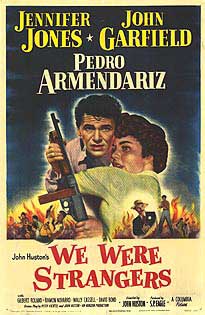
We Were Strangers

Thanks to the local cable provider's high quality product, the three movies I taped off of TCM Monday night turned into one and a half movies. With about 5 minutes to go in 1979's Cuba, the screen freezes so I sit it out for a minute or two. Then onto the fast forward and next thing I know I'm 45 minutes into the next movie. Great, grand, awesome, but in looking for that bright spot the third movie, 1949's We Were Strangers, made it all the way through without any freezes...thankfully.

The theme for TCM's Monday schedule was Cuba so the common thread among the three movies I attempted to record was assassination, murder, coups, and generally death and mayhem around every corner. Cuba has never been a real model for stability, especially in the 20th Century beginning with the Spanish American war through several revolutions after that and then Fidel Castro's dictatorship dominating the country from 1959 and on. All this political instability provides some interesting storylines and settings, often told directly and frankly, politically correct feelings be damned.

It's 1933 in Cuba and the senate has ruled that any congregation of more than three people is illegal because those folks must be plotting some evil revolutionary plans. Following her brother's murder at the hands of the Porra (the secret police like the SS or KGB), China Valdez (Jennifer Jones), pronounced Chee-na, seeks out the resistance movement. She hopes to find a way to kill the man, Ariete (Pedro Armendariz), who shot her brother in cold blood. Instead, she is set up with Tony Fenner (John Garfield), a mysterious American, involved with the resistance.

Fenner concocts a detailed plan that could bring about the end of the current dictatorship. Using China's house that stands near a cemetery, Fenner and his small crew of revolutionaries will dig a tunnel under the street into the cemetery until they reach the tomb of Vicente Contreras, a local higher-up and businessman. His plan calls for the group to murder Contreras, and when all of the government powers that be -- including the president -- show up, they will set the bomb off and hopefully knock out the Cuban power structure. But as Fenner's crew works, Ariete stays on their trail, suspicious of what they're up to.

Released just four years after the end of WWII, 'Strangers' is incredibly frank in dealing with its subject matter. China, Fenner and the group believe they are in the right in attempting to assassinate Cuba's president and his cabinet. As presented, it is a rather nasty government that callously murders its citizens believed to be working against them so that makes it easier to side with the revolutionaries. Still, it is about as straightforward as possible. The collateral damage of innocents is mentioned but considered worth the death toll that a bomb will produce. But whether the group is in the right or not is beyond the point. 'Strangers' tells the story of a group of assassins which is a difficult subject to handle. Credit to tough-guy director John Huston for pulling it off so well.

This was the first Jennifer Jones part that I actually thought was pretty good although to be fair I've only seen two others. Jones was not a classical Hollywood beauty with her somewhat exotic look so she was often cast as minorities, Spanish, Asian, Native American, and here, Cuban. Her China is a strong female character looking for revenge. She's believable and completely sympathetic in the part. As the tough guy lead, Garfield is a good choice to play Fenner. Before his sudden death in 1952, Garfield made himself quite a name as a star, and it's easy to see why here. With little in the way of backstory or even in lines, Garfield's Fenner is a tough, no-nonsense leader. Typically playing good guys in a trio of John Ford westerns, Armendariz pulls off the villain perfectly, the secret policeman with little to no scruples. The rest of Fenner's team includes Gilbert Roland as Guillermo, a dock worker, Wally Cassell as Miguel, a bike mechanic, David Bond as Ramon, a law student, and Jose Perez as Toto.

With some rather obvious green screen efforts filling in for outdoor scenes in Havana, some scenes have a fake look to them as Jones and Garfield 'walk' through the downtown area. Other than those studio-manufactured backdrops, 'Strangers' looks like a typically dark, shadowy film noir. Filmed on soundstages for China's house and cellar, the characters are always half in shadow with faces covered and those shadows dancing around the floors and walls. It's a great looking movie -- not a surprise with Huston directing -- and an interesting time capsule of how a movie from the late 1940s handles the touchy subject of assassination. Well worth a watch.

We Were Strangers (1949): ***/****