The Sons of Katie Elder

The Sons of Katie Elder
"First, we reunite, then find Ma and Pa's killer...then read some reviews."
Showing posts with label Eddie Albert. Show all posts

Monday, August 3, 2015

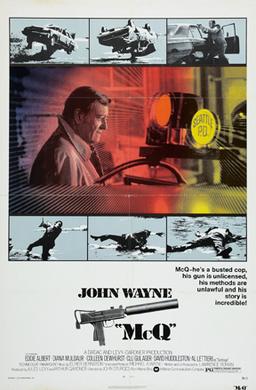
McQ

By the mid 1960's John Wayne wasn't just John Wayne anymore. He was the Duke, an icon and a star. He came to represent something bigger, something Wayne thought people needed to look up to. Because of that sentiment, he turned down some roles that he thought were too much against type. The two big ones? The Major Reisman part from The Dirty Dozen and the role of a famous rogue cop named....Dirty Harry. Wayne regretted not taking the part made famous by Clint Eastwood and went about fixing the issue. The result? Two cop movies, starting with 1974's McQ and following a year later with Brannigan (soon to be reviewed).

A longtime detective on the Seattle police force, Lieutenant Lon 'McQ' McHugh (Wayne) has seen everything there is to be seen. After years on the force, he's sick of the politicians and the glad-handing and all the garbage. He's interested in putting the crooks away, but now one attempted murder hits too close to home when his partner, Lt. Stan Boyle (William Bryant), is shot in the back with a shotgun with no witnesses. Boyle's chances aren't too good, but McQ intends to do something about it. Who shot his partner? The clues are there, and McQ begins to suspect there's a whole lot more going on than meets the eye. He begins to find evidence that could point to any number of trails worth following, from a high-level drug supplier to corruption within the police force. Can he piece it all together before those people he's chasing get him instead?

I've been a huge John Wayne fan for as long as I can remember. If he's starring in a movie, I'll give it a shot. Mostly, they're winners but occasionally there's a dud here and there. I'm looking at you The Conqueror. In this last portion of his career -- mostly the late 1960's and into the 1970's -- Wayne was making movies he wanted to make, movies he figured his fans and audiences wanted to see. Are they classics? With the exception of True Grit and The Shootist, no. On the other hand, they're F-U-N, movies like Big Jake, The Train Robbers, Chisum, The Cowboys and several others. So regretting not taking the Harry Callahan role (a big thank you from Eastwood), Wayne dove headfirst into the renegade cop genre. The winners? Us. McQ and Brannigan aren't classics, but man, are they ever fun.

The rogue/renegade cop movies of the 60's and 70's were everywhere, ranging from Bullitt to Dirty Harry to Magnum Force to The French Connection with plenty more in between. The crime thriller as a whole was at its absolute best. But a John Wayne take on the genre? Yes. Yes. The script gives him some nice touches to show he's a cool cop, like his houseboat, his Pontiac trans am, his efforts to stay involved in his daughter's life, even though ex-wife Julie Adams just couldn't take their marriage anymore. By 1974, Wayne was 66 years old, a little thicker around the midsection and sporting a toupee but you know what? He makes it look effortless. That no-nonsense, all-business attitude plays well as the frustrated cop role. Rules? Meh. Hippies? Don't bug him about them. Getting the crooks behind bars? NOW you're talking.

It doesn't matter the genre. It doesn't matter the script really. It's John Wayne, and he's going to make the most of it. The cast across the board is pretty cool. Eddie Albert gets to glare and snare as Kosterman, McQ's commanding officer who's sick of his take no prisoners attitude, and has some great scenes, two pros going toe to toe. Diana Muldaur plays Boyle's wife, always close with McQ, while Colleen Dewhurst plays Myra, an informant, waitress and drug addict who McQ milks for dirt. Among the cops on the case, also look for Clu Gulager, David Huddleston, and Julian Christopher while Roger E. Mosley plays a pimp/snitch, quite the one-two punch. And last but not least, Al Lettieri does what he does best...in be a slimy 1970's villain, this one a drug supplier with a checkered history with McQ so you know that's going to end well. Some fun parts to back up the Duke throughout.

If you're a fan of Bullitt, the Dirty Harry movies, or assorted other 1960's/1970's cop movies, you'll like this one. Director John Sturges does a good job using his on-location shoots in Seattle to give the story that sense of authenticity, and composer Elmer Bernstein turns in a cool, funky, jazzy score...that's still very clearly an Elmer Bernstein score (and that's a good thing). There's a really cool car chase through and around Seattle's highways about halfway through (just like Bullitt), and the shootout finale on oceanfront beach is very well-done as three 1970's boats, um, I mean "cars," tear after each other. Oh, and John Wayne gets to unleash a heavy-duty automatic machine gun.

Is it a classic? No way, but it is a heck of a lot of fun with a story that never really slows down and has some fun with twists you think you'll see. More than enough to recommend, and John Wayne is having some fun from beginning to end. What would it have been like if Wayne took the Dirty Harry role? We'll never know, but it seemed to turn out generally okay for everyone involved. I guess. Right, Mr. Eastwood?

McQ (1974): ***/****  

Monday, December 2, 2013

Border Cop

So illegal immigration across the U.S./Mexico border, that's a good jumping off point for a movie, right? It's a divisive topic with little middle ground. How about a low-budget flick with a pretty unknown cast that takes no real stance on the topic and when it does....makes little sense?!? I know. How could you not be excited? Let's get going with 1980's Border Cop.

A longtime veteran of the Border Patrol, Frank Cooper (Telly Savalas) is only a few months away from retiring. Just the same, he's pretty good at what he does, ultra-experienced at preventing illegal immigrants from sneaking across the border into the United States. He's also good friends with a teenage Mexican boy, Benito (Danny De La Paz), who he once prevented sneaking into the U.S. illegally. Looking to provide for his newlywed bride, Benito has taken a job as a coyote working for a kingpin smuggler, Suarez (Michael V. Gazzo), who has had his fair share of previous run-ins with Cooper. The veteran Border Patrol agent has long suspected Suarez of an illegal smuggling operation but has never been able to get any proof, until now that is. The problem is, Benito may be too far involved to rescue him in the process.

By my estimation, this movie cost maybe $28.43 to make. From director Christopher Leitch, 'Cop' was filmed on location in Mexico, giving it that realistically gritty look. Know what looks like backroads Mexico? The back roads of Mexico. So it's got that going for it....which is nice. It starts off on a positive enough note, Savalas' Cooper and his partner stopping a souped-up car with two Mexicans strapped underneath trying to sneak across the border. This isn't an action movie though, not by a long shot. The good start gets bogged down in a sea of muddled message, industrial shock value (I know, I didn't think that existed either), and an underuse of the always cool Savalas. For the B-movie that it is, 'Cop' isn't bad. It just isn't very good either. I caught it on MGM-HD so if you can find it on their schedule, do it. The print is downright respectable.

Let's be honest. The only reason this movie is even remotely worthwhile is Telly Savalas in the lead role. A couple years removed from his TV run as detective Kojak, Savalas is as cool as ever. The visual certainly helps from the bald head to the choice to always have his shirt unbuttoned a few buttons too many to the abundance of gold chains he wears. It's almost ridiculous to watch, but Savalas just works...so there. The experienced Border Patrol officer character is certainly cool too. Cooper does the job almost in spite of the job, not necessarily caring for the tactics/policy. That's where things get a little muddled, but more on that later. He sends the illegals back across the border that he catches, but he's not an obsessive, Mexico-hating, America-loving uber-patriot (lots of dashes, huh?). Is it a great performance? No, but if you're a Telly Savalas fan, you'll get a kick out of it.

Basically every other character is drawn with some big old broad strokes, very generic whether it be good or bad. Far too much time was spent on De La Paz's Benito and his new bride, Leina (Cecilia Camacho). Maybe it's just mismarketing, but I thought I was getting a movie that focused more on Cooper and his efforts to stop a person smuggling ring. Seeing a young married couple starting a new life? Meh, not as interesting. Hamming it up in ridiculously evil fashion is Gazzo (Frankie Pentangelli in Godfather 2) as Suarez, leader of the smuggling ring. He's also rocking some epically combed back sideburns. I don't know if that's worth mentioning, but it looks amazing. Just amazing. Herman Blood (Chivo) and Noe Murayama (Mosca) play Suarez's vicious henchmen. And playing Cooper's Border Patrol boss is Eddie Albert, around because.....well, it's Eddie Albert. You already know what the twist is going to be there.   

There's just too much going on and not enough of Telly Savalas by the hour-mark. That's not a good sign in an 86-minute long movie. About 10-15 minutes follow a detour with Benito to a slaughterhouse just over the border, the illegals forced to work there. I'm guessing it's meant to show what they're forced to do, but it's brutal in what they show from shooting animals to gutting their carcasses. In general, I don't know what the story is trying to say. Is the immigration bad? Is it good? Is it just the smuggling of human beings they're condemning or just the smugglers? It's beyond muddled, the ending pretty dumb too as it gets more and more heavy-handed with each passing scene. For diehard Telly Savalas fans only.

Border Cop (1980): **/****

Tuesday, October 12, 2010

Out of the Fog

For over 30 years, something called the Hays Code dominated Hollywood, basically making sure that anything shown on-screen was censored within an inch of its life.  Its effect lessened over the years, but in the 1940s especially you got a sense of that censorship.  The good guys always won, and even if those decent characters did something bad, they were going to pay for it and often enough with their lives. You more or less train yourself to pick out the ending before it happens because studios just didn't get away with those things.

I'm sure there are other examples -- Gone With the Wind comes to mind as a not-so happy ending -- but I can't think of many.  Somewhere in a murky, middle ground is an early film noirish movie that pushes the limit, but only to a certain point, 1941's Out of the Fog.  Directed by Anatole Litvak, the story hovers for awhile, not quite sure where to go but ends up righting itself nicely in the end, and even with a bit of a twist.

In a quiet, little fishing village on the East coast, a small-time racketeer, Harold Goff (John Garfield), moves in when he sees a chance to make some money.  He starts intimidating all the local business owners and residents, demanding they pay him "protection money." Two old friends and fishing buddies, Jonah (Thomas Mitchell) and Olaf (John Qualen), are two of Goff's clients, and even though they object, they don't know what else to do to stop Goff from taking everything they own. Meekly, they decide to go along with the demands, but just about everybody has a limit, and Jonah meets his when Goff starts dating his daughter, Stella (Ida Lupino). Pushed too far, how far then will Jonah and Olaf go to right the situation?

For a movie released in 1941, 'Fog' felt like it got away with a lot of things that a censor should have caught.  Directors, actors and studios found ways to be very subtle and sneak things past censors, but this is pushing the limits.  SPOILERS STOP READING SPOILERS Jonah and Olaf decide to off Goff by drowning him out at sea.  Long story short, their plan doesn't work but Goff drowns in the process.  So technically, they never committed murder even if they did put a plan into action.  At this point, I'm expecting them to get caught and sent to jail.  Joke was on me, the movie ends as happy as can be with everything wrapped up nicely.  It certainly caught me off guard because even when "good" characters commit a transgression, they typically have to pay for it.  Not so here, but the ending works.  END OF SPOILERS

In a career that was cut tragically short when he died at the age of 49, Garfield made a living for doing characters like his Harold Goff.  For being an all around son of a bitch, he's the most amiable racketeer you'll ever meet.  Garfield had this way about him that drew you in as a viewer even when his actions are pretty despicable.  His Goff is a guy you'd love to punch just once in the face, but he's so charming, so friendly in his intimidation techniques you don't even mind.  Of course he does have a mean streak right up his back which comes out in a few creepy scenes so you know things aren't going to end well for his character.  Still, it's a great villainous part, and one of many strong parts in Garfield's cut-short career.

Garfield is easily the best thing 'Fog' has going for it, but I loved the rest of the cast.  Lupino wasn't a classically pretty woman, but there's just something about her in all the movies I've seen with her.  She has this innocence about her but also a hard edge, and you end up seeing why her Stella is so caught up with this new bad boy in town.  Mitchell is one of my all-time favorite character actors even if he did always play a variation on the same character.  He's so likable in his parts that it is refreshing to see a little harder mindset as his Jonah prepares to do some bad, bad things.  Qualen usually drives me nuts in most of his parts (especially his pairings with John Ford), but he's neutral enough here not to be a problem.  Eddie Albert plays George, Stella's thrown aside boyfriend, and George Tobias has an odd very out of place part as a local businessman that doesn't justify the high billing he got.   

One other thing beside some cool, mood setting use of a constant fogginess/smokiness permeating the set (a good choice) is something else that possibly slipped by the censors.  I got a very distinct gay vibe between the Mitchell and Qualen characters.  This could be me overanalzying the situation, but they acted like more than just longtime friends.  Who knows for sure, but to prove me wrong you'll have to check it out.

Out of the Fog <---trailer (1941): ***/****

Thursday, August 19, 2010

7 Women

When I think of John Ford, I typically think of westerns, and male-dominated westerns at that.  If his movies had female characters, they were almost always in the background or as a source of conflict between two men.  Some directors worked well with actresses, but from what I've read about Ford he was much more comfortable directing men.  Certain actresses continually popped up in his movies, but almost always playing basically the same character over and over again.  It's funny then that in a career that included almost 150 movies, his last movie is a female-dominated cast in 1966's 7 Women.

Ford making some interesting decisions late in his career was nothing new.  With Cheyenne Autumn, the director admitted he owed an apology to how Native Americans had been treated in many of his movies, telling their story in this big budget if average western.  In The Man Who Shot Liberty Valance, Ford explored the idea of legend versus fact and the idea of romanticism in the old west.  With '7 Women,' he has a story that could have easily been set in the wild west like so many of his movies were.  But he picks an incredibly unique setting to tell a story that is completely different from any other movie in the Ford lexicon.

In 1935 in northern China along the Mongolian border, Agatha Andrews (Margaret Leighton) is in charge of a Catholic mission that helps any Chinese refugees on the isolated frontier.  She has help from a handful of women who have sacrificed much to be there in this dangerous situation where everything from bandits to diseases threaten everyone inside.  A new doctor, Dr. Cartwright (Anne Bancroft), arrives and quickly finds out how rigid, how very strict Andrews' mission is.  Cartwright is more of a free spirit and doesn't fit in so well, but that's the least of everyone's problems. A warlord/bandit chief, Tunga Khan (Mike Mazurki), is on a rampage across the frontier with the mission right in his path. 

Along with Leighton and Cartwright, the 7 women of the title include Sue Lyon as Emma, a young innocent girl somewhat naive to what's going on, Flora Robson and Anna Lee as two survivors from a nearby mission, Mildred Dunnock as Jane, Agatha's assistant, and Betty Field as Florrie, a middle-aged woman going through her first pregnancy and one of the most shrill, annoying characters I've ever seen in a movie.  It easily could have been '8 Women' but Ford chose to leave out Jane Chang's character for some reason.  Cough RACISM Cough.  Just kidding. These women of all shapes, sizes and creeds certainly cover the gamut, giving a nice diversity as they are forced to cope in these horrific situations where no one is there to protect them other than themselves.

With so many characters, it would have been easy for all the performances to get lost among themselves, but I don't think Anne Bancroft was going to allow it.  This is hands down the reason to see this movie for her performance, rising above a script that really doesn't have much going for it early on.  Dr. Cartwright is as tough as they come, a woman who put herself through school in the 1920s when female doctors weren't exactly commonplace.  Bancroft gives her a hard edge that has enabled her to survive on her own these years, but it's in the last 30 minutes where her character's true colors come to light.  She's spent most of the movie arguing with Leighton's Agatha character, but Bancroft's Cartwright makes a noble decision, leading to a very effective and more than a little surprising ending.

Of the rest of the women, Robson stands out as a fellow missionary who respects Cartwright for all her differences when no one else does.  She is underused unfortunately, but what's there is certainly a positive addition to the movie.  Lyon too represents herself well as the young Emma, torn between her duty and what she sees in the new doctor who is unlike so many other women she's met in her life.  As Agatha, Leighton is the self-righteous, condescending she-devil who thinks she is above criticism but feels incredibly comfortable dishing it out.  Also joining the cast is Eddie Albert as Florrie's Bible-spouting husband, Charles.  Like his wife, this character comes across as easily unlikable early on but he too comes around, realizing how ridiculous his stance is.

Now it is a John Ford movie, and there has to be some element of racism or politically incorrect moments, doesn't there?  I don't mean that as negatively as it sounds, and I am a huge Ford fan, but something almost always pops up in his movies.  Here it is Mazurki and Woody Strode as Mongolian bandits. Mazuriki is laughable as bandit chief Tunga Khan, and Strode looks ridiculous with eye makeup that attempts to make him look like a Mongolian.  Close but no cigar.

It's certainly a change of pace for Ford, and being his last movie, it is an intriguing watch.  It is different from any other Ford movie I've come across and is worth a watch for that reason alone, all flaws aside.  You can watch it at Youtube starting with Part 1 of 9.  Listen to the early parts of the credit, and guess who the composer is.  It took me about two notes, and if you said Elmer Bernstein, you win a cookie.

7 Women <---trailer (1966): ** 1/2 /****

Sunday, May 2, 2010

The Gun Runners


One of my biggest complaints about movies over the last 10 or so years is the overwhelming use of remakes.  Older movies are being updated, TV shows are being turned into movies, basically anything that's been proven successful in the past is being used repeatedly.  And really why not?  Why think of new creative, unique ideas when you can just reuse something from the past?  It seems more prevalent now, but remakes are as old as movies themselves.

Take 1958's The Gun Runners which is based on an Ernest Hemingway novel from 1937, To Have and Have Not.  Using Hemingway is nothing new to say the least, and this B-movie came just 14 years removed from the Humphrey Bogart/Lauren Bacall vehicle and only eight years removed from another remake made in 1950 starring John Garfield.  They all deal with the same story, but it's fair to say this is a remake of a remake...and not a particularly good one at that.

With his midsize fishing boat off the coast of Florida, captain Sam Martin (Audie Murphy) who with his drunken first mate Harvey (Everett Sloane) takes tourists out for fishing trips, but he isn't too successful at it.  He's months behind on payments for his boat with no real sign of money starting to flow in.  One day, an American tourist enlists Sam's services to take him and a lady friend out onto the Gulf where he brings up a proposition.  He'd like to go to Cuba -- in the midst of a revolution -- for a night where no one would bother him, and he'll pay well to get what he wants.  The man's name is Hannigan (Eddie Albert), and he's not telling Sam everything.  He's an arms dealer and has an arrangement for a large inbound shipment for the rebel fighters.  Sam catches wind of the plan though and isn't going to go along willingly, but Hannigan has an ace up his sleeve.

Setting the story in southern Florida with detours over to Cuba is almost always a good idea in hopes of bringing up some controversy, even now 40 years later where the wet-foot, dry foot policy still remains with Cubans trying to escape to the U.S.  But even with veteran tough guy director Don Siegel at the helm, this B-movie lacks a certain energy.  There are long scenes of dialogue that don't really go anywhere, and the dynamics between characters is downright dull at times.

In the lead, Murphy takes off the gunbelt and cowboy hat and replaces it with a silly-looking captain's hat which he keeps on for almost the whole movie.  I'm trying to think of an actor Murphy could be compared to, but I'm drawing a blank.  I'll say this; he's a poor man's somebody.  The real-life WWII hero made a movie career that saw him typically in B-westerns so it is refreshing to see a change of pace here.  But like so much of the movie, his character is boring.  He loves his wife (Patricia Owens) but their relationship lacks any fireworks. He looks out for drunken Harvey but why is he so protective?   It's a nice enough character who you know in the end will make the right decision, but that's part of the problem.  Sam Martin is about as interesting to watch as a drunken Harvey sleeping one off.

It's odd looking back on some actors' careers for how they're remembered.  Albert is generally remembered as the star of the very stupid but very popular TV sitcom Green Acres, but I always think of him as playing a bad guy, and a good one at that.  He was perfectly evil in The Longest Yard and Attack!, and he's one of few bright spots here.  As Hannigan, Albert is charming and slimy at the same time, the kind of villain you love to root against.  He'll deal with whoever has the most money, principals or morals be damned.  The rest of the cast features Richard Jaeckel and Jack Elam in small parts where they're required to look menacing and do little else.

Throughout the movie where there should be a physical confrontation or at least a good shouting match, it feels like Siegel and his crew figured a way to keep the process cheap.  I'm betting not a scene -- two at most -- go by before somebody's drinking, and I'm not talking apple juice.  Got a problem? Go to the bar.  Need to meet someone to talk things out?  Go to a bar.  Maybe this movie would be better if I had watched it drunk or at least buzzed.  It's a snoozer with little to recommend other than Eddie Albert's turn as a villain.

The Gun Runners <---clips (1958): * 1/2 /****