The Sons of Katie Elder

The Sons of Katie Elder
"First, we reunite, then find Ma and Pa's killer...then read some reviews."
Showing posts with label L.Q. Jones. Show all posts

Sunday, January 3, 2016

Hell is For Heroes

In a career shortened by his tragic death at the age of 50, Steve McQueen turned in one memorable performance after another. Films like The Sand Pebbles and The Great Escape and Bullitt come to mind as frequent mentions as the King of Cool's most iconic roles (and rightfully so. They're gems). But how about an underrated performance that doesn't get its due? I've always thought 1962's Hell is For Heroes belonged in McQueen's best performance list. What do you think?

It's 1944 in France along the Siegfried Line and rumors are spreading that troops will be heading home soon. As the infantry waits, Private John Reese (McQueen) arrives as a replacement for an already undermanned squad commanded by Sgt. Larkin (Harry Guardino) with the platoon led by Sgt. Pike (Fess Parker). The troops aren't going home though. They're being sent back on the line. Larkin's squad is in for a surprise though. The entire company was moved in during the night, but many of the men were pulled back during the night and relocated up the line to serve as a reserve for an expected German counterattack. What's that mean for Larkin's squad? The sergeant and his five men, including Reese, must hold an extended portion of the line until reinforcements can arrive. Can they? What if the Germans catch on to who they're actually facing off against?

I think this is one of the best, most underrated war films ever made. It is rarely mentioned in conversations of great war films, but it certainly belongs in the conversation. Director Don Siegel -- one of the all-timers at tough guy flicks -- helms a low-budget (but never in a bad way) war story that genuinely tries to show the horrors of war on a more personal level. This isn't armies clashing over territory. This is a half-dozen tired American soldiers simply trying to survive against overwhelming odds and in spite of idiotic orders. There's no picture of the war or fighting on a grand scale. We're in the trenches and foxholes with the soldiers who are interested in getting some sleep, eating some good food and not being shot at for a change.

What's always appealed to me about Siegel's film is the stark, bleak look. 'Heroes' is filmed in black and white, an excellent decision that helps focus the story more on the soldiers and their bleak situation with little in the way of distraction. Much of the story is focused then on a stretch of line marked with trenches, dugouts, bombed-out pillboxes, dragon's teeth, foxholes and all the remnants of previous fighting littering the ground. Across the line a few hundred yards, the German infantry -- mostly unseen -- waits like a presence just waiting to strike. An obvious impact on TV's Combat!, 'Heroes' has a memorable look, Siegel not undone by his relatively small budget. Throw in a wartime score from Leonard Rosenman -- not used often, highly effective when used -- that's moody and dark and scene-setting and you've got all the ingredients! Watch the opening/closing credits HERE for a sample.

The thing holding it all together though is McQueen's performance as Private John Reese, a brutally efficient soldier and fighter who's most effective in combat. Once removed from the fighting, he starts to get in trouble. This is a performance built on such an intimidating presence that McQueen was supposedly incredibly difficult to work with on-set, rarely getting out of character. His physical appearance is gaunt with several day-old stubble on his face. For lack of a better description, Reese is a psychopath, albeit an incredibly capable soldier. One of the earliest method actors, McQueen radiates intensity and rage here like few performances I've ever seen. He barely speaks and when he does, he's short, quick and to the point. But my goodness, it is a highly memorable performance, one tortured individual who is most at home when the bullets are flying through the air and death is ever-present. One of my first thoughts when watching The Hurt Locker was that Jeremy Renner's character could have been Reese's son! What a performance from McQueen.

The entire ensemble is a strong one with McQueen leading the way. Fess Parker is solid as Pike, the tough sergeant trying to hold his men together even considering the hellish fighting they've been through. Larkin too is a capable soldier, Guardino doing a fine job of showing his unease at what he likely should do and what he's been ordered to do. His squad includes James Coburn as Henshaw, a mechanical genius, Bobby Darin as Corby, a scrounger always ready with a joke/quip, Mike Kellin as Kolinsky, the worrier, and Bill Mullikin as Cumberly, the cheery soldier with a positive outlook. The squad gets unlikely reinforcements in the form of Bob Newhart's Pvt. Driscoll, a typist who finds himself at the front line, and Nick Adams as Homer, a young Polish man who tags along with the squad. Also look for Joseph Hoover as Capt. Loomis, the company commander, and L.Q. Jones appearing very briefly as a supply sergeant.

This is one of the earliest examples of a real look at war I can think of. Sure, Darin has some jokes and Newhart briefly gets to do a telephone bit, but the message of the story is the absolute horror of war. There's nothing glamorous or glorifying about it. It's men killing men in horrific fashion. 'Heroes' is interested in small unit pictures, squad vs. squad, as we see some of the ruses Larkin's men use to trick the Germans into thinking there's far more of them than there really is. When the violence and gunfire erupts, it's quick, unsettling and vicious. Characters die in truly uncomfortable ways that isn't just "Bang...You're Dead." One characters screams "My guts! My guts! Don't tell my wife it was like this!" as he bleeds out before a medic arrives. Generally forgotten, 'Heroes' was one of the first to show war as it really was, laying the groundwork for many future war films.

Take this next part with a grain of salt (I'm not sure how true it is), but I've read Siegel simply ran out of money late in filming and the studio didn't give him anymore. What's next? An improvised ending that is actually one of the most memorable, startling endings I've ever seen. It stays in tune with the movie's general downbeat tone with no happy endings in sight. What I've always wondered then is this...what was the original ending if there was more of a budget? I'm still searching for that answer! In the meantime, it's an excellent movie, one that deserves far more of a reputation among war movie fans. It's a gem.

Hell is For Heroes (1962): ****/****
Rewrite of December 2010 review

Monday, December 28, 2015

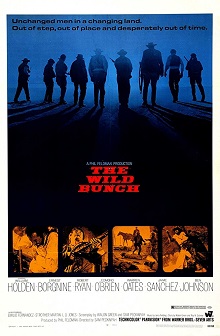
The Wild Bunch

By 1969, director Sam Peckinpah had worked on several TV series and several film productions, including The Deadly Companions, Ride the High Country and Major Dundee. He was an incredibly talented director but one whose fiery personality and personal demons could potentially derail any film he worked on. But in 1969, it all came together, Peckinpah making his classic, his all-time great film, one of the best westerns ever and best films ever in general, 1969's The Wild Bunch.

It's 1913 in a small border town near the Rio Grande, and a gang of outlaws, led by the infamous Pike Bishop (William Holden), disguised as soldiers ride in to rob the bank of a rumored silver shipment. The robbery is an epic disaster as a posse of bounty hunters, led by Deke Thornton (Robert Ryan), a paroled outlaw who used to ride with Pike, is waiting in ambush. Many of Pike's gang is killed in the robbery that nets them NO money. The remaining members of the gang, including Dutch Engstrom (Ernest Borgnine), retreat into Mexico. They need a new job, a new robbery, a new chance to earn some money. Pike especially knows that time is running out, that times are changing, and their chances at surviving as outlaws is becoming ever more unlikely. It doesn't help that Deke and his bounty hunters have followed them into Mexico, looking to collect the bounties on these infamous outlaws. With time running out, what do they do?

What a movie. Every so often, each and EVERY thing involved in the making of a film comes together and forms that perfect symmetry. 'Bunch' is an all-timer, not just a movie I love but a great movie in terms of storytelling and in technical terms. Appropriate for the time it was released (the late 1960's), it is cynical, horrifically violent, brutally honest and generally downbeat. This is a western and film ahead of its time, helping set the tone where films would go in the coming years. This is Peckinpah at the top of his game. He would have other good to great to classic films, but this is his Great film. Just a gem.

There is little to nothing to criticize here. While the filming process sounds incredibly interesting (a film in itself), the choice to film in Mexico pays off huge dividends. Cinematographer Lucien Ballard shoots a beautiful movie with the Mexican countryside and desert as a backdrop. The locations are phenomenal. You feel like you're watching the actual settings of the Mexican Revolution to our story. Composer Jerry Fielding turns in quite the memorable score as well, appropriately epic at times and equally quiet and emotional as necessary in other scenes. Listen to a sample HERE. As for the story itself, Peckinpah and writer Walon Green turn in a screenplay that's just a gem. It isn't a movie in a rush, letting things breathe and allow the viewer to get to know the characters -- for good or bad -- over its 145-minute running time. Sit back and take it in. You shan't be disappointed!

Many westerns have dealt with the death of the old west, the end of an era, but none better than The Wild Bunch. It's 1913 and there's no place for these outlaws, killers and gunfighters anymore. The world is changing, and civilization (of sorts) is moving in to replace them. We follow a gang of those outlaws, robbers, killers/murderers as they try to pull off their one last job and step away, and it's a testament to the acting on display and screenplay that we feel any sympathy at all to these men. Like few movies I've ever seen, there is a doomed quality to these men who are working with limited time on their hands. They know the door is closing on them, more than likely a bloody death awaiting them if they don't figure out something soon.

Where Peckinpah's screenplay is so strong is in its characterization and its depth. There's a whole lot of acting talent on display in 'Bunch,' and for much of the cast, this is their all-time best performance or certainly one of their best. Holden's Pike Bishop is one of the most fascinating characters ever in my book, an aging outlaw who's outlived his time but doesn't know what else to do. Borgnine too is excellent as Dutch, his right-hand man who can also see the writing on the wall. Their scene together after the early botched robbery is essential, two men who potentially know what awaits them but go into things willingly because maybe that ending is what's supposed to happen. On the counter, Ryan's Deke Thornton is equally tragic. He's riding after his old partner, Bishop, and would much rather be riding with them than chasing them. But as the script relies on, your word is your word, and these men live by that coda.

One of the many things Peckinpah loved to touch on in his films was that bond of men under fire who come through while others don't. Holden's Pike is the mouthpiece for that concept, of giving your word and sticking by it even when it'd be far easier to tuck your tail and run. We see that again and again with the bunch, including Pike, Dutch, old, grizzled Sykes (Edmond O'Brien), the crass, unsavory Gorch brothers, Lyle (Warren Oates) and Tector (Ben Johnson), and Angel (Jaime Sanchez), the youngest of the group, a fiery Mexican. What's interesting is that though Pike and the bunch claim to live by this coda, they continue to fall short of actually living up to it. It's when they realize their faults in that department that the story takes a far more tragic turn toward the inevitable ending that you just knew was coming.

Because the already-mentioned star power wasn't enough, here's some more! Along with Ryan, look for scene-chewing Strother Martin and L.Q. Jones as two scummy bounty hunters with Albert Dekker as the railroad magnate "employing" them. Emilio Fernandez is perfectly slimy as Mapache, the Mexican general claiming to be some sort of freedom fighter but it seems it is all for show, for more power, with Jorge Russek and Alfonso Arau (El Guapo in Three Amigos) as his subordinate officers. Also look for Bo Hopkins, Dub Taylor and Chano Urueta in key (if small) supporting parts.

What 'Bunch' has become synonymous with over the years is its groundbreaking, sometimes horrifying portrayal of on-screen violence. It's not that Peckinpah lingers on the violence for the sake of shock value. Far from it, but instead he makes it into an art form. The idea of a 'dance of death' comes to mind in any portrayal of violence with three main set pieces (1. The opening robbery turned into a bloody shootout 2. A prolonged train robbery and 3. The final, bullet-riddled and blood-splattered gun battle). The editing is ridiculously fast and cut in with perfect uses of slow motion. Simply put, there is an art to Peckinpah's use of violence, both in the editing, in the overwhelming use of slow-motion blood squibs, and the impact of that violence we're seeing. If Bonnie and Clyde opened the door some for its own use of on-screen violence, Peckinpah's The Wild Bunch kicked that door wide open. Almost 50 years later, it still resonates, and it's clear the impact it had on hundreds and thousands of movies released since.

It all builds to maybe the most memorable action sequence of all-time. If it's not No. 1, it certainly belongs in the conversation. In a sequence that's been dubbed "The Battle of Bloody Porch," it all comes together in an extended sequence that has lost none of its edge since its release in 1969. This is a transfixing scene that is equal parts horrifying and startling but you just can't look away. There are too many great moments just in this scene alone to mention, including an improvised walk the Bunch takes on their way to a final showdown (maybe the movie's second-strongest sequence). It is followed by a quick, shocking death, and then an eerie moment of silence that hangs in the air. With one gunshot, it is on, bullets flying thick in the air. Obvious SPOILERS but you can watch it HERE. If you haven't seen the movie, I don't recommend watching the sequence out of context. Watch the movie and soak it all in as part of the whole product. Just a remarkable extended sequence with virtually no music. The focus is the characters, violence and death. Nothing more. Nothing less.

A classic in every sense of the word. I pick something new up with every viewing, and it never loses any of its impact. A film without a weakness.

The Wild Bunch (1969): ****/****

Monday, August 24, 2015

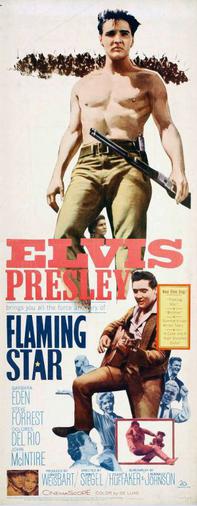
Flaming Star

Elvis Presley was a singer, a performer, an entertainer. And yes, he was a movie star, starring in 31 movies over 13 years. Most were movies meant to capitalize on his singing (and scandalous dancing), the King singing plenty of his songs to keep audiences dancing in their seats. I like Elvis' music a lot, but musicals are not really my thing so I've actually never seen any of those movies. What have I seen? Presley's ventures into the western genre, 1969's Charro! and today's review, 1960's Flaming Star.

In the late 1870's in west Texas, aging, small-time rancher Sam Burton (John McIntire) has worked hard to create a life for himself with his family. On their small but solid ranch, they run cattle and horses, working every day to keep things up. Sam's family includes his wife (his second wife), a full-blooded Kiowa woman, Neddy (Dolores Del Rio), and two sons, Pacer (Presley), and Clint (Steve Forrest), with his first wife. Pacer is a half-breed but has lived his whole life with the whites, not the Kiowas. It's never been much of an issue as the Burton's friends think of them as just that; friends and even family. But when a new, young chief riles up his Kiowa warriors, no one in the territory is safe...except the Burtons who seem to go untouched while everyone around them is attacked. The townspeople and local families begin to suspect something. Now who's the bigger enemies? The supposedly friendly white families and settlers or the rampaging Kiowas?

I caught parts of this 1960 western years (YEARS) ago on AMC at some point but never sat down and watched the entire thing. Well, this channel called Encore Westerns shows westerns...all...day...long, and I was able to track it down. Westerns I haven't seen are getting harder and harder to find! Why this one doesn't have more of a reputation for the positive, I just don't know. It's not a classic, but with an excellent performance from young Mr. Presley and a hard-hitting story, 'Star' deserves much more standing within the western genre.

A big ingredient for success? Director Don Siegel behind the camera. One of the all-time great tough guy directors, Siegel is known for his pairings with Clint Eastwood in the 1960's and 1970's, but he had actually been directing feature films since the late 1940's. He was a no-nonsense kind of director, and 'Star' fits the mold. Even by 1960, westerns often painted the white Americans as the good guys and the Indians (whatever tribe, pick one) as the blood-thirsty savages obsessed with killing. That trend would begin to change in the coming years, but this is one of the first westerns I can think that tries to not only humanize Native Americans but shows that white settlers were far from perfect. It is a rare socially conscious western that simply paints things as they were. Prejudices and biases are ugly in any form, whether it's 2015 or 1878. This is a western story ahead of its time, and it's the better for it.

By the time this film was released, Presley was a S-T-A-R. He'd already made five movies, but this was the first to allow him to show off his dramatic acting chops. Much like he would years later in Charro, Presley gives an above average turn as the stoic, quiet, loyal and very capable anti-hero (of sorts). If there's any red flags, it's that Presley is playing a half-white, half-Indian character, but the part, script or Presley never makes it cliched, forced or overdone. Other than some really tan skin (really tan), the casting of a white actor as a Native American character isn't an issue, never presenting itself. Presley is known for being a singer, a dancer, an entertainer, but when given the chance, he showed that he was a more than respectable dramatic presence too. This is a good one.

The dynamic among the Burton family as a whole is key and the main (and best) focus of the story. For these four people, their "situation" isn't a situation at all. They are family. White blood or Indian blood doesn't matter in the least. McIntire and Del Rio are excellent as a couple that's been married for half a lifetime by now. The same goes for Presley and Forrest, half-brothers who never question the 'half' part. They complain and insult each other but are always there for the other because that's what brothers do. Hatred and violence can be quite the divider though, testing even the strongest of brotherly relationships. Four very strong performances from Presley, McIntire, Del Rio and Forrest as the heart of the movie.

Filling out the rest of the cast, look for a pre-I Dream of Jeannie Barbara Eden, Rodolfo Acosta, Richard Jaeckel, Karl Swenson, L.Q. Jones, Ford Rainey, and Perry Lopez.

There are some slightly overdone dramatic moments in the second half as everything comes front and center. AH, DRAMA! The ending too feels a little rushed, almost like a key scene was shot but eventually cut for timing or something. Overall though, this is an easy movie to recommend for any number of reasons from Elvis fans to western fans. And yes, Presley sings one song early almost to appease his fans before the story takes a turn for the dark. A hard-hitting story western that's definitely worth checking out.

Flaming Star (1960): ***/****

Wednesday, February 11, 2015

The Mask of Zorro

My first introduction the character of Zorro goes back to a Disney Sing-A-Long VHS tape (Yes, VHS, and it was awesome), the theme imprinting itself on my young brain. Listen HERE, and you're welcome. The Zorro character has gone onto bigger and better things, including a late 90s swashbuckling adventure that I missed out as a 13-year old. Here's 1998's The Mask of Zorro.

It's the early 1820s in California -- then still a Spanish territory -- and the people are constantly kept down by the Spanish governor, Don Rafael Montero (Stuart Wilson). Providing a thorn in his side is Don Diego de la Vega (Anthony Hopkins), a rich landowner who has an alter-ego known as Zorro, a masked bandit and expert swordsman who protects the people and baffles the Spanish governor. Montero finally catches up with Zorro though before being sent back to Spain amidst a revolution, dumping the landowner turned bandit in a dumpy prison while also wreaking havoc on Vega's family. Some 20 years later, Vega is wasting away but he manages to pull off a daring escape. What prompts it? He finds out Montero has returned to California with plans to take over the territory. Vega needs help to exact revenge though and finds it in the form of a vengeful Mexican bandit, Alejandro (Antonio Banderas), who must undergo quite the transformation -- with Vega's help -- to exact his revenge and possibly save California in the process from a whole lot of trouble.

The Zorro character's inception dates back to author Johnston McCulley in the late 1910s, the character appearing in some pulp fiction with his popularity quickly spreading. Zorro has appeared in books since then as well as comic books, TV shows and movies on an international level, not just in the United States. As I mentioned, I missed this 1998 adventure when it first came out -- being a punky teenager and all -- but here I sit to catch up with it. 'Mask' was a big success, earning positive reviews and making $250 million in theaters. The reasoning?

From director Martin Campbell, 'Mask' feels like a throwback to swashbuckling movies of Hollywood's Golden Age dating back to the 1930s and 1940s. What did it remind me of most? Maybe the best adventure flick of all time, 1939's The Adventures of Robin Hood. No, this isn't even remotely classic, but my goodness, what a fun movie. The production was somewhat troubled with some casting drama and Robert Rodriguez dropping out (with Campbell replacing him), but it doesn't affect things in the least. The formula is simple. The good guys are honorable, loyal and heroic. The bad guys are evil, despicable, greedy, backstabbing and will no doubt get their comeuppance. The story is a tad long at 136 minutes, but there's not much downtime with a series of swordfights and action scenes sprinkled throughout. In an age where action movies often have a message, it's fun to see a movie that's just....fun.

Who better to play the suave, smooth swordsman than suave, smooth Antonio Banderas? I submit that NO ONE would have been better. Just like in Desperado, probably his most well-known roles along with Puss-In-Boots, Banderas just commits to the part. He's manic energy on the screen, and it works so effortlessly and well. You like Banderas' Alejandro turned Zorro, you're rooting for him, and Banderas looks to be having a ton of fun every minute he's on-screen. It's the Spanish actor at his best. It doesn't hurt either that his supporting cast is excellent, especially his chemistry with Hopkins (a somewhat unlikely Spaniard) and Catherine Zeta-Jones as Elena, the governor's daughter -- with a secret -- who takes a liking to Alejandro, all the while not knowing who he is or what he's up to. The mentor-student relationship between Hopkins and Banderas is excellent, and the chemistry between Zeta-Jones is palpable, whether it be their salsa dance scene or their later swordfight.

So Banderas, Hopkins and Zeta-Jones, that's enough, right? Those are the best parts, but there's more. Wilson is okay as the bigger villain, that dastardly greedy returning governor, but the best villain is Matt Letscher as Captain Harrison Love, apparently a U.S. Army officer working with the Mexicans? It's never really explained, but who cares I guess, he's easy to hate. Also look for Stuart Wilson and Pedro Armendariz Jr. as two Dons, landowners who team up with Montero in his plot to take over California. Smaller parts go to Victor Rivers as Alejandro's brother, a famous bandit, while western character actor L.Q. Jones delivers a small but memorable part as Three-Fingered Jack, an infamous bandit.

As I read some about the making of the movie, it was cool to find out at least part of the story and characters are based in reality of 1850s California history. Now there are some major freedoms taken with that story, but it's always interesting. With a score from composer James Horner and filming on-location in Mexico, the look, sound and feel of the movie is pretty spot-on. The set pieces from a fun training montage to the action-heavy finale at a gold mine carved into the side of a mountain are all pretty memorable. It's that pretty perfect popcorn movie. Sit back and enjoy.

The Mask of Zorro (1998): ***/****

Thursday, September 11, 2014

Santiago

I can think of exactly one movie made about the Spanish-American War. Okay, there I go again lying. It's actually a miniseries, 1997's Rough Riders, that's pretty good if not so well known. Well, I can kinda add a second movie to the list although it involves the years leading up to the war before the U.S. officially got involved. Here we go with 1956's Santiago.

Riding through the swamps of Florida, Cash Adams (Alan Ladd) arrives in Tampa with wagons loaded with guns, ammunition and dynamite ready to close a deal and make some money for himself and his men. Not so fast though, Mr. Adams. The deal he cut with Cuban revolutionaries fighting the Spanish is okay, but now he has to get all his materiel to Cuba himself. Adams finds an old steamboat captain and Civil War veteran, Sidewheel Jones (Chill Wills), to transport his supplies but it's not that simple. On board the boat is another gunrunner, Clay Pike (Lloyd Nolan), who has cut a similar deal with the Cubans. Adams has a rivalry with Pike dating back 10-plus years and the voyage across the Gulf of Mexico will be anything but easy. Spanish ships are waiting to stop them, if the ship can even get there before Adams and Pike tear each other apart.

Airing recently on Turner Classic Movies, 'Santiago' is from director Gordon Douglas. Not necessarily a well-known name, Douglas still has quite a few really solid movies to his name including Rio Conchos, Chuka, In Like Flint, Up Periscope and Golf of the Seven Saints among others. He specialized in tough movies, action and western and war flicks full of tough guy actors doing tough guy stuff. Douglas didn't have a huge visual style or anything that truly set him apart from the rest, but he was a solid, workmanlike director, and I have very much enjoyed a lot of his movies. This one? It's pretty decent, ahead of its time in certain moments with its use of on-screen violence and unfortunately too familiar in other scenes. It doesn't rewrite the genre, but I enjoyed it, 94 minutes of exciting action with a pretty cool cast and a different background, the Cuban War of Independence. Spanish-American War still to come!

The best comparison I can make is the similarities here with Robert Aldrich's 1954 classic western Vera Cruz, one of the most influential westerns of all-time. Here with 'Santiago,' Alan Ladd and Lloyd Nolan channel Gary Cooper and Burt Lancaster, two rivals who are forced to work together to battle a common enemy. All the while, they know a showdown is looming. Ladd is pretty decent as Cash Adams, his backstory providing most of the interest. A cavalry officer fighting the Apaches, he was dishonorably discharged when a captive Apache chief escaped because one of his men got drunk on guard duty. And who was providing those Apaches with repeating rifles? Why Nolan's Clay Pike of course! The rivalry is a little tame, little lacking in energy, but it seems Adams and Pike are never too far away from throwing down and having it out. 

I wish there was more of that darker story material, and that becomes the issue. Yeah, it's a rivalry....but not really. Ladd's Adams is a good gunrunner (if there is such a thing), supplying materiel for the right side. Nolan's Pike doesn't care who gets the guns as long as he gets paid. And because that wasn't enough, we get a love interest with Rossana Podesta playing Dona Isabella, a beautiful Cuban revolutionary who works as the middleman for shipment of the guns. Who do you think she'll end up with?!? You won't need two guesses. There's also an adorable little Cuban boy who bonds with Adams, but you just know things aren't going to end well for the little stinker. At times, things are a tad too clean, a little slow-moving, but for the most part I was entertained throughout. Also, kudos to Ladd who in muggy Florida and Cuba manages to keep his tailored white shirts immaculate no matter what's going on. Now, THAT is talent.

Who else to look for? Wills is excellent, toning down his over the top act that could be a little hammy when overdone, Don Blackman playing Sam, his former slave and current right-hand man. Paul Fix is similarly very good as Trasker, Adams' loyal right-hand man with an interesting background that explain his loyalty. Some of the other tough guys on hand include Royal Dano, L.Q. Jones, and Frank DeKova. The movie is at its strongest when it leans on Ladd, Nolan and the familiar faces all around them. Romance? Motivations for independence? Meh, no thanks. The action and violence can be pretty startling -- even bloody -- and the finale especially is memorable. It even reminded me of the final battle in Major Dundee, a chaotic, quick-cut bloody mess where characters are dispatched without warning.

A decent movie that could have been better, but still worth a watch.

Santiago (1956): ** 1/2 /****

Tuesday, March 4, 2014

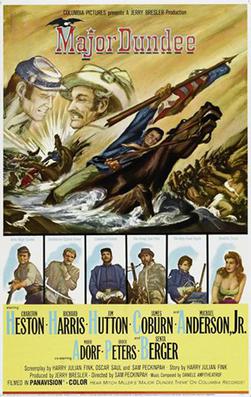
Major Dundee

With his 1962 western Ride the High Country, director Sam Peckinpah put himself on the map, springboarding his directing and writing success on TV into feature films. It took him three years to do a follow-up, a western that had countless production issues and was eventually taken away from Peckinpah in the editing phase. It's everything that was good and bad about Peckinpah as a director. It's not a western often remembered as one of his bests, but 1965's Major Dundee is one of my favorites.

It's late in 1864, the Civil War raging back east, but in the New Mexico territory, an Apache war party led by Sierra Charriba (Michael Pate), massacres a troop of U.S. cavalry, kidnapping three boys from a local ranch at the same time. The commander of a nearby Confederate prison camp, Major Amos Dundee (Charlton Heston) decides to go after the Apaches, rescuing the kids and bringing Charriba to justice. Without abandoning the camp though, he must assemble a ragtag group of Confederate prisoners, black infantry, inexperienced officers, cowboys, drunks, bandits and thieves to capture the Apaches. At his right hand is a Confederate officer and friend from the past but now a sworn enemy, Capt. Benjamin Tyreen (Richard Harris). Dundee's company of irregular cavalry hits the trail, following the Apache war party into Mexico, tangling with occupying French forces as well. The Apaches and the French are just two enemies though, the Union and Confederate loyalties among the company threatening to tear Dundee's command apart from the inside.

The production history of this Peckinpah western has quite the checkered past. The production in Mexico went way over budget and way over schedule. Depending on what you read, Peckinpah's original cut for 'Dundee' was anywhere between three and four hours long. When the studio took it away from him, it was cut down to just over two hours. A DVD released in 2005 had a new, never before seen version with almost 15 additional minutes added to the running time. Some additional footage was found that was unable to be reinserted back into the film, but as is, we'll probably never know/see Peckinpah's intended version. So what's the end result with the 136-minute version? A far better western than the 123-minute version that features some good performances, a ridiculously deep cast, some ahead of its time vicious action, and a story that drifts needlessly at times.

What was Peckinpah's goal? He wanted to make an epic western, a new western in the vein of the John Ford cavalry movies. It was supposed to be big and violent full of scope and vision. 'Dundee' doesn't quite live up to that, but in terms of pure entertainment, it's hard to beat. It starts with Charlton Heston in the titular role. Like Peckinpah's best movies, Dundee is the flawed anti-hero like nobody's business. The story almost becomes Moby Dick in the Civil War west. Dundee has been posted to this isolated prison camp because of a command decision he made at Gettysburg (hinted at, never spelled out), and he intends to right that wrong. His plan? Get the kids back, take out Sierra Charriba, become a hero again. The problem? Dundee may not be cut out for command. He's equal parts brilliant strategist with overreaching egoist. His pride and ego get in the way of things, the mission into Mexico becoming an obsession. Quite the performance, one that doesn't always get the notoriety it deserves in Heston's already impressive filmography.

One of Peckinpah's favorite storytelling devices was the anti-hero and his right hand man, sometimes a former friend turned unwilling ally, a device used to its best ability four years later in The Wild Bunch. Here, that relationship is between Heston's Dundee and Richard Harris' Capt. Ben Tyreen. Again, their checkered history (friendship turned bitter rivalry, even hatred) all leads up to this, two men forced to work together. Harris is one of my favorite actors, and this is my favorite performance of many, one of my all-time favorite characters in any film. Harris' Tyreen is everything Dundee wants to be; intelligent, charming, a good leader, and well liked and respected by his men. Tyreen has one great line after another, Harris bringing this character to life, a Irish immigrant turned cashiered American officer to Confederate renegade. The dynamic between Dundee and Tyreen provides some of the movie's best dialogue scenes, the confrontations crackling with energy. Kudos to both actors for developing that chemistry to its fullest.

Brace yourself though. This movie has one sick cast of tough guy actors, many from the Peckinpah stock character Hall of Fame. Jim Hutton provides some laughs as Lt. Graham, a bumbling artillery officer assigned to the cavalry. James Coburn is a scene-stealer as Samuel Potts, Dundee's one-armed, bearded, quick-witted scout, as is Mario Adorf as the feisty, loyal Sgt. Gomez, Dundee's most capable Union soldier. Michael Anderson Jr. does a fine job too as Trooper Ryan, Dundee's young bugler, providing the narration from his in-mission journal. There's also Brock Peters as Aesop, the leader of the small contingent of black infantry, Slim Pickens as Wiley, the drunken mule-packer, R.G. Armstrong as Reverend Dahlstrom, the shotgun-wielding preacher, and Dub Taylor as Priam, the disheveled horse thief. As for Tyreen's Confederates, there's Ben Johnson as the tough Sgt. Chillum, L.Q. Jones and Warren Oates as Arthur and O.W. Hadley, and John Davis Chandler as Jimmy Lee, the troublemaker. Also look for Karl Swenson as Dundee's second-in-command at the prison camp. Just a ridiculously deep cast full of great characters.

Where the movie struggles some -- but is also damn entertaining in those struggles -- is the final 40 minutes. The story does drift too much from the Apaches to the French to Dundee's lost weekend in Durango and a brief love affair with Senta Berger's Teresa. Trooper Ryan's narration gets choppy, weeks slipping by in a flash. The saving grace is back-to-back action sequences, one a showdown with the Apaches in a box canyon, the other a bloody, violent battle with French lancers in the Rio Grande. This is Peckinpah at his action best, clearly an indicator of where his movies would go, especially with The Wild Bunch. Watch the scene with the French and see how brutal it is, how graphic it could have been if censors allowed it. Characters are unceremoniously killed off (blink and you'll miss it), including one surprising death, but it's just a great action scene leading to a quick ending.

Most Peckinpah fans don't list this as their favorite, maybe not even one of their favorites. I just really like this movie, always have, and the longer version with the additional 15 minutes or so really does help make it better. The musical score from composer Daniele Amfitheatrof takes some heat, especially the Major Dundee theme (listen HERE), but I like it, almost as a guilty pleasure. Filming on location in Mexico, including stops in Durango, a gorgeous waterfall location at El Saltito, and many more, all add to that authentic flavor. You really feel like you're on an odyssey across Mexico, seeing a variety of spots, locations and cities. One of my favorite westerns, a heavily flawed but just a damn entertaining movie in the end. Hard to beat, even if we'll never see that epic 4-hour version Peckinpah intended.

Major Dundee (1965): ****/****
Rewrite of August 2009 review

Friday, October 4, 2013

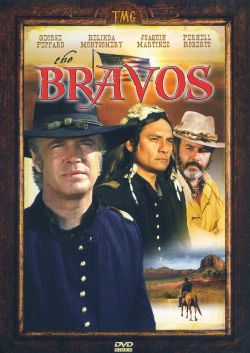
The Bravos

The TV movie is seemingly a thing of the past. In the 1970s and 1980s, TV movies and miniseries dominated the landscape, movie stars making the jump to television as roles presented themselves. Now with cable, dish and satellite, it's hard to consider what's even a TV movie and what isn't. Heading into the wayback machine, it's easy to identify them from the past, like 1972's The Bravos, a western with some potential that doesn't quite live up to it but is entertaining just the same.

It's just a year or two since the end of the Civil War, and the U.S. is focusing on expansion westward. At a remote outpost on the frontier, Major John Harkness (George Peppard) is doing his best to work himself out of quite the situation. His garrison is just 77 men and supplies and ammunition are running low. Those are problems enough, but reports are coming in from his patrols that the Navajo tribes seem to be joining up in the mountains. One report even has their numbers somewhere around 2,000. With so small a force though, Harkness has little options as to what he should do. The situation at the outpost is thrown for another loop when a small wagon train led by egotistical trail guide Jackson Buckley (Pernell Roberts) arrives seeking supplies for their coming trip. That's not all though. Buckley killed three young Kiowa warriors on the trail, Kiowas who were trying to join up with the gathering Navajo warriors. Can help arrive in time to stave off a brutal massacre?

It was pretty evident early-on that this was a TV western, a fact I wasn't aware of until after I started watching (clever Encore Westerns). From director Ted Post, 'Bravos' is a solid, entertaining western that is at times limited by its smallish budget. The 2,000 warrior war party is only mentioned as we never see more than 15 or 20 murdering Indians at a time. What does work though? It's a TV movie, but it was filmed on location in Sedona, Arizona, the sparse, windy and winter-bound desert providing quite the backdrop for the story. It's easy to understand the fear of living out there. Anything could be hiding in that desert just waiting to strike. As well, the set for the cavalry outpost is pretty cool, a crumbling little fort with obvious defensive deficiencies. Also worth mentioning is the musical score from composer Leonard Rosenman, similar to his score from 1962's Hell is For Heroes. 

One of my favorite tough guys stars, Peppard does a good job here leading a capable cast. His Maj. Harkness has been dealt the lousiest of hands, his garrison undermanned, under-supplied and waiting for an inevitable attack against horrific odds. Somehow, he's got to keep his command together even as his officers and enlisted men question what the point of it all is for. A weak subplot involves his son (Vincent Van Patten) who was kicked out of his Eastern school arriving at the outpost at the worst possible moment. Peppard has a knack for being a condescending tough guy, that ever-present smirk on his face, and it works here well. His officers include George Murdock as the questioning second-in-command, Dana Elcar as the fort surgeon, Ron Kelly as the cigar-chomping lieutenant, and John Kellogg as the loyal sergeant-major.

For a TV western, a pretty good cast has been assembled with some familiar faces. It's cool to see L.Q. Jones get a major role, playing the capable scout, Ben Lawler, who always seems to tangle with Harkness despite their long-standing friendship. Jones and Peppard sparkle in their scenes together. Roberts get to preen and yell as the overmatched trail guide, blustering his way through his "occupation" of which he knows little other than money. A young Bo Svenson players Bucholz, a former soldier on the run with Buckley's wagon train, playing a key part in a mission late. Clint Ritchie is solid too as Cpl. Love, the trusted enlisted man seemingly always leading another five-man patrol. Because a love story was needed (????), Belinda Montgomery plays Heller, a young woman traveling with her fiance, Garratt (Barry Brown). 

The biggest place the flick is hit by is in the action department. We're not talking any major battles, gunfights or chases across the desert. What we do get is a shootout here and there, the biggest being "an attack" on the fort by some sniping Navajo warriors. The best part though is a dangerous mission late as Harkness, Lawler and Bucholz head out into the wilderness to rescue Harkness' son from a raiding party. No spoilers here, but it's a cool premise and it is executed really well. You don't need a cast of thousands (hundreds, even tens I suppose) to be effective as is on display here.

Unfortunately though, then the movie just ends, almost like the TV movie just ran out of money or time to fit in a two-hour slot. One thing is resolved, but several other key things need to be dealt with. Nope, not here. Credits roll and the movie is over. I still liked the build-up, but it is a finale that feels forced in all sorts of ways. At 97 minutes, maybe it was getting too long. Maybe some resolution was cut out, but what we get is disappointing. Give it a try at Youtube HERE in its entirety. It's got enough going for it to recommend but know you'll most likely be disappointed with the finale.

The Bravos (1972): ** 1/2 /****

Saturday, November 10, 2012

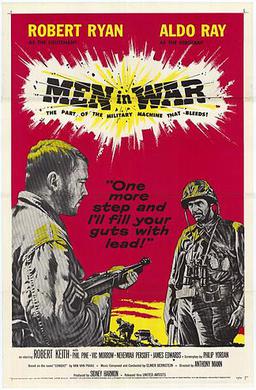
Men in War

The Korean War was unlike any war Americans had ever been involved in. The movies made about it certainly reflected that. There was nothing simple about it, no easy answer, but I suppose that applies to all wars. One of the best movies about Korea is also one that has gone criminally unrecognized over the years, 1957's Men in War

Following a horrifically costly engagement late in 1950 in Korea, Lt. Benson (Robert Ryan) finds himself in command of the ragged remains of his rifle platoon. With just 17 men and no idea where the rest of the battalion is, Benson leads his men to a prearranged objective that he's not even sure still exists. Along the way, they run into Sgt. Montana (Aldo Ray), a stubborn and very capable soldier who's transporting by jeep his shell-shocked commanding officer, the Colonel (Robert Keith). When Benson commandeers the jeep, Montana goes along more than a little unwillingly. Together, the motley group continues to their objective, an otherwise ordinary location, simply titled Hill 465. What awaits there? None of them know.

Never even mentioned among the best war movies around, this Korean War has been criminally neglected since its 1957. From director Anthony Mann, it is a cynical, extremely dark, very realistic, and even a tad existential at times. While it is based in Korea, it really could be any war. The infantry soldiers trudge on, fighting a mostly unseen enemy, just trying to survive. We learn nothing about anyone, and there's no bigger picture of the war. These men are separated from their possibly annihilated unit and walking in heavily occupied enemy territory. The North Koreans appear as needed; in the aftermath of a firefight, two survivors talk quietly -- not really hiding either -- where seconds before bullets and grenades were raining down on them. This is war and the effect it has on the individual.

Beyond that simple story is a realistic story. I try not to use this description too much, but it was truly ahead of its time. We're introduced to Benson's platoon in the aftermath of the attack that separated his platoon from the battalion. The men look exhausted to the point of fainting. One man has been killed -- stabbed in the back with a bayonet -- by a North Korean scout, and so it starts. The cynicism is palpable. Benson mumbles 'Son of a...' before veering off. Ray's Montana shoots a surrendering North Korean, albeit one reaching for a hidden pistol. Later, a second prisoner is used for bait to see if the platoon has been spotted. Filmed in a close-up black and white, I felt like a fly on the wall as a viewer. We feel like we're right there with the foot soldiers. By no means a flashy filming style, but the story doesn't call for it. Also worth mentioning is Elmer Bernstein's eerie but spot-on musical score.

Playing on the basic notion of the unit picture, 'War' has an impressive tough guy cast. It's great to see Ryan get a good guy role. Very capable of playing a hellishly bad villain, Ryan is a perfect choice to play the beaten down officer who must buck up to get his men to safety. Ray as his counter is just as spot-on, a similarly experienced soldier but one with a simpler mission. That angle (protecting your commanding officer) would be used 20 years later in A Bridge Too Far. Benson's platoon includes Riordan (Phillip Pine), the radioman, Lewis (Nehemiah Persoff), the unhinged sergeant, Zwickley (Vic Morrow), the scared to death private, Killian (James Edwards), the mechanic, and Davis (L.Q. Jones), the medic and BAR man. Seven other soldiers are listed in the cast but under the dirt, grime and three-day stubble, it's hard to distinguish them.

For the most part here, the story is fairly familiar. Nothing crazy or out of the blue. The platoon deals with North Korean scouts trying to pick them off, bickering amongst the men, even stumbling into a minefield. Where it distinguishes itself is in the finale as Benson's men reach Hill 465. There is nothing special about the hill, just a big chunk of jagged rock....that's occupied by North Koreans. The small-scale battle has elements of the surreal. The enemy fires only occasionally, only appearing for brief close-ups. In its small scale, it is a very personal, aggressive, and uncomfortable depiction of battle. Soldiers are killed, but we barely see their faces to know who it is. The film ends on a dour note, but an effective one just the same.

A war film that deserves better. Effective message that is never overbearing, great casting, almost documentary-like feel from Mann, all amount to a film well worth watching.

Men in War <---Youtube clip (1957): *** 1/2 /****

Monday, July 16, 2012

Cimarron (1960)

My typical stance on an epic film is 'Bring it on.' You can't have too many of them, especially from the age of the epics, the 1950s through the 1960s. These are big, big movies. Then, I think of my favorite genre; the western. I can't name many quality epic, classic westerns. One exception is How the West Was Won, but I'm drawing a blank as to others. One that aspires to be an epic but ultimately fails is 1960's Cimarron.

Having put his wild cowboy drifting days behind him, Yancy 'Cimarron' Cravat (Glenn Ford) hopes to settle down with his newlywed bride, Sabra (Maria Schell). Yancy's plan starts with an impossible offer from the government, one that seems too good to be true. The Oklahoma territory and its millions of acres will be open to anyone who can stake a claim (the 1889 Land Run, read HERE), and Yancy has a spot all picked out to start a family with Sabra. Things don't go quite as planned though, forcing the couple to improvise and adjust. Setting up a small newspaper in Osage, Oklahoma, Yancy and Sabra are to become part of an era in American history full of drastic and modern change.

From director Anthony Mann, this is an appropriately big epic. The scale is impressive with scenes of hundreds of extras filling the screen behind the biggest names in the cast. None is more impressive than the depiction of the Oklahoma land rush. Literally hundreds of riders and wagons fill the screen from edge to edge as all these hopeful land owners race to stake a claim to their own land. Scenes like this make you appreciate what an epic is in all of its glory on such a large scale. The look of the movie is a beauty from the open prairies of the 1880s to the settled cityscapes of the 1910s. But that is where the positives end unfortunately.

Even with a movie clocking in at 149 minutes, it feels like Cimarron tackles too much. The story covers 25-plus years, but doesn't cover any of those years adequately. The script has jumps in times that come fast and furious, jumping a few months one time and then ten years the next. An episodic, somewhat drifting story can be a necessity dealing with a film of this scale, but at some point it has to be interesting even just a little bit. The tinier episodes here lack any of that interest with an exception here and there. Mann was at his best with smaller scale stories -- The Naked Spur, The Man from Laramie -- but struggles with stories of this magnitude. There's little heart, little emotion, and little interest to see a budding America growing from the wild west to the modern world.

That lack of emotion can be chalked up to any number of things, but the most glaring mistake was the casting. From top to bottom, 'Cimarron' lacks the huge star power of other epics, but that's not a deal breaker. It is though when almost to a man the characters are miscast. Ford and Schell don't have a great chemistry; a problem when these two characters are magnetically drawn together by their unexplained love. Ford's Yancy is trying to put a somewhat checkered past behind him, but that past is never even remotely dealt with, only hinted at. His character ends up being this icon of a growing America, and I'm thinking 'Really?' He bails on his wife for five years at one point, ten years at another. Schell too is trying here, but a character that could -- and probably should -- have been sympathetic comes across as shrill and whiny. When the two leads aren't especially likable, we could be in for a long ride.

The rest of the cast is hit or miss, and as is the case with epics gone bad, it's not always their fault. The ones given more screentime include Arthur O'Connell and Mercedes McCambridge as Tom and Sarah Wyatt, parents of a brood of eight trying to start a new life, a family that befriends Yancy and Sabra. Russ Tamblyn is a scene-stealer as the Cherokee Kid, a troubled youth Yancy tries to help with Vic Morrow as part of his gang. Anne Baxter is wasted as Dixie, a former love of Yancy's who now holds a grudge against him, a businesswoman who opens a whorehouse (a classy one at least). Potential for a cool character, but she's gone halfway through the movie. Also throw in Robert Keith, Charles McGraw, Harry Morgan, Edgar Buchanan, L.Q. Jones and David Opatoshu in supporting parts, some gone in a flash so don't blink. The problem is not the actors, but the lack of any character development. They drift in as needed and disappear as quickly as they appeared. Lots of potential for some very interesting characters, but nothing comes of it as Yancy and Sabra's story develops.

Once again, this won't sound like it makes a whole lot of sense, but there's both too much and not enough going on in a 149-minute movie. It's dull. The story moves along far too fast, glazing over significant portions of the story. I can't think of an epic with characters as unsympathetic as the ones here. I didn't care for most of the characters or how things ended up, and in the end, nothing comes of it. The resolution (using that term loosely) is disappointing and seemingly hypocritical for what we've seen up to this point. An epic attempt, but ultimately a disappointing failure.

Cimarron <---TCM trailer (1960): **/****

Tuesday, December 13, 2011

The Jack Bull

Made for TV typically has a pretty negative connotation, but it doesn't have to. Made for HBO in 1999, The Jack Bull is a western with a lot of potential coming from a strong cast and clearly some production value. The story though gets tedious and repetitive, wasting away what is obviously a lot of talent in front of and behind the camera.

Running his modest but successful spread in 1880s Wyoming, horse trader Myrl Redding (John Cusack) has been wronged by local rancher Henry Ballard (L.Q. Jones). In lieu of cash, Ballard takes two of Redding's prize stallions as payment only to mistreat the animals to the point of near-death. Seeking retribution, Redding steps into a world of trouble when the crotchety Ballard refuses to even admit a wrong was done. He tries to go about it the legal way but is met by the rancher's corrupt ways.  When all else fails after his family gets involved, Redding goes down the route of vigilante with a small army of gunmen. With Wyoming seeking statehood, the conflict is magnified as the state government tries to step in.

The western at its most simple -- and often times its best -- is typically the always present and always topical good vs. bad.  Simple as that. As the west expanded in the 19th Century, individuals were often led to that choice. Stand up in the face of bad/evil, or fold and let good be defeated. That's the premise here in 'Jack.' More than anything, a man must stand up for what he believes in, even when it seems a foolhardy venture. There is right and wrong so pick your side as Cusack's Myrl does. That premise is fine and dandy, but it gets beaten to death in this story. We get it. Myrl wants justice done no matter what it takes. Repeat that for two hours.

While I've always been a fan of John Cusack, that doesn't necessarily mean I think he's a great actor. This part clearly shows his acting ability. His Myrl is the prototypical good hero. He's a family man (with wife Miranda Otto and son Drake Bell) who wants to build up a life, a successful one. Myrl is a man of principle though, a trait that gets him in more trouble than he ever imagined. Cusack brings a humanity to the part, a necessary feature of the lead character here because otherwise his intent gets lost if we don't side with him. Some of the best scenes in the movie are those quiet moments with his families or his crew, including cowboy Woody (John C. McGinley) and Crow Indian and horse wrangler, Billy (Rodney A. Grant). There is a tragic element to the character, but like so much here it gets lost in the shuffle in the movie's second half.

So I love a good old-fashioned gun fight like anybody else, but I can appreciate a more cerebral western too.  Directed by John Badham, 'Jack' tries to be more intellectual, leaving the shoot 'em up angle by the wayside. The problem is that without much in the way of action, we're left to focus on the dialogue and the drama and a story that does a lot of meandering getting anywhere. By the 30-minute mark, I was bored. The story is interesting, but the execution of that story lacks any energy at all.  It bounces around far too much, and by the last 30-45 minutes it completely comes off the rails. It was marketed in the wrong fashion to me at least (nice job there, Netflix) so maybe I was just expecting something different. Whatever the case, a slow-moving story without much of a payoff is not a positive.

Boring story maybe, but the cast is pretty solid top to bottom. It's great to see western icon L.Q. Jones playing the bad guy, and he looks to be having a lot of fun doing it. John Goodman plays Tolliver, a judge called in to deal with the quickly escalating case with Scott Wilson, Jay O. Sanders and Kurt Fuller playing other varieties of corrupt government officials. McGinley and Grant are excellent in supporting parts as Myrl's hands at his little ranch to the point where the story would have been infinitely better with more of them around. Disappointing in the end though because the potential was there. Probably best for die-hard western fans more than anyone else.

The Jack Bull <---trailer (1999): **/****

Thursday, December 1, 2011

Target Zero

Cliched, familiar, flawed, been there and seen that, all things that came to mind while watching 1955's Target Zero, a Korean War story of a lost patrol trying to make it back to their own lines. I've seen this movie before with a different title, and typically I always like them. With a fun couple tweaks here, I liked this one too even if it could have been a B-movie classic.

After a day of heavy fighting, U.N. staffer/nurse Ann Galloway (Peggie Castle) finds herself behind enemy lines with no way to get back to safety. A British tank crew (commanded by Richard Wyler) stumbles upon her and picks her up, the battle-scarred tank running across the remnants of an American patrol, commanded by Lt. Flagler (Richard Conte). Working together, the ragtag group hopes to make it back to American lines, Flagler insisting they head for a strategic hill position. Can they make it through a gauntlet of North Korean soldiers? Will anyone even be at the hill if they make it?

The Lost Patrol, The Steel Helmet, Anzio, this story has been done before and will most likely be done again. The story of a small group of survivors banding together to make it through enemy-infested territory is nothing new to any war movie, Korean or not. But as is the case here, it's just familiar enough to be a fun ride to go along with. Flagler's patrol unknowingly walks into a minefield, hides out as a North Korean patrol walks by, fights among themselves. You name it. You've seen the stereotypes elsewhere if you've even seen a couple war movies. If you can get past the cliches -- or at least go along with them -- you'll most likely enjoy this movie at least a little bit.

Filling out the unit, I had trouble going along with Conte as Lt. Flagler, the idealistic officer who lives for his company and nothing else. Conte's a better villain than a leading man, and I don't see the appeal or respect his men have for him in 'Target.' His patrol includes Charles Bronson as the loyal sergeant, Chuck Connors as Moose, the radioman, L.Q. Jones as O'Hara, the fast-talking Southerner, Strother Martin, Abel Fernandez as Geronimo, an Apache, Don Oreck as Della Nueva, a Latino boxer, and an uncredited and unlisted Richard Park as Pvt. Man Koo, a South Korean soldier. The British tankers include John Alderson and Terence Marney while John Dennis and Aaron Spelling play two American soldiers picked up carrying a mortar tube and little else. Cool little group, Bronson standing out along with Connors and Jones.

Early on, I was more than pleased to see Castle's Ann introduced into the story. A female nurse along for the trip was certainly a unique addition to the story. It takes about 30 minutes before she falls madly in love with Conte's Flagler. She loves him because he's good to his men, because he's driven, because he's a good leader. Yeah, that's awesome. Their scenes together try to explain war, figure it all out, talking about death and moving on, finding a way to cope. Someone picked up War Movie Dialogue Cliches 101 and turned it into a script. Castle's performance is fine -- nothing against her -- but these scenes are painful to watch.

At times playing like an episode of Combat (that's a compliment, I love that show), 'Target' is at its best dealing with the action. It was filmed at Fort Carson, an Army base in Colorado, and it has a great look of a stark land -- in black and white at that -- where anything could happen and anyone could be hiding. Thanks to the filming location, there's also some great aerial footage of fighter jets helping the patrol. The ending certainly influenced 1962's Hell is For Heroes, the patrol stranded on a lonely hilltop ready to face an attack from the North Koreans.

The set-up and intro to that action finale is impressive, but the execution -- or lack of -- is a little disappointing. With a unit picture, usually some men in said unit get picked off, dying in battle. Not here (that page of War Movie Cliches must have fallen out). Everyone makes it. A darker ending is hinted at, including killing Castle's Ann before the North Koreans can get her, but 'Target' doesn't go that far. It's still an entertaining if flawed movie, worth a watch.

Target Zero (1955): ** 1/2 /****

Thursday, June 30, 2011

Operation Mad Ball

One of Jack Lemmon's most famous roles came in 1955 as the quiet, mousey, anti-confrontational Ensign Pulver in Mister Roberts starring alongside Henry Fonda and James Cagney. By the end of the movie, his character has transformed into his polar opposite; confident, sure of himself, and not worried about rustling some feathers.  This was explored some in the all-around bad and unnecessary sequel Ensign Pulver unfortunately.  So while in no way related to either 'Roberts' or 'Pulver,' 1957's Operation Mad Ball made me think of the character Pulver as he plays off a variation of that previous character.

As I'm discovering more and more with the comedies I see, I'm never quite sure how to review them. They're meant to be funny of course, but humor is one of the most subjective things about movies.  What's funny to me can fall flat with everyone else in the audience.  With an action movie, you can talk about the fight sequences or the car chase. With heavy dramatic movies, it's the performances and the actors.  What about comedies? Should I just list all the scenes and bits that made me laugh or chuckle?  Now that would be an invigorating read, wouldn't it?  Basically this is an apology to any readers. I like comedies. I like watching them. Reviewing them? Not so much.

It's September 1945 in France at an Allied hospital near Normandy. World War II has been over for several months now in the European theater, and boredom and tedium have set in for the soldiers. At this hospital is Private Hogan (Lemmon), a highly intelligent wheeler dealer who doesn't actually like work but can get just about anything done if he puts his mind to it. One of his fellow soldiers (Roger Smith) would like nothing more than to meet his girlfriend in a private setting, but only Hogan can arrange it. What starts off as a small romantic evening turns into an extravaganza, a gigantic party with seemingly everyone in camp involved. Can Hogan pull it off though? The company adjutant, gung-ho Captain Lock (Ernie Kovacs), already has Hogan on his radar, and he threatens to bring everything crashing down around the scrounging, wheeling and dealing private.

This war flick was aired recently on Turner Classic Movies as part of a one-night tribute to Ernie Kovacs, the ahead of his time comedian from the 1950s who was tragically killed in a car accident in 1962 at the age of 42.  I've seen him in a role here and there but didn't always come away impressed.  To be fair, I think this is the first movie of his I've seen where he plays a dominant role.  As a character you're not supposed to like, he hits this one out of the park.  His Capt. Lock is that guy you're supposed to hate.  He's not as bumbling as he could have been, but you know in the end Hogan will get the best of him. Kovacs shows a knack for subtle humor and more obvious humor in the form of physical comedy. Some of his facial expressions are priceless.  The best though is his final scene, a look of ultimate despair on his face as to what's happening.

As the story moves along, I was reminded of a MASH episode where Hawkeye needs a new pair of boots and starts to trade things so he can get a pair. One trade turns into another until there's a long line of trades waiting to happen, all of them contingent on the other. That's this movie. A scrounger, a wheeler-dealer, a crafty negotiator, Hogan plays his cards right and almost always gets what he wants. The story isn't the most pointed one around because it needs some detours to show the ridiculous amount of detail the enterprising private goes through to pull off the party. Lots going on overall, including a love interest, Nurse Lt. Bixby (Kathryn Grant), a clueless commanding officer (Arthur O'Connell), a worthy foe for Hogan in a quick-witted French widow, Madame LaFour (Jeanne Manet), and a great bit with a German P.O.W. (Kort Falkenberg) posing as a corpse that Lock thinks is still alive.

One of the all-time greats when it comes to acting -- drama, comedy, it doesn't matter -- Jack Lemmon is the show here.  His Private Hogan is the type of soldier who would be a great officer...if he wanted to or even applied himself. Instead, he's pleased with his low responsibility duties that allow him time for his "extracurricular activities."  Lemmon is a scene-stealer in the sense that even when he's low-key, you're drawn to him.  His crew of fellow low-ranking soldiers include Mickey Rooney, a pre-Bewitched Dick York, James Darren, Smith, an uncredited Paul Picerni, and L.Q. Jones among others.  Rooney is memorable especially as a high-strung Southerner, often rhyming all his speech with a 'Fiddle-dee-doo, fiddle-dee-daa' sing-song style of talking, and York too shines as Lock's secretary/assistant who works as a spy and inside source for Hogan's antics and plans.  Good performances at the top and strong supporting parts to back it all up.

What else to say, what else to say? I liked this easygoing post-World War II comedy. It is filmed in black and white -- always a bonus in my mind -- and never tries to be anything other than fun and entertaining.  It succeeds. At 105 minutes, it's that perfect length for a comedy of its ilk.  Good movie, great cast, and a fun movie overall.

Operation Mad Ball <---trailer (1957): ***/****

Tuesday, June 1, 2010

The Sacketts


In a career that spanned a handful of decades, author Louis L'Amour published over 100 works that included novels, short stories, and even some non-fiction, many of which were turned into TV shows and feature length film adaptations.   Most of these works were westerns, and I started reading them at a young age, starting with The First Fast Draw.   I've enjoyed some more than others, but the ones I've gone back to come from a series of books about the Sackett family.

In the time when miniseries were extremely popular -- better known as the 1970s and 1980s -- two of L'Amour's Sackett novels were turned into a two-part miniseries in 1979 appropriately titled The Sacketts. My first concern was that the two source novels are two separate works about three brothers -- two in one book, and the third in a separate book -- with a very quick crossover.  So how is a miniseries with two vastly different stories expected to work?  Like any adaptation, things were dropped and left by the wayside, but big picture, this miniseries works because of the talent involved.

Based on the novels The Daybreakers and Sackett, the miniseries focuses on three brothers from a Tennessee family heading west in the years following the Civil War.  Tell (Sam Elliott) is the oldest and despite growing up in the South, joined up with a Union infantry regiment during the war.  Once Lee surrenders, Tell heads west, ending up as a drifter/saddle tramp looking for work wherever he can get it.  Too young to join the fight, Orrin (Tom Selleck) is engaged to be married to a local girl, but a long-standing feud interrupts with young brother Tyrel (Jeff Osterhage) killing a man in his brother's defense.   With the local law looking for answers, Orrin and Ty head west to set up a new life.

Riding into Texas, Orrin and Ty sign on with a cattle drive heading north to Abilene.  Along the way, they become more than capable cowpunchers and in the process meet  ramrod and trail driver Tom Sunday (Glenn Ford) and veteran cowboy Cap Rountree (Ben Johnson). Delivering the cattle to a buyer, the quartet sticks together and heads west to Santa Fe only to find a range war brewing between the Mexicans (led by Gilbert Roland) and the Americans (the always evil John Vernon in charge). Further north in the mountains, Tell stumbles upon a gold vein, but that's just the start.  The Bigelow brothers are on his trail looking for vengeance.  And wouldn't you bet, at some point the brothers' trails cross?

Cramming two full books into a 4-hour miniseries had to have been a daunting task for writer Jim Byrnes, and he does a solid job adapting the novels. Both books delved into romantic subplots with the brothers meeting women along the way, but in putting together a story about three brothers -- and not the ladies -- these subplots are just that, subplots in the background.  Byrnes also had to invent basically a new storyline (the brothers meeting up on the trail) and an ending because Daybreakers and Sackett just didn't cross paths.  All in all, props to Byrnes for pulling it off.

Starting with the casting of the Sackett brothers, the actors involved from top to bottom are downright impressive, more so for fans of westerns.  Elliott, Selleck, and Osterhage were not stars when they were chosen to play these brothers.  It's funny that the best character, Tyrel, was played by the actor who for some reason, never became a bigger star.  As L'Amour writes them, Ty was my favorite.  Like Tell, he's quiet and unassuming, but when pushed he pushes back.  Elliott is basically a rougher, older Ty and growls his way through the part, and Selleck gets to be Selleck, a charming, likable personality.  Among the three, there's a definite chemistry which pays off in a big way.

L'Amour's main characters were the prototypical western hero; tough, honorable, and able to shoot their way out of any sticky situation.  These were men of few words who did what was right because they didn't know any other way.  These three actors were all so good there's even an unofficial sequel -- 1982's The Shadow Riders -- where they play a trio of brothers, the Travens this time.  Through all its other flaws in the miniseries, the casting is about as perfect as casting can be.

By 1979, the western had played out its line in terms of moviegoing popularity thanks to the spaghetti westerns and ultra-violent spins the genre took.  So in a way, this is a last hurrah for the western, and the casting represents that.  Tom Sunday is younger in the book, but Ford playing him is just right.  He's a former lawyer, a cowboy, and a gunfighter and serves as a replacement father for the boys.  Johnson as the saddle-sore cowboy who seen it all? Born to play the part.  Roland makes a quick appearance, and Vernon is typically evil.  Ruth Roman is good as Emma, a saloon owner in an outlaw town who knows Cap. The Bigelow brothers include Jack Elam, Slim Pickens, and Gene Evans.  For the cherry on top, throw L.Q. Jones and Paul Koslo in for good measure. It'd be hard to ask for a better cast.

This review is getting a little long so I'll start to wrap this up.   It's hard to complain about a TV miniseries looking like a TV miniseries, but The Sacketts isn't exactly made on a huge scale.  It feels like we see the same town over and over with the same backgrounds once the story requires the brothers to hit the trail.  My biggest complaint though was the music.  A soundtrack doesn't have to be great, it just can't be noticeably bad.  Well, the score here is bad, and in an obvious overdone way.  Overall though, just complaints for a highly entertaining, well-made miniseries that does justice to Louis L'Amour's novels.

The Sacketts (1979): ***/****

Thursday, April 29, 2010

Mother, Jugs and Speed

Pick a profession, any profession at all, and I'd bet you can find some sort of humor in it.  Typically, the darker profession the funnier.  Take 1976's Mother, Jugs and Speed which is about a privately owned ambulance company competing with another ambulance company for a contract with the city.  People driving around saving patients who are in pain doesn't seem like an ideal setting for a comedy, but this one works somehow.

It is typical of many 70s comedies because it has a strong ensemble cast, some really quirky humor -- really quirky -- and a few attempts at some fairly raunchy jokes, most of which that don't work.  The movie's first 30 minutes are the best and the funniest with the story getting weirder and weirder (not necessarily for the better) with each passing minute as so many elements are thrown together.  What does work about the second half of the movie is more of a focus on three key characters, Mother, Jugs and Speed.

A cop on suspension (Harvey Keitel) -- he's under investigation for selling drugs -- takes a job with F & B Ambulances, a privately owned company in Los Angeles.  Dubbed 'Speed' by his new co-workers, he finds quite a business going on.  The owner, Harry Fishbine (Allen Garfield), tells Speed a city council meeting is coming up in a week where the company's fate will be decided and for him to not do anything stupid.  He's teamed with Mother (Bill Cosby) in an ambulance and off they go. Speed finds quite the eccentric group of individuals at F&B including Jugs (Raquel Welch), the secretary, and Murdoch (Larry Hagman), a would-be ladies' man, among many others.  Can this crew of weirdos keep it together long enough to keep the company going?

There isn't a plot here as much as a series of vignettes showing the craziness and quirkiness of the job of the ambulance drivers.  The first 20-25 minutes is just gag after gag as Mother and Co. go through a typical night of doing their job.  Because they're privately owned, the drivers have to ask for payment on pickup -- $42.50 and 50 cents a mile -- which does provide some funny moments.  Their rival, United Ambulance, is always competing with them for patients, and neither company is beneath pulling off some shenanigans.  A local police officer (L.Q. Jones) is always willing to help them out as long as his palm is greased.  It probably would have been difficult to maintain that tone throughout the movie when Captain Buzzkill arrives.

It's after that first 30 minutes that the story takes an odd turn.  The script has a lot of different elements, some of which seem incredibly out of place, almost like director Peter Yates couldn't decide which direction to take his movie in. It's slapstick comedy, then dark comedy, then romance, some perverted actions for good measure, and a shootout at the end.  Hagman's Murdoch tries to rape a knocked out patient but still has a job.  Mother beats the crap out of him but for something completely different.  Murdoch disappears and reappears when his craziness is needed for the finale.

Even with all the ridiculousness going on, the cast has a way of righting the ship.  Cosby is great as Mother, the sarcastic driver who always helps run the place and is protective of the company and his co-workers, even if he never shows it to their faces.  A lot of his laughs sound like he improvised them, but the serious side of the character is dead-on, especially one monologue late about the pressures and demands of the job.  He also has one of the weirdest scenes ever in a "massage parlor" where he gets to do some Cosby-isms.  Welch must have groaned when she saw her character's name, but she's good as Jennifer ("Jugs"), the secretary trying to make it as an EMT.  Keitel is good as always -- when wasn't he good? -- as the straight man to all the craziness.  Along with Hagman, some of the other drivers include Bruce Davison as pot-smoking Leroy, NFL legend Dick Butkus as Rodeo, and Allan Warnick as Bliss, the highly intelligent and highly gay driver.

A weird, off the wall 70s comedy if there ever was one.  I wish the story could have been streamlined some more with a decision to go one way or another, but this is still an enjoyable movie.  It's got some good laughs -- one bit early with a runaway gurney is priceless -- but the main reason to see this is the cast, especially the leads.  Cosby, Welch, and Keitel have a great chemistry together and through all the craziness, that's what is worth watching.

Mother, Jugs and Speed <----trailer (1976): ***/****