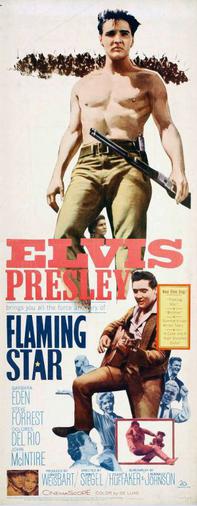
Elvis Presley was a singer, a performer, an entertainer. And yes, he was a movie star, starring in 31 movies over 13 years. Most were movies meant to capitalize on his singing (and scandalous dancing), the King singing plenty of his songs to keep audiences dancing in their seats. I like Elvis' music a lot, but musicals are not really my thing so I've actually never seen any of those movies. What have I seen? Presley's ventures into the western genre, 1969's Charro! and today's review, 1960's Flaming Star.
In the late 1870's in west Texas, aging, small-time rancher Sam Burton (John McIntire) has worked hard to create a life for himself with his family. On their small but solid ranch, they run cattle and horses, working every day to keep things up. Sam's family includes his wife (his second wife), a full-blooded Kiowa woman, Neddy (Dolores Del Rio), and two sons, Pacer (Presley), and Clint (Steve Forrest), with his first wife. Pacer is a half-breed but has lived his whole life with the whites, not the Kiowas. It's never been much of an issue as the Burton's friends think of them as just that; friends and even family. But when a new, young chief riles up his Kiowa warriors, no one in the territory is safe...except the Burtons who seem to go untouched while everyone around them is attacked. The townspeople and local families begin to suspect something. Now who's the bigger enemies? The supposedly friendly white families and settlers or the rampaging Kiowas?
I caught parts of this 1960 western years (YEARS) ago on AMC at some point but never sat down and watched the entire thing. Well, this channel called Encore Westerns shows westerns...all...day...long, and I was able to track it down. Westerns I haven't seen are getting harder and harder to find! Why this one doesn't have more of a reputation for the positive, I just don't know. It's not a classic, but with an excellent performance from young Mr. Presley and a hard-hitting story, 'Star' deserves much more standing within the western genre.
A big ingredient for success? Director Don Siegel behind the camera. One of the all-time great tough guy directors, Siegel is known for his pairings with Clint Eastwood in the 1960's and 1970's, but he had actually been directing feature films since the late 1940's. He was a no-nonsense kind of director, and 'Star' fits the mold. Even by 1960, westerns often painted the white Americans as the good guys and the Indians (whatever tribe, pick one) as the blood-thirsty savages obsessed with killing. That trend would begin to change in the coming years, but this is one of the first westerns I can think that tries to not only humanize Native Americans but shows that white settlers were far from perfect. It is a rare socially conscious western that simply paints things as they were. Prejudices and biases are ugly in any form, whether it's 2015 or 1878. This is a western story ahead of its time, and it's the better for it.
By the time this film was released, Presley was a S-T-A-R. He'd already made five movies, but this was the first to allow him to show off his dramatic acting chops. Much like he would years later in Charro, Presley gives an above average turn as the stoic, quiet, loyal and very capable anti-hero (of sorts). If there's any red flags, it's that Presley is playing a half-white, half-Indian character, but the part, script or Presley never makes it cliched, forced or overdone. Other than some really tan skin (really tan), the casting of a white actor as a Native American character isn't an issue, never presenting itself. Presley is known for being a singer, a dancer, an entertainer, but when given the chance, he showed that he was a more than respectable dramatic presence too. This is a good one.
The dynamic among the Burton family as a whole is key and the main (and best) focus of the story. For these four people, their "situation" isn't a situation at all. They are family. White blood or Indian blood doesn't matter in the least. McIntire and Del Rio are excellent as a couple that's been married for half a lifetime by now. The same goes for Presley and Forrest, half-brothers who never question the 'half' part. They complain and insult each other but are always there for the other because that's what brothers do. Hatred and violence can be quite the divider though, testing even the strongest of brotherly relationships. Four very strong performances from Presley, McIntire, Del Rio and Forrest as the heart of the movie.
Filling out the rest of the cast, look for a pre-I Dream of Jeannie Barbara Eden, Rodolfo Acosta, Richard Jaeckel, Karl Swenson, L.Q. Jones, Ford Rainey, and Perry Lopez.
There are some slightly overdone dramatic moments in the second half as everything comes front and center. AH, DRAMA! The ending too feels a little rushed, almost like a key scene was shot but eventually cut for timing or something. Overall though, this is an easy movie to recommend for any number of reasons from Elvis fans to western fans. And yes, Presley sings one song early almost to appease his fans before the story takes a turn for the dark. A hard-hitting story western that's definitely worth checking out.
Flaming Star (1960): ***/****
The Sons of Katie Elder
"First, we reunite, then find Ma and Pa's killer...then read some reviews."
Showing posts with label Rodolfo Acosta. Show all posts
Monday, August 24, 2015
Friday, January 30, 2015
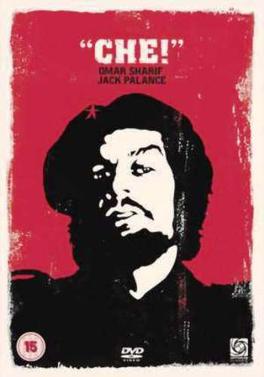
Che!
So by all accounts, everyone agrees a movie is awful. It's made some lists as one of the worst movies ever made. It tackles a controversial subject matter when the wound was still fresh in one of the most turbulent times in world history. The man? Revolutionary Che Guevara. No, it's not Steven Soderbergh's two-part Che. Silly you, I reviewed that HERE and HERE two years ago. It's time for a flick that's been critically panned for years, and don't we all love that?!? Here's 1969's Che!
It's 1956 and a young Che Guevara (Omar Sharif) lands in Cuba with a small revolutionary force of around 80 men commanded by Fidel Castro (Jack Palance). Having studied to be a physician, Che is brought along to be a medic, to treat the wounded but quickly becomes much, much more. As the revolution picks up momentum and followers all across Cuba, Che becomes an essential figure in the fighting, even becoming Castro's right-hand man, a key strategist and tactician in the fighting. It all leads to an overthrow of the government as Fidel, Che and their followers take the head of the coup, installing their own socialist government in 1959. It's just the start though as Cuba becomes a thorn in the side of the United States and worldwide. The revolution has changed though, and Che begins to feel uncomfortable. Maybe he can be of more use elsewhere where the fighting still rages...
Judging by reviews, IMDB ratings, word of mouth, all of the above, this movie from director Richard Fleischer is considered an all-around dud. As a jumping off point, I don't know what it says about me that I didn't think it was that bad. Rather, I was entertained throughout so go figure. Whether you love it or hate it, it's certainly an interesting film. It was made just two years after Che's death in 1967 as the world was tearing itself apart with one bloody conflict after another. My biggest question is 'What was the rush?' in getting a Che Guevara movie into theaters. The script certainly has some issues, packing a ton of stuff (about 10 years) into a 96-minute movie. It has far too many preachy scenes where Sharif's Che expresses his beliefs to anyone and everyone who will listen, and many who couldn't care less. Is it a good movie? No, but it's a fascinating flick in a guilty pleasure sort of way.
Talk about a daunting task. Mr. Sharif, would you be interested in playing infamous revolutionary Che Guevara? Working with a flawed script that tries to accomplish too much in its relatively short running time, Sharif makes the most of it. The screenplay certainly seems based off Guevara's diary and sticks relatively close to the facts of the revolutionary's life. The moments when he's preaching -- repeatedly -- his revolutionary beliefs, his hatred of imperialism (especially America) get to be tedious, but it is in the other, quieter moments where Sharif does an admirable job. We start to see Guevara as a man obsessed with revolution, with chaos, with taking down the system. These beliefs ultimately prove to be his undoing as Che becomes blinded with his goals rather than seeing that his plans simply can't work.
Now the rest of the cast, one actor in particular, has taken some abuse for his role. That man? Steely-eyed, gravelly voiced Jack Palance as Fidel Castro. Wearing a prosthetic nose, sporting big, wire-rimmed glasses and always chomping on a cigar, Palance seems to be playing a stereotype, a cliche of Castro rather than a flesh and blood individual. Fascinating, but not in a good way. The unfortunate part of the cast is that it features a long list of recognizable character actors who popped up in countless 1960s/1970s flicks. Oh, the unfortunate part? They're basically background performers. Some get a line here and there, but for the most part, they walk with Che or are visible in action scenes and dialogue exchanges.
Too bad. Among Che's followers we see Cesare Danova, Robert Loggia, Woody Strode, Perry Lopez, Rudy Diaz, Tom Troupe, Barbara Luna, Linda Marsh and Sid Haig. Other key parts go to Frank Silvera, Albert Paulsen, Rodolfo Acosta, Abraham Sofaer, and Paul Picerni. Just wish they could have been better utilized.
The one thing I can give credit for to this film over the Soderbergh version is that 1969 Che! takes a stance on the revolutionary icon. He's one flawed individual for good and bad. We see what his actions cause in terms of consequence on himself and those around him. In a somewhat odd storytelling device, we see some of the cast directly addressing the camera like a documentary, addressing the developments in Che's life but also in Cuba and Bolivia. Things obviously get a tad dark in the last half hour as Che's efforts in Bolivia never develop as planned. So you know what? I liked this movie. It's not necessarily good, but it's always entertaining (sometimes in a bad way). Still, it's worth a look.
Che! (1969): ***/****
It's 1956 and a young Che Guevara (Omar Sharif) lands in Cuba with a small revolutionary force of around 80 men commanded by Fidel Castro (Jack Palance). Having studied to be a physician, Che is brought along to be a medic, to treat the wounded but quickly becomes much, much more. As the revolution picks up momentum and followers all across Cuba, Che becomes an essential figure in the fighting, even becoming Castro's right-hand man, a key strategist and tactician in the fighting. It all leads to an overthrow of the government as Fidel, Che and their followers take the head of the coup, installing their own socialist government in 1959. It's just the start though as Cuba becomes a thorn in the side of the United States and worldwide. The revolution has changed though, and Che begins to feel uncomfortable. Maybe he can be of more use elsewhere where the fighting still rages...
Judging by reviews, IMDB ratings, word of mouth, all of the above, this movie from director Richard Fleischer is considered an all-around dud. As a jumping off point, I don't know what it says about me that I didn't think it was that bad. Rather, I was entertained throughout so go figure. Whether you love it or hate it, it's certainly an interesting film. It was made just two years after Che's death in 1967 as the world was tearing itself apart with one bloody conflict after another. My biggest question is 'What was the rush?' in getting a Che Guevara movie into theaters. The script certainly has some issues, packing a ton of stuff (about 10 years) into a 96-minute movie. It has far too many preachy scenes where Sharif's Che expresses his beliefs to anyone and everyone who will listen, and many who couldn't care less. Is it a good movie? No, but it's a fascinating flick in a guilty pleasure sort of way.
Talk about a daunting task. Mr. Sharif, would you be interested in playing infamous revolutionary Che Guevara? Working with a flawed script that tries to accomplish too much in its relatively short running time, Sharif makes the most of it. The screenplay certainly seems based off Guevara's diary and sticks relatively close to the facts of the revolutionary's life. The moments when he's preaching -- repeatedly -- his revolutionary beliefs, his hatred of imperialism (especially America) get to be tedious, but it is in the other, quieter moments where Sharif does an admirable job. We start to see Guevara as a man obsessed with revolution, with chaos, with taking down the system. These beliefs ultimately prove to be his undoing as Che becomes blinded with his goals rather than seeing that his plans simply can't work.
Now the rest of the cast, one actor in particular, has taken some abuse for his role. That man? Steely-eyed, gravelly voiced Jack Palance as Fidel Castro. Wearing a prosthetic nose, sporting big, wire-rimmed glasses and always chomping on a cigar, Palance seems to be playing a stereotype, a cliche of Castro rather than a flesh and blood individual. Fascinating, but not in a good way. The unfortunate part of the cast is that it features a long list of recognizable character actors who popped up in countless 1960s/1970s flicks. Oh, the unfortunate part? They're basically background performers. Some get a line here and there, but for the most part, they walk with Che or are visible in action scenes and dialogue exchanges.
Too bad. Among Che's followers we see Cesare Danova, Robert Loggia, Woody Strode, Perry Lopez, Rudy Diaz, Tom Troupe, Barbara Luna, Linda Marsh and Sid Haig. Other key parts go to Frank Silvera, Albert Paulsen, Rodolfo Acosta, Abraham Sofaer, and Paul Picerni. Just wish they could have been better utilized.
The one thing I can give credit for to this film over the Soderbergh version is that 1969 Che! takes a stance on the revolutionary icon. He's one flawed individual for good and bad. We see what his actions cause in terms of consequence on himself and those around him. In a somewhat odd storytelling device, we see some of the cast directly addressing the camera like a documentary, addressing the developments in Che's life but also in Cuba and Bolivia. Things obviously get a tad dark in the last half hour as Che's efforts in Bolivia never develop as planned. So you know what? I liked this movie. It's not necessarily good, but it's always entertaining (sometimes in a bad way). Still, it's worth a look.
Che! (1969): ***/****
Friday, April 19, 2013
The Proud Ones
What's the more iconic figure from the wild wild west, the sheriff/marshal or the cowboy? My first thought is the cowboy, but I'm safe picking either one. Yes, I'm the judge and jury here so deal with it. Countless westerns have dealt with both figures, some better than others, but 1956's The Proud Ones is a generally forgotten gem, the story of a small-town sheriff.
The sheriff of a small Kansas town, Cass Silver (Robert Ryan) is expecting trouble. The town has managed to avoid violence and bloodshed for years, but that's about to change. A new railroad line has made the town an important cattle depot, meaning cattle drives can now use Cass' town as a destination. The first herd is due any day now, and along with them comes Honest John Barrett (Robert Middleton), a saloon owner who has quite the checkered past with Cass as a marshal. Barrett sees the town as a gold mine, the potential for money and riches just waiting at his fingertips. His problem? Cass knows how he operates and doesn't intend to be intimidated by him. The experienced lawman braces for Barrett's plan while also weighing how much a new deputy, Thad Anderson (Jeffrey Hunter), can help. Anderson too has his own secrets, one that could doom them all.
The 1950s were packed to the gills with westerns hitting theaters from bigger budget A-level movies with smaller scale, cheaper B-movies. From director Robert D. Webb, 'Proud' is a better, more enjoyable western because it falls in between the two. It's familiar stuff, the town sheriff protecting his town, his word and his honor against a power-hungry businessman. Familiar isn't bad. There's some solid casting with some A-list names, but they're not there for the sake of star power. The story is mostly relegated to the town set which looks a lot like the set from The Ox-Bow Incident (from 13 years earlier), but the crowded streets with bars, businesses and alleys ending up being a key ingredient to the escalating situation. I also really liked Lionel Newman's score, a combination of soft and subtle -- especially Cass' whistle theme, listen HERE -- with bigger, louder outbursts in tense action scenes. It's a lot of little things again, but combined together it works out nicely.
By 1956, Robert Ryan was an established star in Hollywood, a reliable tough guy know for his villainous roles but also his ability to play flawed heroes. Playing veteran marshal Cass Silver, Ryan's part definitely falls into that second category. He's good at what he goes, but his past is checkered to say the least, thanks in great part to his history with Middleton's Honest John (Get it? It's ironic!). Silver has a tenuous relationship with saloon girl turned restaurant owner Sally (always reliable Virginia Mayo) and has a definite future with her, if he can get out of town and his job alive. In a semi-interesting but still unnecessary twist, Cass also gets knocked over the head and starts experiencing headaches that render him temporarily blind. It seems like something more worthy of a spaghetti western. Isolated and all but on his own, Cass might fight for what he believes in, what's right and upholding his word. I liked the main character a lot, and behind him, things fall into place nicely.
Presenting the town marshal as a main character in a western is nothing new, but I liked what Webb did just the same. 'Proud' had to be an influence on Howard Hawks who three years later with Rio Bravo would make a western with some similar undertones (and some less subtle connections). Cass has two deputies, Jake (Walter Brennan, basically playing the same role he'd play in Rio Bravo), the old jailer trying to keep Cass on his toes, and Jim (Arthur O'Connell), the doting father worried about his expecting wife. There's also a great dynamic between Silver and Hunter's Thad Anderson, the cowboy turned deputy. He blames Silver for his father's death, but he doesn't know all the facts. It's not quite a father-son relationship that develops -- maybe more of a brotherly relationship -- but it's fun to watch Silver keep working with the young deputy, not knowing if he'll get a bullet in his back whenever he turns away.
Rounding out the leads, Middleton is smooth and slimy as Honest John, wanting to get his way no matter what or who stands in his way. In this case, his means to an end is to hire "friends," Pike (Ken Clark) and Chico (Rodolfo Acosta), gunfighters waiting to shoot Cass in the back. In a smaller role that basically has her disappear after an early intro, Mayo fits in well as Sally, Silver's girlfriend who worries about his pride costing him his life.
Released in 1956, 'Proud' is surprisingly dark for an American western of the time. It delves into greed, backstabbing, betrayal and out and out murder. Even cynicism is evident almost from the first scene on. Trying to live up to his job and his word, Cass sees the town turn to Sodom and Gomorrah once there is any sort of money on the line, in this case lots and lots of money. The gunfights are quick and hard-hitting, and the finale in a dark, claustrophobic barn features the earliest use of blood squibs I've ever seen. One character gets shot in the face, another in the head, blood shooting out on impact. It's a western I don't hear much about, but I liked it from the start. Highly recommended.
The Proud Ones (1956): ***/****
The sheriff of a small Kansas town, Cass Silver (Robert Ryan) is expecting trouble. The town has managed to avoid violence and bloodshed for years, but that's about to change. A new railroad line has made the town an important cattle depot, meaning cattle drives can now use Cass' town as a destination. The first herd is due any day now, and along with them comes Honest John Barrett (Robert Middleton), a saloon owner who has quite the checkered past with Cass as a marshal. Barrett sees the town as a gold mine, the potential for money and riches just waiting at his fingertips. His problem? Cass knows how he operates and doesn't intend to be intimidated by him. The experienced lawman braces for Barrett's plan while also weighing how much a new deputy, Thad Anderson (Jeffrey Hunter), can help. Anderson too has his own secrets, one that could doom them all.
The 1950s were packed to the gills with westerns hitting theaters from bigger budget A-level movies with smaller scale, cheaper B-movies. From director Robert D. Webb, 'Proud' is a better, more enjoyable western because it falls in between the two. It's familiar stuff, the town sheriff protecting his town, his word and his honor against a power-hungry businessman. Familiar isn't bad. There's some solid casting with some A-list names, but they're not there for the sake of star power. The story is mostly relegated to the town set which looks a lot like the set from The Ox-Bow Incident (from 13 years earlier), but the crowded streets with bars, businesses and alleys ending up being a key ingredient to the escalating situation. I also really liked Lionel Newman's score, a combination of soft and subtle -- especially Cass' whistle theme, listen HERE -- with bigger, louder outbursts in tense action scenes. It's a lot of little things again, but combined together it works out nicely.
By 1956, Robert Ryan was an established star in Hollywood, a reliable tough guy know for his villainous roles but also his ability to play flawed heroes. Playing veteran marshal Cass Silver, Ryan's part definitely falls into that second category. He's good at what he goes, but his past is checkered to say the least, thanks in great part to his history with Middleton's Honest John (Get it? It's ironic!). Silver has a tenuous relationship with saloon girl turned restaurant owner Sally (always reliable Virginia Mayo) and has a definite future with her, if he can get out of town and his job alive. In a semi-interesting but still unnecessary twist, Cass also gets knocked over the head and starts experiencing headaches that render him temporarily blind. It seems like something more worthy of a spaghetti western. Isolated and all but on his own, Cass might fight for what he believes in, what's right and upholding his word. I liked the main character a lot, and behind him, things fall into place nicely.
Presenting the town marshal as a main character in a western is nothing new, but I liked what Webb did just the same. 'Proud' had to be an influence on Howard Hawks who three years later with Rio Bravo would make a western with some similar undertones (and some less subtle connections). Cass has two deputies, Jake (Walter Brennan, basically playing the same role he'd play in Rio Bravo), the old jailer trying to keep Cass on his toes, and Jim (Arthur O'Connell), the doting father worried about his expecting wife. There's also a great dynamic between Silver and Hunter's Thad Anderson, the cowboy turned deputy. He blames Silver for his father's death, but he doesn't know all the facts. It's not quite a father-son relationship that develops -- maybe more of a brotherly relationship -- but it's fun to watch Silver keep working with the young deputy, not knowing if he'll get a bullet in his back whenever he turns away.
Rounding out the leads, Middleton is smooth and slimy as Honest John, wanting to get his way no matter what or who stands in his way. In this case, his means to an end is to hire "friends," Pike (Ken Clark) and Chico (Rodolfo Acosta), gunfighters waiting to shoot Cass in the back. In a smaller role that basically has her disappear after an early intro, Mayo fits in well as Sally, Silver's girlfriend who worries about his pride costing him his life.
Released in 1956, 'Proud' is surprisingly dark for an American western of the time. It delves into greed, backstabbing, betrayal and out and out murder. Even cynicism is evident almost from the first scene on. Trying to live up to his job and his word, Cass sees the town turn to Sodom and Gomorrah once there is any sort of money on the line, in this case lots and lots of money. The gunfights are quick and hard-hitting, and the finale in a dark, claustrophobic barn features the earliest use of blood squibs I've ever seen. One character gets shot in the face, another in the head, blood shooting out on impact. It's a western I don't hear much about, but I liked it from the start. Highly recommended.
The Proud Ones (1956): ***/****
Monday, March 25, 2013
Posse from Hell
Ah, the posse, where men can be men and.....do manly stuff? Ride horses, shoot guns, track bad guys, eat jerky and drink bad coffee around a fire out in the desert under the stars. Pretty cool, huh? Eh, probably not, but for a western nut like myself, I could get on board with that. Obviously it wasn't a pleasant experience -- tracking down the bad guys to bring them to justice -- but there's been countless westerns following the posse, but few have been better than 1961's Posse from Hell.
Four very dangerous, murdering convicts led by an outlaw named Crip (Vic Morrow) descend on a small, peaceful western town, wreaking havoc and leaving a handful of dead in their wake, including the town marshal. The gang steals $11,000 from the bank and also kidnaps young Helen Caldwell (Zohra Lampert) and takes her with them. As a posse forms the following day, a new deputy arrives in town. His name is Banner Cole (Audie Murphy), and he immediately assumes the marshal's duties, starting with forming the posse. His honesty about the coming hunt scares many people away, leaving Banner with just six men riding with him to take down a four-man gang. The trail awaits with ambushes, double crosses, personal grudges and cowards waiting around every corner. Can Banner hold the group together long enough to get the gang?
From director Herbert Coleman, here is an example of a solid western that's flown under the radar in the 50-plus years since its release. It doesn't hit the 90-minute mark -- wrapping up in 89 instead -- and is most definitely a B-western. 'Hell' was filmed on the backlots with a few excursions to the California desert. The music is pretty standard stuff to the point the full cast and crew listing don't even list a composer. So why does it work then? Western novelist Clair Huffaker (wrote the novel and the screenplay) knows what he's doing. He knows the western and more importantly the characters. His good guy is resolute, his bad guys extremely nasty, and the rest are cannon fodder. Familiar? Maybe, but it's fun and entertaining throughout.
Maybe because it was a B-western and not a huge studio release, 'Hell' can get away with some stuff. That stuff ranks pretty high on the nasty, dark meter. There are things you would expect out of a spaghetti western or revisionist American western from the late 1960s or early 1970s, not a 1961 western. Morrow's Crip is a cold-blooded killer (channeling a similar character he played on an episode of The Rifleman) who favors a double-barreled shotgun and kills with no discretion. His gang kills because they can, not because it actually accomplishes anything. After leaving the town behind, Crip's gang even rapes Helen and leaves her for dead. Banner's posse is equally treacherous with insane, cowardly, big-talking individuals who can't back themselves up. It's a refreshing change of pace from some straightforward white hat good guys and black hat bad guys.
The king of the American B-western, Audie Murphy is an ideal lead. At times, his acting could be a tad wooden, but his stone-faced, almost monotone delivery plays well here. He's less than interested in the feelings or reactions of his posse. He's out there to do a job, not worry about the personalities of these people he's just met. The best dynamic is between Murphy's Banner and John Saxon's Seymour Kern, an Easterner working with the bank in town who's told to go with the posse to watch over the recovered money. The veteran cowboy and the inexperienced Easterner is a familiar convention, but it works. The rest of the posse includes Robert Keith as a power-happy former Union officer, Rodolfo Acosta as a Mexican cowboy known for his tracking ability, Royal Dano as Helen's drunken uncle, Frank Overton as the revenge-seeking townsperson trying to avenge his brother, and Paul Carr as the fast-draw with a pistol who's got little real life experience with his pistols. Also look for Lee Van Cleef as one of Crip's gang. It's a cool group with a variety of personalities, some around to be targets for Crip's gang.
The story is fairly episodic once the posse gets out on the trail. With seven members of the posse, it's clear some aren't going to make it so it becomes a guessing game as to who will survive. There are some surprising twists there so stay tuned through the end. Overall, the story doesn't really know how to end so it does drag a little in the final 15-20 minutes, but the build-up is so worthwhile I barely noticed. It's not enough to detract from a western I very much enjoyed. Highly recommended. Give it a shot at Youtube, link included below.
Posse from Hell (1961): *** 1/2 /****
Four very dangerous, murdering convicts led by an outlaw named Crip (Vic Morrow) descend on a small, peaceful western town, wreaking havoc and leaving a handful of dead in their wake, including the town marshal. The gang steals $11,000 from the bank and also kidnaps young Helen Caldwell (Zohra Lampert) and takes her with them. As a posse forms the following day, a new deputy arrives in town. His name is Banner Cole (Audie Murphy), and he immediately assumes the marshal's duties, starting with forming the posse. His honesty about the coming hunt scares many people away, leaving Banner with just six men riding with him to take down a four-man gang. The trail awaits with ambushes, double crosses, personal grudges and cowards waiting around every corner. Can Banner hold the group together long enough to get the gang?
From director Herbert Coleman, here is an example of a solid western that's flown under the radar in the 50-plus years since its release. It doesn't hit the 90-minute mark -- wrapping up in 89 instead -- and is most definitely a B-western. 'Hell' was filmed on the backlots with a few excursions to the California desert. The music is pretty standard stuff to the point the full cast and crew listing don't even list a composer. So why does it work then? Western novelist Clair Huffaker (wrote the novel and the screenplay) knows what he's doing. He knows the western and more importantly the characters. His good guy is resolute, his bad guys extremely nasty, and the rest are cannon fodder. Familiar? Maybe, but it's fun and entertaining throughout.
Maybe because it was a B-western and not a huge studio release, 'Hell' can get away with some stuff. That stuff ranks pretty high on the nasty, dark meter. There are things you would expect out of a spaghetti western or revisionist American western from the late 1960s or early 1970s, not a 1961 western. Morrow's Crip is a cold-blooded killer (channeling a similar character he played on an episode of The Rifleman) who favors a double-barreled shotgun and kills with no discretion. His gang kills because they can, not because it actually accomplishes anything. After leaving the town behind, Crip's gang even rapes Helen and leaves her for dead. Banner's posse is equally treacherous with insane, cowardly, big-talking individuals who can't back themselves up. It's a refreshing change of pace from some straightforward white hat good guys and black hat bad guys.
The king of the American B-western, Audie Murphy is an ideal lead. At times, his acting could be a tad wooden, but his stone-faced, almost monotone delivery plays well here. He's less than interested in the feelings or reactions of his posse. He's out there to do a job, not worry about the personalities of these people he's just met. The best dynamic is between Murphy's Banner and John Saxon's Seymour Kern, an Easterner working with the bank in town who's told to go with the posse to watch over the recovered money. The veteran cowboy and the inexperienced Easterner is a familiar convention, but it works. The rest of the posse includes Robert Keith as a power-happy former Union officer, Rodolfo Acosta as a Mexican cowboy known for his tracking ability, Royal Dano as Helen's drunken uncle, Frank Overton as the revenge-seeking townsperson trying to avenge his brother, and Paul Carr as the fast-draw with a pistol who's got little real life experience with his pistols. Also look for Lee Van Cleef as one of Crip's gang. It's a cool group with a variety of personalities, some around to be targets for Crip's gang.
The story is fairly episodic once the posse gets out on the trail. With seven members of the posse, it's clear some aren't going to make it so it becomes a guessing game as to who will survive. There are some surprising twists there so stay tuned through the end. Overall, the story doesn't really know how to end so it does drag a little in the final 15-20 minutes, but the build-up is so worthwhile I barely noticed. It's not enough to detract from a western I very much enjoyed. Highly recommended. Give it a shot at Youtube, link included below.
Posse from Hell (1961): *** 1/2 /****
Labels:
1960s,
Audie Murphy,
John Saxon,
Lee Van Cleef,
Robert Keith,
Rodolfo Acosta,
Royal Dano,
Vic Morrow,
westerns
Wednesday, September 21, 2011
Impasse
So I've mentioned before there's nothing wrong with a B-movie, right? There really isn't. Think of a low-budget movie made without any hopes of turning out a classic finished product. The cast will almost certainly feature some big names, and some other names of actors you might not know but you'll certainly recognize them from other supporting roles. Throw in a mix of humor, action and sex, and there you go. You've got your B-movie. All those elements are there with Impasse, but I didn't end up enjoying the movie anywhere near what I thought I would.
Heading his salvage business in the Philippines, Pat Morrison (Reynolds) has possibly stumbled onto the biggest find of his career. He has found out the location of a hidden cache of World War II gold on the island of Corregidor where retreating US forces in 1942 hid anything they couldn't ship out. The only problem? Pat has the general location, but four army vets all hold the clues to the exact location. He's spent months assembling the group (Lyle Bettger, Rodolfo Acosta, Clarke Gordon, and Vic Diaz) and now stands poised to get his hands on the gold if he can get just get past a ring of Filipino security on Corregidor which is easier said than done. His plan becomes murkier when Pat meets, Bobby (Anne Francis), the daughter of one of his crew.
My head kept going back to the same thing repeatedly as I watched this movie. It should have been better. It just should have. A B-movie about a heist of long-forgotten WWII gold in the Philippines sounds like the perfect schlock of a story. And Burt Reynolds is starring in it?!? Oh, count me in. But in turning that story into a feature length movie, director Richard Benedict instead opts to add all these disparate elements that don't work together. In a movie that isn't particularly long at just 100 minutes, but with all these wide-ranging subplots, I'm guessing maybe 30 minutes is actually spent on the gold heist.
So let's have some fun with all these pointless asides the story takes, shall we? Let's start with Reynolds and Francis who have little chemistry together. Francis looks confused in general, seemingly questioning how she ended up in a movie like this. Then there's Penny (Joanne Dalsass), a young lesbian hippie who stalks Francis's Bobby. She's really nice about it though so don't worry. Bobby is a pro tennis player, and Penny follows her around spouting hippie mumbo-jumbo. Bobby's father (Gordon) is kidnapped so Reynold's Pat has to track him down from evil "journalist" (<---you read that right), Wombat (Jeff Corey). Oh, right, the gold heist. There's gold hidden in artillery shells in a maze of underground bunkers, and each of these vets knows part of the location. The heist ends up feeling like a forgotten piece of the story, and then the movie ends in about as anti-climactic fashion as is possible. Yeah, good times.
A known name if not quite a star yet, Burt Reynolds is a bright spot here. He certainly shows off the potential he had to play a leading role, especially in an action movie with some comedy here and there. His Pat Morrison is that conniving rogue you can't help but like, doing whatever he can to make some cash. The anti-climactic ending is somewhat funny because of Reynold's reaction, but only to a point. As for the crew, all-around reliable bad guy Bettger is the racist Hansen, Acosta is the stereotypical Apache, Draco, spouting 'Ay Chihuahua' whenever possible, and Diaz is the sniveling black market dealer, Jesus, who does nothing when he finds out Pat is sleeping with his wife, Mariko (Miko Mayama). Corey I suppose qualifies as a straight bad guy, looking to be having some fun as Wombat, a shady fella who is up to no good in whatever he's doing.
While this is by no means a classic, the movie isn't all bad. In all the departures and asides from the story at hand, the movie is set in the Philippines and thankfully was filmed there instead of a Hollywood backlot. So the story may drift too much for my liking, but it's nice to look at. The Philippines are beautiful. That's something, right? About midway through the movie, there is a very long chase sequence -- just a foot race basically -- between Reynolds and one of Wombat's henchmen. There's nothing fancy about it, just two guys going absolutely nuts running through the back alleys and dingy Manilla streets. Reynolds also does most if not all of his own stunts the whole movie, adding to his badass quota.
The movie is a stinker, if a moderately entertaining stinker. Just don't expect a classic. Sorry, I couldn't find a trailer or clip of any kind.
Impasse (1969): **/****
Labels:
1960s,
Anne Francis,
Burt Reynolds,
Heist movies,
Jeff Corey,
Lyle Bettger,
Rodolfo Acosta
Subscribe to:
Posts (Atom)