The Sons of Katie Elder
"First, we reunite, then find Ma and Pa's killer...then read some reviews."
Showing posts with label Biography. Show all posts
Friday, February 13, 2015
The Story of G.I. Joe
I went to Indiana University in Bloomington for college, getting my journalism degree from the IU School of Journalism. The building was named Ernie Pyle Hall or shortened to 'the Pyle.' The school was named after famed journalist and war correspondent Ernie Pyle who rose to fame during World War II for his columns about the fighting in Europe and the Pacific. His exploits were given a feature film adaptation in a criminally forgotten war film, 1945's The Story of G.I. Joe.
It's 1942 in North Africa and inexperienced American troops are being pushed back on all fronts against the veteran German troops. A journalist and columnist from Indiana, 42-year old Ernie Pyle (Burgess Meredith) joins the American infantry on the front lines looking to tell their stories for the American people back in the states. The tide begins to turn though as the green Americans learn how to fight, pushing the Germans back and winning North Africa. As the war jumps to Italy, Pyle is right there with the troops, documenting everything he sees. Pyle keeps moving around but always seems to find himself with one infantry company with its commander, Captain Bill Walker (Robert Mitchum), and troops not only getting to know him but welcoming him in, the journalist becoming one of them. What does the war hold though? What awaits both Pyle and the American troops?
What an excellent movie. I think the biggest compliment I can give is that 'Joe' is one of the most authentic war movies ever made. It's not just authentic though. It's real, emotional and resonates long after viewing. Director William Wellman wants to tell the story of the grunts, the men on the front lines and does so without any huge displays of patriotism or heroism. These are just 20-somethings who just want to get home. The quickest way to accomplish that? Win the next battle and the next until they get to Berlin. We don't meet any staff officers or get a wider, bigger picture of the war. We get to know the troops, see them on the march, in combat, waiting and waiting. In ways that movies with a much bigger reputation/following didn't do, you really get the sense of what it was like being in the infantry in WWII.
That authenticity comes from Pyle's writings, two of his compilation books serving as inspiration for the screenplay (writers Leopold Atlas, Guy Endore, Philip Stevenson) that was nominated for an Academy Award. Pyle's columns were simple and straightforward, effective because he got a message across that left quite the impression. A relative unknown at the time, Meredith was cast as Pyle, bringing the man to life with a quiet, understated performance. He steals the movie in subtle fashion. Like Pyle's columns, Meredith isn't overbearing or trying too hard. Like good journalists, he listens and looks and waits for the story. He doesn't force it.
It's a feeling that reflects the entire movie. Nothing feels forced. A lot of ground is covered, but you don't feel rushed. There's a natural flow to the story. Overall, 'Joe' is ahead of its time. It was released the summer of 1945 as the war was winding down, but there's not an ounce of propaganda involved. It's just war. We see the effects of battle on the troops, some eventually cracking. We see the looks in the soldiers' faces as they look back on a fallen comrade. They don't talk about the power or glory of war. It's a dirty, nasty business and people die. It is a little touch, but the soldiers have beards and mustaches, the product of days and weeks up at the front without a rest. 'Joe' was filmed in a stark, minimalist black and white that leaves all the focus on the story. There are some beautiful shots throughout mixed in with all the dreary waiting and waiting for something to happen.
In 1945, Mitchum had been working for several years in Hollywood, usually with supporting roles. This is a supporting role, but my goodness, what a part. He was nominated for a Best Supporting Actor for his performance as Lt. (later Captain) Walker, the commander of C Company, 18th Infantry. With Meredith as Pyle, Mitchum's Walker provides the heart of the movie. A genuine friendship develops between the two men, one a 43-year old writer, the other a young officer trying to get his men through the war unscathed. Like his best parts, Mitchum is the picture of realism. There aren't BIG, LOUD moments but real, emotional ones. His scene with Pyle during the battle for Monte Cassino shows the wear and tear on him, the war stripping him down as he sees the casualties mount. It is a subtle, perfect scene, Mitchum showing all the talent we'd come to expect to see in the coming years.
One other performance is really worth mentioning, and that's Freddie Steele as Sgt. Warnicki, a hard-edged, tough NCO who all the men look up to, including Walker and Pyle. A former boxer who had a short-lived career in Hollywood, Steele is excellent. It's just a fascinating character. His main storyline is that he receives a record from his wife who's recorded his young son's voice, a voice he's never heard. Problem? He needs a record player, the payoff a heartbreaking conclusion. The other infantry include Wally Cassell as fun-loving Dendaro, John R. Reilly as Murphy, a washed-out pilot, and William Murphy as Mew, just trying to fill out his life insurance form.
There are too many moments to mention. There's combat -- Walker and Warnicki working up a bombed-out street to take out 2 German snipers -- and then the more personal, the company resting on Christmas in a brief respite from battle. I loved Mew trying to figure out what name to write on his insurance form. I loved Arab, the little mutt dog the company adopts. It all builds to a very real, very moving, heartbreaking ending. This is war seen through the eyes of one of the best war correspondents to ever write. An excellent movie, one of the best war movies ever made.
The Story of G.I. Joe (1945): ****/****
Rewrite of March 2009 review
Labels:
1940s,
Biography,
Burgess Meredith,
Robert Mitchum,
William Wellman,
WWII
Friday, January 30, 2015
Che!
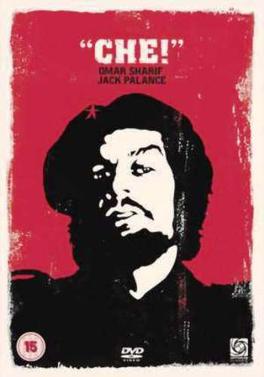
So by all accounts, everyone agrees a movie is awful. It's made some lists as one of the worst movies ever made. It tackles a controversial subject matter when the wound was still fresh in one of the most turbulent times in world history. The man? Revolutionary Che Guevara. No, it's not Steven Soderbergh's two-part Che. Silly you, I reviewed that HERE and HERE two years ago. It's time for a flick that's been critically panned for years, and don't we all love that?!? Here's 1969's Che!
It's 1956 and a young Che Guevara (Omar Sharif) lands in Cuba with a small revolutionary force of around 80 men commanded by Fidel Castro (Jack Palance). Having studied to be a physician, Che is brought along to be a medic, to treat the wounded but quickly becomes much, much more. As the revolution picks up momentum and followers all across Cuba, Che becomes an essential figure in the fighting, even becoming Castro's right-hand man, a key strategist and tactician in the fighting. It all leads to an overthrow of the government as Fidel, Che and their followers take the head of the coup, installing their own socialist government in 1959. It's just the start though as Cuba becomes a thorn in the side of the United States and worldwide. The revolution has changed though, and Che begins to feel uncomfortable. Maybe he can be of more use elsewhere where the fighting still rages...
Judging by reviews, IMDB ratings, word of mouth, all of the above, this movie from director Richard Fleischer is considered an all-around dud. As a jumping off point, I don't know what it says about me that I didn't think it was that bad. Rather, I was entertained throughout so go figure. Whether you love it or hate it, it's certainly an interesting film. It was made just two years after Che's death in 1967 as the world was tearing itself apart with one bloody conflict after another. My biggest question is 'What was the rush?' in getting a Che Guevara movie into theaters. The script certainly has some issues, packing a ton of stuff (about 10 years) into a 96-minute movie. It has far too many preachy scenes where Sharif's Che expresses his beliefs to anyone and everyone who will listen, and many who couldn't care less. Is it a good movie? No, but it's a fascinating flick in a guilty pleasure sort of way.
Talk about a daunting task. Mr. Sharif, would you be interested in playing infamous revolutionary Che Guevara? Working with a flawed script that tries to accomplish too much in its relatively short running time, Sharif makes the most of it. The screenplay certainly seems based off Guevara's diary and sticks relatively close to the facts of the revolutionary's life. The moments when he's preaching -- repeatedly -- his revolutionary beliefs, his hatred of imperialism (especially America) get to be tedious, but it is in the other, quieter moments where Sharif does an admirable job. We start to see Guevara as a man obsessed with revolution, with chaos, with taking down the system. These beliefs ultimately prove to be his undoing as Che becomes blinded with his goals rather than seeing that his plans simply can't work.
Now the rest of the cast, one actor in particular, has taken some abuse for his role. That man? Steely-eyed, gravelly voiced Jack Palance as Fidel Castro. Wearing a prosthetic nose, sporting big, wire-rimmed glasses and always chomping on a cigar, Palance seems to be playing a stereotype, a cliche of Castro rather than a flesh and blood individual. Fascinating, but not in a good way. The unfortunate part of the cast is that it features a long list of recognizable character actors who popped up in countless 1960s/1970s flicks. Oh, the unfortunate part? They're basically background performers. Some get a line here and there, but for the most part, they walk with Che or are visible in action scenes and dialogue exchanges.
Too bad. Among Che's followers we see Cesare Danova, Robert Loggia, Woody Strode, Perry Lopez, Rudy Diaz, Tom Troupe, Barbara Luna, Linda Marsh and Sid Haig. Other key parts go to Frank Silvera, Albert Paulsen, Rodolfo Acosta, Abraham Sofaer, and Paul Picerni. Just wish they could have been better utilized.
The one thing I can give credit for to this film over the Soderbergh version is that 1969 Che! takes a stance on the revolutionary icon. He's one flawed individual for good and bad. We see what his actions cause in terms of consequence on himself and those around him. In a somewhat odd storytelling device, we see some of the cast directly addressing the camera like a documentary, addressing the developments in Che's life but also in Cuba and Bolivia. Things obviously get a tad dark in the last half hour as Che's efforts in Bolivia never develop as planned. So you know what? I liked this movie. It's not necessarily good, but it's always entertaining (sometimes in a bad way). Still, it's worth a look.
Che! (1969): ***/****
It's 1956 and a young Che Guevara (Omar Sharif) lands in Cuba with a small revolutionary force of around 80 men commanded by Fidel Castro (Jack Palance). Having studied to be a physician, Che is brought along to be a medic, to treat the wounded but quickly becomes much, much more. As the revolution picks up momentum and followers all across Cuba, Che becomes an essential figure in the fighting, even becoming Castro's right-hand man, a key strategist and tactician in the fighting. It all leads to an overthrow of the government as Fidel, Che and their followers take the head of the coup, installing their own socialist government in 1959. It's just the start though as Cuba becomes a thorn in the side of the United States and worldwide. The revolution has changed though, and Che begins to feel uncomfortable. Maybe he can be of more use elsewhere where the fighting still rages...
Judging by reviews, IMDB ratings, word of mouth, all of the above, this movie from director Richard Fleischer is considered an all-around dud. As a jumping off point, I don't know what it says about me that I didn't think it was that bad. Rather, I was entertained throughout so go figure. Whether you love it or hate it, it's certainly an interesting film. It was made just two years after Che's death in 1967 as the world was tearing itself apart with one bloody conflict after another. My biggest question is 'What was the rush?' in getting a Che Guevara movie into theaters. The script certainly has some issues, packing a ton of stuff (about 10 years) into a 96-minute movie. It has far too many preachy scenes where Sharif's Che expresses his beliefs to anyone and everyone who will listen, and many who couldn't care less. Is it a good movie? No, but it's a fascinating flick in a guilty pleasure sort of way.
Talk about a daunting task. Mr. Sharif, would you be interested in playing infamous revolutionary Che Guevara? Working with a flawed script that tries to accomplish too much in its relatively short running time, Sharif makes the most of it. The screenplay certainly seems based off Guevara's diary and sticks relatively close to the facts of the revolutionary's life. The moments when he's preaching -- repeatedly -- his revolutionary beliefs, his hatred of imperialism (especially America) get to be tedious, but it is in the other, quieter moments where Sharif does an admirable job. We start to see Guevara as a man obsessed with revolution, with chaos, with taking down the system. These beliefs ultimately prove to be his undoing as Che becomes blinded with his goals rather than seeing that his plans simply can't work.
Now the rest of the cast, one actor in particular, has taken some abuse for his role. That man? Steely-eyed, gravelly voiced Jack Palance as Fidel Castro. Wearing a prosthetic nose, sporting big, wire-rimmed glasses and always chomping on a cigar, Palance seems to be playing a stereotype, a cliche of Castro rather than a flesh and blood individual. Fascinating, but not in a good way. The unfortunate part of the cast is that it features a long list of recognizable character actors who popped up in countless 1960s/1970s flicks. Oh, the unfortunate part? They're basically background performers. Some get a line here and there, but for the most part, they walk with Che or are visible in action scenes and dialogue exchanges.
Too bad. Among Che's followers we see Cesare Danova, Robert Loggia, Woody Strode, Perry Lopez, Rudy Diaz, Tom Troupe, Barbara Luna, Linda Marsh and Sid Haig. Other key parts go to Frank Silvera, Albert Paulsen, Rodolfo Acosta, Abraham Sofaer, and Paul Picerni. Just wish they could have been better utilized.
The one thing I can give credit for to this film over the Soderbergh version is that 1969 Che! takes a stance on the revolutionary icon. He's one flawed individual for good and bad. We see what his actions cause in terms of consequence on himself and those around him. In a somewhat odd storytelling device, we see some of the cast directly addressing the camera like a documentary, addressing the developments in Che's life but also in Cuba and Bolivia. Things obviously get a tad dark in the last half hour as Che's efforts in Bolivia never develop as planned. So you know what? I liked this movie. It's not necessarily good, but it's always entertaining (sometimes in a bad way). Still, it's worth a look.
Che! (1969): ***/****
Tuesday, December 30, 2014
The Imitation Game
Ever heard of Alan Turing? Until about 24 hours ago, I hadn't although I unknowingly was quite aware of his ridiculously important historical contributions. How about something called Enigma? Yes? No? No matter how you answered, here's an easy recommendation as the movie awards season jumps into the full swing. History, World War II, just a film fan, check out 2014's The Imitation Game.
It's 1939 and World War II isn't going well for the Allied effort, especially in England as the German Luftwaffe wreaks havoc with its bombing all over the country. British intelligence is working hard behind the scenes, a huge effort meant to crack one of Germany's essentially unbreakable code, the Enigma. A brilliant mathematician and professor, Alan Turing (Benedict Cumberbatch) is working with British intelligence to break Enigma, but the effort seems impossible. There are literally millions and millions and millions of possibilities to break Enigma, and Alan and a small group of cryptanalysts have a limited window each day to break it before they have to start from scratch the next morning when the Enigma settings are changed. Turing especially is confident he can do it, but as the war rages on and the casualties pile up, even Turing's difficult personality may prove to be the biggest roadblock.
Here's another example of how powerful and interesting and truly, downright interesting history can be. Based on a true story -- with some artistic license taken here and there -- and from director Morten Tyldum tells a truly remarkable story, one that the British government kept under wraps for over 50 years after the end of WWII. The soldiers did the fighting, civilians back home built much of the materiel, the politicians fought and negotiated, all of it essential to the war effort. 'Imitation' does a great job of showing how Turing, a single man, drastically changed the course of the war for the Allies. It is a large-scale story in terms of content but small-scale in its focus. This is a movie about Turing and the men and women in intelligence who helped to break Germany's seemingly perfect code, saving millions of lives and cutting years off the war. Oscar bait? Sure, but it's a goodie.
That Benedict Cumberbatch fellow, he seems to be an actor with some potential (besides having a really cool name). Though he's been working in film and television since the early 2000s, he seems to have hit his groove as an actor, able to do fun blockbusters like the Star Trek sequels and as he shows here, act his freaking butt off. What a performance, one that will hopefully earn him an Oscar nomination, if not a win. It's always tough portraying a historical figure, even if it is one without a ton of name recognition. This is a brilliant, tortured man who was years ahead of his field, an individual who developed one of the first computers, one that helped Turing and Co. eventually break Enigma (relative spoiler I guess). The story also takes a personal detour in the second half of the movie, Cumberbatch truly bringing the individual to life.
It's the little nuances that Cumberbatch does so well, so effortlessly. His Turing is a socially awkward, brilliant individual with a troubled background. He commits himself to his work in almost dangerous fashion. It is an entire commitment. He hits people in the wrong way because his Alan is short, curt, abrupt and believes entirely in himself. All negative, right? He adds these little snippets as he tries to put his pride aside (although I wouldn't consider it pride in Alan's eyes, he just thinks he's right) that humanize him. We see that a lot in his scenes with Keira Knightley's Joan Clarke, a similarly brilliant young woman who doesn't get the respect she deserves because she's a woman and obviously can't be good at math. Kudos to Cumberbatch though, delivering a low-key performance that isn't necessarily a huge LOOK AT ME part that nonetheless steals the movie.
The 'Imitation' cast is uniformly solid. The queen of the period piece, Knightley is perfectly at home in the WWII story in providing an ideal counter to Cumberbatch's Alan. Their chemistry is smooth and easy, two individuals with different backgrounds but plenty of common ground. The other individuals working with Turing include an excellent Matthew Goode, Matthew Beard, Allen Leech, and James Northcote. Charles Dance and Mark Strong are very good too as intelligence officials, one more helpful than the other in assisting Turing's seemingly impossible plan to break the code. Rory Kinnear makes a quick appearance in a flash-forward of sorts as we see Turing living in England in the 1950s.
Let's say this. 'Imitation' tries to accomplish a lot. A LOT. The actual story is astounding that this happened. It wasn't a handful of people but thousands, but THIS HAPPENED. The story never feels disjointed which is a big compliment when you consider how much ground is covered, three-plus years is the crux of the story during the WWII portions. It's fascinating watching Turing's early-model computer come to fruition, the frustration when breaking the code doesn't happen both inward and outward, and eventually when it does happen the unintended consequences. Think of this. Okay, they've broken the code. They now CAN'T ADMIT they've both broken it because then the Germans would know they have broken it. What do you do now? How do you put the code to best use without revealing it has been broken? It is those moments where the movie is at its strongest.
So yeah, we've got some good, old-fashioned Oscar bait here. This is a good movie with a fascinating, always interesting story with some great performances. It isn't though, a great movie. When the story reveals a secret part of Alan's life, but it takes away from the power of the WWII/Enigma story. It is a tragic secret that alters Alan's life in a huge way but at times it feels tacked on like the story didn't exactly know how to handle it, especially in the finale. It is a complaint but nothing even remotely being close to a dealbreaker. Still a must-see movie.
The Imitation Game (2014): ***/****
It's 1939 and World War II isn't going well for the Allied effort, especially in England as the German Luftwaffe wreaks havoc with its bombing all over the country. British intelligence is working hard behind the scenes, a huge effort meant to crack one of Germany's essentially unbreakable code, the Enigma. A brilliant mathematician and professor, Alan Turing (Benedict Cumberbatch) is working with British intelligence to break Enigma, but the effort seems impossible. There are literally millions and millions and millions of possibilities to break Enigma, and Alan and a small group of cryptanalysts have a limited window each day to break it before they have to start from scratch the next morning when the Enigma settings are changed. Turing especially is confident he can do it, but as the war rages on and the casualties pile up, even Turing's difficult personality may prove to be the biggest roadblock.
Here's another example of how powerful and interesting and truly, downright interesting history can be. Based on a true story -- with some artistic license taken here and there -- and from director Morten Tyldum tells a truly remarkable story, one that the British government kept under wraps for over 50 years after the end of WWII. The soldiers did the fighting, civilians back home built much of the materiel, the politicians fought and negotiated, all of it essential to the war effort. 'Imitation' does a great job of showing how Turing, a single man, drastically changed the course of the war for the Allies. It is a large-scale story in terms of content but small-scale in its focus. This is a movie about Turing and the men and women in intelligence who helped to break Germany's seemingly perfect code, saving millions of lives and cutting years off the war. Oscar bait? Sure, but it's a goodie.
That Benedict Cumberbatch fellow, he seems to be an actor with some potential (besides having a really cool name). Though he's been working in film and television since the early 2000s, he seems to have hit his groove as an actor, able to do fun blockbusters like the Star Trek sequels and as he shows here, act his freaking butt off. What a performance, one that will hopefully earn him an Oscar nomination, if not a win. It's always tough portraying a historical figure, even if it is one without a ton of name recognition. This is a brilliant, tortured man who was years ahead of his field, an individual who developed one of the first computers, one that helped Turing and Co. eventually break Enigma (relative spoiler I guess). The story also takes a personal detour in the second half of the movie, Cumberbatch truly bringing the individual to life.
It's the little nuances that Cumberbatch does so well, so effortlessly. His Turing is a socially awkward, brilliant individual with a troubled background. He commits himself to his work in almost dangerous fashion. It is an entire commitment. He hits people in the wrong way because his Alan is short, curt, abrupt and believes entirely in himself. All negative, right? He adds these little snippets as he tries to put his pride aside (although I wouldn't consider it pride in Alan's eyes, he just thinks he's right) that humanize him. We see that a lot in his scenes with Keira Knightley's Joan Clarke, a similarly brilliant young woman who doesn't get the respect she deserves because she's a woman and obviously can't be good at math. Kudos to Cumberbatch though, delivering a low-key performance that isn't necessarily a huge LOOK AT ME part that nonetheless steals the movie.
The 'Imitation' cast is uniformly solid. The queen of the period piece, Knightley is perfectly at home in the WWII story in providing an ideal counter to Cumberbatch's Alan. Their chemistry is smooth and easy, two individuals with different backgrounds but plenty of common ground. The other individuals working with Turing include an excellent Matthew Goode, Matthew Beard, Allen Leech, and James Northcote. Charles Dance and Mark Strong are very good too as intelligence officials, one more helpful than the other in assisting Turing's seemingly impossible plan to break the code. Rory Kinnear makes a quick appearance in a flash-forward of sorts as we see Turing living in England in the 1950s.
Let's say this. 'Imitation' tries to accomplish a lot. A LOT. The actual story is astounding that this happened. It wasn't a handful of people but thousands, but THIS HAPPENED. The story never feels disjointed which is a big compliment when you consider how much ground is covered, three-plus years is the crux of the story during the WWII portions. It's fascinating watching Turing's early-model computer come to fruition, the frustration when breaking the code doesn't happen both inward and outward, and eventually when it does happen the unintended consequences. Think of this. Okay, they've broken the code. They now CAN'T ADMIT they've both broken it because then the Germans would know they have broken it. What do you do now? How do you put the code to best use without revealing it has been broken? It is those moments where the movie is at its strongest.
So yeah, we've got some good, old-fashioned Oscar bait here. This is a good movie with a fascinating, always interesting story with some great performances. It isn't though, a great movie. When the story reveals a secret part of Alan's life, but it takes away from the power of the WWII/Enigma story. It is a tragic secret that alters Alan's life in a huge way but at times it feels tacked on like the story didn't exactly know how to handle it, especially in the finale. It is a complaint but nothing even remotely being close to a dealbreaker. Still a must-see movie.
The Imitation Game (2014): ***/****
Monday, September 9, 2013
Hitchcock
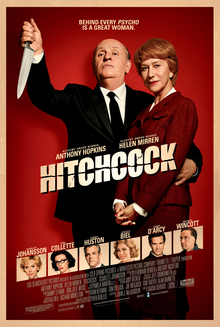
A movie about the making of a movie? Yeah, that doesn't necessarily sound that interesting. Oh, it's about all-time great director Alfred Hitchcock and one of his most respected classics? Okay, I'm a little more interested now. I was curious but skeptical going in, but I ended up liking 2012's Hitchcock a whole lot.
It is 1959 and highly respected Alfred Hitchcock (Anthony Hopkins) is coming off one of his best movies in terms of critical acclaim and audience success, North by Northwest. He's thrown for a loop when a reporter asks if he's going to retire now that's he 60 years old. Hitchcock vows his next film will be his best, a unique, doozy of a flick that audiences have never seen the likes of before. He finds his source in a novel called Psycho, a story loosely based on a real-life murderer. The subject matter is highly controversial, especially for a 1960 audience, and he struggles from the get-go to get the backing to produce his movie. Instead, he and his wife, Alma (Helen Mirren), fund the movie themselves, putting their own money up as backing. Casting, the actual filming, the studio, the censors, all will prove difficult in getting his film made, but it's also threatening to tear up his longtime marriage and partnership with Alma.
Released in 1960, Psycho was a film that earned lukewarm reviews but rabid audiences ate it up and helped it take off. It earned four Oscar nominations -- including Hitchcock for director, Janet Leigh for supporting actress --and quickly became a classic with a story and style that helped rewrite the thriller/horror genre. While it's remembered as a classic now, it had a checkered production as Hitchcock struggled to get backing (studio head Richard Portnow) while also doing battle with the censors (played by Kurtwood Smith) to make the movie that he wanted to make. From the infamous shower scene to the on-screen depiction of violence and sex, it is a gem of a film. Enough with background though. Is a movie about a movie interesting? Sometimes stories based on facts like this can play like reading an encyclopedia, but this one is interesting from the first scene right to the end.
I know there's a lot of great acting performances out there, but I'm genuinely surprised Hopkins did not earn a Best Actor nomination. He certainly deserved it. For one, he's almost unrecognizable as the famous English director. Looks are just one aspect of the performance, one that isn't a do or die moment. What's more important is that Hopkins becomes Hitchcock. The speech patterns, the personal, little mannerisms like holding his suit, pursing his lips, it all adds up to bring the puzzle pieces together. When Hopkins is on-screen, you can't take your eyes away from him. It also isn't a hero pic, portraying the director as he was, an incredibly talented if mercurial director who had tendencies that drove people up a wall at times. On the other hand, he was so talented those people had to put up with him at times.
The movie is significantly better for it. While it is about the making of Psycho, it's more so about how the making of Psycho affected Hitchcock's marriage to Alma Reville, played to perfection by Helen Mirren. While filming, Hitchcock had his quirks. He was always searching for that perfect platinum blonde (Kim Novak, Janet Leigh, Tippi Hedren), sometimes at the expense of paying Alma any attention at all, something that plays out as Alma works with smooth-talking screenwriter Whitfield Cook (Danny Huston). Neither Hitch (he at one points says "Hitch....never mind the cock") nor Alma is below playing some head games, testing their marriage when the pressure of making their movie successful is already wearing on them. We see Hitchcock in all his glory and flaws -- holding grudges, being a peeping tom among others -- but it adds to the movie, making it more than just a documentary. Hopkins and Mirren are two pros at the top of their games, great lead performances.
Working with director Sacha Gervasi is a very talented supporting cast beyond his two stars. I was worried some because the actors are playing....well, actors, and actors much of the audience will be familiar with. Scarlett Johansson is excellent playing Janet Leigh, the star of Psycho who bonds quickly with Hitchcock during filming, Jessica Biel also solid as Psycho co-star Vera Miles. Toni Collette is solid too as Peggy Robertson, Hitch's much-maligned assistant who is nonetheless someone the director counts on in a big way. Michael Stuhlbarg is very good as Lew Wasserman, Hitch's agent trying to help him through the troubled production. Michael Wincott is perfectly creepy as Ed Gein, the real-life inspiration for the Norman Bates character, James D'Arcy playing Anthony Perkins. In a cool storytelling device, Gein actually "talks" to Hitchcock, apparently giving the director inspiration in bringing his movie together.
I liked this movie. Good style, solid characterization and an inside look at a classic film. I loved the bookend storytelling too, Hitchcock actually talking to the audience much like he did in his Alfred Hitchcock Presents TV show. It's on-screen narration that works so well, setting things up. In a cool visual with the narration, the final scene gives a hint to Hitchcock's next film, another classic remembered fondly with Psycho. Just a good solid film overall, most memorable for Anthony Hopkins and Helen Mirren.
Hitchcock (2012): ***/****
It is 1959 and highly respected Alfred Hitchcock (Anthony Hopkins) is coming off one of his best movies in terms of critical acclaim and audience success, North by Northwest. He's thrown for a loop when a reporter asks if he's going to retire now that's he 60 years old. Hitchcock vows his next film will be his best, a unique, doozy of a flick that audiences have never seen the likes of before. He finds his source in a novel called Psycho, a story loosely based on a real-life murderer. The subject matter is highly controversial, especially for a 1960 audience, and he struggles from the get-go to get the backing to produce his movie. Instead, he and his wife, Alma (Helen Mirren), fund the movie themselves, putting their own money up as backing. Casting, the actual filming, the studio, the censors, all will prove difficult in getting his film made, but it's also threatening to tear up his longtime marriage and partnership with Alma.
Released in 1960, Psycho was a film that earned lukewarm reviews but rabid audiences ate it up and helped it take off. It earned four Oscar nominations -- including Hitchcock for director, Janet Leigh for supporting actress --and quickly became a classic with a story and style that helped rewrite the thriller/horror genre. While it's remembered as a classic now, it had a checkered production as Hitchcock struggled to get backing (studio head Richard Portnow) while also doing battle with the censors (played by Kurtwood Smith) to make the movie that he wanted to make. From the infamous shower scene to the on-screen depiction of violence and sex, it is a gem of a film. Enough with background though. Is a movie about a movie interesting? Sometimes stories based on facts like this can play like reading an encyclopedia, but this one is interesting from the first scene right to the end.
I know there's a lot of great acting performances out there, but I'm genuinely surprised Hopkins did not earn a Best Actor nomination. He certainly deserved it. For one, he's almost unrecognizable as the famous English director. Looks are just one aspect of the performance, one that isn't a do or die moment. What's more important is that Hopkins becomes Hitchcock. The speech patterns, the personal, little mannerisms like holding his suit, pursing his lips, it all adds up to bring the puzzle pieces together. When Hopkins is on-screen, you can't take your eyes away from him. It also isn't a hero pic, portraying the director as he was, an incredibly talented if mercurial director who had tendencies that drove people up a wall at times. On the other hand, he was so talented those people had to put up with him at times.
The movie is significantly better for it. While it is about the making of Psycho, it's more so about how the making of Psycho affected Hitchcock's marriage to Alma Reville, played to perfection by Helen Mirren. While filming, Hitchcock had his quirks. He was always searching for that perfect platinum blonde (Kim Novak, Janet Leigh, Tippi Hedren), sometimes at the expense of paying Alma any attention at all, something that plays out as Alma works with smooth-talking screenwriter Whitfield Cook (Danny Huston). Neither Hitch (he at one points says "Hitch....never mind the cock") nor Alma is below playing some head games, testing their marriage when the pressure of making their movie successful is already wearing on them. We see Hitchcock in all his glory and flaws -- holding grudges, being a peeping tom among others -- but it adds to the movie, making it more than just a documentary. Hopkins and Mirren are two pros at the top of their games, great lead performances.
Working with director Sacha Gervasi is a very talented supporting cast beyond his two stars. I was worried some because the actors are playing....well, actors, and actors much of the audience will be familiar with. Scarlett Johansson is excellent playing Janet Leigh, the star of Psycho who bonds quickly with Hitchcock during filming, Jessica Biel also solid as Psycho co-star Vera Miles. Toni Collette is solid too as Peggy Robertson, Hitch's much-maligned assistant who is nonetheless someone the director counts on in a big way. Michael Stuhlbarg is very good as Lew Wasserman, Hitch's agent trying to help him through the troubled production. Michael Wincott is perfectly creepy as Ed Gein, the real-life inspiration for the Norman Bates character, James D'Arcy playing Anthony Perkins. In a cool storytelling device, Gein actually "talks" to Hitchcock, apparently giving the director inspiration in bringing his movie together.
I liked this movie. Good style, solid characterization and an inside look at a classic film. I loved the bookend storytelling too, Hitchcock actually talking to the audience much like he did in his Alfred Hitchcock Presents TV show. It's on-screen narration that works so well, setting things up. In a cool visual with the narration, the final scene gives a hint to Hitchcock's next film, another classic remembered fondly with Psycho. Just a good solid film overall, most memorable for Anthony Hopkins and Helen Mirren.
Hitchcock (2012): ***/****
Subscribe to:
Posts (Atom)