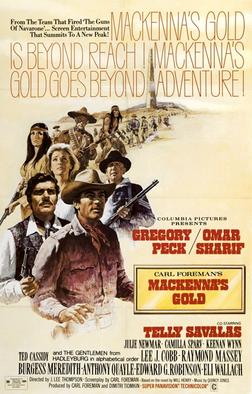
Oh, cable, how I love you. I basically have two channels on if I'm watching TV, either MLB Network or Encore Westerns. A whole channel devoted to western TV shows and movies?!? Aaahhh my head just exploded! It gives me a chance to revisit a whole bunch of movies I haven't seen in years, like 1969's Mackenna's Gold, a big-budget, all-star extravaganza that I remember liking (I think) on my first viewing. Does it hold up?
A marshal for the western town of Hadleyburg, Mackenna (Gregory Peck) is out on the trail when he's ambushed by an old Apache man who dies after a quick shootout. Before he dies, the Apache gives Mackenna a map to a famous, supposedly lost, canyon of gold ('Canon del Oro') that treasure hunters have long sought. Mackenna throws the map in the fire but not before noticing a couple landmarks on it. He's soon cornered by a Mexican bandit, Colorado (Omar Sharif), and his gang who similarly are looking for the canyon of gold. They're not alone. The desert seems full of treasure hunters and gold-hopefuls desperately searching for the gold. Discovering that Mackenna may hold the key to finding the canyon, he's taken along as Colorado's unwilling prisoner. The supposed location is days away across the vast desert with Mackenna, Colorado and his men forced to deal with a do-good posse out of Hadleyburg, an intervening cavalry troop and an Apache war party. How far will the prospect of gold drive all these folks?
I'm a sucker for westerns -- good and bad -- but this one is bad and just not that enjoyable. Talk about a movie where the ingredients don't come together (at all), and you've got this movie. The talent on-hand is unquestionable from director J. Lee Thompson, stars Gregory Peck and Omar Sharif leading a ridiculously deep cast, a cool, potential-filled story and a drop-dead look to it all...it should have been so much better. Or I guess I'd settle for just 'good' too. The formula seems to go after a western Guns of Navarone meets Treasure of the Sierra Madre combination, but it never jells into anything remotely coherent or especially enjoyable. That's tough to say because a cast this good should make a movie pretty decent on its own but alas, it wasn't meant to be this time! If you're looking for a Peck-Thompson-Carl Foreman pairing, stick with 'Navarone.'
Kudos to Encore Westerns. Watching the movie for the second time but first time since 2009, I watched it in widescreen, as it was meant to be. Thompson filmed in Super Panavision 70, a filming technique that fills the screen to epic proportions, almost like a panoramic picture. Shooting on-location in Monument Valley, Glen Canyon and Canyon de Chelly in Arizona adds a great visual appeal to the movie. Shots of riders galloping across these expanses are excellent to watch, a sight to behold, and unfortunately, one of the few genuine positives to take away from a western that's too long at 128 minutes. When a movie's looks are the best thing going...that's never a good thing.
Poor Gregory Peck, he looks like he's as bored as all get-out and doesn't quite know what to do. One of my all-time favorite actors, he's undone by all the shenanigans going on around him. Getting to play straight man to a murdering bandit, a gold-for-eyes posse, a bloodthirsty Apache war party, a murdering cavalry sergeant (an underused Telly Savalas), and all sorts of ancient legends coming to life is never a good thing. As reliable as anyone who's ever graced the screen, Peck is given little more to do than look out for Camilla Sparv's damsel in distress while navigating a love triangle with Julie Newmar's Apache warrior and Sparv. Yeah, you read that right. Catwoman plays an Apache warrior and looks great doing it! She even gets an odd nude swimming scene where she tries to kill both Peck and Sparv. So there's that!
So much of the rest of the cast is simply miscast. I like Sharif in just about any film he's ever done, but he's an odd choice to play our Mexican bandit, Colorado. His gang includes Keenan Wynn as a Mexican bandit named Sanchez, with Ted Cassidy (Lurch from The Addams Family), Rudy Diaz and Robert Phillips as Apache warriors. All spot-on casting! Brace for this list of appearances that amount to little more than cameos, members of a "posse" out of Hadleyburg that's looking for gold. The group includes Eli Wallach, Anthony Quayle, Lee J. Cobb, Burgess Meredith, Raymond Massey and Edward G. Robinson!!! Look at that Hollywood royalty! Unfortunately, they're introduced, given nothing to do and there basically because of their name recognition. So....yeah....there's that! Quite the cast, huh? I just wish they were given more to do. Maybe that character development was cut from the rumored 3-hour version of the film. Yeah, that's it I'm sure.
Just too many moving pieces that never get going in the same direction. There's virtually no story, just some character introductions and then they're off into the desert. The only detour are various ways to kill off characters in waves. Then, there's the beautiful location shooting, with a slight problem. Countless times, one after another, we see the location shots and then a quick cut to our actors in front of a rear projection shot. Nothing takes you out of the story's momentum like Peck, Sharif and Co. riding a "horse" as they tear across the desert. Throw in some odd, out of place narration (it's not Victor Jory's fault!), some painful theme ballads, and generally odd cutting and editing that is more and more jarring with each passing scene.
There's a meanness to the story that's hard to account for. Characters are introduced for the sake of dispatching them in unceremonious fashion, but the general tone of the movie itself isn't that dark. It feels like they're going for that "Greed will make you do horrible things" tone, but it's too light, fluffy and goofy to pull it off. There's some potential obviously with the all-star cast, some equally impressive camera angles and shots, and the location shooting, but there's just too much negative going on to ignore it. A stinker.
Mackenna's Gold (1969): **/****
The Sons of Katie Elder
"First, we reunite, then find Ma and Pa's killer...then read some reviews."
Showing posts with label Omar Sharif. Show all posts
Wednesday, December 30, 2015
Friday, January 30, 2015
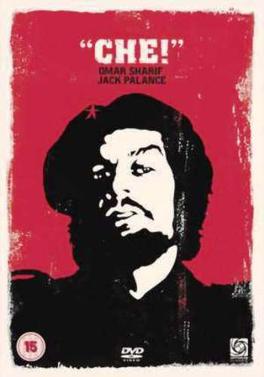
Che!
So by all accounts, everyone agrees a movie is awful. It's made some lists as one of the worst movies ever made. It tackles a controversial subject matter when the wound was still fresh in one of the most turbulent times in world history. The man? Revolutionary Che Guevara. No, it's not Steven Soderbergh's two-part Che. Silly you, I reviewed that HERE and HERE two years ago. It's time for a flick that's been critically panned for years, and don't we all love that?!? Here's 1969's Che!
It's 1956 and a young Che Guevara (Omar Sharif) lands in Cuba with a small revolutionary force of around 80 men commanded by Fidel Castro (Jack Palance). Having studied to be a physician, Che is brought along to be a medic, to treat the wounded but quickly becomes much, much more. As the revolution picks up momentum and followers all across Cuba, Che becomes an essential figure in the fighting, even becoming Castro's right-hand man, a key strategist and tactician in the fighting. It all leads to an overthrow of the government as Fidel, Che and their followers take the head of the coup, installing their own socialist government in 1959. It's just the start though as Cuba becomes a thorn in the side of the United States and worldwide. The revolution has changed though, and Che begins to feel uncomfortable. Maybe he can be of more use elsewhere where the fighting still rages...
Judging by reviews, IMDB ratings, word of mouth, all of the above, this movie from director Richard Fleischer is considered an all-around dud. As a jumping off point, I don't know what it says about me that I didn't think it was that bad. Rather, I was entertained throughout so go figure. Whether you love it or hate it, it's certainly an interesting film. It was made just two years after Che's death in 1967 as the world was tearing itself apart with one bloody conflict after another. My biggest question is 'What was the rush?' in getting a Che Guevara movie into theaters. The script certainly has some issues, packing a ton of stuff (about 10 years) into a 96-minute movie. It has far too many preachy scenes where Sharif's Che expresses his beliefs to anyone and everyone who will listen, and many who couldn't care less. Is it a good movie? No, but it's a fascinating flick in a guilty pleasure sort of way.
Talk about a daunting task. Mr. Sharif, would you be interested in playing infamous revolutionary Che Guevara? Working with a flawed script that tries to accomplish too much in its relatively short running time, Sharif makes the most of it. The screenplay certainly seems based off Guevara's diary and sticks relatively close to the facts of the revolutionary's life. The moments when he's preaching -- repeatedly -- his revolutionary beliefs, his hatred of imperialism (especially America) get to be tedious, but it is in the other, quieter moments where Sharif does an admirable job. We start to see Guevara as a man obsessed with revolution, with chaos, with taking down the system. These beliefs ultimately prove to be his undoing as Che becomes blinded with his goals rather than seeing that his plans simply can't work.
Now the rest of the cast, one actor in particular, has taken some abuse for his role. That man? Steely-eyed, gravelly voiced Jack Palance as Fidel Castro. Wearing a prosthetic nose, sporting big, wire-rimmed glasses and always chomping on a cigar, Palance seems to be playing a stereotype, a cliche of Castro rather than a flesh and blood individual. Fascinating, but not in a good way. The unfortunate part of the cast is that it features a long list of recognizable character actors who popped up in countless 1960s/1970s flicks. Oh, the unfortunate part? They're basically background performers. Some get a line here and there, but for the most part, they walk with Che or are visible in action scenes and dialogue exchanges.
Too bad. Among Che's followers we see Cesare Danova, Robert Loggia, Woody Strode, Perry Lopez, Rudy Diaz, Tom Troupe, Barbara Luna, Linda Marsh and Sid Haig. Other key parts go to Frank Silvera, Albert Paulsen, Rodolfo Acosta, Abraham Sofaer, and Paul Picerni. Just wish they could have been better utilized.
The one thing I can give credit for to this film over the Soderbergh version is that 1969 Che! takes a stance on the revolutionary icon. He's one flawed individual for good and bad. We see what his actions cause in terms of consequence on himself and those around him. In a somewhat odd storytelling device, we see some of the cast directly addressing the camera like a documentary, addressing the developments in Che's life but also in Cuba and Bolivia. Things obviously get a tad dark in the last half hour as Che's efforts in Bolivia never develop as planned. So you know what? I liked this movie. It's not necessarily good, but it's always entertaining (sometimes in a bad way). Still, it's worth a look.
Che! (1969): ***/****
It's 1956 and a young Che Guevara (Omar Sharif) lands in Cuba with a small revolutionary force of around 80 men commanded by Fidel Castro (Jack Palance). Having studied to be a physician, Che is brought along to be a medic, to treat the wounded but quickly becomes much, much more. As the revolution picks up momentum and followers all across Cuba, Che becomes an essential figure in the fighting, even becoming Castro's right-hand man, a key strategist and tactician in the fighting. It all leads to an overthrow of the government as Fidel, Che and their followers take the head of the coup, installing their own socialist government in 1959. It's just the start though as Cuba becomes a thorn in the side of the United States and worldwide. The revolution has changed though, and Che begins to feel uncomfortable. Maybe he can be of more use elsewhere where the fighting still rages...
Judging by reviews, IMDB ratings, word of mouth, all of the above, this movie from director Richard Fleischer is considered an all-around dud. As a jumping off point, I don't know what it says about me that I didn't think it was that bad. Rather, I was entertained throughout so go figure. Whether you love it or hate it, it's certainly an interesting film. It was made just two years after Che's death in 1967 as the world was tearing itself apart with one bloody conflict after another. My biggest question is 'What was the rush?' in getting a Che Guevara movie into theaters. The script certainly has some issues, packing a ton of stuff (about 10 years) into a 96-minute movie. It has far too many preachy scenes where Sharif's Che expresses his beliefs to anyone and everyone who will listen, and many who couldn't care less. Is it a good movie? No, but it's a fascinating flick in a guilty pleasure sort of way.
Talk about a daunting task. Mr. Sharif, would you be interested in playing infamous revolutionary Che Guevara? Working with a flawed script that tries to accomplish too much in its relatively short running time, Sharif makes the most of it. The screenplay certainly seems based off Guevara's diary and sticks relatively close to the facts of the revolutionary's life. The moments when he's preaching -- repeatedly -- his revolutionary beliefs, his hatred of imperialism (especially America) get to be tedious, but it is in the other, quieter moments where Sharif does an admirable job. We start to see Guevara as a man obsessed with revolution, with chaos, with taking down the system. These beliefs ultimately prove to be his undoing as Che becomes blinded with his goals rather than seeing that his plans simply can't work.
Now the rest of the cast, one actor in particular, has taken some abuse for his role. That man? Steely-eyed, gravelly voiced Jack Palance as Fidel Castro. Wearing a prosthetic nose, sporting big, wire-rimmed glasses and always chomping on a cigar, Palance seems to be playing a stereotype, a cliche of Castro rather than a flesh and blood individual. Fascinating, but not in a good way. The unfortunate part of the cast is that it features a long list of recognizable character actors who popped up in countless 1960s/1970s flicks. Oh, the unfortunate part? They're basically background performers. Some get a line here and there, but for the most part, they walk with Che or are visible in action scenes and dialogue exchanges.
Too bad. Among Che's followers we see Cesare Danova, Robert Loggia, Woody Strode, Perry Lopez, Rudy Diaz, Tom Troupe, Barbara Luna, Linda Marsh and Sid Haig. Other key parts go to Frank Silvera, Albert Paulsen, Rodolfo Acosta, Abraham Sofaer, and Paul Picerni. Just wish they could have been better utilized.
The one thing I can give credit for to this film over the Soderbergh version is that 1969 Che! takes a stance on the revolutionary icon. He's one flawed individual for good and bad. We see what his actions cause in terms of consequence on himself and those around him. In a somewhat odd storytelling device, we see some of the cast directly addressing the camera like a documentary, addressing the developments in Che's life but also in Cuba and Bolivia. Things obviously get a tad dark in the last half hour as Che's efforts in Bolivia never develop as planned. So you know what? I liked this movie. It's not necessarily good, but it's always entertaining (sometimes in a bad way). Still, it's worth a look.
Che! (1969): ***/****
Friday, August 16, 2013
The Burglars
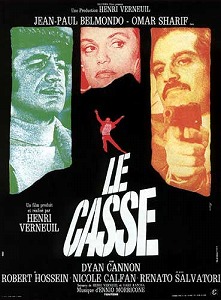
Well, give me credit. I'm timely every so often....now whether I intended to be timely, that's a different story. A few days ago I reviewed an underrated film noir from 1957, The Burglar, only to find out I had also recorded another version of the same novel by author David Goodis. Well, it's alike in basic -- very basic -- storyline alone, going down a different route in 1971's The Burglars. It's plural this time!
Working with a small crew of thieves, a master crook named Azad (Jean-Paul Belmondo) pulls off an impossible job, robbing a wealthy Greek businessman (Jose Luis de Vilallonga) of a million dollar's worth of rare emeralds. The plan goes off without a hitch, or so Azad and the crew think. A suspicious police officer, Abel Zacharia (Omar Sharif), is onto them and knows what they're trying. His only issue becomes proving their guilt, finding them while they're carrying the emeralds. Azad is ready to make his getaway out of a Greek port, but the ship is undergoing maintenance and can't leave for five more days. Now, he must improvise, getting the persistent -- and dirty -- cop off his trail. Can the crew stay quiet and hidden away until they're ready to escape?
Okay, get the basic plot from Goodis' novel and then go with it. That's all this 1971 version really has to do with its source novel or its 1957 predecessor. Now that said, it isn't a bad thing. Director Henri Verneuil has a good film somewhere in his 120-minute movie, but it's finding that movie that proves difficult. Reading a plot description, I thought I was getting a hard boiled heist flick, and in doses, that's what it is. Without much of a transition, one scene will be brutally dark, the next oddly off the wall. Then, we get some weird aside at an "erotic club" followed by one of the craziest, best car chases I've ever seen in a film. While I liked 'Burglars,' I also thought it was far too schizophrenic to be a movie that received a straight-up positive review. When it works though, it really works. It's getting to that point.
The positives are pretty obvious, starting with Belmondo and Sharif as the two leads, the cat-and-mouse rivals. I've yet to be impressed with Belmondo -- I still don't get the appeal of Breathless -- in the films I've seen, but this performance is a gem. He sounds dubbed but apparently that's him (go figure). Most surprisingly though, he proves himself as an action star, handling his own stunts for the most part including a couple ridiculous stunts. He literally rides the side of a handful of buses on busy streets and later takes a rolling fall down the side of a hill with an almost sheer face. His character itself is pretty cool, a confident, slightly showy thief who thinks he has no rivals, always believing he can outsmart Sharif's cop if it comes down to it. That smartass smile/smirk plays well though, and I really liked what he did with the character.
Doing a 180 from most of his hero performances, Sharif looks to be having a ball as the sinister, truly brutal cop, Abel Zacharia, looking to line his own pockets in "catching" Azad. At first glance, he appears to be a pretty normal cop but with each passing scene we learn the true depths of how far he'll go for a payday. Dyan Cannon plays Lena, a nude model and quasi-Playmate of sorts who catches Azad's eye and may be letting on more than she knows. Robert Hossein, Nicole Calfan and Renato Salvatori round out Azad's crew, none really given much to do with the spotlight on Belmondo and Sharif.
Coupled with the tough guy leads, 'Burglars' manages to stand free of the crowd because of the action. A 13-minute car chase about 30 minutes into the movie is ridiculous to the point of being overindulgent. We're talking two cars that should have blown up miles and crashes ago still running and doing so smoothly. It gives us some solid new additions to the car chase sequence too, never a bad thing. Watch it HERE. When there is action, it's handled expertly, including another slightly lower key chase with Belmondo jumping from moving bus to moving bus (again, doing all his own stunts seemingly). Watch a really solid stunt montage HERE. There is a simple professionalism to these scenes that just works well. Not flashy, just efficiently effective. Oh, and composer Ennio Morricone turns in a quiet, understated gem of a soundtrack. Didn't see that coming, did you?
So anyhoo.....the movie does have some flaws. The opening heist sequence is so interested in the gory, boring and downright dull details of how they're pulling the job that any tension gets thrown out the window. What should be a great opening, building momentum is actually a hindrance to a story that ends up being pretty good. A later departure to Cannon's "erotic club" goes on far too long, and in general, too much time is spent with Cannon for a disappointing payoff late in the movie. It is a movie that could have been tightened up at several different points along the way. It's also trying to be funny, action-packed, slightly romantic, full of drama, and it just doesn't always work. In the end, it could have been a near classic, but as is, it's a very watchable heist movie with some pretty severe flaws. Give the movie a watch HERE at Youtube.
The Burglars (1971): ** 1/2 /****
Working with a small crew of thieves, a master crook named Azad (Jean-Paul Belmondo) pulls off an impossible job, robbing a wealthy Greek businessman (Jose Luis de Vilallonga) of a million dollar's worth of rare emeralds. The plan goes off without a hitch, or so Azad and the crew think. A suspicious police officer, Abel Zacharia (Omar Sharif), is onto them and knows what they're trying. His only issue becomes proving their guilt, finding them while they're carrying the emeralds. Azad is ready to make his getaway out of a Greek port, but the ship is undergoing maintenance and can't leave for five more days. Now, he must improvise, getting the persistent -- and dirty -- cop off his trail. Can the crew stay quiet and hidden away until they're ready to escape?
Okay, get the basic plot from Goodis' novel and then go with it. That's all this 1971 version really has to do with its source novel or its 1957 predecessor. Now that said, it isn't a bad thing. Director Henri Verneuil has a good film somewhere in his 120-minute movie, but it's finding that movie that proves difficult. Reading a plot description, I thought I was getting a hard boiled heist flick, and in doses, that's what it is. Without much of a transition, one scene will be brutally dark, the next oddly off the wall. Then, we get some weird aside at an "erotic club" followed by one of the craziest, best car chases I've ever seen in a film. While I liked 'Burglars,' I also thought it was far too schizophrenic to be a movie that received a straight-up positive review. When it works though, it really works. It's getting to that point.
The positives are pretty obvious, starting with Belmondo and Sharif as the two leads, the cat-and-mouse rivals. I've yet to be impressed with Belmondo -- I still don't get the appeal of Breathless -- in the films I've seen, but this performance is a gem. He sounds dubbed but apparently that's him (go figure). Most surprisingly though, he proves himself as an action star, handling his own stunts for the most part including a couple ridiculous stunts. He literally rides the side of a handful of buses on busy streets and later takes a rolling fall down the side of a hill with an almost sheer face. His character itself is pretty cool, a confident, slightly showy thief who thinks he has no rivals, always believing he can outsmart Sharif's cop if it comes down to it. That smartass smile/smirk plays well though, and I really liked what he did with the character.
Doing a 180 from most of his hero performances, Sharif looks to be having a ball as the sinister, truly brutal cop, Abel Zacharia, looking to line his own pockets in "catching" Azad. At first glance, he appears to be a pretty normal cop but with each passing scene we learn the true depths of how far he'll go for a payday. Dyan Cannon plays Lena, a nude model and quasi-Playmate of sorts who catches Azad's eye and may be letting on more than she knows. Robert Hossein, Nicole Calfan and Renato Salvatori round out Azad's crew, none really given much to do with the spotlight on Belmondo and Sharif.
Coupled with the tough guy leads, 'Burglars' manages to stand free of the crowd because of the action. A 13-minute car chase about 30 minutes into the movie is ridiculous to the point of being overindulgent. We're talking two cars that should have blown up miles and crashes ago still running and doing so smoothly. It gives us some solid new additions to the car chase sequence too, never a bad thing. Watch it HERE. When there is action, it's handled expertly, including another slightly lower key chase with Belmondo jumping from moving bus to moving bus (again, doing all his own stunts seemingly). Watch a really solid stunt montage HERE. There is a simple professionalism to these scenes that just works well. Not flashy, just efficiently effective. Oh, and composer Ennio Morricone turns in a quiet, understated gem of a soundtrack. Didn't see that coming, did you?
So anyhoo.....the movie does have some flaws. The opening heist sequence is so interested in the gory, boring and downright dull details of how they're pulling the job that any tension gets thrown out the window. What should be a great opening, building momentum is actually a hindrance to a story that ends up being pretty good. A later departure to Cannon's "erotic club" goes on far too long, and in general, too much time is spent with Cannon for a disappointing payoff late in the movie. It is a movie that could have been tightened up at several different points along the way. It's also trying to be funny, action-packed, slightly romantic, full of drama, and it just doesn't always work. In the end, it could have been a near classic, but as is, it's a very watchable heist movie with some pretty severe flaws. Give the movie a watch HERE at Youtube.
The Burglars (1971): ** 1/2 /****
Labels:
1970s,
Car Movies,
Heist movies,
Jean-Paul Belmondo,
Omar Sharif
Monday, September 24, 2012
Doctor Zhivago
By 1965, director David Lean had already completed two of his most highly regarded and well-respected movies of his prestigious career. With 1957's The Bridge on the River Kwai and 1962's Lawrence of Arabia, Lean basically defined how a director should make a gigantic film epic. So some three years later, he followed up with 1965's Doctor Zhivago, a film I'm still digesting -- for good and bad -- some three days later.
A doctoral student who grew up with an adopted family of sorts, Yuri Zhivago (Omar Sharif) is an aspiring poet in the early 1910s in Russia. He marries childhood friend and longtime love, Tonya (Geraldine Chaplin), and starts a family. Growing up with a single mother, Lara (Julie Christie) goes through some harsh teenage years as she deals with a troubled single mother. As Russia is thrust into World War I -- the fighting eventually turning into the Russian Revolution -- Yuri (working as a doctor) and Lara (as a nurse) meet amongst the aftermath of a battle. They are instantly drawn to each other as they work side-by-side, but as the conflict escalates, this is a relationship that seems doomed to failure.
Wow, I'm not proud of that plot synopsis. It sounds like I'm reading a cheesy romance novel. Anyways, onto bigger, better and more on-point things. This is a GIGANTIC movie as one would come to expect from a David Lean epic. With locations in Spain, Canada and Finland, the scale is a pleasure to watch. Lean and cinematographer Freddie Young shoot each scene -- the snow-capped mountains, the desolate wastelands, the flower-covered plains -- like a Renaissance painting. It is a stunningly gorgeous film, one you can just sit back and experience. Composer Maurice Jarre's score won the Oscar -- rightfully so -- with Lara's Theme (listen HERE) an instantly recognizable, beautiful tune, one that you'll be humming for days. The sets are expansive, the cast numbering in the thousands with extras, and the story covers a time in history (Russia in the 1910s/1920s) that is rich with depth.
So what happens then? Why do I feel conflicted about this Lean-directed epic? In a 200-minute movie, there exists little to no story. It moves from location to location and time to time with transitions that can be jarring at times. My lack of knowledge about Russian history certainly did NOT help my enjoyment and/or appreciation of what was going on. I don't think lyrical is the right description, but it's all I'm coming up with. Story is also a word I use lightly. It isn't really a story so much as a budding relationship that develops over many years and all the people caught up and effected by it. We see snippets of a time/conflict/place, and then zip to another spot. Because of that, I never felt in tune with what was going on, feeling at times very disconnected from the plot.
And onto the cast, much easier to decipher. For one of the all-time great love stories, I didn't think much of the chemistry (or lack of) between Sharif and Christie. Omar Sharif is a very talented actor, and he does a fine job as Yuri Zhivago showing a man's flaws, imperfections and talents. Christie too as Lara is an interesting character, neither individual perfect by any means. I appreciated that. We're watching human beings, not immaculate individuals, but in terms of on-screen chemistry I was not buying Sharif and Christie as a couple that is drawn to each other in an unexplained way, not letting time or circumstances tear them apart. Christie is stunningly beautiful as Lara with Lean electing to photograph her like an angel, especially her blue, blue, BLUE eyes.
The name recognition from the supporting cast will draw in many film fans and understandably so. You don't put a cast together with the likes of Rod Steiger, Alec Guinness, Tom Courtenay, Chaplin, Klaus Kinski and Ralph Richardson together without causing a stir in the acting department. Among that group, there isn't a weak link in the bunch. Some are more impressive than others -- Steiger, Guinness, Chaplin and Kinski -- but the lack of a true, developing story hurts all of the performances. Steiger and Courtenay disappear for long stretches, only to reappear as the story requires. I just don't know how to describe this. I enjoyed the actors, enjoyed seeing their performances, but something just didn't click.
There are moments of near perfection amidst some of the rather leisurely 200-minute running time. After a sluggish first 45-60 minutes, things get flowing at a quicker, more enjoyable pace. Not surprisingly, the high points are several chaotic, impressively staged action sequences. One especially, Bolshevik cavalry charging across an ice-covered lake, stands out. An encounter between Russian replacements and Russian deserters on a wayward, desolate plain is simple in its brutality. Much of the success in these moments come from the visual that Lean and Young created. A framing device at the beginning and end with Guinness (a veteran Communist officer) interviewing a young woman (Rita Tushingham) who could be Yuri and Lara's daughter too is especially effective. The ending too goes right for the jugular, a heart-breaking ending for Yuri and Lara.
I'm torn on what to do here. I can appreciate why so many film fans adore this movie. I can also easily appreciate why some struggle to go along for the ride. Not to use a cop out, but I fall somewhere in between. I loved parts of it, liked others and struggled to go along for other portions. I love both 'River Kwai' and 'Lawrence' so Zhivago had some big shoes to fill in the expectations department, but it never quite lived up to them. Still a must-see film just for the scale and talent involved, but not the classic I was hoping it to be.
Doctor Zhivago <---trailer (1965): ** 1/2 /****
A doctoral student who grew up with an adopted family of sorts, Yuri Zhivago (Omar Sharif) is an aspiring poet in the early 1910s in Russia. He marries childhood friend and longtime love, Tonya (Geraldine Chaplin), and starts a family. Growing up with a single mother, Lara (Julie Christie) goes through some harsh teenage years as she deals with a troubled single mother. As Russia is thrust into World War I -- the fighting eventually turning into the Russian Revolution -- Yuri (working as a doctor) and Lara (as a nurse) meet amongst the aftermath of a battle. They are instantly drawn to each other as they work side-by-side, but as the conflict escalates, this is a relationship that seems doomed to failure.
Wow, I'm not proud of that plot synopsis. It sounds like I'm reading a cheesy romance novel. Anyways, onto bigger, better and more on-point things. This is a GIGANTIC movie as one would come to expect from a David Lean epic. With locations in Spain, Canada and Finland, the scale is a pleasure to watch. Lean and cinematographer Freddie Young shoot each scene -- the snow-capped mountains, the desolate wastelands, the flower-covered plains -- like a Renaissance painting. It is a stunningly gorgeous film, one you can just sit back and experience. Composer Maurice Jarre's score won the Oscar -- rightfully so -- with Lara's Theme (listen HERE) an instantly recognizable, beautiful tune, one that you'll be humming for days. The sets are expansive, the cast numbering in the thousands with extras, and the story covers a time in history (Russia in the 1910s/1920s) that is rich with depth.
So what happens then? Why do I feel conflicted about this Lean-directed epic? In a 200-minute movie, there exists little to no story. It moves from location to location and time to time with transitions that can be jarring at times. My lack of knowledge about Russian history certainly did NOT help my enjoyment and/or appreciation of what was going on. I don't think lyrical is the right description, but it's all I'm coming up with. Story is also a word I use lightly. It isn't really a story so much as a budding relationship that develops over many years and all the people caught up and effected by it. We see snippets of a time/conflict/place, and then zip to another spot. Because of that, I never felt in tune with what was going on, feeling at times very disconnected from the plot.
And onto the cast, much easier to decipher. For one of the all-time great love stories, I didn't think much of the chemistry (or lack of) between Sharif and Christie. Omar Sharif is a very talented actor, and he does a fine job as Yuri Zhivago showing a man's flaws, imperfections and talents. Christie too as Lara is an interesting character, neither individual perfect by any means. I appreciated that. We're watching human beings, not immaculate individuals, but in terms of on-screen chemistry I was not buying Sharif and Christie as a couple that is drawn to each other in an unexplained way, not letting time or circumstances tear them apart. Christie is stunningly beautiful as Lara with Lean electing to photograph her like an angel, especially her blue, blue, BLUE eyes.
The name recognition from the supporting cast will draw in many film fans and understandably so. You don't put a cast together with the likes of Rod Steiger, Alec Guinness, Tom Courtenay, Chaplin, Klaus Kinski and Ralph Richardson together without causing a stir in the acting department. Among that group, there isn't a weak link in the bunch. Some are more impressive than others -- Steiger, Guinness, Chaplin and Kinski -- but the lack of a true, developing story hurts all of the performances. Steiger and Courtenay disappear for long stretches, only to reappear as the story requires. I just don't know how to describe this. I enjoyed the actors, enjoyed seeing their performances, but something just didn't click.
There are moments of near perfection amidst some of the rather leisurely 200-minute running time. After a sluggish first 45-60 minutes, things get flowing at a quicker, more enjoyable pace. Not surprisingly, the high points are several chaotic, impressively staged action sequences. One especially, Bolshevik cavalry charging across an ice-covered lake, stands out. An encounter between Russian replacements and Russian deserters on a wayward, desolate plain is simple in its brutality. Much of the success in these moments come from the visual that Lean and Young created. A framing device at the beginning and end with Guinness (a veteran Communist officer) interviewing a young woman (Rita Tushingham) who could be Yuri and Lara's daughter too is especially effective. The ending too goes right for the jugular, a heart-breaking ending for Yuri and Lara.
I'm torn on what to do here. I can appreciate why so many film fans adore this movie. I can also easily appreciate why some struggle to go along for the ride. Not to use a cop out, but I fall somewhere in between. I loved parts of it, liked others and struggled to go along for other portions. I love both 'River Kwai' and 'Lawrence' so Zhivago had some big shoes to fill in the expectations department, but it never quite lived up to them. Still a must-see film just for the scale and talent involved, but not the classic I was hoping it to be.
Doctor Zhivago <---trailer (1965): ** 1/2 /****
Tuesday, April 3, 2012
The Last Valley
A longtime member of my 'Saved DVDs' option at Netflix, 1971's The Last Valley was finally made available this week, and I was delivered a pleasant surprise as the opening credits rolled, besides the strong casting. The film is directed by James Clavell, someone I think of as an author more than a director. The director of only six films in his career, Clavell is at the head of a different but still impressive historical epic.
It is the middle of the Thirty Years War in the early 1600s and a war that started off about religion in Germany has expanded to other European powers. Walking across a famine-ridden country, a former teacher, Vogel (Omar Sharif) stumbles across a beautiful valley up in the hills seemingly immune from the touches of war. The villagers living in the valley are away for the time, but behind Vogel comes a small company of mercenaries led by the Captain (Michael Caine). Vogel convinces them to winter in the village/valley, the mercenaries forming the uneasiest of alliances with the village leader, Gruber (Nigel Davenport), and the people. Vogel finds himself working as a mediator, both sides not happy with the other as this little valley is thrust into the war for the first time.
In the era of historical epics, this is a late entry to the genre. Clavell wrote, produced and directed this historical epic that I can only describe as...different, in a good way. It doesn't really have a similar movie you can even remotely compare it to. It deals with religion and faith, the lunacy of war, the lunacy of religion, corruption, blind faith, and generally boasts a cynicism that would have been prevalent at the time in the minds of the audience. Without getting pretentious, 'Valley' tries to ask what is the point of fighting? What's the point of a religion that forces its believers to fight and die simply because someone tells them to do so? In all its darkness and cynicism, I liked this movie because of those different features. It doesn't settle for the status quo and impressing with scale. This movie has that impressive scale with a worthwhile message to boot.
If you're going to do a historical epic, do it right in the casting department. Two of the best names around for an epic -- Caine and Sharif -- don't disappoint in their performances. Caine especially delivers an underrated, moving performance as the Captain, a long-time mercenary who's grown weary of the futility of battle, war, and organized religion. He continues to fight, meeting confrontations head on rather than taking the easy way out and running away. His counter is Sharif as Vogel, an intellectual, a former teacher who wants to talk things out, negotiate rather than fight it out. The duo plays well off each other as their situation becomes harder to handle. Neither truly knows what, but both men are looking for something while trying to put their past behind them. At what cost will it come though?
The ensemble cast that backs the duo up does not boast much name recognition, but the characters from Clavell's script come to life with the cast, a wide variety of eclectic characters. Florinda Bolkan plays Erica, a woman in the village who moves in with the Captain, her personal/religious beliefs ready to cause a stir among these God-fearing folks. Davenport as Gruber is perfect, a simmering pot of violence and manipulation just waiting to strike. Per Oscarsson plays Father Sebastian, the village's Christian priest, a religious fanatic who must have things his way. Arthur O'Connell seems like an odd choice to play Hoffman, one of the elder villagers, with his daughter, Inge (Madeleine Hinde), drawing the eye of the mercenaries and Vogel. I especially liked the dynamic among Captain's mercenaries, including the treacherous Hansen (Michael Gothard) and brutal right-hand man Graf (Ian Hogg) among a handful of other characters who would have benefited from more screen-time/development.
The story with a message and a solid cast is aided by two things; location shooting in Austria and the musical score from John Barry. It ends up sounding like an action- gothic horror score with hints of James Bond music. Oddly/bizarrely enough, it works really well. Go figure. Listen to 3 different parts HERE. 'Valley' shot on location in Austria for this mountain valley, and the end result is stunning. Watching the story unfold, it's easy to see why everyone involved is willing to work and fight for their homes, an idyllic green valley with sweeping fields and tree-covered hillsides. Clavell uses a wide camera lens to show the beauty of the Trins, Tol location and doesn't disappoint. Digging a little deeper, I question if there was symbolism going on here. Sharif's Vogel finds the village through a fog-covered forest surrounded by burned out, plague-infested villages. Is this village in the midst, seemingly untouched, some sort of heaven? Maybe not, but it's a cool thought to keep in mind as you watch this gothic historical epic.
My one complaint is that the sweeping story tends to drift a little too much at 125 minutes. It's never slow, but with so many characters and situations, the at-times episodic storytelling drags the pace down. 'Valley' seems to know where it's going though, and the ending -- in all its ambiguous doom and gloom -- works especially well. Its message is simple. War is stupid. Religion is stupid. Fighting for religion blindly? Inexcusable. Think for yourself and decide what's right, not what someone else tells you. Watch the whole movie HERE with Part 1 of 10.
The Last Valley <---trailer (1971): ***/****
It is the middle of the Thirty Years War in the early 1600s and a war that started off about religion in Germany has expanded to other European powers. Walking across a famine-ridden country, a former teacher, Vogel (Omar Sharif) stumbles across a beautiful valley up in the hills seemingly immune from the touches of war. The villagers living in the valley are away for the time, but behind Vogel comes a small company of mercenaries led by the Captain (Michael Caine). Vogel convinces them to winter in the village/valley, the mercenaries forming the uneasiest of alliances with the village leader, Gruber (Nigel Davenport), and the people. Vogel finds himself working as a mediator, both sides not happy with the other as this little valley is thrust into the war for the first time.
In the era of historical epics, this is a late entry to the genre. Clavell wrote, produced and directed this historical epic that I can only describe as...different, in a good way. It doesn't really have a similar movie you can even remotely compare it to. It deals with religion and faith, the lunacy of war, the lunacy of religion, corruption, blind faith, and generally boasts a cynicism that would have been prevalent at the time in the minds of the audience. Without getting pretentious, 'Valley' tries to ask what is the point of fighting? What's the point of a religion that forces its believers to fight and die simply because someone tells them to do so? In all its darkness and cynicism, I liked this movie because of those different features. It doesn't settle for the status quo and impressing with scale. This movie has that impressive scale with a worthwhile message to boot.
If you're going to do a historical epic, do it right in the casting department. Two of the best names around for an epic -- Caine and Sharif -- don't disappoint in their performances. Caine especially delivers an underrated, moving performance as the Captain, a long-time mercenary who's grown weary of the futility of battle, war, and organized religion. He continues to fight, meeting confrontations head on rather than taking the easy way out and running away. His counter is Sharif as Vogel, an intellectual, a former teacher who wants to talk things out, negotiate rather than fight it out. The duo plays well off each other as their situation becomes harder to handle. Neither truly knows what, but both men are looking for something while trying to put their past behind them. At what cost will it come though?
The ensemble cast that backs the duo up does not boast much name recognition, but the characters from Clavell's script come to life with the cast, a wide variety of eclectic characters. Florinda Bolkan plays Erica, a woman in the village who moves in with the Captain, her personal/religious beliefs ready to cause a stir among these God-fearing folks. Davenport as Gruber is perfect, a simmering pot of violence and manipulation just waiting to strike. Per Oscarsson plays Father Sebastian, the village's Christian priest, a religious fanatic who must have things his way. Arthur O'Connell seems like an odd choice to play Hoffman, one of the elder villagers, with his daughter, Inge (Madeleine Hinde), drawing the eye of the mercenaries and Vogel. I especially liked the dynamic among Captain's mercenaries, including the treacherous Hansen (Michael Gothard) and brutal right-hand man Graf (Ian Hogg) among a handful of other characters who would have benefited from more screen-time/development.
The story with a message and a solid cast is aided by two things; location shooting in Austria and the musical score from John Barry. It ends up sounding like an action- gothic horror score with hints of James Bond music. Oddly/bizarrely enough, it works really well. Go figure. Listen to 3 different parts HERE. 'Valley' shot on location in Austria for this mountain valley, and the end result is stunning. Watching the story unfold, it's easy to see why everyone involved is willing to work and fight for their homes, an idyllic green valley with sweeping fields and tree-covered hillsides. Clavell uses a wide camera lens to show the beauty of the Trins, Tol location and doesn't disappoint. Digging a little deeper, I question if there was symbolism going on here. Sharif's Vogel finds the village through a fog-covered forest surrounded by burned out, plague-infested villages. Is this village in the midst, seemingly untouched, some sort of heaven? Maybe not, but it's a cool thought to keep in mind as you watch this gothic historical epic.
My one complaint is that the sweeping story tends to drift a little too much at 125 minutes. It's never slow, but with so many characters and situations, the at-times episodic storytelling drags the pace down. 'Valley' seems to know where it's going though, and the ending -- in all its ambiguous doom and gloom -- works especially well. Its message is simple. War is stupid. Religion is stupid. Fighting for religion blindly? Inexcusable. Think for yourself and decide what's right, not what someone else tells you. Watch the whole movie HERE with Part 1 of 10.
The Last Valley <---trailer (1971): ***/****
Saturday, February 18, 2012
Juggernaut
On board the ocean liner Brittanica, Captain Alex Brunel (Omar Sharif) is in charge of 1,200 passengers traveling from England to New York City. The ship is only a day or so removed from port when a message comes in. A terrorist identified only as Juggernaut has placed seven bombs on-board the ship. He's demanding a ransom of half a million pounds to be delivered by dawn the next morning. If he doesn't receive the money, the bombs will explode. Working against a clock, a bomb disposal team led by Lt. Commander Anthony Fallon (Richard Harris) and right hand man, Charlie Braddock (David Hemmings), are flown in to defuse the bombs. Can they disarm them in time?
My usual picture of disaster movies is chaotic throngs of nameless individuals running around like their hair is on fire, old people and children trampled underfoot. Then Gene Hackman or Paul Newman steps to the forefront and saves the day, calming the masses with one soothing speech. In a lot of ways then, director Richard Lester has created the anti-disaster movie. A somber falls over the ship when the news of the bomb is released, the passengers realizing they can do nothing but sit back and wait, and hope. There is an almost documentary-like feel to Juggernaut, and a general low-key feeling of high-tension situation. It isn't the chaos or violence that erupts, but that sense of doom and dread knowing death waits with the sunrise. A disaster movie doesn't have to be aggressive and in your face to be effective. It just has to hit you emotionally in some way, and it does here. How would you respond in this dire situation?
Maybe Juggernaut doesn't have the huge names other disaster movies do, but it's still a memorable cast listing. More on Harris and Hemmings later, but let's start with Mr. Sharif, calmly cool as the Britannic's captain. He's given little to do other than try and stay calm, but because it is Omar Sharif it is at least watchable in its ho-hum ways. Anthony Hopkins plays Superintendent McCleod, a police officer leading the investigation to find the bomber back in England, also working with some extra motivation, his wife (Caroline Mortimer) and kids are on board. Ian Holm is Porter, the Britannic's company owner trying to fix the situation as best as possible. Shirley Knight plays a single woman who hooks up with Sharif's captain, trying to figure the man out. Roy Kinnear and Jack Watson play two members of the crew while Clifton James has a good part as an American politician with a unique outlook on the situation.
With a story that focuses on the horrific situation more than the personal aspect of the characters, something has got to keep you interested at that individual, person-to-person level. For me, that part came through with Harris and Hemmings as the leaders of the bomb squad. An early introduction shows them disarming a bomb in a London museum only to be called away to another rescue mission. We learn little about them other than Harris' Fallon has yet to meet a bomb he can't defuse, but because of the horrifying aspects of their job, it becomes personal. They live on a day-to-day basis, surviving one day at a time because honestly, they have no idea when their end will come. Harris is a scene stealer and the best thing going for Juggernaut, confident, cocky and ready with a joke because that's the only way he knows how to cope. His brotherly relationship with Hemmings is spot-on, a friendship that could only be a product of years of working together in this death-defying situation.
As mentioned before, what sets Juggernaut apart from so many other still entertaining movies is the bomb aspect. Much of the second half of the movie is spent with Harris, Hemmings and their team sitting in front of these seven bombs placed in oil drums that will explode if moved even a little. Harris' Fallon goes first, experimenting to see what will work, his team following suit. If something goes wrong (i.e. the bomb explodes), the team picks up where he left off. Tension doesn't begin to describe these scenes. The camera is right there on the ground with them in the dark passageways of this immense ocean liner. That documentary feel gives you the sensation of being there with them. The clock keeps ticking down, and what do you think happens? It's a cliche, but a good one. A blue wire and a red wire. Which one do you cut?
Is it possible for a disaster movie to be low-key and still be effective? Juggernaut proves that it can. Not remembered with some of the classic disaster flicks, but it is a good one nonetheless. Good cast, unique twist on a familiar formula, and tension and adrenaline to spare. Well worth checking out.
Juggernaut <---trailer (1974): ***/****
Subscribe to:
Posts (Atom)