The Sons of Katie Elder

The Sons of Katie Elder
"First, we reunite, then find Ma and Pa's killer...then read some reviews."
Showing posts with label Alan Hale. Show all posts

Tuesday, December 23, 2014

The Adventures of Robin Hood

Errol Flynn was a lot of things in a legendary career early in Hollywood's history. He was a swashbuckler, a boxer, a gunfighter, a rabble-rouser in his personal life, someone who lived life to the fullest. But what is that one role, that one part that is instantly recognized as his best? Well, that one's easy, 1938's The Adventures of Robin Hood.

It's 1191 A.D. and the English king, Richard the Lionheart, has been captured by the enemy while returning from the Crusades. In steps his greedy, manipulative brother, Prince John (Claude Rains), who takes over the crown and instantly starts to take advantage of his power. In a growing battle between the Normans and the Saxons, the put-upon people need help, someone to fight back. That man? A Saxon nobleman, Robin Hood (Flynn), who takes to Sherwood Forest with a gang of bandits to be a constant thorn in the side of Prince John and his enforcer, Sir Guy of Gisbourne (Basil Rathbone). They're not any bandits though. They aren't in for personal gain. Robin and his men become heroes as they give their spoils to the people from the money to the food they take. What's their end goal though? Can they somehow take down Prince John?

So everyone has heard of Robin Hood right? His historical reality has long been debated because...well, people just aren't sure he existed. So real or not, the character has become an instantly recognizable individual in literature and storytelling. From directors Michael Curtiz and William Keighley, 'Adventures' was a profoundly important film in Hollywood history. It's the big, splashy, colorful adventure film that helped set the stage for action and adventure films for years to come. The action-packed story with romance and intrigue and all sorts of craziness picked up four Oscar nominations, winning three, and is a perennial entry on all sorts of 'Best' lists, including several AFI lists. Can't go wrong, right?

Start with Errol Flynn. He's one of my favorite movie stars ever, the type of star/actor I'll check out a movie solely because he's in it. There aren't a lot of those stars around then or now. But in a career of memorable parts, this is THE part. He was meant to play Robin Hood. Flynn brings the perfect energy to this folklore character. That infectious smile, that loving-life laugh, that physicality as he swings across the scene (quite literally), fights his way through one sword fight after another, and unleashes arrow after arrow at his pursuers. You can't help but like the character, Flynn bringing him to life and influencing every other Robin Hood portrayal to follow for years whether it be on film, on television and even literature. That Errol Flynn guy. He knew what he was doing.

'Adventures' boasts a solid all-around cast in support of Flynn. The villains are perfectly dastardly, doing all sorts of malicious evil. Rains is the smooth, suave Prince John (slightly effeminate) while Rathbone gets to play the far more sinister Sir Guy, progressively becoming more obsessed with capturing and hanging Robin. Frequent Flynn co-star Olivia De Havilland (they would work together in 8 films) is memorable as Maid Marian, promised to Sir Guy while falling for Robin when she's taken prisoner. Their chemistry is evident throughout just like it was in all their pairings together. As for Robin's Merry men, look for Patrick Knowles as Will Scarlett, Eugene Pallette as Friar Tuck, Alan Hale as Little John, and Herbert Mundin as Much, a mousey squirrel. There's also Melville Cooper as the semi-bumbling but amusing Sheriff of Nottingham and Ian Hunter as King Richard.

Here's my spot here. I appreciate what this movie meant in terms of Hollywood and historical significance, but I didn't love the movie. I liked it a lot, but a slower last 45 minutes left me disappointed. Still....it's a really good movie. It's that perfect popcorn escapism, great good guys and black and white bad guys. The color scheme is a gem, one of the first Hollywood films to really embrace shooting in color. Robin and his Merry men in their Lincoln green uniforms, Prince John and Sir Guy in their bright red, the colors are rich and vivid throughout. As well, the Oscar-winning score from composer Erich Wolfgang Korngold is a gem, several instantly recognizable themes keeping the action flowing throughout (listen HERE). The action is fun and full of some great stunts, several large-scale battles and scuffles dotting the story. An easy movie to recommend.

The Adventures of Robin Hood (1938): ***/****

Monday, October 8, 2012

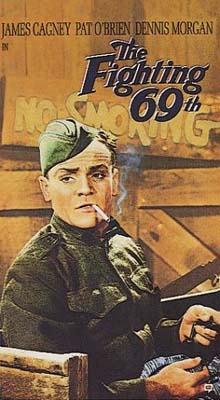
The Fighting 69th

A famous military unit -- the 69th New York --, the most decorated cleric in U.S. military history -- Father Francis Duffy -- and a movie star at the height of his game. Throw those three things together and what do you get? A sometimes overdone, mostly effective and definitely a product of its time, 1940's The Fighting 69th.

As the United States enters the fighting in 1917 in World War I, units are assembled all over the country, including the 69th New York, a regiment dating back to its fighting with the Union in the Civil War. At the head of the unit is Major Wild Bill Donovan (George Brent) who intends to shape up his regiment composed almost entirely of Irishmen from all over the state, and he does so with the help of Catholic priest Father Duffy (Pat O'Brien). Among the new recruits though is a troublemaker, Jerry Plunkett (James Cagney), a spark plug of a man with no real regard for authority who only wants to get to Europe and kill his fair share of Germans.

From director William Keighley, this 1940 war picture rises above a fair share of limitations while using the concept of a 'unit picture' as a jumping off point. It takes a group of men -- in this case the very Irish 69th New York -- and takes us through their training and/or bonding, deployment in war, and then the actual battles. Even with a 1940 release, 'Fighting' does a good job portraying the horrors of WWI. Trench warfare produced some of the nastiest fighting the world has ever seen, and it's easy to see why here. Certain shots and scenes stuck with me, including close-up shots of feet walking by the crude wooden crosses marking muddy graves, the shots of terror of artillery raining down on men in trenches, and of course the suicidal charges across no man's land into German machine guns.

Very much an established star by 1940, Cagney is both good and bad here. At times, he resorts back to stereotypical Cagney; loud and aggressive, boisterous because he can be, annoying to the point you want to rip your ears off and punch him in the face. Other times? You admire the character he's created; a blowhard of a man who really isn't all that confident but puts up a false front just the same. The antics become a little too much at times to the point it feels like the movie is just piling on. Whether or not you'll be able to enjoy this movie will no doubt revolve around being able to sift through the grating at times to get through to the real performance. In the end, it's worth it.

A solid supporting cast backs Cagney up. One thing I can say as an Irishman....don't mess with the Irish. Portraying the real-life hero Father Duffy, O'Brien delivers a saintly performance, one meant to honor the famous priest. No flaws, no mistakes, just a hero. It's an okay performance if laid on a little thick. Brent is all right as Donovan, the stiff-jawed commander of the 69th. Alan Hale is very good as Sgt. Wynn, the drill sergeant trying to toughen up his men while Jeffrey Lynn is a scene-stealer as Sgt. Joyce Kilmer, a poet/writer who should be an officer and leader, not just a little Indian. Also look for a grating comedic performance from Frank McHugh, Dennis Morgan as the selfless Lt. Ames, and Guinn Williams as Pvt. Dolan, the sort-of slow but well-meaning brute of a soldier. 

Without any real sense of subtlety, 'Fighting' tried its best to drive me nuts, and there were parts I just couldn't stand. The brawling Irishmen, the very broad humor, the antics from Plunkett, they all tried to make this a difficult movie to enjoy. But in the end, I was very moved by the finale (and that's knowing what's coming if you've got two working brain cells). Even then, the battle scenes go too far, Cagney's Plunkett sending mortars at a German position with cries of "That's for Brooklyn!" or "Take that, you Krauts!" but it still manages to be effective. There's that part of me that wants to rip this movie, but I just can't too much. I liked it almost in spite of itself. Maybe it's the Irish in me.

The Fighting 69th <---trailer (1940): ***/****

Thursday, December 2, 2010

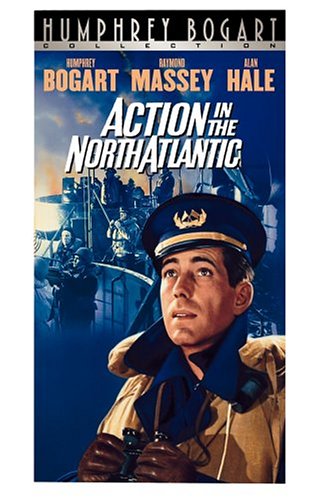
Action in the North Atlantic

Early in World War II, one of the biggest issues facing United States involvement in the war was getting our troops, equipment and materiel across the Atlantic Ocean to the European mainland.  The problem wasn't the ships, there were plenty of those, but the German navy -- especially the U-boats -- which wreaked havoc on those ships, sending thousands of ships and even more men to the bottom of the ocean. But even as the sunk tonnage went up, the ships kept making the dangerous journey.  That's the story of 1943's Action in the North Atlantic.

Now for all you non-history buffs out there, 1943 was right in the midst of World War II when the war was still very much in the balance.  Hollywood did its best to turn out stories that would inspire on the home front and convince Americans that this was a war that needed to be won.  In other words, we're not talking a whole lot of subtlety here, just straight propaganda.  It would be interesting had this movie been made in the 1960s or even now in the 21st Century just to get a different perspective on the story.  But it didn't happen that way, and we get a movie that is very much a prisoner of the time it was made in.  Not always a bad thing.

Sailing to deliver a dangerous shipment of thousands of gallons of fuel, a ship of Merchant Marines commanded by Capt. Steve Jarvis (Raymond Massey) and first officer Joe Rossi (Humphrey Bogart) is attacked and sunk by a German U-boat.  Jarvis, Rossi and some of the crew survive and are picked up, welcomed home as conquering heroes.  It's not long before Jarvis gets a new ship with much of the same crew as they hope to help the war effort aboard the USS Seawitch.  Their first mission is an important one as they will sail as part of an immense convoy traveling from the US all the way to Russia with badly-needed supplies and materiel.  A convoy this big can't help but attract attention, and it seems like it will only be a matter of time before the Germans come around.

Dripping with propaganda and messages of hope, 'Atlantic' is a good example of the movies Hollywood churned out during the war.  The story itself is an interesting one that deserves to be told in an honest, straightforward manner.  Unfortunately, we get the portrayals of these American sailors as angelic men who could do no wrong, and their German counterparts as evil, sadistic bastards who laugh as they ram doomed Americans.  On the positive side, director Lloyd Bacon (Raoul Walsh is an uncredited director here) commits to this garbage all the way. It doesn't hit you over the head the way some early 1940s movies do in getting its message across.  Bogie's final monologue could have been too sappy, but in his hands it is the ideal capper to a solid story.

Now at 126 minutes final running time, 'Atlantic' could use some trimming.  With much of the story taking place at sea, we get some pretty seamless shots of actual ships sailing on the ocean with some well-handled miniature shots.  Of course, that only goes so far.  Stock footage is overused to the point where you can fast forward through large chunks of the story without missing a beat.  The movie is obsessed with showing you what life on a ship is like, but it gets tedious, and it does so quickly.  There's also the portrayal of the German U-boat chasing the Seawitch.  I'm guessing all-told, there is probably about 20-30 minutes of the Germans in the 2-hour movie.  They even speak German...but with no subtitles!  Do you know how boring a movie gets when you can't understand a thing anyone is saying? It's a 2-hour movie, and I watched it in about 90 minutes because the fast forward got a workout.

The saving grace is the cast, including one of my favorites in Bogart.  The man was a chameleon when it came to the roles he could play, and he shows it off here.  This isn't a part that requires a ton of heavy lifting, but Bogart handles it as smoothly as possible. He gets a love interest (easy on the eyes Julie Bishop) that feels tacked on and doesn't serve a real purpose, but Bogart also gets to play the up-and-up hero for a change too.  No concerns if he's the anti-hero just waiting to reveal himself, Bogie is the all-American hero here.  Massey is all right as Capt. Jarvis, but he doesn't have to do much other than growl and talk about how badly he wants to get revenge on the Germans.  I'm sure 1943 audiences ate it all up.

Working from a John Howard Lawson screenplay, 'Atlantic' at its best is when it is dealing with the daily lives of the crew, merchant marines who weren't officially part of the Navy but nonetheless did their best to aid the war effort. The interactions among the crew and the relationships, the friendships, the arguing that develop feel authentic from the start, and you like this motley group of sailors who include Alan Hale, Dane Clark, Sam Levene, Peter Whitney, and Dick Hogan. I don't know what it's like to work and live on a ship for days, weeks and months at a time, but this felt real to me, and not forced.  So in spite of its flaws, I'll still recommend this WWII flick.

Action in the North Atlantic <---trailer (1943): ***/****   

Wednesday, March 24, 2010

Dodge City

I've covered this before, but when I watch enough older movies (pre-1950s or so) it keeps coming up.  If possible, watch these movies with the mindset you're watching them in the year they were released.  New innovations come along every few years with movies starting with the jump from silent to sound and building onward with color, widescreen, 3-D, CGI, and more recently with Avatar, whole new ways of filming human acting.  It's hard sometimes though because well, it isn't 1939.  What was appealing in 1939 doesn't necessarily translate well to 2010.  That was my feeling with 1939's Dodge City.

Look at the all years in Hollywood history and 1939 is often labeled the greatest year in movie history, and for good reason.  Here's a list of the more impressive flicks.  And even though Dodge City is on that list, I'm not judging or comparing it to Gone With the Wind or The Wizard of Oz.  But like both those movies, it is about the spectacle of what's happening on-screen.  It's filmed in Technicolor with lots of bright, vivid colors that look almost fake, huge sets filled with seemingly hundreds of extras, and a story as big as the taming of the west.

After helping the railroad reach Dodge City, Wade Hatton (Errol Flynn) returns after years away from the wild, rumbling boom town with friends Rusty (Alan Hale) and Tex (Guinn Williams).  The town they've helped build has gone to hell and any attempts at civilizing the town are stopped by a cattle man, Jeff Surrett (Bruce Cabot).  Townspeople he has business deals with or owes money end up shot in the back with no witnesses.  The town calls for Hatton to become sheriff and clear Surrett out, and at first he's completely unwilling.  But something changes when an action of Surrett's pushes him too far.  He takes the badge and starts to clean the town up, but Surrett is standing in his way and shows no sign of giving up.

The story is nothing new for a western, but that's not a complaint, just an observation.  The problem is that all the other little things add up to be a problem.  In the casting, Ann Sheridan gets third billing for a part that requires her to sing two or three times as a dance hall girl.  These scenes have a line of dance hall girls dancing on-stage for a saloon full of raucous cowboys and grind the already slim story to a halt.  They're cool enough to look at visually but too distracting overall.  The same goes for the exterior shots of Dodge City (with studios in California filling in for Kansas) which are content to show crowded streets with all their extras.  And even if the spectacle of the movie was more appealing, it pales in a big way compared to Gone With the Wind's spectacle.

The least of the problems is Errol Flynn as tough gunfighter with a golden heart, Wade Hatton.  He's a good example of what western heroes were before Sergio Leone got his hands on the genre in the 1960s.  Hatton is a good man, looking out for women and children first, and when pushed too far, watch out bad guys because he's coming after you.  Frequent Flynn co-star Olivia de Haviland is the love interest who hates Flynn until it's important for her to turn a page and like him.  The duo worked many times together and for good reason.  They had some great chemistry that comes naturally and never looks like they had to force things along.

As his rival, Cabot is a solid villain.  Thanks to his pairings later in his career with John Wayne, it would be easy to think Cabot usually played a variation on the trusty sidekick.  But early in his career, he played his fair share of bad guys, especially in the 30s.  His voice sounds like a deep growl, and he was a physically intimidating actor so he is a good counter to Flynn's heroic good guy.  Victor Jory is also solid as one of Surrett's gunslingers who wouldn't bat an eye at shooting a guy in the back.  Hale and Williams are the annoying, not so funny amusing sidekicks who are there to get a laugh or two.  I like both actors but their parts just aren't funny.

The movie does pick up speed once Hatton becomes sheriff in Dodge City, and the finale starts off promising as Hatton and Co. shoot it out with Surrett on a burning train.  But the ending limps to the finish, almost like director Michael Curtiz just ran out of money.  SPOILER Surrett and his cronies escape and are making their getaway only to have Hatton and Rusty pick them off as they run.  No big showdown, no worthy end for a quality bad guy.  Just a quick shot of a dead Surrett after he's been thrown from his horse.  Surprise, surprise, but Hatton also gets the girl.  I know, it surprised me too.  END OF SPOILER

This is not a bad movie in any way, and it feels wrong giving it a negative review for a movie that's main goal is to be entertaining.  But all the spectacle moments take away from a story that could have been good, if not great.  Errol Flynn is always worth a watch, Olivia de Haviland is a great actress, and Bruce Cabot's a good villain, but that's about it.  Average western worth checking out if you're looking for a decent enough way to kill two hours.  An Errol Flynn fan has posted many of his movies at Youtube, including Dodge City, starting with Part 1 of 10.

Dodge City <----trailer (1939): **/****

Wednesday, February 10, 2010

Desperate Journey

Before becoming one of the U.S.'s most popular presidents, Ronald Reagan made quite a name for himself in the 1930s and 1940s as a movie star. Makes that whole 'Star Wars' idea a little funnier if you ask me. He was usually limited to B-movies, but as an actor he had an easy-going, likable way about him on the screen. Reagan often played second banana to the main star of the movie and made a career -- a movie career at least -- at playing the funny sidekick.

By 1942, Reagan had already teamed once with Errol Flynn in 1940's Santa Fe Trail when they teamed up again for a WWII adventure, 1942's Desperate Journey, that is pretty blatant propaganda watching it now over 70 years later. It's not subtle in the least, and why should it be? Released in September 1942, the U.S. was only a few months removed from entering the war in the North African campaign, and maybe the home front needed some boosting. That propaganda borders on the painfully unfunny at times, but the movie itself is interesting enough to recommend.

Flying a dangerous mission to take out a German railroad yard, Flight Lieutenant Terry Forbes (Flynn) is forced to take command when the commander is killed. Forbes' bomber is able to take out the objective, but the plane is shot down in the process, and it's not long before German forces have scooped them up. The five crew survivors are interrogated by an SS major (Raymond Massey), but they manage to escape with key information about underground Messerschmidt factories. Among the group is a Scottish veteran of WWI (Alan Hale), a cocky American navigator (Reagan), an American flight officer (Arthur Kennedy), and a young British officer (Ronald Sinclair) trying to live up to his father's reputation. Can the five somehow get back to England with their news before the Germans catch them again?

The whole premise is pretty ridiculous and far-fetched in itself but it's entertaining enough. Flynn's Forbes is pretty gung-ho as the flight lieutenant who wants to take the war right at the German war effort. He's a leader who questions himself because the actions he undertook ended up taking the lives of some of his crew, but Flynn is also Joe America (even though he was Australian), the ideal soldier to lead the fight against the Nazis. With his gung-ho attitude, Flynn isn't content with just getting the news back to England, wanting to sabotage anything he can on the way back.

A reviewer at IMDB does point out that the Germans are rather cartoonish or particularly evil with little middle ground, asking where are Colonel Klink and Sergeant Schultz? Hogan's Heroes reference there for you. Their efforts are pretty clumsy in capturing the prisoners as it seems Massey's German major is the only one actually taking part in the chase. For five prisoners with news that could cripple the Germans, wouldn't more people join in the effort? Flynn and Co. even make it across Germany and into the Dutch countryside with little issue or much in the way of danger...and in German uniforms at that, even boarding Goerring's private train at one point.

Now all that said, the movie is incredibly entertaining, a good old-fashioned popcorn movie. The action is exciting -- especially the last half hour as the Germans close in -- including a car chase across the empty Dutch countryside with some boats of cars chugging along. Credit for making it so damn entertaining is the casting, especially Flynn as a WWII version of a swashbuckler who even manages to flirt some with a comely resistance fighter (Nancy Coleman). Reagan and Hale go for the laughs, hamming it up in some scenes that are hard to watch they feel so out of place. Kennedy is the straight man trying to keep the mission on the others' minds.

As for the propaganda, there's several scenes of dialogue where the cast is talking directly to the viewer. Coleman's resistance fighter tells Flynn (and American) to tell everyone that there's people fighting back against the Axis powers and don't forget about them. Flynn's final line is almost laughable "Now for Australia and a crack at those Japs!" but at the time I'm sure it probably drew some cheers from audiences. It's all part of this ridiculously over the top, far-fetched action adventure that is entertaining almost in spite of itself.

Desperate Journey <-----trailer (1942): ***/***

Wednesday, February 3, 2010

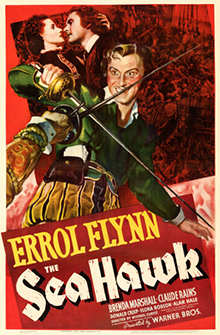
The Sea Hawk

A couple weeks ago I reviewed 1936's Charge of the Light Brigade and as I thought about it since realized I was probably more than a little harsh on star Errol Flynn. I wrote that "he probably didn't act a day in his life" because he seems to always play the ultra-suave, extremely cool hero that saves the day and gets the girl. It came off as more critical than I intended because one of my other favorites, John Wayne, made a career out of playing the same basic character repeatedly. Should we hold it against somebody because they found their niche and ran with it?

It's hard to be critical of Flynn as a movie star because for the most part his movies are so damn entertaining, straight popcorn flicks. But looking at the 1930s and 1940s, he is clearly one of Hollywood's biggest stars. Just look at the movies he made over a 10-year period. He made more classics or near-classics that many actors/actresses make in a career. And as I wrote, just about all those movies has him as a swash-buckling rogue of one sort or another (settings vary) who always ends up on top with a girl on his arm, like 1940's The Sea Hawk.

Flynn plays Geoffrey Thorpe, an English privateer in the late 1500s working for Queen Elizabeth as one of many 'sea hawks.' These English privateers -- or pirates to their enemies -- harass rival countries' ships and keep England flowing in money, gold and treasure. Thorpe's 'Albatross' one day attacks a Spanish galley brimming with treasure and two key passengers onboard, the new Spanish ambassador traveling to England, Don Jose Alvarez (Claude Rains) and his niece Dona Maria (Brenda Marshall). Thorpe delivers his prized catch to Queen Elizabeth (a great performance for Flora Robson) who promptly ignores Alvarez's demands he be put in chains.

Queen Elizabeth has bigger plans for Thorpe and the Albatross. Rumors are swirling that Spain's King Philip is assembling the powerful Spanish Armada with hopes of conquering England. Elizabeth does not have a navy to protect her country -- other than the Sea Hawks -- and no money with which to build a navy. She sends Thorpe on a dangerous mission to Central America; attack the gold convoy coming out of the Spanish mines at Vera Cruz and bring it back so she can assemble a navy in time. Off Thorpe goes, leaving Dona Maria behind. But the plan won't be so easy as Alvarez and the treacherous Wolfingham (Henry Daniell) are at work to make sure the plan fails.

Typecast as a swashbuckler early in his career, it's only fitting that Flynn was in fact very good at fencing having been trained in the art. The training obviously shows because in several of his movies, including The Sea Hawk, Flynn engages in several exciting, intricate-looking sword fights. At one point, Thorpe even takes on four English guards at once in the shadowy court of Queen Elizabeth. It is something so little that as an audience we take for granted sometimes with CGI and stunt doubles, but Flynn handling his own stunts helps make the movie more realistic and for me, much more enjoyable. It's cool to see one of Hollywood's biggest stars at the time going toe to toe like that.

The film opens with a bang as Thorpe's Albatross overwhelms Alvarez's Spanish galley, watch it HERE, with a pretty cool introduction for Flynn as we've heard about his character for most of 10 or 15 minutes. The action sequence does continue into Part 3 for those wanting to continue on. The attack is a great scene in itself, both epically grand as two huge ships duke it out and then on a smaller scale as the two crews engage in hand-to-hand combat to save their ships. The resolution to the fight is particularly unique as how to stop a conflict like that.

Playing Captain Geoffrey Thorpe, Flynn is at his coolest, a driven, patriotic man fighting for queen and country, and of course, the girl. Marshall made 20 movies in a short time and then left show business, and as she shows here as Dona Maria, she's not the greatest actress around but she has some potential. Rains is a worthy villain as always, and Donald Crisp makes the most of a smaller part as Sir John, one of Elizabeth's loyal court members. Often pairing with Flynn as a sidekick, the loyal right hand man, Alan Hale plays Mr. Pitt, the burly, brawling sailor. Robson is actually playing Queen Elizabeth for a second time and almost steals the movie away from Flynn and her co-stars as the outspoken ruler of England.

A movie that's a lot of fun with plenty of action, over-the-top dialogue and some cheesy romance. It's not my favorite Errol Flynn movie, but the swashbuckling actor was never one to disappoint with his action and adventure movies.

The Sea Hawk <----trailer (1940): ***/****