The Sons of Katie Elder

The Sons of Katie Elder
"First, we reunite, then find Ma and Pa's killer...then read some reviews."
Showing posts with label Humphrey Bogart. Show all posts

Monday, February 25, 2013

The Left Hand of God

The lives, missions, and beliefs of priests lends well to film adaptations. Think of movies like Keys of the Kingdom, I Confess, The Mission, The Scarlet and the Black, Going My Way, Boys Town and many others. How about a priest sub-genre? Priests who aren't what they seem, films like 1972's The Wrath of God and 1955's The Left Hand of God.

It's 1947 in a remote province of China, and Father O'Shea (Humphrey Bogart) is on his way to an isolated Catholic miss deep in the hills. His predecessor was killed, and the mission is has been missing a priest for months. Three other Americans await, Dr. David Sigman (E.G. Marshall), his wife, Beryl (Agnes Moorehead), and Anne (Gene Tierney), a widow working at the mission. O'Shea's work is cut out for him, the local villagers happy he's there but also worrisome about his arrival. The biggest problem though isn't from the villagers though, but instead the new priest. O'Shea has a secret that threatens to tear the village apart. One of the few men who knows the secret? A warlord, Mieh Yang (Lee J. Cobb), who with his small army of killers poses a huge threat to the poor farming villages.

Based on a novel by William Barrett, this priestly-based story went through its fair share of incarnations and stars before it finally ended up in the hands of director Edward Dmytryk who eventually decided Bogart would be an ideal choice for the part (Kirk Douglas and Gregory Peck were attached to star in earlier incarnations). The film itself is nothing classic, nothing particularly different or unique, but it is nonetheless an enjoyable, well done movie that I was interested in from beginning to end. I'll say it again, familiarity can be a good thing when handled right (read: not boring). Substituting Malibu Canyon, California for China doesn't seem like an obvious choice, but it works in the same way MASH did replacing California for Korea. Composer Victor Young's score is a step above the rest, not your standard epic score.

After reviewing We're No Angels in late 2012, here's another Bogart film from late in the Hollywood icon's career. With Angels, The Harder They Fall, The Desperate Hours and this film (his last four films before his death in 1957), Bogie takes somewhat atypical roles. They're different, not just typical tough guy parts. Semi-spoiler alert......Bogie isn't a priest, taking the disguise and cover story to escape a troublesome situation. I won't spoil the details here, but an effective flashback lays it all out. It's not a showy or scene-stealing part by any means, but there's something charming about it. Bogie's Jim Carmody -- formerly Father O'Shea -- is quite capable of handling himself but there's a certain element of his lifestyle and past that makes him vulnerable.

Without ever becoming sappy, 'Hand' does a fine job of developing the character. We see his interactions with the cynical Dr. Sigman, a physician trying to consider the bottom line and frustrated with Chinese ways, with the widowed Scotty who sees him for the good he does, and most importantly, the Chinese villagers. Converts to Catholicism, they're seeking answers while also looking for a priest to lead the community. Several scenes show Bogie's Father O'Shea interacting with the village children, a good running bit that could have been pushed too far but knows when to tap the brakes. Bogie does a great job with these scenes, especially with his village assistant/quasi-altar boy, John (Victor Sen Yung), and also talking things out with a father (Benson Fong) who loses his wife and newborn baby minutes apart.

Clocking in at just 87 minutes, 'Hand' lacks the epic scale that the story could have required. It's pretty straightforward and to the point but never in a bad way. Marshall, Moorehead, and Tierney all provide solid support for Bogart, three differing performances that show a variety of responses to his arrival and impact. Cobb as the Chinese warlord is an odd choice to play....well, a Chinese warlord, but he avoids being stereotypical or cliched. Bad eye makeup? Yes. Bad performance? No, it could have been awful. Also look for Philip Ahn in a small part as Yang's assistant. Nothing flashy, but I liked this one a lot, especially for a late role for Bogie, and a goodie at that.

The Left Hand of God (1955): ***/****

Thursday, January 3, 2013

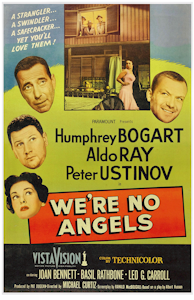
We're No Angels

By 1955, Humphrey Bogart had done everything possible to be a true Hollywood legend. What do you think of when you hear his name though? I typically think of heavy roles, dramatic, intimidating tough guys. Sure, they're not all like that, The African Queen comes to mind, but a majority were. Well, we can add another film to that small list, 1955's We're No Angels.

It's Christmas Eve on Devil's Island in 1895, and three convicts, Joseph (Bogart), Albert (Aldo Ray) and Jules (Peter Ustinov), have managed to escape. The only problem? They've got no money, no papers, and no way of getting off the island. Instead, they meet Felix Ducotel (Leo G. Carroll), a quiet, worrisome and soft-spoken shopkeeper who offers them a job fixing his roof. The trio sees a chance for some easy money, pretending to work on the roof and waiting for nightfall for a chance to rob the shopkeeper blind, giving them everything they need to pull off the successful escape. Pretty simple, right? From their rooftop perch, the convicts start to listen to the goings on in Felix's worrisome life. Uh-oh, now the convicts are interested and even going to help. That escape plan is on hold....for now.

This was a movie on my Netflix queue as a 'Save' option for months after I accidentally read about it at IMDB. I couldn't find it anywhere, and it didn't seem to be on TV...ever. So when TCM aired it in early December, I jumped at the chance. It was well worth the wait. That plot description doesn't exactly scream out buddy comedy, does it? That's what it is though at its most basic. It just happens to be a buddy comedy on steroids that blends a great script, perfect casting and a unique setting that takes advantage of the early stages of widescreen format in films. Long story short, I liked this movie from director Michael Curtiz a whole lot.

The casting works so well because it plays against convention and typecasting. My first thought at hearing Bogie, Aldo Ray and Peter Ustinov in a movie about convicts escaping Devil's Island? Not going to be a comedy. While all three actually are criminals, their crimes are played for laughs (Bogie is a forger, Ray and Ustinov murderers) and end up producing some of the biggest laughs in the movie. I probably use this too much, but the chemistry among these three actors -- all very talented in their own right -- is spot-on. It's effortless. They do it with ease. And because it's a comedy, it's that much better. Dramatic actors doing comedy can be hit or miss, but when handled correctly as it is here, it can carry a movie.

So as is usually the case, this movie goes both ways. Is it the cast lifting up a script or a solid script giving the cast something to do for a change? Oh, no, the Chicken or Egg: Movie Edition! It's both here. Bogie, Ray and Ustinov doing comedy is a welcome change. As good as they are dramatically, they're even better doing comedy. Read some of the more memorable quotes from 'Angels' over at IMDB HERE. It's never obvious humor, most of it underplayed to the point some lines are probably too subtle to even register. That is the beauty though of smart humor though. And throw into the shenanigans, Adolph, a very little, very poisonous snake as the fourth member of the troop with a knack for "solving problems," and we've got some laughs.

Playing the straight man to the convicts' subtle shenanigans, Carroll does a fine job as constantly worried Felix whether it be his family or his business. Joan Bennett and Gloria Talbott round out Felix's family, his loving wife, Amelie, and his daughter, Isabel, madly in love. Basil Rathbone and John Baer play visiting family members, both with their own secrets and looking to take advantage of Felix, his family and his general store. Rathbone is particularly nasty, rounding out a supporting cast that does a solid job without taking away the spotlight from the three main stars.

On top of the acting though the little things come through in 'Angels.' It was one of the first films to use Vistavision, a unique, very colorful widescreen format. The main setting -- Felix's shop, house and roof -- plays like an on-stage play, but the screen is constantly full of bright colors and vivid backgrounds. It hits the ground running in an opening scene that shows the trio of angels escaping from quite a distance. The story itself is pretty interesting and never dull, but it never hurts when a movie is fun to watch in a visual-sense alone. As I seem to do so often, I feel like I'm not explaining why I liked this movie real well (damn comedies!), but I did. A lot, I liked this movie a ton. If you can find a copy or stumble across it on TV, sit down, plant it somewhere comfy and enjoy it.

We're No Angels (1955): *** 1/2 /**** 

Sunday, September 11, 2011

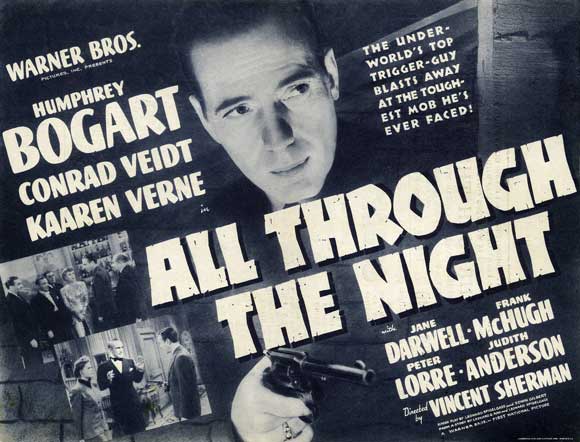
All Through the Night

You know what's not funny? Nazis. Care to differ? I'm a fan of Hogan's Heroes and can appreciate the cartoonish portrayal of Nazis like in The Producers or Charlie Chaplin in The Dictator or even the Three Stooges poking fun at Adolf Hitler.  But at their most basis, is there anything actually, legitimately funny about them? I've never thought so.

Imagine my surprise then when I read the plot description of 1941's All Through the Night which read 'A criminal gang turns patriotic to track down a Nazi gang.' Released in 1941 even before the Japanese sneak attack on Pearl Harbor on December 7, I figured this would be an interesting, potentially very dark propaganda attempt to show an American audience how evil Germany, Hitler, and the Nazis were.  I really figured on that much when I saw Humphrey Bogart was the star. Propaganda? Yes, but so much more and so much weirder. It's got a propaganda message mixed with a mystery thriller but plenty of action and laughs thrown in too. Confused much? I was.

While the rest of the world is wrapped up in WWII, a gang in New York City run by Gloves Donahue (Bogart) goes about their daily business without too much concern of what's happening in Europe. The dapper gangsters have their hands in everything, the suave Gloves at their head. One day, Gloves' mother (Jane Darwell) calls her son in to investigate a disappearance which is quickly revealed as a murder. Gloves and his boys look into it, following the only clue they have, a beautiful woman, Leda (Kaaren Verne), who showed up in the wrong place at the wrong time. What have they stumbled into exactly? The victim was a seemingly innocent baker, but they quickly find out there's much more to it. Gloves and his crew are quickly tangling with a cutthroat crew of German agents doing their best to sabotage America and its interests.

Call this pretty eerie, but according to the IMDB 'All Through the Night' was released in theaters for the first time on December 2, 1941, exactly five days before the attack on Pearl Harbor.  That certainly adds a darker dimension to a story that is oddly enough attempts to be funny and scare the audience into thinking one way.  I get it. I really do.  Many Americans wanted nothing to do with WWII in any way, staying isolated by an ocean on either side from fighting in Europe or the Pacific.  Others obviously wanted our country to get involved, and as a byproduct, we see efforts like this that are certainly trying to influence your feelings on the subject.  The idea is there, but there is something just plain odd, just unexplainable about this movie.

The pacing, the tone, the comedy, the action. It's just all too much here in director Vincent Sherman's movie. We've got Bogie and his gang running around NYC in the middle of the night stumbling across a German spy ring, a Fifth column group, while also tangling with cops who think Gloves is a murderer, and a bar owner and his goons who want to fight it out with Bogie and Co.  Just too much time is spent going for laughs with a story that 1. Doesn't need laughs and 2. Suffers because the humor is slapstick and physical humor.  Maybe this all would have worked with a tweak here and there. Portray the Nazis as cartoonishly stupid idiots and possibly it clicks. As presented here, they're cold-blooded, conniving murderers who will kill anyone who gets in their way. The combination of Gloves and his fast-talking "tough" guys and these brutally cold German agents never gels.

What makes this worse is that there is a lot of talent involved in this can't make up it's mind story.  Bogie is great, playing his usual tough guy but given a chance to show off his comedic chops. He's funny because he plays it straight, throwing one-liners with split second timing.  His gang includes William Demarest, a very young-looking Jackie Gleason, and Frank McHugh, along with Phil Silvers as a bespectacled waiter with a mouth. A year later Bogart would work again with co-star Conrad Veidt in a little film called Casablanca -- maybe you've heard of it -- who here plays the evil German leader who's agents include Peter Lorre and Judith Anderson. The gang gets to ham it up in that fast-talking style of the 1940s where everyone yells and screams wearing their very high-waisted pants and classy hats and suits.  The Germans get to be over the top evil, Veidt's main baddie even willing to blow himself and his little dog up to help the war effort.

While the comedy fell short for me on just about every front, one scene came through and delivered, one where I genuinely thought it was funny.  Posing as German agents to see what these crooks are up to, Gloves and Demarest's Sunshine are forced to "report" on their activities.  With absolutely nothing to report, they pull off this gimmick with gibberish and yelling, ending each statement with 'Heil!' which causes all the other agents in the room to stand with a rousing 'Heil Hitler!'  In the process, they buy themselves some time to escape. Smart humor? No, not in the least, but it was funny...at times.  Overall though, the movie can't figure out what it is and takes too long not deciding. A worthwhile flick for Bogart fans, but not much else.

All Through the Night <---TCM trailer (1941): **/****   

Friday, September 9, 2011

Tokyo Joe

It's amazing the stories you can find out about if you just do a little digging.  That was certainly the case for me after watching 1949's Tokyo Joe.  I liked the movie enough but was looking for something -- anything really -- to write about. The movie's main villain is played by Japanese actor Sessue Hayakawa, probably most well known for his roles in movies like The Bridge on the River Kwai and Swiss Family Robinson. Caught in France during WWII, the actor worked with the French Resistance to help rescue downed Allied fighters. He still worked in films during this time -- making the resistance involvement somewhat dubious in my head -- but his return to Hollywood films came in Tokyo Joe.

The background about the making of the movie is as interesting if not more so than the actual finished product. Along with Hayakawa's return to American films, this Columbia Pictures drama was the first movie to film in a post WWII and still war-torn Tokyo.  Well, sort of filmed.  For the most part, any scene with actual members of the cast was filmed in the Columbia backlot in Hollywood, but a film crew was sent to Tokyo to get second unit footage to help set the scene. In other words, we get covered up stunt doubles made to dress up like the cast which is then awkwardly transitioned to actual footage of the cast. Still, the actual Tokyo footage is pretty crazy to watch, an eerie look at a city still recovering from World War II.

As Japan recovers from WWII with U.S. occupation forces helping the process along, a former Colonel, Joe Barrett (Humphrey Bogart), arrives in Tokyo looking to start up his business that he was forced to abandon at the outbreak of the war some four years earlier. Before the war, he ran a successful, very popular bar in the city, but now finds himself working against the current as no one is able to get him through miles of red tape. Joe finds out his wife, Trina (Florence Marly), who he believed was killed in the war is very much alive, and is now married to an American bureaucrat, Mark Landis (Alexander Knox). Some shady Japanese underground and black market dealers (including Hayakawa) have some dirt on Trina, and only Joe can keep it under wraps, going to work for the dealers transporting illegal goods into the country via a surplus plane. Joe knows he's in over his head, but he has no other alternative, even if a confrontation is coming his way.

A pissed off Bogie in post World War II Tokyo with a score to settle was all I really needed to hear when this movie popped up on TCM's schedule recently. The 1940s were Bogart's decade, and his performance is the best thing going for this story, but other than that it doesn't have much going for it. My picture of director Stuart Heisler making this movie is a man spinning countless plates and seeing which ones stay up the longest. Anything left standing makes the final cut, and there are a lot of plates. As the story figures out where to go -- and the movie's only 88 minutes long to begin with -- as everything is introduced, the pacing suffers. The first 45 minutes border on straight boredom. The last 45 minutes or so do salvage things as best as possible, but the movie on the whole is a mixed bag.

Released in 1949 and the first movie to film in Tokyo since the end of the war, there is still a feeling of American propaganda here.  Certain scenes seem written up by a government official to convince an American audience how noble our actions are in helping the country recover after defeating the Japanese in a brutal war that they had started. On the other hand, the script actually tries to portray the Japanese people as just that, people. We're talking two radically different cultures here, and the Japanese culture does not have the compassion in victory that the U.S. had. So when American forces occupied the country and tried to improve the situation, some Japanese were obviously confused and embarrassed. Thankfully, there isn't much in the way of pandering though, and it felt like a genuine effort to educate and teach as opposed to manipulate and trick an audience.

No one does the tortured, tragic tough guy lead quite like Humphrey Bogart. In a performance that isn't remembered among his best -- more so a judgment of the movie, not his acting -- he does what he does best. Bogie is tough as nails, but in a departure from so many of his other roles, we get to see a softer side of him. This is especially true when he finds out he has a seven-year old daughter, Anya (Lora Lee Michel). He has no idea how to be a father or even interact with the little girl, but he wants to and he at least makes an effort. Torn up inside over how he had to abandon Trina during the war, Jim is trying to right a wrong however he can. A more understated performance from Bogart than you might be used to, but a good one still.

As mentioned earlier, I enjoyed the second half of the movie leaps and bounds ahead of the first half. The drama and action kicks in with the story pointing in the right direction, knowing where it wants to go. Working with U.S. Intelligence, Joe realizes he's stumbled onto a plan to see a Japanese resistance group of angry WWII vets rise up all over Japan. Throw in his daughter being kidnapped as a bargaining chip, and you've got one pissed off Dad working against a clock. While the ending is cut and dry as to exactly what happens, I think it was pretty clear what happens. It is an appropriate ending for a movie from the 1940s, one that is pretty easy to see coming if you think things through.

Other than Bogart, Hayakawa is the only instantly recognizable face here (for me at least). He's a pretty cliched, stereotypical Asian villain, but that's what he did best in the second half of his career. He's one bad dude, and because it is 1949, he's going to get hit with a wall of karma in a big way. Knox is the cold American official while Marly looks almost skeletal as Bogie's squeeze, Trina. Their chemistry is lacking something too which is unfair because of how easy Bogie made it look with Ingrid Bergman or Lauren Bacall. Teru Shimada has a good supporting part too as Ito, Joe's business partner in running the bar, a middle-aged Japanese man trying to come to terms with everything that's happened during and since the end of the war. It's a decent movie limited by its flaws, but it is still Humphrey Bogart, and that's hard to beat.

Tokyo Joe <---TCM clips (1949): ** 1/2 /****

Friday, May 27, 2011

Knock on Any Door

With as many movies as are readily available for viewing, you can't help but take certain movies, stars, and directors for granted at times. There are the instantly recognizable names (typically for good reasons), and recognizable names for all the bad reasons. But there's all sorts of names that are just there, quality movies that don't always get the press or publicity that others do. One of those names is director Nicholas Ray, a solid director who never reached iconic status. His movies are almost always solid with a few near-classics in his repertoire. Making his debut in 1949, Ray started with a courtroom drama, Knock on Any Door.

The natural drama and tension that comes as a result of a courtroom setting is basically a perfect place to base a movie in. If a director can't produce drama, tension and a bundle of nerves, maybe movies aren't for them. The back and forth of a lawyer questioning a witness, the science of getting a jury on your side, the desperate play which in a lot of ways can be a life and death situation, it is all screaming 'DRAMA!' For Ray's debut, the courtroom scenes are the best thing going for the movie. Unfortunately, it takes too long to get to those courtroom scenes, wasting time in some very 1950s melodrama that could have been ripped from a badly written soap opera. Making it worse, the ending gets a little preachy, trying to deliver a message that feels contrived and forced. Other than that, the movie is a solid debut.

A lawyer working for a firm that sees him as a future name partner, Andrew Morton (Humphrey Bogart) is faced with a difficult decision. A young man, Nick Romano (John Derek), who Andrew has defended before -- several times actually -- is again in trouble, but this time for a much more serious charge. Romano (dubbed 'Pretty Boy' by the newspapers) is on trial for robbing a bar and then murdering a police officer who tried to stop the robbery. Romano's record is checkered with past run-ins with the law so Morton has his work cut out for him. The case seems like a slam dunk against Romano, but Morton feels an obligation to defend him. His only tactic may be condemning society for turning Romano into the small-time thug that put him in this situation. But even making it a character issue, will that be enough?

 As a fan of both Bogart and Ray, I was excited to stumble across this one on TCM's schedule a few weeks ago. A courtroom drama with Bogie as a defense lawyer sounded like a slam dunk. And to be fair, the courtroom angle of the movie is the best thing going for Ray's debut. The negative comes from how long it takes to get to the actual trial. Most of an hour is spent in flashback-mode, giving plenty of background about Derek's Nick Romano. He grows up in Skid Row, turning to a life of crime to get by mostly because he doesn't want to work. He falls in love and marries good girl, Emma (Allene Roberts), only to push her away with his actions. My impression was that these scenes were meant to humanize Romano, even make us sympathize with him, but it fails. This is a despicable character in my mind. He has all the chances in the world to better himself and turns his back on every single one of them. The scenes are dull, repetitive and as mentioned before, melodramatic. It kills any momentum heading into the actual trial.

Then there's the courtroom. Playing a defense lawyer has to be the modern equivalent of playing a Shakespearean main character. These are parts tailor-made for above average actors (and actresses to be fair) to just go to town, throw everything at the wall and see what sticks. These are flashy parts. Think of Gregory Peck in To Kill a Mockingbird, James Stewart in Anatomy of a Murder, Tom Cruise in A Few Good Men, Maximillian Schell in Judgment at Nuremberg. These are parts that allow actors to stretch out, get settled and show off their skills. Bogart is one of the all-time greats so seeing him work the jury, the witnesses, the district attorney, even the judge is a thing of beauty. The back and forth as Bogie tries to get a not guilty verdict. Then there's the whole interest of if Romano is guilty. Ray keeps you guessing until the very end as to his innocence or guilt. The reveal is a little hammy, a little overdone, but it still works. It's just too bad that so much time was spent getting there.

Playing the noble defense lawyer, defending the downtrodden and beaten down, Bogart does not disappoint. He so often played the tough lead, the thug, the hired gun, the escaped convict, that it was great to see him playing a more polished, upper class role. The background on Bogie's Morton is that he's like Romano, the young man he is defending. He comes from Skid Row and rose above it, working his tail off to amount to something in life. He feels some obligation to Romano because he sees some of himself in him, a potential, a chance to make a good life for himself. As unlikable as Derek's Romano is, Bogart's Morton cancels it out. You like Morton, respect his ability in the courtroom to do what he needs to do. Bogart and Derek dominate the movie, not leaving much for the supporting cast. George Macready is the apparently slow-witted district attorney gunning for Romano, saving the big guns for late, Candy Toxton is Andrew's wife who has maybe 4 lines in the whole movie, Barry Kelley as Judge Drake, and Dewey Martin and Davis Roberts as two witnesses in Morton's case.

If there's one thing I don't like in my movies, it is a message that is delivered in such a heavy-handed fashion that it loses any meaning.  Not subtle or sly in its delivery, we're talking beat you over the head until it is battered into your brain. That's what Ray throws at you in the courtroom finale. Bogie gets his shot to blow away the audience and doesn't disappoint, delivering his angry monologue with fervor and passion. He condemns anyone and everyone, the individual, the family, the system, the government for creating a society where Skid Rows exist and young men have to turn to a life of crime to get by. He blames so many people and their lack of interest, initiative in making the world a better place, turning a blind eye to the plight of society that I completely tuned the message out. A message is one thing, but screaming that message at the viewer is the complete opposite end of the spectrum (and not in a good way). The final two shots of the movie help the movie end on a moving note, but that heavy-handed attempt just rubbed me the wrong way.The movie is a mixed bag, the courtroom scenes and Bogart making it worthwhile (barely).

Knock on Any Door <---TCM clips (1949): ** 1/2 /****

Wednesday, March 23, 2011

The Harder They Fall

The beauty of sports for me has always been in the simplicity of the actions. A quarterback finding a wide receiver downfield, hitting him in stride. A shortstop and second baseman turning a flawless double play. A basketball player drilling a clutch jump shot with the game on the line. The list is endless, every sport providing its own special moments. But that is just sports at its most basic. Throw in money, ego, and greed, and something as perfect as sport can be easily corrupted. One of the best examples I’ve seen showing the corruption of sport is 1956’s The Harder They Fall.

A boxing story, this movie belongs to be mentioned in the same breath as Rocky and Raging Bull, two universally known boxing classics.  Like few other sports, boxing translates so effortlessly to the screen mostly because of its tragic element. Baseball players ruin their arms, football players risk long-term damage, hockey players lose teeth, but boxing is in a whole other league. Without swords, assorted weapons and some sort of armors, boxers are modern-day gladiators. In a small ring with people cheering them on, they pound away on each other. What isn’t tragic about that?

Out-of-work newspaper sports columnist, Eddie Willis (Humphrey Bogart) is at a crossroads looking for any sort of new profession. He accepts an offer from a boxing club owner, Nick Benko (Rod Steiger), who has long pursued him for work as a press agent. Desperately in need of money, Eddie takes the job as a press agent for a young South American boxer, Toro Moreno (professional wrestler Mike Lane), a beast of a man with all the physical attributes but none of the skill it requires to be a boxer. Nick says don’t worry about it, for Eddie just to do what he does best and build the inexperienced fighter up. It starts off as nothing, a few fights fixed here and there as Toro’s reputation builds. But going down a bad road that will end poorly for everyone involved, Eddie starts to question what he’s doing. Is the money at the end of the road worth what he’s doing?

An honest, depressing and heartbreaking look at the business of boxing, ‘Harder’ is an indictment of the sport and everything and everyone involved in it.  Director Mark Robson doesn’t pull any punches – sorry for the bad choice of words – in laying this story out.  Everyone involved has a bulls-eye squarely painted on their back. The movie is about these people, the ones looking for the easy money at the expense of the fighters who are similarly taking advantage of a small window of opportunity they have to be successful. In the process, the fighters basically throw themselves to the wolves, hoping to make enough money in a short time span to help them live the rest of their life. Not everyone is so lucky, many hanging on to boxing longer than they should have, putting their health, well-being and lives at risk.

One of Hollywood’s best actors and maybe the biggest icon, Humphrey Bogart died at 57 years old just a few weeks after this movie was released in theaters. For a swan song, it would have been hard for Bogart to pick a last role. This is Bogie at his understated best, inhabiting this character who genuinely has the best intentions at heart but ends up going down a road he never anticipated seeing. He’s desperate and makes decisions he might not have otherwise. His Eddie Willis character is the heart of the movie, the conscience who knows everything he’s seen isn’t right. He's a human element in a sea of robotic people with dollar signs for eyes, especially in his scenes with his wife, played to perfection by Jan Sterling. It is a great performance for the Hollywood legend, and a fitting end to an amazing career.

Matching Bogie’s quiet, understated performance and going in the opposite direction is Steiger, ever the brimming ball of energy ready to explode at the slightest push. During filming of the movie, Bogart apparently thought the younger Steiger was overacting, exaggerating his performance in every scene he was in.  It’s hard to tell. This was Steiger in most of his movies. He’s the villain, the shadiest of bad guys who convinces you that he’s on your side as long as you’re valuable. Then the second you have played out your string, he cuts you loose. He has two scenes that stand above the rest, both monologues that illustrates how suave Nick can be in getting you on his side. Nehemiah Persoff, Felice Orlandi, and Val Avery co-star as his yes-men and muscle. Harold J. Stone has a great supporting part as a TV sportscaster who sees through the charade while real-life boxer Jersey Joe Walcott is very memorable as Toro's trainer, George.

Right in the middle of this and being pulled on all sides is Lane as Toro, the good-hearted, naïve South American boxer who had no idea what he was getting into.  Lane was a bear of a man in real life – no CGI here – standing 6'5 and looking the part of the most imposing boxer you’ve ever seen. Playing up the sympathy angle, you genuinely feel for this character, the unknowing dupe of all these businessmen around him. In a rags to riches story though, the ending isn’t quite what you’d expect but in a good way. It’s a great ending if not a happy, Hollywood ending. Appropriate for the story though and the characters especially. Track this movie down. It’s a forgotten classic. Give it a try at Youtube, starting HERE.

The Harder They Fall <---TCM clips (1956): *** 1/2 /****

Sunday, March 6, 2011

Dead End

I knew them only by name for years, seeing them pop up in the TCM schedule occasionally on Saturday mornings.  I had little interest in seeing any of the movies mostly because they sounded pretty awful, but also because movies from the 1930s are so hit or miss.  It's that in between stage where feature films too often felt like larger scale plays as studios dealt with how to make silent movies into sound pictures.  Dubbed the Dead End Kids, this "tough" group of child/teenage actors became huge stars under a couple different names, but if 1937's Dead End is any indication of their stardom, I'm going to continue to steer clear of them.

This is a movie based on a successful stage-based play that has the potential to make the jump from stage to film, but it was a painful movie for me to get through.  There are three different storylines all working against one another -- including the most painful, the Dead End kids -- and never really giving any reason for any one of them to be interesting.  It's a story that follows the goings and happenings on a warm summer day in New York City, a street at a junction where the rich live on one side in their posh, high-rise apartments and the poor in their ratty, decrepit apartments. Oh, the rich and the poor, prepare yourself for a pretentious message on the classes! Eh, maybe not. I don't think this movie could have managed a message if it wanted.

It's a humid, nasty NYC summer day when a man returns to the street he grew up on. He's gone on to other things, earning the nickname Baby Face Martin (Humphrey Bogart). As a gangster/killer out west, Martin's supposedly killed eight people, but he's back now and he wants to see his mother (Marjorie Main) and his old girlfriend, Francie (Claire Trevor). An out of work architect, Dave (Joel McCrea), grew up with Martin and recognizes him, encouraging him to move along before any trouble arises. Then down at the end of the street near the river, a gang of kids and teenagers, the Dead End Kids, harass a doorman to a posh apartment and generally cause mayhem whenever they can because...well, they're idiots.

Let's get the positive (yes, singular) out of the way first because it won't take long.  This is Humphrey Bogart before he was a big star, before he was a household name. In the 1930s, he often played tough guy supporting roles, similar to the ones he would play later but from a leading role.  His talent though is obvious whether it be in a starring role or from a supporting part. It's too bad his part is smaller here, not requiring much of him other than wearing a suit, smoking an occasional cigarette and generally looking tough.  He goes 3-for-3 in that department by the way.  Unfortunately, much of the focus is on the other two plots that do end up crossing paths with Bogie's, but not enough.

Instead, we get lots of interaction with the Dead End Kids, a "tough" street gang of kids/teenagers who like to cause havoc wherever they go. I'm not going to break each character down one by one because they're all interchangeable.  They've got tough street names like Tommy, Spit, T.B. (because he's got tuberculosis...haha that's hilarious), and Milty. A typical conversation goes something like this. "Oh, yeah?!?"...."Yeah!"....."Yeah?!?"...."Well say that again!"...."Oh yeah," and then they push and shove for awhile before running away from a doorman or a cop or an adult.  Listening to these teen actors attempt their awful New York accents is like nails on a chalkboard. Any time they come on screen is nauseating and quickly had me reaching for the fast forward. Awful, awful stuff. How this act appealed to audiences I'll never know.

So on to our intrepid hero, Joel McCrea playing Dave, an out of work architect who now takes odd jobs around town for some cash.  As we meet him, he's painting a sign for a faux-Italian restaurant, and getting a good chuckle out of it at that.  He's currently going out with rich babe, Kay (Wendy Barrie), but also knows that regular girl, Drina (Sylvia Sidney), has a crush on him. Oh, also, Drina's little brother is one of the Dead End Kids....oh no! More drama!  Basically, Dave has nothing going for him, and he has this pretentious air about him that makes him the guardian of this street.  He's the most milquetoast main character/hero I can think of, and because of that, I ended up liking Bogie's killer more than McCrea.  None of this is a criticism of McCrea who I think is a fine actor, but this is not his best part.

Okay, there were a couple more positives to take away, however small they may have been.  Playing the doorman to the swanky rich person apartment is Ward Bond, future member of the John Ford stock company and all around good tough guy actor. He's one of my all-time favorite character actors, and even seeing him for a few scenes here and there made this movie more memorable.  Also, the studio set is pretty cool, claustrophobic and cluttered, making the setting interesting at least if not the goings-on.  A pretty bad movie overall, and one I won't be revisiting anytime soon.

Dead End <---trailer (1937): */****

Thursday, December 2, 2010

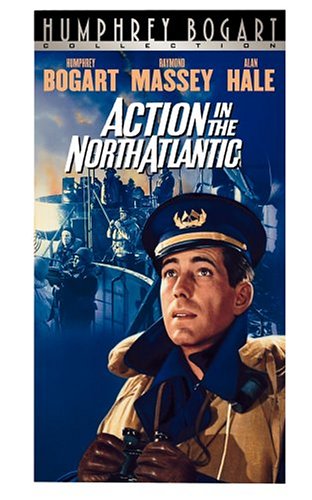
Action in the North Atlantic

Early in World War II, one of the biggest issues facing United States involvement in the war was getting our troops, equipment and materiel across the Atlantic Ocean to the European mainland.  The problem wasn't the ships, there were plenty of those, but the German navy -- especially the U-boats -- which wreaked havoc on those ships, sending thousands of ships and even more men to the bottom of the ocean. But even as the sunk tonnage went up, the ships kept making the dangerous journey.  That's the story of 1943's Action in the North Atlantic.

Now for all you non-history buffs out there, 1943 was right in the midst of World War II when the war was still very much in the balance.  Hollywood did its best to turn out stories that would inspire on the home front and convince Americans that this was a war that needed to be won.  In other words, we're not talking a whole lot of subtlety here, just straight propaganda.  It would be interesting had this movie been made in the 1960s or even now in the 21st Century just to get a different perspective on the story.  But it didn't happen that way, and we get a movie that is very much a prisoner of the time it was made in.  Not always a bad thing.

Sailing to deliver a dangerous shipment of thousands of gallons of fuel, a ship of Merchant Marines commanded by Capt. Steve Jarvis (Raymond Massey) and first officer Joe Rossi (Humphrey Bogart) is attacked and sunk by a German U-boat.  Jarvis, Rossi and some of the crew survive and are picked up, welcomed home as conquering heroes.  It's not long before Jarvis gets a new ship with much of the same crew as they hope to help the war effort aboard the USS Seawitch.  Their first mission is an important one as they will sail as part of an immense convoy traveling from the US all the way to Russia with badly-needed supplies and materiel.  A convoy this big can't help but attract attention, and it seems like it will only be a matter of time before the Germans come around.

Dripping with propaganda and messages of hope, 'Atlantic' is a good example of the movies Hollywood churned out during the war.  The story itself is an interesting one that deserves to be told in an honest, straightforward manner.  Unfortunately, we get the portrayals of these American sailors as angelic men who could do no wrong, and their German counterparts as evil, sadistic bastards who laugh as they ram doomed Americans.  On the positive side, director Lloyd Bacon (Raoul Walsh is an uncredited director here) commits to this garbage all the way. It doesn't hit you over the head the way some early 1940s movies do in getting its message across.  Bogie's final monologue could have been too sappy, but in his hands it is the ideal capper to a solid story.

Now at 126 minutes final running time, 'Atlantic' could use some trimming.  With much of the story taking place at sea, we get some pretty seamless shots of actual ships sailing on the ocean with some well-handled miniature shots.  Of course, that only goes so far.  Stock footage is overused to the point where you can fast forward through large chunks of the story without missing a beat.  The movie is obsessed with showing you what life on a ship is like, but it gets tedious, and it does so quickly.  There's also the portrayal of the German U-boat chasing the Seawitch.  I'm guessing all-told, there is probably about 20-30 minutes of the Germans in the 2-hour movie.  They even speak German...but with no subtitles!  Do you know how boring a movie gets when you can't understand a thing anyone is saying? It's a 2-hour movie, and I watched it in about 90 minutes because the fast forward got a workout.

The saving grace is the cast, including one of my favorites in Bogart.  The man was a chameleon when it came to the roles he could play, and he shows it off here.  This isn't a part that requires a ton of heavy lifting, but Bogart handles it as smoothly as possible. He gets a love interest (easy on the eyes Julie Bishop) that feels tacked on and doesn't serve a real purpose, but Bogart also gets to play the up-and-up hero for a change too.  No concerns if he's the anti-hero just waiting to reveal himself, Bogie is the all-American hero here.  Massey is all right as Capt. Jarvis, but he doesn't have to do much other than growl and talk about how badly he wants to get revenge on the Germans.  I'm sure 1943 audiences ate it all up.

Working from a John Howard Lawson screenplay, 'Atlantic' at its best is when it is dealing with the daily lives of the crew, merchant marines who weren't officially part of the Navy but nonetheless did their best to aid the war effort. The interactions among the crew and the relationships, the friendships, the arguing that develop feel authentic from the start, and you like this motley group of sailors who include Alan Hale, Dane Clark, Sam Levene, Peter Whitney, and Dick Hogan. I don't know what it's like to work and live on a ship for days, weeks and months at a time, but this felt real to me, and not forced.  So in spite of its flaws, I'll still recommend this WWII flick.

Action in the North Atlantic <---trailer (1943): ***/****   

Thursday, November 18, 2010

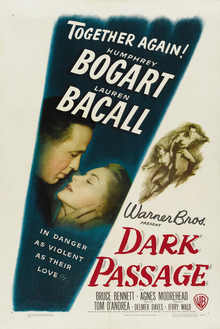
Dark Passage

When I think of current movie stars, I'm not typically thinking of really tough guys who are willing to shake things up a bit when they take a role.  I'm typically thinking soft, pampered, egotistical maniacs who are catered to night and day, and then if they don't get what they want, bitch and moan about it until they do.  Now to be fair, saying all this I never have met any of these movie stars and for all I know they're wonderful people. But then I think about stars from the Golden Age of Hollywood, guys like Gary Cooper, Clark Gable, Spencer Tracy, and one of my favorites, Humphrey Bogart.

The ultimate tough guy who shouldn't have been.  Whatever he may have lacked in stature or just pure physical intimidation, Bogie made up for it with a presence that very few actors can even come close to duplicating.  So what about a movie with Bogart starring where for 45 minutes we don't actually see his face but know it is him nonetheless?  Then for another 15 minutes, we see and hear his familiar voice but his face is covered in bandages. That's 1947's Dark Passage, an underrated film noir that relies on a gimmick, but in a good way.  If you're a fan of Mr. Bogart, this is not one to miss.

Serving a sentence after being found guilty for murdering his wife, Vincent Parry (Bogart) is on the run having escaped from San Quentin Prison outside of San Francisco. He's picked up by a young woman, Irene (Lauren Bacall), who willingly goes along and agrees to sneak him into San Fran through all the police searches and roadblocks.  With the police combing the state for him, Vince decides he needs to undergo plastic surgery because his face is too recognizable.  His plan starts to come together with Irene agreeing to help hide him, but Vince has bigger ideas.  He didn't kill his wife and is going to do everything in his power to find out who the real killer is.  He may not have to look far though because the killer could be coming for him instead.

The gimmick here is that for the first hour of the movie we don't actually see Humphrey Bogart's face.  How cool is that, how original?  I just can't see stars like George Clooney or Brad Pitt doing that, can you? The first 45 minutes anytime Bogie is in a scene, the camera is Bogie's face.  It's his point of view, his perspective.  In these pre-surgery scenes, Parry looks like someone else, a picture we even see in the newspaper.  So really, it's Bogie...but it ain't Bogie.  Then after the surgery while he recovers, his head and face are completely covered by bandages for another 15 minutes in movie time.  It's such an original idea and so ahead of its time that I enjoyed the movie that much more just because of its originality.  It's a gutsy call to hide your star for an hour in a 2-hour movie, but it is handled so well that the movie and its story doesn't miss a beat.

Using this technique of Bogie's eyes serving as the camera certainly is a roll of the dice because if that strategy doesn't work, you've lost the viewers less than halfway through the movie.  Then when we do see Bogart on-screen, the audience is either gone or bored with a movie they have decided to stick with all the way through.  In other words, it could be too late.  The pacing can be a little slow as Parry's plan comes together, but it's never too slow.  More tension could have been added, more sense of the police closing in on him, but that comes into play more the second half of the movie.  Director Delmer Daves moves the camera around as if this character was walking around in an apartment or navigating a confrontation with an overly inquisitive driver.  Original, innovative, and ahead of its time, all positives toward overshadowing the slower moving portions of the movie.

Now onscreen or offscreen, Bogart is an ideal choice to play a character like this.  Basically, we don't need to actually see him.  We know it's him just by his distinctive, deep, gravelly voice.  And even though Bogart played his fair share of shady characters, you know, you just KNOW, there's no way he could have killed his wife so of course he's telling the truth.  He brings his typically hard edge to his role of a man who knows he's been wronged and intends to fix things no matter how long it takes.  Regular Bogie co-star and current Mrs. Bogart Lauren Bacall always worked well with her husband, and this part is no different.  She was one of the few actresses who could match him for on-screen charisma and presence.  And in a completely pointless aside that has nothing to do with the movie, Bacall looks ridiculously gorgeous here.  She always looked good, but this is a step above the rest.

All good elements aside, the execution and revelation of the actual murderer doesn't completely gel.  It feels rushed at times and thrown together.  The reveal is really obvious and somewhat surprising at the same time (if that makes sense) with just too much coincidence thrown in to keep it somewhat manageable.  The final scene on the other hand is perfect, one that was repeated almost 50 years later in The Shawshank Redemption. The rest of the cast includes Agnes Moorehead (later of Bewitched fame) as noisy neighbor Madge, Bruce Bennett as Bob, a fella with an understandable interest in Irene, and Tom D'Andrea as a friendly cabby who helps Vince.  An all-around solid film noir with some great performances from Bogart and Bacall, and some filmmaking techniques that are still worth watching over 60 years later.

Dark Passage <---trailer (1947): ***/****

Wednesday, January 6, 2010

Battle Circus

For 11 seasons staring in 1972, MASH dominated TV as one of the best shows around, including a series finale that still holds the record for most viewers of an episode in the U.S. with over 100 million people watching. It was a unique show that came along at the right time which viewers connected with to the point the show lasted four times longer than the war it was based in, the Korean War.

Comparing the four major wars the U.S. was involved in during the 20th Century, the Korean War was a turning point, both because the U.S. didn't win but also with the changing technology between WWII and Vietnam. In the MASH tv show, the focus was on Mobile Army Surgical Hospitals, hospitals built near the front lines so casualties could be treated quicker and more efficiently. They were always on the move, going backward or forward depending on how the fighting went, and were always on-call in case of incoming casualties that needed to be treated. MASH dealt with all this in its 11-year run, but what about a movie made during the Korean War that dealt with these MASH units? Throw in an unnecessary romance plotline, and you've got 1953's Battle Circus.

It's the middle of the Korean War and nurse Ruth McGara (June Allyson) has received a posting to MASH 66 near the front lines. There she finds a camp with a commanding officer, Lt. Col. Whalter (Robert Keith), who doesn't seem to have much in the way of respect with one of his surgeons, Major Jed Webbe (Humphrey Bogart), basically running things. Ruth tries to settle in as best she can with the chaotic life led by the troops stationed at this MASH unit. With the front lines up in the air and a Communist attack always a possibility, Ruth falls for the roguish Maj. Webbe. While showing interest in the new nurse (almost like Hawkeye Pierce in training), Webbe has little to no interest in a serious relationship with Ruth. Can those two crazy kids keep it together?

Filmed with the help of the Department of Defense and the Attorney General and released in 1953, the movie lacks the typically blunt messages of a war-time movie. Little to no propaganda is thrown at the viewer, and other than a North Korean prisoner, the enemy is almost an afterthought that is spoken of but never shown. The semi-documentary style works well in showing the inner workings of this MASH unit. Where the TV show MASH unit never seemed to move, this one is packing up and on their way several times. Some great sequences with Keenan Wynn's Sgt. Statt leading these moves illustrate how crazy these units could be at times, usually just a mile or so from the front line.

The day-to-day life of MASH 66 are obviously the worthwhile segments in Battle Circus, showing similar things the TV show would deal with almost 20 years later. Several vignettes come to mind, including a helicopter pilot (William Campbell) flying into a hot zone to pick up a wounded soldier and then later trying to reach camp in the dark with his fuel running out. It's the type of thing that almost certainly happened thousands of times during the war, but seeing it brings it to life. The finale especially works as Bogie's Webbe evacuates the hospital with guerillas closing in on all sides, all the while trying to care for the most seriously wounded patients.

For whatever reason though, the day-to-day life portrayal must not have been exciting enough for the studios because Bogart and Allyson's love story was added in. I've never been a huge fan of Allyson -- she comes across as too whiney in all the roles I've seen -- and teaming her with Bogart (who was 20 years older than her at the time) is an odd pairing. Bogie is basically Hawkeye Pierce carrying a gun and has the look of a frazzled, often exhausted surgeon dealing with the neverending flow of wounded patients. He doesn't have much in the way of chemistry with Allyson, and their scenes together ground the otherwise enjoyable/exciting story to a halt.

Too bad because much more time is spent with the falling in love storyline instead of the inner workings of the hospital. Bogie is always cool, and it's fun to see him in a war movie, but the thrown together romance derails the movie. Wynn is solid in a key supporting role, as is Keith, but the division of the storyline takes its toll late. See this one for the sequences of a front-line MASH unit and fast forward through the smaltzy love scenes.

Battle Circus <----trailer (1953): ** 1/2 /****

Wednesday, October 21, 2009

Passage to Marseille

My favorite TV show is Lost which used flashbacks for most of four seasons in its storytelling. I like the reasoning because it gives background without devoting whole seasons to character back stories. The same goes for movies where a 2 or 3 minute flashback can accomplish what a prequel might have been able to do. Of course, with anything good you can take it too far like 1944's Passage to Marseille, an otherwise enjoyable movie set in WWII.

Working off a novel as his source, director Michael Curtiz delivers a movie that at any number of times is juggling 4 different storylines courtesy of a flashbacks; Free French squadron in England, French ship traveling from South America to France, pre-war character stories, and a desperate prison escape from Devil's Island. The plotlines are never confusing, but at certain points I wanted to groan as the screen went fuzzy for another flashback. Reading up about the novel, it seems Curtiz stayed pretty faithful to his subject matter, but could this have been better as four different movies, a huge series? Quite possibly, but that probably would have cost significantly more cash that's not mine.

'Marseille' opens with a great framing device in the middle of WWII as a war correspondent (John Loder) visits a Free French bomber squadron in England where he meets their liasion officer, Freznet (Claude Rains). The writer is curious about one of the machine gunners on one of the bombers, a man named Matrac (Humphrey Bogart). So starts Flashback 1 with Freznet recapping how he met Matrac years before. Sailing from South America to France aboard Capt. Marlowe's (Victor Francen) ship, a little canoe is found floating at sea with five people aboard (Bogart, Peter Lorre, George Tobias, Helmut Dantine, and Phillip Dorn). Freznet figures out these five are Devil's Island escapees trying to get back to fight for their native France. But not so fast, WWII has broken out and France has signed an armistice with Germany.

A French officer, Major Duval (Sydney Greenstreet), onboard wants to deliver the ship to Marseille with its shipment of nickel ore, while Capt. Marlowe intends to head for England and join the war effort. A mutiny looks to be impossible to avoid with the five Devil's Island convicts playing a deciding factor. Sounds like a pretty decent story, doesn't it? We're not done yet with flashbacks to the Devil's Island escape and then Bogie's background as to how he ended up in prison. So here's the basic, during WWII Rains is telling a story about Bogie, who's tellling a story about Devil's Island who's telling a story about Bogie being sent to prison. I'm tired just writing about it.

Besides the mangled story structure (I'm not sure how a linear story could have been done), this was a solid movie all around. The casting is impeccable even if Bogie is an odd choice as a patriotic Frenchman. Thankfully, he makes no attempt at a French accent. Still, Bogart is as an iconic figure as Hollywood ever produced, and he's as calmly cool as he ever was. His backstory with his wife Paula (Michele Morgan) is needed to balance out the changes his character makes as he goes from a newspaperman denouncing the French government to a convict to a patriotic Frenchman. The rest of the cast is pretty nuts with Rains very solid leading a strong ensemble. Vladimir Sokoloff makes quite an impression too as a free man let out of the French penal system who aids the escape effort.

Made two years after Casablanca, 'Marseille' features a boatload of connections, starting with Bogart starring and Rains, Greenstreet and Lorre in supporting roles with Curtiz directing. It definitely has the feel of Casablanca with the war setting serving as a backdrop to an exciting story. Overdone at times -- mostly due to the choppy story courtesy of the flashbacks -- but still a solid movie. Youtube has it available to watch, starting here with Part 1 of 11. See if you can keep up.

Passage to Marseille <----trailer (1944): ***/****