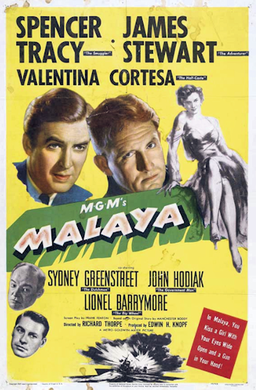
Look down the right side of the page, and you'll see under 'Labels' quite a few war movies. For the most part though, most are about the actual fighting, the combat of war. What about the behind the scenes war angle though? How about the things that make a war possible, like production of planes, guns, materiel, and all that good stuff? A little change of pace today with 1949's Malaya, a shadowy film noir-ish story set in World War II.
Having just escaped the South Pacific with Japanese forces on his tail, newspaper reporter John Royer (James Stewart) is approached by a former boss (Lionel Barrymore) upon arrival. The conversation turns to Royer's exploits -- sometimes shady ones -- in Asia and the Pacific, Royer admitting he knows where quite a lot of raw rubber is being stored, harvested and hidden in Malaya. As the need for war materiel increases, so does the need for rubber, used to build countless key things needed to fight the war. With backing from the government (on a somewhat backdoor-ish deal), Royer agrees to go back to Malaya and see if he can buy as much as the rubber as possible and slip it out of the country. He needs help though and arranges for a friend, former partner and smuggler, Carnahan (Spencer Tracy), to aid the cause. Together, they head into Japanese-occupied territory on their nearly suicidal mission.
Considering the star power assembled here -- and there's more -- I was surprised I had never stumbled across this WWII flick before. I'm glad I did. From director Richard Thorpe, it's a mix between a behind the lines secret agent mission with many of the conventions viewers in 1949 had come to love about the film noir genre. Filmed in black and white with Malaya as the backdrop, it is a South Pacific film noir, and I can honestly say I've never seen a movie quite like that. Okay, maybe 1952's Macao. I loved the setting here, the crowded, smoky saloon and gambling house, the alleyways and dim streets, the expansive mansions and businesses in the countryside. The combination of the war movie and the crime noir just flows well together. It's always fun to see two such vastly different genres combine (usually not this well), but the end result is a lot of fun.
Not exactly a buddy movie, 'Malaya' nonetheless plays on some of those conventions that would become so familiar to audiences over the coming years. This film was the only on-screen pairing Tracy and Stewart ever made although they were together in 1962's How the West Was Won (Tracy narrating, Stewart acting). I'm never going to complain when a film pairs two Hollywood legends like this and lets them have at it. The two play well off each other. Stewart's Royer is a journalist with quite the checkered past, but with this mission, he wants to accomplish something, something meaningful. Tracy's Carnahan is a businessman and a convincing one. He looks out for himself more than anything, questioning Royer's patriotic actions. His bottom line? Usually dollar signs. Together though, they're great, always sarcastically calling each other 'Buddy!' as the mission develops. A WWII Odd Couple noir style of sorts, it's a winning combination.
Most movies would be quite content to pair two actors of that caliber together and let things be, but Thorpe doesn't settle for just two stars. This is one impressive cast, both in star power and performances delivered. Noir veteran and perpetual scene stealer Sydney Greenstreet plays the Dutchman, a saloon and gambling house owner with his hand in everything that could make him more money who joins in with Carnahan and Royer. Valentina Cortese is the checkered woman with a heart of gold, Luana, Carnahan's long-time love. John Hodiak is underused but reliable as always as Keller, a government agent working with Royer who puts the plan in motion for his Malayan plan. Barrymore too makes what amounts to a cameo as Manchester, a businessman working with several other very well to-do businessman to help the war effort. Also look for Gilbert Roland as Romano, one of the locals who teams up with Carnahan, utilizing his "unique" skill set to help in the thieving. Richard Loo gets to sneer and leer as Colonel Tomura, the Japanese officer suspicious of what's going on.
So a story that blends WWII and noir conventions? Not bad, not bad at all. How about elements of a western too? Why not?!? I very much enjoyed how the story plays out as Royer and Carnahan deal with various rubber plantation owners, working with some, intimidating others. We see their motives and intentions though, and that goes a long way. Royer is far from an idealist, but he wants to accomplish something. Carnahan is the opposite, thinking logically. Where it comes to a fork in the road is that both men come to a point where they want to do what's right. Is is the smart decision? No, if anything it's more dangerous, but there's a code of honor of sorts. As a man, what do you decide? The ending has a bit of a cop-out, but it's not a big deal. It's a movie that blends a whole lot of different things but manages to come out the better. Well worth checking out.
Malaya (1949): ***/****
The Sons of Katie Elder
"First, we reunite, then find Ma and Pa's killer...then read some reviews."
Showing posts with label Sydney Greenstreet. Show all posts
Monday, December 24, 2012
Friday, December 30, 2011
Christmas in Connecticut
One of if not the best and most recognizable femme fatales in film noir movies of the 1940s, Barbara Stanwyck excelled at seductive, cold, ruthless female characters early in her career like Double Indemnity. Even when she wasn't glamming it up, she was a more dramatic actress. It's change of pace time, and one of Stanwyck's best and most different roles was 1945's Christmas in Connecticut.
A highly successful and very popular syndicated writer, Elizabeth Lane (Stanwyck) has created quite the elaborate lie. She publishes a monthly column about life on her farm with her husband, baby, and assorted adorable animals. The only problem? Elizabeth lives in a small New York City apartment. Her problem gets bigger when a sailor, Jefferson Jones (Dennis Morgan), rescued after 18 days on the open ocean has requested he meet Elizabeth and be treated to an All-American Christmas. Her publisher (Sydney Greenstreet) has complied, putting Elizabeth in quite the spot. With Jones and her boss on the way, can she continue to pull off a ruse with some help from friend and possible suitor, John (Reginald Gardiner)?
Let the 1940s crazy shenanigans begin! The premise is funny but ridiculous from the word 'go.' How do you pull off a ruse like this? Lies, lies and more lies. It reminded me of an extended episode of I Love Lucy, a crazy scheme that in no possible way would ever work....working. There are some very funny running gags including an appearance-changing baby, a judge (Dick Elliott) constantly trying to marry Elizabeth and John, and Greenstreet's publisher consistently muscling his way into problems. It's a 1940s romantic comedy, and that's a good thing. Stupid? Yes. Ridiculous? Oh, you know it. On the other hand.....
It's a sweet, innocent story that could only work in 1940s America. Romantic comedies released recently are mind-numbing, stories of "old maids" who can't get married, girls/guys talking about their conquests, and dreamy guys who always end up with the can't find a man "I'm so unlucky" woman. Some of that is on display here, but because it was made in the 1940s as opposed to the 2010s, it just works better (in my messed up head anyways). You can probably predict the ending now without seeing the movie. But the funny story, better script, black and white camerawork, a great cast, it all rolls up together into a winner. It just does. Would a story like this work now in 2011? Nope, and that's a good thing.
For all the movies I've seen (and are trying to see), I've only seen Stanwyck in one other movie I can think of even if I was aware of her screen presence as a seductive femme fatale. She does comedy here effortlessly. Her line deliveries are perfect as she navigates her way through "her life," not knowing how to care for a baby, to keep up a house, to cook, to do all the basics a wife might be able to expect. The humor is dry, her deliveries mostly subtle, and the looks she gives are priceless. It's always nice to see someone step out of their box as a performer, and Stanwyck nails this part. Her Elizabeth Lane is a great central character, her predicament seemingly getting worse by the moment.
Other than fellow noir alum Greenstreet, 'Connecticut's' supporting cast doesn't have a lot of star power or name recognition. Morgan as Jones is somewhat dull, the all-American soldier returning home to a hero's welcome, but he does have a good chemistry with Stanwyck, and that's all that really matters. Greenstreet too has a lighter part (with a somewhat darker side) as the money-minded publisher, Alexander Yardley. Gardiner as John Sloan is the dupe, keeping a seat warm until Elizabeth realizes she likes Jefferson. Heavily-accented Hungarian actor S.Z. Sakall is a scene-stealer as Felix, Elizabeth's friend and expert on cooking, with Una O'Connor playing Sloan's Irish live-in maid, Norah.
Not a Christmas classic up there in the vein of Wonderful Life, White Christmas, Miracle on 34th Street, but this is a winner. I'm disappointed I took so long actually sitting down and watching it. Definitely a movie that qualifies as one of those rare "They don't make them like they used to." Funny, charming, and sugary sweet, and a great movie overall.
Christmas in Connecticut <---TCM trailer/clips (1945): ***/****
A highly successful and very popular syndicated writer, Elizabeth Lane (Stanwyck) has created quite the elaborate lie. She publishes a monthly column about life on her farm with her husband, baby, and assorted adorable animals. The only problem? Elizabeth lives in a small New York City apartment. Her problem gets bigger when a sailor, Jefferson Jones (Dennis Morgan), rescued after 18 days on the open ocean has requested he meet Elizabeth and be treated to an All-American Christmas. Her publisher (Sydney Greenstreet) has complied, putting Elizabeth in quite the spot. With Jones and her boss on the way, can she continue to pull off a ruse with some help from friend and possible suitor, John (Reginald Gardiner)?
Let the 1940s crazy shenanigans begin! The premise is funny but ridiculous from the word 'go.' How do you pull off a ruse like this? Lies, lies and more lies. It reminded me of an extended episode of I Love Lucy, a crazy scheme that in no possible way would ever work....working. There are some very funny running gags including an appearance-changing baby, a judge (Dick Elliott) constantly trying to marry Elizabeth and John, and Greenstreet's publisher consistently muscling his way into problems. It's a 1940s romantic comedy, and that's a good thing. Stupid? Yes. Ridiculous? Oh, you know it. On the other hand.....
It's a sweet, innocent story that could only work in 1940s America. Romantic comedies released recently are mind-numbing, stories of "old maids" who can't get married, girls/guys talking about their conquests, and dreamy guys who always end up with the can't find a man "I'm so unlucky" woman. Some of that is on display here, but because it was made in the 1940s as opposed to the 2010s, it just works better (in my messed up head anyways). You can probably predict the ending now without seeing the movie. But the funny story, better script, black and white camerawork, a great cast, it all rolls up together into a winner. It just does. Would a story like this work now in 2011? Nope, and that's a good thing.
For all the movies I've seen (and are trying to see), I've only seen Stanwyck in one other movie I can think of even if I was aware of her screen presence as a seductive femme fatale. She does comedy here effortlessly. Her line deliveries are perfect as she navigates her way through "her life," not knowing how to care for a baby, to keep up a house, to cook, to do all the basics a wife might be able to expect. The humor is dry, her deliveries mostly subtle, and the looks she gives are priceless. It's always nice to see someone step out of their box as a performer, and Stanwyck nails this part. Her Elizabeth Lane is a great central character, her predicament seemingly getting worse by the moment.
Other than fellow noir alum Greenstreet, 'Connecticut's' supporting cast doesn't have a lot of star power or name recognition. Morgan as Jones is somewhat dull, the all-American soldier returning home to a hero's welcome, but he does have a good chemistry with Stanwyck, and that's all that really matters. Greenstreet too has a lighter part (with a somewhat darker side) as the money-minded publisher, Alexander Yardley. Gardiner as John Sloan is the dupe, keeping a seat warm until Elizabeth realizes she likes Jefferson. Heavily-accented Hungarian actor S.Z. Sakall is a scene-stealer as Felix, Elizabeth's friend and expert on cooking, with Una O'Connor playing Sloan's Irish live-in maid, Norah.
Not a Christmas classic up there in the vein of Wonderful Life, White Christmas, Miracle on 34th Street, but this is a winner. I'm disappointed I took so long actually sitting down and watching it. Definitely a movie that qualifies as one of those rare "They don't make them like they used to." Funny, charming, and sugary sweet, and a great movie overall.
Christmas in Connecticut <---TCM trailer/clips (1945): ***/****
Labels:
1940s,
Barbara Stanwyck,
Christmas,
Sydney Greenstreet
Wednesday, October 21, 2009
Passage to Marseille
Working off a novel as his source, director Michael Curtiz delivers a movie that at any number of times is juggling 4 different storylines courtesy of a flashbacks; Free French squadron in England, French ship traveling from South America to France, pre-war character stories, and a desperate prison escape from Devil's Island. The plotlines are never confusing, but at certain points I wanted to groan as the screen went fuzzy for another flashback. Reading up about the novel, it seems Curtiz stayed pretty faithful to his subject matter, but could this have been better as four different movies, a huge series? Quite possibly, but that probably would have cost significantly more cash that's not mine.
'Marseille' opens with a great framing device in the middle of WWII as a war correspondent (John Loder) visits a Free French bomber squadron in England where he meets their liasion officer, Freznet (Claude Rains). The writer is curious about one of the machine gunners on one of the bombers, a man named Matrac (Humphrey Bogart). So starts Flashback 1 with Freznet recapping how he met Matrac years before. Sailing from South America to France aboard Capt. Marlowe's (Victor Francen) ship, a little canoe is found floating at sea with five people aboard (Bogart, Peter Lorre, George Tobias, Helmut Dantine, and Phillip Dorn). Freznet figures out these five are Devil's Island escapees trying to get back to fight for their native France. But not so fast, WWII has broken out and France has signed an armistice with Germany.
A French officer, Major Duval (Sydney Greenstreet), onboard wants to deliver the ship to Marseille with its shipment of nickel ore, while Capt. Marlowe intends to head for England and join the war effort. A mutiny looks to be impossible to avoid with the five Devil's Island convicts playing a deciding factor. Sounds like a pretty decent story, doesn't it? We're not done yet with flashbacks to the Devil's Island escape and then Bogie's background as to how he ended up in prison. So here's the basic, during WWII Rains is telling a story about Bogie, who's tellling a story about Devil's Island who's telling a story about Bogie being sent to prison. I'm tired just writing about it.
Besides the mangled story structure (I'm not sure how a linear story could have been done), this was a solid movie all around. The casting is impeccable even if Bogie is an odd choice as a patriotic Frenchman. Thankfully, he makes no attempt at a French accent. Still, Bogart is as an iconic figure as Hollywood ever produced, and he's as calmly cool as he ever was. His backstory with his wife Paula (Michele Morgan) is needed to balance out the changes his character makes as he goes from a newspaperman denouncing the French government to a convict to a patriotic Frenchman. The rest of the cast is pretty nuts with Rains very solid leading a strong ensemble. Vladimir Sokoloff makes quite an impression too as a free man let out of the French penal system who aids the escape effort.
Made two years after Casablanca, 'Marseille' features a boatload of connections, starting with Bogart starring and Rains, Greenstreet and Lorre in supporting roles with Curtiz directing. It definitely has the feel of Casablanca with the war setting serving as a backdrop to an exciting story. Overdone at times -- mostly due to the choppy story courtesy of the flashbacks -- but still a solid movie. Youtube has it available to watch, starting here with Part 1 of 11. See if you can keep up.
Passage to Marseille <----trailer (1944): ***/****
Subscribe to:
Posts (Atom)