The Sons of Katie Elder

The Sons of Katie Elder
"First, we reunite, then find Ma and Pa's killer...then read some reviews."
Showing posts with label Lionel Barrymore. Show all posts

Monday, December 24, 2012

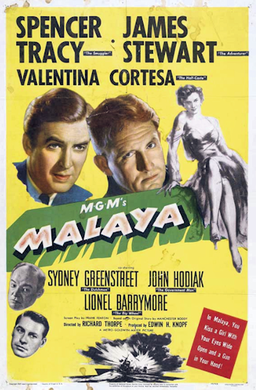
Malaya

Look down the right side of the page, and you'll see under 'Labels' quite a few war movies. For the most part though, most are about the actual fighting, the combat of war. What about the behind the scenes war angle though? How about the things that make a war possible, like production of planes, guns, materiel, and all that good stuff? A little change of pace today with 1949's Malaya, a shadowy film noir-ish story set in World War II.

Having just escaped the South Pacific with Japanese forces on his tail, newspaper reporter John Royer (James Stewart) is approached by a former boss (Lionel Barrymore) upon arrival. The conversation turns to Royer's exploits -- sometimes shady ones -- in Asia and the Pacific, Royer admitting he knows where quite a lot of raw rubber is being stored, harvested and hidden in Malaya. As the need for war materiel increases, so does the need for rubber, used to build countless key things needed to fight the war. With backing from the government (on a somewhat backdoor-ish deal), Royer agrees to go back to Malaya and see if he can buy as much as the rubber as possible and slip it out of the country. He needs help though and arranges for a friend, former partner and smuggler, Carnahan (Spencer Tracy), to aid the cause. Together, they head into Japanese-occupied territory on their nearly suicidal mission.

Considering the star power assembled here -- and there's more -- I was surprised I had never stumbled across this WWII flick before. I'm glad I did. From director Richard Thorpe, it's a mix between a behind the lines secret agent mission with many of the conventions viewers in 1949 had come to love about the film noir genre. Filmed in black and white with Malaya as the backdrop, it is a South Pacific film noir, and I can honestly say I've never seen a movie quite like that. Okay, maybe 1952's Macao. I loved the setting here, the crowded, smoky saloon and gambling house, the alleyways and dim streets, the expansive mansions and businesses in the countryside. The combination of the war movie and the crime noir just flows well together. It's always fun to see two such vastly different genres combine (usually not this well), but the end result is a lot of fun.

Not exactly a buddy movie, 'Malaya' nonetheless plays on some of those conventions that would become so familiar to audiences over the coming years. This film was the only on-screen pairing Tracy and Stewart ever made although they were together in 1962's How the West Was Won (Tracy narrating, Stewart acting). I'm never going to complain when a film pairs two Hollywood legends like this and lets them have at it. The two play well off each other. Stewart's Royer is a journalist with quite the checkered past, but with this mission, he wants to accomplish something, something meaningful. Tracy's Carnahan is a businessman and a convincing one. He looks out for himself more than anything, questioning Royer's patriotic actions. His bottom line? Usually dollar signs. Together though, they're great, always sarcastically calling each other 'Buddy!' as the mission develops. A WWII Odd Couple noir style of sorts, it's a winning combination.

Most movies would be quite content to pair two actors of that caliber together and let things be, but Thorpe doesn't settle for just two stars. This is one impressive cast, both in star power and performances delivered. Noir veteran and perpetual scene stealer Sydney Greenstreet plays the Dutchman, a saloon and gambling house owner with his hand in everything that could make him more money who joins in with Carnahan and Royer. Valentina Cortese is the checkered woman with a heart of gold, Luana, Carnahan's long-time love. John Hodiak is underused but reliable as always as Keller, a government agent working with Royer who puts the plan in motion for his Malayan plan. Barrymore too makes what amounts to a cameo as Manchester, a businessman working with several other very well to-do businessman to help the war effort. Also look for Gilbert Roland as Romano, one of the locals who teams up with Carnahan, utilizing his "unique" skill set to help in the thieving. Richard Loo gets to sneer and leer as Colonel Tomura, the Japanese officer suspicious of what's going on.

So a story that blends WWII and noir conventions? Not bad, not bad at all. How about elements of a western too? Why not?!? I very much enjoyed how the story plays out as Royer and Carnahan deal with various rubber plantation owners, working with some, intimidating others. We see their motives and intentions though, and that goes a long way. Royer is far from an idealist, but he wants to accomplish something. Carnahan is the opposite, thinking logically. Where it comes to a fork in the road is that both men come to a point where they want to do what's right. Is is the smart decision? No, if anything it's more dangerous, but there's a code of honor of sorts. As a man, what do you decide? The ending has a bit of a cop-out, but it's not a big deal. It's a movie that blends a whole lot of different things but manages to come out the better. Well worth checking out.

Malaya (1949): ***/****

Friday, December 25, 2009

It's a Wonderful Life

As much as possible here with my reviews, I do my best to avoid huge, sweeping generalities about moviegoers and their likes and dislikes...this is not one of those times. Released in 1946 to mixed reviews and a horrific showing in theaters, It's a Wonderful Life was pretty much left by the wayside for many years only to be given new life as a new generation of moviegoers rediscovered it in the 1970s and 1980s. Let me say this about critics and audiences in 1946 who didn't think too highly of this movie; they are IDIOTS.

If director Frank Capra can be accused of anything for his abilities as a moviemaker, it was that his films tended to be on the sentimental, downright sappy side. The description 'Capra-esque' is used all the time now to describe a movie that doesn't have a mean bone in its body. Is that really a bad thing? Coming from a movie fan who can be pretty cynical, doesn't really enjoy Hollywood happy endings, and is ready to roll his eyes at a moment's notice, that's saying something. 'Wonderful Life' is sappy, sentimental and meant to tug at your heart strings. What's wrong with a movie that is content being wholesome and entertaining?

For those people who haven't seen the movie -- I think they're called Communists -- here's the quick breakdown. George Bailey (James Stewart) is a family man in the town of Bedford Falls with his wife Mary (Donna Reed) and their four kids. George runs the Building and Loan, a small business that is basically all that remains in town not owning to rich old curmudgeon Mr. Potter (played to evil perfection by Lionel Barrymore). After years of struggling to stay above water financially, George has hit his breaking point. His partner and family relative Uncle Billy (Thomas Mitchell) lost $8,000 that the Building and Loan needs to survive. Looking at a lengthy jail sentence, George seeks a way out and comes to the conclusion he's worth more to his family dead than alive.

But standing on a bridge ready to jump into the freezing waters below, George instead has to jump in after another man that fell in. His name is Clarence (Henry Travers), an angel 2nd Class -- he doesn't have his wings yet -- and he's been sent to save George. But to convince him he's real, Clarence gives George a rare gift...to see what the world would be like if he was never born. Given this opportunity, George sees what a profound affect he's had on people all his life.

Much of the story is George's life seen in flashback as Clarence learns about the man he's supposed to save. This first 75 minutes is key, absolutely essential to show what George's makeup is. His life didn't turn out anywhere near what he had planned, but even with some detours and changes, he has a happy life through his marriage with Mary and his four children. He has family and friends and almost a whole town that needs him. These parts set the stage perfectly for the last hour of the movie as George is forced to take stock of his life and see what he's really accomplished with a life he thinks has been a waste to a certain point.

But the highlight of the movie is that final hour, one of the best extended sequences in the history of the movies. Watching George realize what's going on as he sees how different the world would be if he'd never been born is a series of perfect little vignettes. This leads him to realize his life was actually pretty great, building up to one of the all time great endings to a movie -- seen HERE if you've never seen it. Now I'm not usually a crier with movies, but I'll admit to crying like a little baby at this ending. It is the perfect ending to this story, well almost, but more on that later.

Jimmy Stewart had a lot of classics in his distinguished career, but this movie easily goes Top 5 with much of the praise coming from his performance. He brings George Bailey to life in creating one of Hollywood's greatest characters. As his wife, Donna Reed is the all-American girl everyone wants to marry, and the two do have great chemistry. On a side note, I find it hard to believe that Reed's Mary could not have found a husband if George wasn't around, but maybe that's just me. The supporting cast is just as good with Barrymore never more evil, Travers very funny as Clarence, the 293-year old angel, and Mitchell as bumbling Uncle Billy. There's also Ward Bond, Frank Faylen, Beulah Bondi, Gloria Grahame, and many more recognizable faces.

As absolutely perfect as the ending is in terms of producing an emotion in the audience, there is a question left unresolved. What about evil Mr. Potter? Saturday Night Live answered that question with one of their most inspired skits ever, check it out HERE at Hulu. The original though is the definition of a Christmas classic that's success just keeps on growing. If you haven't seen this movie yet, first what's wrong with you, and second go find it now.

It's a Wonderful Life <----trailer (1946): ****/****

Friday, August 21, 2009

Duel in the Sun

After the huge success of Gone With the Wind in 1939, movie studios spent years looking for the next big epic to springboard off that epic's success. Ah, who am I kidding, they're still doing that now. GWtW producer David O. Selznick tried to duplicate the success with 1946's Duel in the Sun, a western with a feel of a Greek tragedy that has some interesting cast choices, good and bad, but never amounts to much.

Two key roles show the positive and negative in casting. Jennifer Jones, very white Jennifer Jones, plays a young woman who's father was Mexican and mother an Indian so she has to live with some prejudices against her simply because she's of mixed blood. Jones is doused in skin-darkening makeup to make her look like a Mexican/Indian which looks odd. As for her acting, this is one of those roles that critical fans can point to as being too theatrical. She's over-the-top from the start, and yes, the role requires emotion but it's too much and not believable.

The other interesting casting is rising star Gregory Peck who typically played the resolute, heroic good guy in his career. In 'Duel,' it's just the opposite as he plays the bad guy. And to be fair, Peck nails the part. He's the bad guy you love to hate who can spin a story so quickly and smoothly that you forget what a nasty guy is. This development builds from a cowboy who lives his own life and doesn't think much of what others see in him to a raging, psychopathic killer by the end of the movie. It was refreshing to see Peck in such an atypical role.

On to the story now, which begins with Pearl Chavez (Jones) moving to her distant relatives' sprawling ranch in Texas, the Spanish Bit, after her father is hung for murdering his cheating wife and the unlucky fellow she was with. Pearl, half Mexican/half Indian, finds quite the dysfunctional family at the ranch, starting with the family patriarch, Senator Jackson McCanles (Lionel Barrymore), a racist, crippled old man who refuses to admit the times are changing. Pearl falls for Jackson's son Jesse (Joseph Cotten), a lawyer changing with those times, but ends up with loutish Lewton (Peck), a freewheeling type who lives life how he wants it.

It's the years after the Civil War and the United States are developing and moving further west. The Senator wants nothing to do with the expansion, even when Jesse tries to explain it to him. Pearl is dropped into this perilous situation as the family is torn apart and go their separate ways. Trying to hold it all together, Laura Belle McCanles (Lillian Gish) is seemingly the one good person in the house along with her son Jesse.

This movie had issues from the start, especially when it came to the director's chair, just check out the bevy of directors who were at the helm at one point or another. I couldn't help watching the whole thing is that everyone is trying too hard. Some of my friends dislike pre-1960 movies because they are too theatrical, too stiff, and this is the type of movie where I agree with them. Cotten is good as the angelic brother, Barrymore is playing Barrymore, and Gish makes the most of a smaller part. Also Walter Huston has a small but solid supporting part.  But all in all, something doesn't connect. It feels like a Greek tragedy with family rivalries and disagreements, but there's no one to root for.

By the last 30 minutes or so, decisions are made that serve no real purpose or are even vaguely believable other than to drive the movie along. Pearl loves and hates Lewt, and their ever-so normal relationship starts to turn into listening to nails on the chalkboard. I wanted to say 'just let him go! He's messing with your head!' And then the ending, which is too much on any number of levels.

All this is disappointing because money was clearly spent on this big budget western. One scene with Barrymore and Cotten riding to stop the railroad tracks being built on their land has hundreds of men on horseback. They ride over a far-off hill and approach the rail camp, and it's great to watch. It's a gorgeous movie with some shots where you could freeze the DVD and swear it was a painting. But really it tries too hard to be an epic movie but never quite gets there.

Duel in the Sun (1946): **/****