The Sons of Katie Elder

The Sons of Katie Elder
"First, we reunite, then find Ma and Pa's killer...then read some reviews."
Showing posts with label John Wayne. Show all posts

Saturday, January 9, 2016

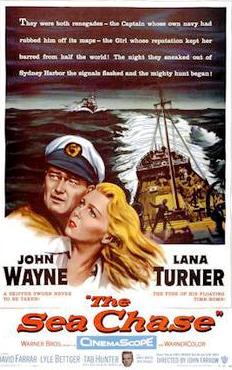
The Sea Chase

First and foremost, John Wayne was one of the screen's most iconic cowboys. Sure, he took some detours along the way as soldiers, cops and on occasion, as sailors and captains. It can be kinda odd seeing him at see instead of in the saddle, but some of the ventures are pretty good, especially 1955's The Sea Chase. And it's not just the Duke that's interesting, but some generally unique choices in storytelling and tone. And away we go on the high seas!

It's the late 1930's and the German steam freighter Ergenstrasse, commanded by German captain Karl Ehrlich (Wayne), is in port in Sydney, Australia. Ehrlich has fallen from some impressive heights in the German navy because he refuses to support the Nazi party, but he's a supremely capable officer with a solid reputation among fellow sailors. Then the whole world is turned upside down when World War II breaks out, leaving the Ergenstrasse far from home and badly under-supplied. Before they slip out from Sydney though, Ehrlich is visited by the German consul who thrusts a German spy on-board, Elsa Keller (Lana Turner), who has important information and needs to get back to German soil. The British Navy doesn't want to let Ehrlich's ship get through though, setting off a cat-and-mouse across the Pacific and Atlantic of who can out-maneuver the other.

This isn't a movie remembered as one of John Wayne's best, but from the star's weakest decade overall, it's a pretty good entry. It isn't a classic, but I found it damn entertaining, director John Farrow at the helm (shipping/sailing pun intended) of a war thriller that's been generally forgotten. John Wayne as a German captain during WWII? Even if he despises the Nazi party, that's a risky play for a star associated with America and patriotism. 'Chase' was filmed in Australia and Hawaii, its sun-drenched locations giving the thriller one purty look. It isn't flashy, but it certainly gets the job done.

So Wayne as a German captain works surprisingly well. He commits himself to the part in the same way he would a cowboy or a soldier. His Karl Ehrlich is a career man, someone who lives by his word and expects others around him to do the same. Nothing is aggressive or heavy-handed about the background, just that Wayne's Ehrlich has little use for Hitler and the Nazis and is paying for those feelings by being sent to captain the far-off German steamer with no value and no hope of promotion. He knows getting back to Germany will end in trouble for his own future, but it is his duty and he feels compelled to do it, troubling results be damned. He looks comfortable to in the role and compared to some of those 1950's duds -- like The Conqueror or Blood Alley -- it's a classic!

In a long, distinguished career, Wayne wasn't always given too many roles with love interests. Okay, that's not true. Love interests other than Maureen O'Hara. Some reviews seem to disagree with me, but I thought the Duke and the lovely Lana Turner were pretty good together. They've both got somewhat checkered pasts and neither has a future that seems too pleasant, but those two stubborn kids, wouldn't you know that they end up falling for each other a tiny bit? Oh, sorry, SPOILER. A good pairing, the only time these two Hollywood legends worked together. It's a very solid pairing.

If a John Wayne at sea love story isn't your thing, the supporting cast here should pull you in. They're not always given a lot to do in a 117-minute running time, but the character actor star power is ON-POINT here. It's cool just seeing all these fellas together, starting with David Farrar as Napier, Ehrlich's friend and a British officer leading the chase, and Lyle Bettger as Chief Officer Kirchner, a die-hard, loyal follower of the Nazi party who's gonna cause all sorts of problems. As for the Ergenstrasse crew -- and I take a deep breath -- look for Tab Hunter, James Arness, Richard Davalos, Luis Van Rooten, John Qualen, Paul Fix, Alan Hale Jr., Peter Whitney, Claude Akins, John Doucette, and Adam Williams. Not bad, huh? Movie nerds will definitely appreciate that character actor-studded cast.

There are some slower portions during the midsection as Ehrlich and the Ergenstrasse improvises and picks up some supplies at a remote Pacific island. It's necessary though as we get to know the persistently stubborn captain and his beautiful German spy on-board. The international intrigue though picks up, especially when Bettger's Kirchner goes on his own and makes a dangerous command decision that puts the whole crew at risk. There's nothing too flashy from beginning to end, but this is a pretty solid sea thriller, meant to be watched on a rainy Sunday afternoon or late at night with some popcorn. A cool change of pace for the Duke with the beautiful Lana Turner and a fun supporting cast. Definitely worth a watch.

The Sea Chase (1955): ***/****

Sunday, November 29, 2015

The War Wagon

I love westerns. I love heist movies. They're two of my favorite genres. So what happens when you combine the two? And throw in two of my all-time favorite actors? Oh, no.....it's a movie nerd alert!!! With just an air of fun hanging over the whole story and production, it's hard not to get on-board and truly enjoy the 1967 western The War Wagon.

Fresh out of jail after serving a three-year sentence for a crime he didn't commit, former rancher Taw Jackson (John Wayne) heads home with revenge on his mind. Framed by a local businessman and landowner, Pierce (Bruce Cabot), Jackson wants to exact revenge where it hurts most...Pierce's gold mine. The attempt would seem suicidal though, Pierce paying for an armor-plated wagon outfitted with a Gatling gun and guarded by 33 outriders that transports the gold from the mine to the train station that would prove to be a major deterrent to any would-be robbers. Jackson isn't about to give up though, but he does need some help, including an unlikely partnership with a hired gun named Lomax (Kirk Douglas) with whom he's had a deadly rivalry in the past and has the bullet wounds to prove it. With a small team of fellow crooks, Taw puts his plan into action to rob the armor-plated wagon, the War Wagon. But just how in hell is he going to pull this off successfully without getting shot full of holes?

This is a movie that's just hard not to like. It was a staple on AMC and TNT growing up so I saw it many times, and it's one I always look forward to revisiting every so often. This last time, well, it had been quite awhile. From tough guy director (and a Wayne favorite) Burt Kennedy, 'War' is one of those perfectly straightforward westerns with no pretensions about the changing times or a revisionist view. It's F-U-N, plain and simple, mixing so effortlessly that western setting with a heist story. Put a crew together, give them a crazy, no way in hell this works mission, and let things fall where they may. Not the best, but one of the most purely entertaining westerns to come out of the decade.

So John Wayne and...Kirk Douglas. Please and THANK YOU. The duo had worked previously together in 1965's In Harm's Way and 1966's Cast a Giant Shadow, but this is the best pairing because it just lets these two pros go to work. Yeah, the heist is fun throughout, but you watch this movie for any and all scenes between Wayne and Douglas. The dialogue crackles between them, a rivalry that treads that fine line between joking and deadly serious. There's some genuine menace in the chemistry, but you just sit back and watch things develop. The best part? They're clearly having a blast. An underrated comedic actor to begin with, Wayne gets to show off his funny chops with some great line deliveries, and Douglas is the perfect foil as Lomax, a hired gun who's a bit of a dandy but takes his job supremely seriously, especially with so much potential money on the line. You couldn't ask for a better star duo to lead the adventure film.

Any good heist needs a good heist team so who to look out for? Certainly a motley crew of crooks, including the very white Howard Keel as Levi Walking Bear, Keenan Wynn as Wes, an employee of Pierce's, and Robert Walker Jr. as Billy, an explosives expert with a drinking problem. A Wayne friend and favorite, Cabot looks to be having a ball as Pierce, the sneering, menacing crook with a whole bunch of power. Also cool to see background player Don Collier get a more visible part as Pierce's right-hand man. Also look for Joanna Barnes, Valora Noland, Bruce Dern, Chuck Roberson (Wayne's stunt double), Emilio Fernandez, and Gene Evans rounding out the cast.

'Wagon' has a lot of little things going for it that combined make for a significantly better flick. Durango, Mexico was one of Wayne's favorite filming locations including Sons of Katie Elder, The Train Robbers, Chisum and here with 'Wagon.' The Mexican mountains and wilderness provide an intimidating, authentic backdrop to the story. Dimitri Tiomkin's score is a gem, big and booming, perfect for an adventure story and one that instantly screams 'Oh, yeah, that's Tiomkin music.' Lastly, an oh so perfectly bad theme song that you can listen to HERE. It's awful, but my goodness, is it ever catchy. I defy you to watch the movie and not to be humming along to the theme days later.

But, ah yes, the heist. There's hints along the way of what Taw, Lomax and Co. are up to, but nothing too specific. So like the best heist movies, as the caper develops, we're in the dark to the exact details, all of that adding a sense of mystery to the proceedings. Nothing too crazy here other than a matter of split-second timing, some dumb luck, and one rather prominent plot hole if you ask me. But there's no point in ripping it to pieces too hard. This is a movie that's meant to be a hell of a lot of fun, and it succeeds throughout on that premise. Wayne and Douglas are pitch perfect together and look to be having a ball.

Sit back, enjoy and let that fun take over from there.

The War Wagon (1967): ***/****
Rewrite of February 2009 review

Friday, October 9, 2015

The Conqueror (1956)

I love John Wayne so let's get that out of the way. I've seen just about every single one of his feature-length films, and more than a few of his ventures are on the Just Hit Play All-Time Favorite List. I can be honest though when necessary, and the 1950's were far from the Duke's strongest decade. Though there were some gems -- Rio Bravo, The Searchers, Hondo among others -- there were some duds, real tankers. Blood Alley, The Barbarian and the Geisha, Legend of the Lost, all not remembered so fondly but one rises (or sinks?) above the rest. Definitely Wayne's worst film and one remembered as one of the worst of all-time, 1956's The Conqueror.

"Why is it so bad, Tim?" you might ask. Why? Well, John Wayne, the all-American movie star takes a crack at playing the infamous Mongol warrior and leader Genghis Khan. Yeah, you read that right. John Wayne plays Genghis Khan. And away we go!

Ruling his tribe/clan of Mongols on the Asian Steppe, fiery, brutal warrior Temujin (Wayne) has caused himself some issues. Namely, a violent conflict he's started with a rival tribe because he kidnapped said tribe leader's wife-to-be, Bortai (Susan Hayward). The equally fiery woman wants nothing to do with Temujin and making it worse, her father killed Temujin's father years before. Uh-oh, family drama! Even as war looms and his people threaten to leave him entirely, Temujin refuses to give up his kidnapped bride who wants nothing to do with him (or does she?!?). Instead, the Mongol leader looks to form an uneasy alliance with a past enemy to hold his power and hopefully gain much, much more. Can it all hold together long enough for Temujin to do what he needs to do to reach out and grab everything he wants? The answer lies on a trail of bodies and a river of blood across the Steppe.

Well, that was a fun plot synopsis to write! It's not too often I get to write a trail of bodies and a river of blood in a review. It's an easy plot to spell out because it is just so criminally bad. We will address John Wayne as Genghis Khan in a bit -- that's too easy -- but there's so much badness here in all-around fashion. The script offers one stilted scene of dialogue after another and then one betrayal and backstabbing after another. Imagine the Indians in 1950's westerns -- Me Indian. How! -- but transitioned to a war on the Asian steppe. Yeah, it's just as bad and cliched and just plain dumb as you'd expect. Actor-turned-director Dick Powell is at the helm of a real stinker here, basically from beginning to end. It doesn't build to bad. It just IS bad.

Okay, John Wayne as Genghis Khan. Let's process this. Let's rationalize. It can't be as bad as it sounds, right? No, it's exactly how it sounds. In the late 1940's and into the 1950's, Wayne really developed as an actor, piling up some of his best roles -- She Wore a Yellow Ribbon, Red River, Sands of Iwo Jima, The Searchers -- but this is just uncomfortable to watch. As Ben Manckiewicz said during the recent airing of 'Conqueror' on TCM, Wayne has said in interviews he played Khan as an American cowboy, a tough gunfighter and wouldn't you know it? That formula doesn't work. He's trying so give him credit because it would have been easy to phone this one in (real easy). Wayne just has too much working against him from the aforementioned dialogue that sounds especially stiff coming from the Duke down to the ridiculous mustache wardrobe set him up with. Bad. Really bad so be forewarned.

No one in the cast escapes the wrath of the script to be honest. Hayward was one tough actress, but she doesn't have much chemistry with Wayne and that's a problem when the driving force of the movie is their passion-filled, love-hate relationship. Hayward does get a bizarre, forced striptease/sexy dance of sorts so....there's that, I guess? Pedro Armendariz plays Temujin's half-brother, Jamuga, his conscious, a wise sidekick who recommends what to do next. Also look for Agnes Moorehead, Thomas Gomez, William Conrad, John Hoyt and Ted de Corsia in supporting parts. Familiar faces Lee Van Cleef and Leo Gordon get supporting background parts. A whole bunch of very non-Asian actors playing Asian parts and the end results are just as bad as you figured they would be. Not a winner in the bunch!

If there's a positive, it comes as a bit of a loaded statement. The scope and scale of the movie is impressive. The battle scenes of colliding, thundering armies crashing into each other are something to behold. The stuntwork is impressive throughout as hundreds of riders fill the screen in lavish uniforms set against the stunning backdrop of the Utah desert. Then there's the issue...the filming locations were 100-miles south of nuclear testing sites and judging by the amount of cast members that would die from cancer over the coming years, it seems the U.S. government's promise that the nuclear fallout wouldn't head their direction...well, that's garbage. Much of the cast and crew would die over the next 5, 10 and 20-plus years from varying cancers, quite possibly from the arduous filming schedule in the Utah desert. If that's not tragic, I don't know what is.

So here we are. The fact that 'Conqueror' has a 3.3 rating on IMDB is a testament to John Wayne fans who are fighting a heck of a battle to bring that number up at least a little. This movie is just as bad and worse as you've heard. I lost interest pretty quickly but stuck it out, hoping things might improve at some point. That's the worst kind of a bad movie, one that's almost impossible to even enjoy in guilty pleasure fashion. Give this one a wide, big-old berth, and that's coming from one of the biggest John Wayne fans around.

The Conqueror (1956): */****

Friday, August 14, 2015

Brannigan

Let's give him points. John Wayne could admit a mistake when he made one. Offered the part of San Francisco detective Harry Callahan -- better known as Dirty Harry -- in the late 1960's, Wayne turned down the part only to see the cop series blow up in a big way for star Clint Eastwood. It took him a couple years to answer, but Wayne turned to the cop genre himself, first with 1974's McQ, and a year later with 1975's Brannigan.

A longtime Chicago cop, Lt. Jim Brannigan (Wayne) has built up quite a reputation for himself over the years, both for good and bad. He's always done his job well but built up quite a list of enemies in the process, especially Ben Larkin (John Vernon), a gangster with a whole lot of knowledge about a whole lot of mob money. With the district attorney's case against Larkin finally coming together, the mobster bails and heads for London on the run. The Chicago police are well aware of the move and with Scotland Yard have Larkin under full surveillance. The catch? They need somebody tough to bring him back. Who better than the man who's been on his case for years, Brannigan himself. The veteran cop heads to England, but what starts as a simple pick-up is quickly thrown out the window when Larkin is kidnapped and ransomed off. Can Brannigan and London police track him down before someone else finishes him off?

As Wikipedia is quick to point out, this 1975 cop drama/thriller follows in the footsteps of Coogan's Bluff (also starring Mr. Eastwood) in terms of the cop as the fish out of water. This isn't fast, brutal Chicago where police work doesn't always play by the rules. This is London, an almost gentlemanly situation where guns are forbidden and rules are made to be followed. Who better than John Wayne to mess that world up? I submit that NO ONE would have been more suited to it. From director Douglas Hickox, 'Brannigan' is a solid if unspectacular cop story, benefiting from Wayne's presence, some solid supporting cast members and very cool on-location shooting in both Chicago (too briefly) and London. Like McQ, it's no classic, but there's enough to recommend.

If you've poked around my reviews these past years, you can tell I kinda like John Wayne. Through good and bad, I'll give his movies a watch. By the 1970's as his health took a turn for the worse (again), he made movies that weren't ground-breaking or world-shattering. Instead, these are movies and roles that are fun. That are entertaining, and in a way, serve as a sort of comfort food. In a way, they were almost a Farewell Tour for one of Hollywood's all-time greats. Much like McQ, Wayne is able to fill the screen with his larger-than-life persona, a gruff, aging cop while still allowing the script to have some fun with his senior citizen status. I've lived in Chicago my whole life, and let me tell you, there's no 68-year old cops running around. From what I've read, Wayne was very much struggling with health concerns during filming, but it doesn't show.

He brings that John Wayne energy in all his scenes, whether he's interrogating a suspect, working with his appointed British partner (Judy Geeson), or going toe-to-toe with his British Scotland Yard counterpart, the very Commander Swann (Richard Attenborough). Health concerns or not (the Duke would only make two more films), Wayne brings that familiar energy to the screen. He has some great chemistry with Geeson in some flirty scenes that aren't pushed too far or too cheesy. The same for his alpha male showdowns with Attenborough's Swann. These are two guys used to doing things their way and getting things done their way. It was very cool to see two pros like Wayne and Attenborough play off each other so effortlessly, one scene ready to murder each other, the next cops doing whatever it takes to get the job done. Some fun parts for surely.

Three years away from his most famous, iconic role in Animal House, Vernon is excellent -- as always -- as the slimy, smooth villain, although he's underused as his characters gets twisted and turned around. Still, it's John Vernon as a bad guy. Hard to pass that up. Mel Ferrer gets to have some fun as Larkin's equally slimy lawyer, forced to work with the cops when the ransom negotiation begins. Also look for Ralph Meeker as Brannigan's commanding officer (a very quick part), Daniel Pilon as a hired killer tasked with offing Brannigan, John Stride as Traven, one of Swann's officers, and James Booth (of Zulu fame) as one of Larkin's sneering kidnappers.

'McQ' had its fair share of flaws, but overall, it was a pretty decent cop flick. I put Brannigan a touch below it. The story and running time feels a little bloated, like 10 or 15 minutes could have been edited here and there. The action is solid -- especially a car chase through London -- and packs quite a punch. It's fun especially seeing Wayne when he does get to unleash all his fury in some interrogation scenes. There are too many times though the story simply drifts. Even the ending disappoints a little, a pretty decent twist livening things up thankfully. It's not a classic and maybe it's not very good at all, but I enjoyed it for what it is.

You only get so many flicks from your favorite actors so enjoy them and focus on the positive. It ain't a classic, but it's entertaining.

Brannigan (1975): ** 1/2 /****

Monday, August 3, 2015

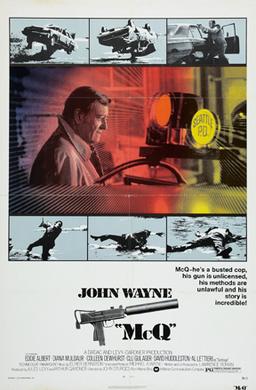
McQ

By the mid 1960's John Wayne wasn't just John Wayne anymore. He was the Duke, an icon and a star. He came to represent something bigger, something Wayne thought people needed to look up to. Because of that sentiment, he turned down some roles that he thought were too much against type. The two big ones? The Major Reisman part from The Dirty Dozen and the role of a famous rogue cop named....Dirty Harry. Wayne regretted not taking the part made famous by Clint Eastwood and went about fixing the issue. The result? Two cop movies, starting with 1974's McQ and following a year later with Brannigan (soon to be reviewed).

A longtime detective on the Seattle police force, Lieutenant Lon 'McQ' McHugh (Wayne) has seen everything there is to be seen. After years on the force, he's sick of the politicians and the glad-handing and all the garbage. He's interested in putting the crooks away, but now one attempted murder hits too close to home when his partner, Lt. Stan Boyle (William Bryant), is shot in the back with a shotgun with no witnesses. Boyle's chances aren't too good, but McQ intends to do something about it. Who shot his partner? The clues are there, and McQ begins to suspect there's a whole lot more going on than meets the eye. He begins to find evidence that could point to any number of trails worth following, from a high-level drug supplier to corruption within the police force. Can he piece it all together before those people he's chasing get him instead?

I've been a huge John Wayne fan for as long as I can remember. If he's starring in a movie, I'll give it a shot. Mostly, they're winners but occasionally there's a dud here and there. I'm looking at you The Conqueror. In this last portion of his career -- mostly the late 1960's and into the 1970's -- Wayne was making movies he wanted to make, movies he figured his fans and audiences wanted to see. Are they classics? With the exception of True Grit and The Shootist, no. On the other hand, they're F-U-N, movies like Big Jake, The Train Robbers, Chisum, The Cowboys and several others. So regretting not taking the Harry Callahan role (a big thank you from Eastwood), Wayne dove headfirst into the renegade cop genre. The winners? Us. McQ and Brannigan aren't classics, but man, are they ever fun.

The rogue/renegade cop movies of the 60's and 70's were everywhere, ranging from Bullitt to Dirty Harry to Magnum Force to The French Connection with plenty more in between. The crime thriller as a whole was at its absolute best. But a John Wayne take on the genre? Yes. Yes. The script gives him some nice touches to show he's a cool cop, like his houseboat, his Pontiac trans am, his efforts to stay involved in his daughter's life, even though ex-wife Julie Adams just couldn't take their marriage anymore. By 1974, Wayne was 66 years old, a little thicker around the midsection and sporting a toupee but you know what? He makes it look effortless. That no-nonsense, all-business attitude plays well as the frustrated cop role. Rules? Meh. Hippies? Don't bug him about them. Getting the crooks behind bars? NOW you're talking.

It doesn't matter the genre. It doesn't matter the script really. It's John Wayne, and he's going to make the most of it. The cast across the board is pretty cool. Eddie Albert gets to glare and snare as Kosterman, McQ's commanding officer who's sick of his take no prisoners attitude, and has some great scenes, two pros going toe to toe. Diana Muldaur plays Boyle's wife, always close with McQ, while Colleen Dewhurst plays Myra, an informant, waitress and drug addict who McQ milks for dirt. Among the cops on the case, also look for Clu Gulager, David Huddleston, and Julian Christopher while Roger E. Mosley plays a pimp/snitch, quite the one-two punch. And last but not least, Al Lettieri does what he does best...in be a slimy 1970's villain, this one a drug supplier with a checkered history with McQ so you know that's going to end well. Some fun parts to back up the Duke throughout.

If you're a fan of Bullitt, the Dirty Harry movies, or assorted other 1960's/1970's cop movies, you'll like this one. Director John Sturges does a good job using his on-location shoots in Seattle to give the story that sense of authenticity, and composer Elmer Bernstein turns in a cool, funky, jazzy score...that's still very clearly an Elmer Bernstein score (and that's a good thing). There's a really cool car chase through and around Seattle's highways about halfway through (just like Bullitt), and the shootout finale on oceanfront beach is very well-done as three 1970's boats, um, I mean "cars," tear after each other. Oh, and John Wayne gets to unleash a heavy-duty automatic machine gun.

Is it a classic? No way, but it is a heck of a lot of fun with a story that never really slows down and has some fun with twists you think you'll see. More than enough to recommend, and John Wayne is having some fun from beginning to end. What would it have been like if Wayne took the Dirty Harry role? We'll never know, but it seemed to turn out generally okay for everyone involved. I guess. Right, Mr. Eastwood?

McQ (1974): ***/****  

Wednesday, May 6, 2015

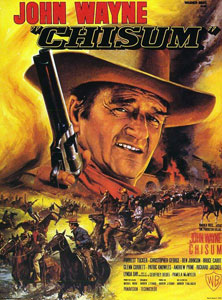
Chisum

By the late 1960s and into the 1970s, John Wayne's movies became more familiar, more safe. You know what though? There's a comfort in familiarity, and there's some genuinely good movies in the bunch. Today's review is one of those efforts, telling one of the more famous stories of the wild west that ranks up there with the gunfight at the O.K. Corral or the Battle of the Little Big Horn. That story? The Lincoln County War. That movie? 1970's Chisum.

It's 1878 in the New Mexico territory, and aging rancher John Chisum (Wayne) has carved an immense cattle ranch out of the wilderness, made it all into something to behold. He's preparing for his niece, Sallie (Pamela McMyler), to come and visit the ranch, but there's some serious issues to be dealt with. An equally powerful man with some serious financial backing, Lawrence Murphy (Forrest Tucker), has moved into Lincoln County and is looking to take over. Take over EVERYTHING. First up on his list? Buying the sheriff, the bank, and scooping up all the land he can and drive Chisum out as quick as he can. Chisum is well-rooted though, and nothing is going to come easy for the despicably vicious, greedy Murphy. There's a wild card in the entire situation though, a young, fiery gunfighter with a fast-growing reputation and a fast draw with his pistol, William Bonney (Geoffrey Deuel), better known as Billy the Kid.

I've loved John Wayne and his movies since I was a little kid. Hopefully, I always will! I hadn't seen this 1970 western from director Andrew McLaglen in years until a recent showing on Turner Classic Movies gave me the opportunity to revisit it. Am I glad I did! It is different, telling the mostly true story of the Lincoln County War with some artistic license thrown in here and there. A lot of familiar faces, filming locations in Durango, Mexico where other Wayne ventures (The War Wagon, Sons of Katie Elder, The Undefeated, The Train Robbers) were filmed, a memorable score from Dominic Frontiere, and cinematographer William Clothier bringing the Mexican locations to life, yeah, it IS familiar. That's not a bad thing. I loved catching up with the movie and liked it much more than I remember. There's just enough different here to keep things interesting. And let's face it, the story and recognizable historical characters are a great backdrop for that mostly true story.

Okay, one of the most famous stories of the wild west. What do we need? How about a movie star capable of leading the way? In 1970, Wayne was still at the top of his game. He had the tough guy hero part down to an art with decades of practice. That is most definitely a compliment. Wayne was always at home in the western, and that's the case here. His Chisum -- based on the real-life John Chisum -- becomes a figurehead of the west. Years before, Chisum moved west into New Mexico and carved out a cattle ranch out of the land. Now, he's learning to slowly, begrudgingly changing with the times to survive. A testament to Wayne here is that he's not on-screen a ton. Yes, he's the star, but the Hollywood legend is content to let other members of a solid ensemble step into the limelight. When he is in the limelight? It's Duke at his tough as nails best, playing straight man to a bunch of antics while also stealing the camera, especially in a late confrontation with Tucker's Murphy. Nothing flashy, just a western professional.

Part of the fun here is the familiar names and characters popping up. The Billy the Kid story has been told in the Young Guns movies, The Left-Handed Gun, Pat Garrett and Billy the Kid, The Outlaw and many more I'm probably forgetting. I liked the spin Deuel puts on young William Bonney, a brash kid trying to put a checkered past behind him. He may be too good with a gun to let it happen though. Deuel's scenes with Glenn Corbett's Pat Garrett are a highlight, especially knowing where these two men end up. Also look for peaceful, second-chance rancher John Tunstall (Patric Knowles), Alex McSween (Andrew Prine, with his wife Lynda Day George), corrupt Sheriff Brady (Bruce Cabot), and more than a few familiar faces in the background.

The cast is one of Chisum's best features. Tucker is a slimy, nasty, slithery villain, with both Christopher George and Richard Jaeckel as his brutal enforcers. Another Just Hit Play favorite, Ben Johnson is Pepper, Wayne's right-hand man, a mumbling cowboy who'd rather solve a problem with his gun than his words, a part similar to the one he played in both The Undefeated and The Train Robbers. You ready though for some other names? Take a deep breath with me. Also look for John Agar, Robert Donner, Ray Teal, Hank Worden, Pedro Armendariz Jr., Edward Faulkner, Christopher Mitchum and plenty of faces from the John Wayne stock company. Quite the cast. QUITE a group of tough guys, a McLaglen specialty. 

About as good as a traditional western can get. There's good guys, dastardly bad guys, shootouts to be had, and set against the backdrop against one of the wild west's most famous/infamous incidents ever. Something really hit me with this most recent watch, and I came away more impressed than I'd been with previous viewings. Hopefully, you'll like it just as much!

Chisum (1970): *** 1/2 /****

Tuesday, February 3, 2015

The Longest Day

When you look back through history, certain dates hold a higher place in the history books. It can be someone's birth, someone's death, or just have an amazing historical significance in terms of impact on the world. High up on that list is June 6, 1944, the day Allied forces invaded Normandy, better known as D-Day. In the age of gigantic, sprawling epics, one of the best movies of the 1960s tackles the immense subject, 1962's The Longest Day.

A plot description wouldn't do this flick justice. It's just infeasible. The history will serve as a big enough jumping off point. After four-plus years of war, Allied forces had massed for months, all prepping for the invasion of Europe, hopefully taking back the continent from Adolf Hitler and his Nazi Third Reich. The invasion was months and years in planning, millions of men, millions of tons of equipment, thousands and thousands of ships, trucks, jeeps and tanks waiting to be unleashed at Normandy and in the French countryside. What was the mystery? The Allies tried desperately to keep the location of the invasion -- Normandy -- secret to help save lives and make the invasion smoother. The Germans similarly tried desperately to discover where the attack was coming. The war hung in the balance along with millions of lives, not just those taking part in the attack but all over the world. Not bad for historical significance, huh?

So tackling that premise in movie form seems a rather daunting task if you ask me. In the age of the epic, this one doesn't disappoint. At 178 minutes, 'Longest' covers a ridiculous amount of ground in a story that takes place over about a 36-hour time span. We see the Allies deciding the time is finally right after days of wavering while the Germans decide if this is the actual invasion or just a feint, a distraction to throw them off. Based on the book by Cornelius Ryan, it is told in docu-drama style as we meet all the participants from the high command to the soldiers, paratroopers to resistance fighters, townspeople to priests and everything and everyone in between. This isn't a movie about characters, but instead about the spectacle and immensity of what happened. If the Allied invasion on D-Day didn't work, who knows how the world would have changed?

Just a huge movie but one that never feels rushed or forced. The three-hour running time absolutely flies by. It was filmed in black and white, giving it an appropriately dated look. Maybe color takes away from what's on-screen, but the decision to film in black and white simply put, works. Ken Annakin, Andrew Marton and Bernhard Wicki combine to direct this behemoth epic and to handle it well. Technically speaking, it is a virtually flawless film. Some stock footage is sprinkled here and there, but many of the locations where the actual events took place were used as filming locations. Talk about authenticity, it can be downright eerie watching some of the scenes knowing the locations' history. The score from Maurice Jarre is used in appropriate doses with the main theme (listen HERE) a memorable piece of music that's always stuck with me.

As an epic though, one thing was required more than just about anything else. That requirement? A cast of seemingly thousands. Literally everyone in Hollywood and stars internationally were required to star in this movie. Okay, a slight exaggeration, but you get my point. Most of these parts were nothing more than cameos, but just as a taste of the ridiculous star power on display, we get John Wayne, Robert Mitchum, Robert Ryan, Henry Fonda, Richard Burton, Edmond O'Brien, Rod Steiger, even a pre-James Bond Sean Connery. Many of those parts only required an on-screen appearance of a minute or two -- some for much more -- but their presence alone...just wowza. The scary part? That's only a somewhat small taste of the depth of the cast that truly brings an international flavor to the D-Day proceedings with German, French, British, American and many more brought together.

The Longest Day is an epic, plain and simple, but for every scene where the scope and scale impresses, I loved the quieter, personal and often times, terrifyingly real scenes just as effective and memorable. I loved Richard Todd as a paratrooper commander tasked with landing in France via glider and taking a key bridge and holding until reinforcements arrive...if they can. The scene where American paratroopers, including strung-up Red Buttons, overshoot their landing zone and land in a German town is tragic and moving. One paratrooper (Sal Mineo) making a tragic decision is surprising and intensely real. I especially liked the simplicity of a late scene between Burton's RAF pilot and Richard Beymer's American paratrooper discussing the necessary evil of the day but also the lunacy of it. I think the best, most iconic moment has Hans Christian Blech's German officer finally spotting the invasion force in the English Channel when the fog clears. His face drops and he mumbles 'Die invasion,' all set to Beethoven's Fifth Symphony. Just a ton of great moments like this.

The other counter to those scenes are the BIG moments, and that's where the technical comes into play. One tremendous scene has a German fighter strafing the beaches, all of which we see from the perspective of the plane. Hundreds and thousands of extras scramble for cover underneath in a remarkable visual scene. The same later in 'Longest' when French commandos fight their way up a street in a French town, a helicopter (I think) filming all the action. As well, the scene of the paratroopers coming down on the German-held Sainte-Mere-Eglise is a horrifying scene that utilizes some very cool camerawork. Also look for a cool scene where American Rangers -- including Robert Wagner, George Segal, Paul Anka, Fabian, Tommy Sands -- scale the cliffs of Pointe de Huc, all trying to knock out a key German emplacement. Some especially memorable moments, not all of them action scenes.

Because I don't want to forget anyone but don't want to overdo it describing EVERY character, also look for Eddie Albert, Irina Demick, Mel Ferrer, Steve Forest, Gert Frobe, Leo Genn, Jeffrey Hunter, Curd Jurgens, Peter Lawford, Christian Marquand,  Roddy McDowall, Kenneth More, Wolfgang Preiss, Ron Randell, Jean Servais, Norman Rossington, Tom Tryon, Peter van Eyck and Stuart Whitman. Okay, I'll take a breath now.

The Longest Day isn't the best war movie around, but it's one of my favorites. It tries to accomplish a ton and succeeds on just about every level. The history, the scale, the spectacle, the gigantic cast, the moments that resonate amongst all the epic qualities. It also serves as an excellent companion piece to the more recent Saving Private Ryan. Nowhere near as violent, but a more far-reaching story. A gem from the age of epics.

The Longest Day (1962): ****/****

Monday, December 22, 2014

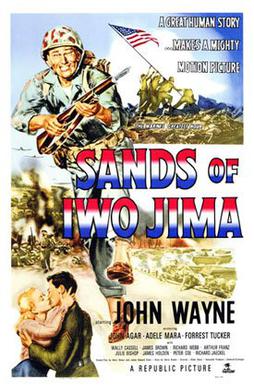
Sands of Iwo Jima

You know what's crazy? In a career that spanned five decades with almost 200 roles to his name, John Wayne only picked up two Oscar nominations for acting. Yeah, a lot of his movies weren't going to win an Oscar to begin with. Yeah, many were 1930s serials barely clocking in at an hour. Others were more fan-friendly, not meant to create Oscar buzz. But in one of his best extended spans of pure acting power, the late 1940s, Wayne picked up his first nomination for 1949's Sands of Iwo Jima.

Following the horrific, costly fighting on Guadalcanal, Marine units all over the Pacific are being sent to the rear to rest up, recoup and get replacements as the war moves closer to Japan. One specific rifle squad, with just two surviving members and a wave of inexperienced replacements, is getting a new drill sergeant, Sergeant John Stryker (Wayne), a tough as nails instructor with plenty of combat under his belt. His methods for training are rough and to the point -- some would say brutal -- but he has one goal as the war continues. Stryker doesn't want to be friends with his men. He wants them to respect him if nothing else and mostly take his training to heart. If they hate him for it...so be it, but he intends to get him through the war unscathed if possible. The island-hopping fighting all across the Pacific continues on, the U.S. Marines ready to get back to the action.

Recently released on Blu-Ray courtesy of Olive Films, 'Sands' is an above average if not great World War II film. From director Allan Dwan, it has a reputation as a bit of a flag-waving patriotic movie, but that's a description that's incredibly limiting. Considering it was released just four years since the end of the war, it's pretty spot-on. The actual war segments are rough and violent without being graphic. It can be startling at times as it follows a war movie formula that would become tried and true in the coming years. Filmed in black and white, 'Sands' benefits from a memorable score from composer Victor Young and is at its strongest when focusing on the Marines in combat, specifically the fighting at Tarawa and Iwo Jima.

Now that John Wayne guy. He's halfway decent. This isn't his best performance -- I say that's from a choice of The Searchers, She Wore a Yellow Ribbon or The Shootist -- but it certainly belongs in the conversation. His tough as nails drill sergeant helped inspire countless movie roles in the years to come, and the Duke dives into the part headfirst. Stryker pushes and pushes his men, knowing that no matter how tough training is, it won't be as tough, as terrifying as combat. The better his men are prepared, maybe the more likely they'll make it through unscathed. It is a man's man type of role (one he deserved a nomination for), but it isn't this cold facade. It isn't one big stereotype. In a couple conversations, a couple quick scenes, we get to learn something about Stryker and his personal life, his background.

That goes a long way with the character. He isn't a heartless, emotionless drill sergeant with ice water in his veins. He pushes his men because he knows what's best for them. It's a varied character. We learn Stryker's wife left him five years before, taking their five-year old son with her. He's left to wonder where they're at, what his son has grown up to. Later on Tarawa, he threatens to shoot one of his own men if they expose the unit's position to go rescue a wounded soldier who's crying out to Stryker for help. In one instant, he's a wall of discipline. In the next, you see the extreme pain in his eyes as one of his men cries out for help from him specifically. The same later as the Marines are called back, Stryker standing on the transport ship looking back at Tarawa with just palpable sorrow in his eyes. As well, there's some humor, including my favorite as Stryker helps a clumsy recruit (Hal Baylor) how to do bayonet drills...by dancing. It's played straight but is a great visual.

Just an excellent performance from the Duke. The rest of the cast relies on the unit picture formula, a bunch of disparate guys thrown together and forced to fight as a cohesive group. John Agar plays Conway, a Marine with the corps in his blood...and he hates it, especially Stryker and all he represents. Forrest Tucker is very good as Thomas, a Marine who's been in Stryker's unit before and holds some serious resentment toward his former sarge. The rest of the squad includes Wally Cassell (the joker), James Brown and Arthur Franz (the vets), Richard Webb (the lovable teddy bear), James Holden (the affable farmer), Peter Coe (the Greek), Richard Jaeckel and William Murphy (the bickering Philadelphia brothers), George Tyne (the married man always ready with a joke), and Martin Milner (the youngster). A solid group of supporting parts from some always reliable character actors.

'Sands' is at its most comfortable and strongest in the training sequences and montages and when Stryker's Marines hit the beaches at Tarawa and Iwo Jima. The hitting the beaches at Tarawa scene is especially effective, the Marines pinned down in a lagoon against a log embankment. Their only way out? Up and over the logs to take out a fortified Japanese pillbox built into a dune. The battle for Iwo Jima is equally effective as Japanese forces absolutely rain down hell on the Marines moving inland. The casualties come fast and furious as the squad is especially hit hard as they approach Mount Suribachi. It all builds to the squad taking part in the patrol that takes Suribachi's summit and ultimately raises the flag. It is a surprising, moving finale as we see the basis for one of the most iconic, instantly recognizable pictures in American history.

It ain't a perfect movie with some parts of the story not working as well. Agar's Conway (a very unlikable character) meets, falls for and gets married to Adele Mara's Allison in scenes that drag the pacing down to a snail-like quality. The Marines getting their leave too is meant to humanize them but the efforts fall short. We learn more in the training and combat sequences. Still, it's an excellent movie courtesy of Wayne's Academy Award-nominated performance and a story of the Marines that doesn't shy away from the nastiness of the fighting in the Pacific. That's not something you can say for a lot of World War II movies released in the late 1940s.

Sands of Iwo Jima (1949): ***/**** 

Monday, December 1, 2014

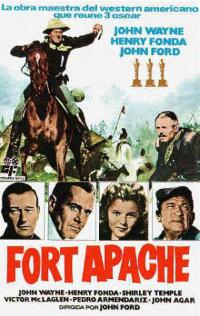
Fort Apache

Director John Ford and star John Wayne went together like peanut butter and jelly. They just clicked, working together 12 times in feature films and many more in uncredited fashion. Right up there with 1952's The Quiet Man, three films stand out as the pair's most memorable films. These are three movies simply known as the Cavalry trilogy, and here's the first, 1948's Fort Apache.

A career officer with a distinguished record, Lt. Colonel Owen Thursday (Henry Fonda) is less than pleased with his new orders. While fellow officers are being sent to fight the Sioux and Cheyenne, Thursday is being sent to a post in Arizona, Fort Apache, where he will take command of a cavalry regiment that's temporarily been under the command of Capt. Kirby York (Wayne). Thursday resents everything about the posting and with no knowledge or respect of the Apaches thinks nothing can happen to advance his career, or at least earn him new orders and a new posting. Not interested in making friends, Thursday's actions cause his regiment, his officers and his men, to resent him for what he's doing. He wants to make the regiment as strong as ever though and continues to push the men. Believing there's nothing he can ultimately do, the new commanding officer sees a chance for glory when Apache warriors leave their reservation. How far will he go?

Later in his career, Ford made darker, more cynical and realistic westerns that almost apologized for his previous genre entries. It's odd then that some 15 to 20 years earlier, it was these westerns that are far better remembered. 'Apache' and the other two Cavalry flicks, She Wore a Yellow Ribbon and Rio Grande, are more how the west should have been and not how it actually was. Ford embraces the romantic concept of the old west. The cavalry were gentlemen and soldiers, family men while the wives were steadfast and loyal, and the government and Indian agents were as corrupt as dirt. The movie is a gem. Ford films on-location in Monument Valley, stunning backdrops from scene to scene, in black and white, producing one of the most visually pleasing westerns ever. The musical score from Richard Hageman is a gem too throughout.

Throughout his career, Ford had his favorite actors to work with, and 'Apache' pairs two of the best in Henry Fonda and John Wayne. This is one of Fonda's most underrated performances, his Thursday a rigid, humorless man and career officer who is equal parts arrogant and condescending. He may be a capable officer but his methods come into question at times. At what point is pride and glory a hindrance, a threat to his command? Wayne's part is less flashy but still quite good. His Capt. York is an experienced Indian fighter with a respect for the Apaches who's trying to help his new commander...except Thursday ain't having it. This is Wayne in fine fashion, natural and quite at home. Their scenes together crackle, two different personalities pushing and testing and feeling each other out. No matter what they discuss though, this is a relationship that seems doomed to failure.

From everything I've read, Ford was a tyrant on his sets, but the man could assemble quite a cast. He brought the best out in his cast (for the most part, some he just pushed mercilessly). Shirley Temple plays Philadelphia, Thursday's daughter who falls for a new lieutenant at the outpost, Lt. Michael O'Rourke (John Agar, Temple's real-life husband). A former silent movie star who worked with Ford regularly before they had a falling out, George O'Brien is excellent as Capt. Collingwood, a former friend who made a decision that halted his career, dooming him to Fort Apache, Anna Lee playing his loyal wife. Ward Bond gets to Irish it up as Sgt. Major O'Rourke, the capable NCO who the rest of the men look up to, a top man at the outpost, with Irene Rich as his wife of many years. From the John Ford Stock Company, look for Pedro Armendariz, Victor McLaglen, Jack Pennick and Dick Foran as four hard-drinking sergeants always getting into trouble.

An Irishman to the core, Ford loved the sense of family and camaraderie and community in his films. This is a prime example. He's interested in the life of the outpost from the officer's dances to the training of the recruits. We see the cavalry moving out in formation, of marching across the desert silhouetted against the rock formations and on the horizon. We see the dynamics of the wives of the fort, of the community that sprouts up in the desert cavalry fort. Ford ate this stuff up in most of his movies and sometimes could lay it on a little thick, but for the most part I felt like he kept those things in check. Yeah, the physical humor with McLaglen is a little thick at times. Yeah, the G-rated love between Temple and Agar is sugary sweet. Yes, Foran even gets to serenade us with an old Irish love song. These moments fit here more, fit with the tone and rhythm where certain other Ford movies are handicapped by moments like this.

Transplanting some characters and tribes, 'Apache' is a pretty thinly veiled take-off on Custer's Last Stand with Fonda's Thursday standing in for Custer. This isn't an action movie -- by a long shot -- with much of the conflict saved for the final 45 minutes as the outnumbered regiment moves out to face Cochise and his warriors. Again, an Irishman can build a sense of doom like no one else, and Ford nails the ending. He builds the tension as we see trouble coming over the horizon and hanging in the air. What Thursday does proves costly in a moving finale both visually and in storytelling. The actual battle is a bit of a disappointment but Ford set out to do what he wanted. The final scene opens up the door especially for some themes that would be discussed 14 years later with Ford's The Man Who Shot Liberty Valance, the movie ending on a far more hopeful note than it could have.

Just an excellent movie. Good story, great-looking film, wonderful score, excellent directing and a very strong ensemble cast, especially Fonda, Wayne, Armendariz and Bond. Not as good as She Wore a Yellow Ribbon but the without a doubt second best movie in the cavalry trilogy. Well worth checking out.

Fort Apache (1948): ****/****

Thursday, September 18, 2014

The Shepherd of the Hills

With 1939's Stagecoach, John Wayne put himself on the map, shaking off almost a decade of B-westerns and serials that seemed to be at the time, his future. So what to do next? You've gotta find that next successful part. Wayne struggled for a stretch. He was in some pretty good movies but not necessarily great roles for him. One of those in-between flicks? That's 1941's The Shepherd of the Hills.

In a tight-knit mountain community in the Ozarks, families on their farms and their businesses go about their lives as normal. Well, almost normal. High up in the mountains, the Matthews family, including matriarch, Aunt Mollie (Beulah Bondi), and hen-pecked Uncle Matt (James Barton), has quite the reputation over the years, full of hate and anger as they sell their moonshine. A young woman, Sally Lane (Betty Field), living with her father has always been on good terms with the Matthews, especially their nephew, Matt (Wayne), but the delicate balance with the community and the moonshining Matthews could change when a stranger (Harry Carey) arrives in town. The man, Daniel Howitt, wants to buy a piece of land that has the legend of being cursed. Who doesn't want him to buy that land? That would be young Matt Matthews with his own reasons for revenge.

Based on a bestselling novel from author Harold Bell Wright of the same name, 'Shepherd' was aired on Turner Classic Movies in....April as part of a John Wayne tribute. Yeah, it took me a little while to get around to it, but here we are just the same. Reading into comparisons between the film and the novel, it sounds like the only thing in common is the title and setting itself. Director Henry Hathaway's film is content to march to its own tune. Is that a good thing? Eh, we'll get to that (read: No, not especially). What is positive? This is a beautiful film, just drop dead gorgeous. 'Shepherd' was filmed on location in Big Bear Valley, California filling in quite nicely for the Ozarks. Filmed in Technicolor, it is a doozy of a visual film, the colorful, natural landscapes absolutely filling the screen. What a movie to watch, appreciate and enjoy.

Now jumping off from the stunning visual look....well, it doesn't. In an effort to bring the mountain life into 3-D real life, I felt like 'Shepherd' simply tries too hard to make the story, setting and characters authentic. You want to get that backwoods, homespun feel across, but as several other movies have shown, it's tough. Think of Tobacco Road or God's Little Acre, movies that end up making stereotypes of its characters and settings. Yeah, that's pretty much the case here. All the people living in this mountain community are too folksy. They believe in voodoo, crazy grudges and are just too 'Gee golly' for their own good. Stretched out over a 98-minute movie, it all gets to be a little much for my liking. Just present the story and characters and see what happens. When their backwoods folksiness is shoved down our throats, the end result is highly disappointing.

So that John Wayne fella? In an ensemble cast, Wayne ends up being more of a supporting player. His Young Matt Matthews is a key character who simply isn't in the movie much. His reasons for revenge provide the jumping off point that takes quite awhile to get going. Instead, the story focuses on countless different characters, Carey's Daniel at the front of that list as he affects the lives of so many. Carey (Harry Carey Jr.'s father) delivers a solid performance, pleasant and easygoing, trying to buy land in this mountain valley where no one else will. Field is pretty good too as the innocent Sally, trying to introduce Daniel to the community. Bondi is pretty evil as Mollie and she's good at it. Also look for Ward Bond, Marc Lawrence, John Qualen and Tom Fadden in supporting parts.

This is one of the few John Wayne movies I hadn't seen a single second of. From the early 1940s, it's one of his flicks that isn't particularly good or particularly bad. Not especially memorable, 'Shepherd' is okay at best, rough at others and with some wasted potential in others. You especially see the potential in Wayne, still figuring himself as an actor but clearly on the right track. As a movie on the whole, it struggles to find a rhythm, a tone, a pace. A disappointing end result, probably still worthwhile for John Wayne fans to see an early post-Stagecoach entry that doesn't receive much buzz.

The Shepherd of the Hills (1941): **/****

Monday, July 21, 2014

Rio Bravo

Do you have a favorite western? No? What's wrong with you?!? Do a search for top 10 lists, of fans and critics alike pointing out their favorite westerns, and you'll see countless picks. One that pops up often that I'm not a huge fan of is 1952's High Noon. You know who else isn't a big fan? The Duke himself, John Wayne. Working with a deep cast, a talented director and a great script, here's Wayne's response to High Noon, 1959's Rio Bravo.

In the Texas border town of Rio Bravo, Sheriff John T. Chance (Wayne) finds himself in a bit of a spot. A man named Joe Burdette (Claude Akins) callously shot down an unarmed man in a bar argument and is now sitting in Chance's jail. A murderer in itself isn't big news, but when Joe's brother is one of the richest men in Texas -- and with a small army of gunmen at his side -- that provides some problems for Chance. Burdette has bottled up the town so Chance can't transport his prisoner and he can't bring help in either. All the sheriff is left with is two deputies, Dude (Dean Martin), a drunkard, and Stumpy (Walter Brennan), an aging crippled man, to help do the job. With the town waiting to see what happens, Burdette's gunmen similarly waiting on the streets, Chance goes about putting a plan into action to get out alive and bring Joe Burdette to justice.

Wowza, what a good movie, a western that deserves its classic status. I grew up watching this Howard Hawks-directed western a lot as a kid and recently revisited it for the first time in years. The plot description proved a little rough because....well, the script is excellent, but the story isn't the most well-connected, concise of stories. If there's a complaint, it's that at 141 minutes and with an episodic story, things can be a tad slow at times, but you never really notice it (or I didn't at least). It isn't a comedy western, and it isn't a cynical, ultra-dark western, but somewhere in between as it mixes comedy (the script again), the drama and the action. Old Tucson is a great location spot for the town of Rio Bravo, that archetypal winding, dusty western town. Composer Dimitri Tiomkin turns in a great subtle score -- very whistle-worthy -- and even test runs part of the score he'd use a year later in The Alamo. All key contributions to a winning formula.   

Of all his movies, John Wayne is most associated with the western genre. Many consider his western roles -- The Searchers, Red River, She Wore a Yellow Ribbon, The Shootist -- to be among his strongest. Maybe not the showiest part, but Wayne's leading role here as Rio Bravo sheriff John T. Chance is Wayne at his tough, likable, easy-going best. If not his best acting performance, it's one of his most visually iconic, the vest over the red or blue shirt, the bent-up hat brim, the ever-present Winchester rifle in his hand. In the acting department, this is one of my favorites of the Duke's. He makes it look criminally easy what he's doing. He lets those around him show off more with "bigger" performances, content to do his thing. In the process, you can't help but watch him. He's the tough lead, the lead with some great comedic timing, and has one of his all-time best love interests in the form of Angie Dickinson as Feathers, a young woman with some troubles behind her. That chemistry is perfect, Wayne's Chance more and more exasperated with each passing scene. Just a great underplayed performance.

As a director, one of Hawks' specialties was the bonds and friendships formed among men in serious situations, a life and death drama. I don't know if that dynamic was ever better than it was here. There isn't a weak spot in the bunch with Wayne as Chance and Martin and Brennan as his maligned deputies. Even teen idol Ricky Nelson manages to find a good spot as Colorado Ryan, a young gunslinger looking to mind his business....at first. Facing seemingly insurmountable odds, they bond, put their differences aside and become stronger as a collective group. Their chemistry is evident throughout, their dialogue crackling with each passing scene. Sure, they sing a couple songs together (My Rifle, My Pony and Me, Cindy, listen HERE) but it's Dean Martin! You're rooting for these guys, each of the quartet bringing something different to the table. Just hard to beat, one of the best, underrated casts in a western.

That's where the script steps to the plate. We don't get much in the way of backstory about most of the characters. In a line here and there, we pick up more than you'd think. We learn what drove Dude to drink, why cackling, ranting Stumpy has a limp, why Chance carries a rifle. Good, interesting characters we get to know quickly, and from there, the cast does the rest. Also look for Ward Bond (in his last film role) as Pat Wheeler, a freight owner who offers to help Chance, an underused, sneering Akins at his best, John Russell as his intimidating older brother, Nathan, Pedro Gonzalez Gonzalez as Carlos, the hotel owner, and Estelita Rodriguez as his wife, Consuela. 

So there isn't the most pointed story here. So be it, Hawks was never interested in the most linear, fast-paced stories. The pacing works here, too many episodic moments to mention. The opener is several minutes of silence as we're introduced to Chance and Dude, ultimately seeing Joe gun an unarmed man down. My personal favorite is a set piece with Chance and Dude following a wounded hired killer with muddy boots into a saloon...only they can't find him. It's a great little scene with an excellent payoff. The movie is full of such great moments, including the finale as Chance and Co. go toe-to-toe with the Burdettes during a prisoner exchange with Old Tucson again providing a pitch perfect backdrop to the western action.

Is it a perfect movie? No, but as far as entertaining movies goes, this one is hard to beat whether it is a western or not. The cast is perfectly used, showing off a chemistry that makes it fun to watch. Some truly funny laughs (Chance calling Stumpy "a treasure" and kissing him on his bald head), some great dialogue and one-liners, and a script that provides some great quotables. Hard to beat, and one of my favorite movies. If you're a fan, check out both El Dorado and Rio Lobo, Hawks basically remaking his own movie twice more.

Rio Bravo (1959): ****/****

Thursday, June 26, 2014

Jet Pilot

Dr. Stangelove. Fail Safe. The Manchurian Candidate. The Bedford Incident. There. That's four classic films about the Cold War, and that's only four. There's countless others worth mentioning, but it would be overkill to list them all. You know what kind of film hasn't been made about the Cold War? I bet you can't guess. Okay, here goes. It's a romantic comedy! Yeah, it threw me off too, but here we are with the truly odd and often painful 1957 flick, Jet Pilot.

Stationed at a remote airstrip and base somewhere along the west coast (maybe even Alaska), Air Force colonel Jim Shannon (John Wayne) is more than a little surprised when he gets a report that a Russian jet is circling his base. It isn't making an offensive move or showing any aggression, but what could the pilot want? The jet is finally forced to land, but Shannon is in for a bigger surprise. The pilot is a woman, Anna Marladovna (Janet Leigh), and she is a refugee, not a defector as she runs from certain death back in Russia for refusing to oblige an order from a commandant. Under some not so intimidating question, Anna gives up nothing, forcing Shannon to go to his superiors. What do they want him to do? Well, nothing. Anna seems drawn to Shannon so play along with it, see if anything comes from their chemistry....and maybe more. Oh, my!

Last month via Twitter (it's not all bad), I won a new John Wayne biography from author Scott Eyman, John Wayne: The Life and Legend (highly recommended), and raced through it in about a week. A great read, a great window into one of my favorite actors and a true Hollywood legend. I loved catching up with so many movies I hadn't seen in years and also realized there's a fair number of his movies out there I've never seen. Case in point? Jet Pilot from director Josef von Sternberg and apparently quite a few other directors. Why do you ask? A "checkered production" would be a fair description of this flick with backing from the always interesting Howard Hughes. Beginning filming in 1949 and continuing until 1950, it was "filmed" for three or four more years -- depending on the source -- and was caught up in a lawsuit, eventually hitting theaters in 1957. As Eyman points out, some reviewers commented "How young are stars look in this movie!" They should. It was from a different decade.

This is one of the Wayne flicks I had no experience with, and let me tell you, that was probably a really good thing. This one is a stinker, really only worthwhile as a truly dated time capsule of a turbulent time in U.S. history. You'd never think it would be easy to minimize the possibility of a nuclear apocalypse to a romantic comedy of sorts, but 'Jet' manages to do it. The story becomes a love story between Wayne's Shannon and Leigh's Anna, the American officer introducing the Russian pilot to all the great things America has to offer. Oh, steak! Oh, champagne! I'd say for most of an hour the whole Russian defector thing is almost completely ignored as we see Shannon and Anna fall hard for each other -- oh, no, tortured love!!! -- and then eventually getting back to business. It's also laughable to think in the midst of the Cold War the American government and armed forces would allow anything even remotely like this to develop, but I'm probably nit-picking, right? Sure, let the Russian pilot and possible spy fly our newly developed jets!

What's truly odd about this is that general tone, that complete lack of urgency or fear or suspicion. This is a really bizarre movie from the get-go. What's really bizarre is that in a sea of oddness and mediocrity both John Wayne and Janet Leigh are pretty good together. They have a legitimate chemistry...it just so happens to be in a story about a defecting Russian pilot in the Cold War. Late in the story, things become a cat and mouse game back and forth, but their development as a budding relationship works surprisingly well. It's odd that we're even watching this develop, but so be it. Make the best of a bad situation and go with it. Now that said, their chemistry is good but that doesn't always translate or even make the story interesting. I still found myself fast-forwarding a lot as the 45-minute mark came around.

As for the rest of the cast, look for Paul Fix as Wayne's second-in-command, Jay C. Flippen, Richard Rober and John Bishop as the three government/military geniuses who concoct the seduction plan,
with Roland Winters as Anna's commanding officer back in mother Russia. Also look for Denver Pyle in an uncredited part as a young husband traveling with his wife. Lovely Anna lets them stay in their spacious hotel room! Why in Russia, room is so little, but here in America! Yeah, you'd be surprised how many conversations there are like this in a painfully long 112-minute movie.

It's probably best to view this 1957 Cold War flick as a novelty. There is some very cool aerial footage of jets roaring across the sky, but those planes have to land at some point, allowing that dang story to get in the way. Other than that, it's pretty rough. Be forewarned going into this one and don't be surprised. For real. It's awful, and I'll defend just about anything John Wayne was involved with. Okay, Janet Leigh vamps it up some, undressing in quite a few scenes and putting on a fashion show for the Duke in others. So there, it's not all awful. Just most of it.

Jet Pilot (1957): */****

Tuesday, June 24, 2014

Stagecoach

The western genre is all but dead, it has been for most of 30-plus years if not more. It is the genre I've always been drawn to, making it that much harder to say that it is in fact, dead. Over three decades though, the 1940s, 1950s and 1960s though, the success of the western was astronomical, both in film and later on television. What was the first truly great western though? From one of Hollywood's strongest years as a whole, here's 1939's Stagecoach.

In Tonto, Arizona in 1880, a stagecoach is preparing to hit the trail, making several stops along the way before reaching its ultimate destination, the town of Lordsburg in the New Mexico territory. The trip will be anything but easy though, rumors of Apache chief Geronimo on the warpath burning ranches and killing everyone they ride across. With a full load of passengers, including a prostitute, Dallas (Claire Trevor), being kicked out of town, as well as a drunken doctor, Doc Boone (Thomas Mitchell), in a similar situation, the stagecoach leaves the town into the wilderness. Before they can even reach their first stop, they pick up another passenger, the Ringo Kid (John Wayne), an outlaw who's escaped from prison and is looking for some revenge on certain people in Lordsburg. Can Ringo make it? Can the stagecoach make it through or will they run into an Apache war party?

In Hollywood history, it's hard to dispute a stronger year than 1939 with Gone With the Wind, The Wizard of Oz, Wuthering Heights, Mr. Smith Goes to Washington and today's review, Stagecoach just some of the classics released that year. From director John Ford (a man with a few decent movies to his name), this is the first true classic western. What sets this western apart? Well, for starters, it is a straightforward, brutally well-told story. It is crisp, fast-moving without being rushed, and packs a whole lot of excitement, development and action in a quick 96-minute running time. You take for granted what a movie like this can be. It won't blow you away, and the formula has been attempted countless times in the years since, but the original is still the best. From the debut of Monument Valley as the backdrop for more than a few Ford/Wayne westerns to the story and the characters, we've got a real classic on our hands.

Above all else -- including its status as a great western -- is that this Ford-directed western helped propel John Wayne, the Duke himself, into stardom. Relegated to B-westerns/serials for almost 10 years after The Big Trail bombed, Wayne does not disappoint here. In his first starring role in a so-called 'A-film' in almost a decade, he shows off that natural, easygoing charm that audiences would come to love about Wayne. He never looked like he was forcing anything, just going with it. His entrance is a classic in itself, a sequence that screams "Look at me, big things are on the horizon!" as Ford's camera zooms in on the Ringo Kid as the stagecoach approaches. Wayne would deliver better performances but the 31-year old actor is a scene-stealer here. Hollywood, say hello again to John Wayne. He isn't going anywhere for quite awhile.

Trivia time. Wayne actually wasn't the top-credited actor in Stagecoach, that honor going to Claire Trevor at the head of a very solid ensemble cast. Ford is very subtle in giving Trevor's Dallas' background, i.e. that she's a prostitute. It was 1939, and that sorta thing was frowned upon in film. I love the character and more than that, I love her chemistry with Wayne's Ringo. These are two people living almost as outcasts, drawn together in a hellish situation. Just two solid performances as is Mitchell -- who won Best Supporting Actor -- in a part that treads that fine line between overacting and just chewing the scenery some. As for the rest of the passengers look for Buck (Andy Devine), the worrisome driver,  Hatfield (John Carradine), a gambler with a reputation, traveling to look out for the very pregnant Lucy Mallory (Louise Platt) who's traveling west to meet her husband, Curley (George Bancroft), the sheriff riding shotgun for Buck, Peacock (Donald Meek), a whiskey salesman, and Gatewood (Berton Churchill), a banker running away with his own money.

Ford was a director of characters, visuals and straightforward stories (for the most part). His films aren't necessarily known for their action scenes. If anything, his bigger set pieces are often underplayed. That's the case here showcasing a shootout between the Ringo Kid and three rivals. Ford actually cuts away from the action right as the guns go off, and instead we see other characters' reactions around town to the shootout. It's an inspired, gutsy choice that is frustrating but stylistically, it works. As for the more visual aspect, an Indian war party roaring after the stagecoach across the smooth desert sand is amazing to watch, featuring some of the most impressive stunts I've ever seen. It's the both of best worlds.

Just a great movie. Monument Valley is absolutely stunning, visually setting the rhythm of the film as a tiny stagecoach travels across the wide expanses of the American west. What awaits them? In that wilderness, anything could. An uncredited musical score from Gerard Carbonara is perfectly suited to the story as well in a film that doesn't have a weakness. It influenced just about every western that came along after it, not to mention other films from countless other genres. It is a classic for a reason for any number of reasons to Ford's directing to the appearance of Monument Valley to the iconic, star-making performance from star John Wayne. All movie fans should see this one.

Stagecoach (1939): ****/****