Errol Flynn was a lot of things in a legendary career early in Hollywood's history. He was a swashbuckler, a boxer, a gunfighter, a rabble-rouser in his personal life, someone who lived life to the fullest. But what is that one role, that one part that is instantly recognized as his best? Well, that one's easy, 1938's The Adventures of Robin Hood.
It's 1191 A.D. and the English king, Richard the Lionheart, has been captured by the enemy while returning from the Crusades. In steps his greedy, manipulative brother, Prince John (Claude Rains), who takes over the crown and instantly starts to take advantage of his power. In a growing battle between the Normans and the Saxons, the put-upon people need help, someone to fight back. That man? A Saxon nobleman, Robin Hood (Flynn), who takes to Sherwood Forest with a gang of bandits to be a constant thorn in the side of Prince John and his enforcer, Sir Guy of Gisbourne (Basil Rathbone). They're not any bandits though. They aren't in for personal gain. Robin and his men become heroes as they give their spoils to the people from the money to the food they take. What's their end goal though? Can they somehow take down Prince John?
So everyone has heard of Robin Hood right? His historical reality has long been debated because...well, people just aren't sure he existed. So real or not, the character has become an instantly recognizable individual in literature and storytelling. From directors Michael Curtiz and William Keighley, 'Adventures' was a profoundly important film in Hollywood history. It's the big, splashy, colorful adventure film that helped set the stage for action and adventure films for years to come. The action-packed story with romance and intrigue and all sorts of craziness picked up four Oscar nominations, winning three, and is a perennial entry on all sorts of 'Best' lists, including several AFI lists. Can't go wrong, right?
Start with Errol Flynn. He's one of my favorite movie stars ever, the type of star/actor I'll check out a movie solely because he's in it. There aren't a lot of those stars around then or now. But in a career of memorable parts, this is THE part. He was meant to play Robin Hood. Flynn brings the perfect energy to this folklore character. That infectious smile, that loving-life laugh, that physicality as he swings across the scene (quite literally), fights his way through one sword fight after another, and unleashes arrow after arrow at his pursuers. You can't help but like the character, Flynn bringing him to life and influencing every other Robin Hood portrayal to follow for years whether it be on film, on television and even literature. That Errol Flynn guy. He knew what he was doing.
'Adventures' boasts a solid all-around cast in support of Flynn. The villains are perfectly dastardly, doing all sorts of malicious evil. Rains is the smooth, suave Prince John (slightly effeminate) while Rathbone gets to play the far more sinister Sir Guy, progressively becoming more obsessed with capturing and hanging Robin. Frequent Flynn co-star Olivia De Havilland (they would work together in 8 films) is memorable as Maid Marian, promised to Sir Guy while falling for Robin when she's taken prisoner. Their chemistry is evident throughout just like it was in all their pairings together. As for Robin's Merry men, look for Patrick Knowles as Will Scarlett, Eugene Pallette as Friar Tuck, Alan Hale as Little John, and Herbert Mundin as Much, a mousey squirrel. There's also Melville Cooper as the semi-bumbling but amusing Sheriff of Nottingham and Ian Hunter as King Richard.
Here's my spot here. I appreciate what this movie meant in terms of Hollywood and historical significance, but I didn't love the movie. I liked it a lot, but a slower last 45 minutes left me disappointed. Still....it's a really good movie. It's that perfect popcorn escapism, great good guys and black and white bad guys. The color scheme is a gem, one of the first Hollywood films to really embrace shooting in color. Robin and his Merry men in their Lincoln green uniforms, Prince John and Sir Guy in their bright red, the colors are rich and vivid throughout. As well, the Oscar-winning score from composer Erich Wolfgang Korngold is a gem, several instantly recognizable themes keeping the action flowing throughout (listen HERE). The action is fun and full of some great stunts, several large-scale battles and scuffles dotting the story. An easy movie to recommend.
The Adventures of Robin Hood (1938): ***/****
The Sons of Katie Elder
"First, we reunite, then find Ma and Pa's killer...then read some reviews."
Showing posts with label 1930s. Show all posts
Tuesday, December 23, 2014
Tuesday, June 24, 2014
Stagecoach
The western genre is all but dead, it has been for most of 30-plus years if not more. It is the genre I've always been drawn to, making it that much harder to say that it is in fact, dead. Over three decades though, the 1940s, 1950s and 1960s though, the success of the western was astronomical, both in film and later on television. What was the first truly great western though? From one of Hollywood's strongest years as a whole, here's 1939's Stagecoach.
In Tonto, Arizona in 1880, a stagecoach is preparing to hit the trail, making several stops along the way before reaching its ultimate destination, the town of Lordsburg in the New Mexico territory. The trip will be anything but easy though, rumors of Apache chief Geronimo on the warpath burning ranches and killing everyone they ride across. With a full load of passengers, including a prostitute, Dallas (Claire Trevor), being kicked out of town, as well as a drunken doctor, Doc Boone (Thomas Mitchell), in a similar situation, the stagecoach leaves the town into the wilderness. Before they can even reach their first stop, they pick up another passenger, the Ringo Kid (John Wayne), an outlaw who's escaped from prison and is looking for some revenge on certain people in Lordsburg. Can Ringo make it? Can the stagecoach make it through or will they run into an Apache war party?
In Hollywood history, it's hard to dispute a stronger year than 1939 with Gone With the Wind, The Wizard of Oz, Wuthering Heights, Mr. Smith Goes to Washington and today's review, Stagecoach just some of the classics released that year. From director John Ford (a man with a few decent movies to his name), this is the first true classic western. What sets this western apart? Well, for starters, it is a straightforward, brutally well-told story. It is crisp, fast-moving without being rushed, and packs a whole lot of excitement, development and action in a quick 96-minute running time. You take for granted what a movie like this can be. It won't blow you away, and the formula has been attempted countless times in the years since, but the original is still the best. From the debut of Monument Valley as the backdrop for more than a few Ford/Wayne westerns to the story and the characters, we've got a real classic on our hands.
Above all else -- including its status as a great western -- is that this Ford-directed western helped propel John Wayne, the Duke himself, into stardom. Relegated to B-westerns/serials for almost 10 years after The Big Trail bombed, Wayne does not disappoint here. In his first starring role in a so-called 'A-film' in almost a decade, he shows off that natural, easygoing charm that audiences would come to love about Wayne. He never looked like he was forcing anything, just going with it. His entrance is a classic in itself, a sequence that screams "Look at me, big things are on the horizon!" as Ford's camera zooms in on the Ringo Kid as the stagecoach approaches. Wayne would deliver better performances but the 31-year old actor is a scene-stealer here. Hollywood, say hello again to John Wayne. He isn't going anywhere for quite awhile.
Trivia time. Wayne actually wasn't the top-credited actor in Stagecoach, that honor going to Claire Trevor at the head of a very solid ensemble cast. Ford is very subtle in giving Trevor's Dallas' background, i.e. that she's a prostitute. It was 1939, and that sorta thing was frowned upon in film. I love the character and more than that, I love her chemistry with Wayne's Ringo. These are two people living almost as outcasts, drawn together in a hellish situation. Just two solid performances as is Mitchell -- who won Best Supporting Actor -- in a part that treads that fine line between overacting and just chewing the scenery some. As for the rest of the passengers look for Buck (Andy Devine), the worrisome driver, Hatfield (John Carradine), a gambler with a reputation, traveling to look out for the very pregnant Lucy Mallory (Louise Platt) who's traveling west to meet her husband, Curley (George Bancroft), the sheriff riding shotgun for Buck, Peacock (Donald Meek), a whiskey salesman, and Gatewood (Berton Churchill), a banker running away with his own money.
Ford was a director of characters, visuals and straightforward stories (for the most part). His films aren't necessarily known for their action scenes. If anything, his bigger set pieces are often underplayed. That's the case here showcasing a shootout between the Ringo Kid and three rivals. Ford actually cuts away from the action right as the guns go off, and instead we see other characters' reactions around town to the shootout. It's an inspired, gutsy choice that is frustrating but stylistically, it works. As for the more visual aspect, an Indian war party roaring after the stagecoach across the smooth desert sand is amazing to watch, featuring some of the most impressive stunts I've ever seen. It's the both of best worlds.
Just a great movie. Monument Valley is absolutely stunning, visually setting the rhythm of the film as a tiny stagecoach travels across the wide expanses of the American west. What awaits them? In that wilderness, anything could. An uncredited musical score from Gerard Carbonara is perfectly suited to the story as well in a film that doesn't have a weakness. It influenced just about every western that came along after it, not to mention other films from countless other genres. It is a classic for a reason for any number of reasons to Ford's directing to the appearance of Monument Valley to the iconic, star-making performance from star John Wayne. All movie fans should see this one.
Stagecoach (1939): ****/****
In Tonto, Arizona in 1880, a stagecoach is preparing to hit the trail, making several stops along the way before reaching its ultimate destination, the town of Lordsburg in the New Mexico territory. The trip will be anything but easy though, rumors of Apache chief Geronimo on the warpath burning ranches and killing everyone they ride across. With a full load of passengers, including a prostitute, Dallas (Claire Trevor), being kicked out of town, as well as a drunken doctor, Doc Boone (Thomas Mitchell), in a similar situation, the stagecoach leaves the town into the wilderness. Before they can even reach their first stop, they pick up another passenger, the Ringo Kid (John Wayne), an outlaw who's escaped from prison and is looking for some revenge on certain people in Lordsburg. Can Ringo make it? Can the stagecoach make it through or will they run into an Apache war party?
In Hollywood history, it's hard to dispute a stronger year than 1939 with Gone With the Wind, The Wizard of Oz, Wuthering Heights, Mr. Smith Goes to Washington and today's review, Stagecoach just some of the classics released that year. From director John Ford (a man with a few decent movies to his name), this is the first true classic western. What sets this western apart? Well, for starters, it is a straightforward, brutally well-told story. It is crisp, fast-moving without being rushed, and packs a whole lot of excitement, development and action in a quick 96-minute running time. You take for granted what a movie like this can be. It won't blow you away, and the formula has been attempted countless times in the years since, but the original is still the best. From the debut of Monument Valley as the backdrop for more than a few Ford/Wayne westerns to the story and the characters, we've got a real classic on our hands.
Above all else -- including its status as a great western -- is that this Ford-directed western helped propel John Wayne, the Duke himself, into stardom. Relegated to B-westerns/serials for almost 10 years after The Big Trail bombed, Wayne does not disappoint here. In his first starring role in a so-called 'A-film' in almost a decade, he shows off that natural, easygoing charm that audiences would come to love about Wayne. He never looked like he was forcing anything, just going with it. His entrance is a classic in itself, a sequence that screams "Look at me, big things are on the horizon!" as Ford's camera zooms in on the Ringo Kid as the stagecoach approaches. Wayne would deliver better performances but the 31-year old actor is a scene-stealer here. Hollywood, say hello again to John Wayne. He isn't going anywhere for quite awhile.
Trivia time. Wayne actually wasn't the top-credited actor in Stagecoach, that honor going to Claire Trevor at the head of a very solid ensemble cast. Ford is very subtle in giving Trevor's Dallas' background, i.e. that she's a prostitute. It was 1939, and that sorta thing was frowned upon in film. I love the character and more than that, I love her chemistry with Wayne's Ringo. These are two people living almost as outcasts, drawn together in a hellish situation. Just two solid performances as is Mitchell -- who won Best Supporting Actor -- in a part that treads that fine line between overacting and just chewing the scenery some. As for the rest of the passengers look for Buck (Andy Devine), the worrisome driver, Hatfield (John Carradine), a gambler with a reputation, traveling to look out for the very pregnant Lucy Mallory (Louise Platt) who's traveling west to meet her husband, Curley (George Bancroft), the sheriff riding shotgun for Buck, Peacock (Donald Meek), a whiskey salesman, and Gatewood (Berton Churchill), a banker running away with his own money.
Ford was a director of characters, visuals and straightforward stories (for the most part). His films aren't necessarily known for their action scenes. If anything, his bigger set pieces are often underplayed. That's the case here showcasing a shootout between the Ringo Kid and three rivals. Ford actually cuts away from the action right as the guns go off, and instead we see other characters' reactions around town to the shootout. It's an inspired, gutsy choice that is frustrating but stylistically, it works. As for the more visual aspect, an Indian war party roaring after the stagecoach across the smooth desert sand is amazing to watch, featuring some of the most impressive stunts I've ever seen. It's the both of best worlds.
Just a great movie. Monument Valley is absolutely stunning, visually setting the rhythm of the film as a tiny stagecoach travels across the wide expanses of the American west. What awaits them? In that wilderness, anything could. An uncredited musical score from Gerard Carbonara is perfectly suited to the story as well in a film that doesn't have a weakness. It influenced just about every western that came along after it, not to mention other films from countless other genres. It is a classic for a reason for any number of reasons to Ford's directing to the appearance of Monument Valley to the iconic, star-making performance from star John Wayne. All movie fans should see this one.
Stagecoach (1939): ****/****
Labels:
1930s,
Andy Devine,
Claire Trevor,
John Carradine,
John Ford,
John Wayne,
Thomas Mitchell,
westerns
Saturday, February 22, 2014
Soup to Nuts
I grew up watching The Three Stooges, and I'll always love them. Most fans know of their comedy shorts, usually running about 15-20 minutes, but their movie careers? Not nearly as well known. Their later movies with Curley Joe DeRita are readily available, even popping up on TV occasionally, but the same can't be said for their early entries prior to their Columbia shorts. Their feature debut? A 1930 comedy called Soup to Nuts.
Working at a costume shop, Ted (Ted Healy) isn't much of a worker, instead hanging out with three of his friends (The Three Stooges) as they work at a local firehouse. That costume shop is in trouble though, the owners sending in a new young businessman, Carlson (Stanley Smith), to clean things up and get the business back on track. Wouldn't you know it though? Carlson falls madly in love with the older owner's daughter, Louise (Lucile Browne), and we've got an issue. At the same time, Ted is trying to appease his whiny girlfriend, Queenie (Frances McCoy), who seems to be interested in him because he can pay for an occasional dinner. Whatever will all these crazy folks do? Can everything be fixed?!?
Does anything jump out from that plot description? One, it doesn't sound very funny. Two, the Stooges aren't in it much. From director Benjamin Stoloff, this 1930 comedy clocks in at a slim 70 minutes and for lack of a better description, is light on actual laughs. This is still very early in the sound era, and it shows. Studios and writers were still figuring out how to transition stage and theatrical work to feature films, what worked and didn't work. The end result is an odd middle ground that's neither theater or film. The humor is broad and not so funny, and the story drifts from one uninteresting subplot to another. Win-win, huh?
I watched this one because of the Three Stooges in their feature debut. For several years before they really took off, the Stooges worked with Ted Healy, the trio acting as sidekicks to the better known comedian. Thankfully by 1934, their contract ended with Healy, and they were able to branch out on their own. They never looked back, becoming an integral, iconic part of American pop culture. Forty-plus years since they released anything -- shorts, films, TV cartoons -- and they're still an instantly recognizable group. Another fact that gets lost in the shuffle at times? The original Stooges were Moe Howard, Larry Fine and.....Shemp Howard, not Curly. Shemp eventually went solo, Curly replacing him in the act, in the process becoming the most popular of all the Stooges. So at this early point in their career, it was the Howard brothers, Moe and Shemp, working with Larry so don't be too surprised if you check this one out.
Take the Stooges out of this movie, and you've got one of thousands of movies that have generally been forgotten by Hollywood, studios and fans over the years. With them? Because they're underused and/or ignored, it's barely watchable. I was fast-forwarding like crazy when they weren't on-screen. The potential is there for the trio though. When they're on-screen, it's fun to watch from the fast-paced dialogue, the physical humor as the trio slaps and hits each other into oblivion. It's all there. A highlight late in the movie has them doing their routine with Ted Healy in front of an audience, the quartet showing they were good together. Too bad there wasn't more of the Stooges. There's also an odd fourth Stooge (played by Fred Sanborn), a mute, bow-legged fireman with some incredibly bushy eyebrows. So about that....yeah, they made the right decision sticking with three rather than four.
Let's keep this short. Do you like The Three Stooges? Give this one a shot with very modest to low expectations. This is not the way to introduce yourself to the comedy legends. If you're looking to do that, check out some of their early Columbia shorts. I've got a feeling if this is your first introduction, it's probably going to be your last. Besides, they're only on-screen for about 15-20 minutes.
Soup to Nuts (1930): */****
Working at a costume shop, Ted (Ted Healy) isn't much of a worker, instead hanging out with three of his friends (The Three Stooges) as they work at a local firehouse. That costume shop is in trouble though, the owners sending in a new young businessman, Carlson (Stanley Smith), to clean things up and get the business back on track. Wouldn't you know it though? Carlson falls madly in love with the older owner's daughter, Louise (Lucile Browne), and we've got an issue. At the same time, Ted is trying to appease his whiny girlfriend, Queenie (Frances McCoy), who seems to be interested in him because he can pay for an occasional dinner. Whatever will all these crazy folks do? Can everything be fixed?!?
Does anything jump out from that plot description? One, it doesn't sound very funny. Two, the Stooges aren't in it much. From director Benjamin Stoloff, this 1930 comedy clocks in at a slim 70 minutes and for lack of a better description, is light on actual laughs. This is still very early in the sound era, and it shows. Studios and writers were still figuring out how to transition stage and theatrical work to feature films, what worked and didn't work. The end result is an odd middle ground that's neither theater or film. The humor is broad and not so funny, and the story drifts from one uninteresting subplot to another. Win-win, huh?
I watched this one because of the Three Stooges in their feature debut. For several years before they really took off, the Stooges worked with Ted Healy, the trio acting as sidekicks to the better known comedian. Thankfully by 1934, their contract ended with Healy, and they were able to branch out on their own. They never looked back, becoming an integral, iconic part of American pop culture. Forty-plus years since they released anything -- shorts, films, TV cartoons -- and they're still an instantly recognizable group. Another fact that gets lost in the shuffle at times? The original Stooges were Moe Howard, Larry Fine and.....Shemp Howard, not Curly. Shemp eventually went solo, Curly replacing him in the act, in the process becoming the most popular of all the Stooges. So at this early point in their career, it was the Howard brothers, Moe and Shemp, working with Larry so don't be too surprised if you check this one out.
Take the Stooges out of this movie, and you've got one of thousands of movies that have generally been forgotten by Hollywood, studios and fans over the years. With them? Because they're underused and/or ignored, it's barely watchable. I was fast-forwarding like crazy when they weren't on-screen. The potential is there for the trio though. When they're on-screen, it's fun to watch from the fast-paced dialogue, the physical humor as the trio slaps and hits each other into oblivion. It's all there. A highlight late in the movie has them doing their routine with Ted Healy in front of an audience, the quartet showing they were good together. Too bad there wasn't more of the Stooges. There's also an odd fourth Stooge (played by Fred Sanborn), a mute, bow-legged fireman with some incredibly bushy eyebrows. So about that....yeah, they made the right decision sticking with three rather than four.
Let's keep this short. Do you like The Three Stooges? Give this one a shot with very modest to low expectations. This is not the way to introduce yourself to the comedy legends. If you're looking to do that, check out some of their early Columbia shorts. I've got a feeling if this is your first introduction, it's probably going to be your last. Besides, they're only on-screen for about 15-20 minutes.
Soup to Nuts (1930): */****
Tuesday, June 26, 2012
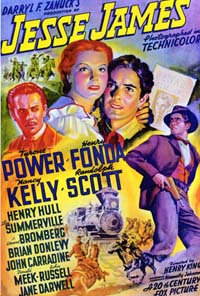
Jesse James
Thanks to films, television shows, dime novels, and with some time gone past, we can now look back at historical figures with rose-tinted glasses. Nowhere is that more evident than with wild west gunslingers, cowboys and outlaws. Some truly bad dudes have been remembered fondly, even as anti-heroes. One that always comes to mind for me is Jesse James, a Confederate guerrilla turned bank robber. He gets the whitewashed hero treatment in 1939's Jesse James.
Helping run the family farm with his mother (Jane Darwell), young Jesse James (Tyrone Power) works with his brother, Frank (Henry Fonda), to create a pleasant life for the family. Their country life is shattered as the railroad moves west, railroad agents ramrodding families off their land. An accident causes the death of the James' boys mother, forcing Jesse and Frank to seek revenge. With rewards posted for their arrest or death, Jesse and Frank are forced into a life of crime, robbing trains and banks as they're on the run. Jesse wants more revenge though, his name growing ever more well known.
Depending on the source, Jesse James is looked at as a heroic rebel, an intelligent bandit, a disturbed thief, and any number of options that fall somewhere in between. From director Henry King, this 1939 western goes an odd route. It makes Jesse a pretty straight hero, not even an anti-hero. We're not talking Butch and Sundance treatment -- it's too blase for that -- but it's approaching that territory. The history is condensed, tweaked and twisted from the start. Yes, it is based in the truth (or at least part of it), but then starts going off route quickly. Powers' Jesse isn't infallible, he's no immaculate hero. Still, it doesn't ring true. Railroad? Uber bad. Bandit? Bad....but he's fighting for his deceased mother.
A star of the 1930s and 1940s, Powers was quite the actor over a career that was cut short by his death in 1957 at the age of 44. I've never seen many of his movies, but he was always a likable enough actor. I came away less than impressed with this effort as the infamous, iconic western bandit, Jesse James. Only part of the blame can be chalked up to him. Even as Jesse's fame rises, we're still seeing him as pretty squeaky clean. Some characters flaws couldn't have hurt. Good or bad though, it just isn't that interesting of a part, and that's saying something. It's Jesse James! How could that not be interesting? It doesn't help the cause that much of the already condensed story is spent on Jesse's developing/loving relationship with Zee (Nancy Kelly), a young woman he's known since they were kids. Yeah! Love story about an outlaw!
Unfortunately for the rest of the cast, what's worth mentioning is that the cast is misused and underused. In a criminally underused part, Fonda is a huge bright spot as Jesse's older brother, Frank. This lanky, laconic, confident young man is a scene-stealer, especially his intro. Still a rising star, Randolph Scott is wasted too as Marshal Will Wright, a peace officer divided between his respect for Jesse and his call to duty. Thankfully, a love triangle isn't a focus of the story among Will, Jesse and Zee. Henry Hull hams it up like a crazy man as drunken newspaperman Rufus Cobb, Zee's uncle. Brian Donlevy has a great part as a sneering, vicious railroad agent who meets Jesse's wrath while John Carradine has a smallish part as Bob Ford, a possibly treacherous member of the James gang. Some interesting characters, just could have used more of them on-screen.
The movie is good and bad -- ridiculous history aside. It's a fondly remembered movie from one of the all-time great years in Hollywood history, 1939, so it does something right. There's some impressive scale, some great tracking shots full of hundreds of extras, one especially of Jesse (a stunt double at least) running across the top of a speeding train. It's a beautiful movie, and some scenes truly stand out, like the botched Northfield robbery and a subsequent chase. At just 106 minutes though, some 16 years of history is condensed into a rushed story. Maybe a rewatch would help, but for now, my first impression was pretty lukewarm. Some parts definitely work, but not on the whole.
Jesse James <---Youtube clip (1939): **/****
Helping run the family farm with his mother (Jane Darwell), young Jesse James (Tyrone Power) works with his brother, Frank (Henry Fonda), to create a pleasant life for the family. Their country life is shattered as the railroad moves west, railroad agents ramrodding families off their land. An accident causes the death of the James' boys mother, forcing Jesse and Frank to seek revenge. With rewards posted for their arrest or death, Jesse and Frank are forced into a life of crime, robbing trains and banks as they're on the run. Jesse wants more revenge though, his name growing ever more well known.
Depending on the source, Jesse James is looked at as a heroic rebel, an intelligent bandit, a disturbed thief, and any number of options that fall somewhere in between. From director Henry King, this 1939 western goes an odd route. It makes Jesse a pretty straight hero, not even an anti-hero. We're not talking Butch and Sundance treatment -- it's too blase for that -- but it's approaching that territory. The history is condensed, tweaked and twisted from the start. Yes, it is based in the truth (or at least part of it), but then starts going off route quickly. Powers' Jesse isn't infallible, he's no immaculate hero. Still, it doesn't ring true. Railroad? Uber bad. Bandit? Bad....but he's fighting for his deceased mother.
A star of the 1930s and 1940s, Powers was quite the actor over a career that was cut short by his death in 1957 at the age of 44. I've never seen many of his movies, but he was always a likable enough actor. I came away less than impressed with this effort as the infamous, iconic western bandit, Jesse James. Only part of the blame can be chalked up to him. Even as Jesse's fame rises, we're still seeing him as pretty squeaky clean. Some characters flaws couldn't have hurt. Good or bad though, it just isn't that interesting of a part, and that's saying something. It's Jesse James! How could that not be interesting? It doesn't help the cause that much of the already condensed story is spent on Jesse's developing/loving relationship with Zee (Nancy Kelly), a young woman he's known since they were kids. Yeah! Love story about an outlaw!
Unfortunately for the rest of the cast, what's worth mentioning is that the cast is misused and underused. In a criminally underused part, Fonda is a huge bright spot as Jesse's older brother, Frank. This lanky, laconic, confident young man is a scene-stealer, especially his intro. Still a rising star, Randolph Scott is wasted too as Marshal Will Wright, a peace officer divided between his respect for Jesse and his call to duty. Thankfully, a love triangle isn't a focus of the story among Will, Jesse and Zee. Henry Hull hams it up like a crazy man as drunken newspaperman Rufus Cobb, Zee's uncle. Brian Donlevy has a great part as a sneering, vicious railroad agent who meets Jesse's wrath while John Carradine has a smallish part as Bob Ford, a possibly treacherous member of the James gang. Some interesting characters, just could have used more of them on-screen.
The movie is good and bad -- ridiculous history aside. It's a fondly remembered movie from one of the all-time great years in Hollywood history, 1939, so it does something right. There's some impressive scale, some great tracking shots full of hundreds of extras, one especially of Jesse (a stunt double at least) running across the top of a speeding train. It's a beautiful movie, and some scenes truly stand out, like the botched Northfield robbery and a subsequent chase. At just 106 minutes though, some 16 years of history is condensed into a rushed story. Maybe a rewatch would help, but for now, my first impression was pretty lukewarm. Some parts definitely work, but not on the whole.
Jesse James <---Youtube clip (1939): **/****
Labels:
1930s,
Brian Donlevy,
Henry Fonda,
John Carradine,
Randolph Scott,
Tyrone Power,
westerns
Thursday, January 12, 2012
Mr. Smith Goes to Washington
It seems not a few days or weeks go by before another political corruption story hits the news circuits. Idealized maybe, but we vote elected officials into office to represent then us, and inevitably we find out that so much more was going on behind the scenes -- cough Blago cough -- that we never find out about. One of the best looks into political corruption, 1939's Mr. Smith Goes to Washington, is a true classic.
When a U.S. senator dies in an unnamed western state, naive and idealistic Jefferson Smith (James Stewart) is named to the vacant seat. The young Smith has no idea that he's been chosen to keep the seat warm for two months before reelection, an unknowing yes man to the more experienced senator from his state, Joseph Paine (Claude Rains). Jefferson is a newspaper publisher who helps run a camp for boys and has no experience in politics. He quickly finds out that he's been chosen only to serve as a dupe but decides to make the best of it, working with his assistant, Saunders (Jean Arthur), to put a bill through the Senate. He's unknowingly stepped into a high-level bill that will force him to deal with all sorts of political corruption, but can he maintain his idealist views?
As far as successful years go in Hollywood history, 1939 is basically 1, 1A and 1B. Any other years pales in comparison, and 'Mr. Smith' more than deserves it standing as one of the year's best. Teaming with Stewart (later reuniting for It's a Wonderful Life), director Frank Capra is at the helms of one of the all-time greats. It avoids some of the sappiness so prevalent in his other films and still manages to get its message across. To a 1930s audience still suffering through the Great Depression, it's message of the underdog sticking to his beliefs and cause must have hit home more. A political machine and system (Edward Arnold as the business kingpin in a frightening, real role) looking out for itself and willing to pressure and intimidate its way to riches? All too realistic. Not a heavy-handed attempt at delivering the message either, an obvious positive.
Okay, casting an idealistic, naive, well-meaning and intelligent young man stepping into a powerful government position, who better to choose than Mr. All American himself, Jimmy Stewart. I can't think of a better actor -- living or dead -- to play Jefferson Smith. His 'aw shucks' demeanor was made for this part. If this movie is going to work, you need to buy Stewart as Jefferson and everything about him. Mission accomplished then. Nominated but ultimately not winning for Best Actor, Stewart was a rising star here. You believe him and genuinely like him through all his innocence and naivete. His Jefferson Smith has become one of the more iconic movie characters ever, and it's easy to see why.
His most memorable scene is a whopper, and an entire 40-minute sequence carries this movie into another higher level. Made to look like he is one of the corrupt politicians and trying to save his good name -- among other things -- Jefferson is forced to filibuster, a political procedure that basically stalls for time. Talking and talking, the hours roll by as he tries to prove his point. This is where Capra's message comes across best, an effort by thousands of Americans -- on both sides, for good and bad -- work to help their side win. A remarkable sequence, and one that's remembered for a reason. Stewart earned his nomination with this scene alone.
The rest of the characters are painted with some broad strokes -- good or bad -- but the performances are almost uniformly strong. Jean Arthur actually received top billing (odd in a movie called Mr. Smith), playing well with Stewart as they show off an easy-going natural chemistry. Claude Rains as Paine, the veteran senator, is the darkest part, a man who wants more politically but knows it will come at a cost; his integrity. Thomas Mitchell plays Diz Moore, Saunders' friend and a political correspondent and reporter. Guy Kibbee, Eugene Pallette and Arnold play Jefferson's main opposition with Harry Carey stealing his scenes as the President of the Senate.
It's nice to go into a classic film and get just that...a classic. So often they're disappointing but not here. Filming on location in Washington D.C. gives a sense of realism and authenticity, and it's a beautiful city to begin with. The sets, especially the Senate chambers, become a character all to themselves. Mostly though, this is a classic about people and their beliefs, how far they're willing to take it when fighting for what they believe is right. A must-see film for movie fans.
Mr. Smith Goes to Washington <---TCM trailer/clips (1939): ****/****
When a U.S. senator dies in an unnamed western state, naive and idealistic Jefferson Smith (James Stewart) is named to the vacant seat. The young Smith has no idea that he's been chosen to keep the seat warm for two months before reelection, an unknowing yes man to the more experienced senator from his state, Joseph Paine (Claude Rains). Jefferson is a newspaper publisher who helps run a camp for boys and has no experience in politics. He quickly finds out that he's been chosen only to serve as a dupe but decides to make the best of it, working with his assistant, Saunders (Jean Arthur), to put a bill through the Senate. He's unknowingly stepped into a high-level bill that will force him to deal with all sorts of political corruption, but can he maintain his idealist views?
As far as successful years go in Hollywood history, 1939 is basically 1, 1A and 1B. Any other years pales in comparison, and 'Mr. Smith' more than deserves it standing as one of the year's best. Teaming with Stewart (later reuniting for It's a Wonderful Life), director Frank Capra is at the helms of one of the all-time greats. It avoids some of the sappiness so prevalent in his other films and still manages to get its message across. To a 1930s audience still suffering through the Great Depression, it's message of the underdog sticking to his beliefs and cause must have hit home more. A political machine and system (Edward Arnold as the business kingpin in a frightening, real role) looking out for itself and willing to pressure and intimidate its way to riches? All too realistic. Not a heavy-handed attempt at delivering the message either, an obvious positive.
Okay, casting an idealistic, naive, well-meaning and intelligent young man stepping into a powerful government position, who better to choose than Mr. All American himself, Jimmy Stewart. I can't think of a better actor -- living or dead -- to play Jefferson Smith. His 'aw shucks' demeanor was made for this part. If this movie is going to work, you need to buy Stewart as Jefferson and everything about him. Mission accomplished then. Nominated but ultimately not winning for Best Actor, Stewart was a rising star here. You believe him and genuinely like him through all his innocence and naivete. His Jefferson Smith has become one of the more iconic movie characters ever, and it's easy to see why.
His most memorable scene is a whopper, and an entire 40-minute sequence carries this movie into another higher level. Made to look like he is one of the corrupt politicians and trying to save his good name -- among other things -- Jefferson is forced to filibuster, a political procedure that basically stalls for time. Talking and talking, the hours roll by as he tries to prove his point. This is where Capra's message comes across best, an effort by thousands of Americans -- on both sides, for good and bad -- work to help their side win. A remarkable sequence, and one that's remembered for a reason. Stewart earned his nomination with this scene alone.
The rest of the characters are painted with some broad strokes -- good or bad -- but the performances are almost uniformly strong. Jean Arthur actually received top billing (odd in a movie called Mr. Smith), playing well with Stewart as they show off an easy-going natural chemistry. Claude Rains as Paine, the veteran senator, is the darkest part, a man who wants more politically but knows it will come at a cost; his integrity. Thomas Mitchell plays Diz Moore, Saunders' friend and a political correspondent and reporter. Guy Kibbee, Eugene Pallette and Arnold play Jefferson's main opposition with Harry Carey stealing his scenes as the President of the Senate.
It's nice to go into a classic film and get just that...a classic. So often they're disappointing but not here. Filming on location in Washington D.C. gives a sense of realism and authenticity, and it's a beautiful city to begin with. The sets, especially the Senate chambers, become a character all to themselves. Mostly though, this is a classic about people and their beliefs, how far they're willing to take it when fighting for what they believe is right. A must-see film for movie fans.
Mr. Smith Goes to Washington <---TCM trailer/clips (1939): ****/****
Tuesday, November 15, 2011
Drums Along the Mohawk
As far as solid years go for a director, 1939 was epically successful for John Ford with three classic or near-classic films. The most well-known is Stagecoach, but Young Mr. Lincoln and Drums Along the Mohawk are two of my favorites too. John Ford doing an American Revolution story without most of the trappings and pitfalls that plague so many of his movies? Count me in, one of my childhood favorites and a movie I've seen countless times.
It's 1776 in upstate New York and newlywed couple Gil Martin (Henry Fonda) and his wife, Lana (Claudette Colbert) are moving into the wilderness, a frontier cabin in Deerfield near the colonial settlement at German Falls. The revolution has started, the colonies declaring their independence from Britain. In Deerfield and the Mohawk Valley, the war seems a long way off as Gil and Lana build up a new live for themselves, starting from the ground up. Colonists loyal to the British, Tories, have stirred up the Indian tribes though, and now the outnumbered colonists find themselves fighting in a war that looked like it passed them by. Right in the mix? Gil and Lana protecting their young family and homestead as the war rages on around them.
Movies about the American Revolution are few and far between so you've got to enjoy them as you stumble onto them. Imagine a Ford western transplanted back to the late 1770s and early 1780s with the British and Indians replacing the bandits and Plains Indians. I grew up watching this movie and have always loved it. 'Mohawk' was filmed in Utah -- not exactly a look-a-like for upstate New York -- but it is a stunningly beautiful movie, especially impressive considering the movie is over 70 years old. Throw in a Yankee Doodle themed score from Alfred Newman, and you've got all the elements for a winner.
It's 1776 in upstate New York and newlywed couple Gil Martin (Henry Fonda) and his wife, Lana (Claudette Colbert) are moving into the wilderness, a frontier cabin in Deerfield near the colonial settlement at German Falls. The revolution has started, the colonies declaring their independence from Britain. In Deerfield and the Mohawk Valley, the war seems a long way off as Gil and Lana build up a new live for themselves, starting from the ground up. Colonists loyal to the British, Tories, have stirred up the Indian tribes though, and now the outnumbered colonists find themselves fighting in a war that looked like it passed them by. Right in the mix? Gil and Lana protecting their young family and homestead as the war rages on around them.
Movies about the American Revolution are few and far between so you've got to enjoy them as you stumble onto them. Imagine a Ford western transplanted back to the late 1770s and early 1780s with the British and Indians replacing the bandits and Plains Indians. I grew up watching this movie and have always loved it. 'Mohawk' was filmed in Utah -- not exactly a look-a-like for upstate New York -- but it is a stunningly beautiful movie, especially impressive considering the movie is over 70 years old. Throw in a Yankee Doodle themed score from Alfred Newman, and you've got all the elements for a winner.
Monday, July 18, 2011
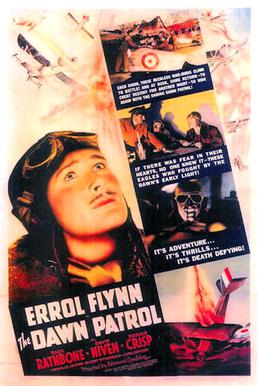
The Dawn Patrol
Maybe its the aviation aspect that studios assume viewers will be more interested in flying, but thankfully World War I pilots have been in several worthwhile movies. Most recently Flyboys struggled in theaters telling the story of American pilots flying with the French early in the war. George Peppard starred in The Blue Max, the story of a German infantry soldier turned national hero. One of the best though is 1938's The Dawn Patrol, an anti-war film that is both thrilling to watch and able to strike a nerve emotionally. That's a good combination if there ever was one.
It's 1915 in France and as a leader of one of the flights in the British 59th Squadron and one of the few pilots with experience, Capt. Courtney (Errol Flynn) consistently finds himself leading rookie, inexperienced pilots on missions where they rarely return. The war demands new pilots though and as quick as they're taught how to fly they are thrown into the fire. Courtney is constantly at odds with squadron commander Major Brand (Basil Rathbone) who realizes the idiocy of the orders he's receiving but can do nothing about it. Courtney's actions one day in destroying a rail depot actually gets Brand promoted, leaving the command post open to which Courtney is promoted. With close friend and fellow pilot, Lt. Scott (David Niven), taking over one of the flights, Courtney steps into the command position, immediately seeing that there will be no winners in this war.
I've long been aware of this movie, but just never got around to seeing it. I had a picture of gallant, heroic Errol Flynn single-handedly winning World War I from his fighter plane, dispatching hundreds of Germans at will. Flynn does play the gallant, heroic pilot, but in terms of the rest of the movie I couldn't have been more wrong. Just a year before WWII started in a time when I think of blatant, painful propaganda movies, this is an anti-war movie screaming for someone to listen to the complete idiocy of war and armed combat. Director Edmund Goulding has a film here that doesn't pull any punches. An assembly line of pilots is sent to their deaths because the war requires it, not because it makes any sense. Someone has to fight, and these inexperienced pilots fit the bill.
The best utilization of this is when Niven's Lt. Scott sees his younger brother, Donnie (Morton Lowry), among the newest batch of replacements. Up to this point both Scott and Courtney have balked at what they're doing, but the new pilots are nameless, faceless and interchangeable individuals. Now they have a boy in front of them fresh out of flight school who with his barely 10 hours of time in a plane is expected to tangle with German aces. Niven's Scott begs, implores Courtney to ground his younger brother, giving him a few days to teach him how to survive. Courtney wants to do so, desperately wants to, but as commanding officer where can he draw the line? He can't because he would have to do this for every new pilot. It tears him up inside, sending these young men to almost certain death, but he's left no other option.
Robin Hood is Flynn's more well-known and even iconic role from 1938, but his part as Captain Courtney in The Dawn Patrol is without question the better part for him. I've always liked Flynn as an actor, but I've been critical at times because he does seem to play similar characters. It is roles like this that show he may play similar characters, but he was more than a movie star, he was an actor. Courtney is forced to go through a transformation because his duty calls for it, not because he wants to. Sending men to their death takes its toll on him, but he continues on. Flynn was just 29 years old at the time, and Niven just 28 as they filmed, both showing they were on their way to bigger and better. They have a friendship on-screen that reflects their friendship off-screen so their characters are unquestionably genuine.
With some impressive aerial footage of World War I era planes, it's impossible not to get sucked into the action. We're watching these flimsy planes that look like a stiff wind would rip them apart as they maneuver and tear through the skies. In an age of planes that travel hundreds of miles in minutes, watching a movie like this can seem like ancient history. The best part of the movie though are the quieter moments, Scott and Courtney reminiscing before a mission that has little chance of success. It's the pilots wearily accepting their orders, hiding the disappointment and running out to their planes. It is Lt. Scott addressing his flight of the squadron, the movie beginning as it ends. There will be no victors, just survivors. These were gentleman fighting a brutish war, much of the time treating their German counterparts with respect. A great scene has Courtney drinking with a downed German pilot (Carl Esmond) just a few hours after shooting him down. There is a surreal nature to the proceedings that just couldn't be made up.
Rightfully so this is remembered as an Errol Flynn movie, and both Flynn and Niven are perfectly cast. Rathbone though is particularly memorable as Major Branch, the commander who wishes he could be up in the sky with his pilots instead of behind a desk. Donald Crisp is good in a supporting part as Phipps, the squadron adjutant while Barry Fitzgerald plays Bott, the squadron mechanic. This is a criminally underrated war movie, one that surprises in the effectiveness of its message. Well worth checking out.
The Dawn Patrol <---trailer (1938): *** 1/2 /****
Wednesday, June 8, 2011
Bad Lands
So the timing isn't really good here as I throw remake and reboot one after another out there, but timing isn't everything, is it? After reviewing 1955's I Died a Thousand Times which was a remake of 1941's High Sierra, I stumbled across another movie that's a virtual scene-for-scene remake of a John Ford classic. Where the previous review at least had a decade in between releases, this one was quite a bit closer. The Ford version is a 1934 flick called The Lost Patrol, and the remake came out just five years later with 1939's Bad Lands.
The Lost Patrol is an interesting film for a lot of reasons, mostly because for a movie released in 1934, it was far ahead of its time. It was quick, hard-hitting and violent, not playing up to conventions of the war genre. Above all else, it is different. A small patrol of Foreign Legion soldiers is trapped at a desert oasis and under siege by Bedouin riflemen (almost always unseen). 'Lands' isn't quite an exact remake mostly because the setting is transplanted from the African desert to the American southwest in the 1870s. Other than the setting though, it's the same movie. Not as good overall, it is still interesting, but mostly as a comparison piece to the better The Lost Patrol.
Leading a posse for a murdering bandit, Apache Jack, Sheriff Bill Cummings (Robert Barrat) is riding at the head of nine men. They have ridden into the desert after Apache Jack escaped from jail and murdered a Mexican woman. Tracking him, they hole up at a water hole high up the rocky hills. The posse finds a vein of silver though in the rocks, and they begin to think about who can get a claim in first. That night though, an Apache war party steals their horses, stranding them in the middle of desert with nowhere to go. Cummings and his posse have ample water, but the Apaches are gunning for them. Should they send for help, or sit tight and hope they can hold out long enough for some sort of help to arrive?
The rehash of the story isn't as sketchy as it seems mostly because both films came from RKO Studios. Neither movie could have cost much to make with the small cast and little need for any sort of background players, army of extras, or any sets at all other than the desert. None of this rehash comes as a judgment because in the years since the premise has been used repeatedly, including a very violent Euro-western, Chato's Land. It is simple, straightforward, and effective. Until the end, we never see more than one Apache, leaving the enemy as more of a presence than an actual scare. The warriors are everywhere and nowhere at the same time, just waiting for their chance to strike.
Maybe because the cast isn't that well known, but filling out the sheriff's posse isn't as fun this time around as The Lost Patrol. The characters are still more genre archetypes (I think that's the word I'm looking for) than red-blooded characters, but come on, they're basically fodder for the Apache war party. Along with Barrat's Sheriff Cummings, there's Mulford (Douglas Walton), the inexperienced rider from NYC, Eaton (Robert Coote), an amiable Englishman, Chick (Noah Beery Jr.), an unlikable rabble-rouser, Billy Sweet (Guinn Williams), a happy go lucky cowboy, Henry (Andy Clyde) and Garth (Francis Ford, John's brother), two old-timer prospectors with some gay undertones, Rayburn (Addison Richards), a gunslinger gunning for the sheriff, Curly (Paul Hurst), a crotchety cowboy, and Lopez (Francis McDonald), a Mexican looking for revenge for the murder of his wife.
With a movie that barely breaks the 60-minute mark with a 70-minute running time, you would think there would be no time to waste. Well, you would be wrong. Before the ambush and siege at the water hole, there's about 10-15 minutes of the posse riding around. Then at the water hole, there are long scenes of dialogue as the posse discusses their lives, their fears, and generally their frustration at the predicament they're in. Throw in the possibility of vast riches with the silver vein, and you've got a lot going on that is not always interesting. The Apaches are a presence for a majority of the movie, finally revealing themselves at the end in one last shootout. The fear of an attack is genuine, but the censors and lack of any violence limit the potential. Most of the posse is killed off-screen, and besides, there are only a few characters that are actually likable.
Just like The Lost Patrol, I liked this movie. It's a good movie that could have been great with a few tweaks here and there. The premise is simple, and that's the beauty of it. The story is straightforward with no wasted subplots, the hope for survival driving and moving everything along. Shot in black and white with an impressive dark streak for a movie from 1939, there's a lot to offer. It just isn't great, and it could have been better. Still, a western The Lost Patrol isn't a bad thing.
Bad Lands (1939): ** 1/2 /****
The Lost Patrol is an interesting film for a lot of reasons, mostly because for a movie released in 1934, it was far ahead of its time. It was quick, hard-hitting and violent, not playing up to conventions of the war genre. Above all else, it is different. A small patrol of Foreign Legion soldiers is trapped at a desert oasis and under siege by Bedouin riflemen (almost always unseen). 'Lands' isn't quite an exact remake mostly because the setting is transplanted from the African desert to the American southwest in the 1870s. Other than the setting though, it's the same movie. Not as good overall, it is still interesting, but mostly as a comparison piece to the better The Lost Patrol.
Leading a posse for a murdering bandit, Apache Jack, Sheriff Bill Cummings (Robert Barrat) is riding at the head of nine men. They have ridden into the desert after Apache Jack escaped from jail and murdered a Mexican woman. Tracking him, they hole up at a water hole high up the rocky hills. The posse finds a vein of silver though in the rocks, and they begin to think about who can get a claim in first. That night though, an Apache war party steals their horses, stranding them in the middle of desert with nowhere to go. Cummings and his posse have ample water, but the Apaches are gunning for them. Should they send for help, or sit tight and hope they can hold out long enough for some sort of help to arrive?
The rehash of the story isn't as sketchy as it seems mostly because both films came from RKO Studios. Neither movie could have cost much to make with the small cast and little need for any sort of background players, army of extras, or any sets at all other than the desert. None of this rehash comes as a judgment because in the years since the premise has been used repeatedly, including a very violent Euro-western, Chato's Land. It is simple, straightforward, and effective. Until the end, we never see more than one Apache, leaving the enemy as more of a presence than an actual scare. The warriors are everywhere and nowhere at the same time, just waiting for their chance to strike.
Maybe because the cast isn't that well known, but filling out the sheriff's posse isn't as fun this time around as The Lost Patrol. The characters are still more genre archetypes (I think that's the word I'm looking for) than red-blooded characters, but come on, they're basically fodder for the Apache war party. Along with Barrat's Sheriff Cummings, there's Mulford (Douglas Walton), the inexperienced rider from NYC, Eaton (Robert Coote), an amiable Englishman, Chick (Noah Beery Jr.), an unlikable rabble-rouser, Billy Sweet (Guinn Williams), a happy go lucky cowboy, Henry (Andy Clyde) and Garth (Francis Ford, John's brother), two old-timer prospectors with some gay undertones, Rayburn (Addison Richards), a gunslinger gunning for the sheriff, Curly (Paul Hurst), a crotchety cowboy, and Lopez (Francis McDonald), a Mexican looking for revenge for the murder of his wife.
With a movie that barely breaks the 60-minute mark with a 70-minute running time, you would think there would be no time to waste. Well, you would be wrong. Before the ambush and siege at the water hole, there's about 10-15 minutes of the posse riding around. Then at the water hole, there are long scenes of dialogue as the posse discusses their lives, their fears, and generally their frustration at the predicament they're in. Throw in the possibility of vast riches with the silver vein, and you've got a lot going on that is not always interesting. The Apaches are a presence for a majority of the movie, finally revealing themselves at the end in one last shootout. The fear of an attack is genuine, but the censors and lack of any violence limit the potential. Most of the posse is killed off-screen, and besides, there are only a few characters that are actually likable.
Just like The Lost Patrol, I liked this movie. It's a good movie that could have been great with a few tweaks here and there. The premise is simple, and that's the beauty of it. The story is straightforward with no wasted subplots, the hope for survival driving and moving everything along. Shot in black and white with an impressive dark streak for a movie from 1939, there's a lot to offer. It just isn't great, and it could have been better. Still, a western The Lost Patrol isn't a bad thing.
Bad Lands (1939): ** 1/2 /****
Friday, March 18, 2011
All Quiet on the Western Front
In one of the most succinct, powerfully effective lines in history, Union general William Tecumseh Sherman said 'War is hell.' Nothing else really needs to be said. There is nothing glamorous about armed conflict in any setting where one man takes the life of another, no matter what movies, TV shows, and books may try and convince you otherwise. Anti-war movies really came to the forefront during the Vietnam War as public sentiment soured on the conflict in Asia. But one of the most moving anti-war stories came long before that, 1930's All Quiet on the Western Front.
Based on the classic novel of the same name by Erich Maria Remarque, this is a remarkable movie for any number of reasons, starting with the year it was released. I would have never pegged this movie as being released in 1930, just a few years into the sound era of movies. There is also a sense with early Hollywood of white-washing stories, of censoring the movies of anything that is even remotely offensive. But that's the point of a war movie like this. It is supposed to offend you, to show the real horrors of war. Considering its 1930 release, it is one of the most violent movies of the era, but it so much more than just violence. This is war at its dirtiest, most base fighting, the effect it has on the men doing the fighting. No glory, no glamor, just survival.
With Germany preparing for war in 1914, teenager Paul Baumer (Lew Ayres) enlists with almost 20 other teenage boys from his school, dreaming of the glory that awaits them on the battlefield as Germany battles England and France. They leave with the notion that nothing would being them greater glory than to die for their country, quickly realizing how ridiculous the notion is. After a quick training period, Paul's company is sent to the front lines as replacements for a veteran unit already worn down and torn apart from the fighting. They find a war unlike anything told to them prior, the idea of heroism and glory quickly going out the window. They settle in to the trench warfare, charging across bomb-marked fields into walls of machine gun fire. A heroic fight for one's country? Maybe, but these soldiers could care less. They just want to survive the hell that surrounds them.
Two characters rise above the story here, starting with Ayres as young, impressionable Paul. His acting can be a little too stage-oriented, but it is through his eyes we see the horror of war. It is a remarkable performance from the 22-year old actor as we see his transformation from a naive newbie on the front lines to a tattered veteran in the matter of days. Somehow, he survives the days, weeks and months as so many of his comrades drop around him. Playing a part that would become synonymous with war movies, Louis Wolheim plays Corporal 'Kat' Katczinsky, the wily veteran who ends up being a leader based almost solely on his ability to teach and survive where so few others can. It's these two performances that anchor the movie. Other than that, most of the cast is pretty interchangeable, faces that don't leave much of an impression before being quickly dispatched.
Working on an impressively large scale for a 1930 release, director Lewis Milestone turns in an all-time classic here. He pulls no punches with his story, staying true to Remarque's source novel and its brutal honesty in portraying the horrors of war. Hundreds of extras fill the screen, and the battle scenes are immense. Milestone shows a knack with his camera in an ahead of its time use of tracking shots that put you in the trenches with the hand-to-hand combat, following the men across acres of open ground under bombardment and heavy fire. Exciting or entertaining? No, not really. This is war where there were no super-soldiers. Men died by the hundreds and thousands in futile efforts to gain a few feet of dirt. The battles are surprisingly graphic, just adding to the affect of what you're actually seeing.
When I think of an above average anti-war movie, I think of the moments that stick with you long after watching the movie. 'Western Front' has too many to even mention, but here are just a few that left the deepest impression. Visiting a wounded soldier, Paul watches him die a slow, painful death, the staff and patients around him not so much as blinking at his cries. Hiding in a trench, Paul tries to save a French soldier's life moments after stabbing him to save his own. After a sustained bombardment, a German soldier finally cracks, running out of the damp, crowded dugout screaming bloody murder. Later, a wounded soldier rises from his hospital bed and trudges across the room to the window where he feels a ray of sunlight on his face, promptly dropping dead. The best though may be Paul's return home, seeing the perception that the people left behind have of this glorious war. He tries to tell them the truth, but to no avail. After all, what does he know having served on the front lines for years?
This is a story where a happy ending just wouldn't work, wouldn't fit with the tone or style of this anti-war message. But even being aware of that doesn't take away from the raw power of the ending, simple in its execution but speaking volumes about the idiocy of war. SPOILERS STOP READING SPOILERS Returning from leave, Paul finds Katczinsky who is wounded scrounging for food. Paul carries him back to the aid station several miles back, unaware his friend has died. He leaves quietly, not sure or not believing what just happened. Days later sitting in a trench, he reaches out for a butterfly resting just inches away and is picked off by a French sniper. The movie ends with the haunting image of Paul's outstretched hand reaching for that one beautiful thing in nature, coming up just short. I can't think of a more appropriately down ending for a movie that had to end that way.
If interested in watching the movie, it is available to watch at Youtube in an above average print thanks to a great restoration job, especially when considering the movie was made over 80 years ago. You can watch it HERE starting with Part 1 of 13.
All Quiet on the Western Front <---trailer (1930): *** 1/2 /****
Based on the classic novel of the same name by Erich Maria Remarque, this is a remarkable movie for any number of reasons, starting with the year it was released. I would have never pegged this movie as being released in 1930, just a few years into the sound era of movies. There is also a sense with early Hollywood of white-washing stories, of censoring the movies of anything that is even remotely offensive. But that's the point of a war movie like this. It is supposed to offend you, to show the real horrors of war. Considering its 1930 release, it is one of the most violent movies of the era, but it so much more than just violence. This is war at its dirtiest, most base fighting, the effect it has on the men doing the fighting. No glory, no glamor, just survival.
With Germany preparing for war in 1914, teenager Paul Baumer (Lew Ayres) enlists with almost 20 other teenage boys from his school, dreaming of the glory that awaits them on the battlefield as Germany battles England and France. They leave with the notion that nothing would being them greater glory than to die for their country, quickly realizing how ridiculous the notion is. After a quick training period, Paul's company is sent to the front lines as replacements for a veteran unit already worn down and torn apart from the fighting. They find a war unlike anything told to them prior, the idea of heroism and glory quickly going out the window. They settle in to the trench warfare, charging across bomb-marked fields into walls of machine gun fire. A heroic fight for one's country? Maybe, but these soldiers could care less. They just want to survive the hell that surrounds them.
Two characters rise above the story here, starting with Ayres as young, impressionable Paul. His acting can be a little too stage-oriented, but it is through his eyes we see the horror of war. It is a remarkable performance from the 22-year old actor as we see his transformation from a naive newbie on the front lines to a tattered veteran in the matter of days. Somehow, he survives the days, weeks and months as so many of his comrades drop around him. Playing a part that would become synonymous with war movies, Louis Wolheim plays Corporal 'Kat' Katczinsky, the wily veteran who ends up being a leader based almost solely on his ability to teach and survive where so few others can. It's these two performances that anchor the movie. Other than that, most of the cast is pretty interchangeable, faces that don't leave much of an impression before being quickly dispatched.
Working on an impressively large scale for a 1930 release, director Lewis Milestone turns in an all-time classic here. He pulls no punches with his story, staying true to Remarque's source novel and its brutal honesty in portraying the horrors of war. Hundreds of extras fill the screen, and the battle scenes are immense. Milestone shows a knack with his camera in an ahead of its time use of tracking shots that put you in the trenches with the hand-to-hand combat, following the men across acres of open ground under bombardment and heavy fire. Exciting or entertaining? No, not really. This is war where there were no super-soldiers. Men died by the hundreds and thousands in futile efforts to gain a few feet of dirt. The battles are surprisingly graphic, just adding to the affect of what you're actually seeing.
When I think of an above average anti-war movie, I think of the moments that stick with you long after watching the movie. 'Western Front' has too many to even mention, but here are just a few that left the deepest impression. Visiting a wounded soldier, Paul watches him die a slow, painful death, the staff and patients around him not so much as blinking at his cries. Hiding in a trench, Paul tries to save a French soldier's life moments after stabbing him to save his own. After a sustained bombardment, a German soldier finally cracks, running out of the damp, crowded dugout screaming bloody murder. Later, a wounded soldier rises from his hospital bed and trudges across the room to the window where he feels a ray of sunlight on his face, promptly dropping dead. The best though may be Paul's return home, seeing the perception that the people left behind have of this glorious war. He tries to tell them the truth, but to no avail. After all, what does he know having served on the front lines for years?
This is a story where a happy ending just wouldn't work, wouldn't fit with the tone or style of this anti-war message. But even being aware of that doesn't take away from the raw power of the ending, simple in its execution but speaking volumes about the idiocy of war. SPOILERS STOP READING SPOILERS Returning from leave, Paul finds Katczinsky who is wounded scrounging for food. Paul carries him back to the aid station several miles back, unaware his friend has died. He leaves quietly, not sure or not believing what just happened. Days later sitting in a trench, he reaches out for a butterfly resting just inches away and is picked off by a French sniper. The movie ends with the haunting image of Paul's outstretched hand reaching for that one beautiful thing in nature, coming up just short. I can't think of a more appropriately down ending for a movie that had to end that way.
If interested in watching the movie, it is available to watch at Youtube in an above average print thanks to a great restoration job, especially when considering the movie was made over 80 years ago. You can watch it HERE starting with Part 1 of 13.
All Quiet on the Western Front <---trailer (1930): *** 1/2 /****
Sunday, March 6, 2011
Dead End
I knew them only by name for years, seeing them pop up in the TCM schedule occasionally on Saturday mornings. I had little interest in seeing any of the movies mostly because they sounded pretty awful, but also because movies from the 1930s are so hit or miss. It's that in between stage where feature films too often felt like larger scale plays as studios dealt with how to make silent movies into sound pictures. Dubbed the Dead End Kids, this "tough" group of child/teenage actors became huge stars under a couple different names, but if 1937's Dead End is any indication of their stardom, I'm going to continue to steer clear of them.
This is a movie based on a successful stage-based play that has the potential to make the jump from stage to film, but it was a painful movie for me to get through. There are three different storylines all working against one another -- including the most painful, the Dead End kids -- and never really giving any reason for any one of them to be interesting. It's a story that follows the goings and happenings on a warm summer day in New York City, a street at a junction where the rich live on one side in their posh, high-rise apartments and the poor in their ratty, decrepit apartments. Oh, the rich and the poor, prepare yourself for a pretentious message on the classes! Eh, maybe not. I don't think this movie could have managed a message if it wanted.
It's a humid, nasty NYC summer day when a man returns to the street he grew up on. He's gone on to other things, earning the nickname Baby Face Martin (Humphrey Bogart). As a gangster/killer out west, Martin's supposedly killed eight people, but he's back now and he wants to see his mother (Marjorie Main) and his old girlfriend, Francie (Claire Trevor). An out of work architect, Dave (Joel McCrea), grew up with Martin and recognizes him, encouraging him to move along before any trouble arises. Then down at the end of the street near the river, a gang of kids and teenagers, the Dead End Kids, harass a doorman to a posh apartment and generally cause mayhem whenever they can because...well, they're idiots.
Let's get the positive (yes, singular) out of the way first because it won't take long. This is Humphrey Bogart before he was a big star, before he was a household name. In the 1930s, he often played tough guy supporting roles, similar to the ones he would play later but from a leading role. His talent though is obvious whether it be in a starring role or from a supporting part. It's too bad his part is smaller here, not requiring much of him other than wearing a suit, smoking an occasional cigarette and generally looking tough. He goes 3-for-3 in that department by the way. Unfortunately, much of the focus is on the other two plots that do end up crossing paths with Bogie's, but not enough.
Instead, we get lots of interaction with the Dead End Kids, a "tough" street gang of kids/teenagers who like to cause havoc wherever they go. I'm not going to break each character down one by one because they're all interchangeable. They've got tough street names like Tommy, Spit, T.B. (because he's got tuberculosis...haha that's hilarious), and Milty. A typical conversation goes something like this. "Oh, yeah?!?"...."Yeah!"....."Yeah?!?"...."Well say that again!"...."Oh yeah," and then they push and shove for awhile before running away from a doorman or a cop or an adult. Listening to these teen actors attempt their awful New York accents is like nails on a chalkboard. Any time they come on screen is nauseating and quickly had me reaching for the fast forward. Awful, awful stuff. How this act appealed to audiences I'll never know.
So on to our intrepid hero, Joel McCrea playing Dave, an out of work architect who now takes odd jobs around town for some cash. As we meet him, he's painting a sign for a faux-Italian restaurant, and getting a good chuckle out of it at that. He's currently going out with rich babe, Kay (Wendy Barrie), but also knows that regular girl, Drina (Sylvia Sidney), has a crush on him. Oh, also, Drina's little brother is one of the Dead End Kids....oh no! More drama! Basically, Dave has nothing going for him, and he has this pretentious air about him that makes him the guardian of this street. He's the most milquetoast main character/hero I can think of, and because of that, I ended up liking Bogie's killer more than McCrea. None of this is a criticism of McCrea who I think is a fine actor, but this is not his best part.
Okay, there were a couple more positives to take away, however small they may have been. Playing the doorman to the swanky rich person apartment is Ward Bond, future member of the John Ford stock company and all around good tough guy actor. He's one of my all-time favorite character actors, and even seeing him for a few scenes here and there made this movie more memorable. Also, the studio set is pretty cool, claustrophobic and cluttered, making the setting interesting at least if not the goings-on. A pretty bad movie overall, and one I won't be revisiting anytime soon.
Dead End <---trailer (1937): */****
This is a movie based on a successful stage-based play that has the potential to make the jump from stage to film, but it was a painful movie for me to get through. There are three different storylines all working against one another -- including the most painful, the Dead End kids -- and never really giving any reason for any one of them to be interesting. It's a story that follows the goings and happenings on a warm summer day in New York City, a street at a junction where the rich live on one side in their posh, high-rise apartments and the poor in their ratty, decrepit apartments. Oh, the rich and the poor, prepare yourself for a pretentious message on the classes! Eh, maybe not. I don't think this movie could have managed a message if it wanted.
It's a humid, nasty NYC summer day when a man returns to the street he grew up on. He's gone on to other things, earning the nickname Baby Face Martin (Humphrey Bogart). As a gangster/killer out west, Martin's supposedly killed eight people, but he's back now and he wants to see his mother (Marjorie Main) and his old girlfriend, Francie (Claire Trevor). An out of work architect, Dave (Joel McCrea), grew up with Martin and recognizes him, encouraging him to move along before any trouble arises. Then down at the end of the street near the river, a gang of kids and teenagers, the Dead End Kids, harass a doorman to a posh apartment and generally cause mayhem whenever they can because...well, they're idiots.
Let's get the positive (yes, singular) out of the way first because it won't take long. This is Humphrey Bogart before he was a big star, before he was a household name. In the 1930s, he often played tough guy supporting roles, similar to the ones he would play later but from a leading role. His talent though is obvious whether it be in a starring role or from a supporting part. It's too bad his part is smaller here, not requiring much of him other than wearing a suit, smoking an occasional cigarette and generally looking tough. He goes 3-for-3 in that department by the way. Unfortunately, much of the focus is on the other two plots that do end up crossing paths with Bogie's, but not enough.
Instead, we get lots of interaction with the Dead End Kids, a "tough" street gang of kids/teenagers who like to cause havoc wherever they go. I'm not going to break each character down one by one because they're all interchangeable. They've got tough street names like Tommy, Spit, T.B. (because he's got tuberculosis...haha that's hilarious), and Milty. A typical conversation goes something like this. "Oh, yeah?!?"...."Yeah!"....."Yeah?!?"...."Well say that again!"...."Oh yeah," and then they push and shove for awhile before running away from a doorman or a cop or an adult. Listening to these teen actors attempt their awful New York accents is like nails on a chalkboard. Any time they come on screen is nauseating and quickly had me reaching for the fast forward. Awful, awful stuff. How this act appealed to audiences I'll never know.
So on to our intrepid hero, Joel McCrea playing Dave, an out of work architect who now takes odd jobs around town for some cash. As we meet him, he's painting a sign for a faux-Italian restaurant, and getting a good chuckle out of it at that. He's currently going out with rich babe, Kay (Wendy Barrie), but also knows that regular girl, Drina (Sylvia Sidney), has a crush on him. Oh, also, Drina's little brother is one of the Dead End Kids....oh no! More drama! Basically, Dave has nothing going for him, and he has this pretentious air about him that makes him the guardian of this street. He's the most milquetoast main character/hero I can think of, and because of that, I ended up liking Bogie's killer more than McCrea. None of this is a criticism of McCrea who I think is a fine actor, but this is not his best part.
Okay, there were a couple more positives to take away, however small they may have been. Playing the doorman to the swanky rich person apartment is Ward Bond, future member of the John Ford stock company and all around good tough guy actor. He's one of my all-time favorite character actors, and even seeing him for a few scenes here and there made this movie more memorable. Also, the studio set is pretty cool, claustrophobic and cluttered, making the setting interesting at least if not the goings-on. A pretty bad movie overall, and one I won't be revisiting anytime soon.
Dead End <---trailer (1937): */****
Labels:
1930s,
Claire Trevor,
Humphrey Bogart,
Joel McCrea,
Ward Bond
Tuesday, February 1, 2011
Only Angels Have Wings
Movies are right at home, the old bread and butter, when dealing with characters running away from something, looking for another shot after some horrific mistake was made in the past. If movies have taught us anything, for an American in this situation, there's two options...both equally deadly. One, enlist in the French Foreign Legion where you will most likely get killed in a nasty massacre in the desert. Two, go to South America and waste away in some dingy, damp village. That's not the whole premise of 1939's Only Angels Have Wings, but it's close.
Reading the description of this 1939 flick from Columbia Pictures, my first reaction was how similar it sounded to the French classic The Wages of Fear and its American remake Sorcerer. 'Angels' obviously came first, but it deals with a similar topic. Deep in an unnamed South American country, a group of Americans -- displaced by their choice or someone else forcing their hand -- working for a struggling company. For one reason or another, they're all running from something in their past, now forced into doing a job that will just as likely kill them as make them rich.
Waiting for her ship to depart, American singer Bonnie Lee (Jean Arthur) stumbles upon a little haven of back home in a South American port city. A complex owned by a European immigrant, Dutch (Sig Ruman) and run by an American pilot, Geoff Carter (Cary Grant), has a restaurant that serves good, old-fashioned American food with a runway outside the building. Bonnie is quickly drawn to the smooth, suave, most definitely aloof Geoff, only to find out how perilous the situation is. Dutch and Geoff have signed a contract to deliver the mail twice a week by plane to cities inland for six months and then receive a big payday. If they fail to deliver, the contract is void. With their stable of American pilots and World War I era planes, they've managed to make it five months and two weeks. They're close to their goal, but the flights become ever more dangerous, and the only way through to the next city is a flight through the fog-covered, looming mountains inland.
I watched this movie over a couple of sittings -- stupid work, getting in the way of my movie watching -- and certainly enjoyed it enough, although I didn't love it. My complaint here is one I usually have with movies released in the 1930s. Hollywood was still figuring out what worked and didn't work with movies, what audiences wanted and what they didn't want. For the most part, the acting isn't over the top as the cast thankfully turns down the theatrical stage touches. It is filmed completely on an indoor set which limits the scope of the story, but in an effort to balance that out, there is some great footage of these rickety looking planes flying through the mountains, taking off and landing, canceling out some of the cheaper effects to illustrate the planes "flying" through rough weather conditions. So what was wrong with this flick? I'm not sure, but something was missing.
Director Howard Hawks carved quite a nice little niche for himself in a career that includes over 40 movies, many of them held in high regard among fans and critics. His stories often focused on a group of men brought together through unlikely, strenuous circumstances having to band together to accomplish a similar goal, bonding in the process and putting their differences aside. 'Angels' is right at home with that premise. Grant is the tough but fair owner and chief pilot of this motley "airline," if you can call it that. His pilots include the always reliable and entertaining Thomas Mitchell as Kid Dabb, a veteran pilot struggling with vision loss, Allyn Joslyn, Noah Beery Jr., Victor Kilian, John Carroll, and Don Barry filling out the ranks of this misfit outfit.
Through all the slower portions of the movie with the pretty awful love triangle, Geoff's crew and their story carries the movie. Grant is at his suave, roguish best, Mitchell is as reliable as ever as the smart-mouthed sidekick, and Rugan and Co. fill in the holes wherever necessary. A key subplot has a new pilot, Bat MacPherson (Richard Barthelmess) arriving to fly, only to find out he's got a past with Mitchell's Kid. The men hold his past decisions against him, but MacPherson rises to the occasion as he desperately attempts to prove it was all a mistake. That's what works so well here. All these men are running from something so whether they realize it or not, they're all in the same boat. If this business have any hopes of succeeding, they will have to work together and put their differences aside. For Hawks, it's a tried and true formula, and as usual, it works.
Now Hawks used that formula a few more times during his career, but he also threw in those awkward, unnecessary love triangles too. Arthur's Bonnie falls for Cary Grant almost right away so then we get two hours of her trying to figure out if she belongs with him. Then MacPherson's new bride (21-year old Rita Hayworth) ends up being a woman from Grant's past to complicate things. Oh, no! Two women in love with the same man?!? If you have an iota of intelligence, you know who he is going to end up with, but my goodness, it takes awhile getting there. Thankfully, there's enough positive going on to outweigh the dull, slow-moving negatives. You can watch it at Youtube, starting HERE with Part 1 of 12.
Only Angels Have Wings <---trailer (1939): ***/****
Reading the description of this 1939 flick from Columbia Pictures, my first reaction was how similar it sounded to the French classic The Wages of Fear and its American remake Sorcerer. 'Angels' obviously came first, but it deals with a similar topic. Deep in an unnamed South American country, a group of Americans -- displaced by their choice or someone else forcing their hand -- working for a struggling company. For one reason or another, they're all running from something in their past, now forced into doing a job that will just as likely kill them as make them rich.
Waiting for her ship to depart, American singer Bonnie Lee (Jean Arthur) stumbles upon a little haven of back home in a South American port city. A complex owned by a European immigrant, Dutch (Sig Ruman) and run by an American pilot, Geoff Carter (Cary Grant), has a restaurant that serves good, old-fashioned American food with a runway outside the building. Bonnie is quickly drawn to the smooth, suave, most definitely aloof Geoff, only to find out how perilous the situation is. Dutch and Geoff have signed a contract to deliver the mail twice a week by plane to cities inland for six months and then receive a big payday. If they fail to deliver, the contract is void. With their stable of American pilots and World War I era planes, they've managed to make it five months and two weeks. They're close to their goal, but the flights become ever more dangerous, and the only way through to the next city is a flight through the fog-covered, looming mountains inland.
I watched this movie over a couple of sittings -- stupid work, getting in the way of my movie watching -- and certainly enjoyed it enough, although I didn't love it. My complaint here is one I usually have with movies released in the 1930s. Hollywood was still figuring out what worked and didn't work with movies, what audiences wanted and what they didn't want. For the most part, the acting isn't over the top as the cast thankfully turns down the theatrical stage touches. It is filmed completely on an indoor set which limits the scope of the story, but in an effort to balance that out, there is some great footage of these rickety looking planes flying through the mountains, taking off and landing, canceling out some of the cheaper effects to illustrate the planes "flying" through rough weather conditions. So what was wrong with this flick? I'm not sure, but something was missing.
Director Howard Hawks carved quite a nice little niche for himself in a career that includes over 40 movies, many of them held in high regard among fans and critics. His stories often focused on a group of men brought together through unlikely, strenuous circumstances having to band together to accomplish a similar goal, bonding in the process and putting their differences aside. 'Angels' is right at home with that premise. Grant is the tough but fair owner and chief pilot of this motley "airline," if you can call it that. His pilots include the always reliable and entertaining Thomas Mitchell as Kid Dabb, a veteran pilot struggling with vision loss, Allyn Joslyn, Noah Beery Jr., Victor Kilian, John Carroll, and Don Barry filling out the ranks of this misfit outfit.
Through all the slower portions of the movie with the pretty awful love triangle, Geoff's crew and their story carries the movie. Grant is at his suave, roguish best, Mitchell is as reliable as ever as the smart-mouthed sidekick, and Rugan and Co. fill in the holes wherever necessary. A key subplot has a new pilot, Bat MacPherson (Richard Barthelmess) arriving to fly, only to find out he's got a past with Mitchell's Kid. The men hold his past decisions against him, but MacPherson rises to the occasion as he desperately attempts to prove it was all a mistake. That's what works so well here. All these men are running from something so whether they realize it or not, they're all in the same boat. If this business have any hopes of succeeding, they will have to work together and put their differences aside. For Hawks, it's a tried and true formula, and as usual, it works.
Now Hawks used that formula a few more times during his career, but he also threw in those awkward, unnecessary love triangles too. Arthur's Bonnie falls for Cary Grant almost right away so then we get two hours of her trying to figure out if she belongs with him. Then MacPherson's new bride (21-year old Rita Hayworth) ends up being a woman from Grant's past to complicate things. Oh, no! Two women in love with the same man?!? If you have an iota of intelligence, you know who he is going to end up with, but my goodness, it takes awhile getting there. Thankfully, there's enough positive going on to outweigh the dull, slow-moving negatives. You can watch it at Youtube, starting HERE with Part 1 of 12.
Only Angels Have Wings <---trailer (1939): ***/****
Labels:
1930s,
Cary Grant,
Howard Hawks,
Noah Beery Jr,
Rita Hayworth,
Thomas Mitchell
Wednesday, March 24, 2010
Dodge City
I've covered this before, but when I watch enough older movies (pre-1950s or so) it keeps coming up. If possible, watch these movies with the mindset you're watching them in the year they were released. New innovations come along every few years with movies starting with the jump from silent to sound and building onward with color, widescreen, 3-D, CGI, and more recently with Avatar, whole new ways of filming human acting. It's hard sometimes though because well, it isn't 1939. What was appealing in 1939 doesn't necessarily translate well to 2010. That was my feeling with 1939's Dodge City.
Look at the all years in Hollywood history and 1939 is often labeled the greatest year in movie history, and for good reason. Here's a list of the more impressive flicks. And even though Dodge City is on that list, I'm not judging or comparing it to Gone With the Wind or The Wizard of Oz. But like both those movies, it is about the spectacle of what's happening on-screen. It's filmed in Technicolor with lots of bright, vivid colors that look almost fake, huge sets filled with seemingly hundreds of extras, and a story as big as the taming of the west.
After helping the railroad reach Dodge City, Wade Hatton (Errol Flynn) returns after years away from the wild, rumbling boom town with friends Rusty (Alan Hale) and Tex (Guinn Williams). The town they've helped build has gone to hell and any attempts at civilizing the town are stopped by a cattle man, Jeff Surrett (Bruce Cabot). Townspeople he has business deals with or owes money end up shot in the back with no witnesses. The town calls for Hatton to become sheriff and clear Surrett out, and at first he's completely unwilling. But something changes when an action of Surrett's pushes him too far. He takes the badge and starts to clean the town up, but Surrett is standing in his way and shows no sign of giving up.
The story is nothing new for a western, but that's not a complaint, just an observation. The problem is that all the other little things add up to be a problem. In the casting, Ann Sheridan gets third billing for a part that requires her to sing two or three times as a dance hall girl. These scenes have a line of dance hall girls dancing on-stage for a saloon full of raucous cowboys and grind the already slim story to a halt. They're cool enough to look at visually but too distracting overall. The same goes for the exterior shots of Dodge City (with studios in California filling in for Kansas) which are content to show crowded streets with all their extras. And even if the spectacle of the movie was more appealing, it pales in a big way compared to Gone With the Wind's spectacle.
The least of the problems is Errol Flynn as tough gunfighter with a golden heart, Wade Hatton. He's a good example of what western heroes were before Sergio Leone got his hands on the genre in the 1960s. Hatton is a good man, looking out for women and children first, and when pushed too far, watch out bad guys because he's coming after you. Frequent Flynn co-star Olivia de Haviland is the love interest who hates Flynn until it's important for her to turn a page and like him. The duo worked many times together and for good reason. They had some great chemistry that comes naturally and never looks like they had to force things along.
As his rival, Cabot is a solid villain. Thanks to his pairings later in his career with John Wayne, it would be easy to think Cabot usually played a variation on the trusty sidekick. But early in his career, he played his fair share of bad guys, especially in the 30s. His voice sounds like a deep growl, and he was a physically intimidating actor so he is a good counter to Flynn's heroic good guy. Victor Jory is also solid as one of Surrett's gunslingers who wouldn't bat an eye at shooting a guy in the back. Hale and Williams are the annoying, not so funny amusing sidekicks who are there to get a laugh or two. I like both actors but their parts just aren't funny.
The movie does pick up speed once Hatton becomes sheriff in Dodge City, and the finale starts off promising as Hatton and Co. shoot it out with Surrett on a burning train. But the ending limps to the finish, almost like director Michael Curtiz just ran out of money. SPOILER Surrett and his cronies escape and are making their getaway only to have Hatton and Rusty pick them off as they run. No big showdown, no worthy end for a quality bad guy. Just a quick shot of a dead Surrett after he's been thrown from his horse. Surprise, surprise, but Hatton also gets the girl. I know, it surprised me too. END OF SPOILER
This is not a bad movie in any way, and it feels wrong giving it a negative review for a movie that's main goal is to be entertaining. But all the spectacle moments take away from a story that could have been good, if not great. Errol Flynn is always worth a watch, Olivia de Haviland is a great actress, and Bruce Cabot's a good villain, but that's about it. Average western worth checking out if you're looking for a decent enough way to kill two hours. An Errol Flynn fan has posted many of his movies at Youtube, including Dodge City, starting with Part 1 of 10.
Dodge City <----trailer (1939): **/****
Look at the all years in Hollywood history and 1939 is often labeled the greatest year in movie history, and for good reason. Here's a list of the more impressive flicks. And even though Dodge City is on that list, I'm not judging or comparing it to Gone With the Wind or The Wizard of Oz. But like both those movies, it is about the spectacle of what's happening on-screen. It's filmed in Technicolor with lots of bright, vivid colors that look almost fake, huge sets filled with seemingly hundreds of extras, and a story as big as the taming of the west.
After helping the railroad reach Dodge City, Wade Hatton (Errol Flynn) returns after years away from the wild, rumbling boom town with friends Rusty (Alan Hale) and Tex (Guinn Williams). The town they've helped build has gone to hell and any attempts at civilizing the town are stopped by a cattle man, Jeff Surrett (Bruce Cabot). Townspeople he has business deals with or owes money end up shot in the back with no witnesses. The town calls for Hatton to become sheriff and clear Surrett out, and at first he's completely unwilling. But something changes when an action of Surrett's pushes him too far. He takes the badge and starts to clean the town up, but Surrett is standing in his way and shows no sign of giving up.
The story is nothing new for a western, but that's not a complaint, just an observation. The problem is that all the other little things add up to be a problem. In the casting, Ann Sheridan gets third billing for a part that requires her to sing two or three times as a dance hall girl. These scenes have a line of dance hall girls dancing on-stage for a saloon full of raucous cowboys and grind the already slim story to a halt. They're cool enough to look at visually but too distracting overall. The same goes for the exterior shots of Dodge City (with studios in California filling in for Kansas) which are content to show crowded streets with all their extras. And even if the spectacle of the movie was more appealing, it pales in a big way compared to Gone With the Wind's spectacle.
The least of the problems is Errol Flynn as tough gunfighter with a golden heart, Wade Hatton. He's a good example of what western heroes were before Sergio Leone got his hands on the genre in the 1960s. Hatton is a good man, looking out for women and children first, and when pushed too far, watch out bad guys because he's coming after you. Frequent Flynn co-star Olivia de Haviland is the love interest who hates Flynn until it's important for her to turn a page and like him. The duo worked many times together and for good reason. They had some great chemistry that comes naturally and never looks like they had to force things along.
As his rival, Cabot is a solid villain. Thanks to his pairings later in his career with John Wayne, it would be easy to think Cabot usually played a variation on the trusty sidekick. But early in his career, he played his fair share of bad guys, especially in the 30s. His voice sounds like a deep growl, and he was a physically intimidating actor so he is a good counter to Flynn's heroic good guy. Victor Jory is also solid as one of Surrett's gunslingers who wouldn't bat an eye at shooting a guy in the back. Hale and Williams are the annoying, not so funny amusing sidekicks who are there to get a laugh or two. I like both actors but their parts just aren't funny.
The movie does pick up speed once Hatton becomes sheriff in Dodge City, and the finale starts off promising as Hatton and Co. shoot it out with Surrett on a burning train. But the ending limps to the finish, almost like director Michael Curtiz just ran out of money. SPOILER Surrett and his cronies escape and are making their getaway only to have Hatton and Rusty pick them off as they run. No big showdown, no worthy end for a quality bad guy. Just a quick shot of a dead Surrett after he's been thrown from his horse. Surprise, surprise, but Hatton also gets the girl. I know, it surprised me too. END OF SPOILER
This is not a bad movie in any way, and it feels wrong giving it a negative review for a movie that's main goal is to be entertaining. But all the spectacle moments take away from a story that could have been good, if not great. Errol Flynn is always worth a watch, Olivia de Haviland is a great actress, and Bruce Cabot's a good villain, but that's about it. Average western worth checking out if you're looking for a decent enough way to kill two hours. An Errol Flynn fan has posted many of his movies at Youtube, including Dodge City, starting with Part 1 of 10.
Dodge City <----trailer (1939): **/****
Wednesday, February 17, 2010
Mutiny on the Bounty (1935)
The story of Fletcher Christian's mutiny aboard the H.M.S Bounty against Captain William Bligh is one of the most famous historical stories that just about everyone knows in some form or another. It is a story that translates well to film, including three well known flicks and a few other less highly regarded ones, with versions made in 1935, 1962, and 1984. The 1935 version, appropriately titled Mutiny on the Bounty, is the one held in highest regard, even earning the Best Picture Oscar and a long list of nominations.
While I'm not doubting the movie for its entertainment value, it does suffer from a problem many movies from the 1930s have. The movie studios were still making the transitition from silent to sound with many actors making the jump right from the stage to the big screen. But before method acting developed in the 1950s, many roles came across as too theatrical, too over the top, as if the actors were playing to audiences who would have been sitting right in front of them. Because of that, it can be hard to get a read on characters and what they're going through, especially in the case of 1935's Bounty.
Making his first sea voyage with an objective of writing a Tahitian dictionary, Roger Byam (Franchot Tone) boards the H.M.S. Bounty with romantic ideas of what the sea is like. He bonds quickly with Fletcher Christian (Clark Gable), the master's mate, and the two become fast friends. The Bounty is sailing to Tahiti where they will pick up 1,000 breadfruits and deliver them to the West Indies. The captain of the ship, William Bligh (Charles Laughton), rules his ship with an iron fist and quickly turns the crew against him with his gung-ho mentality. Christian especially bristles at how Bligh runs the ship, and after successly acquiring the breadfruits, leads a mutiny, putting Bligh and some of the crew on a longboat on the open seas.
Having seen the other two versions, the Marlon Brando and Mel Gibson takes, there was nothing that came as much of a surprise with the 1935 version. The enjoyment of watching movies that deal with similar subjects is how they handle the stories differently. History is built around facts, but it's funny how different those facts can be interpreted in the eyes of the beholder. The actual mutiny is typically handled in the same way, but the build-up and repercussions tend to differ.
The Academy must really have loved the acting in 'Bounty' because Laughton, Gable, and Tone were all nominated for Best Actor...with none of them actually winning. Laughton is a fine actor with a long list of impressive roles to his name, but his Bligh comes across as too cartoonishly evil. Granted, the historical Bligh was not a pleasant character, but some human emotions would have been nice for the character. Gable's Christian is a little better, the voice of the crew who can't understand the madness of their captain. Tone's Byam is a smattering of many different members of the Bounty and is the wavering voter, the individual in the middle. As an officer in the British navy, he should be loyal to his captain but what about his friendship with Fletcher?
Trying to figure out how to review 'Bounty,' the acting was a sticking point. It isn't bad, far from it. I've seen much worse in the way of 1930s over the top theatrical acting. But at the same time, it's hard to say we actually get to know these characters. They're more like cardboard cutouts spouting their lines. Bligh is evil, Christian is good, and Byam is trying to find himself. The hatred and friendship that develops is genuine, but it's easy to side with Christian's decision -- for me at least. Bligh is a blatant liar who treats his men horrifically when it doesn't always call for it. Of course, in all three versions I've sided with Christian's decision. Guess I would have been a mutineer on Pitcairn Island.
As a historical movie, 'Bounty' is all about the spectacle of a high seas voyage. While most of the acting on-board the Bounty was clearly done on a soundstage with an oceanic backdrop, there are actual shots of an 18th century ship sailing across the ocean, and not always in calm seas. There are great shots of the crew preparing the ship for sailing high above in the masts as the expansive sails come flowing down. And not really a surprise, but Tahiti sure looks nice. Maybe not as nice as it did in Technicolor in the 1962 version, but it's hard to make paradise look bad.
So good and bad, I'm still recommending this movie. For all its faults, 'Bounty' is still an entertaining adventure, especially if you're a fan of the history it is based in. Maybe the acting is too much at times, but Gable is and always will be pretty cool onscreen. There are flaws, and the ending does leave a fair share of subplots and storylines waving in the breeze, but worth a rent if nothing else.
Mutiny on the Bounty <----trailer (1935): ** 1/2 /****
While I'm not doubting the movie for its entertainment value, it does suffer from a problem many movies from the 1930s have. The movie studios were still making the transitition from silent to sound with many actors making the jump right from the stage to the big screen. But before method acting developed in the 1950s, many roles came across as too theatrical, too over the top, as if the actors were playing to audiences who would have been sitting right in front of them. Because of that, it can be hard to get a read on characters and what they're going through, especially in the case of 1935's Bounty.
Making his first sea voyage with an objective of writing a Tahitian dictionary, Roger Byam (Franchot Tone) boards the H.M.S. Bounty with romantic ideas of what the sea is like. He bonds quickly with Fletcher Christian (Clark Gable), the master's mate, and the two become fast friends. The Bounty is sailing to Tahiti where they will pick up 1,000 breadfruits and deliver them to the West Indies. The captain of the ship, William Bligh (Charles Laughton), rules his ship with an iron fist and quickly turns the crew against him with his gung-ho mentality. Christian especially bristles at how Bligh runs the ship, and after successly acquiring the breadfruits, leads a mutiny, putting Bligh and some of the crew on a longboat on the open seas.
Having seen the other two versions, the Marlon Brando and Mel Gibson takes, there was nothing that came as much of a surprise with the 1935 version. The enjoyment of watching movies that deal with similar subjects is how they handle the stories differently. History is built around facts, but it's funny how different those facts can be interpreted in the eyes of the beholder. The actual mutiny is typically handled in the same way, but the build-up and repercussions tend to differ.
The Academy must really have loved the acting in 'Bounty' because Laughton, Gable, and Tone were all nominated for Best Actor...with none of them actually winning. Laughton is a fine actor with a long list of impressive roles to his name, but his Bligh comes across as too cartoonishly evil. Granted, the historical Bligh was not a pleasant character, but some human emotions would have been nice for the character. Gable's Christian is a little better, the voice of the crew who can't understand the madness of their captain. Tone's Byam is a smattering of many different members of the Bounty and is the wavering voter, the individual in the middle. As an officer in the British navy, he should be loyal to his captain but what about his friendship with Fletcher?
Trying to figure out how to review 'Bounty,' the acting was a sticking point. It isn't bad, far from it. I've seen much worse in the way of 1930s over the top theatrical acting. But at the same time, it's hard to say we actually get to know these characters. They're more like cardboard cutouts spouting their lines. Bligh is evil, Christian is good, and Byam is trying to find himself. The hatred and friendship that develops is genuine, but it's easy to side with Christian's decision -- for me at least. Bligh is a blatant liar who treats his men horrifically when it doesn't always call for it. Of course, in all three versions I've sided with Christian's decision. Guess I would have been a mutineer on Pitcairn Island.
As a historical movie, 'Bounty' is all about the spectacle of a high seas voyage. While most of the acting on-board the Bounty was clearly done on a soundstage with an oceanic backdrop, there are actual shots of an 18th century ship sailing across the ocean, and not always in calm seas. There are great shots of the crew preparing the ship for sailing high above in the masts as the expansive sails come flowing down. And not really a surprise, but Tahiti sure looks nice. Maybe not as nice as it did in Technicolor in the 1962 version, but it's hard to make paradise look bad.
So good and bad, I'm still recommending this movie. For all its faults, 'Bounty' is still an entertaining adventure, especially if you're a fan of the history it is based in. Maybe the acting is too much at times, but Gable is and always will be pretty cool onscreen. There are flaws, and the ending does leave a fair share of subplots and storylines waving in the breeze, but worth a rent if nothing else.
Mutiny on the Bounty <----trailer (1935): ** 1/2 /****
Labels:
1930s,
Charles Laughton,
Clark Gable,
Franchot Tone,
Historical epics
Sunday, January 24, 2010
The Charge of the Light Brigade
Made even more famous by a poem by Alfred Tennyson (check out that poem HERE), the actual charge of the Light Brigade is one of the most disastrous military events in British history. During the Crimean War, a miscommunication in orders leads to 600 light cavalry charging the wrong enemy position, one heavily guarded by Russian artillery, and being cut to pieces in the process. A movie version released in 1968 told that story, a cynical view of the incident that showed the "battle" for what it was...a disaster. But the 1936 version takes an interesting stance, the Light Brigade knew it was riding into certain death and still did it, and then changes the end result of the battle. Patriotic? Sure. Altering history? You bet. Does it all work? Not really.
It's 1854 and British soldier and member of the 27th Lancers Geoffrey Vickers (Errol Flynn) is returning from a mission and is going to see his fiance, Elsa (Olivia de Havilland) for the first time in many months. In his absense, Vickers isn't aware that Elsa has fallen in love with his brother, Perry (Patric Knowles). As he comes to term with this revelation, Geoffrey must also join the fight against a Suristani leader at the head of a nationwide uprising, Surat Khan (C. Henry Gordon) that could destroy every British outpost in India. After Khan leads an attack and massacres one of these outposts, Vickers and the entire 27th Lancers are aching for revenge and they get that chance when war breaks out and Khan sides with the Russians, hiding out with their artillery on the Balaklava Heights.
The first 60-75 minutes of the movie feels more like a French Foreign Legion movie than the background of the 27th Lancers. It works well enough but seems incredibly forced in giving the Light Brigade a motive, a reason for exacting revenge on their biggest enemy. Changing things for the sake of patriotism is a decision director Michael Curtiz made, and that doesn't work for a long list of reasons. Gordon's Khan comes across as a stereotypically evil Asian villain with no real motivation other than to kill as many British soldiers as possible. The first hour is entertaining as Vickers and his unit fights Khan, but it feels oddly out of place.
SPOILERS for the rest of the review. My biggest issue with the movie is changing the charge from a disaster where the Light Brigade is torn apart to a battle that ultimately leads to a British victory -- which it didn't -- as the brigade knowingly undertakes a suicide charge straight into cannons pointed down their throats. Making it worse, Flynn's Vickers receives orders the brigade should withdraw several miles, disregards those orders, and rewrites them so the brigade will instead attack through a mile-long valley rimmed by artillery. It pissed me off that one man would willingly send so many to their deaths, even if the Light Brigade is itching for a fight. It's changing history for the sake of changing something and it feels false right up until the very end.
All my issues aside, the attack charge is a remarkable feat in filmmaking. Hundreds of riders on horseback filled out the ranks for this epic charge, giving it an authentic depiction that no computer of CGI could do. There's something to be said for hundreds of stuntmen actually undertaking the filming of the not-so disastrous battle. Watch it HERE courtesy of a Youtube user. The scene is tainted because of the use of trip wires strung across the valley with horses running at a full gallop into those wires. Several hundred horses were killed in the process and forced the government to guarantee the safety of animals in motion pictures. It's an incredible sequence, but it is hard not to wince during the scenes.
Playing Geoffrey Vickers, Errol Flynn plays Errol Flynn as he always did. That's not a criticism because Flynn was quite a presence, a huge movie star and impeccably cool on-screen. But at the same time, it's hard to judge if he ever acted a day in his life. Queen of the 1930s de Havilland is a woman torn by two men she both loves in a part that's not as strong as most of her performances. Henry Stephenson and Nigel Bruce play stiff upper lip British officers, and David Niven, one of my favorites, has a small but good part as Randall, one of Vickers' closest friends and fellow soldier.
A film that's remembered as one of the classics of Hollywood's Golden Age, the changes to history proved to be too much for me. Making an idiotic mistake into a heroic, intentional decision did not work for me at all. Errol Flynn is very cool, as always, and the charge in the finale is something to behold, but the flaws definitely outweigh the positives.
The Charge of the Light Brigade <----trailer (1936): **/****
Sunday, July 19, 2009
Beau Geste
Director William Wellman pulls this off with his 1939 classic Beau Geste, a story of three brothers who enlist in the French Foreign Legion. The story opens with a relief column nearing Fort Zinderneuf, a far-off post near an oasis that came under siege by Arab tribesmen. But as the relief draws closer, they find the whole garrison massacred to a man, and the commanding officer dead on the parapets with a French bayonet through his heart. With no enemy dead anywhere in sight and no legionnaires to tell the story, the question arises; what happened to these 50 legionnaires?
After the cool opening sequence at the scene of the massacre, the story flashes back to 15 years prior where three brothers, Beau, Digby and John, have been adopted by a rich English woman, Lady Patricia (Heather Thatcher) The three orphans live the life of luxury, playing war games and playing pranks on each other and their 'cousin' Gussie, the heir to quite a family fortune. But the years pass and Lady Patricia receives a note from her long lost husband saying he'll soon return for the Blue Water diamond, the last thing of any value they own. Before he can retrieve it though, the diamond is stolen by someone living in the house. But who was it?
In hopes of removing suspicions from his younger brothers, Beau (Gary Cooper) takes the blame and enlists in the French Foreign Legion to avoid embarrassment for his family. But it's not too soon before brothers Digby (Robert Preston) and John (Ray Milland) join up too with their big brother. It's in the legion they come under the command of sadistic Sergeant Markoff (Brian Donlevy), who was humiliated at his last post and now seeks to redeem himself, no matter the cost even if it is his own men's lives. It is when Markoff finds out the Geste brothers may be diamond thieves that the real conflict arises, the sergeant splitting the trio up, Beau and John to Zinderneuf as replacements and Digby to another fort for mounted infantry training.
The French Foreign Legion is often presented as this glamorous, honorable fighting unit, but in just about every movie I can think of some unlucky company is getting massacred or abandoned at some far out post with no hope of outside help or survival. In Beau Geste, it's no different. The soldiers at Zinderneuf hope to lead a mutiny against Markoff, but that plan gets put on hold when the Arab tribesmen arrive en masse. The battle scenes are exciting from the start even if we know the end result. The desert outside Yuma, Arizona fills in nicely for the Sahara desert, oasis and all, with the set of the fort a perfect setting for the drama to unfold.
As for the cast, it would be hard to ask for a better one. As the title character, Cooper does what he does best, the sort of everyman role who is noble, honorable, and always looking out for those around him, especially his younger brothers. Preston and Milland round out the trio of brothers, Milland getting slightly more screen time and the love interest, and with Cooper provide the heart, the backbone of the movie. Their scenes together ring true whether it be with the comedic introductions or later in the movie when they've enlisted in the Legion. The three actors bring the characters to life, much like the three leads in another 1939 classic with a somewhat similar story, Gunga Din.
In a role he received a Best Supporting Actor nomination for, Donlevy has a great part as Markoff, the sadistic, half crazy sergeant who will drive his men to the breaking point and then keep on pushing. He wants his good name back and all the medals and privileges that come with a promotion, and as he sees it, it's all in grasp if he wins a significant battle, casualties be damned. Unfortunately for Donlevy, 1939 was the year of Gone With the Wind, Stagecoach, Mr. Smith Goes to Washington, so he didn't get the win, but it's still one of his best parts. Also in the cast is a very young Susan Hayward as Isobel, the love interest who grew up with the Gestes but starts to fall for the youngest brother, John. Just some of the other legionnaires include J. Carrol Naish, Albert Dekker, Broderick Crawford, and Charles Barton.
Labeled as Hollywood's strongest overall year just for the sheer number of classics that were released, 1939 was quite a year for the movies. The old reliable 'they don't make 'em like that anymore' applies to any number of movies from that year, especially Beau Geste. It is good old-fashioned entertainment with an exciting story, strong and likable characters and some creativity in telling the story. With a DVD released just weeks ago, don't skip this one by. A true classic from start to finish.
Subscribe to:
Posts (Atom)