Kirk Douglas is a Hollywood legend. With too many classic films to his name to mention, from Spartacus to Paths of Glory and countless others in between, Douglas is one of the few who deserves that legend status. What's so crazy about his career? He didn't have a climbing period of supporting roles, bit parts and background players. He dove right in, starting with a hugely important part in his screen debut, 1946's The Strange Love of Martha Ivers.
It's 1928 in the up-and-coming town of Iverstown in Pennsylvania when three teenagers from vastly different backgrounds and upbringings are witness to a horrific crime that results in murder. The truth never comes out though, putting the three teenagers on again, vastly different paths into the future. Fast forward to 1946 when the now grown-up Sam Masterson (Van Heflin) drives back into town looking to get his car fixed. He discovers that the other two teenagers have married, with Martha (Barbara Stanwyck) having become one of the most powerful businesswomen in the state with all sorts of public influence. Her husband, Walter (Douglas), is an equally powerful district attorney with political aspirations but really, it's Martha pulling his strings. Now after so many years have passed, the secret that bonds the trio threatens to tear everything down. Martha and Walter are convinced Sam is looking for a payoff. What is his intention exactly?
This is a flick that's hard to peg down. Not quite a romance or a mystery, not quite a thriller or film noir. Instead, director Lewis Milestone's film manages to blend all those elements into one very solid movie. At different points, it is all of those disparate pieces, providing a wave of different tones that might not work together but somehow...they just do. Filmed in black and white, there's a dark, shadowy and sinister look to it all. As well, there's that vein of small-town Americana where everyone has their secrets but no one ever gets called out on them. I will add it is an odd film when you take it all in, but there's something oddly appealing about it, the romance-thriller-mystery-film noir final product.
What holds it all together for me was the characters. We've got four main characters, all of them very human, very flawed and very vulnerable. I don't want to give spoilers away to the opening intro (it runs about 20-25 minutes) but it does involve a murder. If that doesn't provide some pyrotechnics some 17 years later, I don't know what will! Stanwyck, Heflin, Douglas and Lizabeth Scott as a troubled young woman brought into the years-old drama are all on-point in bringing their characters to life, the ensemble working quite well together. They all get their moments to shine and none disappoint. The chemistry between Stanwyck and Heflin is smoldering, as is between Heflin and Scott. In an age of movies that had a tendency to get a little overdone in the acting department, 'Strange' manages to harness all the melodrama and keep it relatively reserved (thankfully!). This is an acting movie, and the actors don't disappoint!
I came away especially impressed with Douglas in his first on-screen appearance and his first-ever film role. His Walter O'Neil is a product of his childhood and later, his marriage to Stanwyck's Martha. As Heflin's Sam points out, he's still a scared-looking little kid. Knowing where Douglas' career would go (and go quickly), it's startling to see him as an alcoholic, sniveling, weakling of a man. What's better? He nails the part. There's a perfect intensity to the proceedings, but he's perfectly believable as a grown man who can basically make a decision for himself. An underrated actor, Heflin delivers one of his best performances as Sam Masterson, a gambler, a WWII vet and with a checkered past to his name who still remains confident that something will come along because...well, because it always has before. Excellent parts for all four leads.
If there's an issue here, it's the pacing. At 116 minutes, 'Strange' can be a tad on the slow side. We spend a lot of time just introducing our characters and laying things out, most of an hour-plus actually. It's only then the wheels go into motion as we start to figure out what everyone's intentions are. What is Sam's plan? Is he interested in blackmail or is he just in the wrong place at the wrong time? What is Scott's Toni's background? Does Martha still have feelings for Sam? A lot to deal with for sure in the closing 45-50 minutes. So that said, I enjoyed the first hour more with its sense of mystery and foreboding doom hanging in the air over this budding industrial town. I was surprised by the ending itself because I just wasn't sure how dark this story would go...but it goes.
An excellent flick all-around, definitely worth checking out.
The Strange Love of Martha Ivers (1946): ***/****
The Sons of Katie Elder
"First, we reunite, then find Ma and Pa's killer...then read some reviews."
Showing posts with label Lewis Milestone. Show all posts
Tuesday, January 26, 2016
Friday, September 6, 2013
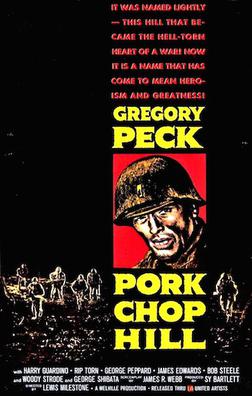
Pork Chop Hill
No soldier wants to die. But what about as a war nears its end? The end of the fighting may only be days away, maybe even hours away. So goes the background for the underrated Korean War drama from 1959, Pork Chop Hill.
It's April 1953 and both American and North Korean/Chinese commanders have agreed to a cease fire with the two sides meeting at Panmunjom. The negotiations though are moving along at a frustratingly slow pace with little being resolved. Near the front lines, the fighting rages on with Lt. Joe Clemons (Gregory Peck) and his King Company awaiting orders, supposedly to withdraw as the fighting dies down with negotiations picking up. The orders though are just the opposite, orders to move forward and take Pork Chop Hill, a worthless hill that's been lost and regained countless times. Now, the Chinese are in possession, but it is a spot on the line that's been deemed very important to negotiations. Clemons assembles his weary company, moving forward to take a hill that holds no military value.
Dubbed the Forgotten War, the Korean War pales in comparison to both World War II and Vietnam in terms of theatrical films released about them. From director Lewis Milestone (A Walk in the Sun, Halls of Montezuma, All Quiet on the Western Front), 'Hill' is a generally forgotten war film that certainly deserves better. It is similar in a lot of ways to 1962's Hell is For Heroes -- even using an eerily similar score from Leonard Rosenman -- and is based on a true story, the battle for Pork Chop Hill. It was filmed in black and white, a highly effective shooting technique, giving everything a sparse, cold and vacant look. Why isn't it remembered as the near-classic that it is? I've got no idea.
What jumped out at me on my recent viewing was the cynicism and darkness that's evident throughout. More surprising? It was made with cooperation from the U.S. Army which in itself isn't too surprising. It's that in exploring the battle, 'Hill' at times shows the complete ineptitude of the American commanders. Assaulting the hill, Clemon's company is put on the grid when American spotlights actually shine right on them in the dead of night. Other companies are given wrong orders, ranging from just plain wrong to misleading. Once King Company is in position, the rear command is genuinely confused, thinking they're fighting a mop-up action when in reality, they're holding on by their fingernails with limited ammunition, food and water. At one point, an U.S.O. photographer is sent up the hill to get photos of an American victory because the folks back home need to see an American win. Peck's reaction is priceless, a commander at wit's end who doesn't know what else to say.
This is an honest criticism of headquarters that's based in reality, and for a 1959 audience, it seems light years ahead of its time. If I didn't know better, it sounds like a Vietnam War movie like Platoon or Apocalypse Now more than a major studio release from 1959. Leading the way is the always reliable, always impressive Gregory Peck. His performance reminded me some of his Oscar-nominated turn in Twelve O'Clock High 10 years earlier. His Clemons is an effective commander simply trying to follow orders and get as many men through the battle unscathed as is possible. Even he is pushed to his limits as one bumbling order after another comes through, the commanders refusing to acknowledge that the battle isn't going as they expected. It's an understated part, but an emotionally effective one. We see the wear and tear on his face, his reassuring, confident tone slowly being worn down.
Beyond Peck though, 'Hill' is noteworthy for its supporting cast of rising and future stars. Harry Guardino and George Peppard play Forstman and Federson, two buddies lugging a machine gun around the hill. Rip Torn plays Lt. Russel, commander of the relief company assigned to help out King Company. 'Hill' is also one of the first war films to show integrated units, Woody Strode playing Franklin, a private fed up with the war, and James Edwards as Cpl. Jurgens, one of Clemon's most dependable, trustworthy men. Also cool casting is George Shibata as Lt. Ohashi, a Japanese-American soldier, Clemon's close friend and one of his platoon commanders. Also look for Norman Fell, Gavin MacLeod, Robert Blake, Biff Elliott, Martin Landau, Harry Dean Stanton, Clarence Williams III and several other familiar faces rounding out King Company's roster.
Clocking in at 97 minutes, a majority of 'Hill' is spent in the trenches and bunkers with King Company, a few asides here and there showing the negotiations of the cease fire. This is a movie interested in the nuts and bolts of the battle, the flanking movements, the reserve companies, the crossfires and preparations for counterattacks. It never gets bogged down though, the battle scenes uncomfortable and unsettling in their reality. It isn't graphic violence here, but that doesn't mean it's not hard to watch. Add in the psychological warfare of a Chinese broadcaster bombarding the American troops with propaganda, and you've got quite the battle here. It's not just bullets and soldiers anymore, but the effect it has on the soldiers' heads too. A great war movie, one that deserves more of a reputation/following.
Pork Chop Hill (1959): *** 1/2 /****
It's April 1953 and both American and North Korean/Chinese commanders have agreed to a cease fire with the two sides meeting at Panmunjom. The negotiations though are moving along at a frustratingly slow pace with little being resolved. Near the front lines, the fighting rages on with Lt. Joe Clemons (Gregory Peck) and his King Company awaiting orders, supposedly to withdraw as the fighting dies down with negotiations picking up. The orders though are just the opposite, orders to move forward and take Pork Chop Hill, a worthless hill that's been lost and regained countless times. Now, the Chinese are in possession, but it is a spot on the line that's been deemed very important to negotiations. Clemons assembles his weary company, moving forward to take a hill that holds no military value.
Dubbed the Forgotten War, the Korean War pales in comparison to both World War II and Vietnam in terms of theatrical films released about them. From director Lewis Milestone (A Walk in the Sun, Halls of Montezuma, All Quiet on the Western Front), 'Hill' is a generally forgotten war film that certainly deserves better. It is similar in a lot of ways to 1962's Hell is For Heroes -- even using an eerily similar score from Leonard Rosenman -- and is based on a true story, the battle for Pork Chop Hill. It was filmed in black and white, a highly effective shooting technique, giving everything a sparse, cold and vacant look. Why isn't it remembered as the near-classic that it is? I've got no idea.
What jumped out at me on my recent viewing was the cynicism and darkness that's evident throughout. More surprising? It was made with cooperation from the U.S. Army which in itself isn't too surprising. It's that in exploring the battle, 'Hill' at times shows the complete ineptitude of the American commanders. Assaulting the hill, Clemon's company is put on the grid when American spotlights actually shine right on them in the dead of night. Other companies are given wrong orders, ranging from just plain wrong to misleading. Once King Company is in position, the rear command is genuinely confused, thinking they're fighting a mop-up action when in reality, they're holding on by their fingernails with limited ammunition, food and water. At one point, an U.S.O. photographer is sent up the hill to get photos of an American victory because the folks back home need to see an American win. Peck's reaction is priceless, a commander at wit's end who doesn't know what else to say.
This is an honest criticism of headquarters that's based in reality, and for a 1959 audience, it seems light years ahead of its time. If I didn't know better, it sounds like a Vietnam War movie like Platoon or Apocalypse Now more than a major studio release from 1959. Leading the way is the always reliable, always impressive Gregory Peck. His performance reminded me some of his Oscar-nominated turn in Twelve O'Clock High 10 years earlier. His Clemons is an effective commander simply trying to follow orders and get as many men through the battle unscathed as is possible. Even he is pushed to his limits as one bumbling order after another comes through, the commanders refusing to acknowledge that the battle isn't going as they expected. It's an understated part, but an emotionally effective one. We see the wear and tear on his face, his reassuring, confident tone slowly being worn down.
Beyond Peck though, 'Hill' is noteworthy for its supporting cast of rising and future stars. Harry Guardino and George Peppard play Forstman and Federson, two buddies lugging a machine gun around the hill. Rip Torn plays Lt. Russel, commander of the relief company assigned to help out King Company. 'Hill' is also one of the first war films to show integrated units, Woody Strode playing Franklin, a private fed up with the war, and James Edwards as Cpl. Jurgens, one of Clemon's most dependable, trustworthy men. Also cool casting is George Shibata as Lt. Ohashi, a Japanese-American soldier, Clemon's close friend and one of his platoon commanders. Also look for Norman Fell, Gavin MacLeod, Robert Blake, Biff Elliott, Martin Landau, Harry Dean Stanton, Clarence Williams III and several other familiar faces rounding out King Company's roster.
Clocking in at 97 minutes, a majority of 'Hill' is spent in the trenches and bunkers with King Company, a few asides here and there showing the negotiations of the cease fire. This is a movie interested in the nuts and bolts of the battle, the flanking movements, the reserve companies, the crossfires and preparations for counterattacks. It never gets bogged down though, the battle scenes uncomfortable and unsettling in their reality. It isn't graphic violence here, but that doesn't mean it's not hard to watch. Add in the psychological warfare of a Chinese broadcaster bombarding the American troops with propaganda, and you've got quite the battle here. It's not just bullets and soldiers anymore, but the effect it has on the soldiers' heads too. A great war movie, one that deserves more of a reputation/following.
Pork Chop Hill (1959): *** 1/2 /****
Saturday, April 13, 2013
Ocean's Eleven (1960)
One of my favorite movies from the 2000s, I love 2001's Ocean's Eleven. I'm no dummy though, and I remember stating that the 2001 remake was better than the original. Well, it took me a little while -- okay, well over a year, but who's counting? -- but I'm revisiting that statement. Was I right or wrong? Maybe somewhere in between? Let's get started with the Rat Pack original, 1960's Ocean's Eleven.
A former paratrooper with countless daring, behind the lines missions under his belt during World War II, Danny Ocean (Frank Sinatra) has moved on with his life, but some 15 years since the end of the war, he's got a plan. The catch? He needs help from his old army buddies to pull off a daring heist. Ocean gets the group together, including Sam Harmon (Dean Martin), Jimmy Foster (Peter Lawford), and Josh Howard (Sammy Davis Jr.) among others, and lays out the plan for them. Just a few days away, Ocean and Co. plan on hitting five of Las Vegas's biggest casinos on New Year's Eve when the vaults are packed to the gills with money. Could it work? The plan depends on to-the-second timing, teamwork and countless little details, maybe even a little luck. It sounds like an impossible plan, but Ocean's crew might be crazy enough to pull it off.
Starting in the mid 1950s, Sinatra, Martin, Davis Jr., Lawford and Joey Bishop teamed up to star in movies that are simply known as....Rat Pack movies. Classic cinema they are not, but they are basically the definition of a good popcorn flick. Just sit back and enjoy them. Of all the Rat Pack movies though, this one is the best by far. Lewis Milestone directs, but his job is basically to get Sinatra and the boys on the right track and let them go. In that sense, he hits it out of the park. It is a vastly different movie than the 2001 remake which is really a remake in name and basic premise alone. The script, the heist, and the Vegas setting are all a means to an end. If you like Sinatra, Martin or any of the Rat Pack, you will enjoy this movie.
Singing or performing on stage, starring in movies, the Rat Pack had an innate chemistry that most entertainers dream of having. So cutting away a lot of other things, this movie is about the Packers hanging out, drinking some liquor, smoking a lot of cigarettes and wearing impeccably cool suits. Is it self-indulgent? Yes, basically the definition of self-indulgent. If you're a fan of Sinatra, Martin or any of the guys, this is the movie for you. It's genuinely funny with plenty of quick, snappy dialogue, lots of one-liners that don't feel like a script. It feels like it is a bunch of friends hanging out busting each other. Oh, and they happen to be planning an epic casino robbery too so they've got that going for them.
One of the biggest differences between the 1960 original and the 2001 remake is the background. Made 15 years after the end of WWII, the paratroopers angle is pretty cool. Sinatra's Danny is the sergeant, Lawford the entitled officer, Martin's Sam the soldier who saved Danny's life and best friend, and so on. Along with Davis. Jr as Josh and Bishop as Mushy, Danny's crew includes Richard Conte as Tony, just out of prison and looking to provide for his son, Henry Silva as smooth, quick-talking Roger, Buddy Lester as Vince, the former club bouncer with an in, Richard Benedict as Curly, Norman Fell as Peter, the explosives specialist, and Clem Harvey as Jackson, the drawling cowboy. Like the best men-on-a-mission movies, there's something inherently cool about a group of specialists working together to pull of an impossible job. When you actually like some of the group? That's even better, like a fastball down the middle.
Not surprisingly, the focus here is on Danny's crew, but the rest of the cast is pretty solid. Angie Dickinson plays Beatrice, Danny's wife who's working through some issues with her always moving husband. Cesar Romero is Duke Santos, a well-connected former gangster who stumbles into Ocean's plan and who happens to be engaged to Jimmy's mother (Ilka Chase). Akim Tamiroff gets a lot of laughs as Spyros, the ex-con who concocted the casino heist but can't come up with the details, turning to Danny for that part. Also look for Red Skelton playing himself in a casino scene, frustrated and wanting more money, and George Raft as a casino head in a strategy session. Even look for an uncredited Shirley MacLaine as a drunken New Year's Eve partygoer who meets Martin's Sam during the heist. And lastly, listen for Richard Boone providing his voice talents in a key scene late, even if he never appears on-screen.
I loved the style from this 1960 heist movie, and that doesn't come as a surprise considering the talent involved. The credits sequence from Saul Bass gets things going nicely. Watch it HERE, composer Nelson Riddle's score playing as accompaniment. Much of the film was shot on location in Las Vegas, and who would have thought? 1960 Vegas looks amazingly fun, like a time capsule into a smooth, cool era. Even the indoor sets look cheesy, but they're cool cheesy. The heist itself is pretty cool if a little more simplistic than the 2001 remake (Damn technology!). As most heist films will tell you though, it's the post-robbery stuff that's the issue. It's Vegas in the middle of the desert. How do you escape or hide the money? The ending delivers a couple great twists, especially the final one that sets up a very cool, very stylish final scene as Ocean's Eleven walk along the Vegas strip.
There is a simple, stylish elegance to this movie. Is it a classic film, an example of great cinema? No, but in terms of pure entertainment value, it's hard to beat. The scene where the crew discuss the upcoming heist in Spyros' well-decorated man cave is epically cool, Ocean's Eleven huddled around the pool table discussing the ins and outs of the heist. It's a fun, cool and entertaining movie that's a prime example of the style of a past era in Hollywood. The Rat Pack is cool. If you agree, you'll like this movie.
Ocean's Eleven (1960): ****/****
A former paratrooper with countless daring, behind the lines missions under his belt during World War II, Danny Ocean (Frank Sinatra) has moved on with his life, but some 15 years since the end of the war, he's got a plan. The catch? He needs help from his old army buddies to pull off a daring heist. Ocean gets the group together, including Sam Harmon (Dean Martin), Jimmy Foster (Peter Lawford), and Josh Howard (Sammy Davis Jr.) among others, and lays out the plan for them. Just a few days away, Ocean and Co. plan on hitting five of Las Vegas's biggest casinos on New Year's Eve when the vaults are packed to the gills with money. Could it work? The plan depends on to-the-second timing, teamwork and countless little details, maybe even a little luck. It sounds like an impossible plan, but Ocean's crew might be crazy enough to pull it off.
Starting in the mid 1950s, Sinatra, Martin, Davis Jr., Lawford and Joey Bishop teamed up to star in movies that are simply known as....Rat Pack movies. Classic cinema they are not, but they are basically the definition of a good popcorn flick. Just sit back and enjoy them. Of all the Rat Pack movies though, this one is the best by far. Lewis Milestone directs, but his job is basically to get Sinatra and the boys on the right track and let them go. In that sense, he hits it out of the park. It is a vastly different movie than the 2001 remake which is really a remake in name and basic premise alone. The script, the heist, and the Vegas setting are all a means to an end. If you like Sinatra, Martin or any of the Rat Pack, you will enjoy this movie.
Singing or performing on stage, starring in movies, the Rat Pack had an innate chemistry that most entertainers dream of having. So cutting away a lot of other things, this movie is about the Packers hanging out, drinking some liquor, smoking a lot of cigarettes and wearing impeccably cool suits. Is it self-indulgent? Yes, basically the definition of self-indulgent. If you're a fan of Sinatra, Martin or any of the guys, this is the movie for you. It's genuinely funny with plenty of quick, snappy dialogue, lots of one-liners that don't feel like a script. It feels like it is a bunch of friends hanging out busting each other. Oh, and they happen to be planning an epic casino robbery too so they've got that going for them.
One of the biggest differences between the 1960 original and the 2001 remake is the background. Made 15 years after the end of WWII, the paratroopers angle is pretty cool. Sinatra's Danny is the sergeant, Lawford the entitled officer, Martin's Sam the soldier who saved Danny's life and best friend, and so on. Along with Davis. Jr as Josh and Bishop as Mushy, Danny's crew includes Richard Conte as Tony, just out of prison and looking to provide for his son, Henry Silva as smooth, quick-talking Roger, Buddy Lester as Vince, the former club bouncer with an in, Richard Benedict as Curly, Norman Fell as Peter, the explosives specialist, and Clem Harvey as Jackson, the drawling cowboy. Like the best men-on-a-mission movies, there's something inherently cool about a group of specialists working together to pull of an impossible job. When you actually like some of the group? That's even better, like a fastball down the middle.
Not surprisingly, the focus here is on Danny's crew, but the rest of the cast is pretty solid. Angie Dickinson plays Beatrice, Danny's wife who's working through some issues with her always moving husband. Cesar Romero is Duke Santos, a well-connected former gangster who stumbles into Ocean's plan and who happens to be engaged to Jimmy's mother (Ilka Chase). Akim Tamiroff gets a lot of laughs as Spyros, the ex-con who concocted the casino heist but can't come up with the details, turning to Danny for that part. Also look for Red Skelton playing himself in a casino scene, frustrated and wanting more money, and George Raft as a casino head in a strategy session. Even look for an uncredited Shirley MacLaine as a drunken New Year's Eve partygoer who meets Martin's Sam during the heist. And lastly, listen for Richard Boone providing his voice talents in a key scene late, even if he never appears on-screen.
I loved the style from this 1960 heist movie, and that doesn't come as a surprise considering the talent involved. The credits sequence from Saul Bass gets things going nicely. Watch it HERE, composer Nelson Riddle's score playing as accompaniment. Much of the film was shot on location in Las Vegas, and who would have thought? 1960 Vegas looks amazingly fun, like a time capsule into a smooth, cool era. Even the indoor sets look cheesy, but they're cool cheesy. The heist itself is pretty cool if a little more simplistic than the 2001 remake (Damn technology!). As most heist films will tell you though, it's the post-robbery stuff that's the issue. It's Vegas in the middle of the desert. How do you escape or hide the money? The ending delivers a couple great twists, especially the final one that sets up a very cool, very stylish final scene as Ocean's Eleven walk along the Vegas strip.
There is a simple, stylish elegance to this movie. Is it a classic film, an example of great cinema? No, but in terms of pure entertainment value, it's hard to beat. The scene where the crew discuss the upcoming heist in Spyros' well-decorated man cave is epically cool, Ocean's Eleven huddled around the pool table discussing the ins and outs of the heist. It's a fun, cool and entertaining movie that's a prime example of the style of a past era in Hollywood. The Rat Pack is cool. If you agree, you'll like this movie.
Ocean's Eleven (1960): ****/****
Tuesday, March 22, 2011
A Walk in the Sun
Somewhat out of necessity and somewhat because of audience demand, Hollywood studios during World War II often turned to patriotic, flag-waving war stories for their movies as opposed to more realistic, balanced looks at the war. Some examples like John Ford’s They Were Expendable peg the Americans as courageous, infallible heroes while the Japanese are the vicious, murdering enemy, but the movie still manages to be an above average entry into the WWII movie genre.
Now of course, all of them weren’t propaganda pictures meant to influence public thought and sentiment about the direction the war was taking or how despicably evil the enemy was. Released in 1945 at the tail end of the war, A Walk in the Sun could easily be pegged as one of those movies, but it rises above that stigma. It doesn’t try to portray the American soldiers in Europe as supermen who can’t be taken down by a whole army of German infantry. On the other side, the Germans are a faceless enemy, but never a demonic one. This is war, and everyone is affected. Just like my previous few of All Quiet on the Western Front, these are soldiers interested in survival, not some higher meaning or purpose in war.
Huddled in a landing craft headed for an Italian beach in the dead of night, an American infantry platoon prepares for the mission ahead of them. Problems start immediately though when the platoon commander and the second-ranking officer are both killed in the landing. Taking over, Sergeant Porter (Herbert Rudley, looking like a dead ringer for Frank Lovejoy) and Sergeant Tyne (Dana Andrews) must now figure out what to do. Their mission was described only vaguely to them; march six miles inland and knock out a key farmhouse along the main road. Little is known what awaits them along the road or the enemy strength at the farmhouse, but they head out into the unknown hoping to accomplish their mission, and hopefully make it back alive.
Any similarities or comparisons to ‘Western Front’ are fair for two reasons. One, director Lewis Milestone directed both movies. Two, they are both based on strong source novels that provide a great blueprint for the story. The reasons ‘Walk’ works is because of similar reasons. This is not an action-heavy story, instead portraying the life of a soldier as it more likely is; long stretches of boredom balanced with extreme fear/terror broken up by seconds of violent chaos. What do the soldiers do in between engagements? They talk. They talk about their worries, their lives back home, their thoughts on the patrol. You name it, it gets covered. A story that puts you right there on the dusty road with the soldiers and gives you an authentic feel for what they’re going through always gets points in my book.
This has to be one of the earlier examples of a ‘unit picture,’ a story that focuses on a specific group of soldiers, sometimes as large as a division or a brigade on down the ladder to a group like a squad or a platoon. Dana Andrews is the star here, the sergeant thrust into a position of power, leading his men on a mission where he knows little to nothing about what they’re supposed to accomplish. Along with Rudley as Porter, the NCO about to crack, the platoon includes Lloyd Bridges as Ward, a sergeant and a farmer back home with a craving for an apple, John Ireland as Windy, an intelligent soldier who is constantly writing letters back home in a unique way, Richard Conte as Rivera, the motor-mouth machine gunner, George Tyne as Friedman, Rivera’s ammunition carrier and sounding board, and Norman Lloyd as Archimbeau, a private convinced the war is destined to go on for years, among many others who make a quick appearance, but never really rise above being a sea of infantry faces. Burgess Meredith narrates.
Every so often at the IMDB, you run across a description so perfect it makes it worthwhile to continue to peruse all the other garbage people post there. One very accurate poster said this 1945 WWII story could easily have been renamed ‘A Talk in the Sun.’ It’s a fair assessment. Of a story that clocks in at 117 minutes, this is a dialogue heavy movie so if you’re looking for action packed excitement, keep looking. I’m all for dialogue in a movie (good, well-written dialogue that is), and for the most part, the conversation is good here. Eventually though, it gets tedious. How many times can we hear Rivera and Friedman argue like an old married couple? How many times will Archimbeau talk about the coming battle in 1955 for Tibet? Some scenes drag more than others, but late in the movie, I started to feel like I was watching the same scenes over and over again. Is that what a soldier’s life is like? Probably, but realism only takes a movie so far.
Balancing the long stretches of boredom here are those chaotic, brief moments of terror where your life can be snatched away from you in the blink of an eye. The patrol is constantly under bombardment while also dealing with patrolling German fighters overhead and tank and armored car patrols. The farmhouse (Semi SPOILERS I guess, yes, they make it to the farmhouse) is heavily guarded, and a suicidal charge across an open field feels like the only solution. Like the best parts of the movie, the battle scenes are well-executed (similar to Milestone’s action in Western Front with some great camerawork) and always keeping you on edge as to what will happen. It’s not a perfect war story, but for a movie released in 1945, the realism and honest look at the life of a soldier help make up for any shortcomings the movie might have. A public domain movie, it is available to watch at Youtube HERE in a somewhat washed out but tolerable print.
A Walk in the Sun <---TCM clips (1945): ***/****
Now of course, all of them weren’t propaganda pictures meant to influence public thought and sentiment about the direction the war was taking or how despicably evil the enemy was. Released in 1945 at the tail end of the war, A Walk in the Sun could easily be pegged as one of those movies, but it rises above that stigma. It doesn’t try to portray the American soldiers in Europe as supermen who can’t be taken down by a whole army of German infantry. On the other side, the Germans are a faceless enemy, but never a demonic one. This is war, and everyone is affected. Just like my previous few of All Quiet on the Western Front, these are soldiers interested in survival, not some higher meaning or purpose in war.
Huddled in a landing craft headed for an Italian beach in the dead of night, an American infantry platoon prepares for the mission ahead of them. Problems start immediately though when the platoon commander and the second-ranking officer are both killed in the landing. Taking over, Sergeant Porter (Herbert Rudley, looking like a dead ringer for Frank Lovejoy) and Sergeant Tyne (Dana Andrews) must now figure out what to do. Their mission was described only vaguely to them; march six miles inland and knock out a key farmhouse along the main road. Little is known what awaits them along the road or the enemy strength at the farmhouse, but they head out into the unknown hoping to accomplish their mission, and hopefully make it back alive.
Any similarities or comparisons to ‘Western Front’ are fair for two reasons. One, director Lewis Milestone directed both movies. Two, they are both based on strong source novels that provide a great blueprint for the story. The reasons ‘Walk’ works is because of similar reasons. This is not an action-heavy story, instead portraying the life of a soldier as it more likely is; long stretches of boredom balanced with extreme fear/terror broken up by seconds of violent chaos. What do the soldiers do in between engagements? They talk. They talk about their worries, their lives back home, their thoughts on the patrol. You name it, it gets covered. A story that puts you right there on the dusty road with the soldiers and gives you an authentic feel for what they’re going through always gets points in my book.
This has to be one of the earlier examples of a ‘unit picture,’ a story that focuses on a specific group of soldiers, sometimes as large as a division or a brigade on down the ladder to a group like a squad or a platoon. Dana Andrews is the star here, the sergeant thrust into a position of power, leading his men on a mission where he knows little to nothing about what they’re supposed to accomplish. Along with Rudley as Porter, the NCO about to crack, the platoon includes Lloyd Bridges as Ward, a sergeant and a farmer back home with a craving for an apple, John Ireland as Windy, an intelligent soldier who is constantly writing letters back home in a unique way, Richard Conte as Rivera, the motor-mouth machine gunner, George Tyne as Friedman, Rivera’s ammunition carrier and sounding board, and Norman Lloyd as Archimbeau, a private convinced the war is destined to go on for years, among many others who make a quick appearance, but never really rise above being a sea of infantry faces. Burgess Meredith narrates.
Every so often at the IMDB, you run across a description so perfect it makes it worthwhile to continue to peruse all the other garbage people post there. One very accurate poster said this 1945 WWII story could easily have been renamed ‘A Talk in the Sun.’ It’s a fair assessment. Of a story that clocks in at 117 minutes, this is a dialogue heavy movie so if you’re looking for action packed excitement, keep looking. I’m all for dialogue in a movie (good, well-written dialogue that is), and for the most part, the conversation is good here. Eventually though, it gets tedious. How many times can we hear Rivera and Friedman argue like an old married couple? How many times will Archimbeau talk about the coming battle in 1955 for Tibet? Some scenes drag more than others, but late in the movie, I started to feel like I was watching the same scenes over and over again. Is that what a soldier’s life is like? Probably, but realism only takes a movie so far.
Balancing the long stretches of boredom here are those chaotic, brief moments of terror where your life can be snatched away from you in the blink of an eye. The patrol is constantly under bombardment while also dealing with patrolling German fighters overhead and tank and armored car patrols. The farmhouse (Semi SPOILERS I guess, yes, they make it to the farmhouse) is heavily guarded, and a suicidal charge across an open field feels like the only solution. Like the best parts of the movie, the battle scenes are well-executed (similar to Milestone’s action in Western Front with some great camerawork) and always keeping you on edge as to what will happen. It’s not a perfect war story, but for a movie released in 1945, the realism and honest look at the life of a soldier help make up for any shortcomings the movie might have. A public domain movie, it is available to watch at Youtube HERE in a somewhat washed out but tolerable print.
A Walk in the Sun <---TCM clips (1945): ***/****
Labels:
1940s,
Burgess Meredith,
Dana Andrews,
John Ireland,
Lewis Milestone,
Richard Conte,
WWII
Friday, March 18, 2011
All Quiet on the Western Front
In one of the most succinct, powerfully effective lines in history, Union general William Tecumseh Sherman said 'War is hell.' Nothing else really needs to be said. There is nothing glamorous about armed conflict in any setting where one man takes the life of another, no matter what movies, TV shows, and books may try and convince you otherwise. Anti-war movies really came to the forefront during the Vietnam War as public sentiment soured on the conflict in Asia. But one of the most moving anti-war stories came long before that, 1930's All Quiet on the Western Front.
Based on the classic novel of the same name by Erich Maria Remarque, this is a remarkable movie for any number of reasons, starting with the year it was released. I would have never pegged this movie as being released in 1930, just a few years into the sound era of movies. There is also a sense with early Hollywood of white-washing stories, of censoring the movies of anything that is even remotely offensive. But that's the point of a war movie like this. It is supposed to offend you, to show the real horrors of war. Considering its 1930 release, it is one of the most violent movies of the era, but it so much more than just violence. This is war at its dirtiest, most base fighting, the effect it has on the men doing the fighting. No glory, no glamor, just survival.
With Germany preparing for war in 1914, teenager Paul Baumer (Lew Ayres) enlists with almost 20 other teenage boys from his school, dreaming of the glory that awaits them on the battlefield as Germany battles England and France. They leave with the notion that nothing would being them greater glory than to die for their country, quickly realizing how ridiculous the notion is. After a quick training period, Paul's company is sent to the front lines as replacements for a veteran unit already worn down and torn apart from the fighting. They find a war unlike anything told to them prior, the idea of heroism and glory quickly going out the window. They settle in to the trench warfare, charging across bomb-marked fields into walls of machine gun fire. A heroic fight for one's country? Maybe, but these soldiers could care less. They just want to survive the hell that surrounds them.
Two characters rise above the story here, starting with Ayres as young, impressionable Paul. His acting can be a little too stage-oriented, but it is through his eyes we see the horror of war. It is a remarkable performance from the 22-year old actor as we see his transformation from a naive newbie on the front lines to a tattered veteran in the matter of days. Somehow, he survives the days, weeks and months as so many of his comrades drop around him. Playing a part that would become synonymous with war movies, Louis Wolheim plays Corporal 'Kat' Katczinsky, the wily veteran who ends up being a leader based almost solely on his ability to teach and survive where so few others can. It's these two performances that anchor the movie. Other than that, most of the cast is pretty interchangeable, faces that don't leave much of an impression before being quickly dispatched.
Working on an impressively large scale for a 1930 release, director Lewis Milestone turns in an all-time classic here. He pulls no punches with his story, staying true to Remarque's source novel and its brutal honesty in portraying the horrors of war. Hundreds of extras fill the screen, and the battle scenes are immense. Milestone shows a knack with his camera in an ahead of its time use of tracking shots that put you in the trenches with the hand-to-hand combat, following the men across acres of open ground under bombardment and heavy fire. Exciting or entertaining? No, not really. This is war where there were no super-soldiers. Men died by the hundreds and thousands in futile efforts to gain a few feet of dirt. The battles are surprisingly graphic, just adding to the affect of what you're actually seeing.
When I think of an above average anti-war movie, I think of the moments that stick with you long after watching the movie. 'Western Front' has too many to even mention, but here are just a few that left the deepest impression. Visiting a wounded soldier, Paul watches him die a slow, painful death, the staff and patients around him not so much as blinking at his cries. Hiding in a trench, Paul tries to save a French soldier's life moments after stabbing him to save his own. After a sustained bombardment, a German soldier finally cracks, running out of the damp, crowded dugout screaming bloody murder. Later, a wounded soldier rises from his hospital bed and trudges across the room to the window where he feels a ray of sunlight on his face, promptly dropping dead. The best though may be Paul's return home, seeing the perception that the people left behind have of this glorious war. He tries to tell them the truth, but to no avail. After all, what does he know having served on the front lines for years?
This is a story where a happy ending just wouldn't work, wouldn't fit with the tone or style of this anti-war message. But even being aware of that doesn't take away from the raw power of the ending, simple in its execution but speaking volumes about the idiocy of war. SPOILERS STOP READING SPOILERS Returning from leave, Paul finds Katczinsky who is wounded scrounging for food. Paul carries him back to the aid station several miles back, unaware his friend has died. He leaves quietly, not sure or not believing what just happened. Days later sitting in a trench, he reaches out for a butterfly resting just inches away and is picked off by a French sniper. The movie ends with the haunting image of Paul's outstretched hand reaching for that one beautiful thing in nature, coming up just short. I can't think of a more appropriately down ending for a movie that had to end that way.
If interested in watching the movie, it is available to watch at Youtube in an above average print thanks to a great restoration job, especially when considering the movie was made over 80 years ago. You can watch it HERE starting with Part 1 of 13.
All Quiet on the Western Front <---trailer (1930): *** 1/2 /****
Based on the classic novel of the same name by Erich Maria Remarque, this is a remarkable movie for any number of reasons, starting with the year it was released. I would have never pegged this movie as being released in 1930, just a few years into the sound era of movies. There is also a sense with early Hollywood of white-washing stories, of censoring the movies of anything that is even remotely offensive. But that's the point of a war movie like this. It is supposed to offend you, to show the real horrors of war. Considering its 1930 release, it is one of the most violent movies of the era, but it so much more than just violence. This is war at its dirtiest, most base fighting, the effect it has on the men doing the fighting. No glory, no glamor, just survival.
With Germany preparing for war in 1914, teenager Paul Baumer (Lew Ayres) enlists with almost 20 other teenage boys from his school, dreaming of the glory that awaits them on the battlefield as Germany battles England and France. They leave with the notion that nothing would being them greater glory than to die for their country, quickly realizing how ridiculous the notion is. After a quick training period, Paul's company is sent to the front lines as replacements for a veteran unit already worn down and torn apart from the fighting. They find a war unlike anything told to them prior, the idea of heroism and glory quickly going out the window. They settle in to the trench warfare, charging across bomb-marked fields into walls of machine gun fire. A heroic fight for one's country? Maybe, but these soldiers could care less. They just want to survive the hell that surrounds them.
Two characters rise above the story here, starting with Ayres as young, impressionable Paul. His acting can be a little too stage-oriented, but it is through his eyes we see the horror of war. It is a remarkable performance from the 22-year old actor as we see his transformation from a naive newbie on the front lines to a tattered veteran in the matter of days. Somehow, he survives the days, weeks and months as so many of his comrades drop around him. Playing a part that would become synonymous with war movies, Louis Wolheim plays Corporal 'Kat' Katczinsky, the wily veteran who ends up being a leader based almost solely on his ability to teach and survive where so few others can. It's these two performances that anchor the movie. Other than that, most of the cast is pretty interchangeable, faces that don't leave much of an impression before being quickly dispatched.
Working on an impressively large scale for a 1930 release, director Lewis Milestone turns in an all-time classic here. He pulls no punches with his story, staying true to Remarque's source novel and its brutal honesty in portraying the horrors of war. Hundreds of extras fill the screen, and the battle scenes are immense. Milestone shows a knack with his camera in an ahead of its time use of tracking shots that put you in the trenches with the hand-to-hand combat, following the men across acres of open ground under bombardment and heavy fire. Exciting or entertaining? No, not really. This is war where there were no super-soldiers. Men died by the hundreds and thousands in futile efforts to gain a few feet of dirt. The battles are surprisingly graphic, just adding to the affect of what you're actually seeing.
When I think of an above average anti-war movie, I think of the moments that stick with you long after watching the movie. 'Western Front' has too many to even mention, but here are just a few that left the deepest impression. Visiting a wounded soldier, Paul watches him die a slow, painful death, the staff and patients around him not so much as blinking at his cries. Hiding in a trench, Paul tries to save a French soldier's life moments after stabbing him to save his own. After a sustained bombardment, a German soldier finally cracks, running out of the damp, crowded dugout screaming bloody murder. Later, a wounded soldier rises from his hospital bed and trudges across the room to the window where he feels a ray of sunlight on his face, promptly dropping dead. The best though may be Paul's return home, seeing the perception that the people left behind have of this glorious war. He tries to tell them the truth, but to no avail. After all, what does he know having served on the front lines for years?
This is a story where a happy ending just wouldn't work, wouldn't fit with the tone or style of this anti-war message. But even being aware of that doesn't take away from the raw power of the ending, simple in its execution but speaking volumes about the idiocy of war. SPOILERS STOP READING SPOILERS Returning from leave, Paul finds Katczinsky who is wounded scrounging for food. Paul carries him back to the aid station several miles back, unaware his friend has died. He leaves quietly, not sure or not believing what just happened. Days later sitting in a trench, he reaches out for a butterfly resting just inches away and is picked off by a French sniper. The movie ends with the haunting image of Paul's outstretched hand reaching for that one beautiful thing in nature, coming up just short. I can't think of a more appropriately down ending for a movie that had to end that way.
If interested in watching the movie, it is available to watch at Youtube in an above average print thanks to a great restoration job, especially when considering the movie was made over 80 years ago. You can watch it HERE starting with Part 1 of 13.
All Quiet on the Western Front <---trailer (1930): *** 1/2 /****
Saturday, August 28, 2010
The Edge of Darkness
Just how involved was the war effort on the home front to help aid the cause in WWII? Major movie studios became involved, producing feature length and documentary movies as a form of positive propaganda to help convince audiences how necessary total victory would be. It was a different time, a different era in the world because now in 2010 can you imagine movie studios releasing movies about the Iraqi/Afghanistan conflicts? Maybe it's just that the times have changed, maybe audiences just aren't as naive, or maybe it's just a different war.
Released in 1943 as WWII was still in the balance, Edge of Darkness (not to be confused with the Mel Gibson vehicle) was one of those studio ventures released in the hopes of showing that countries around the world and their populations were fighting for their freedom and not just the armies. Almost completely isolated from the war by land, the U.S. never first hand experienced the war like Europe or Asia did. But studios did their best to illustrate all the far-reaching effects of the war. Very similar to 1942's Commandos Strike at Dawn, 'Darkness' is an exciting, well-made if flawed look at the resistance effort against the Germans in Norway.
In charge of a small occupying force of just 150 soldiers, German Major Koenig (Helmut Dantine) has his work cut out for him in the small coastal Norwegian town where his men are heavily outnumbered. Koenig is aware of who the leaders of a so-far quiet resistance movement in the town, including the unofficial leader, fisherman Gunnar Brogge (Errol Flynn) and others from the village, the doctor, the butcher, the innkeeper among others. So badly outnumbered, Koenig can't arrest any of these leaders without causing an uproar and possibly a violent revolt. A British agent (Henry Brandon) is able to provide Brogge and his resistance members with rifles and ammunition so they sit back and anxiously wait for their chance to strike at their German occupiers.
Director Lewis Milestone makes an interesting choice in his storytelling technique with a perfect opening sequence. A German patrol arrives in this vacant fishing village, walking through the streets only to find the dead bodies of both German soldiers and many of the villagers. It seems no one has survived this bloody confrontation, but who knows for sure? The rest of the story is a flashback leading up this opening, everything that caused it. It is a really cool technique that's been used to death since, but it works as a great mood and tone setter, putting you on the defensive right away. You think you know how the movie is going to go because you believe you've just seen the ending, but there's a few tricks up Milestone's sleeve here.
Leading a large ensemble cast, Flynn plays Gunnar Brogge, the brave leader of the Norwegian resistance in the village. Flynn was in the news at the time for a statutory rape case filed against him, and from here on his career did suffer to a point even though he was acquitted. It's a solid part if not a particularly memorable one, but the movie suffers when he's not around. The rest of the ensemble is more hit or miss. Ann Sheridan plays Karen Stensgard, the daughter of the local doctor played by Walter Huston who isn't quite sure if violence is the answer. Sheridan is a great female character who rises above just being a love interest, and Huston was never one to disappoint with a supporting part. There's some really awful supporting parts though including Nancy Coleman in a laughably bad part as a Polish refugee caught up in the violence. With Flynn and Sheridan and Huston there for support, the positives outweigh the negatives.
Released in the midst of WWII, there's no chance Milestone's movie is going to show the Germans in a positive light. This is about as straight a propaganda movie as you're going to watch. Dantine's Major Koenig is the prim and proper raving lunatic always shouting about duty and honor to Hitler and the Third Reich, and his soldiers are nothing more than raping, murdering machines. The Norwegians on the other hand are angelic, perfect people oppressed by an invading army. In reality, this isn't far from the truth, but there is no gray ground here, just black and white, good and evil. Speeches overheard on the radio from Winston Churchill and Franklin Delano Roosevelt encourage listeners to salute the brave Norwegian fighters, and if you don't get the message watching the movie, you must have zoned out at a certain point.
The best is saved for last when our answers are resolved as Brogge, Karen and the whole fishing village go on the offensive. The extended battle is about 25 minutes, starting in the village and moving up to the hotel in the hills serving as German HQ. The scale is impressive, and the action exciting with a couple great surprise moments, one being a priest revealing a tommy gun to mow down German soldiers, and two, Karen using a sniper rifle to pick off a soldier raising the Nazi flag. Subtle? Nowhere in sight. But a cool action sequence gets cooler. A message of hope for anyone who would have been watching in 1943, and still a good movie today.
Edge of Darkness <---TCM trailer (1943): ***/****
Released in 1943 as WWII was still in the balance, Edge of Darkness (not to be confused with the Mel Gibson vehicle) was one of those studio ventures released in the hopes of showing that countries around the world and their populations were fighting for their freedom and not just the armies. Almost completely isolated from the war by land, the U.S. never first hand experienced the war like Europe or Asia did. But studios did their best to illustrate all the far-reaching effects of the war. Very similar to 1942's Commandos Strike at Dawn, 'Darkness' is an exciting, well-made if flawed look at the resistance effort against the Germans in Norway.
In charge of a small occupying force of just 150 soldiers, German Major Koenig (Helmut Dantine) has his work cut out for him in the small coastal Norwegian town where his men are heavily outnumbered. Koenig is aware of who the leaders of a so-far quiet resistance movement in the town, including the unofficial leader, fisherman Gunnar Brogge (Errol Flynn) and others from the village, the doctor, the butcher, the innkeeper among others. So badly outnumbered, Koenig can't arrest any of these leaders without causing an uproar and possibly a violent revolt. A British agent (Henry Brandon) is able to provide Brogge and his resistance members with rifles and ammunition so they sit back and anxiously wait for their chance to strike at their German occupiers.
Director Lewis Milestone makes an interesting choice in his storytelling technique with a perfect opening sequence. A German patrol arrives in this vacant fishing village, walking through the streets only to find the dead bodies of both German soldiers and many of the villagers. It seems no one has survived this bloody confrontation, but who knows for sure? The rest of the story is a flashback leading up this opening, everything that caused it. It is a really cool technique that's been used to death since, but it works as a great mood and tone setter, putting you on the defensive right away. You think you know how the movie is going to go because you believe you've just seen the ending, but there's a few tricks up Milestone's sleeve here.
Leading a large ensemble cast, Flynn plays Gunnar Brogge, the brave leader of the Norwegian resistance in the village. Flynn was in the news at the time for a statutory rape case filed against him, and from here on his career did suffer to a point even though he was acquitted. It's a solid part if not a particularly memorable one, but the movie suffers when he's not around. The rest of the ensemble is more hit or miss. Ann Sheridan plays Karen Stensgard, the daughter of the local doctor played by Walter Huston who isn't quite sure if violence is the answer. Sheridan is a great female character who rises above just being a love interest, and Huston was never one to disappoint with a supporting part. There's some really awful supporting parts though including Nancy Coleman in a laughably bad part as a Polish refugee caught up in the violence. With Flynn and Sheridan and Huston there for support, the positives outweigh the negatives.
Released in the midst of WWII, there's no chance Milestone's movie is going to show the Germans in a positive light. This is about as straight a propaganda movie as you're going to watch. Dantine's Major Koenig is the prim and proper raving lunatic always shouting about duty and honor to Hitler and the Third Reich, and his soldiers are nothing more than raping, murdering machines. The Norwegians on the other hand are angelic, perfect people oppressed by an invading army. In reality, this isn't far from the truth, but there is no gray ground here, just black and white, good and evil. Speeches overheard on the radio from Winston Churchill and Franklin Delano Roosevelt encourage listeners to salute the brave Norwegian fighters, and if you don't get the message watching the movie, you must have zoned out at a certain point.
The best is saved for last when our answers are resolved as Brogge, Karen and the whole fishing village go on the offensive. The extended battle is about 25 minutes, starting in the village and moving up to the hotel in the hills serving as German HQ. The scale is impressive, and the action exciting with a couple great surprise moments, one being a priest revealing a tommy gun to mow down German soldiers, and two, Karen using a sniper rifle to pick off a soldier raising the Nazi flag. Subtle? Nowhere in sight. But a cool action sequence gets cooler. A message of hope for anyone who would have been watching in 1943, and still a good movie today.
Edge of Darkness <---TCM trailer (1943): ***/****
Labels:
1940s,
Errol Flynn,
Lewis Milestone,
Walter Huston,
WWII
Thursday, May 14, 2009
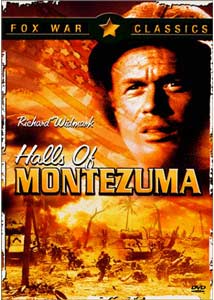
Netflix review #20: Halls of Montezuma
Following the campaigns in the Pacific at Guadalcanal and Tarawa, Lt. Carl Anderson (Richard Widmark) prepares his men for another assault on a Japanese-held island. Anderson's been going through a bit of a breakdown recently as just 7 men from his original platoon have survived. He's torn up inside at the thought of all the men he's lost and gets horrific headaches under stress. It's after the Marines hit the beach and have moved inland that the real trouble starts. The Japanese garrison unleashes hundreds of rockets at the advancing Marines. The problem, no one can spot the rocket emplacements.
Assigned to lead a patrol from his commander, Lt. Colonel Gilfillan (Richard Boone), Anderson must find the rockets and call their location in before a huge push the next day. Among the patrol are the few men Anderson genuinely cares about and wants to see make it through, the original members of the platoon. Leading that group is Pigeon Lane (Jack Palance), a former boxer suckered into the Marines, Coffman (Robert Wagner), the youngster trying to figure out who saved him at Tarawa, Doc Jones (Karl Malden), Anderson's close friend, Cpl. Conroy (Richard Hylton), a former student of Anderson's, Pretty Boy Riley (Skip Homeier), a soldier trying to rise above his past, Slattery (Bert Freed), the best soldier in the bunch and the biggest troublemaker, and Sgt. Zelenko (Neville Brand), the tough sergeant. Then for good measure there's a Japanese translator, a war correspondent (Jack Webb), and a new recruit along.
I've written before about how much I like 'men on a mission' movies, and this certainly qualifies with the cast full of recognizable character actors. But instead of just dropping the viewer into the platoon, we get an interesting technique to get to know the platoon. With a handful of flashbacks, we see their interactions in the group, some while in the unit, others as far back as their civilian days. It helps then when the platoon starts getting picked off by the Japanese. These aren't random, faceless soldiers, we know something about them and their makeup.
For a movie made just 5 years since the end of WWII, director Lewis Milestone tells it pretty straight. These aren't superhero G.I. Joe soldiers. Widmark is close to cracking up, and some of his men aren't too far behind. The more I watch of him, the more I think Widmark is one of the more underrated, underappreciated actors to come out of the late 1940s. As well, the Japanese soldiers aren't presented as stereotypical, one-dimensional soldiers. The whole movie has a clear anti-war stance. The action, while good, is understated. Characters are shot off-screen or hit by shrapnel as they head for a foxhole. And made in 1950 years before blood squibs became commonplace in war movies and westerns, the violence is fairly graphic, including one hand-to-hand encounter with a Japanese sniper.
The DVD has the movie in standard presentation, it was released about 3 years before widescreen was used, a trailer, and a handful of trailers for other Fox war movie DVDs. It's not a great WWII movie, but it's certainly a good one. Widmark leads a strong cast, and in general, Halls of Montezuma was ahead of its time when dealing with some of the deeper issues that war movies would later explore.
Halls of Montezuma (1950): ***/****
I've written before about how much I like 'men on a mission' movies, and this certainly qualifies with the cast full of recognizable character actors. But instead of just dropping the viewer into the platoon, we get an interesting technique to get to know the platoon. With a handful of flashbacks, we see their interactions in the group, some while in the unit, others as far back as their civilian days. It helps then when the platoon starts getting picked off by the Japanese. These aren't random, faceless soldiers, we know something about them and their makeup.
For a movie made just 5 years since the end of WWII, director Lewis Milestone tells it pretty straight. These aren't superhero G.I. Joe soldiers. Widmark is close to cracking up, and some of his men aren't too far behind. The more I watch of him, the more I think Widmark is one of the more underrated, underappreciated actors to come out of the late 1940s. As well, the Japanese soldiers aren't presented as stereotypical, one-dimensional soldiers. The whole movie has a clear anti-war stance. The action, while good, is understated. Characters are shot off-screen or hit by shrapnel as they head for a foxhole. And made in 1950 years before blood squibs became commonplace in war movies and westerns, the violence is fairly graphic, including one hand-to-hand encounter with a Japanese sniper.
The DVD has the movie in standard presentation, it was released about 3 years before widescreen was used, a trailer, and a handful of trailers for other Fox war movie DVDs. It's not a great WWII movie, but it's certainly a good one. Widmark leads a strong cast, and in general, Halls of Montezuma was ahead of its time when dealing with some of the deeper issues that war movies would later explore.
Halls of Montezuma (1950): ***/****
Subscribe to:
Posts (Atom)