Growing
up, I always associated Memorial Day Weekend with the war movie
marathons on TV that dotted TNT, AMC and Turner Classic Movies. I ate
them up -- still do -- as I watched as many as I could. They're still
some of my favorite movies, everything from The Dirty Dozen to The
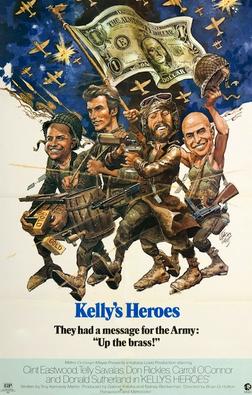
Devil's Brigade and one of my favorites, 1970's Kelly's Heroes.
It's
fall 1944 and Allied forces are fighting their way across France, the
German army slowly being beaten back. At the forefront of the Allied
advance, a recon platoon, including Sgt. Big Joe (Telly Savalas), are worn down after months of fighting. One member of the platoon, Pvt. Kelly (Clint Eastwood),
stumbles across an interesting tidbit of information while
interrogating a German colonel. There is 14,000 bars of gold -- worth
$16 million -- in a bank just waiting to be plucked. The catch? The bank
is 30 miles behind German lines. Joe manages to convince both Big Joe
and the platoon to navigate through the lines and get their hands on the
gold. With a scrounger/supply sergeant, Crapgame (Don Rickles) and three Sherman tanks commanded by a hippie, Oddball (Donald Sutherland), along for the ride, Kelly and his motley crew of soldiers head out with a chance to net quite the payday.
What
an appropriately timed World War II movie. By the late 1960s, the tone
of war movies had changed from the big epics to the more cynical/comedic
variety, movies like MASH and Catch 22 among others. Enter Kelly's
Heroes, directed by Brian G. Hutton
(who also directed Where Eagles Dare), one of the most entertaining war
movies I've ever seen. Cynical with a dark sense of humor but also some
lighter moments -- courtesy of Sutherland's hippie tank commander --
with some great action, memorable score, and one of those perfect tough
guy casts. There's a reason it remains a fan favorite 40-plus years
later, and much of it because it blends all those things together so
effortlessly. Even an odd-sounding theme, Burning Bridges,
fits perfectly in an odd way. It is one of my favorite movies and
always will be, a classic war flick that I can sit down and watch
whenever it pops up on TV.
Can you ask for a better
lead quartet than Clint Eastwood, Telly Savalas, Don Rickles and Donald
Sutherland? Yeah, there has been casts with bigger star power, bigger
name recognition, but it's more than that here. This is four tough guys
having fun, on-screen chemistry that's just hard to describe. They all
get their chance in the spotlight. Eastwood is Eastwood, the impeccably
cool and man of few words hero. Savalas is a subtle scene-stealer as Big
Joe, the unofficial commander of the recon platoon (Hal Buckley
playing the clueless real commander Capt. Maitland), just trying to get
his men through the fighting unscathed and a somewhat unwilling
participant in the gold heist. Rickles is an out of left field choice to
join the cast, but it works, his Crapgame a smart-ass New Yorker always
with an eye for a profit. And then there's Sutherland as Oddball, the
tank commander always talking about positive waves (No Negative Waves,
man!), his Zen-like qualities, heading into battle with music blaring
and shells filled with paint waiting to be unleashed on the Germans.
As
a fan of guy's guys movies, it's simply hard to beat those four stars.
They make it look downright easy. Much of that chemistry and success
comes from the script written by Troy Kennedy-Martin,
a script with too many great one-liners to even mention. We see
familiar character archetypes, familiar war movie situations --
stumbling into a minefield, prepping for battle -- but there's a
different energy to the whole thing. It's that tone that blends the
drama, comedy and action so easily that makes it work. Carroll O'Connor
too is excellent in a part that lets him ham it up as General Colt, the
fiery division commander who's frustrated with the stagnant front
lines, getting a jolt of energy when Kelly's screwball force
unintentionally opens things up all along the front. There's something
to be said for a movie that is non-stop fun. It never gets heavy-handed
or obvious like some more message-oriented war movies.
When
the platoon looks back on a field where some of their fallen comrades
lay dead in the dirt, there's no words that need to be said. The looks
on the surviving men's faces says it all. Showing he's putting on
appearances for his men, Big Joe turns and raises his binoculars to
check one last time. The dynamic is there from the lead quartet right
down to the platoon, a group of recognizable character actors clearly
having some fun. The platoon includes Little Joe (Stuart Margolin), Big Joe's radioman, Cowboy (Jeff Morris) and Willard (Harry Dean Stanton), two drawling best buds, Gutowski (Dick Davalos), the sniper, Petuko (Perry Lopez), the smooth, goofy ladies man, Cpl. Job (Tom Troupe), Joe's second-in-command close friend, Fisher (Dick Balduzzi), the platoon genius, and Babra not Barbara (Gene Collins). Also, you can't forget Gavin MacLeod as Moriarty, Oddball's mechanical genius and constant provide of negative waves.
Also look for Seinfeld's Uncle Leo, Len Lesser, as Bellamy, an engineer Oddball ropes into helping the cause and Karl-Otto Alberty as a German tank commander who goes up against Kelly's forces and Oddball's tank trio.
With
a 146-minute running time, we've got plenty of chances for guys being
guys and plenty of action scenes. We get lots of action -- escaping a
minefield, a tank attack on a railway station, the platoon racing
through a German crossroad under mortar attack -- but the best is saved
for last as the platoon descends on Clermont, the town where the bank
and the gold are waiting. It's an extended sequence that runs about 35
minutes that doesn't rush into it. We get almost 10 minutes of the men
and the tanks sneaking into town while the German garrison slowly wakes
up, composer Lalo Schifrin's score driving the action. The entire movie was filmed in Czechoslovakia, the action finale filmed in the village of Vizinada. It's an extended sequence that is hard to beat.
Just
a great movie overall. Great cast, incredibly quotable, lots of action,
memorable soundtrack (Quentin Tarantino is a big fan of the score,
especially Tiger Tank),
and even a nod to Eastwood's spaghetti western background with a
three-way showdown with said tank. One of my all-time favorites and
hopefully you'll enjoy it just as much as I do.
Kelly's Heroes (1970): ****/****
Rewrite of August 2009 review
The Sons of Katie Elder
"First, we reunite, then find Ma and Pa's killer...then read some reviews."
Showing posts with label Gavin MacLeod. Show all posts
Thursday, June 12, 2014
Friday, September 6, 2013
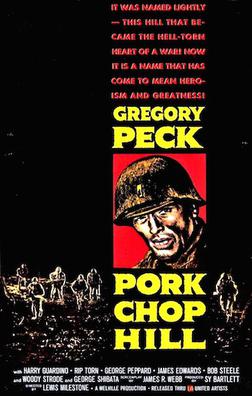
Pork Chop Hill
No soldier wants to die. But what about as a war nears its end? The end of the fighting may only be days away, maybe even hours away. So goes the background for the underrated Korean War drama from 1959, Pork Chop Hill.
It's April 1953 and both American and North Korean/Chinese commanders have agreed to a cease fire with the two sides meeting at Panmunjom. The negotiations though are moving along at a frustratingly slow pace with little being resolved. Near the front lines, the fighting rages on with Lt. Joe Clemons (Gregory Peck) and his King Company awaiting orders, supposedly to withdraw as the fighting dies down with negotiations picking up. The orders though are just the opposite, orders to move forward and take Pork Chop Hill, a worthless hill that's been lost and regained countless times. Now, the Chinese are in possession, but it is a spot on the line that's been deemed very important to negotiations. Clemons assembles his weary company, moving forward to take a hill that holds no military value.
Dubbed the Forgotten War, the Korean War pales in comparison to both World War II and Vietnam in terms of theatrical films released about them. From director Lewis Milestone (A Walk in the Sun, Halls of Montezuma, All Quiet on the Western Front), 'Hill' is a generally forgotten war film that certainly deserves better. It is similar in a lot of ways to 1962's Hell is For Heroes -- even using an eerily similar score from Leonard Rosenman -- and is based on a true story, the battle for Pork Chop Hill. It was filmed in black and white, a highly effective shooting technique, giving everything a sparse, cold and vacant look. Why isn't it remembered as the near-classic that it is? I've got no idea.
What jumped out at me on my recent viewing was the cynicism and darkness that's evident throughout. More surprising? It was made with cooperation from the U.S. Army which in itself isn't too surprising. It's that in exploring the battle, 'Hill' at times shows the complete ineptitude of the American commanders. Assaulting the hill, Clemon's company is put on the grid when American spotlights actually shine right on them in the dead of night. Other companies are given wrong orders, ranging from just plain wrong to misleading. Once King Company is in position, the rear command is genuinely confused, thinking they're fighting a mop-up action when in reality, they're holding on by their fingernails with limited ammunition, food and water. At one point, an U.S.O. photographer is sent up the hill to get photos of an American victory because the folks back home need to see an American win. Peck's reaction is priceless, a commander at wit's end who doesn't know what else to say.
This is an honest criticism of headquarters that's based in reality, and for a 1959 audience, it seems light years ahead of its time. If I didn't know better, it sounds like a Vietnam War movie like Platoon or Apocalypse Now more than a major studio release from 1959. Leading the way is the always reliable, always impressive Gregory Peck. His performance reminded me some of his Oscar-nominated turn in Twelve O'Clock High 10 years earlier. His Clemons is an effective commander simply trying to follow orders and get as many men through the battle unscathed as is possible. Even he is pushed to his limits as one bumbling order after another comes through, the commanders refusing to acknowledge that the battle isn't going as they expected. It's an understated part, but an emotionally effective one. We see the wear and tear on his face, his reassuring, confident tone slowly being worn down.
Beyond Peck though, 'Hill' is noteworthy for its supporting cast of rising and future stars. Harry Guardino and George Peppard play Forstman and Federson, two buddies lugging a machine gun around the hill. Rip Torn plays Lt. Russel, commander of the relief company assigned to help out King Company. 'Hill' is also one of the first war films to show integrated units, Woody Strode playing Franklin, a private fed up with the war, and James Edwards as Cpl. Jurgens, one of Clemon's most dependable, trustworthy men. Also cool casting is George Shibata as Lt. Ohashi, a Japanese-American soldier, Clemon's close friend and one of his platoon commanders. Also look for Norman Fell, Gavin MacLeod, Robert Blake, Biff Elliott, Martin Landau, Harry Dean Stanton, Clarence Williams III and several other familiar faces rounding out King Company's roster.
Clocking in at 97 minutes, a majority of 'Hill' is spent in the trenches and bunkers with King Company, a few asides here and there showing the negotiations of the cease fire. This is a movie interested in the nuts and bolts of the battle, the flanking movements, the reserve companies, the crossfires and preparations for counterattacks. It never gets bogged down though, the battle scenes uncomfortable and unsettling in their reality. It isn't graphic violence here, but that doesn't mean it's not hard to watch. Add in the psychological warfare of a Chinese broadcaster bombarding the American troops with propaganda, and you've got quite the battle here. It's not just bullets and soldiers anymore, but the effect it has on the soldiers' heads too. A great war movie, one that deserves more of a reputation/following.
Pork Chop Hill (1959): *** 1/2 /****
It's April 1953 and both American and North Korean/Chinese commanders have agreed to a cease fire with the two sides meeting at Panmunjom. The negotiations though are moving along at a frustratingly slow pace with little being resolved. Near the front lines, the fighting rages on with Lt. Joe Clemons (Gregory Peck) and his King Company awaiting orders, supposedly to withdraw as the fighting dies down with negotiations picking up. The orders though are just the opposite, orders to move forward and take Pork Chop Hill, a worthless hill that's been lost and regained countless times. Now, the Chinese are in possession, but it is a spot on the line that's been deemed very important to negotiations. Clemons assembles his weary company, moving forward to take a hill that holds no military value.
Dubbed the Forgotten War, the Korean War pales in comparison to both World War II and Vietnam in terms of theatrical films released about them. From director Lewis Milestone (A Walk in the Sun, Halls of Montezuma, All Quiet on the Western Front), 'Hill' is a generally forgotten war film that certainly deserves better. It is similar in a lot of ways to 1962's Hell is For Heroes -- even using an eerily similar score from Leonard Rosenman -- and is based on a true story, the battle for Pork Chop Hill. It was filmed in black and white, a highly effective shooting technique, giving everything a sparse, cold and vacant look. Why isn't it remembered as the near-classic that it is? I've got no idea.
What jumped out at me on my recent viewing was the cynicism and darkness that's evident throughout. More surprising? It was made with cooperation from the U.S. Army which in itself isn't too surprising. It's that in exploring the battle, 'Hill' at times shows the complete ineptitude of the American commanders. Assaulting the hill, Clemon's company is put on the grid when American spotlights actually shine right on them in the dead of night. Other companies are given wrong orders, ranging from just plain wrong to misleading. Once King Company is in position, the rear command is genuinely confused, thinking they're fighting a mop-up action when in reality, they're holding on by their fingernails with limited ammunition, food and water. At one point, an U.S.O. photographer is sent up the hill to get photos of an American victory because the folks back home need to see an American win. Peck's reaction is priceless, a commander at wit's end who doesn't know what else to say.
This is an honest criticism of headquarters that's based in reality, and for a 1959 audience, it seems light years ahead of its time. If I didn't know better, it sounds like a Vietnam War movie like Platoon or Apocalypse Now more than a major studio release from 1959. Leading the way is the always reliable, always impressive Gregory Peck. His performance reminded me some of his Oscar-nominated turn in Twelve O'Clock High 10 years earlier. His Clemons is an effective commander simply trying to follow orders and get as many men through the battle unscathed as is possible. Even he is pushed to his limits as one bumbling order after another comes through, the commanders refusing to acknowledge that the battle isn't going as they expected. It's an understated part, but an emotionally effective one. We see the wear and tear on his face, his reassuring, confident tone slowly being worn down.
Beyond Peck though, 'Hill' is noteworthy for its supporting cast of rising and future stars. Harry Guardino and George Peppard play Forstman and Federson, two buddies lugging a machine gun around the hill. Rip Torn plays Lt. Russel, commander of the relief company assigned to help out King Company. 'Hill' is also one of the first war films to show integrated units, Woody Strode playing Franklin, a private fed up with the war, and James Edwards as Cpl. Jurgens, one of Clemon's most dependable, trustworthy men. Also cool casting is George Shibata as Lt. Ohashi, a Japanese-American soldier, Clemon's close friend and one of his platoon commanders. Also look for Norman Fell, Gavin MacLeod, Robert Blake, Biff Elliott, Martin Landau, Harry Dean Stanton, Clarence Williams III and several other familiar faces rounding out King Company's roster.
Clocking in at 97 minutes, a majority of 'Hill' is spent in the trenches and bunkers with King Company, a few asides here and there showing the negotiations of the cease fire. This is a movie interested in the nuts and bolts of the battle, the flanking movements, the reserve companies, the crossfires and preparations for counterattacks. It never gets bogged down though, the battle scenes uncomfortable and unsettling in their reality. It isn't graphic violence here, but that doesn't mean it's not hard to watch. Add in the psychological warfare of a Chinese broadcaster bombarding the American troops with propaganda, and you've got quite the battle here. It's not just bullets and soldiers anymore, but the effect it has on the soldiers' heads too. A great war movie, one that deserves more of a reputation/following.
Pork Chop Hill (1959): *** 1/2 /****
Monday, February 4, 2013
A Man Called Gannon
There is a certain charm I associate with westerns. The idea of a man riding across the country, all his possessions he's either wearing or they're on his horse with him, and answering to no one is an incredibly cool premise for me. Countless westerns have used that iconic character, the loner-drifter-cowboy, including 1969's A Man Called Gannon, a remake of 1955's Man Without a Star.
Riding a train west after a failed cattle ranch in Texas, cowboy drifter Gannon (Tony Franciosa) meets Jess Washburn (Michael Sarrazin), an inexperienced Easterner from Philadelphia. Jess wants nothing more than to be a cowboy, but he's got no idea where to start. In a jam when they witness a murder, Gannon saves Jess, and the youngster feels obligated to him. Booted off the train, they get jobs working at a local cattle ranch through Matty (Susan Oliver), a prostitute and "friend" of Gannon's. As the experienced cowboy teaches Jess everything he can, they find themselves in the midst of a budding range war. As the sides separate though, Gannon and Jess find they may be on opposite sides.
It's been awhile since I saw the 1955 version/original so I didn't associate this 1969 remake right away with it. The 1955 version starred Kirk Douglas and was pretty good in a simple, straightforward kind of way. There's no reason to remake it to begin with, but here we go just the same. 'Gannon' is one of a wave of movies released in the late 1960s and early 1970s about the changing of the west on the personal level; the cowboy. It reminds me a lot of Monte Walsh, released a year later. It tries to be a little too lyrical and schmaltzy, especially its main theme, a folk song called 'A Smile, A Memory and an Extra Shirt.' 'Gannon' struggles to find the right tone from the get-go, bouncing back and forth between physical comedy, goofiness and the natural darkness that comes from the changing times in the west. Pick a route and take it.
What makes it worthwhile is the casting of Franciosa and Sarrazin in the two lead roles. Neither actor had a ton of star power, but they were both solid actors capable of delivering above average performances. It doesn't hurt that the two parts -- the weathered, veteran cowboy and the inexperienced, wet behind the ears youngster -- are basically the definition of two archetypal western characters. You've seen them before, and you will see them again. I typically think of Franciosa as more of a heavy, a bad guy, so it's cool to see him in a more straight, good guy role. He at first wants nothing to do with Sarrazin's Jess, but can't really shake the persistent youngster. Sarrazin too does a fine job with the part, a young man who so desperately wants to be something, anything, that he puts himself in a bad situation to get to that point.
The relationship that develops between the two is the best part of the movie. Gannon keeps on teaching everything he can, and to his credit, Jess does a good job of picking things up whether it be shooting, roping, or handling a horse. Gannon has a checkered past and still holds some tremendous guilt from a past incident that went horribly wrong. In young Jess, he sees potential to right a wrong. The problem is simple, he can only show him how to do things, but at some point, Jess will have to decide things for himself. As the hooker with a heart of gold, Oliver does a very good job as Matty, a woman trying to fix Gannon for lack of a better description. Judi West plays Beth, the ranch owner trying to keep the place afloat by any means necessary (and with anyone who will help....in the bedroom), John Anderson plays Capper, the ranch top hand, David Sheiner is the maligned but tough sheriff, with James Westerfield, Gavin MacLeod and Eddie Firestone playing some of the cowhands at Beth's ranch.
Unfortunately as things develop in this 105-minute flick from director James Goldstone, the pace lets up and the story loses steam. The opener, with Gannon meeting an old acquaintance (Jason Evers) as a telegraph line is set up, is nearly perfect, setting up how out of place this veteran cowboy is in a changing world. But as things progress, the story goes in too many directions and never quite gets back on the right track. It's never bad, but I started to lose interest (a lot) at about the hour-mark. Harmless enough western, probably worthwhile for a watch.
A Man Called Gannon (1969): ** 1/2 /****
Riding a train west after a failed cattle ranch in Texas, cowboy drifter Gannon (Tony Franciosa) meets Jess Washburn (Michael Sarrazin), an inexperienced Easterner from Philadelphia. Jess wants nothing more than to be a cowboy, but he's got no idea where to start. In a jam when they witness a murder, Gannon saves Jess, and the youngster feels obligated to him. Booted off the train, they get jobs working at a local cattle ranch through Matty (Susan Oliver), a prostitute and "friend" of Gannon's. As the experienced cowboy teaches Jess everything he can, they find themselves in the midst of a budding range war. As the sides separate though, Gannon and Jess find they may be on opposite sides.
It's been awhile since I saw the 1955 version/original so I didn't associate this 1969 remake right away with it. The 1955 version starred Kirk Douglas and was pretty good in a simple, straightforward kind of way. There's no reason to remake it to begin with, but here we go just the same. 'Gannon' is one of a wave of movies released in the late 1960s and early 1970s about the changing of the west on the personal level; the cowboy. It reminds me a lot of Monte Walsh, released a year later. It tries to be a little too lyrical and schmaltzy, especially its main theme, a folk song called 'A Smile, A Memory and an Extra Shirt.' 'Gannon' struggles to find the right tone from the get-go, bouncing back and forth between physical comedy, goofiness and the natural darkness that comes from the changing times in the west. Pick a route and take it.
What makes it worthwhile is the casting of Franciosa and Sarrazin in the two lead roles. Neither actor had a ton of star power, but they were both solid actors capable of delivering above average performances. It doesn't hurt that the two parts -- the weathered, veteran cowboy and the inexperienced, wet behind the ears youngster -- are basically the definition of two archetypal western characters. You've seen them before, and you will see them again. I typically think of Franciosa as more of a heavy, a bad guy, so it's cool to see him in a more straight, good guy role. He at first wants nothing to do with Sarrazin's Jess, but can't really shake the persistent youngster. Sarrazin too does a fine job with the part, a young man who so desperately wants to be something, anything, that he puts himself in a bad situation to get to that point.
The relationship that develops between the two is the best part of the movie. Gannon keeps on teaching everything he can, and to his credit, Jess does a good job of picking things up whether it be shooting, roping, or handling a horse. Gannon has a checkered past and still holds some tremendous guilt from a past incident that went horribly wrong. In young Jess, he sees potential to right a wrong. The problem is simple, he can only show him how to do things, but at some point, Jess will have to decide things for himself. As the hooker with a heart of gold, Oliver does a very good job as Matty, a woman trying to fix Gannon for lack of a better description. Judi West plays Beth, the ranch owner trying to keep the place afloat by any means necessary (and with anyone who will help....in the bedroom), John Anderson plays Capper, the ranch top hand, David Sheiner is the maligned but tough sheriff, with James Westerfield, Gavin MacLeod and Eddie Firestone playing some of the cowhands at Beth's ranch.
Unfortunately as things develop in this 105-minute flick from director James Goldstone, the pace lets up and the story loses steam. The opener, with Gannon meeting an old acquaintance (Jason Evers) as a telegraph line is set up, is nearly perfect, setting up how out of place this veteran cowboy is in a changing world. But as things progress, the story goes in too many directions and never quite gets back on the right track. It's never bad, but I started to lose interest (a lot) at about the hour-mark. Harmless enough western, probably worthwhile for a watch.
A Man Called Gannon (1969): ** 1/2 /****
Labels:
1960s,
Gavin MacLeod,
John Anderson,
Michael Sarrazin,
Tony Franciosa,
westerns
Subscribe to:
Posts (Atom)