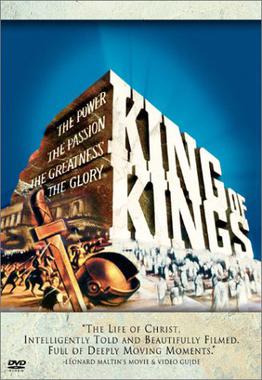
Is there a more daunting task as an actor to play a man millions of people around the world believe to be the Son of God? Sure, any portrayal of a real-life person has to be intimidating, but playing Jesus? That's gotta be on a whole other level. As I learned from the Internet, this movie was the first American film to show an actor's face portraying Jesus Christ. Here it is, a childhood favorite and one I revisited this past Easter weekend, 1961's King of Kings.
This is the story of Jesus (Jeffrey Hunter), a man who grew up in tumultuous times in Judea as Roman occupiers keep the Jewish/Hebrew people oppressed under their thumb. Revolts and rebellions rise up from year to year as Judea seeks its freedom, its independence to get away from the control of the Roman empire. Into this world, Jesus grows up into manhood ready to do his life's calling. Having worked his entire life and living in the Galilean town of Nazareth as a carpenter, Jesus in his late 20's ventures out into the world to embrace his calling as the messiah, the son of God who will teach the world how to live. It is a message that preaches peace but will no doubt send ripples throughout the Roman empire. As Jesus travels around the country with a small group of disciples, his name, his message and his words begin to spread. His followers increase, but so does the danger around him as many want nothing more than to kill him before he becomes too dangerous.
A plot description for a film about the life of Jesus Christ is pretty unnecessary, but I had to lay things out at least a little bit. In the age of the historical film epic, this entry from director Nicholas Ray has always been one of my favorites. I grew up watching it with my Mom every spring, and even years later, it holds up. If anything, I liked it more as a 29-year old viewer as opposed to a 10-year old kid. A whole lot of history is covered in 168 minutes but things never feel rushed. 'King' was filmed on-location in Spain with countless lavish sets and natural backdrops adding an incredibly authentic feel to the proceedings. The TCM print shown on Easter looked PHENOMENAL. Just a stunningly good-looking visual movie. The musical score from composer Miklos Rozsa is pretty perfect too, big and booming mixed in with softer, quieter and just as effective emotional moments. Listen to a sample HERE.
What struck me most in this 1961 epic about Jesus is that...well, it isn't just about Jesus. Ray and writer Philip Yordan use Jesus, his life and his teachings to tell a story about the times this man lived his life. Yes, the focus is on him, but it isn't exclusively focused on him. The casting is very solid with Jeffrey Hunter playing Jesus. Up there with The Searchers as his most famous, respected and recognizable role, Hunter does an excellent job here. It isn't the most human part, but that's not his fault. Hunter is sincere and likable and genuine with a script that keys in on Jesus' teachings more than getting to know the man as a person, as an individual. What works so well is the quieter moments and the impact we see as viewers that this man has on those around him, both the believers and the non-believers. Hunter never became the huge star he could have before his tragic death in 1969, but performances like this show his acting skill.
Four years later, a similarly-themed Jesus epic -- The Greatest Story Ever Told -- would set the bar for ridiculously overdone all-star casts. That ain't the case here. Ray fills out some major roles with recognizable faces and some stars, but this is even't close to being considered an all-star cast. Oh, and that's a good thing. The best supporting part goes to Ron Randell as Lucius, a Roman officer in the garrison at Jerusalem tasked with figuring out if Jesus is a threat to be dealt with. A human, questioning part, and a really good one. Next up, Irish actress Siobhan McKenna as Mary, Jesus' mother, making the character memorable with just a few quick scenes. And then there's the most recognizable face, Robert Ryan getting a meaty part as John the Baptist, a prophet more fiery than Jesus but who preaches the same peaceful message, one predicting the coming of the Son of God.
Who else to look for? If you're familiar with Jesus and the gospels, you know the names. Also in the cast are Pontius Pilate (Hurd Hatfield), Roman governor of Judea, Claudia (Viveca Lindfors), Pilate's more open-minded wife, Herod Antipas (Frank Thring), the Judean governor, his wife, Herodias (Rita Gam), and his stepdaughter, Salome (Brigid Bazlen), disciples Peter (Royal Dano) and Judas (Rip Torn), Barabbas (Harry Guardino), and Mary Magdalene (Carmen Sevilla).
Working consistently throughout the 1950s, director Ray carved a niche for himself as a director of smaller scale human dramas. A biblical epic about Jesus? Not his usual cup of tea. For all the immense scale though, it is the softer, quieter scenes that work. Quick montages of Jesus' miracles set to Rozsa's score are beautiful and effective. The sermon on the mount boasts all sorts of massive scale but is effective because of the dialogue and Hunter's acting. Certain events are glossed over more than others with a bigger focus late on the Passion and Resurrection. Obviously not nearly as graphic as the Passion of the Christ, it remains a moving finale.
King of Kings works because it doesn't try to be gigantically epic. It is content to tell a big story -- maybe history's BIGGEST story -- and to tell it well. Well worth it though, definitely worth checking out. Also listen for Ray Bradbury's uncredited narration, Orson Welles reading said narration, and future familiar face from the spaghetti western genre, Aldo Sambrell, making his screen debut.
King of Kings (1961): ****/****
The Sons of Katie Elder
"First, we reunite, then find Ma and Pa's killer...then read some reviews."
Showing posts with label Rip Torn. Show all posts
Thursday, April 9, 2015
Friday, February 6, 2015
Sol Madrid
Though the name might not be instantly recognizable, director Brian G. Hutton has been at the helm of two of my favorite movies, both of them WWII flicks, Where Eagles Dare and Kelly's Heroes. He only directed nine movies while also acting in film and television so those directing efforts? Gotta scoop them up when you can. Turner Classic Movies helped me out last week, screening 1968's Sol Madrid.
An undercover Interpol officer with a checkered past, Sol Madrid (David McCallum) has been tasked with possibly his most dangerous mission yet. A longtime right-hand man to a Mafia boss in NYC, Harry Mitchell (Pat Hingle) has gone rogue and stole $500,000 from the boss while running away with said boss' girlfriend. The catch? Mitchell has a computer-like mind and is able to remember everything he's ever done for the Mob. If Interpol or the FBI can bring him in and convince him to testify, the case is almost a sure thing against the Mafia. Madrid follows some leads and finds out that Mitchell has headed south of the border to Mexico and is hiding out with a rival mob boss in Acapulco. How can Madrid get to him and then convince him? Well, it starts with finding the mob boss' girlfriend, Stacey (Stella Stevens), and convincing her to help with the promise of protection. Can it all work out?
Even considering the very cool cast assembled here, I'd never even remotely heard of this one. But courtesy of TCM, here we sit! This is a movie I wanted to love but ended up only liking it. I'll get into the cast more in a bit, but it's NUTS! Filmed in Acapulco, featuring an appropriately quirky score from Lalo Schifrin, and a style and winding story that seems like a 1960s bizarre-o film noir...'Madrid' should have been better. That's it. It just should have been better in plain and simple words. This is a 1960s crime thriller that is missing that one special thing to make it a really solid, memorable flick. As is? It's okay, pretty cool in moments, kinda dumb/weird in others.
That cast though....man, it's worth watching just to see the collection of talent assembled. Let's start with the other Man from U.N.C.L.E., David McCallum himself. He never grew into a huge star -- he's probably most well-known for his Ducky role in NCIS -- but it's always cool to see him in a leading role, especially an anti-hero role like this. We meet Sol Madrid as he's resting in an apartment full of drugged-out heroin users. What an introduction! From there, it's one cold-blooded decision after another, all the while observing what's going on around him and planning steps in advance of everyone around him. Brutal, calculating and looking at the bottom line, Madrid risks it all over and over again. And that name? Sol Madrid?!? Sounds very fake, but damn, I wish I had a badass, ridiculously goofy and cool name like that.
I'm a sucker for ensemble casts though, and what we've got here for 'Madrid' is pretty impressive. Stevens specialized in these type of roles in the late 60s and early 70s as the damaged woman so it's right in her wheelhouse! She certainly has some fiery scenes with McCallum's Madrid. How about some tough guys?!? Hey, everybody, it's Telly Savalas as Emil Dietrich, a drug supplier with a rivalry against the Mafia! Next up, Ricardo Montalban as Jalisco, another undercover officer and Madrid's contact who may be too comfortable in his job. Oh, and there's Rip Torn as Villanova, the mob boss with a vengeful streak right up his back. Not a bad group, huh?
Also look for Paul Lukas as an older, experienced mobster, Michael Ansara as a Mexican police officer, Perry Lopez as Francisco, Dietrich's enforcer, and Michael Conrad as Scarpi, a mafia hitman tasked with killing Madrid and Stacey.
Probably the biggest flaw in this 90-minute flick is the story. It's far from pointed and doesn't seem to know where it's going, where it wants to end up. To get his hands on Mitchell, McCallum's Madrid partners up with Dietrich to bring huge amounts of heroin into the U.S. In a painfully slow scene, we actually see the smuggling effort, bringing an already slow pace down to a snail's speed. Things pick up in the final act with some good twists and finally some action, but as a whole, this isn't a consistent movie. Decent, pretty entertaining but with some serious flaws.
Sol Madrid (1968): ** 1/2 /****
An undercover Interpol officer with a checkered past, Sol Madrid (David McCallum) has been tasked with possibly his most dangerous mission yet. A longtime right-hand man to a Mafia boss in NYC, Harry Mitchell (Pat Hingle) has gone rogue and stole $500,000 from the boss while running away with said boss' girlfriend. The catch? Mitchell has a computer-like mind and is able to remember everything he's ever done for the Mob. If Interpol or the FBI can bring him in and convince him to testify, the case is almost a sure thing against the Mafia. Madrid follows some leads and finds out that Mitchell has headed south of the border to Mexico and is hiding out with a rival mob boss in Acapulco. How can Madrid get to him and then convince him? Well, it starts with finding the mob boss' girlfriend, Stacey (Stella Stevens), and convincing her to help with the promise of protection. Can it all work out?
Even considering the very cool cast assembled here, I'd never even remotely heard of this one. But courtesy of TCM, here we sit! This is a movie I wanted to love but ended up only liking it. I'll get into the cast more in a bit, but it's NUTS! Filmed in Acapulco, featuring an appropriately quirky score from Lalo Schifrin, and a style and winding story that seems like a 1960s bizarre-o film noir...'Madrid' should have been better. That's it. It just should have been better in plain and simple words. This is a 1960s crime thriller that is missing that one special thing to make it a really solid, memorable flick. As is? It's okay, pretty cool in moments, kinda dumb/weird in others.
That cast though....man, it's worth watching just to see the collection of talent assembled. Let's start with the other Man from U.N.C.L.E., David McCallum himself. He never grew into a huge star -- he's probably most well-known for his Ducky role in NCIS -- but it's always cool to see him in a leading role, especially an anti-hero role like this. We meet Sol Madrid as he's resting in an apartment full of drugged-out heroin users. What an introduction! From there, it's one cold-blooded decision after another, all the while observing what's going on around him and planning steps in advance of everyone around him. Brutal, calculating and looking at the bottom line, Madrid risks it all over and over again. And that name? Sol Madrid?!? Sounds very fake, but damn, I wish I had a badass, ridiculously goofy and cool name like that.
I'm a sucker for ensemble casts though, and what we've got here for 'Madrid' is pretty impressive. Stevens specialized in these type of roles in the late 60s and early 70s as the damaged woman so it's right in her wheelhouse! She certainly has some fiery scenes with McCallum's Madrid. How about some tough guys?!? Hey, everybody, it's Telly Savalas as Emil Dietrich, a drug supplier with a rivalry against the Mafia! Next up, Ricardo Montalban as Jalisco, another undercover officer and Madrid's contact who may be too comfortable in his job. Oh, and there's Rip Torn as Villanova, the mob boss with a vengeful streak right up his back. Not a bad group, huh?
Also look for Paul Lukas as an older, experienced mobster, Michael Ansara as a Mexican police officer, Perry Lopez as Francisco, Dietrich's enforcer, and Michael Conrad as Scarpi, a mafia hitman tasked with killing Madrid and Stacey.
Probably the biggest flaw in this 90-minute flick is the story. It's far from pointed and doesn't seem to know where it's going, where it wants to end up. To get his hands on Mitchell, McCallum's Madrid partners up with Dietrich to bring huge amounts of heroin into the U.S. In a painfully slow scene, we actually see the smuggling effort, bringing an already slow pace down to a snail's speed. Things pick up in the final act with some good twists and finally some action, but as a whole, this isn't a consistent movie. Decent, pretty entertaining but with some serious flaws.
Sol Madrid (1968): ** 1/2 /****
Wednesday, January 28, 2015
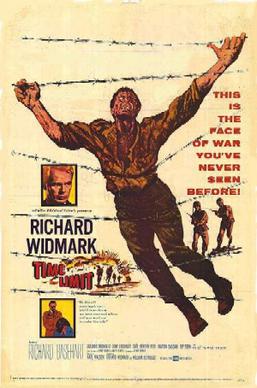
Time Limit
The Korean War helped change things when it came to portrayals of war in film. Sure, there were still huge, blockbuster epics to come like The Longest Day and The Greatest Escape. The nastiness of the war, changing times in America, darker methods of war, it all added up to something new, different and often times, uncomfortable. This wasn't soldier shoots soldier anymore. Part mystery, part prisoner of war drama, part courtroom drama, here's 1957's little-known Time Limit.
An officer in the Judge Advocate General's Corps, Colonel William Edwards (Richard Widmark) is wrapping up interviews for a messy little case that has crossed his desk. An Army major, Harry Cargill (Richard Basehart), has been accused of collaborating with the North Koreans during his time in a prisoner of war camp during the Korean War. Edwards has 14 other witnesses testifying what Cargill did in the P.O.W. camp and complicating matters is that Cargill absolutely refuses to defend himself, turning down legal counsel. If anything, it seems that the officer in question wants to be found guilty and prosecuted to the fullest extent, even if that court martial hearing sentences him to death. It seems like an open and shut case, and that's what makes Edwards curious. Something doesn't add up. What happened in that mountaintop prisoner of war camp in North Korea?
Despite the talent assembled to round out the cast in this 1957 military legal drama, I'd never really heard of this film. I've never seen it pop up in TV listings, and the DVD isn't readily available in Best Buys and Barnes and Nobles. But that Christmas stuff, you get some good presents, and I got this flick! What an interesting movie, one that doesn't get the attention and respect it deserves. Actor Karl Malden takes a crack at the directing chair (his only directing effort) and doesn't disappoint. It is a military film ahead of its time, willing to tackle some brutal, harsh realities about the changing concepts of war. As I mentioned earlier, this isn't Soldier A shoots Soldier B. This is total war that goes far beyond the battlefield. Maybe it's because 'Time' tackles those difficult to talk about subjects that its legacy has been buried over the years. Moral of the story? It's worth catching up with.
A co-producer who also encouraged Malden to direct the film, Widmark clearly had an interest in bringing this film to life. He's always been one of my favorite actors, and this is a performance that clearly shows off his ability. Some of his most well-known performances are big and bold, but this one is understated and subtle (and the better for it). His Colonel Edwards just wants to find out the truth, however dark it may be. It's also a performance that foreshadows Widmark's part four years later in Judgment at Nuremberg, a somewhat similarly-themed courtroom drama. Basehart gets the showier part as Major Cargill, an officer and former prisoner clearly struggling with some past demons. It's never over the top, just emotionally charged. Instead, this is a part of a man just trying to hold it all together as a secret from his past tears him apart.
'Time' doesn't have a huge cast, but there isn't a weak link in the bunch. Dolores Michaels provides a bit of a sexy secretary interest as Edwards' secretary, Jean, while Martin Balsam plays Sergeant Baker, Edwards' adjutant. I really liked and appreciated the dynamic among the trio in the office, three different people with different backgrounds all working toward the same goal. Some of the witnesses Edwards seeks out include June Lockhart as Cargill's worrying wife and Rip Torn as Lt. Miller, a fellow prisoner and bunkmate of Cargill's from the POW camp. Also look for Carl Benton Reid as Edwards' superior officer with a vested interest in the case and Khigh Dhiegh as Colonel Kim, the brutal POW camp commander.
Clocking in at 96 minutes, 'Time' is based on a play and definitely has that distinct feel. Malden's focus is on the actors, letting the camera linger for long, dialogue-driven scenes without a cut. Much of the movie is shot in Edwards' office with a quick departure near the halfway point to visit Lockhart's wife character. That lack of style oddly, gives 'Time' some style in a weird way. It's filmed in black and white and with some interesting camera angles, adds an unforeseen sense of tension that helps build the mystery. It isn't always the quickest movie -- especially the first 45 minutes -- but that momentum picks up in a huge way about the 45-minute mark as things start to reveal themselves.
I thought I had the twist pegged, but I was wrong. The final act features two different twists, one working just as well as the other. These aren't just twists for the sake of a surprise or shock either. These are genuine twists that work while also asking some tough questions. An underrated flick that deserves more of a reputation. Definitely worth checking out.
Time Limit (1957): ***/****
An officer in the Judge Advocate General's Corps, Colonel William Edwards (Richard Widmark) is wrapping up interviews for a messy little case that has crossed his desk. An Army major, Harry Cargill (Richard Basehart), has been accused of collaborating with the North Koreans during his time in a prisoner of war camp during the Korean War. Edwards has 14 other witnesses testifying what Cargill did in the P.O.W. camp and complicating matters is that Cargill absolutely refuses to defend himself, turning down legal counsel. If anything, it seems that the officer in question wants to be found guilty and prosecuted to the fullest extent, even if that court martial hearing sentences him to death. It seems like an open and shut case, and that's what makes Edwards curious. Something doesn't add up. What happened in that mountaintop prisoner of war camp in North Korea?
Despite the talent assembled to round out the cast in this 1957 military legal drama, I'd never really heard of this film. I've never seen it pop up in TV listings, and the DVD isn't readily available in Best Buys and Barnes and Nobles. But that Christmas stuff, you get some good presents, and I got this flick! What an interesting movie, one that doesn't get the attention and respect it deserves. Actor Karl Malden takes a crack at the directing chair (his only directing effort) and doesn't disappoint. It is a military film ahead of its time, willing to tackle some brutal, harsh realities about the changing concepts of war. As I mentioned earlier, this isn't Soldier A shoots Soldier B. This is total war that goes far beyond the battlefield. Maybe it's because 'Time' tackles those difficult to talk about subjects that its legacy has been buried over the years. Moral of the story? It's worth catching up with.
A co-producer who also encouraged Malden to direct the film, Widmark clearly had an interest in bringing this film to life. He's always been one of my favorite actors, and this is a performance that clearly shows off his ability. Some of his most well-known performances are big and bold, but this one is understated and subtle (and the better for it). His Colonel Edwards just wants to find out the truth, however dark it may be. It's also a performance that foreshadows Widmark's part four years later in Judgment at Nuremberg, a somewhat similarly-themed courtroom drama. Basehart gets the showier part as Major Cargill, an officer and former prisoner clearly struggling with some past demons. It's never over the top, just emotionally charged. Instead, this is a part of a man just trying to hold it all together as a secret from his past tears him apart.
'Time' doesn't have a huge cast, but there isn't a weak link in the bunch. Dolores Michaels provides a bit of a sexy secretary interest as Edwards' secretary, Jean, while Martin Balsam plays Sergeant Baker, Edwards' adjutant. I really liked and appreciated the dynamic among the trio in the office, three different people with different backgrounds all working toward the same goal. Some of the witnesses Edwards seeks out include June Lockhart as Cargill's worrying wife and Rip Torn as Lt. Miller, a fellow prisoner and bunkmate of Cargill's from the POW camp. Also look for Carl Benton Reid as Edwards' superior officer with a vested interest in the case and Khigh Dhiegh as Colonel Kim, the brutal POW camp commander.
Clocking in at 96 minutes, 'Time' is based on a play and definitely has that distinct feel. Malden's focus is on the actors, letting the camera linger for long, dialogue-driven scenes without a cut. Much of the movie is shot in Edwards' office with a quick departure near the halfway point to visit Lockhart's wife character. That lack of style oddly, gives 'Time' some style in a weird way. It's filmed in black and white and with some interesting camera angles, adds an unforeseen sense of tension that helps build the mystery. It isn't always the quickest movie -- especially the first 45 minutes -- but that momentum picks up in a huge way about the 45-minute mark as things start to reveal themselves.
I thought I had the twist pegged, but I was wrong. The final act features two different twists, one working just as well as the other. These aren't just twists for the sake of a surprise or shock either. These are genuine twists that work while also asking some tough questions. An underrated flick that deserves more of a reputation. Definitely worth checking out.
Time Limit (1957): ***/****
Friday, September 6, 2013
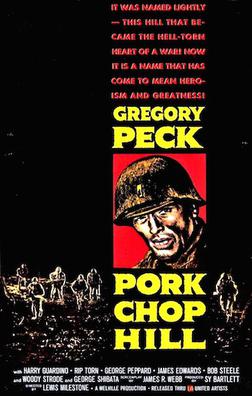
Pork Chop Hill
No soldier wants to die. But what about as a war nears its end? The end of the fighting may only be days away, maybe even hours away. So goes the background for the underrated Korean War drama from 1959, Pork Chop Hill.
It's April 1953 and both American and North Korean/Chinese commanders have agreed to a cease fire with the two sides meeting at Panmunjom. The negotiations though are moving along at a frustratingly slow pace with little being resolved. Near the front lines, the fighting rages on with Lt. Joe Clemons (Gregory Peck) and his King Company awaiting orders, supposedly to withdraw as the fighting dies down with negotiations picking up. The orders though are just the opposite, orders to move forward and take Pork Chop Hill, a worthless hill that's been lost and regained countless times. Now, the Chinese are in possession, but it is a spot on the line that's been deemed very important to negotiations. Clemons assembles his weary company, moving forward to take a hill that holds no military value.
Dubbed the Forgotten War, the Korean War pales in comparison to both World War II and Vietnam in terms of theatrical films released about them. From director Lewis Milestone (A Walk in the Sun, Halls of Montezuma, All Quiet on the Western Front), 'Hill' is a generally forgotten war film that certainly deserves better. It is similar in a lot of ways to 1962's Hell is For Heroes -- even using an eerily similar score from Leonard Rosenman -- and is based on a true story, the battle for Pork Chop Hill. It was filmed in black and white, a highly effective shooting technique, giving everything a sparse, cold and vacant look. Why isn't it remembered as the near-classic that it is? I've got no idea.
What jumped out at me on my recent viewing was the cynicism and darkness that's evident throughout. More surprising? It was made with cooperation from the U.S. Army which in itself isn't too surprising. It's that in exploring the battle, 'Hill' at times shows the complete ineptitude of the American commanders. Assaulting the hill, Clemon's company is put on the grid when American spotlights actually shine right on them in the dead of night. Other companies are given wrong orders, ranging from just plain wrong to misleading. Once King Company is in position, the rear command is genuinely confused, thinking they're fighting a mop-up action when in reality, they're holding on by their fingernails with limited ammunition, food and water. At one point, an U.S.O. photographer is sent up the hill to get photos of an American victory because the folks back home need to see an American win. Peck's reaction is priceless, a commander at wit's end who doesn't know what else to say.
This is an honest criticism of headquarters that's based in reality, and for a 1959 audience, it seems light years ahead of its time. If I didn't know better, it sounds like a Vietnam War movie like Platoon or Apocalypse Now more than a major studio release from 1959. Leading the way is the always reliable, always impressive Gregory Peck. His performance reminded me some of his Oscar-nominated turn in Twelve O'Clock High 10 years earlier. His Clemons is an effective commander simply trying to follow orders and get as many men through the battle unscathed as is possible. Even he is pushed to his limits as one bumbling order after another comes through, the commanders refusing to acknowledge that the battle isn't going as they expected. It's an understated part, but an emotionally effective one. We see the wear and tear on his face, his reassuring, confident tone slowly being worn down.
Beyond Peck though, 'Hill' is noteworthy for its supporting cast of rising and future stars. Harry Guardino and George Peppard play Forstman and Federson, two buddies lugging a machine gun around the hill. Rip Torn plays Lt. Russel, commander of the relief company assigned to help out King Company. 'Hill' is also one of the first war films to show integrated units, Woody Strode playing Franklin, a private fed up with the war, and James Edwards as Cpl. Jurgens, one of Clemon's most dependable, trustworthy men. Also cool casting is George Shibata as Lt. Ohashi, a Japanese-American soldier, Clemon's close friend and one of his platoon commanders. Also look for Norman Fell, Gavin MacLeod, Robert Blake, Biff Elliott, Martin Landau, Harry Dean Stanton, Clarence Williams III and several other familiar faces rounding out King Company's roster.
Clocking in at 97 minutes, a majority of 'Hill' is spent in the trenches and bunkers with King Company, a few asides here and there showing the negotiations of the cease fire. This is a movie interested in the nuts and bolts of the battle, the flanking movements, the reserve companies, the crossfires and preparations for counterattacks. It never gets bogged down though, the battle scenes uncomfortable and unsettling in their reality. It isn't graphic violence here, but that doesn't mean it's not hard to watch. Add in the psychological warfare of a Chinese broadcaster bombarding the American troops with propaganda, and you've got quite the battle here. It's not just bullets and soldiers anymore, but the effect it has on the soldiers' heads too. A great war movie, one that deserves more of a reputation/following.
Pork Chop Hill (1959): *** 1/2 /****
It's April 1953 and both American and North Korean/Chinese commanders have agreed to a cease fire with the two sides meeting at Panmunjom. The negotiations though are moving along at a frustratingly slow pace with little being resolved. Near the front lines, the fighting rages on with Lt. Joe Clemons (Gregory Peck) and his King Company awaiting orders, supposedly to withdraw as the fighting dies down with negotiations picking up. The orders though are just the opposite, orders to move forward and take Pork Chop Hill, a worthless hill that's been lost and regained countless times. Now, the Chinese are in possession, but it is a spot on the line that's been deemed very important to negotiations. Clemons assembles his weary company, moving forward to take a hill that holds no military value.
Dubbed the Forgotten War, the Korean War pales in comparison to both World War II and Vietnam in terms of theatrical films released about them. From director Lewis Milestone (A Walk in the Sun, Halls of Montezuma, All Quiet on the Western Front), 'Hill' is a generally forgotten war film that certainly deserves better. It is similar in a lot of ways to 1962's Hell is For Heroes -- even using an eerily similar score from Leonard Rosenman -- and is based on a true story, the battle for Pork Chop Hill. It was filmed in black and white, a highly effective shooting technique, giving everything a sparse, cold and vacant look. Why isn't it remembered as the near-classic that it is? I've got no idea.
What jumped out at me on my recent viewing was the cynicism and darkness that's evident throughout. More surprising? It was made with cooperation from the U.S. Army which in itself isn't too surprising. It's that in exploring the battle, 'Hill' at times shows the complete ineptitude of the American commanders. Assaulting the hill, Clemon's company is put on the grid when American spotlights actually shine right on them in the dead of night. Other companies are given wrong orders, ranging from just plain wrong to misleading. Once King Company is in position, the rear command is genuinely confused, thinking they're fighting a mop-up action when in reality, they're holding on by their fingernails with limited ammunition, food and water. At one point, an U.S.O. photographer is sent up the hill to get photos of an American victory because the folks back home need to see an American win. Peck's reaction is priceless, a commander at wit's end who doesn't know what else to say.
This is an honest criticism of headquarters that's based in reality, and for a 1959 audience, it seems light years ahead of its time. If I didn't know better, it sounds like a Vietnam War movie like Platoon or Apocalypse Now more than a major studio release from 1959. Leading the way is the always reliable, always impressive Gregory Peck. His performance reminded me some of his Oscar-nominated turn in Twelve O'Clock High 10 years earlier. His Clemons is an effective commander simply trying to follow orders and get as many men through the battle unscathed as is possible. Even he is pushed to his limits as one bumbling order after another comes through, the commanders refusing to acknowledge that the battle isn't going as they expected. It's an understated part, but an emotionally effective one. We see the wear and tear on his face, his reassuring, confident tone slowly being worn down.
Beyond Peck though, 'Hill' is noteworthy for its supporting cast of rising and future stars. Harry Guardino and George Peppard play Forstman and Federson, two buddies lugging a machine gun around the hill. Rip Torn plays Lt. Russel, commander of the relief company assigned to help out King Company. 'Hill' is also one of the first war films to show integrated units, Woody Strode playing Franklin, a private fed up with the war, and James Edwards as Cpl. Jurgens, one of Clemon's most dependable, trustworthy men. Also cool casting is George Shibata as Lt. Ohashi, a Japanese-American soldier, Clemon's close friend and one of his platoon commanders. Also look for Norman Fell, Gavin MacLeod, Robert Blake, Biff Elliott, Martin Landau, Harry Dean Stanton, Clarence Williams III and several other familiar faces rounding out King Company's roster.
Clocking in at 97 minutes, a majority of 'Hill' is spent in the trenches and bunkers with King Company, a few asides here and there showing the negotiations of the cease fire. This is a movie interested in the nuts and bolts of the battle, the flanking movements, the reserve companies, the crossfires and preparations for counterattacks. It never gets bogged down though, the battle scenes uncomfortable and unsettling in their reality. It isn't graphic violence here, but that doesn't mean it's not hard to watch. Add in the psychological warfare of a Chinese broadcaster bombarding the American troops with propaganda, and you've got quite the battle here. It's not just bullets and soldiers anymore, but the effect it has on the soldiers' heads too. A great war movie, one that deserves more of a reputation/following.
Pork Chop Hill (1959): *** 1/2 /****
Subscribe to:
Posts (Atom)