The Sons of Katie Elder

The Sons of Katie Elder
"First, we reunite, then find Ma and Pa's killer...then read some reviews."
Showing posts with label Sean McClory. Show all posts

Wednesday, May 13, 2015

Bandolero!

With 1960's The Alamo -- one of my two favorite movies -- producer-director-star John Wayne built an entire set in Bracketville, Texas, that included the famous Alamo mission and nearby San Antonio. It was a set that was used in many, many films in the years following, even becoming quite the tourist attraction, before closing in the last few years. One of the best and one of my favorites? A 1968 western called Bandolero!

It's 1867 in Val Verde, Texas -- a small border town not far from the Rio Grande -- where noted outlaw Dee Bishop (Dean Martin) and his gang is caught trying to rob a bank, killing two people in the process. Sentenced to hang, the entire gang is rescued on the gallows by Mace Bishop (James Stewart), who is posing as the hangman. Dee and his men escape, riding out of town hell bent for leather trying to reach Mexico ahead of a posse led by the stubborn Val Verde sheriff, July Johnson (George Kennedy). On the trail, the Bishop gang takes a hostage, Maria Stoner (Raquel Welch), a widow of one of the men killed in the robbery, and continue on to Mexico with the posse close behind. Embarrassed in his town, July Johnson has another reason to pursue the gang as far as they go. He's long been in love with Maria. All sides cross into Mexico into what Maria calls 'territorio bandolero.' Translation? Bandit country, bandits who will kill any and all gringos they come across.

This isn't a classic western, but for me, it's always been one that is a lot of fun. It's from director Andrew McLaglen, a director who specialized in pretty straightforward, almost always pretty entertaining guy's guys movies like this, The Wild Geese, McClintock, The Devil's Brigade and many others. He's one of my favorites just because of that, he made movies that were fun, that were entertaining. This is one of his better efforts, a western with a great cast, an interesting premise, and some tweaks and twists and turns in a story that tries to blaze its own trail. Again, not a classic, but damn entertaining and one of my little-known movies I consider a personal favorite.

It starts with two of my favorite actors, Jimmy Stewart and Dean Martin, in lead roles. The character premise is familiar but handled nicely. These are two brothers torn apart by the Civil War, Stewart's Mace fighting for the Union while Martin's Dee fought with the South, specifically Quantrill's Raiders. Now, years later they're brought back together by dumb luck, some coincidence and one brother desperately trying to help the others. These are two good actors, and they carry the dramatic moments. It's especially cool to see Martin in a villain role, albeit a likable villain. The middle portion of the movie is carried by their scenes as they reunite, talk things out, plan for the future, all the while trying to mend their differences. So yeah, they're on the wrong side of the law, but...meh, it's Jimmy Stewart and Dean Martin so you kinda go with it.

As for the Bishop gang, look for Will Geer as the crotchety old man, Pop Chaney, his ill-mannered, probably a little off son, Joe (Tom Heaton), Babe Jenkins (Clint Richie), a deadshot with a rifle and a bit of a ladies man, and Robbie O'Hare (Sean McClory), the hard-living, loving-life Scotsman. An interesting, nasty group to round out the gang.

The rest of the cast ranges from interesting to good to good-looking. Kennedy is underused but very solid as Sheriff Johnson, the peace officer trying to do his job but he's got some ulterior motives for his actions. I also have always liked Andrew Prine as Roscoe Bookbinder, Johnson's loyal deputy. Lonesome Dove author Larry McMurtry was apparently a big fan of this movie and used both character names and general descriptions in that novel. As for Raquel Welch, she's trying, really doing up a Mexican accent. It isn't nearly as bad as some reviews make it out to be -- the script doesn't do her any favors -- but it isn't especially good either. Shallow dude time though, she looks as beautiful as ever. Plenty more familiar faces though including Denver PyleRudy Diaz (the bandit leader), Harry Carey Jr.Perry Lopez, and Dub Taylor.

Now for that Alamo Village portion of our programming. McLaglen uses the Alamo set to good use with two extended set pieces, the opening being Val Verde, the robbery and then the eventual escape. The finale is actually on the Alamo mission set, an abandoned town set among the ruins of the bombed out fort. They try to disguise the recognizable chapel face, but you can't miss it if you're paying attention. It's a great use of the locations, Utah and Arizona also serving as some locations. Also, one more thing. I love composer Jerry Goldsmith, but this is one of his favorites, a score I absolutely love. The use of a mouth harp over the opening credits is an odd choice, but does it ever work. The rest of the score is more action-packed western themes, but it's catchy, memorable and a great support to all the action. Give it a listen HERE.

If there's an issue in this McLaglen western, it's that the script has a great opening set piece and a memorable, blood and guts finale. In the middle....yeah, things drag at times. There's a couple campfire scenes, Maria getting to know Dee, Dee reacquainting himself with Mace, and all the while Johnson's posse tangles with a large gang of bandits. Never boring, but never as exciting as the beginning and end. Now that ending/finale? Yikes, it packs a wallop, packs quite a punch and does so while delivering some genuine surprises. Quite an ending to one of my favorites. A perfectly entertaining little western. Nothing more, nothing less.

Bandolero! (1968): ***/****

Rewrite of February 2010 review

Tuesday, February 21, 2012

Rogue's March

Like The Beatles or any other popular group, everyone has their favorite Rat Pack member. Okay, maybe not everyone, but I needed something to write about so back off. Dean Martin is mine, followed closely by Frank Sinatra, Sammy Davis Jr., Joey Bishop and bringing up the rear, Peter Lawford. I've never thought of him as a great actor -- typically excelling at playing the condescending ass -- but with 1953's Rogue's March I might be coming around a bit.

A clerk who's never seen a second of actual combat, Capt. Dion Lenbridge (Lawford) gets by because his father, Colonel Lenbridge (Leo G. Carroll), is the commander of his regiment around the turn of the 19th Century. As the battalion is preparing to ship out to India, Dion is set up to look like a traitor for having sold secrets documents to Russian agents. The charge is false, but he has no way of reputing it. Before his long sentence begins, Dion escapes and fakes his own death to get the heat off his back. He has a plan though so he joins up with a different British unit under a false name as a private. Somehow and some way, he's going to redeem his honor and clear his name for the treacherous acts he's been accused of.

To be fair to Lawford as an actor, I'm more familiar with the movies he did later in his career near and around his Rat Pack days. He didn't have to act in those movies. He had to be cool more than anything else, but his cool always came across as smarmy and arrogant (to me at least). Lawford though had been working regularly in films since the early 1940s and has quite a few solid roles to his name, this one included. It's not a great role, and he doesn't really call all that much attention to himself. Like the movie on the whole, things pick up in the second half when he has nothing to lose. He's gotten his comeuppance and now has to fight to prove his innocence no matter how difficult or dangerous. Good, solid part, and a believable heroic lead.

As for the movie itself, it reflects Lawford in the lead role. It is a good, entertaining movie that never amounts to anything greater. The early goings as Lawford's Dion (what the hell kind of name is that even? I want to punch him for the name alone) is set up to take a fall are a little slow-going, but once he fakes his death the story picks up momentum. Director Allan Davis is balancing a lot of characters and relationships in a relatively short movie at 84 minutes so naturally some are not dealt with as much as we might like. 'March' has the distinct feel of the classic Gunga Din from the British army in India to the battle scenes to the hidden, menacing enemy. There's a reason it's been forgotten over the years, but you can certainly do worse.

With a fair share of British character actors (and Americans playing Brits), Lawford doesn't have to carry the movie on his own. Richard Greene plays Capt. Thomas Garron, Dion's old friend who knows the charges cannot be true and a soldier as brave as his friend. Janice Rule is Jane, Dion's fiance who doesn't seem too surprised when said dead fiance comes back from beyond the grave. Carroll is the prim and proper veteran British officer with a stiff upper lip, weighing his sentiment for his son with what he owes to the men of his command. Buried away down in the cast listing are Sean McClory, Michael Pate, and Skelton Knaggs as McGinty, Crane and Fish as three of Dion's friends in the regiments when he re-enlists. Also look for John Lupton as Lt. Jersey, an inexperienced officer who looks to Dion in the heat of battle.

Where 'March' most resembles the classic Gunga Din is in the finale, a British regiment trying to hold off an attack by Indian riflemen. The battle sequences are greatly enhanced by some on-location shooting, 'March' actually being filmed in the spot where the story takes place, the Khyber Pass, a mountain pass linking Pakistan and Afghanistan. The American Southwest wouldn't have held a candle to this spot. The black and white photography aids the location shooting, giving that desert an even more desolate and isolated feel, and the scale of the final battle is pretty impressive for such a small movie. It definitely helps make up for the lack of action in the build-up.

Rogue's March (1953): ** 1/2 /****

Monday, July 11, 2011

The Guns of Fort Petticoat

It can be easy at times to forget that in the taming of the wild west, it wasn’t just the men leading the charge. Now granted, the movies, TV shows and western novels tend to focus on the male characters, but the women played a major role in the settling of the west. I’ve made no bones about my issue with female characters in so many westerns, but my issue has nothing to do with what the women did, just how they’re portrayed; the whiny, helpless damsels in distress who couldn’t find their way out of a paper bag. To live in the west in the second half of the 1800s, you had to be tough whether you were man or woman.

Too few westerns take advantage of that situation. There are countless stories of what women accomplished in the west. One of the best examples – which I reviewed a couple years back – was Westward the Women, a story of a wagon train full of women heading west to meet their husbands. They struggle on and keep going, taking everything thrown at them and continuing to fight. As part of the Audie Murphy night recently on Turner Classic Movies, 1957’s The Guns of Fort Petticoat reminded me a lot of ‘Westward’ for all the right reasons, taking the formula and tweaking it a bit as a valley-full of women must fend for themselves during an Indian uprising.

With the Union and Confederate forces back east in the Civil War, cavalry officer Lt. Frank Hewitt (Murphy) sees a superior officer order an unnecessary and brutal attack on a peaceful Indian village and knows there will be repercussions at their western post. He deserts his post and rides south, knowing there will be attacks and raids for thousands of miles in every direction. Hewitt is heading home to his home in Texas, a little valley that lies unprotected with all the men off fighting the war. Organizing all the women left behind, he prepares a defense at an abandoned Spanish mission, knowing an attack will come. He trains the women, readying them for the coming fight, but can he get them ready enough in time?  

This is a movie that had a lot of potential to be a campy western full of obvious humor that would have been remembered for all the wrong reasons. Instead, director George Marshall turns in an above average western that is entertaining, well-made and different from your typical run of the mill cowboys/cavalry and Indians movies. 'Guns' was filmed in Old Tucson, one of the most instantly recognizable locations for western shooting to anyone even remotely familiar with westerns. For starters, it looks great. Not given a credit in the credit sequence, composer Mischa Bakaleinoff turns in an appropriate, exciting western score that keeps the action flowing. At just 82 minutes, this is fast paced and exciting, and a quality example of a modest B-movie rising above its genre conventions.

Before his tragic death in 1971 in a plane crash, Murphy made 44 movies of which 33 were westerns. He just seems at home as the lead -- cowboy, rancher, officer, scout, gunman -- in all these westerns.  I don't intend this as a criticism, but Murphy wasn't the greatest actor around as he worked within a comfort zone that played to his range. Nothing wrong with that. That resolute, staunch hero is especially needed here because he's the only good guy (quite literally GUY) around. There are attacking Indians, conniving cowards, and a gang of opportunistic bandits around with Murphy leading the way for his little company of female fighters. Murphy -- range limitations aside -- is always very believable, very natural in his acting, and his performance is a key to this movie's success.

Instead of working with one tough, strong female co-star, Murphy gets plenty of them here. His company includes Kathryn Grant as Anne, a pretty tomboy who catches Lt. Hewitt's eyes, Hope Emerson as Hannah Lacey, an older, tough as nails woman who claims to be as tough as any three men and becomes Hewitt's "sergeant," (a similar role to the one she played in a similar movie, Westward the Women), Peggy Maley as Lucy, a saloon girl with a heart of gold (of course), Isobel Elsom as a prim and proper Southern woman with her slave/assistant, Hetty (Ernestine Wade) along, Jeanette Nolan as Cora, the bible-thumping religious freak and Patricia Tiernan as Stella, a past love interest of Hewitt's who hasn't quite moved on. As an ensemble filling in the pieces around Murphy, the almost all female supporting cast does not disappoint in their performances.  

So often 1950s westerns can be extremely tame looks at a particularly brutal time in American history. That's not an issue here with this western. When a small group of people fort up and basically prepare for a siege, there are going to be some casualties.  My worry was that somehow all these characters would make it through the movie unscathed, throwing away any semblance of reality. The siege and continuing attacks on the mission where Hewitt and Co. hole up are a bright spot for the movie. They're realistic, violent, and shot in a way where the battle is always coherent and easy to follow (harder than you'd think comparing it to other movies). And there are casualties which is probably a little more shocking because you just don't see many female characters killed in westerns. The action though on top of a solid story make this western better than most.

Now there are moments where this movie leans toward the camp humor (intentionally or not). Jeff Donnell plays Mary Wheeler, a single woman who is pregnant with the baby of a no-good gunslinger, Emmett Kettle (Sean McClory). It's the type of performance that grates like so many other helpless female characters and feels out of place compared to the rest of the women. There's also the obnoxious but somehow necessary little kid (Kim Charney), full of piss and vinegar and "tough talk" who ends up causing an attack when the Indians are about to pass the group by. Nolan's Cora is also a little much as the religious zealot, especially her rant in the end. Other small parts go to Ray Teal, Nestor Paiva and James Griffith as three low-down bandits. Underused parts, but effective for what's needed. Named Salt Pork, Tortilla and Kipper respectively, they also have three of the coolest names ever.

Reviews are somewhat mixed on Guns, and most of the criticisms I read were very fair. But in the end, I liked this western a lot. It isn't a classic western, but it does just about everything it can to be an above average oater. 

The Guns of Fort Petticoat <---TCM clips (1957): *** 1/2 /****

Friday, September 10, 2010

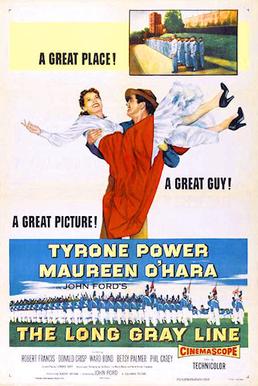
The Long Gray Line

Through all his films, a common, somewhat unexpected link bonds the movies of director John Ford.  It's not cowboys vs. Indians or John Wayne, Henry Fonda or Richard Widmark, but a sense of family and the importance of staying close to those you're related to. One of 11 children from an Irish family, Ford's beliefs filtered into his movies.  The stories, the settings, the characters, the famous John Ford stock company of supporting actors and actresses, Ford for all his aggression and belligerence was a family man.

When comparing his movies, it's easy to overlook his non-westerns.  When in front of a Congressional hearing, Ford even introduced himself saying "I'm John Ford, I make westerns."  But over a career that spanned decades and over 100 movies, it's unfair to just say he was a good director of westerns.  He was a good director for all his faults and tendencies that can drive me nuts at times.  Maybe the best example of a Ford movie -- non-western -- is 1955's The Long Gray Line, a departure from the expected Ford movie but still similar in many ways. 

An Irish immigrant fresh off the boat in New York, young Martin Maher (Tyrone Power) travels to the United States Military Academy at West Point in upstate New York. He enlists in the army and right away begins helping the cadets, some just as a mentor, others as an instructor in classes.  Marty can be a bit of a klutz, a bit of a doof at times, but when the chips are down, he's a good friend and a better man.  The years go by, and Marty continues to reenlist while also marrying Mary O'Donnell (Maureen O'Hara), a pretty redhead from Ireland. They send for Marty's family from Ireland (father Donald Crisp, brother Sean McClory) and life continues, the whole family together again.  And so the years go by, West Point unchanging as the world changes around it in the first half of the 20th Century.

When Ford gets it right, he typically hits a home run, and this qualifies in many ways.  One review described it as a "very Irish" movie.  And somehow that description is dead on more than just the main characters being Irish.  It's about family and sticking together through thick and thin.  More than that, it's the extended family you make in your life.  All those things that drive me up the wall are here, but whether he realized it or not, Ford reins it all in.  It never gets to be too much.  The story is downright sappy at  times, but I don't think Ford ever intended to do anything but that.  For the most part, it hits all the right notes, happy, sad and everything in between.

This was never an intentional slight, but this was the first Tyrone Power movie I'd ever seen from beginning to end.  I never had a negative idea of Power as an actor, but I guess it's fair to say it wasn't particularly positive either.  Above all else, Power's performance here as Sgt. Martin Maher is the reason to check this one out.  Marty is one of the most likable characters ever, willing to help whatever and whoever needs his help.  We see this over the years the impression he makes on his cadets who end up looking at him as a father figure, or at least a big brother looking out for their best interests.  Power gives Marty some funny bits, nails the emotional scenes, and handles an Irish accent that if handled poorly could have derailed the part.  A great performance to lead the movie.

Mentioned earlier, Ford's stock company of actors was a long list of actors/actresses the director worked with on repeated times.  If you've seen more than one Ford movie, you've no doubt seen these faces whether you knew it or not.  'Gray Line' is full of these folks, starting with O'Hara in a perfectly cast part as Marty's tough-minded wife Mary, an ideal match for the equally strong-willed and tough-minded Marty.  Crisp isn't in the movie for long but certainly makes quite an impression as Marty's old school Pops.  My favorite of the stock company has always been Ward Bond, and he doesn't disappoint as Major Keeler, Marty's commanding officer. Also look for Ford regulars Harry Carey Jr. and Patrick Wayne along with Robert Francis, Peter Graves, Philip Carey and William Leslie filling out some meatier supporting parts.

Only one complaint here, and I'll keep it brief.  A story that covers 50-plus years in 140 minutes can't help but feel a little episodic, a little disjointed.  Characters go in and out at will, no explanations offered, but the link through all the slower moving segments is Power as Martin Maher.  Throw the performances in with some great on-location shooting at West Point that help sell the tradition and honor of the academy, and you've got a winner if not quite a classic.

The Long Gray Line <---trailer (1955): ***/****

Friday, May 21, 2010

Cheyenne Autumn

A solid director early in his career, John Ford shot to stardom behind the camera thanks to success in one particular genre, the western.  Starting with Stagecoach in 1939 and continuing into the 1940s with his 'cavalry trilogy,' Ford became a go-to director westerns that he was able to put his own personal -- often romantic -- look at the American west in the latter half of the 19th century.  And in almost every one of these westerns, Native Americans were portrayed in a negative light, whether as a fearful presence or as murdering on-screen savages.

With his last western, 1964's Cheyenne Autumn, Ford did an about face in terms of the depiction with something that has since been dubbed 'white man's guilt.' Based on a true story, the movie attempts to put Native Americans in a positive light instead of the stereotypical savage so often associated with westerns.  It's a noble concept and feels like a bit of an apology on Ford's part, but too many things work against this movie from the start, ranging from the casting to the dull, slow-paced storyline.

It's 1878 and 300 members of a Cheyenne tribe on a reservation in the southwestern desert have had enough.  They don't receive supplies promised to them -- food, clothes, medicine -- and are basically being ignored by the U.S. government.  Led by two proud warriors (Ricardo Montalban and Gilbert Roland), the Cheyenne leave the reservation in the dead of night with hopes of marching almost 1,500 miles north to their ancestral hunting grounds in South Dakota and Montana.  Pursuing them is a cavalry outfit led by the sympathetic Capt. Archer (Richard Widmark) who tries his best to bring the Cheyenne in peacefully.  Nothing comes easy though and the terror sets in of 300 Cheyenne roaming the west in towns all along their trail.

To tell this story, Ford assembles a remarkable cast but as is so often the case with huge casts of big name stars, many are lost in the shuffle.  Along with those mentioned already, there's also Karl Malden, Edward G. Robinson, Dolores Del Rio, Carroll Baker, Jimmy Stewart, Arthur Kennedy, Sal Mineo, George O'Brien, and Sean McClory, along with several others I'll mention later.  Needless to say, that's a ton of talent involved, but the odd thing is almost NOTHING happens the entire movie.  It's downright dull at many points and never really gets the viewer invested in what's going on.

First off, the story does represent the Cheyennes in a positive light as a tribe just trying to survive now that their heyday has passed.  But then Ford spends a majority of the time with the white characters as the Cheyenne tribe disappears here and there for long stretches.  There's also the issue of casting Hispanic actors as Indians which just doesn't make much sense to me.  I figure there weren't many Native American actors working in Hollywood in the 1960s, but for a story trying to be authentic and fair, it would have been worthwhile to cast one or two.  Montalban and Roland represent themselves well as the warriors leading the tribe while Mineo says two or three words and enthusiastically takes his shirt off at one point.

One criticism of Ford over his career is his bawdy, broad humor that populates his movies, and Cheyenne Autumn doesn't disappoint.  About 90 minutes in, a 20-plus minute segment takes a complete detour from the story for some incredibly out of place humor in Dodge City with Stewart playing Wyatt Earp and Kennedy playing Doc Holliday.  Besides being incredibly miscast as the famous gunfighters, the tone of this extended segment is comical and over the top.  The tone to this point has been downbeat if not entirely interesting, and we get a segment here that is ripped right from any of the cavalry trilogy.  This comedic segment is so out of place that it can be difficult to watch in its badness.

What I enjoyed most about this movie were the scenes on the trail with the Indians or with the cavalry pursuing them.  Widmark makes the most of a part that just doesn't give him much to do, but Ford seems incredibly comfortable in the cavalry scenes.  Patrick Wayne (the Duke's son) plays Lt. Scott, a young officer out for blood, Mike Mazurki plays the veteran sergeant, and in a nod to Rio Grande and She Wore a Yellow Ribbon, Ben Johnson and Harry Carey Jr play troopers Plumtree and Smith. A running bit between the two has Archer consistently forgetting Carey's name.  Both parts were uncredited ones for the veteran character actors. Maybe because it feels like a throwback to better westerns, but the cavalry portions of the story are infinitely more watchable than much of the rest of the movie.

For all its flaws, 'Autumn' is still worth watching just to see that huge cast work together and as is typical with a Ford western, the Monument Valley scenery.  Through all the movies ever shot there, I don't know if its ever looked better serving as a backdrop for the story.  Overall though, this is an average movie from a great director like Ford.  It's too inconsistent to call a good western, but one that fans should still see.  A disappointing but intriguing last western from one of the genre's best.

Cheyenne Autumn <----trailer (1964) **/****    

Monday, March 22, 2010

Them!

When American forces dropped atomic bombs on Hiroshima and Nagasaki, it was the beginning of a whole new era in terms of world history.  For the next 50 years, the Cold War had the world in a chokehold thanks to the power that atomic and later nuclear weapons possessed.  So who took advantage of this situation?  Why the movie business of course.  What did people really know about these new weapons and the effects they had?  There's still a conspiracy theory that John Wayne died of cancer because he filmed several movies where atomic bombs were tested.

It's just that type of conspiracy that opens the door on 1954's Them!, a movie out of the big bug/animal subgenre that had its heyday in the 1950s and 1960s.  Out in the deserts where these bombs were tested, what really happened?  Directed by Gordon Douglas, this sci-fi classic plays on the emotions and worries of the time because right up there with the 3 C's (Chinese, Cubans, Commies), what was the biggest threat facing the United States?  Big honking bugs and animals bent on destroying civilization as we know it.

Investigating some strange calls, police Sergeant Ben Peterson (James Whitmore) drives out into the New Mexico to find out exactly what's going on.  Along with his partner, Peterson finds crime scenes with no rational explanations, and the only evidence points to an unidentifiable print in the sand.  Zoology experts (Edmund Gwenn and Joan Weldon), along with some help from FBI agent Robert Graham (James Arness), pick up where Peterson left up.  The motley quartet find that the damage is being done by gigantic ants as big as 15 feet long.  Keeping the news under wraps, they manage to destroy one nest of ants only to find out that two queen ants escaped and have headed west.  Can our motley group of heroes save the day before mankind is destroyed?

In a word...yes.  Did you really think the gigantic bugs were going to beat America?  Come on now.  This is a movie that definitely needs to be viewed with an awareness of when it was made.  The perception that Russia or Cuba could attack at any minute was all around in the 1950s, and more than that, no one was quite sure the effects of the a-bombs or how much damage they really did.  So here with the story, the a-bomb testing had a profound impact on nature, making normal desert ants into enormous killing machines.  It sounds ridiculous -- especially writing the plot synopsis -- but because it is handled seriously without even a tiny bit of a sense of humor, the movie works.

This has all the necessary makings of an enjoyable B-movie, starting with the giant ants.  Without the benefit of computerized special effects, the filmmakers had to create these giant killer ants so they'd appear frightening on-screen.  Credit for originality if not a whole lot of scares just by appearance.  Instead, they decided to have these ants make a shrill, high-pitched noise that surprisingly works a lot better than actually seeing them.  The noises provide a strong sense of foreboding, and that something mysterious and unknown is lurking out of sight (like Cubans or Russians) waiting to attack when the opportunity arises.

Because the story is handled so seriously, 'Them!' is more of a genuine enjoyment movie opposed to a campy, so bad it's good movie.  Always reliable character actors Whitmore and Arness (pre-Gunsmoke) lead the cast and make the most of an average script.  Full-fledged, 3-D characters these are not, but with pros like Whitmore and Arness you don't even notice.  They commit to their parts, and in doing so, help us commit to what could have been a ludicrous movie.  Gwenn (Santa in Miracle on 34th Street) doesn't look well but is only expected to spout off lines about the dangerous ants with his daughter Weldon not making much of an impression.  Also starring are Sean McClory as Major Kibbee, a pilot working on the project, Onslow Stevens as General O'Brien, the Army representative, and Fess Parker as Alan Crotty, a farmer who stumbles across these eastbound traveling giant ants.

If this makes any sense, the last 40 minutes plays like a chase scene you will have seen in any number of movies; cop, western, adventure.  Except instead of chasing a crook, we're chasing two queen ants capable of producing thousands of eggs.  The chase leads to the storm drains off the Los Angeles River with Douglas filming on locations used years later by Grease -- among many other movies.  It's a solid finale as Widmore, Arness, and a lot of soldiers search the storm drains for signs of two children trapped somewhere in the ants nest.  Don't expect greatness out of this one, and you'll almost certainly enjoy it.  You can watch it starting here with Part 1 of 10 at Youtube.

Them!...<-----trailer (1954): ***/****