The Sons of Katie Elder

The Sons of Katie Elder
"First, we reunite, then find Ma and Pa's killer...then read some reviews."
Showing posts with label Apocalyptic. Show all posts

Thursday, November 21, 2013

World War Z

Thanks to AMC's The Walking Dead (among other things), the zombie genre has gotten an energy boost the last couple years from film to books to TV shows. I read Max Brooks' World War Z and loved it, an interesting twist on the zombie genre, most of all a smart, well-written book not interested in horror(ish) shock value. It was apparent the book just couldn't be adapted for one feature length film, making me suspicious of 2013's World War Z. Long story short? It has little to do with Brooks' novel, but it's pretty good just the same.

A former United Nations employee, Gerry Lane (Brad Pitt) lives in Philadelphia with his wife, Karin (Mireille Enos), and their two daughters. Caught up in traffic driving to work, Gerry and his family are caught up in mass chaos, seemingly deranged human beings attacking other ones at will. The Lanes manage to escape the city and all its death and violence, Gerry getting a call from his former boss with the U.N., Thierry (Fana Mokoena), asking him for help. The attacks are not an isolated events, something happening across the world, thousands and maybe millions of people dying. What's going on? The word 'zombie' is beginning to pop up, the undead attacking live human hosts, the victims then turning into zombies themselves. Working with survivors among the military and government, Gerry is tasked with finding a solution; a clue, a lead, something that will help the human race survive. The world is tearing itself apart. Can Gerry survive long enough to find those desperately needed answers?

The difficult part of Brooks' novel is that it isn't a novel, but an oral history. It is a series of interviews with people who survived World War Z -- the zombie takeover -- and what they saw. We meet common people, government officials, brilliant minds working to combat the zombies, military, medical staff and everything in between. We see nothing live, simply hearing about it later. There is a subtle brilliance to its storytelling device. The trick then...how does any two-hour film somehow manage to pack all that detail on a worldwide level into such a short run-time? Basically, it doesn't. The film makes a valiant effort to do so -- Pitt's Lane globe-trotting to find a solution/cure -- but if you're looking for a literal, spot-on adaptation of Brooks' novel, you're going to be disappointed. Take solace in the fact that the movie is still really good.

What I liked about director Marc Forster's film is that it doesn't spell everything out for us in crystal clear fashion, just like the novel. We never find out exactly what caused the zombie takeover, whether it be a disease, a virus, Mother Nature rearing its ugly head. Early on, we don't see the zombies directly, just blurry motion as they race by the camera. It's only as Gerry learns what's going on that we start to see these undead attackers head-on. A doctor (Elyes Gabel) does a great job with a monologue that lays out what's going on, and maybe more scary, if there's anyway to stop it. Without explaining every little detail, we get a picture of what's going in the world as the epidemic takes over. We hear in the background that Washington DC is gone, that other cities aren't far behind. I thought that was a really smart movie. We get that big picture, but it doesn't lose the personal element we get from Gerry, his family and those he meets along the way.

As the only cast member who is in basically every scene, Pitt does a fine job carrying the movie. We learn tidbits about his past, but mostly we're in the here and now. With his past work as a respected, trusted United Nations employee on an international level, his Gerry knows how to handle himself in sticky situations. The rest of the cast is an ensemble (a nice nod/attempt to adapt the novel), the people Gerry meets in his investigation. We meet Segen (Daniella Kertesz), a young Israeli soldier, Capt. Speke (James Badge Dale), an Army officer with a small crew of surviving soldiers in Korea, Warmbrunn (Ludi Boeken), an intellectual helping Israel survive the epidemic, David Morse as an ex-CIA agent caught up in Korea, (Pierfranceso Favino), a World Health Organization doctor in Wales, and Tomas (Fabrizio Zacharee Guido), a young boy caught up in the chaos with the Lanes from Newark. Even Matthew Fox makes a blink and you'll miss it appearance as a parajumper who helps the Lanes. The variety of the people we meet does help give a touch of what Brooks' novel did so well.

The scale is pretty impressive, as it should be with a film featuring a $190 million budget. We go from Philly to Newark to following the U.S. Navy in the Bahamas to Korea, Israel and Wales. There are some pretty impressive set pieces, especially the initial takeover in Philadelphia and a surprising attack in a walled-in Jerusalem. A nighttime encounter with Speke's troops at an isolated base in Korea is the most action you'll see, small scale but unsettling and highly effective. The same goes for the finale in a half-infested W.H.O facility, Lane and several doctors trying to navigate their way through its sterile, fluorescent hallways. It's the finale that was supposedly re-shot by Forster and his crew (at quite the cost), replacing this finale with an epic zombie vs. human battle in Red Square in Moscow. I'd be curious to see that ending, but this one's pretty cool too on that smaller scale.

So there we are. I think this zombie flick is missing something from being a classic, but that didn't take away from a very entertaining, very tense movie. I really liked Brad Pitt leading the ensemble cast in a movie that does a good job balancing out the large scale with the personal. Also worth mentioning is Marco Beltrami's score (listen HERE) as well as dropping in some songs from one of my favorite musical groups, Muse, including Isolated System and Follow Me. Both provide some nice electronic touches to Beltrami's very solid score. Well worth checking out, whether you're a fan of the book or not.

World War Z (2013): ***/****

Tuesday, February 19, 2013

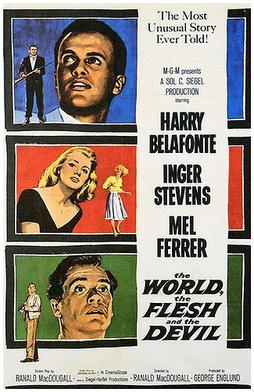
The World, the Flesh and the Devil

With the fear of an atomic apocalypse in the air in the late 1950s and early 1960s, Hollywood took the message to heart, making several movies about the topic, some obviously better than others. As I think of them though, the stories follow the lead-up to that apocalypse. It's only until recently we get more stories about the follow-up to that apocalypse. Well, that's not completely fair, like 1959's The World, the Flesh, and the Devil.

Inspecting a coal mine in Pennsylvania, Ralph Burton (Harry Belafonte) is trapped far underground with seemingly no help coming. He hears diggers working toward him, but several days pass, and the digging stops. Ralph decides to dig himself out, but he's stunned by what he finds. There is no one....anywhere. The world is seemingly empty. Ralph finds newspapers that say atomic weapons were exploded all around the world, and that the entire population of Earth was wiped out in the process. Ralph could be the last human being on the planet and heads for New York City to set up a sort of base to operate out of. He creates a life for himself, gathering supplies, working a radio transmitter, and trying to stay sane. But as the days turn into weeks and then into months, Ralph begins to wonder if he's really on his own.

Days after reviewing The Last Man on Earth, here comes this similar drama from director Ranald MacDougall. If you've seen any of the movies based off Richard Matheson's I Am Legend, this 1959 doomsday science fiction flick will no doubt seem a little familiar. Thankfully though, it is its own movie despite the familiarities among the novel and future films. Not surprising though, 'World' works best on a personal level. If you found yourself completely on your own, how would you react? Would you freak out? At what point would you start to lose your mind? The early portions of the film especially reminded me of a Twilight Zone episode, Where Is Everybody?, where a man finds himself in an empty world. That's the movie at its best and strongest.

That's where part of the familiarity will no doubt come into play. When Ralph finally does emerge from the coal mine, it's a frightening reveal. The movie never once shows a corpse following the apocalypse which may sound like an odd choice, but call it a nice use of artistic license. If we see bodies, it's a different response. Don't see bodies? Ralph truly is alone. The first half hour is an incredible look at an isolated, alone world. During filming, the crew had to start shooting in the early, pre-dusk hours before anyone actually woke up in NYC. We get some truly unique -- even unsettling -- shots of Manhattan and NYC as Ralph makes his way and explores the city. Watch some of the scenes HERE. His exploration of the city is accompanied by composer Miklos Rozsa's memorable score (somewhat reminiscent of his King of Kings score), working together with the visual to create the film's best and most memorable scenes.

It seems though as things go with these post-apocalyptic movies, you can't just leave well enough alone. Semi-SPOILER As Ralph explores NYC, he meets Sarah Crandall (Inger Stevens), a fellow survivor who managed to get into a chamber that protected her from the atomic blasts. Possibly the last two surviving people on the planet, they form a quick friendship, and eventually more, maybe even love. Now, yes, I get it, this movie was released in 1959 in the midst of the civil rights movement, and a relationship between a black man and a white woman would have been rather scandalous (totally wouldn't be now though, right?). The story takes this down a weird road though. There's no one else around. No One. End of the world and all, right? Ralph is so ingrained with how things are in the world that even with absolutely no one around to judge him, still doesn't pursue a relationship with Sarah because he's been taught it's wrong.

Apparently according to Belafonte's biography, the studio/writers/actors had to deal with some interference from above because a black-white relationship in a movie would have been just too much for audiences to handle. I suppose that's fair, but the movie struggles in the second half because of this alteration. The acting becomes odd, wooden, forced and unintentionally uncomfortable. That uncomfortable quality is amped up when a third survivor, Benson Thacker (the very white Mel Ferrer), arrives on the scene. Wouldn't you believe it? Benson falls for Sarah too, and the single Sarah is torn on what to do. You've got to be kidding me. A post-apocalyptic story about the last three people on Earth turns into a love triangle?!? The ending certainly gives some hope for the three -- and with a bigger message; mankind itself in the 1950s/1960s -- but getting there can be a trial.

Loved the first half, got through the second half in this 95-minute sci-fi flick. The performances are solid across the board, and the setting and on-location shooting bring it up a notch. Just know that this movie could have been so much more.

The World, the Flesh and the Devil (1959): ** 1/2 /****

Wednesday, December 5, 2012

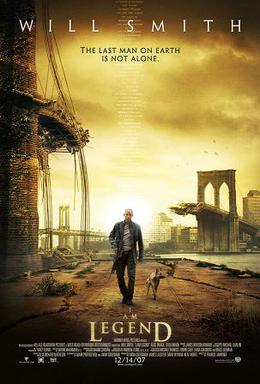
I Am Legend

First written by author Richard Matheson in 1954, 'I Am Legend' is a gem of a book, a story that genuinely creeped me out and sent shivers up and down my back. Movie studios saw potential, and they've gone to the well a handful of times, including the most recent effort, 2007's I Am Legend.

It's been three years since a genetically-mutated medicine reversed its positives and wiped out some 94% of the world's population. Like a disease, it spread, turning normal human beings into mutants, Darkseekers who cannot step into any sort of light. In a silent, completely alone Manhattan in New York City, Dr. Robert Neville (Will Smith) fears he is the last man on Earth. Neville is somehow immune to the disease that affected so many, and now lives on his own, his dog, Sam, a German shepherd, his only companion. They travel through NYC looking for supplies, for help of any sort. All the while, Robert keeps working at a cure, hoping that his blood holds the key to stopping the disease spread.

As bankable a star as Hollywood currently has, Will Smith is the main reason to go see this 2007 science fiction-horror-apocalyptic story. At times, it's easy to think of him as a movie star and not an actor, but he's shown on multiple occasions he is truly an actor. As the last man on Earth, the focus in on Smith's Neville and no one else. He dominates the screen. Dropping into this story some 3 years since the disease, we see Neville's routine from day-to-day. Survive, supply, search and get back home to a fortified house on Washington Square before the Darkseekers come out from their daylight hiding places. In quick flashbacks, we see Robert's involvement in the evacuation of Manhattan, adding another layer to the character. It has to be an actor's dream to have a role like this, and Smith doesn't disappoint.

Most importantly, Smith's performance feels very real. Yes, it's a movie. Yes, he's working off a script, but it feels like a human being would react. Imagine being alone with no one to talk to for three years, but a loving dog that rarely leaves your side. Neville has set up mannequins around NYC and named them, talking to them every day, wondering if he should flirt with a "cute girl" at the video store. He goes to that video store and picks up a different movie everyday (he's working his way through the 'G Section'). Neville hunts -- for food and Darkseekers -- and waits at a specific point each day in case anyone listens to his radio broadcasts. The pressure becomes almost unbearable for him, and rightfully so. The spotlight is on Will Smith, and he certainly embraces it here in a sympathetic, heartfelt, and emotional role.

So what else? The look of this film from director Francis Lawrence is a lynchpin to everything working. The opening sequence is startling especially, laying out the groundwork for the story to come. Driving a souped-up Mustang, Neville and Sam drive through an empty NYC. They're hunting for deer, passing completely isolated, empty streets. Cars line the curbs where they were left. Buildings tower over them, no one inside at all...no one human at least. Seeing New York City like this provides some truly amazing shots. I especially liked composer James Newton Howard's score, his main them in particular. Listen HERE. It is underplayed in a perfect way. Everything about the movie could have been big, loud and obvious, but Lawrence's direction, Howard's music and Smith's acting keep things grounded.

All those positives aside, there are some negatives. The first 60-70 minutes are pretty perfect. The last 30-40 minutes aren't. SPOILERS from here on in SPOILERS We learn that Neville isn't alone when he is rescued one night by Anna (Alice Braga), a woman in her late 20s/early 30s, and Ethan (Charlie Tahan), a young boy, who have similarly managed to survive. Maybe it's just because the focus isn't entirely on Neville anymore, but there's just little interest in seeing Anna and Ethan's plight. The pacing up to this point is perfect, doing a great job of building tension and keeping you guessing, but the last 30 minutes (especially the ending) feels rushed. It ain't a happy ending either, but that wasn't an issue. It works in a big way, tweaking Matheson's original ending, but that's to be expected. It would have been hard to sustain the momentum throughout, but 'Legend' gets close.

An incredibly creepy, well-acted sci-fi horror flick. There are flaws, but the positives outweigh the negatives. I loved Smith's performance, and that rises above any other issues I have.

I Am Legend (2007): *** 1/2 /****

Saturday, September 8, 2012

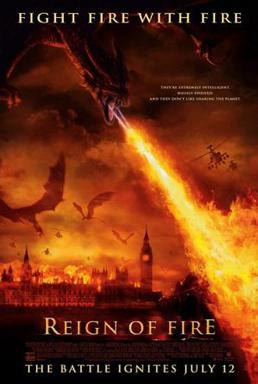
Reign of Fire

Usually post-apocalyptic movies like to throw some natural calamity at us. If it's not nature -- an epic tsunami, a world-ending storm -- then it is something man-made. How about something else though, something different? How about dragons? Yeah, I thought it sounded kind of silly too. I never consciously avoided 2002's Reign of Fire, but I never actively sought it out until recently. While reviews and ratings are mixed, I liked it.

It is 2020 in the countryside outside of London, and a man named Quinn (Christian Bale) is leading a small group of survivors in the ruins of a castle. For some 20 years, immense, destructive dragons have been wreaking havoc all over the Earth, and now the few remaining people have been forced to band together to survive. Hoping to defeat or at least outlast the dragons, Quinn and his group are surprised one day to see an armored convoy approach their gates. Leading this American contingent is Van Zan (Matthew McConaughey), an obsessed dragon slayer hell bent on wiping out the dragons. The two men differ on what to do. Quinn wants to survive, Van Zan wants to go on the hunt. The right answer? Somewhere in between, forcing the men to work together.

Maybe the biggest reason I never sought this flick out was that the premise just sounded too silly. Dragons wiping out mankind? Desperate, poorly-supplied survivors trying to fight back? I don't know. Maybe I was thinking of Pete the Magic Dragon from growing up, but it didn't sound too appealing. Well, I was wrong. I liked it (didn't love it) because director Rob Bowman keeps it serious. If anything, even a little humor -- dark though it may have been -- would have aided the cause. But as is, it's an end of the world story. The backstory with the dragons is actually pretty cool, the creatures periodically coming from the depths of the Earth to ravage the planet, then retire back to deep, cavernous cavities. It isn't anything ground-breaking, but it's better than what I expected.

Playing the two leads, Bale and McConaughey provide an interesting Odd Couple at the forefront of the movie. A pre-Batman Bale is the more sympathetic (if not more interesting) of the two; a grown man trying to help other survivors keep living one more day. As a boy, he saw his mother killed when the first dragon escapes from under London. He's spent the rest of his life trying to right that wrong. The scene-stealing, more showy part goes to McConaughey as Van Zan, an American military officer obsessed with defeating dragons. His look alone -- Mad Max meets Neo-Nazi -- with a shaved head, heavy native tattoos on his arms, sleeveless bomber jacket, wicked goatee, and big old biceps is enough for a badass, but I thought McConaughey does a fine job with the character. He sneers and growls, giving Van Zan quite that dramatic edge.

Also look for a pre-300 Gerard Butler as Creedy, Quinn's long-time friend and right hand man, Izabella Scorupco as Alex, Van Zan's highly trained and effective helicopter pilot, Scott Moutter as Jared, a teenager Quinn saved as a young boy, and David Kennedy, Alexander Siddig and Ned Dennehy as three of Quinn's men who help him combat the dragon attacks.   

Post-apocalyptic. That must mean the world looks pretty dreary, right? The look of the movie certainly reflects that sentiment. It's a dreary, dark, cloudy world without sun after years of fire have ravaged the Earth. 'Reign' was filmed in Ireland and down to the sets and costumes, it looks like a modern Middle Aged story developing. The musical score from composers Ed Shearmur and Brad Wagner is good in that epic Hans Zimmer vein as well.

So how do you combat fire-breathing dragons? Well, you don't really, and if you try.....it sure ain't easy. 'Reign' has some fun with that issue as Quinn and his survivors basically hide when a dragon appears, but when Van Zan's heavily armed crew arrives, we're in for a treat. His attack on a raiding dragon is a high point of the movie featuring a complicated, suicidal plan. The action overall is the best part of the movie, and the finale in a desolated, demolished London is surprisingly cool too. Does this one deserve the rating I'm going to give it? Maybe not, but I liked it just the same. Entertaining, exciting rainy day type of movie that's good with a bucket of popcorn.

Reign of Fire <---trailer (2002): ***/****

Tuesday, August 10, 2010

On the Beach

Not having lived through the Cold War, it's hard to fathom a life that always had a death cloud hanging over the world.  If the U.S. and the Soviet Union did decide to go to war, it would have been over in minutes with no real winner thanks to weapons that guaranteed both sides would be wiped out.  There was always that threat, that looming danger of what could be.  Movies like Fail Safe, Dr. Strangelove, and The Bedford Incident are just some of the movies that have dealt with this subject, but it's the rarer film that deals with after that big what-if, like 1959's On the Beach.

An American submarine commanded by Capt. Dwight Towers (Gregory Peck) surfaces off the coast of Australia and docks.  A nuclear holocaust has wiped out most of the world's population, but Australia was untouched by the apocalyptic fighting.  Towers and the U.S.S. Sawfish arrive to find a country and a continent not quite sure what to do with themselves.  Scientists and intellectuals predict that Australia has five or six months before radiation from the fallout reaches them, and then it will be a quick process of a week or two before all survivors are killed too.  With possibly months to live, what do you do?  Towers and his sub head north to see if there's any hope of survival, that the radiation may miss Australia.

First off, this has to qualify as one of the most depressing movies I've ever seen.  Director Stanley Kramer creates quite a vision of what a post-apocalyptic world would be like. The whole purpose of the movie is to ask what would your reaction be if you knew you only had months to live?  The vehicle of a nuclear fallout is how you to that question, but it works just as well dealing with mortality, we're all going to die.  It's just a matter of when and how.  The story is honest and doesn't try to whitewash anything here, these people are doomed and respond in different ways.

We see these reactions through a wide range of characters.  Peck's Towers lost his wife and two kids back home but sees similarities in an Australian woman, Moira Davidson (Ava Gardner), who has nothing and no one to live for. A young navy officer (Anthony Perkins) deals with his wife (Donna Anderson) who refuses to admit that anything is wrong, and that down the road to avoid unspeakable pain she may have to take her life and that of her baby.   An older scientist/doctor (Fred Astaire) copes by drinking and working on a Ferrari sports car he's purchased. No one reacts the same way, all responding individually to this horror that is presented.

Some moments provide these powerful instances of how the individual would respond.  While patrolling outside San Francisco, Towers' sub has a member of the crew (John Meillon) who is a native of the city escape from the sub and swim ashore, knowing he will die in a matter of days instead of months waiting back in Australia.  He tells Towers he wants to die at home, not in some strange place.  The scene where the sailor talks with Peck (via loudspeaker) is an incredibly moving one.  Just as moving, a scene where Astaire explains how this probably all started; one man probably looking at a computer screen swearing he saw a blip, an attack, and pushing the button or turning the key to assure the mutual destruction.  Kramer's film has a lot of these powerful moments, both those two stand out from the rest. 

For a movie that deals with the end of the world as we know it, in other words an epic scale, it also a very personal movie.  It depends on your reaction to the end of the world, your feelings about knowing that death is coming and there's nothing you can do about it.  My worry about halfway through the movie was that Kramer was waiting to pull the rug out from under the viewer, provide some sort of ridiculous solution that will allow these people to survive.  My worries were unfounded, Kramer is too talented of a director to do that, force some happy ending on the viewer for a story that needs to have an unhappy one.  The last 10 minutes are a perfect ending -- watch HERE -- including a final, very timely warning to 1959 viewers.

My one complaint, a minor one at that in relation to the whole movie, is that no one in Australia really tries to do anything to ensure survival.  With five or six months, much could be accomplished whether it's bomb shelters or finding some protection from the radiation.  Maybe it's naive to think that, probably only saving a few extra weeks or months, but all of Australia is content to go on with their lives as normal, drink a lot, go to the beach.  Everyone just seems freakishly calm, no riots, no looting.  They're all very mannerly about the end of the world.  A minor flaw in an otherwise really effective movie, but one I felt I had to point out.  Don't let it stop you from checking this one out.

On the Beach <----TCM trailer (1959): *** 1/2 /****

Monday, June 7, 2010

The Road

Read enough of an author's work, and I've always thought you get a decent look at their outlook on life.  More specific than that, look at the endings to books/novels/short stories, and often enough you get a window into their heads.  I've read four of Cormac McCarthy's novels and realize it's impossible to peg this guy down.  In 'No Country for Old Men' and 'Blood Meridian,' the endings are cynical, incredibly dark and pessimistic.  McCarthy is not one to write a happy ending, but for 'All the Pretty Horse' and 'The Road' there are endings that at least offer hope.

Most recently, The Road was made into a feature length movie of the same name in 2009.  Granted, it was in theaters for about 90 minutes -- if at all on Chicago's Southside -- so I didn't get a chance to see it, but the movie hit DVD last week.  The book is a critical favorite, and McCarthy shows his ability to spin a simplistic story that can still be profound (maybe because of its simplicity).  When I found out the novel was being made into a movie, I was suspicious at first.  This post-apocalyptic novel is not full of action or dialogue, and to tell you the truth, not much happens at all.  But somehow, just like the source novel, the film is worthwhile almost in spite of itself at times

Director John Hillcoat has made a movie that creates a tangible, very real look at what a post-apocalyptic world would look and feel like.  He filmed all over the U.S. including Pennsylvania and Oregon and drops the viewer into this world.  The only color we ever see is in a few quick flashbacks to a pre-apocalypse world while everything else is shot in shades of gray and brown.  Nothing specific is ever mentioned as to what happened to the world, but plants are dying, animals are seemingly extinct, and the sky is always covered in dark, gloomy clouds.  As one character points out, the world is dying, and we are too.  Uplifting message, huh?

In this dreary God-forsaken world, a man (Viggo Mortensen) travels along the vacant roads with his young son (Kodi Smit-McPhee) just trying to survive from day-to-day.  Food and water are scarce, and they trudge along looking for anything that might help them survive.  It's been years since something happened to the world and almost destroyed civilization, leaving very few people alive.  Those that are left? Some are like the father and son doing their best to survive.  Others have joined together into roving gangs ready and willing to kill for any reason.  The father and son travel south, hoping to eventually reach the coast and hopefully find a better place.  But in this world, there's no guarantees of anything.

McCarthy's novel is simple and to the point in creating this sparsely-occupied world.  Translating that to a 2-hour movie is/was a daunting task if you ask me because whole stretches in the novel are just descriptions of the things they find and places they walk through.  That's really my only issue with the movie.  To call it leisurely paced is a huge understatement.  I realize the movie's trying to tell us and show us how these two people survive in this world, but it drags in a big way.

The movie is at its best when dealing with the trials and tribulations father and son must make their way through.  Very few people are still alive, but when they do find them, it's every man for himself.  It is kill or be killed, and look out for the individual first.  In this vast, desolate world, someone trying to kill you could be anywhere waiting for their chance.  When these moments do come along, they're the type of scenes that can send chills up and down your back like no thriller/horror movie ever could.  These scenes show how alone this father and son really are.  No one's there to help them.  They're on their own.  Maybe that's the purpose of the slower scenes -- to lull you into a comfort zone -- and in that sense, the deliberate pacing works.

Viggo Mortensen, besides having basically the coolest names ever, is one of the best actors around, and this is a performance that lets him show off his talent.  His sole goal in life is not for himself to survive, but to help his son survive and keep going.  This is a man who's survived for years -- and looks it too -- who is driven by that one desire and goal to help his son.  13-year old Smit-McPhee is impressive as well in his first big-budget movie.  This is a boy who doesn't know any other existence, but still has a humanity and a belief in morality as they cross this ravaged world.  Other parts include Charlize Theron (only in flashback) as Viggo's wife, Robert Duvall as Ely, a 90-year old nearly blind man they meet on the trail, and Guy Pearce and Molly Parker as a man and woman traveling south too.

As for McCarthy's ending, the movie sticks pretty close to what the novel presented.  And as depressing as it could be taken, it offers some semblance of hope.  All these apocalyptic, dystopian stories almost have to end with a remnant surviving, one last pocket of humanity that offers some sort of hope for the future -- however bleak that future may be.  The moral of the story is this, I can't get a read on McCarthy at all, and maybe that's a good thing.  His novels aren't always easy to read, and the movie translations can be difficult at times, but in the end they're worth it.

The Road <----trailer (2009): ***/****

Tuesday, March 9, 2010

2012


Watching his movies, I can't help but wonder if Roland Emmerich would have been better suited if he was born about 20 years earlier.  That way, his success in disaster movies would have coincided nicely with the 1970s epidemic of disaster movies.  To his name, he already has Godzilla, Independence Day, The Day After Tomorrow, and now 2012, all dealing with some sort of disaster of epic proportions.  Of course, all of these movies use CGI heavily so where would the German actor be?

I feel the need to point this out so I don't come across too critical, but Emmerich's movies are awful.  (How could that be construed as critical?).  Even his good ones like The Patriot, Stargate, and the ones mentioned before are awful movies.  Just about all of them qualify in the always entertaining 'so bad they're good' category and count me among the moviegoers who enjoyed these schlock fests.  But with his most recent outing, last fall's 2012, I think Emmerich finally hit rock bottom.  It's beyond 'bad but good' and produces so many unintentional -- I hope -- laughs that I'd recommend it for the comedy, not the drama.

Now as the year 2012 draws closer, more and more is being made of the ancient Mayan calendar predicting the end of the world, the apocalypse.  Emmerich takes the idea and runs with it, going from zero to 60 like nobody's business.  An American geologist (Chiwetel Ejiofor, one of the few bright spots in the movie) working with a friend in India finds out the Earth's core is beginning to heat up.  He informs his government superior (Oliver Platt in prime a-hole mode) who then passes it along to the president (Danny Glover).  Fast forward three years to 2012, and the predicted cataclysmic events come earlier than expected.

A divorced dad (John Cusack) works to save his family as the Earth starts to tear itself apart with volcanoes, tsunamis, and earthquakes all starting at once.  It's while vacationing in Yellowstone with his two kids that Cusack's all-American dad starts to catch wind of the coming disaster, but he shrugs off the warnings of a conspiracy theorist (Woody Harrelson) spouting off about the coming disasters.  The crazy guy is of course, correct, forcing divorcee dad to keep his family alive...somehow....some way.  From the theorist, he heard of a government plan to continue mankind, spaceships outfitted to handle 400,000 people each.  The only problem?  These ships are in China.  Oh, but good news, the new dad in the family has taken flying lessons!  Now let's all find a plane!

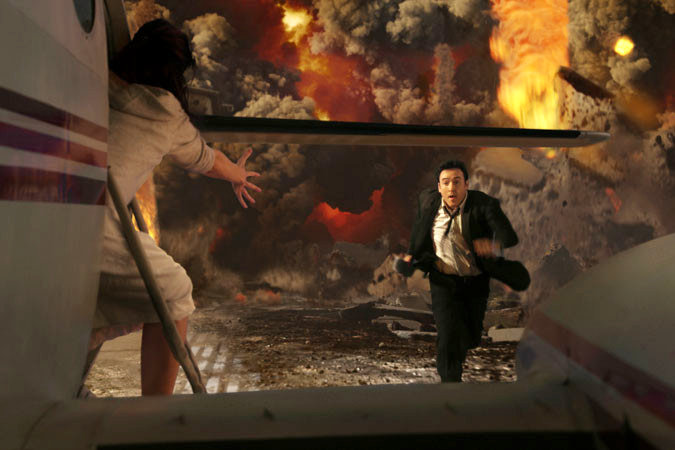
Yeah, yeah, I know no one goes to these big budget disaster movies for the story, but come on, Roland Emmerich.  That's all you've got?  More so than most disaster movies, this one depends on coincidence and huge strokes of luck more than it should.  It's also pretty lazy with four different instances of characters having to outrun deadly death clouds/earthquakes/tsunamis/asteroids, like THIS ONE.  Some of those moments do provide the story's funniest scenes with Cusack scrambling around and looking worried, screaming at anyone who will listen.  I typically like Cusack as an actor, but he was not the right guy for this part.

The cast is full of big names -- as is required in a disaster movie -- who are forced to play cardboard cutouts of characters.  Anyone with half a brain cell can figure out within 30 seconds of a character's introduction if they will or will not survive the disaster.  Divorced dad making up for lost time?  He'll make it, especially cause he's got a cute daughter.  New dad who is an all-around douchebag?  Don't hold your breath.  That's the problem with the whole movie, you can tell where it's going before the movie probably even knew.  Also worth mentioning are Amanda Peet as Cusack's ex, and Thandie Newton as the President's daughter destined to end up with Ejiofor's scientist.  One other observation, do disaster movies require a black president?  Just wondering.

Now on to the good stuff, the CGI.  A sign of good CGI -- for me at least -- is that it doesn't produce groans from audiences when it appears, so basically anything even remotely fake-looking.  Emmerich spares no expense (okay, maybe the story) to produce some top notch CGI action.  The apocalypse never looked so good as when Emmerich is directing the story.  Not surprisingly, watch this one for the special effects.  Your viewing experience will almost certainly be more enjoyable with friends and beer too.  Brace yourself though, it's a long movie at 159 minutes.  And don't trick yourself into thinking it'll fly by, there are times (basically any dialogue scene) that are painfully slow.

Saving the best for last though, the ending.  Cusack saves the day and helps one of the spaceships -- they're actually arks -- survive.  A title cards reads 'Day 27....Year 01'  (pretentious much?) as the three remaining arcs sail around the world, or at least what's left of it.  We learn that Africa, the whole damn continent, wasn't affected at all by the natural disasters.  Not even a little bit, none, zilch, nada.  So actually, the end of the world was only sorta the end of the world.  It's one of the stupidest endings ever...only topped by the alternate ending on the DVD.  No spoilers here, I'll force you to rent/buy it.

A truly awful movie that seems to object to its status as a truly awful movie.  Lots of overacting from some typically talented people, cliched and boring story, and some cool, well-done CGI to balance things out.

2012 <----trailer (2009): */****

Saturday, January 16, 2010

The Book of Eli

Apocalypse movies have been all the rage of late, and why not? Maybe people like to see a picture of what the world we live in is heading for -- possibly that is -- but there's clearly a formula developing as to how to make apocalyptic movies. There's been a recent string of these movies including 2012 and The Road, and most recently The Book of Eli which opened in theaters yesterday.

A combination of Mad Max, The Road and Fahrenheit 451, The Book of Eli appeals to me in the same way many westerns do. The setting is the west in the U.S. some 30 years after 'the flash,' some cataclysmic incident where the ozone layer was torn open and the Earth began to burn. It wasn't a world destroyer though as many people survived, some forming into smaller groups and building communities and towns that dot the country. During the incident -- it's never spelled out although religion is hinted at for being a cause -- a revolution resulted where books, all books, burned. Now a quarter century later the world tries to build up again.

One of those people who survived the blast is Eli (Denzel Washington), a man in his late 30s, maybe early 40s who travels across the country, all the while heading west. In his possession is a leather-bound King James Bible, possibly the last one in existence with all the book burnings. He protects it closely, ready to dispatch anyone who tries to take it from him as he crosses the bleak, vacant stretches of land. One day, he walks into a small town run by a man known only as Carnegie (Gary Oldman) who rules the area because he controls the all-important water supply. In trying to gain as much power as possible, Carnegie has been looking for years for a copy of the Bible and through a young woman, Solara (Mila Kunis), working in his bar finds out that Eli has one. Carnegie wants it and will spare nothing or no one to get it, but Eli has no plans of giving it up easily.

Making their first movie in nine years, the Hughes brothers, Albert and Allen, turn in a strong movie in their return to the big screen. Working with cinematographer/director of photography Don Burgess, the twin brother directing combo create an intensely visual movie full of washed out colors -- almost like sepia -- that give everything a tired, beaten down by the world look. As Eli treks cross-country, it feels like the viewer is in this desert wasteland with him. The desert presents all sorts of dangers like hijackers (Eli's handling of an ambush is a great introductory sequence, one of the better recent action scenes) and an almost complete lack of water.

The action scenes are inspired as Eli equipped with a razor-sharp machete, pistol and pump-action shotgun deals with hijackers, thugs, and Carnegie's men. Unlike many action movies, these scenes are shown in one continuous shot without a cut. So instead of a flurry of quick-cut individual shots, we get one fast yet clear shot of Eli dispatching his attackers. As if those weren't cool enough, there's also a gunfight straight out of the old west as Eli turns to his pistol to get him out of a sticky situation with Carnegie and his demands.

This builds and builds to a phenomenal final 30 minutes. The first 90 are strong and highly enjoyable on their own, but the last half hour takes it to another level. There's one major twist -- think Sixth Sense -- that is hinted at throughout the movie but is handled so well it would be hard to pick up on an initial viewing. I didn't see it coming at all and am still coming around with it. But on a bigger level (no twist involved) it's a very emotional ending, surprisingly so since this movie is being marketed as an action flick, that goes back to what all apocalypse movies have...there will always be a remnant, a group to carry on where others have fallen. This ending features a great cameo from Malcolm McDowell, quite a departure from his Clockwork Orange part.

Starring as a man of few words on a mission, Denzel Washington is phenomenal as Eli. With little in the way of dialogue and even less background, Washington brings Eli to life, a character you find yourself rooting for because somehow you know he is in the right and doing something incredibly worthwhile. When Eli does speak, Washington shows off the old acting chops, especially when he explains how the book came into his possession. An actor more than a movie star, it's always nice to see Washington get to do some heavy-duty fight scenes too. Oldman gets back to his bad guy roots as Carnegie, and Kunis continues a string of movies where she's shown she is more than just shrill Jackie Burkhart. Also worth looking out for is Ray Stevenson as Redridge, Carnegie's right hand man, Jennifer Beals as Claudia, Solara's blind mother, Tom Waits as a suspicious storekeeper, and Frances de la Tour and Michael Gambon as an old married couple Eli meets on the road.

Not overly religious and not quite a straight action movie, The Book of Eli has a little bit of everything for the audience. Great casting, especially Washington and Oldman, help boost this apocalyptic story into something more than just its spare parts. As for the twist, it is one of those revelations that make you want to go back and watch the movie again, see if you can spot all the clues as they're presented. In this movie's case, I look forward to seeing it again because it certainly fooled me the first time around.

The Book of Eli <----trailer (2010): *** 1/2 /****

Sunday, May 31, 2009

Terminator Salvation

Completely out of the blue this week, I went and saw Terminator Salvation with a bunch of family. Actually we bought tickets for Star Trek, but that's a different story. I've seen the first 3 Terminator movies so I knew the story and the background, and maybe most importantly, I've listened to star Christian Bale's on-set rant. That will always be entertaining. I'm kind of in the middle when it comes to Bale. I think he's a really good actor, loved him in 3:10 to Yuma, The Machinist, and Rescue Dawn, but I don't necessarily like him.

And as you look at the previews, trailers, posters and commercials, this movie is presented as Bale's movie, the beginning of the next round of Terminator moves. Bale plays John Connor, the rising leader of the resistance battling Skynet in the post-apocalyptic 2018 United States. For three movies, all we heard about was how John was this great, charismatic leader who must survive to lead the resistance. I hated Edward Furlong in T2, and Nick Stahl was all right in T3 so the precedent isn't that great. We're supposed to believe this character is the savior of mankind, but been given nothing to believe why. John Connor, initials J.C., get it?

It's odd then so much of this movie is spent on other storylines. My guess? Bale's only in about half of the movie's 115 minute running time. As John, he's okay, but it's not his best part. By far, this movie belongs to scene-stealing Sam Worthington as Marcus Wright, maybe the coolest character I've seen in a movie since Tyler Durden. A brief opening scene in 2003 shows Marcus on Death Row, signing a waiver for Dr. Serena Kogan (Helena Bonham Carter, great in a small part) to donate his body to science. Flash forward to 2018 where after a disastrous patrol where only John survives, a man, Marcus, walks out of the rubble. He has a mission, an objective, but even he himself doesn't quite know what it is.

If you've seen the trailer or any number of previews, you know Marcus' secret, but I won't blow it here. I will say his character's turmoil gives the movie some heart, even some depth. As the series looks ahead, and yes, the ending leaves a big opening for more movies, I certainly hope Marcus Wright is included somehow, even more so than John Connor. That's what surprised me about the movie in general, the supporting cast steals the movie. Also worth mentioning are Moon Bloodgood as Blair Williams, a resistance pilot who meets Marcus and believes he can help the effort, Anton Yelchin as Kyle Reese, a young man who will one day become John's father, Bryce Dallas Howard as Kate, John's pregnant wife (formerly played by Claire Danes) and Jadagrace as Star, Kyle's mute traveling partner. And just cause they're cool and generally badasses, Michael Ironside plays a resistance general and rapper Common as Barnes, one of John's men.

Now by this point maybe you're wondering why I even saw the movie. The movie is just there without a lot of reason to get involved. It's not bland, but it's close with some to all of the blame going to director McG. All other things aside, the action scenes are top-notch as John, Marcus, Kyle and Co. battle any number of Terminators. The post-apocalyptic setting in California gives the movie quite a unique look too, like a lot of westerns with the lone gunfighter trying to survive.

Maybe because this story has only been talked about in the previous three movies, with an occasional flashback or flashforward I guess, but T-Salvation didn't quite feel like a Terminator movie. It's a good action movie, but other than the names and some nods to fans of the series, it could have been a stand-alone movie. The Terminators are nameless, just metal robots trying to kill John and Kyle. The Governator himself, Arnold, makes a quasi-appearance but it's so badly done CGI that it's distracting. Other touches gone horribly wrong, the delivery midway through the movie of Arnold's famous line "I'll be back." SSsssssssssssssoooooo bad, so cheesy. I would recommend seeing the first 3 movies before Salvation though. It will definitely help you understand and clear up the storyline here. You might be lost otherwise.

Still, I liked the movie despite its flaws. As I said, the action and chase scenes are good on a big and little level, you care for most of the characters on the small level and the epicness of some of the attacks is cool to watch. Here's an official trailer for T-Salvation that hopefully convinces you to go see the movie, it's one of the more effective trailers I've watched in awhile. And one more push to get you to go see this one...Transformers 2 trailer runs in front of it. If Megan Fox sprawled across another car doesn't convince you to go, I'm out of ideas. You're on your own.