The Sons of Katie Elder

The Sons of Katie Elder
"First, we reunite, then find Ma and Pa's killer...then read some reviews."
Showing posts with label Inger Stevens. Show all posts

Monday, August 18, 2014

The Buccaneer

Ever heard the name Jean Lafitte? If you're a history buff, you should have. A French pirate and privateer, Lafitte operated out of New Orleans and the surrounding bayous through the early 1830s. His name though remains in American history for a big reason, Lafitte helping then-General and future President Andrew Jackson to victory at the Battle of New Orleans in 1815. It's a story told in a generally forgotten film from 1958, The Buccaneer.

War has broken out between the young United States of America and Great Britain, the power up for grabs after British forces capture Washington D.C., the American government barely escaping. Down in Louisiana, New Orleans is bracing for an attack, a small American army commanded by General Andy Jackson (Charlton Heston) ready to hold off a far superior British army. New Orleans will be the key as whoever holds the river will control the Mississippi River. The key to it all? A powerful, rich pirate named Jean Lafitte (Yul Brynner) who helps control the mouth of the Mississippi with his fortified pirate colony. Whichever side he sides with will have all the power and both the British and Americans are desperately trying to convince him. They're both very convincing, but what will Lafitte decide in the end?

Of all the wars America has fought in since the American Revolution in the 1770s and 1780s, the War of 1812 has to be one of those most easily forgotten. I can't even think of another film about the war. 'Buccaneer' is also noteworthy for its director, an actor making his only appearance behind the camera. Who you ask? That would be Anthony Quinn, Zorba himself taking a shot at directing. It is rumored that famed director Cecil B. DeMille did direct some of the movie while also appearing on-screen early for the prologue that sets up the history of what we're about to see in the film. What it tries to accomplish is admirable, bringing a part of American history to light that hasn't gotten the amount of attention that other wars, conflicts and incidents have. What it accomplishes in the end? That's more up in the air.

The biggest positive is Yul Brynner as infamous French pirate Jean Lafitte. As portrayed here, he's probably a little idealistic (but that's more the tone of the movie) as to the historical figure, but Brynner does a solid job. This is a man caught in the middle and trying to figure out what's his best play, whether it be with the British or the Americans. He thinks selfishly, knowing whichever way he chooses will affect his vast fleet of pirates but also thousands of other people. Dressed up as a bit of a dandy -- in one of the few roles I can think of where Brynner sports hair, even if it is a wig -- Brynner commits to the part. He has some fun with it, the best thing going in a story that tries to accomplish a lot in terms of scale and characters and history. His struggles are interesting throughout, a bit of a doomed character, and his scenes in the second half of the movie with Heston's Jackson provide the movie's strongest points.

The rest of 'Buccaneer' is more of a mixed bag. One of my biggest questions involves the sets. The entire movie is filmed on indoor sets, giving the story an odd, even cheap look. In some scenes, like the battle of New Orleans, it adds a cool claustrophobic effect to the proceedings, but for the most part it limits the potential. It's going for an epic scale, full of a long list of characters and big history, but never quite gets there. In other words, the DeMille touch...sorta. Everything is polished and colorful and too clean for an 1810s world. A pirate world at that! It's more than that though, a story that bounces around too much and simply takes too long to get where it needs to be. The last 45 minutes are 'Buccaneer' at its strongest, but the first hour and the last 15 minutes drag a bit too much. Elmer Bernstein's score is okay but not up there with his best.

So DeMille loved his epics, right? Nowhere else is that more evident in the casting. Check out the full cast and crew listing HERE. There's 200-plus names, a whole lot credited, a whole lot more uncredited. Just too much going on all over the place. There's Claire Bloom as the fiery daughter of a rival pirate captain, Charles Boyer as Lafitte's very French second-in-command, Inger Stevens as the beautiful daughter of the Louisiana governor (E.G. Marshall), Heston as Andrew Jackson, Henry Hull as his backwoods, buckskin wearing assistant, Lorne Greene as a rich resident of New Orleans, and George Matthews as Lafitte's loyal henchman of sorts. That's only part of the cast. There's too many familiar faces and recognizable names to mention. Among Lafitte's pirates we see Woody Strode to John Dierkes and many more. If you ask me, it speaks to a movie that was edited some heavily in post-production. 

If you stick around, the second half is significantly better than the first half. The battle of New Orleans isn't a long, drawn-out battle but what's there is enjoyable. Parts of the movie are really good but as a whole it wastes much of its potential. Too bad.

The Buccaneer (1958): **/****

Tuesday, February 19, 2013

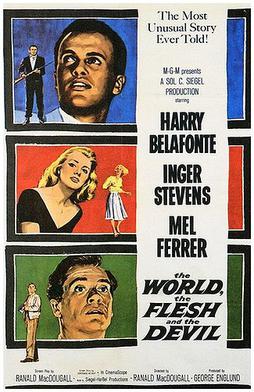
The World, the Flesh and the Devil

With the fear of an atomic apocalypse in the air in the late 1950s and early 1960s, Hollywood took the message to heart, making several movies about the topic, some obviously better than others. As I think of them though, the stories follow the lead-up to that apocalypse. It's only until recently we get more stories about the follow-up to that apocalypse. Well, that's not completely fair, like 1959's The World, the Flesh, and the Devil.

Inspecting a coal mine in Pennsylvania, Ralph Burton (Harry Belafonte) is trapped far underground with seemingly no help coming. He hears diggers working toward him, but several days pass, and the digging stops. Ralph decides to dig himself out, but he's stunned by what he finds. There is no one....anywhere. The world is seemingly empty. Ralph finds newspapers that say atomic weapons were exploded all around the world, and that the entire population of Earth was wiped out in the process. Ralph could be the last human being on the planet and heads for New York City to set up a sort of base to operate out of. He creates a life for himself, gathering supplies, working a radio transmitter, and trying to stay sane. But as the days turn into weeks and then into months, Ralph begins to wonder if he's really on his own.

Days after reviewing The Last Man on Earth, here comes this similar drama from director Ranald MacDougall. If you've seen any of the movies based off Richard Matheson's I Am Legend, this 1959 doomsday science fiction flick will no doubt seem a little familiar. Thankfully though, it is its own movie despite the familiarities among the novel and future films. Not surprising though, 'World' works best on a personal level. If you found yourself completely on your own, how would you react? Would you freak out? At what point would you start to lose your mind? The early portions of the film especially reminded me of a Twilight Zone episode, Where Is Everybody?, where a man finds himself in an empty world. That's the movie at its best and strongest.

That's where part of the familiarity will no doubt come into play. When Ralph finally does emerge from the coal mine, it's a frightening reveal. The movie never once shows a corpse following the apocalypse which may sound like an odd choice, but call it a nice use of artistic license. If we see bodies, it's a different response. Don't see bodies? Ralph truly is alone. The first half hour is an incredible look at an isolated, alone world. During filming, the crew had to start shooting in the early, pre-dusk hours before anyone actually woke up in NYC. We get some truly unique -- even unsettling -- shots of Manhattan and NYC as Ralph makes his way and explores the city. Watch some of the scenes HERE. His exploration of the city is accompanied by composer Miklos Rozsa's memorable score (somewhat reminiscent of his King of Kings score), working together with the visual to create the film's best and most memorable scenes.

It seems though as things go with these post-apocalyptic movies, you can't just leave well enough alone. Semi-SPOILER As Ralph explores NYC, he meets Sarah Crandall (Inger Stevens), a fellow survivor who managed to get into a chamber that protected her from the atomic blasts. Possibly the last two surviving people on the planet, they form a quick friendship, and eventually more, maybe even love. Now, yes, I get it, this movie was released in 1959 in the midst of the civil rights movement, and a relationship between a black man and a white woman would have been rather scandalous (totally wouldn't be now though, right?). The story takes this down a weird road though. There's no one else around. No One. End of the world and all, right? Ralph is so ingrained with how things are in the world that even with absolutely no one around to judge him, still doesn't pursue a relationship with Sarah because he's been taught it's wrong.

Apparently according to Belafonte's biography, the studio/writers/actors had to deal with some interference from above because a black-white relationship in a movie would have been just too much for audiences to handle. I suppose that's fair, but the movie struggles in the second half because of this alteration. The acting becomes odd, wooden, forced and unintentionally uncomfortable. That uncomfortable quality is amped up when a third survivor, Benson Thacker (the very white Mel Ferrer), arrives on the scene. Wouldn't you believe it? Benson falls for Sarah too, and the single Sarah is torn on what to do. You've got to be kidding me. A post-apocalyptic story about the last three people on Earth turns into a love triangle?!? The ending certainly gives some hope for the three -- and with a bigger message; mankind itself in the 1950s/1960s -- but getting there can be a trial.

Loved the first half, got through the second half in this 95-minute sci-fi flick. The performances are solid across the board, and the setting and on-location shooting bring it up a notch. Just know that this movie could have been so much more.

The World, the Flesh and the Devil (1959): ** 1/2 /****

Friday, August 14, 2009

A Glenn Ford double feature

Glenn Ford doesn't get a lot of credit as a major western star like a John Wayne, Clint Eastwood, or Randolph Scott. Maybe it's because he was only in one western that is considered a classic, the original 3:10 To Yuma, but Ford turned out a strong list of quality westerns especially later in his career in the 1950s and 1960s. TCM did a Glenn Ford Day as part of their Summer Under the Stars recently, and I was able to catch two westerns I'd missed in the past both from the second half of his career.

1967's A Time for Killing is a good example of how American westerns tried to respond to the cynical, darker spaghetti westerns from Italy. It's the closing days of the Civil War when a group of Confederate prisoners led by Captain Dorrit Bentley (George Hamilton) escape from a Union stockade near the U.S./Mexico border. Heading south, they ambush a supply train and take a prisoner, Emily Biddle (Inger Stevens), the fiance of the Union major, Wolcott (Ford), tracking them.

Bentley's Confederate escapees are a pretty slimy bunch, not too say that Wolcott's Union patrol is any better. It's the end of a long, bloody war, and these men on both sides are exhausted and just want to go home. I was caught off guard by how far the movie went to show those depths. Even when Bentley finds out the war is over, he keeps the news from the men, and Walcott disobeys orders and follows the fugitives into Mexico. The movie was filmed in Old Tucson and Utah and looks great, appropriately gritty and dusty.

While Ford is good as Major Tom Wolcott, the officer trying to rescue his fiance, it's Hamilton who leaves the deepest impression. His Bentley is an ultra-patriot who refuses to believe the war is over and will continue to take that war to the Yankees. Before her tragic death that was ruled a suicide, Stevens made a string of quality westerns late in the 60s, and she's very good here, holding her own with both Ford and Hamilton. The background players include Kenneth Tobey, Max Baer in a role slightly different from Jethro on Beverly Hillbillies, Timothy Carey, Harry Dean Stanton, Todd Armstrong, and for all you trivia buffs out there, Harrison Ford in just his third movie.

Made two years later, Heaven With a Gun is a more traditional western, but it does make efforts to change with the times when dealing with sex and violence. How many westerns have started with a stranger riding into a town and no one knows who he is or what his motives are? It'd probably take quite a few posts just to list all those movies, but that's how 'Heaven' begins with Jim Killian (Ford) riding into Vinegaroon, a town divided between cattle ranchers and sheepherders. Looking to make up for his violent past, Killian sets up a church in town with hopes of uniting both sides.

His main opposition is Asa Beck (John Anderson), a cattle rancher who with his son, Coke (David Carradine) will have nothing to do with sheepherders and refuses to even listen to Killian's ideas. On the other hand, Killian gets help from everyone else in town including Madge (Carolyn Jones), the saloon/brothel owner, Leloopa (Barbara Hershey), a young Indian girl Jim cares for after her father is killed, and Bart Patterson (William Bryant), a local ranch owner. Also worth mentioning are two supporting parts for J.D. Cannon as a hired gun, Mace, and Noah Beery Jr as Garvey, one of Beck's most trusted hands.

The script calls for some random nudity that feels just thrown into the script for the sake of some topless saloon girls, and the violence is pretty vicious even if it's not shown. Much of it is off-screen, but it's pretty grim whether you see the results or not. The sex and violence then makes the ending seem a little off for me. Killian is trying to stop Beck and his gunhands from massacring the sheepherders and cattle ranchers who are now working together. It doesn't work overall and comes across as too forced, like the money just wasn't there to set up a shootout.

The constant through both movies is Ford's steadying influence on the story. He was usually cast as the good guy, but later in his career they added a wrinkle to that old standby, the good guy who used to be a bad guy and is looking to repent. It's hard to judge Ford as an actor because in roles like this he didn't have to show a lot of range. But like John Wayne did in his later years, Ford nails these parts. He's likable on-screen with a very natural presence. I liked both movies, Time for Killing a lot and Heaven With A Gun despite the ending.

A Time for Killing <---fan-made trailer (1967): ***/****
Heaven With a Gun (1969): ** 1/2 /****

Wednesday, January 28, 2009

Netflix Review 2: Hang 'Em High


After the huge success of Sergio Leone's Dollars trilogy, Clint Eastwood returned to the US and quickly made an American western, Hang 'Em High, that bears quite a resemblance to the basic style of the spaghetti westerns. I've avoided watching Hang 'Em High for years for a couple reasons, I always figured it could never live up to the Dollars movies, and reviews were always mixed. While I enjoyed the movie, my worries were pretty dead on. It was an average western that would not be remembered if Eastwood wasn't starring.


Eastwood is Jed Cooper, a small rancher who has recently bought 100 head of cattle. As he's driving the herd home, Cooper is stopped by a nine-man posse who say he stole the cattle and murdered the rancher even though he's got a bill of sale. They string Cooper up and leave without making sure he's dead. A marshal happens to be riding by and cuts the man down before he dies. After his innocence is proved, Cooper takes a job as a marshal in the Oklahoma territory and starts to hunt the men down one-by-one.


Very much influenced by spaghetti westerns, this movie just doesn't live up to what it could have been. Looking at the cast, I was blown away by all the names, but I guess I should have learned by now. Big cast full of big names: characters aren't developed much at all. Ed Begley plays Capt. Wilson, the leader of the posse who is terrified of Cooper's revenge, but he basically disappears for huge chunks of the movie. Inger Stevens is the obligatory love interest, a woman with a past who's also looking for revenge. Stevens is gorgeous, but her part is as bland as they come.


The rest of the posse is similarly underwhelming despite some big names including L.Q. Jones, Bruce Dern, Alan Hale JR, and Bob Steele. These parts could have been great, add Strother Martin, Dub Taylor, and Warren Oates and you've got a perfect posse.


Three parts, along with Eastwood, stand out. Pat Hingle, always a good slimy villain, is an ideal counterpart to Cooper as Judge Fenton, a power-hungry official who wants statehood for the territory no matter what he has to do. He becomes so obsessed with justice you're not sure if his mind is all there. Ben Johnson, a real-life cowboy, makes a brief appearace as Dave Bliss, the marshal that rescues Cooper. Just by being in the movie, Johnson gives it credibility. Gravelly-voiced Charles McGraw plays Sheriff Ray Calhoun, a peace officer who may be working both sides.


But that's just three supporting roles, Dennis Hopper makes a bizarre one-scene cameo as the Prophet, a crazed, bearded prisoner, and James MacArthur shows up to lead a crowd in prayer at a hanging as the Preacher. It's just all too weird. The movie tries too hard to be a great western. The music is overdone and loud, although some good parts sound like Morricone's soundtracks, but it takes away from the movie overall.


The DVD is cheap with a somewhat grainy widescreen presentation and a trailer I've included the link for that's pretty revealing. Don't watch it if you haven't seen the movie. Overall, I was disappointed with this 1968 western, but there's enough to recommend, especially Eastwood, Hingle, and Ben Johnson.


Hang 'Em High (1968): **/****