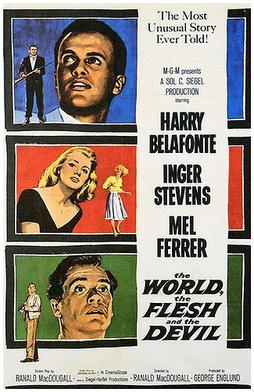
With the fear of an atomic apocalypse in the air in the late 1950s and early 1960s, Hollywood took the message to heart, making several movies about the topic, some obviously better than others. As I think of them though, the stories follow the lead-up to that apocalypse. It's only until recently we get more stories about the follow-up to that apocalypse. Well, that's not completely fair, like 1959's The World, the Flesh, and the Devil.
Inspecting a coal mine in Pennsylvania, Ralph Burton (Harry Belafonte) is trapped far underground with seemingly no help coming. He hears diggers working toward him, but several days pass, and the digging stops. Ralph decides to dig himself out, but he's stunned by what he finds. There is no one....anywhere. The world is seemingly empty. Ralph finds newspapers that say atomic weapons were exploded all around the world, and that the entire population of Earth was wiped out in the process. Ralph could be the last human being on the planet and heads for New York City to set up a sort of base to operate out of. He creates a life for himself, gathering supplies, working a radio transmitter, and trying to stay sane. But as the days turn into weeks and then into months, Ralph begins to wonder if he's really on his own.
Days after reviewing The Last Man on Earth, here comes this similar drama from director Ranald MacDougall. If you've seen any of the movies based off Richard Matheson's I Am Legend, this 1959 doomsday science fiction flick will no doubt seem a little familiar. Thankfully though, it is its own movie despite the familiarities among the novel and future films. Not surprising though, 'World' works best on a personal level. If you found yourself completely on your own, how would you react? Would you freak out? At what point would you start to lose your mind? The early portions of the film especially reminded me of a Twilight Zone episode, Where Is Everybody?, where a man finds himself in an empty world. That's the movie at its best and strongest.
That's where part of the familiarity will no doubt come into play. When Ralph finally does emerge from the coal mine, it's a frightening reveal. The movie never once shows a corpse following the apocalypse which may sound like an odd choice, but call it a nice use of artistic license. If we see bodies, it's a different response. Don't see bodies? Ralph truly is alone. The first half hour is an incredible look at an isolated, alone world. During filming, the crew had to start shooting in the early, pre-dusk hours before anyone actually woke up in NYC. We get some truly unique -- even unsettling -- shots of Manhattan and NYC as Ralph makes his way and explores the city. Watch some of the scenes HERE. His exploration of the city is accompanied by composer Miklos Rozsa's memorable score (somewhat reminiscent of his King of Kings score), working together with the visual to create the film's best and most memorable scenes.
It seems though as things go with these post-apocalyptic movies, you can't just leave well enough alone. Semi-SPOILER As Ralph explores NYC, he meets Sarah Crandall (Inger Stevens), a fellow survivor who managed to get into a chamber that protected her from the atomic blasts. Possibly the last two surviving people on the planet, they form a quick friendship, and eventually more, maybe even love. Now, yes, I get it, this movie was released in 1959 in the midst of the civil rights movement, and a relationship between a black man and a white woman would have been rather scandalous (totally wouldn't be now though, right?). The story takes this down a weird road though. There's no one else around. No One. End of the world and all, right? Ralph is so ingrained with how things are in the world that even with absolutely no one around to judge him, still doesn't pursue a relationship with Sarah because he's been taught it's wrong.
Apparently according to Belafonte's biography, the studio/writers/actors had to deal with some interference from above because a black-white relationship in a movie would have been just too much for audiences to handle. I suppose that's fair, but the movie struggles in the second half because of this alteration. The acting becomes odd, wooden, forced and unintentionally uncomfortable. That uncomfortable quality is amped up when a third survivor, Benson Thacker (the very white Mel Ferrer), arrives on the scene. Wouldn't you believe it? Benson falls for Sarah too, and the single Sarah is torn on what to do. You've got to be kidding me. A post-apocalyptic story about the last three people on Earth turns into a love triangle?!? The ending certainly gives some hope for the three -- and with a bigger message; mankind itself in the 1950s/1960s -- but getting there can be a trial.
Loved the first half, got through the second half in this 95-minute sci-fi flick. The performances are solid across the board, and the setting and on-location shooting bring it up a notch. Just know that this movie could have been so much more.
The World, the Flesh and the Devil (1959): ** 1/2 /****
The Sons of Katie Elder
"First, we reunite, then find Ma and Pa's killer...then read some reviews."
Showing posts with label Harry Belafonte. Show all posts
Tuesday, February 19, 2013
Friday, September 25, 2009
Buck and the Preacher
Just more proof that studios don't have to rely solely on remakes and rehashes? 1972's Buck And the Preacher, a western documenting the story of former slaves moving west in the years following the Civil War. It's a unique story that I can't even think of a similar movie to compare it to. But no, we get remakes of remakes or high quality movies like 'I Hope They Serve Beer in Hell' which I haven't seen but feel safe saying it's not an instant classic. The stories are out there, studios just have to find them.
In his directorial debut, star Sidney Poitier presents a story unique in both its presentation and characters. But before I get long-winded, it all boils down to this; the story of African American families moving west for a new, better life following the Civil War. Westerns so often focus on the gunfighters and the Indian wars that stories like this get lost in the shuffle. Black characters are often supporting characters or in the background but not here. The main characters are all black, and to be honest I can't think of another western even remotely like it.
Trail guide Buck (Poitier) makes his money guiding wagon trains of black families west with hopes of establishing them with new lives in their new found freedom. The memories of the Civil War are still fresh in people's minds and maybe more importantly, the prejudices and racism still exist. Group of riders called 'Nightriders' harass and terrorize these wagon trains, shooting them up and scaring them into heading back east. One particular group, led by a man named Deshay (Cameron Mitchell), attacks one of Buck's trains leaving them with no money and little food to last out the coming winter.
Forced to work together with a con man preacher (Harry Belafonte) he keeps crossing trails with, Buck must think of some way to not only get money for the stranded wagon train but also avoid Deshay and his men. The unlikely duo is forced to take drastic measures, enlisting the help of Buck's wife Ruth (Ruby Dee) along the way as Deshay's murdering posse closes in to finish them off.
A buddy movie rolled together with a story that actually has to say something worthwhile, Buck and the Preacher was a pleasant surprise for me. Reading about it in advance, I got the sense it was a comedy, and while there are several funny moments, it's much more of a serious drama. Poitier as Buck is the typical western hero, resolute in his plans and a man who's word is as good as gold. He will stop at nothing to help the people he's promised to lead. Belafonte gets the scenery-chewing role as the Preacher, a man always ready with a Bible verse but who will also pull a gun on you if need be. Their uneasy friendship/alliance is a pleasure to watch from beginning to end, and in some ways reminded me of Paul Newman and Robert Redford in Butch Cassidy and the Sundance Kid with their bickering.
Background information is slowly filtered out about Belafonte's character, but even then it is a hard character to read. He is clearly out to help himself, others be damned, but when backed into a corner he fights as hard as anyone else. The finale is a good one as Buck and the Preacher seem to be cornered on a rocky summit with a posse quickly surrounding them. As Buck's wife Ruth, Dee is a strong presence with Poitier. It's a small role, but just like her husband, Ruth is willing to stand up for what's right when the time comes. As the villain, Mitchell isn't given much to do other than look menacing, which he pulls off well.
Other important supporting parts include Enrique Lucero and Julie Robinson (Belafonte's wife in real life) as an Indian chief and wife who is a somewhat unwilling ally of Buck. While the movie's focus is on the black families moving west, it's interesting to see the interaction with the Indians. It's two different groups of people, but in many ways they are very similar in the way they were treated by other cultures, especially whites. It's just one more aspect of a unique, interesting western with a message. Definitely give this one a shot.
Buck and the Preacher <----trailer (1972): ***/****
In his directorial debut, star Sidney Poitier presents a story unique in both its presentation and characters. But before I get long-winded, it all boils down to this; the story of African American families moving west for a new, better life following the Civil War. Westerns so often focus on the gunfighters and the Indian wars that stories like this get lost in the shuffle. Black characters are often supporting characters or in the background but not here. The main characters are all black, and to be honest I can't think of another western even remotely like it.
Trail guide Buck (Poitier) makes his money guiding wagon trains of black families west with hopes of establishing them with new lives in their new found freedom. The memories of the Civil War are still fresh in people's minds and maybe more importantly, the prejudices and racism still exist. Group of riders called 'Nightriders' harass and terrorize these wagon trains, shooting them up and scaring them into heading back east. One particular group, led by a man named Deshay (Cameron Mitchell), attacks one of Buck's trains leaving them with no money and little food to last out the coming winter.
Forced to work together with a con man preacher (Harry Belafonte) he keeps crossing trails with, Buck must think of some way to not only get money for the stranded wagon train but also avoid Deshay and his men. The unlikely duo is forced to take drastic measures, enlisting the help of Buck's wife Ruth (Ruby Dee) along the way as Deshay's murdering posse closes in to finish them off.
A buddy movie rolled together with a story that actually has to say something worthwhile, Buck and the Preacher was a pleasant surprise for me. Reading about it in advance, I got the sense it was a comedy, and while there are several funny moments, it's much more of a serious drama. Poitier as Buck is the typical western hero, resolute in his plans and a man who's word is as good as gold. He will stop at nothing to help the people he's promised to lead. Belafonte gets the scenery-chewing role as the Preacher, a man always ready with a Bible verse but who will also pull a gun on you if need be. Their uneasy friendship/alliance is a pleasure to watch from beginning to end, and in some ways reminded me of Paul Newman and Robert Redford in Butch Cassidy and the Sundance Kid with their bickering.
Background information is slowly filtered out about Belafonte's character, but even then it is a hard character to read. He is clearly out to help himself, others be damned, but when backed into a corner he fights as hard as anyone else. The finale is a good one as Buck and the Preacher seem to be cornered on a rocky summit with a posse quickly surrounding them. As Buck's wife Ruth, Dee is a strong presence with Poitier. It's a small role, but just like her husband, Ruth is willing to stand up for what's right when the time comes. As the villain, Mitchell isn't given much to do other than look menacing, which he pulls off well.
Other important supporting parts include Enrique Lucero and Julie Robinson (Belafonte's wife in real life) as an Indian chief and wife who is a somewhat unwilling ally of Buck. While the movie's focus is on the black families moving west, it's interesting to see the interaction with the Indians. It's two different groups of people, but in many ways they are very similar in the way they were treated by other cultures, especially whites. It's just one more aspect of a unique, interesting western with a message. Definitely give this one a shot.
Buck and the Preacher <----trailer (1972): ***/****
Labels:
1970s,
Cameron Mitchell,
Harry Belafonte,
Ruby Dee,
Sidney Poitier,
westerns
Subscribe to:
Posts (Atom)