The Sons of Katie Elder

The Sons of Katie Elder
"First, we reunite, then find Ma and Pa's killer...then read some reviews."
Showing posts with label Rita Hayworth. Show all posts

Friday, July 12, 2013

Pal Joey

There aren't too many actors-performers-entertainers cooler than Frank Sinatra. A movie star since the 1940s, Sinatra hit his groove as a dramatic actor in the mid 1950s in films like From Here to Eternity. How about 1957's Pal Joey? Based off a novel turned stage play, it allows Sinatra to show off that dramatic side while also playing a role that ain't so far removed from his real-life persona. 

Kicked out of one town after another, second-rate singer and performer Joey Evans (Sinatra) arrives in San Francisco on the train with a few bucks in his pockets and the clothes on his back. A performer and singer, Joey wants nothing more than to have his own club, his name in lights outside, but his own troubles with women always derail those plans. He does manage to get a job at a small club where he meets Linda (Kim Novak), a naive, young dancer who still manages to see Joey's act. Undeterred, Joey still has his eyes set on her when he meets Vera Prentice-Simpson (Rita Hayworth), a former stripper turned lonely widow looking for a project. Getting along with Vera and more, Joey has a chance to hit the big time if he plays his cards right, but his old ways are just waiting to make an appearance, ruining everything.

A book turned highly successful musical turned highly successful movie, 'Pal' has quite the history. By the time it reached theaters in director George Sidney's film, it had undergone quite the transformation. Characters have been completely removed, some plot lines thrown by the wayside, other characters tweaked and turned to help make a pretty involved stage play more manageable. Sidney's film version picked up four Oscar nominations (but didn't win any) and two Golden Globe nominations, Sinatra winning for Best Actor. It is a fine example of a time and era in Hollywood long since past, stylish and cool without ever really trying too hard.

Here we are though, an issue I think I will have with every musical ever made. The singing, and more importantly, the out of left field, random, unexplained singing where everyone knows the words spontaneously (including the dance numbers). How does 'Pal' solve that issue? All the songs are naturally in the film's story, Joey, Linda and Vera all singing because the story requires it. Novel concept, huh? Sinatra gets his chance to sing, showing off that natural, easy-going stage ability, including The Lady Is a Tramp (HERE) and I Could Write a Book (HERE) among others, with Novak also getting a chance to sing/perform, Hayworth as well (performing but lip-synched). The best thing going though is simple. The songs are catchy, whistle-worthy songs that will be in your head for days. That's not necessarily a good thing, but it works here.

The Wikipedia entry for this flick is spot-on, many critics pointing to it as the definitive Sinatra flick. Sinatra does a fine job making a pretty despicable character at least mildly tolerable and even likable at times. Is it a stretch for him to play a smooth-talking, extremely talented, schmoozing entertainer? Um.....no, but he brings it to life. There are times you just want to slap the character, but that would be too perfect. It's Sinatra playing Sinatra with a slight twist. With several characters completely wiped from the play, the focus remains on Sinatra, Novak and Hayworth. Novak as Linda is in sex kitten mode, singing with that sultry voice and dancing with.....well, not much on (watch HERE). Hayworth as the slightly older, very smart and been there, seen that Vera is a scene-stealer as well, manipulating and twisting things as she sees necessary. A fine trio to lead the movie's smallish cast.

Also look for Barbara Nichols as Gladys, the conniving dancer/performer Joey bristles at, Bobby Sherwood as Ned, the bandleader who knows Joey's past and typical transgressions, and Hank Henry as Mike Miggins, the club owner who not so willingly gives Joey a shot at his club when he makes a high-reaching promise.

Having seen the play on the North Side of Chicago with the girlfriend in April, I was surprised to see how much was in fact snipped, cut up and prodded along to turn it into the film version. A lot has been changed. Most of the changes were wise choices in hopes of keeping the movie doable in a 109-minute final product. It is a 1957 movie, and the ending is basically the complete polar opposite of the play. For any sort of reality, it's dumb, basically washing away any character study we've developed up to this point with the Joey character. For the sake of a happy ending though, it works....I suppose. It drags a little in the second half, but the talents of the cast make up for some of the slow going. Long story short, it's Frank Sinatra being as cool as he ever was.

Pal Joey (1957): ***/****

Thursday, March 21, 2013

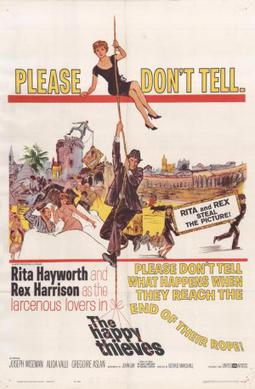
The Happy Thieves

If you've made it this far, maybe you can go a little further. Oh, Shawshank Redemption quotes! Anyways, I've been reviewing a fair share of heist/caper movies recently thanks to Turner Classic Movie's heist marathons. Only a couple more, I swear. Here we go with the relatively unknown 1961 heist flick, The Happy Thieves.

Jimmy Bourne (Rex Harrison) is an art thief, and a really good one at that. Pulling a long recon to steal a painting at a Spanish villa, Jimmy pulls off the job successfully. He gets away unnoticed, handing the rolled-up painting to his partner (and future wife), Eve (Rita Hayworth). Getting it through customs though, Eve loses the tube, forcing Jimmy and his forging art painting partner Jean (Joseph Wiseman), to improvise. It doesn't take long before the truth comes out. A visitor at the Spanish villa, Dr. Munoz (Gregoire Aslan), has pictures that can blackmail Jimmy, Jean and Eve....unless they pull off another art heist for him. Munoz wants the crew to take a Goya painting from the Prado Museum in Madrid. The problem? The painting is large, really large, and won't make for an easy job. The alternative is simple; jail.

Watch enough movies from any genre, and you will become familiar with it and all its conventions, cliches and stereotypes. If you like that genre enough to keep coming back to the well, that's a good thing. Not every heist movie is an extremely dark, cynical story, but the best and more memorable usually are. The job is usually the easiest part with the fallout following the job usually producing more fireworks. From director George Marshall, 'Happy' falls in between unfortunately. Everything from the music to the characters reflects a light, positive, even goofy tone. At the opposite end of the spectrum are some very dark, very surprising twists. If the story had picked one or the other, it could have been significantly better. Don't waver back and forth. Pick a route.

Through the light and the dark, I was most drawn to the casting. Harrison, Hayworth and Wiseman as a small team of crooks pulling an art heist? Count me in. These are three very respectable actors. I don't mean that heist movies don't attract good actors, but seeing actors of this caliber is pretty cool. Harrison as Jimmy is the quiet, gentlemanly thief, always composed, always ready with a contingency plan. Hayworth is okay as Eve, but the character gets on the shrill, worrisome side almost immediately. I didn't buy the chemistry between Harrison and Hayworth either. My favorite part was Wiseman as Jean, an accomplished painter who paints duplicates for Jimmy, usually fighting off his own nerves (some untimely throwing up too) in the process at the job gets closer, or unfortunately...during the job.

Also joining the cast is Aslan, doing what he does best as a menacing, intimidating villain, favoring a walking cane with a rifle in it. Alida Valli plays Duchess Blanca, a well-off, mysterious European woman with her hand in everything. Virgilio Teixeira has a fun and small but key supporting part as Cayetano, a Spanish bullfighter who may be an unknowing participant in Jimmy's job. Also look for George Rigaud, Britt Ekland, Peter Illing and Gerard Tichy in smaller parts.

I did like a lot about this movie. Marshall films in black and white, shooting on-location in Madrid and in Paris. That B&W look gives 'Happy' a throwback, retro visual look. It's a beautiful end product. I also liked the musical score from composer Mario Nascimbene, a mixture of light-hearted music and soft whistling. It leans more toward the light, positive side of the story. When the story turns to the dark, the score doesn't necessarily keep up in the tone department, but I liked the score just the same.

So back and forth between light and dark, the highlight of this heist flick is the actual heist at the Prado Museum. We know how Jimmy and Jean will pull the job, using Jean's forged duplicate to get their hands on Goya's The Second of May 1808. It's a straightforward, pretty simple job that takes advantage of a diversion outside the museum to distract the guards, but like the parts of the movie that do work, it has a certain charm to the developing caper. The bad part? The diversion Jimmy utilizes ends up involving murder, but he doesn't seem bothered by that in the least. When the character background reflects that he's an up-and-up English gentleman only to show no worry about a friend being murdered struck me as odd and out of place. I liked parts of 'Happy' enough, but not enough to really recommend this one fully.  Give it a try at Youtube at the link below.

The Happy Thieves (1961): ** 1/2 /****

Monday, June 11, 2012

The Wrath of God

Why do some movies just reach out and grab you? You know the movie. The one most of your friends have never heard of and give you that 'What the hell are you talking about?' look. It's that hidden gem of a movie that you stumbled across at Netflix, the one you started watching at 2 in the morning when you couldn't sleep. Because you found it, and it seems to have been forgotten among a sea of movies, it's almost your movie. I've got a handful of them, one of my favorites being 1972's The Wrath of God.  

It's the 1920s in an unidentified Central American country, and three men have been brought together to pull off a suicidal, basically impossible mission. First is Emmet Keogh (Ken Hutchison), an IRA gunman on the run. Second, there's Jennings (Victor Buono), a portly, double-dealing and conniving businessman who can never turn away at a chance at some easy cash. And third, there's Father Van Horne (Robert Mitchum), a defrocked priest now working as a con man with some tricks up his sleeve. They have a simple choice in front of them; stand in front of a firing squad or work together to kill Tomas de la Plata (Frank Langella), a maniacal revolutionary who rules his region with a tyrannical fist. Can the unlikely, unholy trio pull the job off and get out alive?

A little known western from 1972 with a solid cast, a somewhat goofy tone that has some fans thinking it's a spoof (I for one, do not), and action, drama and humor. What to take away from it? According to anything written about the movie from director Ralph Nelson, it was beset with problems from the start. Co-star Hutchison severely cut his hand, almost died and was forced to miss several weeks of filming. That's kind of a problem when Hutchison is in almost every scene. Starring in her last movie, Rita Hayworth was struggling with Alzheimer's and couldn't remember her lines. Now this may just be me, but you know what? Somehow and some way, it all works for the better. Yes, it's an odd, weird, even goofy mess of a movie, but it's damn entertaining.

'Wrath' has lots of little things going for it, the things that help make a good movie great. From composer Lalo Schifrin comes a crazy, off the wall, jazzy and Mexican themed score that sounds like an offbeat spaghetti western score (listen to samples HERE). Nelson filmed on location in Mexico using some familiar, memorable spots that you'll have seen in Vera Cruz, Big Jake, The Wild Bunch, and The War Wagon. The finale at the de la Plata hacienda is especially cool, using the same location as the finale to 1954's Vera Cruz. The best thing going though is the script. The movie is based off a Jack Higgins novel (written as James Graham), and while I like the novel, it doesn't have the dark humor the movie does. The whole movie is basically one great one-liner after another, but it never feels forced. Read IMDB's Memorable Quotes HERE for a sample. Credit to Mitchum, Buono and Hutchison especially for committing to the lines because it could have felt cheesy from the get-go in lesser hands.  

Mitchum was the only big, recognizable star in the cast, but that ends up working as a positive for the film. He was often criticized for being too calm, too lackadaisical, for being downright bored in his parts. This is a showy, scene-stealing part, and Mitchum runs away with it. Having some fun with previous "religious" parts like Night of the Hunter and Five Card Stud, he plays Father Oliver Van Horne, a somewhat disheveled, former priest (backstory explained late) now working as a conman and hired gun. He carries a large case loaded with an automatic machine gun and hiding over $50,000. Mitchum clearly looks like he's having some fun here. Hutchison and Buono too stand out, Hutchison as the fiery IRA gunman who gets a love interest, Chela (model Paula Prentiss in one of her 3 career roles), a mute Indian girl, and Buono as the portly, boozing dealer who always looks out for himself first and foremost. The trio has this really easy-going, likable chemistry that carries the movie, a nice positive when they're in almost every scene together.

The other three main parts are basically extended cameos. Playing the maniacal laughing, insane Tomas de la Plata, Langella hams it up like nobody's business. He hates priests after seeing sketchy, immoral priests in his village growing up so when Mitchum's Van Horne shows up, he basically loses his mind. Langella has some great exchanges with Mitchum too, overplaying vs. underplaying. In her last film, Hayworth is clearly struggling with her part, but it's still cool to see her working with the cast. Also hamming it up is John Colicos as Colonel Santilla, the conniving officer trying to get his rival de la Plata knocked off in any way possible. His spelling out the suicide mission to his self-named 'Unholy Trinity' is a priceless scene. Gregory Sierra is solid too as Jurado, de la Plata's one-eyed henchman. Fans of The Wild Bunch should check out the cast too, where you'll see Jorge Russek, Chano Urueta, Aurora Clavel, and Enrique Lucero, all of them playing supporting parts much like in Peckinpah's film.

A quasi-revolutionary western that isn't interested in breaking any ground sure ain't a bad thing. In many of his movies, Nelson was just interested in making entertaining, well-made and exciting movies. 'Wrath' is 3-for-3 there. It's fun from beginning to end, the last 30 minutes especially standing out as Van Horne, Keogh and Jennings make their move in taking out de la Plata. A bloody shootout in a village square leads into a bloodier shootout at the de la Plata hacienda, Van Horne wrapping it up nicely with a great closing line. Is the movie great? By no means, but I love it just the same. It's different, it's funny, and whether it's laughs or action, it should keep you entertained. Now about finding a DVD copy of it.....yeah, that's another story.

The Wrath of God (1972): *** 1/2 /****

Tuesday, February 1, 2011

Only Angels Have Wings

Movies are right at home, the old bread and butter, when dealing with characters running away from something, looking for another shot after some horrific mistake was made in the past.  If movies have taught us anything, for an American in this situation, there's two options...both equally deadly.  One, enlist in the French Foreign Legion where you will most likely get killed in a nasty massacre in the desert.  Two, go to South America and waste away in some dingy, damp village.  That's not the whole premise of 1939's Only Angels Have Wings, but it's close.

Reading the description of this 1939 flick from Columbia Pictures, my first reaction was how similar it sounded to the French classic The Wages of Fear and its American remake Sorcerer.  'Angels' obviously came first, but it deals with a similar topic.  Deep in an unnamed South American country, a group of Americans -- displaced by their choice or someone else forcing their hand -- working for a struggling company.  For one reason or another, they're all running from something in their past, now forced into doing a job that will just as likely kill them as make them rich.

Waiting for her ship to depart, American singer Bonnie Lee (Jean Arthur) stumbles upon a little haven of back home in a South American port city. A complex owned by a European immigrant, Dutch (Sig Ruman) and run by an American pilot, Geoff Carter (Cary Grant), has a restaurant that serves good, old-fashioned American food with a runway outside the building. Bonnie is quickly drawn to the smooth, suave, most definitely aloof Geoff, only to find out how perilous the situation is.  Dutch and Geoff have signed a contract to deliver the mail twice a week by plane to cities inland for six months and then receive a big payday.  If they fail to deliver, the contract is void.  With their stable of American pilots and World War I era planes, they've managed to make it five months and two weeks.  They're close to their goal, but the flights become ever more dangerous, and the only way through to the next city is a flight through the fog-covered, looming mountains inland.

I watched this movie over a couple of sittings -- stupid work, getting in the way of my movie watching -- and certainly enjoyed it enough, although I didn't love it. My complaint here is one I usually have with movies released in the 1930s.  Hollywood was still figuring out what worked and didn't work with movies, what audiences wanted and what they didn't want.  For the most part, the acting isn't over the top as the cast thankfully turns down the theatrical stage touches.  It is filmed completely on an indoor set which limits the scope of the story, but in an effort to balance that out, there is some great footage of these rickety looking planes flying through the mountains, taking off and landing, canceling out some of the cheaper effects to illustrate the planes "flying" through rough weather conditions.  So what was wrong with this flick? I'm not sure, but something was missing.

Director Howard Hawks carved quite a nice little niche for himself in a career that includes over 40 movies, many of them held in high regard among fans and critics. His stories often focused on a group of men brought together through unlikely, strenuous circumstances having to band together to accomplish a similar goal, bonding in the process and putting their differences aside.  'Angels' is right at home with that premise.  Grant is the tough but fair owner and chief pilot of this motley "airline," if you can call it that.  His pilots include the always reliable and entertaining Thomas Mitchell as Kid Dabb, a veteran pilot struggling with vision loss, Allyn Joslyn, Noah Beery Jr., Victor Kilian, John Carroll, and Don Barry filling out the ranks of this misfit outfit.

Through all the slower portions of the movie with the pretty awful love triangle, Geoff's crew and their story carries the movie.  Grant is at his suave, roguish best, Mitchell is as reliable as ever as the smart-mouthed sidekick, and Rugan and Co. fill in the holes wherever necessary.  A key subplot has a new pilot, Bat MacPherson (Richard Barthelmess) arriving to fly, only to find out he's got a past with Mitchell's Kid. The men hold his past decisions against him, but MacPherson rises to the occasion as he desperately attempts to prove it was all a mistake.  That's what works so well here.  All these men are running from something so whether they realize it or not, they're all in the same boat.  If this business have any hopes of succeeding, they will have to work together and put their differences aside.  For Hawks, it's a tried and true formula, and as usual, it works.

Now Hawks used that formula a few more times during his career, but he also threw in those awkward, unnecessary love triangles too.  Arthur's Bonnie falls for Cary Grant almost right away so then we get two hours of her trying to figure out if she belongs with him.  Then MacPherson's new bride (21-year old Rita Hayworth) ends up being a woman from Grant's past to complicate things.  Oh, no! Two women in love with the same man?!?  If you have an iota of intelligence, you know who he is going to end up with, but my goodness, it takes awhile getting there.  Thankfully, there's enough positive going on to outweigh the dull, slow-moving negatives. You can watch it at Youtube, starting HERE with Part 1 of 12.

Only Angels Have Wings <---trailer (1939): ***/****