In 1952, British author Ian Fleming introduced the world to a character that would become one of the most famous, instantly recognizable characters in literature-film-pop culture history. That name....Bond, James Bond. Fleming would write 14 007 novels, starting with 1952's Casino Royale, but it took 10 years for the British super spy to make it to the big screen. It was worth the wait, and one of the most successful franchises in film history was born. It all started with 1962's Dr. No.
A station chief and his new secretary working for British intelligence in Jamaica has gone missing without a trace, leaving London scrambling to figure out what happened. The station chief, Strangways, had been investigating possible interference with American missiles but all his files have been stolen as well. In steps another agent, James Bond (Sean Connery), dispatched to Jamaica to investigate. He's quickly stone-walled wherever he goes, finally receiving some help from a CIA agent, Felix Leiter (Jack Lord), and a local fisherman, Quarrel (John Kitzmiller), who had worked with Strangways. What little evidence Bond can find -- among several attempts to kill him -- is an isolated, mysterious cove, Crab Key, owned by the equally mysterious, Dr. No., who no one knows much about. What's waiting out there? And is Dr. No behind these wayward American rockets? Maybe only Bond can find out.
All successful franchises have to start somewhere, right? This is an excellent jumping off point for my all-time favorite franchise. Producers debated over which Fleming novel to use as the first film, finally settling here on Dr. No. It immediately resonated with fans, propelling Connery to stardom basically instantaneously. It isn't one of the best 007 movies, but it's pretty damn good. You see all the groundwork being laid out for what was to come from the one-liners to the diabolical villains, the girls to the gadgets, the exotic locations and effortless style. And of course, that main theme, maybe the most famous movie theme of all-time. An excellent starting off point. Listen HERE to the theme but shame on you if you haven't heard it by now. No Bond song here, just Monty Norman and John Barry's perfect theme to play over the stylish 1960's credits.
When he was cast to play 007 himself, James Bond, Connery was a young actor who'd worked regularly in films and television but was far from a star. That kinda sorta changed with this film. Just a bit. This is a rare example of perfect casting. Connery was born to play Bond. It's the style, charisma, confidence, it all flows so effortlessly. Maybe not physically, but Connery brings Fleming's Bond to life as well as anyone with Daniel Craig knocking on the door in that department. He's a killer, brutally efficient with his license to kill, but he's also smooth and suave, an impeccably dressed ladies man. Connery finds a rhythm immediately with the character. There's no sense of an actor feeling out what works and what doesn't work. He just knows what he wants to do and goes for it. There were better Connery/Bond entries -- From Russia With Love, Goldfinger, Thunderball -- but Connery is and always will be 007. The maiden voyage with an iconic character, and the young Scottish actor hits a home run with ease.
The rest of the cast lacks huge star power, but that ends up being a positive. It's cool to see Lord in a pre-Hawaii Five-O part and he's got some good chemistry with Connery, as does Kitzmiller in their scenes together. But what about those Bond villains and Bond girls?!? The franchise is off to a good start with Joseph Wiseman as Dr. No and maybe the most iconic Bond girl of all-time, Ursula Andress, as Honey Ryder. Who hasn't seen the famous shot of her in a white bikini coming out of the water? She actually isn't introduced until the hour-mark, but her appearance is definitely an idea of things to come. The same for Wiseman's Dr. No, and he's not introduced until there is less than 25 minutes left in the movie! He's intelligent, foreboding and gets the franchise started off right. Now, if he had just killed Bond on the spot rather than let him waste away in a cell....oh, the possibilities.
Also look for Bernard Lee as M and Lois Maxwell as Moneypenny, introduced in the early goings. Anthony Dawson plays a potential lead for Bond once he arrives in Jamaica while Zena Marshall and Eunice Gayson play two more Bond girls.
I think what's most alarming about this first James Bond movie is how calm it is. It is self-assured and confident, hitting a groove pretty quick, but it barely resembles what the franchise would become (for good and bad). This is more of a detective story than a secret agent story. It isn't necessarily low-key because of all the chases, Bond girl-seducing, perfectly-timed one-liners and all, but it's certainly in that territory. Director Terence Young simply isn't trying too hard -- that would come later in the franchise -- in introducing 007. It's a good intro and not a great one, but it is an excellent film just the same. The next venture, From Russia With Love two years later, is a true classic and one of the series' best.
Dr. No. (1962): ***/****
The Sons of Katie Elder
"First, we reunite, then find Ma and Pa's killer...then read some reviews."
Showing posts with label Joseph Wiseman. Show all posts
Wednesday, October 7, 2015
Wednesday, September 10, 2014
Detective Story
The police procedural in 2014 is a tried and true formula. It's gotten a genre reboot of sorts thanks to HBO's highly successful True Detective, but there's also been Law and Order, Dragnet, Hawaii Five-O, The Streets of San Francisco and countless others. As familiar as the genre can be, it can be fun to go back and see where things started...all the way back in the 1950s!!! Here's 1951's Detective Story.
It's a warm summer day in New York City and things are going about as normal at the 21st Precinct with its crew of detectives and seemingly never-ending stream of criminals, some petty crooks and others looking at a stiff prison sentence. Among the officers on duty is Detective Jim McCleod (Kirk Douglas), a hard-boiled officer who always gets his man, albeit with some less than legal methods. Now he has to deal with a case from his past, a doctor, Schneider (George Macready), who has built a reputation for all the wrong reasons. In previous run-ins, McCleod has never been able to close the case on the doctor through a variety of coincidences that certainly smell fishy. He's become almost obsessed with sending Schneider to jail no matter the case, no matter by what means he can do it. Will McCleod go too far this time around?
From director William Wyler, 'Detective' is based off a play by Sidney Kingsley. Wyler's film picked up four Oscar nominations but ultimately winning none. I've long tried to track it down, Netflix taunting me with the DVD that never seemed to be available. Well, I win Netflix! I found it on Turner Classic Movie's schedule! And in the end, it was well worth the wait. The stage-based roots pay huge dividends, almost the entire 103-minute running time spent in the 21st Precinct's bullpen and offices. It's busy, claustrophobic and a great backdrop to the ensemble story and long list of characters. It is a simple, straightforward technique that works in pretty effortless fashion. There isn't anything particularly flashy about Wyler's film, but it's realistic, tough and often enough ahead of its time mentality, 'Detective' is an easy recommend.
Just 35 years old at the time, it's crazy to think what Douglas accomplished in his first five years in Hollywood. Talk about a guy who hit the ground running, Douglas having Champion, Out of the Past and Ace in the Hole to his name. Add his performance here as Detective Jim McCleod to an impressive list for a young actor. There are times late where things get a little over-dramatic, but Douglas knows just where to stop where things could be considered a little hammy. McCleod is absolutely dripping with rage and fury, his job tearing him apart, not to mention some inner demons coursing through him. We see he's a good cop, pushing and pushing to catch the crooks, knowing all their tricks, but it's also a job that's pushed him to a state where he is hanging on the verge of absolutely losing his mind. Brimming with intensity, this is quite a performance for Douglas. Surprisingly enough, he wasn't nominated for an Oscar here, two other performances picking up nods.
Rounding out the cast is a solid ensemble starting with Eleanor Parker (picking up a Best Actress nomination) as Mary, McCleod's wife. She's a cop's wife, knowing her husband pushes himself while trying not to involve her too much in the horrors of what he sees. As for the other 21st Precinct detectives, look for William Bendix as McCleod's partner, Lou Brody, with Horace McMahon as Lt. Monahan, and Frank Faylen, Bert Freed, Grandon Rhodes and William Phillips rounding out the crew. Other folks to watch out for, Lee Grant as a first-time pickpocket, observing all that goes on in prison (and picking up an Oscar nomination?!?), a young man (Craig Hill) who robbed $400-plus from his boss but his girlfriend's sister (Cathy O'Donnell) wants to help him, and two crooks (Joseph Wiseman in just his second film, Michael Strong) trying not to turn on each other for their long list of burglaries. It's a cool ensemble, all the different responses from both sides of the law as the day develops.
There are weaknesses, but none are deal-breakers. Wiseman hams it up like his life depended on it. Grant's cute pickpocket comes across as more annoying than anything. It is a tad slow-moving at times. That said? It's a gem of a movie. Ahead of its time in dealing with an abortion doctor (in a 1950s film at that!), the story gets uncomfortable and very real as certain elements of the script come to life. The ending is not so surprisingly downbeat. Pay attention with some quick cues within several other scenes, and you should see where it's going. Well worth a watch. Highly recommended.
Detective Story (1951): *** 1/2 /****
It's a warm summer day in New York City and things are going about as normal at the 21st Precinct with its crew of detectives and seemingly never-ending stream of criminals, some petty crooks and others looking at a stiff prison sentence. Among the officers on duty is Detective Jim McCleod (Kirk Douglas), a hard-boiled officer who always gets his man, albeit with some less than legal methods. Now he has to deal with a case from his past, a doctor, Schneider (George Macready), who has built a reputation for all the wrong reasons. In previous run-ins, McCleod has never been able to close the case on the doctor through a variety of coincidences that certainly smell fishy. He's become almost obsessed with sending Schneider to jail no matter the case, no matter by what means he can do it. Will McCleod go too far this time around?
From director William Wyler, 'Detective' is based off a play by Sidney Kingsley. Wyler's film picked up four Oscar nominations but ultimately winning none. I've long tried to track it down, Netflix taunting me with the DVD that never seemed to be available. Well, I win Netflix! I found it on Turner Classic Movie's schedule! And in the end, it was well worth the wait. The stage-based roots pay huge dividends, almost the entire 103-minute running time spent in the 21st Precinct's bullpen and offices. It's busy, claustrophobic and a great backdrop to the ensemble story and long list of characters. It is a simple, straightforward technique that works in pretty effortless fashion. There isn't anything particularly flashy about Wyler's film, but it's realistic, tough and often enough ahead of its time mentality, 'Detective' is an easy recommend.
Just 35 years old at the time, it's crazy to think what Douglas accomplished in his first five years in Hollywood. Talk about a guy who hit the ground running, Douglas having Champion, Out of the Past and Ace in the Hole to his name. Add his performance here as Detective Jim McCleod to an impressive list for a young actor. There are times late where things get a little over-dramatic, but Douglas knows just where to stop where things could be considered a little hammy. McCleod is absolutely dripping with rage and fury, his job tearing him apart, not to mention some inner demons coursing through him. We see he's a good cop, pushing and pushing to catch the crooks, knowing all their tricks, but it's also a job that's pushed him to a state where he is hanging on the verge of absolutely losing his mind. Brimming with intensity, this is quite a performance for Douglas. Surprisingly enough, he wasn't nominated for an Oscar here, two other performances picking up nods.
Rounding out the cast is a solid ensemble starting with Eleanor Parker (picking up a Best Actress nomination) as Mary, McCleod's wife. She's a cop's wife, knowing her husband pushes himself while trying not to involve her too much in the horrors of what he sees. As for the other 21st Precinct detectives, look for William Bendix as McCleod's partner, Lou Brody, with Horace McMahon as Lt. Monahan, and Frank Faylen, Bert Freed, Grandon Rhodes and William Phillips rounding out the crew. Other folks to watch out for, Lee Grant as a first-time pickpocket, observing all that goes on in prison (and picking up an Oscar nomination?!?), a young man (Craig Hill) who robbed $400-plus from his boss but his girlfriend's sister (Cathy O'Donnell) wants to help him, and two crooks (Joseph Wiseman in just his second film, Michael Strong) trying not to turn on each other for their long list of burglaries. It's a cool ensemble, all the different responses from both sides of the law as the day develops.
There are weaknesses, but none are deal-breakers. Wiseman hams it up like his life depended on it. Grant's cute pickpocket comes across as more annoying than anything. It is a tad slow-moving at times. That said? It's a gem of a movie. Ahead of its time in dealing with an abortion doctor (in a 1950s film at that!), the story gets uncomfortable and very real as certain elements of the script come to life. The ending is not so surprisingly downbeat. Pay attention with some quick cues within several other scenes, and you should see where it's going. Well worth a watch. Highly recommended.
Detective Story (1951): *** 1/2 /****
Labels:
1950s,
Cops,
Frank Faylen,
Joseph Wiseman,
Kirk Douglas,
William Bendix,
William Wyler
Thursday, March 21, 2013
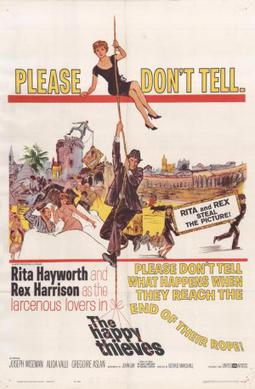
The Happy Thieves
If you've made it this far, maybe you can go a little further. Oh, Shawshank Redemption quotes! Anyways, I've been reviewing a fair share of heist/caper movies recently thanks to Turner Classic Movie's heist marathons. Only a couple more, I swear. Here we go with the relatively unknown 1961 heist flick, The Happy Thieves.
Jimmy Bourne (Rex Harrison) is an art thief, and a really good one at that. Pulling a long recon to steal a painting at a Spanish villa, Jimmy pulls off the job successfully. He gets away unnoticed, handing the rolled-up painting to his partner (and future wife), Eve (Rita Hayworth). Getting it through customs though, Eve loses the tube, forcing Jimmy and his forging art painting partner Jean (Joseph Wiseman), to improvise. It doesn't take long before the truth comes out. A visitor at the Spanish villa, Dr. Munoz (Gregoire Aslan), has pictures that can blackmail Jimmy, Jean and Eve....unless they pull off another art heist for him. Munoz wants the crew to take a Goya painting from the Prado Museum in Madrid. The problem? The painting is large, really large, and won't make for an easy job. The alternative is simple; jail.
Watch enough movies from any genre, and you will become familiar with it and all its conventions, cliches and stereotypes. If you like that genre enough to keep coming back to the well, that's a good thing. Not every heist movie is an extremely dark, cynical story, but the best and more memorable usually are. The job is usually the easiest part with the fallout following the job usually producing more fireworks. From director George Marshall, 'Happy' falls in between unfortunately. Everything from the music to the characters reflects a light, positive, even goofy tone. At the opposite end of the spectrum are some very dark, very surprising twists. If the story had picked one or the other, it could have been significantly better. Don't waver back and forth. Pick a route.
Through the light and the dark, I was most drawn to the casting. Harrison, Hayworth and Wiseman as a small team of crooks pulling an art heist? Count me in. These are three very respectable actors. I don't mean that heist movies don't attract good actors, but seeing actors of this caliber is pretty cool. Harrison as Jimmy is the quiet, gentlemanly thief, always composed, always ready with a contingency plan. Hayworth is okay as Eve, but the character gets on the shrill, worrisome side almost immediately. I didn't buy the chemistry between Harrison and Hayworth either. My favorite part was Wiseman as Jean, an accomplished painter who paints duplicates for Jimmy, usually fighting off his own nerves (some untimely throwing up too) in the process at the job gets closer, or unfortunately...during the job.
Also joining the cast is Aslan, doing what he does best as a menacing, intimidating villain, favoring a walking cane with a rifle in it. Alida Valli plays Duchess Blanca, a well-off, mysterious European woman with her hand in everything. Virgilio Teixeira has a fun and small but key supporting part as Cayetano, a Spanish bullfighter who may be an unknowing participant in Jimmy's job. Also look for George Rigaud, Britt Ekland, Peter Illing and Gerard Tichy in smaller parts.
I did like a lot about this movie. Marshall films in black and white, shooting on-location in Madrid and in Paris. That B&W look gives 'Happy' a throwback, retro visual look. It's a beautiful end product. I also liked the musical score from composer Mario Nascimbene, a mixture of light-hearted music and soft whistling. It leans more toward the light, positive side of the story. When the story turns to the dark, the score doesn't necessarily keep up in the tone department, but I liked the score just the same.
So back and forth between light and dark, the highlight of this heist flick is the actual heist at the Prado Museum. We know how Jimmy and Jean will pull the job, using Jean's forged duplicate to get their hands on Goya's The Second of May 1808. It's a straightforward, pretty simple job that takes advantage of a diversion outside the museum to distract the guards, but like the parts of the movie that do work, it has a certain charm to the developing caper. The bad part? The diversion Jimmy utilizes ends up involving murder, but he doesn't seem bothered by that in the least. When the character background reflects that he's an up-and-up English gentleman only to show no worry about a friend being murdered struck me as odd and out of place. I liked parts of 'Happy' enough, but not enough to really recommend this one fully. Give it a try at Youtube at the link below.
The Happy Thieves (1961): ** 1/2 /****
Jimmy Bourne (Rex Harrison) is an art thief, and a really good one at that. Pulling a long recon to steal a painting at a Spanish villa, Jimmy pulls off the job successfully. He gets away unnoticed, handing the rolled-up painting to his partner (and future wife), Eve (Rita Hayworth). Getting it through customs though, Eve loses the tube, forcing Jimmy and his forging art painting partner Jean (Joseph Wiseman), to improvise. It doesn't take long before the truth comes out. A visitor at the Spanish villa, Dr. Munoz (Gregoire Aslan), has pictures that can blackmail Jimmy, Jean and Eve....unless they pull off another art heist for him. Munoz wants the crew to take a Goya painting from the Prado Museum in Madrid. The problem? The painting is large, really large, and won't make for an easy job. The alternative is simple; jail.
Watch enough movies from any genre, and you will become familiar with it and all its conventions, cliches and stereotypes. If you like that genre enough to keep coming back to the well, that's a good thing. Not every heist movie is an extremely dark, cynical story, but the best and more memorable usually are. The job is usually the easiest part with the fallout following the job usually producing more fireworks. From director George Marshall, 'Happy' falls in between unfortunately. Everything from the music to the characters reflects a light, positive, even goofy tone. At the opposite end of the spectrum are some very dark, very surprising twists. If the story had picked one or the other, it could have been significantly better. Don't waver back and forth. Pick a route.
Through the light and the dark, I was most drawn to the casting. Harrison, Hayworth and Wiseman as a small team of crooks pulling an art heist? Count me in. These are three very respectable actors. I don't mean that heist movies don't attract good actors, but seeing actors of this caliber is pretty cool. Harrison as Jimmy is the quiet, gentlemanly thief, always composed, always ready with a contingency plan. Hayworth is okay as Eve, but the character gets on the shrill, worrisome side almost immediately. I didn't buy the chemistry between Harrison and Hayworth either. My favorite part was Wiseman as Jean, an accomplished painter who paints duplicates for Jimmy, usually fighting off his own nerves (some untimely throwing up too) in the process at the job gets closer, or unfortunately...during the job.
Also joining the cast is Aslan, doing what he does best as a menacing, intimidating villain, favoring a walking cane with a rifle in it. Alida Valli plays Duchess Blanca, a well-off, mysterious European woman with her hand in everything. Virgilio Teixeira has a fun and small but key supporting part as Cayetano, a Spanish bullfighter who may be an unknowing participant in Jimmy's job. Also look for George Rigaud, Britt Ekland, Peter Illing and Gerard Tichy in smaller parts.
I did like a lot about this movie. Marshall films in black and white, shooting on-location in Madrid and in Paris. That B&W look gives 'Happy' a throwback, retro visual look. It's a beautiful end product. I also liked the musical score from composer Mario Nascimbene, a mixture of light-hearted music and soft whistling. It leans more toward the light, positive side of the story. When the story turns to the dark, the score doesn't necessarily keep up in the tone department, but I liked the score just the same.
So back and forth between light and dark, the highlight of this heist flick is the actual heist at the Prado Museum. We know how Jimmy and Jean will pull the job, using Jean's forged duplicate to get their hands on Goya's The Second of May 1808. It's a straightforward, pretty simple job that takes advantage of a diversion outside the museum to distract the guards, but like the parts of the movie that do work, it has a certain charm to the developing caper. The bad part? The diversion Jimmy utilizes ends up involving murder, but he doesn't seem bothered by that in the least. When the character background reflects that he's an up-and-up English gentleman only to show no worry about a friend being murdered struck me as odd and out of place. I liked parts of 'Happy' enough, but not enough to really recommend this one fully. Give it a try at Youtube at the link below.
The Happy Thieves (1961): ** 1/2 /****
Friday, October 21, 2011
Viva Zapata!
Who better to play an infamous revolutionary leader than….Marlon Brando? One of the all-time greats in Hollywood as an actor, Brando played an eclectic, off-the-wall variety of characters in his career. He played Southern hotheads, a German soldier, a rogue American general, a Mafia head of a family, and so many more. So does a Mexican revolutionary sound so far off base? He’s an interesting choice to play Zapata, the only negative coming from an odd make-up choice to make Brando’s eyes appear…Asian? Eh, minor detail.
A poor Mexican farmer in southern Mexico, farmer Emiliano Zapata (Brando) is one of thousands of poor peasants upset with how the government takes advantage of them whenever possible. When their land is scooped up by the government, Emiliano and his brother, Eufemo (Anthony Quinn), join the fighting that has swept the country. Zapata doesn’t fight for glory or fame or riches, just for the people’s rights so they can be treated like human beings. But with so much power on the line, Zapata finds that anyone and everyone must question their own beliefs, choosing between their wants and their needs.
You know what’s a good sign that a movie has a lasting impact? A whole subgenre is named after one person, and in the case here, one movie. After ‘Viva’ was released in 1952, revolutionary westerns started popping up in theaters more and more over the next 20 or so years. Think The Wild Bunch, The Professionals, Villa Rides! and many more. This was one of the first, and it’s a good one, setting the groundwork for the many that would follow, all the characters, story twists, and plotlines there for the taking.
Now 100 years removed from the actual incidents these movies portray, historians now question how revolutionaries like Villa and Zapata have been remembered. Were they heroes or murderers? Directed by Elia Kazan, ‘Viva’ leans toward the hero angle, going as far as building Brando’s Zapata up to almost God-like proportions. It’s never obnoxious or goes too far, but you certainly notice. Brando does a phenomenal job portraying Zapata in a way that doesn’t make the revolutionary tedious or one-note. He’s an illiterate, poor farmer who wants something else for the people and himself. He’s willing to sacrifice it all to accomplish that mission. Brando was nominated for an Academy Award for his part, losing to Gary Cooper in High Noon, but that doesn’t take away from an impressive performance.
Like any historical epic, this movie must deal with a delicate issue. How do you condense 15-20 years of history into a 2-hour movie? ‘Viva’ does a fair job of hitting all the key points of Zapata’s involvement in the revolution, his rise and fall more or less. The first half of the movie struggles some to build any momentum, the rhetoric of the revolution bogging the story down some. The subplot with Zapata marrying Josefa (Jean Peters) doesn’t serve much of a purpose either as it tries to humanize the revolutionary. The pacing picks up in the far superior second half as the revolution takes its toll on Zapata and his army, the conflict becoming fiercer, the battles bloodier, the betrayals and backstabbing more familiar with no end in sight.
Originally expected to play Zapata, Anthony Quinn had to “settle” playing the revolutionary’s brother. Call it fate, but Quinn won the Academy Award for Best Supporting Actor while Brando was only nominated. It’s not a great performance – Quinn had much better – but it reflects the times and who won at the Oscars. It is a big, loud part where Quinn is allowed to chew the scenery and ham it up, a passionate, driven revolutionary who starts to see that everything isn’t as it is made out to be. Another very solid supporting part comes from Joseph Wiseman as Hernando, a somewhat mysterious revolutionary who seems obsessed with winning this fight, seeing what Zapata means to the revolution, not as a person but for what he represents. Also look for an uncredited Henry Silva as Hernando, a peasant and fighter who joins Zapata late in the revolution and Frank Silvera as Victoriano Huerta.
Naturally because this is a positively reviewed movie and generally well respected by critics and fans alike, it is available in absolutely NO formats, no VHS, DVD, or Blu-Ray. It’s been a ‘Save’ option on Netflix for over a year in my queue. So if you can track a copy down, it’s well worth it. Beautiful black and white photography, strong performances from the three leads, and an interesting story about a revolution with no easy answers. Check out four clips HERE at TCM's website.
Viva Zapata ß-trailer (1953): ***/****
Tuesday, June 22, 2010
The Silver Chalice
They can't all be winners, right? Over a long career, at some point movie stars have to have a dud every so often. In most cases though you'll never hear the star actually admit that part of the equation. Well, most cases other than Paul Newman. One of Hollywood's greatest actors and a true legend, even Newman had to start somewhere, making his screen debut in 1954's The Silver Chalice. It's been critically roasted, and more than that, roasted by Newman who took out a full page ad in a newspaper in the 1960s to encourage TV viewers not to watch this movie when it was shown on TV. Now that's the kind of honesty we need more of.
Let's get this out of the way early. 'Chalice' is a bad movie, a truly bad movie, that is entertaining in its awfulness. It was an early trendsetter in huge Biblical epics like The Ten Commandments, The Robe, King of Kings, Spartacus and many others. But you know what all those epics had going for them? A somewhat decent script and some actual scale in terms of sets, costuming and 'a cast of thousands.' Directed by Victor Saville, 'Chalice' has none of those things. Other than an impressive cast full of not quite yet stars and some hopefully unintentionally funny scenes, this one is a big stinker.
Twenty years after the death and resurrection of Jesus Christ, a Greek silversmith in Antioch by the name of Basil (Newman) is fighting for his freedom after his uncle throws him into slavery. He is offered freedom by a man named Joseph of Arimathea (Walter Hampden) who presents a challenge for him as an artist. Joseph owns the cup Jesus used during the Last Supper and wants to give it a proper resting place in the form of an immense chalice that will feature the faces of all those closest to Jesus, mainly the apostles. Basil accepts the challenge and goes to work, but surrounding powers want to get their hands on the Holy Grail, including a revolutionary group led by Mijamin (Joseph Wiseman) and a magician named Simon (Jack Palance).
I'll start with the positives -- however few there were. The cast is something to behold because many of the actors and actresses involved went on to much bigger and better things, Newman obviously at the top of that list. There's also Italian beauty Pier Angeli, future Bonanza star Lorne Greene as Peter, a young Natalie Wood as a slave girl, E.G. Marshall as Basil's adopted father, Michael Pate as Angeli's worrying father, and Virginia Mayo as the key ingredient in the always interesting love triangle. Of course some of these parts are nothing more than a 'blink and you'll miss them' appearance, but with as 'involving' as the story is, it shouldn't be hard.
One of the selling points of these huge historical epics was the lavish sets, costumes and uses of thousands of extras. 'Chalice' basically passes on all three of those -- okay, the costumes are interesting. The sets are absolutely ridiculous, and I'm guessing about $18 was spent putting them together. It's very clear these are on soundstages with gigantic stage-like curtains in the background standing in for actual background. At times, the sets look like Legos or Duplos assembled by toddlers. They're so bad it becomes funny to see how cheesy they look. Check out the backgrounds in THIS scene, the inside of a temple. It looks like they drew in 'the bricks' with a sharpie marker.
Newman later stated in interviews that he thought this was his worst ever performance. I haven't seen all of them, but I'm inclined to agree. He's miscast as a Greek to begin with, and he hasn't developed that on-screen persona, that charm that made him so likable in so many later movies. The rest of the cast isn't exactly challenging for any Oscars either. Mayo looks done up like some sort of drag queen with eyebrows that look like they'd stab someone. Her sexy magician's assistant (seems right at home in a biblical movie) is torn between Basil and Simon, but she looks too ridiculous to even take too seriously. As for the rest of the cast, Angeli has a sexy accent, and Wiseman is a creepy enough 2nd villain.
But more than all the cheap sets and sluggish dialogue, the one star really breathing some life into the movie is Jack Palance as Simon, a magician who believes he has the talent, the ability to convince the Christians he is more powerful than Christ. He chews scenery like nobody's business, hamming it up with his monologues and magic tricks. His Simon also provides one so unintentionally funny moment late in the movie that I almost felt bad for having laughed...almost being the key word. It's the one true worthwhile part of this dud, but if curious, watch it at Youtube starting here with Part 1 of 15.
The Silver Chalice <----trailer (1954): * 1/2 /****
Let's get this out of the way early. 'Chalice' is a bad movie, a truly bad movie, that is entertaining in its awfulness. It was an early trendsetter in huge Biblical epics like The Ten Commandments, The Robe, King of Kings, Spartacus and many others. But you know what all those epics had going for them? A somewhat decent script and some actual scale in terms of sets, costuming and 'a cast of thousands.' Directed by Victor Saville, 'Chalice' has none of those things. Other than an impressive cast full of not quite yet stars and some hopefully unintentionally funny scenes, this one is a big stinker.
Twenty years after the death and resurrection of Jesus Christ, a Greek silversmith in Antioch by the name of Basil (Newman) is fighting for his freedom after his uncle throws him into slavery. He is offered freedom by a man named Joseph of Arimathea (Walter Hampden) who presents a challenge for him as an artist. Joseph owns the cup Jesus used during the Last Supper and wants to give it a proper resting place in the form of an immense chalice that will feature the faces of all those closest to Jesus, mainly the apostles. Basil accepts the challenge and goes to work, but surrounding powers want to get their hands on the Holy Grail, including a revolutionary group led by Mijamin (Joseph Wiseman) and a magician named Simon (Jack Palance).
I'll start with the positives -- however few there were. The cast is something to behold because many of the actors and actresses involved went on to much bigger and better things, Newman obviously at the top of that list. There's also Italian beauty Pier Angeli, future Bonanza star Lorne Greene as Peter, a young Natalie Wood as a slave girl, E.G. Marshall as Basil's adopted father, Michael Pate as Angeli's worrying father, and Virginia Mayo as the key ingredient in the always interesting love triangle. Of course some of these parts are nothing more than a 'blink and you'll miss them' appearance, but with as 'involving' as the story is, it shouldn't be hard.
One of the selling points of these huge historical epics was the lavish sets, costumes and uses of thousands of extras. 'Chalice' basically passes on all three of those -- okay, the costumes are interesting. The sets are absolutely ridiculous, and I'm guessing about $18 was spent putting them together. It's very clear these are on soundstages with gigantic stage-like curtains in the background standing in for actual background. At times, the sets look like Legos or Duplos assembled by toddlers. They're so bad it becomes funny to see how cheesy they look. Check out the backgrounds in THIS scene, the inside of a temple. It looks like they drew in 'the bricks' with a sharpie marker.
Newman later stated in interviews that he thought this was his worst ever performance. I haven't seen all of them, but I'm inclined to agree. He's miscast as a Greek to begin with, and he hasn't developed that on-screen persona, that charm that made him so likable in so many later movies. The rest of the cast isn't exactly challenging for any Oscars either. Mayo looks done up like some sort of drag queen with eyebrows that look like they'd stab someone. Her sexy magician's assistant (seems right at home in a biblical movie) is torn between Basil and Simon, but she looks too ridiculous to even take too seriously. As for the rest of the cast, Angeli has a sexy accent, and Wiseman is a creepy enough 2nd villain.
But more than all the cheap sets and sluggish dialogue, the one star really breathing some life into the movie is Jack Palance as Simon, a magician who believes he has the talent, the ability to convince the Christians he is more powerful than Christ. He chews scenery like nobody's business, hamming it up with his monologues and magic tricks. His Simon also provides one so unintentionally funny moment late in the movie that I almost felt bad for having laughed...almost being the key word. It's the one true worthwhile part of this dud, but if curious, watch it at Youtube starting here with Part 1 of 15.
The Silver Chalice <----trailer (1954): * 1/2 /****
Sunday, August 16, 2009
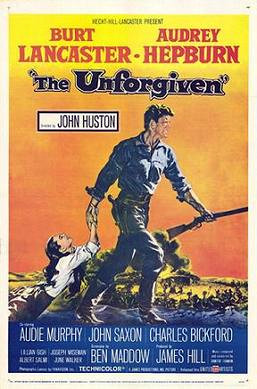
The Unforgiven
Some westerns are content to go for the lowest common denominator, an entertaining story with ridiculous amounts of action. I don't mean that as negatively as it sounds, I own a lot of movies like that. But some westerns strive for something else whether it be getting a message across or trying to make a statement about the times. These can be hit or miss because sometimes they strive to do too much, but every so often they find that balance, like John Huston's 1960 adult western The Unforgiven.
Based on a novel by author Alan Le May, who also wrote The Searchers, you have to figure you're not getting a typical shoot 'em up western. And in general, westerns were getting away from the old stereotypes, especially in the 1950s with some adult, psychological westerns like Anthony Mann's movies teaming up with Jimmy Stewart (all highly recommended). The Unforgiven doesn't settle for anything easy in it's story about a western family dealing with the revelation that their adopted daughter may be a Kiowa.
The Zacharys are a frontier family working their spread in the Texas panhandle and looking to put together a cattle herd to drive north to Wichita. The patriarch of the family since his father died years before, Ben (Burt Lancaster) is the leader, the oldest brother who keeps everyone else in check. His mother, Mattilde (Lillian Gish), runs the house and makes sure the family stays together. Helping Ben around the spread are his two younger brothers, Cash (Audie Murphy), a fiery, hot-tempered cowboy, and Andy (Doug McClure), the youngest brother who's still growing up. Then, there's Rachel (Audrey Hepburn), their adopted sister who their father supposedly found after her parents were massacred by Kiowas.
One day, a mysterious rider (Joseph Wiseman) rides into town with some revealing news. He says that Rachel has Indian blood in her, and that the story her father told was a lie. Everyone around turns on the Zacharys, and the news even tears the family itself apart with Cash refusing to live in the same house as a 'red-skinned' Indian. Even Ben's longtime partner and neighbor Zed Rawlings (Charles Bickford) refuses to deal with the family. All the while, Ben must hold the family together, even when the Kiowas come to take Rachel back.
Any movie, including a western, that deals with racism as straight forward and honest as this one is going to be polarizing. The Unforgiven can be brutally honest in that sense. We're introduced to all these characters, get to know them, and across the board they seem like good people. But the moment the possibility arises that one among them could be an Indian, they turn on each other. That could have been what the times were like, but it's a story that could be set in any decade or time in American history. It works because it doesn't try to whitewash the story.
Credit for that goes to Huston and his cast, an impressive listing of actors. It's not Lancaster's best part, but he's solid in the lead role. Hepburn is a bit of an odd choice as Rachel, but she pulls it off even if she looks little to nothing like a young Kiowa woman. This movie is known as much for the behind the scenes issues with Hepburn, but her role as Rachel works because she makes the character easy to identify with and very sympathetic.
Surprisingly enough with Lancaster and Hepburn in the leads, it's Audie Murphy that has the best part. His Cash Zachary is a deeply flawed character, a racist at the most basic who wants nothing to do with Indians of any sort, even his own adopted sister. Always known for playing the good guy in a white hat, the WWII hero plays completely against part here as the racist cowboy and comes across the best because he puts it all into the part. Of the rest of the cast, Gish and McClure round out the family, a believable representation of a frontier family, and John Saxon has a cool if small part as Johnny Portugal, an Indian horse wrangler/breaker, including this well choreographed chase scene.
Judging the movie apart from its story is a lot easier because Huston presents such a well-package western. Visually, he gets the spectacle down, the epic feel of what living in the west was like. The movie was shot in Durango, Mexico where many westerns were filmed, and it looks beautiful. The west was full of big, wide open spaces and Huston utilizes that feeling with some memorable long shots, some seemingly from miles away on a rock butte or hill. Composer Dimitri Tiomkin's score isn't as consistently strong as some of his others, but his music in those scenes fits perfectly.
A western that's dark and gloomy and doesn't pull any punches with its story dealing with racism and prejudices in the wild west. The movie benefits from some great performances, including a career-best part from Audie Murphy, and location shooting in Durango. This isn't as well known as Alan Le May's other highly respected western The Searchers, but it deserves more recognition than it's gotten in the years since.
The Unforgiven (1960): *** 1/2 /****
Based on a novel by author Alan Le May, who also wrote The Searchers, you have to figure you're not getting a typical shoot 'em up western. And in general, westerns were getting away from the old stereotypes, especially in the 1950s with some adult, psychological westerns like Anthony Mann's movies teaming up with Jimmy Stewart (all highly recommended). The Unforgiven doesn't settle for anything easy in it's story about a western family dealing with the revelation that their adopted daughter may be a Kiowa.
The Zacharys are a frontier family working their spread in the Texas panhandle and looking to put together a cattle herd to drive north to Wichita. The patriarch of the family since his father died years before, Ben (Burt Lancaster) is the leader, the oldest brother who keeps everyone else in check. His mother, Mattilde (Lillian Gish), runs the house and makes sure the family stays together. Helping Ben around the spread are his two younger brothers, Cash (Audie Murphy), a fiery, hot-tempered cowboy, and Andy (Doug McClure), the youngest brother who's still growing up. Then, there's Rachel (Audrey Hepburn), their adopted sister who their father supposedly found after her parents were massacred by Kiowas.
One day, a mysterious rider (Joseph Wiseman) rides into town with some revealing news. He says that Rachel has Indian blood in her, and that the story her father told was a lie. Everyone around turns on the Zacharys, and the news even tears the family itself apart with Cash refusing to live in the same house as a 'red-skinned' Indian. Even Ben's longtime partner and neighbor Zed Rawlings (Charles Bickford) refuses to deal with the family. All the while, Ben must hold the family together, even when the Kiowas come to take Rachel back.
Any movie, including a western, that deals with racism as straight forward and honest as this one is going to be polarizing. The Unforgiven can be brutally honest in that sense. We're introduced to all these characters, get to know them, and across the board they seem like good people. But the moment the possibility arises that one among them could be an Indian, they turn on each other. That could have been what the times were like, but it's a story that could be set in any decade or time in American history. It works because it doesn't try to whitewash the story.
Credit for that goes to Huston and his cast, an impressive listing of actors. It's not Lancaster's best part, but he's solid in the lead role. Hepburn is a bit of an odd choice as Rachel, but she pulls it off even if she looks little to nothing like a young Kiowa woman. This movie is known as much for the behind the scenes issues with Hepburn, but her role as Rachel works because she makes the character easy to identify with and very sympathetic.
Surprisingly enough with Lancaster and Hepburn in the leads, it's Audie Murphy that has the best part. His Cash Zachary is a deeply flawed character, a racist at the most basic who wants nothing to do with Indians of any sort, even his own adopted sister. Always known for playing the good guy in a white hat, the WWII hero plays completely against part here as the racist cowboy and comes across the best because he puts it all into the part. Of the rest of the cast, Gish and McClure round out the family, a believable representation of a frontier family, and John Saxon has a cool if small part as Johnny Portugal, an Indian horse wrangler/breaker, including this well choreographed chase scene.
Judging the movie apart from its story is a lot easier because Huston presents such a well-package western. Visually, he gets the spectacle down, the epic feel of what living in the west was like. The movie was shot in Durango, Mexico where many westerns were filmed, and it looks beautiful. The west was full of big, wide open spaces and Huston utilizes that feeling with some memorable long shots, some seemingly from miles away on a rock butte or hill. Composer Dimitri Tiomkin's score isn't as consistently strong as some of his others, but his music in those scenes fits perfectly.
A western that's dark and gloomy and doesn't pull any punches with its story dealing with racism and prejudices in the wild west. The movie benefits from some great performances, including a career-best part from Audie Murphy, and location shooting in Durango. This isn't as well known as Alan Le May's other highly respected western The Searchers, but it deserves more recognition than it's gotten in the years since.
The Unforgiven (1960): *** 1/2 /****
Labels:
1960s,
Audie Murphy,
Audrey Hepburn,
Burt Lancaster,
John Huston,
John Saxon,
Joseph Wiseman,
westerns
Subscribe to:
Posts (Atom)